1. Introduction
During this last decade, power electronics converters have been integrated at an ever-rising pace in generation, transmission, and distribution power systems. This technology lends itself to a plethora of applications: among others, it could be used as a grid interface for specific kinds of loads (i.e., converter-connected loads (ccls)) or as a means for energy conversion in generation systems fed by fuel cells or renewable energy sources, such as wind or solar photovoltaic (i.e., converter-interfaced generation (cig)). Both usages can be grouped into the broad class of inverter-based resources (ibrs).
The increasing presence of
ibrs has numerous ramifications in different facets of modern electric power systems, such as planning and operation. According to [
1],
ibrs are significantly changing power system dynamic behaviour (and, most notably, oscillatory behaviour during disturbances [
2]) to the extent that the basic stability terms developed in the literature have been recently revised to consider the fast response of converters. Moreover, due to the progressive phase-out of conventional synchronous generators,
cig is expected to have a prominent role in supporting the stability of future grids through the provision of specific services, namely frequency and voltage regulation. In the light of the above, the interactions of
ibrs with the power grid must be accurately studied to ensure a correct operation at all times.
Before the arrival of
ibrs, conventional generation and transmission systems were typically simulated through single-phase equivalent representations and static load and transformer models. This modelling approach was originally imposed during the development of the first power system simulators to overcome the deficiency in the capability of computational systems to perform calculations using detailed, dynamic three-phase models. Based on this simulation setting, generator, transformer, line, and load models have been developed over the years to accurately simulate and predict the complex behaviour of electricity grids. In particular, some models have become customarily based on particular assumptions that were true in the past. For instance, a widely adopted approach is to describe lines with algebraic (i.e., static) representations and loads with constant power models to perform simulations of worst-case scenarios. As shown by the results of a survey collected in [
3], about 70% of utilities and system operators in the world adopt only static load models for steady-state power system studies. The only exception is represented by utilities and system operators in the USA, which use a combination of static and dynamic models. In addition to this, static load models are typically set as constant power loads, and distributed generation is modelled as negative loads. This modelling approach is also dominant when it comes to dynamic power system analyses. Although the survey dates back to 2010, this practice does not seem to have changed up to at least 2018 and 2022, when [
4,
5], which also deal with the topic of load modelling, were respectively published. In [
4] the typical values for the static models under different operating conditions are described. In [
5] the impact of two static load models (i.e, exponential and polynomial model) on small-signal, transient, and frequency stability studies has been assessed. The conclusion of this work is that, in case no accurate data on loads are available, a constant power model should be adopted, as it provides the worst-case scenario and therefore constitutes a conservative approach. This same point is raised in [
6,
7]. Another practice established in power system analysis to typically accelerate simulations is to adopt static line models instead of dynamic ones [
8,
9].
In this article, we want to highlight how these approaches should be used with care in the case of
ibr-dominated grids, as they might lead to a misguided power system stability assessment. Indeed, the growing presence of
ibrs is significantly changing the behaviour of electric power systems. This begs the question as to whether previously developed load and passive elements models (and the assumptions in which they ground) are still adequate in the presence of
ibr-dominated power grids or require revision—a question this paper attempts to answer. This is the same question the authors of [
10] pose in the conclusion of their work. After describing the challenges
ibrs bring to power systems stability studies, they suggest that the increasing penetration of
ibrs may produce new ways through which instability occurs, calling for both more accurate models and new simulation techniques. In particular, the work presented here delves into the most commonly adopted models of loads and passive elements (i.e., lines, transformers, and shunts). After elaborating on their usage in conventional power systems, we assess how these models could be modified and adapted to reliably and accurately simulate and analyse the stability properties of
ibr-dominated grids.
ibrs can be implemented through several converters characterised by different detailed three-phase models. In this paper, we choose the modular multilevel converter (
mmc) as an example to drive the discussion on the impact of the models of passive components on the stability assessment of inverter-dominated power grids [
11]. This converter, which was first introduced in [
12], has become the technology of choice in high-voltage direct current (
hvdc) and multi-terminal direct current (
mtdc) transmission systems thanks to its scalability to high voltages and powers, lower switching activity of the sub-modules composing their legs, high voltage waveform quality, and efficiency [
13,
14]. It is worth noting that the choice above does not limit the validity of the proposed analysis only to
mmcs. Indeed, the aspects we highlight, the results and observations we draw, can be almost invariantly applied to other converter topologies.
To guide the reader through this work, we analyze the well-known ieee 14-bus power test system in several scenarios. In each of these, the test system has been modified according to the study’s needs (e.g., by considering constant impedance loads behind on-load tap changers instead of constant power loads, or by replacing a line with an hvdc link with two mmcs).
What emerges from our work is that: (i) constant power load models and algebraic models of passive elements, despite giving a worst-case approximation of the stability boundary conditions, fail to adequately describe more complex dynamics, especially in ibr-dominated power systems; and (ii) the relationship between mmc impedance and operating frequency is not trivial and has a profound impact on the stability of hybrid power systems, when these are studied by means of a small-signal frequency scan, eigenvalue computation, and large-signal transient stability. In particular, the frequency bandwidth to be considered in the presence of mmcs (and ibrs in general) is much larger (up to ) than that of the conventional pure electro-mechanical models (few tens of ). If inappropriate or inaccurate models of passive elements such as transmission lines, transformers, and shunts are used, this extended bandwidth might lead to poorly damped or even unstable modes. On the contrary, these features might not appear when more detailed models of passive elements are adopted.
The remainder of this work is structured as follows. In
Section 2 we introduce two conventional load models: the constant power and constant impedance load. After deriving their small-signal models and proving that they influence the stability of a simple power system in different ways, we elaborate on the usage of these models and passive elements in power system simulations over time. In
Section 3, we analyse the impact of different models of load and passive elements (i.e., lines and transformers) on the stability of the
ieee14 benchmark system.
Section 4 analyzes the effect on stability due to the connection of an
mmc-based
hvdc link to the
ieee14 benchmark. In particular, two
mmc models of different levels of accuracy are used to perform several studies, including eigenvalue analysis and transient simulation. Lastly,
Section 5 summarises the main results of this work and suggests possible future research avenues.
3. Simulation Results of the Conventional ieee14 Power System
To show the role of constant power and constant impedance load models behind
oltcs on stability, we use as a benchmark the well-known
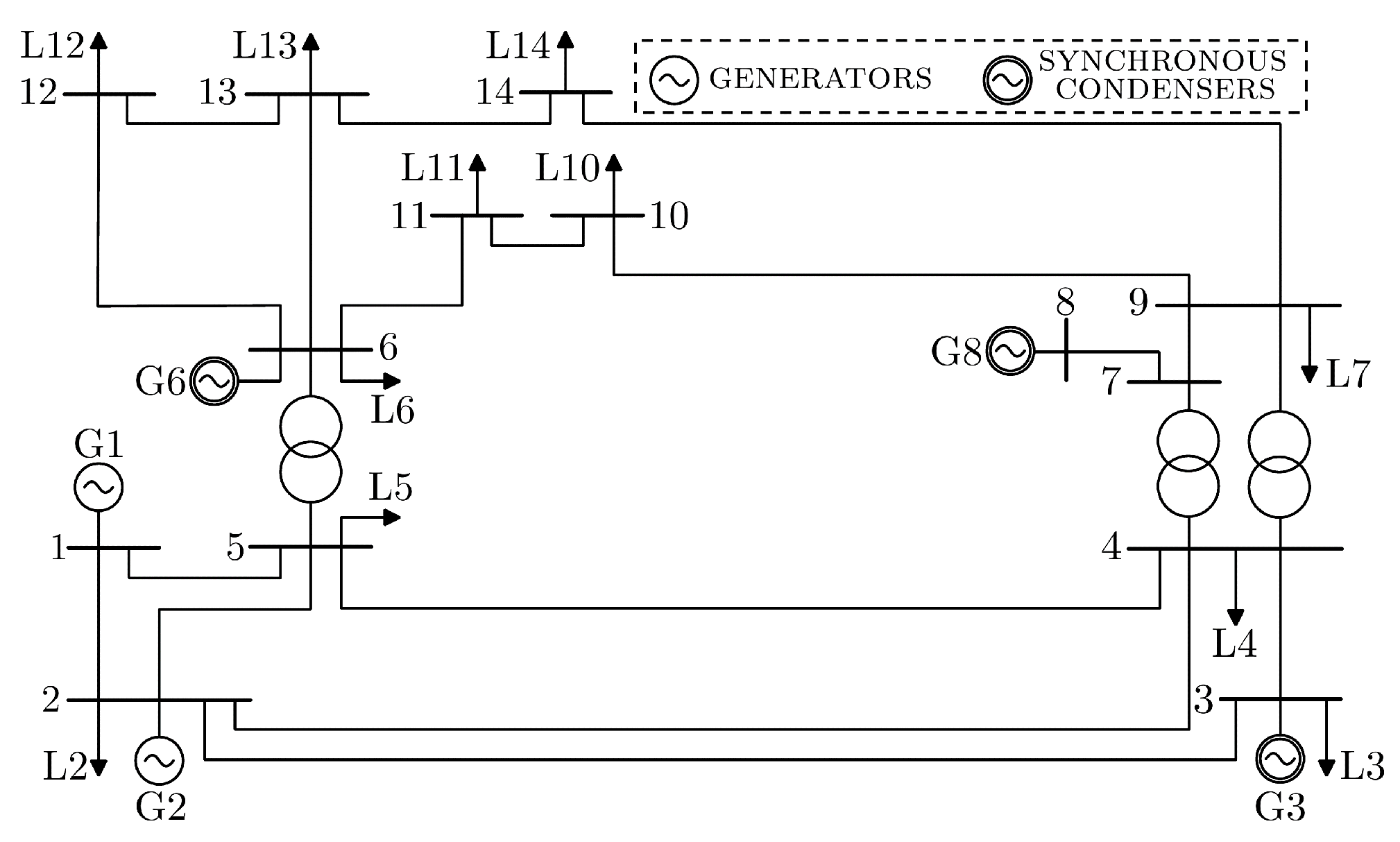
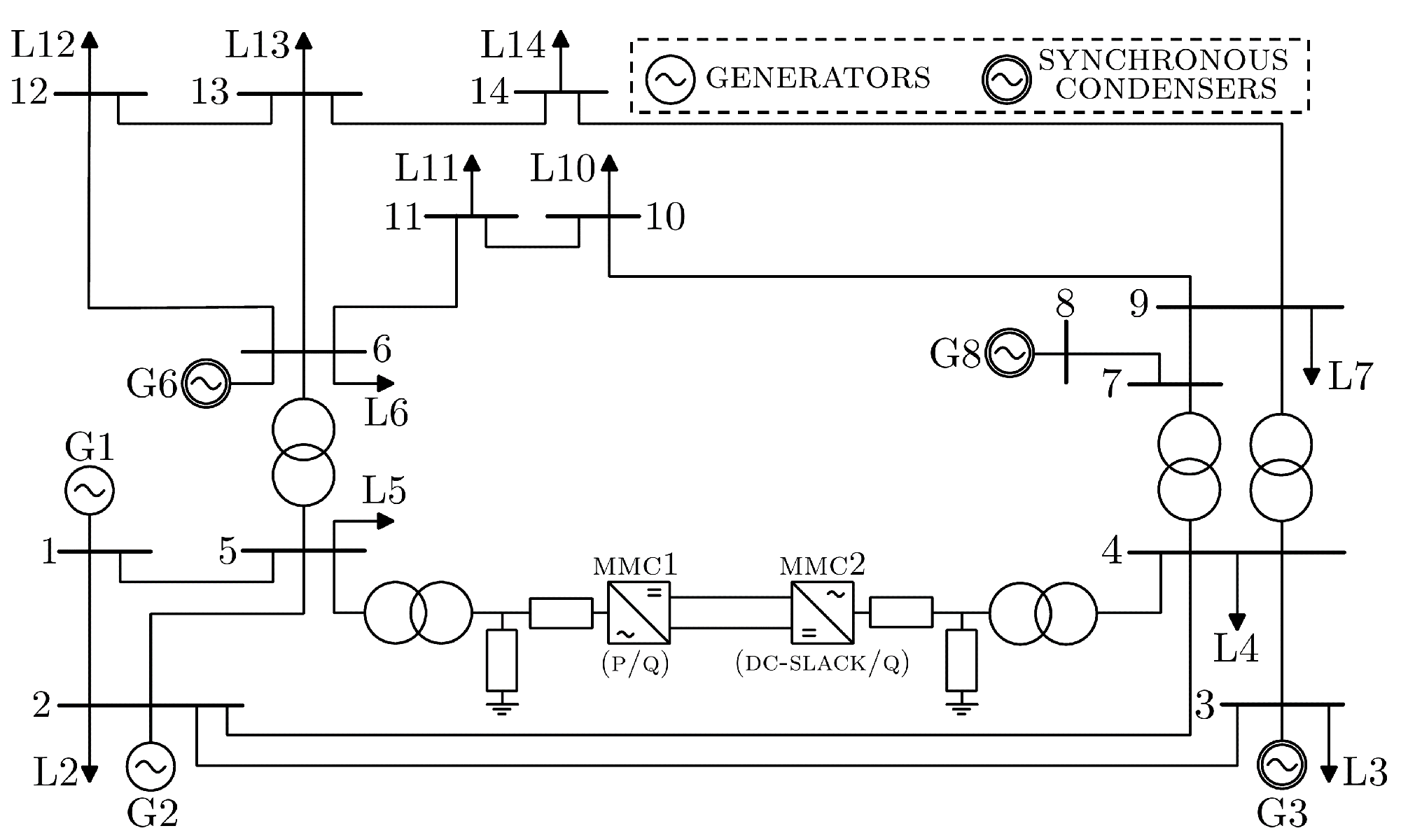
ieee14 power system, whose schematic is shown in
Figure 2. All the parameters of the conventional version of
ieee14 power system can be found in [
9].
In the following, we modify this benchmark several times to simulate different case studies. In this section, we consider four scenarios. The first one, hereafter referred to as ieee14-p, adopts the conventional version of the ieee14 system with constant power loads. In the second scenario, defined as ieee14-z, we substitute the constant power loads with constant impedance ones behind oltcs, whose nominal transformer ratio equals 1 (i.e., all bus voltages computed at pf are inside the respective dead-bands). The parameters of the constant impedance loads are tuned to absorb the same active and reactive power at the pf solution as the ieee14-p scenario.
It is worth pointing out that the classic version of the ieee14 test system adopts static models of passive elements. Compared to their ieee14-p and ieee14-z counterparts, the third and fourth scenarios, hereafter respectively referred to as ieee14-pd and ieee14-zd, employ dynamic models of inductances and capacitances of power lines, transformers, and shunts. These last two scenarios aim at showcasing the impact of alternative passive element modelling on power system stability.
3.1. The ieee14-p and ieee14-z Scenarios
We performed a transient stability analysis of both ieee14-p and ieee14-z scenarios. In both cases, we tripped the line between bus2 and bus5 after from the beginning of the simulations.
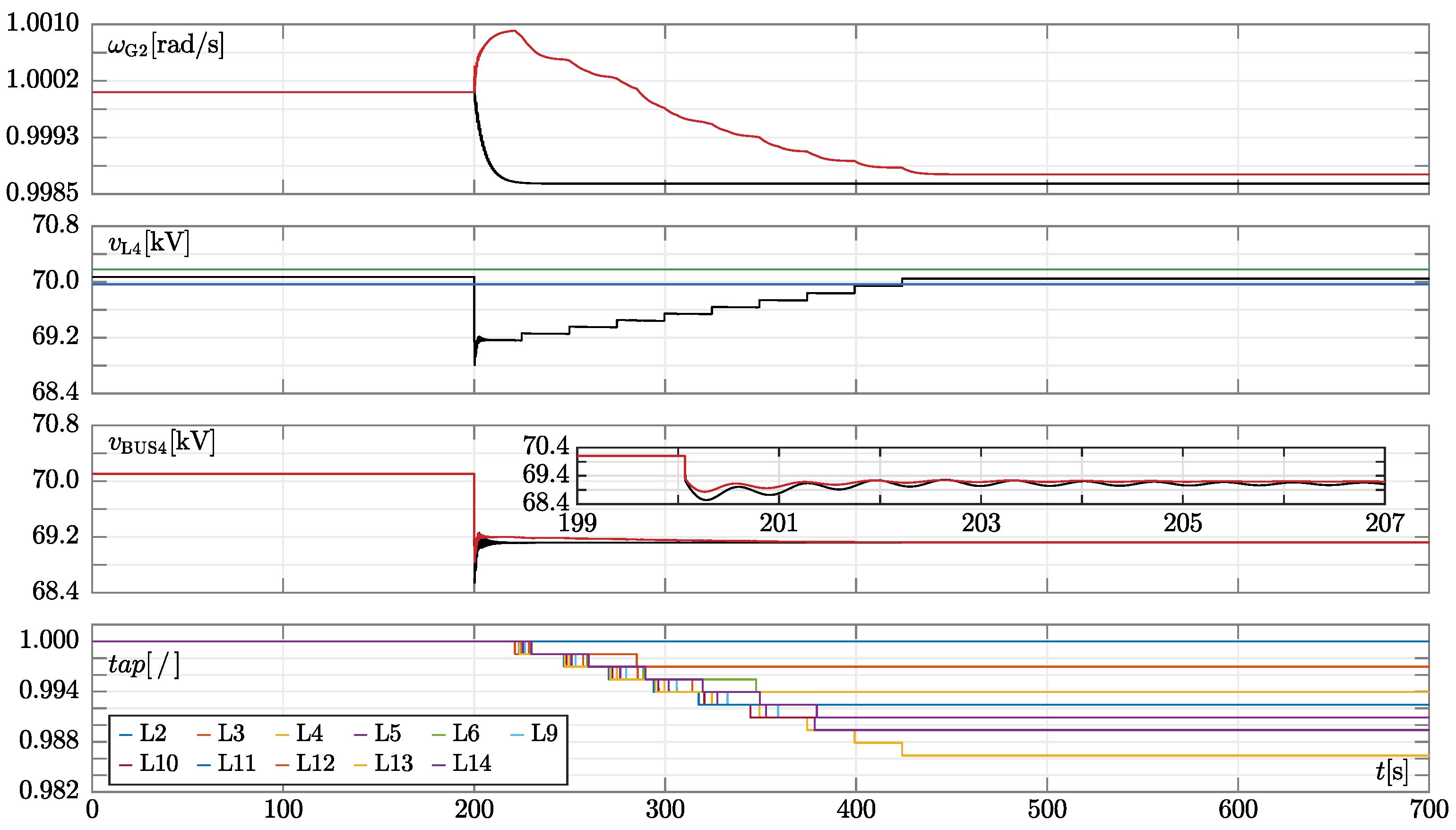
The results of these simulations are shown in
Figure 3. By observing the waveforms related to the
ieee14-p scenario in the upper panel of the figure, one can notice that when the line is tripped, the rotor angular speed of the G2 synchronous generator suddenly decreases and stabilises after some time just below
. This behaviour stems from the fact that line tripping induces a load voltage drop and that all the loads in this scenario are of constant power type. Indeed, to guarantee constant power absorption despite the voltage drop, the currents flowing through the loads must increase. This leads to higher currents and power losses across the lines and transformers (and, thus, overall power demand) and, in turn, a decrease in system synchronous frequency. In the specific case of the
ieee14 benchmark, which does not implement turbine governors, the system frequency stabilises due to the contributions by damping in the swing equations of the synchronous generators and condensers.
It is important to note that this phenomenon leads to an iterative process in which the increase in line currents determines a decrease in load voltage, which, in turn, yields a further increase in line currents. Eventually, this process converges into a new stable working mode of the
ieee14-p scenario, as shown by the magnitude of the
bus4 voltage in
Figure 3 (third panel from the top, black trace).
Consider now the ieee14-z scenario: contrary to the ieee14-p case, the rotor speed of the G2 synchronous generator increases instead of decreasing right after the line tripping. Analogously to the previous scenario, this behaviour is coherent with the load model adopted and line tripping resulting in a load voltage drop. For instance, if we observe the magnitude of the voltage at bus4 (third panel from the top), also in this scenario it decreases just after line tripping (although slightly less than in the ieee14-p case). Since the power absorbed by constant impedance loads varies quadratically with voltage, the decrease in load voltage magnitudes leads to lower load powers. This implies that the currents flowing through the loads, lines, and transformers decrease. The same holds for the overall power demand, thereby leading to an increase in frequency, which stabilises once again due to the damping of the synchronous generators and condensers.
The traces in the second panel from the top in
Figure 3 show that after some time delay the
oltc at
bus4 starts restoring the load voltage till bringing it inside the voltage dead-band (i.e., almost full voltage restoration to its value before the line outage is attained). As shown in the last panel of the figure, the other
oltcs do the same with different time schedules. The load voltage restoration process causes a progressive step increase in the power of the constant impedance loads and, thus, a corresponding decrease in grid frequency. At the end of this (long-term) process lasting more than
(see traces of the other
oltc in the last panel of
Figure 3), the steady-state behaviour of the power system is very close to that of the
ieee14-p case, but not identical, since load voltages are set to different values inside the
oltc dead-bands.
Similar results were already reported in [
9], although with different and simpler
oltc models [
18,
21]. The previously described scenarios highlight that if the analysis focuses exclusively on power system steady-state behaviour (i.e.,
pf results), constant power loads can be adopted instead of constant impedance ones behind
oltcs, thus boosting simulation efficiency at the expense of a minor accuracy loss. However, if the dynamic behaviour is of interest (i.e., transient simulations or small-signal analyses are executed), these two models are not equivalent and may lead to quite different results. For instance, this difference is evident when applying a
overload to the
ieee14-p and
ieee14-z scenarios and tripping the line between
bus2 and
bus5. In the first case, as reported in [
9,
22], the system
pf solution is characterised by a pair of complex conjugated eigenvalues with positive real part equal to
after line tripping, and thus it becomes unstable. On the contrary, in the second case, the system remains
stable despite the overload (i.e., all eigenvalues have a negative real part before and after line tripping). In particular, the grid in this case can withstand a
overload before becoming unstable.
To confirm these completely different results, we performed a transient stability analysis of the
ieee14-p and
ieee14-z case studies by applying a
overload. Based on the above, we predict that the former scenario shall become unstable after applying a disturbance (i.e., line tripping), while the latter remains stable. A similar approach is used in the following section to demonstrate the actual stability or instability of the
ieee14 benchmark in other simulated scenarios after performing an eigenvalue analysis. Results are reported in
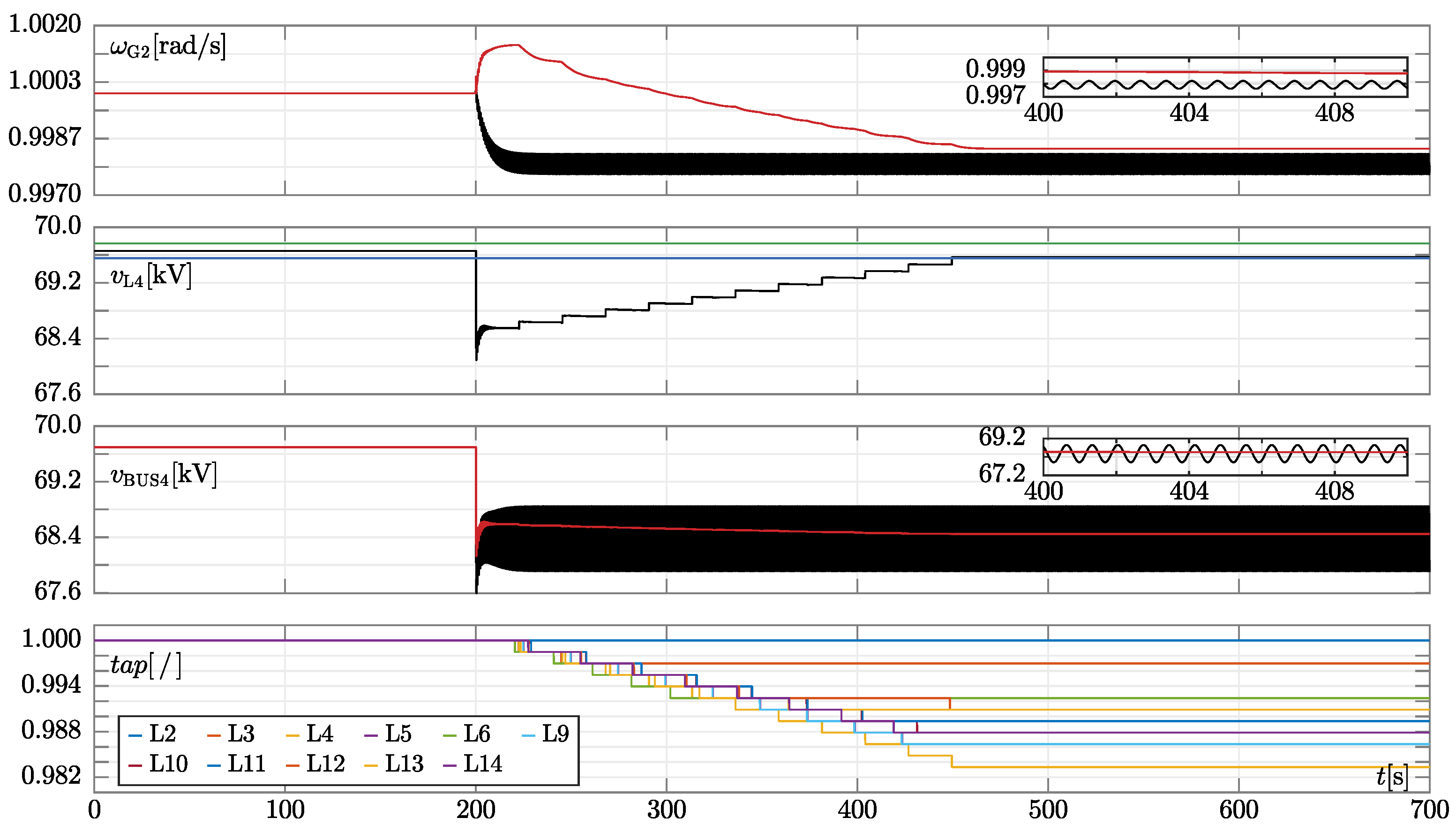
Figure 4.
As expected, after line tripping, the rotor speed of G2 in the ieee14−p scenario (black trace in the upper panel of
Figure 4) starts oscillating, indicating that a periodic steady-state behaviour is observed since a stable stationary solution is not reached (i.e., the grid becomes “unstable”). As shown by the black trace in the third panel from the top, the voltage magnitude of
bus4 also oscillates. The same holds for the voltage at other buses, too. On the contrary, after line tripping, the grid in the
ieee14-z scenario remains stable, without showing any oscillations. Note that
oltcs “fully” restore load powers and thus the absence of oscillations can not be ascribed to the fact that the power of constant impedance loads are lower after line tripping.
In summary, the results in the two case studies confirm that the use of constant impedance loads behind oltcs instead of constant power ones leads to completely different stability results for what concerns both small-signal analyses and transient simulations. Based on this observation, one might wonder which load model actually correctly and accurately represents the real behaviour of the ieee14 system and possibly other grids. To answer this question, we believe the following points are worth considering.
(i) The use of constant power load models leads to pessimistic estimations of the stability boundary conditions. From an engineering point of view, this could be a good feature since it gives safety margins. From this perspective, despite leading to inaccurate results, constant power load models can still be considered adequate and useful.
(ii) The use of constant power loads eliminates the need to implement the complex automata modelling the behaviour of oltcs connected to constant impedance loads, which simplifies power flow and transient stability analyses and reduces the computational burden.
(iii) The tap switching process of the oltcs occurs after relatively long time periods (i.e., tens of seconds). Thus, since the power restoration of the constant impedance loads connected to the oltcs is a decidedly slow process, the electrical dynamics of passive elements can be neglected. Indeed, the only dynamics that should be considered are the electro-mechanical ones of the generators, which are retained when adopting constant power loads. Also, in this case, employing algebraic (i.e., static) models of passive elements facilitate and accelerate simulations while ensuring adequately accurate results.
The above considerations lead to the conclusion that the use of (i) constant power loads instead of constant impedance ones behind oltc in distribution feeders and (ii) algebraic models of passive elements instead of dynamic ones have become customary in modelling and simulating power systems till today. However, this established practice may no longer be valid due to the increasing presence of ibrs. Indeed, due to the controls that they can implement, ibrs may represent fast constant power loads and generation; their ac impedances, which might be complex functions of frequency spanning in the range of several , can deeply interact with the dynamics of passive elements. If algebraic models are used, these interactions may remain hidden; thus, simulations may not accurately reflect the true behaviour of the system. This aspect, which is dealt with in the following, suggests that the conventional model of loads and passive elements may require revision when used in ibr-dominated grids.
3.2. The ieee14-pd and ieee14-zd Dynamic Test Systems
The case studies analyzed so far relied on static models of lines. In the following, we adopt dynamic line models by considering the ieee14-pd and ieee14-zd scenarios and simulating the same outage described in the previous subsection (i.e., line tripping between bus2 and bus5 at ).
The ieee14-pd case gives extremely straightforward results: the adoption of dynamic models and constant power loads yields an unstable pf solution since several eigenvalues jump in the right-half portion of the complex plane. Note that this result anticipates that the introduction in the system of ibrs (e.g., mmcs), whose active and reactive power absorption is regulated to track a reference value (thereby mimicking constant power loads), will lead to similar instabilities. Since the attainment of an unstable pf solution prevents any further analysis of this case study, in the sequel we consider only the ieee14-zd scenario.
In this case, a completely different result is obtained because the
pf solution is
stable. The different behaviours observed in the
ieee14-pd and
ieee14-zd scenarios are coherent with what we obtained by computing the eigenvalues of Equations (
7) and (
9). Indeed, as explained in
Section 2.1, power systems with constant power loads are less robust than those with constant impedance ones from a stability point of view. To facilitate comparisons, the simulation results of the
ieee14-z scenario are replicated in
Figure 5 together with those of the
ieee14-zd one.
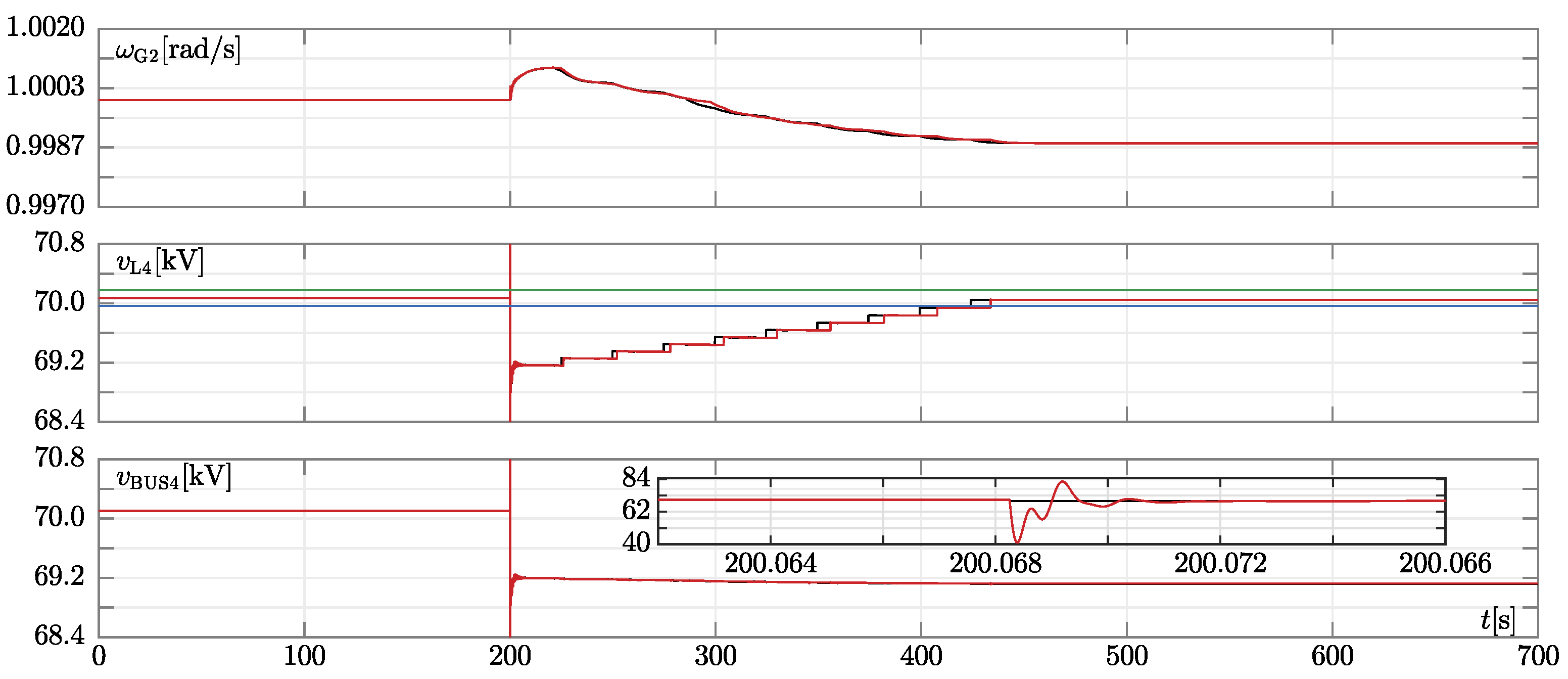
The traces in the two cases almost overlap despite them adopting two different line models. It is worth pointing out that in
Figure 5 the magnitude of the
bus4 voltage is clipped (upper and lower) to allow a better comparison of the waveform in the two cases. The inset in
Figure 5 depicts the unclipped voltage magnitude just before and right after the line tripping.
4. Simulation Results of the Modified ieee14 Power System with an mmc-Based hvdc Link
In this section, we show some simulation results of a modified version of the
ieee14 system. To take into account the effect of the growing presence of
ibrs on power system stability, the line between
bus4 and
bus5 was replaced with an
hvdc link comprising two
mmcs, as shown in
Figure 6.
This modification was proposed and described in [
23,
24,
25]. In a nutshell, the
mmc1 and
mmc2 converters are respectively of
p/q and
dc-slack/q types. In other words,
mmc1 is controlled to exchange a specific amount of active and reactive power. On the contrary,
mmc2 regulates the
dc-side voltage and reactive power exchange. In particular, the active and reactive power transmitted by the
hvdc link is regulated to equal that of the replaced line. To do so, the active power reference value of
mmc1 (i.e., sending end) is
, while the reactive power reference value of both
mmcs is
. In addition, the
dc-side voltage reference value of
mmc2 (i.e., receiving end) is
. The interested reader is referred to
Figure 1 of [
26] and references therein for a possible
mmc control scheme implementation.
When employed in
hvdc systems, the sub-modules (
sms) in each arm of an
mmc can be in the order of hundreds. In this case, adopting the most accurate
mmc model (known as
full-physics model) requires considering a large number of semiconductor devices, thereby leading to prohibitively high computational times [
27]. To address this issue, several
mmc models in the literature have been developed that implement different trade-offs between simulation speed and accuracy. Each of these models is better suited for analysing the efficiency of specific operating conditions and
mmc controls (e.g., circulating current suppression strategies, protections,
plls, and
sm capacitor voltage balancing algorithms [
28,
29]). The interested reader can refer to [
30,
31,
32] and references therein for a review of some of these models, including a description of their advantages and shortcomings when adopted in power system simulation.
In general, the analysis of converters can be divided into three stages [
27]: component, system, and network level studies. Component level studies focus on the early design stage of the converter and the performances of its semiconductors (e.g., conduction and switching losses), with the time of investigation ranging from nano to milliseconds. On the contrary, system-level studies aim at evaluating the interactions between the converter and the power system connected to it, whose extension is usually limited to a few generators and loads. These analyses, which involve dynamics that last from milliseconds to several seconds, allow the validation of converter controls, filters, and protections. Finally, network-level studies analyse how the converter behaves in a large
ac network and affects the electromechanical transients and the steady-state operation of the whole system. Thus, the time interval of interest ranges from a few seconds to several minutes. Such studies address, for instance, power flow and stability analyses.
The full-detailed and bi-value resistor
mmc models allow reducing
cpu times by resorting to simplified representations of the semiconductor devices in each
sm, thus preserving the overall converter topology [
30]. These models can be used as a benchmark to validate simpler ones, test
mmc controls, protections, and behaviour during start-up, normal and abnormal operating conditions. However, due to the simplifications introduced, these representations cannot be used for component-level studies, which can only be performed straightforwardly with the full physics model.
The Thévenin equivalent [
33] and switching function [
34] models, which still rely on simplified
sm representations, are good candidates for system-level studies because they further boost simulation speed by suitably grouping the
sms together, thus obtaining a more compact representation of the
sm strings in each arm. Alternatively, in [
32] a technique called isomorphism is proposed to boost
mmc simulation efficiency that is compatible with any
sm model used, thereby paving the way for detailed analyses if accurate
sm representations are used. In a nutshell, this technique dynamically clusters while simulating the
sms in groups characterised by the same behaviour.
The average model decreases simulation time even more by neglecting the voltage and current ripples due to
sms commutations [
35] and significantly simplifying the
mmc topology by exploiting voltage and current controlled sources. This model is suitable for network-level studies which investigate the dynamic behaviour and stability of large grids comprising multiple
mmcs.
All of the models described so far are represented in the
abc (i.e., three-phase) frame. On the contrary,
mmc models formulated in the
dq0 frame, either based on an average representation [
36] or dynamic phasors [
37], grant a significant boost in simulation speed, making them suitable candidates for
mmc simulation in large-scale power systems.
In general, the boost in simulation speed offered by the mmc models mentioned above may come at the cost of reduced simulation accuracy and/or the loss of internal mmc variables, which are no longer present due to the simplifications introduced in the sm model and the mmc topology. As previously stated, based on the study that needs to be performed (and, thus, the sought trade-off between simulation speed and accuracy), one mmc model might be more suitable than others.
In this paper, we modelled the
mmcs of the
hvdc system at two very different levels of accuracy: the former, hereafter referred to as
accurate, is shown in
Figure 1a–c of [
26] and derives from [
38]. This three-phase model substitutes the
sms in each arm of the
mmc with a single equivalent circuit. It retains the main features of the converter and allows analyzing all of its upper-level controls, as well as the circulating current suppression strategy. The usage of an average model instead of one based on dynamic phasors is justified by the relatively limited size of the
ieee14 benchmark system. In addition, more complex
mmc models, which allow us to analyse the individual behaviour of
sms, have not been adopted because their level of detail is excessive for the simulations described in the following sections. The second
mmc model used in this work (hereafter referred to as
simplified) is the one described in [
39,
40], which resorts to macro-models that retain only the main features at the points of connection of the converters and allow only the implementation of higher-level controllers, such as active and reactive power regulations and droop controls. This representation corresponds to an average model formulated in the
dq-frame. Some of its components are added to properly take into account the converter losses at the
ac and
dc sides. Despite leading to a lower computational burden, one of the drawbacks of this model is that it does not consider any dynamics. Indeed, the impedances connected to its
ac side (e.g., the
mmc transformer impedance) are referred to as the synchronous frequency and are
fixed (i.e., they do not change with grid frequency). As shown in the following, this static model constitutes a deep simplification that could lead to largely different simulation results from those obtained with a more accurate
mmc model. Indeed, the complex topology and control scheme of
mmcs result in them having a multi-frequency response generating non-negligible harmonics.
Regardless of the representation employed, the key aspect of the analyses with these mmc models is that the mmc1 converter at bus5 is always a full-fledged p/q type. Even if a simplified version of the converter is used, its main features at the point of connection to the ac grid (i.e., absorbing a constant active power of and contributing a reactive power of ) are maintained. This represents the main difference with respect to the previously considered cases.
We want to stress that our goal here is not to investigate in detail all the possible controls that can be implemented in mmc1 and mmc2, but rather to show the impact that the two previously described mmc models and their controls might have on the overall power system stability in different scenarios.
4.1. Simplified mmc Model
To begin with, we used the simplified model of the mmcs, which, as previously stated, does not consider any dynamics. We instead considered the electrical dynamics of passive components, adopted constant impedance loads behind oltcs, and swept the active power absorbed by the p/q type mmc1 converter in the interval.
The reactive power of both
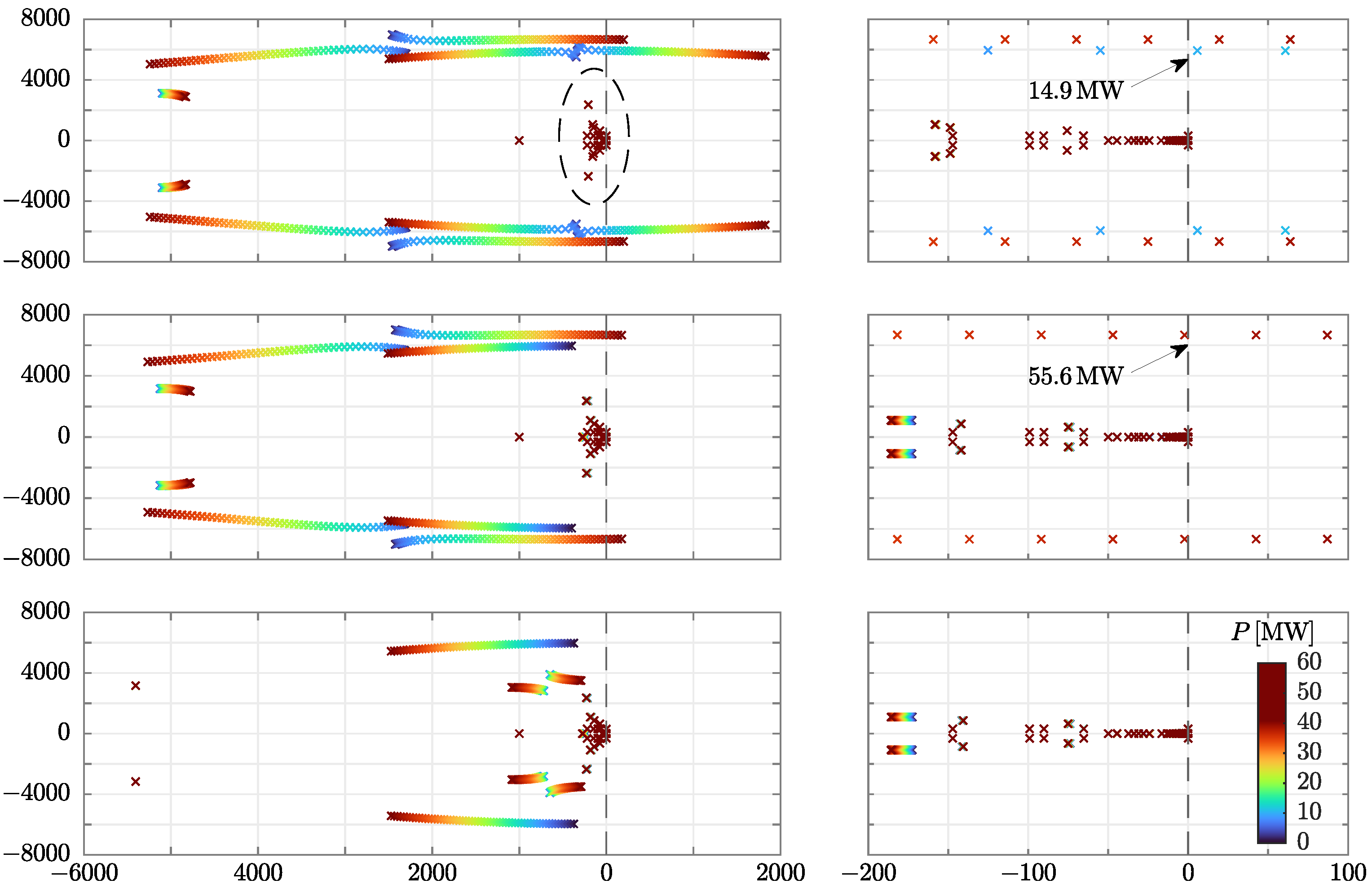
mmcs was also swept in proportion accordingly. At each sample of the sweep, we performed an eigenvalue analysis. The top panel of
Figure 7 reports the paths followed in the complex plane by the most relevant eigenvalues of the system (i.e., those closest to the right-half portion of the complex plane).
During the sweep, as soon as the active power goes above
, the power system becomes unstable since a complex-conjugate pair of eigenvalues with a natural frequency of about
enters the right-half portion of the complex plane. It is worth pointing out that this power value is lower than the one the
hvdc link is supposed to transmit (i.e.,
). The onset of unstable behaviour at around
is visible in the top panel of
Figure 7: eigenvalues are colour-coded based on the active power reference value. Moreover, when the active power sweep reaches
, another complex conjugate pair of eigenvalues enters the right-half plane.
The unstable pairs of complex-conjugate eigenvalues that arise at
and
are due to different reasons, which have been identified through the analysis of the participation factors. In the former case, results indicate that instability is mainly due to
bus5 and the line that connects
bus2 and
bus5 [
41,
42,
43] (i.e., where the
p/q type
mmc1 is connected). On the contrary, in the latter case, the participation factors show that the second unstable mode is mainly due to
bus4 and the line that connects
bus3 and
bus4 (i.e., where the
dc-slack/q type
mmc2 is connected). The relevant aspect that we underline is that the
mmc1 and
mmc2 converters are not unstable
per se but they are when used in the
ieee14 benchmark due to their interactions with the grid.
For instance, a qualitative explanation of the onset of instability at
bus5 due to the
p/q type
mmc1 is the following. From (
1) and (
2) it can be inferred that the
mmc1 is characterised by a negative resistance, which is a common trait of converter-connected elements whose active and reactive power absorption is regulated. In the specific case of the
ieee14 benchmark, when the
mmc1 active power reference exceeds
, its negative resistance becomes higher than the series resistance of the lines/transformers, thereby leading to undamped
rlc oscillations [
44].
A possible way to keep the eigenvalues of the
mmc1 in the left half-plane is to regulate its actual active power exchange by adding an
ac-voltage/active power droop. More specifically, with the addition of the droop the power absorbed by this converter becomes
where the electrical quantities refer to
bus5 and
. This latter parameter mirrors the constant of the proportional regulator used in the
mmc to implement the droop. This control is such that the absorbed power
P rises if the modulus of the
bus5 voltage increases with respect to its value at the
pf solution (i.e.,
) and vice versa otherwise. The introduction of the droop emulates a “constant impedance” load, which absorbs
at nominal bus voltage.
Since the droop modifies the
mmc1 active power set-point (i.e., its transmitted power), we added a low-pass filter block to slowly restore power to its
nominal value. The overall model implementing the regulator is
whose transfer function is
. The addition of the low-pass filter emulates the same effects that an
oltc has on the restoration of the voltage, and, thus, power of a constant impedance load connected to it. In the light of the above, the combination of the droop and the low-pass filter transforms the
p/q type
mmc1 into a constant impedance load behind an
oltc.
After this modification, we repeated the power sweep analysis that we did before. The loci described by the most relevant eigenvalues are reported in the middle panel of
Figure 7. The beneficial effect due to the introduction of the droop and low-pass filter block is evident. Indeed, the unstable complex-conjugate pair of eigenvalues that previously arose at
is now absent.
However, the eigenvalue pair that enters the right-half plane when
goes above
is still present. The analysis of the participation factors confirms again that this pair is due to the
dc-slack/q type
mmc2 converter connected at
bus4. To eliminate this pair it is necessary to act on
mmc2 by modifying its equivalent impedance “seen” at its point of connection. In this case, we added a shunt capacitor to
mmc2 to obtain stability. The eigenvalues loci of the power system after this intervention are shown in the bottom panel of
Figure 7. The addition of shunt capacitors is clearly beneficial because all eigenvalues remain in the left-half plane regardless of the active power reference value.
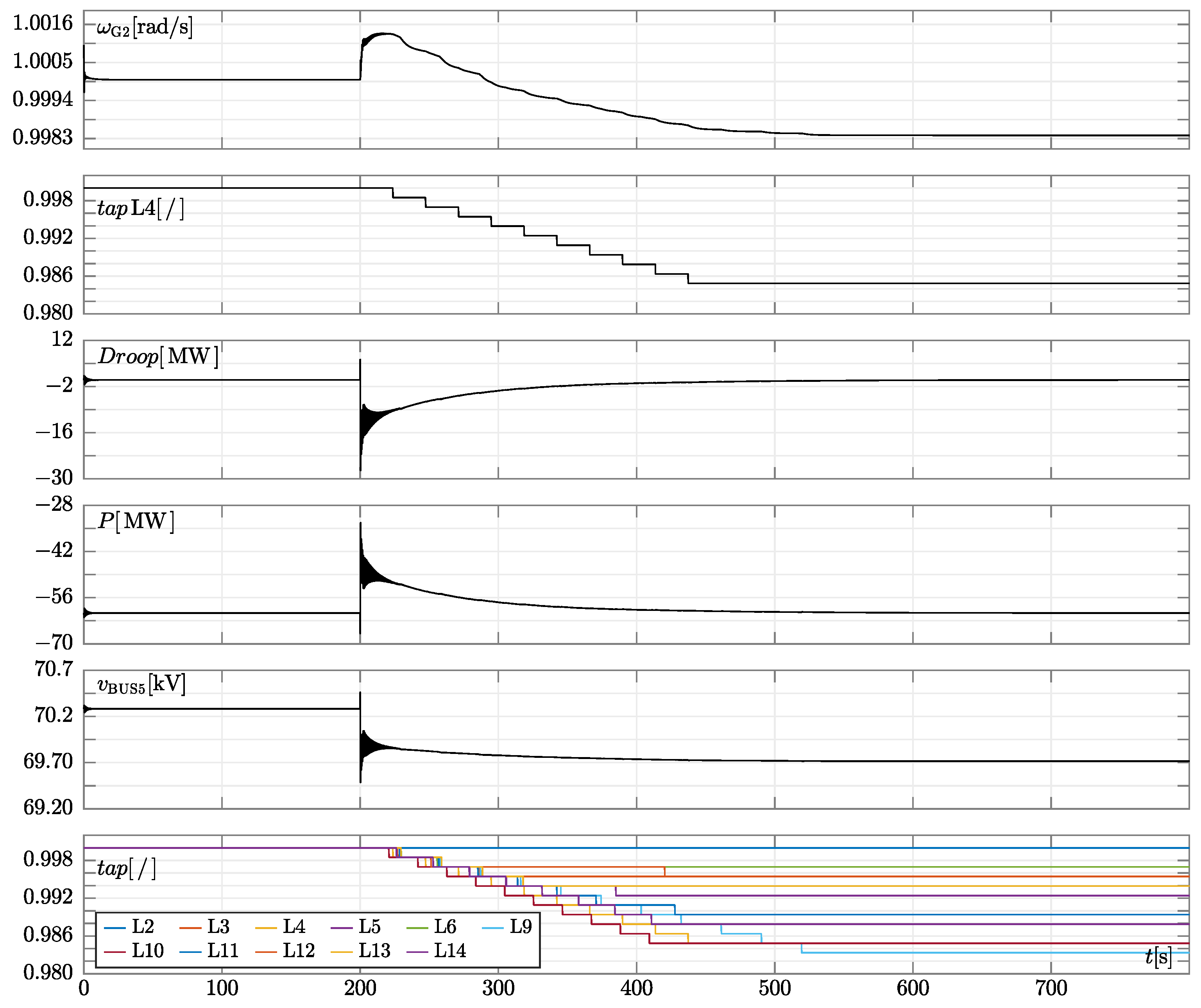
To further check stability, we performed a transient stability analysis analogous to those of
Section 3, whose results are reported in
Figure 8.
As in the previously analysed scenarios, when the line between
bus2 and
bus5 is tripped at
, a voltage drop occurs at all buses, including
bus4 and
bus5. This leads to a decrease in the load power absorbed by the constant impedance loads. In addition, the droop controller of
mmc1 lowers its absorbed power in a similar way. From the same figure, one can notice that the long-term load voltage restoring action of the converter is similar to those of
oltcs. This was obtained through a proper tuning of the
time constant in Equation (
11).
4.2. Accurate mmc Model
In this section, we used the
dcs1 test system by CIGRE as a detailed three-phase model of the
mmc-based
hvdc link. Its schematic, which is fully described in [
27], is not reported here for space reasons. The original power rating of the
dcs1 system is
, which is abundant for our scope: indeed, it is worth recalling that the
hvdc link in
Figure 6 is meant to transmit
. Therefore we reduced the power rating to
. The three-phase transformers of both
mmcs were adapted to step-up voltage from
to
and
respectively to meet the original design requirements. The
pll of each
mmc tracks the frequency at the point of connection and aligns to the q-axis of the
dq-frame.
To have some insight into the behaviour of the system and to understand the mutual interactions between the power system and the
mmcs when a more accurate three-phase
mmc model is used together with constant impedance loads, we computed the admittances of
mmc1 and
mmc2 at their points of connections and checked for possible stability issues [
45,
46,
47]. Note that we deal with a hybrid model of the
ieee14 system, where the
mmcs are simulated with detailed
three-phase dynamic models and the
ieee14 with a
single-phase equivalent model. A conventional eigenvalue analysis can not be performed with this hybrid power system.
At first, we chose the
,
set-points and connected each step-up transformer to an infinite bus. This is the common configuration used to design an
hvdc link and its converter stations that will be connected to
ac systems. The adoption of such a configuration ensures that the
hvdc link and its
mmcs are designed to be stable
per se. However, as explained in the following, this does not prevent possible undesired grid and converter interactions from occurring when the
hvdc link is connected to a real power system, such as the
ieee14 one. The choice of the set-points is based on the top panel of
Figure 7: since with these setpoints no eigenvalue has a positive real part, system stability should be ensured.
The numeric tool we used to compute admittances is fully described in [
26] and implemented in our own simulator
pan [
48,
49]. In extreme synthesis, a small-signal tone with
variable frequency is injected in one of the three phases of the step-up transformer (in our case the “a” phase) of each
mmc. This tone superimposes the phase voltage (of large magnitude). We computed the corresponding phase current, extracted the small-signal current contribution due to the injected small signal, and computed the admittance (i.e., the current versus voltage small-signal transfer function).
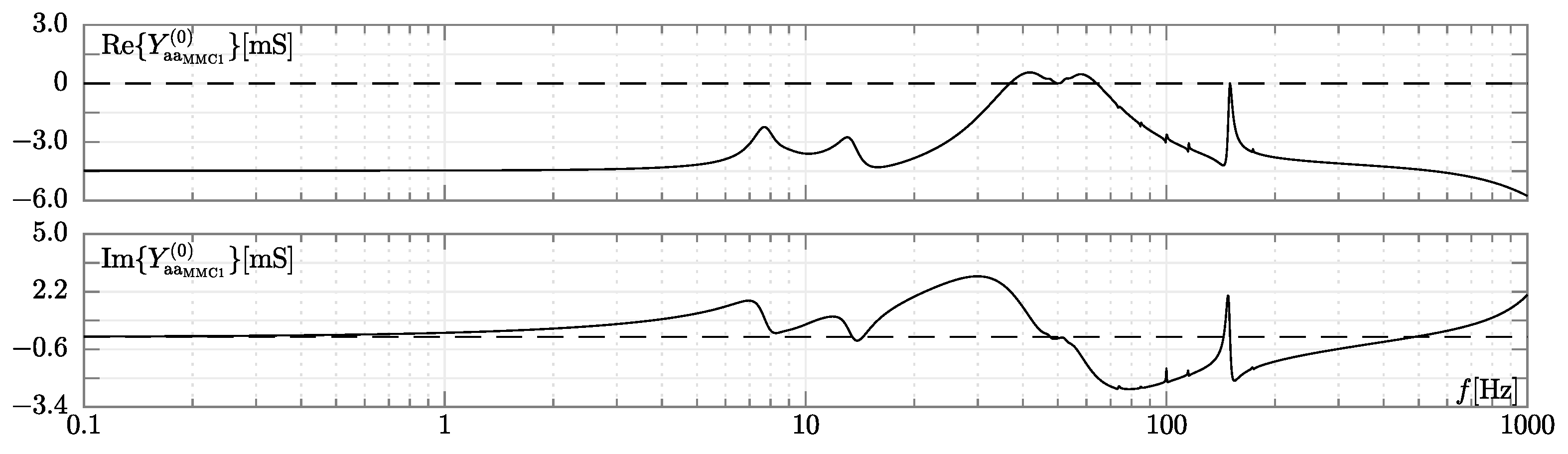
The plots in
Figure 9 depict the real and imaginary components of the admittance of the
p/q type
mmc1.
The plots include several frequency intervals, both at low and high frequencies, where the real part of the admittance is
negative and its imaginary part is
positive (capacitive behaviour). In
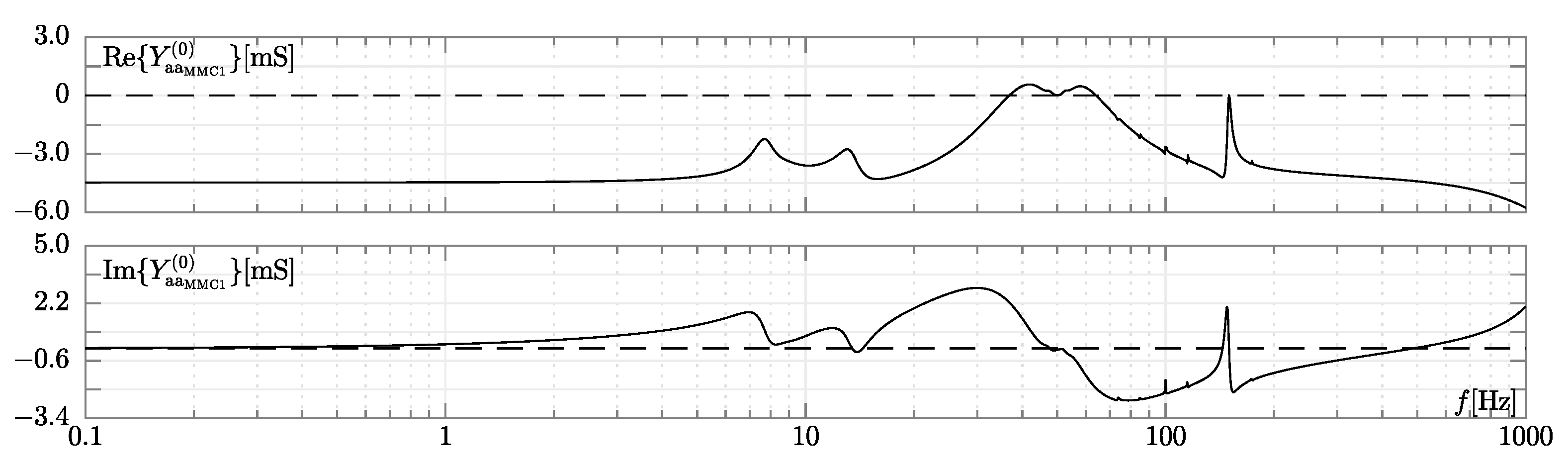
Figure 10 we report the admittance of
mmc2.
The traces are similar to the corresponding ones in
Figure 9, but their magnitudes are about ten times lower. Thus, since
mmc1 potentially exhibits the largest negative conductance in both low and high-frequency intervals, it constitutes the most critical
mmc from a system stability perspective. In particular, as suggested in the previous subsection, (i)
mmc1 can form an
unstable RLC resonator with the inductances of the lines and transformers (i.e., when dynamic models of passive elements are used). This phenomenon might occur at frequencies higher than those at which
ac grids typically operate. In addition, (ii)
mmc1 can even interact with the models of synchronous generators/condensers of the
ieee14 power system leading to poorly damped or unstable (electro-mechanical)
low-frequency modes (less than
).
To provide more details about the first comment (i), consider the high-frequency portion of the admittance of
mmc1 in
Figure 9. For example, at
its susceptance is about
(corresponding to
equivalent capacitance), while its conductance is negative. If the line inductance is larger than
(a value attainable with an overhead line of sufficient length, such as
), an unstable
rlc equivalent circuit can originate [
50]. This happens even at relatively low power levels since the detailed model of the
mmc shows a much more complex admittance function with respect to its simplified counterpart. This kind of instability can be avoided at high frequency provided that the
L inductance of the transformers and the lines is sufficiently low. It is also important to note that this instability does not occur when non-dynamic line and transformer models are adopted. Indeed, in this case, the inductance would be null, thereby preventing the unstable
RLC resonator from originating.
Now, to further elaborate on the second comment (ii), consider the lower-frequency portion of the admittance in
Figure 9. The admittance has a negative real part and positive imaginary part at frequencies less than
. This means that undesired interactions among
mmc1 and the electro-mechanical dynamics of synchronous generators and condensers can arise. These interactions are known as sub-synchronous oscillations (
sso) and are similar to sub-synchronous resonances [
51,
52,
53]. Contrary to the previously mentioned instability issues at high frequencies,
sso cannot be effectively prevented by acting on
L. Indeed, to do so,
L should assume values impractical to obtain. In addition, as better shown in the following,
ssos depend on the
mmc active power exchange.
To check the possible onset of an sso we performed a long-lasting transient analysis of the ieee14 benchmark, where at the line between bus2 and bus5 was tripped as before (compared to other case studies, the time of occurrence of the disturbance was reduced to minimise the simulation effort, since the simulation of detailed mmc models is more cpu time consuming). We started with the same set-points used to compute impedances of mmcs. As previously mentioned, instabilities could be due to an unstable rlc resonator and/or ssos. To confine the onset of possible unstable modes to only sso, we did not consider any dynamics of passive elements (i.e., ).
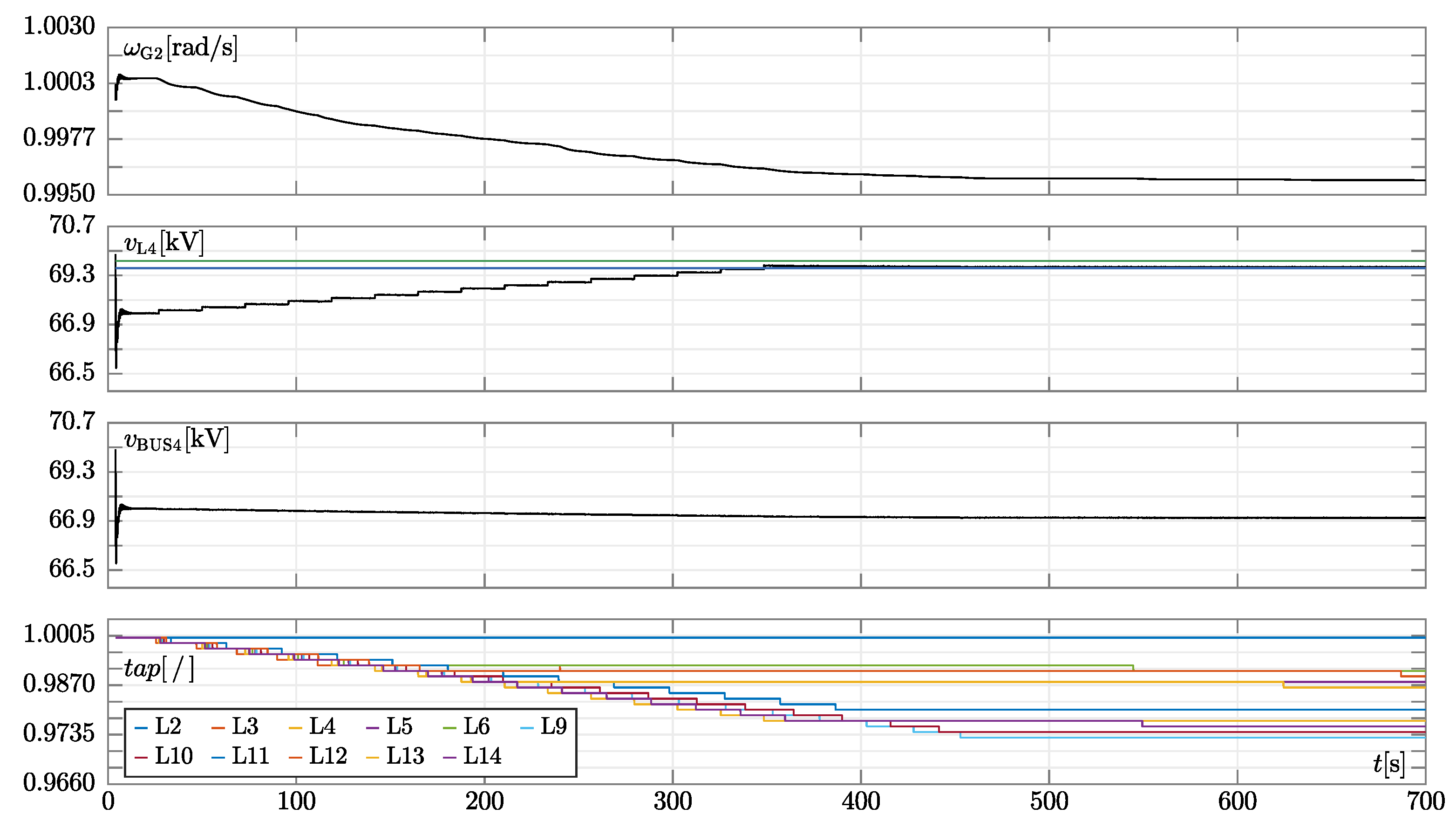
As it can be seen from the results in
Figure 11,
oltcs intervene once again to restore load voltages and, thus, power. The voltage at
bus5, where the potentially critical
mmc1 is connected, is also restored. Any stability problem was not evidenced at the current power level, as it was too low to trigger
ssos.
After having restored and stabilised bus voltages inside the dead-bands of
oltc, we started to slowly increase the power set point of the
p/q type
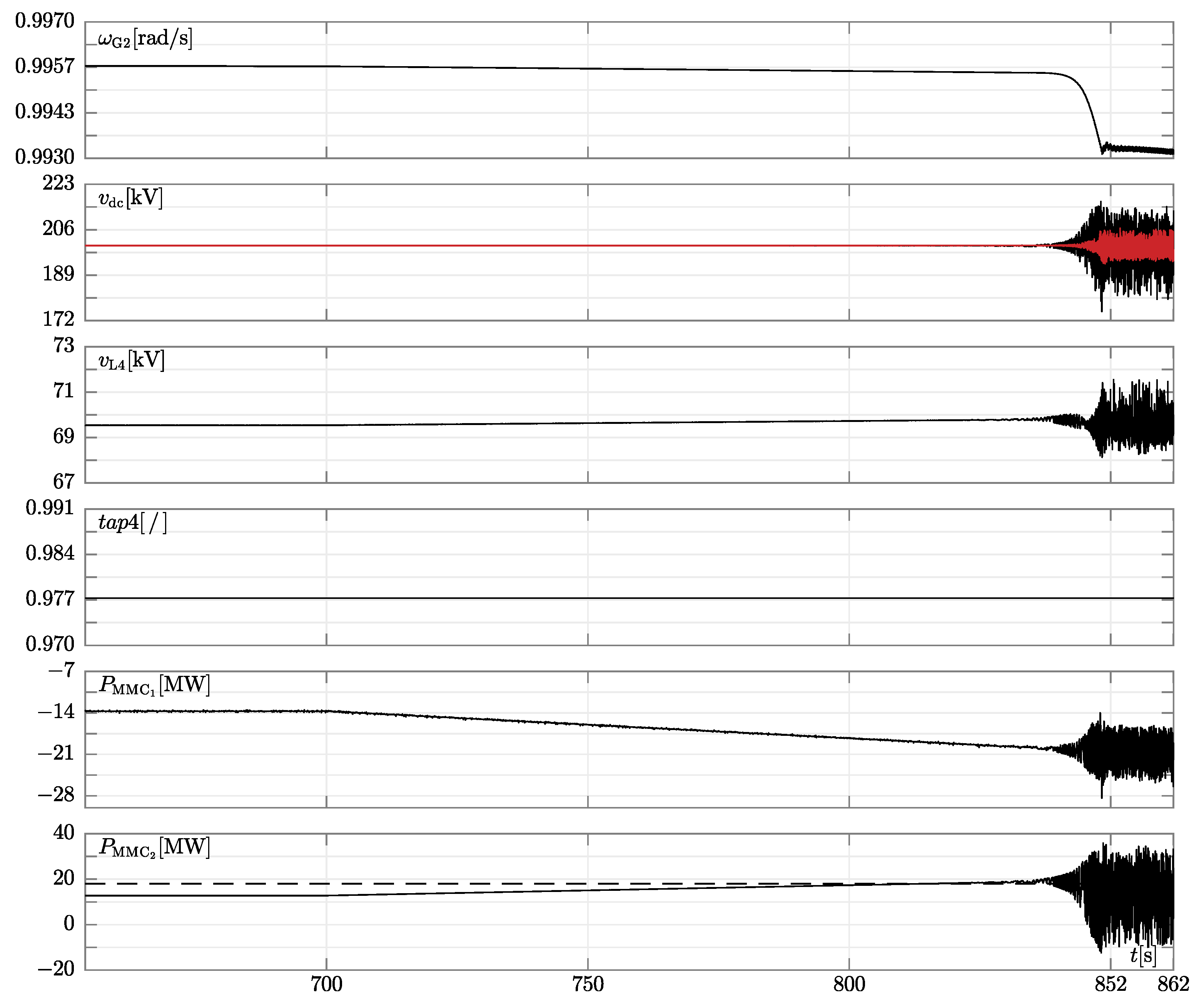
mmc1. The slow increase of power is done to allow the system to adapt to the new working condition and to adequately identify the power level at which it becomes unstable. The corresponding results of the transient stability analysis are reported in
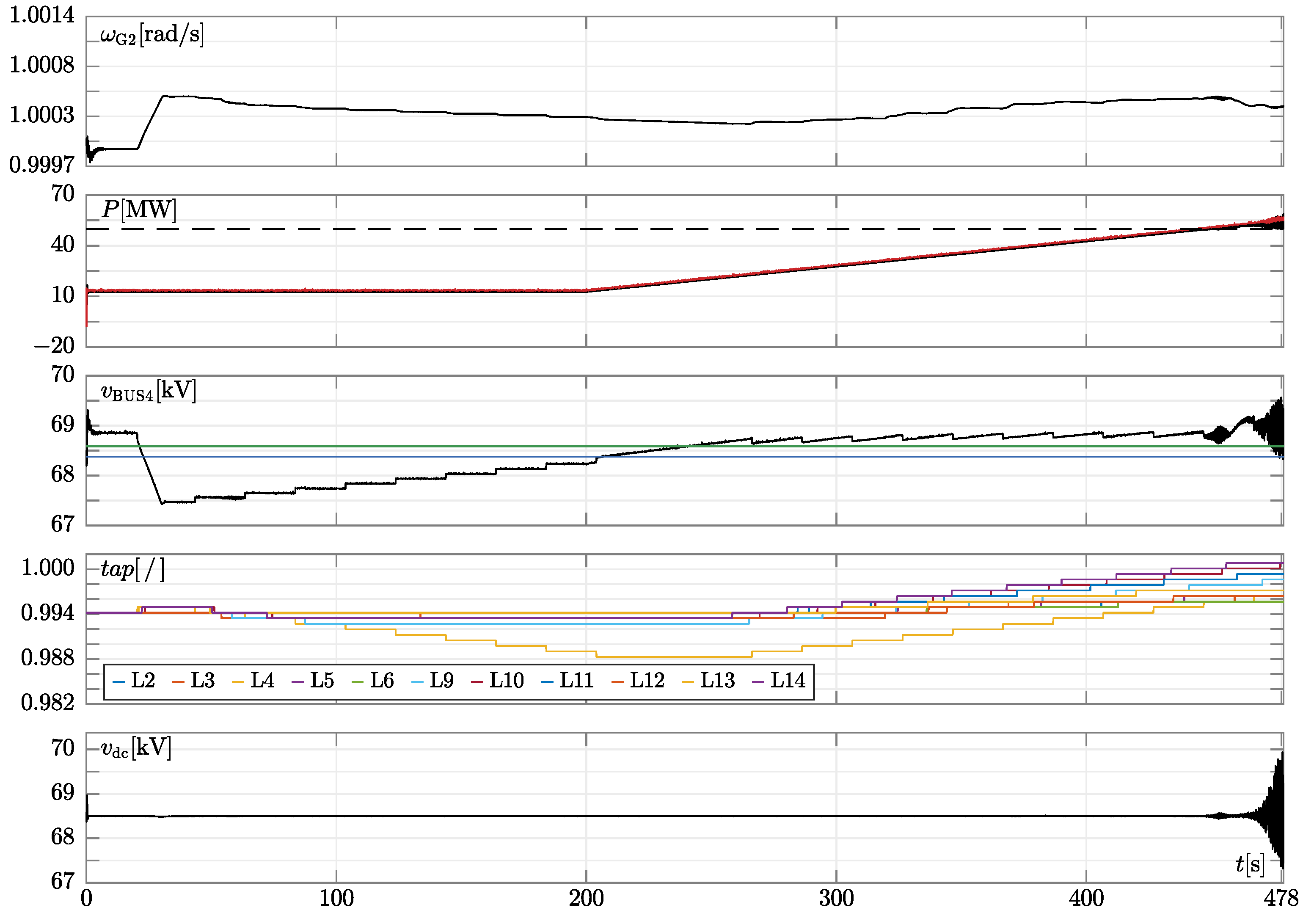
Figure 12.
When the power goes above
(which is well below the final
target), instability occurs as shown by the divergence in the pole-to-ground voltage and power exchange of the
mmcs. Since in this transient stability analysis we did not use dynamic models of lines and transformers, this unstable behaviour can only be ascribed to
ssos [
51].
A possible countermeasure to prevent ssos from originating (and, thus, damping the unstable electro-mechanical modes) consists of increasing the damping parameter of the synchronous generators and condensers. To validate this statement, we repeated the simulation and artificially increased the damping parameter of all the synchronous generators and condensers to 10.
The results obtained in this case are shown in
Figure 13.
We see that during power ramp-up of mmc1 (and thus of mmc2) the oltc at bus4 increases its transformer ratio to bring voltage inside the dead band. Voltage increases since power voltage drops of transmission lines lower. The other oltcs perform in a similar way. We see that stability is ensured up to . If the power absorbed by the sending converter is further increased instability occurs, which means that increasing damping is effective only to a limited extent in preventing ssos.
As a last comment, it is worth pointing out that all of these features would not be visible by adopting constant power loads. Moreover, also the model of the passive elements play a relevant role: indeed, if dynamic line and transformer representations were used, other instabilities than ssos (i.e., attributable to an unstable rlc resonator) might arise.





 ,
,