Abstract
Several management and control techniques for hybrid energy storage systems (HESS) with batteries and supercapacitors are presented in the literature applied to microgrids (MGs). The filter-based control strategy for defining the control loop actuation is one of the most widely used approaches with satisfactory performance. Variations of the Filter-Based Method (FBM) method are proposed to improve the control efficiency of the HESS under load disturbance and intermittent generator sources. However, not enough attention has been paid to the impacts of MG on the operational performance of batteries, despite the fact that they represent a non-negligible percentage of the total cost of MGs. In this paper, a control strategy called FBM-CSoC is proposed that focuses primarily on mitigating battery safety and degradation issues. The control strategy proposes a distribution of the charging and discharging current in a weighted proportional way to the normalized rated capacity and current state of charge (SoC) of each battery in the MG. This control strategy favors both the reduction of the internal temperature variation of the cells and the possibility of them operating in overcharging or over-discharging conditions. A comparative case study between the traditional FBM method and the FBM-CSoC, by means of numerical simulations, demonstrated that the load distribution occurs satisfactorily in energy storage systems. Finally, the FBM-CSoC method can be flexibly used for different types of battery technology and/or batteries with different SoCs integrated with supercapacitors.
1. Introduction
In recent years, investments for distributed generation in the form of Microgrids (MGs) have grown abundantly [1]. Different companies gravitated toward MGs because they bring economic benefits, increased energy efficiency, and enable the introduction of intermittent renewable energy generation to the final consumer [2]. The intermittent nature of most renewable sources often requires the use of energy storage systems to ensure energy stability. Storage technologies such as batteries, hydrogen, and supercapacitors (SC) provide greater robustness and reliability to the system [2].
MGs emerged as a way to organize and coordinate the operation of Distributed Energy Resources (DER). Along with this concept came the difficulty of ensuring reliability and operational safety, which also includes safety aspects for energy storage systems and motivates specialists to look for solutions in order to improve and expand the use of MGs [1,3].
The control of the energy flow of DER can be performed by various isolated converters dedicated to each energy device or through a multiport converter. For technical and economic reasons multiport converters have some advantages over isolated ones, they present less complexity when controlling the entire system and they do not require communication between devices, making possible the centralization of energy management while reducing the number of system’s controllers [4,5,6].
The advantages granted by multiport converters are important in a Hybrid Energy Storage System (HESS) in which SC and batteries with different technologies, or different State-of-Charge (SoC) and State-of-Health (SoH) are interconnected. Thus, the control system can consider this individual information from each energy storage device, in addition to presenting a rapid power response under load fluctuation and maintaining the stability of the MG [7,8].
Several multiport converter topologies have been reported in the literature for MG applications [9,10,11]. As an example, a solid-state transformer was used to interface with various power sources in [12]. A similar operation with a half-bridge configuration has also been proposed in [13], while a multi-input isolated buck-boost converter has been reported in [14,15,16]. From the cited literature, it is evident that multiport bidirectional converters for MG applications require individual power flow control between the energy sources and the load. Therefore, different control strategies for bidirectional converters have been reported for voltage regulation in MGs [17,18,19,20,21]. In general, the reported methods require extensive mathematical integration, increasing control complexity [22].
Among reviewed published work, the most common way of improving MG electrical characteristics, reducing internal losses, and extending battery life, is by using an SC to compensate for the high current demanded during a load transient, relieving the current demanded from the battery and reducing the voltage drop across its terminals [23,24,25]. Most control strategies using batteries and SC use a Filter-Based Method (FBM) [26].
This work proposes an energy management and control method for a multiport bidirectional DC-DC converter for HESS integrated into MGs. Herein, a modified FBM control strategy is proposed, where a parameter formed by the total storage capacity of the HESS, as well as the individual SoC of each battery will be considered in the control loop. For the purposes of this paper, the proposed control strategy will be referred to as FBM-CSoc. The proposed FBM-CSoC method aims to contribute to increasing the useful life of batteries, using a weighted load distribution system based on the nominal capacity of the system and SoC of the batteries. To validate the proposed method, a multi-port energy converter was modeled and tested via computer simulation and the FBM-CSoc results were compared with the conventional FBM results.
This paper is organized as follows: Section 2 presents the elements and topology of the MG used as a case study. The system modeling is presented in Section 3; the control strategy and power management of HESS in MGs are presented in Section 4; the system parameters and simulation results are presented in Section 5; finally, the conclusions is presented in Section 6.
2. MG Topology
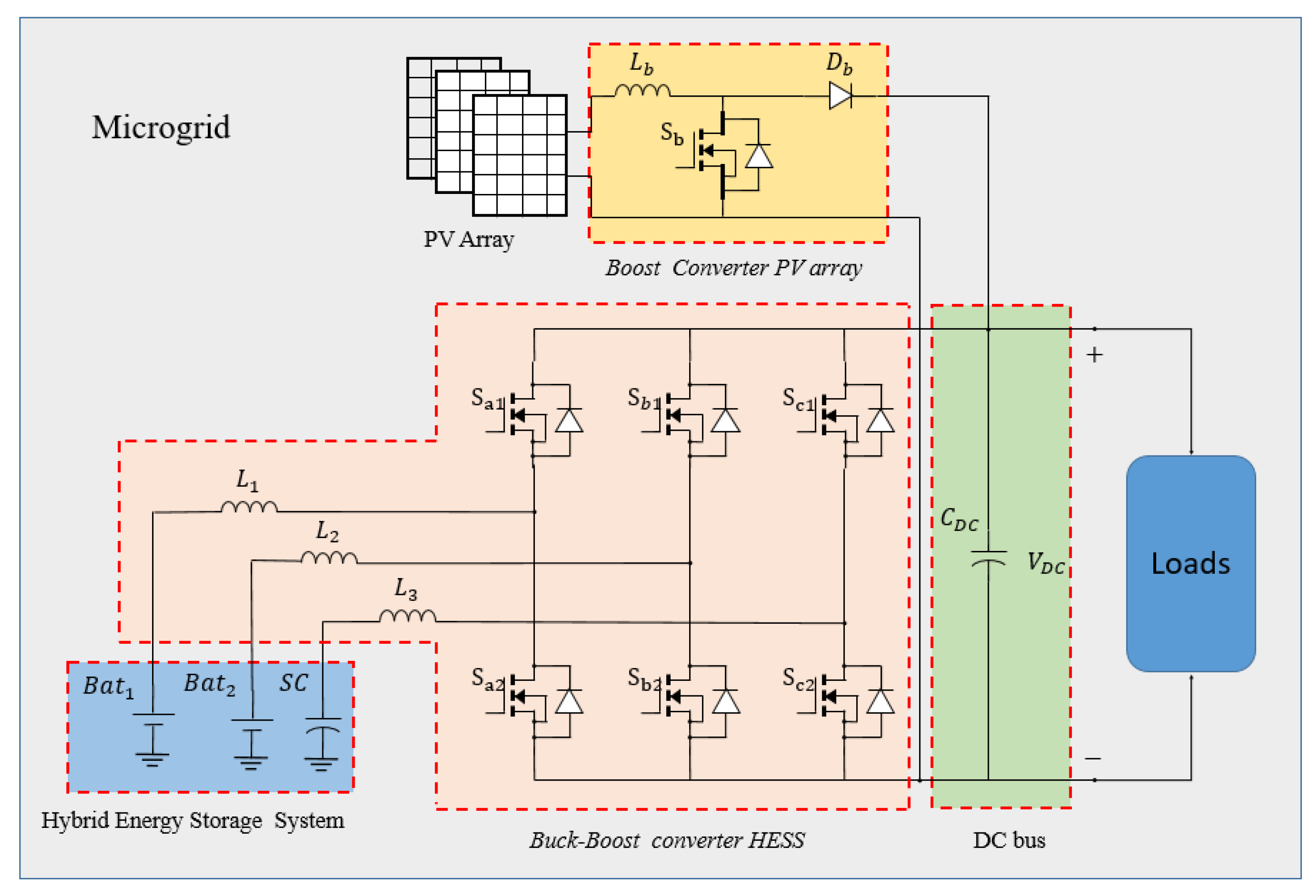
Photovoltaic (PV) systems are one of the most common renewable energy sources in MGs, and batteries are the main technology used for energy storage, these elements can be connected to the MG bus using different static converter topologies [3]. In this work, a DC MG is used with a conventional boost converter coupled to the PV system, and bidirectional buck-boost converters are applied for the energy storage elements.
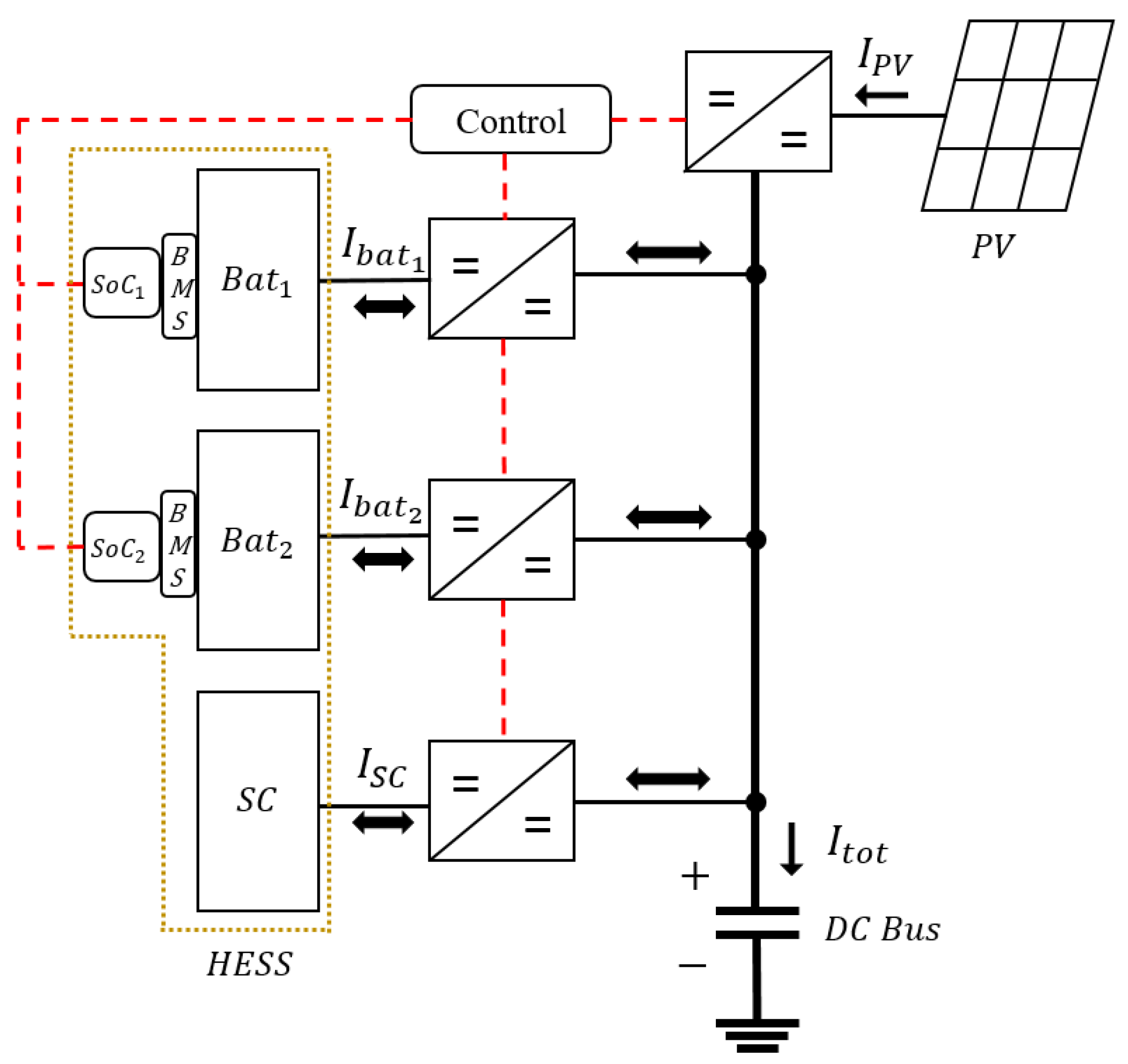
The architecture of the presented HESS in a DC MG consists of two battery banks with different characteristics ( and ) and supercapacitors (). A three-input bidirectional converter controls the charging and discharging of these energy storage elements in a coordinated manner.
Each bidirectional converter consists of six bridged switches arranged as shown in Figure 1, three switching arms connect the MG DC Bus: the battery banks ( and ) and the through the filter inductors , and respectively. In addition, the boost converter is coupled in parallel to the DC bus, which is responsible for controlling the PV system.
Figure 1.
Microgrid Topology.
2.1. HESS Charging Process in MG
When the HESS charging mode is active, the batteries draw power from the DC bus. The power switches , and receive the command signals and operate in a complementary way to the power switches , and respectively, so that the , and share power received from the DC bus.
For the HESS charging process to occur, the voltage level of the DC Bus must be greater than the reference voltage level. At this time, the bidirectional converter will operate in buck mode, lowering the voltage level. The energy needed to charge the HESS comes from the PV system connected to the DC bus.
2.2. HESS Discharging Process in MG
When the load demands energy from the DC bus, the HESS discharge process may occur. At this moment, the bidirectional converter will be operating in boost mode through the signals , , and in the power switches. Since the switches are on the same branches as , and respectively, the control signals operate in a complementary way. In this way, only one switch command circuit is required for each switching branch.
3. Control System Modelling
Figure 2 presents the single-line diagram of the proposed multiport converter for DER integration in MG. The Battery Management System (BMS) of each battery is responsible for providing the values, which are used in the control loop.
Figure 2.
Complete system for DER integration in MG.
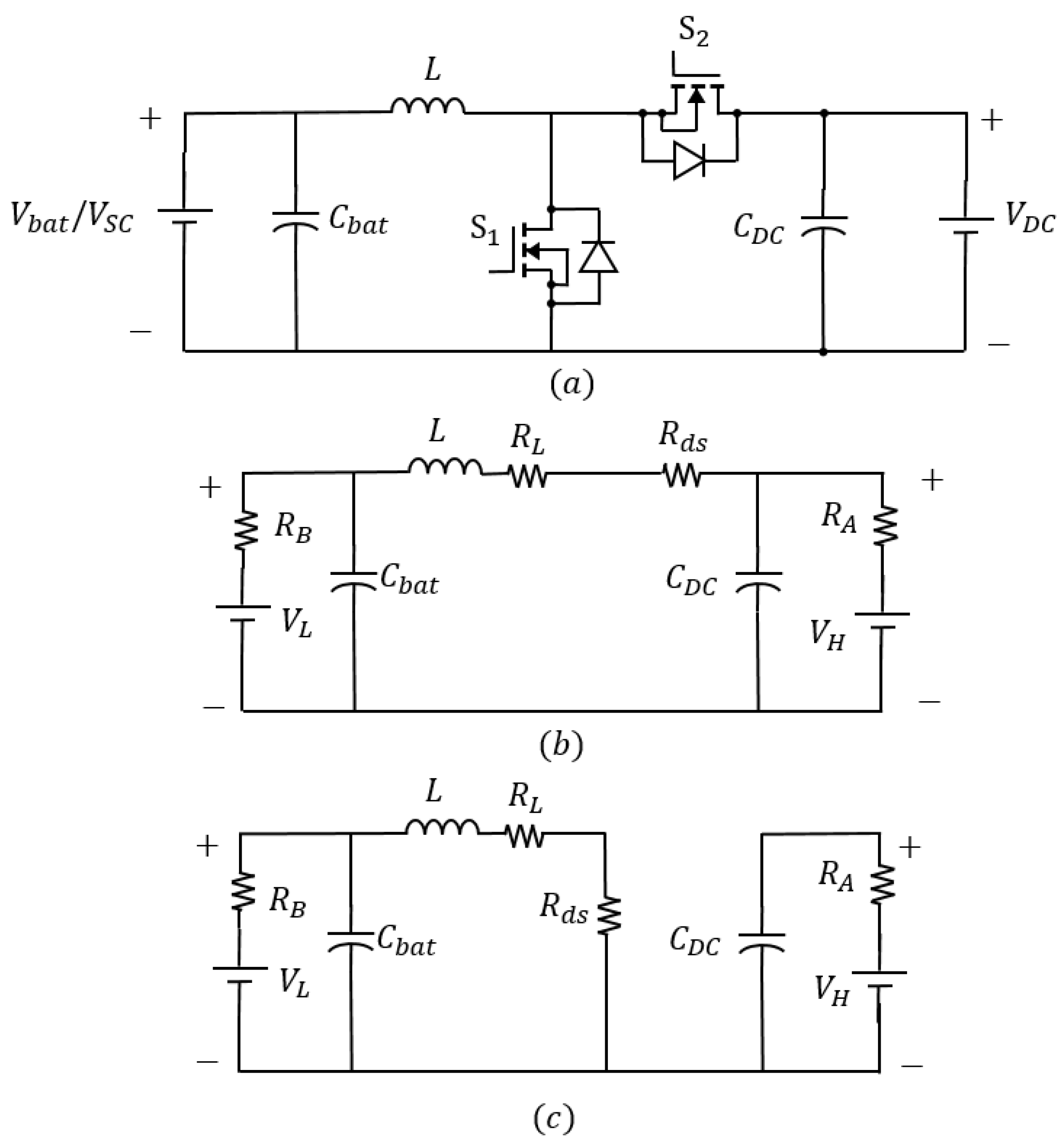
A single input bidirectional buck-boost converter was considered for modeling the HESS converter in the MG, using the average model equations for the batteries and SC reported in [27]. In this paper, the battery control system model is expanded for SC control, considering a simplified bidirectional converter with a single input, as shown in Figure 3, where represents the low voltage side (energy storage devices) and the high voltage side of the converter (DC bus).
Figure 3.
(a) Buck-boost Bidirectional converter; (b) equivalent circuit open and close; (c) equivalent circuit open and close.
A Figure 3a shows the bidirectional buck-boost converter, while the Figure 3b shows the equivalent circuit for the switches closed e open and Figure 3c shows the equivalent circuit for the switches closed and open. The parameters and are the high and low voltage side capacitive elements. In this way, it is possible to define the converter control loop in all operating ranges.
To consider the model’s non-linearities there were taken into consideration the internal resistances of the power switches when in conduction, the internal resistance of the inductor and the series resistances of the sources and , and , respectively. The Equation (1) expressed in [27] represents the transfer function () of the converter as a function of the current () and duty cycle ():
With a, b and c defined by the following expressions:
In which is the equivalent resistance between the inductor and the power switch in conduction, and are the internal resistances of the model sources, D is the duty cycle and the inductor current. The transfer function given by Equation (1) shows that this is a third-order system since there are three energy storage components. With this model represented in small perturbations, it is obtained the relationship between the DC bus voltage, the battery voltage, the inductor current, and the duty cycle. In this way, the charge (buck) and discharge (boost) operating modes share the same transfer function and can share a unified controller [27].
4. Control Logic for HESS Energy Management
This work compares a traditional control strategy: Filter-Based Method, FBM [26] with a modified FBM with load distribution based on the HESS’s nominal capacity and SoC (FBM-CSoC). Both strategies are used for maintaining the DC bus voltage and minimizing the disturbances caused by loads and energy sources. The FBM-CSoC method controls the current module. During the charging of the HESS, the current module is inversely proportional to the batteries SoC, and during the discharge process, it is inversely proportional to the batteries’ Depth of Discharge (DoD).
This type of control strategy increases the safety and lifespan of the batteries as it reduces cells’ internal temperature variation and the chance of them operating in overcharge or overdischarge conditions. These operational conditions are associated with failure modes that could result in energy losses associated with resistive (Joule effect) or chemical phenomena (enthalpy of electrochemical reactions) [28] and may cause catastrophic events such as thermal runaway [28,29,30].
4.1. Conventional Filter-Based Method Structure
Firstly, to define the MG control loops, the DC bus model must be defined according to (5)
where is the DC bus voltage, C is the equivalent DC bus capacitance, is the storage system current used to regulate the DC bus voltage, and and are the currents of the PV system and the load respectively.
If there is an energy imbalance between the energy produced by the PV source and the load demand the MG will drain energy from the energy storage elements. In case demand does not consume all the PV-generated energy the HESS will be charged.
In this architecture a Low Pass Filter (LPF) decomposes the reference current into two components, a low frequency current () and a high frequency current (). The battery current reference () is divided into two equal parts forming and , as shown in (7) and (8).
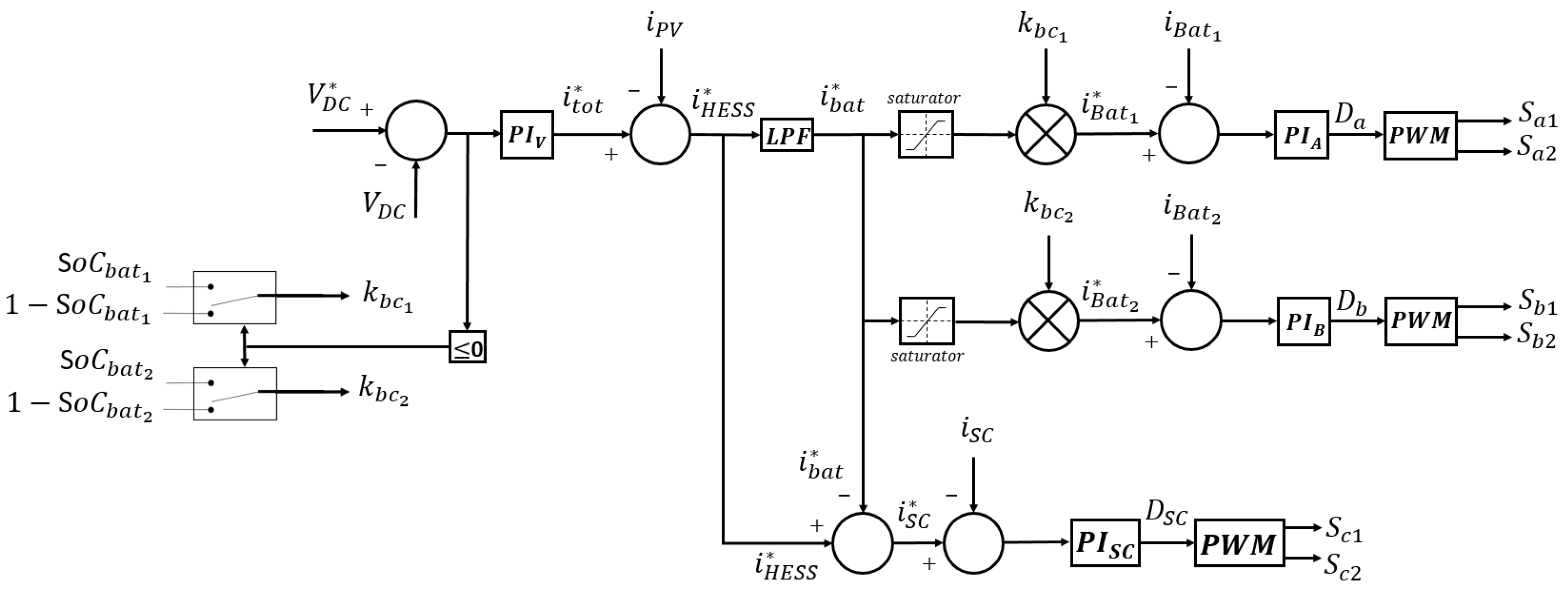
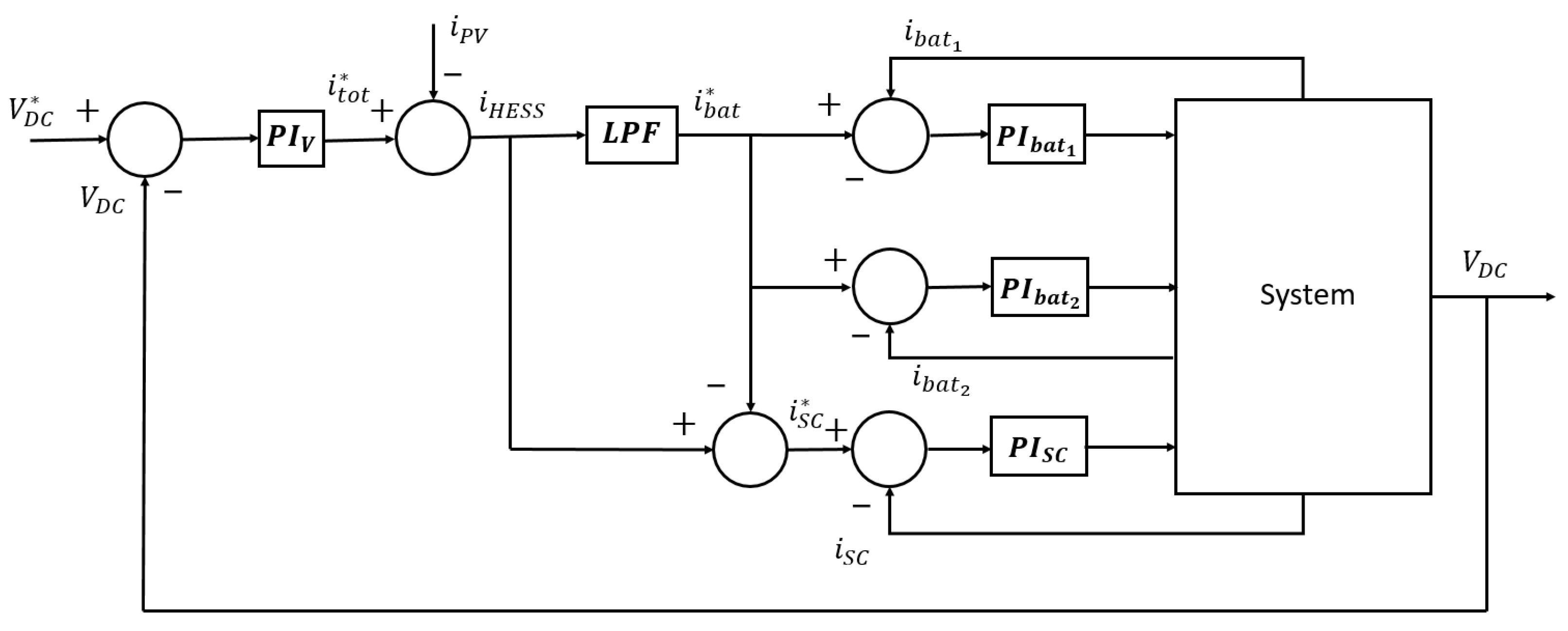
The conventional FBM control structure is presented in Figure 4. The three current control references , and are responsible for controlling the the batteries’ and supercapacitor’s power flow through Proportional-Integral(PI) controllers. Where, , and are responsible for controlling the currents of battery 1, battery 2 and the supercapacitor, respectively.
Figure 4.
Conventional FBM structure.
4.2. FBM-CSoC Proposed Control Structure
For the proposed FBM-CSoC a parameter responsible for a proportional share of the system’s capacity is defined, as presented in (9), for discharge mode and (10) for charge mode.
where is the control parameter added in the FBM loop of the battery of the system. Equations (11) and (12) show how to calculate the total HESS capacity () and the system’s normalized capacity (), respectively:
where n is the number of batteries associated with the system, is the capacity of each battery, and is the sum of the batteries capacities in the HESS.
Figure 5 presents the complete control loop of the FBM-CSoC system that manages the batteries and SC energy flow. In this control strategy the error generated between the DC bus voltage and the reference voltage is used as a trigger for defining the batteries’ control gains () and (). The batteries’ control gains are multiplied by the battery reference current to give the reference current for the PI controllers for each battery technology. The SC reference current is obtained from Equation (13).
where is the composition of the total reference current of the system minus the current injected by the PV system . The total reference current of the batteries is obtained through a LPF. The filter enables the attenuation of the control action of the batteries. The component has a fast transient action. Therefore, it serves as a current control reference for the SC. The current reference is shared between the batteries ( and ) through the respective control gains ( and ) according to (14) and (15). The , and controllers are responsible for generating the duty cycles , and , respectively.
Figure 5.
FBM-CSoC control loop structure.
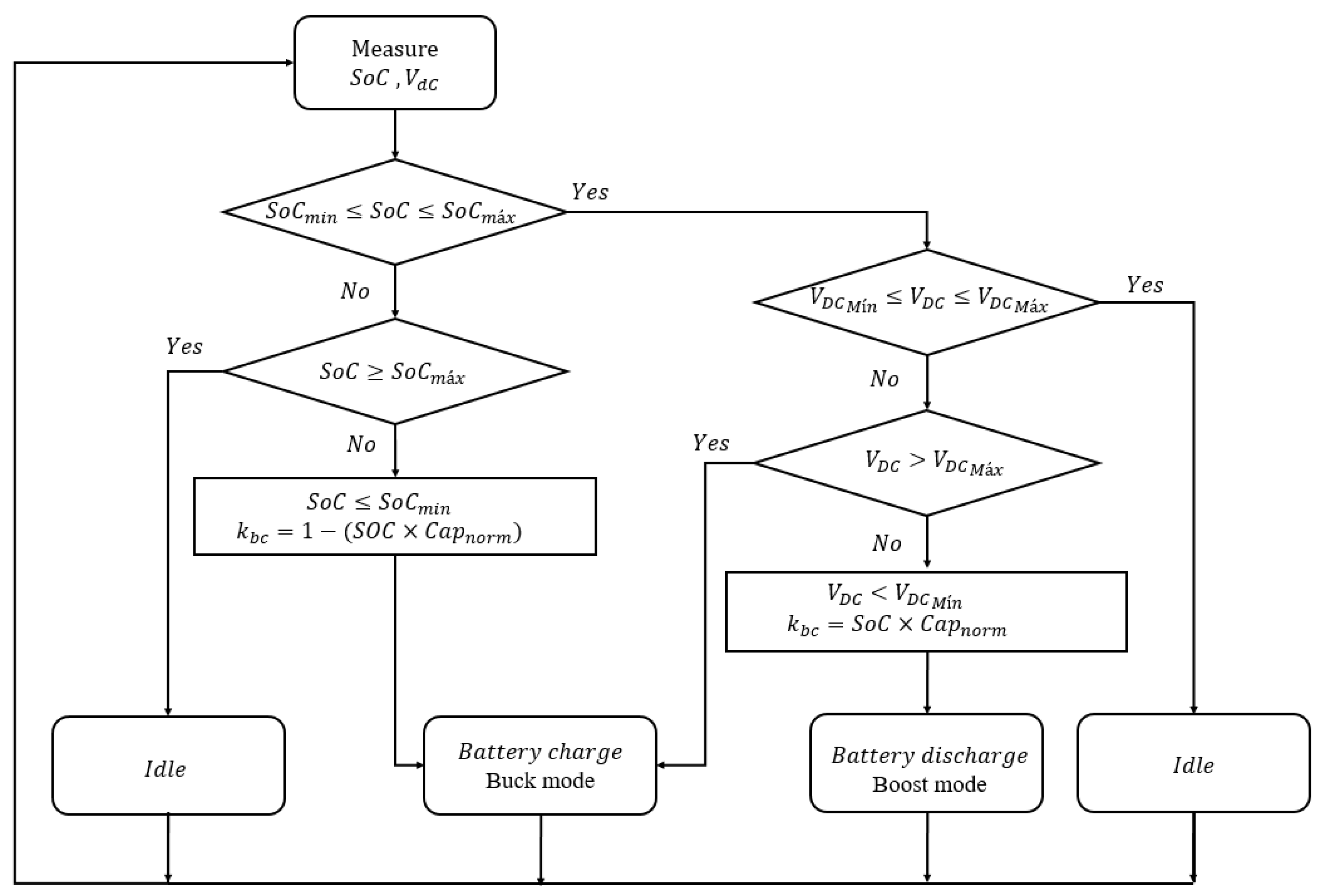
The flowchart in Figure 6 presents the battery-charge management strategy within the MG. Within the processes of charging and discharging the batteries, a parameter () is used in the control loop. This parameter integrates information from the batteries’ State of Charge () and nominal capacity ().
Figure 6.
Flowchart of the HESS charge and discharging process.
5. Simulation Results and Discussion
The MG topology presented in Figure 1 was implemented via computer simulation using PSIM software. For comparison, the conventional FBM and the proposed FBM-CSoC were tested in the same MG structure. Table 1 presents the system parameters and the gains used in the PI controllers. It also presents the batteries and supercapacitor-defined parameters that were used for the multiport converter design.
Table 1.
HESS parameters.
5.1. FBM Results
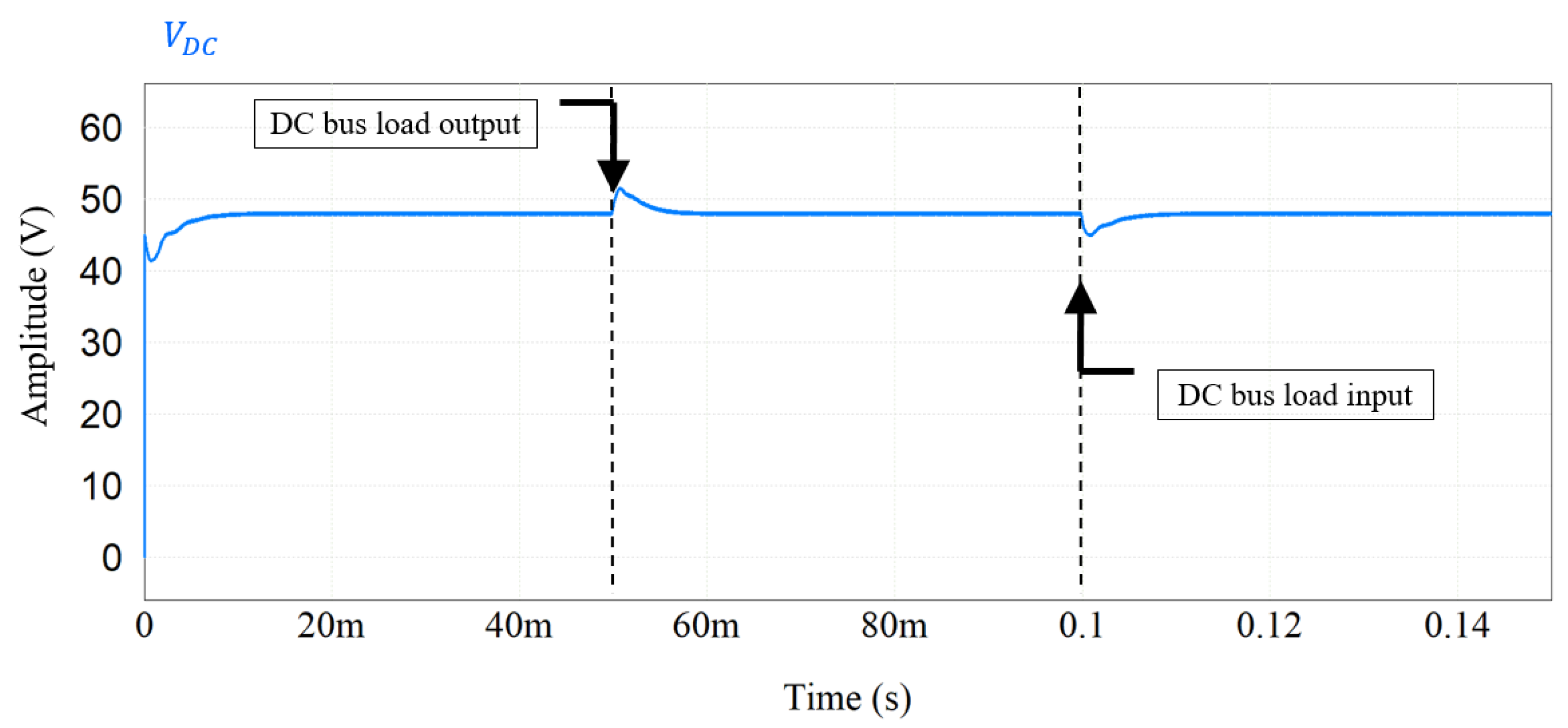
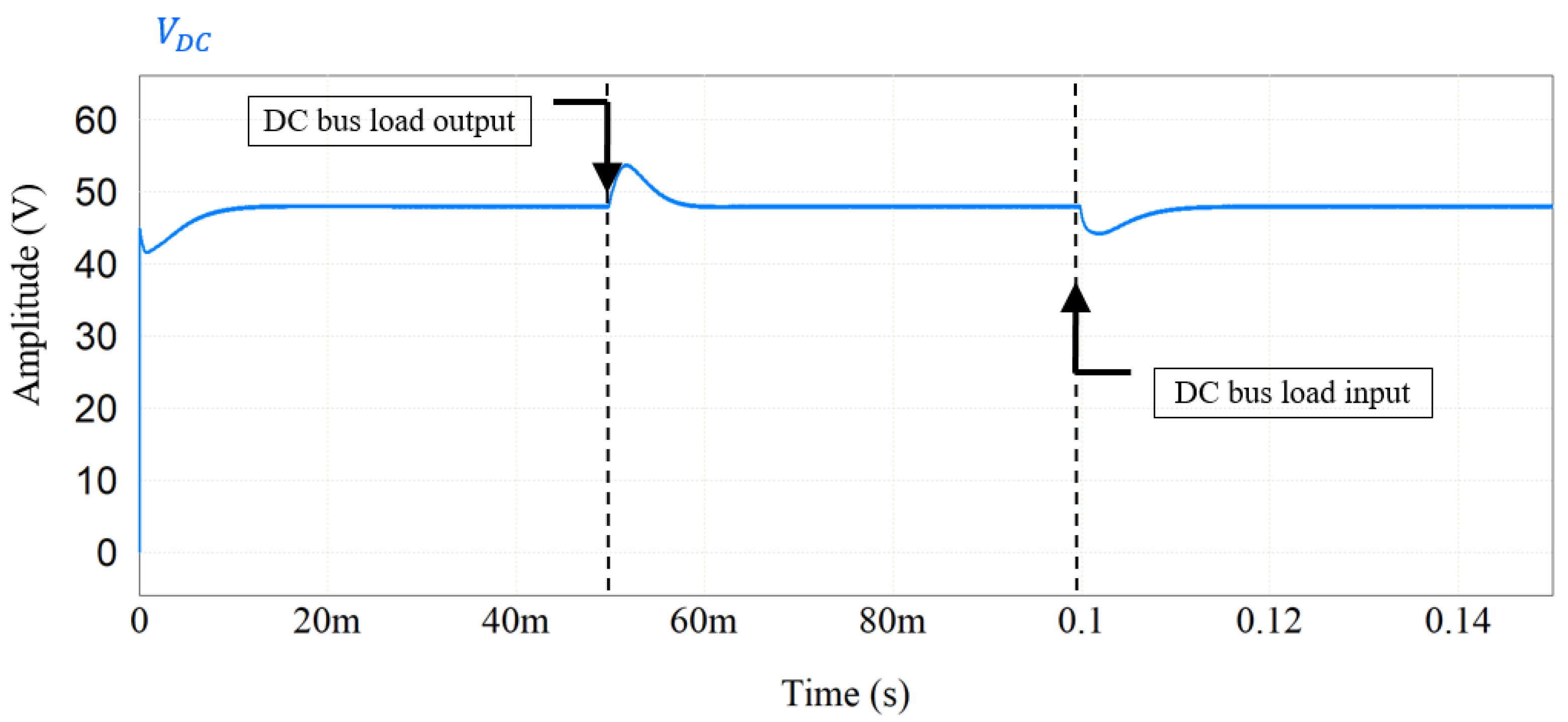
To evaluate the current distribution between the batteries the FBM control loop was implemented. Figure 7 shows the dynamics of the DC bus during a load transient. To evaluate the robustness of the control, a load input and output of 0.05 s and 0.1 s, respectively, was used. The simulation starts with a load of 15 Ω and is reduced by half and then back to the original value.
Figure 7.
DC Bus Voltage with FBM.
Figure 8 shows the battery current during load transients for FBM conventional method. It can be seen that the charging and discharging currents of the batteries ( and ) are equally distributed, that is, even if the capacities and the state of charge between them are different, each battery receives the same amount of electric current. It is also possible to observe the fast response of the SC during the load transient on the DC bus.
Figure 8.
Dynamic and static response currents of system with FBM conventional control.
5.2. FBM-CSoC Results
Figure 9 shows the DC bus voltage using the proposed FBM-CSoC with the same parameters considered in the FBM simulation—Table 1. It is possible to observe that the bus dynamics for FBM-CSoC present a higher overshoot when compared to the FBM method. This is caused by the proportional compensation of the battery currents in the control loop.
Figure 9.
DC Bus Voltage with FBM-CSoC.
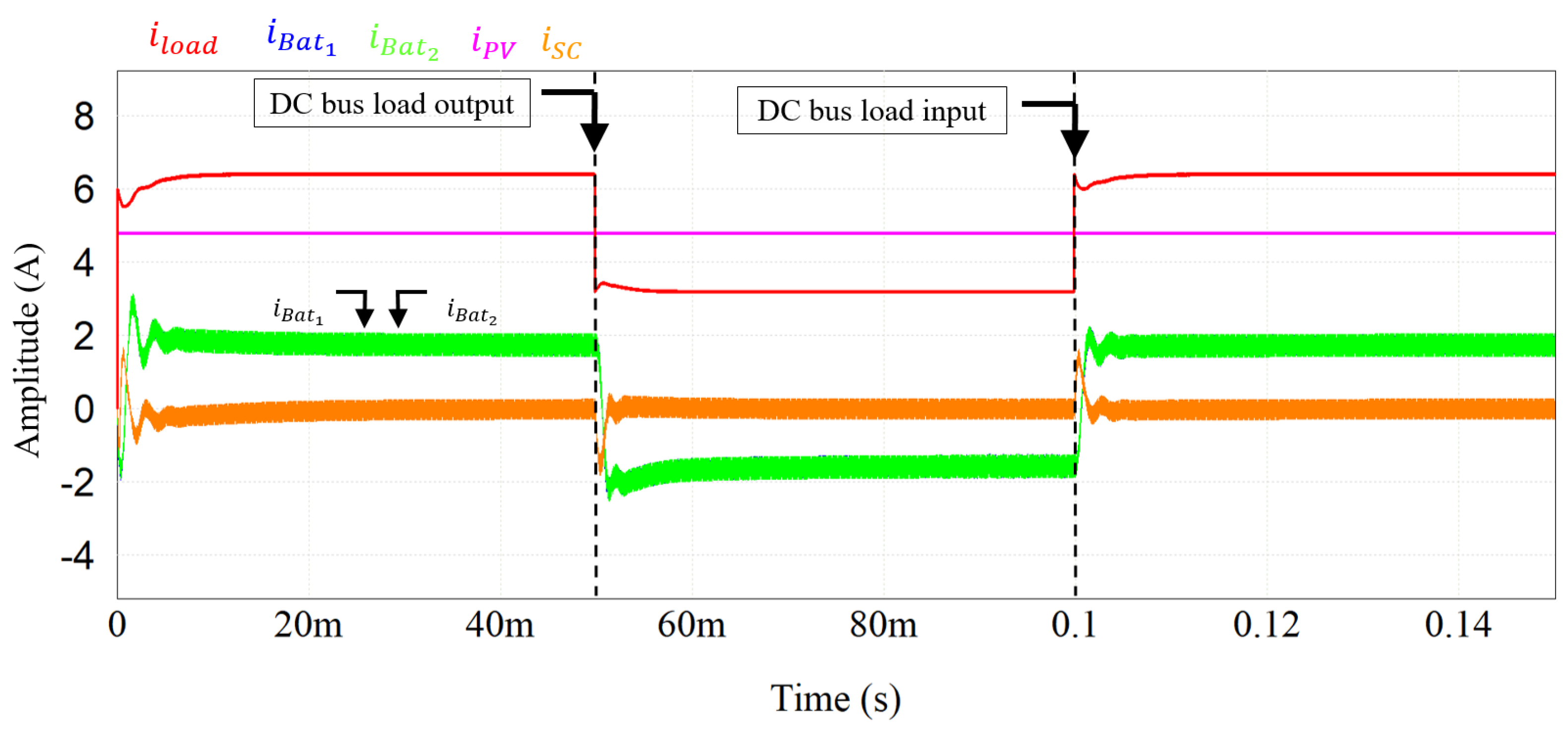
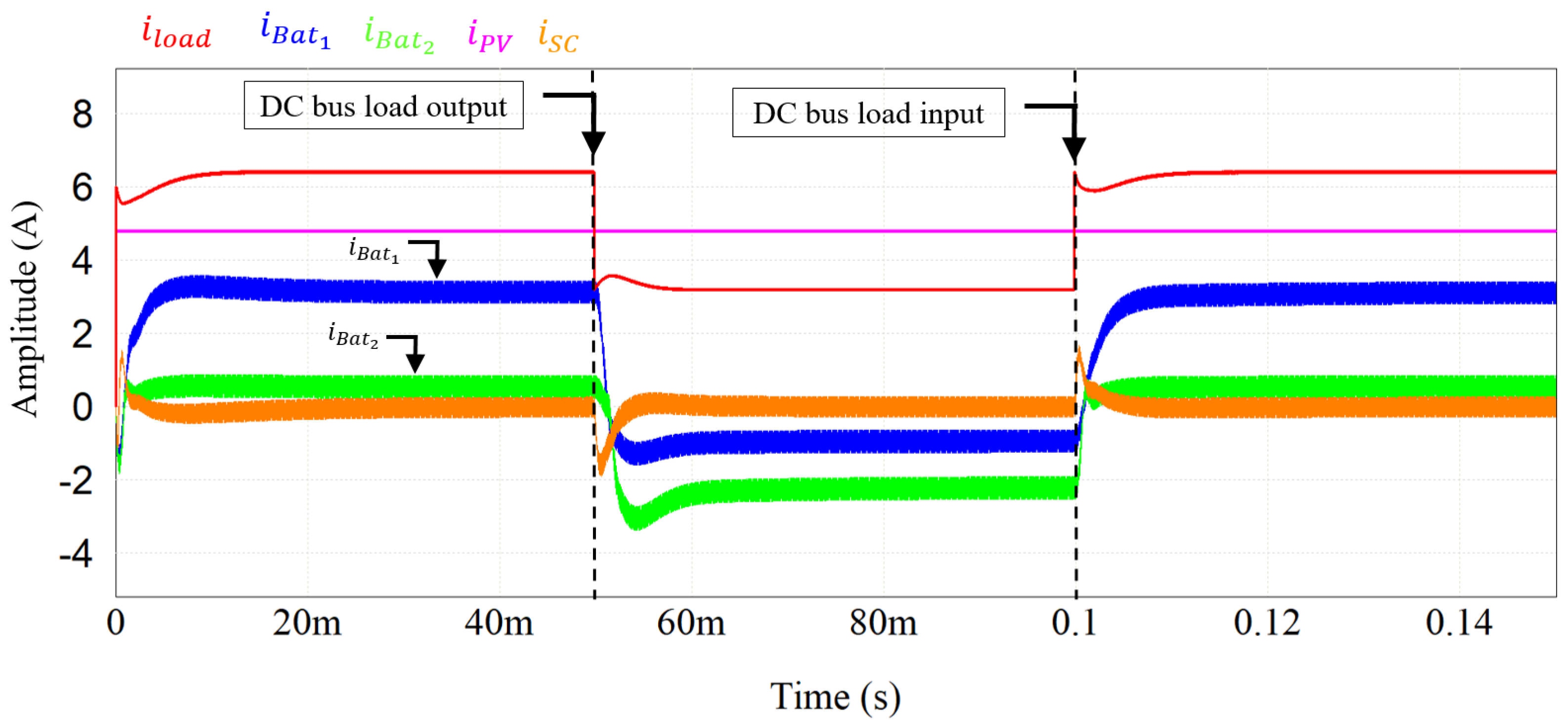
Using the parameters in the FBM-CSoc strategy, the dynamics of battery currents are weighted according to their nominal capacities and state of charge. It can be seen in Figure 10 that the discharge current related to the battery 1, with greater capacity and SoC () presents a lower current rate than battery 2 . During the charging process, the logic is reversed and the larger battery control parameter starts to recharge with a lower current rate.
Figure 10.
Dynamic and static response currents of system with FBM-CSoC control.
In Figure 10, from time simulation t = 0 to t = 0.005, the batteries are being discharged. The energy of the PV system is not sufficient to supply the DC bus and the connected loads so energy must be drained from the batteries. Within this time interval, the initial is 0.8 and the is 0.5. Also, each battery capacity is different: and . Thus, the gains and are obtained. These gains applied to the current control loop of each battery guarantee a current compensation rate, which is proportional to the capacities and SoC of the batteries. During this period of time, it is possible to observe the dynamics of the currents drained from the batteries. supplies to the system a greater current module than ( A and = 429 mA)). Also, in Figure 6 it is possible to observe that between t = 0.05 s to t = 0.1 s the batteries go from discharging to charging mode A) and A). This is possible because the energy available from the PV system is greater than the load connected to the MG. During this period, the gains invert in a complementary way. This is because the battery with the lowest SoCs has charging priority, which in this case is .
The SC connected to the system compensate for the high-frequency-current components of the HESS, Figure 7 presents this dynamic. It is possible to observe that the SC assumes fast dynamics in the HESS during load transition. By comparing Figure 6 and Figure 7, the battery and SC share within the system becomes evident.
6. Conclusions
This work presented a novel strategy (FBM-CSoc) for the control and management of batteries and supercapacitors within a hybrid energy storage system in a microgrid. Herein, a gain technique was developed to manage the charging and discharging of batteries using the energy capacities of each storage component and their respective SoCs. The control FBM-CSoC has a simple structure where the HESS normalized battery capacity is used. The same control structure used in this work can be extended to a greater number of DC-DC ports, increasing the capacity of converting storage elements into HESS, making it a modular and easy-to-implement proposal.
The proposed control method FBM-CSoC was tested through computer simulations and compared with a conventional method based on FBM where it is possible to observe the robustness of the control against the voltage stability of the DC bus and current balance of the batteries according to their capacities and state of charge. Although each battery technology has its own best current rate for charging and discharging cells, generally at high SoC or DoD values, operating at low current rates is interesting to preserve the battery lifespan and increase safety aspects, since lower currents inhibit internal temperature variations, cells overcharge and overdischarge. Finally, the use of the parameterized gain through the battery capacities in the charging and discharging process was considered satisfactory.
Author Contributions
Conceptualization: F.M.d.O. and D.A.C., investigation and simulation: D.A.C. and F.M.d.O., writing and final editing: D.A.C., A.T.T.J., E.K.S.I., N.D.B., A.R., T.G.J. and F.M.d.O. All authors have read and agreed to the published version of the manuscript.
Funding
This research was funded by Itaipu Technology Park (PTI-BR).
Institutional Review Board Statement
Not applicable.
Informed Consent Statement
Not applicable.
Data Availability Statement
Not applicable.
Acknowledgments
The authors thank the Itaipu Technology Park (PTI-BR).
Conflicts of Interest
The authors declare no conflict of interest.
Abbreviations
The following abbreviations are used in this manuscript:
| AC | Alternating Curent |
| BMS | Battery Management System |
| DC | Direct Current |
| DER | Distributed Energy Resources |
| DoD | Depth of Discharge |
| FBM | Filter-Based Method |
| FBM-CSoc | Adapted Filter-Based Method |
| HESS | Hybrid Energy Storage System |
| LPF | Low Pass Filter |
| MGs | Microgrids |
| MPP | Maximum Power Point |
| MPPT | Maximum Power Point Track |
| PI | Proportional Integral |
| PV | Photovoltaic |
| SC | Supercapacitors |
| SoC | State-of-Charge |
| SoH | State-of-Health |
References
- He, L.; Wei, Z.; Yan, H.; Xv, K.-Y.; Zhao, M.-Y.; Cheng, S. A Day-ahead Scheduling Optimization Model of Multi-Microgrid Considering Interactive Power Control. In Proceedings of the 2019 4th International Conference on Intelligent Green Building and Smart Grid (IGBSG), Yi-chang, China, 6–9 September 2019; pp. 666–669. [Google Scholar]
- Smil, V. The long slow rise of solar and wind. Sci. Am. 2014, 310, 52–57. [Google Scholar] [CrossRef] [PubMed]
- Lasseter, R.; Akhil, A.; Marnay, C.; Stephens, J.; Dagle, J.; Guttromson, R.; Meliopoulous, A.; Yinger, R.; Eto, J. The CERTS microgrid concept. In White Paper for Transmission Reliability Program; Office of Power Technologies, US Department of Energy: Washington, DC, USA, 2002; Volume 2, p. 30. [Google Scholar]
- Georgious, R.; Garcia, J.; Garcia, P.; Navarro-Rodriguez, A. A Comparison of Non-Isolated High-Gain Three-Port Converters for Hybrid Energy Storage Systems. Energies 2018, 11, 658. [Google Scholar] [CrossRef]
- Teston, S.; Vilerá, K.; Mezaroba, M.; Rech, C. Control System Development for the Three-Ports ANPC Converter. Energies 2020, 13, 3967. [Google Scholar] [CrossRef]
- Aljarajreh, H.; Lu, D.; Siwakoti, Y.; Tse, C.; See, K. Synthesis and Analysis of Three-Port DC/DC Converters with Two Bidirectional Ports Based on Power Flow Graph Technique. Energies 2021, 14, 5751. [Google Scholar] [CrossRef]
- Haruni, A.; Negnevitsky, M.; Haque, M.; Gargoom, A. A novel operation and control strategy for a standalone hybrid renewable power system. IEEE Trans. Sustain. Energy 2012, 4, 402–413. [Google Scholar] [CrossRef]
- Etxeberria, A.; Vechiu, I.; Camblong, H.; Vinassa, J. Comparison of three topologies and controls of a hybrid energy storage system for microgrids. Energy Convers. Manag. 2012, 54, 113–121. [Google Scholar] [CrossRef]
- Zeng, J.; Ning, J.; Du, X.; Kim, T.; Yang, Z.; Winstead, V. A Four-Port DC–DC Converter for a Standalone Wind and Solar Energy System. IEEE Trans. Ind. Appl. 2019, 56, 446–454. [Google Scholar] [CrossRef]
- Prabhakaran, P.; Agarwal, V. Novel four-port DC–DC converter for interfacing solar PV–fuel cell hybrid sources with low-voltage bipolar DC microgrids. IEEE J. Emerg. Sel. Top. Power Electron. 2018, 8, 1330–1340. [Google Scholar] [CrossRef]
- Tian, Q.; Zhou, G.; Leng, M.; Xu, G.; Fan, X. A nonisolated symmetric bipolar output four-port converter interfacing PV-battery system. IEEE Trans. Power Electron. 2020, 35, 11731–11744. [Google Scholar] [CrossRef]
- Zhao, C.; Round, S.; Kolar, J. An isolated three-port bidirectional DC-DC converter with decoupled power flow management. IEEE Trans. Power Electron. 2008, 23, 2443–2453. [Google Scholar] [CrossRef]
- Tao, H.; Duarte, J.; Hendrix, M. Three-port triple-half-bridge bidirectional converter with zero-voltage switching. IEEE Trans. Power Electron. 2008, 23, 782–792. [Google Scholar]
- Matsuo, H.; Lin, W.; Kurokawa, F.; Shigemizu, T.; Watanabe, N. Characteristics of the multiple-input DC-DC converter. IEEE Trans. Ind. Electron. 2004, 51, 625–631. [Google Scholar] [CrossRef]
- Jiang, W.; Fahimi, B. Multiport power electronic interface—Concept, modeling, and design. IEEE Trans. Power Electron. 2010, 26, 1890–1900. [Google Scholar] [CrossRef]
- Mendis, N.; Muttaqi, K.; Perera, S. Active power management of a super capacitor-battery hybrid energy storage system for standalone operation of DFIG based wind turbines. In Proceedings of the 2012 IEEE Industry Applications Society Annual Meeting, Las Vegas, NV, USA, 7–11 October 2012; pp. 1–8. [Google Scholar]
- Sathishkumar, R.; Kollimalla, S.; Mishra, M. Dynamic energy management of micro grids using battery super capacitor combined storage. In Proceedings of the 2012 Annual IEEE India Conference (INDICON), Kochi, India, 7–9 December 2012; pp. 1078–1083. [Google Scholar]
- Hredzak, B.; Agelidis, V.; Jang, M. A model predictive control system for a hybrid battery-ultracapacitor power source. IEEE Trans. Power Electron. 2013, 29, 1469–1479. [Google Scholar] [CrossRef]
- Teleke, S.; Baran, M.; Bhattacharya, S.; Huang, A. Optimal control of battery energy storage for wind farm dispatching. IEEE Trans. Energy Convers. 2010, 25, 787–794. [Google Scholar] [CrossRef]
- Zhang, J.; Lai, J.; Yu, W. Bidirectional DC-DC converter modeling and unified controller with digital implementation. In Proceedings of the 2008 Twenty-Third Annual IEEE Applied Power Electronics Conference and Exposition, Austin, TX, USA, 24–28 February 2008; pp. 1747–1753. [Google Scholar]
- Kollimalla, S.; Mishra, M.; Narasamma, N. Design and analysis of novel control strategy for battery and supercapacitor storage system. IEEE Trans. Sustain. Energy 2014, 5, 1137–1144. [Google Scholar] [CrossRef]
- Liu, S.; Liu, X.; Jiang, S.; Zhao, Z.; Wang, N.; Liang, X.; Zhang, M.; Wang, L. Application of an Improved STSMC Method to the Bidirectional DC–DC Converter in Photovoltaic DC Microgrid. Energies 2022, 15, 1636. [Google Scholar]
- Ravada, B.; Tummuru, N.; Ande, B. Photovoltaic-Wind and hybrid energy storage integrated multi-source converter configuration for DC microgrid applications. IEEE Trans. Sustain. Energy 2020, 12, 83–91. [Google Scholar] [CrossRef]
- Zhang, Q.; Wang, L.; Li, G.; Liu, Y. A real-time energy management control strategy for battery and supercapacitor hybrid energy storage systems of pure electric vehicles. J. Energy Storage 2020, 31, 101721. [Google Scholar] [CrossRef]
- Habeeb, S.; Tostado-Véliz, M.; Hasanien, H.; Turky, R.; Meteab, W.; Jurado, F. DC Nanogrids for Integration of Demand Response and Electric Vehicle Charging Infrastructures: Appraisal, Optimal Scheduling and Analysis. Electronics 2021, 10, 2484. [Google Scholar] [CrossRef]
- Ramos, G.; Costa-Castelló, R. Energy Management Strategies for Hybrid Energy Storage Systems Based on Filter Control: Analysis and Comparison. Electronics 2022, 11, 1631. [Google Scholar] [CrossRef]
- Jin, Y.; Xu, J.; Zhou, G.; Mi, C. Small-signal modeling and analysis of improved digital peak current control of boost converter. In Proceedings of the 2009 IEEE 6th International Power Electronics and Motion Control Conference, Wuhan, China, 17–20 May 2009; pp. 326–330. [Google Scholar]
- Catherino, H.A. Complexity in battery systems: Thermal runaway in VRLA batteries. J. Power Sources 2005, 158, 977–986. [Google Scholar] [CrossRef]
- Feng, X.; Ouyang, M.; Liu, X.; Lu, L.; Xia, Y.; He, X. Thermal runaway mechanism of lithium ion battery for electric vehicles: A review. Energy Storage Mater. 2018, 10, 246–267. [Google Scholar] [CrossRef]
- Torabi, F.; Esfahanian, V. Study of Thermal-Runaway in Batteries: II. The Main Sources of Heat Generation in Lead-Acid Batteries. J. Electrochem. Soc. 2012, 160, A223. [Google Scholar] [CrossRef]
Publisher’s Note: MDPI stays neutral with regard to jurisdictional claims in published maps and institutional affiliations. |
© 2022 by the authors. Licensee MDPI, Basel, Switzerland. This article is an open access article distributed under the terms and conditions of the Creative Commons Attribution (CC BY) license (https://creativecommons.org/licenses/by/4.0/).