


Abstract
Swap charging (SC) technology offers the possibility of swapping the batteries of electric vehicles (EVs), providing a perfect solution for achieving a long-distance freeway trip. Based on SC technology, a shared SC system (SSCS) concept is proposed to overcome the difficulties in optimal swap battery strategies for a large number of EVs with charging requests and to consider the variance in the battery charging rate simultaneously. To realize the optimal SSCS design, a binary integer programming model is developed to balance the tradeoff between the detour travel cost and the total battery recharge cost in the SSCS. The proposed method is verified with a numerical example of the freeway system in Guangdong Province, China, and can obtain an exact solution using off-the-shelf commercial solvers (e.g., Gurobi).
1. Introduction
Electric vehicles (EVs) are a promising technology for reducing the environmental impacts of road transport [1] and have increased rapidly in number over the past ten years [2]. However, there are several barriers to overcome for expanding the adoption of EVs. One problem with large-scale EV adoption is the limited maximum driving range [3,4] and range anxiety [5,6,7,8], which may make it difficult to complete some long-distance tours. The other problems are high battery purchase cost [9,10,11] and long charging time [11,12,13]. To solve the problems above, an increasing number of researchers have focused on deploying EV charging systems, which will significantly shape current EV coverage [10,14]. These infrastructures can generally be divided into three categories [15]: plug-in EVs (PEVs, i.e., slow chargers and fast chargers) [16], wireless charging EVs (WCEVs, i.e., inductive charging during driving) [17,18], and swap charging EVs (SCEVs) [19,20]. Table 1 shows the comparisons between these infrastructures.

Table 1.
EV charging infrastructure comparisons.
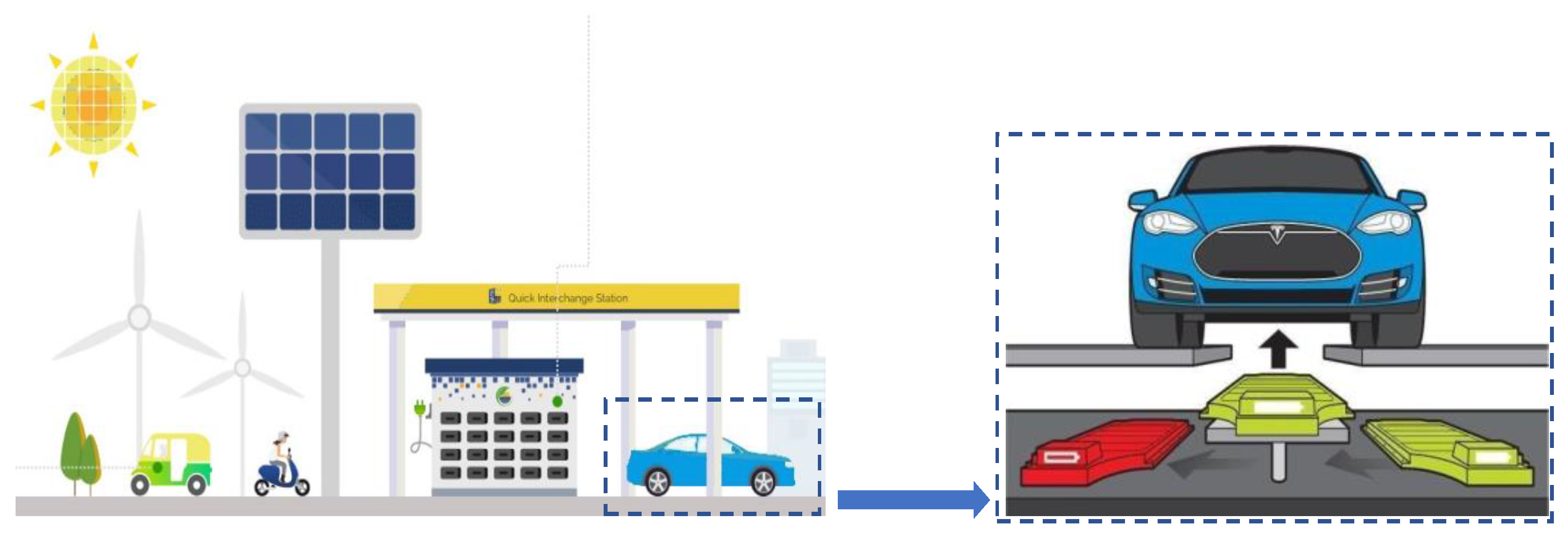
Battery swap stations (BSSs) were originally implemented by the company Better Place, which went out of business in 2013 [15]. Then, five cities in China start testing BSS technology, where they serve personal vehicles, and commercial vehicles [21]. Although BSSs best replicate the experience of existing gas stations, there are still issues that prevent their wide-scale implementation. These include battery ownership, high battery purchase cost, complicated battery standardization issues, and safety issues in the swap and charge process. Since not only do an increasing number of EV consumers expect charging approaches that include short charging times (similar to refueling their current fuel vehicles) [22], but also global economic growth means more people can afford high-cost options, the SCEV mode is becoming increasingly popular [4,19,23,24,25]. SCEVs are good in that they have both fast and economical charging modes [4,26,27]. As shown in Figure 1, a driver can drive into a battery swap station, and a robot replaces the depleted battery with a fully charged spare [28,29]. This swap time could be very short (e.g., less than one minute based on a report from Tesla) with further automation and refinements on the vehicle [30].
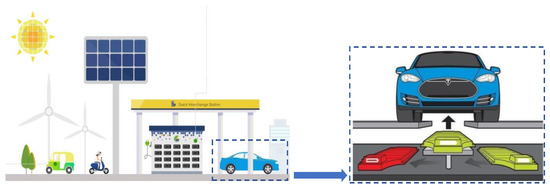
Figure 1.
Battery swap automation and refinements on the vehicle (figure source: SUN mobility and Tesla).
Swap charging (SC) can reduce the peak consumption of electricity by centralized charging [30,31] and avoid grid overloading due to mass EV charging [32] because the empty batteries that are swapped out can be charged when electricity is cheap or demand is low. Since SCEVs are considered to be a suitable EV mode, an increasing number of studies on the SC system (SCS) have emerged worldwide [4,19,25,27,33]. The Fluence Z.E. was the first electric car enabled with battery swapping technology and deployed within the Better Place network in Israel and Denmark in 2012 [4,20,27]. Then, with the advanced SC technology, fully automatic battery swapping was even faster than refueling at gas stations. NIO proposed the smallest power swap station in the world which only took up three parking spaces [2,31]. Based on these state-off-the-art battery swapping technologies’ tests, some researchers have proposed an advanced concept called shared SCS (SSCS) [31]. The SSCS is an SCS that can provide heterogeneous services and requires online reservations in advance. The SSCS has a lot of differences from the regular SCS mode, and the comparisons are shown in Table 2.
Table 2.
Comparisons between the SCS mode and SSCS mode *.
The SCS and the SSCS proposed in this paper are both used for SCEVs, which separate the batteries from the vehicles and allow the SC mode. The SSCS has a few new features, as listed below:
- Reserved charging demand: This feature differs this system from the regular SCS, which can supply service on a come and served basis, as the newly proposed SSCS requires online reservations in advance. All vehicle service strategies (e.g., routing and swapping battery types) can be calculated according to their origins and destinations (ODs), their initial battery power level, etc.
- Multi-type battery supplied: The SCS can only provide fully charged batteries [29], while the SSCS can provide online reservations and allow the BSS to optimally deploy their state of charge (SOC) battery.
- Accurate cost calculated: Different from a regular SCS, where the economic essence is battery leasing, the SSCS conducts energy leasing. In the pricing strategy, the SCS sets a price for each battery, while the SSCS sets a price for the process of recharging the depleted battery to the same power level as the new battery.
- Charging rate considered: In this proposed system, the recharge cost of depleted batteries is calculated by considering the battery charging rate curve. The SSCS can help achieve an optimal charging strategy and improve energy usage efficiency.
1.1. Literature Review
Since public power charging infrastructure plays a critical role in EV systems [7,14,34], an increasing number of researchers have begun to focus on EV routing problems under SC technology and with the battery charging dispatch model [1,4,20,24,25,27,29,30,35], which holds promise to realize long-distance EV travel [4,20]. Here, we summarize some applications and modeling attempts to develop SC in recent years, as shown in Table 3, and the findings can be briefly synthesized as follows.
Table 3.
Comparison between existing related SC models and our model *.
- The battery charging dispatch model was set up from the grid side to minimize the total cost (e.g., infrastructure deployment cost [4] and sequential decision cost [26]) while satisfying various physical constraints. Later, an increasing number of researchers began focusing on the transportation side due to the massive traffic issue and then dealt with this SCS as a vehicle routing problem (VRP) [27,36,37], location routing problem (LRP) [3,24,38], or battery dispatch management problem [15,26,29,32,39,40]. In this paper, we propose vehicle routing and battery dispatching as two vital indices for optimizing an SSCS.
- Due to technological or application limitations (i.e., an internet-based booking platform; BSS operation information processing center (IPC); centralized vehicle introduction systems) over the past few years, there are only a limited number of recent studies [27] on the BSS online reservation system that focused on various vehicle demands. This study proposes a new operational mode under a new information system (i.e., vehicles require advanced reservations and the IPC gives various service strategies).
- Most previous studies provided only a single battery type (i.e., fully charged battery) [4,36,40], and they only allow depleted batteries to be replaced by a standard SOC battery. However, some researchers have considered providing multi-type batteries, as stated in the references [15,27,29], and the introduction of varying SOC batteries gives more flexibility in optimal applications. Since our SSCS model is based on the battery charging rate, we propose an optimal operation strategy, deploying multi-type batteries simultaneously.
Although research focusing on BSS strategies has been ongoing, the results are fragmented. Currently, an integrated way of considering the VRP, battery dispatching, and battery charging efficiency (considering the battery charging rate) has not been fully investigated. To bridge these research gaps and realize the vision of the SSCS, this paper proposes an exact approach to describe the EV routing problem and BSS battery dispatching and determine the optimal SSCS design to minimize the overall system operational cost. We formulate this problem into a binary programming model so that it can deal with the various large-scale strategy issues. This model has a binary decision variable and thus quickly solves an exact solution by off-the-shelf commercial solvers (e.g., Gurobi).
1.2. Contributions
This paper focuses on SC technology and proposes a new structured SSCS to overcome the difficulties in optimal swap battery strategies for a large number of EVs with charging requests and simultaneously considers the varying battery charging rate. The contributions of this paper are mainly three-fold.
- First, we propose an innovative binary programming SSCS model to balance the tradeoff between the vehicle travel cost and battery dispatching cost. This model is a linear integer problem that solves exact solutions by off-the-shelf commercial solvers (e.g., Gurobi).
- Second, we propose an optimal operation strategy for deploying multi-type batteries and simultaneously consider the charging process. In this process, a large number of various charging requests with various initial battery power levels are given various charging strategies (i.e., optimal routes to BSS and battery types). These charging strategies can help improve charging efficiency and minimize the overall system operational cost.
- Finally, a numerical example with real-world freeway data from Guangdong Province, China is conducted to demonstrate the applicability of the proposed model and its effectiveness in reducing construction costs. Overall, this paper provides valuable insights into the future integration of BSSs into long-distance freeway services and offers a numerical method for designing an optimal operational plan for this integrated system.
The remainder of this paper is organized as follows. Section 2 introduces the operation characteristics, notation, and concept of the proposed SSCS. Section 3 formulates the SSCS model with alternative systems. Section 4 tests the proposed model with a numerical example in China and conducts corresponding sensitivity analyses. Finally, Section 5 provides conclusions and recommends future research directions.
2. Model Description
This section introduces the operational process of the SSCS and underlying assumptions. For the convenience of readers, we list some notation frequently used in the paper in Table 4.
Table 4.
Notation.
Consider a set of vehicle stations in space. For each vehicle station , there is a BSS. These stations can also be the ODs of vehicles. Consider a set of batteries with varying SOC } that a shared BSS can provide. Let denote the battery SOC. For each station, the number of battery types can be different. Consider a set of the vehicle trip characteristic index which has a series of various travel demands (i.e., origin station , destination station , and the initial state of the battery charge ). Let denote whether vehicle heads to station and replaces the depleted battery with a well-charged battery in the state of .
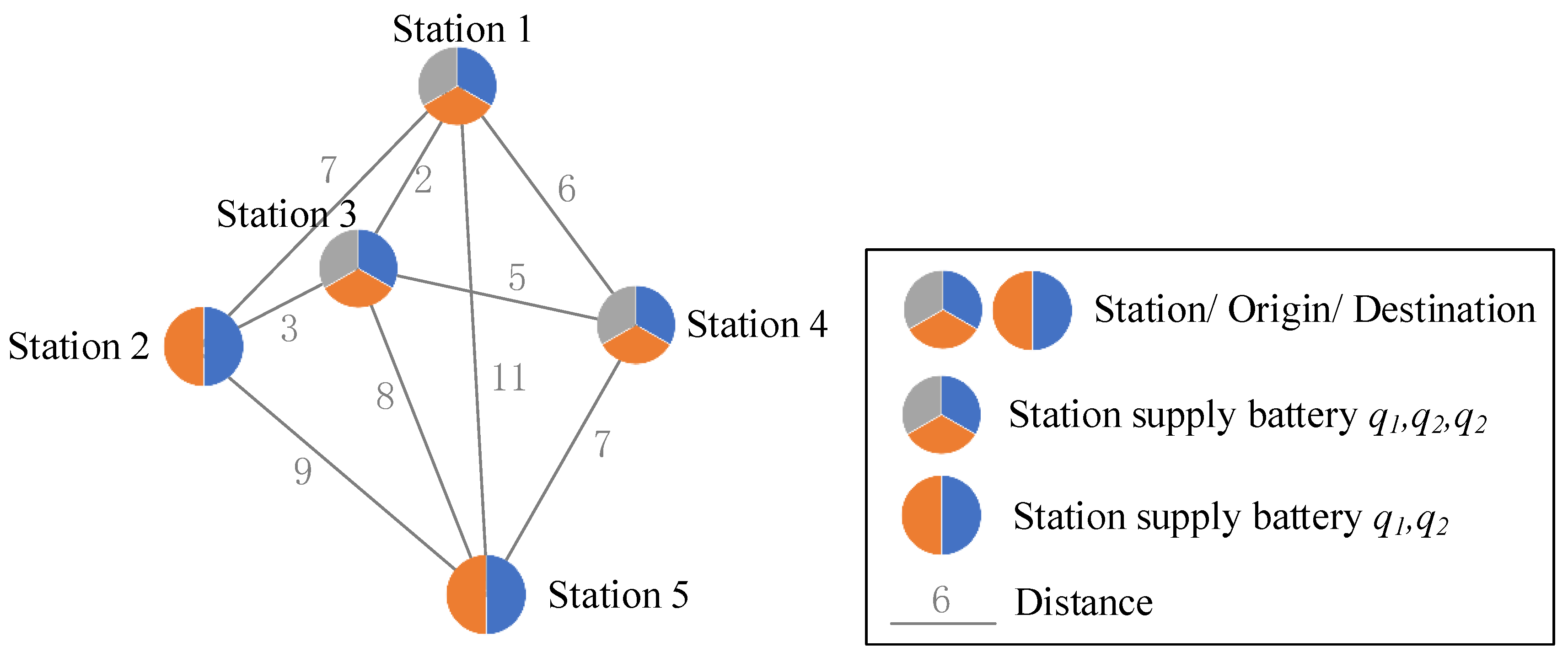
To fully understand the operation process of an SSCS, Figure 2 shows an example with shared BSS stations and three types of battery SOCs . In this figure, on each link between two stations, the segment of a different number represents the travel distance between the stations. The different combinations of colors for the stations represent the battery types they provide.
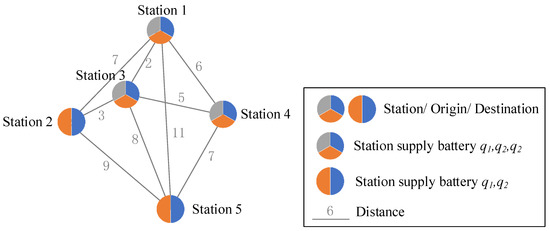
Figure 2.
Example network with different battery mode supplies in the SSC station.
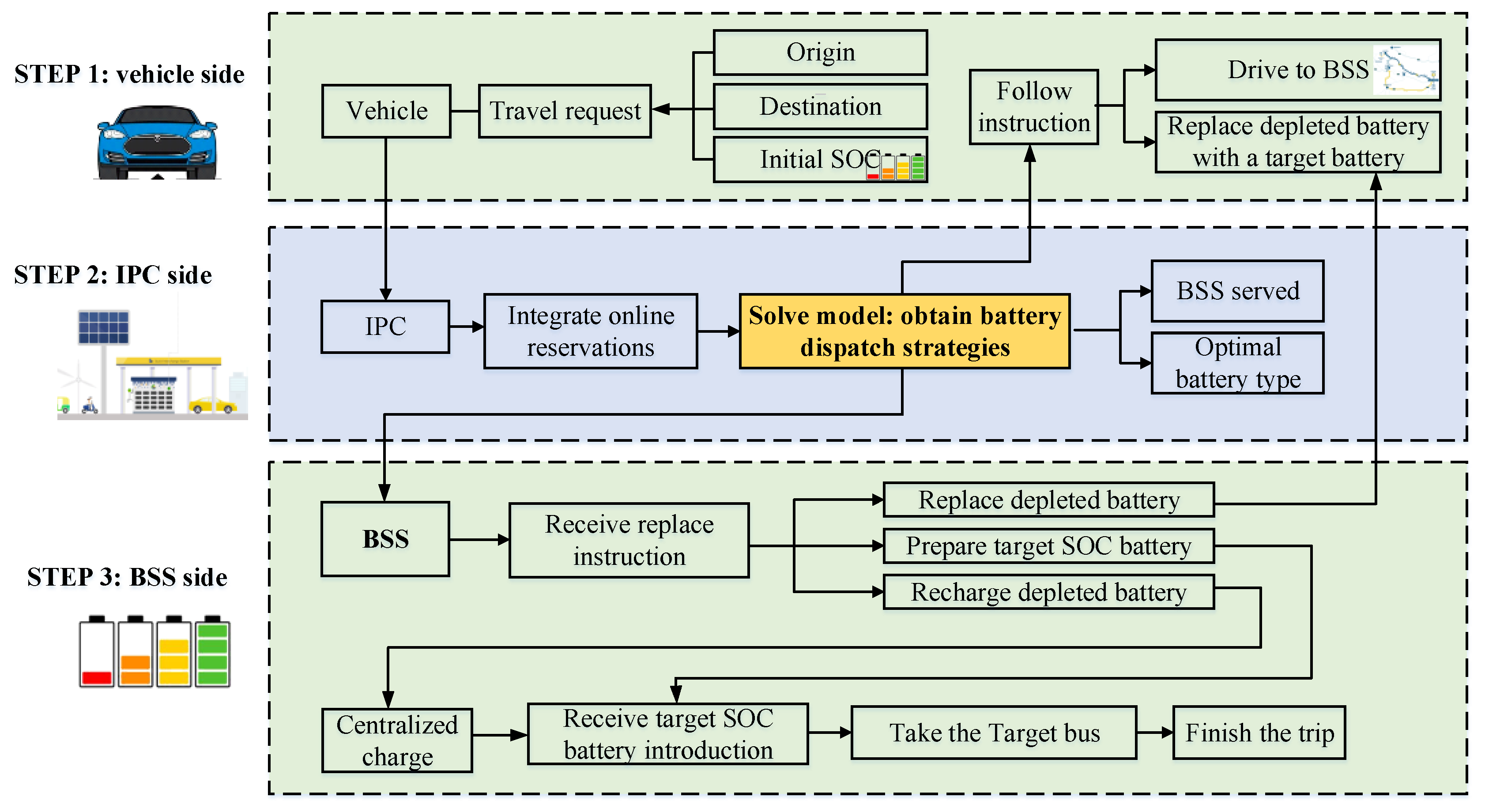
In the SSCS, the entire operation process can be divided into three steps, as shown in Figure 3. The vehicle side allows the EV to make online reservations in advance and then follow the instructions from the IPC. The IPC side requires all the vehicles and BSSs to follow centralized guidance, and the BSS side follows the optimal battery replacement and charging strategies. All these system components operate smoothly under the proposed SSCS model.
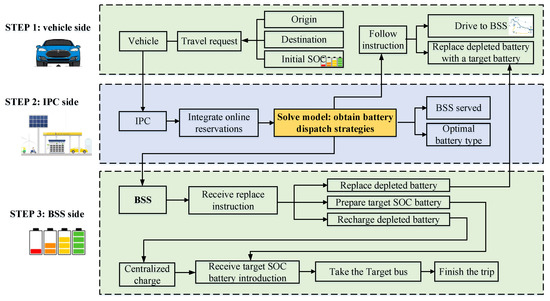
Figure 3.
Operation process in the SSCS. Abbreviation: IPC—information processing center.
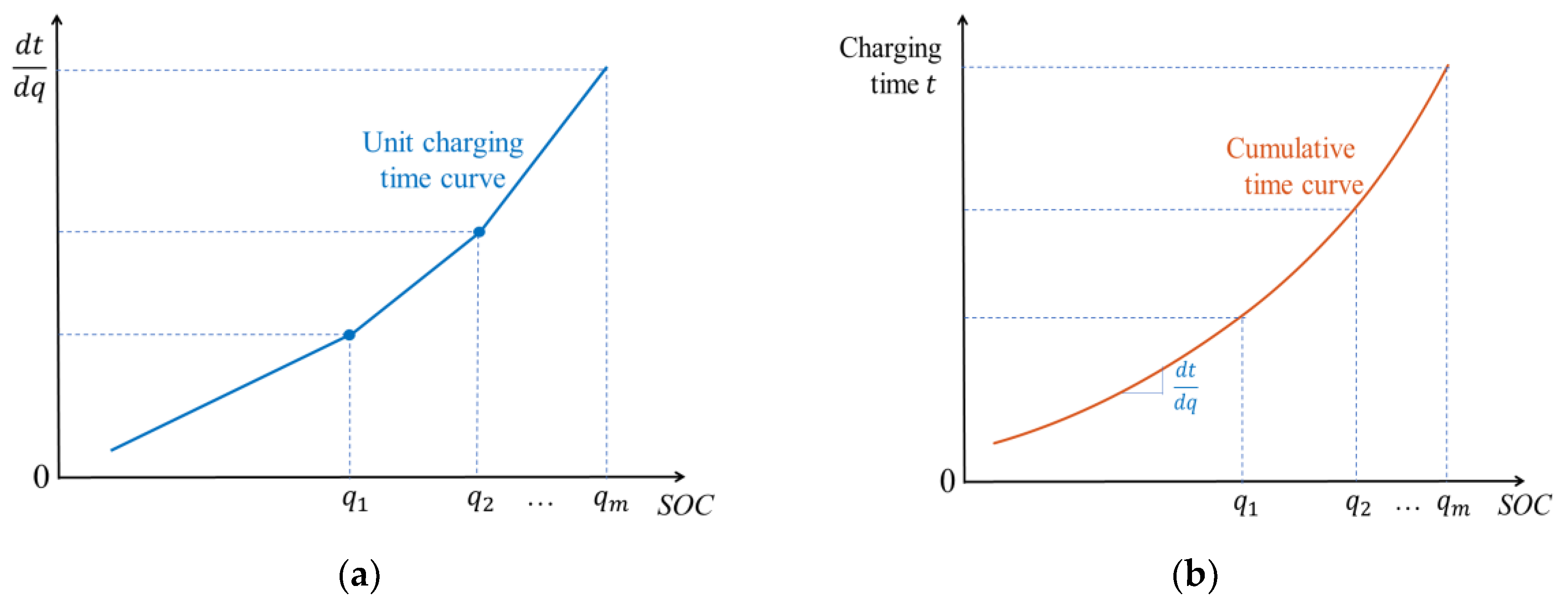
In previous studies [29,41,42,43], the battery charging rate is a concave function that satisfies formula . The charging time function can be approximately formulated as a piecewise function . In Figure 4, we plot the varying SOC (), the battery charging rate (), and the cumulative time functions of the SOCs of the batteries.
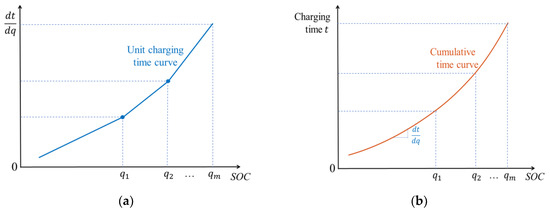
Figure 4.
Performances of charging times with current battery power levels: (a) curve of the varying SOC () and the battery charging rate ( ); (b) cumulative time curve of the SOCs of batteries.
To facilitate the model formulation, we introduce the following assumptions in the investigated problem. These assumptions have been used in other studies on operational design for the SC battery system.
Assumption 1.
The battery power consumption of EVs is proportional to the driving distance [37,44]. It is hard to relax this assumption when a battery consumed along a stretch of road is not dependent on the distance; then, the problem becomes an NP-hard problem and appears to be mathematically intractable [14,45,46].
Assumption 2.
All vehicles in our system share the same battery capacity size. In the previous study, many researchers have already focused on optimizing the battery size to reach a better system income [47].
Assumption 3.
All vehicles in this system reserve swap batteries online and follow the instructions. This assumption will not be strict in the future because of the connected and autonomous vehicle atmosphere and because it has already been applied in previous studies [27].
3. Model Formulation
This section provides a model formulation of the investigated problems. Section 3.1 proposes a model to describe the above-defined SSCS problem. Section 3.2 puts forward the physical constraints that make this model applicable in real-world cases. Finally, Section 3.3 compares this proposed system with the benchmark system.
3.1. Objective Function
The objective function formulated in Equation (1) aims to minimize the SSCS system operational costs, which includes three components: the travel cost of the detour in the swapping battery process (), the total battery cost in the battery recharging process (), and the residual value of electricity power in moving EVs ().
As shown in Equation (2), denotes the travel cost of the detour in the swapping battery process, and denotes the unit detour cost. Let denote the distance of the charging detour, . The total battery cost in the battery recharging process includes charging time costs and charging energy consumption costs. The total battery recharge cost is cumulative and can be calculated by Equation (3). In this formula, let denote the unit time cost for the battery charging process, and let denote the unit power cost for the battery charging process. Equation (4) presents the electricity power residual values of the EVs.
3.2. Constraints
The above objective function is subject to a set of constraints, as formulated below.
Constraints (5) and (6) are related to the safety constraints, which mandates that for each vehicle in the SSCS, the lowest power level value should always exceed the lowest level value () on the right-hand side (RHS). The left-hand side (LHS) in Constraint (5) denotes the battery power level of vehicle when it obtains access to a BSS, and the LHS in Constraint (6) denotes the battery power level when vehicle finishes its trip at its destination. Constraint (7) is a limitation that the SOC of a new swap battery is always higher than the SOC of the depleted battery. Constraint (8) is proposed to limit the EV to only swap the battery once in this model, and the side effects of this constraint can be relieved by multiple inputs and by solving this model. In the future, we will try to put forward a more integrated model. Constraint (9) sets some general constraints of the model, which are related to the network battery power balance, similar to reference [38], which describes the maximum permitted capacity of the battery swapped in each BSS.
3.3. Alternative Systems
A single-type battery system (STBS) is used as an alternative system. The only difference between the STBS and SSCS is that each BSS can only supply a fixed SOC of in an STBS, while the SSCS can supply multiple types of SOCs.
4. Numerical Example
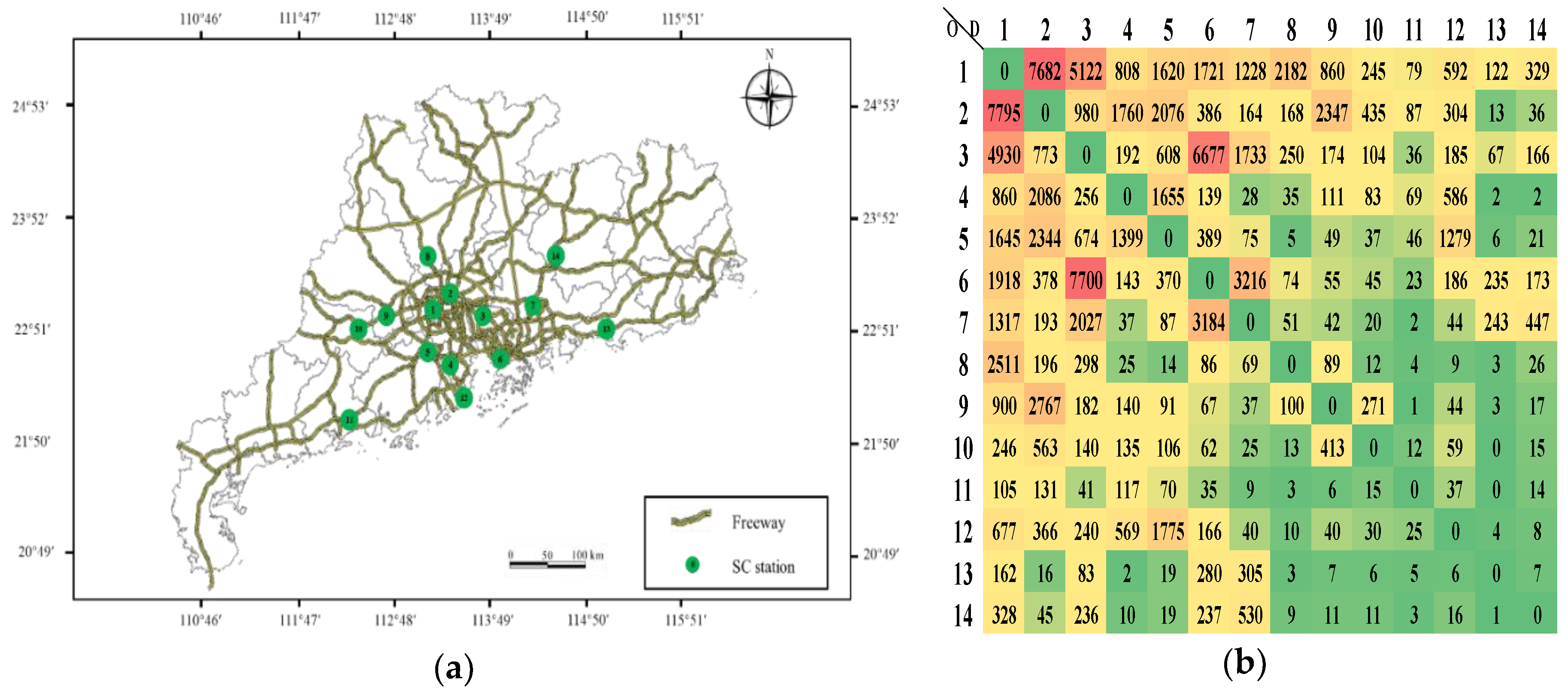
To examine the model performance over different network topologies, we present a numerical example with the designed SSCS over the Guangdong Province freeway network and compare it with the alternative STBS simultaneously. As shown in Figure 5a, the input data included 205,876 records of vehicles passing through 14 key toll stations between 17:00 and 18:00 throughout May 2019. We obtained the corresponding vehicle OD demands, as shown in Figure 5b, and assumed that 50% of the passengers use SCEVs. Then, we assumed that the initial battery SOC of these vehicles followed a random distribution.
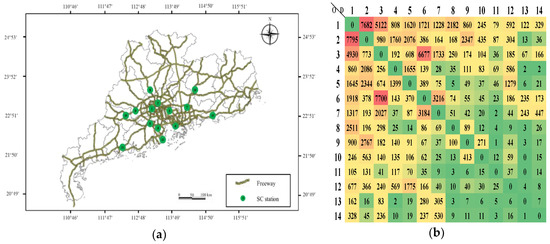
Figure 5.
The input data for this numerical example: (a) designed BSSs in Guangdong Province, China; (b) origin and destination (OD) demand distribution.
4.1. Input Parameters
All experiments were performed on a PC with an Intel® Core™ i7-8550U @1.99 GHz CPU and 24 GB RAM. The code was implemented in MATLAB 2019a, calling a commercial solver Gurobi [48,49,50]. The charging rate we used is normally and approximately fitted to a linear function [41,42], and in this paper, we selected the parameters considering both the vehicle battery characteristics and electric grid characteristics, which are . Other default parameter values were stated in Table 5.
Table 5.
Default parameter settings.
4.2. Optimal Location Result
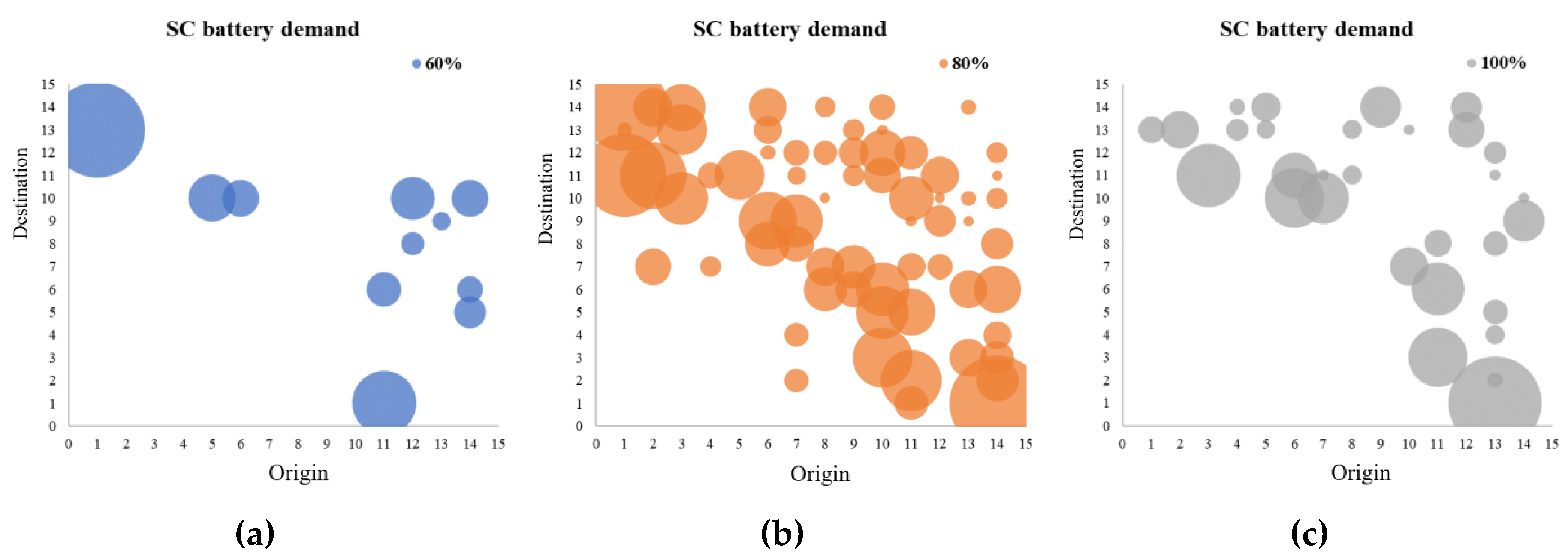
By solving the proposed SSCS model, the optimal objective value (system operational cost) is 926.3, with a CPU time of 0.6359 s. Figure 6 shows the battery swaps of different OD pairs. In this figure, on each row and column intersection, the different color circles represent the different battery types (i.e., SOC ), and the circle size represents the type of dispatch frequency. The results show that the total number of batteries swapped for SOC types of 60%, 80%, and 100% are 139, 940, and 352, respectively.
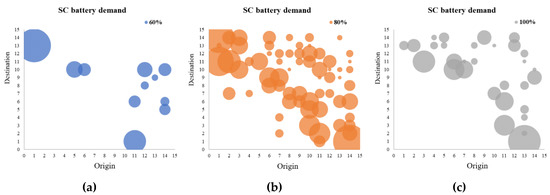
Figure 6.
Battery swaps with different OD pairs with battery SOCs of (a) ; (b) ; and (c) .
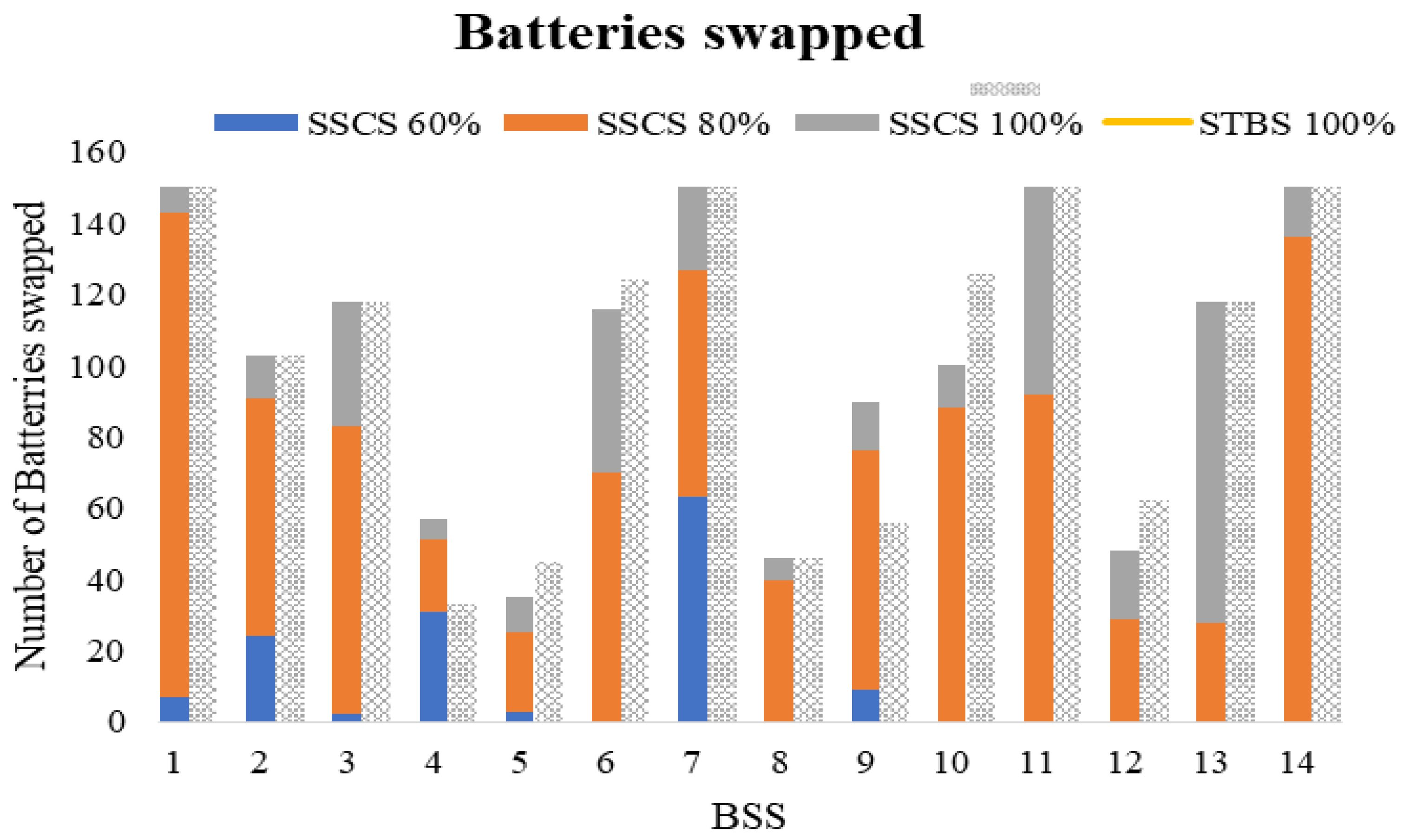
We compared the SSCS solutions with the benchmark STBS. In this experiment, we compared the system operational cost and the average battery level before and after SC, with the average energy gap filled, the average battery level at the destination, and the average energy consumption over the traveled distance as the criteria to evaluate the performance of the proposed system. Figure 7 shows the comparison between the SSCS and STBS in a multi-type battery deployment. Most of the batteries deployed in the SSCS and STBS were the same except for stations 4, 5, 9, 10, and 12, which indicates that the introduction of multiple types of batteries does not significantly change the total amount of battery management.
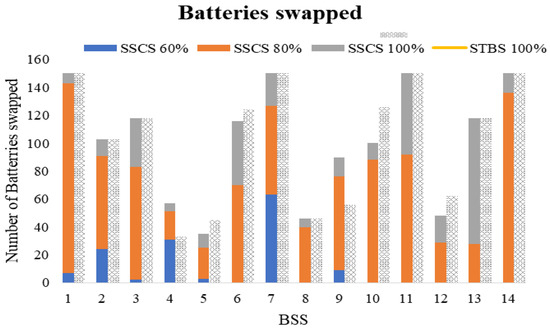
Figure 7.
Comparison of the number of swapped batteries.
More detailed results are shown in Table 6. As we can determine from the comparison result, the total number of batteries the two systems swapped was the same (i.e., 1431). Since they share different battery types (i.e., SSCS has multi-type batteries, and STBS has single-type batteries), their optimal battery levels are different. Compared to the average battery level before SC, the optimal battery level of the STBS (65%) was much higher than that of the SSCS (32.1%), which is not efficient for energy usage. When compared to the average energy gap the charging process fills, the performance of the SSCS (50.9%) was also better than that of the STBS (35%), which is significantly related to the SC efficiency. Since the average energy consumption for traveled distance was similar (SSCS and STBS are 53% and 54%, respectively), the detour distance did not make a noticeable impact. Overall, the multi-type SC strategies for the SSCS could reduce the system operational cost (54.3%) when compared with the STBS.
Table 6.
Results comparison with the alternative system.
4.3. Sensitivity Analysis
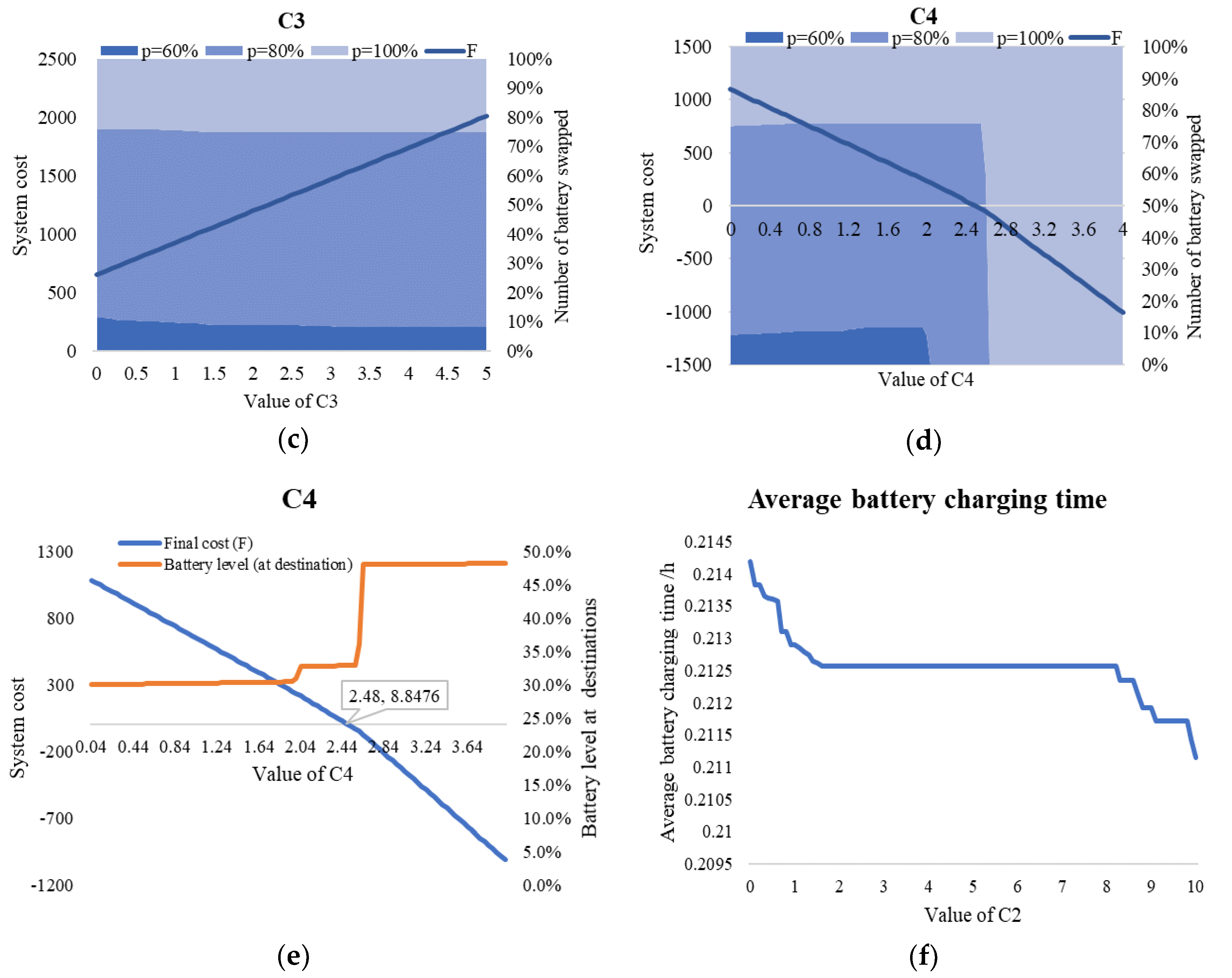
This section analyzes the sensitivity of critical parameters to the cost components in the SSCS. In each instance, only one parameter is varied, and the other parameters maintain their default values. To evaluate the performances of different parameter combinations, we compared the overall system cost and the multi-type battery combinations. To simplify the sensitivity analysis for vectors , , and , we varied the values of these parameters and plotted the results in Figure 8. The findings can be briefly summarized as follows.
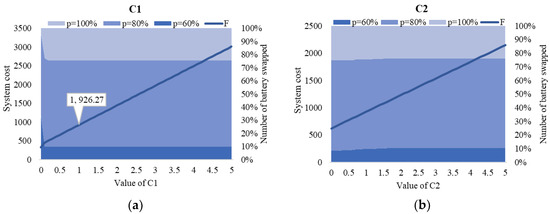
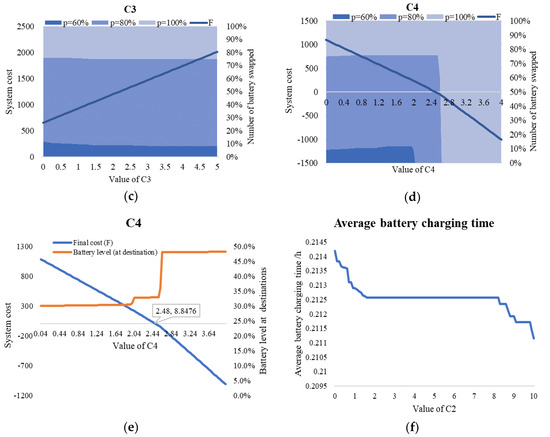
Figure 8.
System operational cost performance and number of batteries swapped with varying values of (a) ; (b) ; (c) ; and (d) . (e) Average battery charging time with varying . (f) System operational cost performance and battery level at the destination with varying .
- We perform a regression analysis of , , , and with the system operational cost (simplified as ), as shown in Figure 8a–d and obtain with . This result reveals a high linear correlation with all four critical parameters.
- The optimal result of battery type performance stability with varying values of , , and is shown in Figure 8. The varying value of can change the optimal strategy significantly, as shown in Figure 8d,e. The increased value of would result in an increased number of vehicles holding more residual energy at the destination.
- Figure 8f shows the performance of the average battery charging time with varying . We learn that is related to the unit time cost for the battery charging process, and it reaches a plateau period when the value of is over 1.5.
5. Conclusions
SC technology offers the possibility of EVs swapping batteries with other EVs and provides plausible solutions for realizing a long-distance freeway trip. By taking advantage of SC technology, this paper proposes an exact approach to describe SSCS operations and determine the optimal SSCS design (i.e., optimal swap battery strategies for EVs with charging requests and the consideration of varying battery charging rates simultaneously) to minimize the overall system operational cost. In this proposed SSCS system, we formulated this problem into a binary integer programming model that could be solved by off-the-shelf commercial solvers (e.g., Gurobi). We explored a numerical example to illustrate the applications of this model from the freeway system in Guangdong Province, China, and compare it with alternative systems (the STBS). The SSCS was shown to be more effective than the alternative (e.g., a reduction of 54.3% in system operational cost).
This study can be extended in several directions. Future research can be conducted to explore the dynamic and stochastic demands of SCEVs, more variables such as maintenance and service levels of BSSs, variation of electricity prices, more complicated multi-type SC strategy combinations, associated vehicle coordination, more efficient customized solution methodologies, and the allowance of these vehicles to participate in peak shaving and valley filling to improve unreasonable charging and discharging. Moreover, it would be interesting to examine the impact of combinations of autonomous, modular, and EV technologies into this SSCS.
Author Contributions
The authors confirm the contributions to this paper are as follows: study conception and design, L.Z.; data collection, M.P.; analysis and interpretation of results, L.Z. and M.P.; draft manuscript preparation, L.Z. and M.P. All authors have read and agreed to the published version of the manuscript.
Funding
This work was supported by the National Natural Science Foundation of China under Grants U1811463.
Acknowledgments
The China Scholarship Council and its financial support are highly acknowledged.
Conflicts of Interest
The authors declare no conflicts of interest.
References
- Zheng, Y.; Dong, Z.Y.; Xu, Y.; Meng, K.; Zhao, J.H.; Qiu, J. Electric vehicle battery charging/swap stations in distribution systems: Comparison study and optimal planning. IEEE Trans. Power Syst. 2014, 29, 221–229. [Google Scholar] [CrossRef]
- Mechthild Wörsdörfer. Global EV Outlook 2019; International Energy Agency: Paris, France, 2019. [Google Scholar]
- Yang, J.; Sun, H. Battery swap station location-routing problem with capacitated electric vehicles. Comput. Oper. Res. 2015, 55, 217–232. [Google Scholar] [CrossRef]
- Mak, H.Y.; Rong, Y.; Shen, Z.J.M. Infrastructure planning for electric vehicles with battery swapping. Manag. Sci. 2013, 59, 1557–1575. [Google Scholar] [CrossRef]
- Sierzchula, W.; Bakker, S.; Maat, K.; Van Wee, B. The influence of financial incentives and other socio-economic factors on electric vehicle adoption. Energy Policy 2014, 68, 183–194. [Google Scholar] [CrossRef]
- Chen, A.; Zhou, Z.; Chootinan, P.; Ryu, S.; Yang, C.; Wong, S.C. Transport Network Design Problem under Uncertainty: A Review and New Developments. Transp. Rev. 2011, 31, 743–768. [Google Scholar] [CrossRef]
- Nie, Y.; Ghamami, M. A corridor-centric approach to planning electric vehicle charging infrastructure. Transp. Res. Part B Methodol. 2013, 57, 172–190. [Google Scholar] [CrossRef]
- Deflorio, F.; Guglielmi, P.; Pinna, I.; Castello, L.; Marfull, S. Modeling and analysis of wireless “charge while driving” operations for fully electric vehicles. Transp. Res. Procedia 2015, 5, 161–174. [Google Scholar] [CrossRef][Green Version]
- Mouhrim, N.; El Hilali Alaoui, A.; Boukachour, J. Optimal allocation of wireless power transfer system for electric vehicles in a multipath environment. In Proceedings of the 2016 3rd International Conference on Logistics Operations Management (GOL), Fez, Morocco, 23–25 May 2016. [Google Scholar]
- Liu, Z.; Song, Z. Robust planning of dynamic wireless charging infrastructure for battery electric buses. Transp. Res. Part C Emerg. Technol. 2017, 83, 77–103. [Google Scholar] [CrossRef]
- Zhao, M.; Li, X.; Yin, J.; Cui, J.; Yang, L.; An, S. An integrated framework for electric vehicle rebalancing and staff relocation in one-way carsharing systems: Model formulation and Lagrangian relaxation-based solution approach. Transp. Res. Part B Methodol. 2018, 117, 542–572. [Google Scholar] [CrossRef]
- Ko, Y.D.; Jang, Y.J.; Lee, M.S. The optimal economic design of the wireless powered intelligent transportation system using genetic algorithm considering nonlinear cost function. Comput. Ind. Eng. 2015, 89, 67–79. [Google Scholar] [CrossRef]
- Yatnalkar, G.; Narman, H. Survey on Wireless Charging and Placement of Stations for Electric Vehicles. In Proceedings of the 2018 IEEE International Symposium on Signal Processing and Information Technology (ISSPIT), Louisville, KY, USA, 6–8 December2018; pp. 526–531. [Google Scholar]
- Chen, Z.; He, F.; Yin, Y. Optimal deployment of charging lanes for electric vehicles in transportation networks. Transp. Res. Part B Methodol. 2016, 91, 344–365. [Google Scholar] [CrossRef]
- Sepetanc, K.; Pandzic, H. A Cluster-Based Operation Model of Aggregated Battery Swapping Stations. IEEE Trans. Power Syst. 2020, 1, 249–260. [Google Scholar] [CrossRef]
- Bansal, P. Charging of Electric Vehicles: Technology and Policy Implications. J. Sci. Policy Gov. 2015, 6, 1–20. [Google Scholar]
- Machura, P.; Li, Q. A critical review on wireless charging for electric vehicles. Renew. Sustain. Energy Rev. 2019, 104, 209–234. [Google Scholar] [CrossRef]
- Jang, Y.J. Survey of the operation and system study on wireless charging electric vehicle systems. Transp. Res. Part C Emerg. Technol. 2018, 95, 844–866. [Google Scholar] [CrossRef]
- Yang, J.; Guo, F.; Zhang, M. Optimal planning of swapping/charging station network with customer satisfaction. Transp. Res. Part E Logist. Transp. Rev. 2017, 103, 174–197. [Google Scholar] [CrossRef]
- Schneider, F.; Thonemann, U.W.; Klabjan, D. Optimization of battery charging and purchasing at electric vehicle battery swap stations. Transp. Sci. 2018, 52, 1211–1234. [Google Scholar] [CrossRef]
- Du, J.; Ouyang, M. Review of electric vehicle technologies progress and development prospect in China. In Proceedings of the 2013 World Electric Vehicle Symposium and Exhibition (EVS27), Barcelona, Spain, 17–20 November 2013; pp. 1–8. [Google Scholar]
- Pérez, J.M.G. Emerging Technologies for Electric and Hybrid Vehicles; MDPI: Basel, Switzerland, 2018; ISBN 3038971901. [Google Scholar]
- Mohamed, A.A.S.; Meintz, A.; Zhu, L. System Design and Optimization of In-Route Wireless Charging Infrastructure for Shared Automated Electric Vehicles. IEEE Access 2019, 7, 79968–79979. [Google Scholar] [CrossRef]
- Hof, J.; Schneider, M.; Goeke, D. Solving the battery swap station location-routing problem with capacitated electric vehicles using an AVNS algorithm for vehicle-routing problems with intermediate stops. Transp. Res. Part B Methodol. 2017, 97, 102–112. [Google Scholar] [CrossRef]
- Masmoudi, M.A.; Hosny, M.; Demir, E.; Genikomsakis, K.N.; Cheikhrouhou, N. The dial-a-ride problem with electric vehicles and battery swapping stations. Transp. Res. Part E Logist. Transp. Rev. 2018, 118, 392–420. [Google Scholar] [CrossRef]
- Yang, S.; Yao, J.; Kang, T.; Zhu, X. Dynamic operation model of the battery swapping station for EV (electric vehicle) in electricity market. Energy 2014, 65, 544–549. [Google Scholar] [CrossRef]
- Adler, J.D.; Mirchandani, P.B. Online routing and battery reservations for electric vehicles with swappable batteries. Transp. Res. Part B Methodol. 2014, 70, 285–302. [Google Scholar] [CrossRef]
- Adegbohun, F.; von Jouanne, A.; Lee, K.Y. Autonomous battery swapping system and methodologies of electric vehicles. Energies 2019, 12, 667. [Google Scholar] [CrossRef]
- Ding, T.; Bai, J.; Du, P.; Qin, B.; Li, F.; Ma, J.; Dong, Z. Rectangle packing problem for battery charging dispatch considering uninterrupted discrete charging rate. IEEE Trans. Power Syst. 2019, 34, 2472–2475. [Google Scholar] [CrossRef]
- Kang, Q.; Wang, J.; Zhou, M.; Ammari, A.C. Centralized Charging Strategy and Scheduling Algorithm for Electric Vehicles under a Battery Swapping Scenario. IEEE Trans. Intell. Transp. Syst. 2016, 17, 659–669. [Google Scholar] [CrossRef]
- Yang, J.; Wang, W.; Ma, K.; Yang, B. Optimal Dispatching Strategy for Shared Battery Station of Electric Vehicle by Divisional Battery Control. IEEE Access 2019, 7, 38224–38235. [Google Scholar] [CrossRef]
- Sun, B.; Sun, X.; Tsang, D.H.K.; Whitt, W. Optimal battery purchasing and charging strategy at electric vehicle battery swap stations. Eur. J. Oper. Res. 2019, 279, 524–539. [Google Scholar] [CrossRef]
- He, F.; Yin, Y.; Lawphongpanich, S. Network equilibrium models with battery electric vehicles. Transp. Res. Part B Methodol. 2014, 67, 306–319. [Google Scholar] [CrossRef]
- He, F.; Wu, D.; Yin, Y.; Guan, Y. Optimal deployment of public charging stations for plug-in hybrid electric vehicles. Transp. Res. Part B Methodol. 2013, 47, 87–101. [Google Scholar] [CrossRef]
- Worley, O.; Klabjan, D. Optimization of battery charging and purchasing at electric vehicle battery swap stations. In Proceedings of the 2011 IEEE Vehicle Power and Propulsion Conference, Chicago, IL, USA, 6–9 September 2011; pp. 1–4. [Google Scholar]
- Jie, W.; Yang, J.; Zhang, M.; Huang, Y. The two-echelon capacitated electric vehicle routing problem with battery swapping stations: Formulation and efficient methodology. Eur. J. Oper. Res. 2019, 272, 879–904. [Google Scholar] [CrossRef]
- Chen, J.; Qi, M.; Miao, L. The Electric Vehicle Routing Problem with Time Windows and Battery Swapping Stations. IEEE Int. Conf. Ind. Eng. Eng. Manag. 2016, 2016, 712–716. [Google Scholar]
- Amiri, S.S.; Jadid, S.; Saboori, H. Multi-objective optimum charging management of electric vehicles through battery swapping stations. Energy 2018, 165, 549–562. [Google Scholar] [CrossRef]
- Widrick, R.S.; Nurre, S.G.; Robbins, M.J. Optimal policies for the management of an electric vehicle battery swap station. Transp. Sci. 2018, 52, 59–79. [Google Scholar] [CrossRef]
- Infante, W.; Ma, J.; Han, X.; Liebman, A. Optimal Recourse Strategy for Battery Swapping Stations Considering Electric Vehicle Uncertainty. IEEE Trans. Intell. Transp. Syst. 2019, 1–11. [Google Scholar] [CrossRef]
- Ouyang, D.; Chen, M.; Liu, J.; Wei, R.; Weng, J.; Wang, J. Investigation of a commercial lithium-ion battery under overcharge/over-discharge failure conditions. RSC Adv. 2018, 8, 33414–33424. [Google Scholar] [CrossRef]
- Chen, Z.; Liu, W.; Yin, Y. Deployment of stationary and dynamic charging infrastructure for electric vehicles along traffic corridors. Transp. Res. Part C Emerg. Technol. 2017, 77, 185–206. [Google Scholar] [CrossRef]
- Koç, Ç.; Jabali, O.; Mendoza, J.E.; Laporte, G. The electric vehicle routing problem with shared charging stations. Int. Trans. Oper. Res. 2019, 26, 1211–1243. [Google Scholar] [CrossRef]
- Wu, X.; Freese, D.; Cabrera, A.; Kitch, W.A. Electric vehicles’ energy consumption measurement and estimation. Transp. Res. Part D Transp. Environ. 2015, 34, 52–67. [Google Scholar] [CrossRef]
- Smith, O.J.; Boland, N.; Waterer, H. Solving shortest path problems with a weight constraint and replenishment arcs. Comput. Oper. Res. 2012, 39, 964–984. [Google Scholar] [CrossRef]
- Laporte, G.; Pascoal, M.M.B. Minimum cost path problems with relays. Comput. Oper. Res. 2011, 38, 165–173. [Google Scholar] [CrossRef]
- Hwang, I.; Jang, Y.J.; Ko, Y.D.; Lee, M.S. System Optimization for Dynamic Wireless Charging Electric Vehicles Operating in a Multiple-Route Environment. IEEE Trans. Intell. Transp. Syst. 2018, 19, 1709–1726. [Google Scholar] [CrossRef]
- Cochran, J.J.; Cox, L.A.; Keskinocak, P.; Kharoufeh, J.P.; Smith, J.C.; Linderoth, J.T.; Lodi, A. MILP Software. In Wiley Encyclopedia of Operations Research and Management Science; John Wiley & Sons Inc.: Hoboken, NJ, USA, 2011. [Google Scholar]
- Zhang, Y.; D’Ariano, A.; He, B.; Peng, Q. Microscopic optimization model and algorithm for integrating train timetabling and track maintenance task scheduling. Transp. Res. Part B Methodol. 2019, 127, 237–278. [Google Scholar] [CrossRef]
- Fuentes, M.; Cadarso, L.; Marín, Á. A hybrid model for crew scheduling in rail rapid transit networks. Transp. Res. Part B Methodol. 2019, 125, 248–265. [Google Scholar] [CrossRef]
© 2020 by the authors. Licensee MDPI, Basel, Switzerland. This article is an open access article distributed under the terms and conditions of the Creative Commons Attribution (CC BY) license (http://creativecommons.org/licenses/by/4.0/).