


Coronary artery aneurysm formation following percutaneous coronary intervention (PCI) with drug-eluting stents is a known, infrequent complication, causing late acquired strut malapposition, a potential trigger for in-stent thrombosis [1]. First generation durable-polymer sirolimus-eluting stents showed a significant association with coronary evaginations on optical coherence tomography (OCT), probably related to the inflammatory and durable polymer [2].
The Xposition S is a sirolimus-eluting self-apposing coronary stent with a durable polymer that, by passively adapting to variances in vessel diameter, allows for maximal stent apposition.
We herein report the case of a late acquired fusiform aneurysm of the mid-left anterior descending artery (LAD) caused by the passive arterial wall dilatation as a consequence of the implantation of aself-expandable stent.
A 61-year-old patient, with known coronary artery disease, underwent PCI with a self-expandable stent (Stentis XPO-SITION S 3.5−4.5 × 27 mm) for an anterior non-ST segment elevation myocardial infarction (NSTEMI) in January 2016. Post-implant OCT showed good apposition of the stent, with a mean vessel diameter of 3.57 mm at the distal edge and 3.67 mm at the proximal edge (Figure 1)
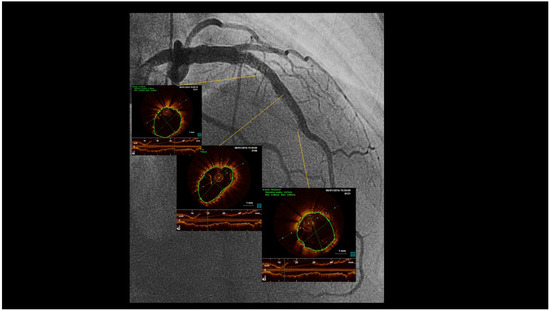
Figure 1.
Post-implant optical coherence tomography (January 2016): good apposition of the stent with a mean vessel diameter of 3.57 mm at the distal edge and 3.67 mm at the proximal edge.
Because of recurrent angina, check-up angiography was performed in March 2018. A fusiform aneurysm of the mid-LAD was discovered. Intravascular ultrasound revealed a uniform dilatation of the vessel with a calibre of 6 mm throughout the whole stented segment, with no evidence of late acquired malapposition (Figure 2), confirming angiographic findings.
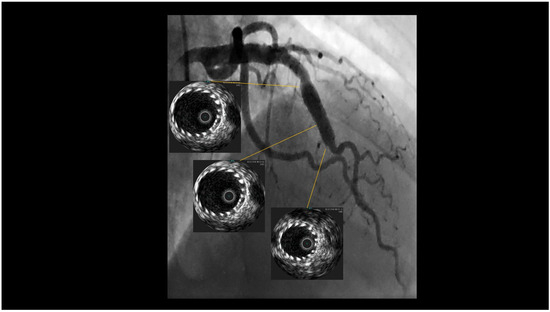
Figure 2.
Intravascular ultrasound (March 2018): evidence of fusiform aneurysm of the mid-left anterior descending artery, with uniform dilatation of the vessel with a calibre of 6 mm throughout the whole stented segment.
This case represents a new, previously undescribed complication after implantation of self-expandable stent, which caused passive arterial wall dilatation.
Conflicts of Interest
No financial support and no other potential conflict of interest relevant to this article was reported.
References
- Alfonso, F.; Pérez-Vizcayno, M.J.; Ruiz, M.; Suárez, A.; Cazares, M.; Hernández, R.; et al. Coronary aneurysms after drug-eluting stent implantation: clinical, angiographic, and intravascular ultrasound findings. J. Am. Coll. Cardiol. 2009, 53, 2053–2060. [Google Scholar] [CrossRef] [PubMed]
- Radu, M.D.; Räber, L.; Kalesan, B.; Muramatsu, T.; Kelbæk, H.; Heo, J.; et al. Coronary evaginations are associated with positive vessel remodelling and are nearly absent following implantation of newer-generation drug-eluting stents: an optical coherence tomography and intravascular ultrasound study. Eur. Heart J. 2014, 35, 795–807. [Google Scholar] [CrossRef] [PubMed]
© 2020 by the author. Attribution - Non-Commercial - NoDerivatives 4.0.