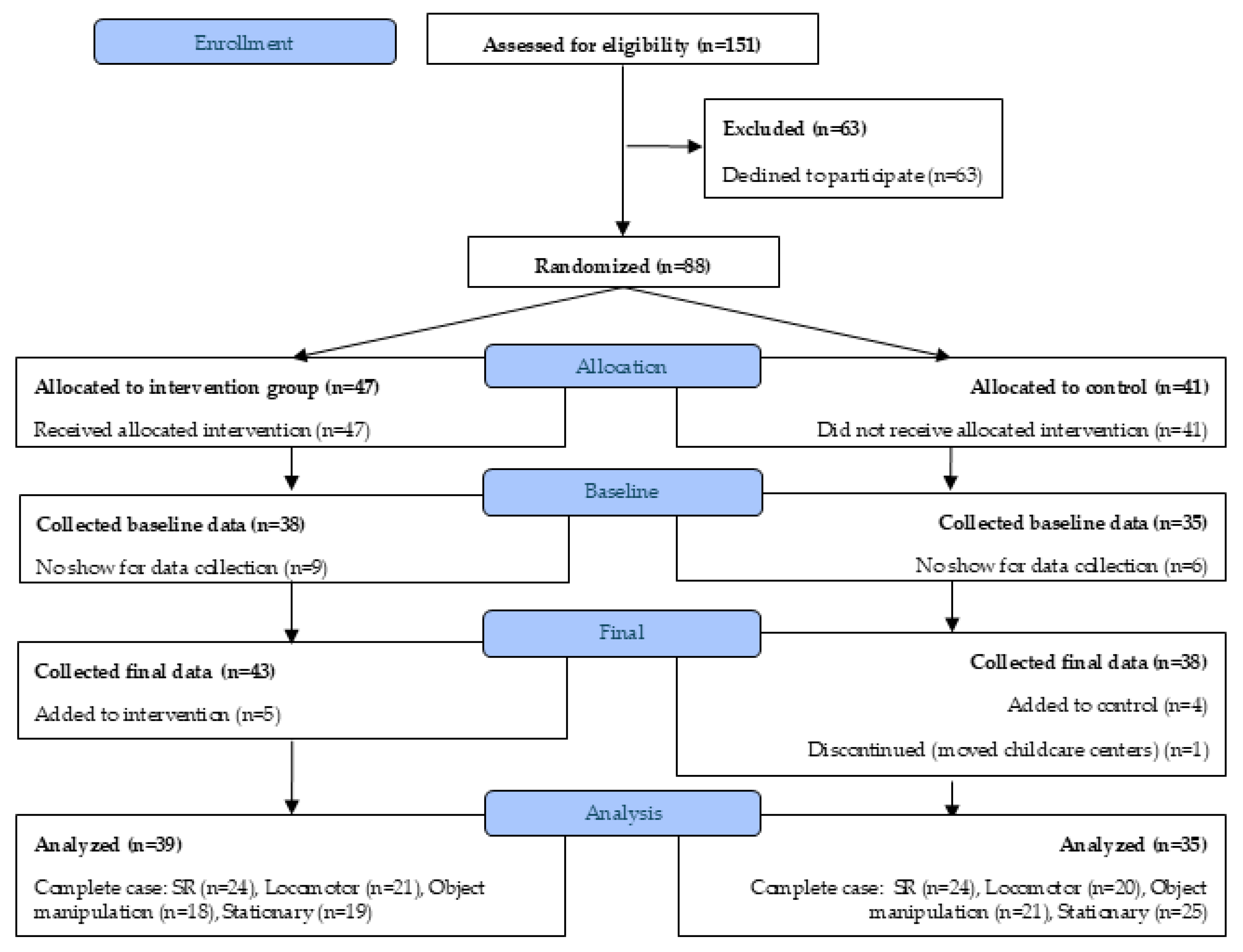
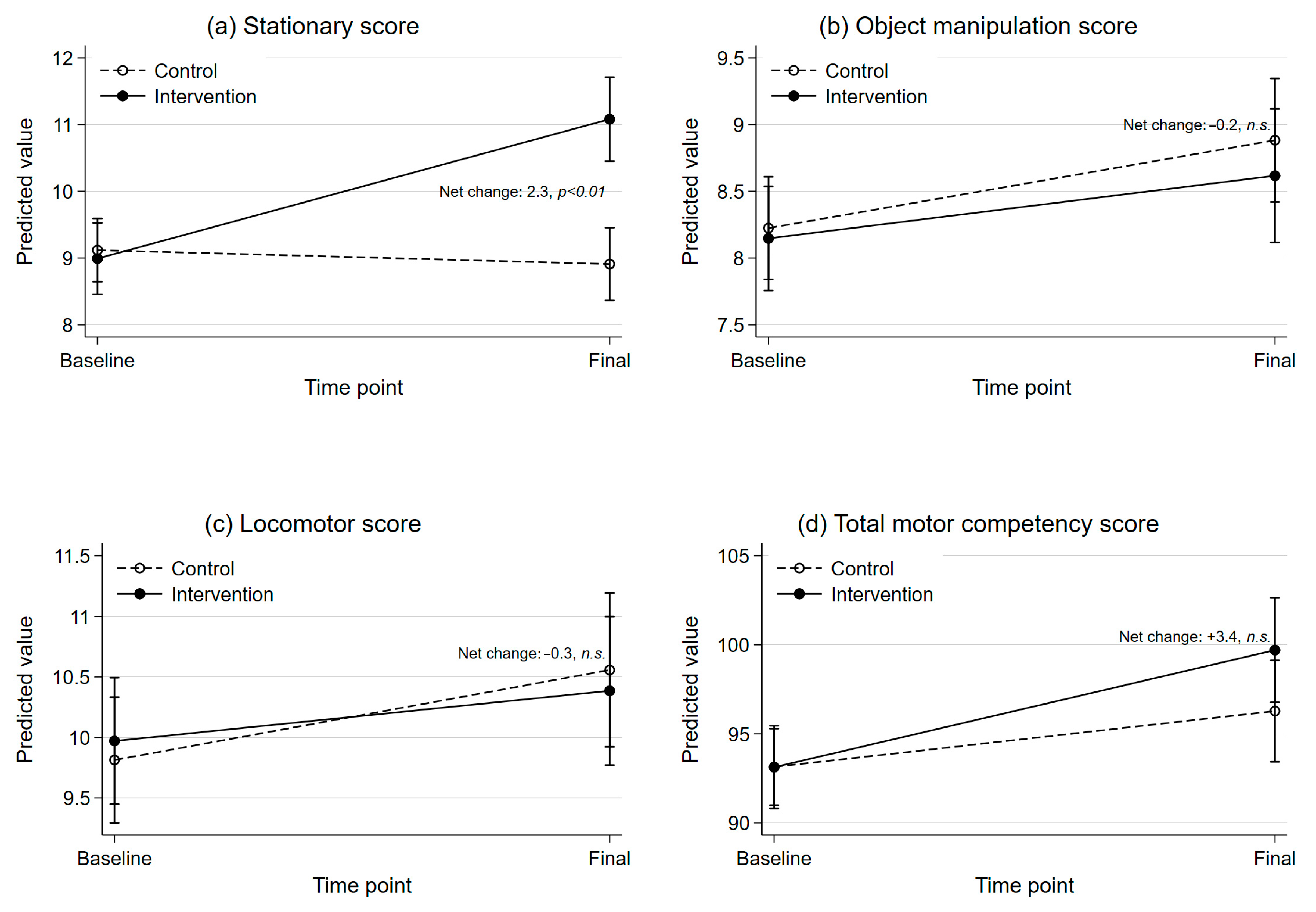
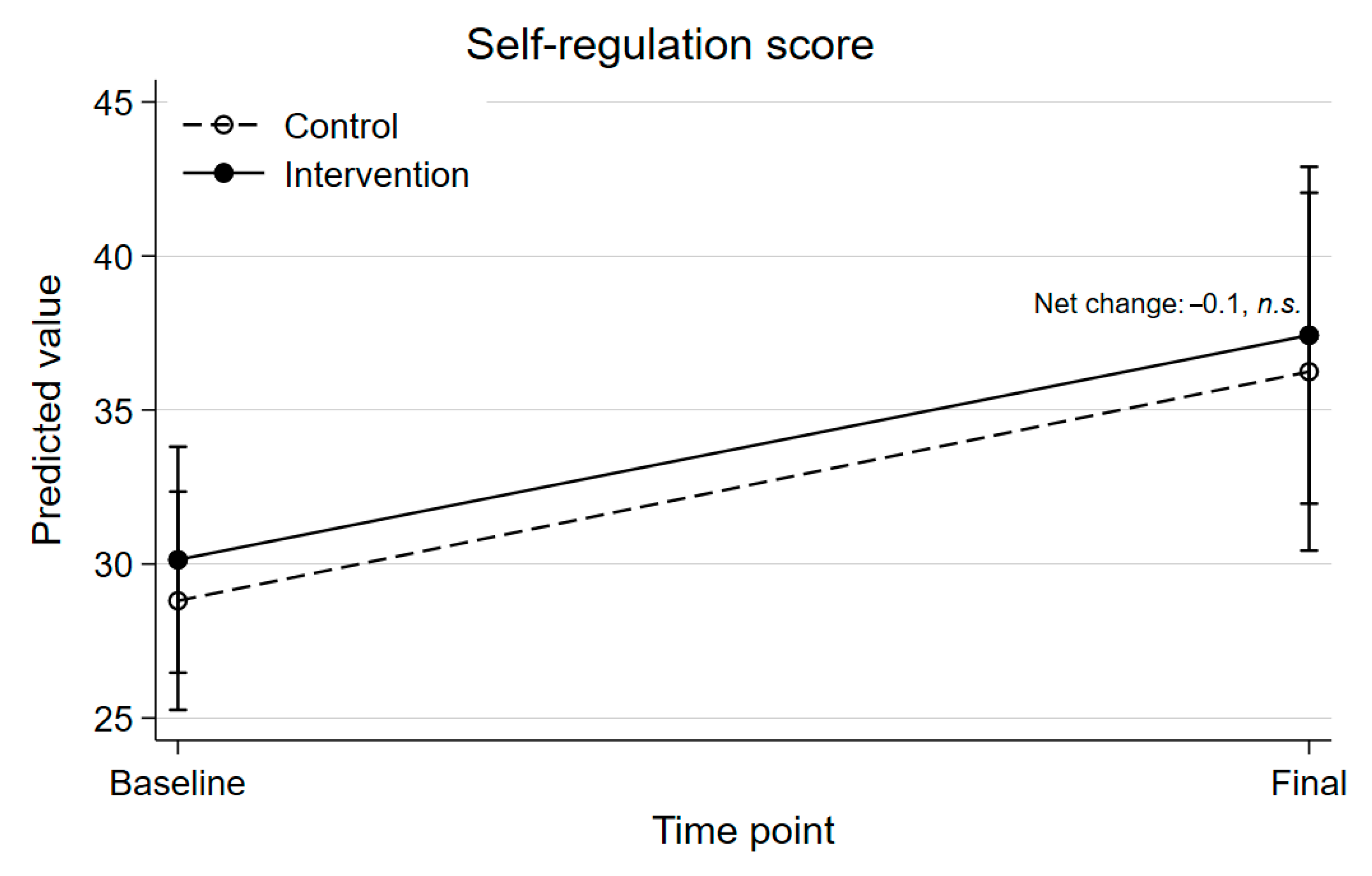
Getting an Active Start: Assessing the Impact of a Physical Literacy-Based Intervention on Preschool-Aged Children’s Fundamental Movement Skills, Motor Competency and Behavioral Self-Regulation

 , , ,
, , ,
Abstract
1. Introduction
2. Materials and Methods
2.1. Physical Literacy Program Development
2.2. Provider Training and Implementation Procedures
2.3. Measures and Instruments
2.4. Post Hoc Detectable Effects Calculations
2.5. Statistical Analyses
3. Results
3.1. Interventions Effects on FMS and Total Motor Competency
3.2. Intervention Effects on Behavioral SR
4. Discussion
Study Limitations
5. Conclusions
Supplementary Materials
Author Contributions
Funding
Institutional Review Board Statement
Informed Consent Statement
Data Availability Statement
Acknowledgments
Conflicts of Interest
Abbreviations
| PA | Physical activity |
| PL | Physical literacy |
| SR | Self-regulation |
| FMS | Fundamental movement skills |
| ECE | Early childcare and education |
| PDMS-2 | Peabody Development Motor Scales-Second Edition |
| HTKS | Head–Toes–Knees–Shoulders |
| GMQ | Gross motor quotient |
References
- Loprinzi, P.D.; Davis, R.E.; Fu, Y.-C. Early motor skill competence as a mediator of child and adult physical activity. Prev. Med. Rep. 2015, 2, 833–838. [Google Scholar] [CrossRef] [PubMed]
- Barnett, L.M.; van Beurden, E.; Morgan, P.J.; Brooks, L.O.; Beard, J.R. Childhood Motor Skill Proficiency as a Predictor of Adolescent Physical Activity. J. Adolesc. Health 2009, 44, 252–259. [Google Scholar] [CrossRef] [PubMed]
- Gallahue, D.L.; Ozmun, J.C.; Goodway, J.D. Understanding Motor Development: Infants, Children, Adolescents, Adults, 7th ed.; McGraw-Hill: New York, NY, USA, 2011. [Google Scholar]
- Clark, J.E.; Metcalfe, J.S. The Mountain of Motor Development: A Metaphor. In Motor Development: Research and Reviews; Clark, J.E., Humphrey, J.H., Eds.; National Association of Sport and Physical Education Publications: Reston, VA, USA, 2002; pp. 163–190. [Google Scholar]
- Lubans, D.R.; Morgan, P.J.; Cliff, D.P.; Barnett, L.M.; Okely, A.D. Fundamental Movement Skills in Children and Adolescents: Review of Associated Health Benefits. Sports Med. 2010, 40, 1019–1035. [Google Scholar] [CrossRef] [PubMed]
- Hulteen, R.M.; Morgan, P.J.; Barnett, L.M.; Stodden, D.F.; Lubans, D.R. Development of Foundational Movement Skills: A Conceptual Model for Physical Activity Across the Lifespan. Sports Med. 2018, 48, 1533–1540. [Google Scholar] [CrossRef]
- Piek, J.P.; Dawson, L.; Smith, L.M.; Gasson, N. The role of early fine and gross motor development on later motor and cognitive ability. Hum. Mov. Sci. 2008, 27, 668–681. [Google Scholar] [CrossRef]
- Sassu, R.; Marcus, O. Links between Behavioural Self-Regulation, Gross Motor Coordination and Social-Emotional Skills in Preschoolers. Bull. Transilv. Univ. Brașov 2024, 16, 161–174. [Google Scholar] [CrossRef]
- Nigg, J.T. Annual Research Review: On the relations among self-regulation, self-control, executive functioning, effortful control, cognitive control, impulsivity, risk-taking, and inhibition for developmental psychopathology. J. Child Psychol. Psychiatry 2017, 58, 361–383. [Google Scholar] [CrossRef]
- McClelland, M.M.; Morrison, F.J. The emergence of learning-related social skills in preschool children. Early Child. Res. Q. 2003, 18, 206–224. [Google Scholar] [CrossRef]
- Blair, C.; Ursache, A. A Bidirectional Model of Executive Functions and Self-Regulation. In Handbook of Self-Regulation: Research, Theory, and Applications, 2nd ed.; Vohs, K.D., Baumeister, R.F., Eds.; The Guilford Press: New York, NY, USA, 2011; pp. 300–320. [Google Scholar]
- Giblin, S.; Collins, D.; MacNamara, A.; Kiely, J. “Deliberate Preparation” as an Evidence-Based Focus for Primary Physical Education. Quest 2014, 66, 385–395. [Google Scholar] [CrossRef]
- Giblin, S.; Collins, D.; Button, C. Physical Literacy: Importance, Assessment and Future Directions. Sports Med. 2014, 44, 1177–1184. [Google Scholar] [CrossRef]
- Figueroa, R.; An, R. Motor Skill Competence and Physical Activity in Preschoolers: A Review. Matern. Child Health J. 2016, 21, 136–146. [Google Scholar] [CrossRef] [PubMed]
- Barnett, L.M.; Morgan, P.J.; van Beurden, E.; Beard, J.R. Perceived sports competence mediates the relationship between childhood motor skill proficiency and adolescent physical activity and fitness: A longitudinal assessment. Int. J. Behav. Nutr. Phys. Act. 2008, 5, 40. [Google Scholar] [CrossRef] [PubMed]
- Montroy, J.J.; Bowles, R.P.; Skibbe, L.E.; McClelland, M.M.; Morrison, F.J. The development of self-regulation across early childhood. Dev. Psychol. 2016, 52, 1744–1762. [Google Scholar] [CrossRef]
- Wesarg-Menzel, C.; Ebbes, R.; Hensums, M.; Wagemaker, E.; Zaharieva, M.S.; Staaks, J.P.C.; van den Akker, A.L.; Visser, I.; Hoeve, M.; Brummelman, E.; et al. Development and socialization of self-regulation from infancy to adolescence: A meta-review differentiating between self-regulatory abilities, goals, and motivation. Dev. Rev. 2023, 69, 101090. [Google Scholar] [CrossRef]
- Hautakangas, M.; Kumpulainen, K.; Uusitalo, L. Children developing self-regulation skills in a Kids’ Skills intervention programme in Finnish Early Childhood Education and Care. Early Child Dev. Care 2022, 192, 1626–1642. [Google Scholar] [CrossRef]
- Grady, A.; Lorch, R.; Giles, L.; Lamont, H.; Anderson, A.; Pearson, N.; Romiti, M.; Lum, M.; Stuart, A.; Leigh, L.; et al. The impact of early childhood education and care-based interventions on child physical activity, anthropometrics, fundamental movement skills, cognitive functioning, and social–emotional wellbeing: A systematic review and meta-analysis. Obes. Rev. 2024, 26, e13852. [Google Scholar] [CrossRef]
- Lum, M.; Wolfenden, L.; Jones, J.; Grady, A.; Christian, H.; Reilly, K.; Yoong, S.L. Interventions to Improve Child Physical Activity in the Early Childhood Education and Care Setting: An Umbrella Review. Int. J. Environ. Res. Public Health 2022, 19, 1963. [Google Scholar] [CrossRef]
- Finch, M.; Jones, J.; Yoong, S.; Wiggers, J.; Wolfenden, L. Effectiveness of centre-based childcare interventions in increasing child physical activity: A systematic review and meta-analysis for policymakers and practitioners. Obes. Rev. 2016, 17, 412–428. [Google Scholar] [CrossRef]
- Howard, S.J.; Vella, S.A.; Cliff, D.P. Children’s sports participation and self-regulation: Bi-directional longitudinal associations. Early Child. Res. Q. 2018, 42, 140–147. [Google Scholar] [CrossRef]
- Piché, G.; Fitzpatrick, C.; Pagani, L.S. Associations between Extracurricular Activity and Self-Regulation: A Longitudinal Study from 5 to 10 Years of Age. Am. J. Health Promot. 2015, 30, e32–e40. [Google Scholar] [CrossRef]
- Robinson, L.E.; Palmer, K.K.; Bub, K.L. Effect of the Children’s Health Activity Motor Program on Motor Skills and Self-Regulation in Head Start Preschoolers: An Efficacy Trial. Front Public Health 2016, 4, 173. [Google Scholar] [CrossRef] [PubMed]
- Brown, V.; Moodie, M.; Sultana, M.; Hunter, K.E.; Byrne, R.; Seidler, A.L.; Golley, R.; Taylor, R.W.; Hesketh, K.D.; Matvienko-Sikar, K. Core outcome set for early intervention trials to prevent obesity in childhood (COS-EPOCH): Agreement on “what” to measure. Int. J. Obes. 2022, 46, 1867–1874. [Google Scholar] [CrossRef] [PubMed]
- Becker, D.R.; McClelland, M.M.; Loprinzi, P.; Trost, S.G. Physical Activity, Self-Regulation, and Early Academic Achievement in Preschool Children. Early Educ. Dev. 2014, 25, 56–70. [Google Scholar] [CrossRef]
- Cairney, J.; Dudley, D.; Kwan, M.; Bulten, R.; Kriellaars, D. Physical literacy, physical activity and health: Toward an evidence-informed conceptual model. Sports Med. 2019, 49, 371–383. [Google Scholar] [CrossRef] [PubMed]
- Ladda, S. Physical Literacy Is a Social Justice Issue. J. Phys. Educ. Recreat. Danc. 2014, 85, 3–4. [Google Scholar] [CrossRef]
- Veijalainen, J.; Reunamo, J.; Heikkilä, M. Early gender differences in emotional expressions and self-regulation in settings of early childhood education and care. Early Child Dev. Care 2021, 191, 173–186. [Google Scholar] [CrossRef]
- Viegas, Â.A.; Mendonça, V.A.; Pontes Nobre, J.N.; Souza Morais, R.L.D.; Fernandes, A.C.; Oliveira Ferreira, F.D.; Scheidt Figueiredo, P.H.; Leite, H.R.; Resende Camargos, A.C.; Rodrigues Lacerda, A.C. Associations of physical activity and cognitive function with gross motor skills in preschoolers: Cross-sectional study. J. Mot. Behav. 2023, 55, 564–579. [Google Scholar] [CrossRef]
- Abdessmed, M.; Mougharbel, F.; Hafizi, K.; Cameron, J.D.; Heidinger, B.; Barnes, J.; D’Anguillli, A.; Adamo, K.B.; Carson, V.; Okely, A.D.; et al. Associations between physical activity, sedentary time and social-emotional functioning in young children. Ment. Health Phys. Act. 2021, 21, 100422. [Google Scholar] [CrossRef]
- Biino, V.; Tinagli, V.; Borioni, F.; Pesce, C. Cognitively enriched physical activity may foster motor competence and executive function as early as preschool age: A pilot trial. Phys. Educ. Sport Pedagog. 2021, 28, 425–443. [Google Scholar] [CrossRef]
- Goodway, J.D.; Robinson, L.E.; Crowe, H. Gender differences in fundamental motor skill development in disadvantaged preschoolers from two geographical regions. Res. Q. Exerc. Sport 2010, 81, 17–24. [Google Scholar] [CrossRef]
- von Suchodoletz, A.; Gestsdottir, S.; Wanless, S.B.; McClelland, M.M.; Birgisdottir, F.; Gunzenhauser, C.; Ragnarsdottir, H. Behavioral self-regulation and relations to emergent academic skills among children in Germany and Iceland. Early Child. Res. Q. 2013, 28, 62–73. [Google Scholar] [CrossRef]
- Wanless, S.; Kim, K.; Zhang, C.; Degol, J.; Chen, J.; Chen, F. Trajectories of behavioral regulation for Taiwanese children from 3.5 to 6 years and relations to math and vocabulary outcomes. Early Child. Res. Q. 2016, 34, 104–114. [Google Scholar] [CrossRef]
- Veldman, S.L.C.; Jones, R.A.; Santos, R.; Sousa-Sá, E.; Okely, A.D. Gross motor skills in toddlers: Prevalence and socio-demographic differences. J. Sci. Med. Sport 2018, 21, 1226–1231. [Google Scholar] [CrossRef] [PubMed]
- Kit, B.K.; Akinbami, L.J.; Isfahani, N.S.; Ulrich, D.A. Gross Motor Development in Children Aged 3–5 Years, United States 2012. Matern. Child Health J. 2017, 21, 1573–1580. [Google Scholar] [CrossRef] [PubMed]
- Starrett, A.; Pennell, A.; Irvin, M.J.; Taunton Miedema, S.; Howard-Smith, C.; Goodway, J.D.; Stodden, D.F.; Brian, A. An Examination of Motor Competence Profiles in Preschool Children: A Latent Profile Analysis. Res. Q. Exerc. Sport 2022, 93, 437–446. [Google Scholar] [CrossRef]
- Brian, A.; Pennell, A.; Taunton, S.; Starrett, A.; Howard-Shaughnessy, C.; Goodway, J.D.; Wadsworth, D.; Rudisill, M.; Stodden, D. Motor Competence Levels and Developmental Delay in Early Childhood: A Multicenter Cross-Sectional Study Conducted in the USA. Sports Med. 2019, 49, 1609–1618. [Google Scholar] [CrossRef]
- Barnett, L.M.; Lai, S.K.; Veldman, S.L.C.; Hardy, L.L.; Cliff, D.P.; Morgan, P.J.; Zask, A.; Lubans, D.R.; Shultz, S.P.; Ridgers, N.D.; et al. Correlates of Gross Motor Competence in Children and Adolescents: A Systematic Review and Meta-Analysis. Sports Med. 2016, 46, 1663–1688. [Google Scholar] [CrossRef]
- Dobell, A.; Pringle, A.; Faghy, M.A.; Roscoe, C.M.P. Fundamental Movement Skills and Accelerometer-Measured Physical Activity Levels during Early Childhood: A Systematic Review. Children 2020, 7, 224. [Google Scholar] [CrossRef]
- Palmer, K.K.; Harkavy, D.; Rock, S.M.; Robinson, L.E. Boys and girls have similar gains in fundamental motor skills across a preschool motor skill intervention. J. Mot. Learn. Dev. 2020, 8, 569–579. [Google Scholar] [CrossRef]
- Kropski, J.A.; Keckley, P.H.; Jensen, G.L. School-based Obesity Prevention Programs: An Evidence-based Review. Obesity 2008, 16, 1009–1018. [Google Scholar] [CrossRef]
- Metcalf, B.; Henley, W.; Wilkin, T. Effectiveness of intervention on physical activity of children: Systematic review and meta-analysis of controlled trials with objectively measured outcomes (EarlyBird 54). BMJ 2012, 345, 16. [Google Scholar] [CrossRef] [PubMed]
- Khambalia, A.Z.; Dickinson, S.; Hardy, L.L.; Gill, T.; Baur, L.A. synthesis of existing systematic reviews and meta-analyses of school-based behavioural interventions for controlling and preventing obesity. Obes. Rev. 2012, 13, 214–233. [Google Scholar] [CrossRef] [PubMed]
- Rising New York Road Runners. Rising New York Road Runners. Available online: https://www.nyrr.org/youth/aboutrisingnyrr (accessed on 1 January 2025).
- Norris, E.; van Steen, T.; Direito, A.; Stamatakis, E. Physically active lessons in schools and their impact on physical activity, educational, health and cognition outcomes: A systematic review and meta-analysis. Br. J. Sports Med. 2020, 54, 826–838. [Google Scholar] [CrossRef] [PubMed]
- Johnstone, A.; Hughes, A.R.; Martin, A.; Reilly, J.J. Utilising active play interventions to promote physical activity and improve fundamental movement skills in children: A systematic review and meta-analysis. BMC Public Health 2018, 18, 789. [Google Scholar] [CrossRef]
- Johnstone, A.; Hughes, A.R.; Janssen, X.; Reilly, J.J. Pragmatic evaluation of the Go2Play Active Play intervention on physical activity and fundamental movement skills in children. Prev. Med. Rep. 2017, 7, 58–63. [Google Scholar] [CrossRef]
- Bai, M.; Lin, N.; Yu, J.J.; Teng, Z.; Xu, M. The effect of planned active play on the fundamental movement skills of preschool children. Hum. Mov. Sci. 2024, 96, 103241. [Google Scholar] [CrossRef]
- Eyre, E.L.J.; Clark, C.C.T.; Tallis, J.; Hodson, D.; Lowton-Smith, S.; Nelson, C.; Noon, M.; Duncan, M.J. The Effects of Combined Movement and Storytelling Intervention on Motor Skills in South Asian and White Children Aged 5–6 Years Living in the United Kingdom. Int. J. Environ. Res. Public Health 2020, 17, 3391. [Google Scholar] [CrossRef]
- Duncan, M.; Cunningham, A.; Eyre, E. A combined movement and story-telling intervention enhances motor competence and language ability in pre-schoolers to a greater extent than movement or story-telling alone. Eur. Phys. Educ. Rev. 2017, 25, 221–235. [Google Scholar] [CrossRef]
- Ulrich, D.A. Peabody Developmental Motor Scales and Activity Cards. Adapt. Phys. Act. Q. 1984, 1, 173–178. [Google Scholar] [CrossRef]
- Staples, K.; MacDonald, M.; Zimmer, C. Assessment of Motor Behavior Among Children and Adolescents with Autism Spectrum Disorder. Int. Rev. Res. Dev. Disabil. 2012, 42, 179–214. [Google Scholar]
- Cameron Ponitz, C.E.; McClelland, M.M.; Jewkes, A.M.; Connor, C.M.; Farris, C.L.; Morrison, F.J. Touch your toes! Developing a direct measure of behavioral regulation in early childhood. Early Child. Res. Q. 2008, 23, 141–158. [Google Scholar] [CrossRef]
- McClelland, M.M.; Gonzales, C.R.; Cameron, C.E.; Geldhof, G.J.; Bowles, R.P.; Nancarrow, A.F.; Merculief, A.; Tracy, A. The Head-Toes-Knees-Shoulders Revised: Links to Academic Outcomes and Measures of EF in Young Children. Front. Psychol. 2021, 12, 721846. [Google Scholar] [CrossRef] [PubMed]
- Caughy, M.O.B.; Brinkley, D.Y.; Pacheco, D.; Rojas, R.; Miao, A.; Contreras, M.M.; Owen, M.T.; Easterbrooks, M.A.; McClelland, M. Self-regulation development among young Spanish-English dual language learners. Early Child. Res. Q. 2022, 60, 226–236. [Google Scholar] [CrossRef] [PubMed]
- McClelland, M.M.; Cameron, C.E.; Duncan, R.; Bowles, R.P.; Acock, A.C.; Miao, A.; Pratt, M.E. Predictors of early growth in academic achievement: The head-toes-knees-shoulders task. Front. Psychol. 2014, 5, 599. [Google Scholar] [CrossRef]
- Barnett, L.M.; Hnatiuk, J.A.; Salmon, J.; Hesketh, K.D. Modifiable factors which predict children’s gross motor competence: A prospective cohort study. Int. J. Behav. Nutr. Phys. Act. 2019, 16, 129. [Google Scholar] [CrossRef]
- Iivonen, S.; Sääkslahti, A.K. Preschool children’s fundamental motor skills: A review of significant determinants. Early Child Dev. Care 2014, 184, 1107–1126. [Google Scholar] [CrossRef]
- Min, Y.; Agresti, A. Random effect models for repeated measures of zero-inflated count data. Stat. Model. 2005, 5, 1–19. [Google Scholar] [CrossRef]
- Miller, A.L.; Palmer, K.K.; Wang, L.; Wang, C.; Riley, H.O.; McClelland, M.M.; Robinson, L.E. Mastery-oriented motor competence intervention improves behavioral but not cognitive self-regulation in head start preschoolers: Randomized controlled trial results. Scand. J. Med. Sci. Sports 2023, 33, 725–736. [Google Scholar] [CrossRef]
- Palmer, K.K.; Chinn, K.M.; Robinson, L.E. The effect of the CHAMP intervention on fundamental motor skills and outdoor physical activity in preschoolers. J. Sport Health Sci. 2019, 8, 98–105. [Google Scholar] [CrossRef]
- Wick, K.; Leeger-Aschmann, C.S.; Monn, N.D.; Radtke, T.; Ott, L.V.; Rebholz, C.E.; Cruz, S.; Gerber, N.; Schmutz, E.A.; Puder, J.J.; et al. Interventions to Promote Fundamental Movement Skills in Childcare and Kindergarten: A Systematic Review and Meta-Analysis. Sports Med. 2017, 47, 2045–2068. [Google Scholar] [CrossRef]
- Logan, S.W.; Robinson, L.E.; Wilson, A.E.; Lucas, W.A. Getting the fundamentals of movement: A meta-analysis of the effectiveness of motor skill interventions in children. Child Care Health Dev. 2012, 38, 305–315. [Google Scholar] [CrossRef] [PubMed]
- Bardid, F.; Lenoir, M.; Huyben, F.; De Martelaer, K.; Seghers, J.; Goodway, J.D.; Deconinck, F.J.A. The effectiveness of a community-based fundamental motor skill intervention in children aged 3–8 years: Results of the “Multimove for Kids” project. J. Sci. Med. Sport 2017, 20, 184–189. [Google Scholar] [CrossRef] [PubMed]
- van Capelle, A.; Broderick, C.R.; van Doorn, N.; E.Ward, R.; Parmenter, B.J. Interventions to improve fundamental motor skills in pre-school aged children: A systematic review and meta-analysis. J. Sci. Med. Sport 2017, 20, 658–666. [Google Scholar] [CrossRef] [PubMed]
- Liu, D.; Huang, Z.; Liu, Y.; Zhou, Y. The role of fundamental movement skills on children’s physical activity during different segments of the school day. BMC Public Health 2024, 24, 1283. [Google Scholar] [CrossRef]
- Cohen, K.E.; Morgan, P.J.; Plotnikoff, R.C.; Callister, R.; Lubans, D.R. Fundamental movement skills and physical activity among children living in low-income communities: A cross-sectional study. Int. J. Behav. Nutr. Phys. Act. 2014, 11, 49. [Google Scholar] [CrossRef]
- Robinson, L.E.; Veldman, S.L.C.; Palmer, K.K.; Okely, A.D. A Ball Skills Intervention in Preschoolers: The CHAMP Randomized Controlled Trial. Med. Sci. Sports Exerc. 2017, 49, 2234–2239. [Google Scholar] [CrossRef]
- Veldman, S.L.C.; Palmer, K.K.; Okely, A.D.; Robinson, L.E. Promoting ball skills in preschool-age girls. J. Sci. Med. Sport 2017, 20, 50–54. [Google Scholar] [CrossRef]
- Haywood, K.M.; Getchell, N. Life Span Motor Development, 5th ed.; Human Kinetics: Champaign, IL, USA, 2009. [Google Scholar]
- Butterfield, S.A.; Angell, R.M.; Mason, C.A. Age and Sex Differences in Object Control Skills by Children Ages 5 to 14. Percept. Mot. Ski. 2012, 114, 261–274. [Google Scholar] [CrossRef]
- Yang, S.-C.; Lin, S.-J.; Tsai, C.-Y. Effect of Sex, Age, and BMI on the Development of Locomotor Skills and Object Control Skills among Preschool Children. Percept. Mot. Ski. 2015, 121, 873–888. [Google Scholar] [CrossRef]
- Martins, C.; Webster, E.K.; Romo-Perez, V.; Duncan, M.; Lemos, L.F.; Staiano, A.; Okely, A.; Magistro, D.; Carlevaro, F.; Bardid, F.; et al. Sex differences in 3- to 5-year-old children’s motor competence: A pooled cross-sectional analysis of 6241 children. Scand. J. Med. Sci. Sports 2024, 34, e14651. [Google Scholar] [CrossRef]
- Manning, M.; Garvis, S.; Fleming, C.; Wong, G.T.W. The relationship between teacher qualification and the quality of the early childhood education and care environment. Campbell Syst. Rev. 2017, 13, 1–82. [Google Scholar] [CrossRef]
- True, L.; Pfeiffer, K.A.; Dowda, M.; Williams, H.G.; Brown, W.H.; O’Neill, J.R.; Pate, R.R. Motor competence and characteristics within the preschool environment. J. Sci. Med. Sport 2017, 20, 751–755. [Google Scholar] [CrossRef] [PubMed]
- Hudson, K.N.; Ballou, H.M.; Willoughby, M.T. Short report: Improving motor competence skills in early childhood has corollary benefits for executive function and numeracy skills. Dev. Sci. 2021, 24, e13071. [Google Scholar] [CrossRef] [PubMed]
- Caughy, M.O.B.; Mills, B.; Owen, M.T.; Hurst, J.R. Emergent self-regulation skills among very young ethnic minority children: A confirmatory factor model. J. Exp. Child Psychol. 2013, 116, 839–855. [Google Scholar] [CrossRef]
- Schmitt, S.A.; McClelland, M.M.; Tominey, S.L.; Acock, A.C. Strengthening school readiness for Head Start children: Evaluation of a self-regulation intervention. Early Child. Res. Q. 2015, 30, 20–31. [Google Scholar] [CrossRef]
- Gonzales, C.R.; Bowles, R.; Geldhof, G.J.; Cameron, C.E.; Tracy, A.; McClelland, M.M. The Head-Toes-Knees-Shoulders Revised (HTKS-R): Development and psychometric properties of a revision to reduce floor effects. Early Child. Res. Q. 2021, 56, 320–332. [Google Scholar] [CrossRef]
- Schmitt, S.A.; Pratt, M.E.; McClelland, M.M. Examining the Validity of Behavioral Self-Regulation Tools in Predicting Preschoolers’ Academic Achievement. Early Educ. Dev. 2014, 25, 641–660. [Google Scholar] [CrossRef]
- Duncan, R.J.; Schmitt, S.A.; Burke, M.; McClelland, M.M. Combining a kindergarten readiness summer program with a self-regulation intervention improves school readiness. Early Child. Res. Q. 2018, 42, 291–300. [Google Scholar] [CrossRef]
- McClelland, M.M.; Tominey, S.L.; Schmitt, S.A.; Hatfield, B.E.; Purpura, D.J.; Gonzales, C.R.; Tracy, A.N. Red Light, Purple Light! Results of an Intervention to Promote School Readiness for Children From Low-Income Backgrounds. Front. Psychol. 2019, 10, 2365. [Google Scholar] [CrossRef]
- Lumeng, J.C.; Miller, A.L.; Horodynski, M.A.; Brophy-Herb, H.E.; Contreras, D.; Lee, H.; Sturza, J.; Kaciroti, N.; Peterson, K.E. Improving Self-Regulation for Obesity Prevention in Head Start: A Randomized Controlled Trial. Pediatrics 2017, 139, e20162047. [Google Scholar] [CrossRef]
- Sasser, T.R.; Bierman, K.L.; Heinrichs, B.; Nix, R.L. Preschool Intervention Can Promote Sustained Growth in the Executive-Function Skills of Children Exhibiting Early Deficits. Psychol. Sci. 2017, 28, 1719–1730. [Google Scholar] [CrossRef] [PubMed]
- Lakes, K.D.; Hoyt, W.T. Promoting self-regulation through school-based martial arts training. J. Appl. Dev. Psychol. 2004, 25, 283–302. [Google Scholar] [CrossRef]
- Willoughby, M.; Hudson, K.; Hong, Y.; Wylie, A. Improvements in motor competence skills are associated with improvements in executive function and math problem-solving skills in early childhood. Dev. Psychol. 2021, 57, 1463–1470. [Google Scholar] [CrossRef] [PubMed]
- Mulvey, K.L.; Taunton, S.; Pennell, A.; Brian, A. Head, Toes, Knees, SKIP! Improving Preschool Children’s Executive Function Through a Motor Competence Intervention. J. Sport Exerc. Psychol. 2018, 40, 233–239. [Google Scholar] [CrossRef]
- Ray, C.; Figuereido, R.; Vepsäläinen, H.; Lehto, R.; Pajulahti, R.; Skaffari, E.; Sainio, T.; Hiltunen, P.; Lehto, E.; Korkalo, L.; et al. Effects of the Preschool-Based Family-Involving DAGIS Intervention Program on Children’s Energy Balance-Related Behaviors and Self-Regulation Skills: A Clustered Randomized Controlled Trial. Nutrients 2020, 12, 2599. [Google Scholar] [CrossRef]
- Hardy, L.L.; King, L.; Farrell, L.; Macniven, R.; Howlett, S. Fundamental movement skills among Australian preschool children. J. Sci. Med. Sport 2010, 13, 503–508. [Google Scholar] [CrossRef]
- Bardid, F.; Huyben, F.; Lenoir, M.; Seghers, J.; De Martelaer, K.; Goodway, J.D.; Deconinck, F.J.A. Assessing fundamental motor skills in Belgian children aged 3–8 years highlights differences to US reference sample. Acta Paediatr. 2016, 105, e281–e290. [Google Scholar] [CrossRef]
- Sparks, S.D. Social-Emotional Learning: “Preschool Classroom Processes as Predictors of Children’s Cognitive Self-Regulation Skills Development”. Educ. Week 2013, 33, 5. [Google Scholar]
- Grissmer, D.; Grimm, K.J.; Aiyer, S.M.; Murrah, W.M.; Steele, J.S. Fine motor skills and early comprehension of the world: Two new school readiness indicators. Dev. Psychol. 2010, 46, 1008–1017. [Google Scholar] [CrossRef]
- Morley, D.; Till, K.; Ogilvie, P.; Turner, G. Influences of gender and socioeconomic status on the motor proficiency of children in the UK. Hum. Mov. Sci. 2015, 44, 150–156. [Google Scholar] [CrossRef]
- Engel, A.C.; Broderick, C.R.; van Doorn, N.; Hardy, L.L.; Parmenter, B.J. Exploring the relationship between fundamental motor skill interventions and physical activity levels in children: A systematic review and meta-analysis. Sports Med. 2018, 48, 1845–1857. [Google Scholar] [CrossRef]
- Williams, K.E.; Berthelsen, D. Implementation of a rhythm and movement intervention to support self-regulation skills of preschool-aged children in disadvantaged communities. Psychol. Music 2019, 47, 800–820. [Google Scholar] [CrossRef]
- Jaeggi, S.M.; Buschkuehl, M.; Shah, P.; Jonides, J. The role of individual differences in cognitive training and transfer. Mem. Cogn. 2014, 42, 464–480. [Google Scholar] [CrossRef]
- Pate, R.R.; Brown, W.H.; Pfeiffer, K.A.; Howie, E.K.; Saunders, R.P.; Addy, C.L.; Dowda, M. An Intervention to Increase Physical Activity in Children: A Randomized Controlled Trial With 4-Year-Olds in Preschools. Am. J. Prev. Med. 2016, 51, 12–22. [Google Scholar] [CrossRef]



| Component | Length | Dose * | Description | PL Domains | Details |
|---|---|---|---|---|---|
| Physical literacy (PL) lesson | 30 min | n = 20 | Featured a “skill of the week” with corresponding activities that were intended to be fun, engaging and appropriate across developmental levels. Participating families received a hard-copy newsletter describing the lessons and how to incorporate PL-based activities at home. | Motor, cognitive and social–emotional development | Lessons 1–5: stationary skills Lessons 6–12: locomotor skills Lessons 13–20: object manipulation skills |
| Active free play | 15 min | Type of PA where children are allowed to move their bodies in a way that they choose. This is also known as unstructured PA. | Motor and social–emotional development | ||
| Literacy activity | 15 min | n = 10 books | Included interactive storybooks that were complementary to the program activities and presented the PL concepts in an age-appropriate format using dialogic literacy strategies. Participating families received a new book each week that was featured during the literacy activity. | Cognitive and motor development | n = 8 promoted PA n = 6 promoted gross motor skills n = 1 promoted self-regulation |
| Full Sample | Boys | Girls | |||||||
|---|---|---|---|---|---|---|---|---|---|
| Control | Intervention | p-Value 1 | Control | Intervention | p-Value 1 | Control | Intervention | p-Value 1 | |
| N | 35 | 39 | 18 | 23 | 17 | 16 | |||
| Race | 0.76 | 0.68 | 0.65 | ||||||
| Multiracial | 2 (7%) | 3 (8%) | 1 (7%) | 1 (5%) | 1 (6%) | 2 (13%) | |||
| White | 28 (90%) | 31 (84%) | 14 (93%) | 21 (91%) | 14 (88%) | 11 (73%) | |||
| Black | 0 (0%) | 1 (3%) | 0 (0%) | 0 (0%) | 0 (0%) | 1 (7%) | |||
| Asian | 1 (3%) | 2 (5%) | 0 (0%) | 1 (5%) | 1 (6%) | 1 (7%) | |||
| Ethnicity | 0.55 | 0.50 | 1.00 | ||||||
| Non-Hispanic | 29 (94%) | 34 (89%) | 14 (93%) | 19 (86%) | 15 (94%) | 15 (94%) | |||
| Hispanic | 2 (6%) | 4 (11%) | 1 (7%) | 3 (14%) | 1 (6%) | 1 (6%) | |||
| Sex | |||||||||
| Boys | 17 (49%) | 23 (59%) | 0.42 | - | - | - | - | ||
| Girls | 17 (49%) | 16 (41%) | - | - | - | - | |||
| Age (years) | 3.8 ± 0.7 | 3.8 ± 0.8 | 0.98 | 3.8 ± 0.7 | 3.9 ± 0.8 | 0.70 | 3.8 ± 0.6 | 3.7 ± 0.8 | 0.59 |
| Age (months) | 51.7 ± 8.4 | 51.6 ± 9.5 | 0.91 | 51.0 ± 9.3 | 51.8 ± 10.4 | 0.79 | 52.5 ± 7.7 | 51.0 ± 8.5 | 0.60 |
| Height (cm) | 105.1 ± 5.8 | 103.4 ± 6.9 | 0.26 | 103.4 ± 5.0 | 103.9 ± 7.3 | 0.82 | 106.9 ± 6.2 | 102.7 ± 6.6 | 0.07 |
| Weight (kg) | 17.5 ± 2.3 | 17.6 ± 2.8 | 0.96 | 16.8 ± 1.5 | 18.06 ± 3.3 | 0.17 | 18.3 ± 2.8 | 17.0 ± 1.7 | 0.12 |
| BMI | 15.8 ± 1.2 | 16.4 ± 1.5 | 0.09 | 15.7 ± 1.1 | 16.5 ± 1.6 | 0.07 | 15.9 ± 1.3 | 16.1 ± 1.2 | 0.71 |
| BMI z-score | 0.2 ± 0.9 | 0.6 ± 0.9 | 0.08 | 0.02 ± 0.9 | 0.6 ± 1.0 | 0.07 | 0.4 ± 0.8 | 0.5 ± 0.8 | 0.60 |
| Baseline | Final | ||||||
|---|---|---|---|---|---|---|---|
| Score 2 | Control (n = 35) | Intervention (n = 39) | p-Value 1 | Control (n = 40) | Intervention (n = 42) | p-Value 1 | |
| Full | Stationary | 9.5 ± 2.3 | 8.6 ± 2.6 | 0.15 | 9.3 ± 2.2 | 10.5 ± 2.5 | 0.07 |
| Locomotion | 9.6 ± 2.1 | 10.2 ± 2.5 | 0.37 | 9.9 ± 2.4 | 11.0 ± 2.3 | 0.09 | |
| Object manipulation | 8.5 ± 2.1 | 7.8 ± 1.3 | 0.13 | 9.0 ± 2.0 | 8.4 ± 1.9 | 0.39 | |
| GMQ | 95.0 ± 12.0 | 92.0 ± 8.8 | 0.32 | 95.2 ± 10.4 | 100.2 ± 11.8 | 0.15 | |
| Self-regulation | 28.8 ± 18.8 | 28.3 ± 17.6 | 0.91 | 24.1 ± 18.2 | 27.3 ± 20.1 | 0.52 | |
| Boys | Stationary | 10.1 ± 2.0 | 7.5 ± 2.3 | 0.003 * | 8.6 ± 2.3 | 9.4 ± 2.5 | 0.40 |
| Locomotion | 10.2 ± 2.2 | 10.1 ± 2.3 | 0.80 | 10.0 ± 1.9 | 10.7 ± 2.6 | 0.42 | |
| Object manipulation | 9.7 ± 2.3 | 8.1 ± 1.6 | 0.03 * | 9.7 ± 2.1 | 8.2 ± 1.9 | 0.07 | |
| GMQ | 101.4 ± 11.3 | 89.2 ± 6.4 | 0.003 * | 95.9 ± 9.6 | 96.6 ± 12.0 | 0.87 | |
| Self-regulation | 24.9 ± 18.9 | 27.8 ± 18.4 | 0.64 | 17.8 ± 15.8 | 26.9 ± 22.0 | 0.16 | |
| Girls | Stationary | 8.9 ± 2.5 | 9.5 ± 2.5 | 0.54 | 10.2 ± 1.9 | 12.0 ± 1.7 | 0.03 * |
| Locomotion | 9.2 ± 2.1 | 10.2 ± 2.7 | 0.25 | 9.7 ± 3.0 | 11.5 ± 1.8 | 0.12 | |
| Object manipulation | 7.4 ± 1.2 | 7.5 ± 0.9 | 0.95 | 7.9 ± 1.3 | 8.9 ± 2.0 | 0.24 | |
| GMQ | 90.1 ± 10.4 | 94.8 ± 10.1 | 0.24 | 94.1 ± 12.0 | 106.7 ± 8.5 | 0.03 * | |
| Self-regulation | 32.4 ± 18.5 | 31.2 ± 17.0 | 0.85 | 32.9 ± 18.1 | 27.8 ± 17.6 | 0.48 | |
Disclaimer/Publisher’s Note: The statements, opinions and data contained in all publications are solely those of the individual author(s) and contributor(s) and not of MDPI and/or the editor(s). MDPI and/or the editor(s) disclaim responsibility for any injury to people or property resulting from any ideas, methods, instructions or products referred to in the content. |
© 2025 by the authors. Licensee MDPI, Basel, Switzerland. This article is an open access article distributed under the terms and conditions of the Creative Commons Attribution (CC BY) license (https://creativecommons.org/licenses/by/4.0/).
Share and Cite
Wilhite, B.C.; Chui, K.; Sacheck, J.M.; Hatfield, D.P.; Morris, M.; Ziembowicz, M.; Herrick, S.; Hennessy, E. Getting an Active Start: Assessing the Impact of a Physical Literacy-Based Intervention on Preschool-Aged Children’s Fundamental Movement Skills, Motor Competency and Behavioral Self-Regulation. Int. J. Environ. Res. Public Health 2025, 22, 1861. https://doi.org/10.3390/ijerph22121861
Wilhite BC, Chui K, Sacheck JM, Hatfield DP, Morris M, Ziembowicz M, Herrick S, Hennessy E. Getting an Active Start: Assessing the Impact of a Physical Literacy-Based Intervention on Preschool-Aged Children’s Fundamental Movement Skills, Motor Competency and Behavioral Self-Regulation. International Journal of Environmental Research and Public Health. 2025; 22(12):1861. https://doi.org/10.3390/ijerph22121861
Chicago/Turabian StyleWilhite, Breanne C., Kenneth Chui, Jennifer M. Sacheck, Daniel P. Hatfield, Margaret Morris, Megan Ziembowicz, Stephanie Herrick, and Erin Hennessy. 2025. "Getting an Active Start: Assessing the Impact of a Physical Literacy-Based Intervention on Preschool-Aged Children’s Fundamental Movement Skills, Motor Competency and Behavioral Self-Regulation" International Journal of Environmental Research and Public Health 22, no. 12: 1861. https://doi.org/10.3390/ijerph22121861
APA StyleWilhite, B. C., Chui, K., Sacheck, J. M., Hatfield, D. P., Morris, M., Ziembowicz, M., Herrick, S., & Hennessy, E. (2025). Getting an Active Start: Assessing the Impact of a Physical Literacy-Based Intervention on Preschool-Aged Children’s Fundamental Movement Skills, Motor Competency and Behavioral Self-Regulation. International Journal of Environmental Research and Public Health, 22(12), 1861. https://doi.org/10.3390/ijerph22121861