


Keywords:
global sustainability; global goals; go green; poverty; pollution; public health; sustainability On 25 September 2015, the United Nations (UN) member countries adopted an ambitious 17 Sustainable Development Goals (SDGs) aiming to ‘transform the world’ in the next 15 years. The implementation of the plan began in January 2016. The ultimate goal of the plan is to promote ‘public health and development’ and ‘global sustainability’ [1]. If everything goes smoothly, we will be able to see a reasonably better world by the end of 2030 and one can expect ‘zero poverty’, ‘no shortage of food’, and ‘healthy populations’ along with alleviated societal problems [2]. All these expectations under the SDGs appear formidable and extremely challenging (Table 1); but, these goals are achievable provided that all actors and stakeholders at all levels are determined to achieve it.

Table 1.
Promising and challenging Seventeen sustainable development goals adopted by United Nations (UN) [2].
However, we need to remember that a merely collaborative approach from scientists and/or academia is not enough to solve the challenging problems of society. To transform the world health-wise and achieve global sustainability by 2030, all actors and stakeholders, including all funding agencies and social scientists, must also play their roles effectively [3,4]. To attain these SDGs, everybody should be on the same page and there should be an efficient and effective cross talk on a regular basis among all actors and stakeholders (Figure 1).
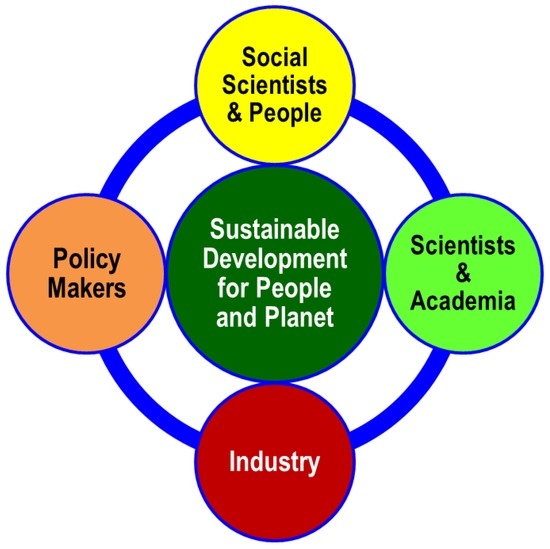
Figure 1.
Stakeholders of global sustainability. All stakeholders should play their roles for sustainable global development.
Currently, it appears that the world community has recognized the importance of protecting our common home as it is our collective responsibility [5]. Along this line, if we make healthy living and the global sustainability our prime priority, then all public and private institutions around the globe need to align themselves with the SDGs. By bearing in mind the importance of healthy living and global sustainability for us and for our future generations, we need to act together.
In summary, achieving the SDGs is a huge and challenging task, but with intensive and well-organized result-oriented collaboration, effective cross talk among scientific communities, social scientists and people, policy makers and industry, and the strong determination of UN member states, we will define our success in making healthy living and the fate of future generations and global sustainability a reality.
Conflicts of Interest
The author declares no conflict of interest.
References
- Towards 2030: Counting and accountability matter. Lancet 2015, 386, 1312.
- United Nations Development Programme Home Page. Sustainable Development Goals (SDGs). Available online: http://www.undp.org/content/undp/en/home/mdgoverview/post-2015-development-agenda.html (accessed on 21 September 2016).
- Rylance, R. Global funders to focus on interdisciplinarity. Nature 2015, 525, 313–315. [Google Scholar] [CrossRef] [PubMed]
- Viseu, A. Integration of social science into research is crucial. Nature 2015, 525, 291. [Google Scholar] [CrossRef] [PubMed]
- United Nations News Centre. UN Adopts New Global Goals, Charting Sustainable Development for People and Planet by 2030 (UN, 2015). Available online: http://www.un.org/apps/news/story.asp?NewsID=51968#.VgtIdOyqpHw (accessed on 23 September 2016).
© 2016 by the author; licensee MDPI, Basel, Switzerland. This article is an open access article distributed under the terms and conditions of the Creative Commons Attribution (CC-BY) license (http://creativecommons.org/licenses/by/4.0/).