Effects of Virtual Reality on the Limb Motor Function, Balance, Gait, and Daily Function of Patients with Stroke: Systematic Review




Abstract
1. Introduction
2. Materials and Methods
2.1. Search Methods
2.2. Eligibility Criteria
2.3. Study Selection and Data Extraction
2.4. Assessment of the Included Studies’ Methodological Quality
2.5. Data Synthesis
3. Results
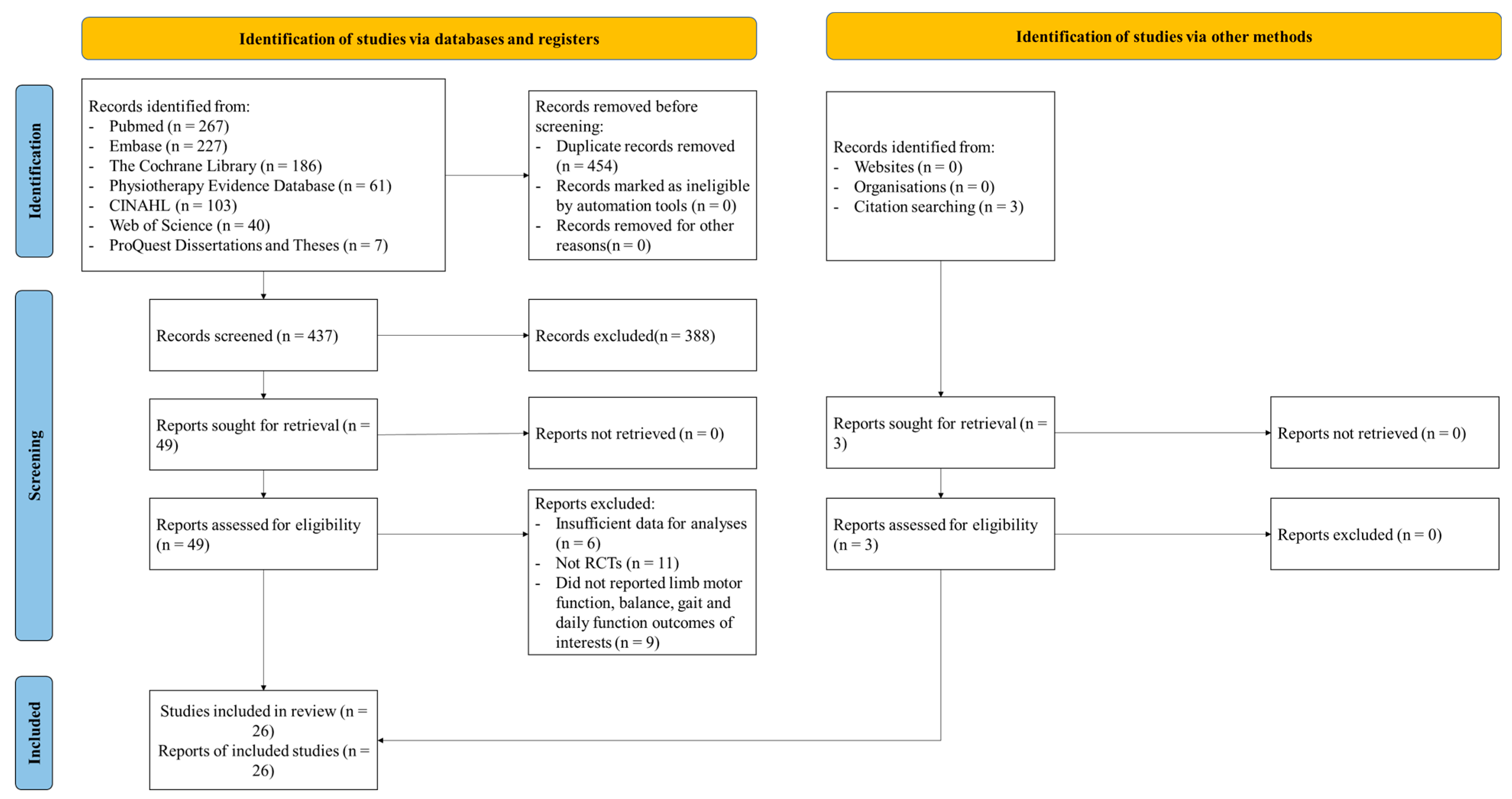
3.1. Search Results
3.2. Study Characteristics
3.3. Quality of the Systematic Reviews
3.4. Evidence Synthesis of VR Interventions
3.4.1. Evidence Synthesis of Upper Limb Function
3.4.2. Evidence Synthesis of Lower Limb Function
3.4.3. Evidence Synthesis of Balance
3.4.4. Evidence Synthesis of Gait
3.4.5. Evidence Synthesis of Daily Function
3.4.6. Evidence Synthesis of Subgroup Analysis
4. Discussion
5. Conclusions
Author Contributions
Funding
Institutional Review Board Statement
Informed Consent Statement
Data Availability Statement
Conflicts of Interest
References
- GBD 2019 Stroke Collaborators. Global, regional, and national burden of stroke and its risk factors, 1990–2019: A systematic analysis for the Global Burden of Disease Study 2019. Lancet Neurol. 2021, 20, 795–820. [Google Scholar] [CrossRef] [PubMed]
- Zhao, Y.; Zhang, X.; Chen, X.; Wei, Y. Neuronal injuries in cerebral infarction and ischemic stroke: From mechanisms to treatment (Review). Int. J. Mol. Med. 2022, 49, 15. [Google Scholar] [CrossRef] [PubMed]
- Ochi, M.; Wada, F.; Saeki, S.; Hachisuka, K. Gait training in subacute non-ambulatory stroke patients using a full weight-bearing gait-assistance robot: A prospective, randomized, open, blinded-endpoint trial. J. Neurol. Sci. 2015, 353, 130–136. [Google Scholar] [CrossRef] [PubMed]
- Axer, H.; Axer, M.; Sauer, H.; Witte, O.W.; Hagemann, G. Falls and gait disorders in geriatric neurology. Clin. Neurol. Neurosurg. 2010, 112, 265–274. [Google Scholar] [CrossRef]
- Dąbrowski, J.; Czajka, A.; Zielińska-Turek, J.; Jaroszyński, J.; Furtak-Niczyporuk, M.; Mela, A.; Poniatowski, Ł.A.; Drop, B.; Dorobek, M.; Barcikowska-Kotowicz, M.; et al. Brain functional reserve in the context of neuroplasticity after stroke. Neural Plast. 2019, 2019, 9708905. [Google Scholar] [CrossRef]
- Shen, J.; Gu, X.; Yao, Y.; Li, L.; Shi, M.; Li, H.; Sun, Y.; Bai, H.; Li, Y.; Fu, J. Effects of virtual reality-based exercise on balance in patients with stroke: A systematic review and meta-analysis. Am. J. Phys. Med. Rehabil. 2022, 102, 316–322. [Google Scholar] [CrossRef]
- Lesauskaitė, V.; Damulevičienė, G.; Knašienė, J.; Kazanavičius, E.; Liutkevičius, A.; Janavičiūtė, A. Older adults-potential users of technologies. Medicina 2019, 55, 253. [Google Scholar] [CrossRef]
- Laver, K.E.; Lange, B.; George, S.; Deutsch, J.E.; Saposnik, G.; Crotty, M. Virtual reality for stroke rehabilitation. Cochrane Database Syst. Rev. 2017, 11, Cd008349. [Google Scholar] [CrossRef]
- Choi, Y.H.; Paik, N.J. Mobile Game-based Virtual Reality Program for Upper Extremity Stroke Rehabilitation. J. Vis. Exp. 2018, 133, 56241. [Google Scholar]
- Lloréns, R.; Noé, E.; Colomer, C.; Alcañiz, M. Effectiveness, usability, and cost-benefit of a virtual reality-based telerehabilitation program for balance recovery after stroke: A randomized controlled trial. Arch. Phys. Med. Rehabil. 2015, 96, 418–425. [Google Scholar] [CrossRef]
- Wu, J.; Zeng, A.; Chen, Z.; Wei, Y.; Huang, K.; Chen, J.; Ren, Z. Effects of virtual reality training on upper limb function and balance in stroke patients: Systematic review and meta-meta-analysis. J. Med. Internet Res. 2021, 23, e31051. [Google Scholar] [CrossRef]
- Peng, Q.C.; Yin, L.; Cao, Y. Effectiveness of virtual reality in the rehabilitation of motor function of patients with subacute stroke: A meta-analysis. Front. Neurol. 2021, 12, 639535. [Google Scholar] [CrossRef] [PubMed]
- De Rooij, I.J.; van de Port, I.G.; Meijer, J.G. Effect of virtual reality training on balance and gait ability in patients with stroke: Systematic review and meta-analysis. Phys. Ther. 2016, 96, 1905–1918. [Google Scholar] [CrossRef]
- Pollock, M.; Fernandes, R.; Becker, L.; Pieper, D.; Hartling, L. Overviews of Reviews. In Cochrane Handbook for Systematic Reviews of Interventions Version 6.2; Higgins, J.P.T., Thomas, J., Chandler, J., Cumpston, M., Li, T., Page, M., Eds.; Cochrane Library: London, UK, 2021; (updated February 2021). [Google Scholar]
- Bougioukas, K.I.; Liakos, A.; Tsapas, A.; Ntzani, E.; Haidich, A.B. Preferred reporting items for overviews of systematic reviews including harms checklist: A pilot tool to be used for balanced reporting of benefits and harms. J. Clin. Epidemiol. 2018, 93, 9–24. [Google Scholar] [CrossRef] [PubMed]
- Shea, B.J.; Reeves, B.C.; Wells, G.; Thuku, M.; Hamel, C.; Moran, J.; Moher, D.; Tugwell, P.; Welch, V.; Kristjansson, E.; et al. AMSTAR 2: A critical appraisal tool for systematic reviews that include randomised or non-randomised studies of healthcare interventions, or both. BMJ 2017, 358, j4008. [Google Scholar] [CrossRef] [PubMed]
- Balshem, H.; Helfand, M.; Schünemann, H.J.; Oxman, A.D.; Kunz, R.; Brozek, J.; Vist, G.E.; Falck-Ytter, Y.; Meerpohl, J.; Norris, S.; et al. GRADE guidelines: 3. Rating the quality of evidence. J. Clin. Epidemiol. 2011, 64, 401–406. [Google Scholar] [CrossRef]
- Aguilera-Rubio, Á.; Alguacil-Diego, I.M.; Mallo-López, A.; Cuesta-Gómez, A. Use of the Leap Motion Controller® System in the rehabilitation of the upper limb in stroke: A systematic review. J. Stroke Cerebrovasc. Dis. 2022, 31, 106174. [Google Scholar] [CrossRef]
- Khan, A.; Podlasek, A.; Somaa, F. Virtual reality in post-stroke neurorehabilitation—A systematic review and meta-analysis. Top. Stroke Rehabil. 2021, 30, 53–72. [Google Scholar] [CrossRef]
- Zhang, B.; Li, D.; Liu, Y.; Wang, J.; Xiao, Q. Virtual reality for limb motor function, balance, gait, cognition and daily function of stroke patients: A systematic review and meta-analysis. J. Adv. Nurs. 2021, 77, 3255–3273. [Google Scholar] [CrossRef]
- Jin, M.; Pei, J.; Bai, Z.; Zhang, J.; He, T.; Xu, X.; Zhu, F.; Yu, D.; Zhang, Z. Effects of virtual reality in improving upper extremity function after stroke: A systematic review and meta-analysis of randomized controlled trials. Clin. Rehabil. 2022, 36, 573–596. [Google Scholar] [CrossRef]
- Al-Whaibi, R.M.; Al-Jadid, M.S.; ElSerougy, H.R.; Badawy, W.M. Effectiveness of virtual reality-based rehabilitation versus conventional therapy on upper limb motor function of chronic stroke patients: A systematic review and meta-analysis of randomized controlled trials. Physiother. Theory Pract. 2021, 38, 2402–2416. [Google Scholar] [CrossRef]
- Li, Y.; Huang, J.; Li, X.; Qiao, J.; Huang, X.; Yang, L.; Yu, H. Effect of time-dose-matched virtual reality therapy on upper limb dysfunction in patients poststroke: A meta-analysis of randomized controlled trials. Arch. Phys. Med. Rehabil. 2021, 103, 1131–1143. [Google Scholar] [CrossRef] [PubMed]
- Fang, Z.; Wu, T.; Lv, M.; Chen, M.; Zeng, Z.; Qian, J.; Chen, W.; Jiang, S.; Zhang, J. Effect of traditional plus virtual reality rehabilitation on prognosis of stroke survivors: A systematic review and meta-analysis of randomized controlled trials. Am. J. Phys. Med. Rehabil. 2022, 101, 217–228. [Google Scholar] [CrossRef] [PubMed]
- Mekbib, D.B.; Han, J.; Zhang, L.; Fang, S.; Jiang, H.; Zhu, J.; Roe, A.W.; Xu, D. Virtual reality therapy for upper limb rehabilitation in patients with stroke: A meta-analysis of randomized clinical trials. Brain Inj. 2020, 34, 456–465. [Google Scholar] [CrossRef]
- Domínguez-Téllez, P.; Moral-Muñoz, J.A.; Salazar, A.; Casado-Fernández, E.; Lucena-Antón, D. Game-based virtual reality interventions to improve upper limb motor function and quality of life after stroke: Systematic review and meta-analysis. Games Health J. 2020, 9, 1–10. [Google Scholar] [CrossRef] [PubMed]
- Ghai, S.; Ghai, I.; Lamontagne, A. Virtual reality training enhances gait poststroke: A systematic review and meta-analysis. Ann. N. Y. Acad. Sci. 2020, 1478, 18–42. [Google Scholar] [CrossRef] [PubMed]
- Xavier-Rocha, T.B.; Carneiro, L.; Martins, G.C.; Vilela-JÚnior, G.B.; Passos, R.P.; Pupe, C.C.B.; Nascimento, O.; Haikal, D.S.; Monteiro-Junior, R.S. The Xbox/Kinect use in poststroke rehabilitation settings: A systematic review. Arq. Neuro-Psiquiatr. 2020, 78, 361–369. [Google Scholar] [CrossRef]
- Lee, H.S.; Park, Y.J.; Park, S.W. The Effects of virtual reality training on function in chronic stroke patients: A systematic review and meta-analysis. Biomed. Res. Int. 2019, 2019, 7595639. [Google Scholar] [CrossRef]
- Mohammadi, R.; Semnani, A.V.; Mirmohammadkhani, M.; Grampurohit, N. Effects of virtual reality compared to conventional therapy on balance poststroke: A systematic review and meta-analysis. J. Stroke Cerebrovasc. Dis. 2019, 28, 1787–1798. [Google Scholar] [CrossRef]
- Ahn, S.; Hwang, S. Virtual rehabilitation of upper extremity function and independence for stoke: A meta-analysis. J. Exerc. Rehabil. 2019, 15, 358–369. [Google Scholar] [CrossRef]
- Aminov, A.; Rogers, J.M.; Middleton, S.; Caeyenberghs, K.; Wilson, P.H. What do randomized controlled trials say about virtual rehabilitation in stroke? A systematic literature review and meta-analysis of upper-limb and cognitive outcomes. J. Neuroeng. Rehabil. 2018, 15, 29. [Google Scholar] [CrossRef]
- Ferreira, V.; Carvas, N., Jr.; Artilheiro, M.C.; Pompeu, J.E.; Hassan, S.A.; Kasawara, K.T. Interactive video gaming improves functional balance in poststroke individuals: Meta-analysis of randomized controlled trials. Eval. Health Prof. 2020, 43, 23–32. [Google Scholar] [CrossRef] [PubMed]
- Gibbons, E.M.; Thomson, A.N.; de Noronha, M.; Joseph, S. Are virtual reality technologies effective in improving lower limb outcomes for patients following stroke—A systematic review with meta-analysis. Top. Stroke Rehabil. 2016, 23, 440–457. [Google Scholar] [CrossRef] [PubMed]
- Iruthayarajah, J.; McIntyre, A.; Cotoi, A.; Macaluso, S.; Teasell, R. The use of virtual reality for balance among individuals with chronic stroke: A systematic review and meta-analysis. Top. Stroke Rehabil. 2017, 24, 68–79. [Google Scholar] [CrossRef] [PubMed]
- Chen, L.; Lo, W.L.; Mao, Y.R.; Ding, M.H.; Lin, Q.; Li, H.; Zhao, J.L.; Xu, Z.Q.; Bian, R.H.; Huang, D.F. Effect of virtual reality on postural and balance control in patients with stroke: A systematic literature review. Biomed. Res. Int. 2016, 2016, 7309272. [Google Scholar] [CrossRef]
- Luque-Moreno, C.; Ferragut-Garcías, A.; Rodríguez-Blanco, C.; Heredia-Rizo, A.M.; Oliva-Pascual-Vaca, J.; Kiper, P.; Oliva-Pascual-Vaca, Á. A decade of progress using virtual reality for poststroke lower extremity rehabilitation: Systematic review of the intervention methods. Biomed. Res. Int. 2015, 2015, 342529. [Google Scholar] [CrossRef]
- Corbetta, D.; Imeri, F.; Gatti, R. Rehabilitation that incorporates virtual reality is more effective than standard rehabilitation for improving walking speed, balance and mobility after stroke: A systematic review. J. Physiother. 2015, 61, 117–124. [Google Scholar] [CrossRef]
- Li, Z.; Han, X.G.; Sheng, J.; Ma, S.J. Virtual reality for improving balance in patients after stroke: A systematic review and meta-analysis. Clin. Rehabil. 2016, 30, 432–440. [Google Scholar] [CrossRef]
- Rodrigues-Baroni, J.M.; Nascimento, L.R.; Ada, L.; Teixeira-Salmela, L.F. Walking training associated with virtual reality-based training increases walking speed of individuals with chronic stroke: Systematic review with meta-analysis. Braz. J. Phys. Ther. 2014, 18, 502–512. [Google Scholar] [CrossRef]
- Lohse, K.R.; Hilderman, C.G.; Cheung, K.L.; Tatla, S.; Van der Loos, H.F. Virtual reality therapy for adults post-stroke: A systematic review and meta-analysis exploring virtual environments and commercial games in therapy. PLoS ONE 2014, 9, e93318. [Google Scholar] [CrossRef]
- Laver, K.; George, S.; Ratcliffe, J.; Crotty, M. Virtual reality stroke rehabilitation—Hype or hope? Aust. Occup. Ther. J. 2011, 58, 215–219. [Google Scholar] [CrossRef]
- Fu, M.J.; Knutson, J.S.; Chae, J. Stroke rehabilitation using virtual environments. Phys. Med. Rehabil. Clin. N. Am. 2015, 26, 747–757. [Google Scholar] [CrossRef]
- Lee, H.C.; Huang, C.L.; Ho, S.H.; Sung, W.H. The effect of a virtual reality game intervention on balance for patients with stroke: A randomized controlled trial. Games Health J. 2017, 6, 303–311. [Google Scholar] [CrossRef]
- Daly, J.J.; Ruff, R.L. Construction of efficacious gait and upper limb functional interventions based on brain plasticity evidence and model-based measures for stroke patients. Sci. World J. 2007, 7, 2031–2045. [Google Scholar] [CrossRef]
- Kim, S.H.; Cho, S.H. Benefits of virtual reality program and motor imagery training on balance and fall efficacy in isolated older adults: A randomized controlled trial. Medicina 2022, 58, 1545. [Google Scholar] [CrossRef]
- Holden, M.K. Virtual environments for motor rehabilitation: Review. Cyberpsychol. Behav. 2005, 8, 187–219. [Google Scholar] [CrossRef] [PubMed]
- Party, I.S.W. National Clinical Guideline for Stroke, 4th ed.; Royal College of Physicians: London, UK, 2012; p. 79. [Google Scholar]
- Schuster-Amft, C.; Eng, K.; Suica, Z.; Thaler, I.; Signer, S.; Lehmann, I.; Schmid, L.; McCaskey, M.A.; Hawkins, M.; Verra, M.L.; et al. Effect of a four-week virtual reality-based training versus conventional therapy on upper limb motor function after stroke: A multicenter parallel group randomized trial. PLoS ONE 2018, 13, e0204455. [Google Scholar] [CrossRef]
- Moore, J.L.; Nordvik, J.E.; Erichsen, A.; Rosseland, I.; Bø, E.; Hornby, T.G. Implementation of high-intensity stepping training during inpatient stroke rehabilitation improves functional outcomes. Stroke 2020, 51, 563–570. [Google Scholar] [CrossRef] [PubMed]
- Mekbib, D.B.; Zhao, Z.; Wang, J.; Xu, B.; Zhang, L.; Cheng, R.; Fang, S.; Shao, Y.; Yang, W.; Han, J.; et al. Proactive motor functional recovery following immersive virtual reality-based limb mirroring therapy in patients with subacute stroke. Neurotherapeutics 2020, 17, 1919–1930. [Google Scholar] [CrossRef] [PubMed]
- Yoon, H.J.; Kim, J.; Park, S.W.; Heo, H. Influence of virtual reality on visual parameters: Immersive versus non-immersive mode. BMC Ophthalmol. 2020, 20, 200. [Google Scholar] [CrossRef]


| Concept | MeSH Terms | Keywords |
|---|---|---|
| Stroke | Cerebrovascular disorders; basal ganglia cerebrovascular disease; brain ischemia; intracranial arterial diseases; intracranial arteriovenous malformations; intracranial embolism and thrombosis; intracranial hemorrhages; stroke; brain infarction; hemiplegia; paresis | Stroke; cva; poststroke; post-stroke; cerebrovasc*; hemipleg*; hemipar*; paresis; brain; cerebral*; cerebell*; brain*; vertebrobasilar |
| Virtual reality | User–computer interface; computers; microcomputers; computer systems; software; computer simulation; computer-assisted instruction; therapy, computer-assisted; computer graphics; video games | Virtual next reality*; virtual-reality; VR; video game*; video next gaming; gaming next console*; interactive next game; interactive next gaming; Nintendo next Wii; gaming next program*; haptics; haptic next device* |
| Systematic review | - | Systematic review; systematic overview; meta-analysis |
| Author, Year | Country | Included Articles | Participants | Intervention | Risk of Bias Assessment Tool | Focus | Meta-Analysis | Subgroup | Outcome | Main Findings |
|---|---|---|---|---|---|---|---|---|---|---|
| Angela Aguilera-Rubio, 2021 [18] | Spain | 6 | n = 144 Subacute stroke: 30 Chronic stroke: 65 Acute stroke: 8 Age range (years): 18–91 | VR 1: the Leap Motion Controller system in VR environments CT 2 Frequency: 20 min/d~60 min/d; 3 d/w~5 d/w Duration: 2~12 weeks Number of sessions: 6~40 sessions | The Downs and Black scale and the CONSORT checklist | UL 3 | No | No | Clinical scores: Upper Extremity Fugl-Meyer Assessment; Action Research Arm Test; Wolf Motor Function Test; Functional Independence Measure; and the Stroke Upper Limb Capacity Scale | After using VR, UL function in stroke patients was improved. |
| Azka Khan, 2021 [19] | Pakistan | 150 | n = 1617 Stroke Age range (years): 42–94 Time since stroke onset: 0.5 -> 12 months | VR: rehabilitation gaming system; electromagnetic motion tracker; IREX; Nintendo Wii Fit; RehabMasterTM system; RAPAEL Smart GloveTM; Kinect CT: physical therapy; occupational therapy Frequency: 5 min/d~120 min/d; 1 d/w~7 d/w Duration: 2~12 weeks Number of sessions: 9~56 sessions | The ROBINS-2 tool | Cognitive, UL, balance, LL 4 | Yes | No | Clinical scores: Fugl-Meyer Assessment, Berg Balance scale; Mini Mental Scale Examination; Box and Block Test; 10 m Walk Test; Timed Up-and-Go test; The Manual Function Test; Action Research Arm | Qualitative synthesis: UL function and balance was improved in the VR group compared to non-VR group. Meta-analysis: For the MMSE score and the Fugl-Meyer score, the difference between the two groups was not statistically significant. |
| Bohan Zhang, 2021 [20] | China | 87 | n = 3540 Infarction stroke: 1664 Hemorrhage stroke: 866 Age range (years): 46–76 Time since stroke onset: 12.7 days–19.2 years Sex: male: 2000; female: 1329 | VR: BioMster; STB-110; MOTOmed; GaitWatch; Xbox360; smart board; Leap Motion; Wii balance board; Kinect; Lokomat; IREX CT: physical therapy; occupational therapy; routine therapy Frequency: 15 min/d~100 min/d; 3 d/w~6 d/w Duration: 2~12 weeks Number of sessions: 6~40 sessions | The Cochrane risk of bias tool and the PEDro scale 5 | UL, LL, balance, gait, cognition, and daily function | Yes | VR intervention duration | Clinical scores: Upper Extremity Fugl-Meyer Assessment; Action Research Arm Test; Wolf Motor Function Test; Box and Block Test; Lower Extremity Fugl-Meyer Assessment; Functional Ambulation Classification (FAC); Berg Balance Scale; 10 m Walk Test; Timed Up-and-Go Test; Velocity; Cadence; Mini Mental State Examination; Auditory Continuous Performance Test; Visual Continuous Performance Test; Functional Independence Measure; Modified Barthel Index | Stroke patients who received VR intervention showed considerable improvements in UL and LL movements, balance, walking, and self-care abilities. |
| Minxia Jin, 2021 [21] | China | 40 | n = 2018 Infarction stroke: 1311 Hemorrhage stroke: 433 Age range (years): 52–76 Time since stroke onset: 0.6–250 months Sex: male: 1252; female: 766 | VR: Playstation EyeToy Games; RFVE; IREX; Xbox Kinect; BilMater; Nintendo Wii; RAPAEL Smart Glove CT: occupational therapy; usual activity; physical therapy Frequency: 20 min/d~60 min/d; 2 d/w~5 d/w Duration: 2~8 weeks Number of sessions: 10~30 sessions | The PEDro scale | UL, daily function | Yes | Severity of paresis; chronicity; type of control; type of virtual reality intervention; and degree of immersion | Clinical scores: Action Research Arm Test; Box and Block Test; Barthel Index; Brunnstrom stage; European Quality of Life 5-Dimension 5-Level Questionnaire; Functional Independence Measure; Fugl-Meyer Assessment Upper Extremity subscale; Jebsen Taylor Hand Function Test; Motor Activity Log—Amount of Use; Motor Activity Log—Quality of Movement; modified Ashworth Scale; modified Barthel Index; Manual Function Test; Manual Muscle Test; Range of Movement; Stroke Impact Scale; Wolf Motor Function Test; 9-Hole Peg Test | Compared to the control group, VR showed better results for overall arm function, and activity limitation. For participation and activity limits (specific tasks), no significant improvements were observed. More progress after training for patients with moderate-to-severe arm palsy. Greater beneficial impact with immersive virtual reality. |
| Reem M. Al-Whaibi, 2021 [22] | Saudi Arabia | 6 | n = 174 Infarction stroke: 65 Hemorrhage stroke: 18 Age range (years): 51–71 Sex: male: 124; female: 50 | VR: Cy-Wee Z game; video games CT: physical therapy; gym therapy; occupational therapy Frequency: 30 min/d~90 min/d; 3 d/w~4 d/w Duration: 1~12 weeks Number of sessions: 6~18 sessions | The Cochrane risk of bias tool | UL | Yes | No | Clinical scores: Fugl-Meyer Assessment for upper extremities; Wolf Motor Function Test; Intrinsic Motivation Inventory; Lawton Instrumental Activities of Daily Living; Stroke Impact Scale; Manual Function Test; Box and Block Test; Chedoke McMaster Arm and Hand Activity Inventory; Fatigue Severity Scale; Motor Activity Log; Reaching Performance Scale in Stroke; Motor Activity Log-Amount Scale | Patients with chronic stroke showed a significant improvement within the group after receiving VR treatment. VR interventions produced similar results to traditional rehabilitation. |
| Yi Li, 2021 [23] | China | 31 | n = 1299 Subacute stroke: 544 Chronic stroke: 707 Acute stroke: 24 Age range (years): 49–69 Time since stroke onset: 0.5–95 months Sex: male: 827; female: 472 | VR: Wii sports games; Nintendo; Kinect CT: physical therapy; occupational therapy Frequency: 30 min/d~60 min/d; 1 d/w~7 d/w Duration: 2~12 weeks Number of sessions: 8~42 sessions | The Cochrane risk of bias tool | UL | Yes | Session time (≤45 min vs. >45 min); intervention duration (<6 weeks vs. ≥6 weeks); sample size (n ≤ 30 vs. n >3 0; n, total enrolled participants). | Clinical scores: Upper Extremity Fugl-Meyer Assessment; Stroke Impact Scale; strength; grip strength; Motricity Index; Box and Block Test; Action Research Arm Test; Wolf Motor Function Test; modified Barthel Index; Jebsen Hand Function Test; Functional Independence Measure; Barthel Index; Motor Activity Log—Quality of Movement | For UL motor function recovery, VR was more effective than time dose-matched CT, and even more effective when using a virtual environment or VR mixed with CT. In contrast to CT, no improvement was achieved in patient performance and participation in daily activities with VR (VR only or VR mixed with CT). VE 6, a type of VR, was clearly superior to CG 7 in terms of movement of the overlying limbs. Structural/functional recovery benefited more from VR when session duration exceeded 45 min. When intervention duration was less than 6 weeks, VR was found to be more beneficial for structural/functional recovery. |
| Zongwei Fang, 2021 [24] | China | 21 | n = 619 Stroke Age range (years): 45–76 Affected side (left): 260 | VR CT Frequency: 20 min/d~60 min/d; 1 d/w~5 d/w Duration: 4~8 weeks Number of sessions: 8~30 sessions | The Cochrane risk of bias tool | UL, balance | Yes | Session time (≥18 sessions versus <18 sessions); VR type (Immersive versus Non-Immersive) | Clinical scores: Fugl-Meyer Assessment–Upper Extremity; Box and Block Test; Functional Independence Measure; Berg Balance Scale | Traditional rehabilitation with VR rehabilitation outperformed traditional rehabilitation in terms of UL flexibility. In terms of activities of daily living and balance, there were no major differences between VR and traditional rehabilitation. Immersive VR may lead to more improvement in UL motor function than non-immersive VR. |
| Destaw B. Mekbib, 2020 [25] | China | 27 | n = 1094 Subacute stroke: 12 studies, range: 0.43–5.7 months Chronic stroke: 14 studies, range: 6.11–51 months; Age range (years): 64.48 | VR: “off-the shelf” commercial video gaming console; custom-built virtual environment CT Frequency: not reported Duration: not reported Number of sessions: not reported | The PEDro scale | UL | Yes | Subacute stage (within 6 months) versus chronic stage (more than 6 months); and total amount of intervention: <15 h of intervention versus ≥15 h of intervention | Clinical scores: Fugl-Meyer Assessment for Upper Extremities; Box and Block Test; Motor Activity Log | VR group showed statistically significant improvement in the recovery of UL, activity, and participation versus the control group. When the intervention time exceeded 15 h, the VR group showed a significant improvement in the recovery of UL function. Improvement in the recovery of UL dysfunction was evident in subacute stroke patients but not in chronic patients. |
| Pablo Domı’nguez-Te´llez, 2020 [26] | France | 20 | n = 874 Stroke Age range (years): 53–76 | VR: immersive VR; Xbox Kinect; 3D immersive VR; mechatronic VR; Nintendo Wii; Smart Glove; Armeo Spring CT Frequency: 30 min/d~60 min/d; 2 d/w~6 d/w Duration: 2~12 weeks Number of sessions: 10~30 sessions | The PEDro scale | UL, daily function | Yes | No | Clinical scores: Fugl-Meyer Assessment for the Upper Extremities; Box and Block Test; modified Barthel Index; Functional Independence Measure | The VR intervention was found to be effective for UL motor function and quality of life. |
| Shashank Ghai, 2020 [27] | Canada | 32 | n = 809 Stroke Age range (years): 41–81 Time since stroke onset: 19 days–15.1 years Sex: male: 541; female: 268 | VR CT Frequency: 20 min/d~60 min/d; 2 d/w~5 d/w Duration: 2~12 weeks Number of sessions: 8~40 sessions | The PEDro scale | Gait | Yes | Intervention method | Clinical scores: 3 min Walk Test; 6 min Walk Test; 10 m Walk Test; 30 s Sit-to-Stand test; Activity-Specific Balance Confidence Scale; Action Reach Arm Test; Berg Balance Scale; Brunel Balance Assessment; Beck depression Inventory; cadence; Chedoke–McMaster Stroke Assessment; Fugl–Meyer Assessment; Four Square Step Test; Functional Reach Test; gate speed; Hamilton Depression Rating Scale; Lateral Reach Test; modified Ashworth Scale; modified Motor Assessment; muscle strength; Tinetti Performance-Oriented Mobility Assessment; Relationship Change Scale; Rivermead Mobility Index; sitting balance test; stride length; System Usability Scale; Tardieu scale; Timed Up-and-Go test; Visual Analog Scale; Walking Ability Questionnaire | VR training was beneficial for cadence, stride length, and speed. |
| Túlio Brandão XAVIER-ROCHA, 2020 [28] | Brazil | 8 | - | VR: Xbox Kinect; virtual reality games CT: standard therapy; task-oriented therapy Frequency: 30 min/d~120 min/d; 2 d/w~5 d/w Duration: 4~8 weeks Number of sessions: 12~40 sessions | The PEDro scale and Higgins visual scale | UL, LL, balance, gait, and daily function | No | No | Clinical scores: Fugl-Meyer Assessment—Upper extremity; Brunnstrom Stage Recovery; Box and Block test; Functional Independence Measure; Berg balance scale; Activity-Specific Balance Confidence Scale; Stroke Impact Scale; Fugl-Meyer Lower Extremities Assessment; Timed Up-and- Go Test; Manual Muscle test; Active range of motion | VR was effective for restoring balance, UL, and LL in post-stroke patients. |
| Han Suk Lee, 2019 [29] | Korea | 21 | n = 562 Stroke Age range (years): 46–72 Time since stroke onset: 6–87 months | VR: Wii balance board system; Nintendo Wii; treadmill training based real-world video; Xbox Kinect CT: standard training; physical therapy Frequency: 30 min/d~180 min/d; 2 d/w~5 d/w Duration: 2~8 weeks Number of sessions: 8~40 sessions | The PEDro scale | UL, LL, and daily function | Yes | The effects on functional improvement | Clinical scores: Rivermead mobility index; modified Ashworth Scale; postural sway velocity—AP eyes open; postural sway velocity—ML eyes closed; Berg Balance Scale; Timed Up-and-Go test; anteroposterior postural sway velocity; mediolateral postural sway velocity; postural sway velocity moment; Fugl-Myer Assessment; Short-Form 36 Health Survey; Wolf Motor Function Test; Reach to Grasp Test; Functional Reach Test; 10 m walking velocity; Box and Block Test; Manual Function Test; Functional Independence Measure; six-minute Walk Test; Wolf Motor Function Test; functional ability; Stroke-Specific Quality of Life Test—Upper Limb | VR was most effective in improving muscle tension, next to muscle strength. |
| Roghayeh Mohammadi, 2019 [30] | Iran | 14 | n = 344 Subacute stroke: 40 Chronic stroke: 265 Age range (years): 52–65 Time since stroke onset: 15 days- >1 year Sex: male: 182; female: 162 | VR: Wii Fit balance board; virtual walking program; BalPro; IREX; BCT VR; Bio Rescue; Xbox Kinect CT: traditional rehabilitation Frequency: 20 min/d~45 min/d; 2 d/w~5 d/w Duration: 2~6 weeks Number of sessions: 10~20 sessions | The PEDro scale | Balance | Yes | No | Clinical scores: Brunel Balance Assessment; Berg Balance Scale; Functional Reach Test; modified Motor Assessment Scale; Timed Up-and-Go test | In terms of balance, the improvement was even more pronounced with the combination of VR and traditional therapy. |
| Sinae Ahn, 2019 [31] | Korea | 34 | n = 1604 Hemiplegic stroke | VR: gaming-based VR; RFVE; RehabMaster intervention CT: occupational therapy; Traditional rehabilitation Frequency: 20 min/d~60 min/d; 2 d/w~7 d/w Duration: 2~6 weeks Number of sessions: 10~24 sessions | The Jadad scale. | UL | Yes | No | Clinical scores: Action Research Arm Test; Barthel Index; Chedoke Arm and Hand Activity Inventory; Functional Independence Measure; Fugl-Meyer Assessment; motor activity log; modified Barthel index; Mini Mental State Examination; manual muscle testing; Wolf Motor Function Test. | Stroke patients’ UL function and independent mobility were effectively restored with VR exercises. |
| Anna Aminov, 2018 [32] | Australia | 31 | n = 971 Subacute stroke: 266 Chronic stroke: 602 Age range (years): 48–74 Time since stroke onset: 2–428 weeks | VR: virtual environment; commercial gaming CT Frequency: 20 min/d~60 min/d; 1 d/w~5 d/w Duration: 3~12 weeks Number of sessions: 4~24 sessions | The PEDro scale | UL, cognitive, and daily function | Yes | Intervention type; simulation type; study quality; recovery stage; control group type; duration; frequency; dose; daily intensity; weekly intensity | Clinical scores: Auditory Continuous Performance Test; Action Research Arm Test; Ashworth scale, Backward Digit Span Test; Backward Visual Span Test; Barthel Index; Box and Block test; color of word in word-color test; Composite Spasticity Index; Fugl-Meyer Assessment; Fugl-Meyer Assessment—Upper Extremity; Forward Digit Span Test; Forward Visual Span Test; Jebsen Hand Function Test; modified Ashworth Scale; Motor Activity Log; Manual Function Test; Motricity Index; Toulouse–Pieron Test; Visual Continuous Performance Test; Visual Learning Test; Verbal Learning Test; Trail Making Test A; Tower of London Test; Quality of Movement; Reaching Performance Scale for Stroke; Wolf Motor Function Test; Wechsler Memory Scale Third Edition; color of word in word-color test | The overall effect that VR generated extended beyond the effects of traditional therapies. Patient participation outcomes were not dramatically helpful. |
| Vilma Ferreira, 2018 [33] | Brazil | 11 | n = 310 Subacute stroke: 137 Chronic stroke: 154 Acute stroke: 19 | VR: real-world video; Wii Kinect; balance-challenging virtual reality exercise CT: walking training; physiotherapy Frequency: 20 min/d~60 min/d; 2 d/w~5 d/w Duration: 2~12 weeks Number of sessions: 12~20 sessions | The PEDro scale | Balance and mobility | Yes | No | Clinical scores: two-minute Walk Test; Timed Up-and-Go Test; Intrinsic Motivation Inventory; Functional Ambulation Category; Berg Balance Scale | With the application of VR, balance was improved. However, there was no change in mobility. |
| Laver KE, 2017 [8] | Australia | 72 | n = 2470 Stroke Age range (years): 46–75 | VR: commercially available gaming consoles; Nintendo Wii; Microsoft Kinect; gaming consoles; GestureTek IREX; Armeo; CAREN system CT: activity retraining; global motor function training Frequency: 20 min/d~90 min/d; 2 d/w~5 d/w Duration: 5~12 weeks Number of sessions: 8~36 sessions | The Cochrane ‘risk of bias’ tool | UL, LLL balance, and daily function | Yes | Dose of intervention; Time since onset of stroke; Specialised or gaming; Severity of impairment | Clinical scores: Action Research Arm Test; Canadian Occupational Performance Measure; Stroke Impact Scale; modified Rankin Scale; EQ5D; Motor Activity Log Arm Function Test; Useful Field of View Test; Barthel Index; Timed Up-and-Go Test; Functional Independence Measure; Box and Block test; Tapper Test; Fugl-Meyer UE; Chedoke Arm and Hand Activity Inventory; hand grip strength | Results were not statistically significant for UL function. For daily function, the between-group comparisons showed differences when virtual reality was combined with usual care. VR had the same effect on gait speed and balance as traditional rehabilitation. |
| Emma Maureen Gibbons, 2016 [34] | Australia | 22 | n = 552 Acute/subacute stroke: 190 Chronic stroke: 362 Age range (years): 41–78 | VR: Wii Fit balance training; VR treadmill training; Xbox Kinect CT: standard care; treadmill training; ergometer bicycle training Frequency: 20 min/d~60 min/d; 2 d/w~6 d/w Duration: 2~12 weeks Number of sessions: 9~30 sessions | The PEDro scale | LL | Yes | No | Clinical scores: Berg Balance Scale; Timed Up-and-Go Test; Functional Reach Test; Stroke Rehabilitation Assessment of Movement Measure; 6 min Walk Test; medial–lateral; 10 m Walk Test; Performance-Oriented Assessment of Mobility | In the chronic stroke population, the VR group was found to favor balance, gait speed, stride length, and step length. |
| Ilona J.M. de Rooij, 2016 [13] | Netherlands | 21 | n = 516 Stroke Age range (years): 46–66 Time since stroke onset: 13 days–12 years | VR: VR treadmill training; VR balance training; virtual object training CT: conventional therapy; PNF exercise program; ergometer bicycle training Frequency: not reported Duration: not reported Number of sessions: not reported | The PEDro scale | Gait speed | Yes | Time dose-matched and VR-added conventional therapy | Clinical scores: 10 m Walk Test; Activity-Specific Balance Confidence; Berg Balance Scale; Functional Reach Test; medial–lateral, modified Motor Assessment Scale; Performance-Oriented Mobility Assessment; postural sway path length; postural sway velocity moment; Stability Index; Timed Up-and-Go Test; Walking Ability Questionnaire; Weight Distribution Index | VR training had a better effect on balance and gait recovery after stroke than traditional rehabilitation. For gait and balance, VR combined with conventional training provided better results than VR alone. |
| Jerome Iruthayarajah, 2016 [35] | Canada | 20 | n = 469 Infarction stroke: 127 Hemorrhage stroke: 101 Age range (years): 47–78 Time since stroke onset: 9.2–73.2 months Affected side (left): 156 Sex: male: 233; female: 203 | VR: Xbox Kinect; Nintendo Wii Fit; treadmill walking; training with real-world video CT: ergometer bicycle training; task-oriented training; general exercise therapy Frequency: 30 min/d~60 min/d; 2 d/w~5 d/w Duration: 6~12 weeks Number of sessions: 10~40 sessions | The PEDro scale | Balance | Yes | Type of VR | Clinical scores: Berg Balance Scale; Timed Up-and-Go Test; Tinetti Performance-Oriented Mobility Assessment; Brunel Balance Assessment; 10 m Walking Test; Tinetti Performance-Oriented Mobility Assessment; Functional Reach Test | VR led to significant improvement in the balance of the patient. |
| Ling Chen, 2016 [36] | China | 9 | n = 265 Stroke Age range (years): 52–66 Time since stroke onset: 35 days–3 years | VR: IREX VR games; VR treadmill; Nintendo Wii Fit; IREX VR games CT: usual balance therapy; non-VR treadmill; physical therapy Frequency: 20 min/d~60 min/d; 3 d/w~5 d/w Duration: 3~5 weeks Number of sessions: 9~20 sessions | The PEDro scale | Balance | No | No | Clinical scores: Brunel Balance Assessment Category; Berg Balance Scale; Barthel Index; Balance Performance Monitoring; center of pressure; Functional Ambulation Categories; functional electrical stimulation; Fugl-Meyer Assessment; modified Motor Assessment Scale; Two-Minute Walk Test; Timed Up-and-Go Test | All but one study demonstrated positive improvements in static or dynamic balance. |
| Carlos Luque-Moreno, 2015 [37] | Spain | 11 | n = 231 Chronic stroke Age range (years): 47–66 Time since stroke onset: 1–11years | VR: Immersive VR; IREX VR system; Rutgers Ankle; WBB easy balance virtual rehabilitation CT Frequency: 20 min/d~60 min/d; 3 d/w~4 d/w Duration: 2~6 weeks Number of sessions: 6~20 sessions | The PEDro scale | LL | No | No | Clinical scores: 3 min Walk Test; 6 min Walk Test; 10 m Walk Test; 30 s Sit-to-Stand Test; Activity-Specific Balance Confidence Test; Anterior Reach Test; Brunel Balance Assessment; Berg Balance Scale; Functional Ambulatory Scale; Fugl-Meyer Scale; modified Motor Assessment Scale; Stepping Test; Timed Stair Test; Timed Up-and-Go Test | There was a significant improvement in gait speed, balance, and motor function following VR intervention. In more than 10 sessions, VR interventions had a positive impact on balance and gait. When combining VR with traditional physiotherapy, better results were obtained |
| Davide Corbetta, 2015 [38] | Italy | 15 | n = 341 Ischemic stroke Age range (years): 48–64 Sex: male: 191; female: 150 | VR: Nintendo WBB; virtual outdoor environment; 3D virtual reality environment CT: treadmill walking training; conventional therapy Frequency: 20 min/d~60 min/d; 2 d/w~4 d/w Duration: 2~6 weeks Number of sessions: 6~20 sessions | The Cochrane Collaboration’s tool | LL, Balance, daily function | Yes | No | Clinical scores: 10 m Walk Test; 6 min Walk Test; Activity-Specific Balance Confidence Test; activities of daily living; Brunel Balance Assessment; Berg Balance Scale; Barthel Index; Community Walk Test; Functional Independence Measure; Fugl-Meyer Assessment; Functional Reach Test; Barthel Index; modified Motor Assessment Scale; Timed Up-and-Go Test; Functional Ambulatory Category | VR had benefits in terms of speed, balance, and mobility. Movement improved when VR was combined with formal rehabilitation training, but there were no significant advantages for walking speed and balance. |
| Zhen Li, 2015 [39] | China | 16 | n = 428 Acute/subacute stroke: 4 studies Chronic stroke: 12 Age range (years): 46–66 | VR: Wii Fit VR; IREX VR; VR-based treadmill CT: treadmill; conventional therapy Frequency: 15 min/d~30 min/d; 2 d/w~5 d/w Duration: 3~12 weeks Number of sessions: 9~24 sessions | The Cochrane Collaborations ‘risk of bias’ tool | Balance | Yes | Time since stroke (less or more than six months), type of intervention | Clinical scores: Force Platform Indicators; Functional Reach Test; Activity-Specific Balance Confidence Scale; Berg Balance Scale; Timed Up-and-Go Test; Stability Index; functional electrical stimulation | People who received virtual reality interventions showed marked improvements in the Berg Balance Scale and the Timed Up and Go Test compared with controls. The difference between the “within six months of stroke” group and the “more than six months after stroke” group was not significant for balance. There were no significant differences between different intervention types for balance. |
| Juliana M. Rodrigues-Baroni, 2014 [40] | Brazil | 7 | n = 154 Chronic stroke Age range (years): 52–66 Time since stroke onset: 10–72 months | VR: virtual reality-based treadmill training; video game exercises CT: treadmill training; ankle movements Frequency: 20 min/d~60 min/d; 3 d/w~5 d/w Duration: 2~6 weeks Number of sessions: 6~20 sessions | The PEDro scale | Walking speed | Yes | No | Clinical scores: walking speed | Compared to the control group, the training with VR resulted in a significant increase in walking speed. |
| Keith R. Lohse, 2014 [41] | Canada | 26 | n = 626 Stroke Age range (years): 47–71 Time since stroke onset: 0.04–6.02 years | VR: 3D computer games; VR tasks; Wii balance board; IREX VR; VRBS training CT: standard occupation therapy Frequency: not reported Duration: not reported Number of sessions: not reported | The PEDro scale | UL, LL, Balance | Yes | VR type | Clinical scores: Action Research Arm Test; Brunel Balance Assessment; Berg Balance Scale; Box and Block Test; Functional Independence Measure; Fugl-Meyer Assessment; International Classification of Function, Disability, and Health; Jebsen–Taylor Hand Function Test; modified Barthel Index; Manual Function Test; modified Motor Assessment Scale; Postural Assessment Scale; Reaching Performance for Stroke Scale; Stroke Impact Scale; Timed Up-and-Go test; Wolf Motor Function Test; 10 m Walk Test | In terms of physical function and activity outcomes, compared to the traditional therapy group, VR therapy showed significant benefits. |
| Author, Year | 1 | 2 | 3 | 4 | 5 | 6 | 7 | 8 | 9 | 10 | 11 | 12 | 13 | 14 | 15 | 16 | Quality of Studies |
|---|---|---|---|---|---|---|---|---|---|---|---|---|---|---|---|---|---|
| Angela Aguilera-Rubio, 2021 [18] | Y 1 | N 3 | N | PY 2 | Y | N | Y | Y | Y | N | NP 4 | NP | Y | N | NP | Y | Low |
| Azka Khan, 2021 [19] | Y | PY | N | PY | Y | Y | Y | Y | Y | N | Y | Y | Y | N | N | Y | Low |
| Bohan Zhang, 2021 [20] | Y | Y | N | Y | Y | Y | Y | Y | Y | N | Y | Y | Y | Y | N | Y | Low |
| Minxia Jin, 2021 [21] | Y | Y | N | Y | Y | Y | Y | Y | Y | N | Y | Y | Y | Y | N | Y | Low |
| Reem M. Al-Whaibi, 2021 [22] | Y | PY | N | Y | Y | Y | Y | Y | Y | N | Y | Y | Y | N | Y | Y | High |
| Yi Li, 2021 [23] | Y | N | N | PY | N | Y | Y | Y | Y | N | Y | Y | Y | Y | N | Y | Low |
| Zongwei Fang, 2021 [24] | Y | Y | N | PY | N | Y | Y | Y | Y | N | Y | Y | Y | Y | Y | Y | Moderate |
| Destaw B. Mekbib, 2020 [25] | Y | N | N | PY | N | Y | Y | Y | Y | N | Y | Y | Y | N | N | Y | Moderate |
| Pablo Domı´nguez-Te´ llez, 2020 [26] | Y | PY | N | PY | Y | Y | Y | Y | Y | N | Y | Y | Y | N | N | Y | Low |
| Shashank Ghai, 2020 [27] | Y | Y | N | PY | Y | Y | Y | Y | Y | N | Y | Y | Y | Y | Y | Y | Moderate |
| Túlio Brandão XAVIER-ROCHA, 2020 [28] | Y | PY | N | Y | Y | N | Y | Y | Y | N | NP | NP | Y | N | NP | Y | Moderate |
| Han Suk Lee, 2019 [29] | Y | N | N | PY | Y | Y | Y | Y | Y | N | Y | Y | Y | N | Y | Y | Low |
| Roghayeh Mohammadi, 2019 [30] | Y | PY | N | PY | Y | Y | Y | Y | Y | N | Y | Y | Y | Y | N | N | Low |
| Sinae Ahn, 2019 [31] | Y | N | N | PY | Y | Y | Y | Y | Y | N | Y | Y | Y | Y | Y | Y | Low |
| Anna Aminov, 2018 [32] | Y | N | N | PY | Y | Y | Y | Y | Y | N | Y | Y | Y | N | N | Y | Critically Low |
| Vilma Ferreira, 2018 [33] | Y | Y | N | PY | Y | N | Y | Y | Y | N | Y | Y | Y | Y | Y | Y | Moderate |
| Laver KE, 2017 [8] | Y | N | N | Y | Y | Y | Y | Y | Y | N | Y | Y | Y | Y | Y | Y | Low |
| Emma Maureen Gibbons, 2016 [34] | Y | N | N | PY | Y | Y | Y | Y | Y | N | Y | Y | Y | N | N | N | Critically Low |
| Ilona J.M. de Rooij, 2016 [13] | Y | N | N | PY | Y | Y | Y | Y | Y | N | Y | Y | Y | Y | N | Y | Critically Low |
| Jerome Iruthayarajah, 2016 [35] | Y | PY | N | Y | Y | Y | Y | Y | Y | N | Y | Y | Y | N | N | N | Low |
| Ling Chen, 2016 [36] | Y | N | N | Y | Y | Y | Y | Y | Y | N | NP | NP | Y | N | NP | Y | Low |
| Carlos Luque-Moreno, 2015 [37] | Y | N | N | PY | N | N | Y | Y | Y | N | NP | NP | Y | N | NP | Y | Low |
| Davide Corbetta, 2015 [38] | Y | N | N | PY | Y | N | Y | Y | Y | N | Y | Y | Y | Y | N | Y | Critically Low |
| Zhen Li, 2015 [39] | Y | Y | N | PY | Y | Y | Y | Y | Y | N | Y | Y | N | N | N | Y | Critically Low |
| Juliana M. Rodrigues-Baroni, 2014 [40] | Y | N | N | PY | Y | Y | Y | Y | Y | N | Y | Y | Y | Y | N | Y | Critically Low |
| Keith R. Lohse, 2014 [41] | Y | Y | N | PY | Y | Y | Y | Y | Y | N | Y | Y | Y | Y | N | Y | Low |
| Author, Year | Lower Factors | |||||
|---|---|---|---|---|---|---|
| Risk of Bias | Inconsistence | Indirectness | Imprecision | Publication Bias | Quality of Evidence (GRADE) | |
| Angela Aguilera-Rubio, 2021 [18] | −1 | 0 | 0 | −1 | 0 | Low |
| Azka Khan, 2021 [19] | −1 | −1 | 0 | 0 | −1 | Very Low |
| Bohan Zhang, 2021 [20] | −1 | −1 | 0 | 0 | −1 | Very Low |
| Minxia Jin, 2021 [21] | −1 | −1 | 0 | 0 | −1 | Moderate |
| Reem M. Al-Whaibi, 2021 [22] | −1 | 0 | 0 | −1 | 0 | Low |
| Yi Li, 2021 [23] | −1 | 0 | 0 | 0 | −1 | Low |
| Zongwei Fang, 2021 [24] | −1 | 0 | 0 | 0 | 0 | Moderate |
| Destaw B. Mekbib, 2020 [25] | −1 | −1 | 0 | 0 | −1 | Low |
| Pablo Domı´nguez-Te´ llez, 2020 [26] | −1 | −1 | 0 | 0 | −1 | Very Low |
| Shashank Ghai, 2020 [27] | −1 | 0 | 0 | 0 | 0 | Moderate |
| Túlio Brandão XAVIER-ROCHA, 2020 [28] | −1 | 0 | 0 | 0 | 0 | Moderate |
| Han Suk Lee, 2019 [29] | −1 | 0 | 0 | 0 | 0 | Moderate |
| Roghayeh Mohammadi, 2019 [30] | −1 | 0 | 0 | −1 | −1 | Very Low |
| Sinae Ahn, 2019 [31] | −1 | 0 | 0 | 0 | 0 | Moderate |
| Anna Aminov, 2018 [32] | −1 | 0 | 0 | 0 | −1 | Low |
| Vilma Ferreira, 2018 [33] | −1 | 0 | 0 | −1 | 0 | Moderate |
| Laver KE, 2017 [8] | −1 | 0 | 0 | 0 | 0 | Moderate |
| Emma Maureen Gibbons, 2016 [34] | −1 | −1 | 0 | 0 | −1 | Very Low |
| Ilona J.M. de Rooij, 2016 [13] | −1 | −1 | 0 | 0 | −1 | Very Low |
| Jerome Iruthayarajah, 2016 [35] | −1 | 0 | 0 | 0 | −1 | Low |
| Ling Chen, 2016 [36] | −1 | 0 | 0 | −1 | 0 | Low |
| Carlos Luque-Moreno, 2015 [37] | −1 | 0 | 0 | −1 | 0 | Low |
| Davide Corbetta, 2015 [38] | −1 | 0 | 0 | −1 | −1 | Very Low |
| Zhen Li, 2015 [39] | −1 | 0 | 0 | 0 | −1 | Low |
| Juliana M. Rodrigues-Baroni, 2014 [40] | −1 | 0 | 0 | −1 | −1 | Very Low |
| Keith R. Lohse, 2014 [41] | −1 | −1 | 0 | 0 | −1 | Very Low |
| Evidence | Number of Studies and Participants | Number of GRADE 1 Results | |||
|---|---|---|---|---|---|
| Very Low | Low | Moderate | High | ||
| Upper limb function | 554 RCTs 16,986 participants | 3 | 5 | 6 | 0 |
| Lower limb function | 262 RCTs 7696 participants | 4 | 1 | 3 | 0 |
| Balance | 165 RCTs 5356 participants | 2 | 3 | 2 | 0 |
| Gait | 155 RCTs 5019 participants | 3 | 0 | 2 | 0 |
| Daily function | 147 RCTs 5073 participants | 1 | 1 | 2 | 0 |
Disclaimer/Publisher’s Note: The statements, opinions and data contained in all publications are solely those of the individual author(s) and contributor(s) and not of MDPI and/or the editor(s). MDPI and/or the editor(s) disclaim responsibility for any injury to people or property resulting from any ideas, methods, instructions or products referred to in the content. |
© 2023 by the authors. Licensee MDPI, Basel, Switzerland. This article is an open access article distributed under the terms and conditions of the Creative Commons Attribution (CC BY) license (https://creativecommons.org/licenses/by/4.0/).
Share and Cite
Zhang, B.; Wong, K.-P.; Qin, J. Effects of Virtual Reality on the Limb Motor Function, Balance, Gait, and Daily Function of Patients with Stroke: Systematic Review. Medicina 2023, 59, 813. https://doi.org/10.3390/medicina59040813
Zhang B, Wong K-P, Qin J. Effects of Virtual Reality on the Limb Motor Function, Balance, Gait, and Daily Function of Patients with Stroke: Systematic Review. Medicina. 2023; 59(4):813. https://doi.org/10.3390/medicina59040813
Chicago/Turabian StyleZhang, Bohan, Ka-Po Wong, and Jing Qin. 2023. "Effects of Virtual Reality on the Limb Motor Function, Balance, Gait, and Daily Function of Patients with Stroke: Systematic Review" Medicina 59, no. 4: 813. https://doi.org/10.3390/medicina59040813
APA StyleZhang, B., Wong, K.-P., & Qin, J. (2023). Effects of Virtual Reality on the Limb Motor Function, Balance, Gait, and Daily Function of Patients with Stroke: Systematic Review. Medicina, 59(4), 813. https://doi.org/10.3390/medicina59040813