Adjunctive Therapy with Chinese Herbal Medicine Lowers Risk of Hearing Loss in Type 2 Diabetes Patients: Results from a Cohort-Based Case-Control Study

 ,
,
Abstract
1. Introduction
2. Results
3. Discussion
4. Materials and Methods
4.1. Data Source
4.2. Underlying Cohort Establishment
4.3. Ascertainment of Case and Control Groups
4.4. Identification of CHM Exposure
4.5. Measurement of Covariates
4.6. Evaluation of Data
5. Conclusions
Author Contributions
Funding
Institutional Review Board Statement
Informed Consent Statement
Data Availability Statement
Conflicts of Interest
References
- Ong, K.L.; Stafford, L.K.; McLaughlin, S.A.; Boyko, E.J.; Vollset, S.E.; Smith, A.E.; Dalton, B.E.; Duprey, J.; Cruz, J.A.; Hagins, H.; et al. Global, regional, and national burden of diabetes from 1990 to 2021, with projections of prevalence to 2050: A systematic analysis for the Global Burden of Disease Study 2021. Lancet 2023, 402, 203–234. [Google Scholar] [CrossRef] [PubMed]
- Sun, H.; Saeedi, P.; Karuranga, S.; Pinkepank, M.; Ogurtsova, K.; Duncan, B.B.; Stein, C.; Basit, A.; Chan, J.C.N.; Mbanya, J.C.; et al. IDF Diabetes Atlas: Global, regional and country-level diabetes prevalence estimates for 2021 and projections for 2045. Diabetes Res. Clin. Pract. 2022, 183, 109119. [Google Scholar] [CrossRef] [PubMed]
- Parker, E.D.; Lin, J.; Mahoney, T.; Ume, N.; Yang, G.; Gabbay, R.A.; ElSayed, N.A.; Bannuru, R.R. Economic Costs of Diabetes in the U.S. in 2022. Diabetes Care 2023, 47, 26–43. [Google Scholar] [CrossRef] [PubMed]
- Shafiepour, M.; Bamdad, Z.; Radman, M. Prevalence of hearing loss among patients with type 2 diabetes. J. Med. Life 2022, 15, 772–777. [Google Scholar] [CrossRef] [PubMed]
- Horikawa, C.; Kodama, S.; Tanaka, S.; Fujihara, K.; Hirasawa, R.; Yachi, Y.; Shimano, H.; Yamada, N.; Saito, K.; Sone, H. Diabetes and risk of hearing impairment in adults: A meta-analysis. J. Clin. Endocrinol. Metab. 2013, 98, 51–58. [Google Scholar] [CrossRef]
- Sun, J.; Singh, P.; Österlund, J.; Orho-Melander, M.; Melander, O.; Engström, G.; Edsfeldt, A. Hyperglycaemia-associated Caspase-3 predicts diabetes and coronary artery disease events. J. Intern. Med. 2021, 290, 855–865. [Google Scholar] [CrossRef]
- Bhatti, J.S.; Sehrawat, A.; Mishra, J.; Sidhu, I.S.; Navik, U.; Khullar, N.; Kumar, S.; Bhatti, G.K.; Reddy, P.H. Oxidative stress in the pathophysiology of type 2 diabetes and related complications: Current therapeutics strategies and future perspectives. Free Radic. Biol. Med. 2022, 184, 114–134. [Google Scholar] [CrossRef]
- Liu, T.; Zhang, L.; Joo, D.; Sun, S.-C. NF-κB signaling in inflammation. Signal Transduct. Target Ther. 2017, 2, 17023. [Google Scholar] [CrossRef]
- Samaha, N.L.; Almasri, M.M.; Johns, J.D.; Hoa, M. Hearing restoration and the stria vascularis: Evidence for the role of the immune system in hearing restoration. Curr. Opin. Otolaryngol. Head Neck Surg. 2021, 29, 373–384. [Google Scholar] [CrossRef]
- Watson, N.; Ding, B.; Zhu, X.; Frisina, R.D. Chronic inflammation–inflammaging–in the ageing cochlea: A novel target for future presbycusis therapy. Ageing Res. Rev. 2017, 40, 142–148. [Google Scholar] [CrossRef]
- Ahn, J.H.; Yang, J.S.; Jung, J.; Kang, S.; Jung, S.J. Association between hearing loss and suicidal ideation: Discrepancy between pure tone audiometry and subjective hearing level. J. Affect. Disord. 2024, 344, 495–502. [Google Scholar] [CrossRef] [PubMed]
- Li, H.; Hung, A.; Li, M.; Yang, A.W.H. Fritillariae thunbergii bulbus: Traditional uses, phytochemistry, pharmacodynamics, pharmacokinetics and toxicity. Int. J. Mol. Sci. 2019, 20, 1667. [Google Scholar] [CrossRef] [PubMed]
- Li, D.; You, H.J.; Hu, G.J.; Yao, R.Y.; Xie, A.M.; Li, X.Y. Mechanisms of the Ping-wei-san plus herbal decoction against Parkinson’s disease: Multiomics analyses. Front. Nutr. 2022, 9, 945356. [Google Scholar] [CrossRef] [PubMed]
- Xia, Q.S.; Gao, Y.; Wen-Bin, W.; Wu, F.; Dong, H.; Xu, L.J.; Fang, K.; Hu, M.L.; Yuan, F.; Lu, F.E.; et al. Ban-xia-xie-xin-tang ameliorates hepatic steatosis by regulating Cidea and Cidec expression in HFD-fed mice. Phytomedicine 2022, 105, 154351. [Google Scholar] [CrossRef] [PubMed]
- Tran, N.; Pham, B.; Le, L. Bioactive compounds in anti-Diabetic plants: From herbal medicine to modern drug discovery. Biology 2020, 9, 252. [Google Scholar] [CrossRef]
- Yen, C.-T.; Livneh, H.; Huang, H.-L.; Lu, M.-C.; Chen, W.-J.; Tsai, T.-Y. Decreased risk of osteoporosis incident in subjects receiving Chinese herbal medicine for Sjögren syndrome treatment: A retrospective cohort study with a nested case-control analysis. Pharmaceuticals 2024, 17, 745. [Google Scholar] [CrossRef]
- Shih, C.C.; Liao, C.C.; Su, Y.C.; Tsai, C.C.; Lin, J.G. Gender differences in traditional Chinese medicine use among adults in Taiwan. PLoS ONE 2012, 7, e32540. [Google Scholar] [CrossRef]
- Aljefree, N.M.; Almoraie, N.M.; Althaiban, M.A.; Hanbazaza, M.A.; Wazzan, H.A.; Shatwan, I.M. Gender differences in knowledge, attitudes, and practices with respect to type 1 diabetes among Saudi public-school teachers. BMC Public Health 2023, 23, 118. [Google Scholar] [CrossRef]
- Williamson, T.T.; Ding, B.; Zhu, X.; Frisina, R.D. Hormone replacement therapy attenuates hearing loss: Mechanisms involving estrogen and the IGF-1 pathway. Aging Cell 2019, 18, e12939. [Google Scholar] [CrossRef]
- Khalin, I.; Alyautdin, R.; Kocherga, G.; Bakar, M.A. Targeted delivery of brain-derived neurotrophic factor for the treatment of blindness and deafness. Int. J. Nanomed. 2015, 10, 3245–3267. [Google Scholar] [CrossRef]
- Eldufani, J.; Blaise, G. The role of acetylcholinesterase inhibitors such as neostigmine and rivastigmine on chronic pain and cognitive function in aging: A review of recent clinical applications. Alzheimers Dement 2019, 5, 175–183. [Google Scholar] [CrossRef] [PubMed]
- Kim, J.H.; Kim, M.; Hong, S.; Kwon, B.; Song, M.W.; Song, K.; Kim, E.Y.; Jung, H.S.; Sohn, Y. Anti-inflammatory effects of Fritillaria thunbergii Miquel extracts in LPS-stimulated murine macrophage RAW 264.7 cells. Exp. Ther. Med. 2021, 21, 429. [Google Scholar] [CrossRef] [PubMed]
- Hung, Y.C.; Pan, T.L.; Hu, W.L. Roles of reactive oxygen Species in anticancer therapy with salvia miltiorrhiza bunge. Oxid. Med. Cell. Longev. 2016, 2016, 5293284. [Google Scholar] [CrossRef] [PubMed]
- Lin, S.K.; Tsai, Y.T.; Lai, J.N.; Wu, C.T. Demographic and medication characteristics of traditional Chinese medicine users among dementia patients in Taiwan: A nationwide database study. J. Ethnopharmacol. 2015, 161, 108–115. [Google Scholar] [CrossRef] [PubMed]
- Neubrech, F.; Sauerbier, M.; Moll, W.; Seegmüller, J.; Heider, S.; Harhaus, L.; Bickert, B.; Kneser, U.; Kremer, T. Enhancing the outcome of traumatic sensory nerve lesions of the hand by additional use of a chitosan nerve tube in primary nerve repair: A randomized controlled bicentric trial. Plast. Reconstr. Surg. 2018, 142, 415–424. [Google Scholar] [CrossRef]
- Ahn, S.-I.; Cho, S.; Choi, N.-J. Effectiveness of chitosan as a dietary supplement in lowering cholesterol in murine models: A meta-analysis. Mar. Drugs 2021, 19, 26. [Google Scholar] [CrossRef]
- Tsai, F.J.; Ho, T.J.; Cheng, C.F.; Shiao, Y.T.; Chien, W.K.; Chen, J.H.; Liu, X.; Tsang, H.; Lin, T.H.; Liao, C.C.; et al. Characteristics of Chinese herbal medicine usage in ischemic heart disease patients among type 2 diabetes and their protection against hydrogen peroxide-mediated apoptosis in H9C2 cardiomyoblasts. Oncotarget 2017, 8, 15470–15489. [Google Scholar] [CrossRef]
- Driver, E.C.; Kelley, M.W. Development of the cochlea. Development 2020, 147, dev162263. [Google Scholar] [CrossRef]
- Shi, F.; Hu, L.; Jacques, B.E.; Mulvaney, J.F.; Dabdoub, A.; Edge, A.S.B. β-Catenin is required for hair-cell differentiation in the cochlea. J. Neurosci. 2014, 34, 6470–6479. [Google Scholar] [CrossRef]
- Bonetto, S.; Gruden, G.; Beccuti, G.; Ferro, A.; Saracco, G.M.; Pellicano, R. Management of dyspepsia and gastroparesis in patients with diabetes. a clinical point of view in the year 2021. J. Clin. Med. 2021, 10, 1313. [Google Scholar] [CrossRef]
- Kim, K.; Ko, S.J.; Cho, S.H.; Kim, J.; Park, J.W. Herbal medicine, Banxia-xiexin tang, for functional dyspepsia: A systematic review and meta-analysis. Front. Pharmacol. 2023, 14, 1130257. [Google Scholar] [CrossRef] [PubMed]
- Chen, H.; Fu, W.; Chen, H.; You, S.; Liu, X.; Yang, Y.; Wei, Y.; Huang, J.; Rui, W. Magnolol attenuates the inflammation and enhances phagocytosis through the activation of MAPK, NF-κB signal pathways in vitro and in vivo. Mol. Immunol. 2019, 105, 96–106. [Google Scholar] [CrossRef] [PubMed]
- Zhang, Z.; Shen, P.; Xie, W.; Cao, H.; Liu, J.; Cao, Y.; Zhang, N. Pingwei san ameliorates dextran sulfate sodium-induced chronic colitis in mice. J. Ethnopharmacol. 2019, 236, 91–99. [Google Scholar] [CrossRef] [PubMed]
- Hu, X.; Sato, J.; Bajotto, G.; Khookhor, O.; Ohsawa, I.; Oshida, Y.; Sato, Y. Goshajinkigan (Chinese herbal medicine niu-che-sen-qi-wan) improves insulin resistance in diabetic rats via the nitric oxide pathway. Nagoya J. Med. Sci. 2010, 72, 35–42. [Google Scholar] [PubMed]
- Xing, Z.; Xia, Z.; Peng, W.; Li, J.; Zhang, C.; Fu, C.; Tang, T.; Luo, J.; Zou, Y.; Fan, R.; et al. Xuefu Zhuyu decoction, a traditional Chinese medicine, provides neuroprotection in a rat model of traumatic brain injury via an anti-inflammatory pathway. Sci. Rep. 2016, 6, 20040. [Google Scholar] [CrossRef]
- Che, C.T.; Wong, M.S.; Lam, C.W. Natural products from Chinese medicines with potential benefits to bone health. Molecules 2016, 21, 239. [Google Scholar] [CrossRef] [PubMed]
- National Health Insurance Database, Taiwan. LHID 2000. Available online: https://dep.mohw.gov.tw/DOS/cp-5119-59201-113.html (accessed on 30 July 2024).
- Liu, C.Y.; Hung, Y.T.; Chuang, Y.L.; Chen, Y.J.; Weng, W.S.; Liu, J.S.; Liang, K.Y. Incorporating development stratification of Taiwan townships into sampling design of large scale health interview survey (in Chinese). J. Health Manag. 2006, 4, 1–22. [Google Scholar] [CrossRef]
- Deyo, R.A.; Cherkin, D.C.; Ciol, M.A. Adapting a clinical comorbidity index for use with ICD-9-CM administrative databases. J. Clin. Epidemiol. 1992, 45, 613–619. [Google Scholar] [CrossRef]


| Variables | Number (%) | Cases | Controls | p |
|---|---|---|---|---|
| n = 4516 (%) | n = 9032 (%) | |||
| Age (years) | 0.79 | |||
| ≤50 | 3052 | 1011 (22.4) | 2041 (22.6) | |
| >50 | 10,496 | 3505 (77.6) | 6991 (77.4) | |
| Mean (SD) | 57.5 | 57.6 (9.0) | 57.4 (7.3) | 0.61 |
| Sex | 0.99 | |||
| Female | 6651 (49.1) | 2217 (49.1) | 4434 (49.1) | |
| Male | 6897 (50.9) | 2299 (50.9) | 4598 (50.9) | |
| Monthly income | 0.89 | |||
| Low | 5001 (36.9) | 1655 (36.6) | 3346 (37.0) | |
| Median | 7710 (56.9) | 2579 (57.1) | 5131 (56.8) | |
| High | 837 (6.2) | 282 (6.2) | 555 (6.1) | |
| Residential area | 0.21 | |||
| Urban | 7834 (57.8) | 2622 (58.1) | 5212 (57.7) | |
| Suburban | 2028 (15.0) | 643 (14.2) | 1385 (15.3) | |
| Rural | 3686 (27.2) | 1251 (27.7) | 2435 (27.0) | |
| CCI | 6.4 (8.1) | 6.5 (8.1) | 6.3 (8.2) | 0.33 |
| CHM Exposure | Patients | Crude OR (95% CI) | Adjusted OR * (95% CI) | |||
|---|---|---|---|---|---|---|
| Cases n = 4516 | Controls n = 9032 | |||||
| Non-CHM Users | 3184 | 70.5 | 5851 | 64.8 | 1 | 1 |
| CHM users | 1332 | 29.5 | 3181 | 35.2 | 0.76 (0.71–0.83) | 0.75 (0.70–0.83) |
| Group 1 (31 days–1 year) | 1138 | 25.2 | 2622 | 29.0 | 0.80 (0.74–0.87) | 0.79 (0.73–0.86) |
| Group 2 (1–2 years) | 123 | 2.7 | 348 | 3.9 | 0.65 (0.53–0.80) | 0.64 (0.52–0.80) |
| Group 3 (more than 2 years) | 71 | 1.6 | 211 | 2.3 | 0.60 (0.47–0.81) | 0.58 (0.47–0.79) |
| Variables | Patients, n (%) | Crude OR (95% CI) | Adjusted OR (95% CI) |
|---|---|---|---|
| Female | |||
| Non-CHM users | 1515 (68.3) | 1 | 1 |
| CHM users | 702 (31.7) | 0.68 (0.62–0.76) | 0.66 (0.60–0.74) * |
| Male | |||
| Non-CHM users | 1669 (72.6) | 1 | 1 |
| CHM users | 630 (27.4) | 0.86 (0.77–0.96) | 0.86 (0.76–0.95) * |
| Aged ≤ 50 years | |||
| Non-CHM users | 685 (67.8) | 1 | 1 |
| CHM users | 326 (32.2) | 0.70 (0.60–0.83) | 0.69 (0.58–0.81) † |
| Aged > 50 years | |||
| Non-CHM users | 2499 (71.3) | 1 | 1 |
| CHM users | 1006 (28.7) | 0.78 (0.71–0.85) | 0.78 (0.72–0.84) † |
| Chinese Herbal Product | Ingredients or Generic Name | Functional Classification |
|---|---|---|
| Single-herb products | ||
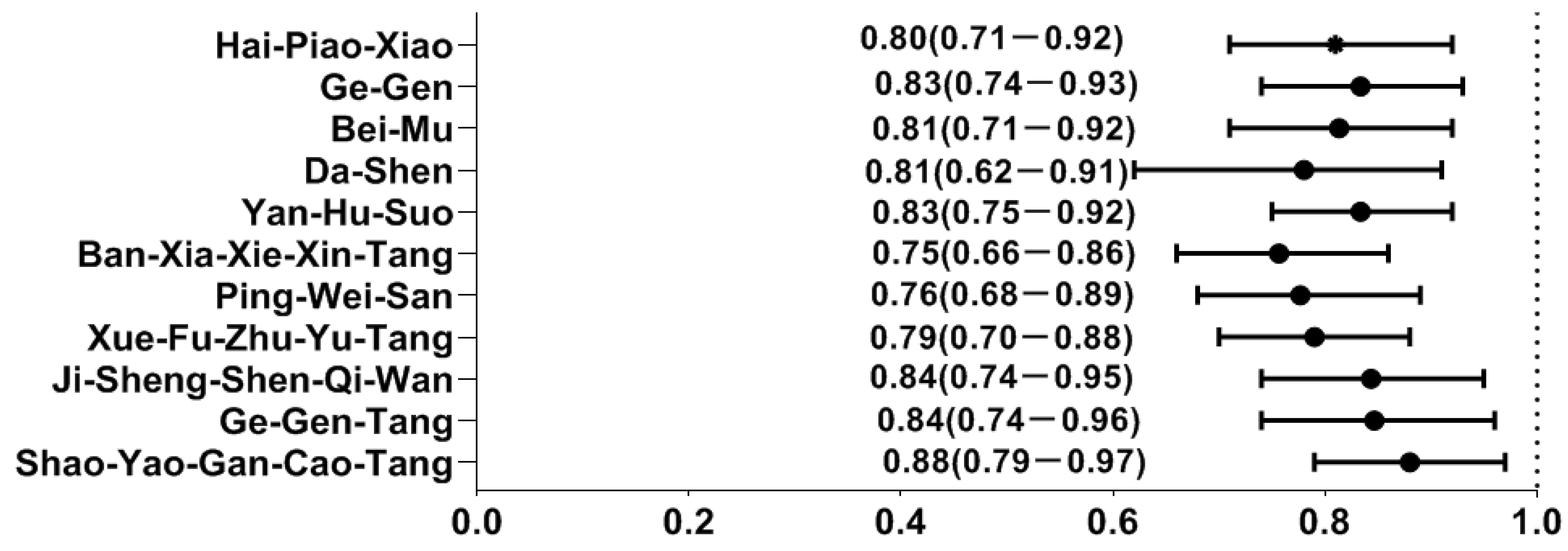
| Yan-Hu-Suo | Corydalis yanhusuo | Used to treat Qi stagnation, blood stasis, chest pain, abdominal pain, amenorrhea, dysmenorrhea, and postpartum stasis |
| Da-Shen | Salvia bowleyana | Invigorates the blood and dispels stasis: for a wide variety of blood stasis disorders in any part of the body. Most commonly used for problems affecting the lower abdomen, chest, or hypochondria. |
| Tian-Hua-Fen | Radix Trichosanthis | Its functions are to clear lung heat, dissolve phlegm, relieve toxicity, and expel pus. |
| Bei-Mu | Fritillariae Thunbergii Bulbus | Eliminate phlegm by cooling, moisten lung to arrest cough, and remove stasis to reduce swelling |
| Ge-Gen | Kudzu Root | Acts to expel pathogenic factors in the muscles to clear heat, vent rashes and nourish the fluids to stop thirst. It also works to raise Yang-Qi and alleviate diarrhoea. |
| Huang-Qin | Scutellaria baicalensis | As an adjuvant therapy of inflammation, diabetes, hypertension, different kinds of cancer and virus related diseases. |
| Mai-Dong | Ophiopogon Root | Nourish yin deficiency, promote body fluid production, nourish the lungs, relieve the mind, and eliminate heart fire. |
| Shyuan-Shen | Scrophularia ningpoensis | Clearing away heat and cooling blood, nourishing Yin and reducing fire, detoxicating and resolving a mass. |
| Jie-Geng | Radix Platycodi | It supports respiratory health and benefits the throat. Jie Geng contains anti-inflammatory, anti-bacterial, expectorant and immune boosting properties. |
| Hai-Piao-Xiao | Endoconcha Sepiae Os Sepiae seu Sepiellae | Controlling acidity, harmonizing the stomach, and alleviating pain |
| Chuanniuxi | Cyathula Root | Activates blood, eliminates stasis. Strengthens tendons and bones. Promotes urination, treats dysuria. |
| Multi-herb products | ||
| Shu-Jing-Huo-Xie-Tang | Tang-kuei root, White peony root, Corydalis root, Chin-chiu, Cnidium root, Raw rehmannia root, Peach kernel, Hoelen fungus, Atractylodes root, Citrus peel, Notopterygium root, Fragrant angelica, Scabrous gentiana root, Fang feng root, Achyranthes root, Ginger root, Chinese licorice root | Clears Heat, cools the blood, nourishes Yin and generates fluids. Breaks up blood stasis and invigorates blood circulation. Strongly dries dampness, tonifies the spleen, induces sweating and expels wind-aampness. Promotes urination and leaches out dampness. |
| Jia-Wei-Xiao-Yao-San | Bupleurum Root, Chinese Angelica Root, White Peony Root, White Atractylodes Rhizome, Poria, Licorice Root, Moutan Bark, Gardenia Fruit, Mint Herb, Ginger | To treat functional dyspepsia. |
| Shao-Yao-Gan-Cao-Tang | Rx. Paeoniae Alba, Rx. Glycyrrhizae Preparata Paeonia lactiflora, Glycyrrhiza uralensis | Antioxidative and antiaggregation effect |
| Liu-Wei-Di-Huang-Wan | Rehmannia Root, Fructus Corni, Dioscorea Rhizome, Alisma Rhizome, Moutan cortex, Poria cocos. | Liver and kidney yin dificiencies, soreness and weakness of the lower back and knees, dizziness, parched mouth and sore throat, heel pain. Enriches the yin and nourishes the kidneys. |
| Ge-Gen-Tang | Puerariae radix (Pueraria lobata Ohwi), Ephedrae Herba (Ephedra sinica Stapf), Cinnamomi Ramulus (Cinnamomum cassia Blume), Paeoniae Radix (Paeonia lactiflora Pallas), Glycyrrhizae Radix preparata (Glycyrrhiza uralensis Fischer), Zingiberis Rhizoma (Zingiber officinale Roscoe), and Zizyphi Fructus (Ziziphus jujuba Mill. var. inermis Rehder) | Induces sweating to release the exterior symptoms and dispel Wind-Cold. It is indicated for stiff neck, headache, muscle aches, alternating chills and fever, sneezing, cough, nasal congestion, runny nose. |
| Ji-Sheng-Shen-Qi-Wan | Rehmannia Root, Fructus Corni, Dioscorea Rhizome, Alisma Rhizome, Moutan cortex, Poria cocos, Roasted Aconite, Cinnamon Bark, Achyranthes bidentata, Semen Plantaginis. | Kidney yang deficiency, lower backache, urinary difficulties./Warms and tonifies kidney yang, regulates water and relieves edema. |
| Xiao-Qing-Long-Tang | Herba Ephedrae, Rhizoma Zingiberis, Ramulus Cinnamomi, Radix et Rhizoma Asari, Rhizoma Pinellia, Fructus Schisandrae Chinensis, Radix et Rhizoma Glycyrrhizae, and Radix paeoniae alba. | Used to treat bronchial asthma and allergic rhinitis. |
| Xue-Fu-Zhu-Yu-Tang | Achyranthes bidentata Blume, Angelica sinensis Diels, radix, Citrus aurantium L., fructus, Bupleurum chinense DC., radix, Carthamus tinctorius L., flos, Glycyrrhiza uralensis Fisch., radix and rhizome, Ligusticum chuanxiong Hort., rhizome, Paeonia lactiflora Pall., radix, Prunus persica Stokes, semen, Platycodon grandifloras, A. DC., radix, Rehmannia glutinosa, Libosch., radix | Invigorate Blood; Expel Blood Stasis; Move Qi; Stop Pain |
| Chuan-Xiong-Cha-Tiao-San | Radix Chuanxiong, Herba Schizonepetae, Radix Saposhnikoviae, Rhizoma et Radix Notopterygii, Radix et Rhizoma Glycyrrhizae, Radix Angelicae Dahuricae, Herba Menthae, Radix et Rhizoma Asari | Dispels wind and clears away heat. It is used for headache, migraine, or headache on the top, aversion to cold and fever, dizziness, nasal obstruction |
| Ping-Wei-San | Atractylodes lancea rhizome, Magnolia officinalis bark, Citrus reticulata peel, Glycyrrhiza uralensis root, Zingiber officinale rhizome, Ziziphus jujuba fruit | For gastroenteritis, intestinal obstruction, coronary artery disease and peptic ulcer |
| Ban-Xia-Xie-Xin-Tang | Pinellia ternate, Makino, Panax ginseng, Zingiber officinale Roscoe, Coptis chinensis Franch., Scutellaria baicalensis Georgi, Ziziphus jujuba Mill. | Treating metabolic diseases, such as nonalcohol fatty liver disease, diabetes mellitus, and obesity. |
Disclaimer/Publisher’s Note: The statements, opinions and data contained in all publications are solely those of the individual author(s) and contributor(s) and not of MDPI and/or the editor(s). MDPI and/or the editor(s) disclaim responsibility for any injury to people or property resulting from any ideas, methods, instructions or products referred to in the content. |
© 2024 by the authors. Licensee MDPI, Basel, Switzerland. This article is an open access article distributed under the terms and conditions of the Creative Commons Attribution (CC BY) license (https://creativecommons.org/licenses/by/4.0/).
Share and Cite
Huang, H.-J.; Livneh, H.; Yen, C.-T.; Lu, M.-C.; Chen, W.-J.; Tsai, T.-Y. Adjunctive Therapy with Chinese Herbal Medicine Lowers Risk of Hearing Loss in Type 2 Diabetes Patients: Results from a Cohort-Based Case-Control Study. Pharmaceuticals 2024, 17, 1191. https://doi.org/10.3390/ph17091191
Huang H-J, Livneh H, Yen C-T, Lu M-C, Chen W-J, Tsai T-Y. Adjunctive Therapy with Chinese Herbal Medicine Lowers Risk of Hearing Loss in Type 2 Diabetes Patients: Results from a Cohort-Based Case-Control Study. Pharmaceuticals. 2024; 17(9):1191. https://doi.org/10.3390/ph17091191
Chicago/Turabian StyleHuang, Hui-Ju, Hanoch Livneh, Chieh-Tsung Yen, Ming-Chi Lu, Wei-Jen Chen, and Tzung-Yi Tsai. 2024. "Adjunctive Therapy with Chinese Herbal Medicine Lowers Risk of Hearing Loss in Type 2 Diabetes Patients: Results from a Cohort-Based Case-Control Study" Pharmaceuticals 17, no. 9: 1191. https://doi.org/10.3390/ph17091191
APA StyleHuang, H.-J., Livneh, H., Yen, C.-T., Lu, M.-C., Chen, W.-J., & Tsai, T.-Y. (2024). Adjunctive Therapy with Chinese Herbal Medicine Lowers Risk of Hearing Loss in Type 2 Diabetes Patients: Results from a Cohort-Based Case-Control Study. Pharmaceuticals, 17(9), 1191. https://doi.org/10.3390/ph17091191