Spectral-Efficient End-to-End Beamforming for 6G XL-MIMO: Synergizing Channel Sensing and Spatial–Frequency Sparsity with Deep Learning
Abstract
1. Introduction
- Neglect of Near-Field Sensing Sparsity: Most existing networks treat the channel matrix as a generic image, ignoring the specific Angle-Delay Domain sparsity caused by the limited scattering clusters in XL-MIMO environments. This leads to the inefficient allocation of neural network resources to noise rather than significant sensing features [22].
- Inefficiency of the Reconstruct-then-Precode Paradigm: Conventional approaches aim to minimize the Mean Squared Error (MSE) of the reconstructed channel. However, the ultimate objective of the sensing process in FDD systems is to maximize beamforming gain (spectral efficiency), not merely to reconstruct the raw data. Reconstructing the full high-dimensional channel at the BS before calculating the precoding matrix (e.g., via Singular Value Decomposition, SVD) is computationally expensive and introduces unnecessary latency [23]. Although recent deep neural network-based strategies have made strides in low-overhead beam management [24], integrating these into a true end-to-end precoding paradigm remains inefficient.
- (1)
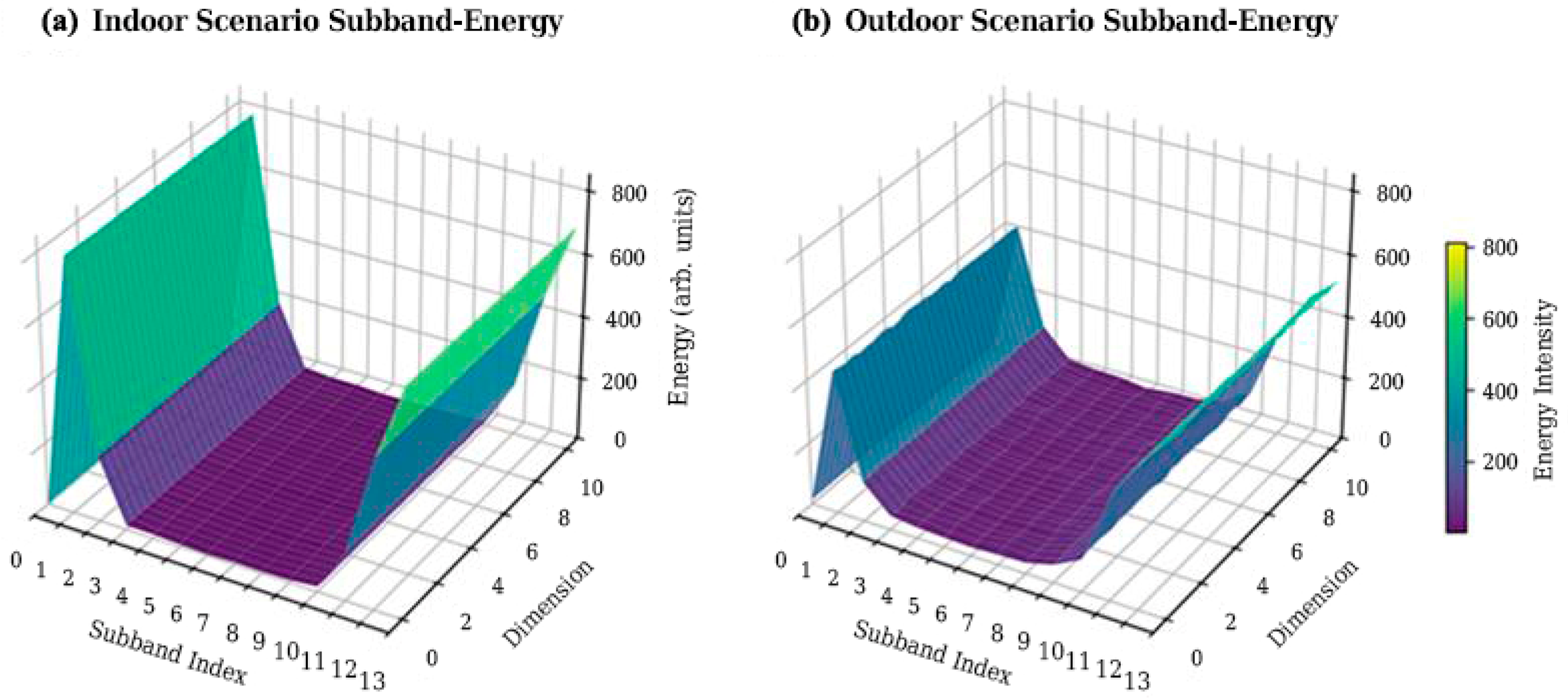
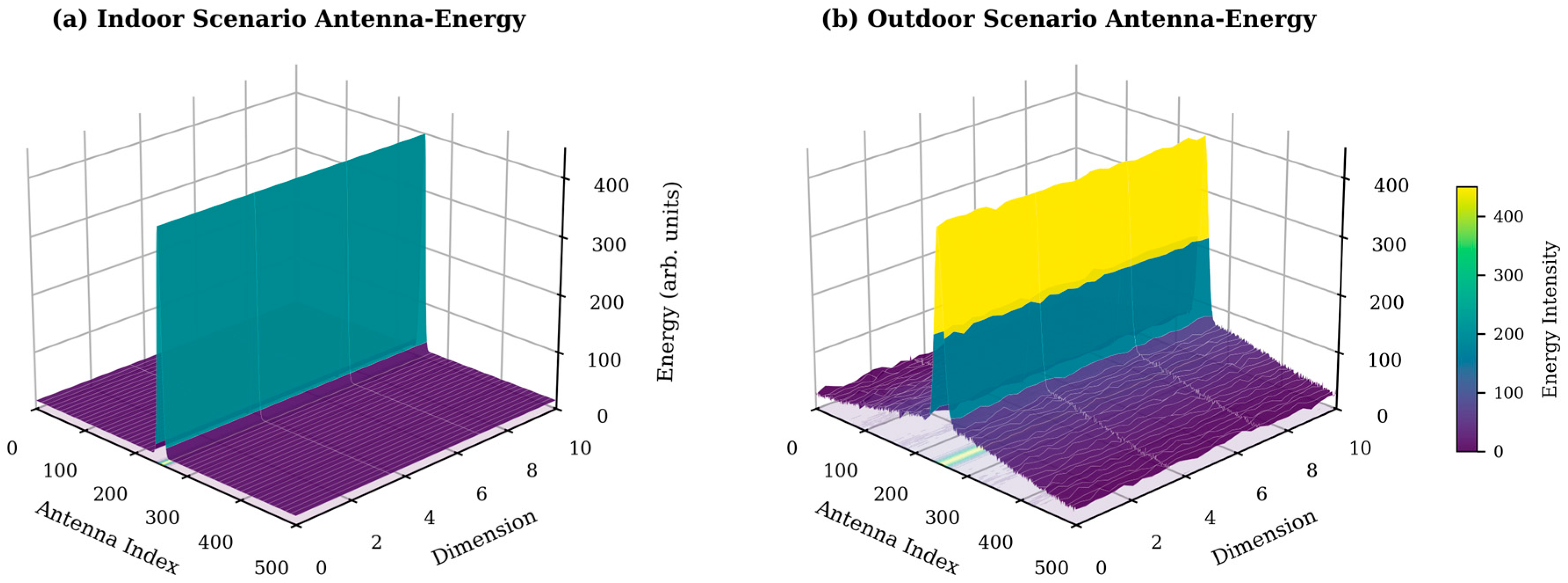
- Analysis of XL-MIMO Spatial-Frequency Sensing Sparsity: We systematically analyze the energy distribution of XL-MIMO channels using hybrid channel models (COST 2100 and QuaDRiGa). Empirical analysis verifies that the channel energy is highly concentrated in specific regions of the Angle-Delay domain, motivating a physics-driven sensing compression strategy.
- (2)
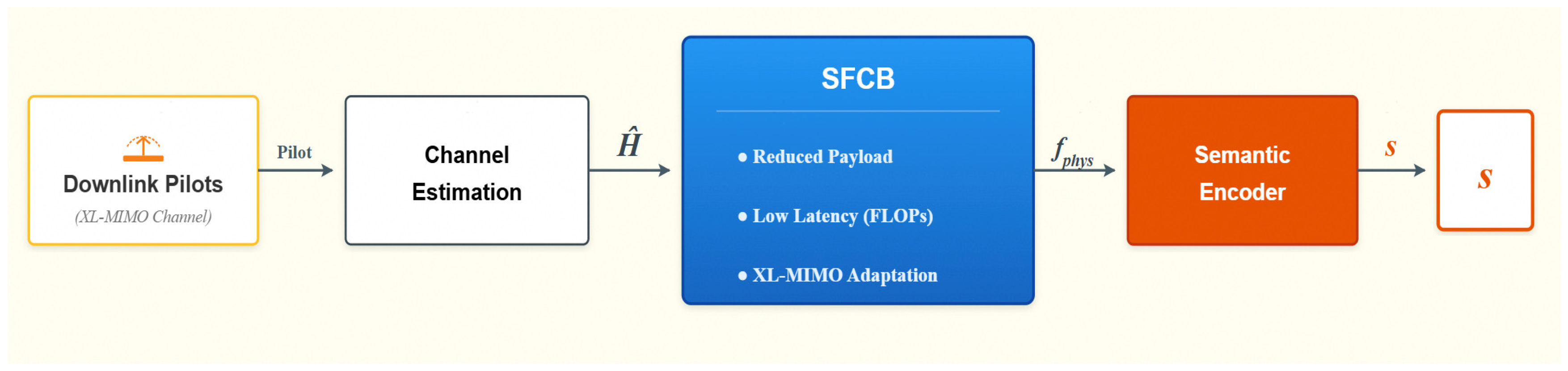
- Design of Spatial–Frequency Concentration Block (SFCB): Instead of processing the full raw CSI, we introduce the SFCB, a pre-processing module that acts as a “hard attention” mechanism. It dynamically screens features based on energy gradients, achieving efficient dimensionality reduction at the source (UE side) and significantly reducing the input size for the subsequent neural network.
- (3)
- Development of Direct Integrated Precoding Network (DIP-I): We propose a lightweight end-to-end network, DIP-I, which maps compressed features directly to the precoding matrix. This design bypasses the explicit channel reconstruction stage, avoiding error accumulation and reducing the computational complexity of SVD operations at the BS.
- (4)
- Validation in Realistic Scenarios: We evaluate the proposed scheme under complex indoor (COST 2100) and outdoor non-line-of-sight (NLOS) (QuaDRiGa) scenarios with a 512-antenna array. Results confirm that our approach outperforms separated feedback-precoding schemes in terms of effective sum-rate and computational efficiency.
2. System Model and XL-MIMO Channel Characteristics
2.1. XL-MIMO System Model
2.1.1. Array Layout and Field Partitioning
2.1.2. Signal Transmission Model
2.2. Multi-Scenario Channel Modeling
- (1)
- Indoor Scenario (COST 2100): For the 5.3 GHz band, the geometry-based stochastic COST 2100 model is adopted [27,28]. This model effectively captures the spatial non-stationarity caused by the large aperture of XL-MIMO arrays, where different antenna subsets may observe different scattering clusters.
- (2)
- Outdoor Scenario (QuaDRiGa): For the 2.1 GHz outdoor NLOS scenario, the QuaDRiGa platform complying with the 3GPP TS 38.901 standard is utilized [29]. This platform accurately simulates SWM propagation characteristics and Visibility Region (VR) effects. The simulation area covers a specific range with the BS configured with 512 antennas.
2.3. Limited Feedback Architecture
- (1)
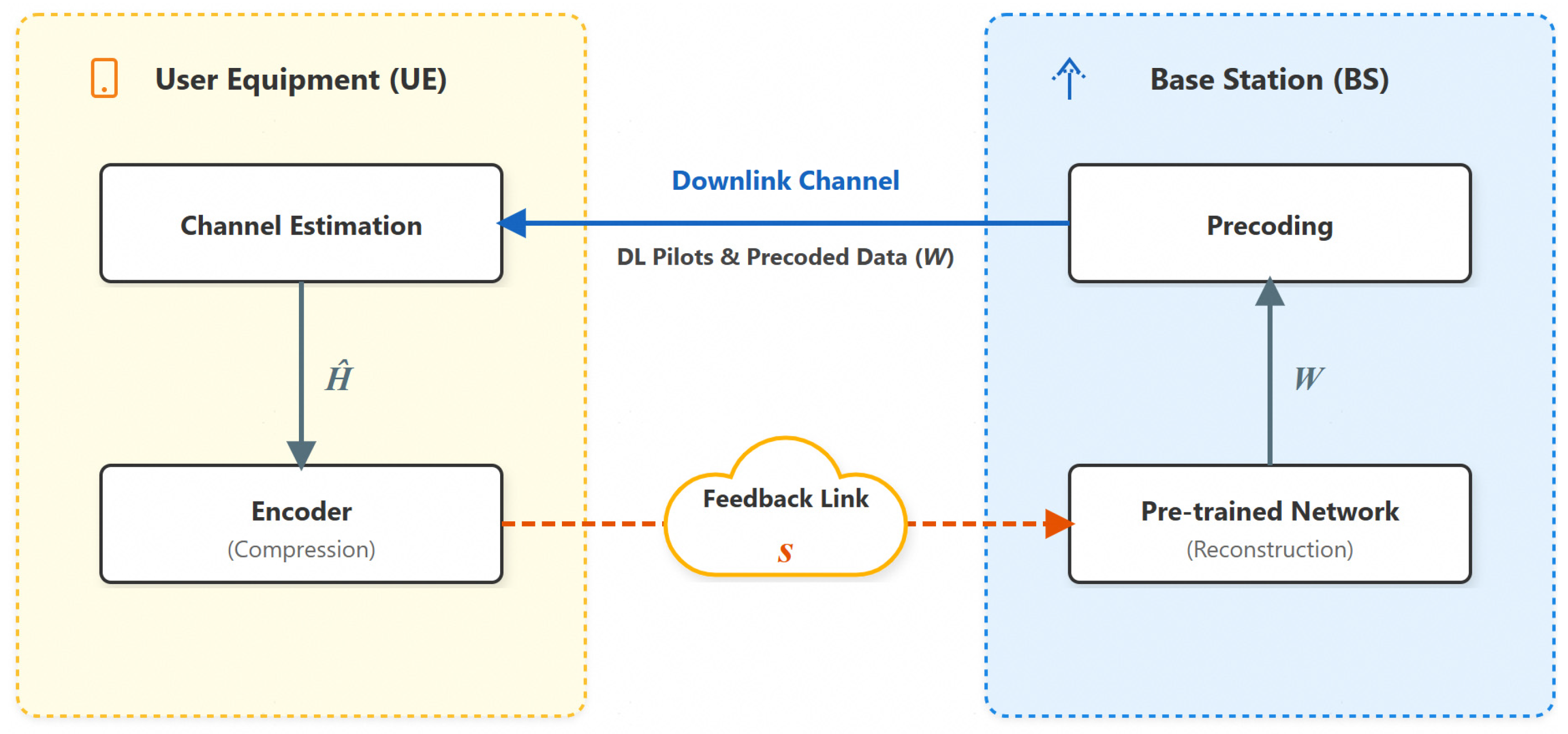
- Channel Estimation: Downlink channel estimation at the UE side to obtain the downlink CSI matrix .
- (2)
- Compressed Feedback: The UE utilizes the proposed dimensionality reduction mechanism (SFCB) and an encoder to map the CSI into a low-dimensional codeword .
- (3)
- Reconstruction and Beamforming: The BS side uses a pre-trained network to reconstruct the precoding matrix directly from the feedback codeword.
3. Dimensionality Reduction Pre-Processing Mechanism Based on SFCB
3.1. Data Distribution Characteristics in Angle-Delay Domain
3.2. Design of Spatial–Frequency Concentration Block (SFCB)
3.2.1. Algorithm Workflow
| Algorithm 1. Adaptive Spatial-Frequency Concentration Block (SFCB) | |
| Require: Angle-Delay CSI matrix Ĥ ∈ ℂNs × Na, Energy concentration ratio Γ. Ensure: Concentrated feature matrix Hout ∈ ℂMs × Ma. | |
| 1: | Step 1: Joint-Domain Energy Mapping. Calculate power density E = |Ĥ|2; |
| 2: | Step 2: Marginal Energy Projection. |
| 3: | es = ∑j=1Na E(·, j), ea = ∑i=1Ns E(i, ·); |
| 4: | Step 3: Adaptive Aperture Determination. |
| 5: | for each dimension d ∈ {s, a} do |
| 6: | edsort = sort_desc(ed); |
| 7: | Find minimal Md s.t. (∑k=1Md edsort(k))/(∑k=1Nd ed(k)) ≥ Γ; |
| 8: | Identify feature-rich index set d based on Md; |
| 9: | end for |
| 10: | Step 4: Spatial Topology Alignment. |
| 11: | s = sort_asc(s), a = sort_asc(a); ▷ Recover original physical structure |
| 12: | Step 5: Dimensionality Resynthesis. |
| 13: | Slice feature matrix Hout = Ĥ(s, a); |
| 14: | return Hout |
3.2.2. Module Advantages
- (1)
- Autonomous Adaptation: The CDF-based thresholding eliminates the need for manual hyperparameter tuning for , allowing the system to handle non-stationary XL-MIMO channels across different UE locations and clusters.
- (2)
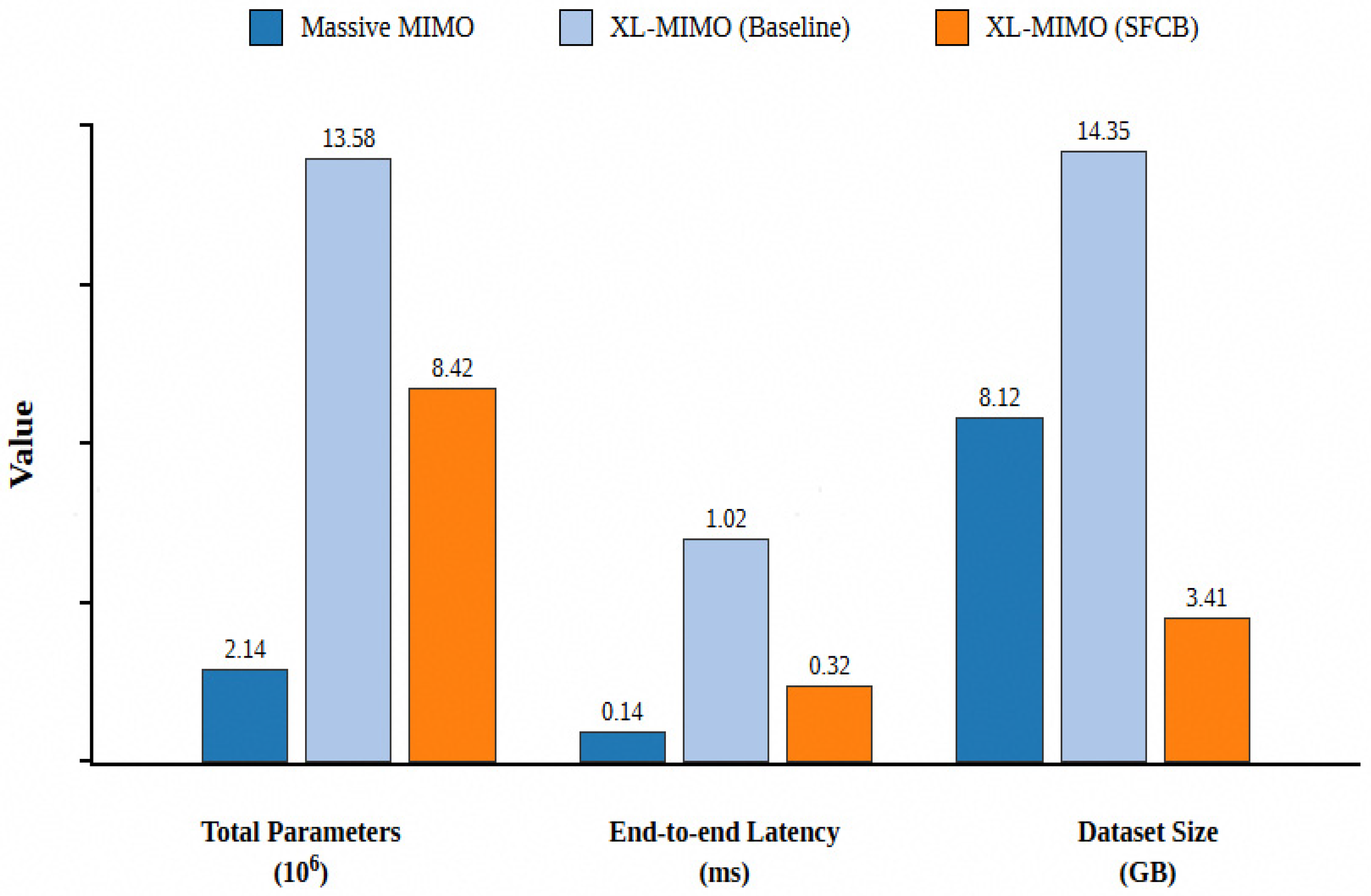
- Reduced Load: Directly reduces the input dimensions and parameter count of the subsequent encoding network.
- (3)
- Optimized Latency: Significantly lowers the Floating Point Operations (FLOPs) during the inference phase.
4. Proposed Two-Stage Beamforming Scheme Based on Dimensionality Reduction Precoding
4.1. Overall Architecture
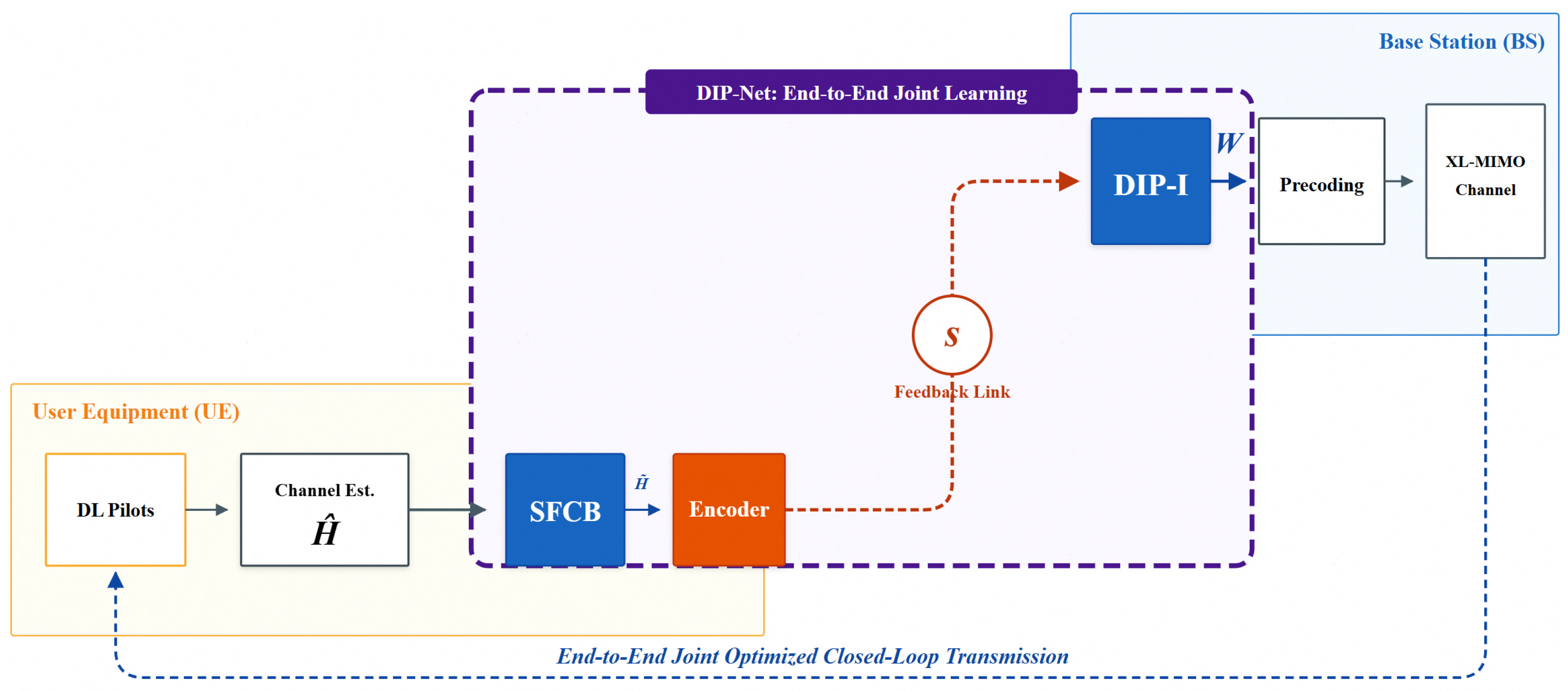
- Stage 1 (Hard Compression): SFCB performs physical-level feature dimensionality reduction, acting as a hard attention mechanism that forces the network to focus on the main path components where channel energy is concentrated.
- Stage 2 (Soft Reconstruction): The deep neural network DIP-I performs end-to-end feature extraction and precoding matrix generation.
4.2. Stage 1: Dimensionality Reduction Precoding
4.3. Stage 2: DIP-I Network Design
4.3.1. Mathematical Description of System Flow
4.3.2. DIP-I Network Architecture
- Training Labels: Singular Value Decomposition (SVD) is performed on the unpruned perfect CSI to extract the principal eigenvector as the ideal label.
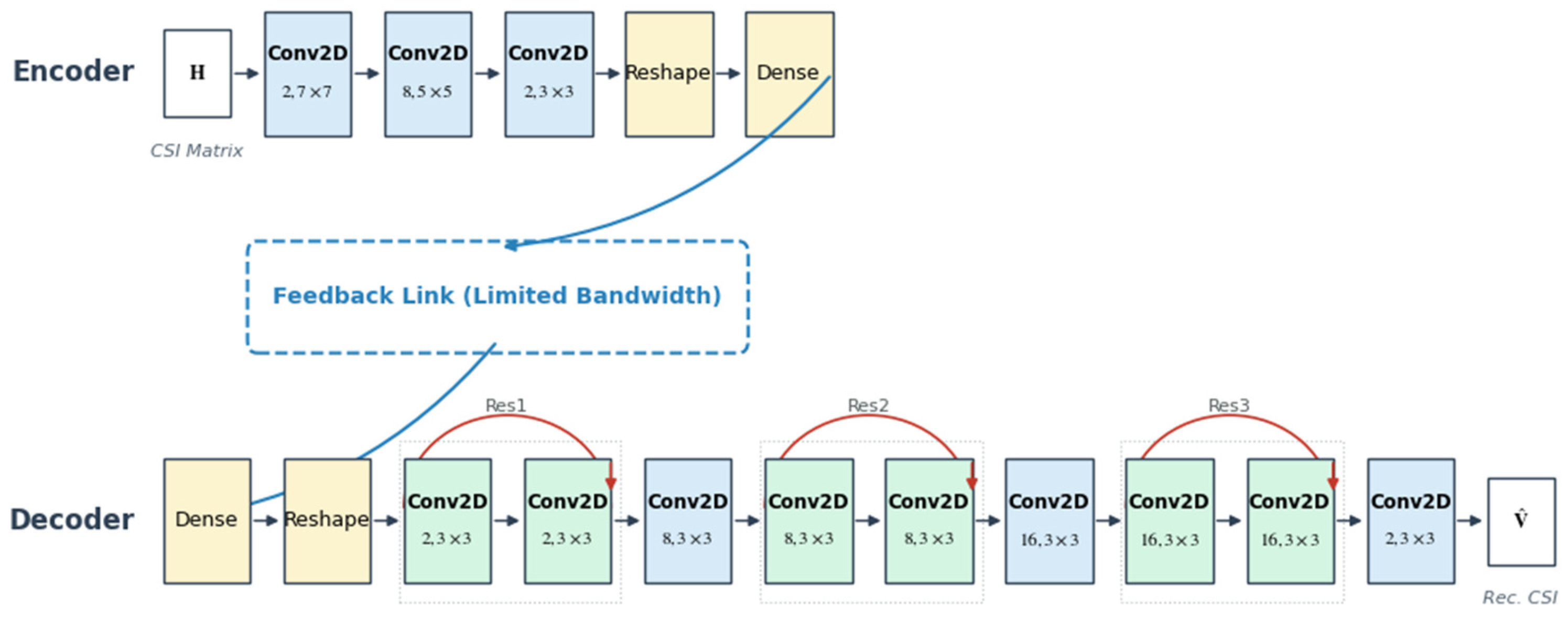
- Encoder (UE side): The input is the data pruned by SFCB. The structure includes 3 convolutional layers (Conv2D, kernel counts 2-8-2) and 1 fully connected layer, responsible for feature extraction and codeword compression.
- Decoder (BS side): First recovers dimensions through a fully connected layer, followed by 3 cascaded Residual Blocks for deep feature reconstruction. The convolutional layers are configured with kernel counts 2-8-16, and the receptive field size is . Finally, a convolutional layer with 2 kernels and a receptive field of outputs the precoding matrix. The residual block design effectively alleviates the gradient vanishing problem and enhances the learning capability for high-dimensional non-linear mapping [30].
4.3.3. Optimization Objective and Training Procedure
- (1)
- Loss Function: The network parameters are optimized by minimizing the Mean Squared Error (MSE) loss function, which quantifies the Euclidean distance between the predicted precoding vector and the ideal label . For a training batch of size B, the objective function is defined as:
- (2)
- Optimization Algorithm and Hyperparameters: The optimization procedure employs the Adaptive Moment Estimation (Adam) optimizer, chosen for its robust convergence properties in non-convex neural network optimization. The specific training procedures are implemented as follows:
- Weight Initialization: Network weights are initialized using the Xavier (Glorot) normal distribution to maintain variance consistency across convolutional layers and prevent early-stage gradient explosion.
- Learning Rate Scheduling: The initial learning rate is set to . A dynamic learning rate decay strategy (e.g., ReduceLROnPlateau) is applied during the optimization process. If the validation loss fails to decrease for a consecutive number of epochs, the learning rate is scaled down by a factor of 0.5, ensuring fine-grained parameter updates near the global minimum.
- Batch Training: The dataset is divided into mini-batches (e.g., ). In each iteration, stochastic gradients are computed through backpropagation, and the parameters are iteratively updated until early stopping criteria are met or the maximum number of epochs is reached.
5. Simulation Results and Performance Evaluation
5.1. Simulation Parameter Settings
- Channel Models: COST 2100 [28] (5.3 GHz, Indoor)/QuaDRiGa (2.1 GHz, Outdoor NLOS).
- Antenna Configuration: BS with 512-antenna ULA with an antenna spacing of half a wavelength, and there are 13 sub-bands. In indoor and outdoor scenarios, place BS at the center of an area with a side length of 20 m and 40 m, respectively. Users are randomly distributed in the above areas.
- Dataset and Network Parameters: The dataset contains 120,000 training samples and 30,000 testing samples, containing 50% indoor scenarios and 50% outdoor scenarios. Epochs = 1000, Batch Size = 128 and Learning Rate = 0.001. The loss function is MSE, and the optimizer is Adam.
- Training Strategy: A two-step training method is adopted: during the training of the network, the SFCB module is added before the encoder to reduce the dimensionality of XL-MIMO data and uses the offline training mode. During the training, the neural network without the DIP-I module is first trained. The input of the network is the dimension-reduced data, and the supervision label is the precoding matrix obtained by performing SVD on the original CSI matrix that is not dimension-reduced. After the training is complete, the DIP-I module is added to quantize the feedback codewords, and then the decoder is trained for 500 epochs.
5.2. Performance Comparative Analysis
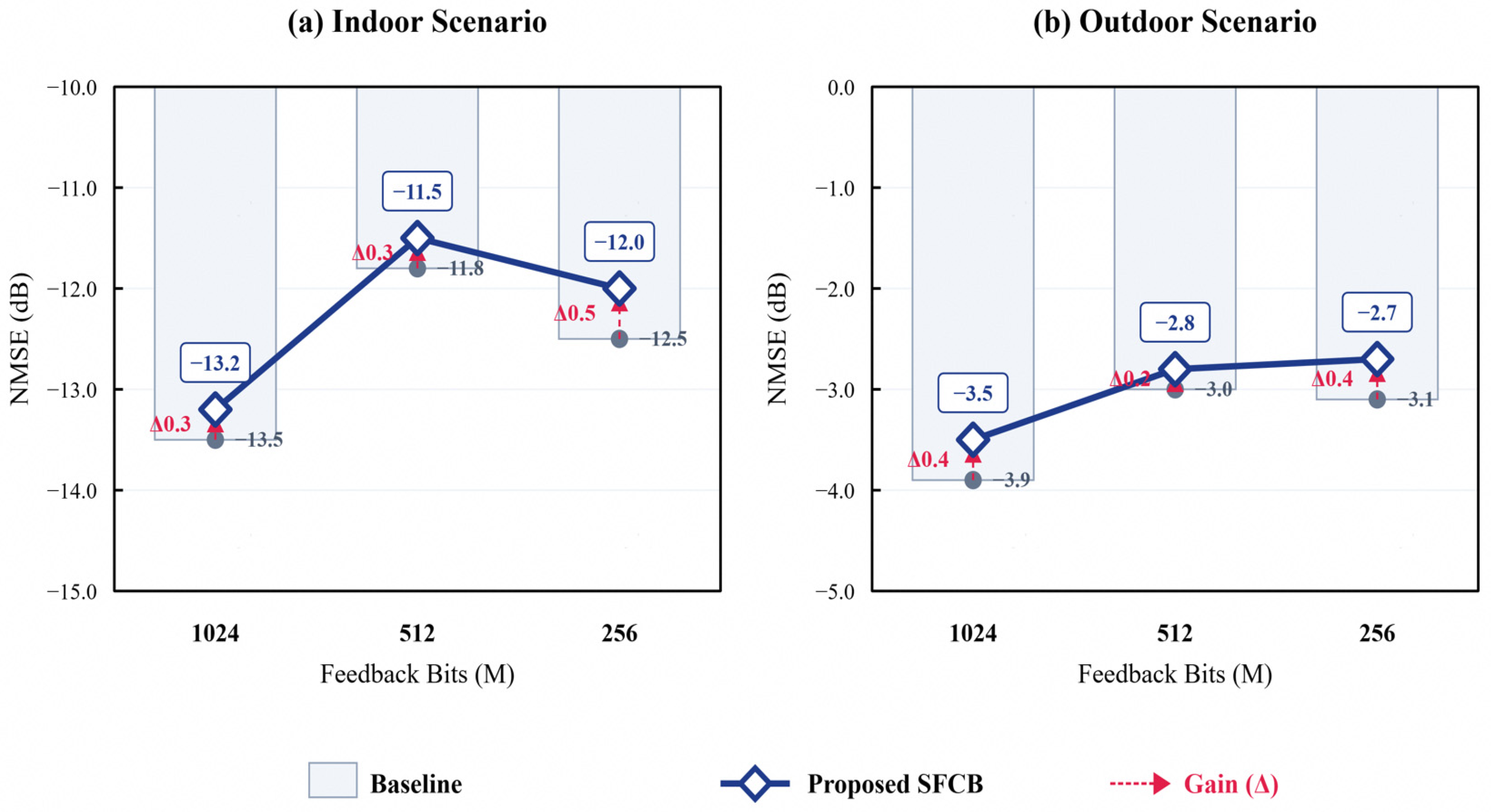
5.2.1. Impact of SFCB on Overhead and Performance
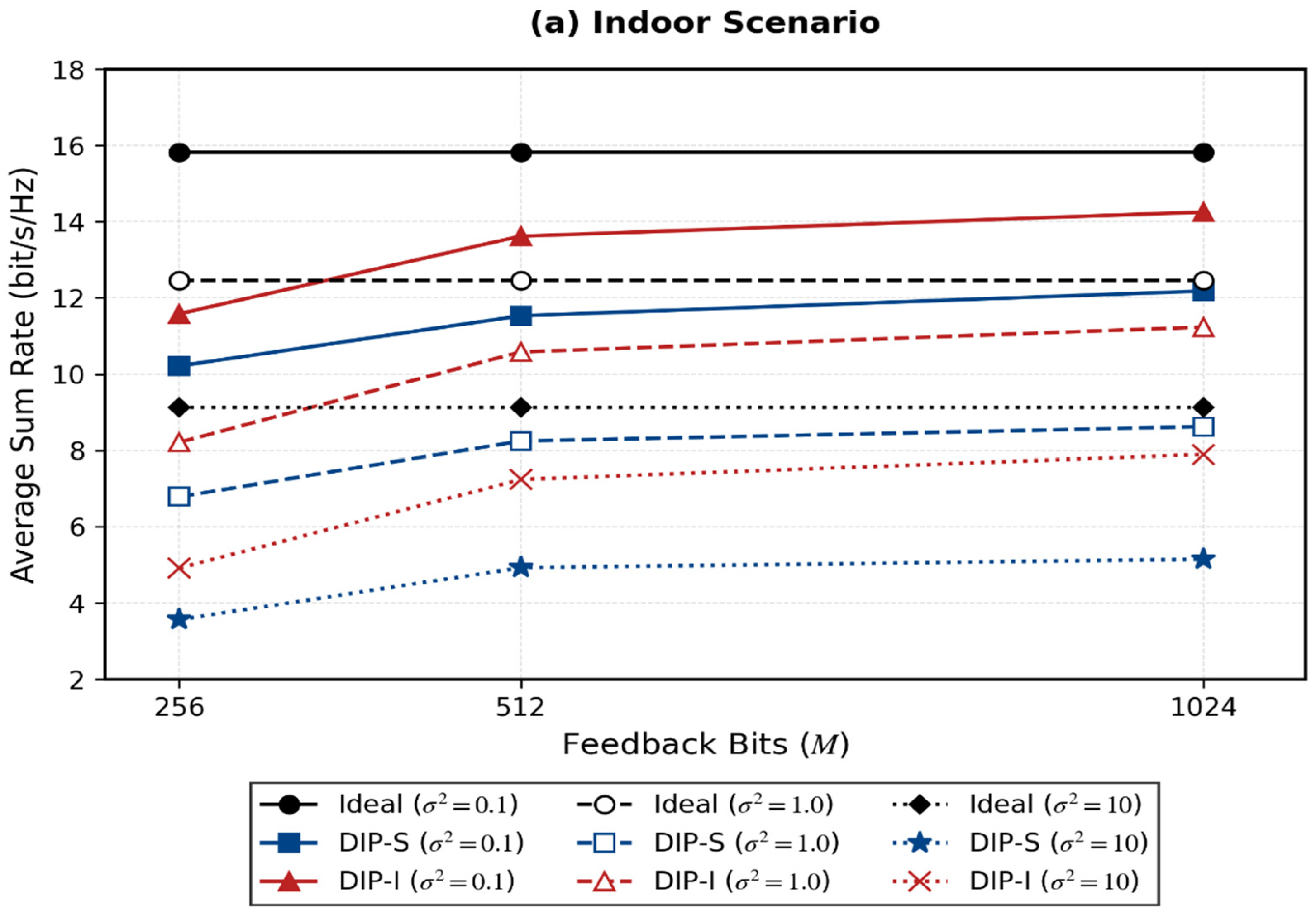
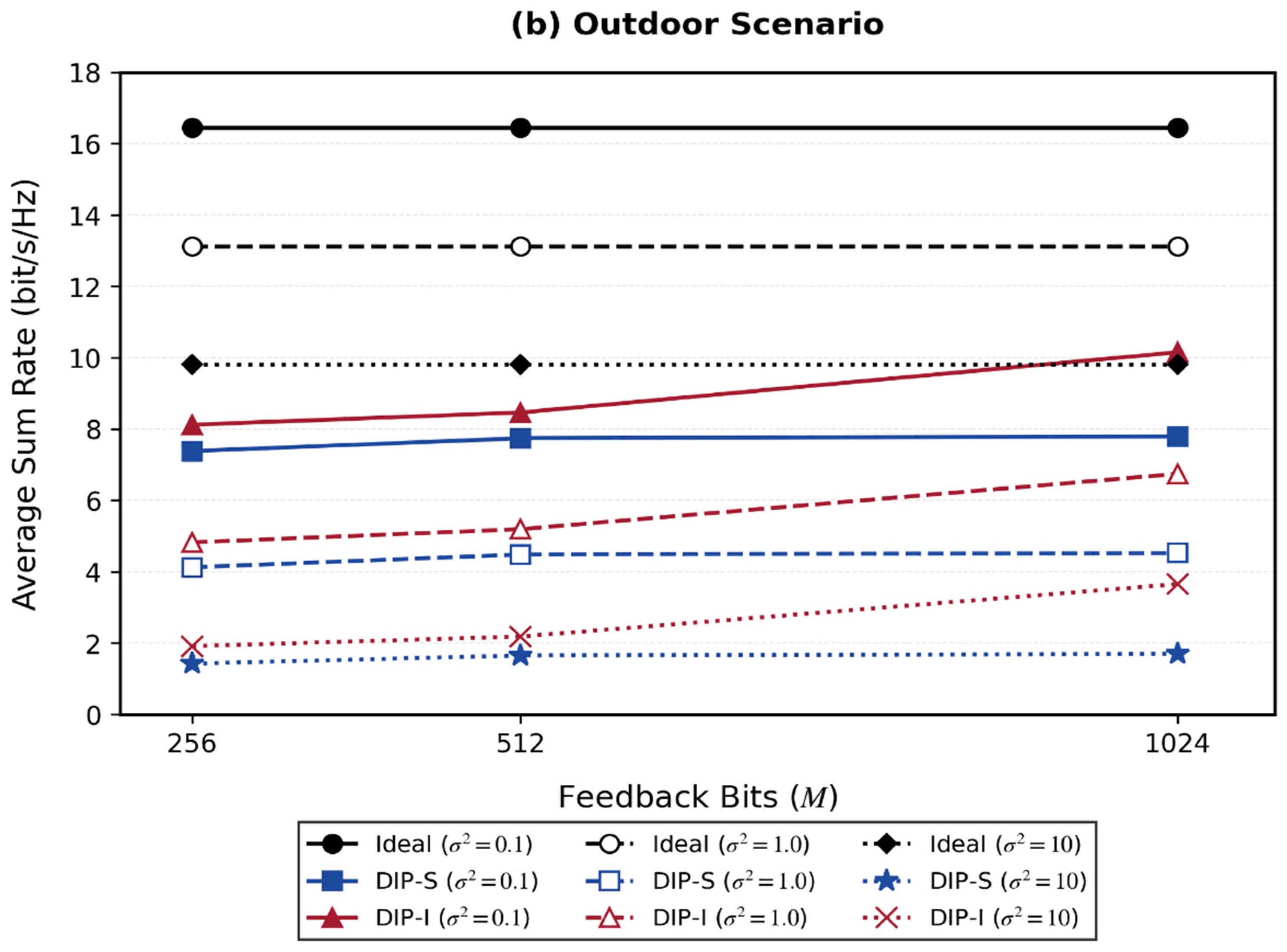
5.2.2. Comparison of Limited Feedback Beamforming Schemes
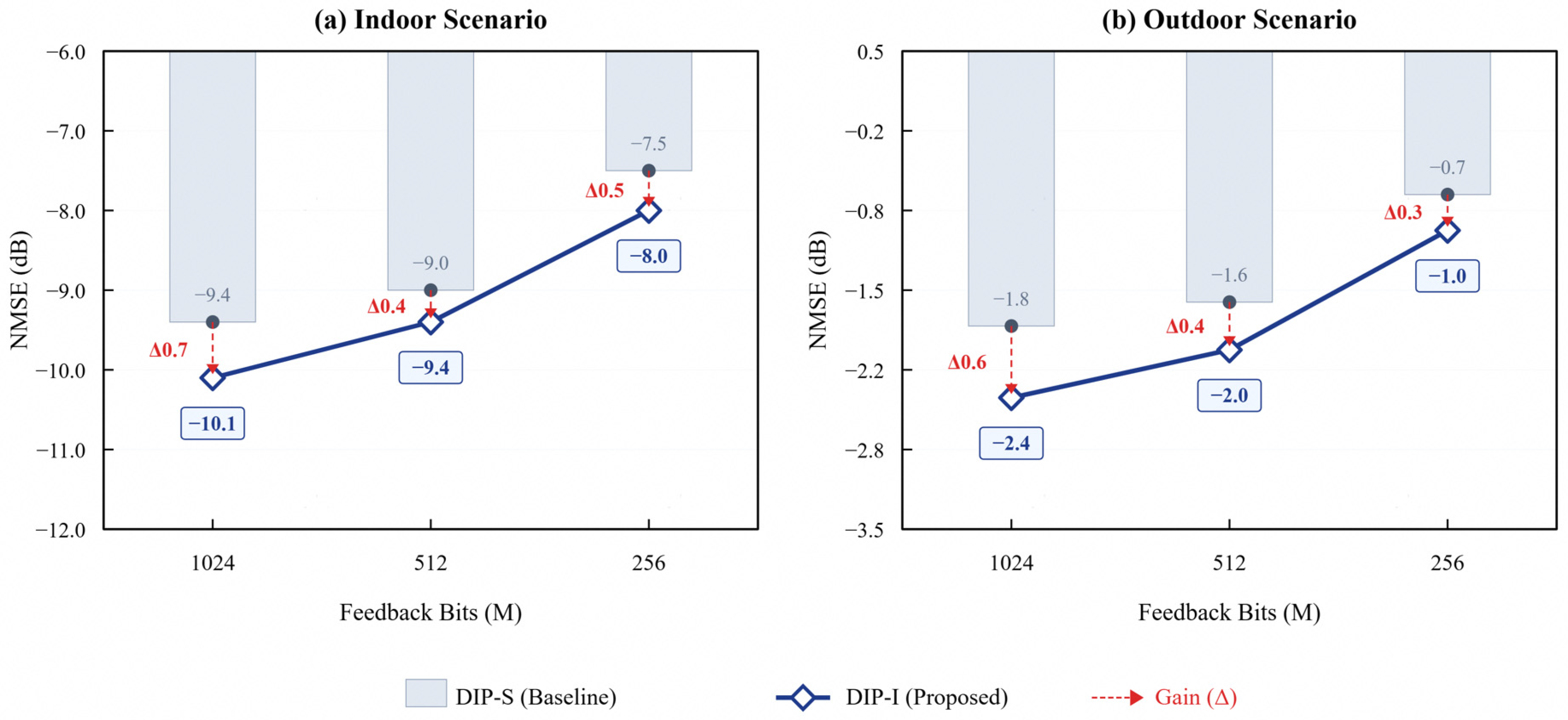
- DIP-S (Separated Scheme): The network is responsible only for reconstructing CSI (), and the BS side calculates precoding via SVD.
- DIP-I (Integrated Scheme): The integrated scheme proposed in this paper. The network directly outputs the precoding matrix .
5.2.3. Throughput Performance Analysis
- (1)
- Hybrid Domain Awareness: While prior works like Wu et al. [26] focus on near-field effects, our scheme simultaneously captures both spherical wavefront (near-field) and spatial non-stationarity, providing a more robust channel representation in realistic XL-MIMO deployments.
- (2)
- Ultra-Low Feedback Overhead: By leveraging the physics-driven SFCB module to prune redundant spatial-frequency features before the encoding stage, our scheme achieves an ‘Ultra-Low’ feedback overhead, outperforming the compression efficiency of vanilla autoencoders.
- (3)
- End-to-End (E2E) Efficiency: Unlike the conventional ‘reconstruct-then-precode’ paradigm seen in Refs. [8,26,28], DIP-I integrates feedback compression and precoding matrix generation into a single mapping process. This E2E design not only bypasses the accumulation of reconstruction errors but also significantly reduces the computational latency at the Base Station (BS), facilitating real-time beamforming in high-dimensional antenna systems.
6. Conclusions
Author Contributions
Funding
Institutional Review Board Statement
Informed Consent Statement
Data Availability Statement
Acknowledgments
Conflicts of Interest
References
- Björnson, E.; Sanguinetti, L.; Wymeersch, H.; Hoydis, J.; Marzetta, T.L. Massive MIMO is a reality—What is next? Five promising research directions for antenna arrays. Digit. Signal Process. 2019, 94, 3–20. [Google Scholar] [CrossRef] [Scilit]
- De Carvalho, E.; Ali, A.; Amiri, A.; Angjelichinoski, M.; Heath, R.W. Non-stationarities in extra-large-scale massive MIMO. IEEE Wirel. Commun. 2020, 27, 74–80. [Google Scholar] [CrossRef] [Scilit]
- Cui, M.; Wu, Z.; Lu, Y.; Wei, X.; Dai, L. Near-field communications for 6G: Fundamentals, challenges, potentials, and future directions. IEEE Commun. Mag. 2023, 61, 40–46. [Google Scholar] [CrossRef] [Scilit]
- Sun, P.; Dai, H.; Wang, B. Integrated sensing and secure communication with XL-MIMO. Sensors 2024, 24, 295. [Google Scholar] [CrossRef] [Scilit]
- Ma, R.; Ma, Y.; Lin, Z. Covert communication assisted by movable time-modulated arrays. IEEE Commun. Lett. 2025, 30, 382–386. [Google Scholar] [CrossRef] [Scilit]
- Liu, X.; Zhang, H.; Xu, J. Self-powered absorptive reconfigurable intelligent surfaces for securing satellite-terrestrial integrated networks. China Commun. 2024, 21, 55–69. [Google Scholar] [CrossRef] [Scilit]
- Lu, H.; Zeng, Y. Communicating with Extremely Large-Scale Array/Surface: Unified Modeling and Performance Analysis. IEEE Trans. Wirel. Commun. 2022, 21, 4039–4053. [Google Scholar] [CrossRef] [Scilit]
- Cui, T.J.; Liu, S. Information metamaterials and metasurfaces. J. Mater. Chem. C 2021, 9, 7616–7630. [Google Scholar] [CrossRef] [Scilit]
- Wang, X.; Chen, H.; Jiang, R. Near-field wideband non-stationary channel estimation for XL-MIMO based on frequency-dependent visibility region. IEEE Trans. Commun. Netw. 2025, 11, 3987–4001. [Google Scholar] [CrossRef] [Scilit]
- Wu, Z.; Dai, L. Multiple access for near-field communications: SDMA or LDMA? IEEE J. Sel. Areas Commun. 2023, 41, 2818–2831. [Google Scholar] [CrossRef] [Scilit]
- Lei, H.; Zhang, J.; Wang, Z. Near-field user localization and channel estimation for XL-MIMO systems: Fundamentals, recent advances, and outlooks. IEEE Wirel. Commun. 2025, 32, 190–198. [Google Scholar] [CrossRef] [Scilit]
- Marzetta, T.L. Noncooperative cellular wireless with unlimited numbers of base station antennas. IEEE Trans. Wirel. Commun. 2010, 9, 3590–3600. [Google Scholar] [CrossRef] [Scilit]
- Wen, C.K.; Shih, W.T.; Jin, S. Deep learning for massive MIMO CSI feedback. IEEE Wirel. Commun. Lett. 2018, 7, 748–751. [Google Scholar] [CrossRef] [Scilit]
- Liu, Z.; Zhang, L.; Ding, Z. An Efficient Deep Learning Framework for Low Rate Massive MIMO CSI Reporting. IEEE Trans. Commun. 2020, 68, 4761–4772. [Google Scholar] [CrossRef] [Scilit]
- Wang, T.; Wen, C.K.; Wang, H.; Gao, F.; Jiang, T.; Jin, S. Deep learning for wireless physical layer: Opportunities and challenges. China Commun. 2017, 14, 92–111. [Google Scholar] [CrossRef] [Scilit]
- Guo, J.; Wen, C.K.; Jin, S.; Li, G.Y. Convolutional neural network-based multiple-rate compressive sensing for massive MIMO CSI feedback: Design, simulation, and analysis. IEEE Trans. Wirel. Commun. 2020, 19, 2827–2840. [Google Scholar] [CrossRef] [Scilit]
- Hua, H.; Xu, J.; Han, T.X. Optimal transmit beamforming for integrated sensing and communication. IEEE Trans. Veh. Technol. 2023, 72, 10588–10603. [Google Scholar] [CrossRef] [Scilit]
- Peng, Z.; Liu, R.; Li, Z.; Pan, C.; Wang, J. Deep learning-based CSI feedback for XL-MIMO systems in the near-field domain. IEEE Wirel. Commun. Lett. 2024, 13, 3613–3617. [Google Scholar] [CrossRef] [Scilit]
- Zhang, X.; Wang, Z.; Zhang, H.; Yang, L. Near-field channel estimation for extremely large-scale array communications: A model-based deep learning approach. IEEE Commun. Lett. 2023, 27, 1155–1159. [Google Scholar] [CrossRef] [Scilit]
- Iqbal, A.; Al-Habashna, A.; Wainer, G.; Boudreau, G. Machine learning in near-field communication for 6G: A survey. arXiv 2025, arXiv:2509.16723. [Google Scholar] [CrossRef] [Scilit]
- Gao, Y.; Lu, Z.; Wu, X.; Yu, W.; Liu, S.; Du, J.; Jin, Y.; Zhang, S.; Chu, X.; Xu, S.; et al. AI-driven channel state information (CSI) extrapolation for 6G: Current situations, challenges and future research. IEEE Commun. Surv. Tutor. 2026, in press. [Google Scholar] [CrossRef] [Scilit]
- Yu, W.; He, H.; Song, S.; Zhang, J.; Dai, L.; Zheng, L.; Letaief, K.B. AI and deep learning for terahertz ultra-massive MIMO: From model-driven approaches to foundation models. Engineering 2026, 56, 14. [Google Scholar] [CrossRef] [Scilit]
- Xia, L.; Yang, D.; Zhang, J.; Yang, H.; Chen, J. Enhanced semantic information transfer of multi-domain samples: An adversarial edge detection method using few high-resolution remote sensing images. Sensors 2022, 22, 5678. [Google Scholar] [CrossRef] [Scilit] [PubMed]
- Cui, M.; Dai, L. Channel estimation for extremely large-scale MIMO: Far-field or near-field? IEEE Trans. Commun. 2022, 70, 2663–2677. [Google Scholar] [CrossRef] [Scilit]
- Liu, S.; Yu, X.; Gao, Z.; Xu, J.; Ng, D.W.K.; Cui, S. Sensing-enhanced channel estimation for near-field XL-MIMO systems. IEEE J. Sel. Areas Commun. 2025, 43, 628–643. [Google Scholar] [CrossRef] [Scilit]
- Jaeckel, S.; Raschkowski, L.; Börner, K.; Thiele, L. QuaDRiGa: A 3-D multi-cell channel model with time evolution for enabling virtual field trials. IEEE Trans. Antennas Propag. 2014, 62, 3242–3256. [Google Scholar] [CrossRef] [Scilit]
- Zhang, R.; Cheng, L.; Wang, S.; Lou, Y.; Gao, Y.; Wu, W.; Ng, D.W.K. Integrated sensing and communication with massive MIMO: A unified tensor approach for channel and target parameter estimation. IEEE Trans. Wirel. Commun. 2024, 23, 8571–8587. [Google Scholar] [CrossRef] [Scilit]
- Liu, L.; Oestges, C.; Poutanen, J.; Haneda, K.; Vainikainen, P.; Quitin, F.; Tufvesson, F.; De Doncker, P. The COST 2100 MIMO channel model. IEEE Wirel. Commun. 2012, 19, 92–99. [Google Scholar] [CrossRef] [Scilit]
- Li, X.; Alkhateeb, A. Deep learning for direct hybrid precoding in millimeter wave massive MIMO systems. In Proceedings of the 53rd Asilomar Conference on Signals, Systems, and Computers, Pacific Grove, CA, USA, 3–6 November 2019; pp. 800–805. [Google Scholar] [CrossRef] [Scilit]
- He, K.; Zhang, X.; Ren, S.; Sun, J. Deep residual learning for image recognition. In Proceedings of the IEEE Conference on Computer Vision and Pattern Recognition (CVPR), Las Vegas, NV, USA, 27–30 June 2016; pp. 770–778. [Google Scholar] [CrossRef] [Scilit]
- Guo, J.; Wen, C.K.; Jin, S.; Li, G.Y. Overview of deep learning-based CSI feedback in massive MIMO systems. IEEE Trans. Commun. 2022, 70, 8017–8045. [Google Scholar] [CrossRef] [Scilit]
- Van Huynh, N.; Wang, J.; Du, H.; Li, G.Y. Generative AI for physical layer communications: A survey. IEEE Trans. Cogn. Commun. Netw. 2024, 10, 706–728. [Google Scholar] [CrossRef] [Scilit]
- Zhu, K.; Pan, C.; Ren, H.; Chai, K.K.; Wang, C.X.; Schober, R.; You, X. Performance analysis and low-complexity design for XL-MIMO with near-field spatial non-stationarities. IEEE J. Sel. Areas Commun. 2024, 42, 1656–1672. [Google Scholar] [CrossRef] [Scilit]
- Ozpoyraz, B.; Dogukan, A.T.; Gevez, Y.; Altun, U.; Basar, E. Deep learning-aided 6G wireless networks: A comprehensive survey of revolutionary PHY architectures. IEEE Open J. Commun. Soc. 2022, 3, 1749–1809. [Google Scholar] [CrossRef] [Scilit]
- Lu, H.; Zeng, Y.; You, C.; Han, Y.; Zhang, J.; Wang, Z.; Dong, Z.; Jin, S.; Wang, C.X.; Jiang, T.; et al. A tutorial on near-field XL-MIMO communications toward 6G. IEEE Commun. Surv. Tutor. 2024, 26, 2213–2257. [Google Scholar] [CrossRef] [Scilit]
- Alkhateeb, A. DeepMIMO: A generic deep learning dataset for millimeter wave and massive MIMO applications. In Proceedings of the Information Theory and Applications Workshop (ITA), San Diego, CA, USA, 10–15 February 2019; pp. 1–8. [Google Scholar] [CrossRef] [Scilit]








| Parameter Description | Symbol | Value |
|---|---|---|
| Number of BS antennas and OFDM subbands (sub-carriers) | Nt, Nc | Integer scalars |
| Antenna spacing of the ULA and carrier wavelength | d, λ | Physical scalars |
| Distance between UE and BS, and the Rayleigh Distance (boundary) | r, rRay | Physical scalars |
| Received signal and additive white Gaussian noise for the k-th subband | yk, nk | Complex scalars |
| Downlink channel vector and precoding vector for the k-th subband | hk, wk | ℂNt× 1 |
| Transmitted symbol and total power constraint (𝔼[|sk|2] ≤ P) | sk, P | Complex, Real scalar |
| Spatial-frequency CSI matrix and Angle-Delay domain CSI matrix | H, HAD | ℂNt× Nc |
| DFT matrices for antenna (angle) and subband (delay) dimensions | Ft, Fc | ℂNt× Nt,ℂNc× Nc |
| Neural network functions for CSI encoding and reconstruction | fenc(·), fdec(·) | Mapping functions |
| Learnable weights and biases for the encoder and decoder networks | Θenc, Θdec | Parameter sets |
| Continuous latent feature vector and quantized feedback bitstream | z, s | ℝM, Binary vector |
| Quantization operator and its corresponding inverse (reconstruction) | Q(·), Q−1(·) | Operators |
| Reconstructed CSI matrix at the BS side | Ĥ | ℂNt× Nc |
| Objective loss function and the set of training channel samples | ,train | Scalar, Dataset |
| Maximum number of training epochs and the current epoch index | Emax, t | Integer scalars |
| Parameter Description | Symbol | Value |
|---|---|---|
| Target Application Scenarios | - | Smart Factory/Dense Urban Hotspot |
| Antenna Array Type | - | Uniform Linear Array (ULA) |
| Number of BS Antennas | M | 512 |
| Carrier Frequency | fc | 10 GHz |
| Antenna Spacing | d = 0.5 λ | 1.5 cm |
| Total Array Aperture | L | 7.665 m |
| Rayleigh Distance | Z | 391.7 m |
| Near-Field Channel Model | - | Hybrid (COST 2100 & QuaDRiGa) |
| Optimizer | - | Adam (η = 10−3) |
| Signal-to-Noise Ratio | SNR | 0–30 dB |
| Training Batch Size | B | 128 |
| Feedback M | Scheme | Indoor Scenario | Outdoor Scenario | ||||
|---|---|---|---|---|---|---|---|
| Q = 2 | Q = 3 | Q = 4 | Q = 2 | Q = 3 | Q = 4 | ||
| 256 | Ideal | 16.00 | 16.00 | 16.00 | 16.41 | 16.41 | 16.41 |
| DIP-I (Proposed) | 9.85 | 10.38 | 11.27 | 5.94 | 6.28 | 8.26 | |
| DIP-S (Baseline) | 8.54 | 9.75 | 10.08 | 5.83 | 6.06 | 7.67 | |
| 512 | Ideal | 16.00 | 16.00 | 16.00 | 16.41 | 16.41 | 16.41 |
| DIP-I (Proposed) | 10.15 | 11.12 | 13.68 | 6.27 | 7.08 | 8.47 | |
| DIP-S (Baseline) | 9.07 | 10.28 | 10.87 | 6.05 | 6.67 | 7.39 | |
| 1024 | Ideal | 16.00 | 16.00 | 16.00 | 16.41 | 16.41 | 16.41 |
| DIP-I (Proposed) | 10.98 | 12.07 | 14.69 | 6.36 | 7.18 | 9.87 | |
| DIP-S (Baseline) | 9.68 | 10.79 | 10.97 | 6.24 | 6.79 | 7.46 | |
| Reference | Array Scale (Number of Ant.) | Channel Model (Near-Field/Non-Stat.) | Core Methodology | Feedback Overhead | E2E Design |
|---|---|---|---|---|---|
| CsiNet [14] | [32, 64] | Far-field/Stationary | Vanilla Autoencoder | High | No |
| Wu et al. [10] | [256, 512] | Near-field/Stationary | LDMA/Beam-focusing | Moderate | No |
| Chen et al. [17] | [128, 256] | Far-field/Non-stat. | Lightweight AE | Low | No |
| Zhao et al. [24] | [512, 1024] | Near-field/Non-stat. | Beam Management DNN | Low | Yes |
| Proposed (DIP-I) | [512, 1024] | Hybrid Near-field & Non-stationary | Physics-driven SFCB & Integrated Precoding | Ultra-Low | Yes |
Disclaimer/Publisher’s Note: The statements, opinions and data contained in all publications are solely those of the individual author(s) and contributor(s) and not of MDPI and/or the editor(s). MDPI and/or the editor(s) disclaim responsibility for any injury to people or property resulting from any ideas, methods, instructions or products referred to in the content. |
© 2026 by the authors. Licensee MDPI, Basel, Switzerland. This article is an open access article distributed under the terms and conditions of the Creative Commons Attribution (CC BY) license.
Share and Cite
Wen, Y.; Zeng, X.; Xie, X. Spectral-Efficient End-to-End Beamforming for 6G XL-MIMO: Synergizing Channel Sensing and Spatial–Frequency Sparsity with Deep Learning. Sensors 2026, 26, 2012. https://doi.org/10.3390/s26072012
Wen Y, Zeng X, Xie X. Spectral-Efficient End-to-End Beamforming for 6G XL-MIMO: Synergizing Channel Sensing and Spatial–Frequency Sparsity with Deep Learning. Sensors. 2026; 26(7):2012. https://doi.org/10.3390/s26072012
Chicago/Turabian StyleWen, Ya, Xiaoping Zeng, and Xin Xie. 2026. "Spectral-Efficient End-to-End Beamforming for 6G XL-MIMO: Synergizing Channel Sensing and Spatial–Frequency Sparsity with Deep Learning" Sensors 26, no. 7: 2012. https://doi.org/10.3390/s26072012
APA StyleWen, Y., Zeng, X., & Xie, X. (2026). Spectral-Efficient End-to-End Beamforming for 6G XL-MIMO: Synergizing Channel Sensing and Spatial–Frequency Sparsity with Deep Learning. Sensors, 26(7), 2012. https://doi.org/10.3390/s26072012