1. Introduction
Global efforts to mitigate climate change have accelerated the transition from conventional internal combustion engine vehicles to electric vehicles (EVs). In EVs, the battery pack serves as the primary energy storage system. However, its substantial mass—typically 400–500 kg increases the overall vehicle weight and reduces driving range. To address this issue, ongoing research has focused on structural optimization and lightweight materials. A 5% reduction in the mass of a 1500 kg vehicle, for example, can improve fuel efficiency by approximately 1.5% and enhance power performance by 4.5% [
1]. Despite these advantages, the safety of EV batteries has emerged as a major concern, as thermal runaway–induced fires can lead to severe property damage and human casualties. Consequently, reliable temperature monitoring and concurrent defect detection have become increasingly important.
Aluminium alloys are widely applied in automotive components such as chassis, suspensions, battery housings, motor casings, and refrigerant manifolds due to their light weight and suitable mechanical properties. However, during manufacturing processes such as casting, forging, and machining, defects including pores and micro-cracks may develop. Additionally, the relatively low strength and softness of aluminium alloys may contribute to processing-related defects. Because aluminium casting is especially prone to pore formation, extensive research has been conducted on improving aluminium moulding processes in both academia and industry [
2,
3]. To overcome the intrinsic weaknesses of pure aluminium, alloying elements are added to enhance mechanical properties such as strength and corrosion resistance. Aluminium alloys of different series exhibit variations in mechanical behaviour depending on alloying elements and manufacturing processes. Most aluminium components used in vehicles have thicknesses of 4 mm or more, with some reaching up to 12 mm to ensure sufficient strength and effective cooling.
For components requiring thermal management—such as EV batteries and motors—temperatures are typically monitored using high-precision sensors such as thermistors, which maintain operation within a safe temperature range. Although thermistors offer excellent accuracy, they increase manufacturing costs and may introduce failure risks such as self-heating or short-circuiting. Therefore, this study aims to replace conventional thermistors with a nondestructive ultrasonic technique capable of both temperature monitoring and defect detection [
4,
5,
6,
7,
8,
9].
Ultrasonic nondestructive testing is widely used to detect internal defects such as pores and cracks in various industrial materials. It is well established that ultrasonic propagation characteristics, including attenuation and velocity, vary with temperature [
10,
11,
12,
13,
14]. Since these propagation characteristics are also influenced by internal defects, this study analyzes the temperature-dependent ultrasonic behaviour of three aluminium alloys commonly used in EV components: Al3003, Al6061, and Al6063. By measuring temperature-dependent variations in maximum ultrasonic amplitude and propagation velocity, the feasibility of using ultrasound for temperature estimation is investigated. Furthermore, nonlinear ultrasonic techniques are employed to evaluate the detection of early-stage defects, including micro-cracks generated during operation or in the manufacturing process. Tensile fatigue tests were performed in increments of 50,000 cycles up to 200,000 cycles, and results showed that nonlinearity increased significantly at elevated temperatures compared with un-fatigued specimens. Overall, this study demonstrates the potential of ultrasonic techniques for simultaneously measuring temperature and detecting defects in aluminium components, providing a cost-effective alternative to thermistors and improving the reliability of EV battery and motor systems [
15,
16,
17,
18,
19,
20,
21].
2. Theory
2.1. Ultrasonic Theory
Ultrasonic waves are generally classified into two fundamental modes: longitudinal waves, in which particle motion occurs parallel to the direction of wave propagation, and transverse waves, in which particle motion is perpendicular to the propagation direction. Longitudinal waves exhibit the highest acoustic velocity and are capable of propagating through solids, liquids, and gases. In contrast, transverse waves cannot propagate in liquids or gases due to insufficient shear rigidity arising from weak intermolecular cohesion.
The propagation velocities of longitudinal
and transverse waves
in a solid medium are described by Equations (1) and (2), respectively, where
E denotes the longitudinal elastic modulus,
G the shear modulus, and
v the Poisson’s ratio. These relationships indicate that ultrasonic wave velocity is dictated by the intrinsic mechanical properties of the material. For metallic materials such as aluminium and steel, changes in density with temperature are minimal; however, elastic moduli decrease significantly as temperature increases. Consequently, ultrasonic propagation velocity decreases with increasing temperature [
22,
23].
2.2. Nonlinear Ultrasonic Theory
Nonlinear ultrasonic waves exhibit the generation of higher-order harmonics when an acoustic wave propagates through a material whose microstructure has been altered by fatigue, plastic deformation, or other forms of damage. This harmonic generation arises from increases in higher-order elastic constants, which cause the stress–strain relationship to deviate from linearity. Thus, while linear ultrasonic theory is insufficient for characterizing materials whose behavior departs from ideal elasticity, nonlinear ultrasonic theory provides greater sensitivity to microstructural changes.
Nonlinearity can generally be categorized into two types: material nonlinearity and geometric nonlinearity. Material nonlinearity originates from nonuniformities within the crystalline lattice, such as dislocations, voids, or precipitates, which induce deviations from ideal elastic behavior. Geometric nonlinearity, on the other hand, occurs when large deformations cause the strain–displacement relationship itself to become nonlinear.
The nonlinear ultrasonic wave equation, shown in Equation (3) [
24,
25], introduces the third-order elastic modulus as a key governing parameter.
Using perturbation methods, the solution can be expressed as a sum of the fundamental frequency component and the second harmonic component, as shown in Equation (4).
Considering only the longitudinal component, the amplitudes of the fundamental and second harmonic waves are represented by Equation (5).
The longitudinal second-harmonic nonlinear parameter
β is defined as the ratio of the second harmonic amplitude to the square of the fundamental amplitude, as expressed in Equation (7). Here,
A represents the wave propagation distance and f is a frequency-independent function. The relative acoustic nonlinearity parameter, used in this study, is calculated as the ratio of the measured second harmonic amplitude to the square of the measured fundamental amplitude. This normalized parameter provides a quantitative measure of acoustic nonlinearity and is widely used for evaluating material degradation [
26,
27].
2.3. Temperature-Dependent Elastic Modulus Theory
It is well established that the elastic modulus of metallic materials decreases as temperature increases. For moderate temperature ranges, this relationship can be approximated using a linear model, as expressed in Equation (8) [
28],
where
E(
T) denotes the elastic modulus at temperature
T,
E0 is the modulus at room temperature (20 °C), and
α is an empirical coefficient representing the temperature dependent rate of modulus reduction. In higher temperature regimes, the temperature dependence of the elastic modulus becomes nonlinear and is better represented by the extended formulation shown in Equation (9). The reduction in elastic modulus with increasing temperature arises from thermally induced lattice vibrations, which weaken interatomic bonding and increase atomic spacing. As a result, the stiffness of the material decreases progressively.
The nonlinear ultrasonic parameter
β can be expressed in terms of the second and third-order elastic moduli,
A and
B, as shown in Equation (10). Because these elastic constants vary with temperature, β also changes accordingly. As temperature rises, increased lattice anharmonicity intensifies nonlinear elastic effects, generally resulting in increased values of β. This phenomenon is associated with enhanced atomic vibration amplitudes and reductions in higher-order elastic constants, which collectively contribute to stronger nonlinear responses [
29,
30,
31,
32,
33].
3. Experimental Set Up
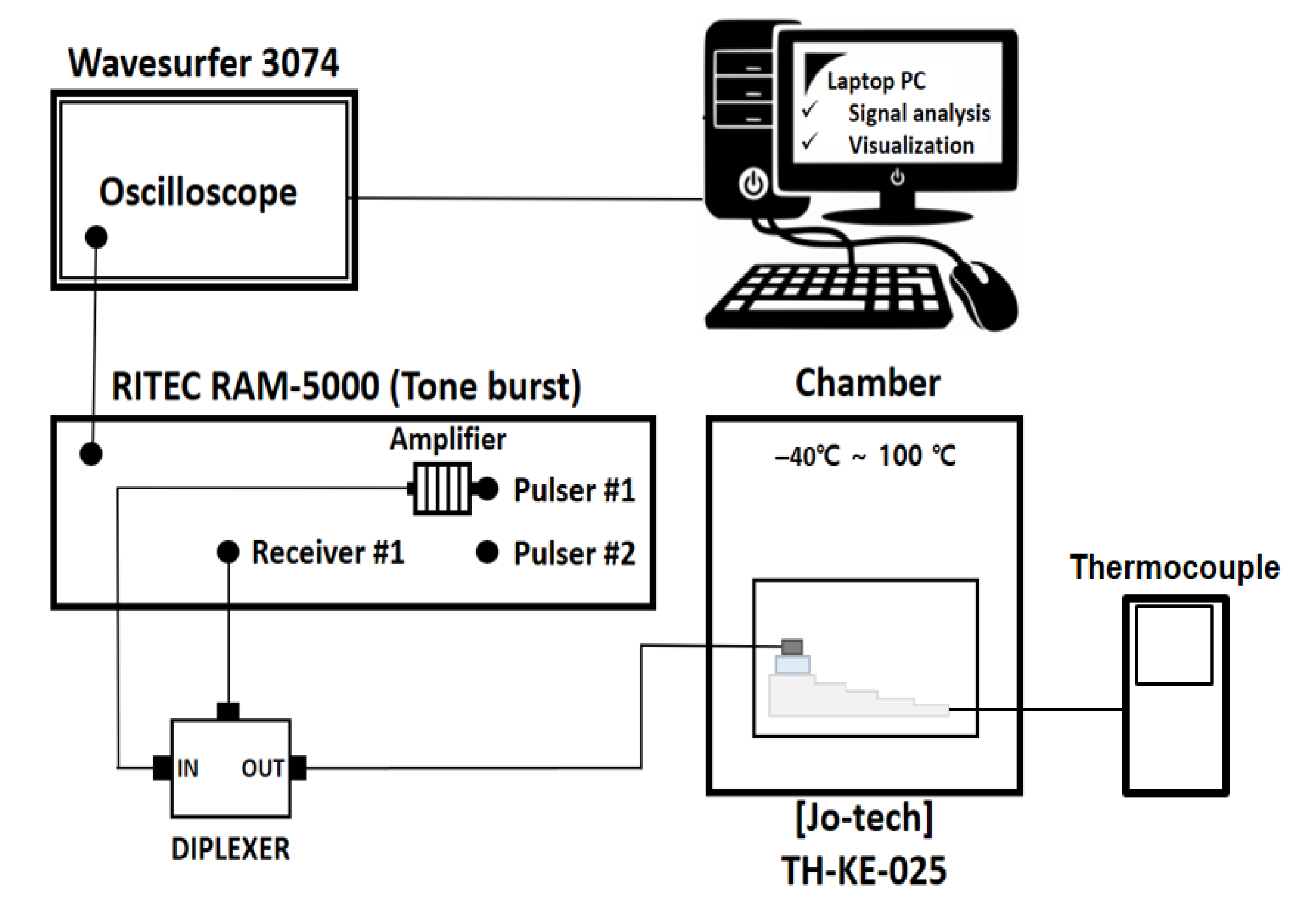
The experimental configuration was organized as shown in
Figure 1. In this study, a high-power signal generator (RAM-5000 SNAP, RITEC, Warwick, RI, USA) capable of generating a constant sine wave was used and data were stored with an oscilloscope (Wavsufer 3074, LeCroy crop, NY, USA) for ultrasonic signal collection. A piezoelectric transducer (D790-SM, 5 MHz, Olympus, USA) dedicated to low temperature and high temperature was used, and the temperature was adjusted using a temperature and humidity chamber (TH-KE-025, JEIO TECH, Republic of Korea) to measure the temperature under extreme environmental conditions.
The experiment was conducted by attaching a thermocouple (FSIC-10199, DAIHAN, Republic of Korea) to measure the temperature inside the specimen after it reached the temperature in the chamber. For the fatigue test, a tensile fatigue tester (DTF-505, IDTNT, Republic of Korea) was used.
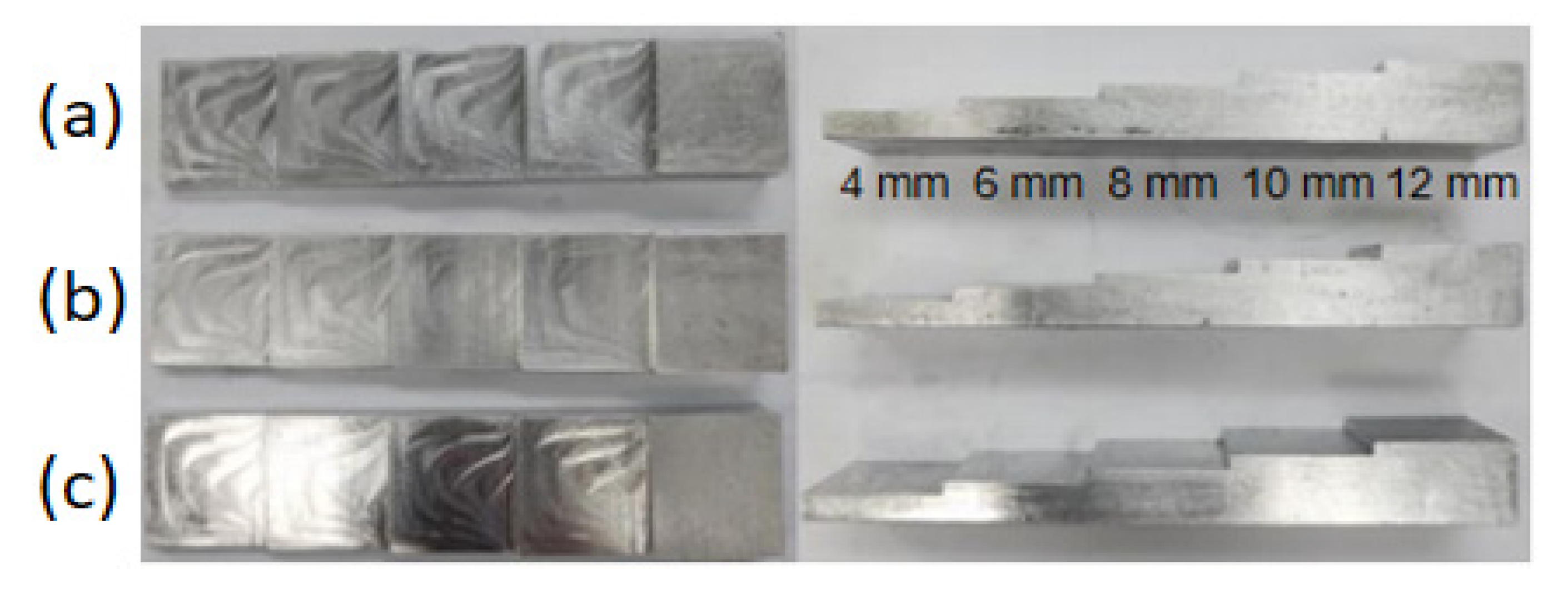
Figure 2 shows the specimen of each aluminium alloy in a step-wedge configuration.
Table 1 summarizes the fundamental mechanical properties of the three aluminium alloys investigated: Al3003, Al6061, and Al6063. Although their alloying compositions differ, all three materials exhibit comparable density and Poisson’s ratio values. However, the tensile strength varies significantly among them, with Al6061 showing the highest strength, followed by Al6063 and Al3003. These differences in mechanical performance are closely related to the distinct alloying elements and heat-treatment characteristics associated with each alloy series. Despite these variations, their room-temperature ultrasonic propagation behavior remains similar due to their comparable elastic modulus values.
Three aluminium alloys commonly used in automotive applications Al6061, Al6063, and Al3003 were selected for evaluation. Step-wedge specimens with thicknesses of 4, 6, 8, 10, and 12 mm were fabricated to examine the influence of thickness on ultrasonic propagation behavior. Although these alloys differ in chemical composition and mechanical properties, their geometric configurations were standardized to ensure consistent comparison across materials. The dimensions and machining processes were carefully controlled to minimize fabrication-induced variability. Since the battery pack and motor have operational efficiency and problems above 70 °C, the maximum amplitude and ultrasonic velocity of ultrasonic waves were measured by increasing the temperature by 20 °C from −40 °C to 80 °C in consideration of abnormal climate.
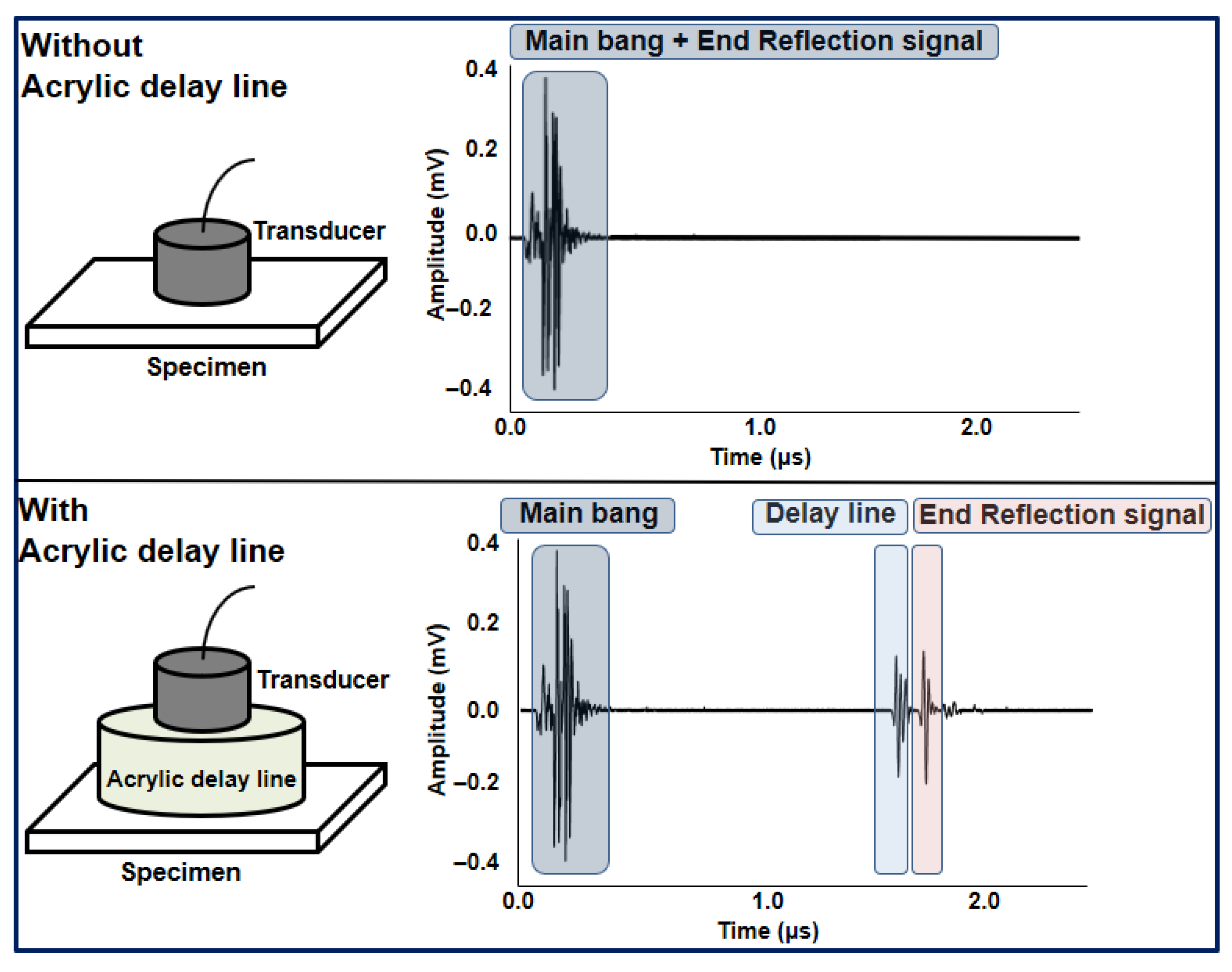
To prevent overlap between the initial excitation (main bang) and the first back-wall reflection, an acrylic delay line was utilized as shown in
Figure 3. This delay line increases the effective propagation path before the wave enters the aluminium specimen, ensuring that the near-field region of the transducer does not interfere with the primary reflection signal. As a result, the reflected ultrasonic wave can be clearly distinguished from the initial excitation pulse, allowing more accurate measurement of attenuation, amplitude, and propagation velocity across different temperature conditions.
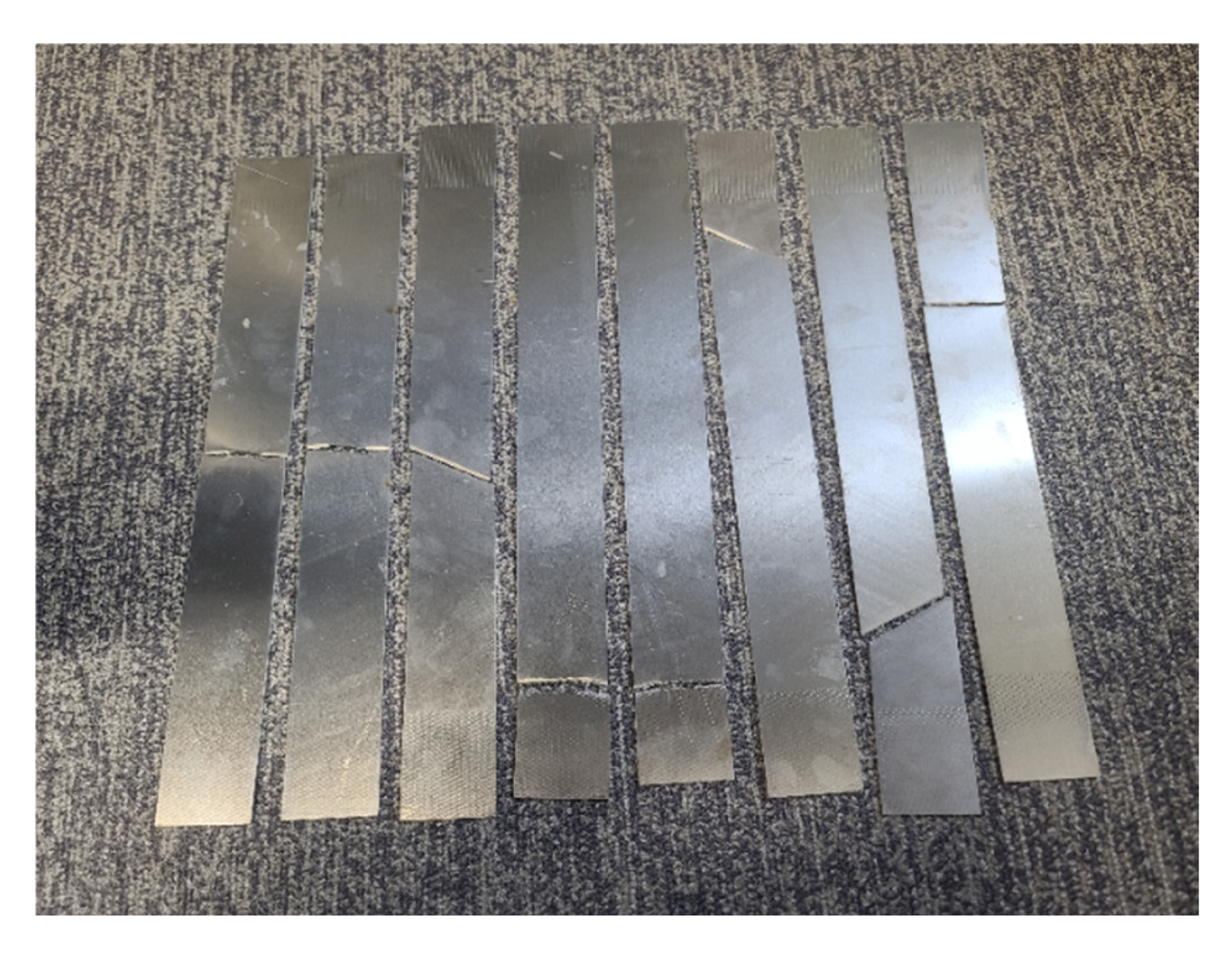
To investigate fatigue-induced microstructural changes and their influence on nonlinear ultrasonic behavior, aluminium plate specimens measuring 400 mm in width, 50 mm in length, and 1 mm in thickness were fabricated, as shown in
Figure 4. Tensile fatigue tests were conducted under multiple loading conditions to determine the cycle range in which fracture occurs. Under a maximum load of 10 kN, failure was observed between approximately 220,000 and 250,000 cycles. The detailed fatigue test parameters were as follows: maximum tensile load of 10 kN, minimum load of 1 kN, loading frequency of 5 Hz, stress ratio of 0.1, and a nominal gauge area of 100 mm
2. Based on these conditions, five sets of specimens were prepared, corresponding to 0, 50,000, 100,000, 150,000, and 200,000 fatigue cycles.
These specimens were subsequently used to evaluate temperature-dependent nonlinearity variations and to assess the sensitivity of nonlinear ultrasonic measurements to accumulated fatigue damage.
All experiments conducted in this study were measured five times, and all results were displayed using error bars.
4. Experimental Results
4.1. Ultrasonic Result
The ultrasonic pulse signal progressively loses energy as it undergoes repeated reflections, beginning with the initial excitation pulse (main bang). As the reflection sequence continues, each successive echo exhibits increased attenuation due to energy dissipation within the material. In this study, attenuation characteristics at various temperatures were evaluated using the amplitude of the ultrasonic waveform and the first back-wall echo for each thickness of the aluminium alloy specimens.
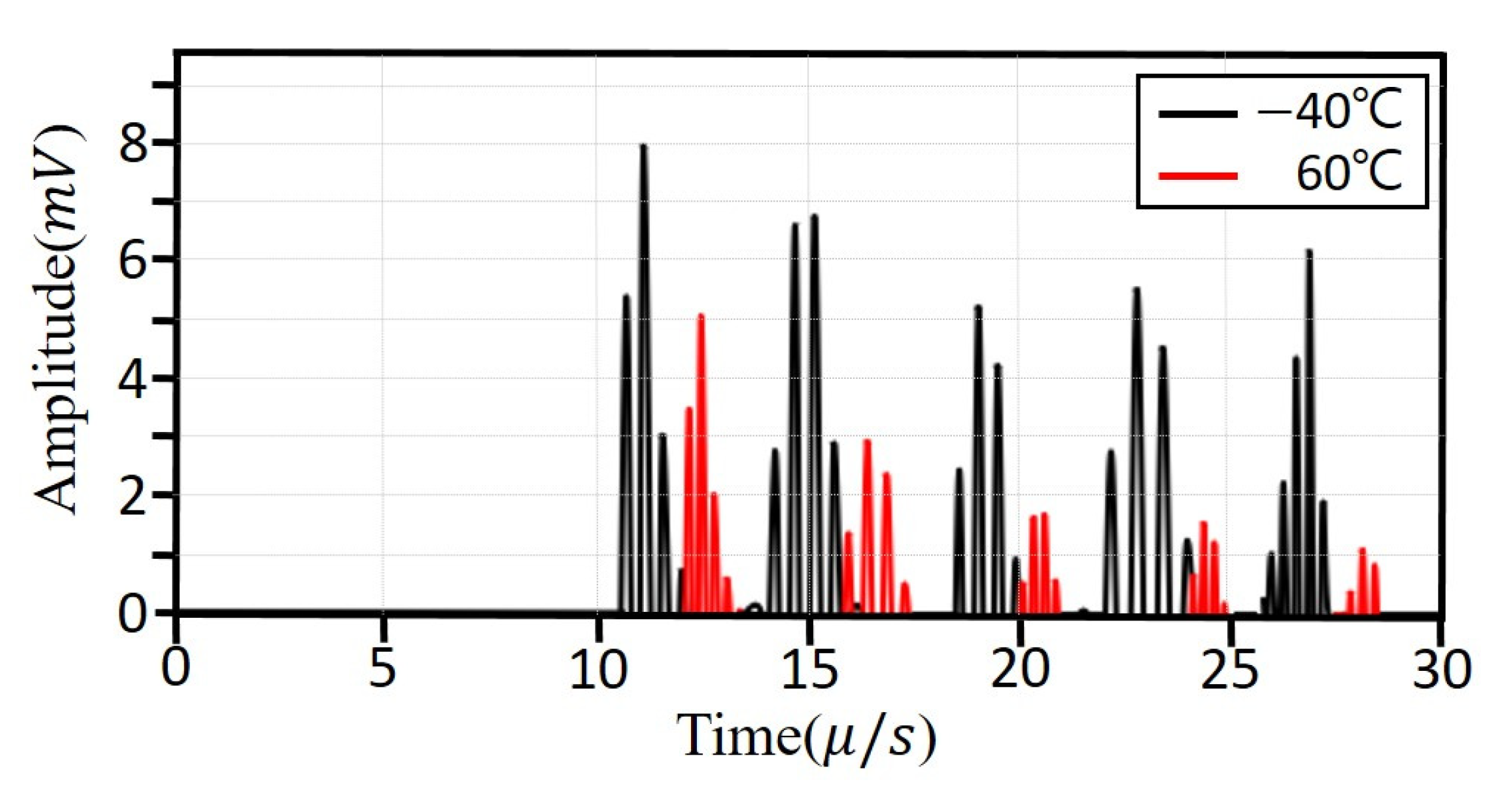
Figure 5 presents the ultrasonic signals of the Al6063 alloy measured at −40 °C and 60 °C, displayed on the same time axis for direct comparison. As temperature increases, signal attenuation becomes more pronounced, and the peak amplitudes of successive reflections decrease accordingly. Additionally, the duration to complete energy decay is shortened at elevated temperatures. To quantitatively compare attenuation, the amplitude of the first reflection—where energy loss is minimal—was used as the reference across all specimens and temperature conditions.
Table 2 summarizes the maximum amplitudes of the first back-wall echo measured for each aluminium alloy across all temperature conditions. Although slight variations were observed among the specimens, Al6063 exhibited marginally higher peak amplitudes in the −20 °C to 40 °C range compared with Al6061 and Al3003. These differences are attributed to variations in alloy composition and corresponding mechanical properties. The experimental results confirm that ultrasonic signal attenuation increases with rising temperature; however, in the low-temperature region (−40 °C to 0 °C), attenuation does not change monotonically. Consequently, it is difficult to establish a temperature dependent linear trend solely from amplitude reduction. This indicates that amplitude based attenuation characteristics alone are insufficient for reliable temperature estimation in aluminium alloys.
Previously, three types of aluminium alloy specimens, Al3003, Al6061, and Al6063, were analyzed for the characteristics of the attenuation of ultrasonic signals according to temperature, and it was confirmed that it was difficult to determine a specific temperature and use it for temperature measurement through the attenuation effect of ultrasonic sig-nals according to temperature. Therefore, in order to promote the ideal possibility for tem-perature measurement of aluminium alloys using ultrasonic testing techniques, we tried to present the ultrasonic propagation velocity in the medium, one of the other ultrasonic propagation characteristics.
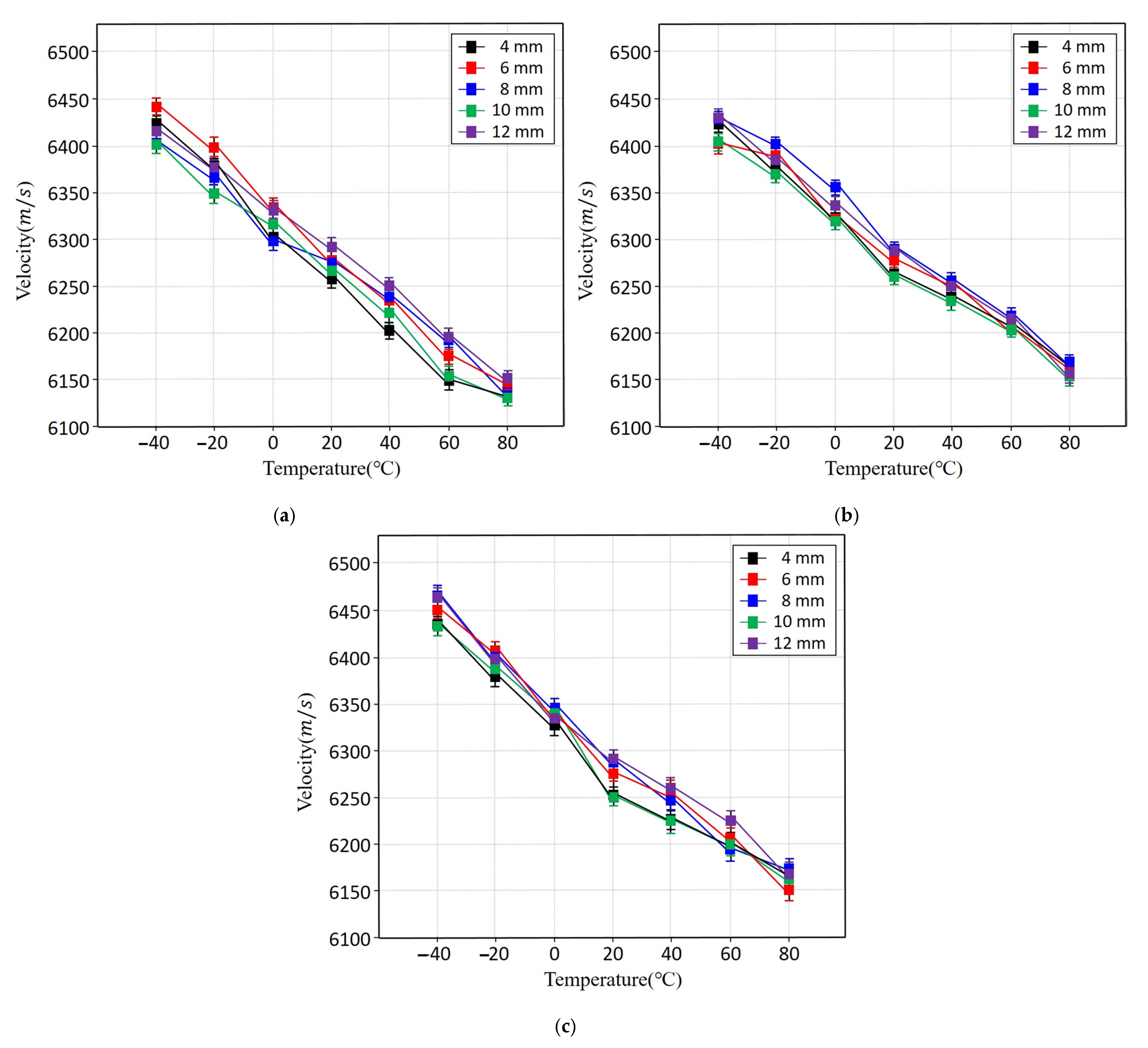
Figure 6 and
Table 3 present the ultrasonic propagation velocities of the three aluminium alloys over the full temperature range. All alloys exhibited a clear decrease in velocity with increasing temperature, consistent with the reduction in elastic modulus at elevated temperatures. Although Al6061 and Al6063 both belonging to the Al-Mg-Si series showed similar velocity trends, Al6063 demonstrated slightly higher velocities at low temperatures. In contrast, Al3003, an Al-Mn-based alloy, maintained lower velocities in the −40 °C to 0 °C range, reflecting differences in alloy composition and mechanical behavior. At approximately 20 °C, the propagation velocities of all three alloys converged, but at temperatures above 40 °C, the rate of velocity reduction increased. This temperature-dependent decline is attributed to the pronounced decrease in elastic modulus with thermal activation of the lattice. Overall, the experimental data show a nearly linear velocity decrease approximately −47 m/s per °C indicating that ultrasonic velocity is a more reliable indicator for temperature estimation than amplitude-based attenuation.
4.2. Nonlinear Ultrasonic Results
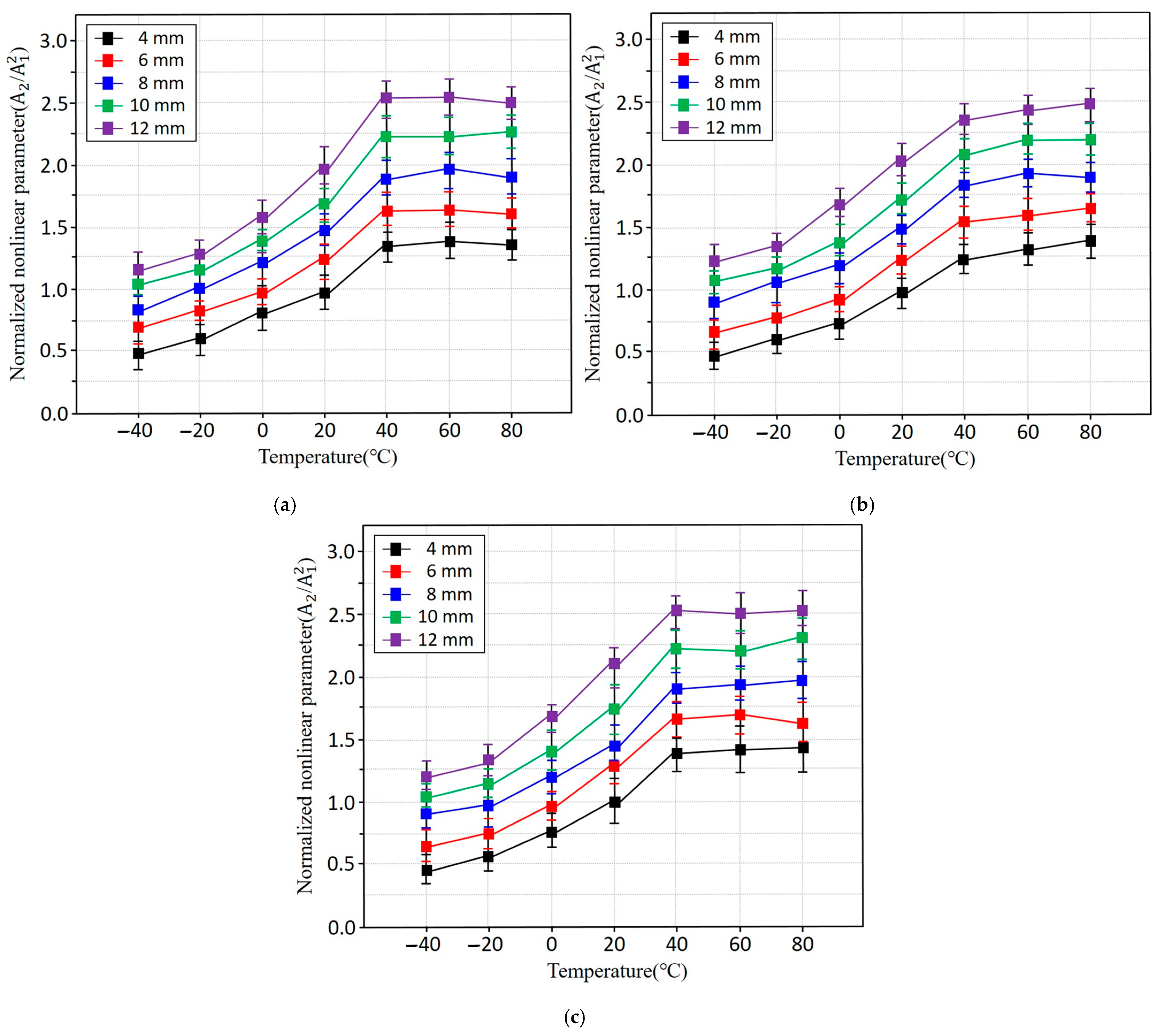
Figure 7 illustrates the nonlinear ultrasonic parameters measured as functions of temperature and specimen thickness for all three aluminium alloys. In general, the nonlinearity parameter
β increases with increasing temperature and thickness. This rise in nonlinearity is attributed to enhanced lattice anharmonicity at elevated temperatures, which increases asymmetry in interatomic potentials. As temperature increases, thermal activation promotes microstructural motions such as the vibration of dislocations, movement of impurities, and local rearrangements of the crystal lattice, thereby strengthening the nonlinear elastic response. The observed increase in β can also be explained by the temperature dependence of higher-order elastic constants. While the second-order elastic modulus decreases gradually with temperature, the third-order modulus decreases more rapidly, resulting in an overall increase in β. This behavior aligns with theoretical predictions for anharmonic solids, where elevated temperatures amplify nonlinear wave matter interactions. The trend is consistent across all three alloys, indicating that alloy composition has only a minor influence on temperature-induced nonlinear behavior.
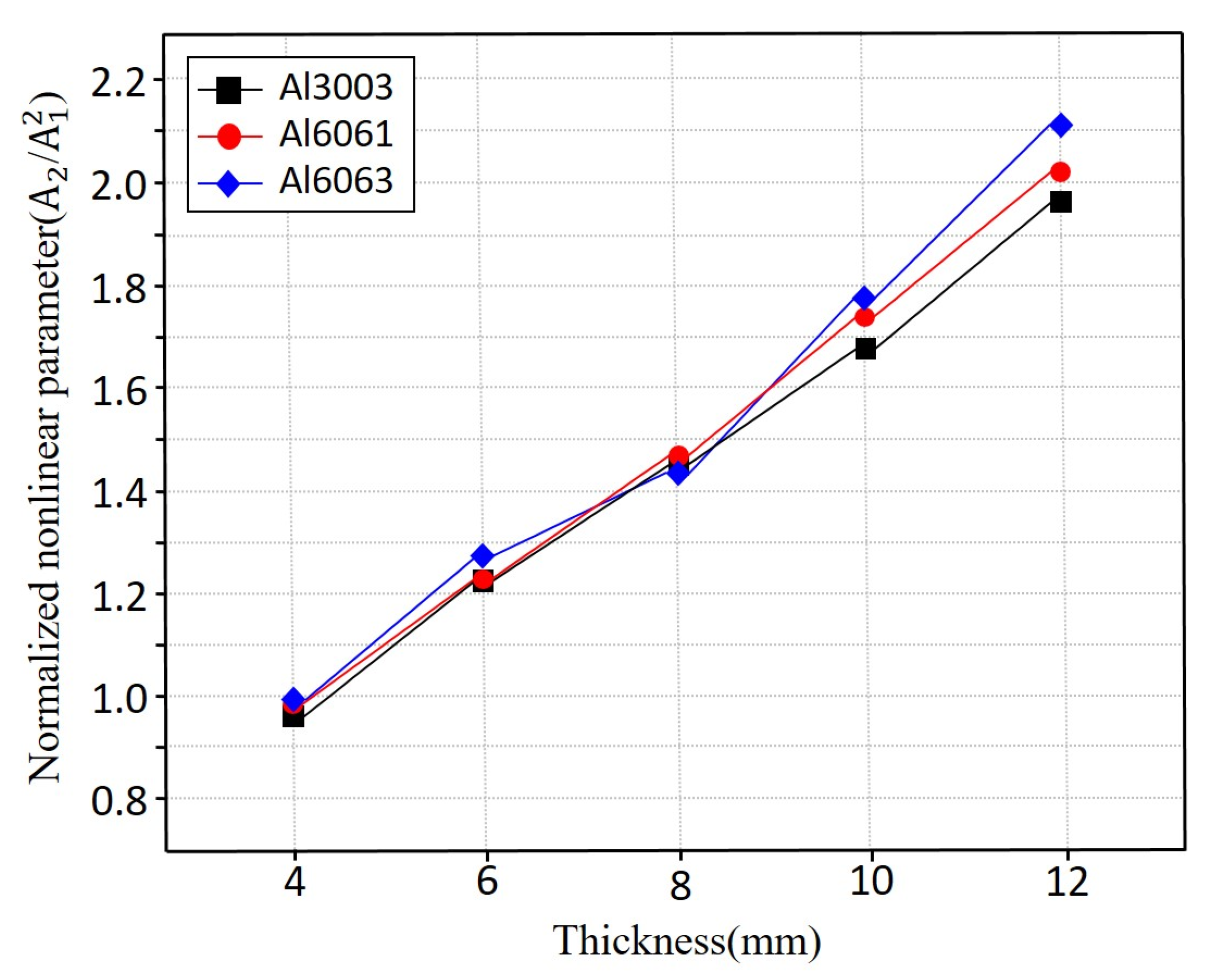
As shown in
Figure 8, all three aluminium alloys Al3003, Al6061, and Al6063 exhibit similar β values at room temperature across the full range of specimen thicknesses. This indicates that alloy composition has minimal influence on nonlinear ultrasonic response under defect-free conditions. The similarity among alloys also corroborates the ultrasonic velocity trends, which likewise showed only minor differences among the materials. These results suggest that, at room temperature, nonlinearity is governed predominant.
Table 4 shows that the elastic modulus (
E), shear modulus (
G), and bulk modulus (
K) all decrease progressively with increasing temperature. Although the rate of reduction diminishes above approximately 40 °C, the overall decline in stiffness reflects thermally activated lattice vibrations, which weaken interatomic bonding and reduce resistance to deformation. This temperature-induced softening increases the material’s anharmonic response, thereby contributing to a rise in the nonlinear parameter
β. In many crystalline solids, higher-order elastic constants decrease more rapidly with temperature than second-order constants. As a result, β becomes increasingly sensitive to thermal excitation. For aluminium alloys, the measured increase in β aligns well with established nonlinear elastic theory, which predicts stronger second-harmonic generation as temperature elevates due to enhanced lattice asymmetry and reduced elastic rigidity.
The temperature-dependent nonlinear parameter β can be further interpreted using Equation (11),
where
β0 represents the reference value at temperature
T0 and
K is the temperature coefficient. For metallic materials,
K typically ranges between 0.002 and 0.003, and for aluminium alloys, a value of approximately 0.0025 is widely accepted [
34]. Using this coefficient,
β at elevated temperatures can be predicted from room temperature measurements, and the resulting trend aligns well. Although the same
β trend was observed for all three alloys, deviations at higher temperatures may result from external experimental factors rather than intrinsic material behavior. The transducer used in this work (D790-SM, 5 MHz, Evident, Quebec City, Quebec) is rated for temperatures between −20 °C and 500 °C; however, cable performance, thermal gradients within the specimen, and insufficient thermal stabilization time can influence measurements. For improved accuracy, specimens should be held at the target temperature for extended periods to ensure full thermal equilibrium [
35]. These considerations are essential when interpreting
β measurements collected under short-duration high-temperature conditions.
4.3. Nonlinear Ultrasonic Result for Fatigue Test Specimens
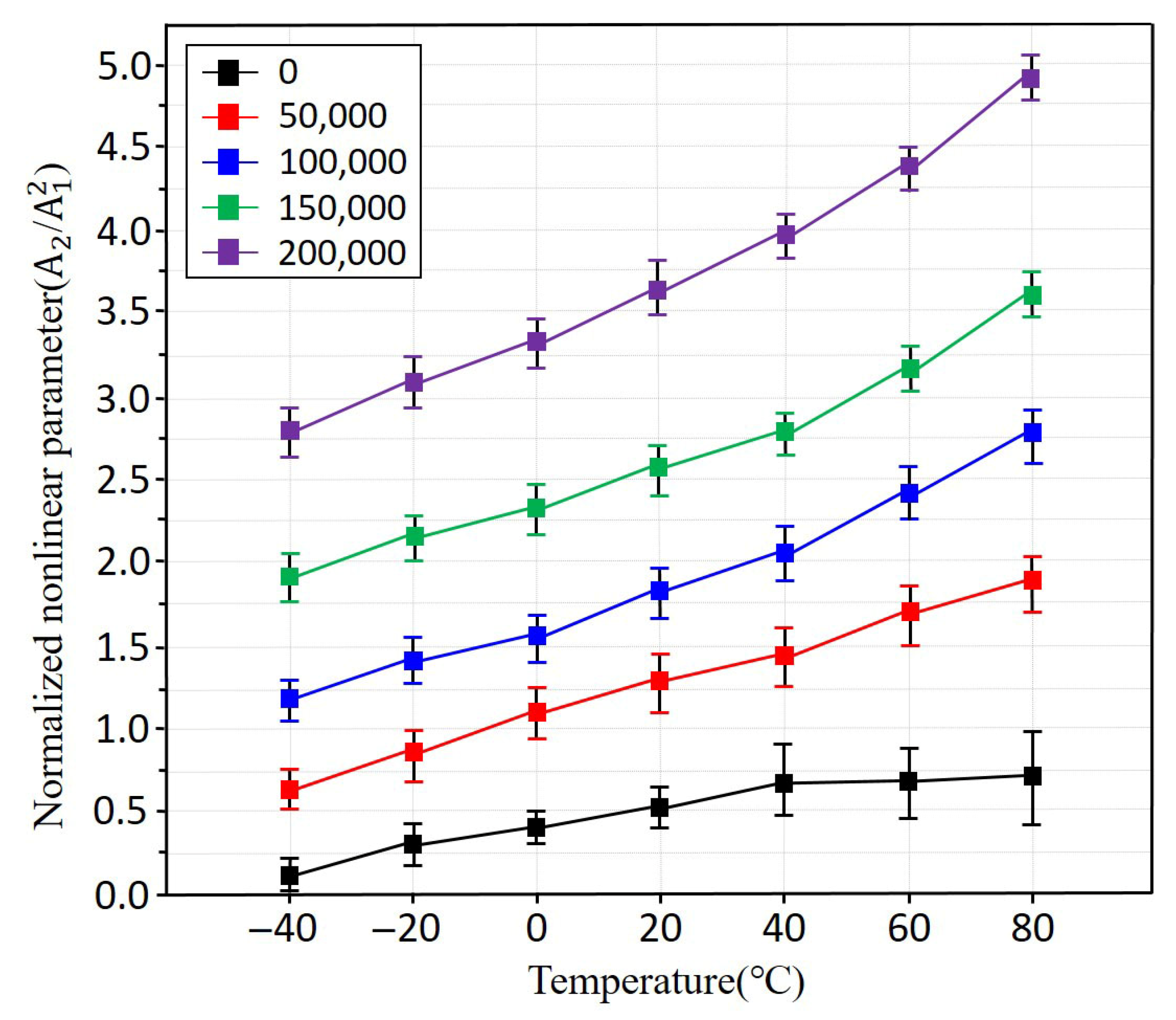
Figure 9 presents the nonlinear ultrasonic parameter
β measured for fatigue-damaged specimens subjected to different numbers of tensile loading cycles. In general, it is well known that the nonlinearity parameter increases with increasing fatigue [
36,
37]. However, for automotive components operating at short-term temperatures, accurate temperature-dependent nonlinearity measurements are not possible. Therefore, it is crucial to determine whether the effects of defects or material micro-changes can be identified even in short-term conditions. As shown in
Figure 7, the non-fatigued specimens do not exhibit an increase in nonlinearity above 40 °C due to insufficient material degradation. However, as fatigue accumulation progresses from 50,000 to 200,000 cycles, β increases steadily, indicating enhanced microstructural degradation such as dislocation accumulation, slip band formation, and early-stage microcracking. Temperature effects further amplify this trend. At elevated temperatures, increased lattice anharmonicity enhances sensitivity to microstructural damage, resulting in more pronounced nonlinear responses. Conversely, at lower temperatures, β exhibits reduced sensitivity, reflecting the suppression of thermally activated lattice motion. Overall, the combined influence of fatigue damage and temperature demonstrates that nonlinear ultrasonic techniques are capable of detecting early-stage degradation in aluminium alloys, even before observable macroscopic defects appear.
5. Conclusions
This study comprehensively investigated the temperature-dependent ultrasonic and nonlinear ultrasonic characteristics of aluminium alloys widely used in electric vehicle components, including battery housings, structural frames, and motor assemblies. Three alloys—Al3003, Al6061, and Al6063—were evaluated through a combination of conventional ultrasonic measurements and nonlinear ultrasonic techniques, and the effects of temperature, thickness, and fatigue-induced microstructural degradation were systematically analyzed.
First, the ultrasonic attenuation of all three aluminium alloys increased as the temperature rose, consistent with enhanced internal friction and thermally activated atomic motion. Although attenuation generally increased, the low-temperature region (−40 °C to 0 °C) exhibited non-monotonic behavior, indicating that amplitude-based attenuation alone is insufficient for reliable temperature estimation.
Second, ultrasonic propagation velocity demonstrated a highly linear and repeatable dependence on temperature across all alloys and thicknesses. A linear relationship with a slope of approximately −47 °C was confirmed, reflecting the substantial reduction in elastic modulus at elevated temperatures. This strong linearity suggests that ultrasonic velocity can serve as a robust alternative to conventional thermistors, enabling nondestructive, real-time temperature estimation in aluminium structures without the need for embedded contact sensors.
Third, nonlinear ultrasonic measurements revealed that the nonlinear parameter β increased with both temperature and specimen thickness. This behavior is attributed to the temperature-dependent softening of higher-order elastic constants and the corresponding enhancement of lattice anharmonicity.
Fourth, tensile fatigue experiments confirmed that β is highly sensitive to microstructural degradation. Specimens subjected to 50,000 to 200,000 fatigue cycles exhibited a progressive increase in β, corresponding to the accumulation of dislocations, slip bands, and early-stage microcracking. Temperature effects further magnified β, with elevated temperatures enhancing sensitivity to fatigue-induced defects.
Overall, the combined experimental results demonstrate that ultrasonic velocity offers a highly linear and reliable indicator for temperature estimation, whereas the nonlinear parameter β provides excellent sensitivity to early fatigue damage. Therefore, ultrasonic techniques, particularly those combining linear and nonlinear measurements, offer a promising nondestructive alternative to thermistors for temperature monitoring and structural health assessment in aluminium components used in electric vehicles.
Author Contributions
J.P. designed and performed the experiments. J.L. conceived the original idea. J.P. developed the theory and performed the computations, with support from J.L., J.P. and J.L. verified the analytical methods. J.P. wrote the draft study, and J.L. performed the final review. All authors have read and agreed to the published version of the manuscript.
Funding
This work was supported by the Korea Institute of Energy Technology Evaluation and Planning (KETEP) and funded (via grant) by the Korea government (MOTIE) (RS-2021-KP002514, Development of R&D engineers for combined cycle power plant technologies) and the Basic Science Research Program through the National Research Foundation of Korea (NRF), funded by the Ministry of Education (RS-2025-25396743).
Institutional Review Board Statement
Not applicable.
Informed Consent Statement
Not applicable.
Data Availability Statement
The data supporting the findings of this study are not publicly available due to security restrictions of the providing company. However, the data may be made available upon reasonable request and subject to review.
Conflicts of Interest
The authors declare no conflicts of interest.
References
- Kim, J.M. Comparative Analysis of Maximum Driving Range of Electric Vehicle and Internal Combustion Engine Vehicle. Trans. KSAE 2013, 21, 105–112. [Google Scholar] [CrossRef] [Scilit]
- Cho, Y.F.; Ma, J.; Kim, J.K.; Lee, D. Evaluation of characteristics to increase yield of aluminum brazing process. In Proceedings of the KSAE Fall Conference, Ulsan, Republic of Korea, 15 November 2023; Available online: https://www.dbpia.co.kr/journal/articleDetail?nodeId=NODE11666454 (accessed on 12 November 2025).
- Cho, Y.G.; Lim, T.S.; Jang, S.G.; Cho, C.H. Front Aluminium Subframe of High Level Vacuum Die-casting. Trans. KSAE 2012, 20, 52–59. [Google Scholar] [CrossRef] [Scilit]
- Kang, T.; Song, S.J.; Park, J.H. Ultrasonic linear and nonlinear properties of fatigued aluminium 6061-T6 with voids. J. KIGAS 2015, 19, 41–46. [Google Scholar] [CrossRef] [Scilit]
- Mak, D.K.; Gauthier, J. Ultrasonic measurement of longitudinal and shear velocities of materials at elevated temperatures. Ultrasonics 1993, 31, 245–249. [Google Scholar] [CrossRef] [Scilit]
- Oroian, M. Measurement, prediction and correlation of density, viscosity, surface tension and ultrasonic velocity of different honey types at different temperatures. J. Food Eng. 2013, 199, 167–172. [Google Scholar] [CrossRef] [Scilit]
- Zhang, Y.; Ming, T.; Li, J. Study on the Influence of Temperature on Ultrasonic Pressure Measurement Technology. J. Phys. Conf. Ser. 2022, 2174, 012008. [Google Scholar] [CrossRef] [Scilit]
- George, P.M.; Divya, P.; Shubhashree, N.S. Ultrasonic velocity of urea–A comparative study at room temperature. Mater. Today Proc. 2020, 33, 2934–2935. [Google Scholar] [CrossRef] [Scilit]
- Vanathi, V.; Mullainathan, S.; Nithiyanatham, S.; Ramasamy, V.; Palaniappan, L. Ultrasonic velocity, density, viscosity for the ternary mixture of (benzene + chloroform + cyclohexane) at different temperatures. Heliyon 2019, 5, e02203. [Google Scholar] [CrossRef] [Scilit]
- Li, M.; He, J. Effect of high temperature on ultrasonic velocity in graphite. Diam. Relat. Mater. 2021, 166, 108368. [Google Scholar] [CrossRef] [Scilit]
- Augereau, F.; Laux, D.; Allais, L.; Mottot, M.; Caes, C. Ultrasonic measurement of anisotropy and temperature dependence of elastic parameters by a dry coupling method applied to a 6061-T6 alloy. Ultrasonics 2007, 46, 34–41. [Google Scholar] [CrossRef] [Scilit]
- Pandey, D.K.; Yadav, R.R. Temperature dependent ultrasonic properties of aluminium nitride. Appl. Acoust. 2009, 70, 412–415. [Google Scholar] [CrossRef] [Scilit]
- Muthu Kumaran, S.; Priyadharsini, N.; Rajendran, V.; Jayakumar, T.; Palanichamy, P.; Shankar, P.; Raj, B. In situ high temperature ultrasonic evaluation for on-line characterization of fine scale precipitation reactions in 8090 Al-Li alloy. Mater. Sci. Eng. A 2006, 435–436, 29–39. [Google Scholar] [CrossRef] [Scilit]
- Rajendran, V.; Muthu Kumaran, S.; Jayakumar, T.; Palanichamy, P.; Shankar, P.; Raj, B. Microstructure and ultrasonic behaviour on thermal heat-treated Al-Li 8090 alloy. J. Alloys Compd. 2009, 478, 147–153. [Google Scholar] [CrossRef] [Scilit]
- Payan, C.; Garnier, V.; Moysan, J. Potential of Nonlinear Ultrasonic Indicators for Nondestructive Testing of Concrete. Adv. Civ. Eng. 2010, 2010, 238472. [Google Scholar] [CrossRef] [Scilit]
- Park, J.; Lee, J.; Min, J.; Cho, Y. Defects Inspection in Wires by Nonlinear Ultrasonic- Guided Wave Generated by Electromagnetic Sensors. Appl. Sci. 2020, 10, 4479. [Google Scholar] [CrossRef] [Scilit]
- Jafarzadeh, E.; Sinclair, A.N. Effect of Nonlinear Wave Propagation on Temperature Rise in High Frequency Imaging. In Proceedings of the 2021 IEEE International Ultrasonics Symposium (IUS), Xi’an, China, 11–16 September 2021; pp. 1–4. [Google Scholar]
- Sun, H.; Zhu, J. Determination of acoustic nonlinearity parameters using thermal modulation of ultrasonic waves. Appl. Phys. Lett. 2022, 116, 241901. [Google Scholar] [CrossRef] [Scilit]
- Yan, B.; Song, Y.; Nie, S.; Yang, M.; Liu, Z. Measurement of the Acoustic Non-Linearity Parameter of Materials by Exciting Reversed-Phase Rayleigh Waves in Opposite Directions. Sensor 2020, 20, 1955. [Google Scholar] [CrossRef] [Scilit]
- Li, W.; Xiao, J.; Deng, M. Micro-defect imaging with an improved resolution using nonlinear ultrasonic Lamb waves. J. Appl. Phys. 2022, 131, 185101. [Google Scholar] [CrossRef] [Scilit]
- Zhao, J.; Wu, J.; Chen, X.; Zeng, R. Effect of Temperature on Ultrasonic Nonlinear Parameters of Carbonated Concrete. Materials 2022, 15, 8797. [Google Scholar] [CrossRef] [Scilit]
- Vosteen, L.F. Effect of Temperature on Dynamic Modulus of Elasticity of Some Structural Alloys; NACA-TN-4348; National Advisory Committee for Aeronautics: Washington, DC, USA, 1958; pp. 1–9. [Google Scholar]
- Kou, H.; Gao, Y.; Shao, J.; Dou, K.; Wang, N. Temperature-porosity-dependent elastic modulus model for metallic materials. Rev. Adv. Mater. Sci. 2022, 61, 769–777. [Google Scholar] [CrossRef] [Scilit]
- Norris, A.N. Finite-Amplitude Waves in Solids. In Nonlinear Acoustics; Academic Press: New York, NY, USA, 2024; pp. 259–273. [Google Scholar]
- Park, J.; Aslam, M.; Lee, J. Ultrasonic Nonlinearity Experiment due to Plastic Deformation of Aluminium Plate Due to Bending Damage. Materials 2023, 16, 4241. [Google Scholar] [CrossRef] [Scilit]
- Cantrell, J.H.; Yost, W.T. Acoustic harmonic generation from fatigue-induced dislocation dipoles. Philos. Mag. A 1994, 69, 315–326. [Google Scholar] [CrossRef] [Scilit]
- Li, W.; Deng, M.; Cho, Y. Cumulative Second Harmonic Generation of Ultrasonic Guided Waves Propagation in Tube-Like Structure. J. Comput. Acoust. 2016, 24, 1650011. [Google Scholar] [CrossRef] [Scilit]
- ASM International. ASM Handbook: Properties and Selection: Nonferrous Alloys and Special-Purpose Materials; ASM International: Novelty, OH, USA, 1991; Volume 2, pp. 62–122. [Google Scholar] [CrossRef] [Scilit]
- Kim, J.; Jhang, K.; Kim, C. Dependence of nonlinear ultrasonic characteristic on second-phase precipitation in heat-treated Al 6061-T6 alloy. Ultrasonics 2018, 82, 84–90. [Google Scholar] [CrossRef] [Scilit] [PubMed]
- Niu, X.; Zhu, L.; Yang, W.; Yu, Z.; Shen, H. Temperature Effects on Nonlinear Ultrasonic Guided Waves. Materials 2023, 16, 3548. [Google Scholar] [CrossRef] [Scilit]
- Hikata, A.; Elbaum, C. Generation of Ultrasonic Second and Third Harmonics Due to Dislocations. I. Phys. Rev. 1966, 144, 469–477. [Google Scholar] [CrossRef] [Scilit]
- Hikata, A.; Sewell, F.A.; Elbaum, C. Generation of Ultrasonic Second and Third Harmonics Due to Dislocations. II. Phys. Rev. 1966, 151, 442–449. [Google Scholar] [CrossRef] [Scilit]
- Cantrell, J.H.; Salama, K. Acoustoelastic characterisation of materials. Int. Mater. Rev. 2013, 36, 125–145. [Google Scholar] [CrossRef] [Scilit]
- Kim, N.; Jang, K.; An, Y.K. Self-Sensing Nonlinear Ultrasonic Fatigue Crack Detection under Temperature Variation. Sensors 2018, 18, 2527. [Google Scholar] [CrossRef] [Scilit]
- Kim, J.; Jhang, K. Evaluation of ultrasonic nonlinear characteristics in heat-treated aluminium alloy (Al-Mg-Si-Cu). Adv. Mater. Sci. Eng. 2013, 2013, 407846. [Google Scholar] [CrossRef] [Scilit]
- Cantrell, J.H.; Yost, W.T. Nonlinear ultrasonic characterization of fatigue microstructures. Int. J. Fatigue 2001, 23, 387–490. [Google Scholar] [CrossRef] [Scilit]
- Pan, Q.; Li, S.; Xu, L.; Zhou, X.; Yu, H.; Li, S.; Jhang, Y. Research on Nonlinear Ultrasonic Testing Technology on Fatigue Process of Metal Materials. In Proceedings of the International Conference on Mechatronics and Automation, Guilin, China, 7–10 August 2022. [Google Scholar] [CrossRef] [Scilit]
| Disclaimer/Publisher’s Note: The statements, opinions and data contained in all publications are solely those of the individual author(s) and contributor(s) and not of MDPI and/or the editor(s). MDPI and/or the editor(s) disclaim responsibility for any injury to people or property resulting from any ideas, methods, instructions or products referred to in the content. |
© 2025 by the authors. Licensee MDPI, Basel, Switzerland. This article is an open access article distributed under the terms and conditions of the Creative Commons Attribution (CC BY) license (https://creativecommons.org/licenses/by/4.0/).