Incorporating Uncertainty in Machine Learning Models to Improve Early Detection of Flavescence Dorée: A Demonstration of Applicability †




Abstract
1. Introduction
2. Materials and Methods
2.1. Materials
2.2. Data Acquisition Procedure
- Campaign 1 (2023): Leaf samples were collected from plants suspected of being positive to FD and marked with colored strips by the expert agronomist found in all the vineyard without limiting the search to a single row. Healthy samples were collected from Pinot Noir plants cultivated in a protected environment. Collection days were the 14th of July, the 6th of September, and the 18th of September. Details about this campaign and the relative data analysis can be found in our previous work [30].
- Campaign 2 (2024): Leaf samples were collected from plants belonging to just one row of the vineyard. The selected row did not contain plants that were affected by FD during 2023. Collection days were the 31st of May, the 1st of July, the 6th of August, and the 20th of September. Details about this campaign and the relative data analysis can be found in our previous work [31].
2.3. Pre-Processing
2.3.1. Selection of Pixels Belonging to the Leaf
2.3.2. Features Computation
2.4. Machine Learning Models Tested
- ML2: a Naive Bayes model with Gaussian distribution [44].
- ML3: a k-Nearest Neighbor (k-NN) model with the number of neighbors equal to 10 and distance metric set to Minkowski cubic distance [45].
- ML4: an Ensemble of Bagged Decision Trees model with maximum number of splits equal to 140 [43,46]. Ensembling is a method to reduce variance in noisy datasets by training multiple instances of the same model architecture in parallel. Among ensembling methods, bagging is a method in which a random sample of the training set is selected and replaced each time a new instance is trained; thus, the final model will be the aggregation of all the models trained in parallel, and their performance will be averaged. In our case, we set the number of parallel models equal to 30.
- ML5: a Wide Neural Network with 1 fully connected layer, a first layer size of 100 neurons (with ReLU activation function), and a maximum of 1000 iterations [47].
2.5. Uncertainty-Aware Models
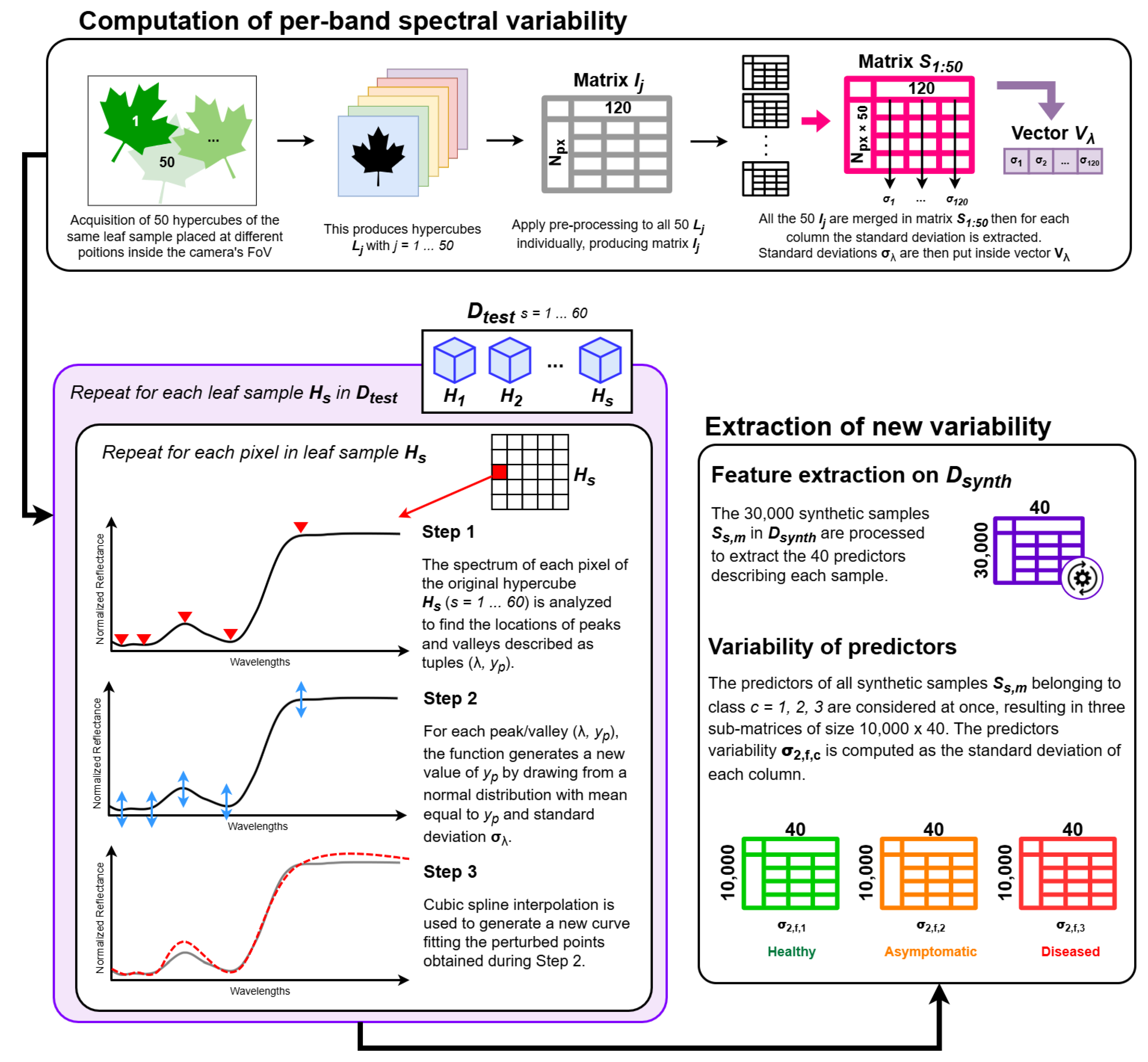
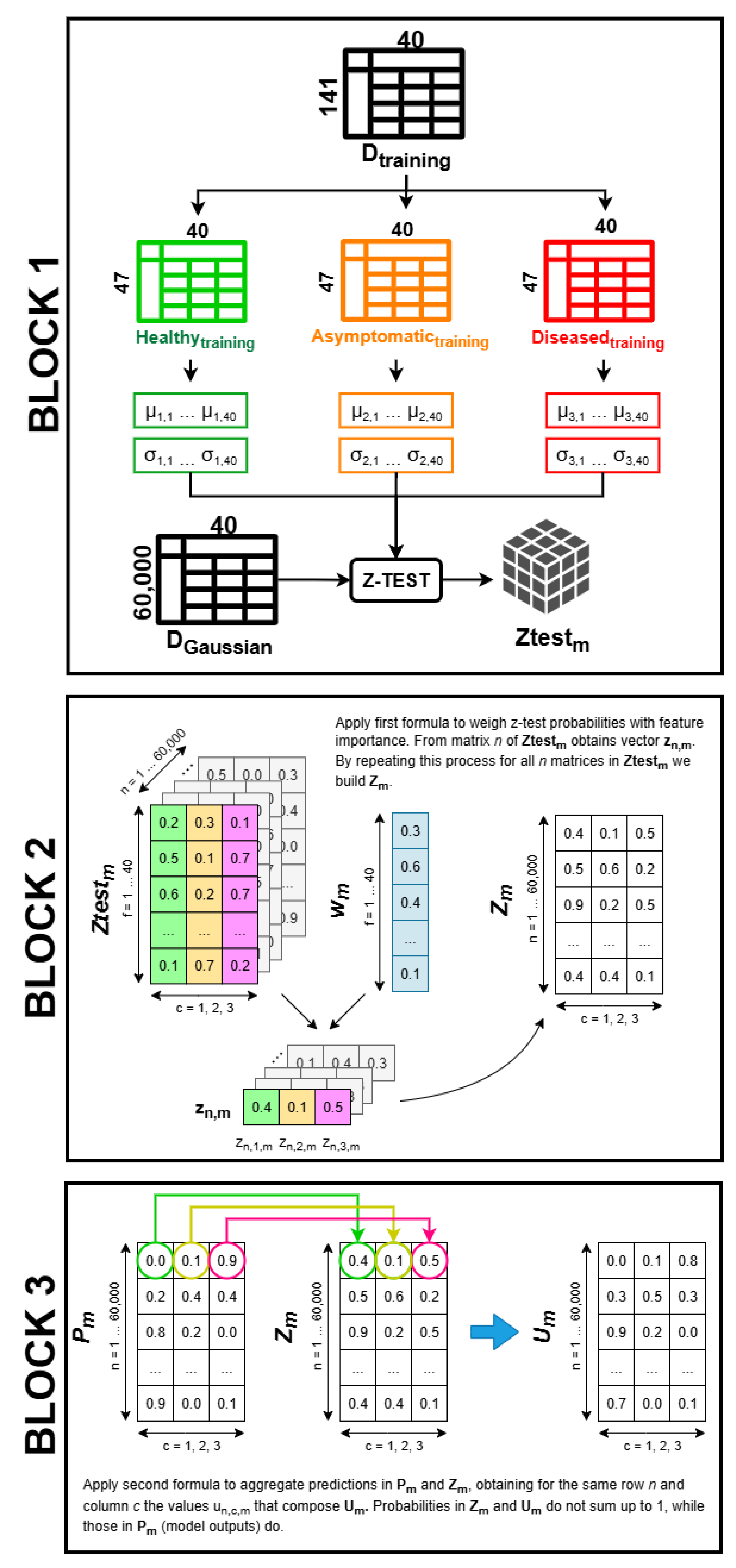
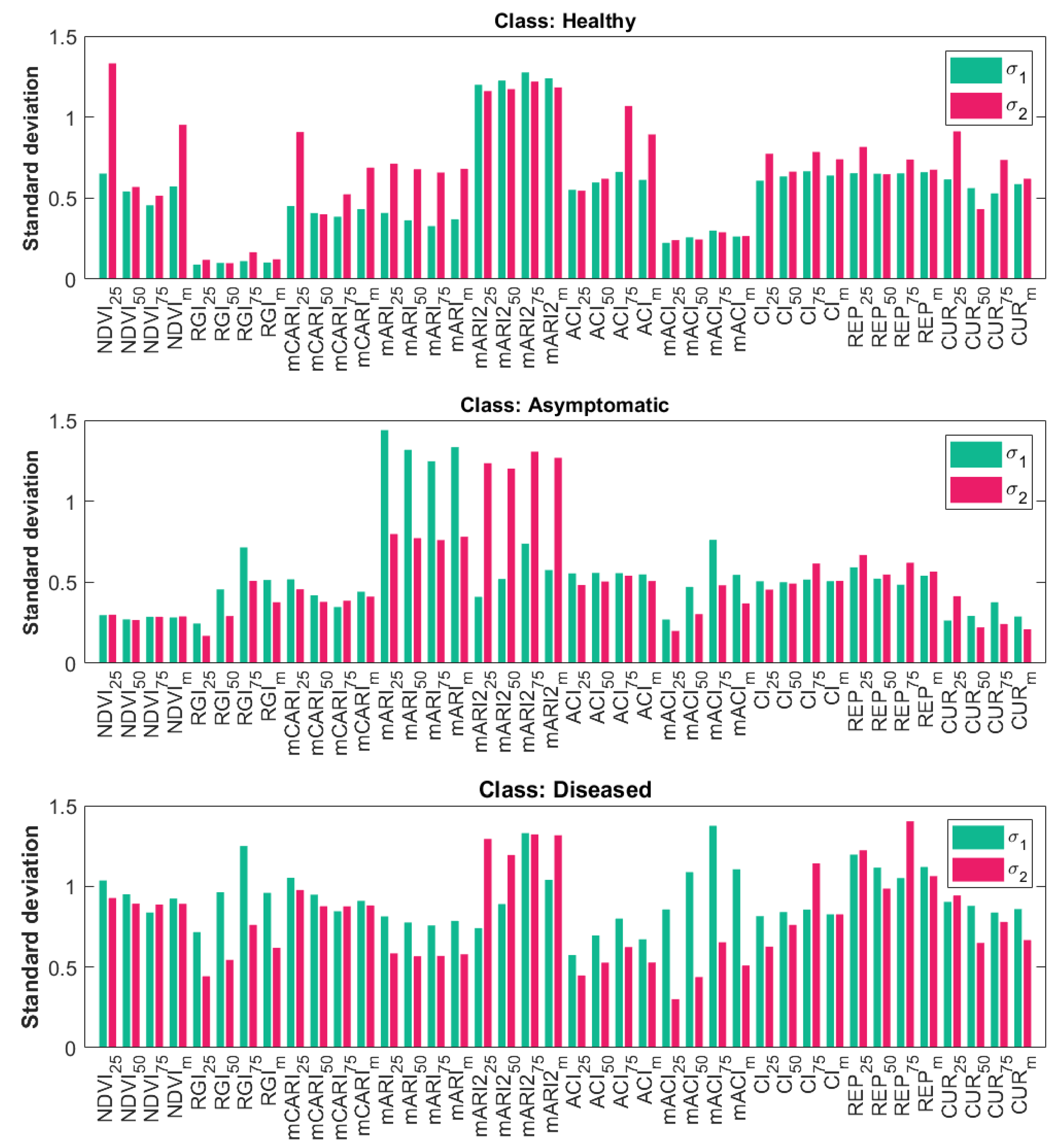
- Generation of synthetic variability: To address the issue of having a low number of samples in our dataset, the idea is to generate new samples using Monte Carlo generation starting from the samples in since they were not seen by the trained ML models. Following the procedure in Section 2.5.1, we generated “synthetic” leaf hypercube samples starting from the original hypercubes in by substituting the spectra contained in each pixel of the original hypercubes with a new one following a Monte Carlo procedure. To do so, we exploited the per-band spectral variability computed by acquiring 50 times the hypercube of a new leaf sample not included in any dataset collected specifically for this test. For each hypercube in , we generated synthetic hypercubes, thus keeping the processing times reasonable considering the high number of pixels contained in them ( > 100,000 px). We then apply the pre-processing procedure described in Section 2.3.2 to the synthetic hypercubes, obtaining feature predictors for each synthetic sample. By comparing the variability of the original predictors in divided per class () with the variability of the synthetic data (), we can determine if the synthetic data properly models the original phenomena. The resulting is then used as the input data uncertainty in the following step.
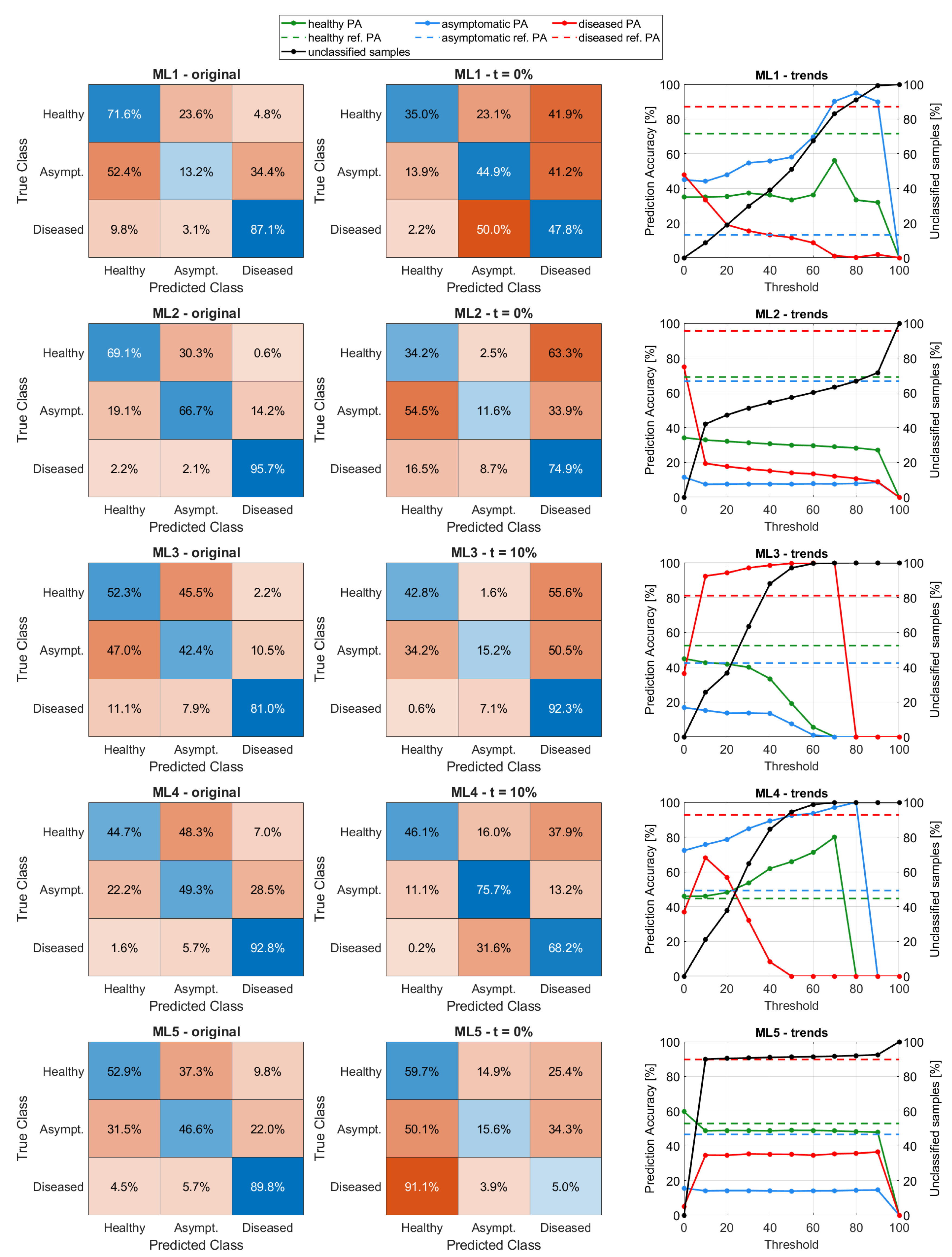
- Classification uncertainty: Following the procedure described in Section 2.5.2, we used the variability to generate new synthetic samples starting from the data in by means of a second Monte Carlo procedure. This allows the generation of feature predictors directly rather than generating a hypercube, which is a faster process in comparison and also ensures we avoid carrying over the uncertainty related to the curve generation procedure used in Section 2.5.1. For each sample s in a total of new samples were generated this way, producing the new dataset with = 60,000 rows. To obtain the uncertainty-aware models, we followed the idea expressed in [48,49] describing a statistical approach to aggregate the traditional confidence scores returned by the models (namely ), representing the probability of the input sample belonging to each class on which the model was trained, with another set of probabilities (namely , also referred to as population uncertainty) representing how likely it is that a certain test sample belongs to a specific class according to whether the features of the sample fall inside the distribution of the training population features or not. Please remember that the prediction vector returned by each model for each test sample n to be inferred contains the probability from 0 to 1 of the nth sample of being of class . The sum of the values in all rows of (e.g., ) is equal to 1. The predictions can then be arranged in a confusion matrix, which, according to [30], can be used as the starting point to apply a Bayesian test and assess the model’s robustness, as demonstrated in Section 2.5.3.
2.5.1. Generation of Synthetic Variability
- The spectrum of a single pixel is analyzed to find the location of all the peaks and valleys of the signal, described as tuples of , where is the data point wavelength corresponding to the location of the peak/valley and is the corresponding normalized reflectance value.
- For each peak/valley , the custom function generates a new point . is obtained by drawing from a normal distribution with mean equal to and standard deviation equal to .
- A new curve is generated using a cubic spline that interpolates all the new points . This curve is the synthetic spectrum of the pixel, .
2.5.2. Classification Uncertainty
2.5.3. Bayesian Test
3. Results
3.1. Discussion
3.2. Limitations of the Study
4. Conclusions
Author Contributions
Funding
Institutional Review Board Statement
Informed Consent Statement
Data Availability Statement
Acknowledgments
Conflicts of Interest
References
- Sacchi, L.; Genchi, M.; Clementi, E.; Bigliardi, E.; Avanzati, A.M.; Pajoro, M.; Negri, I.; Marzorati, M.; Gonella, E.; Alma, A.; et al. Multiple symbiosis in the leafhopper Scaphoideus titanus (Hemiptera: Cicadellidae): Details of transovarial transmission of Cardinium sp. and yeast-like endosymbionts. Tissue Cell 2008, 40, 231–242. [Google Scholar] [CrossRef]
- Chuche, J.; Thiéry, D. Biology and ecology of the Flavescence dorée vector Scaphoideus titanus: A review. Agron. Sustain. Dev. 2014, 34, 381–403. [Google Scholar] [CrossRef]
- European Food Safety Authority; Tramontini, S.; Delbianco, A.; Vos, S. Pest survey card on Flavescence dorée phytoplasma and its vector Scaphoideus titanus. EFSA Support. Publ. 2020, 17, 1909E. [Google Scholar] [CrossRef]
- Askani, L.; Zimmermann, O.; Zimmermann, C.; Rinke, F.; Jarausch, B.; Hoffmann, C.; Zikeli, K.; Fuchs, R. First report of Scaphoideus titanus (Hemiptera: Cicadellidae) in Germany (Baden-Württemberg). EPPO Bull. 2024, 54, 366–368. [Google Scholar] [CrossRef]
- European Knowledge Transfer, WINETWORK. Technical Data Sheet: Flavecence Dorée: How to Manage the Disease with More Precision? In the Regions Already Infected by Flavescence Dorée Disease. 2017. Available online: http://www.winetwork-data.eu/intranet/libretti/0/libretto16625-01-1.pdf (accessed on 14 November 2024).
- Tacoli, F.; Mori, N.; Pozzebon, A.; Cargnus, E.; Da Vià, S.; Zandigiacomo, P.; Duso, C.; Pavan, F. Control of Scaphoideus titanus with natural products in organic vineyards. Insects 2017, 8, 129. [Google Scholar] [CrossRef]
- Oliveira, M.J.R.A.; Roriz, M.; Vasconcelos, M.W.; Bertaccini, A.; Carvalho, S.M.P. Conventional and novel approaches for managing “flavescence dorée” in grapevine: Knowledge gaps and future prospects. Plant Pathol. 2019, 68, 3–17. [Google Scholar] [CrossRef]
- Pelletier, C.; Salar, P.; Gillet, J.; Cloquemin, G.; Very, P.; Foissac, X.; Malembic-Maher, S. Triplex real-time PCR assay for sensitive and simultaneous detection of grapevine phytoplasmas of the 16SrV and 16SrXII-A groups with an endogenous analytical control. VITIS-J. Grapevine Res. 2015, 48, 87. [Google Scholar] [CrossRef]
- Al-Saddik, H.; Simon, J.C.; Cointault, F. Development of Spectral Disease Indices for ‘Flavescence Dorée’ Grapevine Disease Identification. Sensors 2017, 17, 2772. [Google Scholar] [CrossRef]
- Teixeira, A.; Martins, V.; Frusciante, S.; Cruz, T.; Noronha, H.; Diretto, G.; Gerós, H. Flavescence Dorée-Derived Leaf Yellowing in Grapevine (Vitis vinifera L.) Is Associated to a General Repression of Isoprenoid Biosynthetic Pathways. Front. Plant Sci. 2020, 11, 896. [Google Scholar] [CrossRef] [PubMed]
- Al-Saddik, H.; Simon, J.C.; Cointault, F. Assessment of the optimal spectral bands for designing a sensor for vineyard disease detection: The case of ‘Flavescence dorée’. Precis. Agric. 2019, 20, 398–422. [Google Scholar] [CrossRef]
- Junges, A.H.; Almança, M.A.K.; Fajardo, T.V.M.; Ducati, J.R. Leaf hyperspectral reflectance as a potential tool to detect diseases associated with vineyard decline. Trop. Plant Pathol. 2020, 45, 522–533. [Google Scholar] [CrossRef]
- Baratto, C.; Ambrosio, G.; Faglia, G.; Turina, M. Early Detection of Esca Disease in Asymptomatic Vines by Raman Spectroscopy. IEEE Sens. J. 2022, 22, 23286–23292. [Google Scholar] [CrossRef]
- Monno, Y.; Teranaka, H.; Yoshizaki, K.; Tanaka, M.; Okutomi, M. Single-Sensor RGB-NIR Imaging: High-Quality System Design and Prototype Implementation. IEEE Sens. J. 2019, 19, 497–507. [Google Scholar] [CrossRef]
- Lu, J.; Huang, J.; Han, X.; Wang, W.; Lan, Y.; Tong, H. Fusion of MultiSensor and MultiTemporal Data for Early Diagnosis of Litchi Downy Blight Disease. IEEE Sens. J. 2025, 25, 25647–25660. [Google Scholar] [CrossRef]
- Callaghan, K.M.S.; Martinez-Hernandez, U. Low-Cost, Multisensor Nondestructive Banana Ripeness Estimation Using Machine Learning. IEEE Sens. J. 2025, 25, 8797–8806. [Google Scholar] [CrossRef]
- Barjaktarović, M.; Santoni, M.; Faralli, M.; Bertamini, M.; Bruzzone, L. A multispectral acquisition system for potential detection of Flavescence dorée. In Proceedings of the 2022 30th Telecommunications Forum (TELFOR), Belgrade, Serbia, 15–16 November 2022; pp. 1–4. [Google Scholar] [CrossRef]
- Daglio, G.; Cesaro, P.; Todeschini, V.; Lingua, G.; Lazzari, M.; Berta, G.; Massa, N. Potential field detection of Flavescence dorée and Esca diseases using a ground sensing optical system. Biosyst. Eng. 2022, 215, 203–214. [Google Scholar] [CrossRef]
- Albetis, J.; Duthoit, S.; Guttler, F.; Jacquin, A.; Goulard, M.; Poilvé, H.; Féret, J.B.; Dedieu, G. Detection of Flavescence dorée Grapevine Disease Using Unmanned Aerial Vehicle (UAV) Multispectral Imagery. Remote. Sens. 2017, 9, 308. [Google Scholar] [CrossRef]
- Albetis, J.; Jacquin, A.; Goulard, M.; Poilvé, H.; Rousseau, J.; Clenet, H.; Dedieu, G.; Duthoit, S. On the Potentiality of UAV Multispectral Imagery to Detect Flavescence dorée and Grapevine Trunk Diseases. Remote. Sens. 2019, 11, 23. [Google Scholar] [CrossRef]
- Reddy Maddikunta, P.K.; Hakak, S.; Alazab, M.; Bhattacharya, S.; Gadekallu, T.R.; Khan, W.Z.; Pham, Q.V. Unmanned Aerial Vehicles in Smart Agriculture: Applications, Requirements, and Challenges. IEEE Sens. J. 2021, 21, 17608–17619. [Google Scholar] [CrossRef]
- Burkart, A.; Cogliati, S.; Schickling, A.; Rascher, U. A Novel UAV-Based Ultra-Light Weight Spectrometer for Field Spectroscopy. IEEE Sens. J. 2014, 14, 62–67. [Google Scholar] [CrossRef]
- Mishra, P.; Asaari, M.S.M.; Herrero-Langreo, A.; Lohumi, S.; Diezma, B.; Scheunders, P. Close range hyperspectral imaging of plants: A review. Biosyst. Eng. 2017, 164, 49–67. [Google Scholar] [CrossRef]
- Pasinetti, S.; Nuzzi, C.; Botturi, D.; Coffetti, G.; Mangili, S.; Collina, M. How water affects growing plants: An experimental set-up based on 2D vision and on-the-edge sensing. In Proceedings of the 2022 IEEE Workshop on Metrology for Agriculture and Forestry (MetroAgriFor), Perugia, Italy, 3–5 November 2022; pp. 362–367. [Google Scholar] [CrossRef]
- Botturi, D.; Gnutti, A.; Nuzzi, C.; Lanza, B.; Pasinetti, S. STEWIE: eSTimating grapE berries number and radius from images using a Weakly supervIsed nEural network. In Proceedings of the 2023 IEEE International Workshop on Metrology for Agriculture and Forestry (MetroAgriFor), Pisa, Italy, 6–8 November 2023; pp. 277–282. [Google Scholar] [CrossRef]
- Lanza, B.; Botturi, D.; Gnutti, A.; Lancini, M.; Nuzzi, C.; Pasinetti, S. A Stride Toward Wine Yield Estimation from Images: Metrological Validation of Grape Berry Number, Radius, and Volume Estimation. Sensors 2024, 24, 7305. [Google Scholar] [CrossRef] [PubMed]
- Barjaktarovic, M.; Santoni, M.; Faralli, M.; Bertamini, M.; Bruzzone, L. Potential detection of Flavescence dorée in the vineyard using close-range hyperspectral imaging. In Proceedings of the 2023 3rd International Conference on Electrical, Computer, Communications and Mechatronics Engineering (ICECCME), Tenerife, Spain, 19–21 July 2023; pp. 1–6. [Google Scholar] [CrossRef]
- Boulent, J.; St-Charles, P.L.; Foucher, S.; Théau, J. Automatic Detection of Flavescence Dorée Symptoms Across White Grapevine Varieties Using Deep Learning. Front. Artif. Intell. 2020, 3, 564878. [Google Scholar] [CrossRef] [PubMed]
- Silva, D.M.; Bernardin, T.; Fanton, K.; Nepaul, R.; Pádua, L.; Sousa, J.J.; Cunha, A. Automatic detection of Flavescense Dorée grapevine disease in hyperspectral images using machine learning. Procedia Comput. Sci. 2022, 196, 125–132. [Google Scholar] [CrossRef]
- Nuzzi, C.; Micheli, M.; Papa, G.; Saldi, E.; Negri, I.; Pasinetti, S. Hyperspectral Imaging Combined With Machine Learning to Classify Flavescence Dorée Symptoms. In Proceedings of the 2024 IEEE International Workshop on Metrology for Agriculture and Forestry (MetroAgriFor), Padua, Italy, 29–31 October 2024; pp. 444–449. [Google Scholar] [CrossRef]
- Nuzzi, C.; Saldi, E.; Negri, I.; Pasinetti, S. Analysis of Flavescence dorèe leaf symptoms using hyperspectral imaging and machine learning. In Precision Agriculture ’25; Wageningen Academic: Leiden, The Netherlands, 2025; pp. 171–177. [Google Scholar] [CrossRef]
- Cantwell, M.; Hong, G.; Albornoz, K.; Berlanga, M. Fresh grapevine (Vitis vinifera L.) leaves: Postharvest biology and handling recommendations. Sci. Hortic. 2022, 292, 110627. [Google Scholar] [CrossRef]
- Krishnamoorthi, S.; Urano, D. Hyperspectral reflectance imaging and spectral component analysis techniques to reveal distinct color patterns on plant leaves. STAR Protoc. 2025, 6, 103854. [Google Scholar] [CrossRef]
- Krishnamoorthi, S.; Tan, G.Z.H.; Dong, Y.; Leong, R.; Wu, T.Y.; Urano, D. Hyperspectral imaging of liverwort Marchantia polymorpha identifies MpWRKY10 as a key regulator defining Foliar pigmentation patterns. Cell Rep. 2024, 43, 114463. [Google Scholar] [CrossRef]
- Alexandrova, S.; Tatlock, Z.; Cakmak, M. RoboFlow: A flow-based visual programming language for mobile manipulation tasks. In Proceedings of the 2015 IEEE International Conference on Robotics and Automation (ICRA), Seattle, WA, USA, 26–30 May 2015; pp. 5537–5544. [Google Scholar] [CrossRef]
- Kirillov, A.; Mintun, E.; Ravi, N.; Mao, H.; Rolland, C.; Gustafson, L.; Xiao, T.; Whitehead, S.; Berg, A.C.; Lo, W.Y.; et al. Segment Anything. arXiv 2023. [Google Scholar] [CrossRef]
- Steele, M.; Gitelson, A.; Rundquist, D.; Merzlyak, M. Nondestructive estimation of anthocyanin content in grapevine leaves. Am. J. Enol. Vitic. 2009, 60, 87–92. [Google Scholar] [CrossRef]
- Steele, M.R.; Gitelson, A.A.; Rundquist, D.C. A Comparison of Two Techniques for Nondestructive Measurement of Chlorophyll Content in Grapevine Leaves. Agron. J. 2008, 100, 779–782. [Google Scholar] [CrossRef]
- Main, R.; Cho, M.A.; Mathieu, R.; O’Kennedy, M.M.; Ramoelo, A.; Koch, S. An investigation into robust spectral indices for leaf chlorophyll estimation. ISPRS J. Photogramm. Remote. Sens. 2011, 66, 751–761. [Google Scholar] [CrossRef]
- van den Berg, A.K.; Perkins, T.D. Nondestructive Estimation of Anthocyanin Content in Autumn Sugar Maple Leaves. HortScience 2005, 40, 685–686. [Google Scholar] [CrossRef]
- Cristianini, N.; Shawe-Taylor, J. An Introduction to Support Vector Machines and Other Kernel-Based Learning Methods; Cambridge University Press: Cambridge, UK, 2000. [Google Scholar] [CrossRef]
- Breiman, L.; Friedman, J.; Olshen, R.; Stone, C. Classification and Regression Trees; CRC Press: Boca Raton, FL, USA, 1984. [Google Scholar] [CrossRef]
- Breiman, L. Random Forests. Mach. Learn. 2001, 45, 5–32. [Google Scholar] [CrossRef]
- Manning, C.; Raghavan, P.; Schütze, H. Introduction to Information Retrieval; Cambridge University Press: Cambridge, UK, 2008. [Google Scholar] [CrossRef]
- Guo, G.; Wang, H.; Bell, D.; Bi, Y.; Greer, K. KNN Model-Based Approach in Classification. Lecture Notes in Computer Science. In Proceedings of the on the Move to Meaningful Internet Systems 2003: CoopIS, DOA, and ODBASE, OTM 2003, Sicily, Italy, 3–7 November 2003. [Google Scholar] [CrossRef]
- Breiman, L. Bagging predictors. Mach. Learn. 1996, 24, 123–140. [Google Scholar] [CrossRef]
- Hui, P.C.L. Artificial Neural Networks; IntechOpen: Rijeka, Croatia, 2023. [Google Scholar] [CrossRef]
- Fornaser, A.; De Cecco, M.; Bosetti, P.; Mizumoto, T.; Yasumoto, K. Sigma-z random forest, classification and confidence. Meas. Sci. Technol. 2018, 30, 025002. [Google Scholar] [CrossRef]
- Pasinetti, S.; Fornaser, A.; Lancini, M.; De Cecco, M.; Sansoni, G. Assisted Gait Phase Estimation Through an Embedded Depth Camera Using Modified Random Forest Algorithm Classification. IEEE Sens. J. 2020, 20, 3343–3355. [Google Scholar] [CrossRef]
- JCGM 101:2008; Supplement 1 to the “Guide to the Expression of Uncertainty in Measurement”—Propagation of Distributions Using a Monte Carlo Method. Joint Committee for Guides in Metrology: Sèvres, France, 2008. Available online: https://www.bipm.org/en/doi/10.59161/jcgm101-2008 (accessed on 15 November 2023).
- Satopää, V.A.; Baron, J.; Foster, D.P.; Mellers, B.A.; Tetlock, P.E.; Ungar, L.H. Combining multiple probability predictions using a simple logit model. Int. J. Forecast. 2014, 30, 344–356. [Google Scholar] [CrossRef]
- Lundberg, S.M.; Erion, G.; Chen, H.; DeGrave, A.; Prutkin, J.M.; Nair, B.; Katz, R.; Himmelfarb, J.; Bansal, N.; Lee, S.I. From local explanations to global understanding with explainable AI for trees. Nat. Mach. Intell. 2020, 2, 56–67. [Google Scholar] [CrossRef]
- Aas, K.; Jullum, M.; Løland, A. Explaining individual predictions when features are dependent: More accurate approximations to Shapley values. Artif. Intell. 2021, 298, 103502. [Google Scholar] [CrossRef]
- Morone, C.; Boveri, M.; Giosuè, S.; Gotta, P.; Rossi, V.; Scapin, I.; Marzachì, C. Epidemiology of Flavescence Dorée in Vineyards in Northwestern Italy. Phytopathology 2007, 97, 1422–1427. [Google Scholar] [CrossRef] [PubMed]
- Bene, A.; Vergine, M.; Pedrelli, A.; De Bellis, L.; Luvisi, A. Flavescence Dorée and Grapevine Susceptibility: From Host–Pathogen Interaction to Cultivar Categorization. Pathogens 2025, 14, 939. [Google Scholar] [CrossRef] [PubMed]



| Dataset | Healthy | Asymptomatic | Diseased | Total |
|---|---|---|---|---|
| Campaign 1 | 10 | 45 | 45 | 100 |
| Campaign 2 | 57 | 22 | 22 | 101 |
| Total | 67 | 67 | 67 | 201 |
| 47 | 47 | 47 | 141 | |
| 20 | 20 | 20 | 60 |
| Formulation | Description |
|---|---|
| This is a common index used to determine the presence and health of vegetation. It ranges from (water or clouds) to (dense vegetation). Values closer to 0 represent urban areas or bare soil [19]. | |
| It is used to assess vegetation health and the density of vegetation areas. High values indicate healthier or denser vegetation, while lower values suggest non-vegetated areas or sparse vegetation [19,37]. | |
| This index is used to estimate the chlorophyll content in leaves, which is responsible for green pigmentation and plays a crucial role in photosynthesis. High CI values indicate high chlorophyll content [19,38]. | |
| This index estimates chlorophyll content in leaves when other indexes fail due to disturbance factors such as soil background or canopy structure. It is formulated to minimize the influence of these disturbance factors by incorporating multiple wavelengths [39]. | |
| This VI is used to estimate the position of the red-edge band, where rapid changes in reflectance correspond to changes in vegetation health, chlorophyll content, and physiological status [39]. The formulation includes a parameter called “pseudo-Red-Edge” (pRE), which represents the mid-point between two wavelengths of the red-edge spectral band: . | |
| Since the red-edge region is sensitive to changes in chlorophyll content and vegetation structure, measuring the curvature of the spectral reflectance curve in the red-edge region can be a tool to analyze plant physiological processes and health. Higher values correspond to big changes in chlorophyll content or vegetation structure [39]. | |
| This VI determines the presence and concentration of anthocyanins (responsible for red, purple, and blue pigments) in plant leaves. Higher values indicate higher anthocyanin content in leaves [19,37]. | |
| This is a modified version of mARI that takes into account multiple wavelengths of the green and red-edge spectral bands [30]. Ideally, this index should provide an averaged and more accurate estimation of the concentration of anthocyanins in the leaf. | |
| This VI measures the quantity of anthocyanin in leaves and is sensitive to its changes. Higher values generally indicate higher concentrations of anthocyanins in plant leaves [19,37]. | |
| This VI is designed to provide a more robust estimation of anthocyanin content than ACI since the NIR band is sensitive to factors other than anthocyanin content (e.g., leaf structure, water content) [19,40]. |
| Param. | Description | Value |
|---|---|---|
| c | Class index corresponding to “healthy”, “asymptomatic”, and “diseased”. | 3 |
| f | Feature predictors computed as described in Section 2.3.2. | 40 |
| Spectral band index, corresponding to 400–1000 nm (step of 5 nm). | 120 | |
| s | Number of samples contained in , corresponding to its rows. | 60 |
| i | Number of samples per class contained in . | 20 |
| Number of valid pixels belonging to the leaf depicted in a certain hypercube. This number depends on the size of the leaf. | 100,000∼300,000 | |
| M | Number of Monte Carlo simulations conducted to generate synthetic hypercubes as described in Section 2.5.1. | 500 |
| j | Number of hypercubes collected to compute the spectral variability as described in Section 2.5.1. | 50 |
| m | Number of tested models according to Section 2.4. | 5 |
| G | Number of Monte Carlo simulations conducted to generate synthetic predictors as described in Section 2.5.2. | 1000 |
| n | Number of rows in , obtained by generating Monte Carlo predictors G times for each original sample s in as described in Section 2.5.2. |
| Models | Healthy | Asymptomatic | Diseased | ||||||
|---|---|---|---|---|---|---|---|---|---|
| Precision | Recall | F1-Score | Precision | Recall | F1-Score | Precision | Recall | F1-Score | |
| ML1 Orig. | |||||||||
| ML1 t = 0% | |||||||||
| ML2 Orig. | |||||||||
| ML2 t = 0% | |||||||||
| ML3 Orig. | |||||||||
| ML3 t = 10% | |||||||||
| ML4 Orig. | |||||||||
| L4 t = 10% | |||||||||
| ML5 Orig. | |||||||||
| ML5 t = 0% | |||||||||
| Probability | ML1 | ML2 | ML3 | ML4 | ML5 |
|---|---|---|---|---|---|
| ↑↓ | |||||
| ↑↓ | |||||
| ↑↓ | |||||
| ↑↓ | |||||
| ↑↓ | |||||
| ↑↓ |
Disclaimer/Publisher’s Note: The statements, opinions and data contained in all publications are solely those of the individual author(s) and contributor(s) and not of MDPI and/or the editor(s). MDPI and/or the editor(s) disclaim responsibility for any injury to people or property resulting from any ideas, methods, instructions or products referred to in the content. |
© 2025 by the authors. Licensee MDPI, Basel, Switzerland. This article is an open access article distributed under the terms and conditions of the Creative Commons Attribution (CC BY) license (https://creativecommons.org/licenses/by/4.0/).
Share and Cite
Nuzzi, C.; Saldi, E.; Negri, I.; Pasinetti, S. Incorporating Uncertainty in Machine Learning Models to Improve Early Detection of Flavescence Dorée: A Demonstration of Applicability. Sensors 2025, 25, 7493. https://doi.org/10.3390/s25247493
Nuzzi C, Saldi E, Negri I, Pasinetti S. Incorporating Uncertainty in Machine Learning Models to Improve Early Detection of Flavescence Dorée: A Demonstration of Applicability. Sensors. 2025; 25(24):7493. https://doi.org/10.3390/s25247493
Chicago/Turabian StyleNuzzi, Cristina, Erica Saldi, Ilaria Negri, and Simone Pasinetti. 2025. "Incorporating Uncertainty in Machine Learning Models to Improve Early Detection of Flavescence Dorée: A Demonstration of Applicability" Sensors 25, no. 24: 7493. https://doi.org/10.3390/s25247493
APA StyleNuzzi, C., Saldi, E., Negri, I., & Pasinetti, S. (2025). Incorporating Uncertainty in Machine Learning Models to Improve Early Detection of Flavescence Dorée: A Demonstration of Applicability. Sensors, 25(24), 7493. https://doi.org/10.3390/s25247493