You are currently viewing a new version of our website. To view the old version click .
Sensors
  • Article
  • Open Access

25 March 2023

PLG-ViT: Vision Transformer with Parallel Local and Global Self-Attention

,
and
1
Research and Transfer Center CeMOS, Mannheim University of Applied Sciences, 68163 Mannheim, Germany
2
Department of Computer Science, RPTU Kaiserslautern-Landau, 67663 Kaiserslautern, Germany
*
Author to whom correspondence should be addressed.
This article belongs to the Special Issue Transformers in Computer Vision

Abstract

Recently, transformer architectures have shown superior performance compared to their CNN counterparts in many computer vision tasks. The self-attention mechanism enables transformer networks to connect visual dependencies over short as well as long distances, thus generating a large, sometimes even a global receptive field. In this paper, we propose our Parallel Local-Global Vision Transformer (PLG-ViT), a general backbone model that fuses local window self-attention with global self-attention. By merging these local and global features, short- and long-range spatial interactions can be effectively and efficiently represented without the need for costly computational operations such as shifted windows. In a comprehensive evaluation, we demonstrate that our PLG-ViT outperforms CNN-based as well as state-of-the-art transformer-based architectures in image classification and in complex downstream tasks such as object detection, instance segmentation, and semantic segmentation. In particular, our PLG-ViT models outperformed similarly sized networks like ConvNeXt and Swin Transformer, achieving Top-1 accuracy values of 83.4%, 84.0%, and 84.5% on ImageNet-1K with 27M, 52M, and 91M parameters, respectively.

1. Introduction

In the last decade, deep convolutional neural networks (CNNs) [1,2,3] have emerged as one of the standards in computer vision. A critical point in the development of new architectures has always been the receptive field, i.e., the area of the input on which the output values depend. Various methods, such as dilated [4,5] or deformable convolutions [6], attempt to enlarge the receptive field while maintaining complexity and weights. However, in most cases the field remains limited to (semi-)local areas. Recently, Dosovitskiy et al. [7] introduced the first Vision Transformer (ViT), adapting the concept of self-attention [8] to achieve a global receptive field processing non-overlapping image patches. This attention mechanism allows the modeling of dependencies over long spatial distances and has led to transformers surpassing CNNs [1,2,9] in various vision tasks [7,10,11], especially image classification.
Inspired by ViT, several transformer architectures [12,13,14,15,16] have been introduced to further improve the accuracy and efficiency for various tasks. In general, these architectures can be divided into local and global approaches. On the one hand, global approaches (e.g., Pyramid Vision Transformer (PVT) [13]) usually retain the global receptive field of ViT, but decrease the resolution of the key and value feature maps to reduce complexity. However, the complexity of these models is often still quadratic to the resolution of the input image, leading to challenges for high-resolution images. On the other hand, local approaches (e.g., Swin Transformer [12]) use non-overlapping windows, slowly increasing the receptive field by window shifting to describe interactions between different stages. As a result, the ability of the self-attention to capture long-range information is limited. Recently, approaches to combine global as well as local receptive fields have been presented [15,16,17,18], usually with added architectural complexity and computational costs.
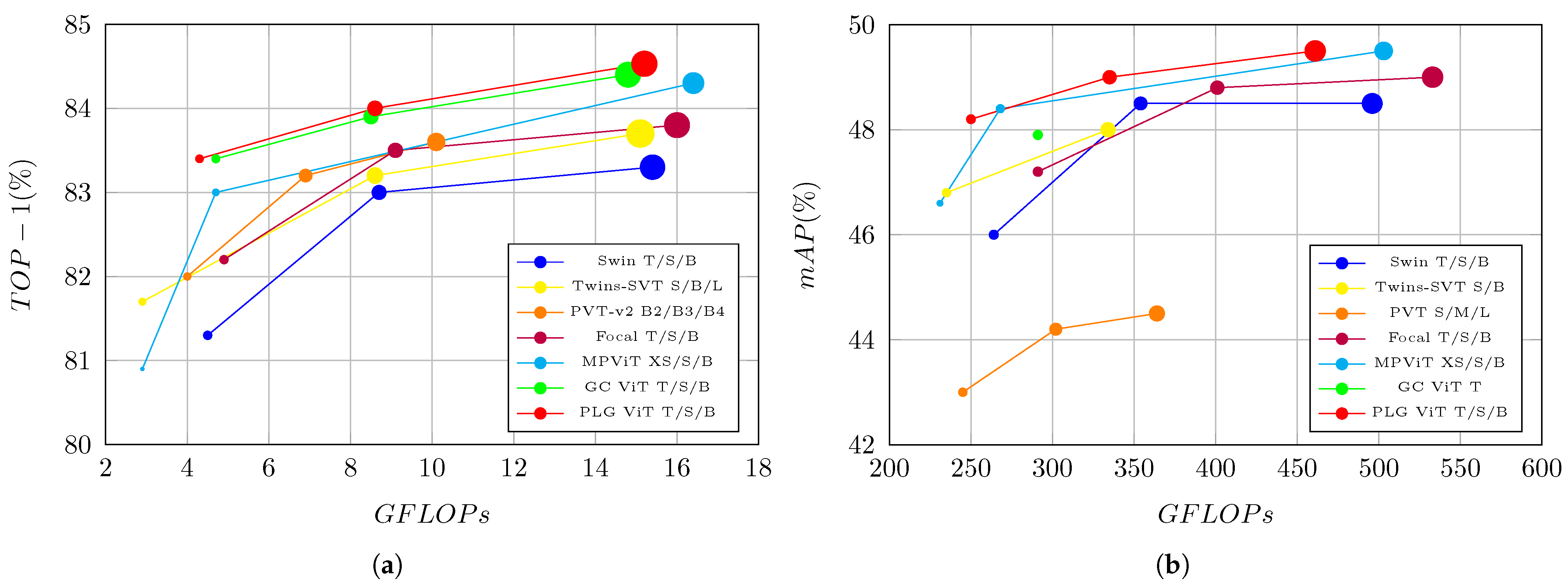
Thus, we propose our novel hierarchical Parallel Local-Global Vision Transformer (PLG-ViT), a general-purpose backbone that has a local as well as global receptive field beginning from its first stage, but without adding architectural complexity or computational costs. We achieve this with our efficient local-global self-attention mechanism with multiple receptive fields at each stage for the parallel processing of fine-grained local as well as coarse-grained global features. Furthermore, we present a light-weighted patch-sampling technique to generate representative global tokens of a fixed window-size and a novel convolution-based feed-forward network (CCF-FFN) for an extra inductive bias during the forward-path for each self-attention operation. Finally, a comprehensive evaluation is presented on various computer vision benchmarks to demonstrate the superior performance of our PLG-ViT (see Figure 1).
Figure 1. Comparison of PLG-ViT in terms of accuracy and efficiency with state-of-the-art methods [12,13,15,16,17,19,20] on the benchmarks ImageNet [21] and COCO [22]. Each method is represented by a circle whose diameter is proportional to the number of parameters. Our PLG-ViT outperforms comparable methods in terms of accuracy with similar numbers of FLOPs and parameters on both benchmarks. (a) Classification on ImageNet [21]. (b) Object Detection on COCO [22].

3. PLG-ViT Architecture

The hierarchical framework of the proposed PLG-ViT for obtaining multi-scale features is presented in Figure 2. The structure of the proposed method follows the model of established convolutional networks (CNNs) [1,2,3] and transformers [12,13,16,33]. We reduce the spatial resolution of the input and in return increase the depth of the features during propagation through the network. Furthermore, our work focuses on the parallel extraction of global and local features, which are subsequently fused together by our convolutional feed-forward network. Due to the different receptive fields, a wide variety of semantic and representative features are extracted for further processing.
Figure 2. Architecture of our PLG-ViT. Overlapping patches are generated by a CNN stem followed by 3 stages of our parallel local-global self-attention blocks. In the last stage, only local features are extracted. Between the individual stages, convolutional downsampling generates overlapping patches.
To obtain features with different spatial resolutions, we divide the model into five stages, with the last four stages consisting of transformer layers. At the first stage, overlapping patches of a given input-image with the resolution z R H × W × 3 are generated from a CNN stem inspired by GC ViT [17]. This CNN stem with a total stride of s = 4 projects the patches into a C-dimensional embedding space, generating the input of the first transformer-stage with a shape of z R H 4 × W 4 × C . This transformer stage consists of N 1 × proposed PLG blocks as shown in Figure 3a, which extract and merge local as well as global features in parallel. After each transformer stage, the spatial resolution of the output features is reduced and the channel size is increased by a factor of 2. Transformer stages 2 and 3 have an identical layout to stage 1. The final stage 4 performs only local self-attention due to the low spatial resolution of the features at this stage.
Figure 3. Model architecture of our PLG-SA block. The PLG-ViT block consists of the parallel local-global self-attention and the convolutional feed-forward network (CCF-FFN). The parallelism of window self-attention and global self-attention enables efficient as well as effective recognition of fine-grained local in addition to coarse-grained global features and interactions in the image.

3.1. Parallel Local-Global Self-Attention

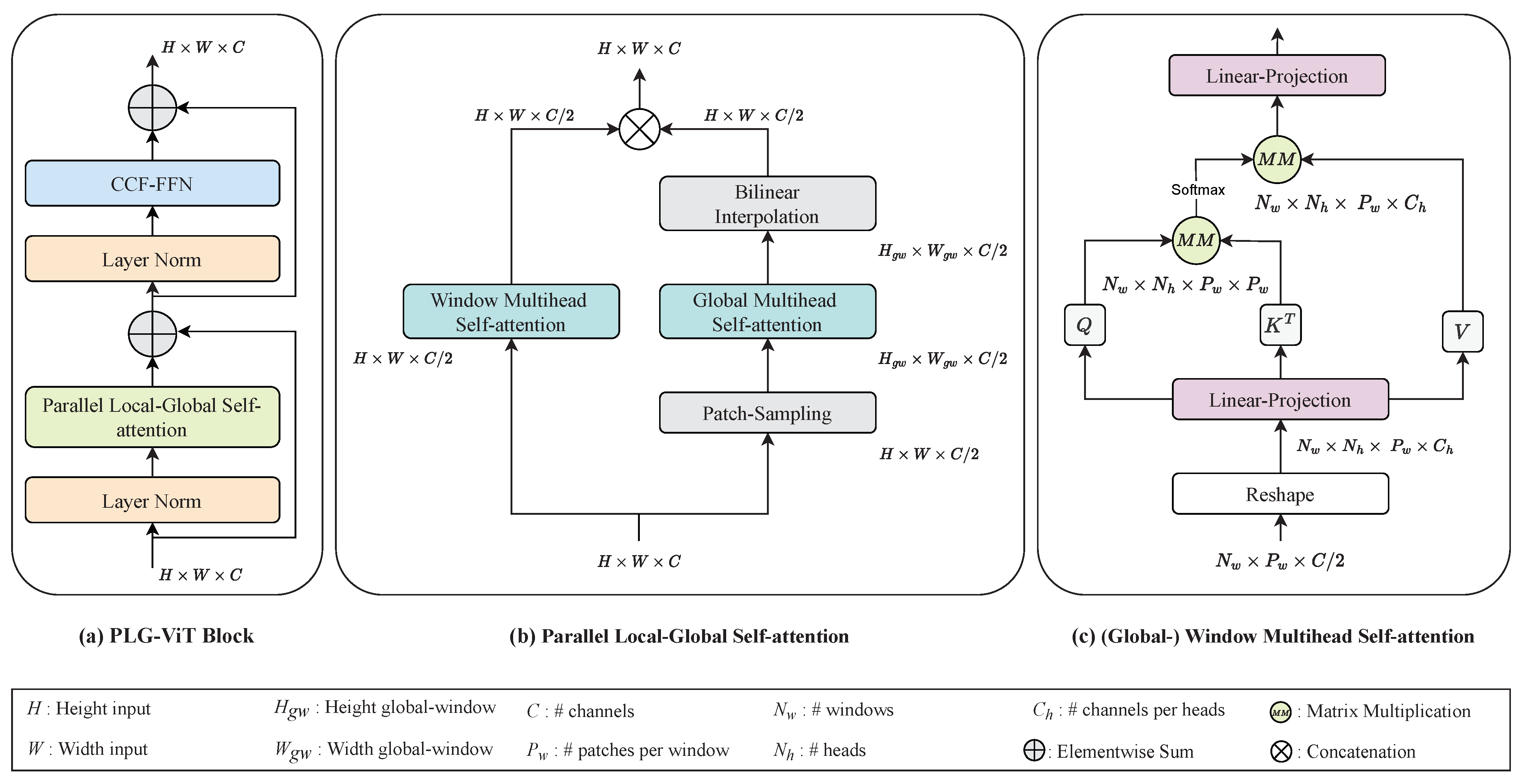
As mentioned earlier, PLG blocks for parallel local-global self-attention (PLG-SA) are the core element of our model and are presented in Figure 3a. The structure was inspired by the original transformer-encoder block [7,8], but we replaced standard multihead self-attention with a parallel local-global self-attention operation. This allows the global analysis of the image complemented by a local view. Furthermore, our CCF feed-forward network (CCF-FFN) replaces the linear MLP of the original transformer for further improvements in accuracy (see Section 4.4). Before self-attention and CCF-FFN, layer normalization [34] is performed. The i-th PLG block can be described by
z i * = PLG - SA ( LN ( z i 1 ) ) + z i 1 , z i = CCF - FFN ( LN ( z i * ) ) + z i * ,
where LN refers to layer normalization.
For efficient processing of local and global features, we perform parallel local and global self-attention (PLG-SA) as shown in Figure 3b. For this purpose, we assume that the input features of the PLG-SA have the shape z R H × W × C , where H and W indicate the spatial dimension of the features and C refers to the feature depth. In the first step of PLG-SA, we split the input z along the feature depth and generate the local features z l R H × W × C 2 and the global features z g R H × W × C 2 . By splitting the feature maps, the number of calculations is decreased, which reduces the model complexity in terms of FLOPs and parameters. In contrast to well-known approaches such as PVT [13], our self-attention mechanism has a linear complexity to the image resolution instead of a quadratic one. More details about the complexity in terms of image size can be found in Section 4.5.
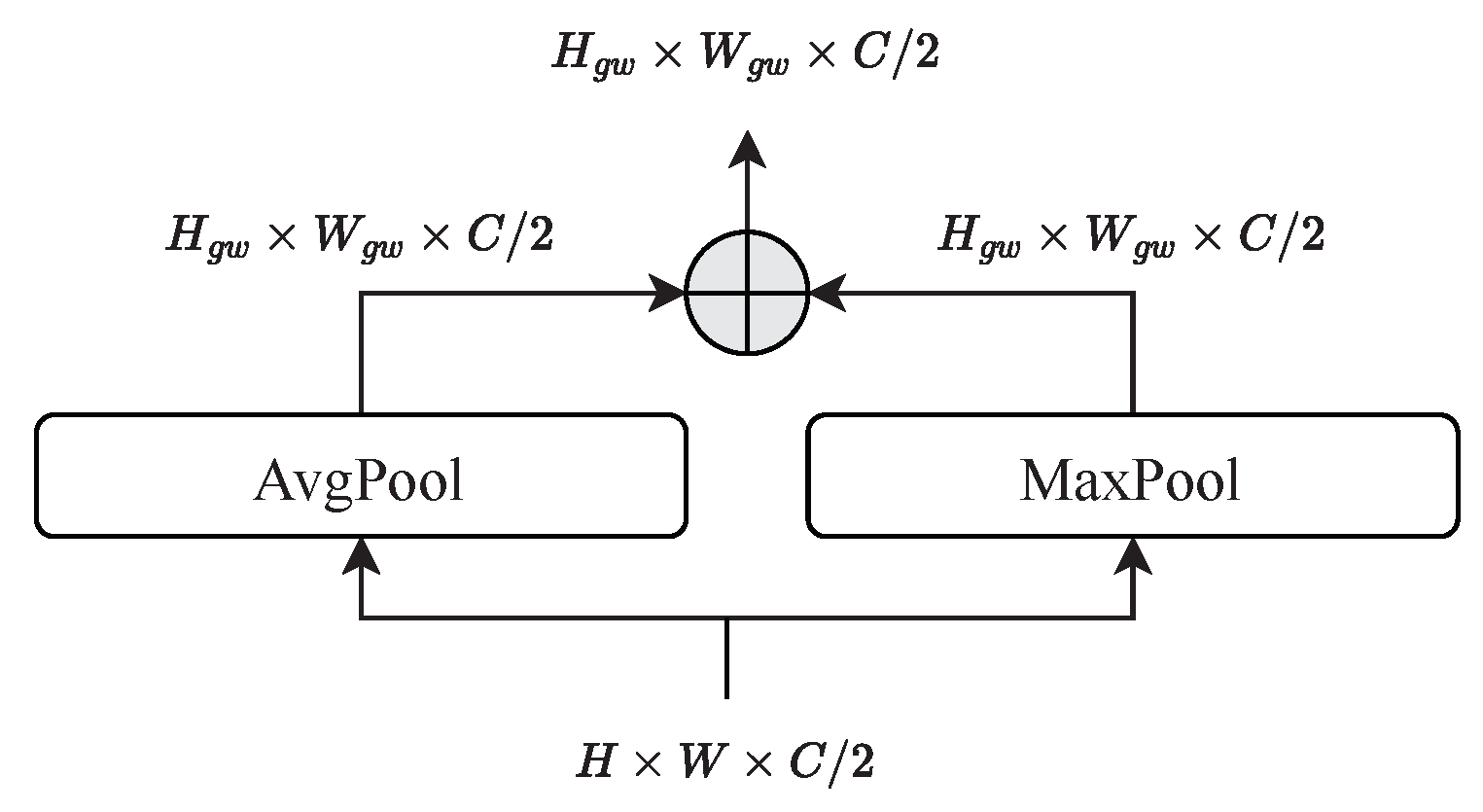
To create windows with a spatially limited receptive field for fine-grained features, we follow the window partitioning strategy of Swin Transformer [12]. This allows us to apply multihead self-attention to the local feature maps z l (see Figure 3c). For global self-attention, we first perform the patch-sampling operation illustrated in Figure 4. Patch-sampling performs adaptive max- and average-pooling to the global features z g and reduces the spatial resolution to z g * R H g w × W g w × C 2 , where ( H g w , W g w ) refers to the global window-size. Due to the combination of average- and max-pooling, which is inspired by attention blocks such as CBAM [35], we are able to extract a rich feature description of each image region. In effect, a single window with a global receptive field is created, to which multihead self-attention is subsequently applied. The self-attention for local and global self-attention are computed as
Attention ( q , k , v ) = Softmax ( q k T d + b ) v ,
where q , k , v are query, key, and value matrices; d is a scaling factor; and b is a trainable relative position bias term [36,37]. As shown in Section 4.4, a relative position bias b improves the accuracy, especially for downstream tasks such as object detection. After applying self-attention to z g * , a bilinear interpolation is performed to recover the original spatial resolution of z g . Finally, the local z l and global z g features are concatenated again to z * R H × W × C . Due to the fusion of local and global features, we are able to generate representative and highly semantic feature maps for later usage in different sparse and dense downstream tasks.
Figure 4. Patch-sampling to generate global windows. Patch-sampling consists of max- and average-pooling, which are added together at the end.

3.2. Additional Blocks

Inspired by MixFFN [11], we implement a convolution-based feed-forward network (FFN) that combines fully connected and convolutional layers. As shown in Section 4.4, an FFN with an inductive bias of convolutional layers enables the transformer to encode position and local information, further improving accuracy. Our CCF-FFN consists of a 1 × 1 point-wise convolution (PWConv) to expand the dimensions of the input z i n by the ratio of α = 4 followed by a 3 × 3 depth-wise convolution (DWConv). Finally, summation is performed with the inputs immediately after applying a last fully-connected layer (FC) to the features. The complete CCF-FFN is formulated as
z * = GeLU ( LN ( PWConv ( z i n ) ) ) , z * = GeLU ( LN ( DWConv 3 × 3 ( z * ) ) ) , z o u t = FC ( z * ) + z i n ,
where LN refers to layer normalization and GeLU refers to Gaussian error linear units [38]. For downsampling we use a modified version of Fused-MBConv [17,39]. The complete downsampling can be described by
z * = SE ( GeLU ( DWConv 3 × 3 ( z i n ) ) ) , z o u t = LN ( SConv 3 × 3 ( PWConv ( z * ) + z i n ) ) ,
where LN, GeLU, and SE denote layer normalization, Gaussian error linear units, and a squeeze and excitation block [40]. SConv 3 × 3 refers to a 3 × 3 convolutional layer with a stride of 2. For CNN-Stem, we add an additional strided 3 × 3 convolutional layer in front of the complete downsampling operation.

3.3. Architecture Variants

In this paper, we consider three network configurations: PLG-ViT Tiny, Small, and Base; these are similar to related methods [1,12,13,33]. The Tiny and Small versions are only 0.25 × and 0.5 × the size and computational complexity of PLG-ViT Base, respectively. We set the local and global window sizes to 7 and 14 by default. A more detailed analysis of the impact of the global window size can be found in Section 4.4. The dimension d of each head is 32 for Base and Tiny, and 24 channels for PLG-ViT Small. The expansion ratio of CCF-FFN is α = 4 for all experiments. The other hyperparameters of the three model variants are
  • Tiny: C = 64, layer numbers = {3, 4, 16, 4}, d = 32
  • Small: C = 96, layer numbers = {3, 3, 16, 3}, d = 24
  • Base: C = 128, layer numbers = {3, 3, 16, 3}, d = 32,
where C is the channel number of the hidden layers in the first transformer-stage, which doubles for each subsequent stage.

4. Evaluation

In the following evaluation, we demonstrate the usability of our network in general computer vision tasks. Therefore, we perform comprehensive experiments on the benchmarks ImageNet-1K [21] for image classification, COCO [22] for object detection and instance segmentation, and ADE20K [41] for semantic segmentation. Domains such as autonomous driving [42,43] and medical technology [44,45] are some of the most important areas for the application of computer vision tasks. For this reason we also investigate the effectiveness of our network in these domains using the two datasets BDD100K [46] and AGAR [45]. In the following, a comparison of our method with the state-of-the-art is conducted. Then, the individual network components are examined in the context of an ablation study. Visual examples of the individual tasks and more detailed explanations of the different training strategies are presented in Appendix C.

4.1. Image Classification

For the task of image classification we use ImageNet-1K [21], which consists of 1.28M images for training and 50K images for validation, including 1000 classes. The classification task is solved by combining global average pooling of the output features of the last transformer-stage with a subsequent linear classifier. For evaluation of the Top-1 accuracy, we report the results on a single crop and use an identical configuration to Swin Transformer [12]. To allow a fair comparison, we have only listed methods of similar size and complexity. There are various approaches [31,47,48] that achieve significantly higher accuracy using more parameters, more FLOPs, additional data, and pre-training strategies. However, these methods are not considered in the following evaluation.
We report our results on ImageNet-1K validation in Table 1 after training for 300 epochs. As can be seen, our PLG-ViT achieves significant improvements on Top-1 accuracy with a similar number of parameters and model complexity (FLOPs). We are able to outperform established state-of-the-art methods like Pyramid Vision Transformer (PVT) v1/v2 [13,19], Swin Transformer [12], and Focal Transformer [15] at all three scales. Specifically, PLG-ViT outperforms its Swin counterparts by +2.1, +0.7, and +1.0 Top-1 accuracy for Tiny, Small, and Base model configurations, respectively. GC ViT [17] and our model are on par in terms of Top-1 accuracy. However, we will show later that we are able to outperform GC ViT in the tasks of object detection (see Section 4.2) and semantic segmentation (see Section 4.3). Our PLG-ViT also surpasses SoTA-CNNs (e.g., ConvNeXt [9]). For the Tiny version of our network, we have also listed the results for a smaller window size of 7 instead of 14. Even in this case, our network shows competitive results. A comparison of image classification Top-1 accuracy in terms of model complexity (i.e., FLOPs) and number of parameters is visualized in Figure 1a.
Table 1. Comparison of Top-1 image classification accuracy on the ImageNet-1K [21] validation set. Params refers to the number of parameters in millions and GFLOPs are calculated at a resolution of 224 2 . Our networks are highlighted in gray. 7 refers to a global window of size 7 2 . All values are taken from the official publications.

4.2. Object Detection and Instance Segmentation

For training and evaluation of object detection and instance segmentation, we utilize mainly the COCO [22] dataset, which contains 118K training and 5K validation images of everyday objects from 80 classes. Our pre-trained models are used as backbones for the typical frameworks of Faster RCNN [55] and RetinaNet [33] for pure object detection, and Mask RCNN [56] for instance segmentation. Like most competing methods [12,16,17,33], we follow the two standard schedules, a 1 × schedule with 12 epochs and single-scale inputs and a 3 × schedule with 36 epochs and multi-scale inputs. The implementation of all methods is based on the MMDetection Framework [57].
In Table 2 we report the results in terms of mAP for bounding boxes (APbox) and segmentation masks (APmask) of our PLG-ViT Mask RCNN model with a 3 × training schedule and multi-scale training. It can be seen that our transformer is able to outperform all CNN-based methods by 2.0 up to 6.2 APbox and 1.2 to 5.0 APmask. The network also performs very well in comparison with the other vision transformers. PLG-ViT outperforms its Swin Transformer [12] counterparts from 0.5/0.2 to 2.0/1.3 APbox/APmask at comparable settings. Even though GC ViT-T [17] and our PLG ViT-T are on par in terms of image classification accuracy, our model is able to outperform it by 0.3 APbox for object detection. In terms of the accuracy of instance segmentation (APmask), our method is outperformed by MPViT. However, a comparison of APbox in terms of model complexity (i.e., FLOPs) and number of parameters is visualized in Figure 1b. Our method demonstrates the best tradeoff in terms of complexity to accuracy, even compared to MPViT.
Table 2. COCO [22] instance segmentation results with Mask RCNN [56]. All models were trained with a 3 × schedule and multi-scale inputs. GFLOPs were calculated with image size (1280, 800). Our networks are highlighted in gray. All values are taken from the official publications.
To prove the universal applicability of our network, we investigated the performance for object detection in different domains with diverse characteristics. For this purpose, training of our PLG-ViT Tiny as the backbone of RetinaNet [33] and Faster RCNN [55] on the three datasets COCO [22], BDD100K [46], and AGAR [45] took place. BDD10K shows daily road scenarios and contains 70K images for training and 10K images for validation. In comparison, the AGAR dataset from the field of medical technology shows high-resolution images of five different bacterial colonies that grew on a culture medium of agar plates and contains approximately 5K training as well as 2K validation images. Single-scale training was performed for 12 epochs with the described settings of a 1 × scheduler. We compared the performance of our model with the CNN-based ResNet50 [1] and ConvNeXt-T [9], as well as the transformer backbones Swin-T [12] and PVTv2-b2 [19].
The results of this domain analysis can be found in Table 3. We report the APbox for different IoU thresholds and object sizes. It can be clearly seen that our network performs better in the relevant metric of the AP than the comparative methods with a comparable number of parameters and model complexity, regardless of the detector used.
Table 3. Object detection results for 3 vision benchmarks [22,45,46] from diverse domains. Comparison of our PLG-ViT-T with Swin-T [12], PVTv2-b2 [19], ConvNeXt-t [9], and ResNet50 [1] using Faster RCNN [55] and RetinaNet [33]. FLOPs were calculated with image size (1280, 800). All models were trained with a single-scale input and 1 × scheduler and the best results are highlighted in bold. All values are based on reproduced results.
These experiments demonstrate the efficiency of our network in terms of high resolution input images. Especially in the field of medical data, as the example of the AGAR dataset shows, low complexity and fewer parameters are a big advantage, because the images have a particularly high resolution in order to represent even the smallest objects. To ensure the applicability of the network even without expensive high-end GPUs, it is important to consider the complexity in terms of FLOPs and the number of parameters in the design of the network. In Section 4.5, we discuss the relationship between resolution and network complexity in more detail.

4.3. Semantic Segmentation

For benchmarking our results for semantic segmentation we used the ADE20K [41] dataset, which contains 20K images for training and 2K images for validation from 150 classes. We employed our pre-trained model as the backbone and utilized UPerNet [58] in MMSegmentation [59] as the framework of choice. For fair comparison, all settings were identical to Swin [12].
The training results after 160K iterations are reported in Table 4 for single- and multi-scale evaluation. PLG-ViT is able to outperform Swin Transformer [12] counterparts by 1.9, 0.4, and 1.8 mIoU for Tiny, Small, and Base models, respectively. For the Tiny and Small model sizes, we slightly lag behind competing approaches [9,17,18,20] in terms of mIoU. However, our Base model is able to outperform most competing methods of the same complexity by a margin up to 1.8 and 1.0 mIoU for single- and multi-scale testing, respectively. Only MPViT [20] achieves slightly better results (+0.4 mIoU) for single-scale testing.
Table 4. Validation results for semantic segmentation with UPerNet [58] on the ADE20K val-set [41]. GFLOPS were calculated using images of size (2048, 512). The last two columns show single- and multi-scale (ms) evaluations of the mIoU. Our networks are highlighted in gray. All values are taken from the official publications.

4.4. Ablation Study

In this section, we ablate the most important design elements and modules of the proposed PLG-ViT. We use ImageNet-1K [21] for image classification and COCO [22] instance segmentation utilizing Mask RCNN [56] with a 1 × scheduler and multi-scale training. Ablation on the effectiveness of several components is reported in Table 5.
Table 5. Ablation study on the effectiveness of the components in PLG-ViT on the tasks of classification, detection, and instance segmentation. Mask RCNN [56] with a 1 × scheduler and ms-training was used for evaluation on COCO [22]. w/o PLG-SA: only local window self-attention; w/o CCF-FFN: replace CCF-FFN with linear MLP; w/o Conv-PE: remove overlapping patch-embedding and convolutional downsampling; Swin Config: use standard config of Swin [12]; w/o rel. pos.: remove relative position bias term; w/o ch. split: PLG-SA without previous splitting along the channels.
PLG-SA. First, we investigated the network performance without our novel parallel local-global self-attention, which is described in Section 3.1. A slight decrease in accuracy on ImageNet (−0.2 Top-1) and COCO (−0.2 APbox and −0.1 APmask) can be seen, with an increase in computational complexity of about 15%. Due to the use of convolutional layers within the model, a communication of all pixels can be performed even with static non-overlapping windows during self-attention.
CCF-FFN. Then, the effect of our novel CCF-FFN (see Section 3.2) was investigated. We observed that the inductive bias of the convolutional operations that are applied in the feed-forward network (FFN) is crucial for the performance on ImageNet and COCO. With the CCF-FFN we gained +0.8 Top-1 accuracy on ImageNet and +2.5 APbox/+1.2 APmask on the COCO benchmark.
Convolutional patch-embedding (Conv-PE). We further investigated the impact of the convolutional and overlapping patch-embedding and downsampling (see Section 3.2). As reported in Table 5, there is a slight decrease of −0.1 in ImageNet Top-1 accuracy. However, a −0.5 decrease in APmask and APbox is noticeable. This indicates that convolutional downsampling is important for complex downstream tasks such as detection and segmentation.
Network Configuration. First, we picked the network parameters following the example of Swin Transformer [12]. For example, we chose a layer depth of [2,2,6,2] and an initial channel size of 96 for PLG-ViT Tiny. Through a series of experiments, we adjusted the layer depth to [3,4,16,4] and the initial channel size to 64m, as described in Section 3.3. The training results for ImageNet and COCO following the original Swin Transformer network configuration are listed in Table 5. A slight decrease in Top-1 accuracy of −0.4 and a broad decrease of −1.6 APbox on COCO are reported.
Relative position bias. Next, we investigated the necessity of the relative position bias term [36,37] (see Section 3.1) in respect of the training results. This term encodes the relative position of the tokens among each other. As the training results show, the relative position bias does not have a large impact on the accuracy of our network. This is in contrast to Swin Transformer, where the accuracy strongly depends on the position bias. The consistent performance of our network without this term can be attributed to the convolutional operations in patch-embedding, which already perform implicit spatial encoding of the individual feature points. Even though the bias hardly contributes to the classification accuracy, it has an effect on the mAP of the object detection, which drops by −0.6.
Feature-splitting. We explored the impact of splitting features along channels before our novel parallel local-global self-attention Section 3.1. This is done primarily to save weights and complexity. As can be seen in Table 5, the network has 34% more parameters and 56% more FLOPs if the full number of channels is used for both local and global self-attention. This additional offset in terms of network complexity cannot be justified by the achieved accuracy values.
Global attention window. In Table 6, we present the impacts of the global window size and the downsampling method during patch sampling for global self-attention. First, we set the height H g w and the width W g w of the global-attention window to ( H g w , W g w ) M × M with M = { 7 , 10 , 14 , 18 } and we report the ImageNet-1K Top-1 and Top-5 accuracy. The results reported in Table 6 show that with increase in the global window size, the model complexity in terms of FLOPS also increases. Furthermore, we observed a peak in accuracy when applying a window size of 14. Considering the moderate complexity in combination with the best Top-1 accuracy of 83.4, 14 was chosen as the general window size. In addition to evaluating the global window size, we also trained a model without global self-attention. Instead, we replaced self-attention with a pyramid-pooling module along the lines of PSPNet [60] and achieved a slightly lower accuracy (−0.3 Top-1) by using simple pooling operations.
Table 6. Ablation study of global self-attention on ImageNet-1K [21]. In the first part, the influence of the global window size was determined. PPM refers to the pyramid-pooling module [60], which replaced our global self-attention in this case. In the second part, the impact of pooling on patch-sampling was determined.
Patch-sampling. In addition to examining the global window size, we also investigated the use of different pooling operations during patch sampling. For this purpose, we considered simple max-pooling, average-pooling, and the sum of both. The results are also listed in Table 6 and show that the combination of both achieves the best ImageNet Top-1 accuracy.

4.5. Computation Overhead Analysis

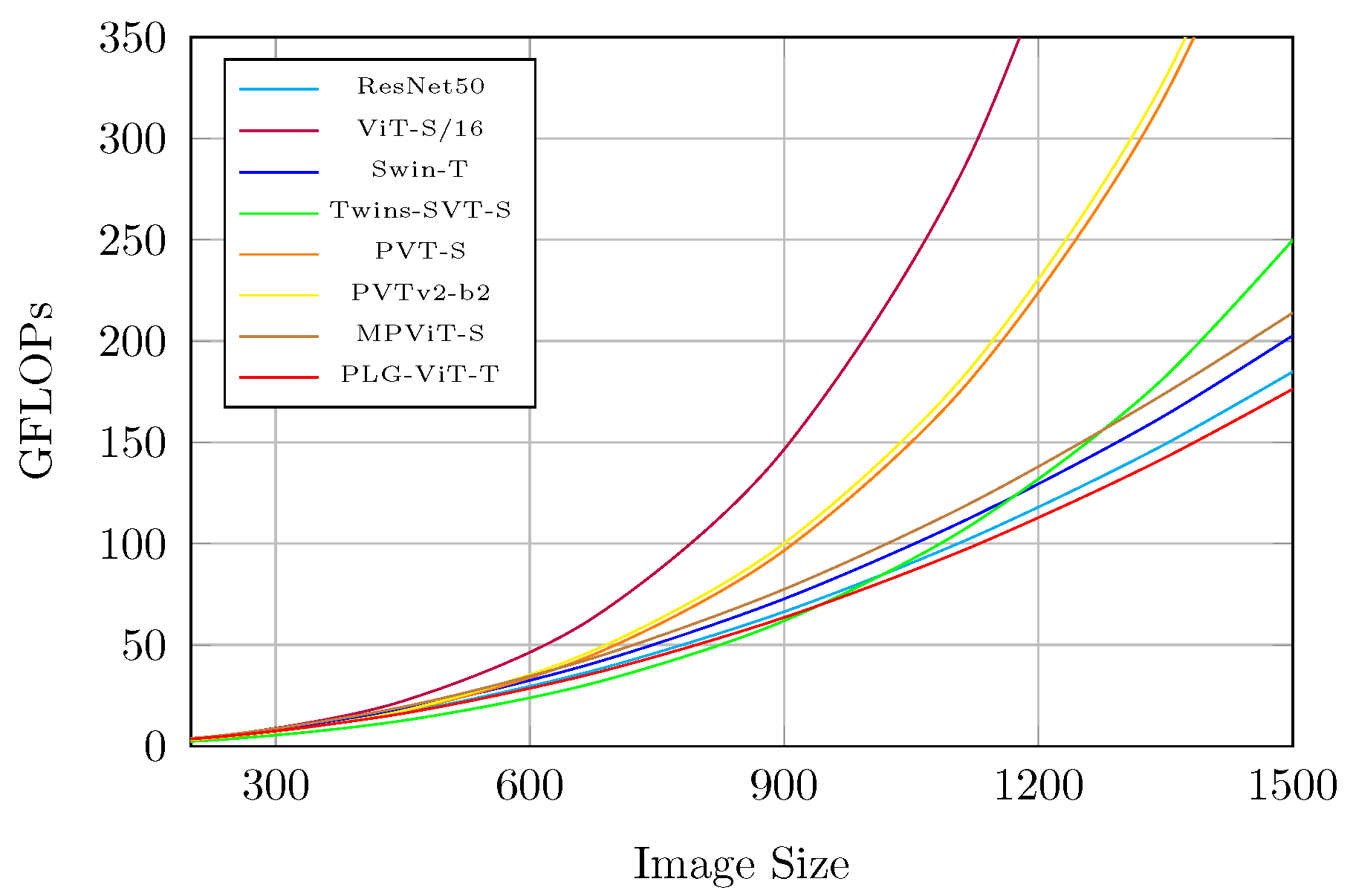
Figure 5 illustrates the growth rate of the overall model complexity (GFLOPs) with increasing input size for several different models, including PLG-ViT Tiny, PVTv2-b2 [19], PVT-S [13], MPViT-S [20], Twins-SVT-S [16], ViT-S/16 [14], ResNet50 [1], and Swin-T [12]. The figure shows that as the input size increases, the growth rate of GFLOPs for PLG-ViT Tiny is much lower compared to PVT, Twins, and ViT, and is similar to that of ResNet50 and Swin. In particular, the standard self-attention of ViT and PVT shows a quadratic increase in complexity with respect to the resolution. The overall complexity of our network is much better compared to the other methods, especially for large image sizes, as shown in Figure 5. The runtime of our PLG-ViT depends on the network size and the hardware used. We achieved a maximum throughput of 352/213/160 frames per second for PLG-ViT Tiny, Small, and Base on a single NVIDIA RTX3060 GPU, respectively. These results suggest that our PLG-ViT is able to address the high computational overhead problem that arises due to the quadratic complexity increase of attention layers in “classical” ViT models.
Figure 5. Complexity evaluation (GFLOPs) under different input sizes. The growth rate of GFLOPs: ViT-S/16 [14] > PVTv2-b2 [19] > PVT-S [13] > Twins-SVT-S [16] > MPViT-S [20] > Swin-T [12] > ResNet50 [1] > PLG-ViT-T (ours). All values are based on reproduced results.

4.6. Interpretability

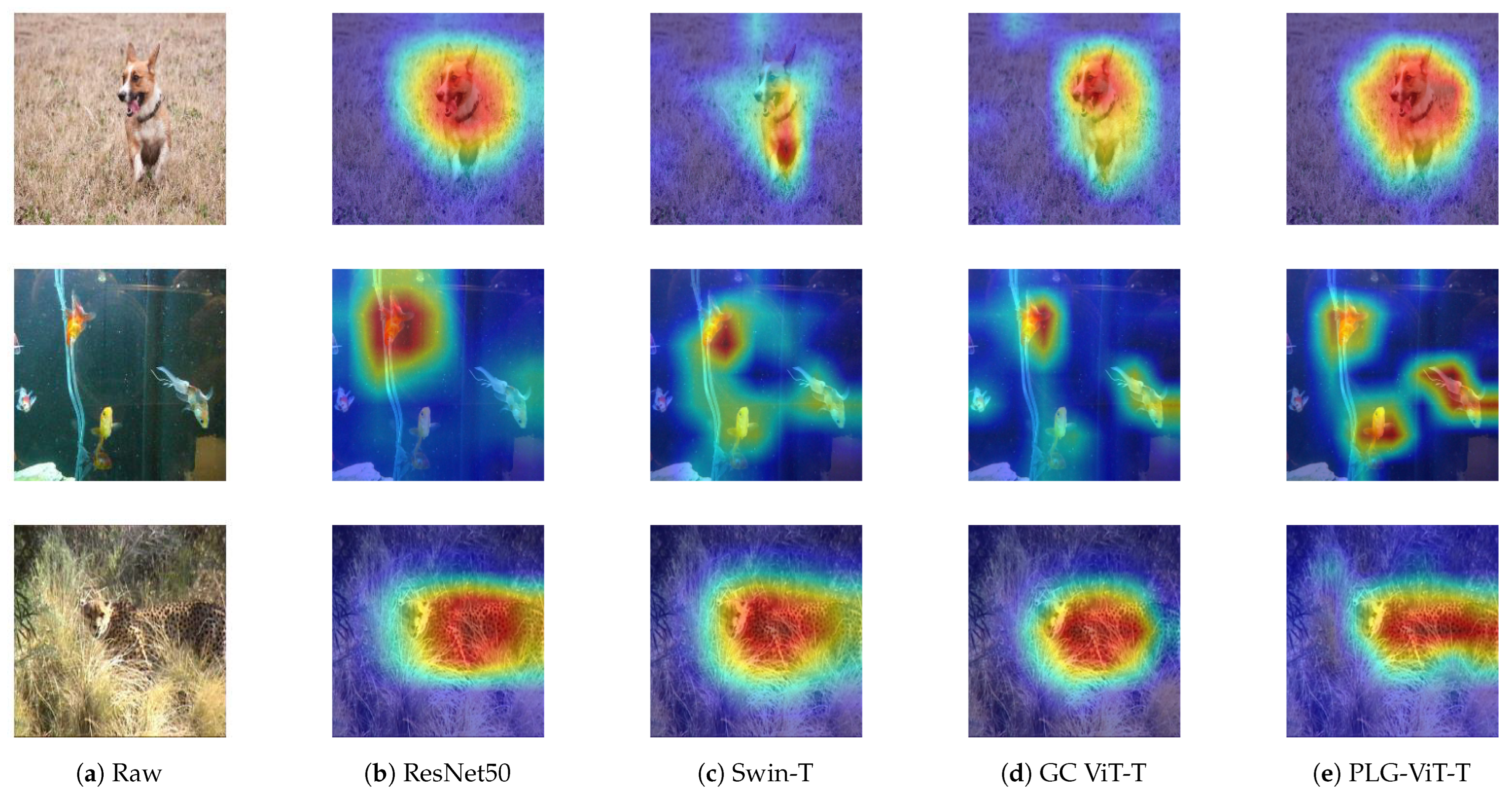
We used GradCAM [61] for the visualization of the final features. It generates heatmaps of an input image that highlight the regions of the image that are most important for the prediction. Figure 6 shows ImageNet-1K [21] val images and the final activation of ResNet50 [1], Swin-T [12], GC ViT-T [17], and our PLG-ViT-T. The GradCAM maps demonstrate the accurate object localization of our proposed method with the most intricate details. In particular, if multiple objects of the same class are present in the image, they are considered equally in the final prediction.
Figure 6. Visualization of the final activation with Grad-CAM [61]. (a): Input image; (bd): SoTA [1,12,17]; (e) our network.

5. Conclusions

In this paper, we presented our Parallel Local-Global Vision Transformer (PLG-ViT) as a general-purpose backbone for image classification and dense downstream tasks. The core of our network is the eponymous parallel local-global self-attention, which separately extracts both local and global features and then fuses them to generate semantic representative features. We developed an effective feed-forward network, our CCF-FFN, which can further increase the effectiveness of our transformer encoder. In addition, due to the splitting of channels for the parallel local and global multihead self-attention, significant savings can be made in terms of the number of parameters and model complexity (e.g., FLOPs). Our Vision Transformer achieves state-of-the-art performance on COCO [22] object detection and ADE20K [41] semantic segmentation and outperforms most comparable networks. Furthermore, we also demonstrated the effectiveness of our network for use in diverse computer vision domains, such as autonomous driving [46], medical technology [45], and everyday situations [22,41].

Author Contributions

Conceptualization, N.E. and O.W.; methodology, N.E. and O.W.; software, N.E.; validation, N.E.; formal analysis, N.E.; investigation, N.E.; resources, N.E. and O.W.; data curation, N.E.; writing—original draft preparation, N.E. and O.W.; writing—review and editing, N.E., O.W. and D.S.; visualization, N.E.; supervision, O.W. and D.S.; project administration, N.E. and O.W.; funding acquisition, N.E. and O.W. All authors have read and agreed to the published version of the manuscript.

Funding

This research was partly funded by the Albert and Anneliese Konanz Foundation, the Federal Ministry of Education, and Research Germany in the project M2Aind-DeepLearning (13FH8I08IA), and the German Research Foundation under grant INST874/9-1.

Institutional Review Board Statement

Not applicable.

Data Availability Statement

Restrictions apply to the availability of these data. ImageNet data were obtained from [21] and are available at https://www.image-net.org/index.php (accessed on 8 February 2023). COCO data were obtained from [22] and are available at https://cocodataset.org/ (accessed on 8 February 2023). ADE20k data were obtained from [41] and are available at https://groups.csail.mit.edu/vision/datasets/ADE20K/ (accessed on 8 February 2023). AGAR data were obtained from [45] and are available at https://agar.neurosys.com/ (accessed on 8 February 2023). BDD100k data were obtained from [46] and are available at https://bdd-data.berkeley.edu/ (accessed on 8 February 2023).

Conflicts of Interest

The authors declare no conflict of interest.

Appendix A. Detailed Architectures

We explained the configuration of our PLG-ViT in Section 3.3. This chapter only serves to describe it in more detail with the help of Table A1. Similar to comparable methods [12,13,33], we consider three network configurations. These three proposed models are PLG-ViT Tiny, Small, and Base, as shown in Table A1. Furthermore, the Tiny and Small versions are only 0.25 × and 0.5 × the size and computational complexity of PLG-ViT Base. In the table, we list all four transformer stages and the CNN stem as stage 0, at the beginning. With the CNN stem, we reduced the spatial dimension of the input image by a stride of s = 4 and increased the channel size to c 1 to { 64 , 96 , 128 } for Tiny, Small, and Base, respectively. For stages 1 , 2 , and 3, we specify in the table the parameters for local-window (lwsa) and global-window self-attention (gwsa). The first number in each curly bracket indicates the window size. As can be seen, we set the local and global window sizes to 7 and 14, respectively. A more detailed analysis of the impact of the global window size can be found in the ablation study (see Section 4.4). The second number in the brackets refers to the number of heads. We set the dimension d of each head to 32 for Base and Tiny, and to 24 channels for PLG-ViT Small. The expansion ratio of CCF-FFN was α = 4 for all experiments. Furthermore, the number of repetitions of each transformer layer can be seen behind each square bracket. Downsampling takes place after each transformer stage. The spatial resolution is reduced by 2 and the number of features is increased by 2. The fourth and final transformer stage is different from the first three. Here, due to the low resolution of the features, only a local window is generated, which in the case of an input resolution of 224 2 is equivalent to a global window. The choice of hyperparameters is supported by the evaluation presented in Section 4.4.
Table A1. Model configurations for our PLG-ViT. There are three configurations introduced: PLG-ViT Tiny, PLG-ViT Small, and PLG-ViT Base, with different model capacities.
Output SizeLayer NamePLG-ViT TinyPLG-ViT SmallPLG-ViT Base
Stage 0 56 × 56 CNN-Stem s t r i d e = 4 ; c 1 = 64 s t r i d e = 4 ; c 1 = 96 s t r i d e = 4 ; c 1 = 128
Stage 1 56 × 56 PLG-Block[ l w s a = { 7 , 1 } ] × 3 [ l w s a = { 7 , 2 } ] × 3 [ l w s a = { 7 , 2 } ] × 3
g w s a = { 14 , 1 } g w s a = { 14 , 2 } g w s a = { 14 , 2 }
Stage 2 28 × 28 CNN-Down s t r i d e = 2 ; c 2 = 128 s t r i d e = 2 ; c 2 = 192 s t r i d e = 2 ; c 2 = 256
PLG-Block[ l w s a = { 7 , 2 } ] × 4 [ l w s a = { 7 , 4 } ] × 3 [ l w s a = { 7 , 4 } ] × 3
g w s a = { 14 , 2 } g w s a = { 14 , 4 } g w s a = { 14 , 4 }
Stage 3 14 × 14 CNN-Down s t r i d e = 2 ; c 3 = 256 s t r i d e = 2 ; c 3 = 384 s t r i d e = 2 ; c 3 = 512
PLG-Block[ l w s a = { 7 , 4 } ] × 16 [ l w s a = { 7 , 8 } ] × 16 [ l w s a = { 7 , 8 } ] × 16
g w s a = { 14 , 4 } g w s a = { 14 , 8 } g w s a = { 14 , 8 }
Stage 4 7 × 7 CNN-Down s t r i d e = 2 ; c 4 = 512 s t r i d e = 2 ; c 4 = 768 s t r i d e = 2 ; c 4 = 1024
PLG-Block[ l w s a = { 7 , 16 } ] × 4 [ l w s a = { 7 , 24 } ] × 3 [ l w s a = { 7 , 32 } ] × 3

Appendix B. Detailed Experimental Settings

We performed comprehensive experiments on the benchmarks ImageNet-1K [21] for image classification, COCO [22] for object detection and instance segmentation, and ADE20K [41] for semantic segmentation. Furthermore, we also investigated the effectiveness of our network in different application domains using the two datasets BDD100k [46] and AGAR [45]. In the following, we explain the different training strategies in more detail.

Appendix B.1. Image Classification on ImageNet-1K

For the task of image classification (see Section 4.1) we used ImageNet-1K [21], which consists of 1.28M images for training and 50K images for validation from 1000 classes. The classification task is solved by a combination of global average pooling of the output features of the last transformer stage and a subsequent linear classifier. For evaluation of the Top-1 accuracy, we report the results for a single crop.
Our training mostly follows DeIT [14] and Swin Transformer [12]. For all models, the input resolution of 224 2 is used. During the training, we use the AdamW optimizer [62] with a momentum of 0.9 and a total batch-size of 1024 with a basic learning rate of 1 × 10 3 . For a fair comparison with most competing methods [12,14,15,16,17,18,52], we also train for only 300 epochs. Gradient clipping with a max norm of 1 and a weight decay of 0.05 are used. Furthermore, we employ a cosine decay learning rate scheduler with 20 epochs of linear warm-up to decrease the learning rate to 1 × 10 7 during the 300 epochs of training. To avoid overfitting, we mostly follow DeIT’s [14] augmentation strategy. This includes RandAugment [63], Cutmix [64], Mixup [65], random erasing [66], and stochastic depth [67]. The degree of stochastic depth augmentation is increased for larger models, i.e., 0.2 , 0.3 , 0.5 for Tiny, Small, and Base, respectively. Due to the fact that the ineffectiveness has already been demonstrated in other work [12], we omit repeated augmentation [68] and exponential moving average (EMA) [69]. All training was performed on eight NVIDIA A100 GPUs and required between 38 and 72 h, depending on the network size (similar to Swin Transformer). The results can be found in Table 1.

Appendix B.2. Object Detection and Instance Segmentation

For training and evaluation of object detection and instance segmentation as described in Section 4.2, we employ mainly the COCO [22] dataset, which contains 118K training and 5K validation images of everyday objects from 80 classes. Our pre-trained models are used as the backbone for the typical frameworks of Faster RCNN [55] and RetinaNet [33] for pure object detection, and Mask RCNN [56] for instance segmentation.
Like most competing methods [12,16,17,33], we also follow the two standard schedules, a 1 × schedule with 12 and a 3 × schedule with 36 training epochs. For the 1 × schedule we resize the shorter side of the image to 800 and keep the longer side to a maximum of 1333. For the 3 × schedule we perform multi-scale training and vary the shorter side between 480 and 800, and keep the longer side almost to 1333. We use AdamW [23] as the optimizer with a total batch size of 16 and an initial learning rate of 1 × 10 4 with a weight decay of 0.05 . The implementation of all methods is based on the MMDetection Framework [57]. All training was performed on four NVIDIA A100 GPUs. The results can be found in Table 2.
To investigate the network performance for object detection in different domains with different characteristics (see Section 4.2), we trained our PLG-ViT-T as the backbone of RetinaNet and Faster RCNN on the three dataset COCO, BDD100K [46], and AGAR [45]. The BDD100K dataset shows multiple scenarios from autonomous driving and contains 70K images for training and 10K images for validation from 10 classes. Furthermore, the AGAR dataset from the field of medical technology was used for additional evaluation. This dataset contains high-resolution images of five different kinds of bacteria that were grown on a culture medium of agar plates. AGAR contains approximately 5K training and 2K validation images. In the context of this experiment, we performed single-scale training of 12 epochs with the described settings of the 1 × scheduler. Only the resolution of the images differed. For BDD10K, we set the size of the images between 1280 and 720 and for AGAR we limited the longest side to 1536 pixels. All training was performed on two NVIDIA A100 GPUs. The results can be found in Table 3.

Appendix B.3. Semantic Segmentation on ADE20K

For benchmarking our results of semantic segmentation (see Section 4.3), we used the ADE20K [41] dataset, which contains 20K images for training and 2K images for validation from 150 classes. We employed our pre-trained model as the backbone and utilized UPerNet [58] in MMSegmentation [59] as our framework. We trained the networks for 160K iterations with an input size of 512 × 512 and a total batch size of 16. The AdamW optimizer was used with an initial learning rate of 6 × 10 5 , a weight decay of 0.01, and a polynomial decay scheduler with a linear warmup of 1500 iterations. Further, the default settings of MMSegmentation were used for augmentation. These are random horizontal flipping, random rescaling within ratio range [0.5, 2.0], and random photometric distortion. In addition, we used stochastic depth with a ratio of 0.2 for all our models. All training was performed on two NVIDIA A100 GPUs. The results can be found in Table 4.

Appendix C. Visual Examples

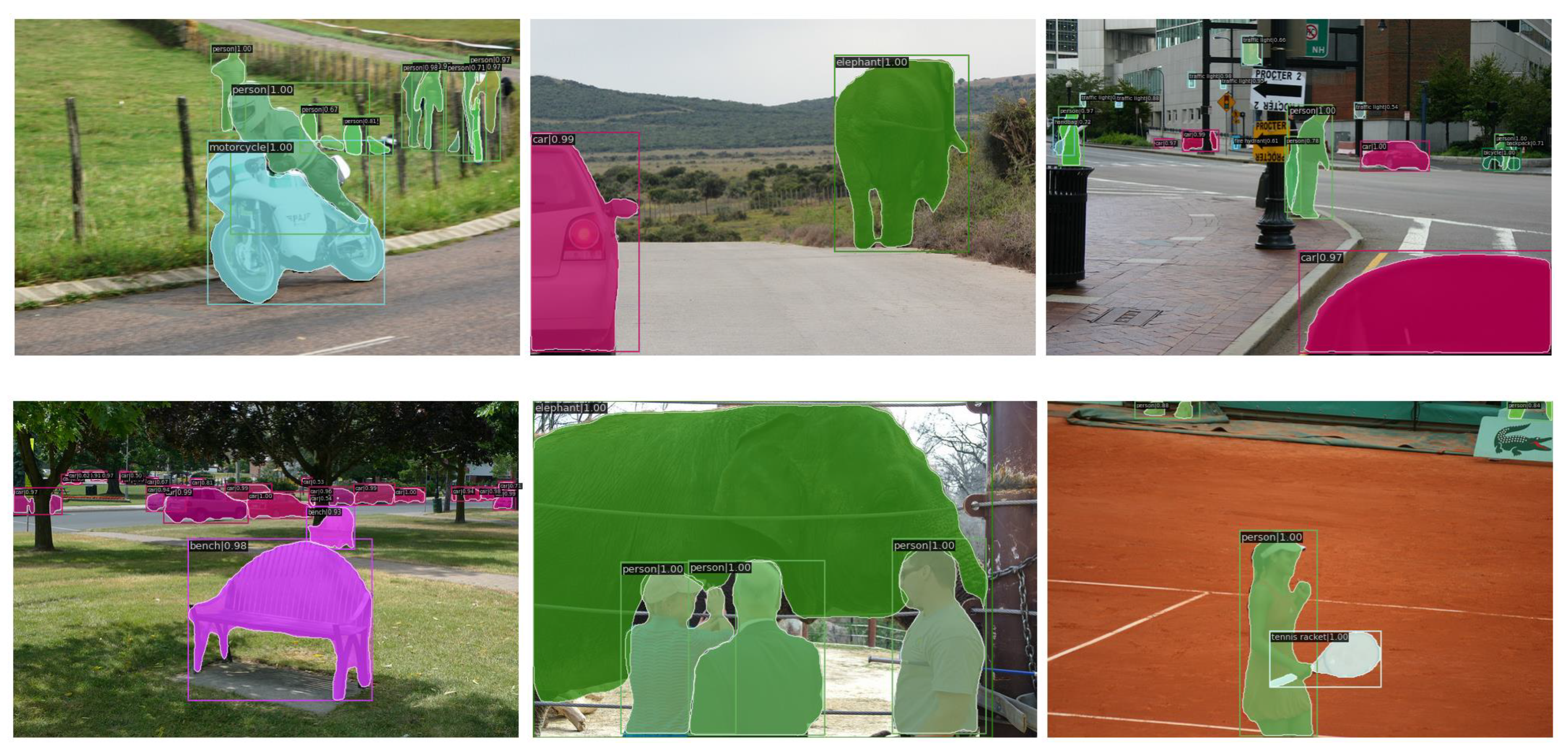
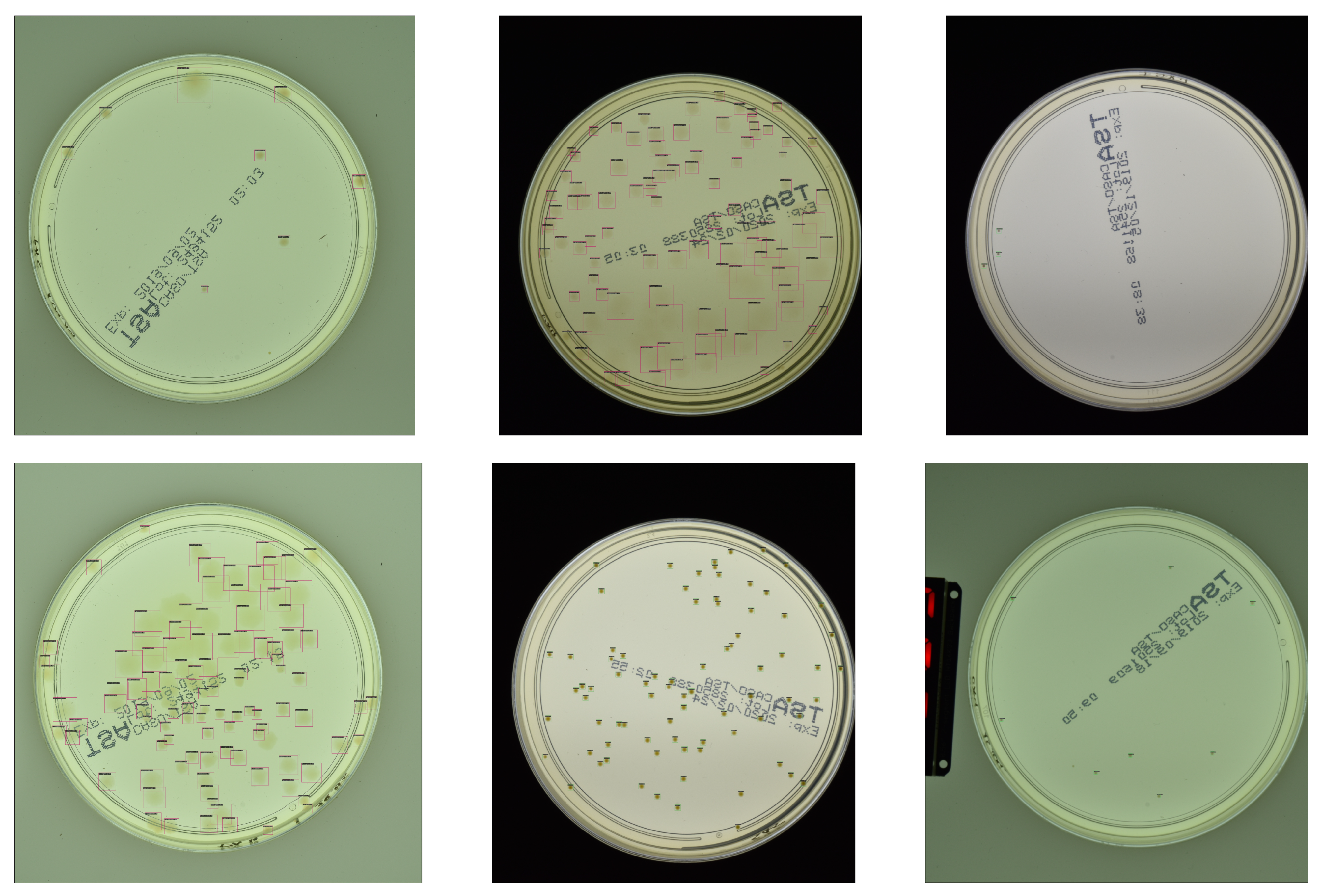
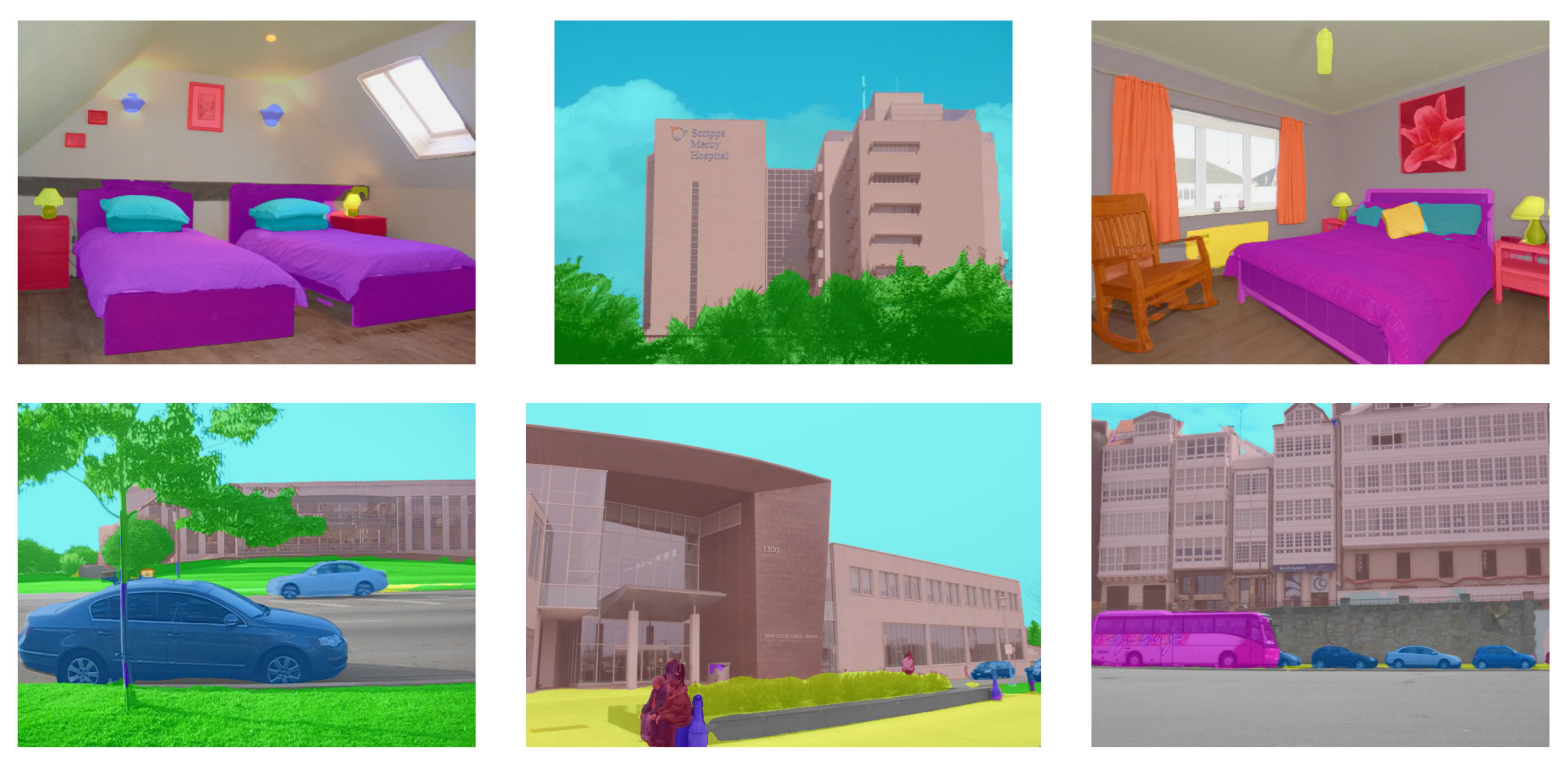
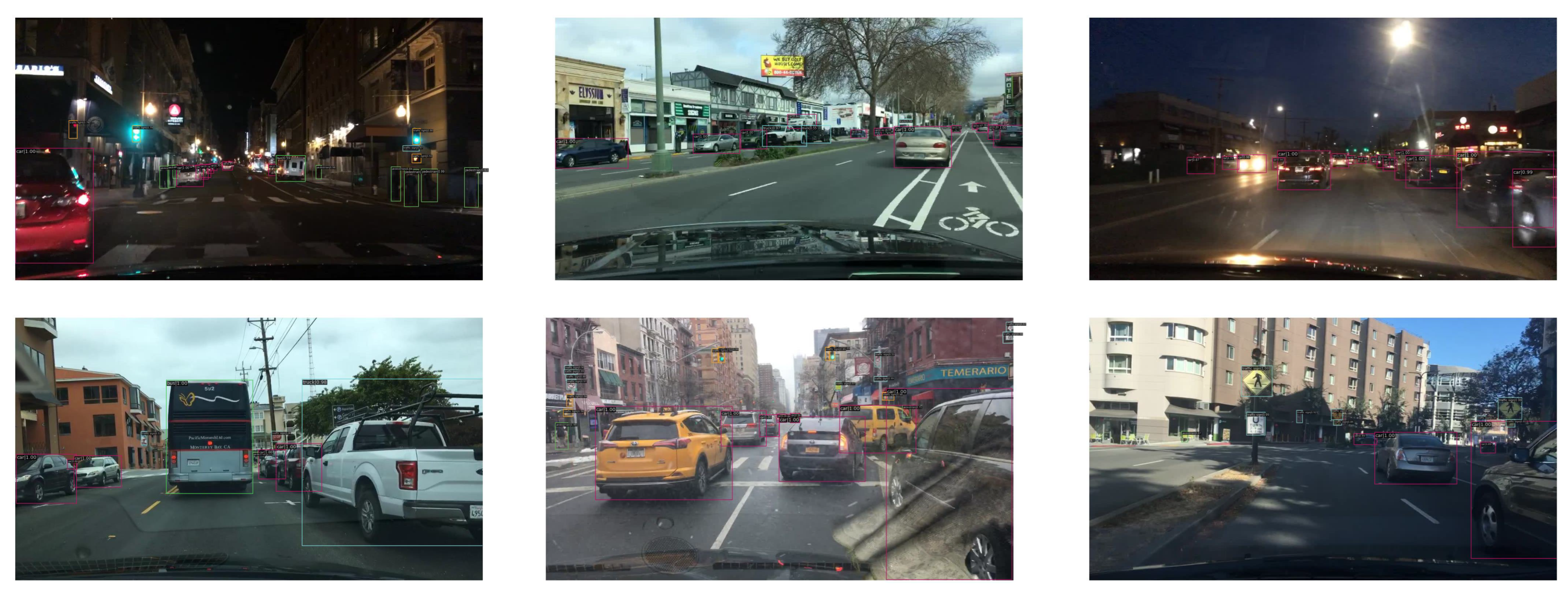
In Figure A1, Figure A3, and Figure A4, we show some qualitative results of our PLG-ViT as the backbone for object detection (COCO [22], BDD100K [46], and AGAR [45]) and instance segmentation (COCO). Furthermore, we present some qualitative results (see Figure A2) of semantic segmentation (ADE20K [41]). These results demonstrate our network’s ability to extract powerful features for different downstream vision tasks.
Figure A1. Examples of our PLG-ViT with Mask RCNN [56] on COCO [22].
Figure A2. Examples of our PLG-ViT with UPerNet [58] on ADE20K [41].
Figure A3. Examples of our PLG-ViT with Faster RCNN [55] on AGAR [45].
Figure A4. Examples of our PLG-ViT with Faster RCNN [55] on BDD100K [46].

References

  1. He, K.; Zhang, X.; Ren, S.; Sun, J. Deep residual learning for image recognition. In Proceedings of the Conference on Computer Vision and Pattern Recognition (CVPR), Las Vegas, NV, USA, 27–30 June 2016. [Google Scholar]
  2. Huang, G.; Liu, Z.; Pleiss, G.; Van Der Maaten, L.; Weinberger, K. Convolutional networks with dense connectivity. Trans. Pattern Anal. Mach. Intell. (TPAMI) 2019, 44, 8704–8716. [Google Scholar] [CrossRef] [PubMed]
  3. Szegedy, C.; Liu, W.; Jia, Y.; Sermanet, P.; Reed, S.; Anguelov, D.; Erhan, D.; Vanhoucke, V.; Rabinovich, A. Going deeper with convolutions. In Proceedings of the Conference on Computer Vision and Pattern Recognition (CVPR), Boston, MA, USA, 7–12 June 2015. [Google Scholar]
  4. Chen, L.C.; Papandreou, G.; Kokkinos, I.; Murphy, K.; Yuille, A.L. Deeplab: Semantic image segmentation with deep convolutional nets, atrous convolution, and fully connected crfs. Trans. Pattern Anal. Mach. Intell. (TPAMI) 2017, 40, 834–848. [Google Scholar] [CrossRef] [PubMed]
  5. Schuster, R.; Wasenmuller, O.; Unger, C.; Stricker, D. Sdc-stacked dilated convolution: A unified descriptor network for dense matching tasks. In Proceedings of the Conference on Computer Vision and Pattern Recognition (CVPR), Long Beach, CA, USA, 15–20 June 2019. [Google Scholar]
  6. Dai, J.; Qi, H.; Xiong, Y.; Li, Y.; Zhang, G.; Hu, H.; Wei, Y. Deformable convolutional networks. In Proceedings of the International Conference on Computer Vision (ICCV), Venice, Italy, 22–29 October 2017. [Google Scholar]
  7. Dosovitskiy, A.; Beyer, L.; Kolesnikov, A.; Weissenborn, D.; Zhai, X.; Unterthiner, T.; Dehghani, M.; Minderer, M.; Heigold, G.; Gelly, S.; et al. An image is worth 16×16 words: Transformers for image recognition at scale. In Proceedings of the International Conference on Learning Representations (ICLR), Addis Ababa, Ethiopia, 26–30 April 2020. [Google Scholar]
  8. Vaswani, A.; Shazeer, N.; Parmar, N.; Uszkoreit, J.; Jones, L.; Gomez, A.N.; Kaiser, Ł.; Polosukhin, I. Attention is all you need. In Proceedings of the Neural Information Processing Systems (NeurIPS), Long Beach, CA, USA, 4–9 December 2017. [Google Scholar]
  9. Liu, Z.; Mao, H.; Wu, C.Y.; Feichtenhofer, C.; Darrell, T.; Xie, S. A convnet for the 2020s. In Proceedings of the Conference on Computer Vision and Pattern Recognition (CVPR), New Orleans, LA, USA, 18–24 June 2022. [Google Scholar]
  10. Zhang, H.; Li, F.; Liu, S.; Zhang, L.; Su, H.; Zhu, J.; Ni, L.M.; Shum, H.Y. DINO: DETR with Improved DeNoising Anchor Boxes for End-to-End Object Detection. In Proceedings of the International Conference on Learning Representations (ICLR), Virtual, 25–29 April 2022. [Google Scholar]
  11. Xie, E.; Wang, W.; Yu, Z.; Anandkumar, A.; Alvarez, J.M.; Luo, P. SegFormer: Simple and efficient design for semantic segmentation with transformers. Neural Inf. Process. Syst. (NeurIPS) 2021, 34, 12077–12090. [Google Scholar]
  12. Liu, Z.; Lin, Y.; Cao, Y.; Hu, H.; Wei, Y.; Zhang, Z.; Lin, S.; Guo, B. Swin transformer: Hierarchical vision transformer using shifted windows. In Proceedings of the International Conference on Computer Vision (ICCV), Virtual, 11–17 October 2021. [Google Scholar]
  13. Wang, W.; Xie, E.; Li, X.; Fan, D.P.; Song, K.; Liang, D.; Lu, T.; Luo, P.; Shao, L. Pyramid vision transformer: A versatile backbone for dense prediction without convolutions. In Proceedings of the International Conference on Computer Vision (ICCV), Virtual, 11–17 October 2021. [Google Scholar]
  14. Touvron, H.; Cord, M.; Douze, M.; Massa, F.; Sablayrolles, A.; Jégou, H. Training data-efficient image transformers & distillation through attention. In Proceedings of the International Conference on Machine Learning (ICML), Virtual, 18–24 July 2021. [Google Scholar]
  15. Yang, J.; Li, C.; Zhang, P.; Dai, X.; Xiao, B.; Yuan, L.; Gao, J. Focal attention for long-range interactions in vision transformers. Neural Inf. Process. Syst. (NeurIPS) 2021, 34, 30008–30022. [Google Scholar]
  16. Chu, X.; Tian, Z.; Wang, Y.; Zhang, B.; Ren, H.; Wei, X.; Xia, H.; Shen, C. Twins: Revisiting the design of spatial attention in vision transformers. Neural Inf. Process. Syst. (NeurIPS) 2021, 34, 9355–9366. [Google Scholar]
  17. Hatamizadeh, A.; Yin, H.; Kautz, J.; Molchanov, P. Global Context Vision Transformers. arXiv 2022, arXiv:2206.09959. [Google Scholar]
  18. Xia, Z.; Pan, X.; Song, S.; Li, L.E.; Huang, G. Vision transformer with deformable attention. In Proceedings of the Conference on Computer Vision and Pattern Recognition (CVPR), New Orleans, LA, USA, 18–24 June 2022. [Google Scholar]
  19. Wang, W.; Xie, E.; Li, X.; Fan, D.P.; Song, K.; Liang, D.; Lu, T.; Luo, P.; Shao, L. Pvt v2: Improved baselines with pyramid vision transformer. Comput. Vis. Media 2022, 8, 415–424. [Google Scholar] [CrossRef]
  20. Lee, Y.; Kim, J.; Willette, J.; Hwang, S.J. MPViT: Multi-Path Vision Transformer for Dense Prediction. In Proceedings of the Conference on Computer Vision and Pattern Recognition (CVPR), New Orleans, LA, USA, 19–20 June 2022. [Google Scholar]
  21. Deng, J.; Dong, W.; Socher, R.; Li, L.J.; Li, K.; Fei-Fei, L. Imagenet: A large-scale hierarchical image database. In Proceedings of the Conference on Computer Vision and Pattern Recognition (CVPR), Miami, FL, USA, 20–25 June 2009. [Google Scholar]
  22. Lin, T.Y.; Maire, M.; Belongie, S.; Hays, J.; Perona, P.; Ramanan, D.; Dollár, P.; Zitnick, C.L. Microsoft coco: Common objects in context. In Proceedings of the European Conference on Computer Vision (ECCV), Zurich, Switzerland, 6–12 September 2014. [Google Scholar]
  23. Sun, C.; Shrivastava, A.; Singh, S.; Gupta, A. Revisiting Unreasonable Effectiveness of Data in Deep Learning Era. In Proceedings of the International Conference on Computer Vision (ICCV), Venice, Italy, 22–29 October 2017. [Google Scholar]
  24. Yuan, L.; Chen, Y.; Wang, T.; Yu, W.; Shi, Y.; Jiang, Z.H.; Tay, F.E.; Feng, J.; Yan, S. Tokens-to-Token ViT: Training Vision Transformers from Scratch on ImageNet. In Proceedings of the International Conference on Computer Vision (ICCV), Virtual, 11–17 October 2021. [Google Scholar]
  25. Han, K.; Xiao, A.; Wu, E.; Guo, J.; Xu, C.; Wang, Y. Transformer in transformer. Neural Inf. Process. Syst. (NeurIPS) 2021, 34, 15908–15919. [Google Scholar]
  26. Chu, X.; Tian, Z.; Zhang, B.; Wang, X.; Wei, X.; Xia, H.; Shen, C. Conditional positional encodings for vision transformers. arXiv 2021, arXiv:2102.10882. [Google Scholar]
  27. Xiao, T.; Singh, M.; Mintun, E.; Darrell, T.; Dollár, P.; Girshick, R. Early convolutions help transformers see better. Neural Inf. Process. Syst. (NeurIPS) 2021, 34, 30392–30400. [Google Scholar]
  28. Chen, C.F.R.; Fan, Q.; Panda, R. Crossvit: Cross-attention multi-scale vision transformer for image classification. In Proceedings of the International Conference on Computer Vision (ICCV), Virtual, 11–17 October 2021. [Google Scholar]
  29. Lin, T.Y.; Dollar, P.; Girshick, R.; He, K.; Hariharan, B.; Belongie, S. Feature Pyramid Networks for Object Detection. In Proceedings of the Conference on Computer Vision and Pattern Recognition (CVPR), Honolulu, HI, USA, 21–26 July 2017. [Google Scholar]
  30. Wu, H.; Xiao, B.; Codella, N.; Liu, M.; Dai, X.; Yuan, L.; Zhang, L. Cvt: Introducing convolutions to vision transformers. In Proceedings of the International Conference on Computer Vision (ICCV), Virtual, 11–17 October 2021. [Google Scholar]
  31. Liu, Z.; Hu, H.; Lin, Y.; Yao, Z.; Xie, Z.; Wei, Y.; Ning, J.; Cao, Y.; Zhang, Z.; Dong, L.; et al. Swin transformer v2: Scaling up capacity and resolution. In Proceedings of the Conference on Computer Vision and Pattern Recognition (CVPR), New Orleans, LA, USA, 18–24 June 2022. [Google Scholar]
  32. Zhang, P.; Dai, X.; Yang, J.; Xiao, B.; Yuan, L.; Zhang, L.; Gao, J. Multi-scale vision longformer: A new vision transformer for high-resolution image encoding. In Proceedings of the International Conference on Computer Vision (ICCV), Virtual, 11–17 October 2021. [Google Scholar]
  33. Lin, T.Y.; Goyal, P.; Girshick, R.; He, K.; Dollár, P. Focal loss for dense object detection. In Proceedings of the International Conference on Computer Vision (ICCV), Venice, Italy, 22–29 October 2017. [Google Scholar]
  34. Ba, J.L.; Kiros, J.R.; Hinton, G.E. Layer normalization. arXiv 2016, arXiv:1607.06450. [Google Scholar]
  35. Woo, S.; Park, J.; Lee, J.Y.; Kweon, I.S. Cbam: Convolutional block attention module. In Proceedings of the European Conference on Computer Vision (ECCV), Munich, Germany, 8–14 September 2018. [Google Scholar]
  36. Raffel, C.; Shazeer, N.; Roberts, A.; Lee, K.; Narang, S.; Matena, M.; Zhou, Y.; Li, W.; Liu, P.J. Exploring the limits of transfer learning with a unified text-to-text transformer. J. Mach. Learn. Res. 2020, 21, 5485–5551. [Google Scholar]
  37. Bao, H.; Dong, L.; Wei, F.; Wang, W.; Yang, N.; Liu, X.; Wang, Y.; Gao, J.; Piao, S.; Zhou, M.; et al. Unilmv2: Pseudo-masked language models for unified language model pre-training. In Proceedings of the International Conference on Machine Learning (ICML), Virtual, 13–18 July 2020. [Google Scholar]
  38. Hendrycks, D.; Gimpel, K. Gaussian error linear units (gelus). arXiv 2016, arXiv:1606.08415. [Google Scholar]
  39. Tan, M.; Le, Q. Efficientnetv2: Smaller models and faster training. In Proceedings of the International Conference on Machine Learning (ICML), Virtual, 18–24 July 2021. [Google Scholar]
  40. Hu, J.; Shen, L.; Sun, G. Squeeze-and-excitation networks. In Proceedings of the Conference on Computer Vision and Pattern Recognition (CVPR), Salt Lake City, UT, USA, 18–23 June 2018. [Google Scholar]
  41. Zhou, B.; Zhao, H.; Puig, X.; Fidler, S.; Barriuso, A.; Torralba, A. Scene Parsing through ADE20K Dataset. In Proceedings of the Conference on Computer Vision and Pattern Recognition (CVPR), Honolulu, HI, USA, 21–26 July 2017. [Google Scholar]
  42. Ebert, N.; Mangat, P.; Wasenmuller, O. Multitask Network for Joint Object Detection, Semantic Segmentation and Human Pose Estimation in Vehicle Occupancy Monitoring. In Proceedings of the Intelligent Vehicles Symposium (IV), Aachen, Germany, 5–9 June 2022. [Google Scholar]
  43. Fürst, M.; Gupta, S.T.; Schuster, R.; Wasenmüller, O.; Stricker, D. HPERL: 3d human pose estimation from RGB and lidar. In Proceedings of the International Conference on Pattern Recognition (ICPR), Virtual, 10–15 January 2021. [Google Scholar]
  44. Cao, H.; Wang, Y.; Chen, J.; Jiang, D.; Zhang, X.; Tian, Q.; Wang, M. Swin-unet: Unet-like pure transformer for medical image segmentation. arXiv 2021, arXiv:2105.05537. [Google Scholar]
  45. Majchrowska, S.; Pawłowski, J.; Guła, G.; Bonus, T.; Hanas, A.; Loch, A.; Pawlak, A.; Roszkowiak, J.; Golan, T.; Drulis-Kawa, Z. AGAR a microbial colony dataset for deep learning detection. arXiv 2021, arXiv:2108.01234. [Google Scholar]
  46. Yu, F.; Chen, H.; Wang, X.; Xian, W.; Chen, Y.; Liu, F.; Madhavan, V.; Darrell, T. Bdd100k: A diverse driving dataset for heterogeneous multitask learning. In Proceedings of the Conference on Computer Vision and Pattern Recognition, Seattle, WA, USA, 13–19 June 2020. [Google Scholar]
  47. Dai, Z.; Liu, H.; Le, Q.V.; Tan, M. Coatnet: Marrying convolution and attention for all data sizes. Neural Inf. Process. Syst. (NeurIPS) 2021, 34, 3965–3977. [Google Scholar]
  48. Zhai, X.; Kolesnikov, A.; Houlsby, N.; Beyer, L. Scaling vision transformers. In Proceedings of the Conference on Computer Vision and Pattern Recognition (CVPR), New Orleans, LA, USA, 19–20 June 2022. [Google Scholar]
  49. Xie, S.; Girshick, R.; Dollár, P.; Tu, Z.; He, K. Aggregated residual transformations for deep neural networks. In Proceedings of the Conference on Computer Vision and Pattern Recognition (CVPR), Honolulu, HI, USA, 21–26 July 2017. [Google Scholar]
  50. Chen, Z.; Zhu, Y.; Zhao, C.; Hu, G.; Zeng, W.; Wang, J.; Tang, M. Dpt: Deformable patch-based transformer for visual recognition. In Proceedings of the International Conference on Multimedia (ACM MM), Virtual, China, 20–24 October 2021. [Google Scholar]
  51. Yu, W.; Luo, M.; Zhou, P.; Si, C.; Zhou, Y.; Wang, X.; Feng, J.; Yan, S. Metaformer is actually what you need for vision. In Proceedings of the Conference on Computer Vision and Pattern Recognition (CVPR), New Orleans, LA, USA, 19–20 June 2022. [Google Scholar]
  52. Dong, X.; Bao, J.; Chen, D.; Zhang, W.; Yu, N.; Yuan, L.; Chen, D.; Guo, B. Cswin transformer: A general vision transformer backbone with cross-shaped windows. In Proceedings of the Conference on Computer Vision and Pattern Recognition (CVPR), New Orleans, LA, USA, 19–20 June 2022. [Google Scholar]
  53. Rao, Y.; Zhao, W.; Tang, Y.; Zhou, J.; Lim, S.L.; Lu, J. HorNet: Efficient High-Order Spatial Interactions with Recursive Gated Convolutions. Neural Inf. Process. Syst. (NeurIPS) 2022, 35, 10353–10366. [Google Scholar]
  54. Guo, M.H.; Lu, C.Z.; Liu, Z.N.; Cheng, M.M.; Hu, S.M. Visual attention network. arXiv 2022, arXiv:2202.09741. [Google Scholar]
  55. Ren, S.; He, K.; Girshick, R.; Sun, J. Faster R-CNN: Towards Real-Time Object Detection with Region Proposal Networks. Trans. Pattern Anal. Mach. Intell. (TPAMI) 2017, 39, 1137–1149. [Google Scholar] [CrossRef]
  56. He, K.; Gkioxari, G.; Dollár, P.; Girshick, R. Mask r-cnn. In Proceedings of the International Conference on Computer Vision, Venice, Italy, 22–29 October 2017. [Google Scholar]
  57. Chen, K.; Wang, J.; Pang, J.; Cao, Y.; Xiong, Y.; Li, X.; Sun, S.; Feng, W.; Liu, Z.; Xu, J.; et al. MMDetection: Open mmlab detection toolbox and benchmark. arXiv 2019, arXiv:1906.07155. [Google Scholar]
  58. Xiao, T.; Liu, Y.; Zhou, B.; Jiang, Y.; Sun, J. Unified perceptual parsing for scene understanding. In Proceedings of the European Conference on Computer Vision (ECCV), Munich, Germany, 8–14 September 2018. [Google Scholar]
  59. Contributors, M. MMSegmentation: OpenMMLab Semantic Segmentation Toolbox and Benchmark. 2020. Available online: https://github.com/open-mmlab/mmsegmentation (accessed on 8 February 2023).
  60. Zhao, H.; Shi, J.; Qi, X.; Wang, X.; Jia, J. Pyramid scene parsing network. In Proceedings of the Conference on Computer Vision and Pattern Recognition (CVPR), Honolulu, HI, USA, 21–26 July 2017. [Google Scholar]
  61. Selvaraju, R.R.; Cogswell, M.; Das, A.; Vedantam, R.; Parikh, D.; Batra, D. Grad-cam: Visual explanations from deep networks via gradient-based localization. In Proceedings of the International Conference on Computer Vision (ICCV), Venice, Italy, 22–29 October 2017. [Google Scholar]
  62. Loshchilov, I.; Hutter, F. Decoupled weight decay regularization. arXiv 2017, arXiv:1711.05101. [Google Scholar]
  63. Cubuk, E.D.; Zoph, B.; Shlens, J.; Le, Q.V. Randaugment: Practical automated data augmentation with a reduced search space. In Proceedings of the Conference on Computer Vision and Pattern Recognition Workshops (CVPR), Seattle, WA, USA, 14–19 June 2020. [Google Scholar]
  64. Yun, S.; Han, D.; Oh, S.J.; Chun, S.; Choe, J.; Yoo, Y. Cutmix: Regularization strategy to train strong classifiers with localizable features. In Proceedings of the International Conference on Computer Vision, Seoul, Republic of Korea, 27 October–2 November 2019. [Google Scholar]
  65. Zhang, H.; Cisse, M.; Dauphin, Y.N.; Lopez-Paz, D. mixup: Beyond empirical risk minimization. arXiv 2017, arXiv:1710.09412. [Google Scholar]
  66. Zhong, Z.; Zheng, L.; Kang, G.; Li, S.; Yang, Y. Random erasing data augmentation. In Proceedings of the Conference on Artificial Intelligence (AAAI), New York, NY, USA, 7–12 February 2020. [Google Scholar]
  67. Huang, G.; Sun, Y.; Liu, Z.; Sedra, D.; Weinberger, K.Q. Deep networks with stochastic depth. In Proceedings of the European Conference on Computer Vision (EECV), Amsterdam, The Netherlands, 11–14 October 2016. [Google Scholar]
  68. Hoffer, E.; Ben-Nun, T.; Hubara, I.; Giladi, N.; Hoefler, T.; Soudry, D. Augment your batch: Improving generalization through instance repetition. In Proceedings of the Conference on Computer Vision and Pattern Recognition (CVPR), Seattle, WA, USA, 13–19 June 2020. [Google Scholar]
  69. Polyak, B.T.; Juditsky, A.B. Acceleration of stochastic approximation by averaging. SIAM J. Control. Optim. 1992, 30, 838–855. [Google Scholar] [CrossRef]
Disclaimer/Publisher’s Note: The statements, opinions and data contained in all publications are solely those of the individual author(s) and contributor(s) and not of MDPI and/or the editor(s). MDPI and/or the editor(s) disclaim responsibility for any injury to people or property resulting from any ideas, methods, instructions or products referred to in the content.

Article Metrics

Citations

Article Access Statistics

Multiple requests from the same IP address are counted as one view.