


Abstract
The use of markerless motion capture systems is becoming more popular for walking and running analysis given their user-friendliness and their time efficiency but in some cases their validity is uncertain. Here, the test-retest reliability of the MotionMetrix software combined with the use of Kinect sensors is tested with 24 healthy volunteers for walking (at 5 km·h−1) and running (at 10 and 15 km·h−1) gait analysis in two different trials. All the parameters given by the MotionMetrix software for both walking and running gait analysis are tested in terms of reliability. No significant differences (p > 0.05) were found for walking gait parameters between both trials except for the phases of loading response and double support, and the spatiotemporal parameters of step length and step frequency. Additionally, all the parameters exhibit acceptable reliability (CV < 10%) but step width (CV > 10%). When analyzing running gait, although the parameters here tested exhibited different reliability values at 10 km·h−1, the system provided reliable measurements for most of the kinematic and kinetic parameters (CV < 10%) when running at 15 km·h−1. Overall, the results obtained show that, although some variables must be interpreted with caution, the Kinect + MotionMetrix system may be useful for walking and running gait analysis. Nevertheless, the validity still needs to be determined against a gold standard system to fully trust this technology and software combination.
1. Introduction
In both research and diagnosis, the use of marker-based motion capture technologies has been expanded dramatically. However, inherent limits in data collecting may restrict its use in contexts such as patient homes, sports fields, or public spaces where the use of a large number of cameras is impractical. Here, a markerless motion capture system has been offered as one possible solution [1,2].
Markerless systems do not require any markers or sensors to be attached to the body, reducing clinical feasibility and testing time significantly. The lack of markers, on the other hand, may have an impact on measuring accuracy. Thus, investigations examining the validity of such systems under different conditions are crucial. In this context, doctors, sports practitioners, and researchers have been paying close attention to a markerless motion capture system [1,3,4,5,6,7].
The validity of the Kinect™ sensor, created first for interacting with video games on the Microsoft Xbox™ platform by using body movements, for the analysis of gait parameters has been previously evaluated [1,3,4,5,6,7]. Various pieces of software, including various filters and calibrations, have been studied in these works. Whereas Schmitz et al. [1] analyzed the validity of the Kinect™ system with the KinectFusion software for kinematic data assessment, Dolatabadi et al. [3] identified the concurrent validity of the Kinect™ for Windows to measure gait spatiotemporal variables. Then, the validity of the Kinect™ for gait kinematics analysis in comparison with a “gold standard” motion capture system was assessed, operating both systems under Cartesian calibration [4]. Likewise, concurrent validity of the Kinect system for spatiotemporal gait parameters was also assessed [6]. However, none of the mentioned studies considered the MotionMetrix™ software, which might affect measuring accuracy.
As far as the authors’ concern, only one study took into account the Kinect + MotionMetrix combination [8]. Here, the absolute reliability and concurrent validity of the Kinect + MotionMetrix combination was evaluated for spatiotemporal parameters when running at a comfortable velocity by comparing data between the combination system and two widely used systems (i.e., high-speed video analysis and OptoGait). It was found that contact time (CT) was overestimated by the system, whereas flight time (FT) was underrated. However, it resulted to be a valid tool for step frequency (SF) and step length (SL) measures [8]. Although concurrent validity has been assessed, the reliability of the Kinect + MotionMetrix system for either walking or running parameters has not been evaluated.
To identify whether findings are attributable to changes in gait pattern or merely systematic measurement errors, a gait analysis system’s reliability is critical. Therefore, the aim of this study is to analyze the test–retest reliability of both walking and running gait on a treadmill running at 5, 10 and 15 km·h−1 by comparing inter-session data obtained from the Kinect + MotionMetrix system.
2. Materials and Methods
This study follows the STROBE recommendations for reporting observational studies [9].
2.1. Subjects
A group of 16 men and 8 women recreationally active (age = 22.7 ± 2.6 years; body mass = 69.1 ± 11.7 kg; height = 1.72 ± 0.10 m; weekly training = 6.9 ± 2.4 h/week) [10] and familiar with treadmill running voluntarily took part in the study. All of them were free from injuries and reported no physical limitations or health problems. An informed consent was signed by each participant after being informed of the objectives and procedures. It was made clear that they were free to leave at any point. The study followed the Declaration of Helsinki (2013) and was approved by the Ethics Board of the local university (No. 2546/CEIH/2022).
2.2. Procedures
Each participant attended the laboratory only once. The participants were instructed to refrain from strenuous activity for, at least, 48 h before data collection [11]. During the test, they wore their usual running clothes and shoes. A treadmill (WOODWAY Pro XL, Woodway, Inc., Waukesha, WI, USA) walking and running protocol was completed. An accommodation period on the treadmill of, at least, 8 min was completed at a self-selected velocity [12]. Thereafter, a protocol where 1-min bouts at 5, 10 and 15 km·h−1 was completed. After a 5-min break to avoid fluctuations in the running pattern caused by fatigue, all the participants completed the protocol again. Data were collected during the last 30 s of each bout to guarantee participant adaptation to the running speed
2.3. Materials and Testing
Participants body mass (kg) and height (m) were obtained using a bioimpedance scale (Inbody 230, Inbody, Seul, Korea) and a stadiometer (SECA 222, SECA, Corp., Hamburg, Germany), respectively.
Table 1 shows the definition of all the parameters provided by the MotionMetrix software (MotionMetrix AB). It offers different kinetic and kinematic variables depending on gait velocity used during analysis. The combination Kinect + MotionMetrix was employed to measure such parameters and all the additional variables that the software provides for walking and running gait. To control potential influencing factors for temporal parameters, only the right leg of the participants was analyzed (i.e., asymmetry) [11]. Through the use of a depth sensor, the Microsoft KinectTM sensor (version 1.0, Microsoft, Redmond, WA, USA) can monitor 3-D motions. It can locate 20 body joints in 3D space at 30 Hz. Here, two Microsoft KinectTM sensors were placed on either side of a treadmill in a certain configuration (170 cm from the treadmill’s center in forward direction and 190 cm in the perpendicular direction, according to manufacturer recommendations) and utilized in conjunction with MotionMetrixTM software (Figure 1). The Microsoft KinectTM sensors can reach 60 Hz when both sensors can track the same point at the same time (according to the manufacturer). For data collection, manufacturer recommendations were considered (i.e., software calibration, tight clothes, no shiny black fabric or reflexes, no moving shoelaces, no moving hair, no sunlight, and no treadmill parts blocking the entire view of the participant).

Table 1.
Definitions of the variables provided by the MotionMetrix software.
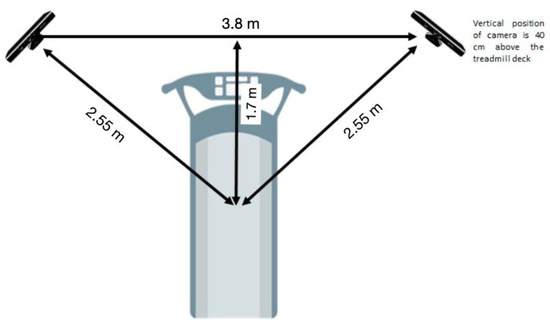
Figure 1.
Experimental set-up including treadmill and the positioning of the kinect cameras.
2.4. Statistical Analysis
Data are shown as mean, standard deviation (SD), and ranges. Shapiro-Wilk test confirmed the assumption of data normal distribution (p > 0.05). A mean comparison analysis (i.e., dependent samples T-test) was applied between variables from both trials of each participant (i.e., test-retest) for magnitude comparison. Cohen’s d effect size (ES) was adopted to interpret the magnitude of the differences following the next criterion: trivial (<0.20), small (0.20–0.59), moderate (0.60–1.19), large (1.20–2.00) and very large (>2.00) [13]. By means of standard error (SE) and coefficient of variation (CV in %, confidence interval (CI): 95%) reliability was assessed [13] and identified as acceptable when CV < 10% [14]. Moreover, intraclass correlation coefficient (ICC, model 3.1) between both trials and for each of the variables analyzed was provided after recommendations by Koo and Li [15]. ICC was interpreted considering the following cut-off values [16]: poor (ICC < 0), trivial (0–0.2), small (0.21–0.40), moderate (0.41–0.60), substantial (0.61–0.80), and almost perfect (>0.81). The 95% CI for these ICCs was also described. Custom spreadsheets were used to assess reliability [17]. The criterion alpha level was set at α = 0.05.
3. Results
3.1. Test-Retest Reliability and ICC Interpretation during Walking Gait
The test-retest reliability data for the kinematic parameters reported by the Kinect + MotionMetrix system during walking at 5 km·h−1 are shown in Table 2.
Table 2.
Descriptive data (means, ±SD) and inter-session reliability of kinematic parameters obtained from Kinect + MotionMetrix software walking at 5 km·h−1.
When analyzing walking gait, significant differences were exhibited only for load response (LR) and double support (DS) phases (p = 0.016 and 0.014, respectively) showing a small magnitude of differences (ES = 0.42 and 0.37, respectively) when evaluating both measurements. Moreover, SL and SF showed significant differences (p = 0.002 and 0.008, respectively) with a trivial magnitude of differences (ES ≤ 0.12). For the rest of variables, no significant differences were identified.
Walking gait measures showed acceptable reliability for all variables (i.e., CV < 4%) except step width (SW) (CV = 12.12%). The ICC values obtained with markerless system for ST, SL and SF exhibited an almost perfect correlation (ICC = 0.95, 0.94, and 0.96, respectively). Pre-swing phase (PSw), LR, DS and SW showed substantial correlation (ICC < 0.80). Moreover, whereas ICCs for both StP and SwP were interpreted as moderate (<0.60), ICCs for hip frontal angle (HFA) and knee frontal angle (KFA) were considered as poor (ICC < 0).
3.2. Test-Retest Reliability and ICC Interpretation during Running Gait
Table 3 and Table 4 show the test-retest reliability data for the kinetic and kinematic variables reported by the Kinect + MotionMetrix system during running at both 10 and 15 km·h−1, respectively.
Table 3.
Descriptive data (means, ±SD) and inter-session reliability of the kinematic parameters obtained from Kinect + MotionMetrix software running at 10 km·h−1.
Table 4.
Descriptive data (means, ±SD) and inter-session reliability of the kinematic and kinetic parameters obtained from Kinect + MotionMetrix software running at 15 km·h−1.
When analyzing running gait at 10 km·h−1, significant differences were found between both measures for stride time (StrT), stride length (StrL), SF, SL, maximal thigh flexion (ThighFlex), maximal knee flexion during swing (KFSw), knee rotation (KRot) and SW (p < 0.05). The magnitude of the differences for these variables was interpreted as either trivial (ES < 0.20 for SF, ThighFlex, KFSw, KRot, and SW) or small (ES < 0.60 for StrT, StrL, and SL). However, no significant differences for the rest of the variables provided by the system when running at 10 km·h−1 (see Table 3).
Table 4 displays running analysis at 15 km·h−1 using Kinect + MotionMetrix system. Here, no significant differences between trials were found when analyzing kinematic parameters (p > 0.05) except when assessing vertical displacement (Vdisp) and KRot (p < 0.03), which also show a small (ES = 0.22) and trivial (ES = 0.17) magnitude of the differences, respectively. When examining kinetic variables, significant differences (p < 0.05) were found for vertical force (VertF), maximal loading rate (LRmax), maximal propulsion rate (PRmax), external work (ExW), leg-spring stiffness (LSS), knee vertical force (KFv), knee frontal moment (KMf), hip vertical force (HFv), and hip frontal moment (HMf). The magnitude of the differences for all the parameters mentioned above were identified as small (ES < 0.60) except PRmax, KFv, and HFv that were identified as trivial (ES < 0.20). The rest of the variables show no significant differences when analyzing running gait at 15 km·h−1 (see Table 4).
When assessing reliability for running gait analysis at 10 km·h−1, all variables seemed to show acceptable reliability (CV < 10%) except when evaluating reliability for foot strike angle (FSA), ankle landing (AL), spine angle (SpA), ThighFlex, knee flexion when landing (KFL), and SW (CV > 10%). The ICCs obtained revealed moderate correlation for thigh extension (ThighExt) and CT (ICC = 0.44 and 0.51, respectively), substantial correlation for ThighFlex, shank angle (ShA), KFL, knee flexion during stance phase (KFS), and knee flexion during swing phase (KFSw) (ICC = 0.67–0.78), and an almost perfect correlation (ICC > 0.81) for the rest of variables at a running speed of 10 km·h−1.
Then, when running velocity was set at 15 km·h−1, although all the kinematic variables provided by the system show acceptable reliability (CV < 10%), AL, SpA, and SW exhibited CV > 10% for their measures. When kinetic variables were considered, all the parameters show acceptable reliability (CV < 10%) except lateral force (LatF) and elastic exchange EEx showing CV = 13.97% and 21.4%, respectively. The ICC values obtained revealed almost perfect correlation for most of the kinetic and kinematic parameters (ICC > 0.83) except the kinematic parameters of ShA, SpA, and CT (ICC = 0.69, 0.76, 0.80, respectively) and the kinetic parameters of VertF, LRmax, Prmax, KFv, and HFv (ICC = 0.79, 0.71, 0.65, 0.80, and 0.79, respectively). Furthermore, the kinetic variable of elastic exchange (Eex) shows moderate correlation (ICC = 0.58).
4. Discussion
This study aimed to determine the test–retest (inter-trial) reliability of the Kinect + MotionMetrix system for the analysis of both walking and running gait parameters (i.e., kinetic and kinematic variables) on a treadmill. Here, twenty-four participants were tested to assess the inter-trial reliability of such markerless system. Our results show that, although there were significant differences between both measurements for both LR and DS phases, and the spatiotemporal parameters of SL and SF, the system seems to provide reliable measurements when analyzing walking gait at 5 km·h−1. Then, when considering reliability when running at 10 km·h−1, no significant differences were found for most of the variables except when assessing StrT, StrL, SF, SL, ThighFlex, (KFSw), Krot, and SW. The system apparently provides reliable measures for all the variables apart from FSA, AL, SpA, ThighFlex, KFL, and SW. During running at 15 km·h−1, no significant differences were found when evaluating kinematic parameters for both trials besides Vdisp and Krot obtaining, additionally, reliable measures from the system for all the kinematic parameters excepting AL, SpA, and SW. If kinematic parameters (i.e., running velocity) are considered, only Vdisp and Krot showed significant differences between both trials, providing the system reliable measurements for all these parameters except when assessing AL, SpA, and SW. For kinetic variables, although the system seems to be reliable when analyzing such parameters (excepting LatF and Eex), significant differences between trials were found for the measures of VertF, Lrmax, Prmax, ExW, LSS, KFv, KMf, HFv, and HMf. The results expose not only the overall intersession reliability of the system when assessing kinematics in walking and running gait, but also its inaccuracy when considering some kinetic parameters.
Research on validity and reliability of markerless motion capture systems for biomechanical analysis during either walking or running on a treadmill is limited. Although the validity of the Kinect™ sensor for walking gait analysis has been assessed [1,3,4,5], the findings reported are controversial. A previous study [3] stated that the Kinect™ sensor used for Windows is a valid tool for measuring walking gait spatiotemporal parameters. Others [5,6] have reported important differences when comparing spatiotemporal parameters measured by the Kinect™ sensor and such parameters by a three-dimensional motion capture system. Particularly, Clark et al. [6] determined that walking gait parameters obtained employing the Kinect™ were lower (i.e., −16% ST, −19% StrT, −1.7% SL) than those acquired utilizing the three-dimensional system. Similarly, Xu et al. [5] claimed that the Kinect™ system reported valid ST and StrT values, but shorter stance time (i.e., −9%) regarding the three-dimensional system when walking. Seemingly, the accuracy of the Kinect™ system in measuring spatiotemporal characteristics is mainly reliant on factors such as the software and filter settings used, the gold standard or reference system examined, or the procedure followed as well as target variables. It is worth noting that the treadmill protocol used in the present study was intended to reduce any potential gait and running variability caused by either treadmill inexperience or fatigue [18,19]. It has been reported that a minimum time of 6 to 8 min is required for healthy young adults and novice treadmill runners to accommodate their locomotion on the treadmill. Thus, it remains unknown whether the Kinect™ system would perform in greater variability conditions.
As treadmill running has been shown to have certain biomechanical variations from running on the ground [12], readers must be cautious when interpreting the results here reported. Some of the investigations that looked into the validity of the Kinect™ system were done on the ground [3,6], whereas just three studies were completed on a treadmill [4,5,7]. This is key as validity or reliability data obtained while walking should not be transferred to running situations since the magnitude of the parameters changes and other phases emerge (i.e., FT does not exist during walking, while there is no double-support time during running). Pfister and colleagues [7] investigated sagittal plane gait kinematics at different walking and running velocities (i.e., 4.8 to 8.8 km·h−1), which are lower than the velocity in the current study (i.e., 5, 10 and 15 km·h−1), without mentioning kinetic and kinematic parameters, and concluded that the measurement accuracy of the Kinect™ system was not acceptable for clinical measurement analysis (i.e., the system did not provide consistent hip or knee measurements as compared to a three-dimensional system). It is worth mentioning that Pfister [7] employed an older software (i.e., Brekel Kinect) combined with the Kinect™ sensor, which might explain the variations between the studies. The Brekel software operated at 30 Hz, but the software utilized in this study (i.e., MotionMetrix™) can operate at 60 Hz, implying a better level of precision. Indeed, the values obtained in the present study for knee and hip measures present lower CV at the different velocities (<~10%). However, when assessing ankle and spine angles, the CV were greater (>~12%) regardless running velocity.
To the best of the authors’ knowledge, only one study [8] has examined the validity of the Kinect + MotionMetrix system during running. Here, absolute reliability and concurrent validity of this system for measuring CT, FT, SF, and SL was assessed when running at 12 km·h−1. It was determined that the Kinect + MotionMetrix system provides valid SF and SL values, but CT and FT are overestimated and underestimated, respectively [8]. Our study complements the aforementioned study by assessing the reliability of the system not only for the spatiotemporal parameters previously mentioned, but for all the parameters (i.e., kinetic and kinematic variables) that the system provides as well. Of note, the MotionMetrix system offers different parameters depending on the walking or running velocity during analysis.
The lack of studies either assessing MotionMetrix™ reliability or employing the system for walking and/or running gait analysis has made the discussion section a challenge, being this the main limitation of the study. At the same time, this study offers evidence-based knowledge to fill such gap and to provide future studies support in the use of Kinect + MotionMetrix system. However, it is worth mentioning that the validity of the kinetics and kinematics variables still needs to be determined against a gold standard system to fully trust this technology and software combination. Furthermore, the sample recruited were active healthy subjects remaining therefore unknown how the system would perform in greater variability conditions such as (i.e., patients with gait disorders)
To sum up, the results indicate that the Kinect + MotionMetrix software provides reliable measures when analyzing walking gait at 5 km·h−1 for all the parameters that the software acquires except for SW (CV = 12.12%). Moreover, it provides reliable measurements for all the variables acquired in running at 10 km·h−1 except for FSA and AL (CV = 15.90% and 17.46%, respectively), ThighFlex, KFL and SW (CV = 16.26%, 10.14% and 10.72%, respectively). Finally, when running at 15 km·h−1, the software also provides reliable values for all the kinematic parameters excepting AL, SpA, and SW (CV = 17.46%, 23.27% and 22.22%, respectively). However, when considering kinetic parameters in running at 15 km·h−1, all the acquired values seem to be reliable apart from EEx (CV = 21.40%).
5. Conclusions
The results obtained show that, although some variables should be interpreted with caution, the Kinect + MotionMetrix system may be useful for walking and running gait analysis after a simple 30 s calibration. Both researchers and clinicians must be aware of the characteristics of the measures depending on either the walking or running velocity as the reliability of the parameters may fluctuate. The use of the MotionMetrix software offers practitioners a low-cost, time-efficient, and user-friendly motion analysis system for assessing and monitoring both walking and running gait at different velocities. Despite these promising results, the validity of the Kinect + MotionMetrix system still needs to be determined against a gold standard system to fully trust this technology and software combination.
Author Contributions
Conceptualization, S.A.R.-A. and F.G.-P.; methodology, D.J.-C. and E.J.R.-M.; software, L.E.R.-S. and J.M.C.-G.; validation, S.A.R.-A. and F.G.-P.; formal analysis, D.J.-C.; investigation, L.E.R.-S.; resources, E.J.R.-M. and J.M.C.-G.; data curation, L.E.R.-S.; writing—original draft preparation, D.J.-C.; writing—review and editing, F.G.-P.; visualization, S.A.R.-A.; supervision, L.E.R.-S.; project administration, F.G.-P.; funding acquisition, F.G.-P. and L.E.R.-S. All authors have read and agreed to the published version of the manuscript.
Funding
The authors declare no funding has been received for this research.
Institutional Review Board Statement
The study was conducted in accordance with the Declaration of Helsinki, and approved by the Institutional Review Board (or Ethics Committee) of University of Granada (protocol code 2546/CEIH/2022, 18th January 2022).
Informed Consent Statement
Informed consent was obtained from all subjects involved in the study.
Data Availability Statement
The data presented in this study are available on request from the corresponding author. The data are not publicly available due to the participants privacy.
Conflicts of Interest
The authors declare no conflict of interest.
References
- Schmitz, A.; Ye, M.; Shapiro, R.; Yang, R.; Noehren, B. Accuracy and repeatability of joint angles measured using a single camera markerless motion capture system. J. Biomech. 2014, 47, 587–591. [Google Scholar] [CrossRef] [PubMed]
- van der Kruk, E.; Reijne, M.M. Accuracy of human motion capture systems for sport applications; state-of-the-art review. Eur. J. Sport Sci. 2018, 18, 806–819. [Google Scholar] [CrossRef] [PubMed]
- Dolatabadi, E.; Taati, B.; Mihailidis, A. Concurrent validity of the Microsoft Kinect for Windows v2 for measuring spatiotemporal gait parameters. Med. Eng. Phys. 2016, 38, 952–958. [Google Scholar] [CrossRef] [PubMed]
- Lamine, H.; Bennour, S.; Laribi, M.; Romdhane, L.; Zaghloul, S. Evaluation of calibrated kinect gait kinematics using a vicon motion capture system. Comput. Methods Biomech. Biomed. Eng. 2017, 20, S111–S112. [Google Scholar] [CrossRef] [PubMed] [Green Version]
- Xu, X.; McGorry, R.W.; Chou, L.-S.; Lin, J.-H.; Chang, C.-C. Accuracy of the Microsoft Kinect™ for measuring gait parameters during treadmill walking. Gait Posture 2015, 42, 145–151. [Google Scholar] [CrossRef] [PubMed] [Green Version]
- Clark, R.A.; Bower, K.J.; Mentiplay, B.F.; Paterson, K.; Pua, Y.-H. Concurrent validity of the Microsoft Kinect for assessment of spatiotemporal gait variables. J. Biomech. 2013, 46, 2722–2725. [Google Scholar] [CrossRef] [PubMed]
- Pfister, A.; West, A.M.; Bronner, S.; Noah, J.A. Comparative abilities of Microsoft Kinect and Vicon 3D motion capture for gait analysis. J. Med. Eng. Technol. 2014, 38, 274–280. [Google Scholar] [CrossRef] [PubMed]
- García-Pinillos, F.; Jaén-Carrillo, D.; Hermoso, V.S.; Román, P.L.; Delgado, P.; Martinez, C.; Carton, A.; Seruendo, L.R. Agreement Between Spatiotemporal Gait Parameters Measured by a Markerless Motion Capture System and Two Reference Systems—A Treadmill-Based Photoelectric Cell and High-Speed Video Analyses: Comparative Study. JMIR Mhealth Uhealth 2020, 8, e19498. [Google Scholar] [CrossRef] [PubMed]
- von Elm, E.; Altman, D.G.; Egger, M.; Pocock, S.J.; Gøtzsche, P.C.; Vandenbroucke, J.P. The Strengthening the Reporting of Observational Studies in Epidemiology (STROBE) statement: Guidelines for reporting observational studies. Ann. Intern. Med. 2007, 147, 573–577. [Google Scholar] [CrossRef] [PubMed] [Green Version]
- McKay, A.K.; Stellingwerff, T.; Smith, E.S.; Martin, D.T.; Mujika, I.; Goosey-Tolfrey, V.L.; Sheppard, J.; Burke, L.M. Defining Training and Performance Caliber: A Participant Classification Framework. Int. J. Sports Physiol. Perform. 2022, 17, 317–331. [Google Scholar] [CrossRef] [PubMed]
- Radzak, K.N.; Putnam, A.M.; Tamura, K.; Hetzler, R.K.; Stickley, C.D. Asymmetry between lower limbs during rested and fatigued state running gait in healthy individuals. Gait Posture 2017, 51, 268–274. [Google Scholar] [CrossRef] [PubMed]
- van Hooren, B.; Fuller, J.T.; Buckley, J.D.; Miller, J.R.; Sewell, K.; Rao, G.; Barton, C.; Bishop, C.; Willy, R.W. Is Motorized Treadmill Running Biomechanically Comparable to Overground Running? A Systematic Review and Meta-Analysis of Cross-Over Studies. Sports Med. 2020, 50, 785–813. [Google Scholar] [CrossRef] [PubMed] [Green Version]
- Hopkins, W.G.; Marshall, S.W.; Batterham, A.M.; Hanin, J. Progressive statistics for studies in sports medicine and exercise science. Med. Sci. Sports Exerc. 2009, 41, 3. [Google Scholar] [CrossRef] [PubMed] [Green Version]
- Atkinson, G.; Nevill, A.M. Statistical methods for assessing measurement error (reliability) in variables relevant to sports medicine. Sports Med. 1998, 26, 217–238. [Google Scholar] [CrossRef] [PubMed]
- Koo, T.K.; Li, M.Y. A guideline of selecting and reporting intraclass correlation coefficients for reliability research. J. Chiropr. Med. 2016, 15, 155–163. [Google Scholar] [CrossRef] [PubMed] [Green Version]
- Landis, J.R.; Koch, G.G. The measurement of observer agreement for categorical data. Biometrics 1977, 33, 159–174. [Google Scholar] [CrossRef] [PubMed] [Green Version]
- Hopkins, W.G. Spreadsheets for analysis of validity and reliability. Sportscience 2017, 21, 36–44. [Google Scholar]
- Lavcanska, V.; Taylor, N.F.; Schache, A.G. Familiarization to treadmill running in young unimpaired adults. Hum. Mov. Sci. 2005, 24, 544–557. [Google Scholar] [CrossRef] [PubMed]
- Schieb, D.A. Kinematic accommodation of novice treadmill runners. Res. Q. Exerc. Sport 1986, 57, 1–7. [Google Scholar] [CrossRef]
Publisher’s Note: MDPI stays neutral with regard to jurisdictional claims in published maps and institutional affiliations. |
© 2022 by the authors. Licensee MDPI, Basel, Switzerland. This article is an open access article distributed under the terms and conditions of the Creative Commons Attribution (CC BY) license (https://creativecommons.org/licenses/by/4.0/).