You are currently viewing a new version of our website. To view the old version click .
Sensors
  • Article
  • Open Access

26 May 2022

SELWAK: A Secure and Efficient Lightweight and Anonymous Authentication and Key Establishment Scheme for IoT Based Vehicular Ad hoc Networks

,
,
,
,
and
1
Department of Computer Science and Information Technology, Hazara University, Mansehra 21300, Pakistan
2
Department of Computer Science, Abbottabad Campus, COMSATS University Islamabad, Abbottabad 22060, Pakistan
3
Department of Computer Science, Islamabad Campus, COMSATS University Islamabad, Islamabad 44000, Pakistan
4
College of Computer Science and Information Systems, King Khalid University, Abha 62529, Saudi Arabia
This article belongs to the Special Issue Sustainable Computing Based on Internet of Things Empowered with Artificial Intelligence and Blockchain

Abstract

In recent decades, Vehicular Ad Hoc Networks (VANET) have emerged as a promising field that provides real-time communication between vehicles for comfortable driving and human safety. However, the Internet of Vehicles (IoV) platform faces some serious problems in the deployment of robust authentication mechanisms in resource-constrained environments and directly affects the efficiency of existing VANET schemes. Moreover, the security of the information becomes a critical issue over an open wireless access medium. In this paper, an efficient and secure lightweight anonymous mutual authentication and key establishment (SELWAK) for IoT-based VANETs is proposed. The proposed scheme requires two types of mutual authentication: V2V and V2R. In addition, SELWAK maintains secret keys for secure communication between Roadside Units (RSUs). The performance evaluation of SELWAK affirms that it is lightweight in terms of computational cost and communication overhead because SELWAK uses a bitwise Exclusive-OR operation and one-way hash functions. The formal and informal security analysis of SELWAK shows that it is robust against man-in-the-middle attacks, replay attacks, stolen verifier attacks, stolen OBU attacks, untraceability, impersonation attacks, and anonymity. Moreover, a formal security analysis is presented using the Real-or-Random (RoR) model.

1. Introduction

The past decade has witnessed colossal advancements in Information and Communication technologies (ICT) resulting in a number of concepts appearing on technological horizons. In practice, ICT has become an integral part of every field of human life. The concept of “smart and autonomous environment” is the result of emerging ICT models that can benefit human society at large. The Internet of Things enables the autonomous and smart society to connect billions of smart devices to inter- and intra-communication to achieve its goals [1,2,3]. These intelligent sensing and interconnected devices depict a tremendous capacity for replicating the physical environment into corresponding digital environments. IoT-based smart environments can assist society in a broad spectrum, such as e-health care, business, e-commerce, logistics, education, agriculture, defense, and many more.
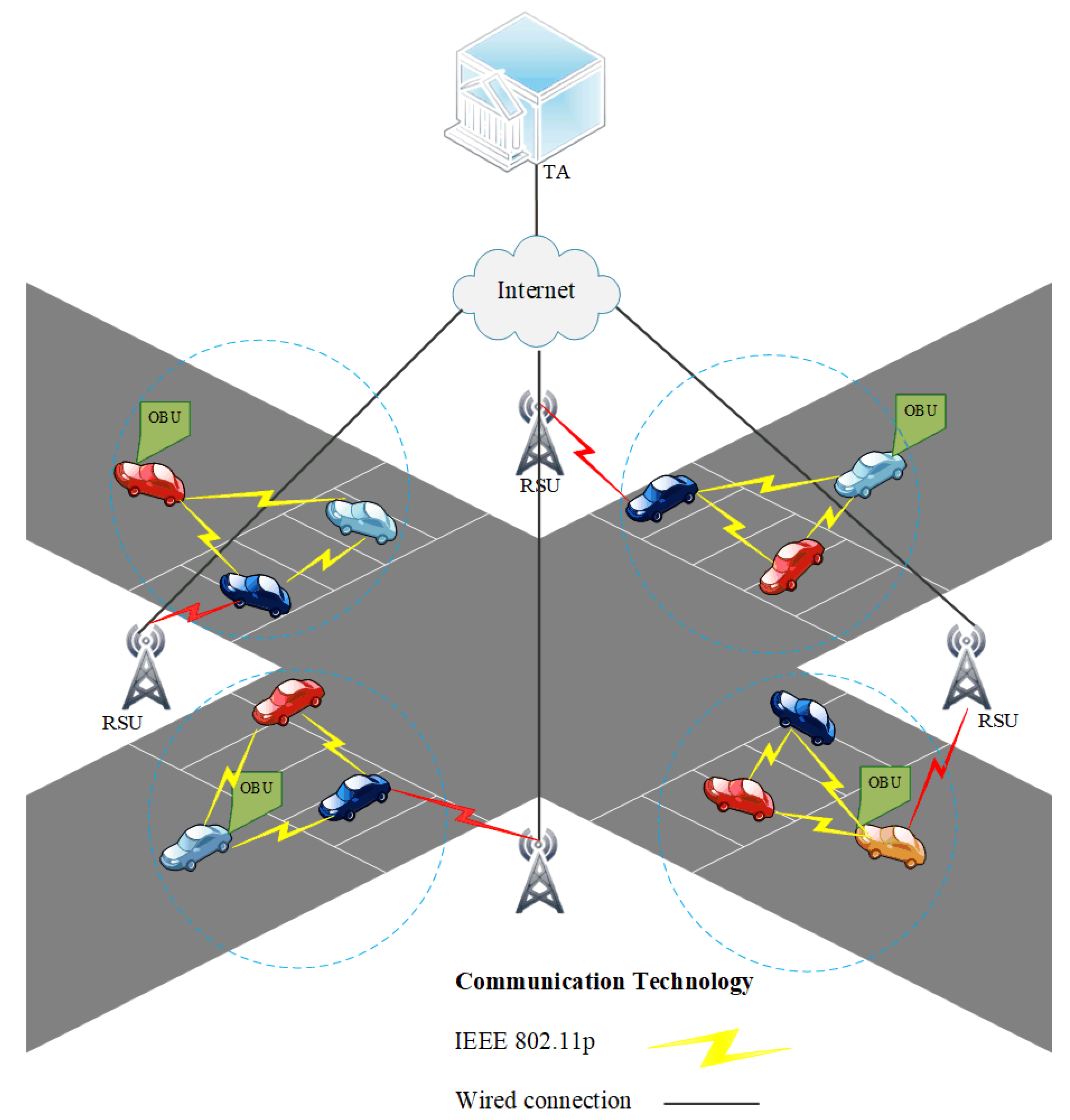
VANETs are a crucial component of a smart and autonomous environment with an aim to deliver Intelligent Transport System [4] where vehicles communicate with each other, roadside infrastructure, and/or other network services. ITS aims to provide controlled traffic flows, co-operative traffic monitoring, collision prevention, detour route computation, and internet connectivity to moving vehicles. Therefore, VANETS became a combination of wireless ad hoc networks and IoT-based devices for the provision of services. There are three main components of ITS: (a) vehicle, (b) Trust Authority (TA), and (c) Road-Side Unit (RSU), as shown in Figure 1. Vehicular communication takes place in two ways: (a) Vehicle to Vehicle (V2V) and (b) Vehicle to RSU (V2R). Each vehicle is equipped with an onboard unit (OBU) that receives and processes traffic-related data. The OBU also transmits information related to neighboring vehicles and RSUs using Dedicated Short Range Communication (DSRC) protocols [5]. The RSU is deployed beside the road as a base station and acts as a connecting node between OBUs and the Trusted Authority (TA). The RSU performs various authentication operations. The TA’s responsibilities are to register the OBUs and RSUs, perform maintenance, and conduct the entire vehicular system.
Figure 1. A Typical VANET Scenario.
Moving vehicles with varying accelerations make VANETs different from traditional ad hoc networks, thereby featuring specific network challenges in the case of VANETs. Resource-constrained IoT devices and the wireless nature of communication in VANETs make security a concern of prime focus [6]. Insecure communication may result in the transfer of life-critical information to an adversary. Unauthentic information may lead a passenger to a path of adversary’s choice, thus, putting life in danger [7]. Acceptance of a malicious message may cause malfunctioning of the vehicle system. Therefore, security gains prime importance in the case of VANETs, as unwanted situations may cause privacy breaches to one extent and prove to be fatal to the other.
A Secure and Efficient Lightweight Anonymous Mutual Authentication and Key establishment scheme for IoT-based vehicular ad hoc networks (SELWAK) is proposed in this paper. The proposed scheme uses a simple XOR operation and a one-way hash function, making it light in terms of resource usage. Various authentication and key establishment schemes have been discussed in the literature. Moreover, resource-constrained devices do not support traditional cryptographic operations due to low memory and computational power, and therefore demand lightweight cryptographic preemptive. Ensuring the privacy of vehicles is a challenging issue because an adversary can trace the traveling routes of vehicles and identify vehicles that may cause serious danger. To overcome privacy issues, the proposed scheme uses mask identities to ensure anonymity and privacy preservation. In addition to this, an attacker cannot relate driver’s multiple mask identities to reveal his/her real identity. The proposed scheme provides better security services in a cost-effective manner compared to existing schemes. The SELWAK consists of four phases: (i) Registration, (ii) authentication and key agreement, (iii) RSU-to-RSU key establishment, and (iv) password change.
In the registration phase, vehicles and roadside units register with the TA. The driver of the vehicle chooses various credentials and sends them to the TA in a secure way. Then, the vehicle is deployed on the VANETs. Before deployment of a vehicle in VANETs, TA sends the information to vehicle Vi in a secure way, and OBUi stores that information for future use. In the RSU registration phase, the TA generates credentials for every RSU that is deployed in VANETs. The second phase consists of two sub phases, such as (i): V2V authentication key agreement phase and (ii) the V2RSU authentication key agreement phase. In each sub phase, after successful mutual authentication, a session key is established between two entities, and this key is later used for authentication purposes. In the key establishment phase of RSU-to-RSU, a session key is established between those RSUs on the basis of their preloaded credentials. For secure communication, it is necessary that the driver of the vehicle change the password periodically. There is an option available for drivers to change passwords locally without interacting with the TA. Formal security analysis of the SELWAK was done using the Real-or-Random (RoR) model. SELWAK provides better security services and effectively reduces computational cost and communication overhead, as indicated by the derived results. The following are the main contributions of this paper.
  • In this paper, a novel lightweight anonymous authentication and key establishment scheme for VANETs is proposed that uses one-way cryptographic hash functions and simple XOR operations.
  • We ensure the privacy of vehicles so that an adversary cannot trace the real identity and travel routes of vehicles.
  • SELWAK is secure against replay attacks, impersonation attacks, man-in-the-middle attacks, stolen verifier attacks, stolen OBU attacks, untraceability, and anonymity.
  • Formal security proof of establishing a secure session key is provided using the RoR model.
The remainder of the paper is organized as follows. Section 2 discusses related work, whereas Section 3 presents systems models. In Section 4, the proposed SELWAK is described, while Section 5 presents the security analysis. In Section 6, we evaluate the performance of the proposed scheme, and Section 7 concludes the paper.

3. System Model

The network and thread models are presented in this section.

3.1. Network Model

The network model for VANET used in the SELWAK is shown in Figure 1. In this model, the entities involved are vehicles (Vi), roadside units (RSUs), and TA. In the network model, three types of participation involved: V2V, V2RSU and RSU2RSU.The TA is responsible for generating identities, for example, keys, and identities for vehicles and RSUs. The information generated by TA is stored in the memory of RSUs and OBUs, which can be used for authentication purposes. In light of the proposed model, the authentication processes that are required are V2V, V2RSU and RSU2RSU.

3.2. Threat Model

According to this model, all entities are assumed to communicate with each other through the insecure channel. RSUs are also assumed to be semi-trusted. An attacker can easily delete, modify, or eavesdrop the transmitted message. As RSUs are considered semi-trusted, we considered that the RSU’s confidential information is stored in tamper-proof devices within RSUs. However, we considered that OBUs are not installed with tamper-proof devices. Moreover, by using a power analysis attack [22,23], an attacker can extract all the sensitive information from some stolen OBUs of the vehicles. Finally, the TA is considered a fully trusted authority.

4. Proposed Scheme

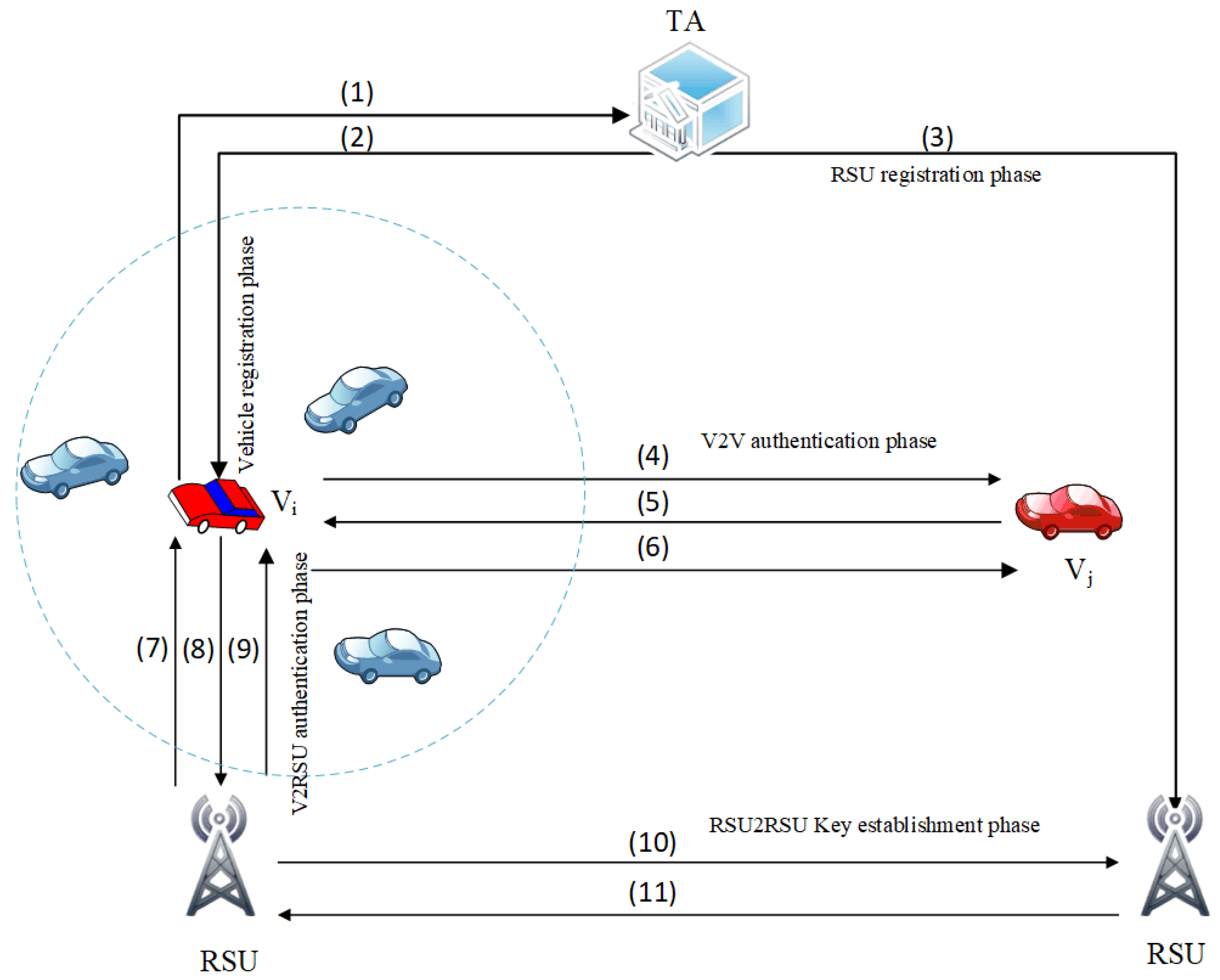
In this paper, a novel lightweight and anonymous authentication and key establishment scheme for IoT-based VANETs is proposed. In SELWAK, when a vehicle joins the region of another vehicle, anonymous mutual authentication between the vehicles is performed to avoid communication with malicious vehicles. To perform different types of wireless communications in VANETs, our authentication scheme can be divided into three categories: Vehicle-to-Vehicle, Vehicle-to-Roadside Unit, and Roadside Unit-to- Roadside Unit authentication. The proposed scheme works in four phases: registration phase, authentication, and key agreement phase, RSR-to RSU key establishment phase, and password change phase. Before giving a detailed description of the various phases, we briefly describe each phase in Figure 2. The definitions of the notations in our scheme are described in Table 1.
Figure 2. The phases involved in the proposed scheme. Vehicle Registration Phase (1). Registration request message (2). The registration response message. RSU Registration Phase (3). RSU’scredentials generated by TA. V2V Authentication and Key Establishment Phase (4). Authentication request message (5). Authentication reply message (6). Acknowledge message. V2RSU Authentication and Key Establishment Phase (7). Send a request message for Authentication (8). Authentication reply message (9). Acknowledgement message RSU2RSU Key Establishment phase (10). Send a request message for Key establishment (11). Key establishment response message.
Table 1. Notations used in the paper.

4.1. Registration Phase

In this phase, the registration of vehicles and roadside units is done in the following ways.

4.1.1. Vehicle Registration Phase

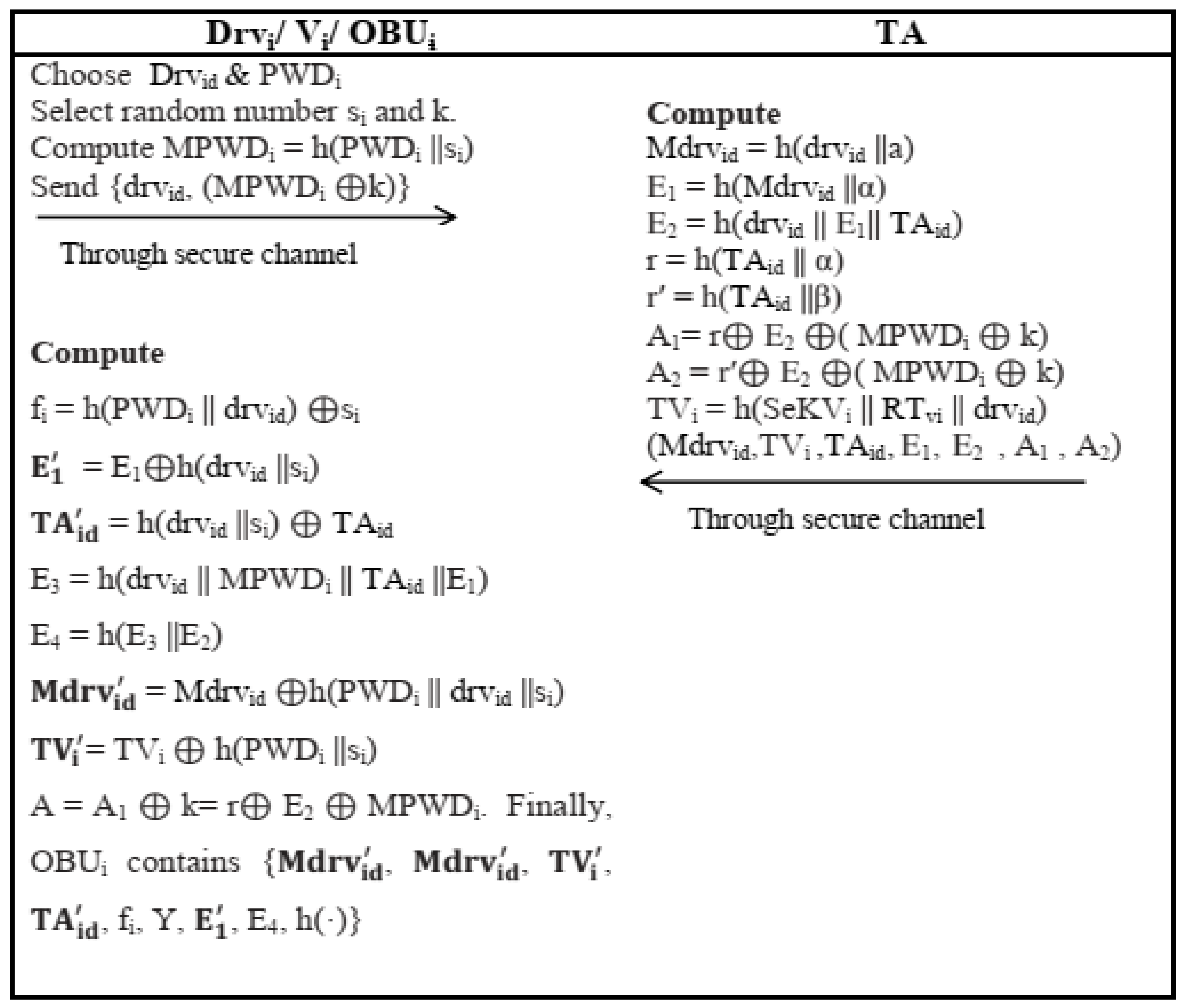
It is necessary to register each vehicle offline with the TA for secure V2V and V2R communication. The vehicle’s registration with the TA is a one-time process; hence, for the execution of this process, a secure channel is required, e.g., in person. The steps below are used for this purpose.
  • The driver Drvi of vehicle Vi, on his own choice, chooses a password PWDi and unique identity Drvid and two 160-bit random numbers si and k. OBUi computes a masked password M P W D i = h ( P W D i   | | s i ) , transmit ( d r v i d ,   ( M P W D i k ) )   to the TA through a secure channel.
  • After receiving the registration request ( d r v i d ,   ( M P W D i k ) ) ,   TA calculated M d r v i d = h ( d r v i d   | | a ) ,   E   1 = h ( M d r v i d   | | α )   using a pre-generated 160-bit secret key α. It further calculate E 2   =   h ( d r v i d | | E 1 | | T A i d ) ,   r   =   h ( T A i d | | α ) ,   r   =   h ( T A i d | | β ) ,   A 1   =   r E 2 ( M P W D i k ) ,   and   A 2   =   r E 2 ( M P W D i k ) .   Furthermore, for every registered vehicle Vi, a unique secret key S e K V i is also generated by TA and computes time based credential T V i = h ( S e K V i   | | R T v i   | |   d r v i d ) on the basis of timestamp generated duringregistration time R T v   of   V i   and   identity   d r v i d   of   driver .   Then, TA transmit ( M d r v i d ,   T V i ,   T A i d ,   E 1 ,   E 2 , A 1 , A 2 ) to through a secure channel.
  • After receiving information ( M d r v i d ,   T V i ,   T A i d ,   E 1 ,   E 2 ,   A 1 ,   A 2 ) ,   O B U i compute f i   =   h ( P W D i | | d r v i d ) s i ,   E 1   = E 1 h ( d r v i d | | s i ) ,   TA id h ( d r v i d | | s i ) T A i d ,   E 3   =   h ( d r v i d | | M P W D i | | T A i d | | E 1 ) ,   E 4   =   h ( E 3 | | E 2 ) ,   M d r v i d   =   M d r v i d h ( P W D i d | | d r v i d | | s i ) ,   TV i   =   T V i h ( P W D i | | s i ) ,   A   =   A 1 k   =   r E 2 M P W D i .
OBUi then deletes k ,   M d r v i d ,   T V i ,   TAid, E1, A1 and A2 from its memory. Finally, OBUi contains { M d r v i d ,   T V i ,   TA id ,   f i ,   Y ,   E 1 ,   E 4 ,   h ( · ) } . The pictorial representation of algorithm is given in Figure 3.
Figure 3. Vehicle Registration Phase.

4.1.2. Roadside Unit Registration Phase

Trusted authority generates 160-bit secret keys α and β, before deployment of R S U s in VANETs. Then trusted authority generates unique identities of R S U s like R S U i d 1 , R S U i d 2 R S U i d n and corresponding masked identities γ i , γ j     γ n that are generated as γ = h   ( R S U i d k | | β ) . The TA further generates identities for R S U j as r   = h ( T A i d | |   β ) . In addition, TA generates time-based identities for each R S U j as T RSU j = h   ( TA id | | RTRSU j | |   β ) . The R S U j then give the information { r ,   γ , T R S U j } . In our scheme γ is used for Vehicle Vi to R S U j authentication and T R S U j is used for symmetric key establishment between R S U s . The polynomial-based key distribution for RSU2RSU key establishment. To do this, TA first selects bivariate polynomial þ ( x , y ) =   þ ( x , y ) = l n 0 m = 0 n s l , m x l y m G F ( þ ) [ x , y ] over a finite field degree n. For each R S U j TA computer polynomial share þ ( T R S U j ,   y ) . The R S U j is also loaded with þ ( T R S U j ,   y ) in its memory.

4.2. Authentication and Key Establishment Phase

Initially, D r v i inputs a password PWD i * and identity drvid to O B U i . The O B U i calculates s i * = f 1   h ( P W D i *   | | d r v i d ), E 1 * = E 1   h ( d r v i d | | s i * ) = h ( M d r v i d   | | α ) , M P D W i * = h( P W D i * || s i * ), T A i d * = T A i d h( d r v i d || s i * ) and M d r v i d = M d r v i d   h( P W D i * || d r v i d || s i * ). O B U i further computes E2* = h ( M d r v i d || E 1 * || T A i d * ), r = A     E 2 *   M P D W i * , r   = A   E 2 *     M P D W i * , E 3 * = h ( d r v i d || M P D W i * || T A i d * || E 1 * ) and E 4 * = h ( E 3 * || E 2 * ). Inputting correct credentials: password and identity by authorized users. Each vehicle also computes the same r and r’. OBUi checks the condition if E 4 * = E4. If conditions hold, it implies that d r v i is authentic users. If the condition is not satisfied, then the phase is terminated. In addition, O B U i also computes T V i = T V i     M P D W i * .

4.2.1. V-To-V Authentication and Key Establishment Phase

In V2V authentication, two neighboring vehicles perform the following steps:
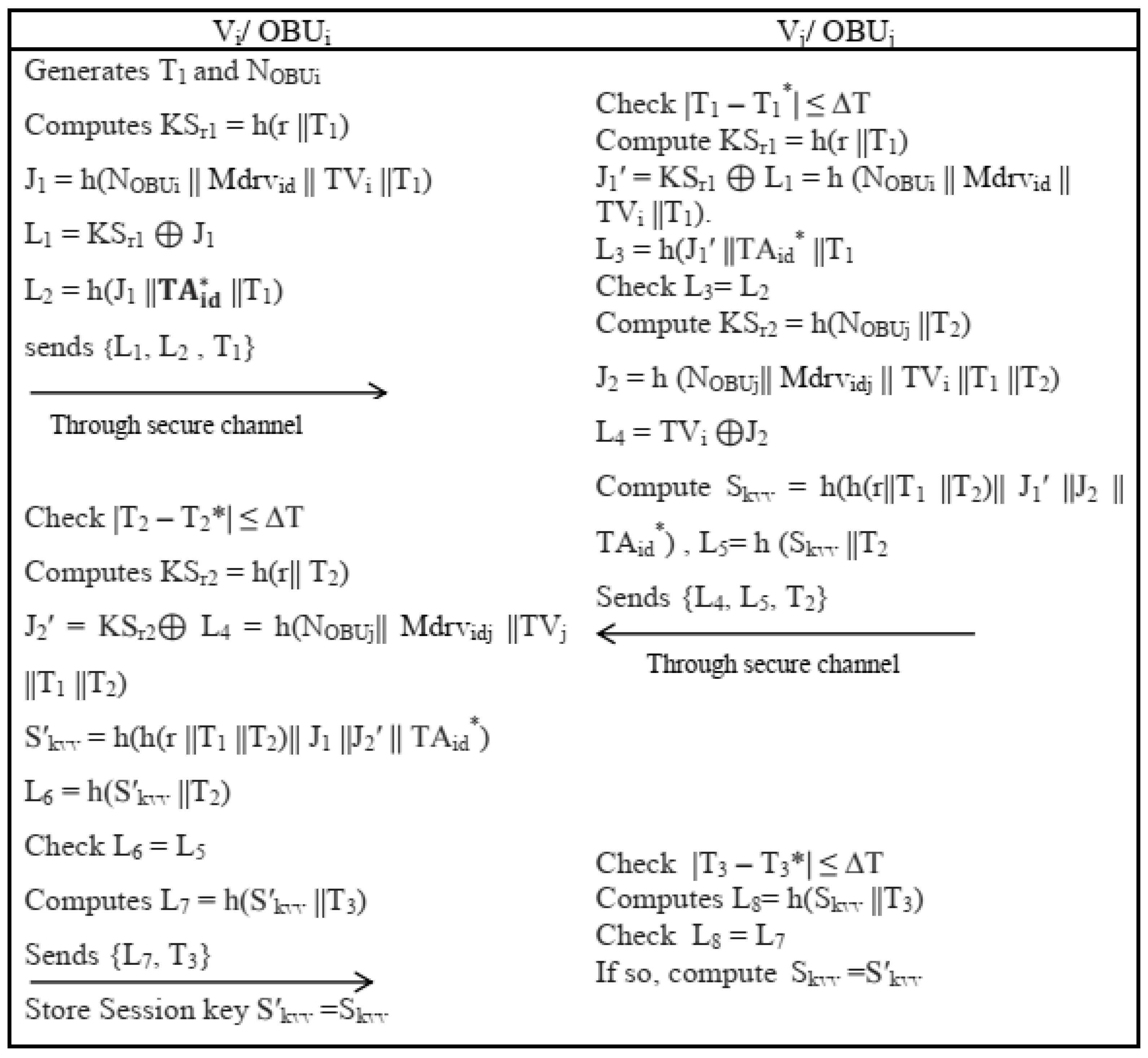
  • Onboard Unit OBUi generates current timestamp T1 and chooses random nonce N O B U i ,   and computes secret key K S r 1 = h ( r   | | T 1 ) .   Two neighbor vehicles used r and r for authentication in VANETs. An OBUj further compute J 1 = h ( N O B U i   | |   M d r v   i d | |   T V   i | | T 1 ) ,   L 1 = K S r 1 J 1 and L 2 = h ( J   1 | | TA id *   | | T 1 ) ,   and sends authentication requests {L1, L2, T1} to its neighboring vehicle through a public channel.
  • “After receiving {L1, L2, T1}, OBUj validates the timeliness of T1 by checking condition | T 1   T 1 * |     Δ T ,   where T 1 * is the time when the message is received and ΔT is the maximum transmission delay. If the condition holds, OBUj calculates the time-dependent secret key K S r 1 = h ( r   | | T 1 ) on the basis of T1 and previously computed r. It then computes J 1 = K S r 1 L 1 = h   ( N O B U i   | |   M d r v i d   | |   T V i   | | T 1 ) .   To proceed, it then calculates L 3 = h   ( J 1 | | T A i d *   | | T 1 ) .   The OBUi further checks the condition L3 = L3, if condition holds then Vj authenticate Vi and reject otherwise.
  • The OBUj selects a random nonce N O B U i and current timestamp T2, and computes time-dependent secret key K S r 2 = h ( N O B U j   | | T 2 ) ,   J 2 = h   ( N O B U j   | |   M d r v i d j   | |   T V i   | | T 1   | | T 2 )   and   L   4 =   T V i J 2 .   Then, the session key is computed S k v v = h ( h ( r | | T   1 | | T 2 ) | |   J 1   | | J 2   | |   T A i d * )   and   L 5 = h   ( S k v v   | | T 2 ) , and sends {L4, L5, T2} to Vi via a public channel.
  • On the reception of {L4, L5, T2}, OBUi also checks the validity of T2 by | T 2 T 2 * |   Δ T ,   where T 2 * I message arrival time. If the condition is fulfilled, by using received T2 and earlier computer r and J 2 = K S r 2 L 4 = h ( N O B U j | |   M d r v i d j   | | T V j   | | T 1   | | T 2 ) . , OBUi computes K S r 2 = h   ( r | |   T 2 ) . The OBUi further computes the session key S k v v = h ( h ( r   | | T 1   | | T 2 ) | |   J 1   | | J   2 | |   T A i d * ) ,   L 6 = h ( S k v v   | | T 2 ) . It then checks the condition L6 = L5. If the condition is satisfied, Vi successfully authenticates. Using the current timestamp T3, the OBU computes L 7 = h ( S k v v   | | T 3 ) ,   and finally sends a response message {L7, T3} to Vj via a public channel.
  • On the reception of {L7, T3}, OBUj checks the correctness of T3 by checking condition | T 3 T 3 * |     Δ T ,   where   T 3 * is reaching time. Then, it computes L 8 = h ( S   k v v | | T 3 )   and checks whether L   8 = L 7 .   If the condition is satisfied, the session key computed by OBUi is correct, and it guarantees that both Vi and the session key are established by Vj in this way S k v v   ( = S k v v )   to   start mutual communication. The pictorial representation of algorithm is given in Figure 4.
    Figure 4. V2V Authentication and Key Establishment Phase.

4.2.2. V-to-RSU Authentication and Key Establishment Phase

In this phase, vehicle V i and neighbor roadside unit RSUj perform the following steps for authentication and key establishment:
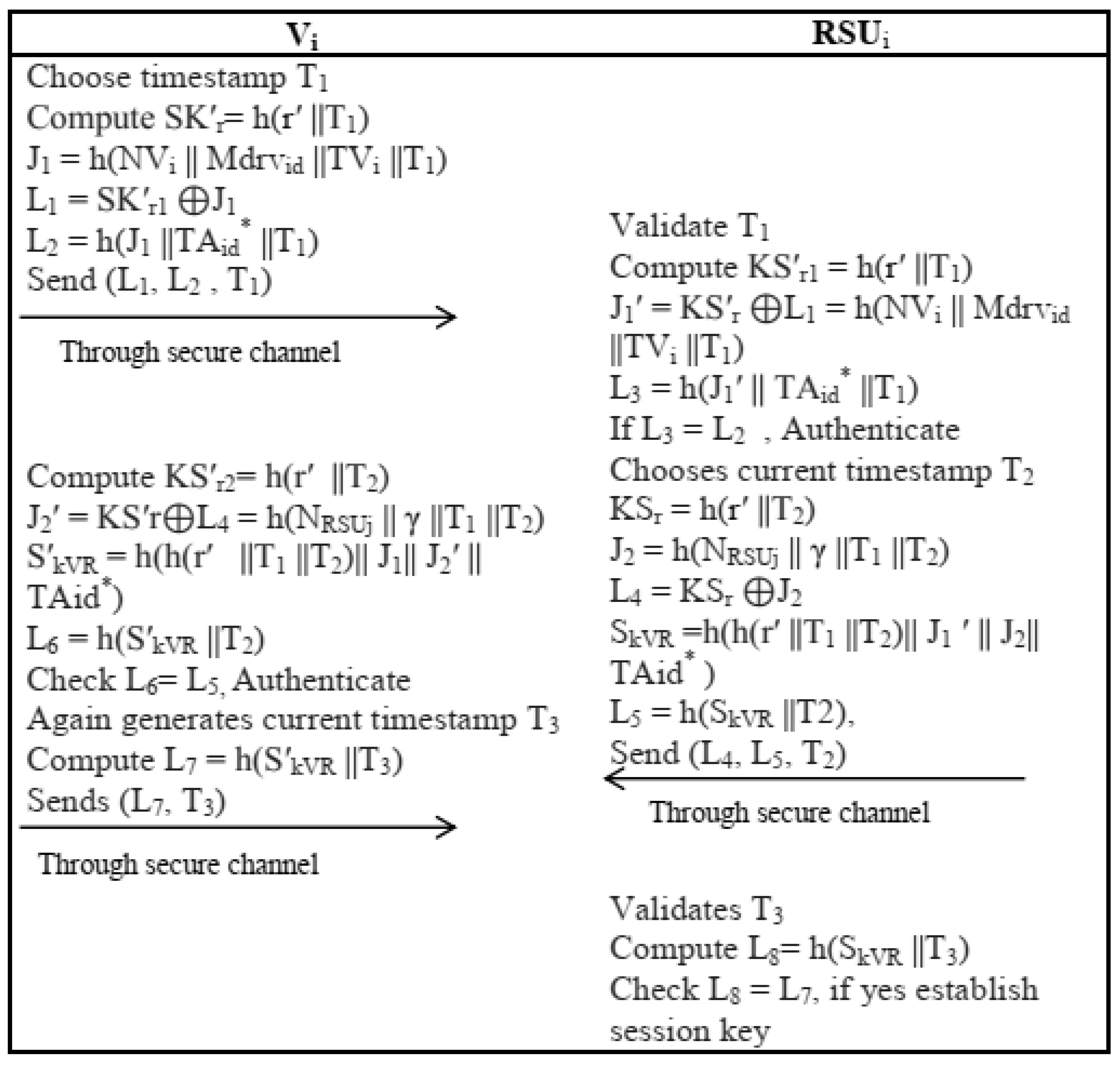
  • An OBUi chooses a timestamp T1 and random nonce N V i and calculates the time-dependent key S K r = h ( r   | | T 1 )   on the basis of previously calculated r. It further computes J 1 = h ( N V i   | |   M d r v i d   | | T V i   | | T 1 ) ,   L   1 = S K r 1 J 1 and   L 2 = h ( J 1 | | T A   i d * | | T 1 )   and sends {L1, L2, T1} as an authentication message to its nearby RSUj through a public channel.
  • After receiving {L1, L2, T1} RSUj validate T1. If it validates the timestamp, then RSUj calculates the time-dependent key S K r 1 = h ( r | | T 1 )   on   the   basis   of   T 1 .   It   then   computes J 1 = S K r L 1 = h ( N V i   | |   M d r v i d   | | T V i   | | T 1 )   and   L 3 = h ( J 1   | |   T A   i d * | | T 1 ) .   If L3 = L2 holds the RSUj authenticate Vi and reject otherwise.
  • The RSUj then chooses the current timestamp T2 and random nonce NRSU to calculate another time-dependent key K S r = h ( r | | T 2 ) , J 2 = h ( N R S U j   | |   γ   | | T 1   | | T 2 )   and   L 4 = K S r J 2 .   It further calculates the session key S k V R = h ( h ( r | | T 1   | | T 2 ) | |   J 1 | |   J 2 | |   T A   i d * ) and L 5 = h ( S k V R   | | T 2 ) , and sends message {L4, L5, T2} to Vi through an open channel. The pictorial representation of algorithm is given in Figure 5.
    Figure 5. V2RSU Authentication and key establishment phase.

4.3. Key Establishment Phase between RSUs

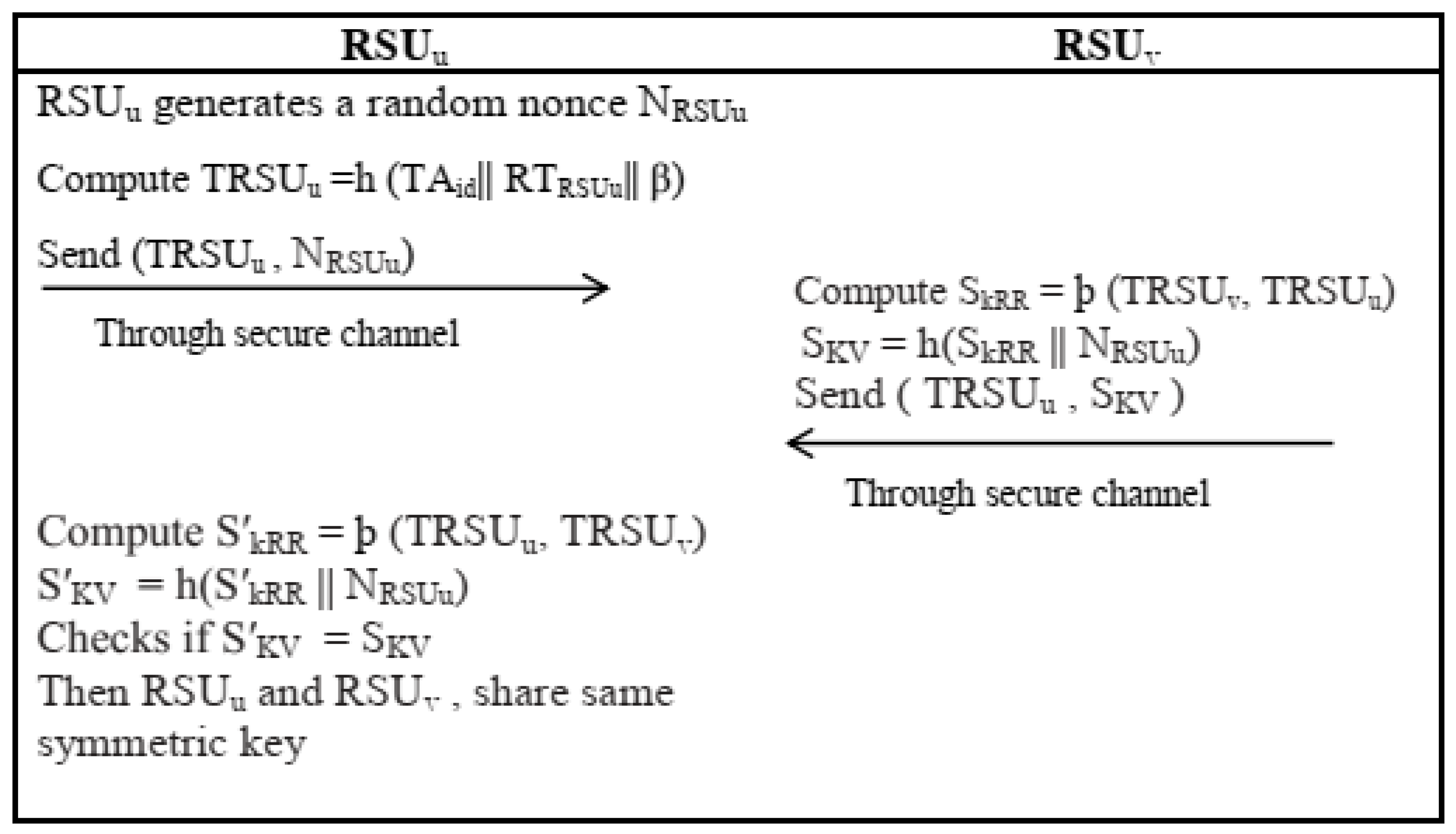
Two neighbor Roadside Units, namely RSUu and RSUv established pairwise key using the following steps.
  • The random nonce N R S U u is generated by RSUu and sends { T R S U u ,   N R S U u }   to RSUv.
  • Upon receiving “ { T R S U u ,   N R S U u } ,   RSUu calculates symmetric key shared with RSUu as S k R R = þ   ( T R S U v , T R S U u ) by pre-loaded polynomial share þ (TRSv, y) and S K V = h ( S k R R   | | N R S U u ) .   The RSUv then sends the message { T R S U u , S K V }   to   RSU u .
  • Finally, on reception of { TRSU u ,   S KV } ,   RSUu calculate the symmetric key and share with RSUu as   S k R R = þ   ( T R S U u , T R S U v )   ( = S k R R )   by pre-loaded polynomial share þ (TRSUu, y) and S K V = h ( S k R R   | |   N R S U u ) on the basis of its own already generated random nonce N R S U u .   In addition to this, RSUu proves if S K V = S K V .   If   the   condition   is   satisfied ,   it showed that both RSUu and RSUv used valid symmetric keys for their onward communication.
  • After receiving {L4, L5, T2}, OBUi also validates T2. If it is valid, then OBUi calculate time-dependent key S K r 2 = h   ( r | | T 2 )   on   the basis of T2 and J 2   = S K r L 4 = h ( N R S U j   | |   γ   | | T 1   | | T 2 ) . It further calculates a session key S k V R = h ( h ( N R S U j   | |   γ   | | T 1   | | T 2 ) | |   J 1 | |   J 2   | | T A   i d * )   and L 6 = h ( S k V R   | | T 2 ) .   If   condition   L 6 = L 5 is satisfied then Vi successfully authenticate RSUj. The OBUi again generates the current timestamp T3 to calculates L 7 = h ( S k V R   | | T 3 ) and sends {L7, T3} to RSUj through an open channel.
  • Upon receiving a message {L7, T3}, RSUj Validates T3. If it is valid, then RSUj calculates L 8 = h ( S k V R   | | T 3 ) and checks whether L8 = L7. If the condition is satisfied, then the session key computed by OBUi is correct.

4.4. Password Update Phase

In SELWAK, after the registration phase, the Vehicle’s O B U i can update password without using a verification table. The legal user changes the password periodically to improve the security of the system. The following steps are used:
  • Drvi provides provides an identity drvid and an old password P W D i o l d .   The   O B U i   then   computes   s i *   =   f i h ( P W D i o l d   | | d r v i d ) ,   E 1 *   =   E 1 ' h ( d r v i d   | |   s i * ) , M P W D i o l d   =   h ( P W D i o l d   | |   s i * ) ,   T A i d *   =   T A i d ' h ( d r v i d | |   s i * ) , M d r v i d *   =   M d r v i d '     h ( P W D i o l d   | | d r v i d   | | s i * ) , E 2 *   =   h ( M d r v i d *   | | E 1 * | |   T A i d * ) ,   E 3 o l d   =   h ( d r v i d | |   M P W D i o l d   | |   T A i d *   | |   E 1 * )   and   E 4 o l d   =   h ( E 3 o l d   | |   E 2 * ) .
    OBU i   checks   if   E 4 o l d = E 4 .   If the condition is not satisfied, the password updating process is stopped. Else, D r v i   is   a   authentic user and allowed the OBUi to update the password.
  • The driver Drvi is requested to give a new password P W D i n e w .   Then, it computes M d r v i d * *   =   M d r v i d * h ( P W D i n e w | | d r v i d | | s i * ) ,   T V i *   =   T V i M P W D i o l d ,   T V i * *   =   T V i * h ( T V i * s i * ) ,   f i n e w   =   h ( P W D i n e w | | d r v i d s i * ) ) ,   M P W D i n e w   =   h ( P W D i n e w | | s i * ) ,   E 3 n e w   =   h ( d r v i d | | M P W D i n e w | | T A i d * | | E 1 * ) ,   E 4 n e w   =   h ( E 3 | | E 2 * ) ,   A *   =   A ( M P W D i o l d P W D i n e w )   =   r E 2 P W D i n e w   and   A * *   =   A ( P W D i o l d P W D i n e w )   =   r E 2 P W D i n e w .
  • Finally, OBUi replaces P W D i ,   T V i ,   f i ,   A ,   A   and   E 4 with d r v i d * * ,   T V i * * ,   f i n e w ,   A * ,   A * *   and   E 4 n e w in its memory. Therefore, OBUi contains the message { M d r v i d * * ,   T V i * * ,   T A i d ,   f i n e w ,   A * ,   A * * , A 1 ,   E 4 n e w ,   h ( · ) } after the password update. The pictorial representation of algorithm is given in Figure 6.
    Figure 6. RSU2RSU Key Establishment Phase.

5. Security Analysis

The RoR model [21] was used for the formal security analysis of SELWAK. We also show that our scheme is secure against well-known attacks.

5.1. Formal Security Analysis

Formal security analysis of SELWAK is presented using the Real-or-Random (RoR) model. The security of the session key is shown using the RoR model for the proposed scheme. There are two main participants in our scheme: Vehicle Vi and Roadside Unit R S U j . The RoR [35] has the following components.

5.1.1. Participants

Let v i t and R S U j u be the instance t and u of the Vi and R S U j , and called as oracles.

5.1.2. Accepted State

The t is an instance that is called an accepted state. Upon reception of the last message, it changes into an accepted state. The t concatenate the entire sent and received messages in proper order and for the current session form a session identification of t .

5.1.3. Partnering

Two of the instances t 1 and t 2 are called the partners of each other if they fulfill the following conditions.
  • Both of t 1 and t 2 are in valid accepted states.
  • Both of t 1 and t 2 mutual authenticate and share identical session identification.
  • Both of t 1 and t 2 are mutual partners [36].

5.1.4. Freshness

If attacker A cannot apply the key generated for a particular session of two nodes on the bases reveal query then v i t and R S U j u are called fresh.

5.1.5. Adversary

Adversary A has full control over the communication between the partners and has the ability to alter the message. Adversary has the following access to queries:
  • EX ( v i t , R S U j u ): An adversary executes this query to obtain a message that is exchanged between two original partners. This is called an eavesdropping attack.
  • RL ( t ): An adversary using this query gets the current session key generated by t .
  • SN ( t , message): By executing this query, an adversary sends a message to the participant and receives the message. This is called an active attack.
  • OBU ( v i t ): An adversary executes this query to extract stored information in OBU. This is called a stolen attack.
  • Test ( t ):It models the semantic security ofa session key. After starting the experiment, coin c is flipped, and only the adversary can know the output. This is helpful for determining the output of a test query.

5.1.6. Session Key’s Semantic Security

The main task of an attacker is to differentiate the real session key from the random session key of an instance in the RoR model. An adversary has several test queries to either v i t and R S U j u . The random bit c and the output of the test query should be consistent. When an experiment is over, an adversary outputs a guessed bit c and wins the game if c = c . Suppose Win is an event in which an adversary can win a game. The advantage of Adversary is that it breaks the semantic security of the proposed authentic key exchange schemes. Authentic key exchange is defined by a d T A A K E = | 2 p r [ W i n ] 1 | . TA is secure if a d T A A K E θ for a sufficient smart real number θ > 0.

5.1.7. Random Oracle

All the participants, including the adversary, will have to access a one-way hash function, which is called the random oracle model [36].The security proof of Theorem 1 presented in [20] is the same. The breaking of the semantic security of the session key for V2V and V2R is proved in Theorem 1 [37].
Theorem 1.
In the RoR model, intruder A runs in polynomial time t against the SELWAK. Let Qh, |Hash|, Dec, |Dec| and QSN be a number of the H queries, the range space of h(·), distributed password dictionary, size of dictionary, and number of sent queries. An adversary’s advantage  a d T A A K E break the semantic security of the session key between OBU and RSU in the proposed scheme is defined as
a d T A A K E Q h 2 / | H a s h | + 2 . Q S N | D e c | .
Proof. 
As in the Chang and Le scheme [36], here the sequences of the four games says Gi = (0,1,2,3). Wini is an event where an adversary can successfully guess a bit c in game Gi. Below is a detailed description of these games. □
Game G0: In the random oracle model, it is considered a real attack of the adversary on the proposed scheme. An adversary first guess bit c at the start of the game. By definition, we have
a d R S U A K E = | 2 p r b [ W i n 0 ] 1 |
Game G1: In this game, an eavesdropping attack of an adversary is simulated by executing an EX ( v i t , R S U j u ) query. At the end of the game, the adversary makes a test query. An adversary will have to know whether the test query’s output is the real session key of the vehicle and RSU or a random number. We get
P r b [ W i n 0 ] = P r b [ W i n 1 ]
Game G2: In this game, an active attack on an adversary is simulated. An adversary tries to cheat the participants to receive the altered message. To verify the collision in the hash output, an adversary is allowed to query several oracles. When the birthday paradox is applied, we have
| P r b [ W i n 1 ] P r b [ W i n 2 ] | Q h 2 / 2 | H a s h |
Game G3: In this game, the Corrupt OBU query is simulated. An adversary extracts the information stored in OBUi. It is difficult to calculate the correct password. If the system only allows a specific password as an input, we can get
| P r b [ W i n 2 ] P r b [ W i n 3 ] | Q S N | D e c |
An adversary can simulate all the games except that an adversary needs to guess c to win the game after the test query to oracle; we get P r b [ W i n 3 ] = 1 / 2 from Equation (1), we have
( 1 / 2 ) a d R S U A K E = | p r b [ W i n 0 ] 1 / 2 | .
With the help of triangular inequality, we have | P r b [ W i n 1 ] P r b [ W i n 3 ] | | P r b [ W i n 1 ] P r b [ W i n 2 ] | + | P r b [ W i n 2 ] P r b [ W i n 3 ] | Q h 2 / 2 | H a s h | + Q S N | D e c | . As a result, Equations (2) and (6) become
| p r b [ W i n 0 ] 1 2 | Q h 2 / 2 | H a s h | + Q S N | D e c | .
Finally, from Equations (6) and (7). we get a d T A A K E Q h 2 / | H a s h | + 2 . Q S N | D e c | .

5.2. Informal Security Analysis

In this section, the proposed scheme’s resilience against some well-known attacks is discussed, and the security features of the proposed scheme are also compared with existing schemes.
  • Replay Attack: In the V2V and V2RSU authentication processes, the corresponding messages MSG1 = (L1, L2, T1) and MSG2 = (L7, T3) have timestamps T1 and T3. If an attacker wants to reply to the message with delay, then the timestamp attached to the message will fail. Therefore, our scheme is robust against reply attacks.
  • Impersonation Attack: During the V2V authentication an attacker can impersonate the vehicle; to do so, an attacker must create an authentic message MSG1 = (L1, L2, T1). For creating MSG1 an attacker requires secret r. An attacker cannot calculate message MSG1 even if he/she generates his/her own timestamp and random none as secret r, Mdrvid, TVi and TAid.
  • Man-in-the-middle Attack: In the proposed scheme, two messages, namely MSG1 = (L1, L2, T1) and MSG2 = (L7, T3) are required for V2V authentication. If an attacker wants to modify the message, then he/she first generates a current timestamp and random nonce. An attacker cannot calculate KSr1A = h(r||T1A as he/she did not have a secret key. Thus, an attacker cannot modify messages.
  • Stolen Verifier Attack: The information ( Mdrv i d , Mdrv i d , T V i , T A i d , fi, Y, E 1 , E4, h(·)) is stored in OBUi of the vehicle. We assume that an attacker can steal stored information from OBUi. However, the one-way hash function protects the secrets PWDi, r, r’, TAid, drvid. An attacker cannot guess the secrets PWDi, r, r′, TAid, drvid correctly due to the collision resistance property of a one-way hash function.
  • Stolen OBU Attack: Suppose that an attacker has stolen the OBUi of the vehicle. An attacker can extract the stored information ( Mdrv id , Mdrv id , TV i , TA id , fi, Y, E 1 , E4, h(·)) from OBUi. It is difficult for an attacker to drive drvid from Mdrvid without having the secret α.
  • Untraceability: In the V2V and V2RSU authentication phases of the proposed scheme, two messages are followed: MSG1 = (L1, L2, T1) and MSG2 = (L7, T3). All messages are distinct in each session, and the attacker cannot trace the RSU or vehicle.
  • Anonymity: In the proposed scheme, the messages for V2V and V2RSU authentication do not involve the identities of the RSU and the user. Therefore, it is infeasible for an attacker to drive the real identities of the RSU and the user. Hence, the proposed scheme satisfies the anonymity property.
  • Insider Attack: SELWAk is robust against insider attacks. The neighboring vehicles cannot get unauthorized access to the sensitive information of a particular vehicle by stealing its credentials.

6. Performance Analysis

In this section, the performance of the proposed scheme and the existing schemes are analyzed. The proposed scheme is implemented with the following specifications: 2.66 GHz Intel(R) Core TM 2 Quad processor with 4 GB of memory using Windows 10. We compared SELWAK with some existing schemes based on computational costs, as well as communication costs. The performance result shows that our scheme is efficient in terms of computational cost and communication overhead compared to existing schemes.

6.1. Computation Overhead

The notations Tpm-ECC, Tpa-ECC, and Th used in Table 2 represent Elliptic Curve Cryptographic points multiplication, Elliptic Curve Cryptographic points addition, and one-way hash function, respectively. As bitwise XOR operations take negligible time, we have not considered them for performance evaluation.
Table 2. Computation Cost Comparison.
We have considered the values 0.6718 ms, 0.0031 ms, and 0.001 ms for various cryptographic operations like Tpm-ECC, Tpa-ECC, and Th from existing experimental values [5,19,27]. The computational costs of SELWAK and some existing schemes are compared in Table 2. The schemes to which we compare our work include those of Zhong et al. [17], Ali et al. [19], Cui et al. [20], Xie et al. [21], Li et al. [24], Al-shareeda et al. [27], and Jalawai et al. [32]. An authentication scheme with privacy preservation property based on identity was proposed in [17]. To reduce communication overhead, a registration list is used instead of a revocation list. The security features of VANET were not affected by malicious vehicles. Moreover, their scheme did not use bilinear pairing operations, which takes more execution time. An elliptic curve cryptography-based and identity-based signature with a conditional privacy-preserving authentication scheme and general one-way hash functions for V2V communication is proposed in [19]. Cui et al. [20] presented a secure authentication approach with privacy properties for VANET. This scheme uses ECC and identity-based signatures for both V2I and V2V communication. The authors used the binary search method and the cuckoo filter method to improve the success rate of batch signature verification. Xieet al. [21] proposed a robust and secure conditional privacy-preserving scheme using identity-based authentication. The reliability and integrity of the messages are ensured using identity-based signatures for V2V and V2I communication. Performance analysis shows that this scheme has a high computational cost and communication overhead. To ensure secure communication in VANET, an authentication scheme based on ECC that satisfies privacy preservation is proposed in [27]. An efficient, provably-secure and anonymous conditional privacy-preserving authentication scheme for vehicular ad hoc networks has been proposed in [32]. Similarly, an authentication approach for global mobility networks was proposed in [38]. This scheme is based on an elliptic curve crypto system and therefore takes much execution time to perform major cryptographic operations.
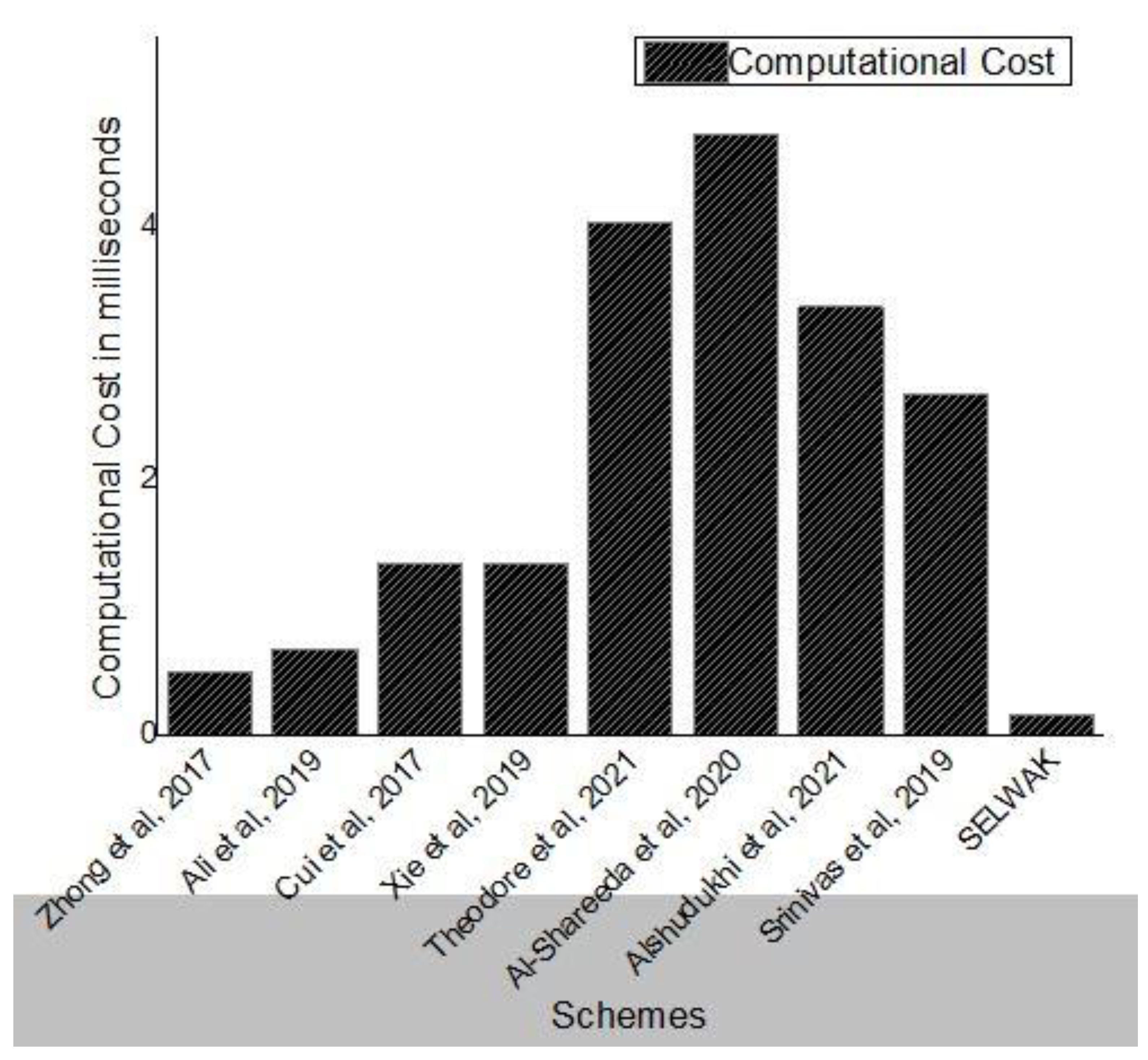
The total computational cost for SELWAK is 16Th + 11TXOR, which is less than that of all compared schemes. The performance result shows that our scheme is efficient in terms of computational cost and communication overhead compared to existing schemes.

6.2. Communication Overhead

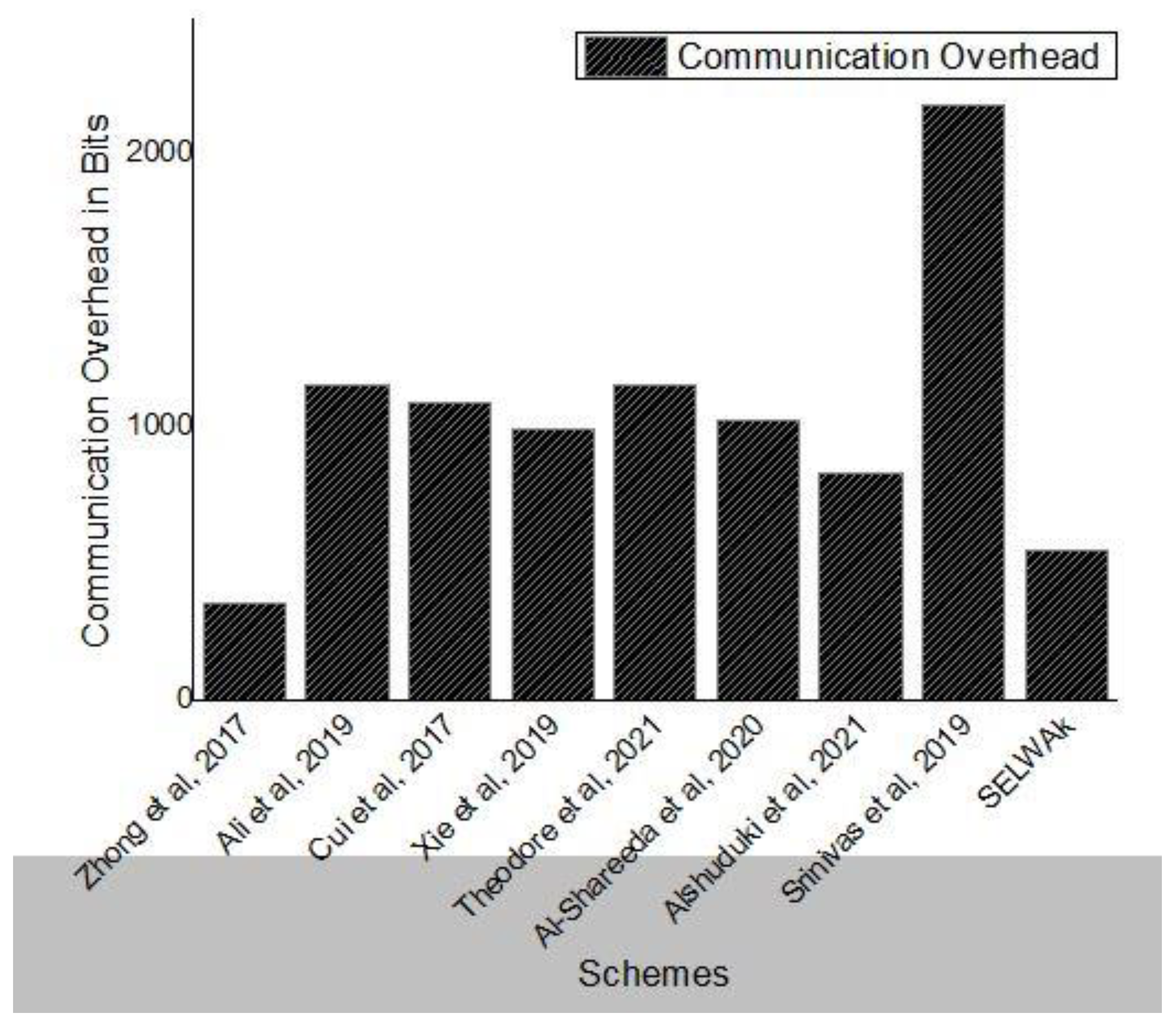
In this section, we have compared our scheme with [17,19,20,21,24,27,32], schemes. The authentication message of [17] is {T, m, σ}. Thus, the size of the authentication message is 160 × 2 + 4 = 352 bits. In [19] the size of the authentication message is 2 × 40 + 2 × 20 + 4 + 160 = 1152 bits. In [20] the size of message authentication is 40 + 2 × 20 + 4 + 160 + 256 = 1084 bits. The communication cost analysis shows that the corresponding authentication message of [21] scheme is [Ti, δ]. Thus, the size of the message is 320 × 2 + 100 × 2 + 32 = 992 bits. In our scheme, the authentication and key establishment phase require two messages MSG1 = (L1, L2, T1) and MSG2 = (L7, T3) and need (160 + 160 + 32) = 352 bits and (160 + 32) = 192 bits. Thus, the total computational cost for V2V and V2RSU authentication phases is equal to (352 + 192) = 544 bits. The communication overhead of various schemes have been shown in Table 3.
Table 3. Communication Cost Comparison.
As shown in Figure 7, the execution time taken by our proposed scheme is much less than that of the other four schemes. The proposed scheme is also efficient, even in the worst case, compared to other schemes.
Figure 7. Computation Cost Comparison.
In Figure 8, we show total extra bits sent with the original message during vehicle communication for various schemes.
Figure 8. Communication Overhead Comparison.

7. Conclusions

We proposed a novel SELWAK scheme for VANETs. Our scheme is efficient in terms of computational cost and communication overhead due to the one-way hash function and bitwise XOR operations. The SELWAK has extra features, such as mutual authentication and Vehicles and roadside unit anonymity properties. The proposed scheme is robust against driver impersonation attacks, OBU impersonation attacks, OBU capture attacks, RSU impersonation attacks, anonymity, and untraceability, perfect forward and backward secrecy, eavesdropping attacks, and insider attacks. The formal analysis of the proposed scheme was conducted using the RoR model. Therefore, the proposed scheme works efficiently for intelligent transportation systems.
In future work, anonymous mutual authentication will be carried out using BAN Logic and some simulation platforms, such as NS2, SUMO, and OMNET++, to simulate VANETs.

Author Contributions

Conceptualization, S.A.J. and M.A.; methodology, N.U.A.; software, J.S.; validation, S.A.J., A.A. and M.M.; formal analysis, S.A.J.; investigation, N.U.A.; resources, J.S.; data curation, S.A.J.; writing—original draft preparation, S.A.J. All authors have read and agreed to the published version of the manuscript.

Funding

This research received no external funding.

Institutional Review Board Statement

Not applicable.

Data Availability Statement

Not applicable.

Conflicts of Interest

The authors declare no conflict of interest.

References

  1. Zafar, F.; Khattak, H.A.; Aloqaily, M.; Hussain, R. Carpooling in Connected and Autonomous Vehicles: Current Solutions and Future Directions. ACM Comput. Surv. 2022, 1–33. [Google Scholar] [CrossRef]
  2. King, J.; Awad, A.I. A distributed security mechanism for resource-constrained IoT devices. Informatica 2016, 40, 133–143. [Google Scholar]
  3. Zahra, S.; Gong, W.; Khattak, H.A.; Shah, M.A.; Song, H. Cross-Domain Security and Interoperability in Internet of Things. IEEE Internet Things J. 2021. [Google Scholar] [CrossRef]
  4. Chaubey, N.K. Security analysis of vehicular ad hoc networks (VANETs): A comprehensive study. Int. J. Secur. Its Appl. 2016, 10, 261–274. [Google Scholar] [CrossRef]
  5. Cui, J.; Tao, X.; Zhang, J.; Xu, Y.; Zhong, H. HCPA-GKA: A hash function-based conditional privacy-preserving authentication and group-key agreement scheme for VANETs. Veh. Commun. 2018, 14, 15–25. [Google Scholar] [CrossRef]
  6. Kouicem, D.E.; Bouabdallah, A.; Lakhlef, H. Internet of things security: A top-down survey. Comput. Netw. 2018, 141, 199–221. [Google Scholar] [CrossRef] [Green Version]
  7. Sicari, S.; Rizzardi, A.; Miorandi, D.; Coen-Porisini, A. Internet of Things: Security in the keys. In Proceedings of the 12th ACM Symposium on QoS and Security for Wireless and Mobile Networks, Malta, Malta, 13–17 November 2016; pp. 129–133. [Google Scholar]
  8. Wang, Y.; Zhong, H.; Xu, Y.; Cui, J. ECPB: Efficient conditional privacy-preserving authentication scheme supporting batch verification for VANETs. Int. J. Netw. Secur. 2016, 18, 374–382. [Google Scholar]
  9. Islam, S.H.; Obaidat, M.S.; Vijayakumar, P.; Abdulhay, E.; Li, F.; Reddy, M.K.C. A robust and efficient password-based conditional privacy preserving authentication and group-key agreement protocol for VANETs. Futur. Gener. Comput. Syst. 2018, 84, 216–227. [Google Scholar] [CrossRef]
  10. Azees, M.; Vijayakumar, P.; Deboarh, L.J. EAAP: Efficient Anonymous Authentication With Conditional Privacy-Preserving Scheme for Vehicular Ad Hoc Networks. IEEE Trans. Intell. Transp. Syst. 2017, 18, 2467–2476. [Google Scholar] [CrossRef]
  11. Islam, S.H.; Biswas, G.P. A pairing-free identity-based authenticated group key agreement protocol for imbalanced mobile networks. Ann. Telecommun. 2012, 67, 547–558. [Google Scholar] [CrossRef]
  12. Malik, A.; Pandey, B. Security Analysis of Discrete Event Based Threat Driven Authentication Approach in VANET Using Petri Nets. Int. J. Netw. Secur. 2018, 20, 601–608. [Google Scholar]
  13. Zhang, L.; Men, X.; Choo, K.-K.R.; Zhang, Y.; Dai, F. Privacy-Preserving Cloud Establishment and Data Dissemination Scheme for Vehicular Cloud. IEEE Trans. Dependable Secur. Comput. 2018, 17, 634–647. [Google Scholar] [CrossRef]
  14. Liu, J.; Li, J.; Zhang, L.; Dai, F.; Zhang, Y.; Meng, X.; Shen, J. Secure intelligent traffic light control using fog computing. Future Gener. Comput. Syst. 2018, 78, 817–824. [Google Scholar] [CrossRef]
  15. Wazid, M.; Das, A.K.; Kumar, N.; Odelu, V.; Reddy, A.G.; Park, K.S.; Park, Y. Design of Lightweight Authentication and Key Agreement Protocol for Vehicular Ad Hoc Networks. IEEE Access 2017, 5, 14966–14980. [Google Scholar] [CrossRef]
  16. Ibrahim, S.; Hamdy, M.; Shaaban, E. Towards an optimum authentication service allocation and availability in VANETs. Int. J. Netw. Secur. 2017, 19, 955–965. [Google Scholar]
  17. Zhong, H.; Huang, B.; Cui, J.; Xu, Y.; Liu, L. Conditional Privacy-Preserving Authentication Using Registration List in Vehicular Ad Hoc Networks. IEEE Access 2017, 6, 2241–2250. [Google Scholar] [CrossRef]
  18. Gope, P.; Amin, R.; Islam, S.H.; Kumar, N.; Bhalla, V.K. Lightweight and privacy-preserving RFID authentication scheme for distributed IoT infrastructure with secure localization services for smart city environment. Future Gener. Comput. Syst. 2018, 83, 629–637. [Google Scholar] [CrossRef]
  19. Ali, I.; Lawrence, T.; Li, F. An efficient identity-based signature scheme without bilinear pairing for vehicle-to-vehicle communication in VANETs. J. Syst. Arch. 2019, 103, 101692. [Google Scholar] [CrossRef]
  20. Cui, J.; Zhang, J.; Zhong, H.; Xu, Y. SPACF: A Secure Privacy-Preserving Authentication Scheme for VANET With Cuckoo Filter. IEEE Trans. Veh. Technol. 2017, 66, 10283–10295. [Google Scholar] [CrossRef]
  21. Xie, L.; Ding, Y.; Yang, H.; Wang, X. Blockchain-Based Secure and Trustworthy Internet of Things in SDN-Enabled 5G-VANETs. IEEE Access 2019, 7, 56656–56666. [Google Scholar] [CrossRef]
  22. Alshudukhi, J.S.; Mohammed, B.A.; Al-Mekhlafi, Z.G. An Efficient Conditional Privacy-Preserving Authentication Scheme for the Prevention of Side-Channel Attacks in Vehicular Ad Hoc Networks. IEEE Access 2020, 8, 226624–226636. [Google Scholar] [CrossRef]
  23. Bayat, M.; Barmshoory, M.; Rahimi, M.; Aref, M.R. A secure authentication scheme for VANETs with batch verification. Wirel. Netw. 2014, 21, 1733–1743. [Google Scholar] [CrossRef]
  24. Al-shareeda, M.A.; Anbar, M.; Manickam, S.; Hasbullah, I.H.; Abdullah, N.; Hamdi, M.M.; Al-Hiti, A.S. NE-CPPA: A new and efficient conditional privacy-preserving authentication scheme for vehicular ad hoc networks (VANETs). Appl. Math. 2020, 14, 1–10. [Google Scholar]
  25. Al-Shareeda, M.A.; Anbar, M.; Alazzawi, M.A.; Manickam, S.; Al-Hiti, A.S. LSWBVM: A Lightweight Security Without Using Batch Verification Method Scheme for a Vehicle Ad Hoc Network. IEEE Access 2020, 8, 170507–170518. [Google Scholar] [CrossRef]
  26. He, D.; Zeadally, S.; Xu, B.; Huang, X. An Efficient Identity-Based Conditional Privacy-Preserving Authentication Scheme for Vehicular Ad Hoc Networks. IEEE Trans. Inf. Forensics Secur. 2015, 10, 2681–2691. [Google Scholar] [CrossRef]
  27. Alshudukhi, J.S.; Al-Mekhlafi, Z.G.; Mohammed, B.A. A Lightweight Authentication With Privacy-Preserving Scheme for Vehicular Ad Hoc Networks Based on Elliptic Curve Cryptography. IEEE Access 2021, 9, 15633–15642. [Google Scholar] [CrossRef]
  28. Cui, J.; Wang, Y.; Zhang, J.; Xu, Y.; Zhong, H. Full Session Key Agreement Scheme Based on Chaotic Map in Vehicular Ad Hoc Networks. IEEE Trans. Veh. Technol. 2020, 69, 8914–8924. [Google Scholar] [CrossRef]
  29. Vijayakumar, P.; Azees, M.; Chang, V.; Deborah, J.; Balusamy, B. Computationally efficient privacy preserving authentication and key distribution techniques for vehicular ad hoc networks. Clust. Comput. 2017, 20, 2439–2450. [Google Scholar] [CrossRef]
  30. Vijayakumar, P.; Azees, M.; Kozlov, S.A.; Rodrigues, J.J.P.C. An Anonymous Batch Authentication and Key Exchange Protocols for 6G Enabled VANETs. IEEE Trans. Intell. Transp. Syst. 2021, 23, 1630–1638. [Google Scholar] [CrossRef]
  31. Pulagara, S.B.; Alphonse, P. An intelligent and robust conditional privacy preserving authentication and group-key management scheme for vehicular ad hoc networks using elliptic curve cryptosystem. Concurr. Comput. Pract. Exp. 2019, 33, e5153. [Google Scholar] [CrossRef]
  32. Theodore, S.K.A.; Gandhi, K.R.; Palanisamy, V. A novel lightweight authentication and privacy-preserving protocol for vehicular ad hoc networks. Complex Intell. Syst. 2021, 1–11. [Google Scholar] [CrossRef]
  33. Ren, Y.; Li, X.; Sun, S.-F.; Yuan, X.; Zhang, X. Privacy-preserving batch verification signature scheme based on blockchain for Vehicular Ad-Hoc Networks. J. Inf. Secur. Appl. 2021, 58, 102698. [Google Scholar] [CrossRef]
  34. Srinivas, J.; Mishra, D.; Mukhopadhyay, S.; Kumari, S.; Guleria, V. An Authentication Framework for Roaming Service in Global Mobility Networks. Inf. Technol. Control 2019, 48, 129–145. [Google Scholar] [CrossRef] [Green Version]
  35. Abdalla, M.; Fouque, P.-A.; Pointcheval, D. Password-based authenticated key exchange in the three-party setting. In Proceedings of the International Workshop on Public Key Cryptography, Edinburgh, UK, 4–7 May 2005; Springer: Berlin/Heidelberg, Germany, 2005; pp. 65–84. [Google Scholar]
  36. Chatterjee, S.; Roy, S.; Das, A.K.; Chattopadhyay, S.; Kumar, N.; Vasilakos, A.V. Secure Biometric-Based Authentication Scheme Using Chebyshev Chaotic Map for Multi-Server Environment. IEEE Trans. Dependable Secur. Comput. 2016, 15, 824–839. [Google Scholar] [CrossRef]
  37. Chang, C.-C.; Le, H.-D. A Provably Secure, Efficient, and Flexible Authentication Scheme for Ad hoc Wireless Sensor Networks. IEEE Trans. Wirel. Commun. 2015, 15, 357–366. [Google Scholar] [CrossRef]
  38. Li, J.; Choo, K.-K.R.; Zhang, W.; Kumari, S.; Rodrigues, J.J.; Khan, M.K.; Hogrefe, D. EPA-CPPA: An efficient, provably-secure and anonymous conditional privacy-preserving authentication scheme for vehicular ad hoc networks. Veh. Commun. 2018, 13, 104–113. [Google Scholar] [CrossRef]
Publisher’s Note: MDPI stays neutral with regard to jurisdictional claims in published maps and institutional affiliations.

Article Metrics

Citations

Article Access Statistics

Multiple requests from the same IP address are counted as one view.