You are currently viewing a new version of our website. To view the old version click .
Sensors
  • Article
  • Open Access

15 April 2016

Enhancement of ELDA Tracker Based on CNN Features and Adaptive Model Update
,
,
and
1
National Key Laboratory of Science and Technology on Multispectral Information Processing, School of Automation, Huazhong University of Science and Technology, Wuhan 430074, China
2
Department of Computer Science and Engineering, University of Nebraska-Lincoln, Lincoln, NE 68503, USA
*
Author to whom correspondence should be addressed.
This article belongs to the Section Sensor Networks

Abstract

Appearance representation and the observation model are the most important components in designing a robust visual tracking algorithm for video-based sensors. Additionally, the exemplar-based linear discriminant analysis (ELDA) model has shown good performance in object tracking. Based on that, we improve the ELDA tracking algorithm by deep convolutional neural network (CNN) features and adaptive model update. Deep CNN features have been successfully used in various computer vision tasks. Extracting CNN features on all of the candidate windows is time consuming. To address this problem, a two-step CNN feature extraction method is proposed by separately computing convolutional layers and fully-connected layers. Due to the strong discriminative ability of CNN features and the exemplar-based model, we update both object and background models to improve their adaptivity and to deal with the tradeoff between discriminative ability and adaptivity. An object updating method is proposed to select the “good” models (detectors), which are quite discriminative and uncorrelated to other selected models. Meanwhile, we build the background model as a Gaussian mixture model (GMM) to adapt to complex scenes, which is initialized offline and updated online. The proposed tracker is evaluated on a benchmark dataset of 50 video sequences with various challenges. It achieves the best overall performance among the compared state-of-the-art trackers, which demonstrates the effectiveness and robustness of our tracking algorithm.

1. Introduction

Visual tracking is a critical technique to many applications [1,2,3], such as surveillance [4,5], robot vision [6], etc. Recently, tracking-by-detection has become an attractive tracking approach [7], which treats tracking as a category detection problem and trains a detector to separate the object from the background. In this class of tracking methods, appearance representation and the observation model (classifier) play important roles, as in detection. Tracking-by-detection methods can be roughly classified into two categories, the generative model and the discriminative model. The latter builds an observation model by online collecting positive and negative examples from the initial or tracked objects. Positive examples are usually sampled near the object location, which may be slightly different from the true object example. These slight differences will be amplified during tracking, leading to further drifting [8].
To address the tracking drift problem with discriminative models, in our previous work, we proposed an exemplar-based model, referred to as exemplar-based linear discriminant analysis (ELDA) [9], which considers tracking as a specific object instance detection task, rather than a general object category detection task as in object detection. Noticing that the trade-off between discriminative ability and adaptivity is crucial to the training of a model-free tracker, we mainly considered the following two aspects in the ELDA framework:
  • The exemplar-based model is quite discriminative and specific, because it trains a linear discriminant analysis (LDA) classifier using one positive example and massive negative examples. Besides, to improve its discriminative ability, the ELDA tracker applies histograms of oriented gradient (HoG) features [10] as the appearance representation of the object [9].
  • On the other hand, the adaptivity of the exemplar-based model is improved by combining an ensemble of detectors. Each detector (object model) is built based on a positive example; thus, the exemplar-based model can be considered as a template-based method. Model (or template) updating is very important to build a robust tracker.
While ELDA has demonstrated good performance in tracking, we observed that it could still be improved in both discriminative ability and adaptivity.
(1)
Discriminative ability
HoG is a quite discriminative representation, which is widely used in object detection tasks [10]. It is well known that HoG is an artificial feature, while learned features have dominated in computer vision recently, especially convolutional neural network (CNN) features. CNN features achieve the best performance in most tasks of object recognition [11,12,13], object detection [14,15], scene labeling [16], action recognition [17], image super-resolution [18], etc. It has been shown that the CNN features have even stronger discriminative ability than HoG.
Therefore, a natural question is: Can we use CNN features in visual tracking? To the best of our knowledge, few works have considered that so far. There are two reasons in our opinion. First, very large-scale training data are required to train a deep CNN. However, a small quantity of examples, especially positive examples, can be acquired in the tracking procedure. In recent years, some works proved that CNN features can be considered as a general representation [13]. If the features are extracted by a deep network, they could be exploited for various tasks. That means CNN features with a pre-trained deep network using a large-scale dataset can be used as appearance representation in visual tracking. The second reason is that computing CNN features on each sliding window is quite time consuming for tracking. Girshick et al. proposed an R-CNN method for object detection by first selecting a small number of region proposals [14]. However, this strategy is not a good solution to tracking-by-detection methods; because the candidate region is just around the object, and the error of selected proposals will be amplified during tracking, resulting in drifting. Thus, CNN features can be used to improve the discriminative ability, while a fast computation method is required for tracking.
(2)
Adaptivity
There are two limitations of the ELDA tracker in the terms of adaptivity: (1) ELDA builds a short-term object model using the object models within a fixed time window TM. To ensure robustness, TM is typically set to a large value, e.g., TM = 500 in [9]. However, such a large number of examples is redundant, because the object instances within a short time window are similar. Thus, selecting a small set of “good” object models is a good solution to this problem. (2) The ELDA tracker models the background as a Gaussian model; however, in fact, the background is quite complex in many cases. A single Gaussian distribution is too simple to describe the complex background. A more powerful model is required.
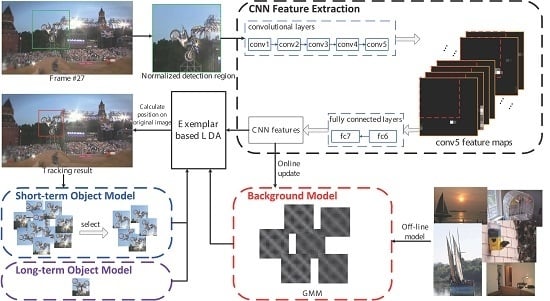
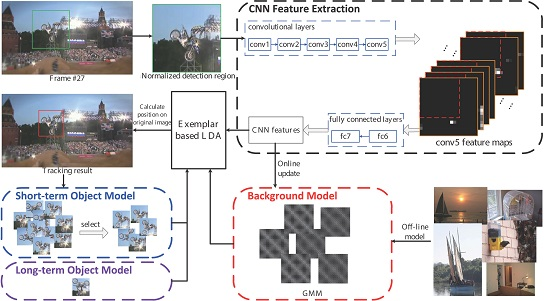
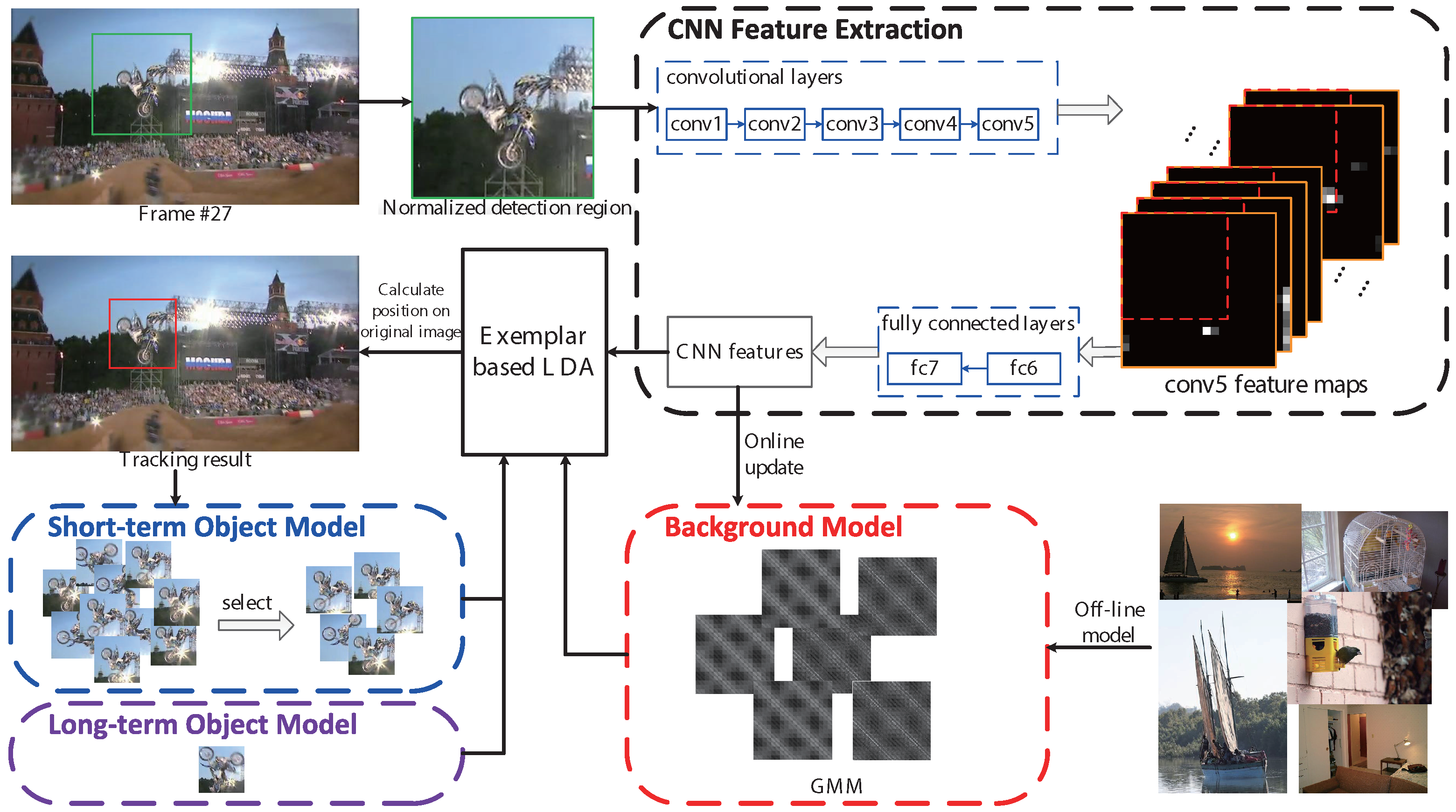
To this end, this paper presents an exemplar-based tracker based on CNN features and adaptive model update for visual tracking (ECT), as shown in Figure 1. CNN features are introduced into the exemplar-based tracking method for appearance representation and sped up by separately computing convolutional layers and fully-connected layers. The VGG-F CNN architecture [19] is used in this paper, which contains five convolutional layers (conv1–5) and three fully-connected layers (fc6–8). Generally, the feature of the seventh fully-connected layer (fc7) is used as a representation for many tasks in computer vision. To speed up CNN feature extraction in this architecture, we first compute the fifth convolutional feature maps (conv5) on the whole detection region and then compute the seventh fully-connected layer (fc7) on each sliding window. To improve the adaptivity, we propose a method to update object models by selecting the detectors with strong discriminative ability and uncorrelated to other selected detectors; and build the background as a Gaussian mixture model (GMM) to cover the complex variations of the scenes.
Figure 1. An overview of the ECT tracking algorithm. The convolutional layers and fully-connected layers of convolutional neural network (CNN) features are computed separately. We first compute the Convolutional Layer 5 (conv5) feature maps on the whole detection region, and then compute fully-connected layers (fc7) on each sliding window. The long-term object model is based on the object instance in the first frame; the short-term object model is a more compact set of the previous object models. The background model is a Gaussian mixture model (GMM), which is initialized offline and updated online. Finally, CNN features are fed to an ensemble of exemplar-based LDA detectors for tracking. The figure is best viewed in color.
There are four main contributions: (1) we introduce CNN features into the visual tracking tasks, without training a deep network; (2) we proposed a two-step CNN feature extraction method to speed up the algorithm; (3) a new strategy is proposed to update object models according to discriminative ability and correlation; (4) GMM is used to build the background model, to improve the adaptivity in the complex scene.
The rest of this paper is organized as follows. Related work is reviewed in Section 2. The proposed ECT tracker is introduced in detail in Section 3. In Section 4, experimental results are presented. Additionally, we conclude this paper in Section 5.

3. Our Method

3.1. ELDA Tracker

The ELDA tracker in frame k is composed of an ensemble of ELDA detectors:
H k ( X ) = λ 1 H 1 ( X ) + i = 2 k λ i H i ( X )
where X denotes a feature vector of a candidate sub-window and H k ( X ) denotes an ELDA detector obtained in frame k, which can be written as:
H k ( X ) = ω k T × X
ω k = Σ k 1 ( X k p μ k )
where the value of H k ( X ) is the confidence score corresponding to X, ω k denotes an object model and ( Σ k , μ k ) is the background model.
ELDA consists of four parts: the long-term object model, the short-term object model, the offline background model and the online background model. For more details of them, we refer the readers to [9]. This work follows exactly the same framework as [9] in building all of the components except for the short-term object model.
This section mainly focuses on the improved parts of our method. First, we use CNN features (fast method) as appearance representation rather than HoG, presented in Section 3.2. CNN features are proven to be more discriminative. Second, we update the short-term object model by a new strategy, as seen in Section 3.3. Thus, a small number of effective object models is used for tracking. Finally, we model the background as a GMM, and update it online, introduced in Section 3.4.

3.2. Appearance Representations

We introduce CNN features for appearance representation into the exemplar-based tracker, which represents an image region of a searching window as a holistic descriptor. We follow the “CNN + SVM (LDA)” framework to build the exemplar based detectors. That is to say, the 4096-dimensional CNN feature vector of a positive sample is fed into an exemplar LDA classifier to train a detector. Since the input to CNN is of the fixed size N × N × 3 (224 × 224 × 3 in the VGG-F CNN architecture [19]), we normalize the windows of the size w × h × 3 (w and h are the width and height of the windows, respectively) to N × N × 3 by bilinear interpolation, to fit the CNN network. The 4096-dimensional feature vector is usually taken on the sixth or seventh fully-connected layer (fc6 or fc7).
Calculating the 4096-dimensional feature vector over each densely-sampled window directly is quite time consuming, because some convolutional features are computed several times. We notice that the convolutional layers can generate the feature maps of any sizes, in a sliding window manner, and the convolutional layers need not to have a fixed image size; while the fully-connected layers require a fixed feature (input) size. That is to say, the fixed size constraint comes only from the fully-connected layers [12]. Hence, to speed up the computation of the CNN features of all of the candidate sliding windows, we separately operate the convolutional layers and the fully-connected layers in two steps, as shown in Figure 1. This is partly motivated by [12]. Specifically, the algorithm of two-step CNN features extraction is shown in Algorithm 1.
Algorithm 1 Two-step CNN feature extraction
Input:
  • The image region to be detected;
Output:
  • The CNN features of each sub-window;
  • The bounding box of tracking result in the original image;
1:
pre-compute the conv5 feature maps on the entire detection region;  
2:
slide the 13 × 13 window on conv5 feature maps, and compute fc7 features on these patches;  
3:
compute the scores of the patches using the ECT tracker, and find the final result by the non-maximum suppression (NMS) algorithm;  
4:
calculate the bounding box (tracking result) in the original image corresponding to each window on the conv5 feature maps by Equations (4) and (5).
It can be seen that we compute the conv5 feature maps over the entire region only once, which avoids repeatedly computing the convolutional features. The candidate patches for detection are densely sampled on the conv5 feature maps. In the VGG-F CNN architecture [19], the size of candidate patches is 13 × 13, which fits the input size of fc6. For each candidate patch, its representation is the output feature of fc7. Next, we introduce the method of position transition, from conv5 feature maps to the normalized image and from the normalized image to the original image. We denote a region position P in an image or a feature map using the top-left position p l , t and bottom-right position p r , b . The position of a result window in a conv5 feature map is denoted as P c o n v 5 . Then, we present how to obtain the final position P o r i in the original image. The corresponding position in the normalized image region P n o r can be calculated by:
p l , t n o r = ( p l , t c o n v 5 1 ) × s + γ o l , t p r , b n o r = ( p r , b c o n v 5 1 ) × s γ + o r , b
where γ is the radius of the receptive field in the normalized image of each pixel in conv5 feature maps, s is the effective stride and o l , t and o r , b are respectively the offsets of the top-left and bottom-right positions, as in [12]. Additionally, the position P o r i in the original image can be obtained by:
p l , t o r i = p l , t n o r × w / N p r , b o r i = p r , b n o r × h / N
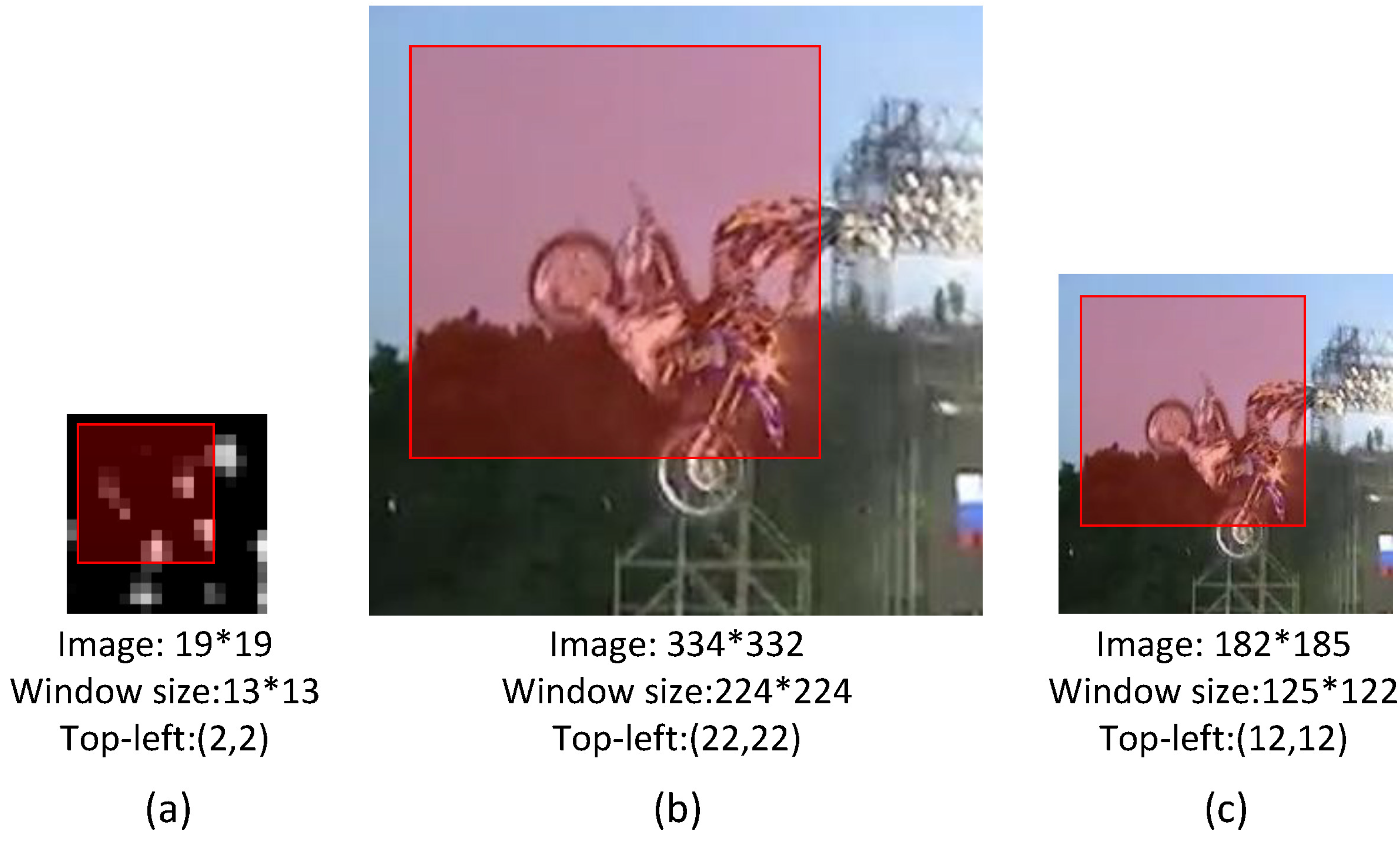
We present an example to illustrate how to calculate the final position in the original image in Figure 2. Note that, in our work, the step length of the sliding window may vary with the size of the object window for different video sequences, which can be approximated by:
S h o r = r o u n d ( 16 × w / N ) S v e r = r o u n d ( 16 × h / N )
where S h o r and S v e r are the horizontal and vertical step lengths, respectively.
Figure 2. Corresponding relations of positions in: (a) conv5 feature maps; (b) the normalized image region; and (c) the original image. The red rectangles denote the corresponding regions in these three images. The positions of the windows (with top-left coordinates and sizes) in different images are listed below these images.

3.3. Object Model Update

The exemplar-based model with CNN features is quite discriminative. To build a robust tracker, we should improve its adaptivity by updating short-term object models (note that, the way to build the long-term object model is the same with [9]). In this paper, the short-term object model is updated by selecting the detectors with strong discriminative ability and uncorrelated to other selected detectors. Gao et al. employed a sliding time window to select the object models [9]. Some other methods can be used, as well, like cluster methods, the random selection method, and so forth. For the precision and running speed of our tracker, we propose a greedy method to select “good” object models, as shown in Algorithm 2. We first rank all of the short-term object models by their discriminative ability, resulting in a candidate set of object models. We then take an object model from the candidate set in order and add it into the final short-term object model set, if it is uncorrelated to other selected detectors. In our method, the discriminative ability of a model ω i is measured by the confidence score H i ( X k ) to the current positive example X k , while the correlation between a candidate model ω u and a selected model ω z is measured by the distance of their confidence scores to all tracking results. More precisely, the distance d i s z from ω u to ω z can be computed as:
d i s z = i = 1 k ( H u ( X i ) H z ( X i ) ) 2
Note that, the model size Z < L is possible, in which case we can change the threshold τ to repeat our algorithm. However, considering the efficiency of our method, we will not do this more than once.
Algorithm 2 Object model updating algorithm
Input:
  • The set of all the short-term object models { ω i } , ( i = 2 , 3 , , k );
  • The set of the representations { X k } of tracking results; k is the index of current frame;
  • The predefined threshold τ;
  • The maximum size of final object models L;
Output:
  • The final object models R ;
1:
rank all the models { ω i } using the scores of H i ( X k ) = ω i T × X k ;
2:
take the top M models as candidates C = { ω m } , m = 1 , 2 , , M ;
3:
take the first model ω u (u = 1) from C , and put it into R ; its size is Z = 1;
4:
while ZL&uM do
5:
  take a model from C in order (from two to M), denote as ω u ;
6:
  flag = 1;
7:
  for Z = 1 to Z do
8:
      compute the distance d i s z from ω u to ω z by Equation (7);
9:
      if d i s z < τ then
10:
            flag = 0;
11:
             break;
12:
      end if
13:
  end for
14:
  if flag == 1 then
15:
      put ω u into R ;
16:
      Z = Z +1;
17:
  end if
18:
end while

3.4. Background Model Update

We model the background as a GMM with C components, denoted by:
M B = { ( p c , μ c , Σ c ) } , c = 1 , 2 , . . . , C
where p c , μ c , Σ c respectively represent the prior probability, mean and covariance of the c-th component. Let us denote by M k B = { ( p k , c , μ k , c , Σ k , c ) } c = 1 C the background model maintained at the time instance k. The initial model M 0 B is built offline, by using a large amount of negative samples on some natural images. We use the expectation maximum (EM) algorithm to calculate M 0 B .
We update the background model online to improve the adaptivity by some negative samples quite relevant to the tracking task. At the time instance k, we calculate the model M k B using the previous model M k 1 B and new negative samples. Let us denote by X k , c the collection of the n c negative samples that match the c-th component and by N k , c the number of samples used in calculating M k B , and let S k , c = X k , c · X k , c T . The iteration step of the online background model update can then be given by:
p k , c = p k 1 , c + α ( 1 p k 1 , c )
N k , c = N k 1 , c + n c
S k , c = S k 1 , c + X k , c · X k , c T
μ k , c = μ k 1 , c * N k 1 , c / N k , c + μ k , c
Σ k , c = ( S k , c N k , c μ k , c · μ k , c T ) / ( N k , c 1 )
where α is the learning rate.

4. Experimental Results

In this section, we evaluate the proposed tracking method (denoted as ECT), in comparison with other state-of-the-art trackers, on the CVPR2013 benchmark dataset [7] consisting of 50 sequences. This dataset covers 11 challenging scenarios for visual tracking, i.e., illumination variation, scale variation, occlusion, deformation, motion blur, fast motion, in-plane rotation, out-of-plane rotation, out-of-view, background clutters and low resolution. This dataset is an up-to-date comprehensive benchmark specifically designed for evaluation of tracking performance.

4.1. Implementation Details

For the object representation, we extract CNN features for appearance representation in this work, using the public MATLAB code MatConvNet (the code of MatConvNet can be found at: http://www.vlfeat.org/matconvnet/). We apply imagenet-vgg-f [19] as the pre-trained CNN model, which was trained to perform object classification on ILSVRC13 [59]. The input image of this CNN architecture is 224 × 224 × 3 in dimension; the conv5 feature maps are 13 × 13 × 256 in dimension; and the feature vector on fc7 is 4096 in dimension. In our two-step CNN extraction process, the size of input image is no smaller than 224 × 224; the size of conv5 feature maps is related to the input image; and the size of sliding windows on conv5 is 13 × 13, each window products of an fc7 feature vector of 4096 in dimension. Here are other parameters of this network in Equation (4): the radius of the receptive field r = 139/2, the stride s = 16, the top-left offset o l , t = 63 and the bottom-right offset o r , b = 75 [12]. For the object model updating, the size of candidate models is M = 100; the maximum size of the final models is L = 20; and the threshold is τ = 0.3. For the background model updating, the number of Gaussian distributions in GMM is C = 7; the learning rate is α = 0.7.
To build the offline background model, we collected more than 1,000,000 patches (64 × 64 pixels) by randomly sampling on the 5096 images of the PASCAL VOC 2008 dataset [60]. Then, the CNN feature is extracted to build the initial background model by normalizing them to 224 × 224 using bilinear interpolation; and the online negatives are sampled in the ring area with 5 < d ≤ 30. The detecting area R d is also set to 30. Note that the step of the sliding window relates to the size of object. This sample scheme is coarser than the dense sample scheme in general.
The tracker was implemented using MATLAB and C/C++. The average time cost for all testing sequences is about 2 fps on a workstation with Intel Xeon E5-2650 CPU (2.6 GHz) and an Nvidia Tesla K20C GPU. In our implementation, CNN features and the exemplar LDA classifier are computed using GPU. We also test the average time cost with the CPU only, which is about 0.6 fps. Note that our code is implemented without intensive program optimizations, such as parallel programming, which can be used to reduce the time cost of our tracker.

4.2. Overall Performance

We run the one-pass evaluation (OPE) [7] on the CVPR2013 benchmark using the proposed ECT tracker. Many trackers are compared in our experiment. The work [7] compares 29 popular trackers on this benchmark dataset. Besides the 29 trackers, we also compare our tracker to some other trackers, whose results on the benchmark are reported in recent past, i.e., SCEBT [61], ELDA [9], KCF [36], TGPR [62] and DLT [58]. Thus, 35 trackers in total are compared in our experiment.
Two common evaluation criteria are used for quantitative comparison, namely the precision plot and the success plot, proposed by [7]. First, we define these two criteria briefly. Both of them measure the percentage of successfully-tracked frames over an entire video against the densely-sampled threshold. In the precision plot, the threshold is the central location error (CLE), while in the success plot, the threshold is the bounding box overlap ratio (OR). For each frame, the result is denoted as the tracked bounding box B T and the central location C T , which for the ground truth are B G and C G , respectively. CLE is defined as the average Euclidean distance (in pixels) between C T and C G . OR is defined by the intersection over union (IOU) metric a r e a ( B T B G ) a r e a ( B T B G ) . To rank the trackers, we use the threshold metric (at 20) for the precision plot, while the area under the curve (AUC) metric for the success plot. The evaluation plots are computed using the tool provided by [7].
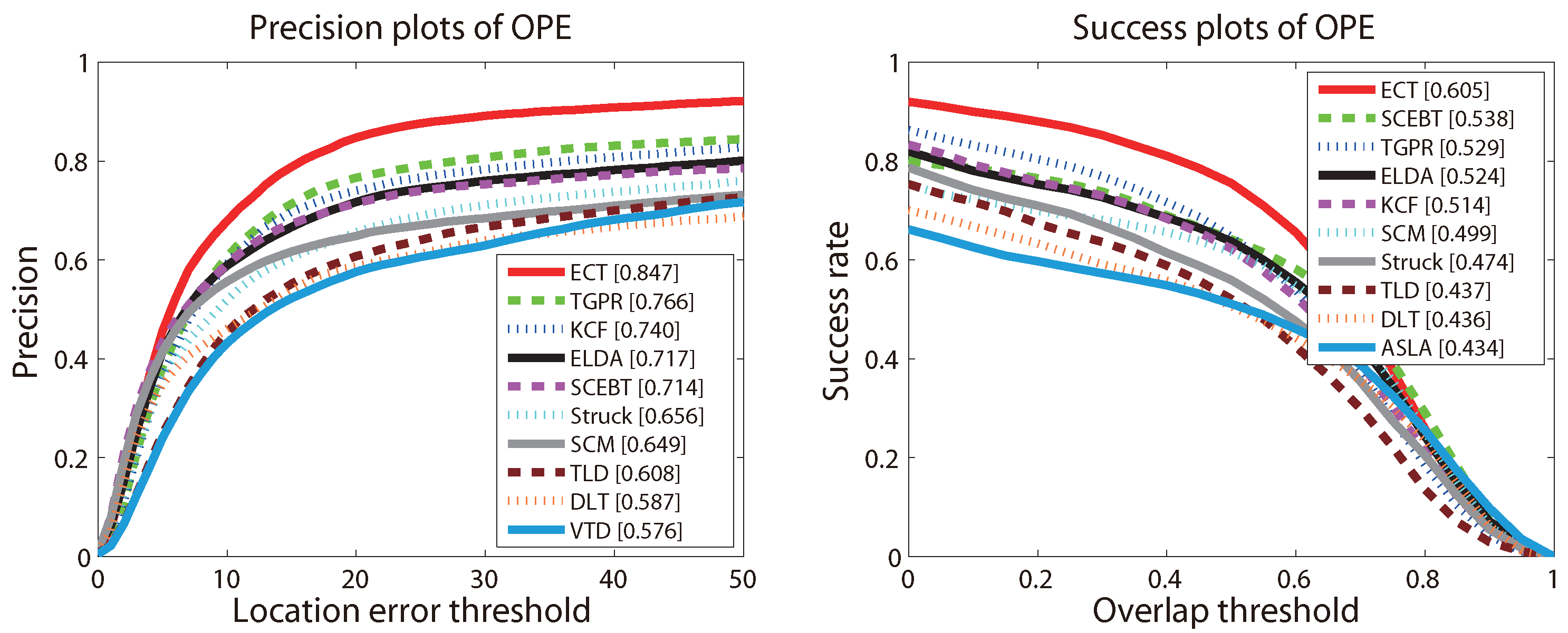
The precision and success plots for OPE are shown in Figure 3. All 35 trackers mentioned above are compared in this experiment, but only the top ten trackers with respect to the ranking scores are reported in each plot. The trackers appearing in these two plots and not mentioned above are as follows: Struck [29], SCM [44], TLD [31], VTD [49], ASLA [43]. The ranks are set with the score at threshold 20 and the AUC score for precision and success plots, respectively. The scores are also presented in the square brackets with the name of the trackers. Figure 3 shows that the proposed ECT achieves overall the best performance using both metrics. The remarkable performance gain obtained on such a large dataset demonstrates that our proposed method is very robust to the general challenges in tracking (the detailed results of the proposed method can be found on the project web page: https://sites.google.com/site/changxingao/ecnn).
Figure 3. The precision plot and success plot for one-pass evaluation (OPE) on the CVPR2013 benchmark. The top ten trackers with respect to the ranking scores are shown in each plot. The figure is best viewed in color.
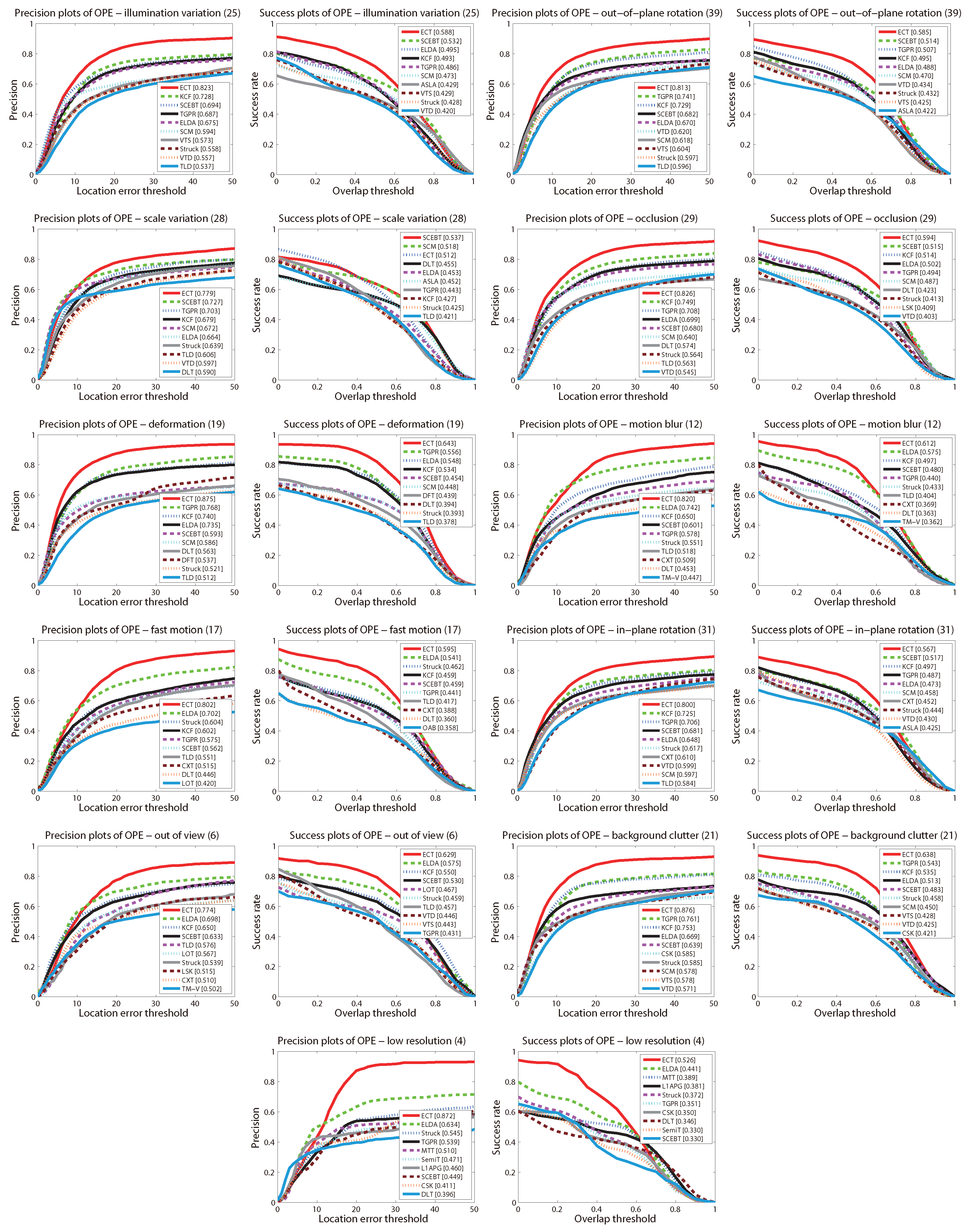
Then, we discuss the performance of ECT with the 11 challenging attributes, the precision and success plots are shown in Figure 4. The ranks are set with the score at threshold 20 and the AUC score for the precision and success plots respectively. It can be seen that ECT achieves the best performance in all 11 attributes using both metrics, expect in scale variation using the success plot. That demonstrates the robustness of our tracker to various challenges, especially to deformations, fast motions, background clutters and low resolution challenges. As mentioned above, ECT dose not rank first with scale variation challenge using the success plot. We believe the reason is that the detectors in ECT are designed for a fixed scale.
Figure 4. Average precision plot and success plot for OPE on the tracking benchmark dataset with 11 challenging attributions. The top ten trackers with respect to the ranking scores are shown in each plot. The figure is best viewed in color.

4.3. Quantitative Comparison

To further evaluate the robustness of our method in detail, we compare it against the other seven trackers, the top two of the 29 trackers reported in [7] (Struck [29], SCM [44]) and five trackers mentioned above (SCEBT [61], KCF [36], TGPR [62], DLT [58], ELDA [9]). For better analysis of the effectiveness of the ECT tracker, we first report the tracking performance at several different thresholds based on both the precision metric and the success rate metric in Table 1 and Table 2, respectively. The ECT tracker consistently outperforms other trackers at different thresholds. These comparison results demonstrate the superiority of the ECT tracker.
Table 1. Tracking performance at different thresholds based on the precision metric for 8 trackers on the benchmark dataset (p@x means the precision metric at the central location error x). Bold and underlined values indicate best and second best performance.
Table 2. Tracking performance at the different thresholds based on the success rate metric for 8 trackers on the benchmark dataset (p@x means the success rate metric at the bounding box overlap ratio x). Bold and underlined values indicate best and second best performance.
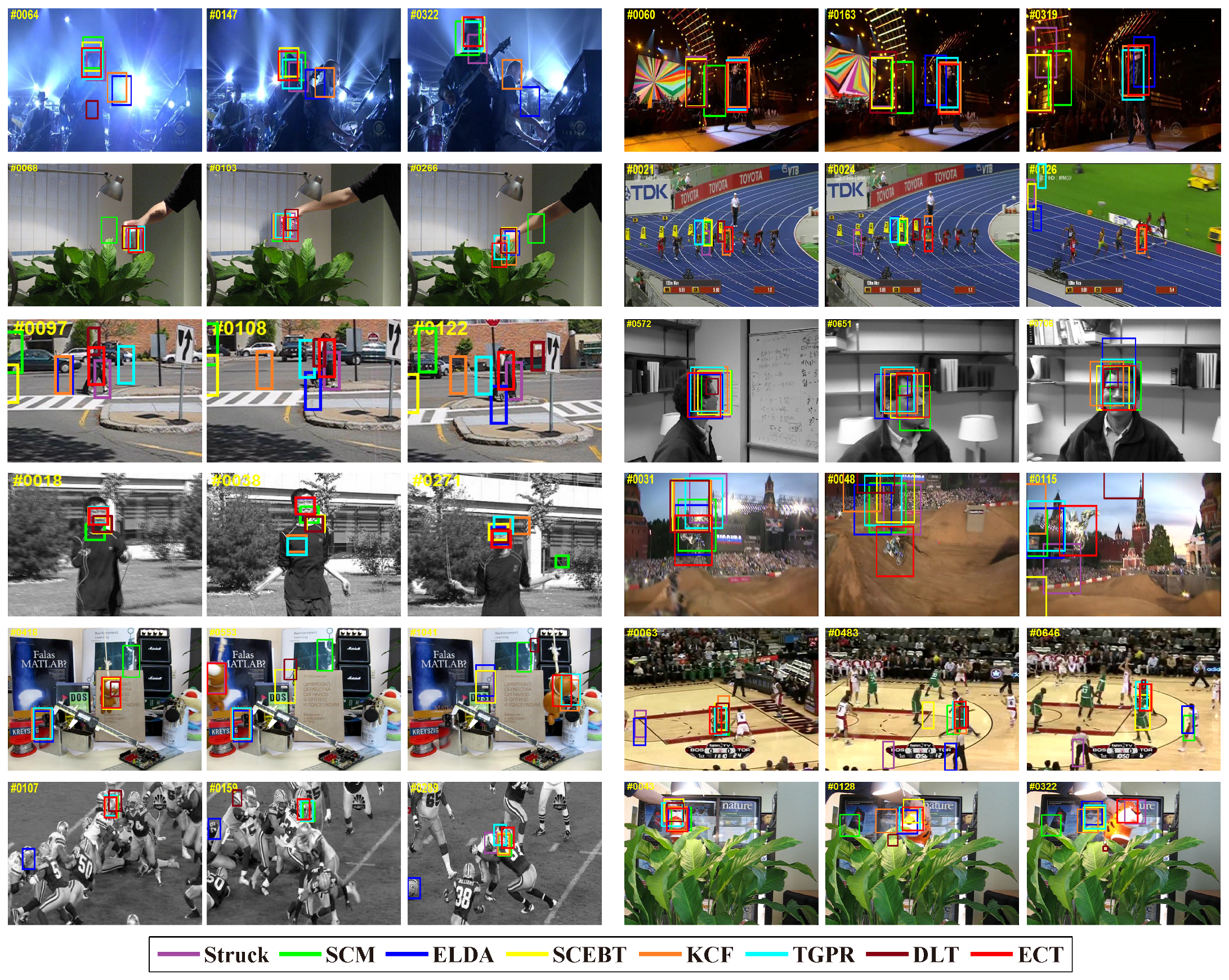
For intuitive demonstration, Figure 5 presents a qualitative comparison of the tracked bounding box with the eight trackers using both metrics on twelve challenging sequences. The challenging attributes of these sequences have been annotated in the benchmark [7]. The comparison results demonstrate the good performance of the ECT tracker in both accuracy and adaptivity.
Figure 5. Tracked bounding box results comparisons of eight trackers in 12 videos. The figure is best viewed in color.
Although ECT does not need to train a deep network during tracking, the CNN features are used to represent objects. Thus, we also compare our method to some deep learning-based tracking algorithms, i.e., DLT [58], DeepTrack [63], CNT [64], SO-DLT [65], in terms of the score at threshold 20 for the precision plot and the AUC score for the success rate plot; because the detailed results of the bounding box at each frame of DeepTrack, CNT and SO-DLT are not public. The comparison results are reported in Table 3, which shows that ECT performs comparably to DeepTrack and significantly better than the others.
Table 3. Comparison of the deep learning-based trackers and our approach in terms of score at threshold 20 for the precision plot (TP) and the AUC score for the success rate plot (ASR), on the CVPR2013 benchmark. Bold and underlined values indicate best and second best performance.

4.4. Evaluation of Components

To verify the contributions of each of the three proposed components, including the appearance representation using CNN features, the object model and the background model, we build three variants of the ECT tracker for comparative study, which are detailed as below:
  • ELDA_CNN: replacing the HoG representation in ELDA with CNN features;
  • ECT-OM: removing the proposed object model from ECT;
  • ECT-BM: removing the proposed background model from ECT;
Note that, in building these variant trackers, we keep unchanged everything except for the highlighted modifications above. Furthermore, note that we include the ELDA tracker in our comparison, as well, since the current work basically follows the ELDA framework.
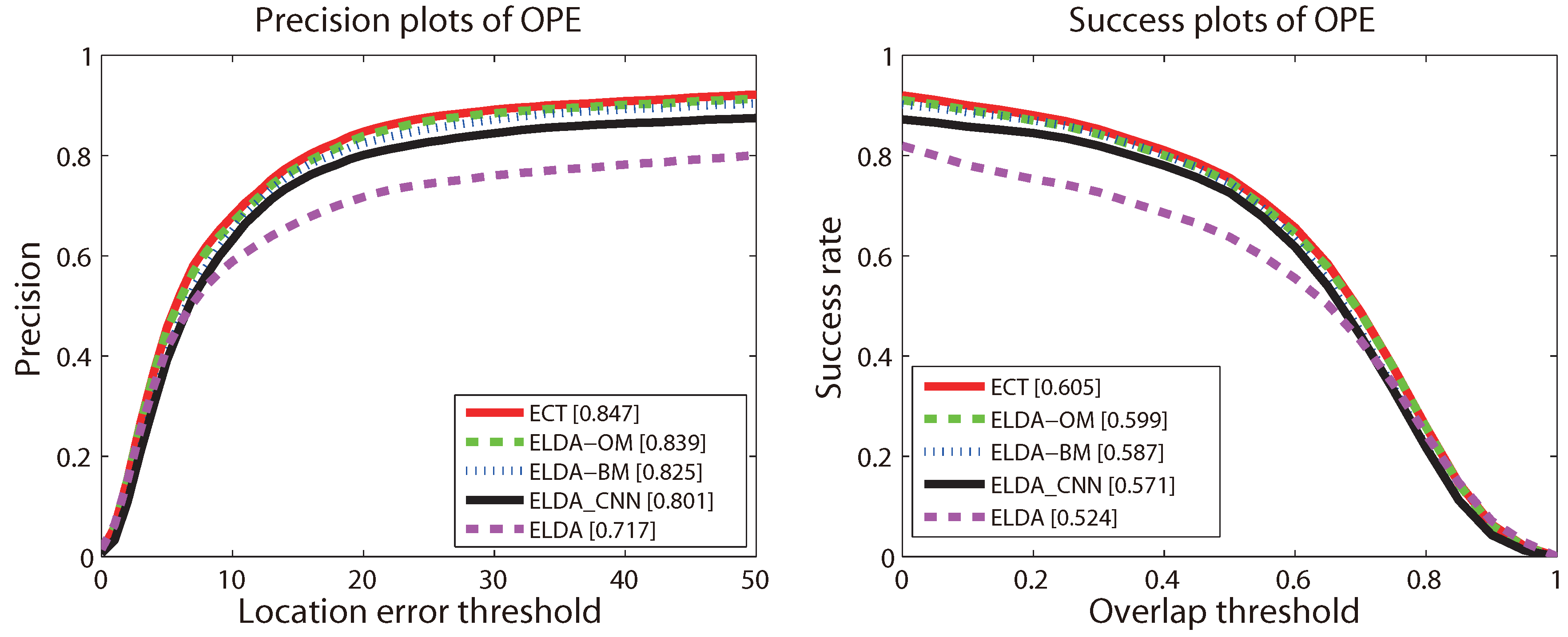
The comparison results are reported in Figure 6. It can be seen that ELDA_CNN obviously outperforms ELDA; this proves that CNN features play the most important role in the ECT tracker. That is because appearance representation is most critical (as pointed out in [66]), and CNN features are quite discriminative. ECT-OM performs better than ECT-BM, which means that the object model is less important than the background model. The reason is that, modeling the background as a GMM allows our tracker to adapt to the complex scenes, while selecting a subset of object instances to build an object model designed in consideration of tracking speed. Surprisingly, ECT slightly outperforms ECT-OM, which means the selected compact object model is more effective, by dropping out some bad models.
Figure 6. The precision plot and success plot of different versions of our method for OPE on the CVPR2013 benchmark. The top ten trackers with respect to the ranking scores are shown in each plot. The ranks are set with the score at threshold 20 and the AUC score for precision and success plots, respectively. The figure is best viewed in color.

5. Conclusions

This paper has proposed to enhance the ELDA tracking algorithm by CNN features and adaptive model update. CNN features are used as the object representation; and a two-step CNN feature extraction method has been proposed for fast computation; an object model update method is employed to build a compact object model; and the background model is described using a GMM. Promising results on video sequences of the CVPR2013 benchmark with various challenges showed that our method outperforms the state-of-the-art tracking algorithms, which demonstrated the robustness of our method. We are considering the following for the future work. We are searching for a method to refine the network during the tracking procedure, with low time cost. In this paper, the CNN architecture is pre-trained, which is not sufficiently specific to track an object instance.

Acknowledgments

This work was supported by the Project of the National Natural Science Foundation of China No. 61271328 and No. 61401170.

Author Contributions

Changxin Gao proposed the core idea, implemented the algorithm, partially designed the experiments and wrote the main body of the paper. Huizhang Shi performed the experiments. Jin-Gang Yu partially contributed to the idea, partially designed the experiments and analyzed the experimental results. Nong Sang partially contributed to the idea, supervised this work and revised the paper.

Conflicts of Interest

The authors declare no conflict of interest.

Abbreviations

AUC
area under the curve
CNN
convolutional neural networks
ELDA
exemplar-based linear discriminant analysis
HoG
histograms of oriented gradients
GMM
Gaussian mixture model
IOU
intersection over union
LDA
linear discriminant analysis
NMS
non-maximum suppression
OPE
one-pass evaluation
SIFT
scale-invariant feature transform

References

  1. Gao, H.; Li, J. Detection and Tracking of a Moving Target Using SAR Images with the Particle Filter-Based Track-Before-Detect Algorithm. Sensors 2014, 14, 10829–10845. [Google Scholar] [CrossRef] [PubMed]
  2. Xue, M.; Yang, H.; Zheng, S.; Zhou, Y.; Yu, Z. Incremental Structured Dictionary Learning for Video Sensor-Based Object Tracking. Sensors 2014, 14, 3130–3155. [Google Scholar] [CrossRef] [PubMed]
  3. Choi, Y.J.; Kim, Y.G. A Target Model Construction Algorithm for Robust Real-Time Mean-Shift Tracking. Sensors 2014, 14, 20736–20752. [Google Scholar] [CrossRef] [PubMed]
  4. Chen, J.; Wang, Y.; Wu, H. A coded aperture compressive imaging array and its visual detection and tracking algorithms for surveillance systems. Sensors 2012, 12, 14397–14415. [Google Scholar] [CrossRef] [PubMed]
  5. Qin, L.; Snoussi, H.; Abdallah, F. Object Tracking Using Adaptive Covariance Descriptor and Clustering-Based Model Updating for Visual Surveillance. Sensors 2014, 14, 9380–9407. [Google Scholar] [CrossRef] [PubMed]
  6. Pan, S.; Shi, L.; Guo, S. A Kinect-Based Real-Time Compressive Tracking Prototype System for Amphibious Spherical Robots. Sensors 2015, 15, 8232–8252. [Google Scholar] [CrossRef] [PubMed]
  7. Wu, Y.; Lim, J.; Yang, M.H. Online Object Tracking: A Benchmark. In Proceedings of the IEEE Conference on Computer Vision and Pattern Recognition (CVPR), Portland, OR, USA, 23–28 June 2013; pp. 2411–2418.
  8. Babenko, B.; Yang, M.H.; Belongie, S. Viusal tracking with online multiple instance learning. In Proceedings of the IEEE Conference on Computer Vision and Pattern Recognition (CVPR), Miami, FL, USA, 20–25 June 2009; pp. 983–990.
  9. Gao, C.; Chen, F.; Yu, J.G.; Huang, R.; Sang, N. Robust Visual Tracking Using Exemplar-based Detectors. IEEE Trans. Circuits Syst. Video Technol. 2015. [Google Scholar] [CrossRef]
  10. Dalal, N.; Triggs, B. Histograms of Oriented Gradients for Human Detection. In Proceedings of the IEEE Conference on Computer Vision and Pattern Recognition (CVPR), San Diego, CA, USA, 25 June 2005; Volume 1, pp. 886–893.
  11. Krizhevsky, A.; Sutskever, I.; Hinton, G.E. ImageNet Classification with Deep Convolutional Neural Networks. In Advances in Neural Information Processing Systems (NIPS); 2012; pp. 1097–1105. [Google Scholar]
  12. He, K.; Zhang, X.; Ren, S.; Sun, J. Spatial pyramid pooling in deep convolutional networks for visual recognition. IEEE Trans. Pattern Anal. Machine Intell. 2015, 37, 1904–1916. [Google Scholar] [CrossRef] [PubMed]
  13. Gong, Y.; Wang, L.; Guo, R.; Lazebnik, S. Multi-scale Orderless Pooling of Deep Convolutional Activation Features. In Proceedings of the European Conference on Computer Vision (ECCV), Zurich, Switzerland, 6–12 September 2014; pp. 392–407.
  14. Girshick, R.; Donahue, J.; Darrell, T.; Malik, J. Rich feature hierarchies for accurate object detection and semantic segmentation. In Proceedings of the IEEE Conference on Computer Vision and Pattern Recognition (CVPR), Columbus, OH, USA, 23–28 June 2014.
  15. Erhan, D.; Szegedy, C.; Toshev, A.; Anguelov, D. Scalable Object Detection using Deep Neural Networks. In Proceedings of the IEEE Conference on Computer Vision and Pattern Recognition (CVPR), Columbus, OH, USA, 23–28 June 2014; pp. 2147–2154.
  16. Farabet, C.; Couprie, C.; Najman, L.; LeCun, Y. Learning hierarchical features for scene labeling. IEEE Trans. Pattern Anal. Mach. Intell. 2013, 35, 1915–1929. [Google Scholar] [CrossRef] [PubMed]
  17. Ji, S.; Xu, W.; Yang, M.; Yu, K. 3D convolutional neural networks for human action recognition. IEEE Trans. Pattern Anal. Mach. Intell. 2013, 35, 221–231. [Google Scholar] [CrossRef] [PubMed]
  18. Dong, C.; Loy, C.C.; He, K.; Tang, X. Learning a deep convolutional network for image super-resolution. In Proceedings of the European Conference on Computer Vision (ECCV), Zurich, Switzerland, 6–12 September 2014; pp. 184–199.
  19. Chatfield, K.; Simonyan, K.; Vedaldi, A.; Zisserman, A. Return of the Devil in the Details: Delving Deep into Convolutional Nets. Proc. BMVC 2014. arXiv:1405.3531. [Google Scholar]
  20. Malisiewicz, T.; Gupta, A.; Efros, A.A. Ensemble of exemplar-SVMs for object detection and beyond. In Proceedings of the International Conference on Computer Vision (ICCV), Barcelona, Spain, 6–13 November 2011; pp. 89–96.
  21. Hariharan, B.; Malik, J.; Ramanan, D. Discriminative decorrelation for clustering and classification. In Proceedings of the 12th European Conference on Computer Vision (ECCV), Florence, Italy, 7–13 October 2012; pp. 459–472.
  22. Yilmaz, A.; Javed, O.; Shah, M. Object tracking: A survey. ACM Comput. Surv. 2006, 38. [Google Scholar] [CrossRef]
  23. Yang, H.; Shao, L.; Zheng, F.; Wang, L.; Song, Z. Recent advances and trends in visual tracking: A review. Neurocomputing 2011, 74, 3823–3831. [Google Scholar] [CrossRef]
  24. Smeulders, A.W.; Chu, D.M.; Cucchiara, R.; Calderara, S.; Dehghan, A.; Shah, M. Visual tracking: An experimental survey. IEEE Trans. Pattern Anal. Mach. Intell. 2014, 36, 1442–1468. [Google Scholar] [PubMed]
  25. Grabner, H.; Grabner, M.; Bischof, H. Real-time tracking via on-line boosting. In Proceedings of the British Machine Vision Conference (BMVC), Edinburgh, UK, 4–7 September 2006.
  26. Grabner, H.; Leistner, C.; Bischof, H. Semi-supervised on-line boosting for robust tracking. In Proceedings of the 10th European Conference on Computer Vision (ECCV), Marseille, France, 12–18 October 2008; pp. 234–247.
  27. Stalder, S.; Grabner, H.; Van Gool, L. Beyond semi-supervised tracking: Tracking should be as simple as detection, but not simpler than recognition. In Proceedings of the International Conference on Computer Vision (ICCV) Workshops, Kyoto, Japan, 27 September–4 October 2009; pp. 1409–1416.
  28. Zhang, K.; Zhang, L.; Yang, M.H. Real-time compressive tracking. In Proceedings of the European Conference on Computer Vision (ECCV), Florence, Italy, 7–13 October 2012; pp. 864–877.
  29. Hare, S.; Saffari, A.; Torr, P.H.S. Struck: Structured output tracking with kernels. In Proceedings of the International Conference on Computer Vision (ICCV), Barcelona, Spain, 6–13 November 2011; pp. 263–270.
  30. Viola, P.; Jones, M. Robust real-time object detection. Int. J. Comput. Vis. 2001, 4, 51–52. [Google Scholar]
  31. Kalal, Z.; Matas, J.; Mikolajczyk, K. P-N learning: Bootstrapping binary classifiers by structural constraints. In Proceedings of the IEEE Conference on Computer Vision and Pattern Recognition (CVPR), San Francisco, CA, USA, 13–18 June 2010; pp. 49–56.
  32. Dinh, T.B.; Vo, N.; Medioni, G. Context tracker: Exploring supporters and distracters in unconstrained environments. In Proceedings of the IEEE Conference on Computer Vision and Pattern Recognition (CVPR), Providence, RI, USA, 20–25 June 2011; pp. 1177–1184.
  33. Ma, C.; Liu, C. Two dimensional hashing for visual tracking. Comput. Vis. Image Underst. 2015, 135, 83–94. [Google Scholar] [CrossRef]
  34. Tang, F.; Brennan, S.; Zhao, Q.; Tao, H. Co-tracking using semi-supervised support vector machines. In Proceedings of the International Conference on Computer Vision (ICCV), Rio de Janeiro, Brazil, 14–21 October 2007; pp. 1–8.
  35. Song, S.; Xiao, J. Tracking revisited using RGBD camera: Unified benchmark and baselines. In Proceedings of the International Conference on Computer Vision (ICCV), Sydney, Australia, 1–8 December 2013; pp. 233–240.
  36. Henriques, J.F.; Caseiro, R.; Martins, P.; Batista, J. High-speed tracking with kernelized correlation filters. IEEE Trans. Pattern Anal. Mach. Intell. 2015, 37, 583–596. [Google Scholar] [CrossRef] [PubMed]
  37. Zhou, Y.; Bai, X.; Liu, W.; Latecki, L.J. Similarity Fusion for Visual Tracking. Int. J. Comput. Vis. 2016. [Google Scholar] [CrossRef]
  38. Sun, L.; Liu, G. Visual object tracking based on combination of local description and global representation. IEEE Trans. Circuits Syst. Video Technol. 2011, 21, 408–420. [Google Scholar] [CrossRef]
  39. Bouachir, W.; Bilodeau, G.A. Collaborative part-based tracking using salient local predictors. Comput. Vis. Image Underst. 2015, 137, 88–101. [Google Scholar] [CrossRef]
  40. Zhang, S.; Yao, H.; Sun, X.; Lu, X. Sparse coding based visual tracking: Review and experimental comparison. Pattern Recognit. 2012, 46, 1772–1788. [Google Scholar] [CrossRef]
  41. Ross, D.; Lim, J.; Lin, R.S.; Yang, M.H. Incremental Visual Tracking. Int. J. Comput. Vis. 2008, 77, 125–141. [Google Scholar] [CrossRef]
  42. Liu, B.; Huang, J.; Kulikowsk, C. Robust tracking using local sparse appearance model and k-selection. In Proceedings of the IEEE Conference on Computer Vision and Pattern Recognition (CVPR), Providence, RI, USA, 20–25 June 2011; pp. 1313–1320.
  43. Jia, X.; Lu, H.; Yang, M.H. Visual tracking via adaptive structural local sparse appearance model. In Proceedings of the IEEE Conference on Computer Vision and Pattern Recognition (CVPR), Providence, RI, USA, 6–21 June 2012; pp. 1822–1829.
  44. Zhong, W.; Lu, H.; Yang, M.H. Robust object tracking via sparsity-based collaborative model. In Proceedings of the IEEE Conference on Computer Vision and Pattern Recognition (CVPR), Providence, RI, USA, 6–21 June 2012; pp. 1838–1845.
  45. Zhang, T.; Ghanem, B.; Liu, S.; Ahuja, N. Roubst visual tracking via multi-task sparse learning. In Proceedings of the IEEE Conference on Computer Vision and Pattern Recognition (CVPR), Providence, RI, USA, 6–21 June 2012; pp. 2042–2049.
  46. Bao, C.; Wu, Y.; Ling, H.; Ji, H. Real time robust L1 tracker using accelerated proximal gradient approach. In Proceedings of the IEEE Conference on Computer Vision and Pattern Recognition (CVPR), Providence, RI, USA, 6–21 June 2012; pp. 1830–1837.
  47. Wang, B.; Tang, L.; Yang, J.; Zhao, B.; Wang, S. Visual Tracking Based on Extreme Learning Machine and Sparse Representation. Sensors 2015, 15, 26877–26905. [Google Scholar] [CrossRef] [PubMed]
  48. Kwon, J.; Lee, K.M. Tracking by sampling trackers. In Proceedings of the International Conference on Computer Vision (ICCV), Barcelona, Spain, 6–13 November 2011; pp. 1195–1202.
  49. Kwon, J.; Lee, K.M. Visual tracking decomposition. In Proceedings of the IEEE Conference on Computer Vision and Pattern Recognition (CVPR), San Francisco, CA, USA, 13–18 June 2010; pp. 1269–1276.
  50. Godec, M.; Roth, P.M.; Bischof, H. Hough-based tracking of non-rigid objects. Comput. Vis. Image Underst. 2013, 117, 1245–1256. [Google Scholar] [CrossRef]
  51. Wang, H.; Sang, N.; Yan, Y. Real-Time Tracking Combined with Object Segmentation. In Proceedings of the International Conference on Pattern Recognition (ICPR), Stockholm, Sweden, 24–28 August 2014; pp. 4098–4103.
  52. Wen, L.; Du, D.; Lei, Z.; Li, S.Z.; Yang, M.H. JOTS: Joint Online Tracking and Segmentation. In Proceedings of the IEEE Conference on Computer Vision and Pattern Recognition (CVPR), Boston, MA, USA, 7–12 June 2015; pp. 2226–2234.
  53. Baudat, G.; Anouar, F. Generalized discriminant analysis using a kernel approach. Neural Comput. 2000, 12, 2385–2404. [Google Scholar] [CrossRef] [PubMed]
  54. Krzanowski, W.; Jonathan, P.; Mccarthy, W.; Thomas, M. Discriminant analysis with singular covariance matrices: Methods and applications to spectroscopic data. Appl. Stat. 1995, 44, 101–115. [Google Scholar] [CrossRef]
  55. Ye, J.; Janardan, R.; Li, Q. Two-dimensional linear discriminant analysis. In Proceedings of the Advances in Neural Information Processing Systems (NIPS), Vancouver, BC, Canada, 13–18 December 2004; pp. 1569–1576.
  56. Rao, C.R. The utilization of multiple measurements in problems of biological classification. J. R. Stat. Soc. Ser. B (Methodol.) 1948, 10, 159–203. [Google Scholar]
  57. Fan, J.; Xu, W.; Wu, Y.; Gong, Y. Human tracking using convolutional neural networks. IEEE Trans. Neural Netw. 2010, 21, 1610–1623. [Google Scholar] [PubMed]
  58. Wang, N.; Yeung, D.Y. Learning a deep compact image representation for visual tracking. In Proceedings of the Advances in Neural Information Processing Systems (NIPS), Lake Tahoe, NV, USA, 5–10 December 2013; pp. 809–817.
  59. Russakovsky, O.; Deng, J.; Su, H.; Krause, J.; Satheesh, S.; Ma, S.; Huang, Z.; Karpathy, A.; Khosla, A.; Bernstein, M.; et al. ImageNet Large Scale Visual Recognition Challenge. Int. J. Comput. Vis. 2015, 115, 211–252. [Google Scholar] [CrossRef]
  60. Everingham, M.; Van Gool, L.; Williams, C.; Winn, J.; Zisserman, A. The PASCAL Visual Object Classes Challenge 2008 (VOC2008) Results. Available online: http://host.robots.ox.ac.uk/pascal/VOC/voc2008/index.html (accessed on 14 April 2016).
  61. Wang, N.; Yeung, D.Y. Ensemble-based tracking: Aggregating crowdsourced structured time series data. In Proceedings of the 31th International Conference on Machine Learning (ICML), Beijing, China, 21–26 June 2014; pp. 806–813.
  62. Gao, J.; Ling, H.; Hu, W.; Xing, J. Transfer learning based visual tracking with Gaussian processes regression. In 13th Proceedings of the European Conference on Computer Vision (ECCV), Zurich, Switzerland, 6–12 September 2014; pp. 188–203.
  63. Li, H.; Li, Y.; Porikli, F. DeepTrack: Learning Discriminative Feature Representations by Convolutional Neural Networks for Visual Tracking. In Proceedings of the British Machine Vision Conference (BMVC), Nottingham, UK, 1–5 September 2014.
  64. Zhang, K.; Liu, Q.; Wu, Y.; Yang, M.H. Robust Visual Tracking via Convolutional Networks without Learning. IEEE Trans. Image Process. 2015, 25, 1779–1792. [Google Scholar]
  65. Wang, N.; Li, S.; Gupta, A.; Yeung, D.Y. Transferring Rich Feature Hierarchies for Robust Visual Tracking. Comput. Vis. Pattern Recognit. 2015. arXiv:1501.04587. [Google Scholar]
  66. Wang, N.; Shi, J.; Yeung, D.Y.; Jia, J. Understanding and Diagnosing Visual Tracking Systems. In Proceedings of the IEEE International Conference on Computer Vision (ICCV), Santiago, Chile, 7–13 December 2015.

Article Metrics

Citations

Article Access Statistics

Multiple requests from the same IP address are counted as one view.