


Abstract
Alveopora japonica is restricted to the Asia-Pacific region, ranging from subtropical to temperate waters. In 2016, a massive bleaching event of an A. japonica population was observed at the south coast of Jeju Island, South Korea, which is within its northernmost limit. After the bleaching event, most of the colonies had recovered by 2017.
The scleractinian coral Alveopora japonica Eguchi, 1968, has a spatial distribution range restricted to exclusively subtropical and temperate reefs. This species ranges from Taiwan, through Japan (Ryukyu arc and South Kyushu), and up to Jeju Island, in the southern region of South Korea [1]. As a colonial scleractinian species, A. japonica is zooxanthellate, and it has been argued that its capability to switch to any genus of Symbiodiniaceae is most suitable for the given environmental conditions and has enabled it to thrive in the vastly variable temperature scheme of temperate reefs [2].
As a consequence of global warming, A. japonica has recently experienced explosive population growth, outcompeting the indigenous seaweed species Ecklonia cava, which is the main species of kelp forests in Jeju Island [3,4]. The rapid recruitment rate of A. japonica (7.8 colonies m−2 yr−1) may be the most significant contributing factor to their success in spatial competition in subtidal habitats [5]. However, this population expansion causes changes in the ecosystem with negative impacts on local habitats and their marine biodiversity [3].
In 2016, coral reefs in tropical/subtropical regions underwent the most severe bleaching event on record. Nevertheless, there are no reports of whether this massive coral bleaching event also occurred in the northernmost habitats of the A. japonica population. Although massive bleaching as such is not a novel observation, it is unusual in respect to temperate coral communities. Here, we provide the first report about a massive bleaching event of scleractinian corals along the temperate Asia-Pacific marginal distribution zone.
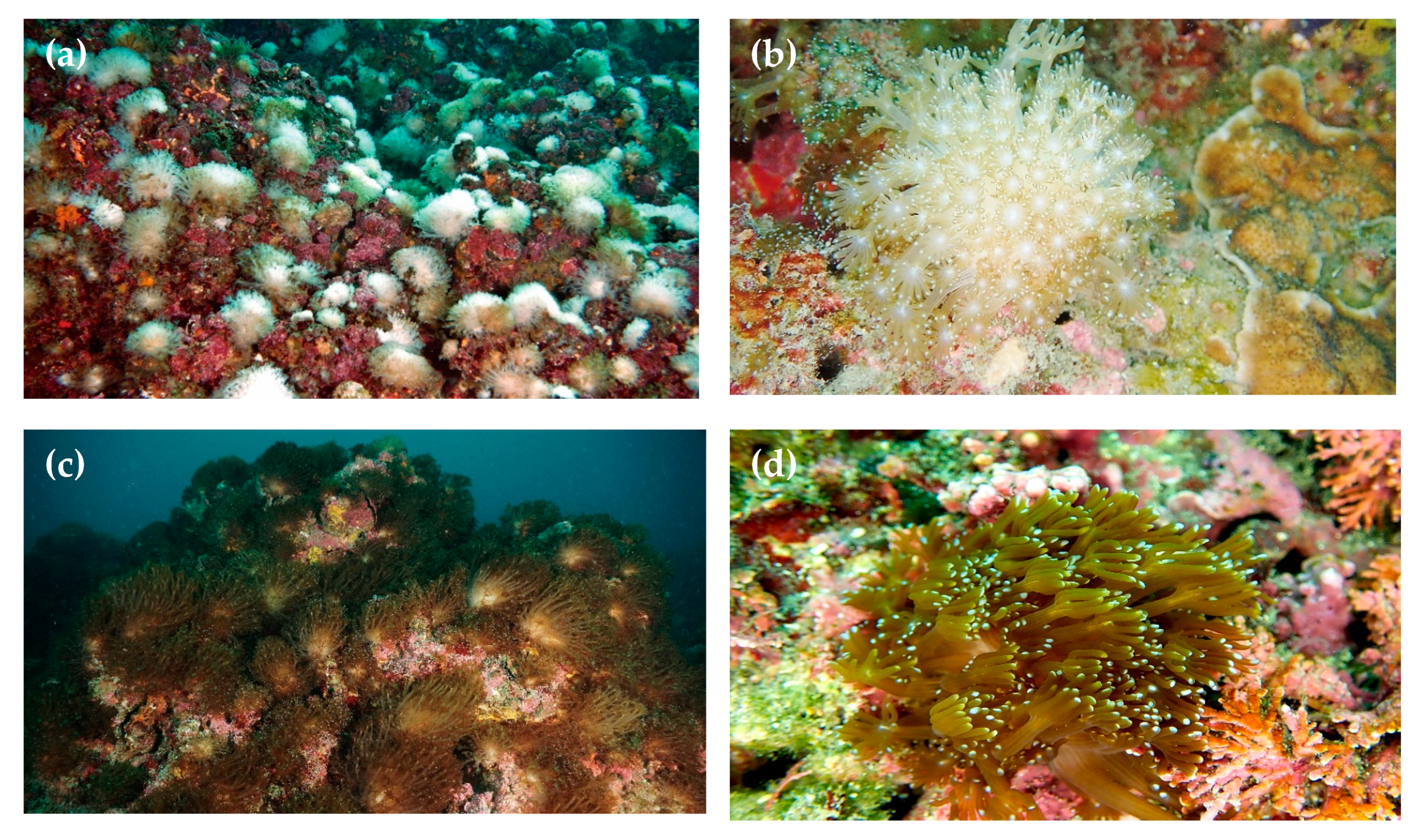
In September 2016, the mass bleaching of the A. japonica population in subtidal habitats was observed along the southern coast of Jeju Island (33°14′23.95″ N, 126°35′26.44″ E) at a water depth of 10 m (Figure 1a). The population density of A. japonica was very high in this area, showing an abundance of 155 colonies m−2 [4]. Based on photographic assessment criteria, we estimate that 91–96% of colonies were affected by this bleaching event. The summer water temperature in August 2016 along the south coast of Jeju Island showed the highest value (daily average 27.0 °C, maximum 28.7 °C) of the past two decades (average in August; 24.3 °C) (Data from Korea Hydrographic and Oceanographic Agency). These abnormally high water temperatures may have contributed to the observed coral bleaching in this region.
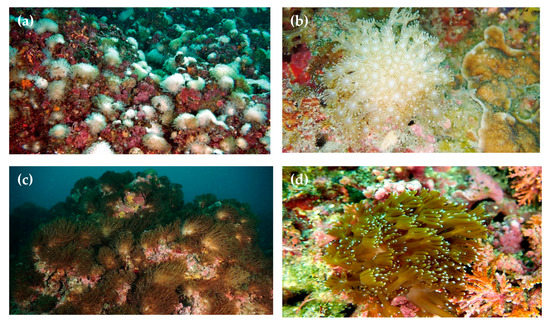
Figure 1.
(a) Massive bleaching of Alveopora japonica population observed at subtidal of Jeju Island in 2016; (b) Bleached Alveopora japonica still actively waving with elongated tentacles; (c) Recovered Alveopora japonica population after bleaching event (2017); (d) A healthy Aveopora japonica colony in 2017.
Although bleached, most of the colonies were alive, their polyps extended, and tentacles actively moving (Figure 1b). When we revisited the site in June 2017, we found these bleached corals had recovered (Figure 1c,d). Despite the observed extensive bleaching and persistent rise in seawater temperature, the A. japonica population of Jeju Island continues to recover and even expand.
In the past, seaweed species had provided a canopy, shielding the environment underneath from high radiation. Now, however, much of this seaweed cover declined due to global warming and spatial competition with the A. japonica population [6]. Thus, in the coming years, we expect summer bleaching events to occur more frequently due to high radiation in addition to the continuously rising seawater temperature.
However, seawater temperature in winter around Jeju Island has risen by 3.6 °C over the last 36 years compared to just 0.7 °C in summer (Data was derived from NOAA AVHRR and NASA MODIS Level 3 Standard Mapped Image products for the period of 1985 to 2020), providing a more favorable temperature for this species. In respect to the ongoing global warming crisis, this indicates that although the population may suffer from severe heat stress in the summers to come, it also may have better chances of recovery and even growth during the winter seasons. Future investigations will show whether summer bleaching will eventually become too severe for winter recovery to succeed.
Author Contributions
Conceptualization, T.K. (Taihun Kim) and T.K. (Taeho Kim); methodology, H.-S.Y. and S.K.C.; validation, T.K. (Taihun Kim); formal analysis, H.-S.Y. and Y.B.S.; investigation, S.K.C. and T.K. (Taeho Kim); resources, T.K. (Taeho Kim); writing and visualizing, T.K. (Taihun Kim); supervision and project administration, Y.B.S. and D.-H.K. All authors have read and agreed to the published version of the manuscript.
Funding
This research was supported by the project “Biogeochemical cycling and marine environmental change study”, funded by the Korea Institute of Ocean Science and Technology (KIOST), grant number PEA0012.
Institutional Review Board Statement
Not applicable.
Informed Consent Statement
Not applicable.
Data Availability Statement
Not applicable.
Acknowledgments
We would like to express our appreciation to the administrative and technical support team of the Jeju Institute, KIOST.
Conflicts of Interest
The authors declare no conflict of interest.
References
- Veron, J.E.N. Coral of the World; Australian Institute of Marine Science: Townsville, Australia, 2000.
- Lee, M.J.; Jeong, H.J.; Jang, S.H.; Lee, S.Y.; Kang, N.S.; Lee, K.H.; Kim, H.S.; Wham, D.C.; LaJeunesse, T.C. Most low-abundance “Background” Symbiodinium spp. Are transitory and have minimal functional significance for symbiotic corals. Microb. Ecol. 2016, 71, 771–783. [Google Scholar] [CrossRef] [PubMed]
- Denis, V.; Chen, C.A.; Song, J.I.; Woo, S. Alveopora japonica beds thriving under kelp. Coral Reefs 2013, 32, 503. [Google Scholar] [CrossRef] [Green Version]
- Vieira, C.; Keshavmurthy, S.; Ju, S.-J.; Hyeong, K.; Seo, I.; Kang, C.-K.; Hong, H.-K.; Chen, C.A.; Choi, K.-S. Population dynamics of a high-latitude coral Aveopora japonica Eguchi from Jeju Island, off the southern coast of Korea. Mar. Freshwater Res. 2016, 67, 594–604. [Google Scholar] [CrossRef]
- Hong, H.-K.; Keshavmurthy, S.; Kang, C.-K.; Hwang, K.; Park, S.R.; Cho, S.-H.; Choi, K.-S. Alveopora japonica repopulation of a bare substrate off Jeju Island Korea. Bull. Mar. Sci. 2015, 91, 477–478. [Google Scholar] [CrossRef]
- Denis, V.; Ribas-Deulofeu, L.; Loubeyres, M.; De Palmas, S.; Hwang, S.-J.; Song, J.-I.; Chen, C.A. Recruitment of the subtropical coral Alveopora japonica in the temperate waters of Jeju Island, South Korea. Bull. Mar. Sci. 2015, 91, 85–96. [Google Scholar] [CrossRef]
Publisher’s Note: MDPI stays neutral with regard to jurisdictional claims in published maps and institutional affiliations. |
© 2022 by the authors. Licensee MDPI, Basel, Switzerland. This article is an open access article distributed under the terms and conditions of the Creative Commons Attribution (CC BY) license (https://creativecommons.org/licenses/by/4.0/).