
Abstract
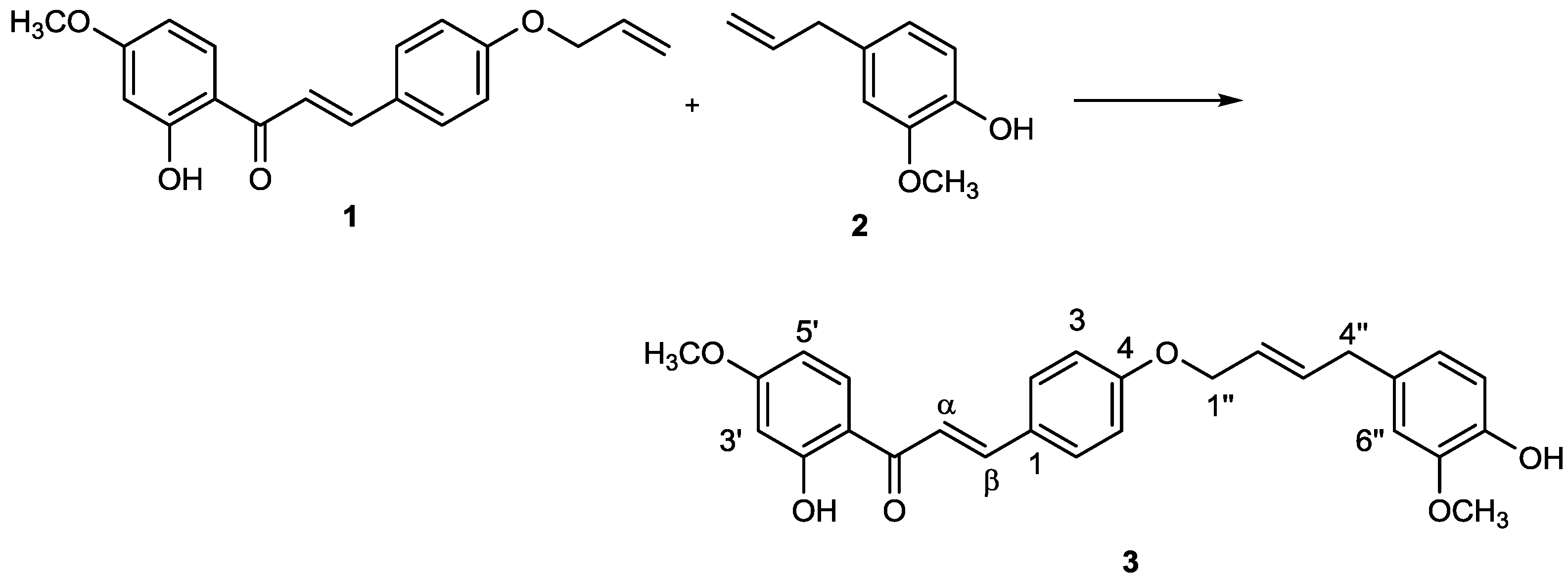
A hybrid of eugenol and a chalcone has been synthesized in good yield via cross olefin metathesis. The title compound (3) was characterized by spectroscopic data including NMR, infrared, and ESI-MS.
1. Introduction
The assembly of natural product hybrids has been an interesting strategy to gain new leads in drug discovery [1]. A convenient method to synthesize hybrid molecules is olefin cross metathesis. The hybrid molecule is formed from two precursors in which each molecule contains a terminal olefin in the presence of olefin metathesis catalysts [2]. The olefin metathesis reaction takes place with a wide tolerance to many organic functional groups. This is ideal to make hybrid molecules from natural products without any additional protective group. Eugenol is a major component of the essential oil from cloves, and plays an important role in the antibacterial activity of clove oil against Salmonella typhi [3]. The allyl group of eugenol is an important functional group in producing hybrid molecules of eugenol and other compounds. In our program to produce a library of compounds for antibacterial screening, we synthesized and modified some natural product compounds [4]. In this paper, we report the synthesis of a hybrid molecule between eugenol (2) and a chalcone (1) in the presence of Grubbs II catalyst (Scheme 1). By using Grubbs II catalyst, we found that the reaction took place at the allyl groups and furnished an E olefin as the major product (see Figure S2 in the supplementary for more details) [5].
Scheme 1.
Synthesis of chalcone and eugenol hybrid by cross olefin metathesis reaction.
2. Experimental Section
All chemicals and solvents for reactions were purchased from commercial suppliers and were used without purification. All solvents for chromatography were distilled before use. The melting point was determined with a Fisher-Johns Melting Point Apparatus and is uncorrected. Fourier transform infrared (FTIR) spectra were recorded with an FTIR prestige 21 Shimadzu instrument (Shimadzu Corp., Kyoto, Japan). 1H- and 13C-NMR (1D and 2D) spectra were recorded on an Agilent DD2 system operating at 500 MHz (1H) and 125 MHz (13C) (Agilent Technologies Inc., Santa Clara, CA, USA). High-resolution mass spectra was obtained with an ESI-TOF (ElectroSpray Ionisation—Time Of Flight) Waters LCT Premier XE mass spectrometer (Waters Corp., Milford, MA, USA).
Preparation of Compound 3
A mixture of (E)-1-(2,4-dimethoxy)-3-(4′-allyloxy)prop-2-en-1-one (1) (45 mg, 0.145 mmol, 1 eq), eugenol (2) (477 mg, 2.9 mmol, 20 eq) and Grubbs catalyst 2nd Generation (6.2 mg, 7.25 × 10⁻³ μmol, 5.3 mol%) in CH2Cl2 (7.5 mL) was stirred for 2 h at 40 °C under N2 atmosphere. The reaction was monitored by thin layer chromatography (TLC) analysis. After completion of the reaction, the mixture was concentrated in vacuo. Purification of the product was done by radial chromatography with n-hexane:acetone (20:2) to give a mixture of compound 3 and an inseparable isomer (2′Z) of 3 (9:1) as an orange solid (63 mg, 94%), m.p.: 114–115 °C. FTIR (KBr): 3448 (stretch OH, H bond), 2920 (stretch CH3 sp3), 1631 (stretch C=O), 1566 and 1446 (stretch C=C aromatic), 1220 and 1012 (stretch C-O-Ar) cm−1. 1H-NMR (500 MHz, CDCl3) δ ppm: 13.55 (s, 1H, H2′); 7.86 (d, J = 15.5 Hz, 1H, Hβ); 7.82 (d, J = 8.5 Hz, 1H, H6′); 7.59 (d, J = 9.0 Hz, 2H, H2/6); 7.45 (d, J = 15.5 Hz, 1H, Hα); 6.94 (d, J = 8.5 Hz, 2H, H3/5); 6.86 (d, J = 8.0 Hz, 1H, H9′′); 6.68 (d, J = 10 Hz, 2H, H5′/10′′); 6.48 (dd, J = 11 and 2.5 Hz, 2H, H3′/6′′); 6.01 (dt, J = 15.0 and 6.0 Hz, 1H, H2′′); 5.75 (dt, J = 15.0 and 6.0 Hz, 1H, H3′′); 4.56 (d, J = 6.0 Hz, 2H, H1′′); 3.85 (s, 6H, 4′-OCH3/7′′-OCH3); 3.37 (d, J = 6.5 Hz, 2H, H4′′). 13C-NMR (125 MHz, CDCl3) δ ppm: 192.0 (C=O); 166.7 (C2′); 166.2 (C4′); 161.0 (C4); 146.6 (C7′′); 144.4 (C8′′); 144.2 (Cβ); 134.8 (C2′′); 131.4 (C5′′); 130.4 (C2/6); 130.2 (C6′); 127.7 (C1); 125.5 (C3′′); 121.3 (C10′′); 118.0 (Cα); 115.3 (C3/5); 114.5 (C1′); 114.3 (C9′′); 111.2 (C5′); 107.7 (C6′′); 101.2 (C3′); 68.7 (C1′′); 56.0 (4′-OCH3); 55.7 (7′′-OCH3); 38.5 (C4′′). HR-ESI-TOF MS for C27H26O6 ([M + H]+) calculated: m/z 447.1808, found: m/z 447.1801.
Supplementary Materials
The 1H, 13C, 2D 1H-13C HSQC and 2D 1H-13C HMBC NMR spectra are available online at: www.mdpi.com/1422-8599/2017/1/M922.
Supplementary File 1Supplementary File 2Supplementary File 3Supplementary File 4Acknowledgments
This research was partially supported by Directorate General of Higher Education, Ministry of Education and Culture, Indonesia and the Indonesian Oil Palm Estate Fund.
Author Contributions
Didin Mujahidin and Yana M. Syah designed the experiment. Muhamad S. Fareza executed the experiment. All authors interpreted data and prepare the manuscript in the same contribution.
Conflicts of Interest
The authors declare no conflict of interest.
References
- Tietze, L.F.; Bell, H.P.; Chandrasekhar, S. Natural product hybrids as new leads for drug discovery. Angew. Chem. Int. Ed. 2003, 42, 3996–4028. [Google Scholar] [CrossRef] [PubMed]
- Dragutan, I.; Dragutan, V.; Demonceau, A. Targeted drugs by olefin metathesis: Piperidine-based iminosugars. RSC Adv. 2012, 2, 719–736. [Google Scholar] [CrossRef]
- Devi, K.P.; Nisha, S.A.; Sakthivel, R.; Pandian, S.K. Eugenol (an essential oil of clove) acts as an antibacterial agent against Salmonela typhi by disrupting the cellular membrane. J. Ethnopharmacol. 2010, 130, 107–115. [Google Scholar] [CrossRef] [PubMed]
- Fareza, M.S.; Syah, Y.M.; Mujahidin, D.; Juliawaty, L.D.; Kurniasih, I. Antibacterial Flavanones and Dihydrochalcones from Macaranga trichocarpa. Z. Naturforsch. 2014, 69c, 375–380. [Google Scholar] [CrossRef]
- Chatterjee, A.K.; Choi, T.-L.; Sanders, D.P.; Grubbs, R.H. A General Model for Selectivity in Olefin Cross Metathesis. J. Am. Chem. Soc. 2003, 125, 11360–11370. [Google Scholar] [CrossRef] [PubMed]
© 2016 by the authors; licensee MDPI, Basel, Switzerland. This article is an open access article distributed under the terms and conditions of the Creative Commons Attribution (CC-BY) license (http://creativecommons.org/licenses/by/4.0/).