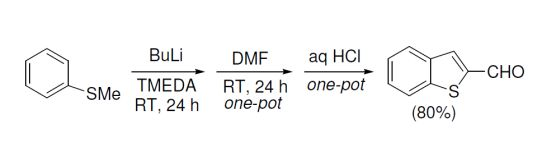
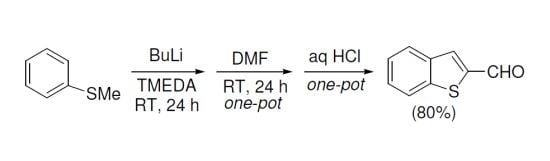
Benzo[b]thiophene-2-carbaldehyde



Abstract
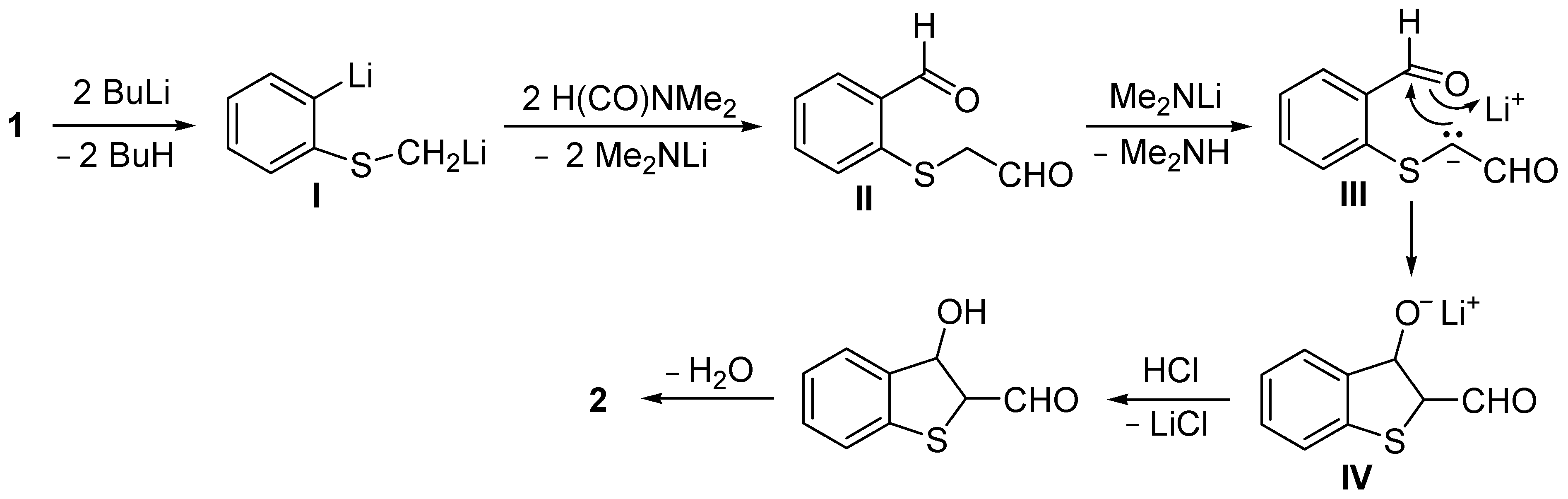
:
Experimental
Supplementary materials
Supplementary File 1Supplementary File 2Supplementary File 3Acknowledgments
Author Contributions
Conflicts of Interest
References
- Sharif, M.; Opalach, J.; Langer, P.; Beller, M.; Wu, X.-F. Oxidative synthesis of quinazolinones and benzothiadiazine 1,1-dioxides from 2-aminobenzamide and 2-aminobenzenesulfonamide with benzyl alcohols and aldehydes. RSC Adv. 2014, 4, 8–17. [Google Scholar] [CrossRef]
- Saadi, J.; Yamamoto, H. β-Siloxy-α-haloketones through highly diastereoselective single and double Mukaiyama aldol reactions. Chem. Eur. J. 2013, 19, 3842–3845. [Google Scholar] [CrossRef] [PubMed]
- Maity, S.; Naveen, T.; Sharma, U.; Maiti, D. Stereoselective nitration of olefins with tBuONO and TEMPO: Direct access to nitroolefins under metal-free conditions. Org. Lett. 2013, 15, 3384–3387. [Google Scholar] [CrossRef] [PubMed]
- Nguyen, T.T.B.; Lomberget, T.; Tran, N.C.; Barret, R. Synthesis of (Z) isomers of benzoheterocyclic derivatives of Combretastatin A-4: A comparative study of several methods. Tetrahedron 2013, 69, 2336–2347. [Google Scholar] [CrossRef]
- Trump, R.P.; Bresciani, S.; Cooper, A.W.J.; Tellam, J.P.; Wojno, J.; Blaikley, J.; Orband-Miller, L.A.; Kashatus, J.A.; Boudjelal, M.; Dawson, H.C.; et al. Optimized chemical probes for REV-ERBα. J. Med. Chem. 2013, 56, 4729–4737. [Google Scholar] [CrossRef] [PubMed]
- Penthala, N.R.; Sonar, V.N.; Horn, J.; Leggas, M.; Yadlapallia, J.S.K.B.; Crooks, P.A. Synthesis and evaluation of a series of benzothiophene acrylonitrile analogs as anticancer agents. Med. Chem. Commun. 2013, 4, 1073–1078. [Google Scholar] [CrossRef] [PubMed]
- Tiruveedhula, V.V.N.P.B.; Witzigmann, C.M.; Verma, R.; Kabir, M.S.; Rott, M.; Schwan, W.R.; Medina-Bielski, S.; Lane, M.; Close, W.; Polanowski, R.L.; et al. Design and synthesis of novel antimicrobials with activity against Gram-positive bacteria and mycobacterial species, including M. tuberculosis. Bioorg. Med. Chem. 2013, 21, 7830–7840. [Google Scholar] [CrossRef] [PubMed]
- Zhong, Z.-J.; Zhang, D.-J.; Peng, Z.-G.; Li, Y.-H.; Shan, G.-Z.; Zuo, L.-M.; Wu, L.-T.; Li, S.-Y.; Gao, R.-M.; Li, Z.-R. Synthesis and antiviral activity of a novel class of (5-oxazolyl)phenylamines. Eur. J. Med. Chem. 2013, 69, 32–43. [Google Scholar] [CrossRef] [PubMed]
- Patel, R.V.; Patel, J.K.; Nile, S.H.; Park, S.W. Synthesis and biological evaluation of piperazinyl-2-(benzo)thiophen/-furan-2-yl-acetonitriles as Strecker reaction products. Lett. Drug Design Discov. 2013, 10, 462–470. [Google Scholar] [CrossRef]
- Nguyen, T.T.B.; Lomberget, T.; Tran, N.C.; Colomb, E.; Nachtergaele, L.; Thoret, S.; Dubois, J.; Guillaume, J.; Abdayem, R.; Haftek, M.; et al. Synthesis and biological evaluation of novel heterocyclic derivatives of combretastatin A-4. Bioorg. Med. Chem. Lett. 2012, 22, 7227–7231. [Google Scholar] [CrossRef] [PubMed]
- Gigant, N.; Claveau, E.; Bouyssou, P.; Gillaizeau, I. Diversity-oriented synthesis of polycyclic diazinic scaffolds. Org. Lett. 2012, 14, 844–847. [Google Scholar] [CrossRef] [PubMed]
- Branytska, O.; Neumann, R. Synthesis of aromatic aldehydes by oxidative hydroxymethylation. Synlett 2004, 1575–1576. [Google Scholar] [CrossRef]
- Hopf, H.; Hucker, J.; Ernst, L. On the functionalization of [2.2](1,4)phenanthrenoparacyclophane. Eur. J. Org. Chem. 2007, 1891–1904. [Google Scholar] [CrossRef]
- Zhu, Y.; Zhao, B.; Shi, Y. Highly efficient Cu(I)-catalyzed oxidation of alcohols to ketones and aldehydes with diaziridinone. Org. Lett. 2013, 15, 992–995. [Google Scholar] [CrossRef] [PubMed]
- Hsiao, C.-N.; Bhagavatula, L.; Pariza, R.J. A practical synthesis of 2-carbonylbenzo[b]thiophenes. Synth. Commun. 1990, 20, 1687–1695. [Google Scholar] [CrossRef]

© 2014 by the authors; licensee MDPI, Basel, Switzerland. This article is an open access article distributed under the terms and conditions of the Creative Commons Attribution license (http://creativecommons.org/licenses/by/3.0/).
Share and Cite
Mancuso, R.; Gabriele, B. Benzo[b]thiophene-2-carbaldehyde. Molbank 2014, 2014, M823. https://doi.org/10.3390/M823
Mancuso R, Gabriele B. Benzo[b]thiophene-2-carbaldehyde. Molbank. 2014; 2014(2):M823. https://doi.org/10.3390/M823
Chicago/Turabian StyleMancuso, Raffaella, and Bartolo Gabriele. 2014. "Benzo[b]thiophene-2-carbaldehyde" Molbank 2014, no. 2: M823. https://doi.org/10.3390/M823
APA StyleMancuso, R., & Gabriele, B. (2014). Benzo[b]thiophene-2-carbaldehyde. Molbank, 2014(2), M823. https://doi.org/10.3390/M823
 Display in JSmol Viewer