


Abstract
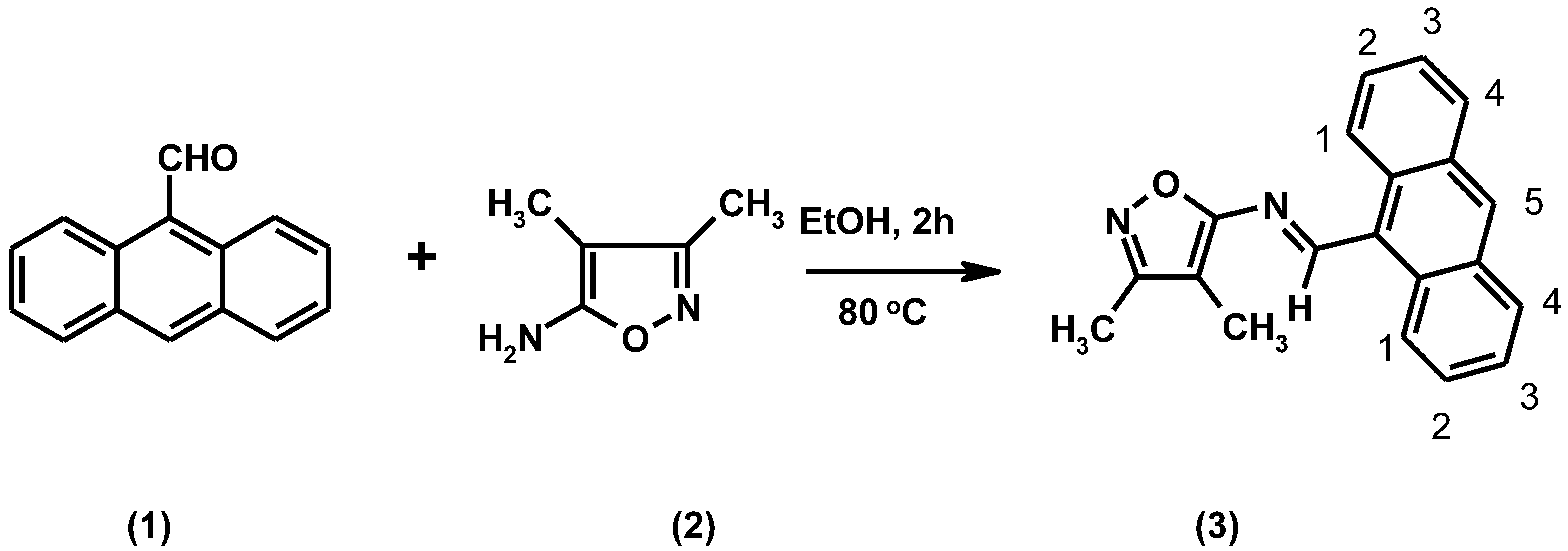
The title compound, anthracen-9-ylmethylene-(3,4-dimethylisoxazol-5-yl)amine (3), was synthesized in high yield by reaction of anthracene-9-carbaldehyde and 5-amino-3,4-dimethyl-isoxazole in ethanol. The structure of this new compound was confirmed by elemental analysis, IR, 1H NMR, 13C NMR and GC-MS spectral analysis.
Five-membered heterocyclic compounds with special reference to isoxazole derivatives are an important subset of the natural products that exhibit biological activities, including anticancer [1], antifungal and antibacterial properties [2]. These compounds have also found application in electroluminescent devices and UV stabilization polymers [3]. Isoxazole-containing Schiff bases can form complexes with d4, d5, d6 metals, such as zinc, cadmium, cobalt, nickel, osmium and iridium, they exhibit luminescent properties and have been widely investigated in recent experiments [4]. They are applicable in the fields of materials science such as non-linear optics (NLO) [5], optical limiting [6], electrochemical sensing and Langmuir films [7]. In the present paper, we are reporting a novel isoxazole-containing Schiff base from the reaction of anthracene-9-carbaldehyde with 5-amino-3,4-dimethylisoxazole [8].
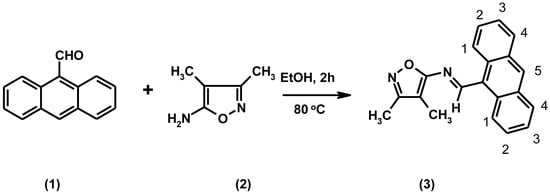
Scheme 1.
Synthesis of the title compound.
Scheme 1.
Synthesis of the title compound.
Experimental
A mixture of anthracene-9-carbaldehyde (0.50 g, 0.0024 mol) and 5-amino-3,4-dimethylisoxazole (0.27 g, 0.0024 mol) in ethanol (15 mL) was heated for 2 h at 80 °C. The progress of the reaction was monitored by TLC. The solid that separated from the cooled mixture was collected and recrystallized from a methanol-chloroform mixture (8:2) to give the title compound (3) as a yellow solid.
Yield: 82%; m.p. 146–147 °C.
GC-MS m/z (rel. int.%): 301 (62) [M+1]+.
IR (KBr) vmax cm−1: 2917 (C-H), 1580 (HC=N), 1158 (C-N).
1H NMR (600 MHZ, CDCl3) (δ/ppm): 10.12 (s, CHolefinic), 8.95 (d, 2H, H-1, J = 8.8 Hz), 7.61 (dd, 2xH, H-2, J = 5.6 Hz), 7.50 (dd, 2xH, H-3, J = 7.2 Hz), 8.56 (d, 2H, H-4 J = 8.0 Hz), 7.65 (s, H-5), 2.30 (s, CH3), 2.16 (s, CH3).
13CNMR (150 MHz, CDCl3) δ: 165.44, 162.07, 159.82, 132.63, 131.53, 131.10, 130.05, 129.27, 129.12, 127.94, 125.54, 124.07, 123.56, 116.50, 108.03, 10.83, 6.89.
Anal. calc. for C20H16N2O: C, 79.98, H, 5.37, N, 9.33. Found: C, 79.94, H, 5.32, N, 9.28.
Supplementary materials
Supplementary File 1Supplementary File 2Supplementary File 3Acknowledgements
The authors would like to thank the Chemistry Department, King Abdulaziz University, Jeddah, Saudi Arabia for providing the research facilities.
References
- Chauhan, P.M.S.; Martins, C.J.A.; Horwell, D.C. Syntheses of novel heterocycles as anticancer agents. Bioorg. Med. Chem. 2005, 13, 3513–3518. [Google Scholar] [CrossRef] [PubMed]
- Raffa, D.; Daidone, G.; Maggio, B.; Schillaci, D.; Plescia, F.; Torta, L. Synthesis and antifungal activity of new N-isoxazolyl-2-iodobenzamides. Il Farmaco 1999, 54, 90–94. [Google Scholar] [CrossRef]
- Priyadarsini, K.I. Photophysics, photochemistry and photobiology of curcumin: Studies from organic solutions, bio-mimetics and living cells. J. Photochem. Photobiol. C Photochem. Rev. 2009, 10, 81–95. [Google Scholar] [CrossRef]
- Shakru, P.; Subhashini, N.J.P.; Kumar, S.; Shivaraj, K. Synthesis, characterization and antimicrobial studies on Cobalt (II),Nickel (II), Copper (II) and Zinc (II) complexes of N, O, S donor Schiff bases. J. Chem. Pharm. Res. 2010, 2, 38–46. [Google Scholar]
- Bhuiyan, M.D.H.; Teshome, A.; Gainsford, G.J.; Ashraf, M.; Clays, K.; Asselberghs, I.; Kay, A.J. Synthesis, characterization, linear and non-linear optical (NLO) properties of some Schiff’s bases. Opt. Mater. 2010, 32, 669–672. [Google Scholar] [CrossRef]
- Rudresha, B.J.; Bhat, B.R.; Kumar, H.C.S.; Kumar, K.I.S.; Safakath, K.; Philip, R. Synthesis, characterization and third-order nonlinear optical studies of copper complexes containing 1,10-phenanthroline-5,6-dione and triphenylphosphine ligands. Synthetic Met. 2011, 161, 535–539. [Google Scholar] [CrossRef]
- Singh, L.P.; Bhatnagar, J.M. Copper(II) selective electrochemical sensor based on Schiff Base complexes. Talanta 2004, 64, 313–319. [Google Scholar] [CrossRef] [PubMed]
- Asiri, A.M.; Khan, S.A.; Rasl, M.G. N-[(9-Ethyl-9H-carbazol-3-yl)methylene]-3,4-dimethylisoxazol-5-amine. Molbank 2010, 2011, M684. [Google Scholar] [CrossRef]
© 2011 by the authors; licensee MDPI, Basel, Switzerland. This article is an open access article distributed under the terms and conditions of the Creative Commons Attribution license (http://creativecommons.org/licenses/by/3.0/).