Author Contributions
Conceptualization, B.R., S.G. and A.D.; methodology, B.R., F.D. and R.D.G.; software, B.R., R.R.F. and E.P.; validation, B.R., R.R.F. and E.P.; formal analysis, B.R., M.R. and A.D.; investigation, B.R.; resources, A.D. and A.G.; data curation, B.R. and M.R.; writing—original draft preparation, B.R., M.R., F.D., E.M., T.E.P., S.G. and A.D.; writing—review and editing, B.R., F.D., S.G., A.G., T.E.P. and A.D.; visualization, M.R. and B.R.; supervision, S.G., A.D. and A.G.; project administration, A.D. and A.G.; funding acquisition, A.D. All authors have read and agreed to the published version of the manuscript.
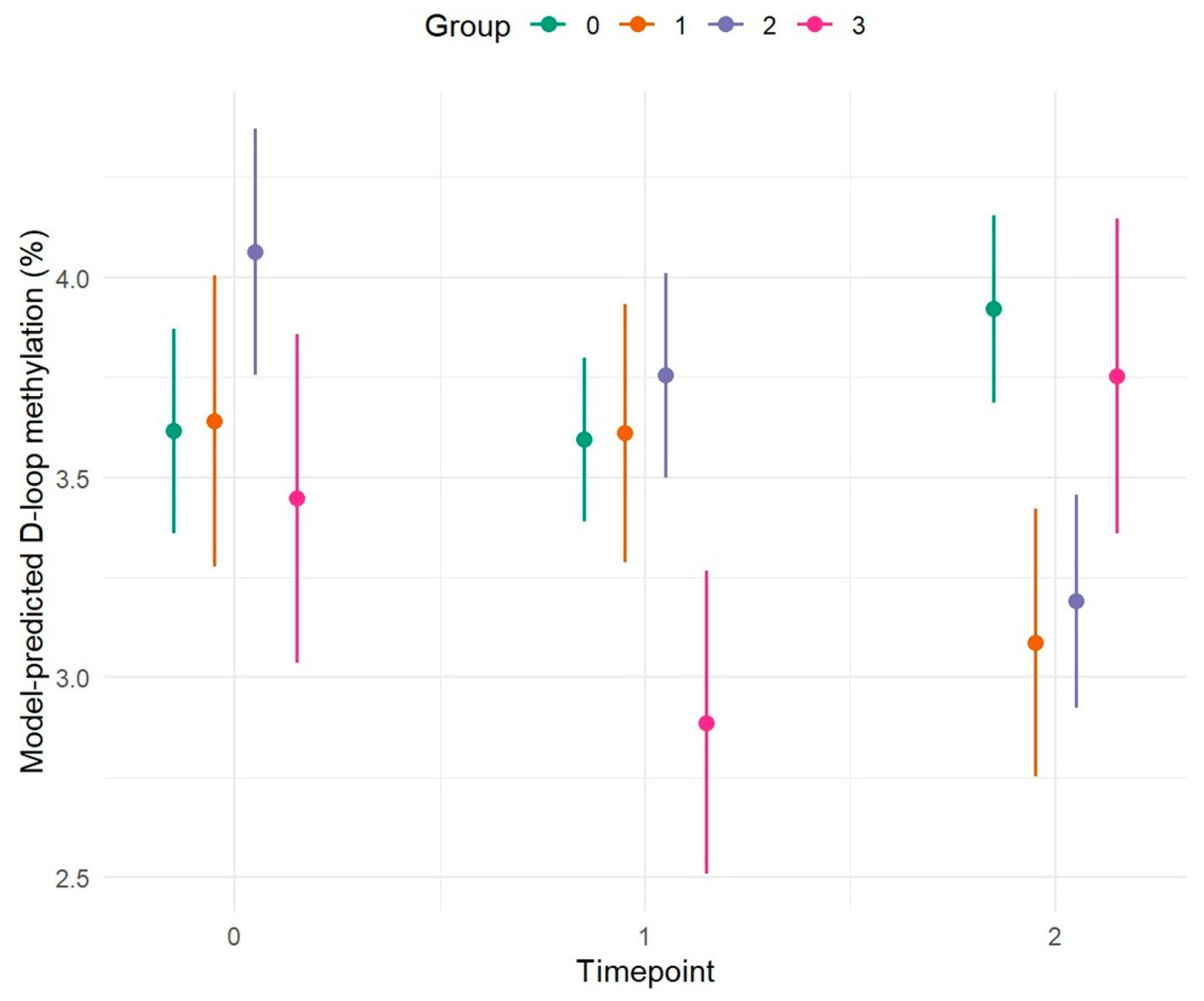
Figure 1.
Longitudinal trend of D-loop methylation levels as a function of time, assessed at baseline (T0), after four years (T1), and after an additional four years (T2), across the different study groups. Summary of study cohort: Group 0 (HC-HC-HC, n = 34) (green) = Patients with no cognitive deficits at any time point (healthy controls); Group 1 (HC-HC-AD, n = 12) (orange) = Patients cognitively healthy at two time points, diagnosed with AD at T2; Group 2 (HC-MCI-AD, n = 20) (blue) = Patients cognitively healthy at T0, with MCI at T1, and AD at T2; Group 3 (MCI-MCI-AD, n = 9) (fuchsia) = Patients with MCI at both T0 and T1, and AD at T2. Lines represent marginal predictions estimated from a linear mixed-effects model with a random intercept for subject, adjusted for age and sex. Shaded areas indicate 95% confidence intervals.
Figure 1.
Longitudinal trend of D-loop methylation levels as a function of time, assessed at baseline (T0), after four years (T1), and after an additional four years (T2), across the different study groups. Summary of study cohort: Group 0 (HC-HC-HC, n = 34) (green) = Patients with no cognitive deficits at any time point (healthy controls); Group 1 (HC-HC-AD, n = 12) (orange) = Patients cognitively healthy at two time points, diagnosed with AD at T2; Group 2 (HC-MCI-AD, n = 20) (blue) = Patients cognitively healthy at T0, with MCI at T1, and AD at T2; Group 3 (MCI-MCI-AD, n = 9) (fuchsia) = Patients with MCI at both T0 and T1, and AD at T2. Lines represent marginal predictions estimated from a linear mixed-effects model with a random intercept for subject, adjusted for age and sex. Shaded areas indicate 95% confidence intervals.
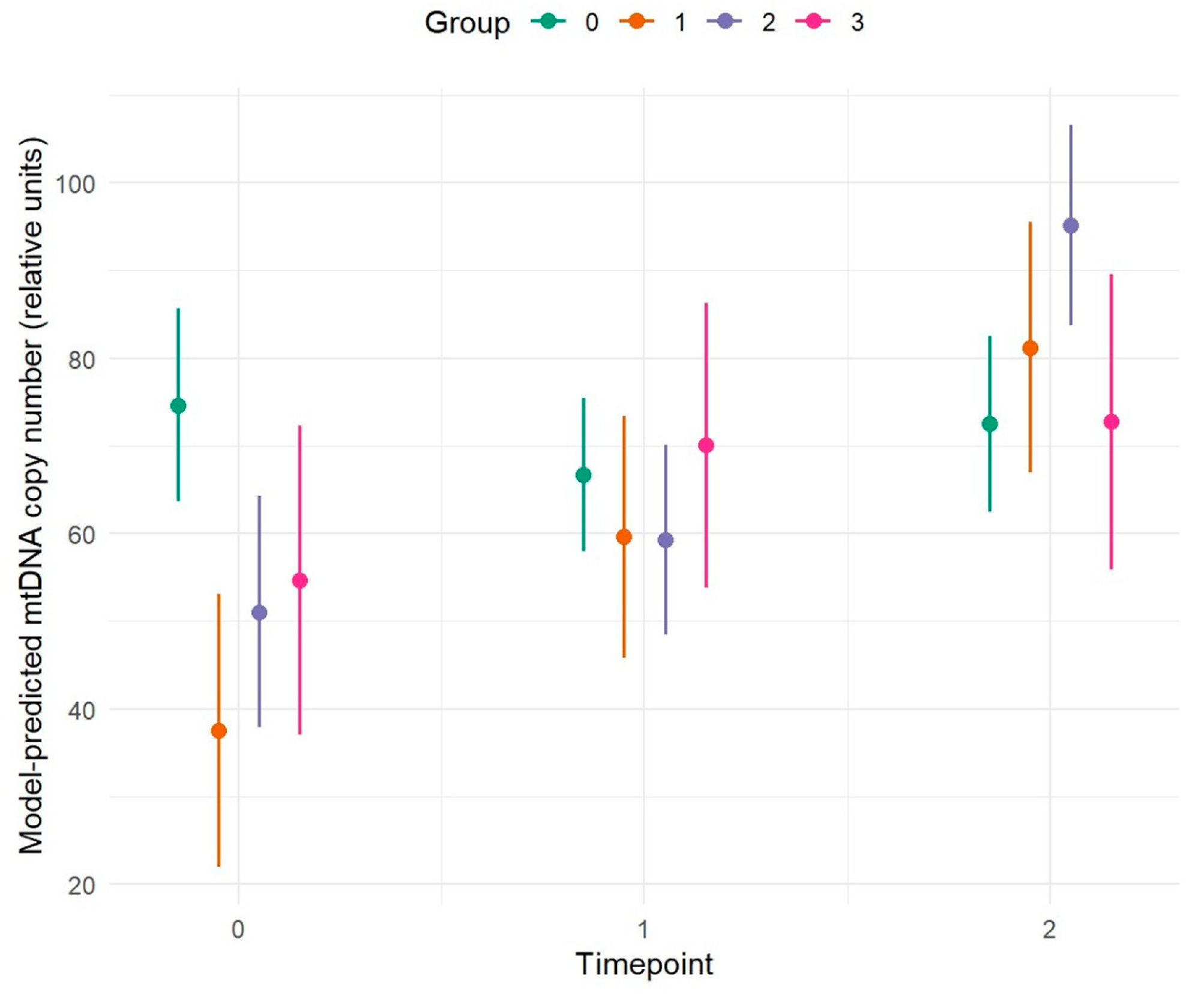
Figure 2.
Longitudinal trend of mtDNA copy number levels as a function of time, assessed at baseline (T0), after four years (T1), and after an additional four years (T2), across the different study groups. Summary of study cohort: Group 0 (HC-HC-HC, n = 34) (green) = Patients with no cognitive deficits at any time point (healthy controls); Group 1 (HC-HC-AD, n = 12) (orange) = Patients cognitively healthy at two time points, diagnosed with AD at T2; Group 2 (HC-MCI-AD, n = 20) (blue) = Patients cognitively healthy at T0, with MCI at T1, and AD at T2; Group 3 (MCI-MCI-AD, n = 9) (fuchsia) = Patients with MCI at both T0 and T1, and AD at T2. Lines represent marginal predictions estimated from a linear mixed-effects model with a random intercept for subject, adjusted for age and sex. Shaded areas indicate 95% confidence intervals.
Figure 2.
Longitudinal trend of mtDNA copy number levels as a function of time, assessed at baseline (T0), after four years (T1), and after an additional four years (T2), across the different study groups. Summary of study cohort: Group 0 (HC-HC-HC, n = 34) (green) = Patients with no cognitive deficits at any time point (healthy controls); Group 1 (HC-HC-AD, n = 12) (orange) = Patients cognitively healthy at two time points, diagnosed with AD at T2; Group 2 (HC-MCI-AD, n = 20) (blue) = Patients cognitively healthy at T0, with MCI at T1, and AD at T2; Group 3 (MCI-MCI-AD, n = 9) (fuchsia) = Patients with MCI at both T0 and T1, and AD at T2. Lines represent marginal predictions estimated from a linear mixed-effects model with a random intercept for subject, adjusted for age and sex. Shaded areas indicate 95% confidence intervals.
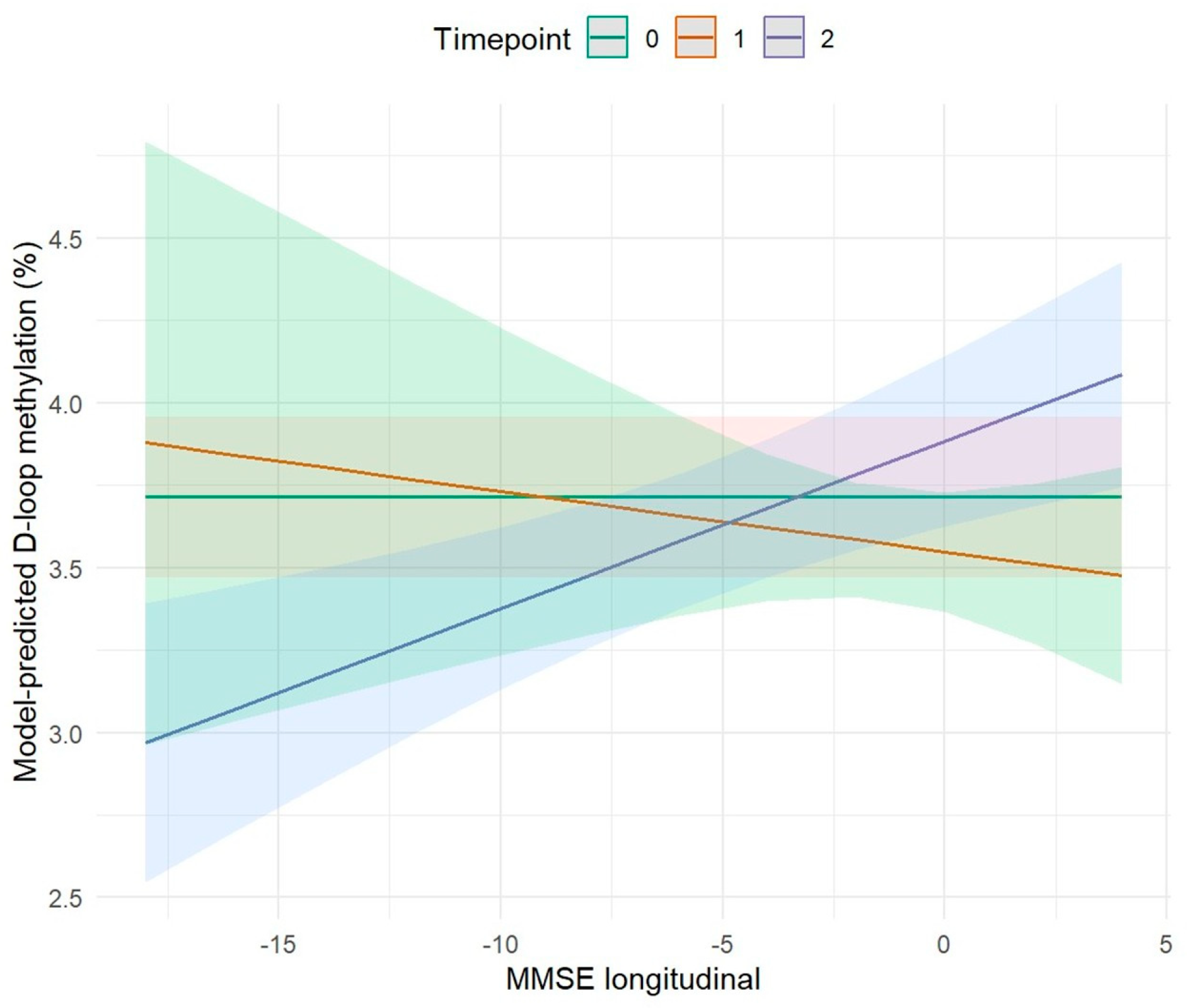
Figure 3.
Effect of longitudinal MMSE on changes in D-loop methylation levels over time. Lines represent marginal predictions estimated from a linear mixed-effects model with a random intercept for subject, adjusted for age and sex. Shaded areas indicate 95% confidence intervals. The green line refers to time point 0, the orange line to time point 1, and the purple line to time point 2.
Figure 3.
Effect of longitudinal MMSE on changes in D-loop methylation levels over time. Lines represent marginal predictions estimated from a linear mixed-effects model with a random intercept for subject, adjusted for age and sex. Shaded areas indicate 95% confidence intervals. The green line refers to time point 0, the orange line to time point 1, and the purple line to time point 2.
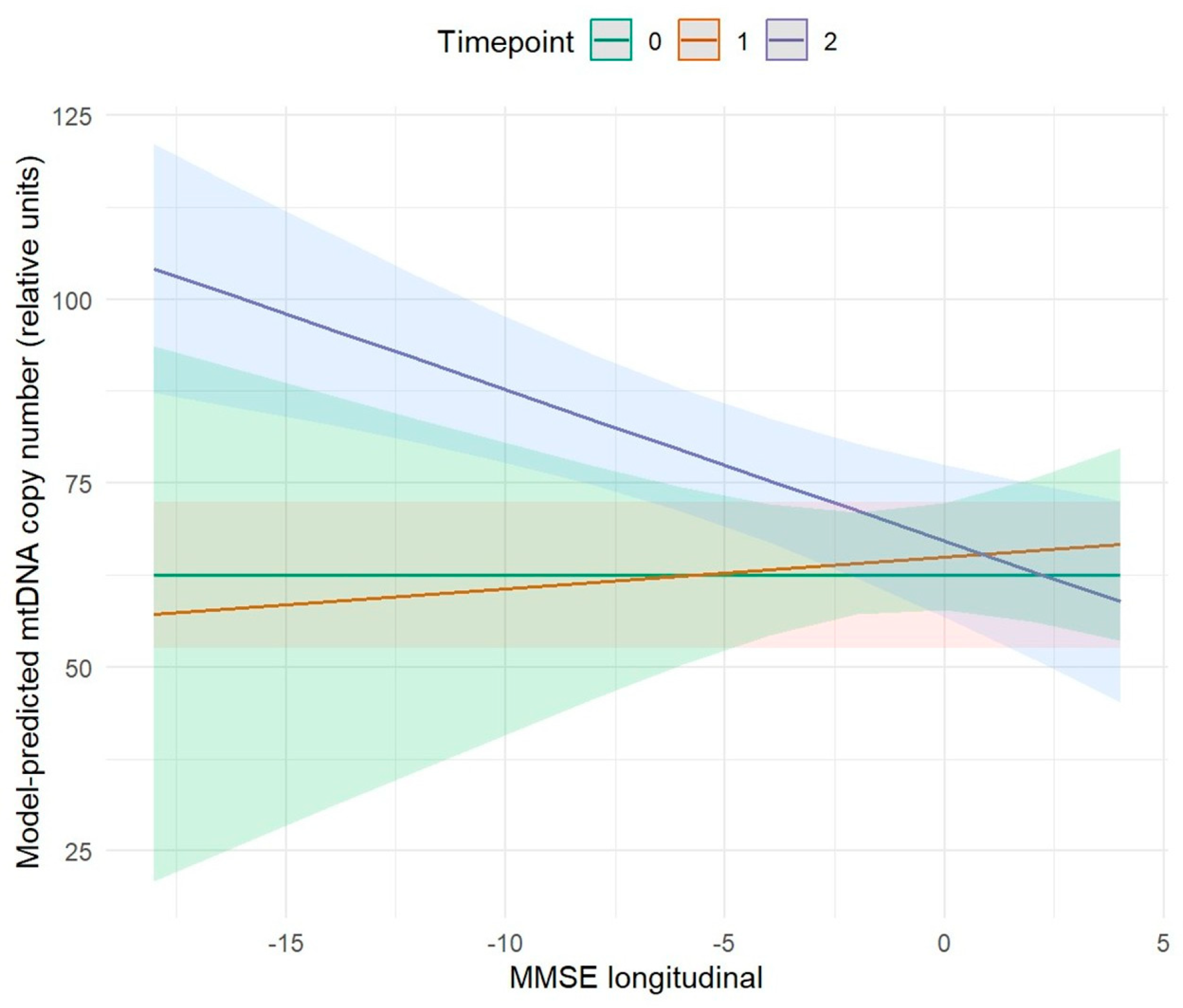
Figure 4.
Effect of longitudinal MMSE on changes in mtDNA copy number levels over time. Lines represent marginal predictions estimated from a linear mixed-effects model with a random intercept for subject, adjusted for age and sex. Shaded areas indicate 95% confidence intervals. The green line refers to time point 0, the orange line to time point 1, and the purple line to time point 2.
Figure 4.
Effect of longitudinal MMSE on changes in mtDNA copy number levels over time. Lines represent marginal predictions estimated from a linear mixed-effects model with a random intercept for subject, adjusted for age and sex. Shaded areas indicate 95% confidence intervals. The green line refers to time point 0, the orange line to time point 1, and the purple line to time point 2.
Figure 5.
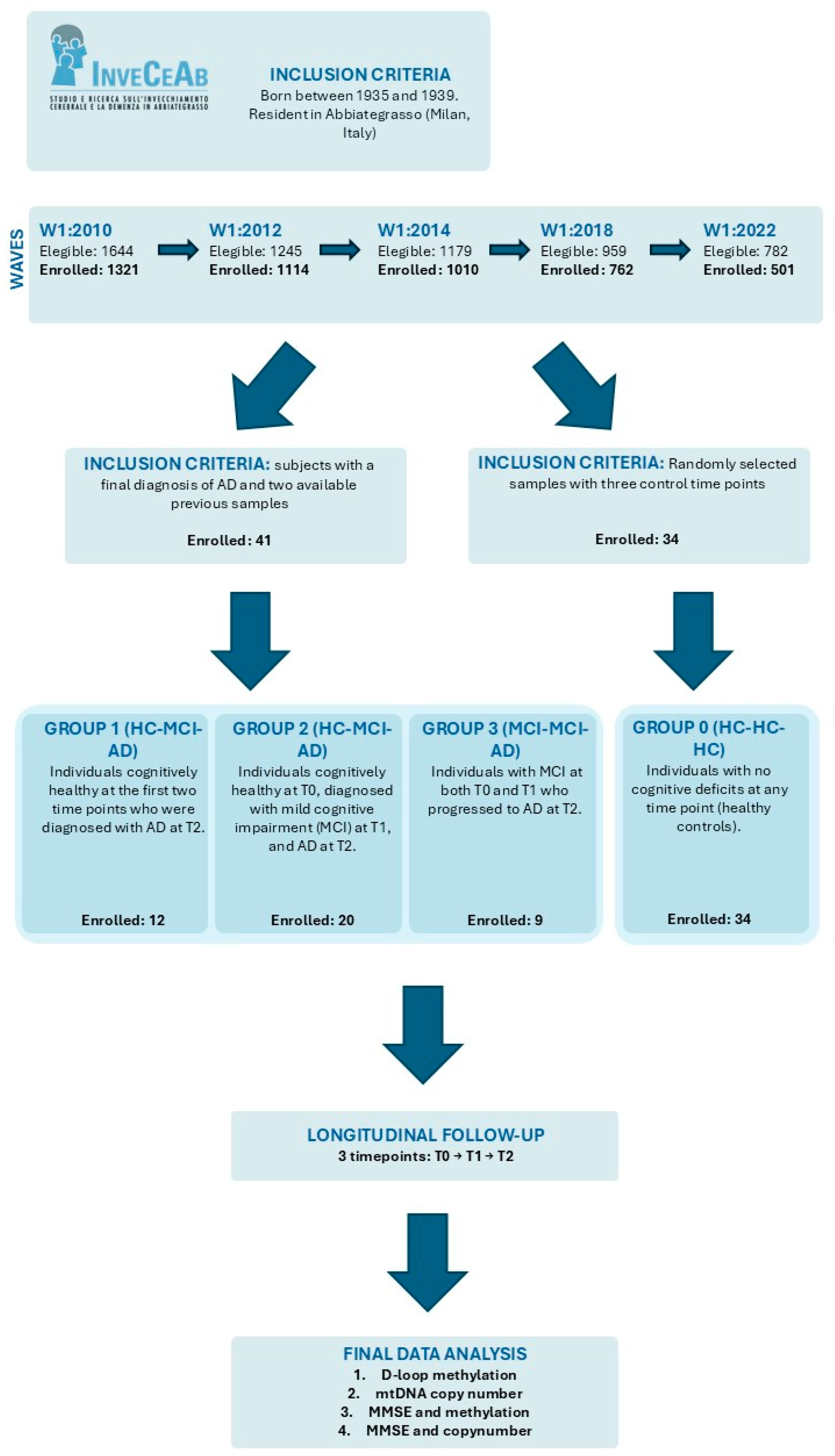
Flow diagram illustrating the InveCe.Ab study waves, participant selection, and measures of interest in the present study. The upper panel describes the inclusion criteria for the population-based InveCe.Ab cohort. The central panel shows the flow of participants across the five study waves. The panel reports the participants included in the analyses and their allocation into groups according to clinical progression. The final box summarizes the analyses performed on the study samples.
Figure 5.
Flow diagram illustrating the InveCe.Ab study waves, participant selection, and measures of interest in the present study. The upper panel describes the inclusion criteria for the population-based InveCe.Ab cohort. The central panel shows the flow of participants across the five study waves. The panel reports the participants included in the analyses and their allocation into groups according to clinical progression. The final box summarizes the analyses performed on the study samples.
Table 1.
Results of the linear mixed-effects model examining longitudinal changes in D-loop methylation across diagnostic groups and time points (T0, T1, and T2). Summary of study cohort: Group 0 (HC-HC-HC, n = 34) = Patients with no cognitive deficits at any time point (healthy controls); Group 1 (HC-HC-AD, n = 12) = Patients cognitively healthy at two time points, diagnosed with AD at T2; Group 2 (HC-MCI-AD, n = 20) = Patients cognitively healthy at T0, with MCI at T1, and AD at T2; Group 3 (MCI-MCI-AD, n = 9) = Patients with MCI at both T0 and T1, and AD at T2.
Table 1.
Results of the linear mixed-effects model examining longitudinal changes in D-loop methylation across diagnostic groups and time points (T0, T1, and T2). Summary of study cohort: Group 0 (HC-HC-HC, n = 34) = Patients with no cognitive deficits at any time point (healthy controls); Group 1 (HC-HC-AD, n = 12) = Patients cognitively healthy at two time points, diagnosed with AD at T2; Group 2 (HC-MCI-AD, n = 20) = Patients cognitively healthy at T0, with MCI at T1, and AD at T2; Group 3 (MCI-MCI-AD, n = 9) = Patients with MCI at both T0 and T1, and AD at T2.
| Parameters | Beta | SE | 95% Confidence Interval | p-Value |
|---|
| (Intercept) | 1.78 | 1.27 | [−0.72–4.28] | 0.164 |
| T1 | −0.02 | 0.15 | [−0.31–0.27] | 0.880 |
| T2 | 0.30 | 0.19 | [−0.07–0.67] | 0.109 |
| Group 1 | 0.02 | 0.18 | [−0.34–0.39] | 0.892 |
| Group 2 | 0.45 | 0.15 | [0.14–0.75] | 0.004 |
| Group 3 | −0.17 | 0.20 | [−0.57–0.23] | 0.410 |
| Age | 0.02 | 0.02 | [−0.01–0.06] | 0.175 |
| Sex (M) | −0.15 | 0.08 | [−0.30–0.00] | 0.056 |
| APOE ε4+ carrier | 0.02 | 0.17 | [−0.32–0.36] | 0.899 |
| TOMM40(G)+ carrier | −0.05 | 0.14 | [−0.33–0.22] | 0.698 |
| T1: Group 1 | −0.01 | 0.26 | [−0.52–0.50] | 0.972 |
| T2: Group 1 | −0.86 | 0.26 | [−1.37–−0.35] | 0.001 |
| T1: Group 2 | −0.29 | 0.22 | [−0.71–0.14] | 0.188 |
| T2: Group 2 | −1.17 | 0.22 | [−1.60–−0.75] | <0.001 |
| T1: Group 3 | −0.54 | 0.29 | [−1.10–0.03] | 0.064 |
| T2: Group 3 | 0.00 | 0.29 | [−0.56–0.57] | 0.994 |
| APOE ε4+/TOMM40(G) + carrier | 0.04 | 0.23 | [−0.41–0.49] | 0.860 |
Table 2.
Pairwise group comparisons post hoc analysis for D-loop methylation level between the selected groups at T0, T1 after four years, and T2 after another for years. Summary of study cohort: Group 0 (HC-HC-HC, n = 34) (green) = Patients with no cognitive deficits at any time point (healthy controls); Group 1 (HC-HC-AD, n = 12) (orange) = Patients cognitively healthy at two time points, diagnosed with AD at T2; Group 2 (HC-MCI-AD, n = 20) (blue) = Patients cognitively healthy at T0, with MCI at T1, and AD at T2; Group 3 (MCI-MCI-AD, n = 9) (fuchsia) = Patients with MCI at both T0 and T1, and AD at T2.
Table 2.
Pairwise group comparisons post hoc analysis for D-loop methylation level between the selected groups at T0, T1 after four years, and T2 after another for years. Summary of study cohort: Group 0 (HC-HC-HC, n = 34) (green) = Patients with no cognitive deficits at any time point (healthy controls); Group 1 (HC-HC-AD, n = 12) (orange) = Patients cognitively healthy at two time points, diagnosed with AD at T2; Group 2 (HC-MCI-AD, n = 20) (blue) = Patients cognitively healthy at T0, with MCI at T1, and AD at T2; Group 3 (MCI-MCI-AD, n = 9) (fuchsia) = Patients with MCI at both T0 and T1, and AD at T2.
| Pairwise Group Comparisons Post Hoc Analysis |
|---|
| Contrast | Mean Difference | SE | 95% Confidence Interval | p-Value |
|---|
| T0—Group 0 VS. Group 1 | −0.02 | 0.18 | [−0.50–0.45] | 0.999 |
| T0—Group 0 VS. Group 2 | −0.45 | 0.15 | [−0.85–−0.046] | 0.022 |
| T0—Group 0 VS. Group 3 | 0.17 | 0.20 | [−0.36–0.70] | 0.842 |
| T0—Group 1 VS. Group 2 | −0.42 | 0.20 | [−0.93–0.09] | 0.153 |
| T0—Group 1 VS. Group 3 | 0.19 | 0.24 | [−0.43–0.82] | 0.851 |
| T0—Group 2 VS. Group 3 | 0.61 | 0.22 | [0.04–1.19] | 0.029 |
| T1—Group 0 VS. Group 1 | −0.01 | 0.18 | [−0.49–0.46] | 0.100 |
| T1—Group 0 VS. Group 2 | −0.16 | 0.15 | [−0.56–0.24] | 0.728 |
| T1—Group 0 VS. Group 3 | 0.70 | 0.20 | [0.17–1.24] | 0.004 |
| T1—Group 1 VS. Group 2 | −0.14 | 0.20 | [−0.66–0.37] | 0.888 |
| T1—Group 1 VS. Group 3 | 0.72 | 0.24 | [0.09–1.35] | 0.016 |
| T1—Group 2 VS. Group 3 | 0.87 | 0.22 | [0.29–1.44] | 0.001 |
| T2—Group 0 VS. Group 1 | 0.83 | 0.18 | [0.35–1.31] | <0.001 |
| T2—Group 0 VS. Group 2 | 0.73 | 0.15 | [0.33–1.13] | <0.001 |
| T2—Group 0 VS. Group 3 | 0.17 | 0.20 | [−0.36–0.70] | 0.848 |
| T2—Group 1 VS. Group 2 | −0.10 | 0.20 | [−0.62–0.41] | 0.954 |
| T2—Group 1 VS. Group 3 | −0.67 | 0.24 | [−1.29–−0.04] | 0.031 |
| T2—Group 2 VS. Group 3 | −0.56 | 0.22 | [−1.13–0.01] | 0.056 |
Table 3.
Within-group time comparisons post hoc analysis for D-loop methylation level between the selected groups at T0, T1 after four years, and T2 after another four years. Summary of study cohort: Group 0 (HC-HC-HC, n = 34) (green) = Patients with no cognitive deficits at any time point (healthy controls); Group 1 (HC-HC-AD, n = 12) (orange) = Patients cognitively healthy at two time points, diagnosed with AD at T2; Group 2 (HC-MCI-AD, n = 20) (blue) = Patients cognitively healthy at T0, with MCI at T1, and AD at T2; Group 3 (MCI-MCI-AD, n = 9) (fuchsia) = Patients with MCI at both T0 and T1, and AD at T2.
Table 3.
Within-group time comparisons post hoc analysis for D-loop methylation level between the selected groups at T0, T1 after four years, and T2 after another four years. Summary of study cohort: Group 0 (HC-HC-HC, n = 34) (green) = Patients with no cognitive deficits at any time point (healthy controls); Group 1 (HC-HC-AD, n = 12) (orange) = Patients cognitively healthy at two time points, diagnosed with AD at T2; Group 2 (HC-MCI-AD, n = 20) (blue) = Patients cognitively healthy at T0, with MCI at T1, and AD at T2; Group 3 (MCI-MCI-AD, n = 9) (fuchsia) = Patients with MCI at both T0 and T1, and AD at T2.
| Within-Group Time Comparisons Post Hoc Analysis |
|---|
| Contrast | Mean Difference | SE | 95% Confidence Interval | p-Value |
|---|
| Group 0 T0–T1 | 0.02 | 0.148 | [−0.33–0.37] | 0.988 |
| Group 0 T0–T2 | −0.30 | 0.189 | [−0.75–0.14] | 0.245 |
| Group 0 T1–T2 | −0.33 | 0.148 | [−0.68–0.02] | 0.073 |
| Group 1 T0–T1 | 0.03 | 0.232 | [−0.52–0.58] | 0.990 |
| Group 1 T0–T2 | 0.55 | 0.260 | [−0.06–1.17] | 0.085 |
| Group 1 T1–T2 | 0.52 | 0.232 | [−0.03–1.07] | 0.065 |
| Group 2 T0–T1 | 0.31 | 0.185 | [−0.13–0.75] | 0.219 |
| Group 2 T0–T2 | 0.87 | 0.219 | [0.36–1.39] | <0.001 |
| Group 2 T1–T2 | 0.56 | 0.185 | [0.13–1.00] | 0.007 |
| Group 3 T0–T1 | 0.56 | 0.265 | [−0.07–1.19] | 0.091 |
| Group 3 T0–T2 | −0.31 | 0.290 | [−0.99–0.38] | 0.542 |
| Group 3 T1–T2 | −0.87 | 0.265 | [−1.49–−0.24] | 0.004 |
Table 4.
Results of the linear mixed-effects model examining longitudinal changes in mtDNA copy number across diagnostic groups and time points (T0, T1, and T2). Summary of study cohort: Group 0 (HC-HC-HC, n = 34) (green) = Patients with no cognitive deficits at any time point (healthy controls); Group 1 (HC-HC-AD, n = 12) (orange) = Patients cognitively healthy at two time points, diagnosed with AD at T2; Group 2 (HC-MCI-AD, n = 20) (blue) = Patients cognitively healthy at T0, with MCI at T1, and AD at T2; Group 3 (MCI-MCI-AD, n = 9) (fuchsia) = Patients with MCI at both T0 and T1, and AD at T2.
Table 4.
Results of the linear mixed-effects model examining longitudinal changes in mtDNA copy number across diagnostic groups and time points (T0, T1, and T2). Summary of study cohort: Group 0 (HC-HC-HC, n = 34) (green) = Patients with no cognitive deficits at any time point (healthy controls); Group 1 (HC-HC-AD, n = 12) (orange) = Patients cognitively healthy at two time points, diagnosed with AD at T2; Group 2 (HC-MCI-AD, n = 20) (blue) = Patients cognitively healthy at T0, with MCI at T1, and AD at T2; Group 3 (MCI-MCI-AD, n = 9) (fuchsia) = Patients with MCI at both T0 and T1, and AD at T2.
| Parameters | Beta | SE | 95% Confidence Interval | p-Value |
|---|
| (Intercept) | 181.33 | 55.66 | [+72.25–+290.43] | 0.002 |
| T1 | −7.95 | 6.27 | [−20.25–+4.34] | 0.206 |
| T2 | −2.16 | 8.10 | [−18.03–+13.71] | 0.790 |
| Group 1 | −37.14 | 7.86 | [−52.55–−21.73] | <0.001 |
| Group 2 | −23.59 | 6.59 | [−36.51–−10.67] | <0.001 |
| Group 3 | −20.02 | 8.74 | [−37.16–−2.89] | 0.023 |
| Age | −1.34 | 0.74 | [−2.79–+0.11] | 0.075 |
| Sex (M) | −0.36 | 3.40 | [−7.03–+6.29] | 0.915 |
| APOE ε4 + carrier | 3.70 | 7.50 | [−11.00–+18.40] | 0.623 |
| TOMM40(G) + carrier | −1.29 | 6.09 | [−13.22–+10.64] | 0.834 |
| T1: Group 1 | 30.08 | 10.83 | [+8.86–+51.31] | 0.006 |
| T2: Group 1 | 45.85 | 10.83 | [+24.63–+67.08] | <0.001 |
| T1: Group 2 | 16.17 | 9.09 | [−1.64–+33.98] | 0.077 |
| T2: Group 2 | 46.25 | 9.09 | [+28.43–+64.06] | <0.001 |
| T1: Group 3 | 23.39 | 12.09 | [−0.31–+47.08] | 0.055 |
| T2: Group 3 | 20.26 | 12.09 | [−3.43–+43.96] | 0.096 |
| APOE ε4+/TOMM40(G) + carrier | −3.19 | 10.10 | [−22.99–+16.62] | 0.753 |
Table 5.
Pairwise group comparisons post hoc analysis for mtDNA copy numbers between the selected groups at T0, T1 after four years, and T2 after another four years. Summary of study cohort: Group 0 (HC-HC-HC, n = 34) (green) = Patients with no cognitive deficits at any time point (healthy controls); Group 1 (HC-HC-AD, n = 12) (orange) = Patients cognitively healthy at two time points, diagnosed with AD at T2; Group 2 (HC-MCI-AD, n = 20) (blue) = Patients cognitively healthy at T0, with MCI at T1, and AD at T2; Group 3 (MCI-MCI-AD, n = 9) (fuchsia) = Patients with MCI at both T0 and T1, and AD at T2.
Table 5.
Pairwise group comparisons post hoc analysis for mtDNA copy numbers between the selected groups at T0, T1 after four years, and T2 after another four years. Summary of study cohort: Group 0 (HC-HC-HC, n = 34) (green) = Patients with no cognitive deficits at any time point (healthy controls); Group 1 (HC-HC-AD, n = 12) (orange) = Patients cognitively healthy at two time points, diagnosed with AD at T2; Group 2 (HC-MCI-AD, n = 20) (blue) = Patients cognitively healthy at T0, with MCI at T1, and AD at T2; Group 3 (MCI-MCI-AD, n = 9) (fuchsia) = Patients with MCI at both T0 and T1, and AD at T2.
| Pairwise Group Comparisons Post Hoc Analysis |
|---|
| Contrast | Mean Difference | SE | 95% Confidence Interval | p-Value |
|---|
| T0—Group 0 VS. Group 1 | 37.14 | 7.86 | [0.36–0.93] | <0.001 |
| T0—Group 0 VS. Group 2 | 23.59 | 6.59 | [0.11–0.59] | 0.002 |
| T0—Group 0 VS. Group 3 | 20.02 | 8.74 | [−0.01–0.63] | 0.104 |
| T0—Group 1 VS. Group 2 | −13.55 | 8.50 | [−0.60–0.02] | 0.384 |
| T0—Group 1 VS. Group 3 | −17.12 | 10.30 | [−0.71–0.04] | 0.344 |
| T0—Group 2 VS. Group 3 | −3.56 | 9.41 | [−0.39–0.30] | 0.981 |
| T1—Group 0 VS. Group 1 | 7.06 | 7.86 | [−0.24–0.34] | 0.806 |
| T1—Group 0 VS. Group 2 | 7.42 | 6.59 | [−0.17–0.31] | 0.674 |
| T1—Group 0 VS. Group 3 | −3.36 | 8.74 | [−0.43–0.20] | 0.981 |
| T1—Group 1 VS. Group 2 | 0.36 | 8.50 | [−0.29–0.33] | 1.000 |
| T1—Group 1 VS. Group 3 | −10.42 | 10.30 | [−0.54–0.21] | 0.741 |
| T1—Group 2 VS. Group 3 | −10.78 | 9.41 | [−0.53–0.15] | 0.661 |
| T2—Group 0 VS. Group 1 | −8.71 | 7.86 | [−0.39–0.18] | 0.685 |
| T2—Group 0 VS. Group 2 | −22.66 | 6.59 | [−0.45–0.03] | 0.004 |
| T2—Group 0 VS. Group 3 | −0.24 | 8.74 | [−0.34–0.30] | 1.000 |
| T2—Group 1 VS. Group 2 | −13.95 | 8.50 | [−0.41–0.20] | 0.358 |
| T2—Group 1 VS. Group 3 | 8.47 | 10.30 | [−0.29–0.46] | 0.843 |
| T2—Group 2 VS. Group 3 | 22.42 | 9.41 | [−0.15–0.53] | 0.084 |
Table 6.
Within-group time comparisons post hoc analysis for mtDNA copy number between the selected groups at T0, T1 after four years, and T2 after another for years. Summary of study cohort: Group 0 (HC-HC-HC, n = 34) (green) = Patients with no cognitive deficits at any time point (healthy controls); Group 1 (HC-HC-AD, n = 12) (orange) = Patients cognitively healthy at two time points, diagnosed with AD at T2; Group 2 (HC-MCI-AD, n = 20) (blue) = Patients cognitively healthy at T0, with MCI at T1, and AD at T2; Group 3 (MCI-MCI-AD, n = 9) (fuchsia) = Patients with MCI at both T0 and T1, and AD at T2.
Table 6.
Within-group time comparisons post hoc analysis for mtDNA copy number between the selected groups at T0, T1 after four years, and T2 after another for years. Summary of study cohort: Group 0 (HC-HC-HC, n = 34) (green) = Patients with no cognitive deficits at any time point (healthy controls); Group 1 (HC-HC-AD, n = 12) (orange) = Patients cognitively healthy at two time points, diagnosed with AD at T2; Group 2 (HC-MCI-AD, n = 20) (blue) = Patients cognitively healthy at T0, with MCI at T1, and AD at T2; Group 3 (MCI-MCI-AD, n = 9) (fuchsia) = Patients with MCI at both T0 and T1, and AD at T2.
| Within-Group Time Comparisons Post Hoc Analysis |
|---|
| Contrast | Mean Difference | SE | 95% Confidence Interval | p-Value |
|---|
| Group 0 T0–T1 | 7.95 | 6.27 | [−0.05–0.37] | 0.415 |
| Group 0 T0–T2 | 2.16 | 8.10 | [−0.24–0.29] | 0.962 |
| Group 0 T1–T2 | −5.80 | 6.27 | [−0.35–0.07] | 0.626 |
| Group 1 T0–T1 | −22.13 | 9.77 | [−0.76–−0.11] | 0.064 |
| Group 1 T0–T2 | −43.69 | 11.00 | [−1.09–−0.36] | <0.001 |
| Group 1 T1–T2 | −21.57 | 9.77 | [−0.62–0.04] | 0.073 |
| Group 2 T0–T1 | −8.22 | 7.79 | [−0.38–0.14] | 0.544 |
| Group 2 T0–T2 | −44.09 | 9.33 | [−0.85–−0.23] | <0.001 |
| Group 2 T1–T2 | −35.87 | 7.79 | [−0.68–−0.16] | <0.001 |
| Group 3 T0–T1 | −15.43 | 11.10 | [−0.64–0.11] | 0.352 |
| Group 3 T0–T2 | −18.11 | 12.30 | [−0.71–0.11] | 0.305 |
| Group 3 T1–T2 | −2.67 | 11.10 | [−0.41–0.34] | 0.969 |
Table 7.
Results of the linear mixed-effects model examining longitudinal changes in MMSE and D-loop methylation across time points (T0, T1, and T2).
Table 7.
Results of the linear mixed-effects model examining longitudinal changes in MMSE and D-loop methylation across time points (T0, T1, and T2).
| Parameters | Beta | SE | 95% Confidence Interval | p-Value |
|---|
| (Intercept) | 1.91 | 1.67 | [−1.36–+5.18] | 0.255 |
| T1 | −0.31 | 1.22 | [−2.71–+2.08] | 0.797 |
| T2 | 1.35 | 1.29 | [−1.17–+3.88] | 0.294 |
| Age | 0.02 | 0.02 | [−0.02–+0.05] | 0.342 |
| Sex (M) | −0.18 | 0.08 | [−0.35–−0.01] | 0.037 |
| APOE ε4 + carrier | 0.08 | 0.19 | [−0.29–+0.45] | 0.662 |
| TOMM40(G) + carrier | −0.08 | 0.15 | [−0.38–+0.22] | 0.600 |
| MMSE_baseline | 0.01 | 0.03 | [−0.05–+0.07] | 0.654 |
| APOE ε4+/TOMM40(G)+ carrier | −0.01 | 0.25 | [−0.51–+0.48] | 0.952 |
| T1: MMSE_baseline | 0.01 | 0.04 | [−0.08–+0.09] | 0.903 |
| T2: MMSE_baseline | −0.04 | 0.04 | [−0.13–+0.05] | 0.345 |
| T1: MMSE_longitudinal | −0.02 | 0.03 | [−0.07–+0.04] | 0.502 |
| T2: MMSE_longitudinal | 0.05 | 0.01 | [+0.02–+0.08] | <0.001 |
Table 8.
LMM analysis comparisons for MMSE and mtDNA copy numbers between the selected groups at T0, T1 after four years, and T2 after another for years.
Table 8.
LMM analysis comparisons for MMSE and mtDNA copy numbers between the selected groups at T0, T1 after four years, and T2 after another for years.
| Parameters | Beta | SE | 95% Confidence Interval | p-Value |
|---|
| (Intercept) | 101.60 | 67.87 | [−31.43–+234.63] | 0.138 |
| T1 | −0.40 | 47.89 | [−94.28–+93.47] | 0.993 |
| T2 | −48.89 | 50.58 | [−148.03–+50.24] | 0.335 |
| Age | −0.83 | 0.77 | [−2.33–+0.67] | 0.284 |
| Sex (M) | 2.53 | 3.51 | [−4.35–+9.43] | 0.473 |
| APOE ε4 + carrier | 1.95 | 7.72 | [−13.19–+17.09] | 0.802 |
| TOMM40(G) + carrier | −5.87 | 6.20 | [−18.03–+6.28] | 0.347 |
| MMSE_baseline | 0.96 | 1.23 | [−1.46–+3.38] | 0.438 |
| APOE ε4+/TOMM40(G) + carrier | −3.76 | 10.40 | [−24.13–+16.62] | 0.719 |
| T1: MMSE_baseline | 0.10 | 1.70 | [−3.23–+3.43] | 0.952 |
| T2: MMSE_baseline | 1.91 | 1.76 | [−1.53–+5.35] | 0.279 |
| T1: MMSE_longitudinal | 0.43 | 1.08 | [−1.69–+2.56] | 0.691 |
| T2: MMSE_longitudinal | −2.06 | 0.59 | [−3.22–−0.90] | <0.001 |
Table 9.
Summary of study cohort: Group 0 (HC-HC-HC, n = 34) = Patients with no cognitive deficits at any time point (healthy controls); Group 1 (HC-HC-AD, n = 12) = Patients cognitively healthy at two time points, diagnosed with AD at T2; Group 2 (HC-MCI-AD, n = 20) = Patients cognitively healthy at T0, with MCI at T1, and AD at T2; Group 3 (MCI-MCI-AD, n = 9) = Patients with MCI at both T0 and T1, and AD at T2. SD = Standard Deviation.
Table 9.
Summary of study cohort: Group 0 (HC-HC-HC, n = 34) = Patients with no cognitive deficits at any time point (healthy controls); Group 1 (HC-HC-AD, n = 12) = Patients cognitively healthy at two time points, diagnosed with AD at T2; Group 2 (HC-MCI-AD, n = 20) = Patients cognitively healthy at T0, with MCI at T1, and AD at T2; Group 3 (MCI-MCI-AD, n = 9) = Patients with MCI at both T0 and T1, and AD at T2. SD = Standard Deviation.
| Phenotype | Group 0 at t0 | Group 1 at t0 | Group 2 at t0 | Group 3 at t0 |
|---|
| Blood Sample | 34 | 12 | 20 | 9 |
| Mean Age ±SD | 75.97 ± (2.08) | 75.33 ± (2.39) | 75.20 ± (2.91) | 76.00 ± (2.00) |
| Sex (F) | 16 | 8 | 14 | 3 |
| Sex (M) | 18 | 4 | 6 | 6 |
| MMSE ±SD | 28.91 ± (1.19) | 28.00 ± (1.81) | 27.40 ± (3.35) | 26.11 ± (1.36) |
| APOE 2//3 | 2 | 1 | 2 | 1 |
| APOE 3//3 | 26 | 8 | 12 | 5 |
| APOE 3//4 | 6 | 3 | 6 | 2 |
| APOE 4//4 | 0 | 0 | 0 | 1 |
| TOMM40 AA | 28 | 7 | 15 | 5 |
| TOMM40 AG | 6 | 5 | 5 | 3 |
| TOMM40 GG | 0 | 0 | 0 | 1 |
Table 10.
Primer sequences for RT-qPCR.
Table 10.
Primer sequences for RT-qPCR.
| Region | Primer Forward | Primer Reverse |
|---|
| mt-DNA (D-loop) | CACCCAAGAACAGGGTTTGT | TGGCCATGGGTATGTTGTTA |
| GAPDH | CTGAACGGGAAGCTCACTGG | GGCAGGTTTTTCTAGACGGC |




 ,
,