Multilevel Screening Platform Utilizing Cellular and Zebrafish Models to Identify Short Peptides with High Improvement of Motor Neuron Growth

Abstract
1. Introduction
2. Results
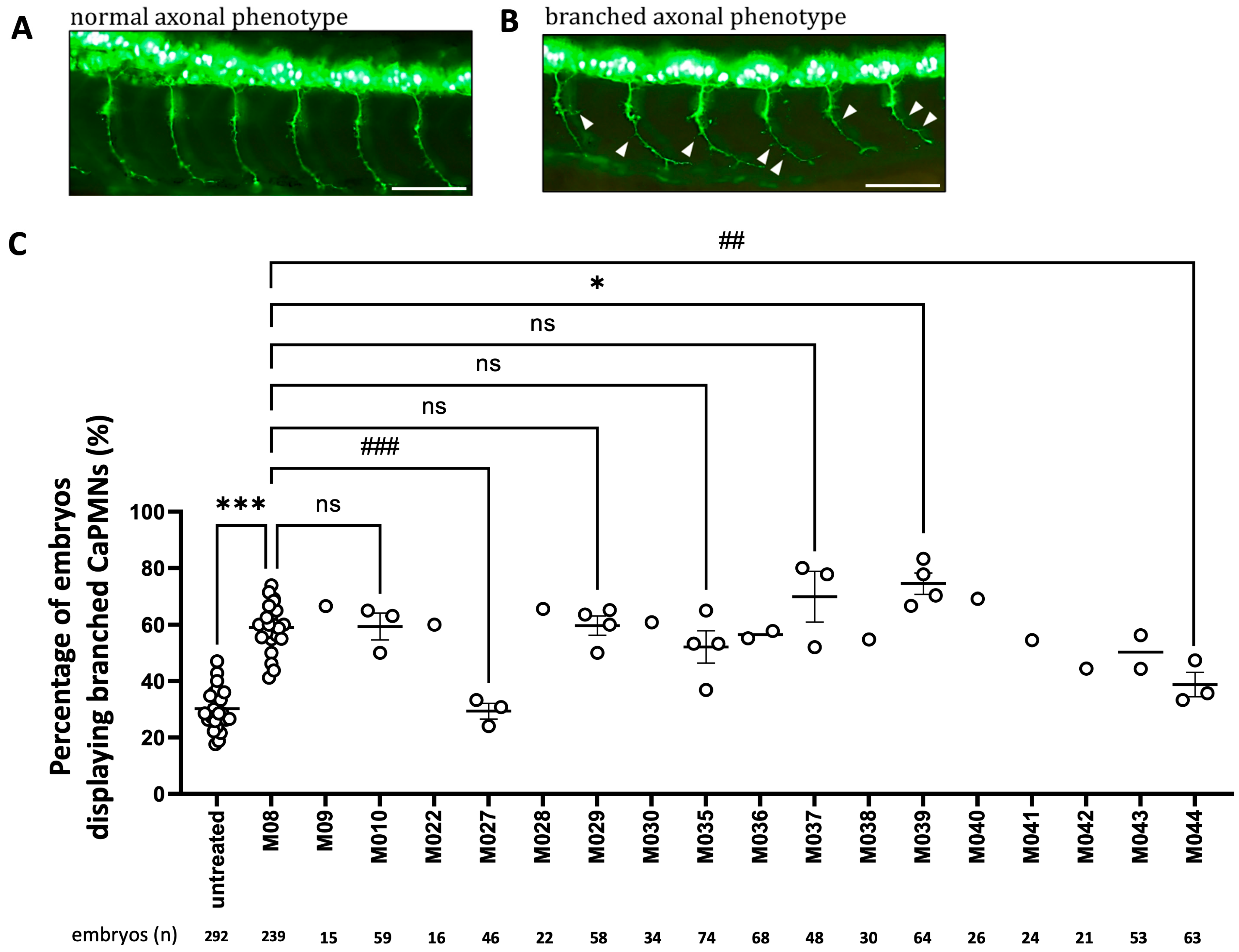
2.1. Effects of Supplementary Pgk1-Derived Short Peptide and Its Mutants on the Formation of Branched CaPMNs in Zebrafish Embryos
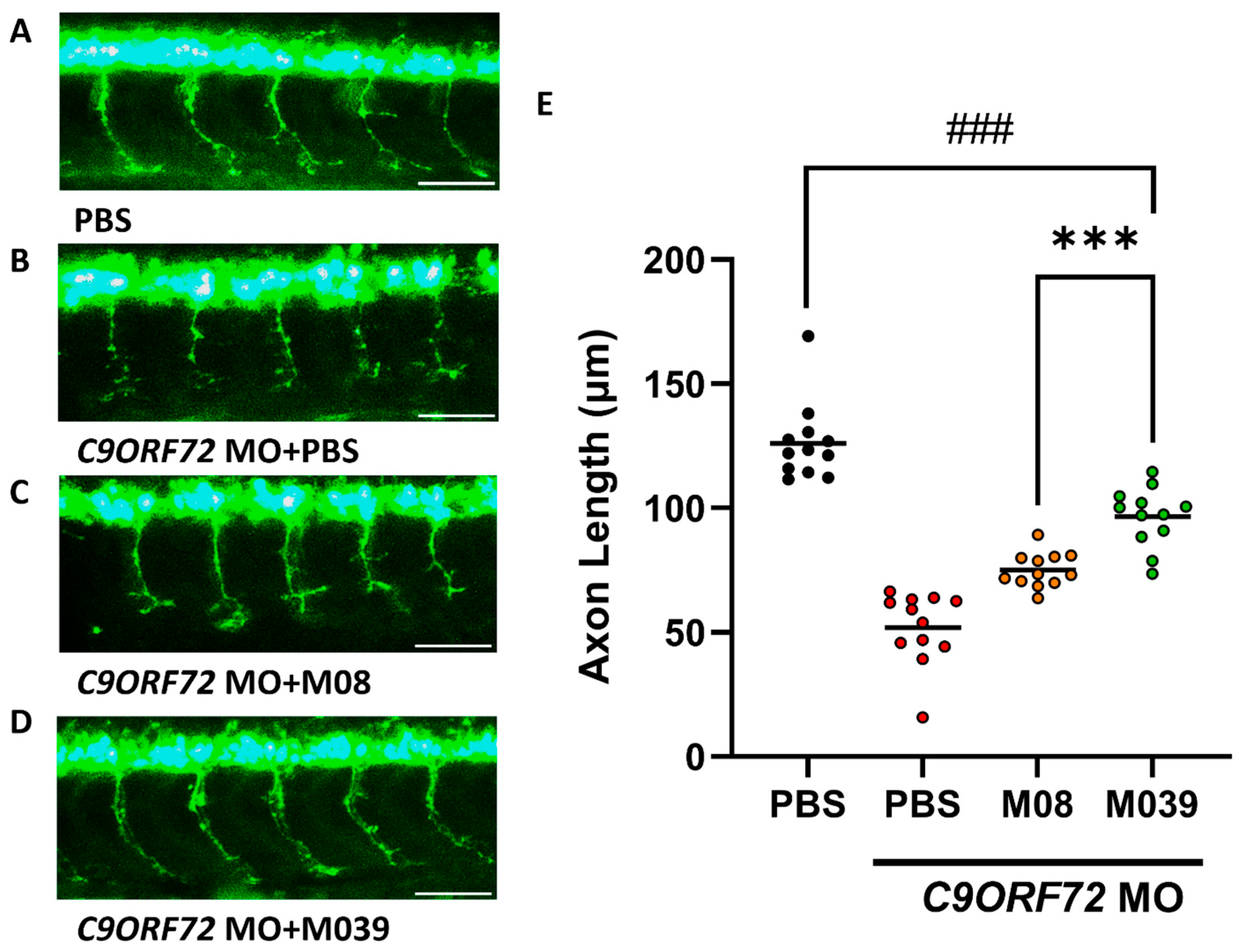
2.2. Administration of Mutant Short Peptide M039 Resulted in the Partial Rescue of Shortened Axonal Growth Defect in ALS-like Zebrafish Embryos
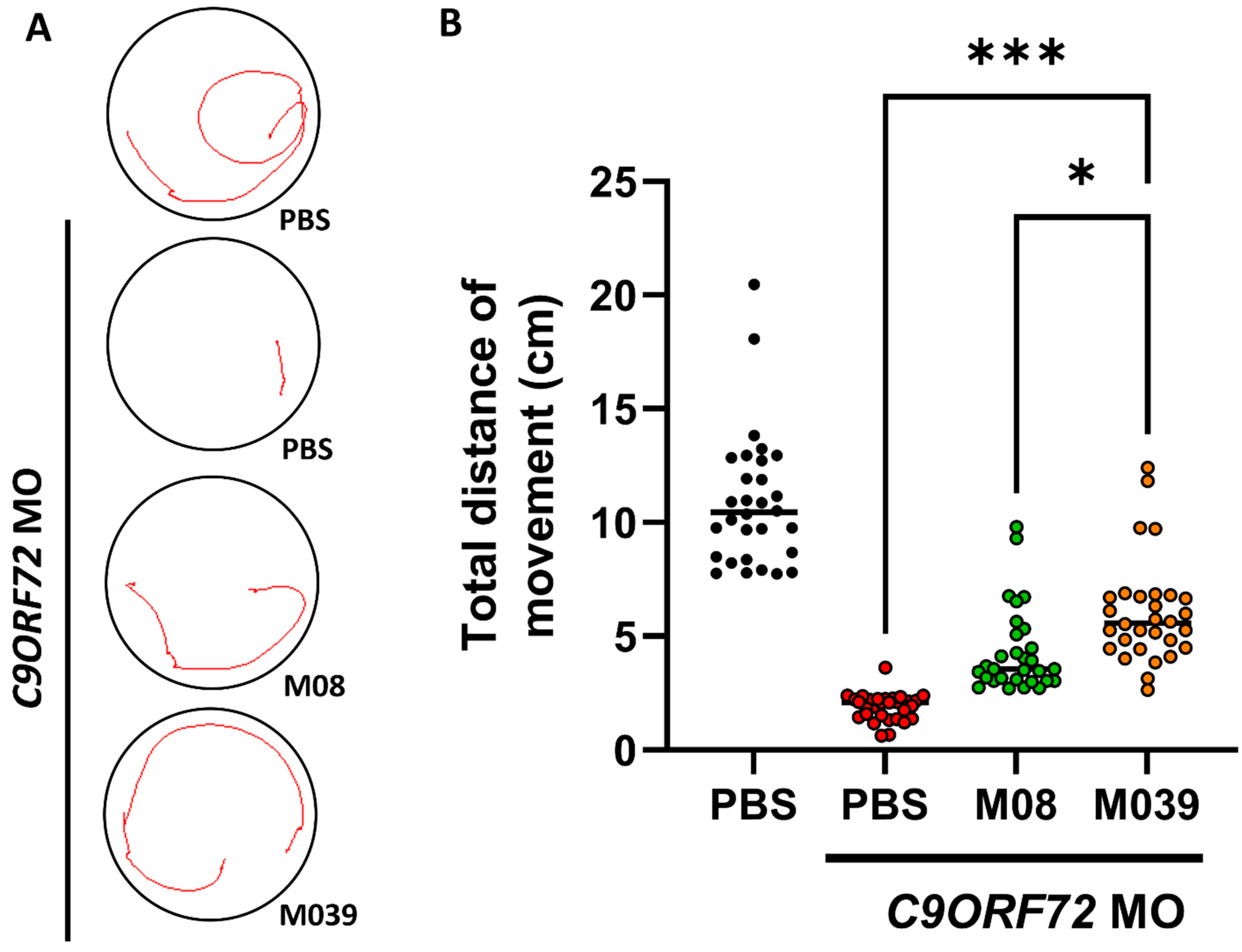
2.3. Administration of Mutant Short Peptide M039 Markedly Improved Swimming Defect in ALS-like Zebrafish Embryos
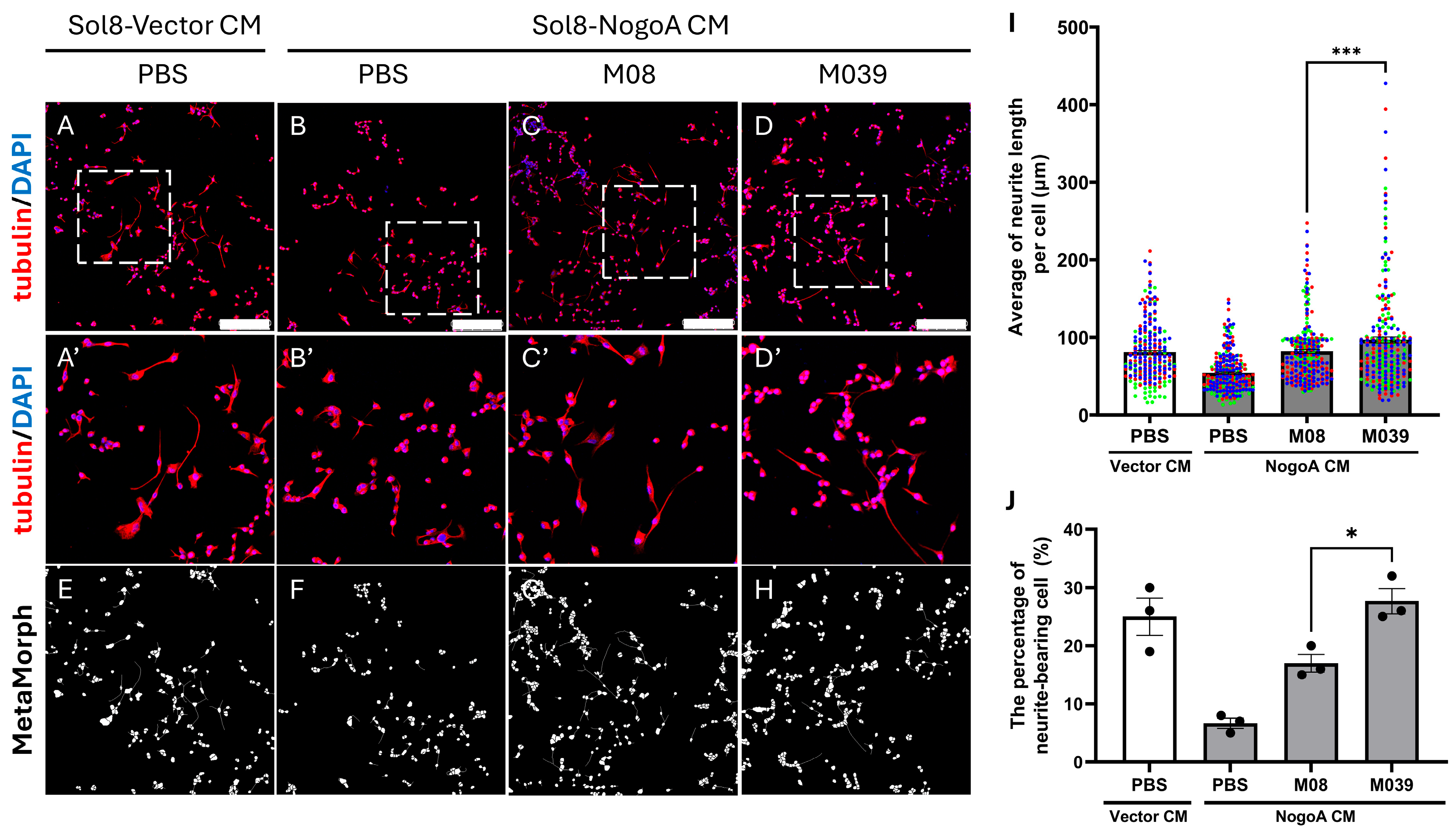
2.4. Exogenous Addition of Mutant M039 Could More Effectively Promote the Length of NOMN Compared to Benchmark M08
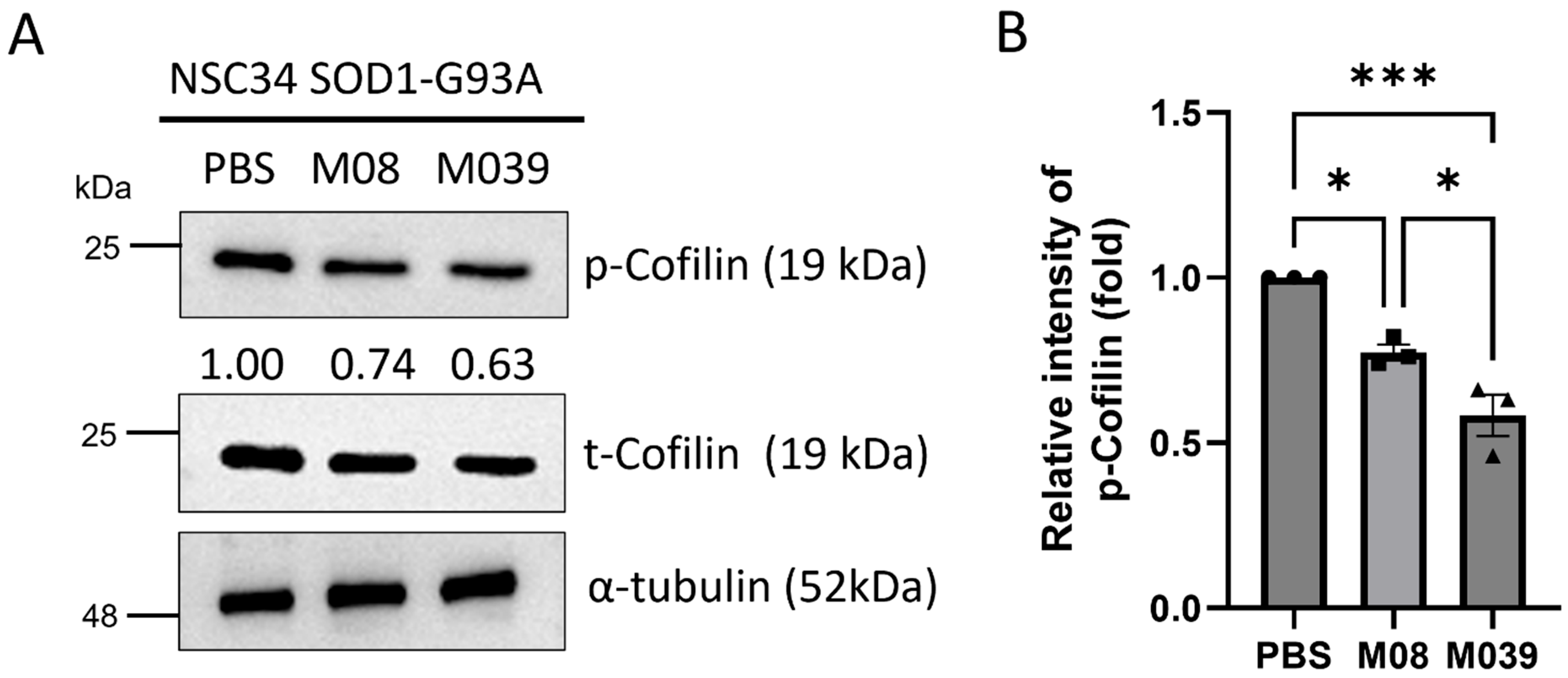
2.5. Exogenous Addition of Mutant Short Peptide M039 Displayed a Greater Efficacy to Reduce p-Cofilin Level in ALS-like Cells
3. Discussion
3.1. Zebrafish Phenotypic Screening Platform Demonstrates That Pgk1-Derived Original Short Peptide and Its Mutants Show Functional Disparity in Promoting Branched Formation of CaPMNs
3.2. Zebrafish Phenotypic Screening Revealed That Mutant Short Peptide M039 Could Promote the Highest Formation of CaPMNs
3.3. Arg Substitution for Glu at the 358th of Short Peptide M039 Might Strengthen Structural Stability and Interaction, Enhancing the Formation of Branched CaPMNs
3.4. Mutant Peptides M027, M029, and M044 Selected from Zebrafish Screening Demonstrated Loss of Function Toward the Formation of Branched CaPMNs
3.5. Effects of Charge-Reversal Mutation and Multiple Mutations of Short Peptides on the Improvement of Branched CaPMNs Formation
3.6. Zebrafish-First Strategy Followed by Cell-Based Mechanistic Validation
3.7. Zebrafish Platform Applied for Screening Potential Peptide Drugs
4. Materials and Methods
4.1. Pgk1-Derived Peptide and Its Mutants Designed for This Study
4.2. Peptide Synthesis and Preparation
4.3. Zebrafish Husbandry and Transgenic Line
4.4. Formation of Branched CaPMNs in Zebrafish Embryos
4.5. Knockdown of C9ORF72 and Axonal Length in Zebrafish Embryos
4.6. Tracking the Swimming Trajectory of Zebrafish Larvae
4.7. Culture Conditions of NSC34 Neural Cells and Sol8 Myoblasts
4.8. NOMN Derived from NSC34 Cells Cultured in CM
4.9. Protein Level of p-Cofilin Expressed in ALS-like NSC34 Neural Cells
4.10. Protein Extraction from Cells
4.11. Western Blot Analysis
4.12. Statistical Analysis
5. Conclusions
Author Contributions
Funding
Institutional Review Board Statement
Informed Consent Statement
Data Availability Statement
Acknowledgments
Conflicts of Interest
References
- Teame, T.; Zhang, Z.; Ran, C.; Zhang, H.; Yang, Y.; Ding, Q.; Xie, M.; Gao, C.; Ye, Y.; Duan, M.; et al. The use of zebrafish (Danio rerio) as biomedical models. Anim. Front. Rev. Mag. Anim. Agric. 2019, 9, 68–77. [Google Scholar] [CrossRef] [Scilit] [PubMed]
- Howe, K.; Clark, M.D.; Torroja, C.F.; Torrance, J.; Berthelot, C.; Muffato, M.; Collins, J.E.; Humphray, S.; McLaren, K.; Matthews, L.; et al. The zebrafish reference genome sequence and its relationship to the human genome. Nature 2013, 496, 498–503, Correction in Nature 2014, 505, 248. [Google Scholar] [CrossRef] [Scilit] [PubMed]
- Lieschke, G.J.; Currie, P.D. Animal models of human disease: Zebrafish swim into view. Nat. Rev. Genet. 2007, 8, 353–367. [Google Scholar] [CrossRef] [Scilit] [PubMed]
- MacRae, C.A.; Peterson, R.T. Zebrafish as tools for drug discovery. Nat. Rev. Drug Discov. 2015, 14, 721–731. [Google Scholar] [CrossRef] [Scilit]
- Swinney, D.C.; Anthony, J. How were new medicines discovered? Nat. Rev. Drug Discov. 2011, 10, 507–519. [Google Scholar] [CrossRef] [Scilit]
- Kalueff, A.V.; Gebhardt, M.; Stewart, A.M.; Cachat, J.M.; Brimmer, M.; Chawla, J.S.; Craddock, C.; Kyzar, E.J.; Roth, A.; Landsman, S.; et al. Towards a comprehensive catalog of zebrafish behavior 1.0 and beyond. Zebrafish 2013, 10, 70–86. [Google Scholar] [CrossRef] [Scilit]
- Rennekamp, A.J.; Peterson, R.T. 15 years of zebrafish chemical screening. Curr. Opin. Chem. Biol. 2015, 24, 58–70. [Google Scholar] [CrossRef] [Scilit]
- Saleem, S.; Kannan, R.R. Zebrafish: An emerging real-time model system to study Alzheimer’s disease and neurospecific drug discovery. Cell Death Discov. 2018, 4, 45, Erratum in Cell. Death. Discov. 2019, 10, 116.. [Google Scholar] [CrossRef] [Scilit]
- Patton, E.E.; Zon, L.I.; Langenau, D.M. Zebrafish disease models in drug discovery: From preclinical modelling to clinical trials. Nat. Rev. Drug Discov. 2021, 20, 611–628. [Google Scholar] [CrossRef] [Scilit]
- Baraban, S.C.; Dinday, M.T.; Hortopan, G.A. Drug screening in Scn1a zebrafish mutant identifies clemizole as a potential Dravet syndrome treatment. Nat. Commun. 2013, 4, 2410. [Google Scholar] [CrossRef] [Scilit]
- Hortopan, G.A.; Dinday, M.T.; Baraban, S.C. Spontaneous seizures and altered gene expression in GABA signaling pathways in a mind bomb mutant zebrafish. J. Neurosci. Off. J. Soc. Neurosci. 2010, 30, 13718–13728. [Google Scholar] [CrossRef] [Scilit]
- Kiernan, M.C.; Vucic, S.; Cheah, B.C.; Turner, M.R.; Eisen, A.; Hardiman, O.; Burrell, J.R.; Zoing, M.C. Amyotrophic lateral sclerosis. Lancet 2011, 377, 942–955. [Google Scholar] [CrossRef] [Scilit]
- Renton, A.E.; Chiò, A.; Traynor, B.J. State of play in amyotrophic lateral sclerosis genetics. Nat. Neurosci. 2014, 17, 17–23. [Google Scholar] [CrossRef] [Scilit] [PubMed]
- Brown, R.H.; Al-Chalabi, A. Amyotrophic lateral sclerosis. N. Engl. J. Med. 2017, 377, 162–172. [Google Scholar] [CrossRef] [Scilit] [PubMed]
- Tzeplaeff, L.; Wilfling, S.; Requardt, M.V.; Herdick, M. Current state and future directions in the therapy of ALS. Cells 2023, 12, 1523. [Google Scholar] [CrossRef] [Scilit] [PubMed]
- Margeta, M. Neuromuscular disease: 2023 update. Free Neuropathol. 2023, 4, 2. [Google Scholar] [CrossRef] [Scilit]
- Abe, K.; Aoki, M.; Tsuji, S.; Itoyama, Y.; Sobue, G.; Togo, M.; Hamada, C.; Tanaka, M.; Akimoto, M.; Nakamura, K.; et al. Safety and efficacy of edaravone in well defined patients with amyotrophic lateral sclerosis: A randomised, double-blind, placebo-controlled trial. Lancet Neurol. 2017, 16, 505–512. [Google Scholar] [CrossRef] [Scilit]
- Jokic, N.; Gonzalez de Aguilar, J.-L.; Pradat, P.-F.; Dupuis, L.; Echaniz-Laguna, A.; Muller, A.; Dubourg, O.; Seilhean, D.; Hauw, J.-J.; Loeffler, J.-P.; et al. Nogo expression in muscle correlates with amyotrophic lateral sclerosis severity. Ann. Neurol. 2005, 57, 553–556. [Google Scholar] [CrossRef] [Scilit]
- Pradat, P.F.; Bruneteau, G.; Gonzalez de Aguilar, J.L.; Dupuis, L.; Jokic, N.; Salachas, F.; Le Forestier, N.; Echaniz-Laguna, A.; Dubourg, O.; Hauw, J.J.; et al. Muscle Nogo-A expression is a prognostic marker in lower motor neuron syndromes. Ann. Neurol. 2007, 62, 15–20. [Google Scholar] [CrossRef] [Scilit]
- Lin, C.Y.; Wu, C.L.; Lee, K.Z.; Chen, Y.J.; Zhang, P.H.; Chang, C.Y.; Harn, H.J.; Lin, S.Z.; Tsai, H.J. Extracellular Pgk1 enhances neurite outgrowth of motoneurons through Nogo66/NgR-independent targeting of NogoA. eLife 2019, 8, e49175. [Google Scholar] [CrossRef] [Scilit]
- Fu, C.Y.; Chen, H.Y.; Lin, C.Y.; Chen, S.J.; Sheu, J.C.; Tsai, H.J. Extracellular Pgk1 interacts neural membrane protein enolase-2 to improve the neurite outgrowth of motor neurons. Commun. Biol. 2023, 6, 849. [Google Scholar] [CrossRef] [Scilit] [PubMed]
- Lee, B.C.; Tsai, J.C.; Huang, Y.H.; Wang, C.C.; Lee, H.C.; Tsai, H.J. The 419th aspartic acid of neural membrane protein enolase 2 is a key residue involved in the axonal growth of motor neurons mediated by interaction between enolase 2 receptor and extracellular Pgk1 ligand. Int. J. Mol. Sci. 2024, 25, 10753. [Google Scholar] [CrossRef] [Scilit] [PubMed]
- Lau, J.L.; Dunn, M.K. Therapeutic peptides: Historical perspectives, current development trends, and future directions. Bioorg. Med. Chem. 2018, 26, 2700–2707. [Google Scholar] [CrossRef] [Scilit] [PubMed]
- Endo, M.; Ohashi, K.; Sasaki, Y.; Goshima, Y.; Niwa, R.; Uemura, T.; Mizuno, K. Control of growth cone motility and morphology by LIM kinase and Slingshot via phosphorylation and dephosphorylation of cofilin. J. Neurosci. Off. J. Soc. Neurosci. 2003, 23, 2527–2537. [Google Scholar] [CrossRef] [Scilit]
- Myers, P.Z.; Eisen, J.S.; Westerfield, M. Development and axonal outgrowth of identified motoneurons in the zebrafish. J. Neurosci. Off. J. Soc. Neurosci. 1986, 6, 2278–2289. [Google Scholar] [CrossRef] [Scilit]
- Chaytow, H.; Carroll, E.; Gordon, D.; Huang, Y.-T.; van der Hoorn, D.; Smith, H.L.; Becker, T.; Becker, C.G.; Faller, K.M.E.; Talbot, K.; et al. Targeting phosphoglycerate kinase 1 with terazosin improves motor neuron phenotypes in multiple models of amyotrophic lateral sclerosis. eBioMedicine 2022, 83, 104202. [Google Scholar] [CrossRef] [Scilit]
- Pedone, E.; Saviano, M.; Rossi, M.; Bartolucci, S. A single point mutation (Glu85Arg) increases the stability of the thioredoxin from Escherichia coli. Protein Eng. 2001, 14, 255–260. [Google Scholar] [CrossRef] [Scilit]
- Strub, C.; Alies, C.; Lougarre, A.; Ladurantie, C.; Czaplicki, J.; Fournier, D. Mutation of exposed hydrophobic amino acids to arginine to increase protein stability. BMC Biochem. 2004, 5, 9. [Google Scholar] [CrossRef] [Scilit]
- Jafari, M.; Chen, P. Peptide mediated siRNA delivery. Curr. Top. Med. Chem. 2009, 9, 1088–1097. [Google Scholar] [CrossRef] [Scilit]
- Pace, C.N.; Scholtz, J.M. A helix propensity scale based on experimental studies of peptides and proteins. Biophys. J. 1998, 75, 422–427. [Google Scholar] [CrossRef] [Scilit]
- Aurora, R.; Rose, G.D. Helix capping. Protein Sci. Publ. Protein Soc. 1998, 7, 21–38. [Google Scholar] [CrossRef] [Scilit] [PubMed]
- Sheinerman, F.B.; Norel, R.; Honig, B. Electrostatic aspects of protein-protein interactions. Curr. Opin. Struct. Biol. 2000, 10, 153–159. [Google Scholar] [CrossRef] [Scilit] [PubMed]
- Baker, N.A.; Sept, D.; Joseph, S.; Holst, M.J.; McCammon, J.A. Electrostatics of nanosystems: Application to microtubules and the ribosome. Proc. Natl. Acad. Sci. USA 2001, 98, 10037–10041. [Google Scholar] [CrossRef] [Scilit] [PubMed]
- Eberhardt, J.; Santos-Martins, D.; Tillack, A.F.; Forli, S. AutoDock Vina 1.2.0: New Docking Methods, Expanded Force Field, and Python Bindings. J. Chem. Inf. Model. 2021, 61, 3891–3898. [Google Scholar] [CrossRef] [Scilit]
- Li, L.; Vorobyov, I.; Allen, T.W. The different interactions of lysine and arginine side chains with lipid membranes. J. Phys. Chem. B 2013, 117, 11906–11920. [Google Scholar] [CrossRef] [Scilit]
- Joseph, P.R.B.; Sawant, K.V.; Iwahara, J.; Garofalo, R.P.; Desai, U.R.; Rajarathnam, K. Lysines and Arginines play non-redundant roles in mediating chemokine-glycosaminoglycan interactions. Sci. Rep. 2018, 8, 12289. [Google Scholar] [CrossRef] [Scilit]
- Griffin, A.L.; Jaishankar, P.; Grandjean, J.-M.; Olson, S.H.; Renslo, A.R.; Baraban, S.C. Zebrafish studies identify serotonin receptors mediating antiepileptic activity in Dravet syndrome. Brain Commun. 2019, 1, fcz008. [Google Scholar] [CrossRef] [Scilit]
- White, R.M.; Cech, J.; Ratanasirintrawoot, S.; Lin, C.Y.; Rahl, P.B.; Burke, C.J.; Langdon, E.; Tomlinson, M.L.; Mosher, J.; Kaufman, C.; et al. DHODH modulates transcriptional elongation in the neural crest and melanoma. Nature 2011, 471, 518–522. [Google Scholar] [CrossRef] [Scilit]
- Kitcher, S.R.; Kirkwood, N.K.; Camci, E.D.; Wu, P.; Gibson, R.M.; Redila, V.A.; Simon, J.A.; Rubel, E.W.; Raible, D.W.; Richardson, G.P.; et al. ORC-13661 protects sensory hair cells from aminoglycoside and cisplatin ototoxicity. JCI Insight 2019, 4, e126764. [Google Scholar] [CrossRef] [Scilit]
- North, T.E.; Goessling, W.; Walkley, C.R.; Lengerke, C.; Kopani, K.R.; Lord, A.M.; Weber, G.J.; Bowman, T.V.; Jang, I.-H.; Grosser, T.; et al. Prostaglandin E2 regulates vertebrate haematopoietic stem cell homeostasis. Nature 2007, 447, 1007–1011. [Google Scholar] [CrossRef] [Scilit]
- Hansen, I.K.Ø.; Lövdahl, T.; Simonovic, D.; Hansen, K.Ø.; Andersen, A.J.C.; Devold, H.; Richard, C.S.M.; Andersen, J.H.; Strøm, M.B.; Haug, T. Antimicrobial Activity of Small Synthetic Peptides Based on the Marine Peptide Turgencin A: Prediction of Antimicrobial Peptide Sequences in a Natural Peptide and Strategy for Optimization of Potency. Int. J. Mol. Sci. 2020, 21, 5460. [Google Scholar] [CrossRef] [Scilit]
- Fernández, J.A.A.; de Moura, T.C.; Vila, S.F.; Gaytán, J.A.R.; López-Díaz, I.; Learte-Aymamí, S.; Vázquez, M.E.; Mayán, M.D.; Sánchez, L.; Maurer-Morelli, C.V. Effects of two different peptides on pentylenetetrazole-induced seizures in larval zebrafish. PLoS ONE 2025, 20, e0308581. [Google Scholar] [CrossRef] [Scilit] [PubMed]
- Ramachandran, S.; Rajagopal, S. Zebrafish: A Model for Marine Peptide Based Drug Screening, 1st ed.; Springer: Singapore, 2019; ISBN 978-981-13-7843-0. [Google Scholar]
- Shi, J.; Ge, J.; Zhang, Z.; Wei, L.; Dong, Y.; Li, G.; Yang, Q.; Pan, J.; Ji, Y. Anti-Thrombotic Effect of Hemp Seed Peptides in Zebrafish by Dual Regulation of vegfr1 Signaling and Caspase-3-Mediated Apoptosis. Food Sci. Nutr. 2025, 13, e70756. [Google Scholar] [CrossRef] [Scilit] [PubMed]
- Westerfield, M. The Zebrafish Book: A Guide for the Laboratory Use of Zebrafish (Danio rerio), 4th ed.; University of Oregon Press: Eugene, OR, USA, 2000. [Google Scholar]
- Flanagan-Steet, H.; Fox, M.A.; Meyer, D.; Sanes, J.R. Neuromuscular synapses can form in vivo by incorporation of initially aneural postsynaptic specializations. Dev. Camb. Engl. 2005, 132, 4471–4481. [Google Scholar] [CrossRef] [Scilit] [PubMed]
- Cashman, N.R.; Durham, H.D.; Blusztajn, J.K.; Oda, K.; Tabira, T.; Shaw, I.T.; Dahrouge, S.; Antel, J.P. Neuroblastoma × spinal cord (NSC) hybrid cell lines resemble developing motor neurons. Dev. Dyn. Off. Publ. Am. Assoc. Anat. 1992, 194, 209–221. [Google Scholar] [CrossRef] [Scilit]
- Gomes, C.; Palma, A.S.; Almeida, R.; Regalla, M.; McCluskey, L.F.; Trojanowski, J.Q.; Costa, J. Establishment of a cell model of ALS disease: Golgi apparatus disruption occurs independently from apoptosis. Biotechnol. Lett. 2008, 30, 603–610. [Google Scholar] [CrossRef] [Scilit]
- Lin, C.Y.; Lee, H.C.; Fu, C.Y.; Ding, Y.Y.; Chen, J.S.; Lee, M.H.; Huang, W.J.; Tsai, H.J. MiR-1 and miR-206 target different genes to have opposing roles during angiogenesis in zebrafish embryos. Nat. Commun. 2013, 4, 2829. [Google Scholar] [CrossRef] [Scilit]




| Peptide(s) | Sequence of Amino Acids from 345th to 360th of Pgk1 | Mutation Type | |||||||||||||||||||||
|---|---|---|---|---|---|---|---|---|---|---|---|---|---|---|---|---|---|---|---|---|---|---|---|
| Charge | Polarity | ||||||||||||||||||||||
| M08 | W | E | A | F | A | R | G | T | K | A | L | M | D | E | V | V | |||||||
| M09 | . | . | . | . | . | . | . | . | . | P | . | . | . | . | . | . | # | + | |||||
| M010 | . | . | . | . | . | . | . | . | R | . | . | . | . | . | . | . | ↑ | * | |||||
| M022 | . | . | . | . | . | . | . | . | . | . | . | . | R | Q | . | . | ↑ | * | |||||
| M027 | . | . | . | . | . | . | . | . | R | P | . | . | . | . | . | . | ↑ | + | |||||
| M028 | . | . | . | . | . | . | . | . | . | P | . | . | R | Q | . | . | ↑ | + | |||||
| M029 | . | . | . | . | . | . | . | . | R | . | . | . | R | Q | . | . | ↑ | * | |||||
| M030 | . | . | . | . | . | . | . | . | R | P | . | . | R | Q | . | . | ↑ | * | |||||
| M035 | . | R | . | . | . | . | . | . | . | . | . | . | . | . | . | . | ↑ | * | |||||
| M036 | . | . | . | . | . | D | . | . | . | . | . | . | . | . | . | . | ↓ | * | |||||
| M037 | . | . | . | . | . | . | . | . | D | . | . | . | . | . | . | . | ↓ | * | |||||
| M038 | . | . | . | . | . | . | . | . | . | . | . | . | R | . | . | . | ↑ | * | |||||
| M039 | . | . | . | . | . | . | . | . | . | . | . | . | . | R | . | . | ↑ | * | |||||
| M040 | . | . | . | . | . | . | . | . | . | . | . | . | . | . | . | . | K | A | T | S | R | # | * |
| M041 | . | . | P | . | . | D | . | . | . | . | . | . | R | R | . | . | ↑ | * | |||||
| M042 | . | . | P | . | . | D | . | . | R | . | . | . | R | R | . | . | ↑ | + | |||||
| M043 | . | . | P | . | . | D | . | . | D | P | . | . | R | R | . | . | ↑ | + | |||||
| M044 | . | . | . | . | . | . | R | . | . | . | R | Q | ↑ | * | |||||||||
Disclaimer/Publisher’s Note: The statements, opinions and data contained in all publications are solely those of the individual author(s) and contributor(s) and not of MDPI and/or the editor(s). MDPI and/or the editor(s) disclaim responsibility for any injury to people or property resulting from any ideas, methods, instructions or products referred to in the content. |
© 2025 by the authors. Licensee MDPI, Basel, Switzerland. This article is an open access article distributed under the terms and conditions of the Creative Commons Attribution (CC BY) license.
Share and Cite
Lee, B.-C.; Wang, C.-C.; Chen, S.-P.; Tsai, H.-J. Multilevel Screening Platform Utilizing Cellular and Zebrafish Models to Identify Short Peptides with High Improvement of Motor Neuron Growth. Int. J. Mol. Sci. 2026, 27, 281. https://doi.org/10.3390/ijms27010281
Lee B-C, Wang C-C, Chen S-P, Tsai H-J. Multilevel Screening Platform Utilizing Cellular and Zebrafish Models to Identify Short Peptides with High Improvement of Motor Neuron Growth. International Journal of Molecular Sciences. 2026; 27(1):281. https://doi.org/10.3390/ijms27010281
Chicago/Turabian StyleLee, Bing-Chang, Chun-Cheng Wang, Shan-Pin Chen, and Huai-Jen Tsai. 2026. "Multilevel Screening Platform Utilizing Cellular and Zebrafish Models to Identify Short Peptides with High Improvement of Motor Neuron Growth" International Journal of Molecular Sciences 27, no. 1: 281. https://doi.org/10.3390/ijms27010281
APA StyleLee, B.-C., Wang, C.-C., Chen, S.-P., & Tsai, H.-J. (2026). Multilevel Screening Platform Utilizing Cellular and Zebrafish Models to Identify Short Peptides with High Improvement of Motor Neuron Growth. International Journal of Molecular Sciences, 27(1), 281. https://doi.org/10.3390/ijms27010281