Appendix A
Appendix A.1. Basic Principles in Constructing Discontinuous Helices for Specified Atoms in a Helical Molecular Structure
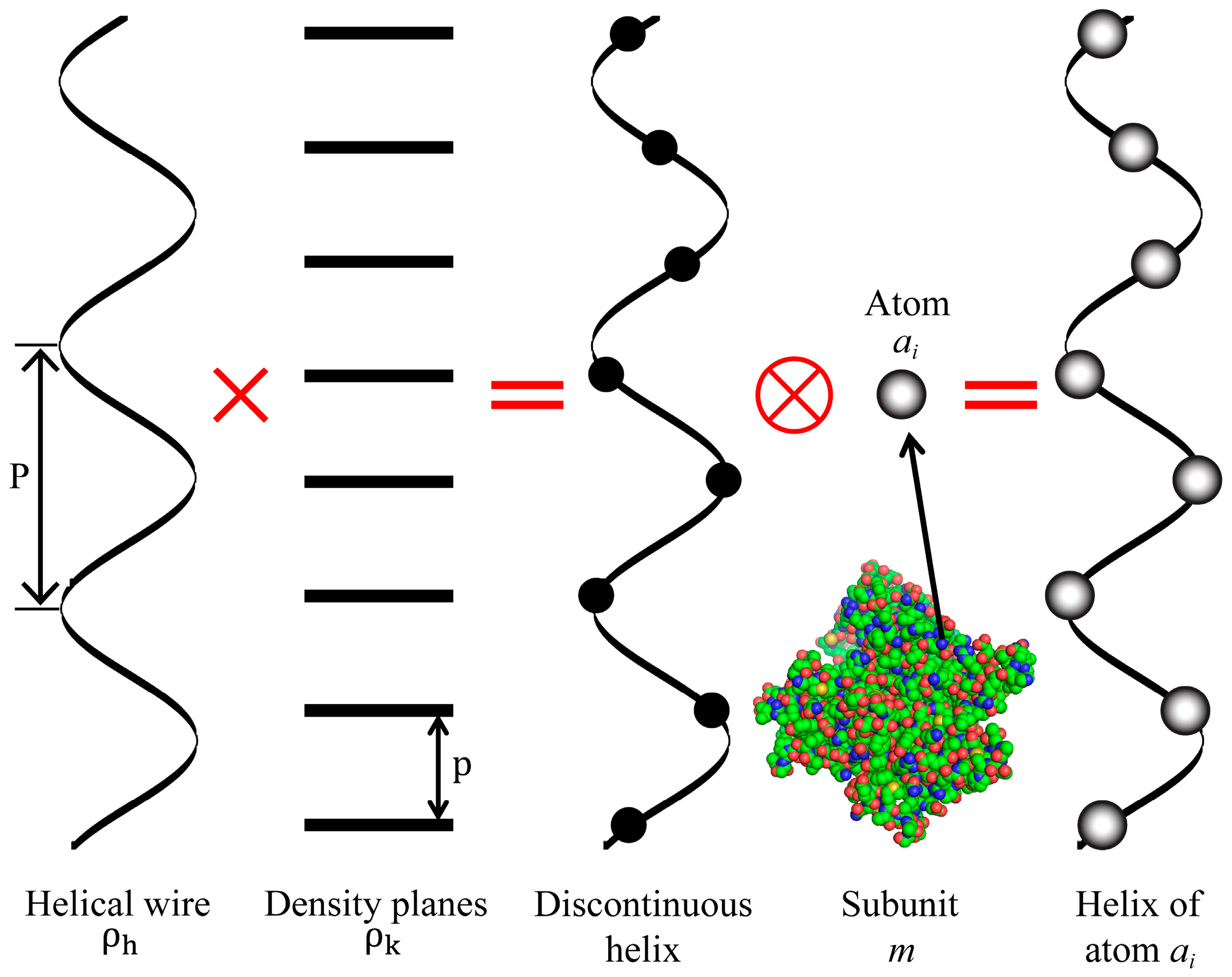
The vertebrate sarcomere lattice of actin filaments contains 340–460 helically arranged actin subunits. The diffraction patterns of actin filament can be represented as the Fourier transform of multiple discontinuous helices, with one helix corresponding to each atom in the actin filament monomer assembly. The basic principles used to construct these structures are illustrated in
Figure A1. In muscle cells, filaments are typically arranged as a helical array of multi-atom monomers where each atom,
, within the monomer has its own helical wire,
, passing through the same atom along all F-actin monomers. A cylindrical helix is a smooth 3D curved line such that any point on this helix is equidistant from a fixed line in space, called the helix axis, and its tangent makes a constant angle with the axis. Therefore, in cylindrical coordinates, the helix axial coordinate,
, is proportional to angle
, thus, for the axial increment of
equal to one pitch,
, the angle increment
is equal to
. In a relaxed actin filament, the helix has a constant pitch,
. The equation of the helix passing through atom
is defined as
, where
is radius of the helix cylinder of and
is the angle at which the helical wire intersects the plane perpendicular to the longitudinal axis at the tip of the actin filament,
(
Figure 3C).
Figure A1.
Basic principles of constructing a discontinuous helix. The convolution of a single turn of the helix and linearly arranged 3D delta functions (lattice of points) aligned along the helix axis and separated by the pitch,
, forms helical wires,
, of prescribed length [
30]. For helically arranged subunits or a multi-atom structure, the axial position of each monomer or atom can be represented by its own density plane,
, axially separated by distance
. Then, the discontinuous helix can be formed by product of the helical wire and
for dimensionless and massless subunit or atom. For helically arranged subunits
consisting of many atoms, each atom,
, forms its own wire and discrete helix. The helical arrangement of an atom
in actin monomers along an actin filament can be represented as convolution of discontinuous set of the atom positions and the atom object function represented as sphere with its Van der Waals radius.
Figure A1.
Basic principles of constructing a discontinuous helix. The convolution of a single turn of the helix and linearly arranged 3D delta functions (lattice of points) aligned along the helix axis and separated by the pitch,
, forms helical wires,
, of prescribed length [
30]. For helically arranged subunits or a multi-atom structure, the axial position of each monomer or atom can be represented by its own density plane,
, axially separated by distance
. Then, the discontinuous helix can be formed by product of the helical wire and
for dimensionless and massless subunit or atom. For helically arranged subunits
consisting of many atoms, each atom,
, forms its own wire and discrete helix. The helical arrangement of an atom
in actin monomers along an actin filament can be represented as convolution of discontinuous set of the atom positions and the atom object function represented as sphere with its Van der Waals radius.
The atoms
on this helical wire are represented as a discontinuous helix,
, which can be constructed as the product of a continuous helical wire,
, with a pitch
, and a set of horizontal density planes,
. These planes pass through a selected atom
over all subunits, the planes are axially separated from the next, in a sequence by a distance
[
30]. In relaxed actin filaments, the axial separation between atoms also has a constant value,
. By repeating the process of forming discontinuous helices for all atoms in an actin monomer (
Figure 3), one can generate a set of discontinuous helices that collectively represent the periodic structure of the actin filament (
Figure 3C). Each discontinuous helix,
, for each atom,
, or
, for each grain,
, is defined by
, angular coordinate
where the helix passes through the plane at axial coordinate
, the atom
axial coordinate in the first monomer,
, the atom (or grain) separation,
, and the angular increment between atoms
in sequential monomers,
, where for 13/6 helix,
. The same definitions apply on
related to position of the grain centers,
. Furthermore, discontinuous helices contain finite size atoms, or coarse-grained representations of groups of atoms, which are approximated as effective spheres, with radii,
or
.
In cylindrical coordinates, a continuous helix or a helical wire is defined as
,
,
. The Fourier transform in 3D in cylindrical coordinates has the form
where
is the object function,
are cylindrical coordinates in inverse space, the exponential term is the scalar product of coordinates in real and inverse space and
is the infinitesimal volume. Using the identity
for the exponential term in Equation (A1) and expressing the sine function as
, where
and
, the Equation (A1) can be re-expressed using a Bessel function expansion [
55] as
The transform derived for a continuous helix [
15,
56] applies to helix starting from
when
. However, for a rotated identical helix, whether for atom
or coarse-grained actin monomer substructure, such that
when
, the transform should include an angular exponential term to account for the shift in angle of
.
Appendix A.2. The Fourier Transform of a Continuous Helix
Let us here consider first the Fourier transform for a nonuniformly deformed continuous helix passing through an atom
, with radius,
, defined as [
15,
56]
, where a piecewise pitch,
, is represented as a set of the constant pitches,
, within segments
(
Figure 13B). The step changes from
to
occur at the axial locations where crossbridges are attached,
. The helix object function
, assuming that the density along the helix is unity, can be expressed for each atom
as the product of two
-functions:
where
denotes helix passing through atom
starting at the angular position
,
is represented as the series of
values at each segment
(
Figure 13A). The number of these constant pitch segments is
.
After integration over
and
using the formalism
, the Fourier transform for continuous helix passing through atom
(Equation (2)) becomes
Appendix A.3. The Fourier Transform of a Discontinuous Helix
The Fourier transforms of uniformly and nonuniformly deformed discontinuous helices,
, were derived in Prodanovic et al. [
15]. In their formulation, each actin monomer is lumped into a single equivalent sphere, representing all atoms in the monomer, and the force transferred from the myosin crossbridge to the actin coincides with the axial location of the equivalent sphere center. Because the axial tension, strain, and intermonomer spacing along an actin filament change at each site of bound myosin, i.e., in a single plane perpendicular to the helix axis, the piecewise description of deformed actin filament is directly defined by the axial coordinate
from MUSICO simulations. The assumption that crossbridge force is transferred to the actin filament within a single plane perpendicular to the helix axis at
, rather than across an interaction area, simplifies mathematical formulation. Since monomer spacing in deformed actin filament varies from segment to segment, and multiple monomers can be within each segment, we included both the current monomer number,
, and the current segment,
, in the notation of axial and angular positions of atom
. Therefore, in the following text, the coordinates in deformed configuration are denoted as
and
.
Appendix B
Discontinuous Helices Derived from All-Atom Actin Filament Structure Under Relaxed and Contracted Conditions
The axial periodicity of the atoms in the relaxed filaments will follow equidistant spacings of the axial subunits. Each atom forms its own discontinuous helix with a radius
and uniform axial spacing of the subunits
. The positions of the helices are defined by the coordinates of the atom
in the first monomer
,
and
, where the axial position of the same atom on all other subunits is assumed to be on a continuous helix of constant radius, starting at the angular position
at
(
Figure 13B,C). The coordinate
can be defined arbitrarily, but because of simplicity we define it as the coordinate at the tip of actin filament, i.e., the position of atom which is farthest away from the plane passing through the center of mass of the first monomer. The coordinates of atom
in monomer
following equidistant spacings between the sequential monomers along actin filaments are
,
, and
.
In contrast, the axial periodicity of the atoms in the filaments under contracting conditions displays variable spacing between the axial subunits, depending on the tension in segments
between the loading planes. In this configuration, each atom forms its own discontinuous helix with a radius
, but axial spacing of the actin monomers aligns with the spacing within each segment
, denoted as
, which is proportional to the segment peach,
. This proportionality is valid for all
s, except in cases where the spacing spans across two segments,
and
, denoted as intersegment spacings,
. The spacing
is defined as the difference between the positions of atoms
in the first monomer of the segment
,
, and in the last monomer within the segment
,
. Since the segments
and segment
contain different pitches, the pitch changes at
from
to
. In deformed configuration fragments,
and
are derived by assuming that the angular increments between sequential atoms
remain the same in both deformed and undeformed configurations,
. This assumption enables calculations of the fragment increments in the deformed configuration by including the changes in pitch, expressed as
and
, and the intersegment spacing
(for details see
Appendix C).
Appendix C
Intersegment spacing between successive atoms
just below and just above load plane
, denoted as
, is calculated as the distance between the positions of
in the last monomer within the segment
and in the first monomer of the segment
(
Figure 14). Assuming that the angular increment between consecutive atoms
on a discrete helix is constant and equal to the angular increment of the undeformed helix, i.e.,
then the parts of angle increments in the segments
and
are
and
, respectively. Here
,
and
are coordinates of the angles of atom
on the helix passing through the atoms
in the monomer just below the plane
in segment
and the first monomer above the plane in segment
, respectively. The increment in the intersegment angle is
.
Accordingly, the parts in intersegment spacing can be related to the increments in angle using the definition of helix in deformed configuration as and . The sum of the increments in angle, after substituting the above relations, becomes . Since the proportion between monomer spacing and pitch for 13/6 helix in both undeformed and deformed configurations remains the same, if the helix does not unwind, i.e., and , the above equation simplifies to . Furthermore, in the undeformed configuration, the monomer spacing and the intersegment spacing are the same, leading to . Because the fragment increments in angles are the same in the deformed and the undeformed configurations, the increments in fragment length in deformed configurations are proportional to the strains in the segments and , i.e., and , where the value of is defined from the undeformed configuration of the actin filament, and the fragments of atom positions relative to the load plane, , and are known from the undeformed actin filament monomer configuration.
Appendix D
We have defined five distinct regions where atom
can be located within the monomer relative to the position on the loading plane
. We introduced a differential, denoted as
, between the monomer number associated with load plane
,
, and the monomer number where atom
at coordinate
is located,
. This differential is suitable for generalized formulation of the axial coordinate
for atom
placed in regions (ii–v) within actin monomer. The value of
is equal to zero if
is in region (ii), 1 if in region (iii), −1 if in region (iv), and −2 if in region (v) (see
Figure 14A,B). The monomer number for coordinate
is equal to
.
The formulation of the axial coordinate of atom
in monomer
in the deformed configuration is complex and have to take in account all spacing across the segments,
and intersegment spacings,
, up to the monomer
. When the atom
is in proximity to the load plane passing through a monomer in a narrow region around the load plane
,
Å, then
or
; therefore,
or
, thus it is not necessary to calculate
, because
or
, respectively. In this case, the number of subunit spacings
within the segment length
is equal to
. This simplifies calculation of
in region (i), and coordinate of a monomer
in segment
is simple sum of
s over the segments up to (and including)
, and the spacings in segment
up to
:
except in segment
when the coordinate simplifies to
is
.
Note that , because there is no load in the segment , thus the spacing in this segment is the same as in the relaxed filaments.
In all other cases,
has a value between
and
, and the monomer numbers from which
and
are calculated depend on the region of the monomer where the atom
is located. Using values of
for the atoms placed in the regions (ii–v), enables formulation of general expression for coordinate of a monomer
in segment
as
This general formula is valid except in situations when crossbridges are bound to the first monomer (
). A brief description of how these exceptions are handled is given in
Appendix E.
Appendix E
When crossbridges are bound to the first and second monomer ( and ), the general formulation related to segment should be adjusted in the following ways.
If a load plane passes through monomer 1 () and atom is in proximity of the plane (within ) or is below the loading plane (region (ii)), , then , where is the undeformed helix spacing. However, if , then atom is also below the load plane, but located within region (iii) of monomer 2 (), and its . Note that below the load plane, there is no deformation, thus, in the segment , the spacing remains unchanged (i.e., ). Once or are calculated using Equation (A6), then can be obtained, as described above.
On the other hand, when atom position is above the load plane, all atoms are in regions (iv and v), then there is no a single atom of monomer in the segment , and the atom position of the first monomer is in the segment . In this case, part of the monomer above the loading plane should be corrected for the deformation in the segment , i.e., . Since the atom in is in segment , there is no intersegment spacing . In addition, below the load line there is no deformation of the monomer thus for actin filament end part from to is in undeformed, whereas part of the monomer above the load line is in the deformed part of the filament, so this part of the coordinate includes correction for the strain because this part belongs to the segment .
Moreover, when crossbridges are bound to monomer 1 and 2, and also for atoms in monomer which have a position above the (load) plane , i.e., for atoms belonging to region (v), then there is not a single atom of monomer in the segments and . Therefore, positions of the atoms of the first monomer are in the segment , and their axial coordinate should be corrected for the deformation in the segments and , i.e., . Note that, in this case, there is no and , and the deformation in segments and are included in the corrected coordinate . Also, below the load line there is no deformation of the monomer, thus, is in undeformed part, but part of the monomer above the load line is in the deformed part of the filament, so this part of the coordinate includes correction for the strain because this part belongs to the segment and also part of the coordinate includes correction for the strain because this part belongs to the segment .
Because the coordinate of the atom in the first monomer is in segment 2 or in segment 3, the lower and upper limits of summation in the Equation (A6) should be adjusted appropriately.
Appendix F
The intensity is proportional to
, i.e., the Fourier transform (Equation (1)) should be multiplied by its complex conjugate. Because the intensity,
, varies with
, cylindrically averaged diffraction intensity is then obtained by integration of the intensity over
from 0 to
. The analytic expression for cylindrically averaged diffraction intensity can then be easily derived for finite number of layer lines as a sum of products of the coefficients
, and the nonzero values of the corresponding integrals over all layer lines. Thus, the cylindrical average after integration simplifies to
Detailed derivation of the Equation (A7) is shown in Appendix from Prodanovic [
15].
For the numerical integration of Equation (A7), we used the trapezoidal rule by dividing the integrand into equal angular segments,
wide, and summing their areas to approximately obtain the cylindrically averaged actin filament X-ray diffraction pattern. Using an angular increment of
provided sufficient accuracy. For details see
Supplemental Material (Figures S8 and S9 and Tables S1 and S2).
Appendix G
Table A1.
Alphabetical list of symbols used throughout the manuscript, with corresponding definitions.
Table A1.
Alphabetical list of symbols used throughout the manuscript, with corresponding definitions.
| Symbols | Definition |
|---|
| Individual atom with index |
| Individual coarse-grained sphere with index |
| Helix object function |
| The Fourier transform for a discontinuous helix passing through atom |
| Crossbridge force acting on actin |
| Fourier transform of helical structure factor |
| Fourier transform of spherical object, for specific atom |
| Bessel function of the -th order |
| Current number of the plane where myosin is bound to actin |
| Total number of constant pitch segments |
| Axial length of segment with constant pitch |
| Current number of a subunit (monomer) |
| Monomer indexed |
| Monomer indexed |
| The differential used for generalized formulation of the axial coordinate for atom placed in regions (ii–v) within actin monomer; determines monomer index shift. |
| Number of monomer spacings within segment |
| Number of atoms in the actin monomer |
| Axial spacing between monomers along the helix |
| Axial spacing between monomers along the helix for the undeformed helix. |
| Axial spacing between monomers along the helix within segment |
| Intersegment monomer spacing of atom between successive monomers, depending of the position of atom within the monomer and and , and associated strains on each side of the load plane |
| Pitch of the undeformed helix. |
| Pitch within the segment |
| Piecewise pitch represented as a set of the constant pitches, , within segments |
| Helical angular coordinate |
| Azimuthal angle increment |
| Azimuthal angular position of the helix passing through the load plane |
| Azimuthal angle of atom in monomer within segment |
| Starting angular coordinate of discontinuous helix for each atom and for each grain |
| Angular increment between atoms in sequential monomers |
| Angular position for each cluster center |
| Angular coordinates of the angles of atom on the helix passing through the atoms in the monomer just below the plane , in segment |
| Angular coordinates of the angles of atom on the helix passing through the atoms in the first monomer above the plane in segment |
| Helix cylinder radius for discontinuous helix |
| Helix radius of an atom in the undeformed helix configuration |
| Helix radius for each atom |
| Radial coordinate of atom in monomer . |
| Radial distance from the actin filament’s main axis for each cluster center |
| Equivalent radius used to present grain size |
| , | Effective sphere radius for groups of atoms and coarse grained representations |
| Van der Waals radius of atom |
| Infinitesimal volume |
| Cylindrical coordinates in inverse space |
| Continuous helical wire with pitch |
| Density planes separated by axial distance |
| Discontinuous helix, which can be constructed as the product of a continuous helical wire, , with a pitch, , and a set of horizontal density planes, |
| , | Discontinuous helix cylinder radius for each atom and for each grain |
| Transform of finite-size atom object |
| Effective atomic volume |
| Helix axial coordinate |
| Axial coordinate at the tip of actin filament (starting axial position of the actin filament) |
| Axial position for each cluster center |
| , | Fragments of atom positions relative to the load plane |
| Increment of axial coordinate for atom in monomer 1 relative to the loading plane |
| Increment of axial coordinate when atom is in region (iii) of monomer 2 but below the load plane |
| Midplane through the interaction area where a crossbridge is bound, corresponds to plane |
| Coordinate of the last plane |
| Maximum coordinate of atom relative to the load plane in monomer |
| Minimum coordinate of atom relative to the load plane in monomer |
| Axial coordinate of atom in monomer , measured along the filament axis in undeformed configuration |
| Axial position of atom in subunit within segment in nonuniformly deformed configuration |
Figure 1.
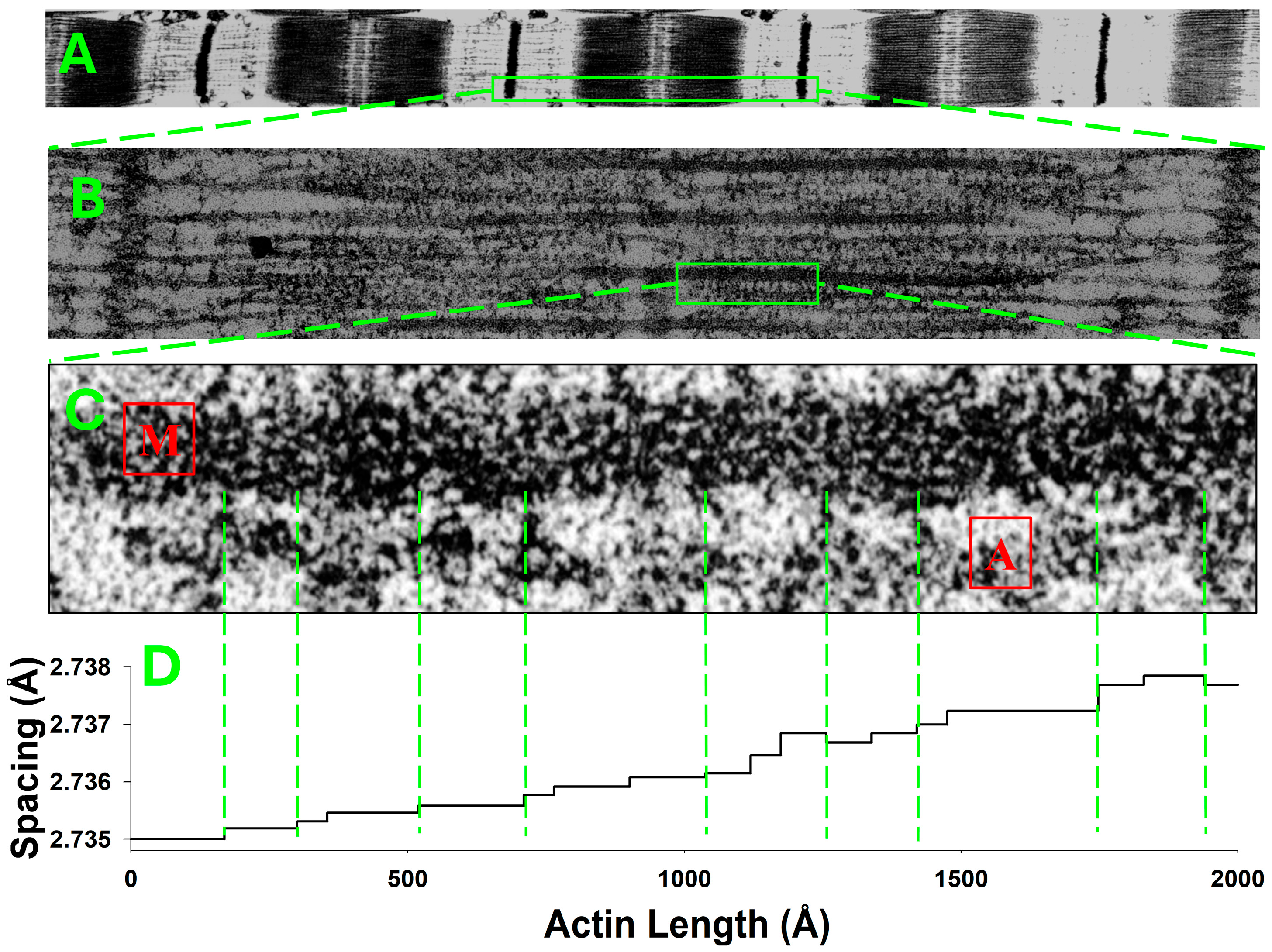
The monomer spacings along an actin filament under nonuniform strain during fully developed isometric tension. (A) Electron micrograph (H.E. Huxley unpublished) showing part of myofibril, and (B) zoomed in detail from panel (A) showing interdigitated actin (denoted by a red A in panel (C)) and myosin filaments (denoted by a red M in panel (C)) in frog (skeletal) sarcomere lattice. (C) Zoomed in detail from (B), showing the position of myosin heads attached to actin filaments (crossbridges), denoted by green dashed lines. (D) The piecewise change in spacing between neighboring actin monomers coincides with the locations of myosin molecules bound to actin sites. Here interactions are shown between only one myosin filament with one actin filament (green dashed lines between panels (C) and (D)), but in the hexagonal lattice in the A-band, three myosin filaments will interact with each actin filament. Actin monomer spacing generally increases from the free end of the actin filament toward the Z-line but can occasionally decrease due to the effect of stochastic compressive forces by the bound crossbridges.
Figure 1.
The monomer spacings along an actin filament under nonuniform strain during fully developed isometric tension. (A) Electron micrograph (H.E. Huxley unpublished) showing part of myofibril, and (B) zoomed in detail from panel (A) showing interdigitated actin (denoted by a red A in panel (C)) and myosin filaments (denoted by a red M in panel (C)) in frog (skeletal) sarcomere lattice. (C) Zoomed in detail from (B), showing the position of myosin heads attached to actin filaments (crossbridges), denoted by green dashed lines. (D) The piecewise change in spacing between neighboring actin monomers coincides with the locations of myosin molecules bound to actin sites. Here interactions are shown between only one myosin filament with one actin filament (green dashed lines between panels (C) and (D)), but in the hexagonal lattice in the A-band, three myosin filaments will interact with each actin filament. Actin monomer spacing generally increases from the free end of the actin filament toward the Z-line but can occasionally decrease due to the effect of stochastic compressive forces by the bound crossbridges.

Figure 2.
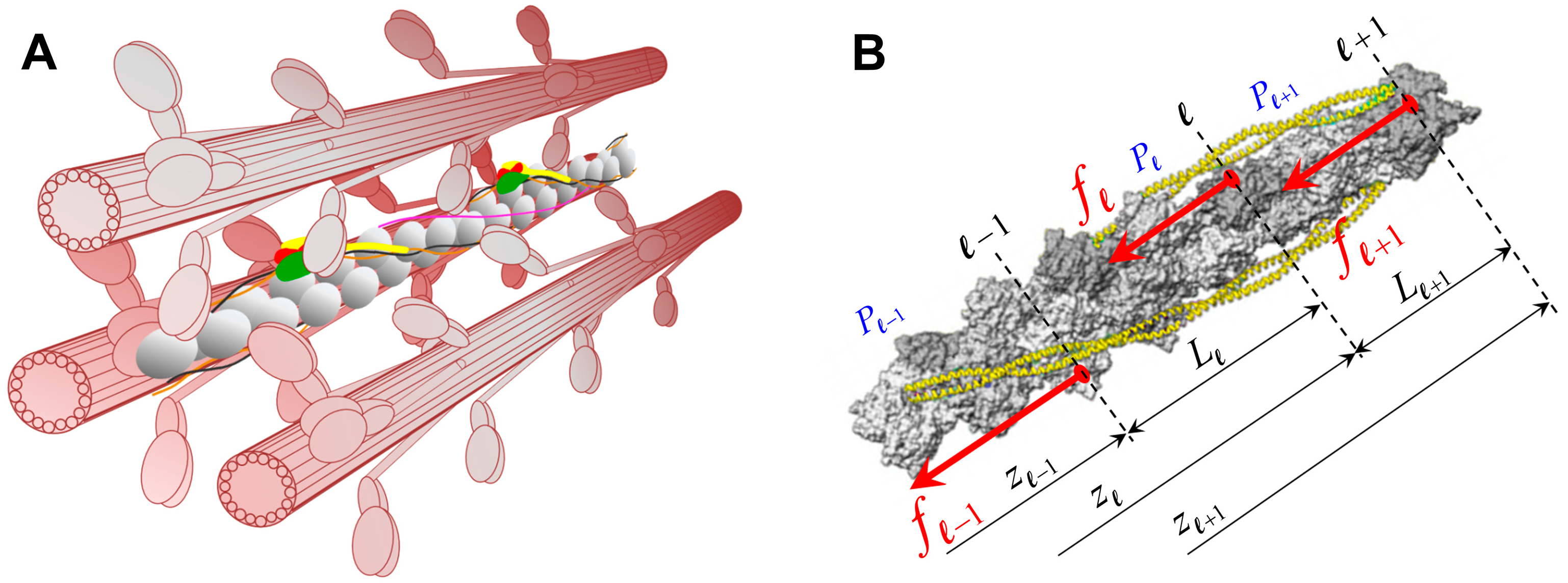
Spatially explicit simulations of muscle force using MUSICO. Myosin filament interacts with actin filaments, arranged in multiple interconnected hexagonal lattices. (A) Three-dimensional representation of three myosin filaments interacting with an actin filament. (B) The crossbridge forces in the axial direction calculated in MUSICO (red arrows) are shown on the surface 3D structural model of actin filament. Note that positions of axial forces follow helical position of actin binding sites where myosin heads are bound. The subscript denotes the current number of the plane where myosin is bound to actin and crossbridge force acting on actin is . The length of segments, , are defined by the axial positions of the planes, and the pitch within the segment is .
Figure 2.
Spatially explicit simulations of muscle force using MUSICO. Myosin filament interacts with actin filaments, arranged in multiple interconnected hexagonal lattices. (A) Three-dimensional representation of three myosin filaments interacting with an actin filament. (B) The crossbridge forces in the axial direction calculated in MUSICO (red arrows) are shown on the surface 3D structural model of actin filament. Note that positions of axial forces follow helical position of actin binding sites where myosin heads are bound. The subscript denotes the current number of the plane where myosin is bound to actin and crossbridge force acting on actin is . The length of segments, , are defined by the axial positions of the planes, and the pitch within the segment is .
Figure 3.
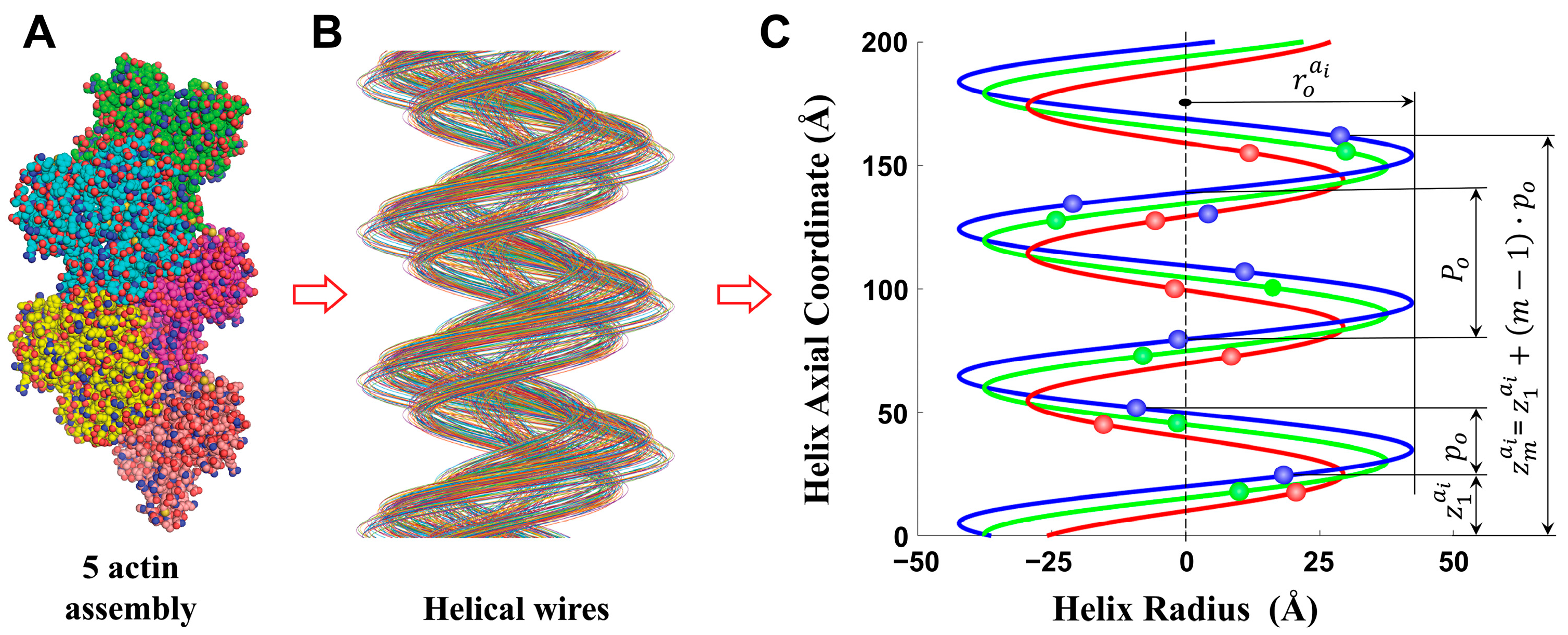
All-atom representation of actin helices. A fragment of an actin filament consisting of five helically arranged subunits (from 3actin.pdb structure [
36]) is shown in (
A). Through each atom,
, of a subunit
, one helical wire can be constructed to pass through the same atom in all other subunits. For each of the 2991 atoms, there will correspond one helical wire with its own helix radius,
, and pitch,
(
B). The discontinuous helix of an array of atoms,
, repeating along all monomers with axial spacing,
, can be constructed for each helical wire (
C), where the coordinates of the atom in monomer
are
,
, and
. The expression for
of an undeformed helix is shown as a function of monomer spacing and pitch,
and
.
Figure 3.
All-atom representation of actin helices. A fragment of an actin filament consisting of five helically arranged subunits (from 3actin.pdb structure [
36]) is shown in (
A). Through each atom,
, of a subunit
, one helical wire can be constructed to pass through the same atom in all other subunits. For each of the 2991 atoms, there will correspond one helical wire with its own helix radius,
, and pitch,
(
B). The discontinuous helix of an array of atoms,
, repeating along all monomers with axial spacing,
, can be constructed for each helical wire (
C), where the coordinates of the atom in monomer
are
,
, and
. The expression for
of an undeformed helix is shown as a function of monomer spacing and pitch,
and
.
Figure 4.
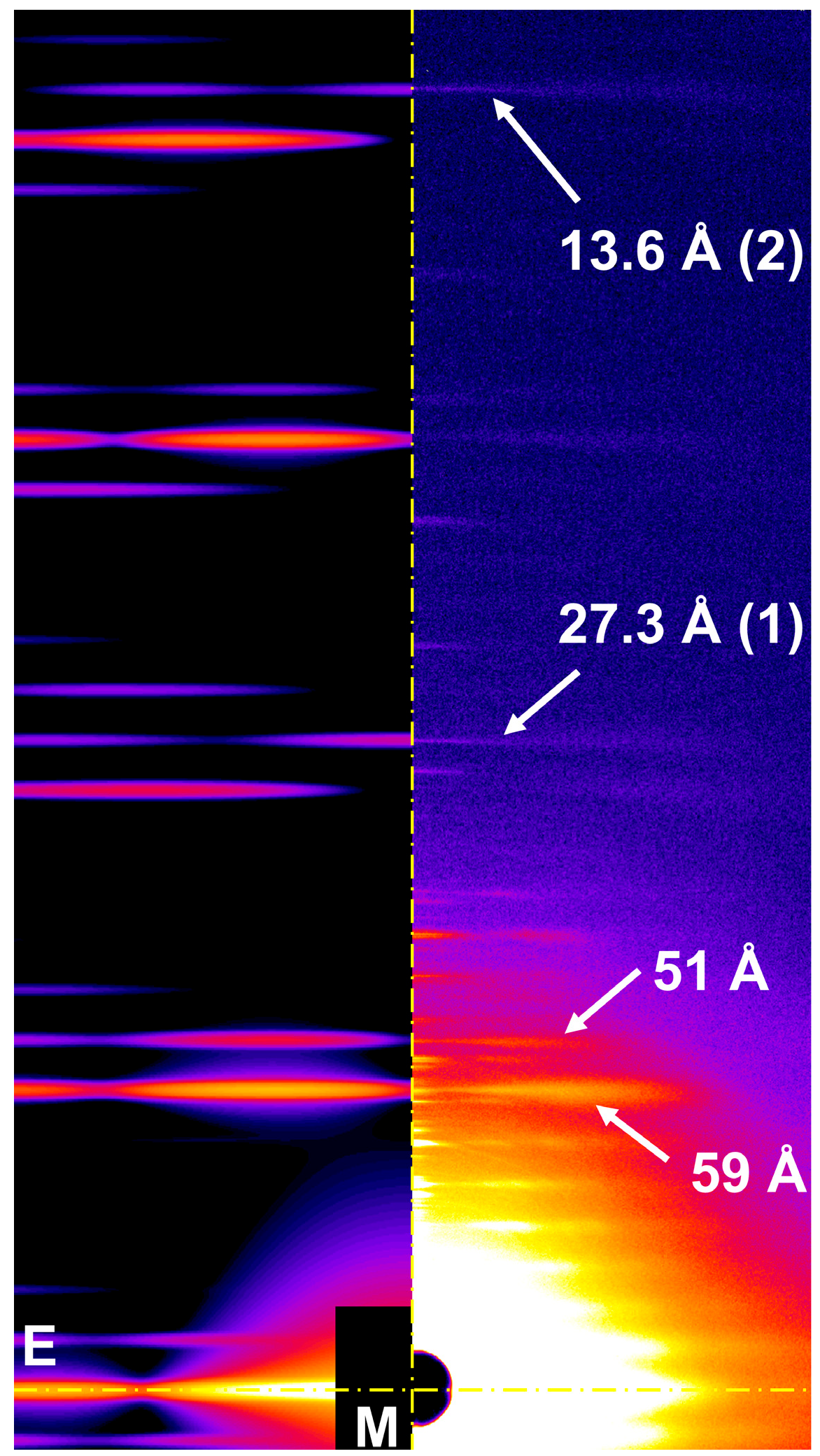
Comparison of predicted and X-ray diffraction patterns for a relaxed actin filament (all-atom model) with an observed X-ray diffraction pattern from relaxed frog muscle adapted from [
37]. Arrows indicate the positions of the first two actin meridional reflections and the 51 Å and 59 Å layer lines.
Figure 4.
Comparison of predicted and X-ray diffraction patterns for a relaxed actin filament (all-atom model) with an observed X-ray diffraction pattern from relaxed frog muscle adapted from [
37]. Arrows indicate the positions of the first two actin meridional reflections and the 51 Å and 59 Å layer lines.
Figure 5.
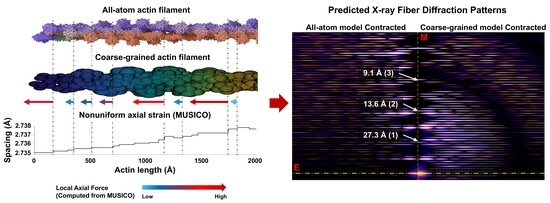
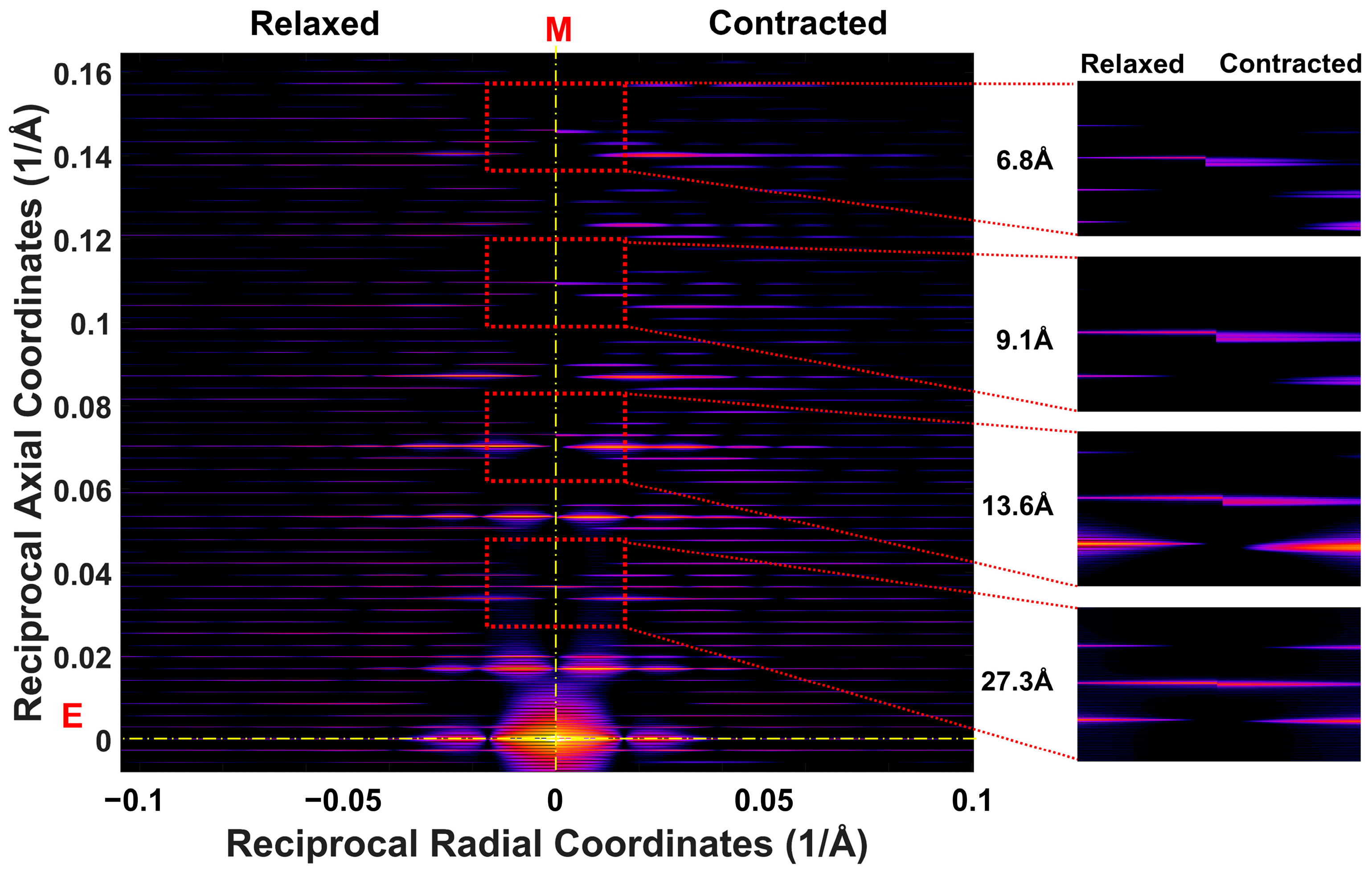
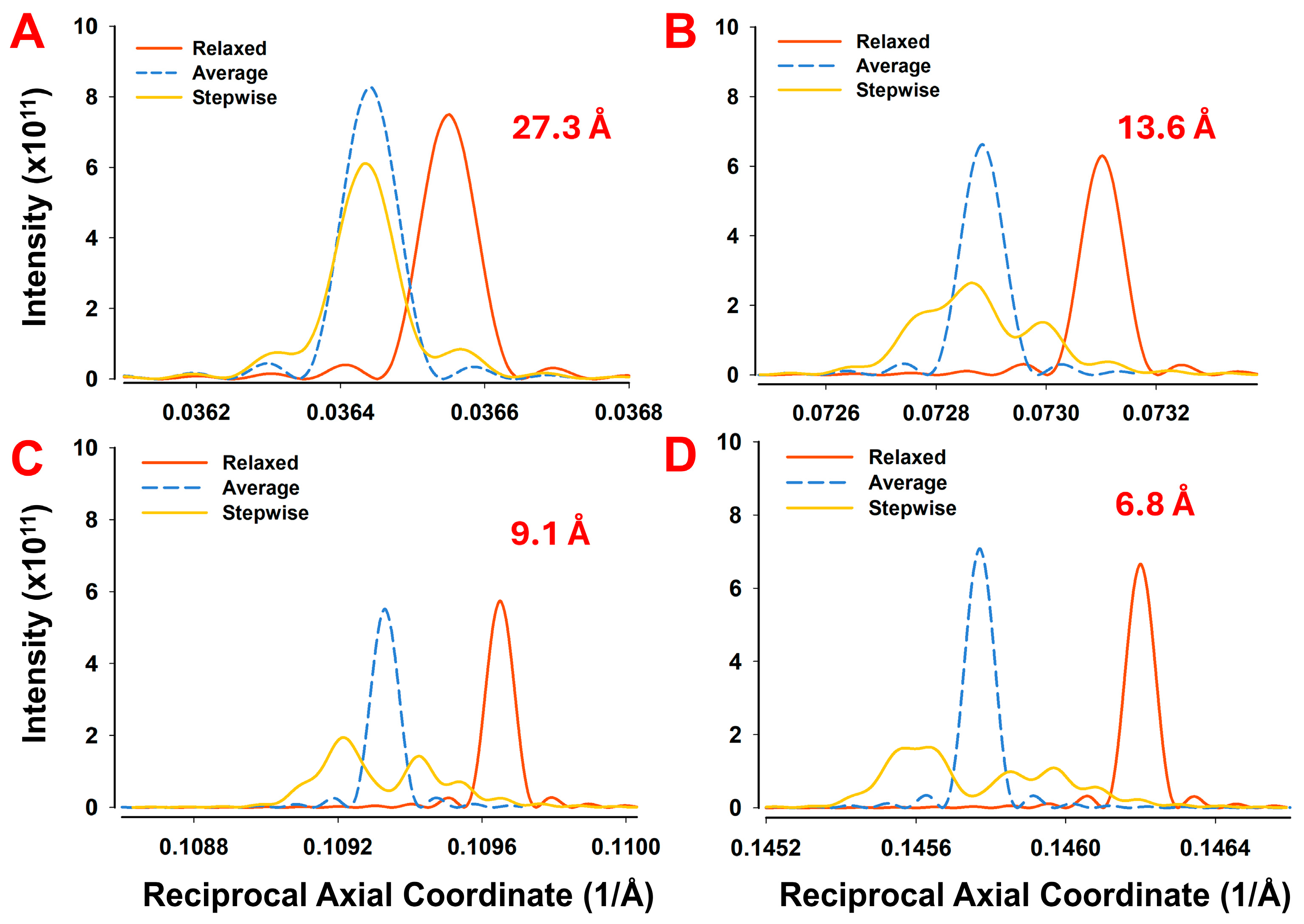
Predicted X-ray diffraction patterns of relaxed and contracted actin filaments (all-atom model). Diffraction intensities computed from an all-atom model of the actin filament, sampled over 18 viewing angles, are presented for both relaxed (left) and contracted (right) states, providing insights into the mechanical behavior of actin under nonuniform strain. Red letters, E and M, and yellow dash-dotted lines, denote equatorial and meridional lines respectively. The insets display detailed profiles of the meridional reflections at: 27.3 Å (1st actin meridional reflection), 13.6 Å (2nd), 9.1 Å (3rd), and 6.8 Å (4th), along with nearby layer lines. These profiles illustrate systematic shifts in reflection spacings and broadening of meridional peaks when filaments are strained during contraction.
Figure 5.
Predicted X-ray diffraction patterns of relaxed and contracted actin filaments (all-atom model). Diffraction intensities computed from an all-atom model of the actin filament, sampled over 18 viewing angles, are presented for both relaxed (left) and contracted (right) states, providing insights into the mechanical behavior of actin under nonuniform strain. Red letters, E and M, and yellow dash-dotted lines, denote equatorial and meridional lines respectively. The insets display detailed profiles of the meridional reflections at: 27.3 Å (1st actin meridional reflection), 13.6 Å (2nd), 9.1 Å (3rd), and 6.8 Å (4th), along with nearby layer lines. These profiles illustrate systematic shifts in reflection spacings and broadening of meridional peaks when filaments are strained during contraction.
Figure 6.
Comparison of meridional actin filament profiles between relaxed and contracted muscle from
Figure 5 (all-atom model) for the first (
A), second (
B), third (
C), and fourth actin meridional reflections (
D). Meridional intensity profiles predicted by MUSICO simulations are compared for three scenarios: (i) relaxed filaments (red thick lines); (ii) uniformly deformed filaments exhibiting a constant Mean monomer spacing (blue dashed lines); and (iii) filaments with nonuniform monomer spacings resulting from the local change in force along actin filament due to crossbridge forces from bound myosins (orange thick lines) (see
Figure 1B). The relaxed and uniformly deformed filaments show similar profiles with reciprocal space shifts corresponding to changes in spacing. In contrast, the meridional reflections from nonuniformly deformed filaments exhibit broader diffraction distributions reflecting the degree of nonuniformity, except for the 1st actin meridional reflection at ~27.3 Å.
Figure 6.
Comparison of meridional actin filament profiles between relaxed and contracted muscle from
Figure 5 (all-atom model) for the first (
A), second (
B), third (
C), and fourth actin meridional reflections (
D). Meridional intensity profiles predicted by MUSICO simulations are compared for three scenarios: (i) relaxed filaments (red thick lines); (ii) uniformly deformed filaments exhibiting a constant Mean monomer spacing (blue dashed lines); and (iii) filaments with nonuniform monomer spacings resulting from the local change in force along actin filament due to crossbridge forces from bound myosins (orange thick lines) (see
Figure 1B). The relaxed and uniformly deformed filaments show similar profiles with reciprocal space shifts corresponding to changes in spacing. In contrast, the meridional reflections from nonuniformly deformed filaments exhibit broader diffraction distributions reflecting the degree of nonuniformity, except for the 1st actin meridional reflection at ~27.3 Å.
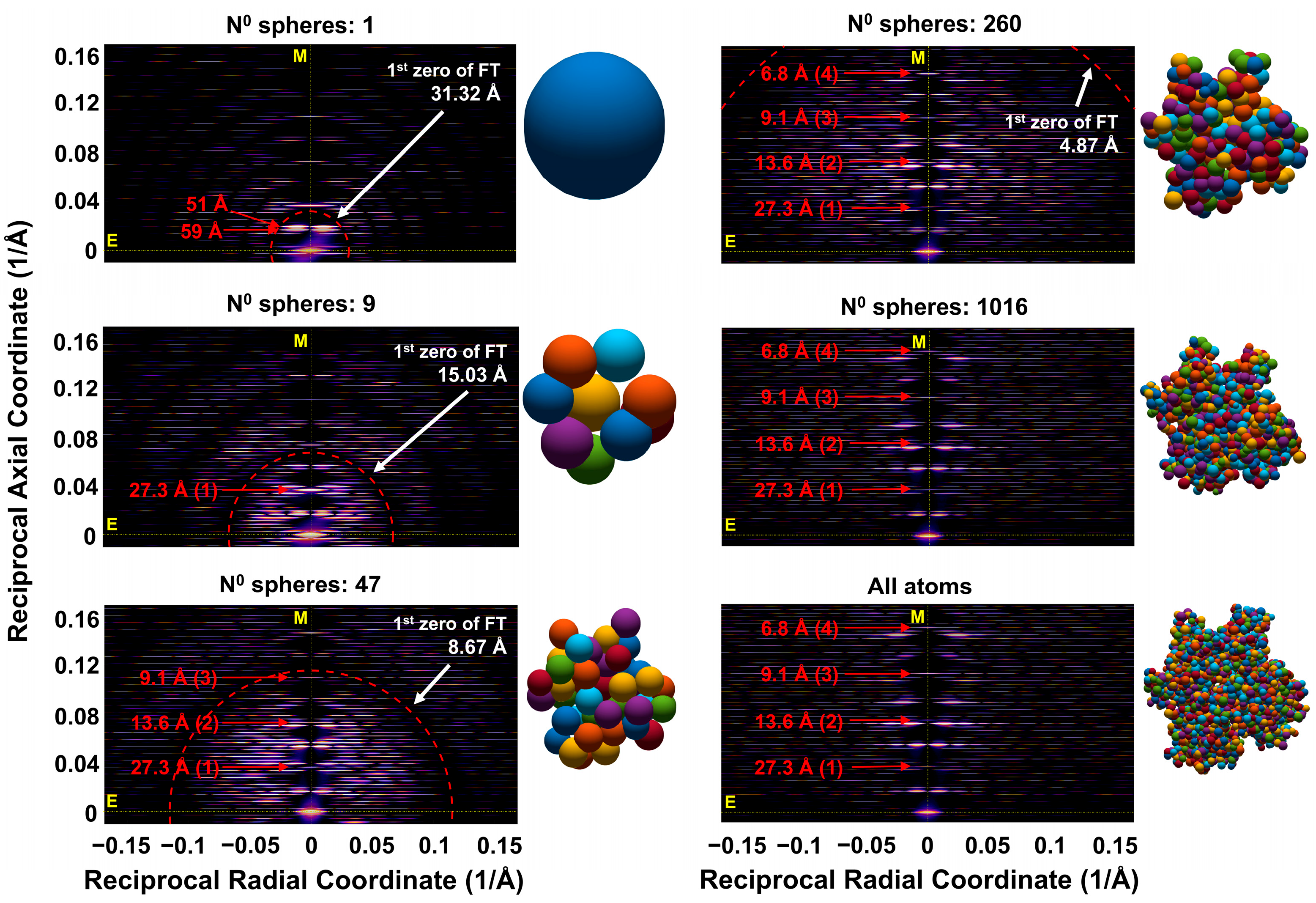
Figure 7.
Comparison of predicted all-atom and coarse-graining models of relaxed actin filaments, at
. As the number of grains decreases, the size of grains (equivalent sphere radius) increases, leading to a reduction in the visible field. The outer boundary of the visible field is indicated by dashed red line semi-circles, which show the first zero of Fourier transform of the equivalent sphere, as given in
Table 1.
Figure 7.
Comparison of predicted all-atom and coarse-graining models of relaxed actin filaments, at
. As the number of grains decreases, the size of grains (equivalent sphere radius) increases, leading to a reduction in the visible field. The outer boundary of the visible field is indicated by dashed red line semi-circles, which show the first zero of Fourier transform of the equivalent sphere, as given in
Table 1.
Figure 8.
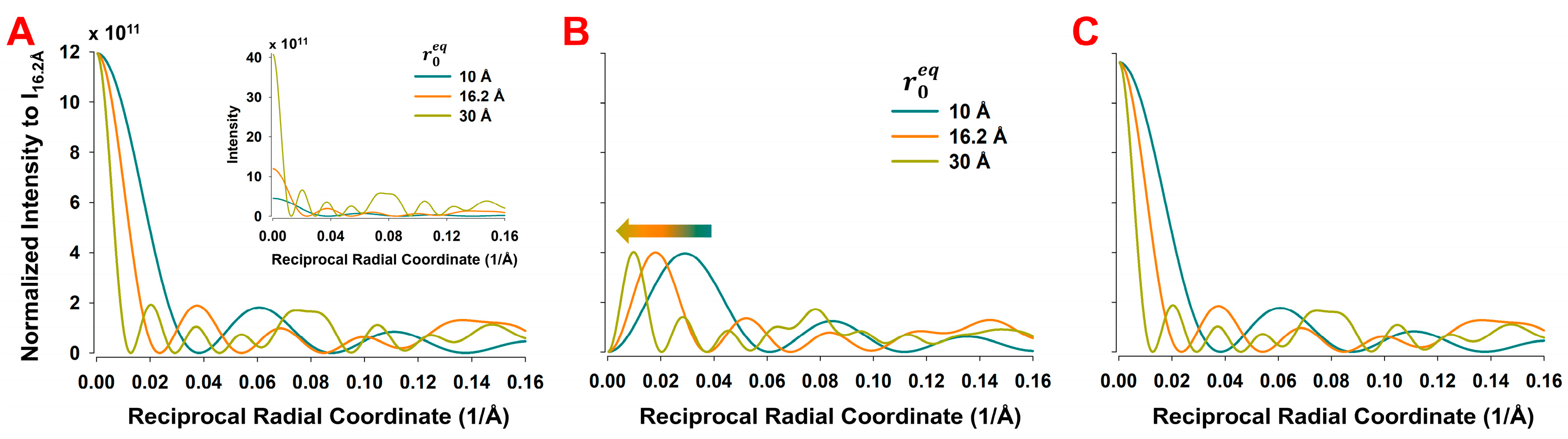
Sensitivity analysis of profiles along layer lines for discrete helix cylinder radii in relaxed actin filaments. All plots are normalized to the intensity of a helix with radius of 16.24 Å. (A) Normalized equatorial profiles. The inset shows the same profiles before normalization, illustrating the effect of the helix radius on their magnitude. (B) Normalized radial profiles at the level of 6th actin layer line (59 Å). The arrow shows the inward shift of the first maximum with decreasing helix radius radius (C) Normalized radial profiles at the level of the 1st actin meridional reflection.
Figure 8.
Sensitivity analysis of profiles along layer lines for discrete helix cylinder radii in relaxed actin filaments. All plots are normalized to the intensity of a helix with radius of 16.24 Å. (A) Normalized equatorial profiles. The inset shows the same profiles before normalization, illustrating the effect of the helix radius on their magnitude. (B) Normalized radial profiles at the level of 6th actin layer line (59 Å). The arrow shows the inward shift of the first maximum with decreasing helix radius radius (C) Normalized radial profiles at the level of the 1st actin meridional reflection.
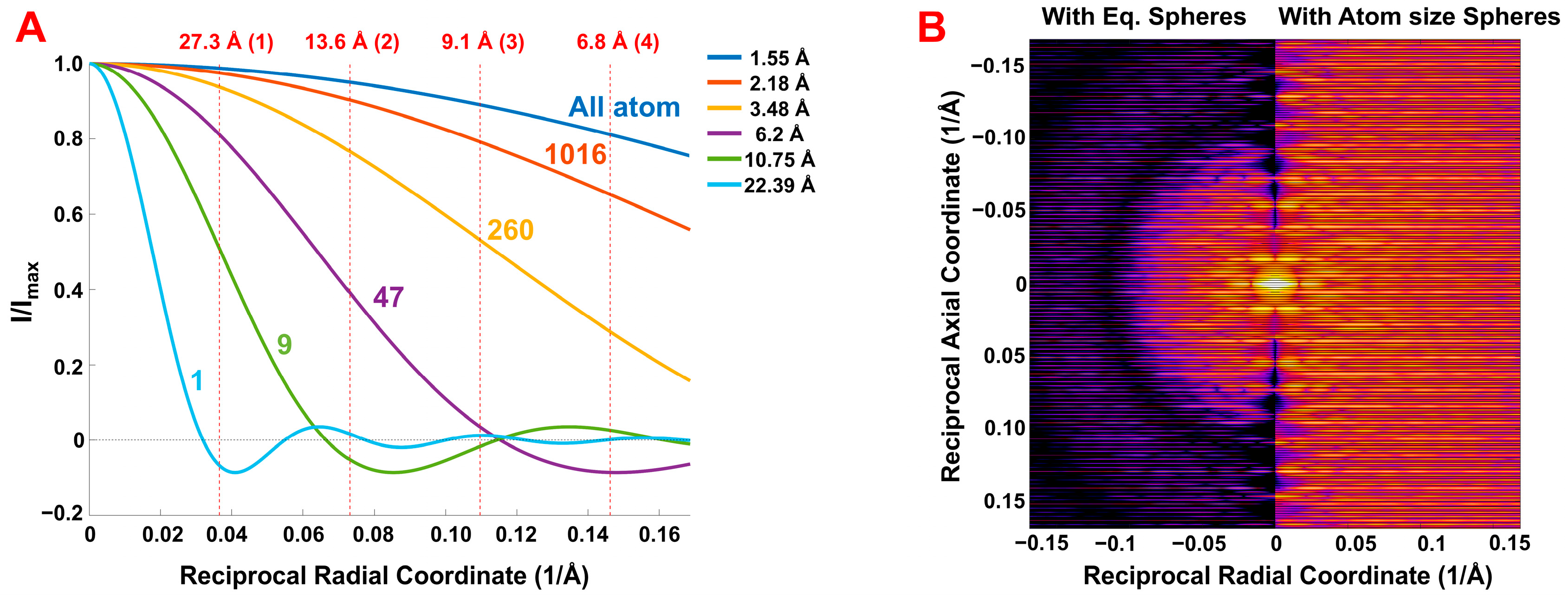
Figure 9.
The effect of grain size on the shape factor. (
A) Fourier transform of equivalent sphere profile for a range of average grain sizes corresponding to variety of grains per myosin monomers. Number of grains per actin monomer (blue) and average grain radius and their size associated with color of each profile line strongly affect the shape of profile. Larger gain sizes attenuate intensities of predicted X-ray diffraction patterns by rapid intensity decay at smaller reciprocal radii (
Table 1); (
B) predicted X-ray diffraction patterns for relaxed coarse-grained model with 47 spheres per actin monomer with average grain size
= 6.20 Å (left side) and with average atomic size of
= 1.55 Å with equivalent grain mass (right side).
Figure 9.
The effect of grain size on the shape factor. (
A) Fourier transform of equivalent sphere profile for a range of average grain sizes corresponding to variety of grains per myosin monomers. Number of grains per actin monomer (blue) and average grain radius and their size associated with color of each profile line strongly affect the shape of profile. Larger gain sizes attenuate intensities of predicted X-ray diffraction patterns by rapid intensity decay at smaller reciprocal radii (
Table 1); (
B) predicted X-ray diffraction patterns for relaxed coarse-grained model with 47 spheres per actin monomer with average grain size
= 6.20 Å (left side) and with average atomic size of
= 1.55 Å with equivalent grain mass (right side).
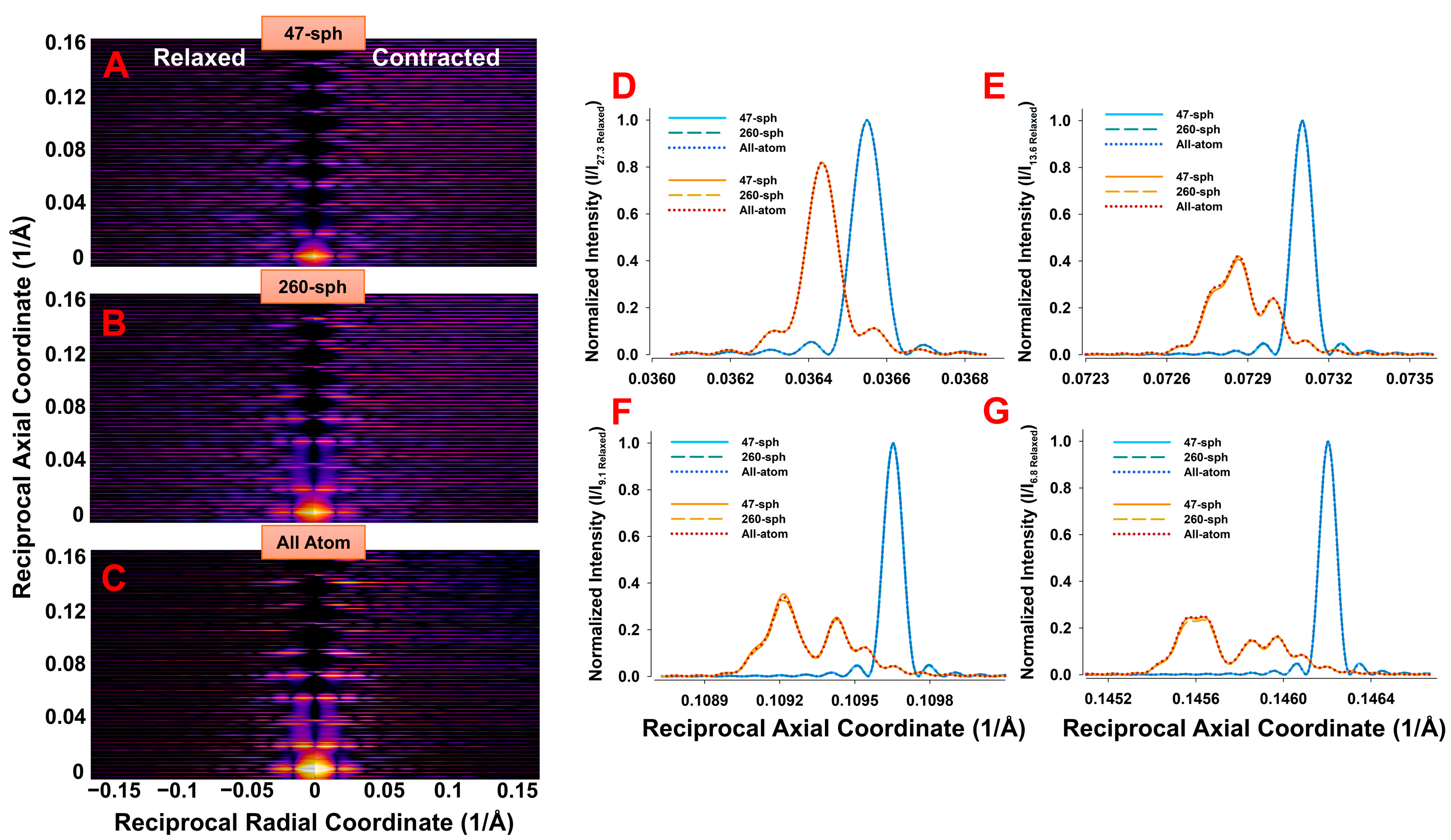
Figure 10.
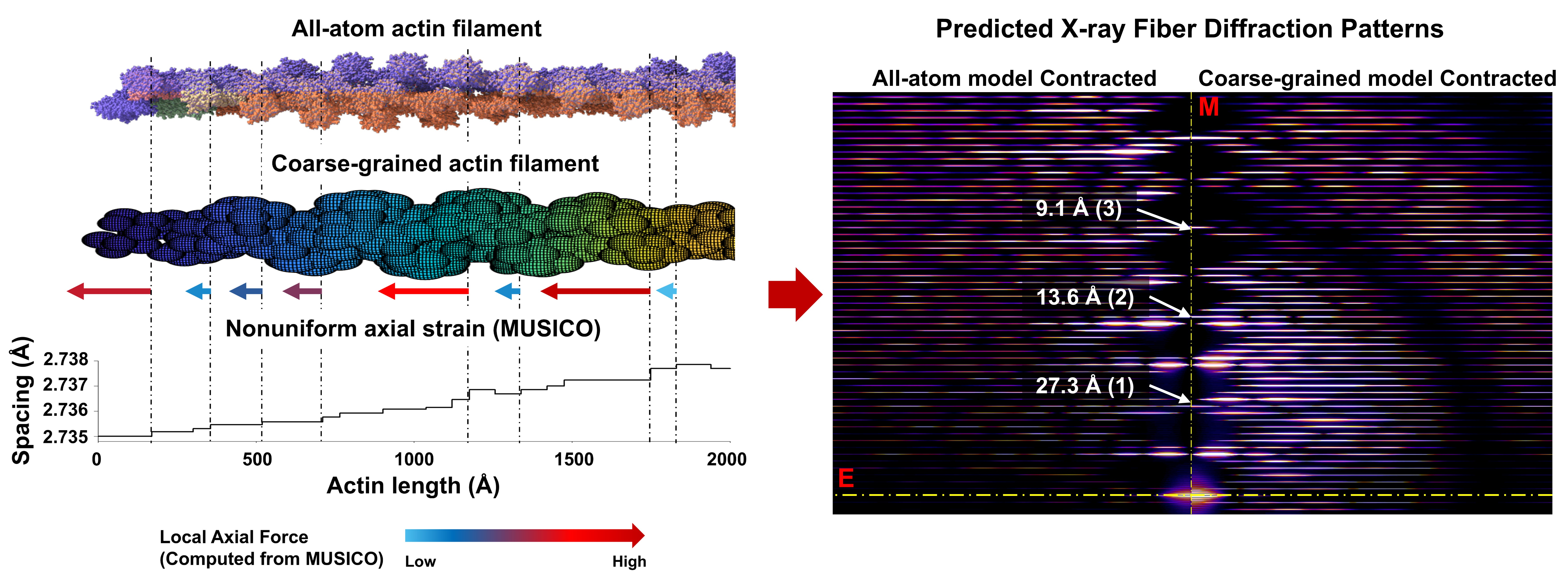
Comparison of X-ray diffraction patterns and meridional intensity profiles between relaxed and contracted actin filaments using models with different levels of coarse-graining: 47-sphere model (A), 260-sphere model (B), and all-atom model (C). Intensity profiles of the 1st to 4th actin meridional reflections are shown in panels (D–G), respectively. Blue lines represent relaxed filaments, while orange lines correspond to contracting filaments. The 47-sphere coarse-grained model is shown as solid lines, the 260-sphere model as dashed lines, and the all-atom model as dotted lines. The overall peak positions remain similar across different model resolutions, but the intensity varies with the level of coarse-graining. As the number of spheres in the model increases, the diffraction intensities become closer to those of the all-atom model.
Figure 10.
Comparison of X-ray diffraction patterns and meridional intensity profiles between relaxed and contracted actin filaments using models with different levels of coarse-graining: 47-sphere model (A), 260-sphere model (B), and all-atom model (C). Intensity profiles of the 1st to 4th actin meridional reflections are shown in panels (D–G), respectively. Blue lines represent relaxed filaments, while orange lines correspond to contracting filaments. The 47-sphere coarse-grained model is shown as solid lines, the 260-sphere model as dashed lines, and the all-atom model as dotted lines. The overall peak positions remain similar across different model resolutions, but the intensity varies with the level of coarse-graining. As the number of spheres in the model increases, the diffraction intensities become closer to those of the all-atom model.
Figure 11.
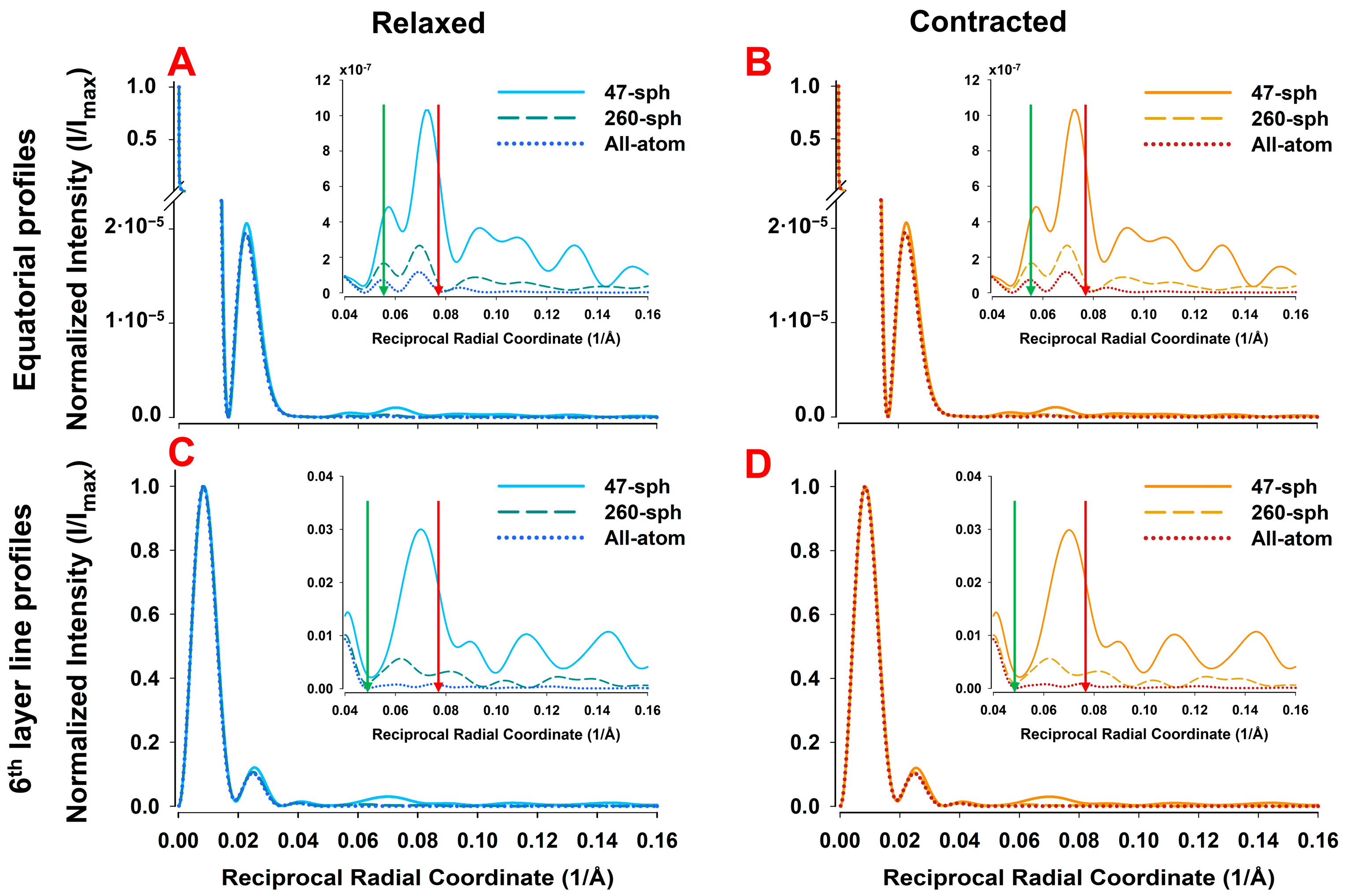
The X-ray diffraction profiles in radial direction for coarse-grained models with 47 spheres (solid lines), 260 spheres (dashed lines), and the all-atom model (dotted lines) in both relaxed (left) and contracted (right) filament states. The profiles are normalized to the intensity of the first actin meridional reflection. The insets provide a detailed view of the differences between the models, showing variations in peak positions and intensities. The red arrows indicate the extent of experimental observations if diffraction data is recorded up to the second actin meridional reflection, while the green arrow marks the region where the overall profile shapes remain consistent across models. Equatorial profiles are shown from relaxed and contracted actin filaments in panels (A) and (B), respectively. Profiles along the 6th layer line (59 Å) in the radial direction from relaxed and deformed actin filaments are shown in panels (C) and (D), respectively.
Figure 11.
The X-ray diffraction profiles in radial direction for coarse-grained models with 47 spheres (solid lines), 260 spheres (dashed lines), and the all-atom model (dotted lines) in both relaxed (left) and contracted (right) filament states. The profiles are normalized to the intensity of the first actin meridional reflection. The insets provide a detailed view of the differences between the models, showing variations in peak positions and intensities. The red arrows indicate the extent of experimental observations if diffraction data is recorded up to the second actin meridional reflection, while the green arrow marks the region where the overall profile shapes remain consistent across models. Equatorial profiles are shown from relaxed and contracted actin filaments in panels (A) and (B), respectively. Profiles along the 6th layer line (59 Å) in the radial direction from relaxed and deformed actin filaments are shown in panels (C) and (D), respectively.
Figure 12.
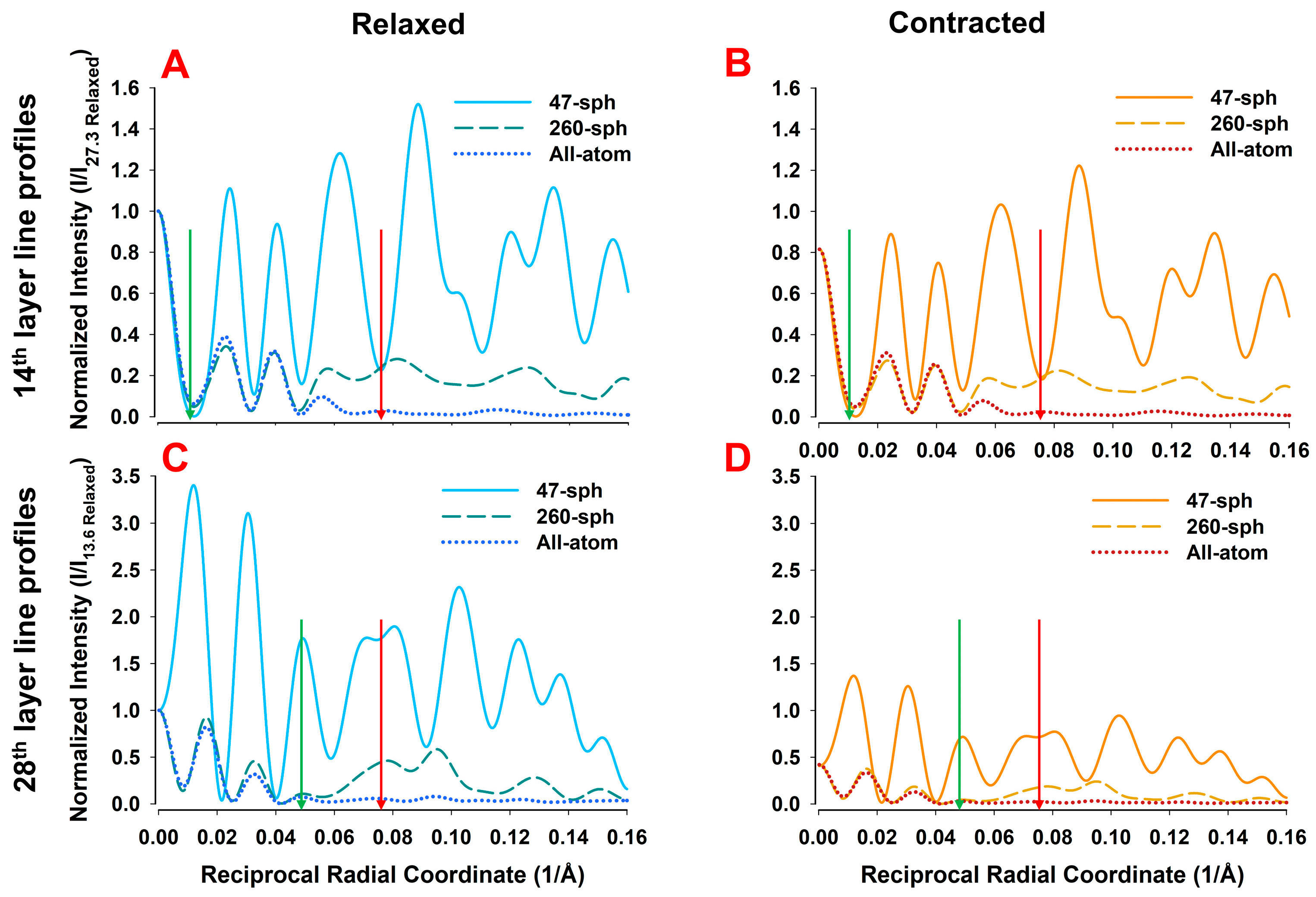
Comparison of diffraction profiles in the radial direction along the layer line of the 1st and 2nd actin meridional reflection for actin monomers represented by coarse-grained models with 47 spheres (solid lines), 260 spheres (dashed lines), and the all-atom model (dotted lines) in relaxed (left) and contracting (right) filaments. The intensities in the profiles are normalized to that of the first actin meridional reflection. The red arrows indicate the extent of observable reflections if experimental data are recorded up to the second actin meridional reflection, while the green arrows mark the region where the profiles remain consistent across different models. The radial profiles of the layer line corresponding to the 1st actin meridional reflection line in relaxed and contracting actin filaments are shown in panels (A) and (B), respectively. The radial profiles of the layer line corresponding to the 2nd actin meridional reflection from relaxed and contracted actin filaments are shown in panels (C) and (D), respectively.
Figure 12.
Comparison of diffraction profiles in the radial direction along the layer line of the 1st and 2nd actin meridional reflection for actin monomers represented by coarse-grained models with 47 spheres (solid lines), 260 spheres (dashed lines), and the all-atom model (dotted lines) in relaxed (left) and contracting (right) filaments. The intensities in the profiles are normalized to that of the first actin meridional reflection. The red arrows indicate the extent of observable reflections if experimental data are recorded up to the second actin meridional reflection, while the green arrows mark the region where the profiles remain consistent across different models. The radial profiles of the layer line corresponding to the 1st actin meridional reflection line in relaxed and contracting actin filaments are shown in panels (A) and (B), respectively. The radial profiles of the layer line corresponding to the 2nd actin meridional reflection from relaxed and contracted actin filaments are shown in panels (C) and (D), respectively.

Figure 13.
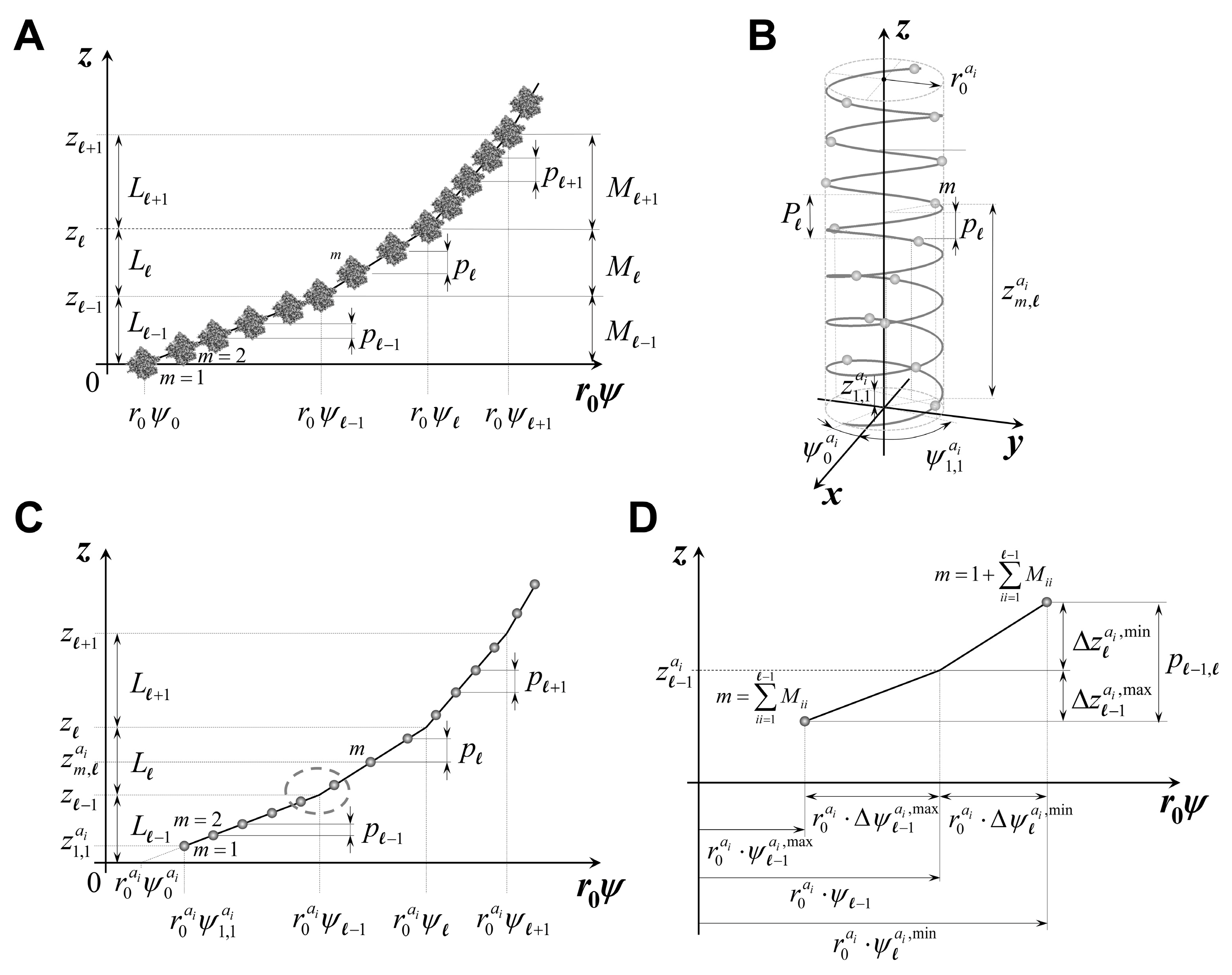
The geometry of a nonuniformly deformed discontinuous helix. (A) Three consecutive segments of a nonuniformly deformed discontinuous helix, represented by a set of helically arranged subunits, are displayed in the radial projection as the miniature dark gray monomers connected with straight lines. Changes in the axial monomer spacings are defined at positions, , of the planes where crossbridges are bound to actin filament. The axial positions of sequential planes define the segments with the constant pitch, , over the segment length, , where index, , denotes the current number of the segment. The index of the coordinate of each segment end point, i.e., the coordinate where the pitch, i.e., slope, changes is set to coincide with the current segment number, . The changes in actin subunit spacings, , follow the segment slopes, and the number of subunit spacings, within a segment, , is denoted as , thus . The number of these constant pitch segments is . Therefore, for each actin filament, there will be coordinates , where is the coordinate of the tip of each actin filament, denoted to be equal to 0, and coordinates measured from the tip of the actin filament to the position of the planes where crossbridges are bound to the actin filament, except , which is the coordinate of the plane at the boundary with Z-disk. Note that the index of the plane number, , coincides with the segment length and pitch indices because the position of the first plane is calculated from the tip of actin filament, i.e., from coordinate . The discontinuous helix is defined by the radius of the helix cylinder, , and angular position of the helix passing through the load plane, . (B) Each atom, , in a subunit forms its own discontinuous helix where the atom’s positions arranged along the helix are shown as gray spheres. The position of the atom, , in the subunit is defined by radial position , assumed to be the same in all subunits. The axial coordinate of the atom, , in all subunits, , measured from the zeroth plane () and the azimuthal angle , where index is the current number of a subunit and is the segment number. (C) Radial projection of a nonuniformly deformed discontinuous helix passing through an array of positions of the atom, , shown as gray spheres. The change in spacing, , for atom, , is shown through radial projection coordinates and . Depending on a position of the atoms within the first monomer ( and ) and following the assumption that crossbridge force is transferred to the actin in a single plane perpendicular to the helix axis at , the positions of atoms rarely coincide with the positions of the planes, . Thus, for each atom, , the spacing, , is constant for the subunits within the segment, , except where the spacing shares attributes of two segments, e.g., of and as shown in the gray dotted circle. (D) The zoomed in detail in the gray dotted circle (from (C)). The spacing between the two positions of the atom, , spanning two segments is defined by the slopes in segments and . The contribution fractions of and segment slopes for the intersegment atom, , spacing, , are defined by and , and pitches and above the load plane, , in the same region but in the following monomer .
Figure 13.
The geometry of a nonuniformly deformed discontinuous helix. (A) Three consecutive segments of a nonuniformly deformed discontinuous helix, represented by a set of helically arranged subunits, are displayed in the radial projection as the miniature dark gray monomers connected with straight lines. Changes in the axial monomer spacings are defined at positions, , of the planes where crossbridges are bound to actin filament. The axial positions of sequential planes define the segments with the constant pitch, , over the segment length, , where index, , denotes the current number of the segment. The index of the coordinate of each segment end point, i.e., the coordinate where the pitch, i.e., slope, changes is set to coincide with the current segment number, . The changes in actin subunit spacings, , follow the segment slopes, and the number of subunit spacings, within a segment, , is denoted as , thus . The number of these constant pitch segments is . Therefore, for each actin filament, there will be coordinates , where is the coordinate of the tip of each actin filament, denoted to be equal to 0, and coordinates measured from the tip of the actin filament to the position of the planes where crossbridges are bound to the actin filament, except , which is the coordinate of the plane at the boundary with Z-disk. Note that the index of the plane number, , coincides with the segment length and pitch indices because the position of the first plane is calculated from the tip of actin filament, i.e., from coordinate . The discontinuous helix is defined by the radius of the helix cylinder, , and angular position of the helix passing through the load plane, . (B) Each atom, , in a subunit forms its own discontinuous helix where the atom’s positions arranged along the helix are shown as gray spheres. The position of the atom, , in the subunit is defined by radial position , assumed to be the same in all subunits. The axial coordinate of the atom, , in all subunits, , measured from the zeroth plane () and the azimuthal angle , where index is the current number of a subunit and is the segment number. (C) Radial projection of a nonuniformly deformed discontinuous helix passing through an array of positions of the atom, , shown as gray spheres. The change in spacing, , for atom, , is shown through radial projection coordinates and . Depending on a position of the atoms within the first monomer ( and ) and following the assumption that crossbridge force is transferred to the actin in a single plane perpendicular to the helix axis at , the positions of atoms rarely coincide with the positions of the planes, . Thus, for each atom, , the spacing, , is constant for the subunits within the segment, , except where the spacing shares attributes of two segments, e.g., of and as shown in the gray dotted circle. (D) The zoomed in detail in the gray dotted circle (from (C)). The spacing between the two positions of the atom, , spanning two segments is defined by the slopes in segments and . The contribution fractions of and segment slopes for the intersegment atom, , spacing, , are defined by and , and pitches and above the load plane, , in the same region but in the following monomer .

Figure 14.
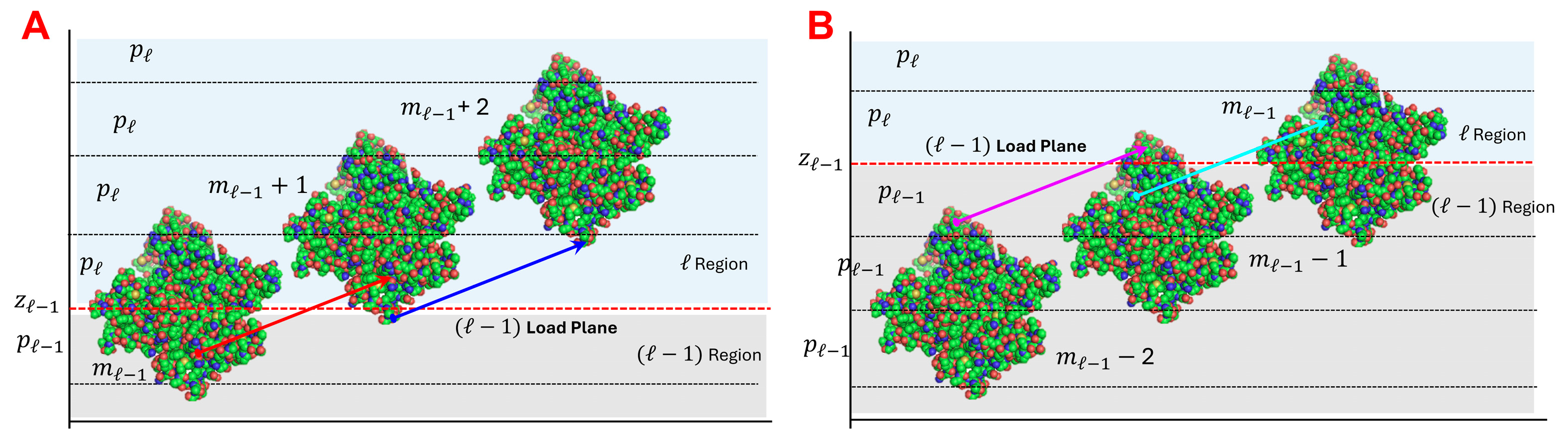
The position of the atoms in actin monomers below and above the load plane. There are five distinct regions within the monomer where atom can be located. Depending on which region the atom resides in, different monomers can be associated with the calculation of the intersegment spacing , except when the atom is in the proximity () of the load plane, i.e., region (i). (A) When the coordinate atom is located below the load plane and threshold region (i) but not lower than , it is assigned to region (ii) and if is further below the load plane, i.e., more than , it belongs to region (iii). Atoms with in the region (ii) are associated with monomer , while those in region (iii) are assigned to monomer . (B) When the atom with coordinate is the above load plane but not exceeding , it belongs to region (iv), and if it lies beyond , it is in region (v). Atoms with in the region (iv) are associated with monomer , whereas those in region (v) are assigned to monomer . The arrows represent the vector between the atom coordinate below the load plane, , and above the load plane, , in the same region but in the following monomer. Red dashed lines denote the load plane . Gray background represents region, while blue background represents region above the load plane .
Figure 14.
The position of the atoms in actin monomers below and above the load plane. There are five distinct regions within the monomer where atom can be located. Depending on which region the atom resides in, different monomers can be associated with the calculation of the intersegment spacing , except when the atom is in the proximity () of the load plane, i.e., region (i). (A) When the coordinate atom is located below the load plane and threshold region (i) but not lower than , it is assigned to region (ii) and if is further below the load plane, i.e., more than , it belongs to region (iii). Atoms with in the region (ii) are associated with monomer , while those in region (iii) are assigned to monomer . (B) When the atom with coordinate is the above load plane but not exceeding , it belongs to region (iv), and if it lies beyond , it is in region (v). Atoms with in the region (iv) are associated with monomer , whereas those in region (v) are assigned to monomer . The arrows represent the vector between the atom coordinate below the load plane, , and above the load plane, , in the same region but in the following monomer. Red dashed lines denote the load plane . Gray background represents region, while blue background represents region above the load plane .

Table 1.
The effect of the coarse-grain size, defined by the radius of the equivalent sphere, on the radial position where the Fourier transform (FT) of actin filament diffraction patterns exhibits rapid intensity decay in proximity of its first zero value.
Table 1.
The effect of the coarse-grain size, defined by the radius of the equivalent sphere, on the radial position where the Fourier transform (FT) of actin filament diffraction patterns exhibits rapid intensity decay in proximity of its first zero value.
Coarse-Grained
Model | Average Equivalent
Sphere Radius (Å) | First Zero of the 3D
FT of Sphere (Å) |
|---|
| Single Sphere | 22.39 | 31.32 |
| 9 Spheres | 10.75 | 15.03 |
| 47 Spheres | 6.20 | 8.67 |
| 260 Spheres | 3.48 | 4.87 |
| 1016 Spheres | 2.18 | 3.05 |
| All Atom | 1.55 | 2.17 |




 ,
,