Mass Spectrometry Quantification of Epigenetic Changes: A Scoping Review for Cancer and Beyond

 , , and
Abstract
1. Introduction
2. Materials and Methods
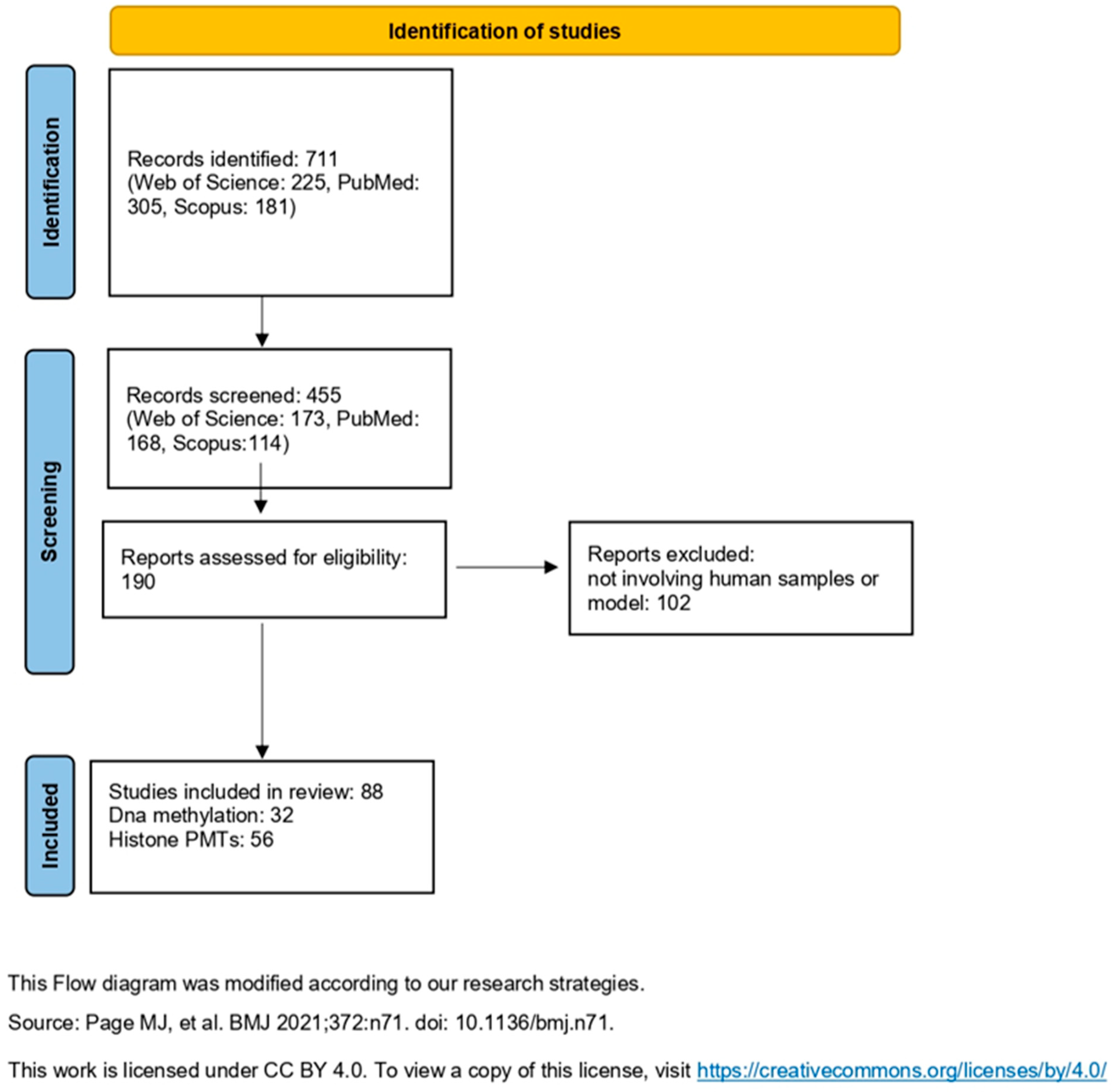
2.1. Search Strategy and Sources
- Which epigenetic modifications are most frequently studied using MS?
- Which MS instruments are most employed?
- Which studies apply MS in clinical contexts or in human biological models?
- Have any new approaches or improvements been developed in sample preparation and data analysis specific to the application of MS to epigenetics?
2.2. Search Terms
3. Results
3.1. Epigenetic Modifications Identified by Mass Spectrometry
3.2. DNA Methylation
3.3. Histone PMTs
4. Discussion
4.1. DNA Methylation
4.2. Histone PMTs
4.3. General Observations Across MS-Based Epigenetic Workflows
5. Conclusions
Author Contributions
Funding
Data Availability Statement
Conflicts of Interest
Abbreviations
| PMTs | post-translation modifications |
| Cyt | Cytidine |
| 5mC | 5-Methylcytosine |
| 5hmC | 5-Hydroxymethylcytosine |
| 5caC | 5-Carboxylcytosine |
| 5fC | 5-Formylcytosine |
| dC | Deoxycytidine |
| 5mdC | 5-Methyldeoxycytidine |
| 5hmdC | 5-Hydroxymethyldeoxycytidine |
| 4mdC | N4-Methyldeoxycytidine |
| 5cadC | 5-Carboxyldeoxycytidine |
| 5fdC | 5-Formyldeoxycytidine |
| 5-Aza-dC | 5-Azadeoxycytidine |
| 2o-mdC | 2′-Oxymethylcytidine |
| dG | 2′-Deoxyguanosine |
| 5-fodC | 5-Formyl-2′-deoxycytidine |
| 5forC | 5-Formylcytidine |
| 5-fodU | 5-Formyl-2′-deoxyuridine |
| 5-forU | 5-Formyluridine |
| 5forCm | 2′-O-methyl-5-formylcytidine |
| 5-forUm | 2′-O-methyl-5-formyluridine |
| 5hmdU | 5-Hydroxymethyldeoxyuridine |
| dA | 2′-Deoxyadenosine |
| dT | Thymidine |
| N3-5gmdC | 6-Azide-β-glucosyl-5-hydroxymethylcytidine |
| O6-Me-dG | O6-Methyl-2′-deoxyguanosine |
| O6-CM-dG | O6-Carboxymethyl-2′-deoxyguanosine |
| N6-CM-dA | N6-Carboxymethyl-2′-deoxyadenosine |
| εdA | N6-Vinyl-2′-deoxyadenosine |
| N2-Et-dG | N2-Ethyl-2′-deoxyguanosine |
| 5-Cl-dC | 5-Chloro-2′-deoxycytidine |
| Guo | Guanosine |
| Ado | Adenosine |
| Urd | Uridine |
| 5-methyluridine | 5-Methyluridine |
| dU | 2′-Deoxyuridine |
| m6dA | N6-Methyl-2′-deoxyadenosine |
| 3MeA | N3-Methyladenine |
| 7MeG | N7-Methylguanine |
| 6MeG | O6-Methylguanine |
| 1MeG | 1-Methylguanine |
| 9MeG | 9-Methylguanine |
| 2EtdG | 2-Ethyl-2′-deoxyguanosine |
| 1MeA | 1-Methyladenine |
| 9MeA | 9-Methyladenine |
| MeA | 3-Methyladenine (come da tua lista) |
| 9EtA | 9-Ethyladenine |
| 9EtG | 9-Ethylguanine |
| Ino | Inosine |
| 5-methyl-CMP | 5-Methylcytidylic acid |
| FA | Formic Acid |
| ACN | Acetonitrile |
| MeOH | Methanol |
| LOD | Limit of Detection |
| LLOD | Lower Limit of Detection |
| LOQ | Limit of Quantification |
| LLOQ | Lower Limit of Quantification |
| RSD | Relative Standard Deviation |
| CV | Coefficient of Variation |
| LC | Liquid Chromatography |
| QqQ | Triple Quadrupole |
| Q | Quadrupole |
| TOF | Time-of-Flight |
| ICP | Inductively Coupled Plasma |
| MALDI | Matrix-Assisted Laser Desorption/Ionization |
| DESI | Desorption Electrospray Ionization |
| CE | Capillary Electrophoresis |
| HILIC | Hydrophilic Interaction Liquid Chromatography |
| LAMP | Linear Amplification |
| AD | Alzheimer’s Disease |
| CRC | Colon Rectal Cancer |
| Affi-BAMS | Affinity-bead Assisted Mass Spectrometry |
| SDS-PAGE | Sodium Dodecyl Sulfate Polyacrylamide Gel Electrophoresis |
| SPE | Solid Phase Extraction |
| DI | Direct Infusion |
| DDA | Data-Dependent Acquisition |
| DIA | Data-Independent Acquisition |
| SIM | Selected Ion Monitoring |
| PRM | Parallel Reaction Monitoring |
| MRM | Multiple Reaction Monitoring |
| SWATH | Sequential Window Acquisition of all Theoretical Fragmention Spectra |
References
- Chen, S.; Lai, W.; Wang, H. Recent Advances in High-Performance Liquid Chromatography Tandem Mass Spectrometry Techniques for Analysis of DNA Damage and Epigenetic Modifications. Mutat. Res.—Genet. Toxicol. Environ. Mutagen. 2024, 896, 503755. [Google Scholar] [CrossRef] [Scilit]
- Unnikrishnan, A.; Freeman, W.M.; Jackson, J.; Wren, J.D.; Porter, H.; Richardson, A. The Role of DNA Methylation in Epigenetics of Aging. Pharmacol. Ther. 2019, 195, 172–185. [Google Scholar] [CrossRef] [Scilit] [PubMed]
- Sadida, H.Q.; Abdulla, A.; Marzooqi, S.A.; Hashem, S.; Macha, M.A.; Akil, A.S.A.-S.; Bhat, A.A. Epigenetic Modifications: Key Players in Cancer Heterogeneity and Drug Resistance. Transl. Oncol. 2024, 39, 101821. [Google Scholar] [CrossRef] [Scilit] [PubMed]
- Papait, R.; Serio, S.; Condorelli, G. Role of the Epigenome in Heart Failure. Physiol. Rev. 2020, 100, 1753–1777. [Google Scholar] [CrossRef] [Scilit]
- Tahiliani, M.; Koh, K.P.; Shen, Y.; Pastor, W.A.; Bandukwala, H.; Brudno, Y.; Agarwal, S.; Iyer, L.M.; Liu, D.R.; Aravind, L.; et al. Conversion of 5-Methylcytosine to 5-Hydroxymethylcytosine in Mammalian DNA by MLL Partner TET1. Science 2009, 324, 930–935. [Google Scholar] [CrossRef] [Scilit]
- Pajares, M.J.; Palanca-Ballester, C.; Urtasun, R.; Alemany-Cosme, E.; Lahoz, A.; Sandoval, J. Methods for Analysis of Specific DNA Methylation Status. Methods 2021, 187, 3–12. [Google Scholar] [CrossRef] [Scilit]
- Traube, F.R.; Schiffers, S.; Iwan, K.; Kellner, S.; Spada, F.; Müller, M.; Carell, T. Isotope-Dilution Mass Spectrometry for Exact Quantification of Noncanonical DNA Nucleosides. Nat. Protoc. 2019, 14, 283–312. [Google Scholar] [CrossRef] [Scilit] [PubMed]
- Cooke, M.S.; Evans, M.D.; Dizdaroglu, M.; Lunec, J. Oxidative DNA Damage: Mechanisms, Mutation, and Disease. FASEB J. 2003, 17, 1195–1214. [Google Scholar] [CrossRef] [Scilit]
- Luger, K.; Mäder, A.W.; Richmond, R.K.; Sargent, D.F.; Richmond, T.J. Crystal Structure of the Nucleosome Core Particle at 2.8 Å Resolution. Nature 1997, 389, 251–260. [Google Scholar] [CrossRef] [Scilit]
- Audia, J.E.; Campbell, R.M. Histone Modifications and Cancer. Cold Spring Harb. Perspect. Biol. 2016, 8, a019521. [Google Scholar] [CrossRef] [Scilit] [PubMed]
- Tricco, A.C.; Lillie, E.; Zarin, W.; O’Brien, K.K.; Colquhoun, H.; Levac, D.; Moher, D.; Peters, M.D.J.; Horsley, T.; Weeks, L.; et al. PRISMA Extension for Scoping Reviews (PRISMA-ScR): Checklist and Explanation. Ann. Intern. Med. 2018, 169, 467–473. [Google Scholar] [CrossRef] [Scilit] [PubMed]
- Page, M.J.; McKenzie, J.E.; Bossuyt, P.M.; Boutron, I.; Hoffmann, T.C.; Mulrow, C.D.; Shamseer, L.; Tetzlaff, J.M.; Akl, E.A.; Brennan, S.E.; et al. The PRISMA 2020 Statement: An Updated Guideline for Reporting Systematic Reviews. BMJ 2021, 372, n71. [Google Scholar] [CrossRef] [Scilit]
- Moore, L.D.; Le, T.; Fan, G. DNA Methylation and Its Basic Function. Neuropsychopharmacology 2013, 38, 23–38. [Google Scholar] [CrossRef] [Scilit]
- Rotondo, J.C.; Aquila, G.; Oton-Gonzalez, L.; Selvatici, R.; Rizzo, P.; De Mattei, M.; Pavasini, R.; Tognon, M.; Campo, G.C.; Martini, F. Methylation of SERPINA1 Gene Promoter May Predict Chronic Obstructive Pulmonary Disease in Patients Affected by Acute Coronary Syndrome. Clin. Epigenetics 2021, 13, 79. [Google Scholar] [CrossRef] [Scilit]
- Rotondo, J.C.; Oton-Gonzalez, L.; Selvatici, R.; Rizzo, P.; Pavasini, R.; Campo, G.C.; Lanzillotti, C.; Mazziotta, C.; De Mattei, M.; Tognon, M.; et al. SERPINA1 Gene Promoter Is Differentially Methylated in Peripheral Blood Mononuclear Cells of Pregnant Women. Front. Cell Dev. Biol. 2020, 8, 550543. [Google Scholar] [CrossRef] [Scilit]
- Greenberg, M.V.C.; Bourc’his, D. The Diverse Roles of DNA Methylation in Mammalian Development and Disease. Nat. Rev. Mol. Cell Biol. 2019, 20, 590–607. [Google Scholar] [CrossRef] [Scilit]
- Singer, B.D. A Practical Guide to the Measurement and Analysis of DNA Methylation. Am. J. Respir. Cell Mol. Biol. 2019, 61, 417–428. [Google Scholar] [CrossRef] [Scilit]
- Rotondo, J.C.; Lanzillotti, C.; Mazziotta, C.; Tognon, M.; Martini, F. Epigenetics of Male Infertility: The Role of DNA Methylation. Front. Cell Dev. Biol. 2021, 9, 689624. [Google Scholar] [CrossRef] [Scilit] [PubMed]
- Schübeler, D. Function and Information Content of DNA Methylation. Nature 2015, 517, 321–326. [Google Scholar] [CrossRef] [Scilit] [PubMed]
- Wu, H.; Zhang, Y. Mechanisms and Functions of Tet Protein-Mediated 5-Methylcytosine Oxidation. Genes. Dev. 2011, 25, 2436–2452. [Google Scholar] [CrossRef] [Scilit]
- Hieda, M.; Matsuura, N.; Kimura, H. Histone Modifications Associated with Cancer Cell Migration and Invasion. In Cancer Epigenetics; Verma, M., Ed.; Methods in Molecular Biology; Springer: New York, NY, USA, 2015; Volume 1238, pp. 301–317. ISBN 978-1-4939-1803-4. [Google Scholar]
- Lin, S.; Garcia, B.A. Examining Histone Posttranslational Modification Patterns by High-Resolution Mass Spectrometry. In Methods in Enzymology; Elsevier: Amsterdam, The Netherlands, 2012; Volume 512, pp. 3–28. ISBN 978-0-12-391940-3. [Google Scholar]
- Iglesias, T.; Espina, M.; Montes-Bayón, M.; Sierra, L.; Blanco-González, E. Anion Exchange Chromatography for the Determination of 5-Methyl-2′-Deoxycytidine: Application to Cisplatin-Sensitive and Cisplatin-Resistant Ovarian Cancer Cell Lines. Anal. Bioanal. Chem. 2015, 407, 2423–2431. [Google Scholar] [CrossRef] [Scilit]
- Desjobert, C.; El Maï, M.; Gérard-Hirne, T.; Guianvarc’h, D.; Carrier, A.; Pottier, C.; Arimondo, P.B.; Riond, J. Combined Analysis of DNA Methylation and Cell Cycle in Cancer Cells. Epigenetics 2015, 10, 82–91. [Google Scholar] [CrossRef] [Scilit]
- Yin, R.; Mo, J.; Lu, M.; Wang, H. Detection of Human Urinary 5-Hydroxymethylcytosine by Stable Isotope Dilution HPLC-MS/MS Analysis. Anal. Chem. 2015, 87, 1846–1852. [Google Scholar] [CrossRef] [Scilit]
- Xiong, J.; Jiang, H.-P.; Peng, C.-Y.; Deng, Q.-Y.; Lan, M.-D.; Zeng, H.; Zheng, F.; Feng, Y.-Q.; Yuan, B.-F. DNA Hydroxymethylation Age of Human Blood Determined by Capillary Hydrophilic-Interaction Liquid Chromatography/Mass Spectrometry. Clin. Epigenetics 2015, 7, 72. [Google Scholar] [CrossRef] [Scilit]
- Si, X.; Zhao, Y.; Yang, C.; Zhang, S.; Zhang, X. DNA Methylation as a Potential Diagnosis Indicator for Rapid Discrimination of Rare Cancer Cells and Normal Cells. Sci. Rep. 2015, 5, 11882. [Google Scholar] [CrossRef] [Scilit]
- Alnaes, G.; Ronneberg, J.; Kristensen, V.; Tost, J. Heterogeneous DNA Methylation Patterns in the GSTP1 Promoter Lead to Discordant Results between Assay Technologies and Impede Its Implementation as Epigenetic Biomarkers in Breast Cancer. Genes 2015, 6, 878–900. [Google Scholar] [CrossRef] [Scilit] [PubMed]
- Yuan, F.; Zhang, X.; Nie, J.; Chen, H.; Zhou, Y.; Zhang, X. Ultrasensitive Determination of 5-Methylcytosine and 5-Hydroxymethylcytosine in Genomic DNA by Sheathless Interfaced Capillary Electrophoresis-Mass Spectrometry. Chem. Commun. 2016, 52, 2698–2700. [Google Scholar] [CrossRef] [Scilit] [PubMed]
- Guo, M.; Li, X.; Zhang, L.; Liu, D.; Du, W.; Yin, D.; Lyu, N.; Zhao, G.; Guo, C.; Tang, D. Accurate Quantification of 5-Methylcytosine, 5-Hydroxymethylcytosine, 5-Formylcytosine, and 5-Carboxylcytosine in Genomic DNA from Breast Cancer by Chemical Derivatization Coupled with Ultra Performance Liquid Chromatography-Electrospray Quadrupole Time of Flight Mass Spectrometry Analysis. Oncotarget 2017, 8, 91248–91257. [Google Scholar] [CrossRef] [Scilit]
- Jiang, H.; Liu, T.; Guo, N.; Yu, L.; Yuan, B.; Feng, Y. Determination of Formylated DNA and RNA by Chemical Labeling Combined with Mass Spectrometry Analysis. Anal. Chim. Acta 2017, 981, 1–10. [Google Scholar] [CrossRef] [Scilit] [PubMed]
- Shahal, T.; Koren, O.; Shefer, G.; Stern, N.; Ebenstein, Y. Hypersensitive Quantification of Global 5-Hydroxymethylcytosine by Chemoenzymatic Tagging. Anal. Chim. Acta 2018, 1038, 87–96. [Google Scholar] [CrossRef] [Scilit]
- Vető, B.; Szabó, P.; Bacquet, C.; Apró, A.; Hathy, E.; Kiss, J.; Réthelyi, J.M.; Szeri, F.; Szüts, D.; Arányi, T. Inhibition ofDNAMethyltransferase Leads to Increased Genomic 5-hydroxymethylcytosine Levels in Hematopoietic Cells. FEBS Open Bio 2018, 8, 584–592. [Google Scholar] [CrossRef] [Scilit]
- Yin, J.; Chen, S.; Zhang, N.; Wang, H. Multienzyme Cascade Bioreactor for a 10 Min Digestion of Genomic DNA into Single Nucleosides and Quantitative Detection of Structural DNA Modifications in Cellular Genomic DNA. ACS Appl. Mater. Interfaces 2018, 10, 21883–21890. [Google Scholar] [CrossRef] [Scilit]
- Guo, C.; Xie, C.; Chen, Q.; Cao, X.; Guo, M.; Zheng, S.; Wang, Y. A Novel Malic Acid-Enhanced Method for the Analysis of 5-Methyl-2′-Deoxycytidine, 5-Hydroxymethyl-2′-Deoxycytidine, 5-Methylcytidine and 5-Hydroxymethylcytidine in Human Urine Using Hydrophilic Interaction Liquid Chromatography-Tandem Mass Spectrometry. Anal. Chim. Acta 2018, 1034, 110–118. [Google Scholar] [CrossRef] [Scilit]
- Roosendaal, J.; Rosing, H.; Lucas, L.; Oganesian, A.; Schellens, J.H.M.; Beijnen, J.H. Development, Validation, and Clinical Application of a High-Performance Liquid Chromatography-Tandem Mass Spectrometry Assay for the Quantification of Total Intracellular β-Decitabine Nucleotides and Genomic DNA Incorporated β-Decitabine and 5-Methyl-2′-Deoxycytidine. J. Pharm. Biomed. Anal. 2019, 164, 16–26. [Google Scholar] [CrossRef] [Scilit]
- Nakagawa, T.; Wakui, M.; Hayashida, T.; Nishime, C.; Murata, M. Intensive Optimization and Evaluation of Global DNA Methylation Quantification Using LC-MS/MS. Anal. Bioanal. Chem. 2019, 411, 7221–7231. [Google Scholar] [CrossRef] [Scilit]
- Tang, Y.; Wang, Z.; Li, M.; Zhang, R.; Zhang, J. Simultaneous Quantitation of 14 DNA Alkylation Adducts in Human Liver and Kidney Cells by UHPLC-MS/MS: Application to Profiling DNA Adducts of Genotoxic Reagents. J. Pharm. Biomed. Anal. 2019, 166, 387–397. [Google Scholar] [CrossRef] [Scilit] [PubMed]
- Guo, M.; Liu, D.; Sha, Q.; Geng, H.; Liang, J.; Tang, D. Succinic Acid Enhanced Quantitative Determination of Blood Modified Nucleosides in the Development of Diabetic Nephropathy Based on Hydrophilic Interaction Liquid Chromatography Mass Spectrometry. J. Pharm. Biomed. Anal. 2019, 164, 309–316. [Google Scholar] [CrossRef] [Scilit] [PubMed]
- Yuan, F.; Bi, Y.; Zhang, J.-Y.; Zhou, Y.-L.; Zhang, X.-X.; Song, C.-X. 5-Carboxylcytosine Is Resistant towards Phosphodiesterase I Digestion: Implications for Epigenetic Modification Quantification by Mass Spectrometry. RSC Adv. 2019, 9, 29010–29014. [Google Scholar] [CrossRef] [Scilit]
- Szabó, B.; Németh, K.; Mészáros, K.; Szücs, N.; Czirják, S.; Reiniger, L.; Rajnai, H.; Krencz, I.; Karászi, K.; Krokker, L.; et al. Demethylation Status of Somatic DNA Extracted From Pituitary Neuroendocrine Tumors Indicates Proliferative Behavior. J. Clin. Endocrinol. Metab. 2020, 105, dgaa156. [Google Scholar] [CrossRef] [Scilit] [PubMed]
- Yuan, F.; Yu, Y.; Zhou, Y.-L.; Zhang, X.-X. 5hmC-MIQuant: Ultrasensitive Quantitative Detection of 5-Hydroxymethylcytosine in Low-Input Cell-Free DNA Samples. Anal. Chem. 2020, 92, 1605–1610. [Google Scholar] [CrossRef] [Scilit]
- Németh, K.; Mészáros, K.; Szabó, B.; Butz, H.; Arányi, T.; Szabó, P. A Relative Quantitation Method for Measuring DNA Methylation and Hydroxymethylation Using Guanine as an Internal Standard. Anal. Methods 2021, 13, 4614–4622. [Google Scholar] [CrossRef] [Scilit]
- Yin, Y.; Lei, S.; Li, L.; Yang, X.; Yin, Q.; Xu, T.; Zhou, W.; Li, H.; Gu, W.; Ma, F.; et al. RPTOR Methylation in the Peripheral Blood and Breast Cancer in the Chinese Population. Genes Genom. 2022, 44, 435–443. [Google Scholar] [CrossRef] [Scilit]
- Dal-Bekar, N.E.; Siomek-Gorecka, A.; Gackowski, D.; Köken-Avşar, A.; Yarkan-Tuğsal, H.; Birlik, M.; İşlekel, H. Global Hypomethylation Pattern in Systemic Sclerosis: An Application for Absolute Quantification of Epigenetic DNA Modification Products by 2D-UPLC-MS/MS. Clin. Immunol. 2022, 239, 108997. [Google Scholar] [CrossRef] [Scilit]
- Zhou, J.; Li, Z.; Hu, J.; Wang, C.; Liu, R.; Lv, Y. HOGG1-Assisted DNA Methylation Analysis via a Sensitive Lanthanide Labelling Strategy. Talanta 2022, 239, 123136. [Google Scholar] [CrossRef] [Scilit]
- Li, K.; Li, Z.; Wu, J.; Gong, Y.; Guo, L.; Xie, J. In Vitro Evaluation of DNA Damage Effect Markers toward Five Nitrogen Mustards Based on Liquid Chromatography–Tandem Mass Spectrometry. Chem. Res. Toxicol. 2022, 35, 99–110. [Google Scholar] [CrossRef] [Scilit]
- Zheng, J.; Wang, H. Highly Efficient Gel Electrophoresis for Accurate Quantification of Nucleic Acid Modifications via In-Gel Digestion with UHPLC-MS/MS. Anal. Chem. 2023, 95, 13407–13411. [Google Scholar] [CrossRef] [Scilit]
- Fresnais, M.; Jung, I.; Klein, U.B.; Miller, A.K.; Turcan, S.; Haefeli, W.E.; Burhenne, J.; Longuespée, R. Important Requirements for Desorption/Ionization Mass Spectrometric Measurements of Temozolomide-Induced 2′-Deoxyguanosine Methylations in DNA. Cancers 2023, 15, 716. [Google Scholar] [CrossRef] [Scilit] [PubMed]
- Hu, Y.; Hong, X.; Yuan, Z.; Mu, J.; Zhang, X.; Fang, Z.; Yuan, Y.; Zheng, S.; Guo, C. Pan-Cancer Analysis of DNA Epigenetic Modifications by Hydrophilic Interaction Liquid Chromatography-Tandem Mass Spectrometry. Chin. Chem. Lett. 2023, 34, 108023. [Google Scholar] [CrossRef] [Scilit]
- Xie, R.; Yang, X.; He, W.; Luo, Z.; Li, W.; Xu, C.; Cui, X.; Zhang, W.; Wei, N.; Wang, X.; et al. LAMP-MS for Locus-Specific Visual Quantification of DNA 5 mC and RNA m6A Using Ultra-Low Input. Angew. Chem. Int. Ed. 2025, 64, e202413872. [Google Scholar] [CrossRef] [Scilit]
- Qu, J.; Kumar, A.; Liu, Y.-M.; Odubanjo, O.V.; Noubissi, F.K.; Hu, Y.; Hu, H. Ultraperformance Liquid Chromatography Tandem Mass Spectrometry Assay of DNA Cytosine Methylation Excretion from Biological Systems. ACS Omega 2025, 10, 13370–13376. [Google Scholar] [CrossRef] [Scilit] [PubMed]
- Vandoolaeghe, Q.; Bouchart, V.; Guérin, Y.; Lagadu, S.; Lopez-Piffet, C.; Delépée, R. Comparison of PGC and Biphenyl Stationary Phases for the High Throughput Analysis of DNA Epigenetic Modifications by UHPLC-MS/MS. J. Chromatogr. B 2025, 1250, 124382. [Google Scholar] [CrossRef] [Scilit] [PubMed]
- Matsuda, S.; Furuya, K.; Ikura, M.; Matsuda, T.; Ikura, T. Absolute Quantification of Acetylation and Phosphorylation of the Histone Variant H2AX upon Ionizing Radiation Reveals Distinct Cellular Responses in Two Cancer Cell Lines. Radiat. Environ. Biophys. 2015, 54, 403–411. [Google Scholar] [CrossRef] [Scilit]
- Kulej, K.; Avgousti, D.; Weitzman, M.; Garcia, B. Characterization of Histone Post-Translational Modifications during Virus Infection Using Mass Spectrometry-Based Proteomics. Methods 2015, 90, 8–20. [Google Scholar] [CrossRef] [Scilit]
- Xu, L.; Chen, J.; Gao, J.; Yu, H.; Yang, P. Crosstalk of Homocysteinylation, Methylation and Acetylation on Histone H3. Analyst 2015, 140, 3057–3063. [Google Scholar] [CrossRef] [Scilit] [PubMed]
- Yuan, Z.-F.; Lin, S.; Molden, R.C.; Cao, X.-J.; Bhanu, N.V.; Wang, X.; Sidoli, S.; Liu, S.; Garcia, B.A. Epiprofile Quantifies Histone Peptides with Modifications by Extracting Retention Time and Intensity in High-Resolution Mass Spectra. Mol. Cell. Proteom. 2015, 14, 1696–1707. [Google Scholar] [CrossRef] [Scilit]
- Anderson, K.W.; Turko, I.V. Histone Post-Translational Modifications in Frontal Cortex from Human Donors with Alzheimer’s Disease. Clin. Proteom. 2015, 12, 26. [Google Scholar] [CrossRef] [Scilit]
- Maile, T.M.; Izrael-Tomasevic, A.; Cheung, T.; Guler, G.D.; Tindell, C.; Masselot, A.; Liang, J.; Zhao, F.; Trojer, P.; Classon, M.; et al. Mass Spectrometric Quantification of Histone Post-Translational Modifications by a Hybrid Chemical Labeling Method. Mol. Cell. Proteom. 2015, 14, 1148–1158. [Google Scholar] [CrossRef] [Scilit]
- Molden, R.C.; Bhanu, N.V.; LeRoy, G.; Arnaudo, A.M.; Garcia, B.A. Multi-Faceted Quantitative Proteomics Analysis of Histone H2B Isoforms and Their Modifications. Epigenetics Chromatin 2015, 8, 15. [Google Scholar] [CrossRef] [Scilit]
- Singh, R.; Harshman, S.W.; Ruppert, A.S.; Mortazavi, A.; Lucas, D.M.; Thomas-Ahner, J.M.; Clinton, S.K.; Byrd, J.C.; Freitas, M.A.; Parthun, M.R. Proteomic Profiling Identifies Specific Histone Species Associated with Leukemic and Cancer Cells. Clin. Proteom. 2015, 12, 22. [Google Scholar] [CrossRef] [Scilit] [PubMed]
- Sowers, J.L.; Mirfattah, B.; Xu, P.; Tang, H.; Park, I.Y.; Walker, C.; Wu, P.; Laezza, F.; Sowers, L.C.; Zhang, K. Quantification of Histone Modifications by Parallel-Reaction Monitoring: A Method Validation. Anal. Chem. 2015, 87, 10006–10014. [Google Scholar] [CrossRef] [Scilit] [PubMed]
- Krautkramer, K.A.; Reiter, L.; Denu, J.M.; Dowell, J.A. Quantification of SAHA-Dependent Changes in Histone Modifications Using Data-Independent Acquisition Mass Spectrometry. J. Proteome Res. 2015, 14, 3252–3262. [Google Scholar] [CrossRef] [Scilit]
- Sidoli, S.; Lin, S.; Xiong, L.; Bhanu, N.V.; Karch, K.R.; Johansen, E.; Hunter, C.; Mollah, S.; Garcia, B.A. Sequential Window Acquisition of All Theoretical Mass Spectra (SWATH) Analysis for Characterization and Quantification of Histone Post-Translational Modifications. Mol. Cell Proteom. 2015, 14, 2420–2428. [Google Scholar] [CrossRef] [Scilit]
- Han, Y.; Lu, C.; Zhang, K.; Tian, S.; Fan, E.; Chen, L.; He, X.; Zhang, Y. Quantitative Characterization of Histone Post-Translational Modifications Using a Stable Isotope Dimethyl-Labeling Strategy. Anal. Methods 2015, 7, 3779–3785. [Google Scholar] [CrossRef] [Scilit]
- Chen, Y. Quantitative Analysis of the Sirt5-Regulated Lysine Succinylation Proteome in Mammalian Cells. Methods Mol. Biol. 2016, 1410, 23–37. [Google Scholar] [CrossRef] [Scilit]
- Minshull, T.C.; Cole, J.; Dockrell, D.H.; Read, R.C.; Dickman, M.J. Analysis of Histone Post Translational Modifications in Primary Monocyte Derived Macrophages Using Reverse Phase×reverse Phase Chromatography in Conjunction with Porous Graphitic Carbon Stationary Phase. J. Chromatogr. A 2016, 1453, 43–53. [Google Scholar] [CrossRef] [Scilit]
- Sidoli, S.; Bhanu, N.V.; Karch, K.R.; Wang, X.; Garcia, B.A. Complete Workflow for Analysis of Histone Post-Translational Modifications Using Bottom-up Mass Spectrometry: From Histone Extraction to Data Analysis. J. Vis. Exp. 2016, 111, e54112. [Google Scholar]
- Xu, Q.; Xu, F.; Liu, L.; Chen, Y. Compositional Analysis of Asymmetric and Symmetric Dimethylated H3R2 Using Liquid Chromatography-Tandem Mass Spectrometry-Based Targeted Proteomics. Anal. Chem. 2016, 88, 8441–8449. [Google Scholar] [CrossRef] [Scilit] [PubMed]
- Wang, T.-Y.; Chai, Y.-R.; Jia, Y.-L.; Gao, J.-H.; Peng, X.-J.; Han, H.-F. Crosstalk among the Proteome, Lysine Phosphorylation, and Acetylation in Romidepsin-Treated Colon Cancer Cells. Oncotarget 2016, 7, 53471–53501. [Google Scholar] [CrossRef] [Scilit] [PubMed]
- Govaert, E.; Van Steendam, K.; Scheerlinck, E.; Vossaert, L.; Meert, P.; Stella, M.; Willems, S.; De Clerck, L.; Dhaenens, M.; Deforce, D. Extracting Histones for the Specific Purpose of Label-Free MS. Proteomics 2016, 16, 2937–2944. [Google Scholar] [CrossRef] [Scilit] [PubMed]
- Vitko, D.; Majek, P.; Schirghuber, E.; Kubicek, S.; Bennett, K. FASIL-MS: An Integrated Proteomic and Bioinformatic Workflow To Universally Quantitate In Vivo-Acetylated Positional Isomers. J. Proteome Res. 2016, 15, 2579–2594. [Google Scholar] [CrossRef] [Scilit]
- Gu, H.; Ren, J.; Jia, X.; Levy, T.; Rikova, K.; Yang, V.; Lee, K.; Stokes, M.; Silva, J. Quantitative Profiling of Post-Translational Modifications by Immunoaffinity Enrichment and LC-MS/MS in Cancer Serum without Immunodepletion. Mol. Cell. Proteom. 2016, 15, 692–702. [Google Scholar] [CrossRef] [Scilit]
- Noberini, R.; Uggetti, A.; Pruneri, G.; Minucci, S.; Bonaldi, T. Pathology Tissue-Quantitative Mass Spectrometry Analysis to Profile Histone Post-Translational Modification Patterns in Patient Samples. Mol. Cell Proteom. 2016, 15, 866–877. [Google Scholar] [CrossRef] [Scilit]
- Sidoli, S.; Fujiwara, R.; Garcia, B.A. Multiplexed Data Independent Acquisition (MSX-DIA) Applied by High Resolution Mass Spectrometry Improves Quantification Quality for the Analysis of Histone Peptides. Proteomics 2016, 16, 2095–2105. [Google Scholar] [CrossRef] [Scilit] [PubMed]
- Reddy, D.; Khade, B.; Pandya, R.; Gupta, S. A Novel Method for Isolation of Histones from Serum and Its Implications in Therapeutics and Prognosis of Solid Tumours. Clin. Epigenetics 2017, 9, 30. [Google Scholar] [CrossRef] [Scilit]
- Sidoli, S.; Lu, C.; Coradin, M.; Wang, X.; Karch, K.R.; Ruminowicz, C.; Garcia, B.A. Metabolic Labeling in Middle-down Proteomics Allows for Investigation of the Dynamics of the Histone Code. Epigenetics Chromatin 2017, 10, 34. [Google Scholar] [CrossRef] [Scilit] [PubMed]
- Feist, P.E.; Sidoli, S.; Liu, X.; Schroll, M.M.; Rahmy, S.; Fujiwara, R.; Garcia, B.A.; Hummon, A.B. Multicellular Tumor Spheroids Combined with Mass Spectrometric Histone Analysis To Evaluate Epigenetic Drugs. Anal. Chem. 2017, 89, 2773–2781. [Google Scholar] [CrossRef] [Scilit] [PubMed]
- Méhul, B.; Perrin, A.; Grisendi, K.; Galindo, A.N.; Dayon, L.; Ménigot, C.; Rival, Y.; Voegel, J.J. Mass Spectrometry and DigiWest Technology Emphasize Protein Acetylation Profile from Quisinostat-Treated HuT78 CTCL Cell Line. J. Proteom. 2018, 187, 126–143. [Google Scholar] [CrossRef] [Scilit]
- Guo, Q.; Sidoli, S.; Garcia, B.A.; Zhao, X. Assessment of Quantification Precision of Histone Post-Translational Modifications by Using an Ion Trap and down to 50000 Cells as Starting Material. J. Proteome Res. 2018, 17, 234–242. [Google Scholar] [CrossRef] [Scilit]
- Yuan, Z.-F.; Sidoli, S.; Marchione, D.M.; Simithy, J.; Janssen, K.A.; Szurgot, M.R.; Garcia, B.A. EpiProfile 2.0: A Computational Platform for Processing Epi-Proteomics Mass Spectrometry Data. J. Proteome Res. 2018, 17, 2533–2541. [Google Scholar] [CrossRef] [Scilit]
- Greer, S.M.; Sidoli, S.; Coradin, M.; Schack Jespersen, M.; Schwämmle, V.; Jensen, O.N.; Garcia, B.A.; Brodbelt, J.S. Extensive Characterization of Heavily Modified Histone Tails by 193 Nm Ultraviolet Photodissociation Mass Spectrometry via a Middle-Down Strategy. Anal. Chem. 2018, 90, 10425–10433. [Google Scholar] [CrossRef] [Scilit]
- Zhao, P.; Kavarthapu, R.; Anbazhagan, R.; Liao, M.; Dufau, M.L. Interaction of Positive Coactivator 4 with Histone 3.3 Protein Is Essential for Transcriptional Activation of the Luteinizing Hormone Receptor Gene. Biochim. Biophys. Acta Gene Regul. Mech. 2018, 1861, 971–981. [Google Scholar] [CrossRef] [Scilit] [PubMed]
- De Clerck, L.; Willems, S.; Noberini, R.; Restellini, C.; Van Puyvelde, B.; Daled, S.; Bonaldi, T.; Deforce, D.; Dhaenens, M. hSWATH: Unlocking SWATH’s Full Potential for an Untargeted Histone Perspective. J. Proteome Res. 2019, 18, 3840–3849. [Google Scholar] [CrossRef] [Scilit] [PubMed]
- Sidoli, S.; Kori, Y.; Lopes, M.; Yuan, Z.-F.; Kim, H.J.; Kulej, K.; Janssen, K.A.; Agosto, L.M.; da Cunha, J.P.C.; Andrews, A.J.; et al. One Minute Analysis of 200 Histone Posttranslational Modifications by Direct Injection Mass Spectrometry. Genome Res. 2019, 29, 978–987. [Google Scholar] [CrossRef] [Scilit]
- Janssen, K.; Coradin, M.; Lu, C.; Sidoli, S.; Garcia, B. Quantitation of Single and Combinatorial Histone Modifications by Integrated Chromatography of Bottom-up Peptides and Middle-down Polypeptide Tails. J. Am. Soc. Mass Spectrom. 2019, 30, 2449–2459. [Google Scholar] [CrossRef] [Scilit] [PubMed]
- Bhanu, N.V.; Sidoli, S.; Garcia, B.A. A Workflow for Ultra-Rapid Analysis of Histone Post-Translational Modifications with Direct-Injection Mass Spectrometry. Bio Protoc. 2020, 10, e3756. [Google Scholar] [CrossRef] [Scilit]
- Hamza, G.M.; Bergo, V.B.; Mamaev, S.; Wojchowski, D.M.; Toran, P.; Worsfold, C.R.; Castaldi, M.P.; Silva, J.C. Affinity-bead Assisted Mass Spectrometry (Affi-BAMS): A Multiplexed Microarray Platform for Targeted Proteomics. Int. J. Mol. Sci. 2020, 21, 2016. [Google Scholar] [CrossRef] [Scilit]
- Verhelst, S.; De Clerck, L.; Willems, S.; Van Puyvelde, B.; Daled, S.; Deforce, D.; Dhaenens, M. Comprehensive Histone Epigenetics: A Mass Spectrometry Based Screening Assay to Measure Epigenetic Toxicity. MethodsX 2020, 7, 101055. [Google Scholar] [CrossRef] [Scilit]
- Bux, E.M.; Solis-Mezarino, V.; Kuhm, C.; Northoff, B.H.; Karin, I.; Klopstock, T.; Holdt, L.M.; Völker-Albert, M.; Imhof, A.; Peleg, S. Determining Histone H4 Acetylation Patterns in Human Peripheral Blood Mononuclear Cells Using Mass Spectrometry. Clin. Mass Spectrom. 2020, 15, 54–60. [Google Scholar] [CrossRef] [Scilit]
- Hu, Y.; Zhang, L.; Chen, J.; Yao, J.; Jin, H.; Yang, P. Outer Membrane Protease OmpT-Based Strategy for Simplified Analysis of Histone Post-Translational Modifications by Mass Spectrometry. Anal. Chem. 2020, 92, 732–739. [Google Scholar] [CrossRef] [Scilit]
- Zhang, T.; Zhang, W.; Liu, L.; Chen, Y. Simultaneous Detection of Site-Specific Histone Methylations and Acetylation Assisted by Single Template Oriented Molecularly Imprinted Polymers. Analyst 2020, 145, 1376–1383. [Google Scholar] [CrossRef] [Scilit]
- Abshiru, N.A.; Sikora, J.W.; Camarillo, J.M.; Morris, J.A.; Compton, P.D.; Lee, T.; Neelamraju, Y.; Haddox, S.; Sheridan, C.; Carroll, M.; et al. Targeted Detection and Quantitation of Histone Modifications from 1,000 Cells. PLoS ONE 2020, 15, e0240829. [Google Scholar] [CrossRef] [Scilit]
- Zappacosta, F.; Wagner, C.; Della Pietra, A.; Gerhart, S.; Keenan, K.; Korenchuck, S.; Quinn, C.; Barbash, O.; McCabe, M.; Annan, R. A Chemical Acetylation-Based Mass Spectrometry Platform for Histone Methylation Profiling. Mol. Cell. Proteom. 2021, 20, 100067. [Google Scholar] [CrossRef] [Scilit]
- Noberini, R.; Savoia, E.O.; Brandini, S.; Greco, F.; Marra, F.; Bertalot, G.; Pruneri, G.; McDonnell, L.A.; Bonaldi, T. Spatial Epi-Proteomics Enabled by Histone Post-Translational Modification Analysis from Low-Abundance Clinical Samples. Clin. Epigenetics 2021, 13, 145. [Google Scholar] [CrossRef] [Scilit] [PubMed]
- Kuchaříková, H.; Dobrovolná, P.; Lochmanová, G.; Zdráhal, Z. Trimethylacetic Anhydride-Based Derivatization Facilitates Quantification of Histone Marks at the MS1 Level. Mol. Cell Proteom. 2021, 20, 100114. [Google Scholar] [CrossRef] [Scilit] [PubMed]
- Joseph-Chowdhury, J.-S.N.; Stransky, S.; Graff, S.; Cutler, R.; Young, D.; Kim, J.S.; Madrid-Aliste, C.; Aguilan, J.T.; Nieves, E.; Sun, Y.; et al. Global Level Quantification of Histone Post-Translational Modifications in a 3D Cell Culture Model of Hepatic Tissue. J. Vis. Exp. 2022, 2022, e63606. [Google Scholar] [CrossRef] [Scilit]
- Sowers, M.L.; Tang, H.; Singh, V.K.; Khan, A.; Mishra, A.; Restrepo, B.I.; Jagannath, C.; Zhang, K. Multi-OMICs Analysis Reveals Metabolic and Epigenetic Changes Associated with Macrophage Polarization. J. Biol. Chem. 2022, 298, 102418. [Google Scholar] [CrossRef] [Scilit]
- Wu, J.; Li, N.; Huang, X.; Chen, J.; Jia, Y.; He, Z.; Mo, T.; He, L.; Wang, Y.; Zhang, H. Proteomic Quantification of Lysine Acetylation and Succinylation Profile Alterations in Lung Adenocarcinomas of Non-Smoking Females. Yonago Acta Medica 2022, 65, 132–147. [Google Scholar] [CrossRef] [Scilit]
- Hamza, G.M.; Miele, E.; Wojchowski, D.M.; Toran, P.; Worsfold, C.R.; Anthonymuthu, T.S.; Bergo, V.B.; Zhang, A.X.; Silva, J.C. Affi-BAMSTM: A Robust Targeted Proteomics Microarray Platform to Measure Histone Post-Translational Modifications. Int. J. Mol. Sci. 2023, 24, 10060. [Google Scholar] [CrossRef] [Scilit] [PubMed]
- Searfoss, R.M.; Karki, R.; Lin, Z.; Robison, F.; Garcia, B.A. An Optimized and High-Throughput Method for Histone Propionylation and Data-Independent Acquisition Analysis for the Identification and Quantification of Histone Post-Translational Modifications. J. Am. Soc. Mass Spectrom. 2023, 34, 2508–2517. [Google Scholar] [CrossRef] [Scilit]
- Macur, K.; Schissel, A.; Yu, F.; Lei, S.; Morsey, B.; Fox, H.S.; Ciborowski, P. Change of Histone H3 Lysine 14 Acetylation Stoichiometry in Human Monocyte Derived Macrophages as Determined by MS-Based Absolute Targeted Quantitative Proteomic Approach: HIV Infection and Methamphetamine Exposure. Clin. Proteom. 2023, 20, 48. [Google Scholar] [CrossRef] [Scilit] [PubMed]
- Van den Ackerveken, P.; Lobbens, A.; Pamart, D.; Kotronoulas, A.; Rommelaere, G.; Eccleston, M.; Herzog, M. Epigenetic Profiles of Elevated Cell Free Circulating H3.1 Nucleosomes as Potential Biomarkers for Non-Hodgkin Lymphoma. Sci. Rep. 2023, 13, 16335. [Google Scholar] [CrossRef] [Scilit] [PubMed]
- Liu, C.; Xu, M.; Li, W.; Cao, X.; Wang, Y.; Chen, H.; Zhang, T.; Lu, M.; Xie, H.; Chen, Y. Quantitative Pattern of hPTMs by Mass Spectrometry-Based Proteomics with Implications for Triple-Negative Breast Cancer. J. Proteome Res. 2024, 23, 1495–1505. [Google Scholar] [CrossRef] [Scilit]
- Vai, A.; Noberini, R.; Ghirardi, C.; de Paula, D.; Carminati, M.; Pallavi, R.; Araújo, N.; Varga-Weisz, P.; Bonaldi, T. Improved Mass Spectrometry-Based Methods Reveal Abundant Propionylation and Tissue-Specific Histone Propionylation Profiles. Mol. Cell. Proteom. 2024, 23, 100799. [Google Scholar] [CrossRef] [Scilit] [PubMed]
- Lopes, M.; Lund, P.J.; Garcia, B.A. Optimized and Robust Workflow for Quantifying the Canonical Histone Ubiquitination Marks H2AK119ub and H2BK120ub by LC-MS/MS. J. Proteome Res. 2024, 23, 5405–5420. [Google Scholar] [CrossRef] [Scilit]
- Ryzhaya, P.; Pírek, P.; Zdráhal, Z.; Lochmanová, G. Arg-C Ultra Simplifies Histone Preparation for LC-MS/MS. Anal. Chem. 2025, 97, 12486–12492. [Google Scholar] [CrossRef] [Scilit]
- Zahn, E.; Xie, Y.; Liu, X.; Karki, R.; Searfoss, R.M.; de Luna Vitorino, F.N.; Lempiäinen, J.K.; Gongora, J.; Lin, Z.; Zhao, C.; et al. Development of a High-Throughput Platform for Quantitation of Histone Modifications on a New QTOF Instrument. Mol. Cell Proteom. 2025, 24, 100897. [Google Scholar] [CrossRef] [Scilit]
- Searfoss, R.M.; Zahn, E.; Lin, Z.; Garcia, B.A. Establishing a Top-Down Proteomics Platform on a Time-of-Flight Instrument with Electron-Activated Dissociation. J. Proteome Res. 2025, 24, 1230–1240. [Google Scholar] [CrossRef] [Scilit]
- Chao, M.-R.; Yen, C.-C.; Hu, C.-W. Prevention of Artifactual Oxidation in Determination of Cellular 8-Oxo-7,8-Dihydro-2′-Deoxyguanosine by Isotope-Dilution LC–MS/MS with Automated Solid-Phase Extraction. Free Radic. Biol. Med. 2008, 44, 464–473. [Google Scholar] [CrossRef] [Scilit] [PubMed]
- Costello, M.; Pugh, T.J.; Fennell, T.J.; Stewart, C.; Lichtenstein, L.; Meldrim, J.C.; Fostel, J.L.; Friedrich, D.C.; Perrin, D.; Dionne, D.; et al. Discovery and Characterization of Artifactual Mutations in Deep Coverage Targeted Capture Sequencing Data Due to Oxidative DNA Damage during Sample Preparation. Nucleic Acids Res. 2013, 41, e67. [Google Scholar] [CrossRef] [Scilit]
- Sathyanarayana, S.H.; Spracklin, S.B.; Deharvengt, S.J.; Green, D.C.; Instasi, M.D.; Gallagher, T.L.; Shah, P.S.; Tsongalis, G.J. Standardized Workflow and Analytical Validation of Cell-Free DNA Extraction for Liquid Biopsy Using a Magnetic Bead-Based Cartridge System. Cells 2025, 14, 1062. [Google Scholar] [CrossRef] [Scilit]
- Crutchfield, C.A.; Thomas, S.N.; Sokoll, L.J.; Chan, D.W. Advances in Mass Spectrometry-Based Clinical Biomarker Discovery. Clin. Proteom. 2016, 13, 1. [Google Scholar] [CrossRef] [Scilit] [PubMed]
- Fung, A.W.S.; Sugumar, V.; Ren, A.H.; Kulasingam, V. Emerging Role of Clinical Mass Spectrometry in Pathology. J. Clin. Pathol. 2020, 73, 61–69. [Google Scholar] [CrossRef] [Scilit]
- Robusti, G.; Vai, A.; Bonaldi, T.; Noberini, R. Investigating Pathological Epigenetic Aberrations by Epi-Proteomics. Clin. Epigenetics 2022, 14, 145. [Google Scholar] [CrossRef] [Scilit]
- Noberini, R.; Robusti, G.; Bonaldi, T. Mass Spectrometry-based Characterization of Histones in Clinical Samples: Applications, Progress, and Challenges. FEBS J. 2022, 289, 1191–1213. [Google Scholar] [CrossRef] [Scilit] [PubMed]
- Stunnenberg, H.G.; Vermeulen, M. Towards Cracking the Epigenetic Code Using a Combination of High-throughput Epigenomics and Quantitative Mass Spectrometry-based Proteomics. BioEssays 2011, 33, 547–551. [Google Scholar] [CrossRef] [Scilit] [PubMed]


| Ref, Year | MS Quantification | Samples | Sample Pre-Treatment | Validation Parameters | Instruments |
|---|---|---|---|---|---|
| [23], 2015 | 5mdC | A549 human lung adenocarcinoma epithelial cell line and A2780 human ovarian carcinoma cell line | Extraction: PureLink Genomic DNA Mini Kit (Invitrogen, Carlsbad, CA, USA). Enzymatic Digestion: Nuclease S1 at 37 °C Purification: membrane ultracentrifugation with a Centricon YM-10 filter device. | %RSDs < 4%. LOD: 40–41 ng mL−1 for 5mdCMP and dCMP (measured element (31P) with same stoichiometry (1:1) in all nucleotide monophosphate) | System: LC-2 double-focusing magnetic sector field ICP-MS Column: A Mono-Q™ column |
| [24], 2015 | 5hmdC, 5mdC, dC, dG | Metastatic melanoma cell line WM266–4 and leukemia cell line KG1 | DNA Extraction: Blood & Cell Culture DNA Mini Kit (Qiagen, France). DNA Hydrolysis: Denaturation: at 100 °C for 3 min Enzymatic Digestion: Step 1: Nuclease P1 at 45 °C for 2 h. Step 2: Venom phosphodiesterase I at 37 °C for 2 h. Step 3: Alkaline phosphatase 1 h at 37 °C. | Not Reported | System: LC-Q TRAP Column: Polar-RP 80A. Eluent A: 0.1% FA in H2O Eluent B: 0.1% FA in MeOH |
| [25], 2015 | 5mC, 5hmC, 5fC, 5caC | human urine | SPE: HLB cartridge; Elution: First Elution: 1:9 MeOH/H2O solution. Second Elution: 3:7 MeOH/H2O solution Drying & Reconstitution: H2O | Recovery %: 101.3 ± 4.1% for 10 nM 5hmC, 103.5 ± 2.4% for 20 nM 5hmC, 70.2 ± 0.9% for 10 nM 5mC, and 89.9 ± 0.6% for 20 nM 5mC. Inter-day precision (RSD%): from 2.9% to 10.6%, and the intra-day: from 1.4% to 7.7%. LODs: 25 amol for 5mC and 250 amol for 5hmC; LOQs: 75 amol for 5mC and 760 amol for 5hmC. | System: LC-QqQ Column: NUCLEOSHELL RP 18 Eluent A: 2.0 mM NH4HCO3 in H2O, pH 8.5 Eluent B: 100% MeOH |
| [26], 2015 | 5-mC, 5-hmC | human blood. | DNA Extraction: E.Z.N.A. Blood DNA Kit (Omega Bio-Tek Inc., Norcross, GA). Enzymatic Digestion: Step 1: S1 nuclease at 37 °C for 4 h. Step 2: Alkaline phosphatase and venom phosphodiesterase 2 h at 37 °C. Purification: phenol/chloroform extraction, followed by two extractions with chloroform Reconstitution: ACN/H2O. | LODs for 5-mC and 5-hmC were 0.04 and 0.13 fmol RSDs% and relative errors <11.2% and 14.0%, respectively. | System: on-line trapping/cHILIC/micrOTOF-Q Columns: on-line trapping column: 0.5 cm poly(MAA-co-EGDMA) monolithic capillary. Analytical column: 30 cm hydrophilic organic-silica hybrid monolith. Eluent A: 0.01% FA in H2O. Eluent B: 0.01% FA in ACN |
| [27], 2015 | Cyt, 5mdC | Normal breast cell line MCF10A, breast cancer cell line MCF7. | Hydrolysis: 1 mL of FA in a muffle furnace at 140 °C for 1.5 h. Drying and Reconstitution: 1 mL of MeOH | Not reported | System: LC-Orbitrap |
| [28], 2015 | DNA methylation patterns in the GSTP1 promoter | Colon cancer and normal control tissues | DNA Extraction: Wizard Genomic DNA Purification kit (Qiagen, Germany). Sample Preparation: GOOD assay Matrix Preparation: matrix solution of α-cyano-4-hydroxycinnamic acid methyl ester in acetone Sample and Matrix Spotting: spotted onto the target plate using a robot. A small volume of the DNA sample pipetted onto the top of the dried matrix. | Not reported | System: MALDI-TOF Acceleration potential: ±18 kV, and ion extraction is delayed by 200 ns. |
| [29], 2016 | 5‘-mdC 5‘-hmdC | human liver cancer tissue | DNA Extraction and Quantification: Takara MiniBEST universal Genomic DNA Extraction Kit (Takara Bio, Dalian, China). | LODs: 5 amol and 10 amol for 5′-mdC 5′-hmdC; Intra-and inter-day RSDs% < 6.2% and 7.9%. Intra-day RSD% for the peak area: 7.4%; Inter-day RSD for the peak area: 8.4% | System: CE-Orbitrap Capillary: A 100 cm long bare fused-silica capillary with a 30 µm internal diameter Capillary Preparation: flushed with MeOH, H2O, 0.1 M NaOH, 0.1 M HCl, and finally with the background electrolyte (BGE), which is 10% acetic acid (pH 2.2). |
| [30], 2017 | 5mC, 5hmC, 5fC, 5caC | Global human breast cancer and tumor-adjacent normal tissue genomes. | Extraction: extraction kit (Puhe Bio-Tech Co. Ltd., Wuxi, China) Enzymatic Digestion: Step 1: incubated with Cryonase Cold-active Nuclease at 40 °C for 1 h. Step 2: Alkaline phosphatase and phosphodiesterase I at 37 °C for an additional 4 h. Purification: NaCl and absolute ethanol Derivatization: 4-(dimethylamino) benzoic anhydride. |
LODs and LOQ of 5-mC, 5-hmC, 5-foC, and 5-caC: 1.2~2.5 fmol and 3.7~7.6 fmol, Intra-and inter-batch RSDs: 3.1~6.3%, 3.4~5.1% for 5-mC; 0.9~5.5%, 1.6~5.5% for 5-hmC; 0.8~12.9%, 2.3~9.9% for 5-foC; 5.1~9.1%, 3.8~7.2% for 5-caC | System: LC-Q TOF Column: Eclipse Plus C18 column and UPLC SB C18 column. |
| [31], 2017 | 5-fodC, 5 forC, 5-fodU, 5-forU, 5 forCm, 5-forUm, | Human embryonic kidney cells (293T), human breast cancer cells (MCF-7) Tissue samples from thyroid carcinoma patients | Extraction: E.Z.N.A. HP kits (Omega Bio-Tek Inc., Norcross, GA, USA) Enzymatic Digestion: Step 1: at 95 °C, then incubated with S1 nuclease at 37 °C for 2 h. Step 2: Alkaline phosphatase and venom phosphodiesterase I 2 h at 37 °C. Purification: chloroform extraction to remove proteins; graphitized carbon black SPE cartridge Labeling: The purified and dried sample is then chemically labeled using specific reagents (GirP, GirT, and 4-APC) for targeted analysis. | LODs and LOQ: 0.03 and 0.10 fmol for 5-fodC,0.04 and 0.12fmol for5 for C,0.05 and 0.17fmol for5-fodU and 0.05 and 0.18 fmol for5-forU. Intra-and inter-day RSDs for four GirP-labeled < 13.2% and 14.3%, respectively; | System: LC-QqQ SPME Column: A poly(MAA-co-EGDMA) monolith as an in-tube SPME column for sample loading and washing. Analytical Column: Shim-pack ODS column Eluent A: 0.1% FA in H2O Eluent B: 0.1% FA in MeOH |
| [32], 2018 | dC, dT, dA, dG, 5mdC, 5hmdC (converted in N3-5gmdC) | blood samples from healthy individuals and leukemia patients, | Extraction: DNA Tissue kit (5 Prime, Hilden, Germany). Protein Removal: proteinase K overnight at 55 °C. Filtration: Amicon Ultra 0.5 mL 10K columns. Enzymatic Hydrolysis: Step 1: DNA samples are heat-denatured at 98 °C for 5 min. Nuclease S1 at 37 °C for 3 h. Step 2: Antarctic phosphatase and phosphodiesterase at 37 °C Inactivation: at 80 °C for 10 min in the presence of EDTA. Labeling Strategy: β-GT enzyme: convert 5hmC into N3-5gmC | Not reported | System: LC-QqQ Column: Xselect HSS T3 column Eluent A: 0.1% FA in H2O Separate solvent containing 0.1% FA. |
| [33], 2018 | dC, 5mdC, 5hmdC | 375 melanoma, A2058 melanoma, HepG2 hepatocarcinoma, HeLa cervix carcinoma, MES-SA uterine sarcoma, H1650 bronchoalveolar carcinoma, HTR8 placenta, BeWo choriocarcinoma, HL60 promyeloblast, and K562 lymphoblast cell lines | DNA Chemical Hydrolysis: 100% FA heated at 130 °C for 90 min | Not Reported | System: LC-Q TRAP Column: Agilent RX-Sil Eluent A: H2O + 0.1% FA. Eluent B: ACN + 0.1% FA. |
| [34], 2018 | 5hmdC | ladder cancer (T24) cells | BenzoSAC bioreactor Digestion: Benzonase, snake venom phosphodiesterase (SVP), and alkaline phosphatase (ALP). | LOD:0.2 nM LOQ: 0.5 nM Recovery%: 85.4 ± 5.9%, 92.5 ± 4.8% and 102.2 ± 3.2% for 2, 10, and 100 nM of 5hmC, respectively. intraday RSD%:4% Inter-day RSD%:6.6% | System: LC-QqQ Column: Zorbax Eclipse Plus C18: Eluent: 5% MeOH and 95% 2 mM ammonium bicarbonate solution. |
| [35], 2018 | 5mdC,5-hmdC | Human urine of CRC patients CRC | SPE: MCX cartridge, elution with CH3CN/H2O/NH4OH (90:10:5, v/v/v). | LODs for 5-mdC, 5 hmdC, 5-mrC and 5-hmrC being 0.025, 0.025, 0.025 and 0.050fmol, respectively. RSD%: 0.20% to 2.63%. Accuracy%: 98.19–109.54% | System: LC-Q TRAP Column: BEH HILIC Eluent A: ACN containing FA, ammonium formate, and malic acid. Eluent B: H2O containing FA and ammonium formate. |
| [36], 2019 | dc, 5mdc | Human blood | DNA Sample Preparation Extraction: QIAamp DNA Mini Kit (Qiagen, Germantown, MD, USA). Enzymatic Digestion: Step 1: Nuclease P1 at 65 °C for 10 min Step 2: Alkaline phosphatase at 37 °C for 1 h | Recoveries%: 31.0% for 2dC, 32.3% for 2dC, 21.9% for 5mdC. LLOQ of 50 ng/mL and 5 ng/mL for 2dC and 5mdC, respectively. Bias (%) from −5.2% to 9% CV% from 0.9% to 12.6% | System: LC-Q TRAP Column: H2Os Nova-Pak Silica Eluent A: 5 mM ammonium acetate in H2O Eluent B: 5 mM ammonium acetate in a H2O-ACN mixture |
| [37], 2019 | Guo, uro, cyt, 5-mdU, dU, dC, dA, mdC, hmdC, dT, dG, 5-Aza-dC | Human pancreas carcinoma cell lines (MIAPaCa-2, AsPC-1, and BxPC-3),human colorectal carcinoma cell lines (HT29, Caco-2, and HCT116), human breast cancer cell lines (SKBR, CF-7, MDAMB231, MDAMB468, and T47D | DNA Hydrolysis Protocol: Denaturation: at 95 °C for 3 min, Enzymatic Digestion: DNA Degradase Plus, nuclease P, PDE, and ALP and incubated at 37 °C for 2 h Inactivation: at 70 °C for 20 min. | intra-day CV% < 3% inter-day CV%< 5%. | System: LC-QqQ Columns: Acquity UPLC BEH Phenyl Column Eluent A: 0.1% ammonium bicarbonate in H2O Eluent B: 0.1% ammonium bicarbonate in 90% MeOH |
| [7], 2019 | 1. 5mdC, 5hmdC, 5fdC, 5cadC 8oxodG 2. 4mdC and 6mdA | NGN cells66 HEK293T cells mES wild-type cell line J1 | gDNA Isolation: Zymo-Spin IIC-XL spin column (Zymo Research Corp, Irvine, California, USA). DNA Digestion: two separate enzyme mixes: Mastermix 1: Nuclease S1 and ZnSO4. Mastermix 2: s snake venom phosphodiesterase I and EDTA. | LLOQ: from 6.5 × 10⁻⁴ to 0.1 pmol; ULOQ: from 0.47 to 228.6 pmol | System: LC-QqQ Method 1: Column: C8 Method 2: Column: C18 Mobile Phases: Solvent of a H2O/ACN |
| [38], 2019 | 5mC, 1MeG, 6MeG, 7MeG, 9MeG 2EtdG, 1MeA, 3MeA, and 9MeA 5hmC and 5mdC MeA, 9EtA and 9EtG | Human kidney cell line 293 T and the human liver cell line L02 exposed to 3 genotoxic reagents: N-methyl-N-nitrosourea (MNU), methyl methanesulfonate (MMS) and 4-(methylnitrosamino)1-(3-pyridyl)-1-butanone (NNK). | DNA Extraction: QIAamp DNA mini kit (Qiagen, Germantown, MD, USA). Hydrolysis: 1N HCl and heated at 85 °C for 1 h. Enzymatic Digestion: Step 1: Nuclease P1 and incubated at 37 °C for 2 h. Step 2: Alkaline phosphatase 2 h at 37 °C. | Accuracy: 82.1–115% Intra-day RSD%: <14% Inter-day RSD%: <15% Recoveries% of two pretreatment methods: 50.5% to 126%, ME%: NO LLOQs:0.25 ng/mL for 5hmC; 0.1 ng/mL for 1MeG, 7MeG, 9MeG and 2EtdG; and 0.05 ng/mL for the other analytes. LLODs: 50 pg/mL for 5hmC; 10 pg/mL for 1MeG, 7MeG, 9MeG and 2EtdG; and 5 pg/mL for the other analytes | System: LC-QqQ Column: H2Os ACQUITY UPLC BEH Amide Eluent A: H2O with 0.1% FA and 10 mM ammonium acetate. Eluent B: ACN with 0.1% FA. |
| [39], 2019 | Cyt, urd, ino, 5-methyl-CMP, cyt monophosphate 5mdC | Serum samples | Protein Precipitation and Extraction: pre-chilled MeOH/chloroform mixture at −20 °C. Drying and Reconstitution: in mobile phase. | Inter-day RSD%: from 0.38% to 10.42% Intra-day RSD%: from 2.04% to 13.26% Recovery%: from: 81.55% to 115.69% LLOQ: from 0.02 to 195.30 ng/mL | System: LC-QqQ Column: H2Os XBridge Amide column Eluent A: H2O containing acetic acid, ammonium acetate, and succinic acid. Eluent B: ACN. |
| [40], 2019 | 5mC, 5hmC, 5fC, 5caC. | Tet1 overexpressed 293T cells | One-Step Hydrolysis: combination of enzymes: PDE1 & ALP Benzonase, PDE1 & ALP DNase 1, PDE1 & ALP Nucleoside Digestion Mix (from NEB) DNA Degradase Plus (from Zymo) Two-Step Hydrolysis: Step 1: P1 nuclease, PDE1, and ALP are incubated overnight. Step 2: The same enzyme mix is incubated for an additional 3 h. | Not reported | System: LC-QqQ Column: ZORBAX Eclipse Plus C18 Eluent A: 10 mM ammonium acetate (pH 6.0) Eluent B: MeOH |
| [41], 2020 | Cyt, 5mC, 5hmC | Tissue samples from patients with PitNET were collected | DNA Extraction: QIAamp Fast DNA Tissue Kit (Qiagen, Germantown, MD, USA). and from blood samples QIAamp DNA Mini Kit (Qiagen, Germantown, MD, USA).. Hydrolysis: 0.2 mL of 98% FA and hydrolyzed by heating at 140 °C for 90 min. | Not reported | System: LC-Q TRAP Column: BEH HILIC column. Eluent A: H2O with 2.5 mM ammonium formate. Eluent B: ACN with 0.05% FA. |
| [42], 2020 | dC, 5mC, 5hmC, and labeled 5hmC (oxidation to 5fC) | human plasma | cfDNA Extraction: QIAamp circulating nucleic acid kit (Qiagen, Germantown, MD, USA). cfDNA Hydrolysis: nucleoside digestion mix | 5hmC level in the cfDNA sample (less than 5 ng). to 12.5 fmol Without labeling, LOD of 5hmC: 2.5 fmol After labeling: LOD14 amol intra-day: from 0.74% to 7.4%. Inter-day: from 7.2% to 11% | System: LC-QqQ Column: A Zorbax Eclipse Plus C18 Eluent A: H2O with 0.0085% FA (FA) Eluent B: MeOH with 0.0085% FA (FA) |
| [43], 2021 | 5mC, 5hmC | Human cell lines: HL60 (CCL-240) and K562 (CCL-243) | Hydrolysis: FA Incubation: 140 °C for 90 min. Drying: evaporated under a stream of nitrogen. Reconstitution: 50:50 ACN-H2O solution containing 0.1% FA | Accuracy and precision: range of 0.005–0.5% for 5hmC and 1–15% for 5mC. LOQ for 5hmC 1.43 fmol and 7.14 fmol for 5mC | System: LC-Q TRAP Column: Zorbax Rx-SIL Eluent A: H2O with 0.1% FA. Eluent B: ACN with 0.1% FA. |
| [44], 2022 | Methylation of sixth intron of RPTOR harboring six CpG sites | Peripheral blood samples BC cases and healthy controls | gDNA Extraction: Genomic DNA Extraction Kit (Zymo Research, Orange County, CA, USA) Bisulfite Conversion: EZ-96 DNA Methylation Gold Kit (Zymo Research, Orange County, CA, USA). PCR & Purification | Not reported | System: MALDI-TOF |
| [45], 2022 | 5-mC, 5-hmdC, 5-cadC, 5-fdC, 5-hmdU | whole blood specimens of SSc and healty patients | DNA Extraction: High Pure PCR Template Kit (Roche, Germany). Enzymatic Digestion: Step 1: The DNA is mixed with Nuclease P1 and incubated at 37 °C for 1 h. Step 2: Alkaline phosphatase 37 °C for 1 h. Purification: 10 kDa cut-off membrane | Not reported | System: LC-QqQ Column: X-select CSH C18 |
| [46], 2022 | 5mC, methylated cytosine | human serum sample | Enzyme: hOGG1, bisulfite conversion step. | LLOD: 84 pM, and a 0.1% methylation. Recovery%: between 96.7% and 105%, RSD%: 3.0–3.5%, | System: ICP-MS Label: lanthanide (169-thulium) for DNA methylation analysis. Nebulizer Gas Flow: 0.93 L/min Auxiliary Gas Flow: 1.2 L/min Plasma Gas Flow: 18 L/min ICP RF Power: 1300 W Isotope Monitored: 169-Tm |
| [47], 2022 | 8-Oxo-dG, εdA, N6-Me-dA, N2-Et-dG, O6-5-Cl-dC, 5-m-dC, 5-hm-dC | human embryonic lung fibroblast (HELF) cells | Nuclear Extraction: commercial kit and proteinase K at 55 °C for 2 h DNA Precipitation: sodium acetate, pre-cooled absolute ethanol Enzymatic Digestion: deoxyribonuclease at 37 °C for 2 h. Phosphodiesterase and alkaline phosphatase overnight. Purification: chloroform extraction; evaporated and redissolved in ultrapure H2O | LOD: 0.02pg (on-column), RSD% intra-day and interday precisions: 0.5–8.1 and 0.9–11.5% Accuracy: 85.7–113.0% ME%: 94.5%–108.5% Recovery%:106.7–113.7% | System: LC-QqQ Column: Thermo Hypurity advance Eluent: 5 mM ammonium acetate (pH 7.3) and ACN 95:5 (v/v). |
| [48], 2023 | dC, dA, dG, dT 5mC, 6 mA | Cells lines HEK 293 and HEK 293T | Enzymatic Digestion: Benzonase and SVP, and incubated at 37 °C for 8 h. CIP is then added for an additional 1 h of incubation. Purification: ultrafiltration tube | Not reported | System: LC-QqQ Column: Zorbax Eclipse Plus C18 Eluent A: 2.0 mM NH4HCO3 in H2O Eluent B: 100% MeOH |
| [49], 2023 | dG, O6-Me-dG | Pure solutions | Matrix Preparation: Graphene in ethanol/TFA DHPT in MeOH/TFA 3-HPA in H2O DHB in MeOH/H2O/TFA CHCA in MeOH/H2O/TFA DESI Sample Preparation: Sample spotted onto a specialized Aquarray DMA Slides. | Not reported | System: Synapt G2-Si DESI-Q-IM-TOF |
| [50], 2023 | m6dA, 5-mdC, 5-hmdC, dA, dG, dC, T, Ado, Guo, Cyt, Urd, 5-mdC, 5-hmdC | human tumor and healty tissues | DNA Extraction: QIAamp DNA Mini Kit (Qiagen, Germantown, MD, USA).. Enzymatic Digestion: Step 1: NP1, PDE2, and EHNA at 37 °C for 48 h. EHNA Step 2: Quick CIP at 37 °C for an additional 2 h. Purification: chloroform extraction. | LODs: 0.005 to 0.25 nM; LOQs: 0.05 to 1 nM; accuracy and precision: intraday: RSD%: 0.16% to 3.54%; accuracy: 94.79% to 104.84%. Interday: RSD%: 0.09% to 2.65%; accuracy: 91.63 to 104.78 | System: LC-Q TRAP Column: H2Os BEH Amide Eluent A: H2O with 0.2% FA, 10 mM ammonium formate, and 0.05 mM malic acid. Eluent B: ACN with 0.2% FA, 2 mM ammonium formate, and 0.05 mM malic acid. |
| [51], 2025 | 5mC, cyt | Plasma of CRC and healthy patients. | Extraction: VAHTS™ Serum Plasm Circulating DNA Kit (Vazyme, China) cfDNA Extraction: Ligation and Bisulfite Treatment: cytosine to uracils Amplification:T7 RNA polymerase Linear Amplification: PCR Amplification Incorporation of a specific dideoxynucleotide for the methylation status: ddATP: unmethylated dU). ddGTP:methylated (5mC) | Not reported | LAMP-TOF |
| [52], 2025 | 5mC, 2omdC | MDA-MB-231 breast cancer cells, HEK293 cells | DNA Extraction: QIAwave DNA Blood & Tissue Kit (Qiagen, Pittsburgh, PA, USA). Cell lysis with proteinase K and Buffer AL, and purification using a DNeasy Mini spin column. Hydrolysis of a CAA-PBS solution at 100 °C for 30 min Online SPE: C18 guard column cartridge | Not reported | System: LC-QqQ Column: biphenyl column Eluent: 15% MeOH in H2O containing 0.1% FA. |
| [53], 2025 | 5mC, 5hmC, 5fC, 5caC | Blood samples | DNA Extraction: commercial kit, precipitated by adding isopropyl alcohol and NaCl. Purification: cold ethanol-H2O solution. Enzymatic Hydrolysis:automated platform by adds two successive enzyme mixes. | LOQ: 8.0 × 10⁻⁹mol/L for 5mC and 1.0 × 10⁻¹⁰ for 5hmC. | System: LC-Q TRAP Column: Method 1: Hypercarb Method 2: Force Biphenyl Eluent A: H2O + 0.1% acetic acid Eluent B: MeOH 0.1% acetic acid. |
| Reference, Year | Sample | Instruments | MS Quantifications | Sample Pre-Treatment |
|---|---|---|---|---|
| [54], 2015 | cH2AX and K5-acetylated H2AX | System: LC-QqQ Column: BEH C18, CSH C18 column Analysis method: MRM | Acetylated and phosphorilated h2ay | Acid Extraction: sulfuric acid Precipitation: trichloroacetic In-Solution Trypsin Digestion Desalting: C18 StageTip. |
| [55], 2015 | human IMR90 fibroblast cells infected with adenovirus. | System: LC-Orbitrap Fusion/Q-Orbitrap Column: C18 Eluent A: H2O and 0.1% FA Eluent B: 95% ACN and 0.1% FA Analysis method: DDA | Histone PMTs | Acid Extraction: 0.2 M H2SO4 Precipitation: trichloroacetic acid Propionylation: propionic anhydride in 2-propanol pH 8 Digestion: trypsin Post-Digestion Propionylation Desalting: C18 material |
| [56], 2015 | HEK293 T, HCT116 cells | System: LC-Q-Orbitrap Column: C18 Eluent A: FA in H2O Eluent B ACN Analysis method: full scan 2. Absolute Quantification System: LC-QTRAP Column: Agilent Zorbax 300 SB-C18 Eluent A: FA in H2O Eluent B: FA in ACN Analysis method: MRM | Homocysteinylation, methylation and acetylation on histone H3 | Acid Extraction: hydrochloric acid Propionylation: NHS-propionate Digestion: trypsin. Post-Digestion Propionylation |
| [57], 2015 | HeLa Cell Culture | System: LC-Orbitrap Column: C18 Eluent A: H2O Eluent B: ACN Analysis method: DDA | Histone peptides with modifications | Acidic Extraction: sulfuric acid Precipitation: trichloroacetic acid Propionylation: mixture of propionic anhydride and 2-propanol Digestion: trypsin Post-Digestion Propionylation Desalting: C18 Stage-tips |
| [58], 2015 | frontal cortex from human donors with AD | Qualitative Analysis System: LC-QTOF Column: ProtID C18 nano-chip. Eluent A: H2O Eluent B: ACN Analysis method: DDA Quantitative Analysis System: LC-QqQ Column: Zorbax Eclipse Plus C18 Eluent A: FA in H2O Eluent B: FA in ACN Analysis method: MRM | Histone PTMs | Acid Extraction: sulfuric acid solution Precipitation: trichloroacetic acid Chemical derivatisation: reduction with dithiothreitol and iodoacetamide Digestion: trypsin |
| [59], 2015 | HEK293T cells, PC9 cells, HeLa cells | System: LC-ion trap-Orbitrap Column: C18 Eluent A: H2O and FA Eluent B: FA and ACN. Analysis method: DDA | Histone PMTs | Acid Extraction: acid-based method. Method 1: Propionylation: propionic anhydride and isopropanol Digestion: trypsin Post-Digestion Propionylation: Desalting: C18-stage-tip Method 2: Propionylation: propionic anhydride and H2O Digestion: trypsin Labeling: phenyl isocyanate Acidification: trifluoroacetic acid Desalting: C18-stage-tips. |
| [60], 2015 | HeLa S3 cell, Jurkat, HL60, cells, PANC cells and U2OS cells PC3 cells, LHCN M2, LHCN M2 | 1. Top-Down H2B Analysis (HeLa and Jurkat cells) System: LC-ion trap-Orbitrap 2. Top-Down H2B Analysis (cancer cell lines) System: LC-Orbitrap Fusion 3. Bottom-Up Histone Analysis System: LC-ion trap-Q-Orbitrap Column: C18 Eluent A: H2O with FA Eluent B: ACN with FA Analysis method: DDA | H2B isoform composition | Acid Extraction: sulfuric acid solution. Precipitation: Trichloroacetic acid Histone H2B Purification: RP-HPLC Propylanisation: Propionic Anhydride Digestion: trypsin for several hours. Post-Digestion Propionylation Desalting: C18-StageTips |
| [61], 2015 | Normal B cells and B cells isolated from Peripheral blood CLL patients, CD19+ cells, M1–M4 cells, hTERT cells, RT4 cells a, T24 and UM-UC-3 | System: LC-Q-TOF Column: C18 column Eluent A: trifluoroacetic acid in H2O Eluent B: trifluoroacetic acid in ACN Method analysis: DDA | Histone proteome | Acid Extraction: sulfuric acid solution Precipitation: trichloroacetic acid Gel Separation: SDS-PAGE In-Gel Digestion: trypsin, |
| [62], 2015 | Human Neural Stem Cells | System: LC-ion trap-Orbitrap Column: C18 Eluent A: FA in H2O Eluent B: FA in ACN Analysis method: PRM | Histone modifications | Acid extraction: Precipitation: perchloric acid Propionylation: mixture of propionic anhydride and isopropanol. The pH is maintained at 8–9 using ammonium hydroxide Digestion: trypsin. Post-Digestion Propionylation Desalting: C18-stage-tips |
| [63], 2015 | Human MCF7 breast cancer cells | System: LC-Q-Orbitrap Column: NanoEase C18 Eluent A: FA in H2O Eluent B: FA in ACN Analysis method: DIA | Histone PTMs | Acid extraction Chemical derivatisation: Propionylation: propionic anhydride. Digestion: trypsin |
| [64], 2015 | hESCs strain WA09 (or H9) | System: Chip-LC-TOF-TOF-TOF Column: ChromXP C-18 chip Eluent A: FA in H2O Eluent B: FA in ACN Analysis method: SWATH | Histone PMTs | Acid Extraction: sulfuric acid Precipitation: trichloroacetic acid Propionylation: mixing propionic anhydride with 2-propanol Digestion: trypsin Desalting: C18 Stage-tips |
| [65], 2015 | HeLa cells | System: LC-ion trap-Q-Orbitrap Column: homemade capillary column containing Jupiter C12 resin Eluent A: FA in H2O Eluent B: FA in ACN Analysis method: DDA | Histone PMTs | Acid Extraction: sulfuric acid. Precipitation: trichloroacetic acid Labeling: formaldehyde and cyanoborohydrate SDS-PAGE In-Gel Digestion: enzyme trypsin Second Labeling Desalting: ZipTip |
| [66], 2016 | Karpas 422 cells | System: LC-Q-Orbitrap Column: Xselect HSS T3 C18 Mobile Phases: Eluent A: FA in H2O Eluent B: FA in ACN 2. Column: CORTECS HILIC Mobile Phases: Eluent A: FA and ammonium formate in H2O; Eluent B: FA and ammonium formate in a mixture of MeOH and ACN. Analysis method: MRM | Histone PMTs | Acid extraction: hydrochloric acid solution. Separation: HPLC Propionylation: propionate acid N-hydroxysuccinimide ester Digestion: enzyme trypsin. Post-Digestion Derivatization |
| [67], 2016 | human primary monocyte derived macrophages | System: LC-QTOF Column: PepMap C18 Eluent A: 0.1% FA and 3% ACN Eluent B: 0.1% FA and 97% ACN. Analysis method: not reported | Histone PMTs | Acid extraction: 0.4 N sulfuric acid Precipitation: trichloroacetic acid Propionylation: 3:1 propionic anhydride:ACN in-solution digestion: trypsin |
| [68], 2016 | human embryonic stem cells with and without retinoic acid (RA) stimulation | System: LC-Orbitrap Column: C18 column Eluent A: H2O and and 0.1% FA Eluent B: 95% ACN and 0.1% FA Analysis method: DIA, DDA | Histone PMTs | Acid Extraction: cold sulfuric acid solution Precipitation: trichloroacetic acid Propionylation: propionyl anhydride. Digestion: trypsin Post-Digestion Propionylation Desalting: Stage-tip, which contains a C18 material |
| [69], 2016 | Nnormal MCF-10A cells, parental drug-sensitive MCF-7/WT cancer cells, drug-resistant MCF-7/ADR cancer cells | System: LC-QqQ Column: HILIC Eluent A: ammonium acetate Eluent B: ACN Analysis method: MRM | Asymmetric and symmetric dimethylated H3R2 | Acid Extraction: sulfuric acid solution Precipitation: acetone Reduction: dithiothreitol and then alkylated with iodoacetamide. Digestion: enzyme thermolysin |
| [70], 2016 | HCT-8, HCT-116 cell lines | System: LC-Q-Orbitrap Column: Acclaim PepMap RSLC Eluent A 0.1% FA in H2O Eluent B: 0.1% FA in 98% ACN Analysis method: DDA | Lysine-acetylome and global-phosphorylation | Chromatin Protein Extraction: urea solution Precipitation: trichloroacetic acid Reduction: dithiothreitol and then alkylated with indole-3-acetic acid. Digestion: trypsin Affinity Enrichment: anti-lysine-acetylation and anti-lysine-phosphorylation antibody beads. |
| [71], 2016 | Human embryonic WA01 Oct4-eGFP knock-in reporter cell line | System: LC-Q-TOF Columns: C18 Eluent A: FA in H2O Eluent B: FA in ACN Analysis method: DDA | Histone PMTs | Acid extraction: acid not reported Precipitation: trichloroacetic acid Digestion: trypsin |
| [72], 2016 | HeLa (ATCC CCL-2) | System: LC-Q-Orbitrap Columns: ReproSil-Pur C18 Eluent A: FA in H2O Eluent B: FA in a mixture of isopropanol and MeOH Analysis method: DDA | Acetylation changes on the histones peptide | Acidic histone Extraction: hydrochloric acid Propionylation: propionic anhydride. Digestion: trypsin, Desalting: UltraMicroSpin Column. Alternative Method: FASIL chemical modification: D3-acetylation directly on a filter. Desalting: C18 spin columns. |
| [73], 2016 | serum samples of patients with acute myeloid leukemia, breast cancer, and nonsmall cell lung cancer | System: LC-ion trap-Q-Orbitrap Column: C18 Eluent: ACN in 0.125% FA Analysis method: DDA | Histone PMTs | Reduction and Alkylation: dithiothreitol and iodoacetimide. Digestion: trypsin-TPCK. Acidification: Trichloroacetic acid Desalting: SEP PAK Classic C18 column. Immunoprecipitation: Antibody Binding Second Digestion: trypsin Final Clean-up: C18 tips |
| [74], 2016 | Fresh-frozen Human Breast Cancer Tissue | System: LC-Q-Orbitrap Column: in-house-made C18. Eluent A: FA in H2O Eluent B: FA in ACN Analysis method: DDA, full scan | Histone PMTs | Lysis and Digestion: buffer with SDS and an enzyme called Benzonase Gel Separation: SDS-PAGE gel. Chemical alkilation: D6-acetic anhydride. In-Gel Digestion: trypsin. Desalting: C18/C and SCX chromatography on StageTips. |
| [75], 2016 | HeLa cells | System: LC-modern Orbitrap instrument Column: PepMap Easy-Spray Eluent A: FA in H2O Eluent B: FA in ACN Analysis method: MSX-DIA | Histone PMTs | Acid Extraction: sulfuric acid solution Precipitation: trichloroacetic acid Propionylation: mixture of propionic anhydride Digestion: trypsin Post-Digestion Propionylation Desalting: C18 Stage-tips |
| [76], 2017 | Serum human samples | System: LC-Orbitrap Analysis method: DDA | Histone analysis untargeted | Protein Precipitation: trichloroacetic acid Acid Extraction: sulfuric acid Histone Precipitation: acetone Digestion: trypsin Desalting: ZipTip C18 columns |
| [77], 2017 | HeLa cells and cells undergoing epithelial to mesenchymal transition (EMT) | 1. Bottom-Up Analysis System: LC-Q-Orbitrap Column: ReproSil-Pur C18-AQ Eluent A: H2O and FA Eluent B: ACN and FA Analysis method: DIA 2. Middle-Down Analysis System: LC-Orbitrap Fusion Columns: Polycat A analytical | Histone H3 N-terminal tails | Acid Extraction: sulfuric acid solution Precipitation: trichloroacetic acid Bottom-Up MS: Digestion: trypsin Middle-Down MS: Digestion: GluC |
| [78], 2017 | HCT116 colon carcinoma MCTS | 1. System: LC-ion trap-Q-Orbitrap Column: Reprosil-Pur C18-AQ Eluent A: H2O and FA Eluent B: ACN and FA Analysis Method: DIA 2. Imaging Mass Spectrometry System: MALDI-TOF/TOF Laser: 800 laser shots per array position at a laser frequency of 1000 Hz. Resolution: Lateral resolution is either 75 μm or 35 μm. | Histone PMTs | Acid Extraction: sulfuric acid Precipitation: trichloroacetic acid Propionylation: propionic anhydride and ACN. Digestion: trypsin Post-Digestion Propionylatio Desalting: C18 Stage-tips Mass Spectrometry Analysis matrix (a-cyano-4-hydroxycinnamic acid, CHCA) |
| [79], 2018 | Human CTCL cell line HuT78 from peripheral blood of patients with Sezary syndrome | System: LC-Modern Orbitrap instrument Columns: Acclaim PepMap RSLC C18. Eluent A: H2O and FA Eluent B: ACN and FA Analysis method: DDA | Modifications of the acetylated proteome. | Chemical reduction and alkylation Digestion: Lys-C/trypsin Labeling: tandem mass tags Clean-up: Oasis HLB cartridges Enrichment: anti-acetyl lysine antibody beaded agarose. |
| [80], 2018 | HeLa,293T, human embryonic stem cells, andmyoblasts | System: LC-Orbitrap Column: Reprosil-Pur C18-AQ Eluent A: FA in H2O Eluent B: ACN and FA Method analysis: DIA | Histone PMTs | Acid Extraction: sulfuric acid Precipitation: trichloroacetic acid Propionylation: propionylation solution. Digestion: trypsin Post-Digestion Propionylation Desalting: C18 Stage-tips |
| [81], 2018 | HeLa cells | Sistem: LC-Orbitrap Column: Reprosil-Pur C18-AQ nano-column Eluent A: FA in H2O Eluent B: ACN and FA Analysis method: DIA | Histone peptides | Acid Extraction: sulfuric acid solution. Precipitation: trichloroacetic acid TCA Propionylation: mixture of propionic anhydride Digestion: trypsin. Post-Digestion Propionylation Desalting: C18 Stage-tips |
| [82], 2018 | HeLa S3 cells | System: LC-Fusion Lumos Orbitrap Column: in-house packed PolyCAT A WCX-HILIC) Eluent A: 75% ACN with 20 mM propionic acid (pH 6) Eluent B:75% H2O with FA (pH 2.5) Analysis method: DDA | Identification and localization of PTMs on histones | Acidic extraction: acid not reported Precipitation: trichloroacetic acid Digestion: enzyme GluC pH 4 |
| [83], 2018 | MCF7-A2 cell | System: LC-ion trap Method instrument details are not reported | Acetylation of the H3.3 histone variant | Method 1: In-Gel Digestion: trypsin. Method 2: In-Solution Digestion with Multiple Enzymes: trypsin, chymotrypsin, and GluC. Propionylation: propionic anhydride |
| [84], 2019 | breast cancer cells (MDA-MB-468 and MDA-MB-453) treated with HDACi Panobinostat | System: LC-TOF-TOF-TOF Column: Triart C18 Eluent A: H2O in ACN Eluent B: ACN in FA Analysis Methods: DDA, SWATH | Targeted study of histones | Acid Extraction: hydrochloric acid solution Precipitation: trichloroacetic acid Propionylation: propionic anhydride solution Digestion: trypsin Post-Digestion Propionylation |
| [85], 2019 | human embryonic kidney cells 293 (HEK293) | System: LC-Orbitrap Fusion Column: A Reprosil-Pur C18-AQ Eluent A: FA in H2O Eluent B: FA in ACN Analysis method: DIA | Histone PTM | Acid Extraction: sulfuric acid solution Precipitation: trichloroacetic acid Propionylation: propionic anhydride and ammonium hydroxide Digestion: trypsin Desalting: stage-tip made from C18 and Porous Graphitic Carbon resins. |
| [86], 2019 | HeLa S3 cells | System: LC-Orbitrap Fusion Columns: different in-house packed columns: C18 (Reprosil-Pur) C30 (Develosil) PGC (Hypercarb) WCX-HILIC (PolyCAT A) Analysis method: Bottom-Up Analysis: DIA Middle-Down Analysis: full scan, DDA | Histone modifications | Acid Extraction: sulfuric acid solution Precipitation: trichloroacetic acid Bottom-up: Propionylation: propionic anhydride Digestion: trypsin Post-Digestion Propionylation Desalting: C18 stage-tips Middle-down HPLC Fractionation Digestion: GluC |
| [87], 2020 | human myoblast cell line, LHCN-M2 | DI-Orbitrap Fusion Tribrid Analysis method: SIM | Histone PTMs | Acid Extraction: cold sulfuric acid Precipitation: trichloroacetic acid Propionylation: condition not reported Digestion: Trypsin |
| [88], 2020 | MKN45 cells. HeLa cells | Affi-BAMS Assay Workflow System: MALDI-TOF | Profiling of multiple proteins and PTMs | Affi-BAMS protocols The proteins are reduced with DTT and then alkylated with iodoacetamide Digestion: trypsin-TPCK. Desalting: SEP PAK Classic C18 columns Immunoprecipitation Bead Preparation: Specific antibodies conjugated to magnetic agarose beads overnight. |
| [89], 2020 | cells culture | LC-TOF-TOF-TOF Column: Triart C18 Eluent: low pH reversed-phase gradient with FA and DMSO. Analysis method: DDA | Histone PMTs | Acid Extraction: sulfuric acid Precipitation: trichloroacetic acid Acetylation: acetic anhydride, hydroxylamine Propionylation: propionic anhydride. Digestion: trypsin Desalting: Sep-Pak C18 μElution Plate. |
| [90], 2020 | peripheral blood mononuclear cells from human patients | System: LC-Orbitrap Column: in-house packed C18 Eluent A: 0.1%FA in H2O Eluent B: 0.1% FA in ACN Analysis method: targeted setup | Acetylation patterns of histone H4 | Acid Extraction: Sulfuric acid Precipitation: trichloroacetic acid Gel Separation: Gel Electrophoresis Acetylation: d6-deuterated acetic anhydride. Digestion: trypsin Desalting: C18-StageTips |
| [91], 2020 | HEK293T cells, KMS11 multiple myeloma cells and NSD2 selective knockout KMS11cells | 1. System: LC-ion trap-Q-Orbitrap Column: A C18 Eluent A: FA in H2O Eluent B: FA in ACN 2. In-Depth Analysis with LC-Orbitrap Fusion Lumos Column: C18. Eluent A: FA in H2O Eluent B: FA in ACN Analysis Method: DDA | Histone PMT | Acidic extraction: hydrochloric acid Digestion: protease OmpT. Desalting: C18-zip-tip |
| [92], 2020 | human breast cell lines: MCF-7/WT, MDA-MB-231 cells, MCF-10A | 1. Non-Targeted Analysis System: LC-TOF-TOF-TOF Column: BioBasix SCX Eluent A: low-salt solution Eluent B:high-salt solution. 2. Targeted Analysis System: LC-QqQ Column: SB-C18 Eluent A: FA in H2O Eluent B: FA in ACN Analysis method: MRM | Site-specific histone methylations and acetylation assisted | Acid extraction: sulfuric acid solution. Precipitation: acetone. Reduction and alkylation: dithiothreitol and iodoacetamide. FASP Method: loading the solution into a filter unit with a 10 kDa cutoff. Digestion: trypsin |
| [93], 2020 | HeLa-S3 cell, human bone marrow CD34+ cells from healthy donors (NBMs) | System: LC-QqQ Columns: PicoChip packed with Bischoff ProntoSIL C18-AQ resin Eluent A: FA in H2O Eluent B: FA in ACN Analysis method: MRM | Histone PMTs | Acid extraction: sulfuric acid Precipitation: Trichloroacetic Propionylation: mixture of isopropanol and propionic anhydride Digestion: trypsin. Post-Digestion Propionylation: |
| [94], 2021 | KARPAS-422 cell line Z-138, MDA-MB-468, and Toledo lines | System: LC-Orbitrap Columns: C18 Eluent: mixture of ACN and FA. Analysis Methods: DDA, PRM | H3K27 and H4R3 methylation profiling | Histone Acid Extraction: sulfuric acid solution Precipitation: trichloroacetic acid Lysine Acetylation: acetic anhydride in ACN. Lysine Propionylation: propionic anhydride in ACN at pH 8. Digestion: Trypsin Desalting: Sep-Pak C18 μElution Plate |
| [95], 2021 | Breast cancer cell line MDA-MB-468, frozen breast cancer and FFPE ovarian and head and neck cancers | System: LC-Q-Orbitrap Column: EASY-Spray Eluent A: FA in H2O Eluent B: FA in ACN Analysis method: DDA 2. Imaging System: MALDI-Q-Orbitrap Laser Settings:349 nm and 500 Hz. Pixel Size: spatial resolution of 35 x 35 μm. | Histone PMTs | Separation:SDS-PAGE gel. Chemical derivatisation: Acylation: D6-acetic anhydride or propionic anhydride In-gel digestion: trypsin. Post-Digestion Derivatization: propionic anhydride or phenyl isocyanate Desalting: StageTips before analysis. Preparation for MALDI-MS: indium-tin oxide slides and coated with a 2,5-dihydroxybenzoic acid matrix |
| [96], 2021 | Chronic lymphocytic leukemia cell line MEC-1 | System: LC-Modern Orbitrap instrument Columns: Acclaim Pepmap100 C18 Eluent A: FA in H2O Eluent B: FA in ACN Analysis method: DDA | Histone PMTs | Acid Extraction: sulfuric acid Precipitation: trichloroacetic acid. Chemical acylation: trimethylacetic anhydride. Digestion: trypsin Post-Digestion Derivatization Desalting: HyperSep SpinTip C18 |
| [97], 2022 | C3A hepatocytes (HepG2/C3A) cultured. | System: LC-HR-MS Column: C18 Eluent A: 2% ACN + 0.1% FA Eluent B: 80% ACN + 0.1% FA Analysis method: MS/MS detail not reported | Histone PMTs | Acidic histone Extraction: sulfuric acid Precipitation: cold solution of trichloroacetic acid Digestion: trypsin Propionylation: condition not reported Post digestion propionylation Desalting: HLB resin inside a well of a filter plate. |
| [98], 2022 | human blood–derived monocytes | Sistem: LC-Q-Orbitrap Column: In-house packed columns Eluent A: H2O Eluent B: ACN Analysis method: full scan, PRM | Histone modifications | SDS-PAGE gel electrophoresis In-gel digestion: trypsin |
| [99], 2022 | Lung adenocarcinoma and paracancerous tissue samples | System: LC-Q-Orbitrap Column: Acclaim PepMap RSLC Eluent A: FA in H2O Eluent B: FA in ACN Analysis method: DDA | Lysine acetylation and succinylation profile alterations | Precipitation: cold solution of trichloroacetic acid Reduction and alkylation: dithiothreitol and iodoacetamide Digestion: trypsin Desalting: Strata X C18 SPE column Labeling: tandem mass tags Desalting: Strata X C18 SPE column |
| [100], 2023 | MCF7 cells line | System: MALDI-TOF-MS Laser Power: 20–40%. Laser Shots: 2000 shots per spot. Laser Frequency: 10,000 Hz. | PTM marks of H3 and H4 histones. | Affi-BAMS platform Digestion: enzyme LysC. Peptide Enrichment: affinity capture beads |
| [101], 2023 | HEK293T | System: LC-Q-Orbitrap Columns: in-house packed ReproSil-Pur C18-AQ Eluent A: FA in H2O Eluent B: FA in ACN Analysis method: DIA | Histone propionylation | Acid Extraction: sulfuric acid Precipitation: trichloroacetic acid Propionylation: propionic anhydride at pH 8 using ammonium Digestion: Trypsin Post-Digestion Propionylation Desalting: StageTips |
| [102], 2023 | HIV-infected and Meth exposed hMDMs | System: LC-QTRAP Column: Omega reversed-phase Eluent A: FA in H2O Eluent B: FA in ACN Analysis method: MRM | Histone H3 lysine 14 acetylation stoichiometry | Acid Extraction: chilled sulfuric acid solution. Precipitation: cold trichloroacetic acid Pre-Digestion Propionylation: propionic anhydride in ACN Digestion: trypsin. Post-Digestion Propionylation: Desalting: mixed cation exchange cartridges. |
| [103], 2023 | human plasma | System: LC-Q-Orbitrap Column: 15 cm analytical column packed with ReproSil-Pur C18-AQ Eluent A: 0.1% formia acid in H2O Eluent B: 0.1% FA in ACN Analysis method: DDA | Histone PMTs | Nucleosome Immunoprecipitation: anti-histone H3.1 antibody Propionylation Digestion: trypsin. |
| [104], 2024 | Human breast cancer cell lines, MCF-7 (luminal A), T47D (luminal A), BT474 (luminal B), ZR-75-30 (luminal B), HCC1954 (HER2+), SK-BR-3 (HER2+), MDA-MB-231. breast tissue (TNBC), and MDA-MB-468 (TNBC), normal breast cell line, MCF-10A, | System: LC-Modern Orbitrap instrument Column: A C18 column is used for separation. Eluent A: FA in H2O Eluent B: FA in ACN Analysis method: DDA Targeted Proteomics System: LC-Q-TRAP Column: InfinityLab Poroshell 120 SB C18 Analysis method: MRM | Histone PTMs | Acid Extraction: sulfuric acid Precipitation: Trichloroacetic acid Chemical Derivatization: Propionylation: condition not reported Digestion: trypsin Post-Digestion Propionylation: Desalting: C18 Pierce Spin Tips |
| [105], 2024 | normal and tumor breast clinical samples | System: LC-Q-Orbitrap Column: EASY-Spray C18 Eluent A: FA in H2O, Eluent B ACN and FA. Analysis method: DDA | Histone PTMs and histone acylations: propionylations and butyrylations | Gel electrophoresis step Propionylation: propionic anhydride or deuterated propionic anhydride. Digestion: trypsin Post digestion derivatisation: deuterated propionic anhydride Acidification: trifluoroacetic acid Desalting: C18 StageTips |
| [106], 2024 | HEK293 e 293T | System: LC-Q-Orbitrap Column: in-house fabricated C18 fused silica column Eluent A: FA in H2O Eluent B: FA in ACN Analysis method: DDA | Histone ubiquitination marks 2AK119ub and H2BK120ub. | Acid Extraction: sulfuric acid solution Precipitation: Trichloroacetic acid Digestion: trypsin Propionylation: propionic anhydride Desalting: C18 StageTips |
| [107], 2025 | MEC-1 chronic lymphocytic leukemia cell line | System: LC-Modern Orbitrap instrument Column: Aurora C18 Eluent A: mixture of FA in H2O Eluent B:FA in 80% ACN Method analysis: DDA | Histone PMTs | Acid Extraction: ice-cold sulfuric acid Precipitation: ice-cold trichloroacetic acid Chemical Derivatization: trimethylammonium Digestion: enzyme Arg-C Ultra Post-Digestion Propionylation: trimethylammonium Desalting: AttractSPE® Tips C18 |
| [108], 2025 | human lung adenocarcinoma cell line NCI-H1437 | System: LC-Q-TOF Liquid Chromatography (LC) Column: Kinetex XB C18 Eluent A: FA in H2O Eluent B: FA in ACN Analysis method: SWATH DIA | Histone PMTs | Acid Extraction: sulfuric acid solution. Precipitation: trichloroacetic acid Propionylation: propionic anhydride Digestion: trypsin Post-Digestion Propionylation |
| [109], 2025 | standard solutions | System: LC-Q-TOF Column: nanoEase M/Z Protein BEH C4 Column Eluent A: 0.1% FA in H2O Eluent B: 0.1% FA in ACN Analysis method: MRM | PMTs site localization, histone PMTs | No treatment for standard solutions |
Disclaimer/Publisher’s Note: The statements, opinions and data contained in all publications are solely those of the individual author(s) and contributor(s) and not of MDPI and/or the editor(s). MDPI and/or the editor(s) disclaim responsibility for any injury to people or property resulting from any ideas, methods, instructions or products referred to in the content. |
© 2025 by the authors. Licensee MDPI, Basel, Switzerland. This article is an open access article distributed under the terms and conditions of the Creative Commons Attribution (CC BY) license.
Share and Cite
Comito, R.; Mannaioli, A.; Msemwa, A.P.L.; Bravi, F.; Zunarelli, C.; Negri, E.; Porru, E.; Violante, F.S. Mass Spectrometry Quantification of Epigenetic Changes: A Scoping Review for Cancer and Beyond. Int. J. Mol. Sci. 2026, 27, 149. https://doi.org/10.3390/ijms27010149
Comito R, Mannaioli A, Msemwa APL, Bravi F, Zunarelli C, Negri E, Porru E, Violante FS. Mass Spectrometry Quantification of Epigenetic Changes: A Scoping Review for Cancer and Beyond. International Journal of Molecular Sciences. 2026; 27(1):149. https://doi.org/10.3390/ijms27010149
Chicago/Turabian StyleComito, Rossana, Agnese Mannaioli, Agen Peter Lunghi Msemwa, Francesca Bravi, Carlotta Zunarelli, Eva Negri, Emanuele Porru, and Francesco Saverio Violante. 2026. "Mass Spectrometry Quantification of Epigenetic Changes: A Scoping Review for Cancer and Beyond" International Journal of Molecular Sciences 27, no. 1: 149. https://doi.org/10.3390/ijms27010149
APA StyleComito, R., Mannaioli, A., Msemwa, A. P. L., Bravi, F., Zunarelli, C., Negri, E., Porru, E., & Violante, F. S. (2026). Mass Spectrometry Quantification of Epigenetic Changes: A Scoping Review for Cancer and Beyond. International Journal of Molecular Sciences, 27(1), 149. https://doi.org/10.3390/ijms27010149