Targeting Host Dependency Factors: A Paradigm Shift in Antiviral Strategy Against RNA Viruses

 , and
, and
Abstract
1. Introduction
2. Brief Introduction of General RNA Viruses
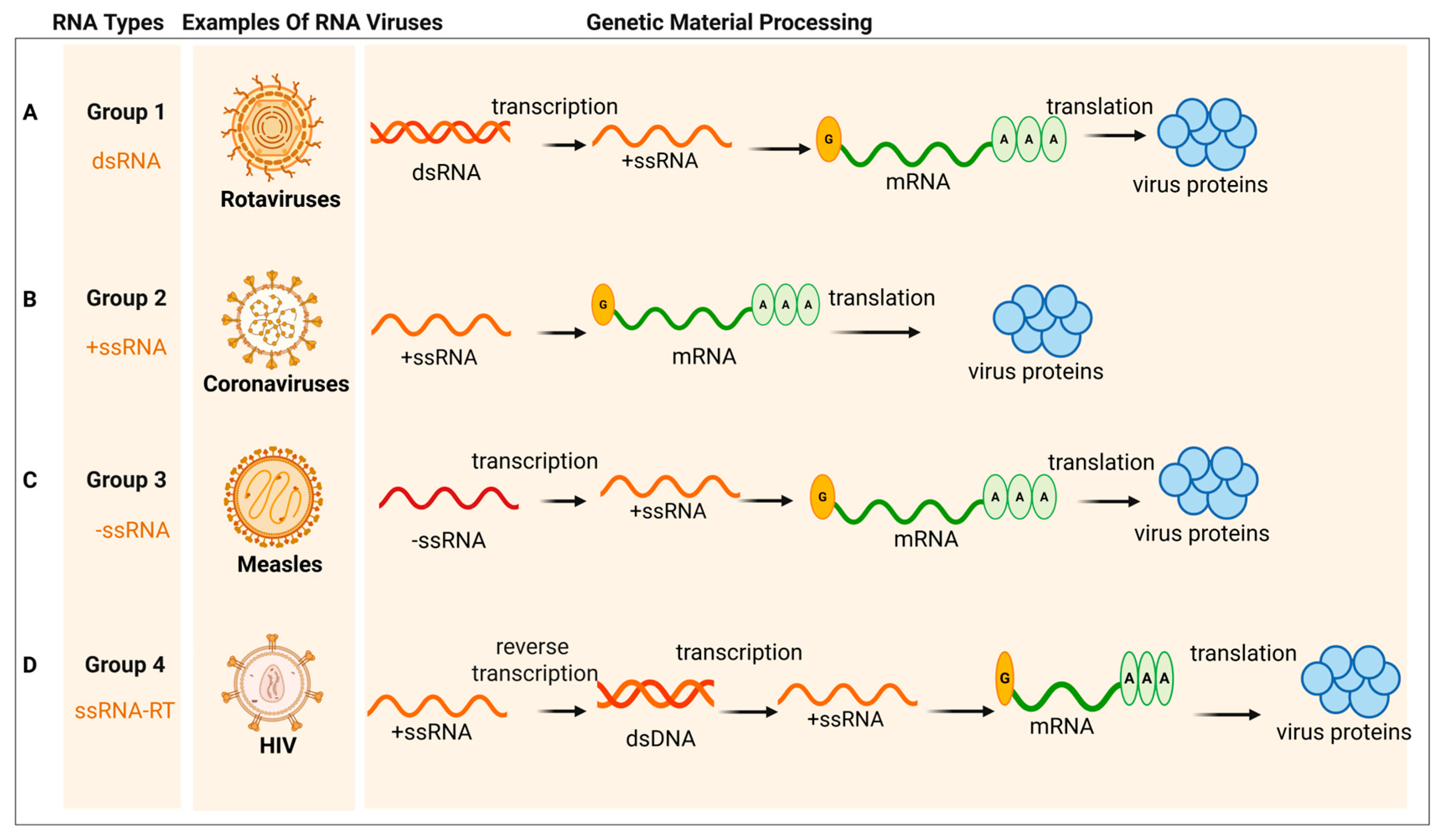
2.1. The Classification of RNA Viruses
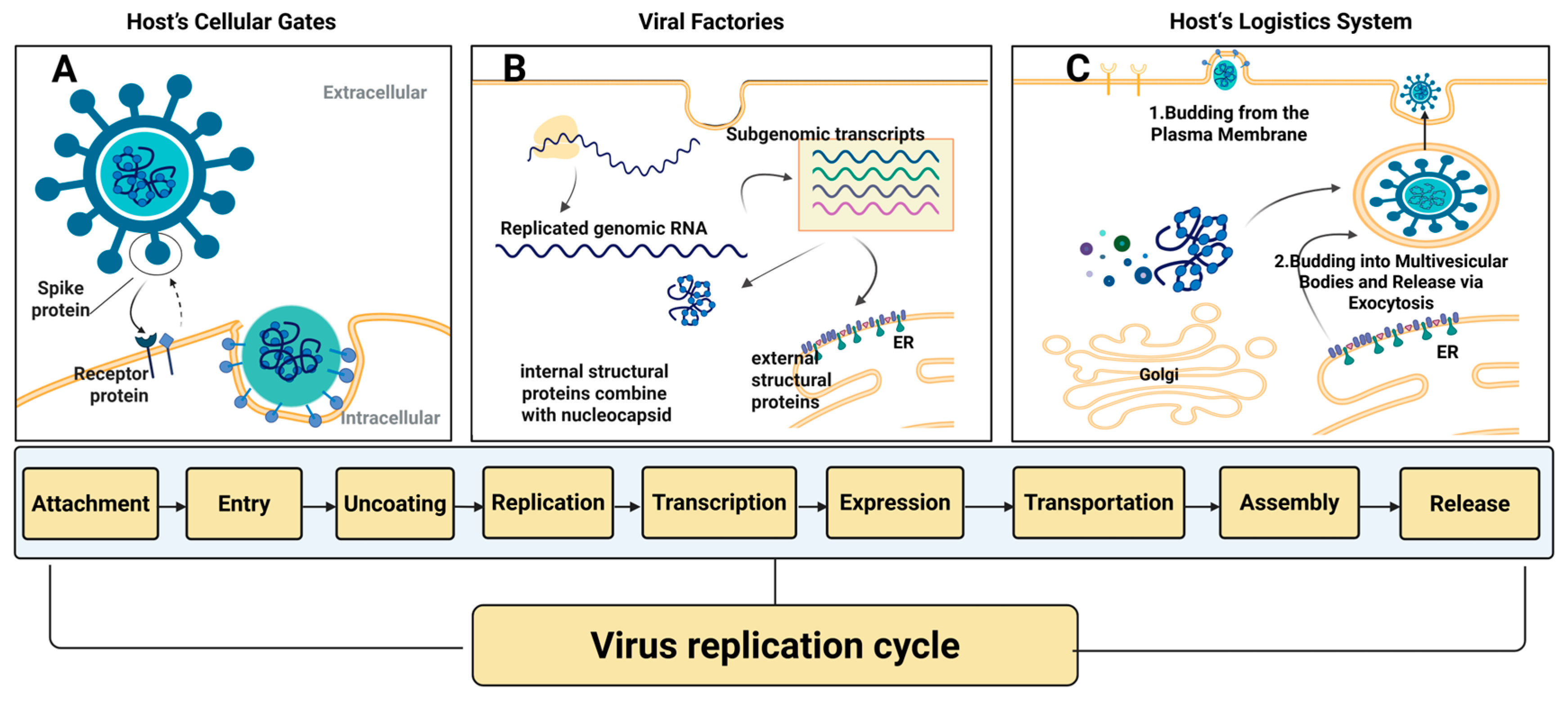
2.2. The Life Cycle of RNA Virus
3. Breaching the Invasion Gateway
3.1. Hijacking the Host’s Cellular Gates: Attachment and Entry
3.2. Targeting HDFs in Viral Entry
4. Decoding the Viral “Factories”
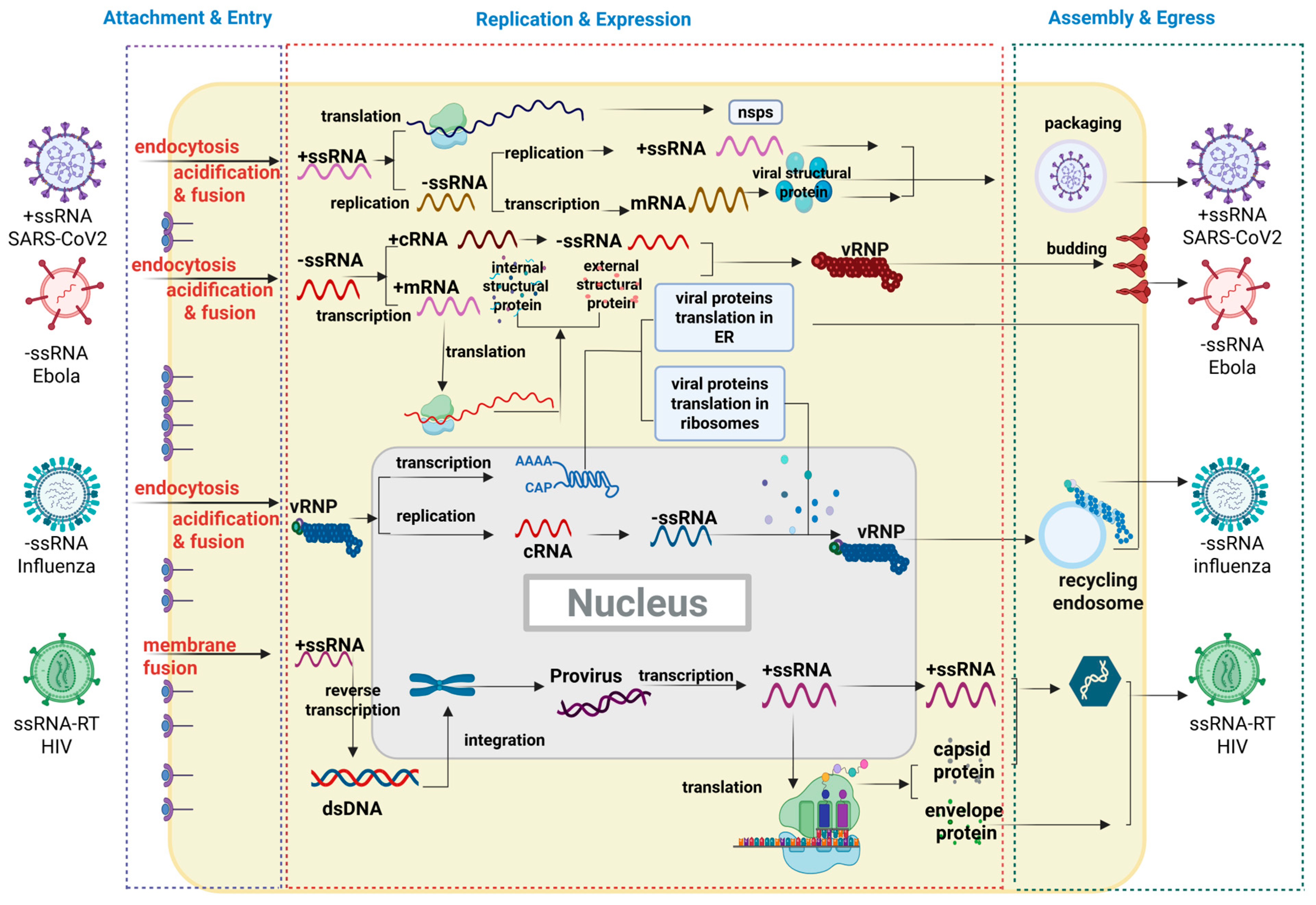
4.1. The Viral “Factories”: Replication and Expression
4.2. Targeting HDFs in Viral Replication

| Host Dependency Factor (HDF) | Virus Example | Clinical States | Targeting Drug/Strategy |
|---|---|---|---|
| TMEM41B [93] | Coronaviruses | / | / |
| VMP1 [93] | Coronaviruses | / | / |
| Host Kinase System [96,97] | Ebola Virus (EBOV) | / | / |
| CAD (Carbamoyl-Phosphate Synthetase 2) [98] | Ebola Virus (EBOV) | / | / |
| Host Nucleotide Metabolism | Various RNA viruses | In clinical development | Ribavirin [150] |
| Host Curvature-inducing Proteins [114] | Various RNA viruses | / | / |
| Host’s Lipid Metabolic Network | Severe Acute Respiratory Syndrome Coronavirus 2 (SARS-CoV-2) | In clinical development | Imipramine, ceftanorine [117] |
| RNA Polymerase II [132] | Influenza A virus (IAV) | / | / |
| ANP32 Family Proteins [132] | Influenza A virus (IAV) | / | / |
| Various RNA viruses | |||
| TOP1 | Various RNA viruses | In clinical development | Camptothecin [151] |
| LEDGF/p75 [138] | Retroviruses (HIV) | / | / |
| Sec24C [142] | Human Immunodeficiency Virus (HIV) | / | / |
| DPMS Complex & ALG3 [143] | Flaviviruses | / | / |
| Glycolysis Pathway | Various RNA viruses | Marketed drugs | 2-Deoxy-D-Glucose (2-DG) (in Phase 1/2/3 clinical trial) [29] |
| SBDS & SPATA5 proteins [144] | Flaviviruses & Coronaviruses | / | / |
| LLPS | Various RNA viruses | / | / |
| NF-B | IAV & SARS-CoV-2 | / | |
| HDAC1 | IAV & SARS-CoV-2 | Marketed drugs | Valproic Acid (VPA) [152] |
| GFPT2 | HCV | / | / |
| PEX11B | ZIKV | / | / |
| LC3 | SARS-CoV-2 | / | / |
| AMPK | Various RNA viruses | / | / |
| G3BP1/2 | SARS-CoV-2 | Marketed drugs | Imatinib, Decitabine [105] |
5. Commandeering the Host Logistics
5.1. Commandeering the Host’s Logistics System: Assembly and Egress
5.2. Targeting HDFs in Assembly and Egress
6. Conclusions and Outlook
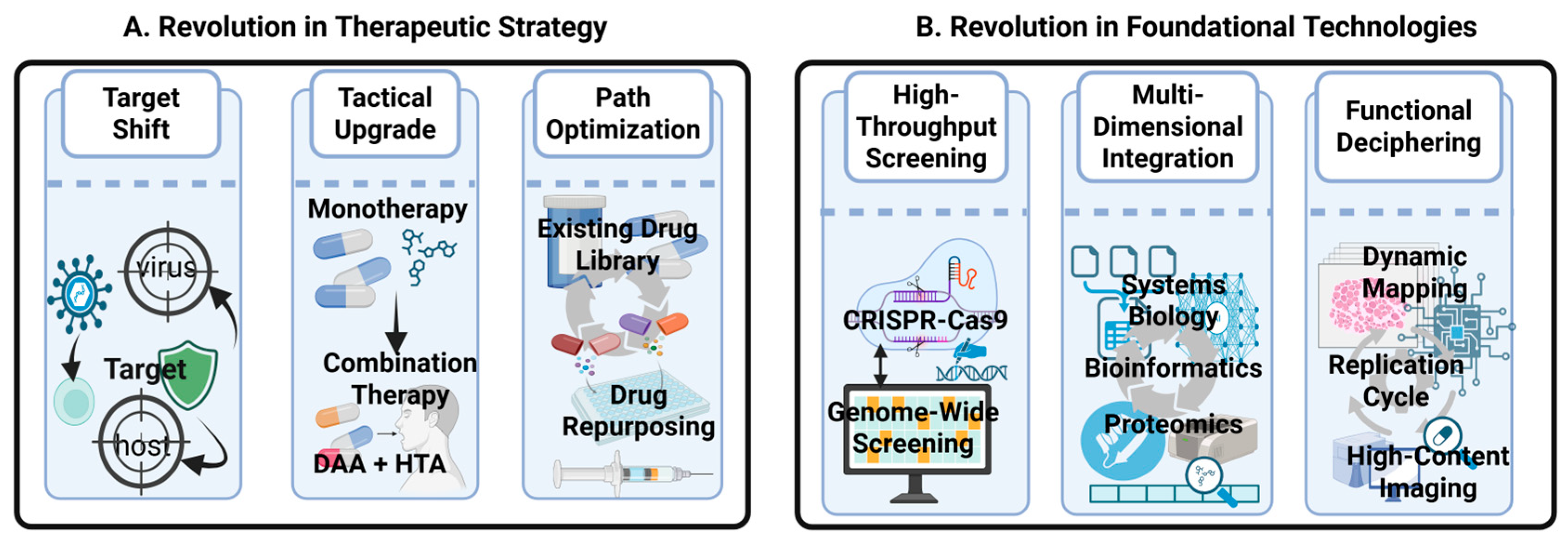
- Synergistic Combination Therapies: The strategic combination of DAAs and HTAs (“DAA + HTA”) will emerge as a cornerstone regimen. This approach constrains viral evolution from multiple angles, potentially allows for lower drug doses, and enhances overall efficacy, representing a robust long-term solution to the problem of drug resistance. Notably, the potential of LLPS targeting is uniquely highlighted by its fundamental orthogonality to the targets of DAAs. The LLPS mechanism is structurally and physicochemical distinct from DAA targeting, making LLPS targeting an excellent candidate for combination therapy (Figure 5A).
- Tunable Therapeutic Modalities: The field will move beyond simple inhibition towards the “fine-tuned modulation” of HDF activity with regulatory dimensions spanning epigenetics, host signaling pathways, biomolecular condensates and liquid–liquid phase separation, autophagy and autophagy-dependent HDFs, and various host organelles. Modalities such as allosteric modulators and molecular glues aim to precisely perturb the virus–host interface, effectively inhibiting the virus while sparing essential host functions, thereby broadening the therapeutic window.
- Precision in Target Identification: The next generation of HDFs will be discovered by focusing on those that are “preferentially hijacked” by viruses or become essential only in infected cells. Leveraging functional genomics, proteomics, and AI-driven analytics will be key to identifying these ideal targets with inherently higher therapeutic indices (Figure 5B).
Author Contributions
Funding
Data Availability Statement
Conflicts of Interest
References
- Lamers, M.M.; Haagmans, B.L. SARS-CoV-2 pathogenesis. Nat. Rev. Microbiol. 2022, 20, 270–284. [Google Scholar] [CrossRef]
- Liang, Y. Pathogenicity and virulence of influenza. Virulence 2023, 14, 2223057. [Google Scholar] [CrossRef]
- Van Heuvel, Y.; Schatz, S.; Rosengarten, J.F.; Stitz, J. Infectious RNA: Human immunodeficiency virus (HIV) biology, therapeutic intervention, and the quest for a vaccine. Toxins 2022, 14, 138. [Google Scholar] [CrossRef] [PubMed]
- Lungu, C.N.; Putz, M.V. SARS-CoV-2 spike protein interaction space. Int. J. Mol. Sci. 2023, 24, 12058. [Google Scholar] [CrossRef]
- Zhang, J.; Xiao, T.; Cai, Y.; Chen, B. Structure of SARS-CoV-2 Spike Protein. Curr. Opin. Virol. 2021, 50, 173–182. [Google Scholar] [CrossRef] [PubMed]
- Li, X.; Gu, M.; Zheng, Q.; Gao, R.; Liu, X. Packaging signal of influenza A virus. Virol. J. 2021, 18, 36. [Google Scholar] [CrossRef] [PubMed]
- Domingo, E.; García-Crespo, C.; Lobo-Vega, R.; Perales, C. Mutation rates, mutation frequencies, and proofreading-repair activities in RNA virus genetics. Viruses 2021, 13, 1882. [Google Scholar] [CrossRef]
- Yeo, J.Y.; Goh, G.-R.; Su, C.T.-T.; Gan, S.K.-E. The determination of HIV-1 RT mutation rate, its possible allosteric effects, and its implications on drug resistance. Viruses 2020, 12, 297. [Google Scholar] [CrossRef]
- Barnes, J.E.; Lund-Andersen, P.K.; Patel, J.S.; Ytreberg, F.M. The effect of mutations on binding interactions between the SARS-CoV-2 receptor binding domain and neutralizing antibodies B38 and CB6. Sci. Rep. 2022, 12, 18819. [Google Scholar] [CrossRef]
- Li, Y.; Liu, P.; Hao, T.; Liu, S.; Wang, X.; Xie, Y.; Xu, K.; Lei, W.; Zhang, C.; Han, P. Rational design of an influenza-COVID-19 chimeric protective vaccine with HA-stalk and S-RBD. Emerg. Microbes Infect. 2023, 12, 2231573. [Google Scholar] [CrossRef]
- Wu, N.C.; Wilson, I.A. Influenza hemagglutinin structures and antibody recognition. Cold Spring Harb. Perspect. Med. 2020, 10, a038778. [Google Scholar] [CrossRef]
- Rashid, F.; Xie, Z.; Suleman, M.; Shah, A.; Khan, S.; Luo, S. Roles and functions of SARS-CoV-2 proteins in host immune evasion. Front. Immunol. 2022, 13, 940756. [Google Scholar] [CrossRef]
- Lu, L.; Su, S.; Yang, H.; Jiang, S. Antivirals with common targets against highly pathogenic viruses. Cell 2021, 184, 1604–1620. [Google Scholar] [CrossRef]
- Shiraki, K.; Yasumoto, S.; Toyama, N.; Fukuda, H. Amenamevir, a helicase-primase inhibitor, for the optimal treatment of herpes zoster. Viruses 2021, 13, 1547. [Google Scholar] [CrossRef]
- Zhu, J.; Zhang, H.; Lin, Q.; Lyu, J.; Lu, L.; Chen, H.; Zhang, X.; Zhang, Y.; Chen, K. Progress on SARS-CoV-2 3CLpro inhibitors: Inspiration from SARS-CoV 3CLpro peptidomimetics and small-molecule anti-inflammatory compounds. Drug Des. Devel. Ther. 2022, 16, 1067–1082. [Google Scholar] [CrossRef]
- Mishra, A.; Rathore, A.S. RNA dependent RNA polymerase (RdRp) as a drug target for SARS-CoV2. J. Biomol. Struct. Dyn. 2022, 40, 6039–6051. [Google Scholar] [CrossRef]
- Shiraki, K.; Daikoku, T. Favipiravir, an anti-influenza drug against life-threatening RNA virus infections. Pharmacol. Ther. 2020, 209, 107512. [Google Scholar] [CrossRef]
- Hashemian, S.M.R.; Pourhanifeh, M.H.; Hamblin, M.R.; Shahrzad, M.K.; Mirzaei, H. RdRp inhibitors and COVID-19: Is molnupiravir a good option? Biomed. Pharmacother. 2022, 146, 112517. [Google Scholar] [CrossRef]
- Hashemian, S.M.R.; Sheida, A.; Taghizadieh, M.; Memar, M.Y.; Hamblin, M.R.; Baghi, H.B.; Nahand, J.S.; Asemi, Z.; Mirzaei, H. Paxlovid (Nirmatrelvir/Ritonavir): A new approach to COVID-19 therapy? Biomed. Pharmacother. 2023, 162, 114367. [Google Scholar] [CrossRef]
- Zwillenberg, M.; Tang, E.; Quaas, J. Neuraminidase inhibitors for treatment of influenza. Acad. Emerg. Med. 2021, 28, 1195–1197. [Google Scholar] [CrossRef]
- Mtambo, S.E.; Amoako, D.G.; Somboro, A.M.; Agoni, C.; Lawal, M.M.; Gumede, N.S.; Khan, R.B.; Kumalo, H.M. Influenza viruses: Harnessing the crucial role of the M2 ion-channel and neuraminidase toward inhibitor design. Molecules 2021, 26, 880. [Google Scholar] [CrossRef]
- Yao, Z.; Zhang, L.; Duan, Y.; Tang, X.; Lu, J. Molecular insights into the adaptive evolution of SARS-CoV-2 spike protein. J. Infect. 2024, 88, 106121. [Google Scholar] [CrossRef]
- Magazine, N.; Zhang, T.; Wu, Y.; McGee, M.C.; Veggiani, G.; Huang, W. Mutations and evolution of the SARS-CoV-2 spike protein. Viruses 2022, 14, 640, Correction in Viruses 2023, 15, 1787. [Google Scholar] [CrossRef]
- Xu, J.; Luo, Q.; Huang, Y.; Li, J.; Ye, W.; Yan, R.; Zhou, X.; He, Z.; Liu, G.; Zhu, Q. Influenza neuraminidase mutations and resistance to neuraminidase inhibitors. Emerg. Microbes Infect. 2024, 13, 2429627. [Google Scholar] [CrossRef]
- Jalily, P.H.; Duncan, M.C.; Fedida, D.; Wang, J.; Tietjen, I. Put a cork in it: Plugging the M2 viral ion channel to sink influenza. Antivir. Res. 2020, 178, 104780. [Google Scholar] [CrossRef]
- Petrova, V.N.; Russell, C.A. The evolution of seasonal influenza viruses. Nat. Rev. Microbiol. 2018, 16, 47–60, Erratum in Nat. Rev. Microbiol. 2018, 16, 60. https://doi.org/10.1038/nrmicro.2017.146. [Google Scholar] [CrossRef]
- Cao, Y.; Jian, F.; Wang, J.; Yu, Y.; Song, W.; Yisimayi, A.; Wang, J.; An, R.; Chen, X.; Zhang, N. Imprinted SARS-CoV-2 humoral immunity induces convergent Omicron RBD evolution. Nature 2023, 614, 521–529. [Google Scholar] [CrossRef]
- Bojkova, D.; Klann, K.; Koch, B.; Widera, M.; Krause, D.; Ciesek, S.; Cinatl, J.; Münch, C. Proteomics of SARS-CoV-2-infected host cells reveals therapy targets. Nature 2020, 583, 469–472. [Google Scholar] [CrossRef]
- Wali, L.; Karbiener, M.; Chou, S.; Kovtunyk, V.; Adonyi, A.; Gösler, I.; Contreras, X.; Stoeva, D.; Blaas, D.; Stöckl, J. Host-directed therapy with 2-deoxy-D-glucose inhibits human rhinoviruses, endemic coronaviruses, and SARS-CoV-2. J. Virus Erad. 2022, 8, 100305. [Google Scholar] [CrossRef]
- Hiatt, J.; Hultquist, J.F.; McGregor, M.J.; Bouhaddou, M.; Leenay, R.T.; Simons, L.M.; Young, J.M.; Haas, P.; Roth, T.L.; Tobin, V. A functional map of HIV-host interactions in primary human T cells. Nat. Commun. 2022, 13, 1752. [Google Scholar] [CrossRef]
- Yant, S.R.; Mulato, A.; Hansen, D.; Tse, W.C.; Niedziela-Majka, A.; Zhang, J.R.; Stepan, G.J.; Jin, D.; Wong, M.H.; Perreira, J.M. A highly potent long-acting small-molecule HIV-1 capsid inhibitor with efficacy in a humanized mouse model. Nat. Med. 2019, 25, 1377–1384. [Google Scholar] [CrossRef]
- Frericks, N.; Kloehn, M.; Lange, F.; Pottkämper, L.; Carpentier, A.; Steinmann, E. Host-targeting antivirals for chronic viral infections of the liver. Antivir. Res. 2025, 234, 106062. [Google Scholar] [CrossRef]
- Tammaro, C.; Guida, M.; Appetecchia, F.; Biava, M.; Consalvi, S.; Poce, G. Direct-acting antivirals and host-targeting approaches against enterovirus B infections: Recent advances. Pharmaceuticals 2023, 16, 203. [Google Scholar] [CrossRef]
- Zheng, Y.; Li, S.; Song, K.; Ye, J.; Li, W.; Zhong, Y.; Feng, Z.; Liang, S.; Cai, Z.; Xu, K. A broad antiviral strategy: Inhibitors of human DHODH pave the way for host-targeting antivirals against emerging and re-emerging viruses. Viruses 2022, 14, 928. [Google Scholar] [CrossRef]
- Daniloski, Z.; Jordan, T.X.; Wessels, H.-H.; Hoagland, D.A.; Kasela, S.; Legut, M.; Maniatis, S.; Mimitou, E.P.; Lu, L.; Geller, E. Identification of required host factors for SARS-CoV-2 infection in human cells. Cell 2021, 184, 92–105.e16. [Google Scholar] [CrossRef]
- Wei, J.; Alfajaro, M.M.; DeWeirdt, P.C.; Hanna, R.E.; Lu-Culligan, W.J.; Cai, W.L.; Strine, M.S.; Zhang, S.-M.; Graziano, V.R.; Schmitz, C.O. Genome-wide CRISPR screens reveal host factors critical for SARS-CoV-2 infection. Cell 2021, 184, 76–91.e13. [Google Scholar] [CrossRef]
- Li, B.; Clohisey, S.M.; Chia, B.S.; Wang, B.; Cui, A.; Eisenhaure, T.; Schweitzer, L.D.; Hoover, P.; Parkinson, N.J.; Nachshon, A. Genome-wide CRISPR screen identifies host dependency factors for influenza A virus infection. Nat. Commun. 2020, 11, 164. [Google Scholar] [CrossRef]
- Flint, M.; Chatterjee, P.; Lin, D.L.; McMullan, L.K.; Shrivastava-Ranjan, P.; Bergeron, É.; Lo, M.K.; Welch, S.R.; Nichol, S.T.; Tai, A.W. A genome-wide CRISPR screen identifies N-acetylglucosamine-1-phosphate transferase as a potential antiviral target for Ebola virus. Nat. Commun. 2019, 10, 285. [Google Scholar] [CrossRef]
- Zhang, F.; Tang, Y.; Jia, Y.; Zhou, Y. RNA viruses: From RNA processing and interaction mechanisms to new prevention and control strategies. Sci. Sin. Vitae 2025, 55, 1851–1876. [Google Scholar] [CrossRef]
- Lee, J.; Kreutzberger, A.J.; Odongo, L.; Nelson, E.A.; Nyenhuis, D.; Kiessling, V.; Liang, B.; Cafiso, D.S.; White, J.M.; Tamm, L.K. Ebola virus glycoprotein interacts with cholesterol to enhance membrane fusion and cell entry. Biophys. J. 2021, 120, 191A. [Google Scholar] [CrossRef]
- Colpitts, C.C.; Tsai, P.-L.; Zeisel, M.B. Hepatitis C virus entry: An intriguingly complex and highly regulated process. Int. J. Mol. Sci. 2020, 21, 2091. [Google Scholar] [CrossRef]
- Jackson, C.B.; Farzan, M.; Chen, B.; Choe, H. Mechanisms of SARS-CoV-2 entry into cells. Nat. Rev. Mol. Cell Biol. 2022, 23, 3–20. [Google Scholar] [CrossRef]
- Zhou, P.; Yang, X.L.; Wang, X.G.; Hu, B.; Zhang, L.; Zhang, W.; Si, H.R.; Zhu, Y.; Li, B.; Huang, C.L.; et al. A pneumonia outbreak associated with a new coronavirus of probable bat origin. Nature 2020, 579, 270–273. [Google Scholar] [CrossRef]
- Ni, Z.; Wang, J.; Yu, X.; Wang, Y.; Wang, J.; He, X.; Li, C.; Deng, G.; Shi, J.; Kong, H. Influenza virus uses mGluR2 as an endocytic receptor to enter cells. Nat. Microbiol. 2024, 9, 1764–1777. [Google Scholar] [CrossRef]
- de Lima Cavalcanti, T.Y.V.; Pereira, M.R.; de Paula, S.O.; Franca, R.F.O. A Review on Chikungunya Virus Epidemiology, Pathogenesis and Current Vaccine Development. Viruses 2022, 14, 969. [Google Scholar] [CrossRef]
- Sirohi, D.; Kuhn, R.J. Zika Virus Structure, Maturation, and Receptors. J. Infect. Dis. 2017, 216, S935–S944. [Google Scholar] [CrossRef]
- Wei, Y.; Liu, H.; Hu, D.; He, Q.; Yao, C.; Li, H.; Hu, K.; Wang, J. Recent Advances in Enterovirus A71 Infection and Antiviral Agents. Lab. Investig. 2024, 104, 100298. [Google Scholar] [CrossRef]
- Garmaroudi, F.S.; Marchant, D.; Hendry, R.; Luo, H.; Yang, D.; Ye, X.; Shi, J.; McManus, B.M. Coxsackievirus B3 replication and pathogenesis. Future Microbiol. 2015, 10, 629–653. [Google Scholar] [CrossRef]
- Talukdar, P.; Dutta, D.; Ghosh, E.; Bose, I.; Bhattacharjee, S. Molecular Pathogenesis of Nipah Virus. Appl. Biochem. Biotechnol. 2023, 195, 2451–2462. [Google Scholar] [CrossRef]
- Matsuyama, S.; Nao, N.; Shirato, K.; Kawase, M.; Saito, S.; Takayama, I.; Nagata, N.; Sekizuka, T.; Katoh, H.; Kato, F. Enhanced isolation of SARS-CoV-2 by TMPRSS2-expressing cells. Proc. Natl. Acad. Sci. USA 2020, 117, 7001–7003. [Google Scholar] [CrossRef]
- Jocher, G.; Grass, V.; Tschirner, S.K.; Riepler, L.; Breimann, S.; Kaya, T.; Oelsner, M.; Hamad, M.S.; Hofmann, L.I.; Blobel, C.P. ADAM10 and ADAM17 promote SARS-CoV-2 cell entry and spike protein-mediated lung cell fusion. EMBO Rep. 2022, 23, e54305. [Google Scholar] [CrossRef]
- Richardson, P.; Griffin, I.; Tucker, C.; Smith, D.; Oechsle, O.; Phelan, A.; Rawling, M.; Savory, E.; Stebbing, J. Baricitinib as potential treatment for 2019-nCoV acute respiratory disease. Lancet 2020, 395, e30–e31, Erratum in Lancet 2020, 395, 1906. [Google Scholar] [CrossRef]
- Hoffmann, M.; Kleine-Weber, H.; Schroeder, S.; Krüger, N.; Herrler, T.; Erichsen, S.; Schiergens, T.S.; Herrler, G.; Wu, N.H.; Nitsche, A.; et al. SARS-CoV-2 Cell Entry Depends on ACE2 and TMPRSS2 and Is Blocked by a Clinically Proven Protease Inhibitor. Cell 2020, 181, 271–280.e8. [Google Scholar] [CrossRef]
- Marchant, D.; Singhera, G.K.; Utokaparch, S.; Hackett, T.L.; Boyd, J.H.; Luo, Z.; Si, X.; Dorscheid, D.R.; McManus, B.M.; Hegele, R.G. Toll-like receptor 4-mediated activation of p38 mitogen-activated protein kinase is a determinant of respiratory virus entry and tropism. J. Virol. 2010, 84, 11359–11373. [Google Scholar] [CrossRef]
- Cavalli, V.; Vilbois, F.; Corti, M.; Marcote, M.J.; Tamura, K.; Karin, M.; Arkinstall, S.; Gruenberg, J. The stress-induced MAP kinase p38 regulates endocytic trafficking via the GDI:Rab5 complex. Mol. Cell 2001, 7, 421–432. [Google Scholar] [CrossRef] [PubMed]
- Chander, Y.; Kumar, R.; Khandelwal, N.; Singh, N.; Shringi, B.N.; Barua, S.; Kumar, N. Role of p38 mitogen-activated protein kinase signalling in virus replication and potential for developing broad spectrum antiviral drugs. Rev. Med. Virol. 2021, 31, 1–16. [Google Scholar] [CrossRef] [PubMed]
- Halfmann, P.; Neumann, G.; Kawaoka, Y. The Ebolavirus VP24 protein blocks phosphorylation of p38 mitogen-activated protein kinase. J. Infect. Dis. 2011, 204, S953–S956. [Google Scholar] [CrossRef]
- Jiang, F.F.; Wang, R.Q.; Guo, C.Y.; Zheng, K.; Liu, H.L.; Su, L.; Xie, S.S.; Chen, H.C.; Liu, Z.F. Phospho-proteomics identifies a critical role of ATF2 in pseudorabies virus replication. Virol. Sin. 2022, 37, 591–600. [Google Scholar] [CrossRef]
- Moreira, E.A.; Yamauchi, Y.; Matthias, P. How Influenza Virus Uses Host Cell Pathways during Uncoating. Cells 2021, 10, 1722. [Google Scholar] [CrossRef] [PubMed]
- Banerjee, I.; Miyake, Y.; Nobs, S.P.; Schneider, C.; Horvath, P.; Kopf, M.; Matthias, P.; Helenius, A.; Yamauchi, Y. Influenza A virus uses the aggresome processing machinery for host cell entry. Science 2014, 346, 473–477. [Google Scholar] [CrossRef]
- Pérez-Yanes, S.; Lorenzo-Sánchez, I.; Cabrera-Rodríguez, R.; García-Luis, J.; Trujillo-González, R.; Estévez-Herrera, J.; Valenzuela-Fernández, A. The ZIKV NS5 Protein Aberrantly Alters the Tubulin Cytoskeleton, Induces the Accumulation of Autophagic p62 and Affects IFN Production: HDAC6 Has Emerged as an Anti-NS5/ZIKV Factor. Cells 2024, 13, 598. [Google Scholar] [CrossRef]
- Qu, M.; Wei, D.; Ke, Q.; Cheng, P.; Ma, Y.; Afera, B.; Guo, K.; Li, M.; Yin, X.; Wang, X.; et al. Histone deacetylase 6 inhibits STING-dependent antiviral immunity via site-specific deacetylation. J. Biol. Chem. 2025, 301, 110841. [Google Scholar] [CrossRef]
- Cabrera-Rodríguez, R.; Pérez-Yanes, S.; Montelongo, R.; Lorenzo-Salazar, J.M.; Estévez-Herrera, J.; García-Luis, J.; Íñigo-Campos, A.; Rubio-Rodríguez, L.A.; Muñoz-Barrera, A.; Trujillo-González, R.; et al. Transactive Response DNA-Binding Protein (TARDBP/TDP-43) Regulates Cell Permissivity to HIV-1 Infection by Acting on HDAC6. Int. J. Mol. Sci. 2022, 23, 6180. [Google Scholar] [CrossRef]
- Zhao, Y.; Zou, J.; Gao, Q.; Xie, S.; Cao, J.; Zhou, H. CMAS and ST3GAL4 play an important role in the adsorption of influenza virus by affecting the synthesis of sialic acid receptors. Int. J. Mol. Sci. 2021, 22, 6081. [Google Scholar] [CrossRef]
- Williams-Noonan, B.J.; Todorova, N.; Kulkarni, K.; Aguilar, M.-I.; Yarovsky, I. An active site inhibitor induces conformational penalties for ACE2 recognition by the spike protein of SARS-CoV-2. J. Phys. Chem. B 2021, 125, 2533–2550. [Google Scholar] [CrossRef]
- Simoneau, C.R.; Chen, P.-Y.; Xing, G.K.; Hayashi, J.M.; Chen, I.P.; Khalid, M.M.; Meyers, N.L.; Taha, T.Y.; Leon, K.E.; Suryawanshi, R.K. NF-κB inhibitor alpha controls SARS-CoV-2 infection in ACE2-overexpressing human airway organoids. Sci. Rep. 2024, 14, 15351. [Google Scholar] [CrossRef]
- Ahmad, I.; Pawara, R.; Surana, S.; Patel, H. The repurposed ACE2 inhibitors: SARS-CoV-2 entry blockers of COVID-19. Top. Curr. Chem. 2021, 379, 40. [Google Scholar] [CrossRef]
- Zhu, Y.; Feng, M.; Wang, B.; Zheng, Y.; Jiang, D.; Zhao, L.; Mamun, M.A.A.; Kang, H.; Nie, H.; Zhang, X.; et al. New insights into the non-enzymatic function of HDAC6. Biomed. Pharmacother. 2023, 161, 114438. [Google Scholar] [CrossRef]
- Choi, S.J.; Lee, H.C.; Kim, J.H.; Park, S.Y.; Kim, T.H.; Lee, W.K.; Jang, D.J.; Yoon, J.E.; Choi, Y.I.; Kim, S.; et al. HDAC6 regulates cellular viral RNA sensing by deacetylation of RIG-I. EMBO J. 2016, 35, 429–442. [Google Scholar] [CrossRef]
- Chen, N.; Zhang, B.; Deng, L.; Liang, B.; Ping, J. Virus-host interaction networks as new antiviral drug targets for IAV and SARS-CoV-2. Emerg. Microbes Infect. 2022, 11, 1371–1389. [Google Scholar] [CrossRef]
- Pizzorno, A.; Padey, B.; Terrier, O.; Rosa-Calatrava, M. Drug repurposing approaches for the treatment of influenza viral infection: Reviving old drugs to fight against a long-lived enemy. Front. Immunol. 2019, 10, 531. [Google Scholar] [CrossRef]
- Monteil, V.; Eaton, B.; Postnikova, E.; Murphy, M.; Braunsfeld, B.; Crozier, I.; Kricek, F.; Niederhöfer, J.; Schwarzböck, A.; Breid, H. Clinical grade ACE2 as a universal agent to block SARS-CoV-2 variants. EMBO Mol. Med. 2022, 14, e15230. [Google Scholar] [CrossRef]
- Jastrząb, P.; Narejko, K.; Car, H.; Wielgat, P. Cell membrane sialome: Sialic acids as therapeutic targets and regulators of drug resistance in human cancer management. Cancers 2023, 15, 5103. [Google Scholar] [CrossRef]
- Heida, R.; Bhide, Y.C.; Gasbarri, M.; Kocabiyik, Ö.; Stellacci, F.; Huckriede, A.L.; Hinrichs, W.L.; Frijlink, H.W. Advances in the development of entry inhibitors for sialic-acid-targeting viruses. Drug Discov. Today 2021, 26, 122–137. [Google Scholar] [CrossRef]
- Läubli, H.; Nalle, S.C.; Maslyar, D. Targeting the siglec–sialic acid immune axis in cancer: Current and future approaches. Cancer Immunol. Res. 2022, 10, 1423–1432. [Google Scholar] [CrossRef]
- Ahmad, I.; Fatemi, S.N.; Ghaheri, M.; Rezvani, A.; Khezri, D.A.; Natami, M.; Yasamineh, S.; Gholizadeh, O.; Bahmanyar, Z. An overview of the role of Niemann-pick C1 (NPC1) in viral infections and inhibition of viral infections through NPC1 inhibitor. Cell Commun. Signal. 2023, 21, 352. [Google Scholar] [CrossRef]
- Sulkowski, M.S.; Kang, M.; Matining, R.; Wyles, D.; Johnson, V.A.; Morse, G.D.; Amorosa, V.; Bhattacharya, D.; Coughlin, K.; Wong-Staal, F. Safety and antiviral activity of the HCV entry inhibitor ITX5061 in treatment-naive HCV-infected adults: A randomized, double-blind, phase 1b study. J. Infect. Dis. 2014, 209, 658–667. [Google Scholar] [CrossRef]
- Tawar, R.G.; Heydmann, L.; Bach, C.; Schüttrumpf, J.; Chavan, S.; King, B.J.; McClure, C.P.; Ball, J.K.; Pessaux, P.; Habersetzer, F. Broad neutralization of hepatitis C virus-resistant variants by Civacir hepatitis C immunoglobulin. Hepatology 2016, 64, 1495–1506. [Google Scholar] [CrossRef]
- Sonawane, K.D.; Barale, S.S.; Dhanavade, M.J.; Waghmare, S.R.; Nadaf, N.H.; Kamble, S.A.; Mohammed, A.A.; Makandar, A.M.; Fandilolu, P.M.; Dound, A.S.; et al. Structural insights and inhibition mechanism of TMPRSS2 by experimentally known inhibitors Camostat mesylate, Nafamostat and Bromhexine hydrochloride to control SARS-coronavirus-2: A molecular modeling approach. Inform. Med. Unlocked 2021, 24, 100597. [Google Scholar] [CrossRef]
- Liu, T.; Luo, S.; Libby, P.; Shi, G.-P. Cathepsin L-selective inhibitors: A potentially promising treatment for COVID-19 patients. Pharmacol. Ther. 2020, 213, 107587. [Google Scholar] [CrossRef]
- Shang, C.; Zhuang, X.; Zhang, H.; Li, Y.; Zhu, Y.; Lu, J.; Ge, C.; Cong, J.; Li, T.; Tian, M. Inhibitors of endosomal acidification suppress SARS-CoV-2 replication and relieve viral pneumonia in hACE2 transgenic mice. Virol. J. 2021, 18, 46. [Google Scholar] [CrossRef]
- Hillis, A.L.; Martin, T.D.; Manchester, H.E.; Högström, J.; Zhang, N.; Lecky, E.; Kozlova, N.; Lee, J.; Persky, N.S.; Root, D.E. Targeting cholesterol biosynthesis with statins synergizes with AKT inhibitors in triple-negative breast cancer. Cancer Res. 2024, 84, 3250–3266. [Google Scholar] [CrossRef]
- Titanji, B.K.; Farley, M.M.; Mehta, A.; Connor-Schuler, R.; Moanna, A.; Cribbs, S.K.; O’Shea, J.; DeSilva, K.; Chan, B.; Edwards, A.; et al. Use of Baricitinib in Patients With Moderate to Severe Coronavirus Disease 2019. Clin. Infect. Dis. 2021, 72, 1247–1250. [Google Scholar] [CrossRef]
- Ling, J.; Li, J.; Khan, A.; Lundkvist, Å.; Li, J.P. Is heparan sulfate a target for inhibition of RNA virus infection? Am. J. Physiol. Cell Physiol. 2022, 322, C605–C613. [Google Scholar] [CrossRef]
- Deng, H.; Cao, H.; Wang, Y.; Li, J.; Dai, J.; Li, L.-F.; Qiu, H.-J.; Li, S. Viral replication organelles: The highly complex and programmed replication machinery. Front. Microbiol. 2024, 15, 1450060. [Google Scholar] [CrossRef]
- Etibor, T.A.; Yamauchi, Y.; Amorim, M.J. Liquid Biomolecular Condensates and Viral Lifecycles: Review and Perspectives. Viruses 2021, 13, 366. [Google Scholar] [CrossRef]
- Su, J.M.; Wilson, M.Z.; Samuel, C.E.; Ma, D. Formation and Function of Liquid-Like Viral Factories in Negative-Sense Single-Stranded RNA Virus Infections. Viruses 2021, 13, 126. [Google Scholar] [CrossRef]
- Li, M.; Hou, Y.; Zhou, Y.; Yang, Z.; Zhao, H.; Jian, T.; Yu, Q.; Zeng, F.; Liu, X.; Zhang, Z.; et al. LLPS of FXR proteins drives replication organelle clustering for β-coronaviral proliferation. J. Cell Biol. 2024, 223, e202309140. [Google Scholar] [CrossRef]
- Wang, Z.; Zhang, J.; Huang, J.; Sha, G.; Song, X.; Cao, X.; Yan, Z.; Liu, C.; Chen, S.; Li, Z.; et al. Plant negative-strand RNA virus phosphoprotein condensates exploit host trafficking and lipid synthesis for viral factory assembly. Sci. Adv. 2025, 11, eadx7905. [Google Scholar] [CrossRef]
- Wei, W.; Bai, L.; Yan, B.; Meng, W.; Wang, H.; Zhai, J.; Si, F.; Zheng, C. When liquid-liquid phase separation meets viral infections. Front. Immunol. 2022, 13, 985622. [Google Scholar] [CrossRef]
- Liu, X.; Xia, X.; Martynowycz, M.W.; Gonen, T.; Zhou, Z.H. Molecular sociology of virus-induced cellular condensates supporting reovirus assembly and replication. Nat. Commun. 2024, 15, 10638. [Google Scholar] [CrossRef]
- Ci, Y.; Shi, L. Compartmentalized replication organelle of flavivirus at the ER and the factors involved. Cell. Mol. Life Sci. 2021, 78, 4939–4954. [Google Scholar] [CrossRef] [PubMed]
- Ji, M.; Li, M.; Sun, L.; Zhao, H.; Li, Y.; Zhou, L.; Yang, Z.; Zhao, X.; Qu, W.; Xue, H. VMP1 and TMEM41B are essential for DMV formation during β-coronavirus infection. J. Cell Biol. 2022, 221, e202112081. [Google Scholar] [CrossRef]
- Huang, Y.; Wang, T.; Zhong, L.; Zhang, W.; Zhang, Y.; Yu, X.; Yuan, S.; Ni, T. Molecular architecture of coronavirus double-membrane vesicle pore complex. Nature 2024, 633, 224–231. [Google Scholar] [CrossRef]
- Dolnik, O.; Becker, S. Assembly and transport of filovirus nucleocapsids. PLoS Pathog. 2022, 18, e1010616. [Google Scholar] [CrossRef]
- Biedenkopf, N.; Hartlieb, B.; Hoenen, T.; Becker, S. Phosphorylation of Ebola virus VP30 influences the composition of the viral nucleocapsid complex: Impact on viral transcription and replication. J. Biol. Chem. 2013, 288, 11165–11174. [Google Scholar] [CrossRef]
- Miyake, T.; Farley, C.M.; Neubauer, B.E.; Beddow, T.P.; Hoenen, T.; Engel, D.A. Ebola virus inclusion body formation and RNA synthesis are controlled by a novel domain of nucleoprotein interacting with VP35. J. Virol. 2020, 94, e02100-19. [Google Scholar] [CrossRef] [PubMed]
- Brandt, J.; Wendt, L.; Bodmer, B.S.; Mettenleiter, T.C.; Hoenen, T. The cellular protein CAD is recruited into Ebola virus inclusion bodies by the nucleoprotein NP to facilitate genome replication and transcription. Cells 2020, 9, 1126. [Google Scholar] [CrossRef] [PubMed]
- Lopez, N.; Camporeale, G.; Salgueiro, M.; Borkosky, S.S.; Visentín, A.; Peralta-Martinez, R.; Loureiro, M.E.; de Prat-Gay, G. Deconstructing virus condensation. PLoS Pathog. 2021, 17, e1009926. [Google Scholar] [CrossRef]
- Luo, L.; Li, Z.; Zhao, T.; Ju, X.; Ma, P.; Jin, B.; Zhou, Y.; He, S.; Huang, J.; Xu, X.; et al. SARS-CoV-2 nucleocapsid protein phase separates with G3BPs to disassemble stress granules and facilitate viral production. Sci. Bull. 2021, 66, 1194–1204. [Google Scholar] [CrossRef]
- Yang, S.; Shen, W.; Hu, J.; Cai, S.; Zhang, C.; Jin, S.; Guan, X.; Wu, J.; Wu, Y.; Cui, J. Molecular mechanisms and cellular functions of liquid-liquid phase separation during antiviral immune responses. Front. Immunol. 2023, 14, 1162211. [Google Scholar] [CrossRef]
- Liu, Y.; Yao, Z.; Lian, G.; Yang, P. Biomolecular phase separation in stress granule assembly and virus infection. Acta Biochim. Biophys. Sin. 2023, 55, 1099–1118. [Google Scholar] [CrossRef]
- Zhang, X.; Zheng, R.; Li, Z.; Ma, J. Liquid-liquid Phase Separation in Viral Function. J. Mol. Biol. 2023, 435, 167955. [Google Scholar] [CrossRef]
- Zhang, D.W.; Xu, X.S.; Xie, L.; Xu, L.; Fu, Z.; Li, Y.; Xu, X. Natural product sennoside B disrupts liquid-liquid phase separation of SARS-CoV-2 nucleocapsid protein by inhibiting its RNA-binding activity. J. Enzym. Inhib. Med. Chem. 2025, 40, 2501743. [Google Scholar] [CrossRef]
- Ali, N.; Prasad, K.; AlAsmari, A.F.; Alharbi, M.; Rashid, S.; Kumar, V. Genomics-guided targeting of stress granule proteins G3BP1/2 to inhibit SARS-CoV-2 propagation. Int. J. Biol. Macromol. 2021, 190, 636–648. [Google Scholar] [CrossRef]
- Wu, C.; Wagner, N.D.; Moyle, A.B.; Feng, A.; Sharma, N.; Stubbs, S.H.; Donahue, C.; Davey, R.A.; Gross, M.L.; Leung, D.W. Disruption of Ebola NP0VP35 inclusion body-like structures reduce viral infection. J. Mol. Biol. 2023, 435, 168241. [Google Scholar] [CrossRef]
- Kurhade, C.; Kang, S.; Biering, S.B.; Hwang, S.; Randall, G. CAPRIN1 is required for control of viral replication complexes by interferon gamma. mBio 2023, 14, e00172-23. [Google Scholar] [CrossRef] [PubMed]
- Kanojia, A.; Sharma, M.; Shiraz, R.; Tripathi, S. Flavivirus–host interaction landscape visualized through genome-wide CRISPR screens. Viruses 2022, 14, 2164. [Google Scholar] [CrossRef]
- Cui, L.; Lee, Y.H.; Kumar, Y.; Xu, F.; Lu, K.; Ooi, E.E.; Tannenbaum, S.R.; Ong, C.N. Serum metabolome and lipidome changes in adult patients with primary dengue infection. PLoS Negl. Trop. Dis. 2013, 7, e2373. [Google Scholar] [CrossRef] [PubMed]
- Kyle, J.; Burnum-Johnson, K.; Wendler, J.; Eisfeld, A.; Halfmann, P.J.; Watanabe, T.; Sahr, F.; Smith, R.; Kawaoka, Y.; Waters, K. Plasma lipidome reveals critical illness and recovery from human Ebola virus disease. Proc. Natl. Acad. Sci. USA 2019, 116, 3919–3928. [Google Scholar] [CrossRef] [PubMed]
- Jin, H.; He, J.; Dong, C.; Li, B.; Ma, Z.; Li, B.; Huang, T.; Fan, J.; He, G.; Zhao, X. Altered lipid profile is a risk factor for the poor progression of COVID-19: From two retrospective cohorts. Front. Cell. Infect. Microbiol. 2021, 11, 712530. [Google Scholar] [CrossRef]
- den Boon, J.A.; Nishikiori, M.; Zhan, H.; Ahlquist, P. Positive-strand RNA virus genome replication organelles: Structure, assembly, control. Trends Genet. 2024, 40, 681–693. [Google Scholar] [CrossRef]
- Nagy, P.D. Co-opted membranes, lipids, and host proteins: What have we learned from tombusviruses? Curr. Opin. Virol. 2022, 56, 101258. [Google Scholar] [CrossRef]
- Guedán, A.; Caroe, E.R.; Barr, G.C.; Bishop, K.N. The role of capsid in HIV-1 nuclear entry. Viruses 2021, 13, 1425. [Google Scholar] [CrossRef] [PubMed]
- Farley, S.E.; Kyle, J.E.; Leier, H.C.; Bramer, L.M.; Weinstein, J.B.; Bates, T.A.; Lee, J.-Y.; Metz, T.O.; Schultz, C.; Tafesse, F.G. A global lipid map reveals host dependency factors conserved across SARS-CoV-2 variants. Nat. Commun. 2022, 13, 3487. [Google Scholar] [CrossRef]
- Drucker, D.J. Diabetes, obesity, metabolism, and SARS-CoV-2 infection: The end of the beginning. Cell Metab. 2021, 33, 479–498. [Google Scholar] [CrossRef] [PubMed]
- Wang, T.; Cao, Y.; Zhang, H.; Wang, Z.; Man, C.H.; Yang, Y.; Chen, L.; Xu, S.; Yan, X.; Zheng, Q. COVID-19 metabolism: Mechanisms and therapeutic targets. MedComm 2022, 3, e157. [Google Scholar] [CrossRef]
- San Felipe, C.J.; Batra, J.; Muralidharan, M.; Malpotra, S.; Anand, D.; Bauer, R.; Verba, K.A.; Swaney, D.L.; Krogan, N.J.; Grabe, M.; et al. Coupled equilibria of dimerization and lipid binding modulate SARS Cov 2 Orf9b interactions and interferon response. Elife 2025, 14, RP106484. [Google Scholar] [CrossRef]
- Hou, P.; Wang, X.; Wang, H.; Wang, T.; Yu, Z.; Xu, C.; Zhao, Y.; Wang, W.; Zhao, Y.; Chu, F.; et al. The ORF7a protein of SARS-CoV-2 initiates autophagy and limits autophagosome-lysosome fusion via degradation of SNAP29 to promote virus replication. Autophagy 2023, 19, 551–569. [Google Scholar] [CrossRef] [PubMed]
- Heaton, N.S.; Randall, G. Dengue virus-induced autophagy regulates lipid metabolism. Cell Host Microbe 2010, 8, 422–432. [Google Scholar] [CrossRef]
- Jordan, T.X.; Randall, G. Dengue Virus Activates the AMP Kinase-mTOR Axis To Stimulate a Proviral Lipophagy. J. Virol. 2017, 91, e02020-16. [Google Scholar] [CrossRef]
- Randall, G. Lipid Droplet Metabolism during Dengue Virus Infection. Trends Microbiol. 2018, 26, 640–642. [Google Scholar] [CrossRef]
- Martín-Acebes, M.A.; Vázquez-Calvo, Á.; Saiz, J.C. Lipids and flaviviruses, present and future perspectives for the control of dengue, Zika, and West Nile viruses. Prog. Lipid Res. 2016, 64, 123–137. [Google Scholar] [CrossRef]
- Gullberg, R.C.; Steel, J.J.; Pujari, V.; Rovnak, J.; Crick, D.C.; Perera, R. Stearoly-CoA desaturase 1 differentiates early and advanced dengue virus infections and determines virus particle infectivity. PLoS Pathog. 2018, 14, e1007261. [Google Scholar] [CrossRef] [PubMed]
- Horner, S.M.; Liu, H.M.; Park, H.S.; Briley, J.; Gale, M., Jr. Mitochondrial-associated endoplasmic reticulum membranes (MAM) form innate immune synapses and are targeted by hepatitis C virus. Proc. Natl. Acad. Sci. USA 2011, 108, 14590–14595. [Google Scholar] [CrossRef]
- Vazquez, C.; Horner, S.M. MAVS Coordination of Antiviral Innate Immunity. J. Virol. 2015, 89, 6974–6977. [Google Scholar] [CrossRef] [PubMed]
- Xia, W.; Jiang, P. p53 promotes antiviral innate immunity by driving hexosamine metabolism. Cell Rep. 2024, 43, 113724. [Google Scholar] [CrossRef]
- Kanno, T.; Miyako, K.; Endo, Y. The diverse interaction of metabolism, immune response, and viral pathogens. Front. Immunol. 2025, 16, 1619926. [Google Scholar] [CrossRef]
- Dixit, E.; Boulant, S.; Zhang, Y.; Lee, A.S.; Odendall, C.; Shum, B.; Hacohen, N.; Chen, Z.J.; Whelan, S.P.; Fransen, M.; et al. Peroxisomes are signaling platforms for antiviral innate immunity. Cell 2010, 141, 668–681. [Google Scholar] [CrossRef] [PubMed]
- Wong, C.P.; Xu, Z.; Hou, S.; Limonta, D.; Kumar, A.; Power, C.; Hobman, T.C. Interplay between Zika Virus and Peroxisomes during Infection. Cells 2019, 8, 725. [Google Scholar] [CrossRef]
- Frasson, I.; Diamante, L.; Zangrossi, M.; Carbognin, E.; Pietà, A.D.; Penna, A.; Rosato, A.; Verin, R.; Torrigiani, F.; Salata, C. Identification of druggable host dependency factors shared by multiple SARS-CoV-2 variants of concern. J. Mol. Cell Biol. 2024, 16, mjae004. [Google Scholar] [CrossRef]
- Fodor, E.; Te Velthuis, A.J. Structure and function of the influenza virus transcription and replication machinery. Cold Spring Harb. Perspect. Med. 2020, 10, a038398. [Google Scholar] [CrossRef]
- Takahashi, K.; Halfmann, P.; Oyama, M.; Kozuka-Hata, H.; Noda, T.; Kawaoka, Y. DNA topoisomerase 1 facilitates the transcription and replication of the Ebola virus genome. J. Virol. 2013, 87, 8862–8869. [Google Scholar] [CrossRef]
- Weller, S.K.; Kuchta, R.D. The DNA helicase–primase complex as a target for herpes viral infection. Expert Opin. Ther. Targets 2013, 17, 1119–1132. [Google Scholar] [CrossRef] [PubMed]
- Ehrhardt, C.; Rückle, A.; Hrincius, E.R.; Haasbach, E.; Anhlan, D.; Ahmann, K.; Banning, C.; Reiling, S.J.; Kühn, J.; Strobl, S.; et al. The NF-κB inhibitor SC75741 efficiently blocks influenza virus propagation and confers a high barrier for development of viral resistance. Cell. Microbiol. 2013, 15, 1198–1211. [Google Scholar] [CrossRef] [PubMed]
- Kumar, N.; Xin, Z.T.; Liang, Y.; Ly, H.; Liang, Y. NF-kappaB signaling differentially regulates influenza virus RNA synthesis. J. Virol. 2008, 82, 9880–9889. [Google Scholar] [CrossRef] [PubMed]
- Nilsson-Payant Benjamin, E.; Uhl, S.; Grimont, A.; Doane Ashley, S.; Cohen, P.; Patel Roosheel, S.; Higgins Christina, A.; Acklin Joshua, A.; Bram, Y.; Chandar, V.; et al. The NF-κB Transcriptional Footprint Is Essential for SARS-CoV-2 Replication. J. Virol. 2021, 95, e0125721. [Google Scholar] [CrossRef]
- Kvaratskhelia, M.; Sharma, A.; Larue, R.C.; Serrao, E.; Engelman, A. Molecular mechanisms of retroviral integration site selection. Nucleic Acids Res. 2014, 42, 10209–10225. [Google Scholar] [CrossRef]
- Michieletto, D.; Lusic, M.; Marenduzzo, D.; Orlandini, E. Physical principles of retroviral integration in the human genome. Nat. Commun. 2019, 10, 575. [Google Scholar] [CrossRef]
- Crawford, J.M.; Yan, L.L.; Zaher, H.; Hardy, R.W. Host-Dependent Modifications of Packaged Alphavirus Genomic RNA Influence Virus Replication in Mammalian Cells. Viruses 2022, 14, 2606. [Google Scholar] [CrossRef]
- Chen, L.; Wang, C.; Luo, J.; Su, W.; Li, M.; Zhao, N.; Lyu, W.; Attaran, H.; He, Y.; Ding, H.; et al. Histone Deacetylase 1 Plays an Acetylation-Independent Role in Influenza A Virus Replication. Front. Immunol. 2017, 8, 1757. [Google Scholar] [CrossRef]
- Rebensburg, S.V.; Wei, G.; Larue, R.C.; Lindenberger, J.; Francis, A.C.; Annamalai, A.S.; Morrison, J.; Shkriabai, N.; Huang, S.-W.; KewalRamani, V. Sec24C is an HIV-1 host dependency factor crucial for virus replication. Nat. Microbiol. 2021, 6, 435–444. [Google Scholar] [CrossRef]
- Labeau, A.; Simon-Loriere, E.; Hafirassou, M.-L.; Bonnet-Madin, L.; Tessier, S.; Zamborlini, A.; Dupré, T.; Seta, N.; Schwartz, O.; Chaix, M.-L. A genome-wide CRISPR-Cas9 screen identifies the dolichol-phosphate mannose synthase complex as a host dependency factor for dengue virus infection. J. Virol. 2020, 94, e01751-19. [Google Scholar] [CrossRef]
- Ohlson, M.B.; Eitson, J.L.; Wells, A.I.; Kumar, A.; Jang, S.; Ni, C.; Xing, C.; Buszczak, M.; Schoggins, J.W. Genome-scale CRISPR screening reveals host factors required for ribosome formation and viral replication. mBio 2023, 14, e0012723. [Google Scholar] [CrossRef]
- Jo, U.; Murai, Y.; Agama, K.K.; Sun, Y.; Saha, L.K.; Yang, X.; Arakawa, Y.; Gayle, S.; Jones, K.; Paralkar, V. TOP1-DNA trapping by exatecan and combination therapy with ATR inhibitor. Mol. Cancer Ther. 2022, 21, 1090–1102. [Google Scholar] [CrossRef]
- Schalkwijk, H.H.; Snoeck, R.; Andrei, G. Acyclovir resistance in herpes simplex viruses: Prevalence and therapeutic alternatives. Biochem. Pharmacol. 2022, 206, 115322. [Google Scholar] [CrossRef]
- Oláh, J.; Szénási, T.; Lehotzky, A.; Norris, V.; Ovádi, J. Challenges in Discovering Drugs That Target the Protein-Protein Interactions of Disordered Proteins. Int. J. Mol. Sci. 2022, 23, 1550. [Google Scholar] [CrossRef]
- Qin, C.; Wang, Y.L.; Zheng, J.; Wan, X.B.; Fan, X.J. Current perspectives in drug targeting intrinsically disordered proteins and biomolecular condensates. BMC Biol. 2025, 23, 118. [Google Scholar] [CrossRef]
- Kumar, N.; Sharma, S.; Kumar, R.; Tripathi, B.N.; Barua, S.; Ly, H.; Rouse, B.T. Host-directed antiviral therapy. Clin. Microbiol. Rev. 2020, 33, e00168-19. [Google Scholar] [CrossRef]
- Poulakou, G.; Barakat, M.; Israel, R.J.; Bacci, M.R.; Virazole Collaborator Group for COVID-19 Respiratory Distress; Abril, J.F.M.H.; Álvarez, S.N.; Fonseca, F.L.A.; Kainis, I.; Kalomoiri, S. Ribavirin aerosol in hospitalized adults with respiratory distress and COVID-19: An open-label trial. Clin. Transl. Sci. 2023, 16, 165–174. [Google Scholar] [CrossRef]
- Heath, J.R.; Lloyd, A.E.; Kulinski, R.M.; Fromuth, D.P.; Dembowski, J.A. Camptothecin, a topoisomerase I inhibitor, impedes productive herpes simplex virus type 1 infection. J. Virol. 2025, 99, e0127625. [Google Scholar] [CrossRef]
- Sanyal, M.; Watson, A.; Shah, P.; Lee, D.; Liang, S.; Joshi, G.; Metitiri, E.; Chowdhury, W.H.; Bacich, D.; Dube, P.; et al. Valproic acid use is associated with diminished risk of contracting COVID-19, and diminished disease severity: Epidemiologic and in vitro analysis reveal mechanistic insights. PLoS ONE 2024, 19, e0307154. [Google Scholar] [CrossRef]
- Loperena González, P.N.; Karthigeyan, K.P.; Corry, J.; Krishna, A.; Hackenberg, B.; Sierra, B.; Kwiek, J.J. Mammalian fatty acid synthase: A commonly used viral host dependency factor and a putative target for host-targeted broad-spectrum antiviral therapeutic development. mBio 2025, 16, e0395424. [Google Scholar] [CrossRef]
- Gales, J.P.; Kubina, J.; Geldreich, A.; Dimitrova, M. Strength in diversity: Nuclear export of viral RNAs. Viruses 2020, 12, 1014. [Google Scholar] [CrossRef]
- Esparza, M.; Bhat, P.; Fontoura, B.M. Viral–host interactions during splicing and nuclear export of influenza virus mRNAs. Curr. Opin. Virol. 2022, 55, 101254. [Google Scholar] [CrossRef]
- He, L.; Wang, Q.; Wang, X.; Zhou, F.; Yang, C.; Li, Y.; Liao, L.; Zhu, Z.; Ke, F.; Wang, Y. Liquid-liquid phase separation is essential for reovirus viroplasm formation and immune evasion. J. Virol. 2024, 98, e0102824. [Google Scholar] [CrossRef]
- Shimotohno, K. HCV Assembly and Egress via Modifications in Host Lipid Metabolic Systems. Cold Spring Harb. Perspect. Med. 2021, 11, a036814. [Google Scholar] [CrossRef]
- Saraste, J.; Prydz, K. Assembly and Cellular Exit of Coronaviruses: Hijacking an Unconventional Secretory Pathway from the Pre-Golgi Intermediate Compartment via the Golgi Ribbon to the Extracellular Space. Cells 2021, 10, 503. [Google Scholar] [CrossRef]
- Malik, Y.A. Properties of coronavirus and SARS-CoV-2. Malays. J. Pathol. 2020, 42, 3–11. [Google Scholar]
- Avilov, S.V.; Moisy, D.; Naffakh, N.; Cusack, S. Influenza A virus progeny vRNP trafficking in live infected cells studied with the virus-encoded fluorescently tagged PB2 protein. Vaccine 2012, 30, 7411–7417. [Google Scholar] [CrossRef]
- Alenquer, M.; Vale-Costa, S.; Etibor, T.A.; Ferreira, F.; Sousa, A.L.; Amorim, M.J. Influenza A virus ribonucleoproteins form liquid organelles at endoplasmic reticulum exit sites. Nat. Commun. 2019, 10, 1629. [Google Scholar] [CrossRef]
- Rossman, J.S.; Lamb, R.A. Influenza virus assembly and budding. Virology 2011, 411, 229–236. [Google Scholar] [CrossRef]
- Papa, G.; Albecka, A.; Mallery, D.; Vaysburd, M.; Renner, N.; James, L.C. IP6-stabilised HIV capsids evade cGAS/STING-mediated host immune sensing. EMBO Rep. 2023, 24, e56275. [Google Scholar] [CrossRef]
- McGraw, A.; Hillmer, G.; Medehincu, S.M.; Hikichi, Y.; Gagliardi, S.; Narayan, K.; Tibebe, H.; Marquez, D.; Mei Bose, L.; Keating, A. Exploring HIV-1 maturation: A new frontier in antiviral development. Viruses 2024, 16, 1423. [Google Scholar] [CrossRef]
- Hurley, J.H.; Hanson, P.I. Membrane budding and scission by the ESCRT machinery: It’s all in the neck. Nat. Rev. Mol. Cell Biol. 2010, 11, 556–566. [Google Scholar] [CrossRef]
- Freed, E.O. HIV-1 assembly, release and maturation. Nat. Rev. Microbiol. 2015, 13, 484–496. [Google Scholar] [CrossRef]
- Carter, T.; Iqbal, M. The influenza a virus replication cycle: A comprehensive review. Viruses 2024, 16, 316. [Google Scholar] [CrossRef]
- Álvarez-Fernández, H.; Mingo-Casas, P.; Blázquez, A.-B.; Caridi, F.; Saiz, J.C.; Pérez-Pérez, M.-J.; Martín-Acebes, M.A.; Priego, E.-M. Allosteric inhibition of neutral sphingomyelinase 2 (nSMase2) by DPTIP: From antiflaviviral activity to deciphering its binding site through in silico studies and experimental validation. Int. J. Mol. Sci. 2022, 23, 13935. [Google Scholar] [CrossRef]
- Husby, M.L.; Amiar, S.; Prugar, L.I.; David, E.A.; Plescia, C.B.; Huie, K.E.; Brannan, J.M.; Dye, J.M.; Pienaar, E.; Stahelin, R.V. Phosphatidylserine clustering by the Ebola virus matrix protein is a critical step in viral budding. EMBO Rep. 2022, 23, e51709. [Google Scholar] [CrossRef] [PubMed]
- Zhang, J.; Wu, Y.; Wang, Y.; Liu, P.; Liu, K.; Sun, J.; Zhang, P.; Wang, X.; Liu, X.; Xu, X. Influenza A virus infection activates STAT3 to enhance SREBP2 expression, cholesterol biosynthesis, and virus replication. iScience 2024, 27, 110424. [Google Scholar] [CrossRef]
- Zhang, J.; Cao, R.; Wang, Y.; Sun, Y.; Ji, X.; Liu, P.; Liu, K.; Sun, J.; Chen, X.; Cai, D.; et al. Influenza virus infection reprograms cholesterol biosynthesis to facilitate virus replication by the TAK1-RORγ axis. PLoS Pathog. 2025, 21, e1013646. [Google Scholar] [CrossRef] [PubMed]
- Li, X.; Li, L.; Tian, J.; Su, R.; Sun, J.; Li, Y.; Wang, L.; Zhou, H.; Sha, S.; Xiao, J.; et al. SREBP2-dependent lipid droplet formation enhances viral replication and deteriorates lung injury in mice following IAV infection. Emerg. Microbes Infect. 2025, 14, 2470371. [Google Scholar] [CrossRef] [PubMed]
- Kumar, S.; Roy, V. Repurposing drugs: An empowering approach to drug discovery and development. Drug Res. 2023, 73, 481–490. [Google Scholar] [CrossRef]
- Xiao, Y.; Yang, Y.; Xiong, H.; Dong, G. The implications of FASN in immune cell biology and related diseases. Cell Death Dis. 2024, 15, 88. [Google Scholar] [CrossRef]
- Jiang, W.; Hu, J.-W.; He, X.-R.; Jin, W.-L.; He, X.-Y. Statins: A repurposed drug to fight cancer. J. Exp. Clin. Cancer Res. 2021, 40, 241. [Google Scholar] [CrossRef]
- Tallon, C.; Hollinger, K.R.; Pal, A.; Bell, B.J.; Rais, R.; Tsukamoto, T.; Witwer, K.W.; Haughey, N.J.; Slusher, B.S. Nipping disease in the bud: nSMase2 inhibitors as therapeutics in extracellular vesicle-mediated diseases. Drug Discov. Today 2021, 26, 1656–1668. [Google Scholar] [CrossRef]
- Stalder, D.; Gershlick, D.C. Direct trafficking pathways from the Golgi apparatus to the plasma membrane. Semin. Cell Dev. Biol. 2020, 107, 112–125. [Google Scholar] [CrossRef]
- Mathew, C.; Ghildyal, R. CRM1 inhibitors for antiviral therapy. Front. Microbiol. 2017, 8, 1171. [Google Scholar] [CrossRef]
- Silverberg, J.I.; Boguniewicz, M.; Quintana, F.J.; Clark, R.A.; Gross, L.; Hirano, I.; Tallman, A.M.; Brown, P.M.; Fredericks, D.; Rubenstein, D.S. Tapinarof validates the aryl hydrocarbon receptor as a therapeutic target: A clinical review. J. Allergy Clin. Immunol. 2024, 154, 1–10. [Google Scholar] [CrossRef]
- Martin-Serrano, J.; Neil, S.J. Host factors involved in retroviral budding and release. Nat. Rev. Microbiol. 2011, 9, 519–531. [Google Scholar] [CrossRef] [PubMed]
- Hurley, J.H.; Coyne, A.N.; Miączyńska, M.; Stenmark, H. The expanding repertoire of ESCRT functions in cell biology and disease. Nature 2025, 642, 877–888. [Google Scholar] [CrossRef] [PubMed]
- Bajimaya, S.; Hayashi, T.; Frankl, T.; Bryk, P.; Ward, B.; Takimoto, T. Cholesterol reducing agents inhibit assembly of type I parainfluenza viruses. Virology 2017, 501, 127–135. [Google Scholar] [CrossRef] [PubMed]


| Virus Name | Virus Type | Glycoprotein | Host Receptor |
|---|---|---|---|
| Ebola Virus (EBOV) | −ssRNA | GP | NPC1 |
| Hepatitis C virus (HCV) | +ssRNA | E1/E2 | SR-BI, CD81, Claudin-1, Occludin |
| Severe Acute Respiratory Syndrome Coronavirus 2 (SARS-CoV-2) | +ssRNA | Spike Protein | ACE2 |
| Influenza A Virus (IAV) | −ssRNA | Hemagglutinin, HA | Sialic Acid, mGluR2 |
| Chikungunya Virus (CHIKV) | +ssRNA | E1/E2 | MXRA8, Prohibitin-1, TIM-1, Glycosaminoglycans (GAGs) |
| Sindbis Virus (SINV) | +ssRNA | E1/E2 | Laminin Receptor (LAMR), Heparan Sulfate (HS) |
| Respiratory Syncytial Virus (RSV) | −ssRNA | F, G | CX3CR1, Nucleolin (NCL), Heparan Sulfate (HS) |
| Norovirus (NoV) | +ssRNA | VP1 | Histo-Blood Group Antigens (HBGAs), CD300lf |
| Enterovirus A71 (EV-A71) | +ssRNA | VP1 | SCARB2, PSGL-1, HEV |
| Coxsackievirus B3 (CVB3) | +ssRNA | VP1 | CAR, DAF |
| Nipah Virus (NiV) | −ssRNA | G, F | Ephrin-B2, Ephrin-B3 |
| Zika Virus (ZIKV) | +ssRNA | E(Envelope) | AXL, Tyro3, TIM-1, DC-SIGN |
| Host Dependency Factor (HDF) | Virus Example | Clinical States | Targeting Drug/Strategy |
|---|---|---|---|
| ACE2 (Angiotensin-Converting Enzyme 2) | Severe Acute Respiratory Syndrome Coronavirus 2 (SARS-CoV-2) | Marketed drugs In clinical development. | Ivermectin, Paritaprevir, Darunavir, Chloroquine, Hydroxychloroquine, Remdesivir, Azithromycin, Arbidol [67] MLN-4760(in Phase 2 clinical trial) [67], APN01(in Phase 3 clinical trial) [72] |
| Sialic Acid Receptors | Influenza Virus (IAV) | Marketed drugs In clinical development | Oseltamivir, Zanamivir [73], Peramivir [74], Gemtuzumab, Ozogamicin [75] DAS-181(in Phase 2 clinical trial) [74], NC318 (in Phase 2 clinical trial) [75] |
| mGluR2 (Metabotropic Glutamate Receptor 2) [44] | Influenza Virus (IAV) | / | / |
| CCR5 | Human Immunodeficiency Virus (HIV) | Marketed drugs | Maraviroc [30] |
| NPC1 (Niemann-Pick C1) | Ebola Virus (EBOV) | Marketed drugs | Imipramine [76] |
| SR-BI (Scavenger Receptor Class B Type I) | Hepatitis C Virus (HCV) | In clinical development | ITX5061 (in Phase 2 clinical trial) [77] |
| CD81 | Hepatitis C Virus (HCV) | In clinical development | Civacir (in Phase 3 clinical trial) [78] |
| Claudin-1 [41] | Hepatitis C Virus (HCV) | / | / |
| Occludin [41] | Hepatitis C Virus (HCV) | / | / |
| TMPRSS2 (Transmembrane Serine Protease 2) | Coronaviruses (e.g., SARS-CoV-2) | Marketed drugs | Camostat mesylate, Nafamostat mesylate [79] |
| Cathepsins | Coronaviruses (e.g., SARS-CoV-2) | Marketed drugs | Clofazimine, Glycopeptide antibiotics, Rifampicin, Saquinavir, Chloroquine, Astaxanthin, Dexamethasone, IFN-γ, Clenbuterol, Heparin [80] |
| Endosomal Acidification (Low pH) | Various (e.g., Coronaviruses, Influenza Virus) | Marketed drugs | Chloroquine, Hydroxychloroquine [81] |
| Clathrin [41] | Hepatitis C Virus (HCV) | / | / |
| Cholesterol Synthesis Pathway | Ebola Virus (EBOV), various | Marketed drugs | Statins [82] |
| p38 MAPK | Various RNA viruses | / | / |
| AAK1 | SARS-CoV-2 | Marketed drugs | Baricitinib [83] |
| HDAC6 | Various RNA viruses | / | / |
| MXRA8, Prohibitin-1, GAGs | Chikungunya Virus (CHIKV) | / | / |
| LAMR | Sindbis Virus (SINV) | / | / |
| CX3CR1, NCL | Respiratory Syncytial Virus (RSV) | / | / |
| HS [84] | Various (e.g., RSV, SINV) | / | / |
| HBGAs, CD300lf | Norovirus (NoV) | / | / |
| SCARB2, PSGL-1, HEV | Enterovirus A71 (EV-A71) | / | / |
| CAR, DAF | Coxsackievirus B3 (CVB3) | / | / |
| Ephrin-B2, Ephrin-B3 | Nipah Virus (NiV) | / | / |
| AXL, Tyro3, DC-SIGN | Zika Virus (ZIKV) | / | / |
| TIM-1 | Various (e.g., CHIKV, ZIKV) | / | / |
| p38 MAPK | Various RNA viruses | / | / |
| Host Dependency Factor (HDF) | Virus Example | Clinical States | Targeting Drug/Strategy |
|---|---|---|---|
| CRM1 | Human Immunodeficiency Virus (HIV), Influenza A virus (IAV) | Marketed drugs | Selinexor/KPT-330 (in Phase 1/2 clinical trial), Verdinexor/KPT-335 (in Phase 1/2 clinical trial) [178] |
| NXF1 System | Influenza A virus (IAV) | In clinical development | Tapinarof [179] |
| Rab GTPase Family (e.g., Rab11a) [160,161,162] | Influenza A virus (IAV) | / | / |
| Inositol Hexaphosphate (IP6) [163,164] | Human Immunodeficiency Virus (HIV) | / | / |
| Cyclophilin A (CypA) | Human Immunodeficiency Virus (HIV) | In clinical development | Cyclosporin A (CsA) [164] |
| Host Kinase SRPK1 & Phosphatase PP2A [95] | Filoviruses | / | / |
| Arp2/3 Complex [95] | Filoviruses | / | / |
| ESCRT Machinery [165,180,181] | Various RNA viruses | / | / |
| Fatty Acid Synthase (FASN) [169] | Various (e.g., Ebola Virus (EBOV)) | / | / |
| Neutral Sphingomyelinase 2 (nSMase2) [169] | Various | / | / |
| Acid Sphingomyelinase (ASM)/PS Clustering | Ebola Virus (EBOV) | In clinical development | Fendiline [169] |
| Lipid rafts | Influenza Virus (IV) | In clinical development | Gemfibrozil, Lovastatin [182] |
| G3BP1 | HCV | / | / |
| ATXN2 | HCV | / | / |
| DDX3X | HCV | / | / |
| PABP1 | HCV | / | / |
Disclaimer/Publisher’s Note: The statements, opinions and data contained in all publications are solely those of the individual author(s) and contributor(s) and not of MDPI and/or the editor(s). MDPI and/or the editor(s) disclaim responsibility for any injury to people or property resulting from any ideas, methods, instructions or products referred to in the content. |
© 2025 by the authors. Licensee MDPI, Basel, Switzerland. This article is an open access article distributed under the terms and conditions of the Creative Commons Attribution (CC BY) license.
Share and Cite
Yang, J.; Qu, Y.; Yuan, Z.; Lun, Y.; Kuang, J.; Shao, T.; Qi, Y.; Li, Y.; Zhu, L. Targeting Host Dependency Factors: A Paradigm Shift in Antiviral Strategy Against RNA Viruses. Int. J. Mol. Sci. 2026, 27, 147. https://doi.org/10.3390/ijms27010147
Yang J, Qu Y, Yuan Z, Lun Y, Kuang J, Shao T, Qi Y, Li Y, Zhu L. Targeting Host Dependency Factors: A Paradigm Shift in Antiviral Strategy Against RNA Viruses. International Journal of Molecular Sciences. 2026; 27(1):147. https://doi.org/10.3390/ijms27010147
Chicago/Turabian StyleYang, Junru, Ying Qu, Zhixiang Yuan, Yufei Lun, Jingyu Kuang, Tong Shao, Yanhua Qi, Yingying Li, and Lvyun Zhu. 2026. "Targeting Host Dependency Factors: A Paradigm Shift in Antiviral Strategy Against RNA Viruses" International Journal of Molecular Sciences 27, no. 1: 147. https://doi.org/10.3390/ijms27010147
APA StyleYang, J., Qu, Y., Yuan, Z., Lun, Y., Kuang, J., Shao, T., Qi, Y., Li, Y., & Zhu, L. (2026). Targeting Host Dependency Factors: A Paradigm Shift in Antiviral Strategy Against RNA Viruses. International Journal of Molecular Sciences, 27(1), 147. https://doi.org/10.3390/ijms27010147