Functional Variation in RGS12 Should Not Preclude Methylphenidate Use in Bipolar Disorder with Established Mood Stabilization: Preclinical Evidence
 , , , and
Abstract
1. Introduction
2. Results and Discussion
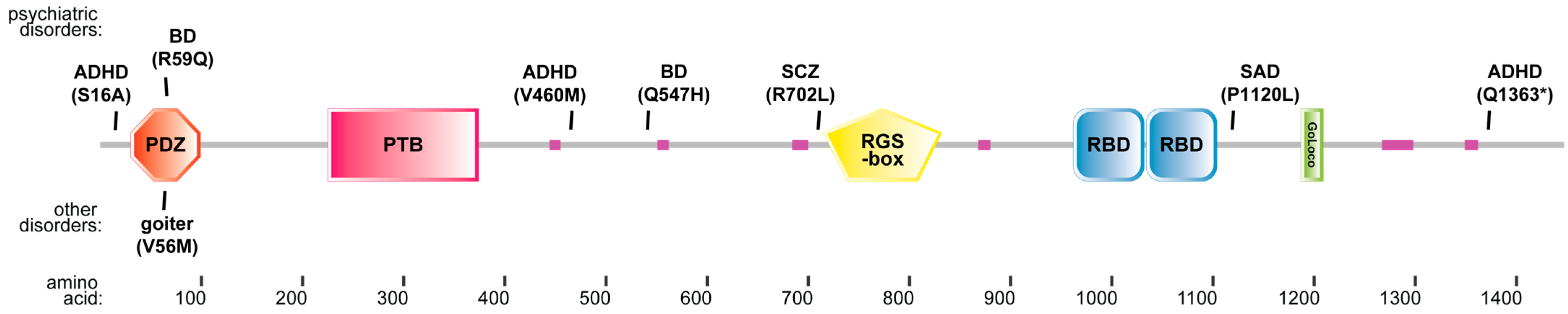
2.1. Multiple RGS12 Variations Seen in Psychiatric Disorders Including ADHD and BD
2.2. Establishing a Reduction-of-Function Status to the PDZ Domain-Localized Variation
2.3. Reduction in Function Caused by the R59Q BD Variation Likely Leaves Methylphenidate Responsiveness Intact
2.4. Study Limitations and Future Directions
3. Materials and Methods
3.1. Database Searches
3.2. MD Simulations of PDZ Mutations
3.3. Locomotion Studies
3.3.1. Animals
3.3.2. Drugs and Dosing Rationale
- -
- d-amphetamine hemisulfate, 1–5 mg/kg (ip), produces robust hyperlocomotion with maximal effect near 3 mg/kg;
- -
- methamphetamine hydrochloride, 1.5 mg/kg (ip), elicits a comparable dopamine-dependent hyperlocomotor response used here to directly compare with amphetamine;
- -
- methylphenidate hydrochloride, 5–20 mg/kg (ip), covers the established dose–response range for norepinephrine–dopamine reuptake inhibition in rodents;
- -
- apomorphine, 1 mg/kg (ip), a non-selective D1/D2 dopamine receptor agonist, serves as a positive control for postsynaptic dopamine responsiveness.
3.3.3. Behavior Testing
3.3.4. Data Analysis
4. Conclusions
Supplementary Materials
Author Contributions
Funding
Institutional Review Board Statement
Informed Consent Statement
Data Availability Statement
Conflicts of Interest
References
- Comparelli, A.; Polidori, L.; Sarli, G.; Pistollato, A.; Pompili, M. Differentiation and comorbidity of bipolar disorder and attention deficit and hyperactivity disorder in children, adolescents, and adults: A clinical and nosological perspective. Front. Psychiatry 2022, 13, 949375. [Google Scholar] [CrossRef]
- Schiweck, C.; Arteaga-Henriquez, G.; Aichholzer, M.; Edwin Thanarajah, S.; Vargas-Caceres, S.; Matura, S.; Grimm, O.; Haavik, J.; Kittel-Schneider, S.; Ramos-Quiroga, J.A.; et al. Comorbidity of ADHD and adult bipolar disorder: A systematic review and meta-analysis. Neurosci. Biobehav. Rev. 2021, 124, 100–123. [Google Scholar] [CrossRef]
- Mishra, V.C.; Solanki, G.; Singh, D.; Goyal, M.K. Prevalence and clinical correlates of co-morbid attention deficit hyperactivity disorder in euthymic adults with bipolar disorder: A cross-sectional study. Indian J. Psychiatry 2023, 65, 1129–1136. [Google Scholar] [CrossRef]
- Berkol, T.D.; Yargic, I.; Ozyildirim, I.; Yazici, O. Comorbidity of Adult Attention Deficit and Hyperactivity Disorder in Bipolar Patients: Prevalence, Sociodemographic and Clinical Correlates. Noro Psikiyatr. Ars. 2014, 51, 97–102. [Google Scholar] [CrossRef] [PubMed][Green Version]
- Mereu, M.; Contarini, G.; Buonaguro, E.F.; Latte, G.; Manago, F.; Iasevoli, F.; de Bartolomeis, A.; Papaleo, F. Dopamine transporter (DAT) genetic hypofunction in mice produces alterations consistent with ADHD but not schizophrenia or bipolar disorder. Neuropharmacology 2017, 121, 179–194. [Google Scholar] [CrossRef] [PubMed]
- da Silva, B.S.; Grevet, E.H.; Silva, L.C.F.; Ramos, J.K.N.; Rovaris, D.L.; Bau, C.H.D. An overview on neurobiology and therapeutics of attention-deficit/hyperactivity disorder. Discov. Ment. Health 2023, 3, 2. [Google Scholar] [CrossRef]
- Avinoam, R.; Revital, R.; Doron, B.; Ella, S.; Yaacov, B. A Common Cause of ADHD and Bipolar Disorder (BD). Bipolar Disord. 2025, 27, 472–475. [Google Scholar] [CrossRef]
- Chiorean, A.; Jones, B.D.M.; Murong, M.; Gonzalez-Torres, C.; Kloiber, S.; Ortiz, A.; Rosenblat, J.D.; Mulsant, B.H.; Husain, M.I. Prescribed psychostimulants and other pro-cognitive medications in bipolar disorder: A systematic review and meta-analysis of recurrence of manic symptoms. Bipolar Disord. 2024, 26, 418–430. [Google Scholar] [CrossRef] [PubMed]
- Viktorin, A.; Ryden, E.; Thase, M.E.; Chang, Z.; Lundholm, C.; D’Onofrio, B.M.; Almqvist, C.; Magnusson, P.K.; Lichtenstein, P.; Larsson, H.; et al. The Risk of Treatment-Emergent Mania With Methylphenidate in Bipolar Disorder. Am. J. Psychiatry 2017, 174, 341–348, Erratum in Am. J. Psychiatry 2016, 173, 1154. https://doi.org/10.1176/appi.ajp.2016.17311correction. [Google Scholar] [CrossRef]
- Findling, R.L.; Short, E.J.; McNamara, N.K.; Demeter, C.A.; Stansbrey, R.J.; Gracious, B.L.; Whipkey, R.; Manos, M.J.; Calabrese, J.R. Methylphenidate in the treatment of children and adolescents with bipolar disorder and attention-deficit/hyperactivity disorder. J. Am. Acad. Child Adolesc. Psychiatry 2007, 46, 1445–1453. [Google Scholar] [CrossRef]
- Scheffer, R.E.; Kowatch, R.A.; Carmody, T.; Rush, A.J. Randomized, placebo-controlled trial of mixed amphetamine salts for symptoms of comorbid ADHD in pediatric bipolar disorder after mood stabilization with divalproex sodium. Am. J. Psychiatry 2005, 162, 58–64. [Google Scholar] [CrossRef]
- Zeni, C.P.; Tramontina, S.; Ketzer, C.R.; Pheula, G.F.; Rohde, L.A. Methylphenidate combined with aripiprazole in children and adolescents with bipolar disorder and attention-deficit/hyperactivity disorder: A randomized crossover trial. J. Child Adolesc. Psychopharmacol. 2009, 19, 553–561. [Google Scholar] [CrossRef] [PubMed]
- Miskowiak, K.W.; Obel, Z.K.; Guglielmo, R.; Bonnin, C.D.M.; Bowie, C.R.; Balanza-Martinez, V.; Burdick, K.E.; Carvalho, A.F.; Dols, A.; Douglas, K.; et al. Efficacy and safety of established and off-label ADHD drug therapies for cognitive impairment or attention-deficit hyperactivity disorder symptoms in bipolar disorder: A systematic review by the ISBD Targeting Cognition Task Force. Bipolar Disord. 2024, 26, 216–239. [Google Scholar] [CrossRef]
- Salvi, V.; Ribuoli, E.; Servasi, M.; Orsolini, L.; Volpe, U. ADHD and Bipolar Disorder in Adulthood: Clinical and Treatment Implications. Medicina 2021, 57, 466. [Google Scholar] [CrossRef] [PubMed]
- Alsabban, S.; Rivera, M.; McGuffin, P. Genome-wide searches for bipolar disorder genes. Curr. Psychiatry Rep. 2011, 13, 522–527. [Google Scholar] [CrossRef] [PubMed]
- Barnett, J.H.; Smoller, J.W. The genetics of bipolar disorder. Neuroscience 2009, 164, 331–343. [Google Scholar] [CrossRef] [PubMed]
- Faraone, S.V.; Larsson, H. Genetics of attention deficit hyperactivity disorder. Mol. Psychiatry 2019, 24, 562–575. [Google Scholar] [CrossRef] [PubMed]
- Akutagava-Martins, G.C.; Rohde, L.A.; Hutz, M.H. Genetics of attention-deficit/hyperactivity disorder: An update. Expert Rev. Neurother. 2016, 16, 145–156. [Google Scholar] [CrossRef]
- van Hulzen, K.J.E.; Scholz, C.J.; Franke, B.; Ripke, S.; Klein, M.; McQuillin, A.; Sonuga-Barke, E.J.; PGC ADHD Working Group; Kelsoe, J.R.; Landen, M.; et al. Genetic Overlap Between Attention-Deficit/Hyperactivity Disorder and Bipolar Disorder: Evidence From Genome-wide Association Study Meta-analysis. Biol. Psychiatry 2017, 82, 634–641. [Google Scholar] [CrossRef] [PubMed]
- Khoury, E.; Acquaviva, E.; Purper-Ouakil, D.; Delorme, R.; Ellul, P. Meta-analysis of personal and familial co-occurrence of Attention Deficit/Hyperactivity Disorder and Bipolar Disorder. Neurosci. Biobehav. Rev. 2023, 146, 105050. [Google Scholar] [CrossRef]
- Michelini, G.; Kitsune, V.; Vainieri, I.; Hosang, G.M.; Brandeis, D.; Asherson, P.; Kuntsi, J. Shared and Disorder-Specific Event-Related Brain Oscillatory Markers of Attentional Dysfunction in ADHD and Bipolar Disorder. Brain Topogr. 2018, 31, 672–689. [Google Scholar] [CrossRef]
- Ashok, A.H.; Marques, T.R.; Jauhar, S.; Nour, M.M.; Goodwin, G.M.; Young, A.H.; Howes, O.D. The dopamine hypothesis of bipolar affective disorder: The state of the art and implications for treatment. Mol. Psychiatry 2017, 22, 666–679. [Google Scholar] [CrossRef]
- Greenwood, T.A.; Joo, E.J.; Shekhtman, T.; Sadovnick, A.D.; Remick, R.A.; Keck, P.E.; McElroy, S.L.; Kelsoe, J.R. Association of dopamine transporter gene variants with childhood ADHD features in bipolar disorder. Am. J. Med. Genet. B Neuropsychiatr. Genet. 2013, 162B, 137–145. [Google Scholar] [CrossRef]
- Nunez, N.A.; Coombes, B.J.; Romo-Nava, F.; Bond, D.J.; Vande Voort, J.; Croarkin, P.E.; Leibman, N.; Gardea Resendez, M.; Veldic, M.; Betcher, H.; et al. Clinical and Genetic Correlates of Bipolar Disorder With Childhood-Onset Attention Deficit Disorder. Front. Psychiatry 2022, 13, 884217. [Google Scholar] [CrossRef]
- Buitelaar, J.; Bolte, S.; Brandeis, D.; Caye, A.; Christmann, N.; Cortese, S.; Coghill, D.; Faraone, S.V.; Franke, B.; Gleitz, M.; et al. Toward Precision Medicine in ADHD. Front. Behav. Neurosci. 2022, 16, 900981. [Google Scholar] [CrossRef]
- Serretti, A. Precision medicine in mood disorders. Psychiatry Clin. Neurosci. Rep. 2022, 1, e1. [Google Scholar] [CrossRef]
- Pisanu, C.; Squassina, A. RNA Biomarkers in Bipolar Disorder and Response to Mood Stabilizers. Int. J. Mol. Sci. 2023, 24, 10067. [Google Scholar] [CrossRef]
- Baek, J.H.; Lee, D.; Lee, D.; Jeong, H.; Cho, E.Y.; Ha, T.H.; Ha, K.; Hong, K.S. Exploring intra-diagnosis heterogeneity and inter-diagnosis commonality in genetic architectures of bipolar disorders: Association of polygenic risks of major psychiatric illnesses and lifetime phenotype dimensions. Psychol. Med. 2024, 54, 3082–3088. [Google Scholar] [CrossRef] [PubMed]
- Cruceanu, C.; Schmouth, J.F.; Torres-Platas, S.G.; Lopez, J.P.; Ambalavanan, A.; Darcq, E.; Gross, F.; Breton, B.; Spiegelman, D.; Rochefort, D.; et al. Rare susceptibility variants for bipolar disorder suggest a role for G protein-coupled receptors. Mol. Psychiatry 2018, 23, 2050–2056. [Google Scholar] [CrossRef] [PubMed]
- Zhao, L.; Lin, Y.; Lao, G.; Wang, Y.; Guan, L.; Wei, J.; Yang, Z.; Ni, P.; Li, X.; Jiang, Z.; et al. Association study of dopamine receptor genes polymorphism with cognitive functions in bipolar I disorder patients. J. Affect. Disord. 2015, 170, 85–90. [Google Scholar] [CrossRef] [PubMed]
- Siderovski, D.P.; Hessel, A.; Chung, S.; Mak, T.W.; Tyers, M. A new family of regulators of G-protein-coupled receptors? Curr. Biol. 1996, 6, 211–212. [Google Scholar] [CrossRef]
- Snow, B.E.; Hall, R.A.; Krumins, A.M.; Brothers, G.M.; Bouchard, D.; Brothers, C.A.; Chung, S.; Mangion, J.; Gilman, A.G.; Lefkowitz, R.J.; et al. GTPase activating specificity of RGS12 and binding specificity of an alternatively spliced PDZ (PSD-95/Dlg/ZO-1) domain. J. Biol. Chem. 1998, 273, 17749–17755. [Google Scholar] [CrossRef] [PubMed]
- Gross, J.D.; Kaski, S.W.; Schroer, A.B.; Wix, K.A.; Siderovski, D.P.; Setola, V. Regulator of G protein signaling-12 modulates the dopamine transporter in ventral striatum and locomotor responses to psychostimulants. J. Psychopharmacol. 2018, 32, 191–203. [Google Scholar] [CrossRef] [PubMed]
- Gross, J.D.; Kaski, S.W.; Schmidt, K.T.; Cogan, E.S.; Boyt, K.M.; Wix, K.; Schroer, A.B.; McElligott, Z.A.; Siderovski, D.P.; Setola, V. Role of RGS12 in the differential regulation of kappa opioid receptor-dependent signaling and behavior. Neuropsychopharmacology 2019, 44, 1728–1741. [Google Scholar] [CrossRef]
- Forstner, A.J.; Fischer, S.B.; Schenk, L.M.; Strohmaier, J.; Maaser-Hecker, A.; Reinbold, C.S.; Sivalingam, S.; Hecker, J.; Streit, F.; Degenhardt, F.; et al. Whole-exome sequencing of 81 individuals from 27 multiply affected bipolar disorder families. Transl. Psychiatry 2020, 10, 57. [Google Scholar] [CrossRef] [PubMed]
- White, A.N.; Gross, J.D.; Kaski, S.W.; Trexler, K.R.; Wix, K.A.; Wetsel, W.C.; Kinsey, S.G.; Siderovski, D.P.; Setola, V. Genetic deletion of Rgs12 in mice affects serotonin transporter expression and function in vivo and ex vivo. J. Psychopharmacol. 2020, 34, 1393–1407. [Google Scholar] [CrossRef]
- Escobar, A.D.P.; Casanova, J.P.; Andres, M.E.; Fuentealba, J.A. Crosstalk Between Kappa Opioid and Dopamine Systems in Compulsive Behaviors. Front. Pharmacol. 2020, 11, 57. [Google Scholar] [CrossRef]
- Mayer, F.P.; Stewart, A.; Varman, D.R.; Moritz, A.E.; Foster, J.D.; Owens, A.W.; Areal, L.B.; Gowrishankar, R.; Velez, M.; Wickham, K.; et al. Kappa opioid receptor antagonism restores phosphorylation, trafficking and behavior induced by a disease-associated dopamine transporter variant. Mol. Psychiatry 2025, 30, 4651–4664. [Google Scholar] [CrossRef]
- Agogo-Mawuli, P.S.; Mendez, J.; Oestreich, E.A.; Bosch, D.E.; Siderovski, D.P. Molecular Modeling and In Vitro Functional Analysis of the RGS12 PDZ Domain Variant Associated with High-Penetrance Familial Bipolar Disorder. Int. J. Mol. Sci. 2024, 25, 11431. [Google Scholar] [CrossRef]
- Friesner, R.A.; Murphy, R.B.; Repasky, M.P.; Frye, L.L.; Greenwood, J.R.; Halgren, T.A.; Sanschagrin, P.C.; Mainz, D.T. Extra precision glide: Docking and scoring incorporating a model of hydrophobic enclosure for protein-ligand complexes. J. Med. Chem. 2006, 49, 6177–6196. [Google Scholar] [CrossRef]
- Tubert-Brohman, I.; Sherman, W.; Repasky, M.; Beuming, T. Improved docking of polypeptides with Glide. J. Chem. Inf. Model. 2013, 53, 1689–1699. [Google Scholar] [CrossRef] [PubMed]
- Landrum, M.J.; Lee, J.M.; Benson, M.; Brown, G.R.; Chao, C.; Chitipiralla, S.; Gu, B.; Hart, J.; Hoffman, D.; Jang, W.; et al. ClinVar: Improving access to variant interpretations and supporting evidence. Nucleic Acids Res. 2018, 46, D1062–D1067. [Google Scholar] [CrossRef]
- Chen, S.; Francioli, L.C.; Goodrich, J.K.; Collins, R.L.; Kanai, M.; Wang, Q.; Alfoldi, J.; Watts, N.A.; Vittal, C.; Gauthier, L.D.; et al. A genomic mutational constraint map using variation in 76,156 human genomes. Nature 2024, 625, 92–100, Erratum in Nature 2024, 626, E1. https://doi.org/10.1038/s41586-024-07050-7. [Google Scholar] [CrossRef] [PubMed] [PubMed Central]
- Uhlik, M.T.; Temple, B.; Bencharit, S.; Kimple, A.J.; Siderovski, D.P.; Johnson, G.L. Structural and evolutionary division of phosphotyrosine binding (PTB) domains. J. Mol. Biol. 2005, 345, 1–20. [Google Scholar] [CrossRef]
- Willard, M.D.; Willard, F.S.; Li, X.; Cappell, S.D.; Snider, W.D.; Siderovski, D.P. Selective role for RGS12 as a Ras/Raf/MEK scaffold in nerve growth factor-mediated differentiation. EMBO J. 2007, 26, 2029–2040. [Google Scholar] [CrossRef] [PubMed]
- Kimple, R.J.; De Vries, L.; Tronchere, H.; Behe, C.I.; Morris, R.A.; Gist Farquhar, M.; Siderovski, D.P. RGS12 and RGS14 GoLoco motifs are G αi interaction sites with guanine nucleotide dissociation inhibitor Activity. J. Biol. Chem. 2001, 276, 29275–29281. [Google Scholar] [CrossRef] [PubMed]
- Guipponi, M.; Santoni, F.A.; Setola, V.; Gehrig, C.; Rotharmel, M.; Cuenca, M.; Guillin, O.; Dikeos, D.; Georgantopoulos, G.; Papadimitriou, G.; et al. Exome sequencing in 53 sporadic cases of schizophrenia identifies 18 putative candidate genes. PLoS ONE 2014, 9, e112745, Erratum in PLoS ONE 2015, 10, e0141630. https://doi.org/10.1371/journal.pone.0141630. [Google Scholar] [CrossRef]
- Xu, B.; Roos, J.L.; Dexheimer, P.; Boone, B.; Plummer, B.; Levy, S.; Gogos, J.A.; Karayiorgou, M. Exome sequencing supports a de novo mutational paradigm for schizophrenia. Nat. Genet. 2011, 43, 864–868. [Google Scholar] [CrossRef]
- Lima, L.d.A.; Feio-dos-Santos, A.C.; Belangero, S.I.; Gadelha, A.; Bressan, R.A.; Salum, G.A.; Pan, P.M.; Moriyama, T.S.; Graeff-Martins, A.S.; Tamanaha, A.C.; et al. An integrative approach to investigate the respective roles of single-nucleotide variants and copy-number variants in Attention-Deficit/Hyperactivity Disorder. Sci. Rep. 2016, 6, 22851, Erratum in Sci. Rep. 2016, 6, 25861. https://doi.org/10.1038/srep25861. [Google Scholar] [CrossRef]
- Yan, J.; Takahashi, T.; Ohura, T.; Adachi, H.; Takahashi, I.; Ogawa, E.; Okuda, H.; Kobayashi, H.; Hitomi, T.; Liu, W.; et al. Combined linkage analysis and exome sequencing identifies novel genes for familial goiter. J. Hum. Genet. 2013, 58, 366–377. [Google Scholar] [CrossRef]
- Doyle, D.A.; Lee, A.; Lewis, J.; Kim, E.; Sheng, M.; MacKinnon, R. Crystal structures of a complexed and peptide-free membrane protein-binding domain: Molecular basis of peptide recognition by PDZ. Cell 1996, 85, 1067–1076. [Google Scholar] [CrossRef]
- Sheng, M.; Sala, C. PDZ domains and the organization of supramolecular complexes. Annu. Rev. Neurosci. 2001, 24, 1–29. [Google Scholar] [CrossRef]
- Ye, F.; Liu, W.; Shang, Y.; Zhang, M. An Exquisitely Specific PDZ/Target Recognition Revealed by the Structure of INAD PDZ3 in Complex with TRP Channel Tail. Structure 2016, 24, 383–391. [Google Scholar] [CrossRef] [PubMed][Green Version]
- Ernst, A.; Appleton, B.A.; Ivarsson, Y.; Zhang, Y.; Gfeller, D.; Wiesmann, C.; Sidhu, S.S. A structural portrait of the PDZ domain family. J. Mol. Biol. 2014, 426, 3509–3519. [Google Scholar] [CrossRef]
- Wei, J.; Li, Y.; Jiao, F.; Wang, X.; Zhou, H.; Qiao, Y.; Yuan, Z.; Qian, C.; Tian, Y.; Fang, Y. DLGAP3 suppresses malignant behaviors of glioma cells via inhibiting RGS12-mediated MAPK/ERK signaling. Brain Res. 2025, 1848, 149334. [Google Scholar] [CrossRef]
- Kumawat, A.; Chakrabarty, S. Hidden electrostatic basis of dynamic allostery in a PDZ domain. Proc. Natl. Acad. Sci. USA 2017, 114, E5825–E5834. [Google Scholar] [CrossRef]
- Sarkar, S.; Dhibar, S.; Jana, B. Modulation of the conformational landscape of the PDZ3 domain by perturbation on a distal non-canonical α3 helix: Decoding the microscopic mechanism of allostery in the PDZ3 domain. Phys. Chem. Chem. Phys. 2024, 26, 21249–21259. [Google Scholar] [CrossRef] [PubMed]
- Han, D.D.; Gu, H.H. Comparison of the monoamine transporters from human and mouse in their sensitivities to psychostimulant drugs. BMC Pharmacol. 2006, 6, 6. [Google Scholar] [CrossRef] [PubMed]
- Challasivakanaka, S.; Zhen, J.; Smith, M.E.; Reith, M.E.A.; Foster, J.D.; Vaughan, R.A. Dopamine transporter phosphorylation site threonine 53 is stimulated by amphetamines and regulates dopamine transport, efflux, and cocaine analog binding. J. Biol. Chem. 2017, 292, 19066–19075. [Google Scholar] [CrossRef]
- Desai, R.I.; Terry, P.; Katz, J.L. A comparison of the locomotor stimulant effects of D1-like receptor agonists in mice. Pharmacol. Biochem. Behav. 2005, 81, 843–848. [Google Scholar] [CrossRef]
- Andersen, P.H.; Jansen, J.A. Dopamine receptor agonists: Selectivity and dopamine D1 receptor efficacy. Eur. J. Pharmacol. 1990, 188, 335–347. [Google Scholar] [CrossRef]
- Pouchon, A.; Nasserdine, R.; Donde, C.; Bertrand, A.; Polosan, M.; Bioulac, S. A systematic review of pharmacotherapy for attention-deficit/hyperactivity disorder in children and adolescents with bipolar disorders. Expert Opin. Pharmacother. 2023, 24, 1497–1509. [Google Scholar] [CrossRef]
- Feier, G.; Valvassori, S.S.; Varela, R.B.; Resende, W.R.; Bavaresco, D.V.; Morais, M.O.; Scaini, G.; Andersen, M.L.; Streck, E.L.; Quevedo, J. Lithium and valproate modulate energy metabolism in an animal model of mania induced by methamphetamine. Pharmacol. Biochem. Behav. 2013, 103, 589–596. [Google Scholar] [CrossRef]
- Ikawa, H.; Kanata, S.; Akahane, A.; Tochigi, M.; Hayashi, N.; Ikebuchi, E. A case of methamphetamine use disorder presenting a condition of ultra-rapid cycler bipolar disorder. SAGE Open Med. Case Rep. 2019, 7, 2050313X19827739. [Google Scholar] [CrossRef] [PubMed]
- Faraone, S.V. The pharmacology of amphetamine and methylphenidate: Relevance to the neurobiology of attention-deficit/hyperactivity disorder and other psychiatric comorbidities. Neurosci. Biobehav. Rev. 2018, 87, 255–270. [Google Scholar] [CrossRef]
- Seidel, S.; Singer, E.A.; Just, H.; Farhan, H.; Scholze, P.; Kudlacek, O.; Holy, M.; Koppatz, K.; Krivanek, P.; Freissmuth, M.; et al. Amphetamines take two to tango: An oligomer-based counter-transport model of neurotransmitter transport explores the amphetamine action. Mol. Pharmacol. 2005, 67, 140–151. [Google Scholar] [CrossRef]
- Sulzer, D.; Sonders, M.S.; Poulsen, N.W.; Galli, A. Mechanisms of neurotransmitter release by amphetamines: A review. Prog. Neurobiol. 2005, 75, 406–433. [Google Scholar] [CrossRef]
- Easton, N.; Steward, C.; Marshall, F.; Fone, K.; Marsden, C. Effects of amphetamine isomers, methylphenidate and atomoxetine on synaptosomal and synaptic vesicle accumulation and release of dopamine and noradrenaline in vitro in the rat brain. Neuropharmacology 2007, 52, 405–414. [Google Scholar] [CrossRef] [PubMed]
- Amara, S.G. Dynamic regulation of signaling pathways in dopamine neurons: The intracellular actions of amphetamines. Proc. Annu. Meet. Jpn. Pharmacol. Soc. 2019, 92, 2-SL06. [Google Scholar] [CrossRef]
- Luethi, D.; Kaeser, P.J.; Brandt, S.D.; Krahenbuhl, S.; Hoener, M.C.; Liechti, M.E. Pharmacological profile of methylphenidate-based designer drugs. Neuropharmacology 2018, 134, 133–140. [Google Scholar] [CrossRef]


Disclaimer/Publisher’s Note: The statements, opinions and data contained in all publications are solely those of the individual author(s) and contributor(s) and not of MDPI and/or the editor(s). MDPI and/or the editor(s) disclaim responsibility for any injury to people or property resulting from any ideas, methods, instructions or products referred to in the content. |
© 2025 by the authors. Licensee MDPI, Basel, Switzerland. This article is an open access article distributed under the terms and conditions of the Creative Commons Attribution (CC BY) license (https://creativecommons.org/licenses/by/4.0/).
Share and Cite
Agogo-Mawuli, P.S.; Gross, J.D.; Setola, V.; Gall, B.J.; Siderovski, D.P. Functional Variation in RGS12 Should Not Preclude Methylphenidate Use in Bipolar Disorder with Established Mood Stabilization: Preclinical Evidence. Int. J. Mol. Sci. 2025, 26, 11993. https://doi.org/10.3390/ijms262411993
Agogo-Mawuli PS, Gross JD, Setola V, Gall BJ, Siderovski DP. Functional Variation in RGS12 Should Not Preclude Methylphenidate Use in Bipolar Disorder with Established Mood Stabilization: Preclinical Evidence. International Journal of Molecular Sciences. 2025; 26(24):11993. https://doi.org/10.3390/ijms262411993
Chicago/Turabian StyleAgogo-Mawuli, Percy S., Joshua D. Gross, Vincent Setola, Bryan J. Gall, and David P. Siderovski. 2025. "Functional Variation in RGS12 Should Not Preclude Methylphenidate Use in Bipolar Disorder with Established Mood Stabilization: Preclinical Evidence" International Journal of Molecular Sciences 26, no. 24: 11993. https://doi.org/10.3390/ijms262411993
APA StyleAgogo-Mawuli, P. S., Gross, J. D., Setola, V., Gall, B. J., & Siderovski, D. P. (2025). Functional Variation in RGS12 Should Not Preclude Methylphenidate Use in Bipolar Disorder with Established Mood Stabilization: Preclinical Evidence. International Journal of Molecular Sciences, 26(24), 11993. https://doi.org/10.3390/ijms262411993