Exploring Cyclodextrin Complexes of Lipophilic Antioxidants: Benefits and Challenges in Nutraceutical Development

 , , , , , , and
Abstract
1. Introduction
2. Cyclodextrins in Nutraceutical Development
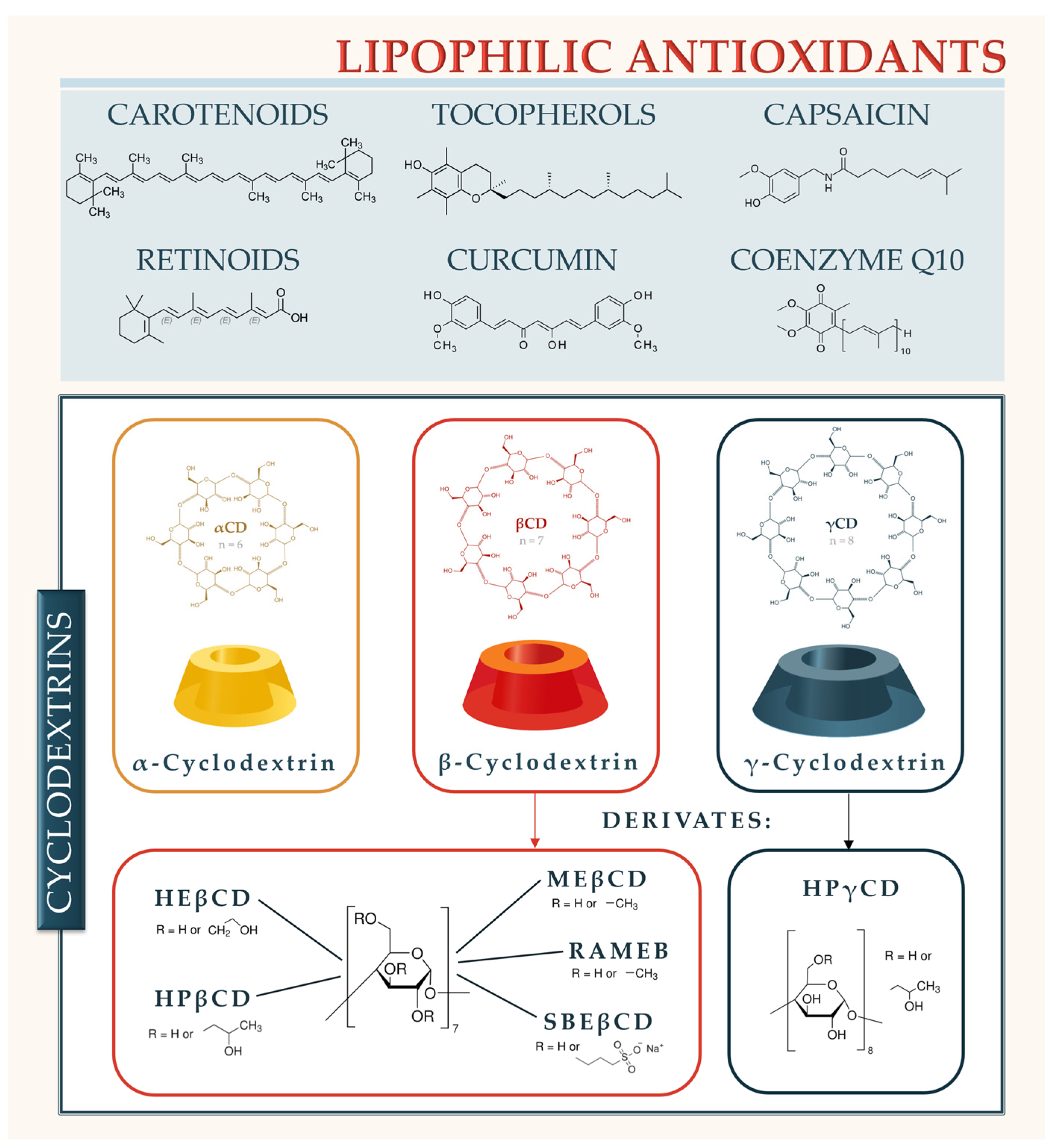
2.1. Cyclodextrins—Structural Features and Novel Cyclodextrin Derivatives
2.2. Metabolism and Safety of Cyclodextrins
2.3. Regulatory Status
2.4. Inclusion Complex Formation
2.5. Preparation and Characterization of Cyclodextrin Complexes—Sustainable Approaches
3. Antioxidants in Functional Foods and Nutraceuticals
3.1. Antioxidants and Their Mechanisms of Action
3.2. Bioavailability of Lipophilic Antioxidants
3.3. Challenges in Formulating Lipophilic Antioxidants
4. Cyclodextrin-Based Formulations of Lipophilic Antioxidants
4.1. Cyclodextrin-Based Formulations of Carotenoids
4.2. Cyclodextrin-Based Formulations of Tocopherols and Tocotrienols

| Tocopherol | Cyclodextrin; Tocopherol:Cyclodextrin Ratio (molar) | Technology of Preparation | Characterization | Target Functionality Aspect | Effect | Reference |
|---|---|---|---|---|---|---|
| alpha tocopherol | βCD | kneading | NMR | Photostability | ≡ | [206] |
| Stability | ≡ | |||||
| Antioxidative activity | ≡ | |||||
| HPβCD; 1:1 | Photostability | ↘ photostability | ||||
| Stability | ↗ stability | |||||
| Antioxidative activity | ≡ | |||||
| HPγCD | Photostability | ↘ photostability | ||||
| Stability | ↗ stability | |||||
| Antioxidative activity | ≡ | |||||
| βCD; 1:1 | freeze-drying | DSC, FTIR, NMR | Thermal stability | ↗ thermal stability | [207] | |
| HPβCD; 1:1 | ||||||
| HPβCD; 1:1; 1:2 | nanofibres; electrospinning | NMR, XRD, FTIR, DSC | Stability | ↗ stability | [208] | |
| Solubility | ↗ solubility | |||||
| Antioxidative activity | ↗ antioxidative activity | |||||
| Photostability | ↗ photostability | |||||
| osβCD; 1:12 | freeze-drying | FTIR, NMR, SEM, AFM | Antioxidative activity | ↗ antioxidative activity | [211] | |
| Emulsifying properties (particle size distribution, ζ-potential, and creaming index) | ↗ emulsifying properties | |||||
| LR-CD (CD9–CD22); 1:2 | coprecipitation | SEM, FTIR, NMR | Thermal stability | ↗ thermal stability | [210] | |
| Stability | ↗ stability | |||||
| Hyaluronic acid-βCD Grafted Copolymer | freeze-drying | FTIR, NMR, SEM, XRD, | Solubility | ↗ solubility | [212] | |
| βCD Hydrogel nanocomposites; 1:8 | coprecipitation; suspension chemical crosslinking | FTIR, DSC, XRD, SEM, TEM, AFM, CLSM | Bioavailavility | ↗ bioavailability | [213] | |
| βCD/cinnamaldehyde based Pickering emulsions | freeze-drying; high speed shear emulsification | / | Bioavailavility | ↗ bioavailability | [214] | |
| tocopheryl acetate | βCD; 1:1 | freeze-drying | IR, TGA, DSC | Stability | ↗ stability | [202] |
| Photostability | ↗ photostability | |||||
| LR-CD (CD22–CD54); 10:1 | coprecipitation | FTIR | Solubility | ↗ solubility | [209] | |
| Antioxidative activity | ↘ antioxidative activity |
4.3. Cyclodextrin-Based Formulations of Retinoids
4.4. Cyclodextrin-Based Formulations of Capsaicin, Coenzyme Q10, and Curcumin
| Cyclodextrin | Technology of Preparation | Characterization | Target Functionality Aspect | Effect | Reference |
|---|---|---|---|---|---|
| Capsaicin | |||||
| HPβCD | Magnetic stirring | UV, IR, DSC | solubility, oral bioavailability, gastric irritation | ↑ solubility ↑ oral bioavailability ↓ gastric irritation | [223] |
| HPβCD | freeze-drying | DSC, XRD, ITC, NMR SEM, | solubility | ↑ solubility sustained release kinetics ↑ pain control in combination with mepivacaine compared to mepivacaine alone | [225] |
| HPβCD | saturation method | DSC, XRD | bioavailability, pharmacokinetics | ↑ bioavailability faster absorption | [224] |
| βCD nanosponges | melt method, freeze-drying | UV, DSC, FTIR, XRD, NMR, RS, SEM, ELS | solubility, toxicity, anti-arthritic activity | ↑ solubility ↓ toxicity = anti-arthritic activity | [226] |
| Coenzyme Q10 | |||||
| αCD βCD γCD HPβCD | kneading method | XRD, DSC | oral bioavailability | ↑ bioavailability of q10 in γCD complexes | [228] |
| βCD γCD | precipitation, freeze-drying | FTIR, DSC, TGA, XRD | solubility, thermal stability, photochemical stability | ↑ solubility (γCD > βCD) ↑ thermal stability (βCD > γCD) ↑ photochemical stability (βCD > γCD) | [230] |
| αCD βCD γCD | high-pressure homogenization, spray drying | DSC | solubility, oral bioavailability | ↑ solubility (γCD) ↑ bioavailability (γCD) | |
| βCD (Q10VITAL®) | precipitation, evaporation, thermal drying | DSC, XRD, IR | oral bioavailability | ↑ bioavailability | [229] |
| Curcumin | |||||
| βCD | freeze drying, kneading, co-evaporation, co-precipitation | DSC | dissolution, thermal stability, photochemical stability, storage stability | ↑ dissolution in SGF degradation of the complex in SPF ↓ photochemical stability ↑ thermal stability ↑ storage (humidity) stability | [233] |
| sβCD | freeze-drying | XRD, TGA, FTIR, NMR | solubility, photochemical, thermal, storage, gastrointestinal stability | ↑ solubility ↑ storage stability ↑ thermal stability ↑ photochemical stability ↑ stability in gastrointestinal conditions | [232] |
| sβCD/chitosan | freeze-drying | XRD, TGA, FTIR, NMR | gastrointestinal stability, controlled release | ↑ solubility ↑ stability in gastrointestinal conditions | [233] |
| αCD βCD γCD | pulverization | FTIR, DSC, XRD, NMR | solubility, oral bioavailability | ↑ solubility ↑ bioavailability in order αCD > βCD > γCD | [237] |
| βCD | freeze-drying | FTIR | anticancer activity (liver, lungs) | ↑ anticancer activity | [236] |
| βCD | co-precipitation, freeze-drying | FTIR, XRD | nasal bioavailability, in vitro cellular uptake | ↑ bioavailability ↑ cellular uptake | [235] |
| βCD | precipitation | FTIR, XRD, SEM | oral bioavailability | ↑ bioavailability | [234] |
| βCD | Kneading | FTIR, DSC, XRD, NMR, SEM, CVS | solution, intravenous bioavailability, anticancer activity in pancreas | ↑ solubility ↑ bioavailability and concentration in pancreas ↑ anticancer activity in vitro | [243] |
| βCD βCD nanosponges | sonication, solvent-free melting method (nanosponge) | DSC, XRD, FTIR, SEM | solubility, dissolution | ↑ solubility =dissolution rate | [238] |
| γ-MOF | impregnation | XRD, FTIR | Thermal stability, photochemical stability, pH stability | ↑ thermal stability ↑ photochemical stability ↑ stability under different pH | [240] |
| γ-MOF composite films | vapour diffusion (multiple step preparation) | NMR, FTIR, XRD | mechanical properties, barrier properties, antioxidative activity, antimicrobial activity, biocompatibility, fruit preservation | ↑ light barrier ↑ mechanical properties ↓ water barrier ↑oxygen barrier significant antibacterial activity good biocompatibility (80% zebrafish survival) ↑ fruit preservation | [241] |
| HPβCD HPγ nanofibers | electrospinning | NMR, FTIR, XRD, DSC, TGA | solubility, dissolution, antioxidative activity | ↑ solubility (HPγCD) complete disintegration of fibre structure and dissolution in SSF ↑ antioxidative activity (HPγCD) | [239] |
| βCD nanoparticles | freeze-drying | NMR, FTIR, DSC, XRD, DLS; TEM | anticancer activity | ↑ anticancer activity | [242] |
5. Conclusions
Author Contributions
Funding
Data Availability Statement
Conflicts of Interest
Abbreviations
| CD | cyclodextrin |
| αCD | α-cyclodextrin |
| βCD | β-cyclodextrin |
| γCD | γ-cyclodextrin |
| HPβCD | hydroxypropyl-β-cyclodextrin |
| RAMEB | randomly methylated β-cyclodextrin |
| SBEβCD | sulphobuthylether-β-cyclodextrin |
| HPγCD | hydroxypropyl-γ-cyclodextrin |
| MeβCD | methyl-β-cyclodextrin |
| HEβCD | hydroxyethyl-β-cyclodextrin |
| LD | lethal dose |
| NOEL | no observed effect level |
| FDA | Food and Drug Administration |
| USP/NF | United States Pharmacopeia and the National Formulary |
| DSC | differential scanning spectroscopy |
| XRPD | X-ray powder diffraction |
| ssNMR | solid state NMR |
| SOD | superoxide dismutase |
| ROS | reactive oxygen species |
| CoQ10 | coenzyme Q10 |
| GIT | gastrointestinal tract |
| SLN | solid lipid nanoparticle |
| NLC | nanostructured lipid carrier |
| LRCDs | large-ring cyclodextrins |
| CAP | capsaicin |
| CUR | curcumin |
| SGF | simulated gastric fluid |
| SIF | simulated intestinal fluid |
| MOF | metal–organic framework |
References
- Halliwell, B. Understanding mechanisms of antioxidant action in health and disease. Nat. Rev. Mol. Cell Biol. 2024, 25, 13–33. [Google Scholar] [CrossRef] [PubMed]
- Blagov, A.V.; Summerhill, V.I.; Sukhorukov, V.N.; Zhigmitova, E.B.; Postnov, A.Y.; Orekhov, A.N. Potential use of antioxidants for the treatment of chronic inflammatory diseases. Front. Pharmacol. 2024, 15, 1378335. [Google Scholar] [CrossRef]
- Muscolo, A.; Mariateresa, O.; Giulio, T.; Mariateresa, R. Oxidative stress: The role of antioxidant phytochemicals in the prevention and treatment of diseases. Int. J. Mol. Sci. 2024, 25, 3264. [Google Scholar] [CrossRef]
- Tan, Y.; McClements, D.J. Improving the bioavailability of oil-soluble vitamins by optimizing food matrix effects: A review. Food Chem. 2021, 348, 129148. [Google Scholar] [CrossRef]
- Carneiro, S.B.; Duarte, F.Í.C.; Heimfarth, L.; Quintans, J.D.S.S.; Quintans-Júnior, L.J.; Júnior, V.F.D.V.; De Lima, Á.A.N. Cyclodextrin-Drug Inclusion Complexes: In Vivo and in Vitro Approaches. Int. J. Mol. Sci. 2019, 20, 642. [Google Scholar] [CrossRef]
- Loftsson, T. Cyclodextrins in parenteral formulations. J. Pharm. Sci. 2021, 110, 654–664. [Google Scholar] [CrossRef]
- Jansook, P.; Ogawa, N.; Loftsson, T. Cyclodextrins: Structure, Physicochemical Properties and Pharmaceutical Applications. Int. J. Pharm. 2018, 535, 272–284. [Google Scholar] [CrossRef] [PubMed]
- Haimhoffer, A.; Rusznyák, A.; Réti-Nagy, K.; Vasvári, G.; Váradi, J.; Vecsernyés, M.; Bácskay, I.; Fehér, P.; Ujhelyi, Z.; Fenyvesi, F. Cyclodextrins in Drug Delivery Systems and their Effects on Biological Barriers. Sci. Pharm. 2019, 87, 33. [Google Scholar] [CrossRef]
- Larsen, K.L. Large Cyclodextrins. J. Inclus. Phenom. Macrocycl. Chem. 2002, 43, 1–13. [Google Scholar] [CrossRef]
- Duchêne, D.; Bochot, A. Thirty Years with Cyclodextrins. Int. J. Pharm. 2016, 514, 58–72. [Google Scholar] [CrossRef]
- Kurkov, S.V.; Loftsson, T. Cyclodextrins. Int. J. Pharm. 2013, 453, 167–180. [Google Scholar] [CrossRef]
- Saokham, P.; Loftsson, T. γ-Cyclodextrin. Int. J. Pharm. 2017, 516, 278–292. [Google Scholar] [CrossRef]
- Kiss, T.; Fenyvesi, F.; Bácskay, I.; Váradi, J.; Fenyvesi, É.; Iványi, R.; Szente, L.; Tósaki, Á.; Vecsernyés, M. Evaluation of the Cytotoxicity of β-Cyclodextrin Derivatives: Evidence for the Role of Choles-Terol Extraction. Eur. J. Pharm. Sci. 2010, 40, 376–380. [Google Scholar] [CrossRef]
- Muankaew, C.; Loftsson, T. Cyclodextrin-Based Formulations: A Non-Invasive Platform for Targeted Drug Delivery. Basic Clin. Pharmacol. Toxicol. 2018, 122, 46–55. [Google Scholar] [CrossRef]
- Munro, I.C.; Newberne, P.M.; Young, V.R.; Bär, A. Safety Assessment of γ-Cyclodextrin. Regul. Toxicol. Pharmacol. 2004, 39, 3–13. [Google Scholar] [CrossRef]
- Musuc, A.M. Cyclodextrins: Advances in Chemistry, Toxicology, and Multifaceted Applications. Molecules 2024, 29, 5319. [Google Scholar] [CrossRef]
- Puskás, I.; Szente, L.; Szőcs, L.; Fenyvesi, É. Recent List of Cyclodextrin-Containing Drug Products. Period. Polytech. Chem. Eng. 2023, 67, 11–17. [Google Scholar] [CrossRef]
- Kali, G.; Haddadzadegan, S.; Laffleur, F.; Bernkop-Schnürch, A. Per-Thiolated Cyclodextrins: Nanosized Drug Carriers Providing a Prolonged Gastrointestinal Residence Time. Carbohydr. Polym. 2023, 300, 120275. [Google Scholar] [CrossRef]
- Hussain Asim, M.; Ijaz, M.; Rösch, A.C.; Bernkop-Schnürch, A. Thiolated Cyclodextrins: New Perspectives for Old Excipients. Coord. Chem. Rev. 2020, 420, 213433. [Google Scholar] [CrossRef]
- Liu, Z.; Ye, L.; Xi, J.; Wang, J.; Feng, Z. Cyclodextrin Polymers: Structure, Synthesis, and Use as Drug Carriers. Prog. Polym. Sci. 2021, 118, 101408. [Google Scholar] [CrossRef]
- European Medicines Agency Committee for Human Medicinal Products (EMA/CHMP) Cyclodextrins Used as Excipients Report Published in Support of the ‘Questions and Answers on Cyclodextrins Used as Excipients in Medicinal Products for Human Use’ (EMA/CHMP/495747/2013). Available online: https://www.ema.europa.eu/en/documents/scientific-guideline/questions-answers-cyclodextrins-used-excipients-medicinal-products-human-use_en.pdf. (accessed on 30 October 2025).
- Hoover, R.K.; Alcorn, H.; Lawrence, L.; Paulson, S.K.; Quintas, M.; Luke, D.R.; Cammarata, S.K. Clinical Pharmacokinetics of Sulfobutylether-β-Cyclodextrin in Patients With Varying Degrees of Renal Impairment. J. Clin. Pharmacol. 2018, 58, 814–822. [Google Scholar] [CrossRef] [PubMed]
- Cal, K.; Centkowska, K. Use of Cyclodextrins in Topical Formulations: Practical Aspects. Eur. J. Pharm. Biopharm. 2008, 68, 467–478. [Google Scholar] [CrossRef]
- Wittkowski, K.M. The Effect of Alpha-Cyclodextrin on Postprandial Glucose Excursions: A Systematic Meta-Analysis. Cureus 2022, 14, 31160. [Google Scholar] [CrossRef] [PubMed]
- Arruda, T.R.; Marques, C.S.; Soares, N.F.F. Native Cyclodextrins and Their Derivatives as Potential Additives for Food Packaging: A Review. PSA 2021, 2, 825–842. [Google Scholar] [CrossRef]
- Crini, G. Review: A history of cyclodextrins. Chem. Rev. 2014, 114, 10940–10975. [Google Scholar] [CrossRef] [PubMed]
- Kurkov, S.V.; Madden, D.E.; Carr, D.; Loftsson, T. The Effect of Parenterally Administered Cy-clodextrins on the Pharmacokinetics of Coadministered Drugs. J. Pharm. Sci. 2012, 101, 4402–4408. [Google Scholar] [CrossRef]
- Saokham, P.; Muankaew, C.; Jansook, P.; Loftsson, T. Solubility of Cyclodextrins and Drug/Cyclodextrin Complexes. Molecules 2018, 23, 1161. [Google Scholar] [CrossRef]
- Do, T.T.; Van Hooghten, R.; Van den Mooter, G. A Study of the Aggregation of Cyclodextrins: Determination of the Critical Aggregation Concentration, Size of Aggregates and Thermodynamics Using Isodesmic and K2–K Models. Int. J. Pharm. 2017, 521, 318–326. [Google Scholar] [CrossRef]
- Ryzhakov, A.; Do Thi, T.; Stappaerts, J.; Bertoletti, L.; Kimpe, K.; Sá Couto, A.R.; Saokham, P.; Van den Mooter, G.; Augustijns, P.; Somsen, G.W.; et al. Self-Assembly of Cyclodextrins and Their Complexes in Aqueous Solutions. J. Pharm. Sci. 2016, 105, 2556–2569. [Google Scholar] [CrossRef]
- Saokham, P.; Sá Couto, A.; Ryzhakov, A.; Loftsson, T. The self-assemble of Natural Cyclodextrins in Aqueous Solutions: Application of Miniature Permeation Studies for Critical Aggregation Concentration (cac) Determinations. J. Pharm. Sci. 2016, 505, 187–193. [Google Scholar] [CrossRef]
- Loftsson, T.; Sigurdsson, H.H.; Jansook, P. Anomalous Properties of Cyclodextrins and Their Complexes in Aqueous Solutions. Materials 2023, 16, 2223. [Google Scholar] [CrossRef]
- Loftsson, T.; Moya-Ortega, M.D.; Alvarez-Lorenzo, C.; Concheiro, A. Pharmacokinetics of Cyclodextrins and Drugs after Oral and Parenteral Administration of Drug/Cyclodextrin Complexes. J. Pharm. Pharmacol. 2016, 68, 544–555. [Google Scholar] [CrossRef]
- Popielec, A.; Loftsson, T. Effects of Cyclodextrins on the Chemical Stability of Drugs. Int. J. Pharm. 2017, 531, 532–542. [Google Scholar] [CrossRef]
- Loftsson, T.; Brewster, M.E. Pharmaceutical Applications of Cyclodextrins: Basic Science and Product Development. J. Pharm. Pharmacol. 2010, 62, 1607–1621. [Google Scholar] [CrossRef] [PubMed]
- Loftsson, T.; Brewster, M.E. Pharmaceutical Applications of Cyclodextrins: Effects on Drug Permeation through Biological Membranes. J. Pharm. Pharmacol. 2011, 63, 1119–1135. [Google Scholar] [CrossRef] [PubMed]
- Conceição, J.; Adeoye, O.; Cabral-Marques, H.M.; Lobo, J.M.S. Cyclodextrins as excipients in tablet formulations. Drug. Discov. Today 2018, 23, 1274–1284. [Google Scholar] [CrossRef]
- Arima, H.; Higashi, T.; Motoyama, K. Improvement of the Bitter Taste of Drugs by Complexation with Cyclodextrins: Applications, Evaluations and Mechanisms. Ther. Deliv. 2012, 3, 633–644. [Google Scholar] [CrossRef] [PubMed]
- Helena, M.; Marques, C. A review on cyclodextrin encapsulation of essential oils and volatiles. Flavour. Frag. J. 2010, 25, 313–326. [Google Scholar] [CrossRef]
- Liu, Y.; Chen, Y.; Gao, X.; Fu, J.; Hu, L. Application of Cyclodextrin in Food Industry. Crit. Rev. FSNT 2022, 62, 2627–2640. [Google Scholar] [CrossRef]
- Pereira, A.G.; Carpena, M.; Oliveira, P.G.; Mejuto, J.C.; Prieto, M.A.; Gandara, J.S. Main Ap-plications of Cyclodextrins in the Food Industry as the Compounds of Choice to Form Host–Guest Complexes. Int. J. Mol. Sci. 2021, 22, 1339. [Google Scholar] [CrossRef]
- Szente, L.; Szemán, J.; Sohajda, T. Analytical Characterization of Cyclodextrins: History, Official Methods and Recommended New Techniques. J. Pharm. Biomed. Anal. 2016, 130, 347–365. [Google Scholar] [CrossRef] [PubMed]
- Quevedo, M.A.; Zoppi, A. Current trends in molecular modeling methods applied to the study of cyclodextrin complexes. J. Inclus. Phenom. Macrocycl. Chem. 2017, 90, 1–14. [Google Scholar] [CrossRef]
- Mura, P. Analytical Techniques for Characterization of Cyclodextrin Complexes in Aqueous Solution: A review. J. Pharm. Biomed. Anal. 2014, 101, 238–250. [Google Scholar] [CrossRef]
- Haouas, M.; Falaise, C.; Leclerc, N.; Floquet, S.; Cadot, E. NMR Spectroscopy to Study Cyclodextrin-Based Host–guest Assemblies with Polynuclear Clusters. Dalton Trans. 2023, 52, 13467–13481. [Google Scholar] [CrossRef]
- Lima Cavalcanti, I.D.; Xavier Junior, F.H.; Santos Magalhães, N.S.; Nogueira, M.C.d.B.L. Isothermal Titration Calorimetry (ITC) as a Promising Tool in Pharmaceutical Nanotechnology. Int. J. Pharm. 2023, 641, 123063. [Google Scholar] [CrossRef]
- Mura, P. Analytical Techniques for Characterization of Cyclodextrin Complexes in the Solid State: A review. J. Pharm. Biomed. Anal. 2015, 113, 226–238. [Google Scholar] [CrossRef]
- Jug, M.; Maestrelli, F.; Bragagni, M.; Mura, P. Preparation and Solid-State Characterization of Bupivacaine Hydrochloride Cyclodextrin Complexes Aimed for Buccal Delivery. J. Pharm. Biomed. Anal. 2010, 52, 9–18. [Google Scholar] [CrossRef]
- Ziaee, A.; Albadarin, A.B.; Padrela, L.; Femmer, T.; O’Reilly, E.; Walker, G. Spray Drying of Pharmaceuticals and Biopharmaceuticals: Critical Parameters and Experimental Process Optimization approaches. Eur. J. Pharm. Sci. 2019, 127, 300–318. [Google Scholar] [CrossRef]
- Abla, K.K.; Mehanna, M.M. Freeze-Drying: A Flourishing Strategy to Fabricate Stable Pharmaceutical and Biological Products. Int. J. Pharm. 2022, 628, 122233. [Google Scholar] [CrossRef]
- Banchero, M. Supercritical Carbon Dioxide as a Green Alternative to Achieve Drug Complexation with Cyclodextrins. Pharmaceuticals 2021, 14, 562. [Google Scholar] [CrossRef] [PubMed]
- Moufawad, T.; Moura, L.; Ferreira, M.; Bricout, H.; Tilloy, S.; Monflier, E.; Costa Gomez, M.; Landy, D.; Fourmentin, S. First Evidence of Cyclodextrin Inclusion Complexes in a Deep Eutectic Solvent. ACS Sustain. Chem. Eng. 2019, 7, 6345–6351. [Google Scholar] [CrossRef]
- Kfoury, M.; Fourmentin, S. State of the art in Cyclodextrin Solubility Enhancement. Are Green Solvents the Solution? J. Mol. Liq. 2024, 410, 125599. [Google Scholar] [CrossRef]
- Jug, M.; Mura, P.A. Grinding as Solvent-Free Green Chemistry Approach for Cyclodextrin Inclusion Complex Preparation in the Solid State. Pharmaceutics 2018, 10, 189. [Google Scholar] [CrossRef] [PubMed]
- Nicoletti, C.D.; de Sá Haddad Queiroz, M.; de Souza Lima, C.G.; de Carvalho da Silva, F.; Futuro, D.O.; Ferreira, V.F. An Improved Method for the Preparation of β-Lapachone:2-Hydroxypropyl-β-Cyclodextrin Inclusion Complexes. J. Drug Deliv. Sci. Technol. 2020, 58, 101777. [Google Scholar] [CrossRef]
- Zanolla, D.; Perissutti, B.; Passerini, N.; Invernizzi, S.; Voinovich, D.; Bertoni, S.; Melegari, C.; Millotti, G.; Albertini, B. Milling and Comilling Praziquantel at Cryogenic and Room Temperatures: As-Sessment of the Process-Induced Effects on Drug Properties. J. Pharm. Biomed. Anal. 2018, 153, 82–89. [Google Scholar] [CrossRef]
- Cabrera-Quiñones, N.C.; López-Méndez, L.J.; Guadarrama, P. Inclusion and Non-Inclusion Complexes between Curcumin and β-Cyclodextrin with High-Curcumin Loading and Enhanced Aque-ous Solubility Obtained by Mechanochemistry. ChemistrySelect 2023, 8, e202303254. [Google Scholar] [CrossRef]
- Cid-Samamed, A.; Rakmai, J.; Mejuto, J.C.; Simal-Gandara, J.; Astray, G. Cyclodextrins Inclusion Complex: Preparation Methods, Analytical Techniques and Food Industry Applications. Food Chem. 2022, 384, 132467. [Google Scholar] [CrossRef]
- Hădărugă, N.G.; Bandur, G.N.; David, I.; Hădărugă, D.I. A Review on Thermal Analyses of Cyclodextrins and Cyclodextrin Complexes. Environ. Chem. Lett. 2019, 17, 349–373. [Google Scholar] [CrossRef]
- Baird, J.A.; Taylor, L.S. Evaluation of Amorphous Solid Dispersion Properties Using Thermal Analysis Techniques. Adv. Drug Deliv. Rev. 2012, 64, 396–421. [Google Scholar] [CrossRef]
- Jablan, J.; Szalontai, G.; Jug, M. Comparative Analysis of Zaleplon Complexation with Cyclodex-Trins and Hydrophilic Polymers in Solution and in Solid State. Adv. Drug Deliv. Rev. 2012, 71, 35–44. [Google Scholar] [CrossRef]
- Dedroog, S.; Pas, T.; Vergauwen, B.; Huygens, C.; Van den Mooter, G. Solid-State Analysis of Amorphous Solid Dispersions: Why DSC and XRPD May not Be Regarded as Stand-Alone Techniques. J. Pharm. Biomed. Anal. 2020, 178, 112937. [Google Scholar] [CrossRef]
- Mazurek, A.H.; Szeleszczuk, Ł. A Review of Applications of Solid-State Nuclear Magnetic Resonance (ssNMR) for the Analysis of Cyclodextrin-Including Systems. Int. J. Mol. Sci. 2023, 24, 3648. [Google Scholar] [CrossRef]
- Jurmanović, S.; Jug, M.; Safner, T.; Radić, K.; Domijan, A.M.; Pedisić, S.; Šimić, S.; Jablan, J.; Vitali Čepo, D. Utilization of Olive Pomace as a Source of Polyphenols: Optimization of Microwave-Assisted Extraction and Characterization of Spray-Dried Extract. J. Food Nutr. Res. 2019, 58, 51–62. [Google Scholar]
- Jablan, J.; Marguí, E.; Posavec, L.; Klarić, D.; Cinčić, D.; Galić, N.; Jug, M. Product Contamination During Mechanochemical Synthesis of Praziquantel Co-Crystal, Polymeric Dispersion and Cyclodextrin Complex. J. Pharm. Biomed. Anal. 2024, 238, 115855. [Google Scholar] [CrossRef]
- Maestrelli, F.; Cirri, M.; Mennini, N.; Zerrouk, N.; Mura, P. Improvement of Oxaprozin Solubil-Ity and Permeability by the Combined Use of Cyclodextrin, Chitosan, and Bile Components. Eur. J. Pharm. Biopharm. 2011, 78, 385–393. [Google Scholar] [CrossRef] [PubMed]
- Suvarna, V.; Gujar, P.; Murahari, M. Complexation of Phytochemicals with Cyclodextrin Derivatives–An Insight. Biomed. Pharmacother. 2017, 88, 1122–1144. [Google Scholar] [CrossRef]
- Vitali Čepo, D.; Jug, M.; Grdić Rajković, M.; Jablan, J. Formulation of a Nutraceutical Derived from Carob: Β-Cyclodextrin Encapsulation of Antioxidants from Carob Pod. JFNR 2017, 6, 48–60. [Google Scholar]
- Kıran, T.R.; Otlu, O.; Karabulut, A.B. Oxidative Stress and Antioxidants in Health and Disease. J. Lab. Med. 2023, 47, 1–11. [Google Scholar] [CrossRef]
- Pisoschi, A.M.; Pop, A.; Iordache, F.; Stanca, L.; Predoi, G.; Serban, A.I. Oxidative Stress Mitiga-Tion by Antioxidants-An Overview on Their Chemistry and Influences on Health Status. Eur. J. Med. Chem. 2021, 209, 112891. [Google Scholar] [CrossRef]
- Carazo, A.; Macáková, K.; Matoušová, K.; Krčmová, L.K.; Protti, M.; Mladěnka, P. Vitamin A update: Forms, sources, kinetics, detection, function, deficiency, therapeutic use and toxicity. Nutrients 2021, 13, 1703. [Google Scholar] [CrossRef]
- Celik, S.E.; Bekdeser, B.; Tufan, A.N.; Apak, R. Modified Radical Scavenging and Antioxidant Activity Measurement of Β-Carotene with Β-Cyclodextrins Complexation in Aqueous Medium. Anal. Sci. 2017, 33, 299–305. [Google Scholar] [CrossRef]
- Focsan, A.L.; Polyakov, N.E.; Kispert, L.D. Supramolecular Carotenoid Complexes of Enhanced Solubility and Stability—The Way of Bioavailability Improvement. Molecules 2019, 24, 3947. [Google Scholar] [CrossRef]
- Meng, L.; Liu, S.; Luo, J.; Tu, Y.; Li, T.; Li, P.; Yu, J.; Shi, L. Oxidative Stress and Reactive Oxygen Species in Otorhinolaryngological Diseases: Insights from Pathophysiology to Targeted Antioxidant Therapies. Redox Rep. 2025, 30, 2458942. [Google Scholar] [CrossRef]
- Joshi, B.; Kar, S.K.; Yadav, P.K.; Yadav, S.; Shrestha, L.; Bera, T.K. Therapeutic and Medicinal Uses of Lycopene: A Systematic Review. Int. J. Res. Med. Sci. 2020, 8, 1195. [Google Scholar] [CrossRef]
- Sun, X.; Jia, H.; Xu, Q.; Zhao, C.; Xu, C. Lycopene Alleviates H2O2-Induced Oxidative Stress, Inflammation and Apoptosis in Bovine Mammary Epithelial Cells via the NFE2L2 Signaling Pathway. Food Funct. 2019, 10, 6276–6285. [Google Scholar] [CrossRef]
- Khan, U.M.; Sevindik, M.; Zarrabi, A.; Nami, M.; Ozdemir, B.; Kaplan, D.N.; Selamoglu, Z.; Hasan, M.; Kumar, M.; Alshehri, M.M.; et al. Lycopene: Food Sources, Biological Activities, and Human Health Benefits. Oxid. Med. Cell. Longev. 2021, 19, 2713511. [Google Scholar] [CrossRef]
- Li, N.; Wu, X.; Zhuang, W.; Xia, L.; Chen, Y.; Wu, C.; Rao, Z.; Du, L.; Zhao, R.; Yi, M.; et al. Tomato and Lycopene and Multiple Health Outcomes: Umbrella Review. Food Chem. 2021, 343, 128396. [Google Scholar] [CrossRef] [PubMed]
- Chang, M.C.; Kwak, S.G.; Kwak, S. Effect of Dietary Vitamins C and E on The Risk of Parkinson’s Disease: A Meta-Analysis. Clin. Nutr. 2021, 40, 3922–3930. [Google Scholar] [CrossRef] [PubMed]
- Riaz Rajoka, M.S.; Thirumdas, R.; Mehwish, H.M.; Umair, M.; Khurshid, M.; Hayat, H.F.; Phimolsiripol, Y.; Pallarés, N.; Martí-Quijal, F.J.; Barba, F.J. Role of Food Antioxidants in Modulating Gut Microbial Communities: Novel Understandings in Intestinal Oxidative Stress Damage and Their Impact on Host Health. Antioxidants 2021, 10, 1563. [Google Scholar] [CrossRef]
- Niki, E. Role of Vitamin E as a Lipid-Soluble Peroxyl Radical Scavenger: In Vitro and in Vivo Evidence. Free Radic. Biol. Med. 2014, 66, 3–12. [Google Scholar] [CrossRef]
- Schneider, C. Chemistry and Biology of Vitamin E. Mol. Nutr. Food Res. 2005, 49, 7–30. [Google Scholar] [CrossRef] [PubMed]
- Zhou, Y.; Luo, X.; Wang, Z.; McClements, D.J.; Huang, W.; Fu, H.; Zhu, K. Dual Role of Polyglycerol Vitamin E Succinate in Emulsions: An Efficient Antioxidant Emulsifier. Food Chem. 2023, 416, 135776. [Google Scholar] [CrossRef]
- Debbabi, M.; Nury, T.; Zarrouk, A.; Mekahli, N.; Bezine, M.; Sghaier, R.; Grégoire, S.; Martine, L.; Durand, P.; Camus, E.; et al. Protective Effects of α-Tocopherol, γ-Tocopherol and Oleic Acid, Three Compounds of Olive Oils, and No Effect of Trolox, on 7-Ketocholesterol-Induced Mitochondrial and Peroxisomal Dysfunction in Microglial BV-2 Cells. Int. J. Mol. Sci. 2016, 17, 1973. [Google Scholar] [CrossRef]
- Vašková, J.; Stupák, M.; Vidová Ugurbaş, M.; Židzik, J.; Mičková, H. Therapeutic uses of retinol and retinoid-related antioxidants. Molecules 2025, 30, 2191. [Google Scholar] [CrossRef]
- Lips, P. Hypervitaminosis A and Fractures. N. Engl. J. Med. 2003, 348, 347–349. [Google Scholar] [CrossRef]
- Food and Nutrition Board, Institute of Medicine. Dietary Reference Intakes for Vitamin A, Vitamin K, Arsenic, Boron, Chromium, Copper, Iodine, Iron, Manganese, Molybdenum, Nickel, Silicon, Vanadium, and Zinc; National Academy Press: Washington, DC, USA, 2002; Available online: https://nap.nationalacademies.org/read/10026/chapter/1#ii (accessed on 30 October 2025).
- Baineni, R.; Gulati, R.; Delhi, C.K. Vitamin A Toxicity Presenting as Bone Pain. Arch. Dis. Child. 2017, 102, 556–558. [Google Scholar] [CrossRef]
- Takeda, A.; Nyssen, O.P.; Syed, A.; Jansen, E.; Bueno-de-Mesquita, B.; Gallo, V. Vitamin A and Carotenoids and the Risk of Parkinson’s Disease: A Systematic Review and Meta-analysis. Neuroepidemiology 2013, 42, 25–38. [Google Scholar] [CrossRef]
- Sood, B.; Patel, P.; Keenaghan, M. Coenzyme Q10; StatPearls Publishing: Treasure Island, FL, USA, 2024. Available online: https://www.ncbi.nlm.nih.gov/books/NBK430685/ (accessed on 30 October 2025).
- Duarte-Jurado, A.P.; Gopar-Cuevas, Y.; Saucedo-Cardenas, O.; Loera-Arias, M.D.J.; Montes-de-Oca-Luna, R.; Garcia-Garcia, A.; Rodriguez-Rocha, H. Antioxidant Therapeutics in Parkinson’s Disease: Current Challenges and Opportunities. Antioxidants 2021, 10, 453. [Google Scholar] [CrossRef]
- Barclay, L.R.C.; Vinqvist, M.R.; Mukai, K.; Goto, H.; Hashimoto, Y.; Tokunaga, A.; Uno, H. On the Antioxidant Mechanism of Curcumin: Classical Methods are Needed to Determine Antioxidant Mechanism and Activity. Org. Lett. 2000, 2, 2841–2843. [Google Scholar] [CrossRef] [PubMed]
- Witika, B.A.; Makoni, P.A.; Matafwali, S.K.; Mweetwa, L.L.; Shandele, G.C.; Walker, R.B. Enhancement of Biological and Pharmacological Properties of an Encapsulated Polyphenol: Curcumin. Molecules 2021, 26, 4244. [Google Scholar] [CrossRef]
- Virk, T.L.; Liu, Q.; Yuan, Y.; Xu, X.; Chen, F. Curcumin as Therapeutic Modulator of Impaired Antioxidant Defense System: Implications for Oxidative Stress-Associated Reproductive Dysfunction. Biology 2025, 14, 750. [Google Scholar] [CrossRef] [PubMed]
- Panahi, Y.; Alishiri, G.H.; Parvin, S.; Sahebkar, A. Mitigation of Systemic Oxidative Stress by Curcuminoids in Osteoarthritis: Results of a Randomized Controlled trial. J. Diet. Suppl. 2016, 13, 209–220. [Google Scholar] [CrossRef]
- Zhang, W.; Zhang, Y.; Fan, J.; Feng, Z.; Song, X. Pharmacological Activity of Capsaicin: Mechanisms and Controversies. Mol. Med. Rep. 2024, 29, 38. [Google Scholar] [CrossRef]
- Li, Z.; Zhang, J.; Cheng, K.; Zhang, L.; Wang, T. Capsaicin Alleviates the Intestinal Oxidative Stress via Activation of TRPV1/PKA/UCP2 and Keap1/Nrf2 Pathways in Heat-stressed Mice. J. Funct. Foods 2023, 108, 105749. [Google Scholar] [CrossRef]
- Nouchi, R.; Suiko, T.; Kimura, E.; Takenaka, H.; Murakoshi, M.; Uchiyama, A.; Aono, M.; Kawashima, R. Effects of Lutein and Astaxanthin Intake on the Improvement of Cognitive Functions among Healthy Adults: A Systematic Review of Randomized Controlled Trials. Nutrients 2020, 12, 617. [Google Scholar] [CrossRef]
- Yagi, A.; Nouchi, R.; Butler, L.; Kawashima, R. Lutein has a Positive Impact on Brain Health in Healthy Older Adults: A Systematic Review of Randomized Controlled Trials and Cohort Studies. Nutrients 2021, 13, 1746. [Google Scholar] [CrossRef]
- Huang, Y.M.; Dou, H.L.; Huang, F.F.; Xu, X.R.; Zou, Z.Y.; Lin, X.M. Effect of Supplemental Lutein and Zeaxanthin on Serum, Macular Pigmentation, and Visual Performance in Patients with Early Age-Related Macular Degeneration. BioMed Res. Int. 2015, 2015, 564738. [Google Scholar] [CrossRef]
- Liu, Y.; Ni, M.; Wu, R.; Yang, Z.; Zhu, X.; Chen, J. The level and efficacy of lutein in patients with age-related macular degeneration: A comprehensive systematic review and meta-analysis. Ann. Transl. Med. 2022, 10, 299. [Google Scholar] [CrossRef]
- Hajizadeh-Sharafabad, F.; Zahabi, E.S.; Malekahmadi, M.; Zarrin, R.; Alizadeh, M. Carotenoids Supplementation and Inflammation: A Systematic Review and Meta-Analysis of Randomized Clinical Trials. Crit. Rev. Food Sci. Nutr. 2022, 62, 8161–8177. [Google Scholar] [CrossRef] [PubMed]
- Grether-Beck, S.; Marini, A.; Jaenicke, T.; Stahl, W.; Krutmann, J. Molecular Evidence that Oral Supplementation with Lycopene or Lutein Protects Human Skin Against Ultraviolet Radiation: Results from a Double-Blinded, Placebo-Controlled, Crossover Study. Br. J. Dermatol. 2017, 176, 1231–1240. [Google Scholar] [CrossRef] [PubMed]
- Wilson, L.M.; Tharmarajah, S.; Jia, Y.; Semba, R.D.; Schaumberg, D.A.; Robinson, K.A. The Effect of Lutein/Zeaxanthin Intake on Human Macular Pigment Optical Density: A Systematic Review and Meta-Analysis. Adv. Nutr. 2021, 12, 2244–2254. [Google Scholar] [CrossRef] [PubMed]
- Lopresti, A.L.; Smith, S.J. The Effects of Lutein/Zeaxanthin (Lute-gen®) on Eye Health, Eye Strain, Sleep Quality, and Attention in High Electronic Screen Users: A Randomized, Double-Blind, Placebo-Controlled Study. Front. Nutr. 2025, 12, 1522302. [Google Scholar] [CrossRef]
- Hammond, B.R., Jr.; Miller, L.S.; Bello, M.O.; Lindbergh, C.A.; Mewborn, C.; Renzi-Hammond, L.M. Effects of Lutein/Zeaxanthin Supplementation on the Cognitive Function of Community Dwelling Older Adults: A Randomized, Double-Masked, Placebo-Controlled Trial. Front. Aging Neurosci. 2017, 9, 254. [Google Scholar] [CrossRef] [PubMed]
- Renzi-Hammond, L.M.; Bovier, E.R.; Fletcher, L.M.; Miller, L.S.; Mewborn, C.M.; Lindbergh, C.A.; Baxter, J.H.; Hammond, B.R. Effects of a Lutein and Zeaxanthin Intervention on Cognitive Function: A Randomized, Double-Masked, Placebo-Controlled Trial of Younger Healthy Adults. Nutrients 2017, 9, 1246. [Google Scholar] [CrossRef]
- Lindbergh, C.A.; Renzi-Hammond, L.M.; Hammond, B.R.; Terry, D.P.; Mewborn, C.M.; Puente, A.N.; Miller, L.S. Lutein and Zeaxanthin Influence Brain Function in Older Adults: A Randomized Controlled Trial. J. Int. Neuropsychol. Soc. 2018, 24, 77–90. [Google Scholar] [CrossRef]
- Petyaev, I.M.; Dovgalevsky, P.Y.; Klochkov, V.A.; Chalyk, N.E.; Pristensky, D.V.; Chernyshova, M.P.; Udumyan, R.; Kocharyan, T.; Kyle, N.H.; Lozbiakova, M.V.; et al. Effect of Lycopene Supplementation on Cardiovascular Parameters and Markers of Inflammation and Oxidation in Patients with Coronary Vascular Disease. Food Sci. Nutr. 2018, 6, 1770–1777. [Google Scholar] [CrossRef]
- Xie, Z.; Yang, F. The Effects of Lycopene Supplementation on Serum Insulin-Like Growth Factor 1 (IGF-1) Levels and Cardiovascular Disease: A Dose-Response Meta-Analysis of Clinical Trials. Complement. Ther. Med. 2021, 56, 102632. [Google Scholar] [CrossRef]
- Wolak, T.; Sharoni, Y.; Levy, J.; Linnewiel-Hermoni, K.; Stepensky, D.; Paran, E. Effect of Tomato Nutrient Complex on Blood Pressure: A Double Blind, Randomized Dose–Response Study. Nutrients 2019, 11, 950. [Google Scholar] [CrossRef]
- Hayashi, M.; Ishibashi, T.; Maoka, T. Effect of Astaxanthin-Rich Extract Derived from Paracoccus carotinifaciens on Cognitive Function in Middle-Aged and Older Individuals. J. Clin. Biochem. Nutr. 2018, 62, 195–205. [Google Scholar] [CrossRef]
- Chan, K.C.; Chen, S.C.; Chen, P.C. Astaxanthin Attenuated Thrombotic Risk Factors in Type 2 Diabetic Patients. J. Funct. Foods 2019, 53, 22–27. [Google Scholar] [CrossRef]
- Baralic, I.; Andjelkovic, M.; Djordjevic, B.; Dikic, N.; Radivojevic, N.; Suzin-Zivkovic, V.; Radojevic-Skodric, S.; Pejic, S. Effect of Astaxanthin Supplementation on Salivary IgA, Oxidative Stress, and Inflammation in Young Soccer Players. Evid. Based Complement. Alternat. Med. 2015, 2015, 783761. [Google Scholar] [CrossRef]
- Tominaga, K.; Hongo, N.; Fujishita, M.; Takahashi, Y.; Adachi, Y. Protective effects of astaxanthin on skin deterioration. J. Clin. Biochem. Nutr. 2017, 61, 33–39. [Google Scholar] [CrossRef]
- Matsuura, B.; Miyake, T.; Yamamoto, S.; Furukawa, S.; Hiasa, Y. Usefulness of beta-cryptoxanthin for nonalcoholic fatty liver diseases. J. Food. Nutr. Disor. 2016, 5, 1–8. [Google Scholar] [CrossRef]
- Jaffary, F.; Faghihi, G.; Mokhtarian, A.; Hosseini, S.M. Effects of oral vitamin E on treatment of atopic dermatitis: A randomized controlled trial. J. Res. Med. Sci. 2015, 20, 1053–1057. [Google Scholar] [CrossRef] [PubMed]
- Tantavisut, S.; Tanavalee, A.; Honsawek, S.; Suantawee, T.; Ngarmukos, S.; Adisakwatana, S.; Callaghan, J.J. Effect of Vitamin E on Oxidative Stress Level in Blood, Synovial Fluid, and Synovial Tissue in Severe Knee Osteoarthritis: A Randomized Controlled Study. BMC Musculoskelet. Disord. 2017, 18, 281. [Google Scholar] [CrossRef] [PubMed]
- Mazloom, Z.; Hejazi, N.; Dabbaghmanesh, M.H.; Dashtabi, A. Effects of Vitamin E on Fasting and Postprandial Oxidative Stress, Inflammatory Markers, Glucose Status, Insulin Resistance, Blood Pressure and Pulse Rate in Type-2 Diabetic Patients: A Randomized Clinical Trial. Galen. Med. J. 2015, 4, 67–74. [Google Scholar] [CrossRef]
- Muthu, S.K.; Narang, T.; Saikia, U.N.; Kanwar, A.J.; Parsad, D.; Dogra, S. Low-Dose Oral Isotretinoin Therapy in Lichen Planus Pigmentosus: An Open-Label Non-Randomized Prospective Pilot Study. Int. J. Dermatol. 2016, 55, 1048–1054. [Google Scholar] [CrossRef]
- Dhaked, D.R.; Meena, R.S.; Maheshwari, A.; Agarwal, U.S.; Purohit, S. A Randomized Comparative Trial of Two Low-Dose Oral Isotretinoin Regimens in Moderate to Severe Acne vulgaris. Indian. Dermatol. Online J. 2016, 7, 378–385. [Google Scholar] [CrossRef]
- Acmaz, G.; Cınar, L.; Acmaz, B.; Aksoy, H.; Kafadar, Y.T.; Madendag, Y.; Ozdemir, F.; Sahin, E.; Muderris, I. The Effects of Oral Isotretinoin in Women with Acne and Polycystic Ovary Syndrome. BioMed Res. Int. 2019, 2019, 2513067. [Google Scholar] [CrossRef]
- de Freitas, M.C.; Cholewa, J.M.; Gobbo, L.A.; de Oliveira, J.V.; Lira, F.S.; Rossi, F.E. Acute Capsaicin Supplementation Improves 1500-m Running Time-Trial Performance and Rate of Perceived Exertion in Physically Active Adults. J. Strength Cond. Res. 2018, 32, 572–577. [Google Scholar] [CrossRef] [PubMed]
- de Freitas, M.C.; Billaut, F.; Panissa, V.L.G.; Rossi, F.E.; Figueiredo, C.; Caperuto, E.C.; Lira, F.S. Capsaicin Supplementation Increases Time to Exhaustion in High-Intensity Intermittent Exercise without Modifying Metabolic Responses in Physically Active Men. Eur. J. Appl. Physiol. 2019, 119, 971–979. [Google Scholar] [CrossRef]
- Grgic, J.; Memon, A.R.; Chen, S.; Ramirez-Campillo, R.; Barreto, G.; Haugen, M.E.; Schoenfeld, B.J. Effects of Capsaicin and Capsiate on Endurance Performance: A Meta-Analysis. Nutrients 2022, 14, 4531. [Google Scholar] [CrossRef]
- Oliver, J.M.; Stoner, L.; Rowlands, D.S.; Caldwell, A.R.; Sanders, E.; Kreutzer, A.; Mitchell, J.B.; Purpura, M.; Jäger, R. Novel Form of Curcumin Improves Endothelial Function in Young, Healthy Individuals: A Double-blind Placebo Controlled Study. J. Nutr. Metab. 2016, 2016, 1089653. [Google Scholar] [CrossRef]
- Santos-Parker, J.R.; Strahler, T.R.; Bassett, C.J.; Bispham, N.Z.; Chonchol, M.B.; Seals, D.R. Curcumin Supplementation Improves Vascular Endothelial Function in Healthy Middle-Aged and Older Adults by Increasing Nitric Oxide Bioavailability and Reducing Oxidative Stress. Aging 2017, 9, 187. [Google Scholar] [CrossRef] [PubMed]
- Jiménez-Osorio, A.S.; García-Niño, W.R.; González-Reyes, S.; Álvarez-Mejía, A.E.; Guerra-León, S.; Salazar-Segovia, J.; Falcón, I.; Montes de Oca-Solano, H.; Madero, M.; Pedraza-Chaverr, J. The Effect of Dietary Supplementation with Curcumin on Redox Status and Nrf2 Activation in Patients with Nondiabetic or Diabetic Proteinuric Chronic Kidney Disease: A Pilot Study. J. Ren. Nutr. 2016, 26, 237–244. [Google Scholar] [CrossRef] [PubMed]
- Jakubczyk, K.; Drużga, A.; Katarzyna, J.; Skonieczna-Żydecka, K. Antioxidant Potential of Cur-cumin—A Meta-Analysis of Randomized Clinical Trials. Antioxidants 2020, 9, 1092. [Google Scholar] [CrossRef] [PubMed]
- Mirzabeigi, P.; Mohammadpour, A.H.; Salarifar, M.; Gholami, K.; Mojtahedzadeh, M.; Javadi, M.R. The effect of Curcumin on Some of Traditional and Non-Traditional Cardiovascular Risk Factors: A Pilot Randomized, Double-blind, Placebo-Controlled Trial. Iran. J. Pharm. Res. 2015, 14, 479–486. [Google Scholar]
- Qu, H.; Guo, M.; Chai, H.; Wang, W.T.; Gao, Z.Y.; Shi, D.Z. Effects of Coenzyme Q10 on Statin-Induced Myopathy: An Updated Meta-Analysis of Randomized Controlled Trials. J. Am. Heart Assoc. 2018, 7, e009835. [Google Scholar] [CrossRef]
- Borges, M.D. Translational Cardiology: Practical Insights into the Coenzyme Q10 Role as Potential Therapeutic Agent for Cardiovascular Disease Treatment via Systematic Review and Meta-Analysis of Prospective Cohort Studies. Trans. Med. Open Access 2024, 2, 1–9. [Google Scholar] [CrossRef]
- Sarmiento, A.; Diaz-Castro, J.; Pulido-Moran, M.; Moreno-Fernandez, J.; Kajarabille, N.; Chirosa, I.; Guisado, I.M.; Chirosa, L.J.; Guisado, R.; Ochoa, J.J. Short-Term Ubiquinol Supplementation Reduces Oxidative Stress Associated with Strenuous Exercise in Healthy Adults: A Randomized Trial. Biofactors 2016, 42, 612–622. [Google Scholar] [CrossRef]
- Sanoobar, M.; Dehghan, P.; Khalili, M.; Azimi, A.; Seifar, F. Coenzyme Q10 as a Treatment for Fatigue and Depression in Multiple Sclerosis Patients: A Double Blind Randomized Clinical Trial. Nutr. Neurosci. 2016, 19, 138–143. [Google Scholar] [CrossRef] [PubMed]
- Di Pierro, F.; Rossi, A.; Consensi, A.; Giacomelli, C.; Bazzichi, L. Role for a Water-Soluble Form of CoQ10 in Female Subjects Affected by Fibromyalgia. A Preliminary Study. Clin. Exp. Rheumatol. 2017, 35, 20–27. [Google Scholar]
- Dahri, M.; Tarighat-Esfanjani, A.; Asghari-Jafarabadi, M.; Hashemilar, M. Oral Coenzyme Q10 Supplementation in Patients with Migraine: Effects on Clinical Features and Inflammatory Markers. Nutr. Neurosci. 2019, 22, 607–615. [Google Scholar] [CrossRef]
- Abrego-Guandique, D.M.; Bonet, M.L.; Caroleo, M.C.; Cannataro, R.; Tucci, P.; Ribot, J.; Cione, E. The Effect of Beta-Carotene on Cognitive Function: A Systematic Review. Brain Sci. 2023, 13, 1468. [Google Scholar] [CrossRef]
- Buscemi, S.; Corleo, D.; Di Pace, F.; Petroni, M.L.; Satriano, A.; Marchesini, G. The Effect of Lutein on Eye and Extra-Eye Health. Nutrients 2018, 10, 1321. [Google Scholar] [CrossRef]
- Hazarika, N. Acne Vulgaris: New Evidence in Pathogenesis and Future Modalities of Treatment. J. Dermatolog. Treat. 2021, 32, 277–285. [Google Scholar] [CrossRef]
- Scott-Emuakpor, R.; Vuthaluru, K.; Nagre, A.; Jawed, I.; Patel, P.A.; Sidhu, H.K. Role of Oral Retinoids in Treatment of Acne Vulgaris with a Bioinformatics-Based Perspective of Personalized Medicine. Cureus 2023, 15, e38019. [Google Scholar] [CrossRef]
- Choonara, B.F.; Choonara, Y.E.; Kumar, P.; Bijukumar, D.; du Toit, L.C.; Pillay, V. A Review of Advanced Oral Drug Delivery Technologies Facilitating the Protection and Absorption of Protein and Peptide Molecules. Biotechnol. Adv. 2014, 32, 1269–1282. [Google Scholar] [CrossRef]
- Tyagi, P.; Pechenov, S.; Subramony, J.A. Oral Peptide Delivery: Translational Challenges Due to Physiological Rffects. J. Control. Release 2018, 287, 167–176. [Google Scholar] [CrossRef]
- Gonçalves, J.; Ramos, R.; Luís, A.; Rocha, S.; Rosado, T.; Gallardo, E.; Duarte, A.P. Assessment of the Bioaccessibility and Bioavailability of the Phenolic Compounds of Prunus Avium L. by in Vitro Digestion and Cell Model. ACS Omega 2019, 4, 7605–7613. [Google Scholar] [CrossRef]
- Yildiz, Z.I.; Topuz, F.; Kilic, M.E.; Durgun, E.; Uyar, T. Encapsulation of Antioxidant Beta-Carotene by Cyclodextrin Complex Electrospun Nanofibers: Solubilization and Stabilization of Beta-Carotene by Cyclodextrins. Food Chem. 2023, 423, 136284. [Google Scholar] [CrossRef]
- Murillo, A.G.; Hu, S.; Fernandez, M.L. Zeaxanthin: Metabolism, Properties, and Antioxidant Protection of Eyes, Heart, Liver, and Skin. Antioxidants 2019, 8, 390. [Google Scholar] [CrossRef]
- Lilly, M.B.; Wu, C.; Ke, Y.; Chen, W.P.; Soloff, A.C.; Armeson, K.; Yokoyama, N.N.; Li, X.; Song, L.; Yuan, Y.; et al. A phase I study of docetaxel plus synthetic lycopene in metastatic prostate cancer patients. Clin. Transl. Med. 2024, 14, e1627. [Google Scholar] [CrossRef] [PubMed]
- Cakir, M.A.; Helvacioglu, I. Bioavailability and Health Effects of Some Carotenoids by Different Cooking Methods. Int. J. Gastron. Res. 2023, 2, 70–77. [Google Scholar] [CrossRef]
- Baghabrishami, R.G.; Goli, S.A.H. Tomato Seed Oil-Enriched Tomato Juice: Effect of Oil Addi-Tion Type and Heat Treatment on Lycopene Bioaccessibility and Oxidative Stability. Food Chem. 2023, 402, 134217. [Google Scholar] [CrossRef]
- Yamanashi, Y.; Takada, T.; Kurauchi, R.; Tanaka, Y.; Komine, T.; Suzuki, H. Transporters for the Intestinal Absorption of Cholesterol, Vitamin E, and Vitamin K. J. Atheroscler. Thromb. 2017, 24, 347–359. [Google Scholar] [CrossRef]
- Abe-Matsumoto, L.T.; Sampaio, G.R.; Bastos, D.H.M. Stability of Antioxidant Vitamins in Commercial Vitamin Supplements. Braz. J. Pharm. Sci. 2019, 54, e17700. [Google Scholar] [CrossRef]
- Irías-Mata, A.; Sus, N.; Flory, S.; Stock, D.; Woerner, D.; Podszun, M.; Frank, J. α-Tocopherol Transfer Protein does not Regulate the Cellular Uptake and Intracellular Distribution of α-and γ-Tocopherols and-Tocotrienols in Cultured Liver Cells. Redox Biol. 2018, 19, 28–36. [Google Scholar] [CrossRef]
- Szewczyk, K.; Chojnacka, A.; Górnicka, M. Tocopherols and Tocotrienols—Bioactive Dietary Compounds; What is Certain, What is Doubt? Int. J. Mol. Sci. 2021, 22, 6222. [Google Scholar] [CrossRef]
- Leyden, J.; Del Rosso, J.; Baum, E. The Use of Isotretinoin in the Treatment of Acne Vulgaris-Clinical Considerations and Future Directions. J. Clin. Aesthet. Dermatol. 2014, 7, 3–21. [Google Scholar]
- Siviero, A.; Gallo, E.; Maggini, V.; Gori, L.; Mugelli, A.; Firenzuoli, F.; Vannacci, A. Curcumin, a Golden Spice with a Low Bioavailability. J. Herb. Med. 2015, 5, 57–70. [Google Scholar] [CrossRef]
- Kamal, D.A.M.; Salamt, N.; Yusuf, A.N.M.; Kashim, M.I.A.M.; Mokhtar, M.H. Potential Health Benefits of Curcumin on Female Reproductive Disorders: A review. Nutrients 2021, 13, 3126. [Google Scholar] [CrossRef]
- Liu, S.; Liu, J.; He, L.; Liu, L.; Cheng, B.; Zhou, F.; He, Y. A comprehensive review on the benefits and problems of curcumin with respect to human health. Molecules 2022, 27, 4400. [Google Scholar] [CrossRef]
- Mantle, D.; Dybring, A. Bioavailability of Coenzyme Q10: An Overview of the Absorption Process and Subsequent Metabolism. Antioxidants 2020, 9, 386. [Google Scholar] [CrossRef] [PubMed]
- Wang, Y.; Lilienfeldt, N.; Hekimi, S. Understanding Coenzyme Q. Physiol. Rev. 2024, 104, 1533–1610. [Google Scholar] [CrossRef] [PubMed]
- Rodríguez-Ribera, L.; Corredor, Z.; Silva, I.; Díaz, J.M.; Ballarín, J.; Marcos, R.; Pastor, S.; Coll, E. Vitamin E-coated Dialysis Membranes Reduce the Levels of Oxidative Genetic Damage in Hemodialysis Patients. Res. Genet. Toxicol. Environ. Mutagen. 2017, 815, 16–21. [Google Scholar] [CrossRef] [PubMed]
- Pisoschi, A.M.; Pop, A.; Cimpeanu, C.; Turcuş, V.; Predoi, G.; Iordache, F. Nanoencapsulation Techniques for Compounds and Products with Antioxidant and Antimicrobial Activity—A Critical View. Eur. J. Med. Chem. 2018, 157, 1326–1345. [Google Scholar] [CrossRef]
- Simon, L.; Lapinte, V.; Lionnard, L.; Marcotte, N.; Morille, M.; Aouacheria, A.; Kissa, K.; Devoisselle, J.M.; Bégu, S. Polyoxazolines Based Lipid Nanocapsules for topical Delivery of Antioxidants. Int. J. Pharm. 2020, 579, 119126. [Google Scholar] [CrossRef]
- Tarone, A.G.; Cazarin, C.B.B.; Junior, M.R.M. Anthocyanins: New Techniques and Challenges in Microencapsulation. Food Res. Int. 2020, 133, 109092. [Google Scholar] [CrossRef]
- Alfei, S.; Zuccari, G. Attempts to Improve Lipophilic Drugs’ Solubility and Bioavailability: A Focus on Fenretinide. Pharmaceutics 2024, 16, 579. [Google Scholar] [CrossRef]
- Kurmaz, S.V.; Fadeeva, N.V.; Skripets, J.A.; Komendant, R.I.; Ignatiev, V.M.; Emel’yanova, N.S.; Soldatova, Y.V.; Faingold, I.I.; Poletaeva, D.A.; Kotelnikova, R.A. New Water-Soluble Forms of α-Tocopherol: Preparation and Study of Antioxidant Activity in Vitro. Mendeleev Commun. 2022, 32, 117–119. [Google Scholar] [CrossRef]
- Toydemir, G.; Gultekin Subasi, B.; Hall, R.D.; Beekwilder, J.; Boyacioglu, D.; Capanoglu, E. Effect of Food Processing on Antioxidants, their Bioavailability and Potential Relevance to Human Health. Food Chem. 2022, 14, 100334. [Google Scholar] [CrossRef]
- Abourashed, E.A. Bioavailability of Plant-Derived Antioxidants. Antioxidants 2013, 2, 309–325. [Google Scholar] [CrossRef]
- Lee, M.H.; Kim, H.D.; Jang, Y.J. Delivery Systems Designed to Enhance Stability and Suitability of Lipophilic Bioactive Compounds in Food Processing: A review. Food Chem. 2024, 437, 137910. [Google Scholar] [CrossRef] [PubMed]
- Lu, Q.; Li, L.; Xue, S.; Yang, D.; Wang, S. Stability of Flavonoid, Carotenoid, Soluble Sugar and Vitamin C in ‘Cara Cara’ Juice during Storage. Foods 2019, 8, 417. [Google Scholar] [CrossRef] [PubMed]
- Bhalani, D.V.; Nutan, B.; Kumar, A.; Singh Chandel, A.K. Bioavailability Enhancement Techniques for Poorly Aqueous Soluble Drugs and Therapeutics. Biomedicines 2022, 10, 2055. [Google Scholar] [CrossRef]
- Borges, A.; de Freitas, V.; Mateus, N.; Fernandes, I.; Oliveira, J. Solid Lipid Nanoparticles as Carriers of Natural Phenolic Compounds. Antioxidants 2020, 9, 998. [Google Scholar] [CrossRef]
- Dehnad, D.; Emadzadeh, B.; Ghorani, B.; Rajabzadeh, G.; Kharazmi, M.S.; Jafari, S.M. Nanovesicular Carriers for Bioactive Compounds and their Applications in Food Formulations. Crit. Rev. Food Sci. Nutr. 2024, 64, 5583–5602. [Google Scholar] [CrossRef]
- Prabhakar, P.; Tripathy, S.; Verma, D.K.; Singh, S.; Thakur, M.; Singh, A.K.; Srivastav, P.P.; Banerjee, M.; Patel, A.R.; Chávez González, M.L.; et al. Trends and Advances in Liposome Formulation Technology with an Emphasis on Ensuring Safety and Quality in Food and Drug Applications. Food Biosci. 2025, 69, 106913. [Google Scholar] [CrossRef]
- Shafiepour, M.; Razavi, S.H.; Khanniri, E.; Jahan, F.M.; Nouri, M.; Afraei, M. Nanocarriers for foods: A review of niosomes and proniosomes in bioactive compounds. Food Humanit. 2025, 4, 100623. [Google Scholar] [CrossRef]
- da Silva Santos, V.; Badan Ribeiro, A.P.; Andrade Santana, M.H. Solid Lipid Nanoparticles as Carriers for Lipophilic Compounds for Applications in Foods. Food Res. Int. 2019, 122, 610–626. [Google Scholar] [CrossRef]
- Rezaei, A.; Fathi, M.; Jafari, S.M. Nanoencapsulation of Hydrophobic and Low-Soluble Food Bioactive Compounds within Different Nanocarriers. Food Hydrocoll. 2019, 88, 146–162. [Google Scholar] [CrossRef]
- Gunawan, M.; Boonkanokwong, V. Current Applications of Solid Lipid Nanoparticles and Nanostructured Lipid Carriers as Vehicles in Oral Delivery Systems for Antioxidant Nutraceuticals: A review. Colloids Surf. B Biointerfaces 2024, 233, 113608. [Google Scholar] [CrossRef] [PubMed]
- Nicolaescu, O.E.; Belu, I.; Mocanu, A.G.; Manda, V.C.; Rău, G.; Pîrvu, A.S.; Ionescu, C.; Ciulu-Costinescu, F.; Popescu, M.; Ciocîlteu, M.V. Cyclodextrins: Enhancing Drug Delivery, Solubility and Bioavailability for Modern Therapeutics. Pharmaceutics 2025, 17, 288. [Google Scholar] [CrossRef]
- Sevim, S.; Sanlier, N. Cyclodextrin as a Singular Oligosaccharide: Recent Advances of Health Benefit and in Food Applications. J. Food Sci. 2024, 89, 8215–8230. [Google Scholar] [CrossRef] [PubMed]
- Fenyvesi, É.; Sohajda, T. Cyclodextrin-Enabled Green Environmental Biotechnologies. Environ. Sci. Pollut. Res. 2022, 29, 20085–20097. [Google Scholar] [CrossRef]
- Fuenmayor, C.A.; Baron-Cangrejo, O.G.; Salgado-Rivera, P.A. Encapsulation of Carotenoids as Food Colorants via Formation of Cyclodextrin Inclusion Complexes: A review. Polysaccharides 2021, 2, 454–476. [Google Scholar] [CrossRef]
- Garg, A.; Lai, W.C.; Chopra, H.; Agrawal, R.; Singh, T.; Chaudhary, R.; Dubey, B.N. Nanosponge: A Promising and Intriguing Strategy in Medical and Pharmaceutical Science. Heliyon 2024, 10, 23303. [Google Scholar] [CrossRef]
- Gujar, S.; Telange, D.; Pethe, A. Supramolecular Complexes of Phospholipids and β-Cyclodextrin with Bioactive β-Carotene: A Comparative Physico-Chemical and Functional Evaluation. Indian. J. Pharm. Edu. Res. 2020, 54, s220–s229. [Google Scholar] [CrossRef]
- Dela, C.J.; Flores, F. Evaluation of Physicochemical Characteristics, in Vitro Release and Anti-Oxidant Properties of Β-Carotene And Β-Cyclodextrin Inclusion Complexes with Rice as Food Matrix. Philipp. Agric. Sci. 2020, 103, 337–348. [Google Scholar] [CrossRef]
- Durante, M.; Milano, F.; De Caroli, M.; Giotta, L.; Piro, G.; Mita, G.; Frigione, M.; Lenucci, M.S. Tomato Oil Encapsulation by α-, β-, and γ-Cyclodextrins: A Comparative Study on the Formation of Supramolecular Structures, Antioxidant Activity, and Carotenoid Stability. Foods 2020, 9, 1553. [Google Scholar] [CrossRef]
- Flores, F.P.; Kong, F. Water Dispersibility of the β-Carotene Source and its Effect on the Physical, Thermal, and in vitro Release Properties of an Inclusion Complex. Int. J. Food Sci. Technol. 2021, 56, 3618–3626. [Google Scholar] [CrossRef]
- Kaur, M.; Bawa, M.; Singh, M. β-Carotene-β-Cyclodextrin Inclusion Complex: Towards Enhanced Aqueous Solubility. J. Glob. Biosci. 2016, 5, 3665–3675. [Google Scholar]
- de Lima Petito, N.; da Silva Dias, D.; Costa, V.G.; Falcão, D.Q.; de Lima Araujo, K.G. Increasing Solubility of Red Bell Pepper Carotenoids by Complexation with 2-Hydroxypropyl-β-Cyclodextrin. Food Chem. 2016, 208, 124–131. [Google Scholar] [CrossRef]
- Lobo, F.A.T.; Silva, V.; Domingues, J.; Rodrigues, S.; Costa, V.; Falcão, D.; de Lima Araújo, K.G. Inclusion Complexes of Yellow Bell Pepper Pigments with β-Cyclodextrin: Preparation, Characterisation and Application as Food Natural Colorant. J. Sci. Food Agric. 2018, 98, 2665–2671. [Google Scholar] [CrossRef]
- Nalawade, P.; Gajjar, A. Assessment of In-Vitro Bio Accessibility and Characterization of Spray Dried Complex of Astaxanthin with Methylated Betacyclodextrin. J. Incl. Phenom. Macrocyc. Chem. 2015, 83, 63–75. [Google Scholar] [CrossRef]
- Pinzón-García, A.D.; Orellano, L.A.A.; de Lazari, M.G.T.; Campos, P.P.; Cortes, M.E.; Sinisterra, R.D. Evidence of Hypoglycemic, Lipid-Lowering and Hepatoprotective Effects of the Bixin and Bixin: β-CD Inclusion Compound in High-Fat-Fed Obese Mice. Biomed. Pharmacother. 2018, 106, 363–372. [Google Scholar] [CrossRef] [PubMed]
- Puebla-Duarte, A.L.; Bernal-Mercado, A.T.; Santos-Sauceda, I.; Acosta-Elias, M.; Fernández-Quiroz, D.; Burruel-Ibarra, S.E.; de Jesús Ornelas-Paz, J.; Pérez-Cabral, I.D.; Rodríguez-Félix, F.; Iturralde-García, R.D.; et al. The Characterization and Antioxidant and Erythroprotective Effects of β-Carotene Complexed in β-Cyclodextrin. Int. J. Mol. Sci. 2025, 26, 3902. [Google Scholar] [CrossRef]
- Sun, X.; Zhu, J.; Liu, C.; Wang, D.; Wang, C.Y. Fabrication of Fucoxanthin/2-Hydroxypropyl-β-Cyclodextrin Inclusion Complex Assisted by Ultrasound Procedure to Enhance Aqueous Solubility, Stability and Antitumor Effect of Fucoxanthin. Ultrason. Sonochem. 2022, 90, 106215. [Google Scholar] [CrossRef]
- Wang, H.; Wang, S.; Zhu, H.; Wang, S.; Xing, J. Inclusion Complexes of Lycopene and β-Cyclodextrin: Preparation, Characterization, Stability and Antioxidant Activity. Antioxidants 2019, 8, 314. [Google Scholar] [CrossRef] [PubMed]
- Yazdani, M.; Tavakoli, O.; Khoobi, M.; Wu, Y.S.; Faramarzi, M.A.; Gholibegloo, E.; Farkhondeh, S. Beta-Carotene/Cyclodextrin-Based Inclusion Complex: Improved Loading, Solubility, Stability, and Cytotoxicity. J. Incl. Phenom. Macrocyc. Chem. 2022, 102, 55–64. [Google Scholar] [CrossRef]
- Angi, R.; Kalóczkai, A.J.; Kovács, A.; Marton, A.D.; Bárdos, V.; Dormán, P.; Katona, G.; Agócs, A.; Csorba, A.; Nagy, Z.Z.; et al. Harnessing Cyclodextrins for Enhanced Ocular Delivery of Carotenoid Derivatives: From Development to Ex Vivo Characterization. Carbohydr. Polym. Technol. Appl. 2025, 9, 100718. [Google Scholar] [CrossRef]
- Wong, K.H.; Xie, Y.; Huang, X.; Kadota, K.; Yao, X.S.; Yu, Y.; Chen, X.; Lu, A.; Yang, Z. Delivering Crocetin Across the Blood-Brain Barrier by Using γ-Cyclodextrin to Treat Alzheimer’s Disease. Sci. Rep. 2020, 10, 3654. [Google Scholar] [CrossRef]
- Xu, P.X.; Dai, Z.Q.; Li, D.J.; Liu, C.Q.; Wu, C.E.; Song, J.F. Preparation, Optimization, Charac-terization, and In Vitro Bioaccessibility of a Lutein Microparticle Using Spray Drying with β-Cyclodextrin and Stevioside. J. Food Process. Preserv. 2021, 45, e15032. [Google Scholar] [CrossRef]
- Wang, H.; Yan, W.; Sun, Y.; Yang, C.S. δ-Tocotrienol is the Most Potent Vitamin E Form in Inhibiting Prostate Cancer Cell Growth and Inhibits Prostate Carcinogenesis in Ptenp−/− Mice. Cancer Prev. Res. 2022, 15, 233–245. [Google Scholar] [CrossRef]
- Braithwaite, M.C.; Kumar, P.; Choonara, Y.E.; du Toit, L.C.; Tomar, L.K.; Tyagi, C.; Pillay, V. A novel Multi-Tiered Experimental Approach Unfolding the Mechanisms behind Cyclodextrin-Vitamin Inclusion Complexes for Enhanced Vitamin Solubility and Stability. Int. J. Pharm. 2017, 532, 90–104. [Google Scholar] [CrossRef] [PubMed]
- Kim, J.E.; Ferruzzi, M.G.; Campbell, W.W. Egg Consumption Increases Vitamin E Absorption from Co-Consumed Raw Mixed Vegetables in Healthy Young Men. J. Nutr. 2016, 146, 2199–2205. [Google Scholar] [CrossRef]
- Neunert, G.; Szwengiel, A.; Walejko, P.; Witkowski, S.; Polewski, K. Photostability of Alpha-Tocopherol Ester Derivatives in Solutions and Liposomes. Spectroscopic and LC–MS Studies. J. Photochem. Photobiol. B Biol. 2016, 160, 121–127. [Google Scholar] [CrossRef]
- Ali, H.M.; Attia, M.H.; Ramadan, K.M.; Rashed, E.N.; Bendary, E.S. Improving Stabilization of α-Tocopherol and α-Tocopheryl Acetate against Oxidation, Light and UV Radiation by Complexation with β-Cyclodextrin and Starch. J. Food Sci. Technol. 2025, 62, 75–87. [Google Scholar] [CrossRef]
- López-Nicolás, J.M.; Rodríguez-Bonilla, P.; García-Carmona, F. Cyclodextrins and antioxidants. Crit. Rev. Food Sci. Nutr. 2014, 54, 251–276. [Google Scholar] [CrossRef]
- Uekaji, Y.; Terao, K. Bioavailability Enhancement of Hydrophobic Nutraceuticals using γ-Cyclodextrin. J. Incl. Phenom. Macro. Chem. 2019, 93, 3–15. [Google Scholar] [CrossRef]
- Wüpper, S.; Lüersen, K.; Rimbach, G. Cyclodextrins, Natural Compounds, and Plant Bioactives—A Nutritional Perspective. Biomolecules 2021, 11, 401. [Google Scholar] [CrossRef]
- Iaconinoto, A.; Chicca, M.; Pinamonti, S.; Casolari, A.; Bianchi, A.; Scalia, S. Influence of Cy-clodextrin Complexation on the Photodegradation and Antioxidant Activity of α-Tocopherol. Die Pharm. 2004, 59, 30–33. [Google Scholar]
- Lange, K.; Gierlach-Hładon, T. Solid State Characterization of α-Tocopherol in Inclusion Complexes with Cyclodextrins. Acta Pol. Pharm. 2015, 72, 21–30. [Google Scholar]
- Celebioglu, A.; Uyar, T. Antioxidant Vitamin E/Cyclodextrin Inclusion Complex Clectrospun Nanofibers: Enhanced Water Solubility, Prolonged Shelf Life, and Photostability of Vitamin E. J. Agric. Food Chem. 2017, 65, 5404–5412. [Google Scholar] [CrossRef]
- Kuttiyawong, K.; Saehu, S.; Ito, K.; Pongsawasdi, P. Synthesis of Large-Ring Cyclodextrin from Tapioca Starch by Amylomaltase and Complex Formation with Vitamin E Acetate for Solubility Enhance-ment. Process Biochem. 2015, 50, 2168–2176. [Google Scholar] [CrossRef]
- Cao, C.; Xu, L.; Xie, P.; Hu, J.; Qi, J.; Zhou, Y.; Cao, L. The Characterization and Evaluation of the Synthesis of Large-Ring Cyclodextrins (CD9-CD22) and α-Tocopherol with Enhanced Thermal Stability. RSC Adv. 2020, 10, 6584–6591. [Google Scholar] [CrossRef]
- Ke, D.; Chen, W.; Chen, W.; Yun, Y.H.; Zhong, Q.; Su, X.; Chen, H. Preparation and Characterization of Octenyl Succinate β-Cyclodextrin and Vitamin E Inclusion Complex and its Application in Emulsion. Molecules 2020, 25, 654. [Google Scholar] [CrossRef]
- Singh, P.; Wu, L.; Ren, X.; Zhang, W.; Tang, Y.; Chen, Y.; Carrier, A.; Zhang, X.; Zhang, J. Hyaluronic-Acid-Based β-Cyclodextrin Grafted Copolymers as Biocompatible Supramolecular Hosts to Enhance the Water Solubility of Tocopherol. Int. J. Pharm. 2020, 586, 119542. [Google Scholar] [CrossRef]
- Eid, M.; Sobhy, R.; Zhou, P.; Wei, X.; Wu, D.; Li, B. β-Cyclodextrin-Soy Soluble Polysaccharide Based Core-Shell Bionanocomposites Hydrogel for Vitamin E Swelling Controlled Delivery. Food Hydrocoll. 2020, 104, 105751. [Google Scholar] [CrossRef]
- Cheng, C.; Yuan, C.; Cui, B.; Li, J.; Liu, G. β-Cyclodextrin Based Pickering Emulsions for α-Tocopherol Delivery: Antioxidation Stability and Bioaccessibility. Food. Chem. 2024, 438, 138000. [Google Scholar] [CrossRef] [PubMed]
- Tomas, M.; Jafari, S.M. Influence of Food Processing Operations on Vitamins. Encycl. Food. Chem. 2018, 2, 129–139. [Google Scholar] [CrossRef]
- Katouzian, I.; Jafari, S.M. Nano-Encapsulation as a Promising Approach for Targeted Delivery and Controlled Release of Vitamins. Trends. Food. Sci. Technol. 2016, 53, 34–48. [Google Scholar] [CrossRef]
- Vilanova, N.; Solans, C. Vitamin A Palmitate-β-Cyclodextrin Inclusion Complexes: Characterization, Protection and Emulsification Properties. Food. Chem. 2015, 175, 529–535. [Google Scholar] [CrossRef]
- Fathalla, Z.; Shoman, M.E.; Barakat, H.S.; Al Fatease, A.; Alamri, A.H.; Abdelkader, H. Cyclodextrins and Amino Acids Enhance Solubility and Tolerability of Retinoic Acid/Tretinoin: Molecular Docking, Physicochemical, Cytotoxicity, Scratch Assay, and Topical Gel Formulations Investigation. Pharmaceutics 2024, 16, 853. [Google Scholar] [CrossRef]
- Celebioglu, A.; Uyar, T. Design of Polymer-Free Vitamin-A Acetate/Cyclodextrin Nanofibrous Webs: Antioxidant and Fast-Dissolving Properties. Food. Funct. 2020, 11, 7626–7637. [Google Scholar] [CrossRef]
- Kim, H.; Hu, Y.; Jeong, D.; Jun, B.H.; Cho, E.; Jung, S. Synthesis, Characterization, and Retinol Stabilization of Fatty Amide-β-Cyclodextrin Conjugates. Molecules 2016, 21, 963. [Google Scholar] [CrossRef]
- Zhang, G.; Meng, F.; Guo, Z.; Guo, T.; Peng, H.; Xiao, J.; Liu, B.; Singh, V.; Gui, S.; York, P.; et al. Enhanced Stability of Vitamin A Palmitate Microencapsulated by γ-Cyclodextrin Metal-Organic Frameworks. J. Microencapsul. 2018, 35, 249–258. [Google Scholar] [CrossRef]
- Gupta, A.; Joshi, R.; Dewangan, L.; Shah, K.; Soni, D.; Patil, U.K.; Chauhan, N.S. Capsaicin: Pharmacological Applications and Prospects for Drug Designing. J. Pharm. Pharmacol. 2025, 77, 459–474. [Google Scholar] [CrossRef]
- Zhao, Y.; Sun, C.; Shi, F.; Firempong, C.K.; Yu, J.; Xu, X.; Zhang, W. Preparation, Characterization, and Pharmacokinetics Study of Capsaicin via Hydroxypropyl-Beta-Cyclodextrin Encapsulation. Pharm. Biol. 2016, 54, 130–138. [Google Scholar] [CrossRef] [PubMed]
- Chen, X.; Sun, X.; Ren, K.; Zhang, X.; Zhang, Z.; Gong, T. Enhanced Aqueous Solubility and Bioavailability of Capsaicin by the Preparation of an Inclusion Complex. Arzneimittelforschung 2010, 60, 571–574. [Google Scholar] [CrossRef]
- Couto, V.M.; de Oliveira-Nascimento, L.; Cabeça, L.F.; Geraldes, D.C.; Costa, J.S.R.; Riske, K.A.; Franz-Montan, M.; Yokaychiya, F.; Dias Franco, M.K.K.; de Paula, E. Capsaicin-Cyclodextrin Complex Enhances Mepivacaine Targeting and Improves Local Anesthesia in Inflamed Tissues. Int. J. Mol. Sci. 2020, 21, 5741. [Google Scholar] [CrossRef]
- Kadian, V.; Rao, R. Exploring the in Vitro Anti-Arthritic Potential of Capsaicin-Coordinated β-Cyclodextrin Nanosponges. J. Drug. Deliv. Sci. Technol. 2023, 87, 104801. [Google Scholar] [CrossRef]
- Paroha, S.; Chandel, A.K.S.; Dubey, R.D. Nanosystems for Drug Delivery of Coenzyme Q10. Environ. Chem. Lett. 2018, 16, 71–77. [Google Scholar] [CrossRef]
- Gao, X.; Nishimura, K.; Hirayama, F.; Arima, H.; Uekama, K.; Schmid, G.; Terao, K.; Nakata, D.; Fukumi, H. Enhanced Dissolution and Oral Bioavailability of Coenzyme Q10 in dogs Obtained by Inclusion Complexation with γ-Cyclodextrin. Asian. J. Pharm. Sci. 2006, 1, 95–102. [Google Scholar]
- Takahashi, H.; Bungo, Y.; Mikuni, K.; Beppu, H.; Ozaki, S.; Shimpo, K.; Itani, Y.; Sonoda, S. Improved Thermal Property and Absorption of Coenzyme Q10 in Humans Using Cyclodextrin. J. Appl. Glycosci. 2010, 57, 193–197. [Google Scholar] [CrossRef]
- Fir, M.M.; Smidovnik, A.; Milivojevic, L.; Zmitek, J.; Prosek, M. Studies of CoQ10 and Cyclodextrin Complexes: Solubility, Thermo- and Photo-Stability. J. Incl. Phenom. Macrocyc. Chem. 2009, 64, 225–232. [Google Scholar] [CrossRef]
- Paramera, E.I.; Konteles, S.J.; Karathanos, V.T. Stability and Release Properties of Curcumin Encapsulated in Saccharomyces Cerevisiae, β-Cyclodextrin and Modified Starch. Food. Chem. 2011, 125, 913–922. [Google Scholar] [CrossRef]
- Hu, Y.; Qiu, C.; Julian McClements, D.; Qin, Y.; Long, J.; Jiao, A.; Li, X.; Wang, J.; Jin, Z. Encapsulation, Protection, and Delivery of Curcumin Using Succinylated-Cyclodextrin Systems with Strong Resistance to Environmental and Physiological Stimuli. Food. Chem. 2022, 376, 131869. [Google Scholar] [CrossRef]
- Xu, H.; Ma, Q.; Qiu, C.; Wang, J.; Jin, Z.; Hu, Y. Encapsulation and Controlled Delivery of Curcumin by Self-Assembled Cyclodextrin Succinate/Chitosan Nanoparticles. Food Hydrocoll. 2024, 157, 110465. [Google Scholar] [CrossRef]
- Song, W.; Chen, X.; Dai, C.; Lin, D.; Pang, X.; Zhang, D.; Lin, J. Comparative study of preparation, evaluation, and pharmacokinetics in beagle dogs of curcumin β-cyclodextrin inclusion complex, curcumin solid dispersion, and curcumin phospholipid complex. Molecules 2022, 27, 2998. [Google Scholar] [CrossRef]
- Zhang, L.; Yang, S.; Wong, L.R.; Xie, H.; Ho, P.C.L. In Vitro and In Vivo Comparison of Curcumin-Encapsulated Chitosan-Coated Poly (Lactic-Co-Glycolic Acid) Nanoparticles and Curcumin/Hydroxypropyl-β-Cyclodextrin Inclusion Complexes Administered Intranasally as Therapeutic Strategies for Alzheimer’s Disease. Mol. Pharm. 2020, 17, 4256–4269. [Google Scholar] [CrossRef]
- Zhang, L.; Man, S.; Qiu, H.; Liu, Z.; Zhang, M.; Long, M.; Gao, W. Curcumin-Cyclodextrin Complexes Enhanced the Anti-Cancer Effects of Curcumin. Environ. Toxicol. Pharmacol. 2016, 48, 31–38. [Google Scholar] [CrossRef]
- Patro, N.M.; Sultana, A.; Terao, K.; Nakata, D.; Jo, A.; Urano, A.; Ishida, Y.; Gorantla, R.N.; Pandit, V.; Devi, K.; et al. Comparison and Correlation of In Vitro, In Vivo and In Silico Evaluations of Alpha, Beta and Gamma Cyclodextrin Complexes of Curcumin. J. Incl. Phenom. Macrocyc. Chem. 2014, 78, 471–483. [Google Scholar] [CrossRef]
- Mashaqbeh, H.; Obaidat, R.; Al-Shar’i, N. Evaluation and Characterization of Curcumin-β-Cyclodextrin and Cyclodextrin-Based Nanosponge Inclusion Complexation. Polymers 2021, 13, 4073. [Google Scholar] [CrossRef] [PubMed]
- Celebioglu, A.; Uyar, T. Fast-dissolving Antioxidant Curcumin/Cyclodextrin Inclusion Complex Electrospun Nanofibrous Webs. Food Chem. 2020, 317, 126397. [Google Scholar] [CrossRef] [PubMed]
- Sun, Q.; Sheng, J.; Yang, R. Encapsulation of Curcumin in CD-MOFs: Promoting its Incorporation into Water-Based Products and Consumption. Food Funct. 2021, 12, 10795–10805. [Google Scholar] [CrossRef] [PubMed]
- Cai, X.; Chen, L.; Yang, X.; Wang, Y.; Xu, J.; Zhang, R.; Ling, S.; Liu, Y. Active Curcumin-Loaded γ-Cyclodextrin-Metal Organic Frameworks as Nano Respiratory Channels for Reinforcing Chitosan/Gelatin Films in Strawberry Preservation. Food Hydrocoll. 2025, 159, 110656. [Google Scholar] [CrossRef]
- Wei, T.; Zhang, Y.; Lei, M.; Qin, Y.; Wang, Z.; Chen, Z.; Zhang, L.; Zhu, Y. Development of Oral Curcumin Based on pH-Responsive Transmembrane Peptide-Cyclodextrin Derivative Nanoparticles for Hepatoma. Carbohydr. Polym. 2022, 277, 118892. [Google Scholar] [CrossRef]
- Dandawate, P.R.; Vyas, A.; Ahmad, A.; Banerjee, S.; Deshpande, J.; Swamy, K.V.; Jamadar, A.; Dumhe-Klaire, A.C.; Padhye, S.; Sarkar, F.H. Inclusion complex of novel curcumin analogue CDF and β-cyclodextrin (1:2) and its enhanced in vivo anticancer activity against pancreatic cancer. Pharm. Res. 2012, 29, 1775–1786. [Google Scholar] [CrossRef]


| CD | Number of Glucopyranose Units | MW (g mol−1) | Aqueous Solubility (mg/mL) | Inner Cavity Diameter (Å) | Toxicity (LD50 or NOEL) | Application |
|---|---|---|---|---|---|---|
| α-cyclodextrin (αCD) [10,12] | 6 | 972 | 145 | 4.5–5.3 | Low LD50 1000 mg/kg; rat; IV route LD50 > 5000 mg/kg; rat; oral route | Food additive, oral and parenteral pharmaceuticals |
| β-cyclodextrin (βCD) [9,10,12,13] | 7 | 1135 | 18.5 | 6.0–6.5 | Moderate (nephrotoxicity) LD50 788 mg/kg; rat; IV route LD50 > 5000 mg/kg; rat; oral route | Food additive, drug solubilization and stabilization in oral and dermal pharmaceuticals, cosmetics |
| Hydroxypropyl-β- cyclodextrin (HPβCD) [9] | 7 | 1400 | >600 | 5.8–6.5 | Very low NOEL 3600 mg/kg/day; rat; oral route | Drug solubilization and stabilization in oral, ophthalmic, and parenteral pharmaceuticals, cosmetics |
| Randomly methylated β-cyclodextrin (RAMEB) [9,13] | 7 | 1312 | >500 | 5.8–6.5 | High (haematolysis, cytotoxicity) LD50 > 8000 mg/kg; rat; oral route NOEL 300 mg/kg/day; rat; oral route | Research, topical drug delivery (nasal and ophthalmic) |
| Sulphobuthylether-β-cyclodextrin (SBEβCD) [9,13] | 7 | 2163 | >500 | 7.5–8.3 | Low NOEL 500 mg/kg/day; rat; oral route | Solubilization and stabilization of parenteral pharmaceuticals |
| γ-cyclodextrin (γCD) [10,11] | 8 | 1297 | 232 | 7.5–8.3 | Low LD50 > 3750 mg/kg; rat; IV route LD50 > 8000 mg/kg; rat; oral route | Solubilization in oral and parenteral pharmaceuticals |
| Hydroxypropyl-γ-cyclodextrin (HPγCD) [10,11] | 8 | 1576 | >500 | 7.5–8.3 | Low LD 50 and NOEL not available | Solubilization of ophthalmic and parenteral pharmaceuticals |
| Compound | Health Effect | Outcomes | Participants | Study Design | Dosage/Duration | Reference |
|---|---|---|---|---|---|---|
| Carotenoids | ||||||
| Lutein | brain protection | cognitive function improvement improvement in visual episodic memory in young and middle-aged people favourable effect on grey matter volumes, resting-state connectivity, and learning activity in healthy older individuals | healthy young (≥18 years), middle-aged (40–60 years), or older (≥60 years) | randomized controlled trials (systematic review) | 10 mg lutein daily/12 months | [98,99] |
| eye protection | MPOD a, visual sensitivities of early AMD b patients increasement | early AMD b patients adults (≥40 years) | randomized, double-blinded, placebo-controlled trial, meta-analysis | 10 mg daily/2 years 20 mg daily/6 months | [100,101] | |
| anti-inflammatory | better antioxidant capability to reduce inflammatory response and lipid peroxidation | adults (<50 years) | meta-analysis | >10 mg daily/<12 weeks | [102] | |
| skin protection | better defence against UVA/B and UVA1-induced cutaneous gene expression | adults | placebo-controlled, double-blinded, randomized | 10 mg daily/12 weeks | [103] | |
| Lutein (L) and zeaxanthin (Z) | eye protection | MPOD a increasement higher gains in the tear film break-up time, photo-stress recovery time | healthy adults (>18 years) adults (18 to 65 years) who spent more than six hours a day in front of an electronic screen | meta-analysis randomized, double-blind, placebo-controlled study | >10 mg/day L + Z, ≥3 weeks 10 mg L + 2 mg Z/6 months | [104,105] |
| neuroprotective/neurocognitive | improvement in composite memory (only male), cognitive flexibility, complex attention MPOD a increasement complex attention, spatial memory, and reasoning ability improvement cerebral circulation supports neurocognitive function improvement | healthy adults (average 72–74 years) healthy young adults (18–30 years) | randomized, double-blind, placebo-controlled trial | 10 mg L + 2 mg Z daily/12 months | [106,107,108] | |
| Lycopene | cardioprotective | better adjustment of cardiovascular parameters and inflammatory conditions in CVD c patients possible health advantages in the treatment of heart disease | CVD c patients (45–73 years) healthy individuals (≥60 years) | randomized controlled study, meta-analysis | 7 mg daily/1 month >15 mg/daily (up to 30 mg/daily)/<12 weeks | [109,110] |
| antihypersensitive | efficacy in lowering SBP d in hypertensive individuals | hypertensive individuals (35–60 years) | double blind, randomized dose–response study | 15 and 30 mg/4 weeks | [111] | |
| skin protection | better defence against UVA/B and UVA1-induced cutaneous gene expression | adults | placebo-controlled, double-blinded, randomized trial | 5 mg daily/12 weeks | [103] | |
| Astaxanthin | neuroprotective | improvement in verbal fluency, recall after 5 min + cued recall, instantaneous recall, and Stroop test score | healthy adults (45–64 years) | randomized, double-blind, placebo-controlled trial | 8 mg daily/2 months | [112] |
| anti-obesity | inflammatory cytokines decrease, better lipid profiles, and lessened hemostatic problems | diabetic patients, type 2 (40–75 years) | double-blind, placebo-controlled study | 6 and 12 mg daily/8 weeks | [113] | |
| anti-inflammatory | lower levels of muscle enzymes in plasma blunted systemic inflammatory response | male football players | randomized, double-blind and placebo-controlled study | 4 mg daily/12 weeks | [114] | |
| environmental damage-induced skin deterioration prevention | healthy women (35–60 years) | randomized double-blind, parallel-group, placebo-controlled study | 6 and 12 mg daily/16 weeks | [115] | ||
| CRP e decreasement | healthy individuals (<50 years) | meta-analysis | 2 to ≤10 mg daily/<12 weeks | [102] | ||
| β-Cryptoxanthin | antioxidative | biological parameters improvement in patients with NAFLD f | NAFLD f patients | clinical trial | 3 mg/12 weeks | [116] |
| Vitamin E (Tocopherols and Tocotrienols) | ||||||
| Vitamin E | antioxidative | effective in reducing itching and lesions in AD g patients, lessen oxidative stress conditions, and relieve clinical symptoms in people with knee osteoarthritis | patients with AD g (10–50 years) ≥18-year-old adults, clinically diagnosed with knee osteoarthritis | double-blind, randomized, placebo-controlled trial, randomized controlled study | 400 IU daily/4 months 400 IU daily/2 months | [117,118] |
| anti-inflammatory | lessen oxidative stress in people with type 2 diabetes during fasting and after meals | patients with type 2 diabetes | single-blind placebo-controlled trial | 400 IU daily/6 weeks | [119] | |
| Retinoids | ||||||
| Isotretinoin | anti-inflammatory | stabilization of symptoms, reduction in hyperpigmentation level, and slowing the progression of the disease | patients with LPP h | prospective study | 20 mg daily/6 months | [120] |
| efficient therapy for mild to severe acne vulgaris | patients with moderate to severe acne vulgaris | prospective randomized comparative study | 20 mg/24 weeks | [121] | ||
| sufficient healing for the symptoms of PCOS i with severe cystic acne (who are not suitable candidates for OCP j use) | patients with PCOS i and acne (18–40 years, BMI 18–44 kg/m2) | prospective study | 20–40 mg daily | [122] | ||
| Others | ||||||
| Capsaicin | ergogenic | improvement in middle distance running (1500 m) performance and reduced ratings of perceived exertion in physically active adults, extended the time until fatigue without altering energy expenditure, oxygen consumption, lactate, and the rate of perceived effort, acutely enhanced muscular endurance, and reduction in the rate of perceived exertion | physically active adults (20–35 years) healthy adults | randomized, double-blind, crossover design, meta-analysis | 12 mg 45 min before exercises | [123,124,125] |
| Curcumin | cardioprotective | improvement in endothelial function | healthy adults (19–29 years) | controlled double-blind parallel prospective study | 200 mg curcumin in the form of CurcuWIN (curcumin + demethoxycurcumin + demethoxycurcumin)/8 weeks | [126] |
| resistance and conduit artery endothelial function improvement | healthy men and postmenopausal women (45–74 years) | double-blind, parallel design, randomized study | 2000 mg daily Longvida® (~400 mg curcumin)/12 weeks | [127] | ||
| antioxidative | antioxidant capacity improvement in individuals with diabetes, proteinuric CKD k reduction in lipid peroxidation in plasma in patients with nondiabetic proteinuric CKD k | nondiabetic or diabetic proteinuric CKD k | randomized double-blind placebo-controlled clinical trial | 320 mg daily/8 weeks | [128] | |
| MDA l concentration reduction and increase in total antioxidant capacity | adults (average 27.60 ± 3.79 years) | meta-analysis | 645 mg daily/67 days | [129] | ||
| anti-inflammatory | considerable reduction in patients’ dyslipidaemia lowering serum levels of triglycerides, LDL m, and VLDL n cholesterol blood lipid levels regulation | patients with coronary artery disease | randomized double-blind placebo-controlled trial | 500 mg capsules, four times a day/8 weeks | [130] | |
| Coenzyme Q10 | cardioprotective | statin-associated muscle symptoms decrease, additional strategy to treat statin-induced myopathy | patients with cardiovascular diseases | meta-analysis | 100 to 600 mg daily/30–90 days | [131] |
| improvement in ejection fraction larger advantages for people with heart failure as opposed to those with other cardiovascular conditions | adults (18 and older) with or without heart failure or cardiovascular diseases | meta-analysis | >200 mg/day, more than 12 weeks | [132] | ||
| antioxidative | oxidation decreasement | healthy, trained firemen (38.9 ± 8.7 years) | randomized, double blind, and placebo-controlled trial | 200 mg daily/2 weeks before intense physical activity | [133] | |
| anti-inflammatory | fatigue and depression improvement in patients with MS o | patients with MS | randomized, double-blinded, placebo-controlled trial | 500 mg daily/12 weeks | [134] | |
| lowering fibromyalgia patients’ pain, exhaustion, and sleep disturbance decrease in severity, duration, and migraine frequency | fibromyalgia patients non-menopausal women with episodic migraine diagnosed between the ages of 18 and 50 | randomized, open-label, crossover study randomized, double-blind, placebo-controlled clinical trial | 200 mg/2 times a day/3 months | [135,136] | ||
| Carotenoid | Cyclodextrin | Technology of Preparation | Characterization | Target Functionality Aspect | Effect | Reference |
|---|---|---|---|---|---|---|
| β-carotene | MeβCD HPβCD HeβCD | precipitation and vacuum drying | FTIR | phase solubility, antioxidant activity | ↑ solubility ↓ antioxidant activity ↓ radical scavenging activity | [182] |
| β-carotene | βCD | physical blending, kneading, and co-precipitation | SEM, FTIR | antioxidant activity, in vitro release | ↓ release of β-carotene ↑ antioxidant activity | [183] |
| all-[E]- and [Z]-lycopene, β-carotene | αCD βCD γCD | dissolution, stirring, nitrogen sparging for emulsion formation, and freeze-drying | SEM, LCSM, FTIR, DSC | stability, antioxidant activity | ↓ degradation of carotenoids ↑ antioxidant activity (αCD and βCD) | [184] |
| β-carotene | βCD | co-precipitation and freeze drying | SEM, DSC, FTIR | in vitro release properties (extractability of β-carotene) | ↓ in vitro release | [185] |
| β-carotene | βCD | co-precipitation and extended co-precipitation | FTIR, NMR, TEM | solubility | ↑ solubility | [186] |
| red bell pepper carotenoids | HPβCD | ultrasound homogenization, stirring, centrifugation, and freeze drying (complex of carotenoids and 2-HPβCD in 1:4, 1:6, 1:8, and 1:10 mass ratio) | FTIR, DSC, DLS, 1H NMR | solubility | ↑ solubility | [187] |
| yellow bell pepper carotenoids | βCD | ultrasonic homogenization and kneading | FTIR, DSC, HPLC | colour stability of isotonic drinks | ↑ colour stability | [188] |
| astaxanthin | MeβCD | physical blending, kneading, and spray drying (1:2 molar ratio) | FTIR, DSC, 1H NMR, UV, XRD | in vitro evaluation (solubility, bioaccessibility, antioxidant activity, antiproliferative activity) | ↑ solubility ↑ dissolution study ↑ bioaccessibility ↑ radical scavenging activity ↑ inhibition activity | [189] |
| bixin | βCD | mixing solutions and freeze drying | FTIR, XRD, TG/DTG-DTA, 1H NMR, 2D ROESY | insulin resistance, insulin-stimulated glucose uptake, effect of a high-fat diet with and without treatment compared with the normal diet, effect of treatment on adiposity and on liver in high-fat fed C57BL/6 obese mice (body weight, Lee’s Index, adiposity, CHT, TG, CHT/HDL-c, glucose levels (metabolic markers) and liver markers (AST and ALT) were determined) | ↓ metabolic and liver parameters ↓ body weight ↓ Lee’s index ↓ relative adipose tissue weight ↓ serum cholesterol (CHT) ↓ triglycerides (TG) ↓ CHT/HDL-c ratio ↓ glucose levels | [190] |
| β-carotene | βCD | co-precipitation (40:60 (% w/w)) | UV, FTIR, Raman spectroscopy, DSC, TGA, SEM, XRD | stability, antioxidant activity, bioavailability | ↑ stability = antioxidant activity erythroprotective effect | [191] |
| fucoxanthin | HPβCD | mixing solutions, blending, ultrasound homogenization, stirring, evaporation, and lyophilization | UV, FTIR, SEM, XRD, DSC | solubility, heat, storage, and gastrointestinal stability, antiproliferative activity | ↑ solubility ↑ stability ↑antitumor activity | [192] |
| lycopene | βCD | co-precipitation and drying at 50 °C | SEM, UV, HPLC, DSC | solubility, thermal and photostability, antioxidant activity | ↑ solubility ↑ thermal and photostability ↑ antioxidant activity | [193] |
| β-carotene | βCD | nanosponges with 2 cross-linkers (EPI-2:1 and HMDI-4:1) | UV-VIS, FTIR, DSC, XRD, FE-SEM | solubility, in vitro release, storage, photostability, cytotoxicity | ↑ solubility (EPI as cross-linker) ↑stability ↑ in vitro release (HMDI as cross-linker) ↑ cytotoxicity (HMDI as cross-linker) | [194] |
| lutein, zeaxanthin | HPβCD HPγCD, RAMEB | dissolution and stirring | 1H NMR | solubility, stability, in vitro corneal permeability, ex vivo corneal permeability, and mapping of the excised porcine corneas | ↑ permeability ↑ corneal permeability | [195] |
| β-carotene | βCD | kneading (1:1, 1:2 and 1:3 molar ratios) and drying at 50 °C for 24 h | FTIR, DSC | stability, solubility, in vitro dissolution study | ↑ stability ↑ solubility (1:2) ↑ in vitro dissolution | [182] |
| crocetin | γCD | dissolution, ultrasonic homogenization, neutralization, pH adjustment, and membrane extrusion | FTIR, DSC | therapeutic efficacy, cell viability, cytotoxicity, pharmacokinetic study, antioxidant activity, bioavailability | ↑ solubility ↓ expression of CTFs and levels of Aβ ↑ neuroprotective effect ↑antioxidant activity ↑ absorption (intravenous injection) ↑ bioavailability ↑ passage of the crocetin through the blood–brain barrier | [196] |
| lutein | βCD | spray-drying | SEM, FTIR, DSC | saturation solubility, bioaccessibility | ↑ solubility ↑ bioaccessibility | [197] |
| Retinoid | Cyclodextrin; Retinoid:Cyclodextrin Ratio (molar) | Technology of Preparation | Characterization | Target Functionality Aspect | Effect | Reference |
|---|---|---|---|---|---|---|
| Retinyl palmitate | βCD; 1:1 | freeze-drying | FTIR, TGA | Solubility | ↗ solubility | [217] |
| Photostability | ↗ photostability | |||||
| Retinol | βCD; 2:1 | coprecipitation; freeze-drying | FTIR, NMR | Solubility | ↗ solubility | [197] |
| Retinyl acetate | βCD; 1:1 | |||||
| Retinyl palmitate | βCD; 1:1 | |||||
| Retinoic acid | βCD; 1:1 | kneading | DSC, FTIR | Solubility | ↗ solubility | [218] |
| HPβCD; 1:1 | ||||||
| Retinyl acetate | HPβCD; 1:2 | nanofibres; electrospinning | NMR, XRD, FTIR, DSC, TGA | Thermal stability | ↗ thermal stability | [219] |
| Solubility | ↗ solubility | |||||
| Antioxidative activity | ↗ antioxidative activity | |||||
| HPγCD; 1:2 | Stability | ↗ stability | ||||
| Solubility | ↗ solubility | |||||
| Antioxidative activity | ↗ antioxidative activity | |||||
| Retinol | sβCD | coprecipitation | FTIR, TGA | Photostability | ↗ photostability | [220] |
| oβCD | ||||||
| Retinyl palmitate | γCD-MOF; 1:3.2 | coprecipitation | XRD | Stability | ↗ stability | [221] |
Disclaimer/Publisher’s Note: The statements, opinions and data contained in all publications are solely those of the individual author(s) and contributor(s) and not of MDPI and/or the editor(s). MDPI and/or the editor(s) disclaim responsibility for any injury to people or property resulting from any ideas, methods, instructions or products referred to in the content. |
© 2025 by the authors. Licensee MDPI, Basel, Switzerland. This article is an open access article distributed under the terms and conditions of the Creative Commons Attribution (CC BY) license (https://creativecommons.org/licenses/by/4.0/).
Share and Cite
Jug, M.; Radić, K.; Nižić Nodilo, L.; Galić, E.; Petković, T.; Jurić, M.; Golub, N.; Jerić, I.; Vitali Čepo, D. Exploring Cyclodextrin Complexes of Lipophilic Antioxidants: Benefits and Challenges in Nutraceutical Development. Int. J. Mol. Sci. 2025, 26, 11682. https://doi.org/10.3390/ijms262311682
Jug M, Radić K, Nižić Nodilo L, Galić E, Petković T, Jurić M, Golub N, Jerić I, Vitali Čepo D. Exploring Cyclodextrin Complexes of Lipophilic Antioxidants: Benefits and Challenges in Nutraceutical Development. International Journal of Molecular Sciences. 2025; 26(23):11682. https://doi.org/10.3390/ijms262311682
Chicago/Turabian StyleJug, Mario, Kristina Radić, Laura Nižić Nodilo, Emerik Galić, Tea Petković, Marina Jurić, Nikolina Golub, Ivanka Jerić, and Dubravka Vitali Čepo. 2025. "Exploring Cyclodextrin Complexes of Lipophilic Antioxidants: Benefits and Challenges in Nutraceutical Development" International Journal of Molecular Sciences 26, no. 23: 11682. https://doi.org/10.3390/ijms262311682
APA StyleJug, M., Radić, K., Nižić Nodilo, L., Galić, E., Petković, T., Jurić, M., Golub, N., Jerić, I., & Vitali Čepo, D. (2025). Exploring Cyclodextrin Complexes of Lipophilic Antioxidants: Benefits and Challenges in Nutraceutical Development. International Journal of Molecular Sciences, 26(23), 11682. https://doi.org/10.3390/ijms262311682