Article

Heterogeneity of Primary Ciliary Dyskinesia Gene Variants: A Genetic Database Analysis in Russia


by
Elena I. Kondratyeva
1,
Sergey N. Avdeev
2,
Tatiana A. Kyian
1,*,
Oksana P. Ryzhkova
1,
Yuliya L. Melyanovskaya
1,
Victoria V. Zabnenkova
1,
Maria V. Bulakh
1,
Zamira M. Merzhoeva
2,
Artem V. Bukhonin
1,
Natalia V. Trushenko
2,
Baina B. Lavginova
2,
Daria O. Zhukova
2 and
Sergey I. Kutsev
1
1
Research Centre for Medical Genetics, 1 Moskvorechye St., Moscow 115522, Russia
2
Pulmonology Department, Sechenov First Moscow State Medical University (Sechenov University), Healthcare Ministry of Russia, Trubetskaya St. 8, Build. 2, Moscow 119991, Russia
*
Author to whom correspondence should be addressed.
Int. J. Mol. Sci. 2025, 26(23), 11674; https://doi.org/10.3390/ijms262311674
Submission received: 10 November 2025 / Revised: 26 November 2025 / Accepted: 28 November 2025 / Published: 2 December 2025
(This article belongs to the Special Issue Molecular Mechanisms Underlying the Pathogenesis of Genetic Diseases)

Abstract

Primary ciliary dyskinesia (PCD) is a rare hereditary disorder belonging to the group of ciliopathies, with autosomal recessive, autosomal dominant, and, less frequently, X-linked inheritance patterns. The aim of this study was to investigate the genetic heterogeneity of the Russian population of PCD patients based on national registry data. The study included patients with PCD confirmed by molecular genetic testing. Quantitative data were analyzed using non-parametric statistical methods. Differences were considered statistically significant at p < 0.05. The study included 109 patients with PCD. Molecular genetic testing identified pathogenic variants in 29 autosomal recessive genes. The analysis of pathogenic variant distribution in the Russian PCD cohort revealed the highest number of changes in the DNAH5 and DNAH11 genes. 26 genetic variants in 13 genes were identified for the first time in the Russian population. Variants in the DNAH5 gene were significantly more frequent in Kartagener’s syndrome (KS) patients (32/55%) compared to those without KS (11/21.5%) (χ2 = 12.8; p = 0.0004; OR = 4.48). Preliminary data indicate that the frequency spectrum of DNAH5 and DNAH11 genes in Russian patients is similar to international trends. Additionally, there is an accumulation of pathogenic variants in the DNAH5, DNAH11, CCDC39, and CFAP300 genes.

1. Introduction

PCD is a rare inherited disease that belongs to the group of ciliopathies, with autosomal recessive, autosomal dominant, and, less frequently, X-linked inheritance patterns [1]. More than 60 genes associated with PCD have been identified. According to a study from 34 PCD centers in Europe, Asia and South America, 46 genes and 908 genetic variants associated with PCD were identified in 1236 patients. The study confirmed 687 (56%) homozygous variants, 528 (43%) compound heterozygous variants, and 20 (2%) hemizygous variants. X-linked variants were reported in the OFD1, DNAAF6, and RPGR genes, along with 1 (0.1%) autosomal dominant variant in the FOXJ1 gene [2].
It is well established that the disease is caused by a defect in the ultrastructure of motile cilia in the respiratory tract epithelium and other similar structures (e.g., flagella of sperm cells, fallopian tube villi, ventricular ependyma). These defects in ciliary assembly and function are caused by specific genes in which variants have been identified [3].
The inability of the cilia to move synchronously leads to impaired mucociliary clearance and to the progression of respiratory tract disease, recurrent otitis media, hearing loss, chronic rhinosinusitis and impaired fertility. The initial symptoms manifest from the first days of life and continuously progress, ultimately leading to respiratory failure [4,5].
The diagnosis of PCD involves a set of investigation: measurement of nasal nitric oxide (nNO), high-speed video microscopy analysis (HSVM) to assess ciliary beat frequency and pattern in viable ciliated cells (ex vivo or in vitro using Air-Liquid Interface (ALI) cultures); immunofluorescent staining of various structural proteins, transmission electron microscopy (TEM) and genetic testing to identify pathogenic variants in genes associated with PCD. According to the European Respiratory Society (ERS) guidelines, the diagnosis of PCD is established using three methods: HSVM, TEM and molecular genetic testing [6]. The American Thoracic Society (ATS) also recommends the use of TEM and genetic diagnostics [7,8]. The recommendations of the ERS experts were used in the Russian registry.
In recent years, more than 60 genes responsible for PCD have been described in the scientific record. Significant genetic heterogeneity is associated primarily with five key genes: DNAH5, DNAH11, DNAI1, CCDC39 and CCDC40. These genes represent the most frequently mutated PCD-associated genes in the global population. By analyzing genetic databases, Hannah et al. demonstrated that the frequency of pathogenic variants in the five principal PCD genes exhibits significant variability across different ethnicities and geographic regions. Mutations in these genes account for a significant proportion of the global genetic basis of PCD and have therefore served as the foundation for developing targeted therapies [9].
The main research objective was to investigate the genetic heterogeneity of the Russian patient population with PCD based on the 2024 registry data.

2. Results

In 2024, the Research Centre for Medical Genetics database enrolled 350 patients. Molecular genetic testing was performed for 188 patients (53.7%), among whom 148 (78%) were found to carry monoallelic or biallelic pathogenic variants. A definitive genetic diagnosis of PCD was established in 109 patients (73.6%), while the remaining 39 patients (26.4%) required functional assays for variant confirmation. A total of 121 genetic variants (95.9%) were found in 29 genes with autosomal recessive inheritance. Variants in genes with autosomal dominant (n = 2 (1.8%) FOXJ1 gene) and X-linked recessive (n = 3 (2.7%) OFD1 gene) modes of inheritance were much less common.
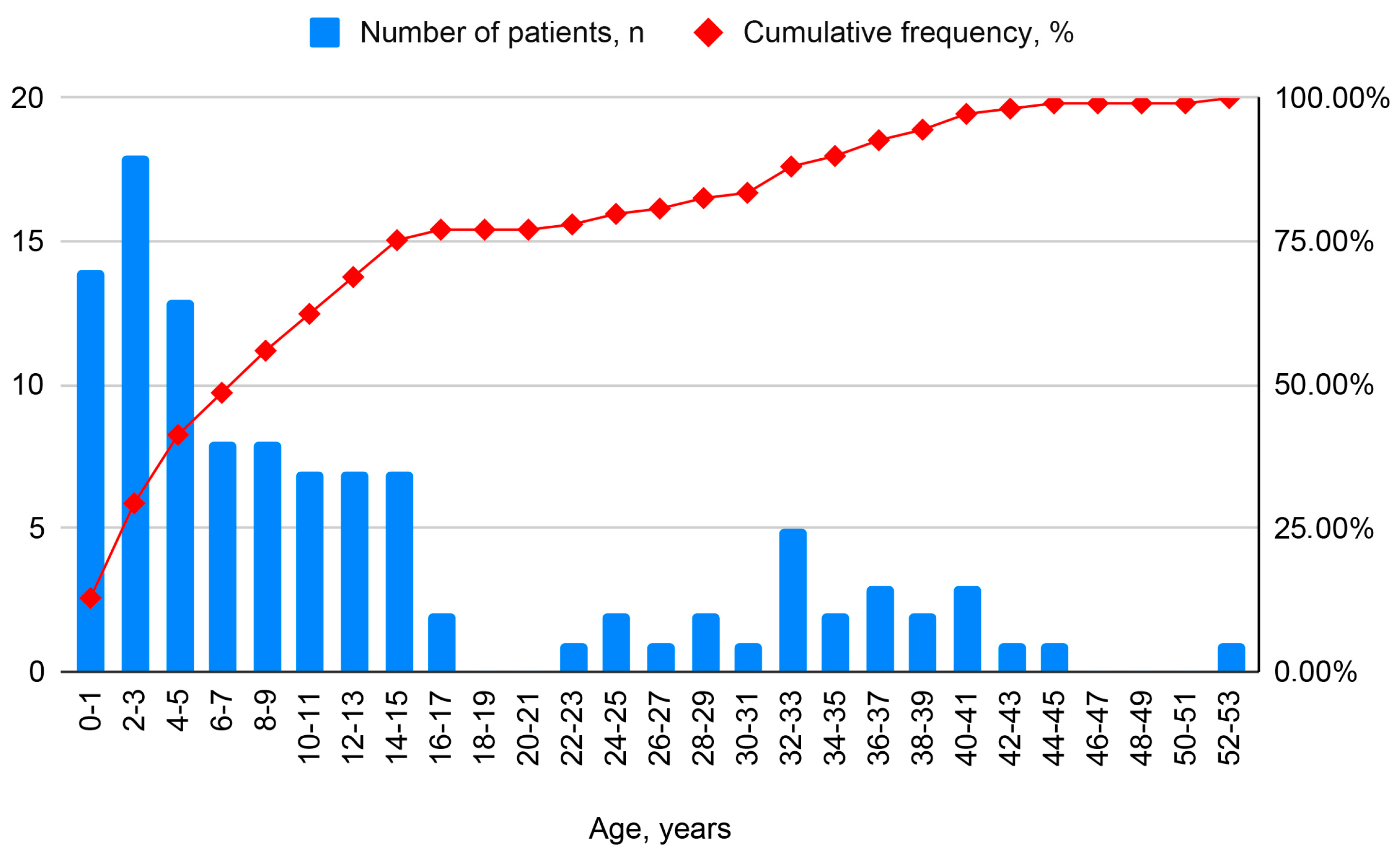
The database included 109 patients with PCD. In the current year, 88 (80.7%) patients were followed up, while 21 (19.3%) were lost to follow-up. The mean age of patients in 2024 was 17.7 ± 13.1 years, with a median age of 14 (IQR 8–27) years. The oldest patient in 2024 was 55 years old (located in Moscow), and the youngest was 0.1 years old. Adult patients (≥18 years) constituted 34.9% of the cohort (Figure 1).
The study population showed a female predominance (55%) over male patients (45%). The mean age at diagnosis was 14.6 ± 13.8 years, with a Me of 10 years (IQR 8–25.8) (Table 1). The median age at diagnosis was 7 years (IQR 2.3–10.0) in pediatric patients and 32 years (IQR 17–38.5) in adults. For patients with Kartagener’s syndrome (KS), the age at diagnosis was 11.6 years (IQR 0.6–14) (Figure 2).
Genetic testing was performed for all 109 patients (100%) in the cohort. The analysis identified 121 unique pathogenic variants across 29 different genes in this Russian PCD patient cohort. The majority, 116 variants (95.9%), were found in genes with autosomal recessive inheritance. Variants in autosomal dominant genes were found in 2 patients (1.8%), specifically in the FOXJ1 gene, and variants in X-linked recessive genes were found in 3 patients (2.7%), specifically in the OFD1 gene; these occurred significantly less frequently.
Among patients with identified variants, homozygous genotypes were present in 39 patients (35.8%), compound heterozygous in 65 (59.6%), hemizygous in 3 (2.7%), and heterozygous in 2 (1.8%). Variants in autosomal recessive genes were collectively identified in 208 alleles, compared to 2 alleles for the autosomal dominant variant and 3 alleles for the X-linked recessive variants.
Analysis of the pathogenic variant distribution within the Russian PCD cohort showed that the highest number of changes was detected in the DNAH5 and DNAH11 genes. The frequency of identified genetic variants in descending order is presented in Table 2.
When the patients were stratified into groups, 58 (53%) were classified as having KS and 51 (47%) without it. Analysis revealed that variants in the DNAH5 gene were significantly more frequent in the KS group, affecting 32 patients (55%), compared to 11 patients (21.5%) in the non-KS group (χ2 = 12.8; p = 0.0004; OR = 4.48; 5% CI 0.92–10.4) (Table 3).
The genes: DNAAF3, LRRC50/DNAAF1, CCDC103, CCDC40, CFAP52, DNAH6, DNAH7, RSPH4A, CCDC164/DRC1, DNAH17, FSIP2, GAS8/DRC4, SPAG1, RSPH9, and CEP164—each identified in single patients and therefore not included in the table.
Twenty-six novel genetic variants across 13 genes: DNAH5, OFD1, DNAH14, DNAH2, DNAH11, DNAAF11/LRRC6, DNAAF4, DNAAF1, CFAP221, CCDC39, DNAH6, CFAP300, and CEP164 were identified for the first time in the Russian population compared to global data (Table 4).
By the type of mutation, the identified variants were: missense—45 variants (37.2%), nonsense—30 variants (24.8%), frameshift mutation—27 (22.3%), splice site mutation—15 (12.4%); copy number variation—1 (0.8%), deletions/duplications without frameshift—2 (1.8%), intronic variant—1 (0.8%) (Table S1). In a patient with a pathogenic nucleotide sequence variant in exon 3 of the CFAP300 gene (chr11:102058881 CT>C) in a homo/hemizygous state, resulting in a frameshift mutation (NM_032930.3: c.200delT, p.(Phe67fs)), a likely pathogenic variant was identified in the PKD1 gene in a hemizygous state (consistent with autosomal dominant inheritance). No significant variants were found in the remaining patients.

3. Discussion

A comparative analysis of key patient characteristics and the age at diagnosis across various international PCD specialist centers is of significant interest. According to a multicenter study encompassing data from 34 global PCD centers, the median age of the study population was 21.6 years (IQR 15.4–32.2 years). The cohort comprised 428 individuals (35%) under 18 years of age and 808 (65%) aged 18 years or older. Data on the age at diagnosis were available for 947 individuals, revealing a median age at diagnosis of 10 years (IQR 4.4–17 years). Notably, the median age at diagnosis for participants with laterality defects was 8 years (IQR 1.08–16.3 years), compared to 11 years (IQR 6–17.9 years) for those without such defects (p < 0.0001) [2]. In the Russian cohort, the mean age at diagnosis was 14.6 ± 13.8 years, with a Me of 10 years (IQR 8–25.8) (Table 1). The median age at diagnosis was 7 years (IQR 2.3–10.0) in pediatric patients and 32 years (IQR 17–38.5) in adults. For patients with Kartagener syndrome, the median age at diagnosis was 11.6 years (IQR 0.6–14).
In a cohort of 1236 patients with PCD, 908 pathogenic variants across 46 PCD-associated genes were identified. The genotypic distribution revealed 687 homozygous (56%) and 528 compound heterozygous (43%) variants. Hemizygous, X-linked variants (in OFD1, DNAAF6, and RPGR) were diagnosed in 20 individuals (2%), while a single patient presented with an autosomal dominant variant in the FOXJ1 gene [2].
In the Russian cohort, the autosomal recessive inheritance pattern with compound heterozygous variants predominated (95.9%). In contrast, data from 34 centers worldwide show a predominance of homozygous variants, comprising 56% of cases. Regarding autosomal dominant forms, a variant in the FOXJ1 gene was identified in a single patient (0.08%) within the multinational cohort of 1236 patients. In comparison, this variant was found in two patients (1.8%) within the Russian cohort of 109 patients [2].
According to the Russian genetic database, the frequency of variants in the DNAH5 gene aligned with the multicenter international study, ranking first in both cohorts (33.9% and 22%, respectively). The DNAH11 gene ranked second in both populations (9.2% and 11%). Statistically significant differences were observed between the Russian cohort and global data for variants in the DNAH5 and CFAP300 genes. It is important to note that these findings are preliminary and may be subject to change with a larger sample size. The observed disparities are likely attributable to recurrent variants that have become prevalent due to genetic drift (founder effect).
Beyond this point, the frequency spectrum of other genes diverged. In the Russian cohort, variants in the CCDC39 and CFAP300 genes shared the third rank (6.4% each), whereas in the international dataset, the CCDC40 gene occupied the third position (9%) (Table 5) [2].
The genes LRRC50/DNAAF1, DNAH7, DNAAF3, CCDC164/DRC1, RSPH4A, CEP164, CFAP52, DNAH6, DNAH17, FSIP2, CCDC103, GAS8/DRC4, SPAG1, and RSPH9 were each identified in single patients and are consequently not presented in the table.
In a Chinese study involving 244 patients with PCD, of whom 116 (47.5%) were female, 120 (49.2%) were diagnosed with KS, and 189 (77.5%) were diagnosed with PCD before 18 years of age. Among these patients, 120 (49.2%) showed first symptoms during the neonatal period, 85 (34.8%) in early childhood, and 3 (1.2%) in adulthood. For the 237 patients with precisely documented age at diagnosis, the mean age was 13.1 years.
Among 142 genetically characterized patients, pathogenic variants were identified in 25 PCD-associated genes. The genotypic distribution was as follows: 105 patients (73.9%) had compound heterozygous mutations, 27 (19.0%) had homozygous mutations, 6 (4.2%) had X-linked recessive mutations, and 4 (2.8%) had no detectable mutations. Of all identified variants, over half were loss-of-function mutations, comprising frameshift (26.7%), nonsense (21.0%), splicing (9.9%), and deletion (2.9%) variants. The most frequently identified genes were DNAH5 (21.1%), DNAH11 (18.3%), CCDC39 (9.2%), CCDC40 (6.3%), HYDIN (4.9%), CCNO (4.9%), and DNAAF3 (4.9%) (Table 6) [11].
The genetic profile of the Russian cohort shares similarities with Chinese data, particularly concerning the high-frequency genes DNAH5, DNAH11, and CCDC39, though HYDIN variants appear more common in the Chinese population [12].
In the Chinese cohort, over half of all identified variants were loss-of-function mutations, comprising frameshift (26.7%), nonsense (21.0%), splicing (9.9%), and deletion (2.9%) variants. The Russian cohort exhibited a different mutational spectrum. The most prevalent variant type was missense (37.2%), followed by nonsense (24.8%), frameshift (22.3%), splicing site mutations (12.4%), copy number variations (0.8%), in-frame deletions/duplications (1.8%), and intronic variants (0.8%).
Recent years have witnessed significant genetic heterogeneity in the five key PCD-associated genes (DNAH5, DNAH11, DNAI1, CCDC39, and CCDC40) across western populations [9,13].
A study conducted by Hannah WB et al. investigated the global prevalence and ethnic heterogeneity of variants in major PCD-associated genes, including DNAI1. Analysis of genetic variant databases revealed that DNAI1 mutations are relatively frequent in the PCD patient population. The specific frequency of DNAI1 variations demonstrates population-specific differences, being identified in approximately 10–15% of patients in western countries [9].

4. Materials and Methods

4.1. Clinical Methods

a. Patient history: a comprehensive anamnestic assessment.
b. PCD Risk Stratification: For patients presenting with a persistent wet cough and clinical suspicion of PCD, the PICADAR predictive tool was employed in accordance with international guidelines. A threshold score of >5 points was applied, corresponding to a reported sensitivity of 0.90 and specificity of 0.75 [14].

4.2. Molecular Genetic Methods

Patient DNA analysis was performed on the Illumina NextSeqDx 500 next-generation sequencer (Illumina, Inc. San Diego, CA, USA) using SeqCap EZ HyperCap Workflow reagents (Roche, Basel, Switzerland). Detected variants were named according to HGVS nomenclature [15]. Whole-exome sequencing data were processed using a standard automated data analysis algorithm provided by Illumina and available at https://basespace.illumina.com [16]. Population frequencies of identified variants were assessed using reference samples from the 1000 Genomes Project (https://www.internationalgenome.org), ESP6500: Exome Sequencing Project v. 6500, gnomAD (v.3.1.2), and RuExac (a database of variants obtained through whole-exome sequencing (WES, CES) at the Research Centre for Medical Genetics) [17]. Pathogenicity assessment of this variant in the studied samples was conducted in accordance with Russian guidelines for interpreting data obtained by massive parallel sequencing (MPS) [18,19].

4.3. Statistical Analyses

Statistical analyses were performed using IBM SPSS Statistics software, version 26 (IBM Co., Armonk, NY, USA). The distribution of the quantitative variables was non-normal and the data are presented as median and interquartile range (IQR), reported as Me (IQR). Categorical variables are summarized as absolute numbers and percentages (%). Statistical analysis of quantitative data was performed using the Mann–Whitney U test. Categorical data were analyzed using Pearson’s Chi-squared test or Fisher’s exact test. The Wilcoxon signed-rank test was used for comparison of paired samples (pre-post analysis). A p-value of ≤0.05 was deemed statistically significant.

5. Conclusions

Our findings confirm the critical importance of molecular genetic testing for the timely and accurate determination of the genetic basis of PCD. Preliminary data demonstrate that the frequency distribution of variants in the DNAH5 and DNAH11 genes in the Russian population aligns with international trends. Therefore, the optimal diagnostic approach is the use of whole-exome (or whole-genome) sequencing. Furthermore, we observed significant clustering of pathogenic variants in the DNAH5, DNAH11, CCDC39, and CFAP300 genes. The development of targeted genetic panels for PCD diagnosis represents a promising future direction. These diagnostic advancements will be crucial for improving patient quality of life, particularly with the advent of targeted therapies.

Supplementary Materials

The following supporting information can be downloaded at: https://www.mdpi.com/article/10.3390/ijms262311674/s1.

Author Contributions

Conceptualization, S.I.K.; methodology, E.I.K.; software, A.V.B.; validation, O.P.R. and M.V.B.; formal analysis, D.O.Z. and V.V.Z.; data curation, Z.M.M. and D.O.Z.; resources, Y.L.M.; writing—original draft preparation, T.A.K.; writing—review and editing, N.V.T. and B.B.L.; supervision, S.N.A. and E.I.K.; project administration, S.I.K. All authors have read and agreed to the published version of the manuscript.

Funding

This research was conducted within the framework of the research project “Comprehensive analysis of gene-phenotype correlations in cystic fibrosis and primary ciliary dyskinesia No. 122032300396-1”.

Institutional Review Board Statement

The study was approved by the Ethics Committee of the Research Centre for Medical Genetics No. 4 of 19 April 2021 (Moscow, Russia) and conducted in accordance with the provisions of the Declaration of Helsinki of 1975.

Informed Consent Statement

Informed consent was obtained from all subjects involved in the study.

Data Availability Statement

The original contributions presented in this study are included in the article and Supplementary Materials. Further inquiries can be directed to the corresponding author.

Conflicts of Interest

The authors declare no conflicts of interest.

References

  1. Online Mendelian Inheritance in Man, OMIM®. McKusick-Nathans Institute of Genetic Medicine, Johns Hopkins University. 2024. Available online: https://omim.org/ (accessed on 25 August 2025).
  2. Raidt, J.; Riepenhausen, S.; Pennekamp, P.; Olbrich, H.; Amirav, I.; Athanazio, R.A.; Aviram, M.; Balinotti, J.E.; Bar-On, O.; Bode, S.F.N.; et al. Analyses of 1236 genotyped primary ciliary dyskinesia individuals identify regional clusters of distinct DNA variants and significant genotype-phenotype correlations. Eur. Respir. J. 2024, 64, 2301769. [Google Scholar] [CrossRef] [PubMed]
  3. Kouis, P.; Yiallouros, P.K.; Middleton, N.; Evans, J.S.; Kyriacou, K.; Papatheodorou, S.I. Prevalence of primary ciliary dyskinesia in consecutive referrals of suspect cases and the transmission electron microscopy detection rate: A systematic review and meta-analysis. Pediatr. Res. 2017, 81, 398–405. [Google Scholar] [CrossRef] [PubMed]
  4. Lucas, J.S.; Burgess, A.; Mitchison, H.M.; Moya, E.; Williamson, M.; Hogg, C. Diagnosis and management of primary ciliary dyskinesia. Arch. Dis. Child. 2014, 99, 850–856. [Google Scholar] [CrossRef] [PubMed]
  5. Kondratyeva, E.I.; Avdeev, S.N.; Kyian, T.A.; Mizernitskiy, Y.L. Classification of primary ciliary dyskinesia. Pulmonologiya 2023, 33, 731–738. (In Russian) [Google Scholar] [CrossRef]
  6. Shoemark, A.; Goutaki, M.; Kinghorn, B.; Ardura-Garcia, C.; Baz-Redón, N.; Chilvers, M.; Davis, S.D.; De Brandt, J.; Dell, S.; Dhar, R.; et al. European Respiratory Society and American Thoracic Society guidelines for the diagnosis of Primary Ciliary Dyskinesia. Eur. Respir. J. 2025, 2500745. [Google Scholar] [CrossRef] [PubMed]
  7. Shapiro, A.J.; Davis, S.D.; Polineni, D.; Manion, M.; Rosenfeld, M.; Dell, S.D.; Chilvers, M.A.; Ferkol, T.W.; Zariwala, M.A.; Sagel, S.D.; et al. Diagnosis of Primary Ciliary Dyskinesia. An Official American Thoracic Society Clinical Practice Guideline. Am. J. Respir. Crit. Care Med. 2018, 197, e24–e39. [Google Scholar] [CrossRef] [PubMed]
  8. Lucas, J.S.; Barbato, A.; Collins, S.A.; Goutaki, M.; Behan, L.; Caudri, D.; Dell, S.; Eber, E.; Escudier, E.; Hirst, R.A.; et al. European Respiratory Society guidelines for the diagnosis of primary ciliary dyskinesia. Eur. Respir. J. 2017, 49, 1601090. [Google Scholar] [CrossRef] [PubMed] [PubMed Central]
  9. Hannah, W.B.; Seifert, B.A.; Truty, R.; Zariwala, M.A.; Ameel, K.; Zhao, Y.; Nykamp, K.; Gaston, B. The global prevalence and ethnic heterogeneity of primary ciliary dyskinesia gene variants: A genetic database analysis. Lancet Respir. Med. 2022, 10, 459–468. [Google Scholar] [CrossRef] [PubMed] [PubMed Central]
  10. Kopanos, C.; Tsiolkas, V.; Kouris, A.; Chapple, C.E.; Albarca Aguilera, M.; Meyer, R.; Massouras, A. VarSome: The human genomic variant search engine. Bioinformatics 2019, 35, 1978–1980. [Google Scholar] [CrossRef] [PubMed]
  11. Peng, B.; Gao, Y.H.; Xie, J.Q.; He, X.W.; Wang, C.C.; Xu, J.F.; Zhang, G.J. Clinical and genetic spectrum of primary ciliary dyskinesia in Chinese patients: A systematic review. Orphanet J. Rare Dis. 2022, 17, 283. [Google Scholar] [CrossRef] [PubMed]
  12. Olbrich, H.; Schmidts, M.; Werner, C.; Onoufriadis, A.; Loges, N.T.; Raidt, J.; Banki, N.F.; Shoemark, A.; Burgoyne, T.; Al Turki, S.; et al. Recessive HYDIN mutations cause primary ciliary dyskinesia without randomization of left-right body asymmetry. Am. J. Hum. Genet. 2012, 91, 672–684. [Google Scholar] [CrossRef] [PubMed]
  13. Knowles, M.R.; Zariwala, M.; Leigh, M. Primary Ciliary Dyskinesia. Clin. Chest Med. 2016, 37, 449–461. [Google Scholar] [CrossRef] [PubMed]
  14. Behan, L.; Dimitrov, B.D.; Kuehni, C.E.; Hogg, C.; Carroll, M.; Evans, H.J.; Goutaki, M.; Harris, A.; Packham, S.; Walker, W.T.; et al. PICADAR: A diagnostic predictive tool for primary ciliary dyskinesia. Eur. Respir. J. 2016, 47, 1103–1112. [Google Scholar] [CrossRef] [PubMed]
  15. den Dunnen, J.T.; Dalgleish, R.; Maglott, D.R.; Hart, R.K.; Greenblatt, M.S.; McGowan-Jordan, J.; Roux, A.F.; Smith, T.; Antonarakis, S.E.; Taschner, P.E. HGVS Recommendations for the Description of Sequence Variants: 2016 Update. Hum. Mutat. 2016, 37, 564–569. [Google Scholar] [CrossRef] [PubMed]
  16. Illumina. BaseSpace Sequence Hub; Illumina, Inc.: San Diego, CA, USA, 2024; Available online: https://basespace.illumina.com (accessed on 25 August 2025).
  17. Ryzhkova, O.P.; Kardymon, O.L.; Prohorchuk, E.B.; Konovalov, F.A.; Maslennikov, A.B.; Stepanov, V.A.; Afanasyev, A.A.; Zaklyazminskaya, E.V.; Kostareva, A.A.; Pavlov, A.E.; et al. Guidelines for the interpretation of massive parallel sequencing variants. Med. Genet. 2017, 16, 4–17. (In Russian) [Google Scholar]
  18. Richards, S.; Aziz, N.; Bale, S.; Bick, D.; Das, S.; Gastier-Foster, J.; Grody, W.W.; Hegde, M.; Lyon, E.; Spector, E.; et al. Standards and guidelines for the interpretation of sequence variants: A joint consensus recommendation of the American College of Medical Genetics and Genomics and the Association for Molecular Pathology. Genet. Med. 2015, 17, 405–423. [Google Scholar] [CrossRef] [PubMed]
  19. Demchenko, A.G.; Kyian, T.A.; Kondratyeva, E.I.; Bragina, E.E.; Ryzhkova, O.P.; Veiko, R.V.; Nazarova, A.G.; Chernykh, V.B.; Smirnikhina, S.A.; Kutsev, S.I. CFAP300 Loss-of-Function Mutations with Primary Ciliary Dyskinesia: Evidence from Ex Vivo and ALI Cultures. Int. J. Mol. Sci. 2025, 26, 7655. [Google Scholar] [CrossRef] [PubMed]
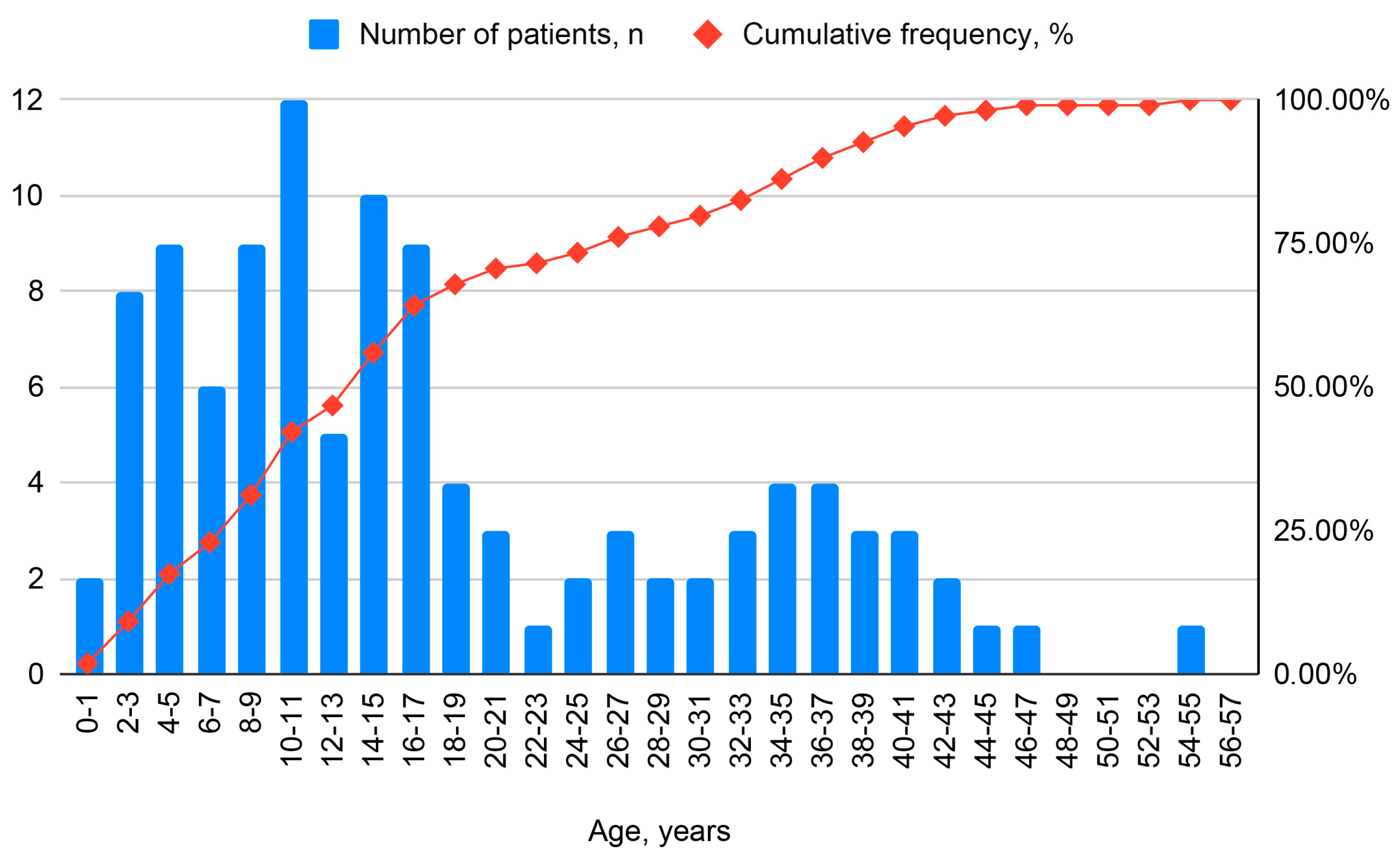
Figure 1. Histogram of the patient age.
Ijms 26 11674 g001
Figure 2. Histogram of age at diagnosis in different patient groups.
Ijms 26 11674 g002
Table 1. The mean age and median age at diagnosis.
ParameterChild (<18 Years)Adult (≥18 Years)All
Total number n (%)71 (65.1)38 (34.9)109 (100)
Age at diagnosis, years
M ± SD6.6 ± 4.827.9 ± 13.814.6 ± 13.8
Me (IQR)7 (2.3–10.0)32 (17–38.5)10 (8–25.8)
Table 2. Number of genes, genetic variants and their frequency in the Russian population.
GeneNumber of Identified Unique Genetic VariantsInheritance PatternNumber of Patients with Pathogenic Variants, nNumber of Patients with Pathogenic Variants, %
1DNAH5 43 AR4339.4
2DNAH11 13 AR109.2
3CCDC39 5 AR76.4
4C11ORF70/CFAP300 4 AR76.4
5LRRC6/DNAAF11 3 AR54.6
6OFD1 3 XLR32.7
7HYDIN 5 AR32.7
8DNAH9 4 AR32.7
9CCDC40 2 AR21.8
10CFAP221 1 AR21.8
11DNAH14 4 AR21.8
12CCDC114/ODAD1 4 AR21.8
13DNAL1 1 AR21.8
14DYX1C1/DNAAF4 3 AR21.8
15FOXJ1 2 AD21.8
16LRRC50/DNAAF1 2 AR10.9
17DNAH7 2 AR10.9
18DNAAF3 2 AR10.9
19CCDC164/DRC1 2 AR10.9
20RSPH4A 2 AR10.9
21CEP164 2 AR10.9
22CFAP52 2 AR10.9
23DNAH6 2 AR10.9
24DNAH17 2 AR10.9
25FSIP2 2 AR10.9
26CCDC103 1 AR10.9
27GAS8/DRC4 1 AR10.9
28SPAG1 1 AR10.9
29RSPH9 1 AR10.9
All genes123 109100%
Note: frequently occurring variants in genes according to the Varsome database [10].
Table 3. Frequency of PCD-associated genes in patients with and without Kartagener syndrome (KS).
GeneInheritance PatternKS, nKS, %Absence of KS, nAbsence of KS, %p-Value
1DNAH5AR3255.01121.50.0004
2DNAH11AR58.659.80.748
3CCDC39AR35.247.81
4DNAH9AR0035.8-
5C11ORF70/CFAP300AR58.624.00.4
6LRRC6/DNAAF11AR11.747.80.2
7DNAH14AR0024.0-
8HYDINAR0035.8-
9CCDC114/ODAD1AR11.711.91
10OFD1XLR0035.8-
11DYX1C1/DNAAF4AR0024.0-
12CFAP221AR0024.0-
13DNAL1AR23.500.00-
14RSPH4AAR11.700.00-
15FOXJ1AD11.711.91
Table 4. New onset genetic variants in PCD-associated genes identified in the Russian population.
GeneUnreported Genetic Variant PreviouslygnomAD v3.1.2 Number of HomozygotesgnomAD v3.1.2 Allele FrequencyACMGP
1DNAH5c.12850dup, p.(Tyr4284LeufsTer14)n/dn/dPVS1, PM2, PM3P
c.3074dupC, p.(Ala1026fs)n/dn/dPVS1, PM2, PM3P
c.8390T>G, p.(Leu2797Arg)n/dn/dPM2, PM3VoUS
c.6813C>A, p.(Cys2271Ter)n/dn/dPVS1, PM2LP
c.12216del, p.(Tyr4072Ter)n/dn/dPVS1, PM2LP
c.13604_13609del, p.(Val4535_Tyr4536del)n/dn/dPM2, PM3VoUS
2DNAH11c.13387_13444dup, p.(Arg4482LysfsTer20)n/dn/dPVS1, PM2LP
c.5461-3T>G, p.(?)n/dn/dPM2, PM3VoUS
c.8572G>A, p.(Gly2858Ser)00.0002037PM2VoUS
c.8363A>G, p.(His2788Arg)n/dn/dPM2VoUS
3OFD1c.2674C>T, p.(Gln892Ter)n/dn/dPVS1, PM2LP
4DNAH14c.9011G>C, p.(Arg3004Pro)n/dn/dPM2VoUS
c.12068C>T, p.(Pro4023Leu)n/dn/dPM2VoUS
5DNAH2c.5372C>T, p.Thr1791Met00.00003942PM2VoUS
6DNAAF11/LRRC6c.574C>G, p.(Gln192Glu)00.001197PM2VoUS
c.1011A>G, p.(Gln337Gln)00.00003942PM2VoUS
7DNAAF4c.430dup, p.(Ile144AsnfsTer8)00.00001994PVS1, PM2, PM3P
8DNAAF1c.1384C>T, p.(Gln462Ter)n/dn/dPVS1, PM2LP
c.655T>C, p.(Cys219Arg)00.00006580PM2, PM3P
9CFAP221c.1641dup, p.(Asn548GlnfsTer6)00.0001646PVS1, PM2LP
10CCDC39c.2492_2496del, p.Met831ThrfsTer7n/dn/dPVS1, PM2, PM3P
11DNAH6c.11669G>A, p.(Arg3890His)00.0005784PM2VoUS
c.11612-42A>G, p.?00.0008870PM2, PP3VoUS
12CFAP300c.289G>T, p.(Glu97Ter)00.000006576PVS1, PM2LP
13CEP164c. 1865G>A, p.Arg622Gln00.0001446PM2, PP3VoUS
c.3055C>T, p.Gln1019Ter00.00003944PVS1, PM2LP
ACMG criteria: P—pathogenic, LP—likely pathogenic, VoUS—uncertain significance.
Table 5. Comparative analysis of PCD-associated gene frequency in the Russian Federation and the International Study (2024).
GeneRussia
(N = 109)
Patient, %International Study (N = 1236)Patient, %
(International Study)
Place
(International Study)
p
DNAH5 (603335)4339.427522.010.009
DNAH11 (603339)109.214211.020.5
CCDC39 (613798)76.4665.050.7
C11ORF70/CFAP300 (618058)76.4221.8130.006
LRRC6/DNAAF11 (614930)54.6443.680.3
OFD1 (300170)32.730.24180.009
HYDIN (610812)32.7423.490.8
DNAH9 (603330)35.550.4160.00008
CCDC40 (613799)21.81159.030.004
CFAP22121.810.08220.02
DNAH1421.80-
CCDC114/ODAD1 (615038)21.8373.0100.5
DNAL1 (610062)21.80
DYX1C1/DNAAF4 (608706)21.8352.8110.4
FOXJ1 (602291)21.810.1210.02
Table 6. Comparative analysis of genetic heterogeneity in PCD patients from the Russian and Chinese cohort.
Russian CohortChinese Cohort
Gene%Gene%
DNAH539.4DNAH521.1
DNAH119.2DNAH1118.3
CCDC396.4CCDC399.2
C11ORF70/CFAP3006.4CCDC406.3
LRRC6/DNAAF114.6HYDIN4.9
OFD12.7CCNO4.9
HYDIN2.7DNAAF34.9
DNAH95.5DNAH13.5
CCDC402DNAAF11 (LRRC6)3.5
Disclaimer/Publisher’s Note: The statements, opinions and data contained in all publications are solely those of the individual author(s) and contributor(s) and not of MDPI and/or the editor(s). MDPI and/or the editor(s) disclaim responsibility for any injury to people or property resulting from any ideas, methods, instructions or products referred to in the content.