


Abstract
The addition reaction of triorganotin anions to α,β-unsaturated nitriles leads to α-alkyl-β-stannylnitriles with high diastereoselectivity.
Introduction
The reaction of triphenyl- and trimethyltin anions with α,β-unsaturated ketones in acetonitrile as solvent is rather instantaneous and leads with high diastereoselectivity and in nearly quantitative yields, to β-stannylketones [1]. On the other hand, there are few reports in the literature concerned with the reaction of triorganostannyl anions with α,β-unsaturated nitriles which would lead to β-stannylnitriles through an 1,4-addition. Taking into account the application of these adducts as inter-mediates in organic synthesis [2,3] we started some studies on the reaction of triphenyl- and trimeth-yltinpotassium with compounds I, II and III, in acetonitrile (ACN) as solvent.
Experimental
To a solution of the stannyl anion (from the reaction between an organotin hydride and potassium tert-butoxide [1]) was added a solution of the nitrile in ACN. The reaction was quenched by the addi-tion of water or an alkyl halide and then worked as usual. The adducts were purified by column chro-matography, distillation or recrystallization and characterized by 1H and 13C NMR.
Results and Discussion
The experimental results indicate that the addition reaction to α,β-unsaturated nitriles is partially inhibited by the presence of one substituent in the α- or β- positions. Thus, while acrilonitrile lead to the adduct in an 85% yield, metacrilonitrile and 2-butenonitrile gave lower yields (62% and 43% re-spectively). On the other hand, the addition is highly inhibited by the presence of α- and β-substituents in open chain olefinic systems (2,3-diphenylpropenonitrile gave a null reaction) but not in cyclic ones (1-cyanocyclohexene and 2-cyano-3,4-dihydronaphthalene gave 63% and 67% yield, respectively).
The stereochemical results show that these reactions are highly diastereoselective. Thus, we only obtained pure threo isomers from open chain nitriles and cis adducts from the cyclic ones. Trapping the intermediate carbanions with different alkyl halides would allow the diastereoselective synthesis of a large number of α-alkyl-β-stannylnitriles.
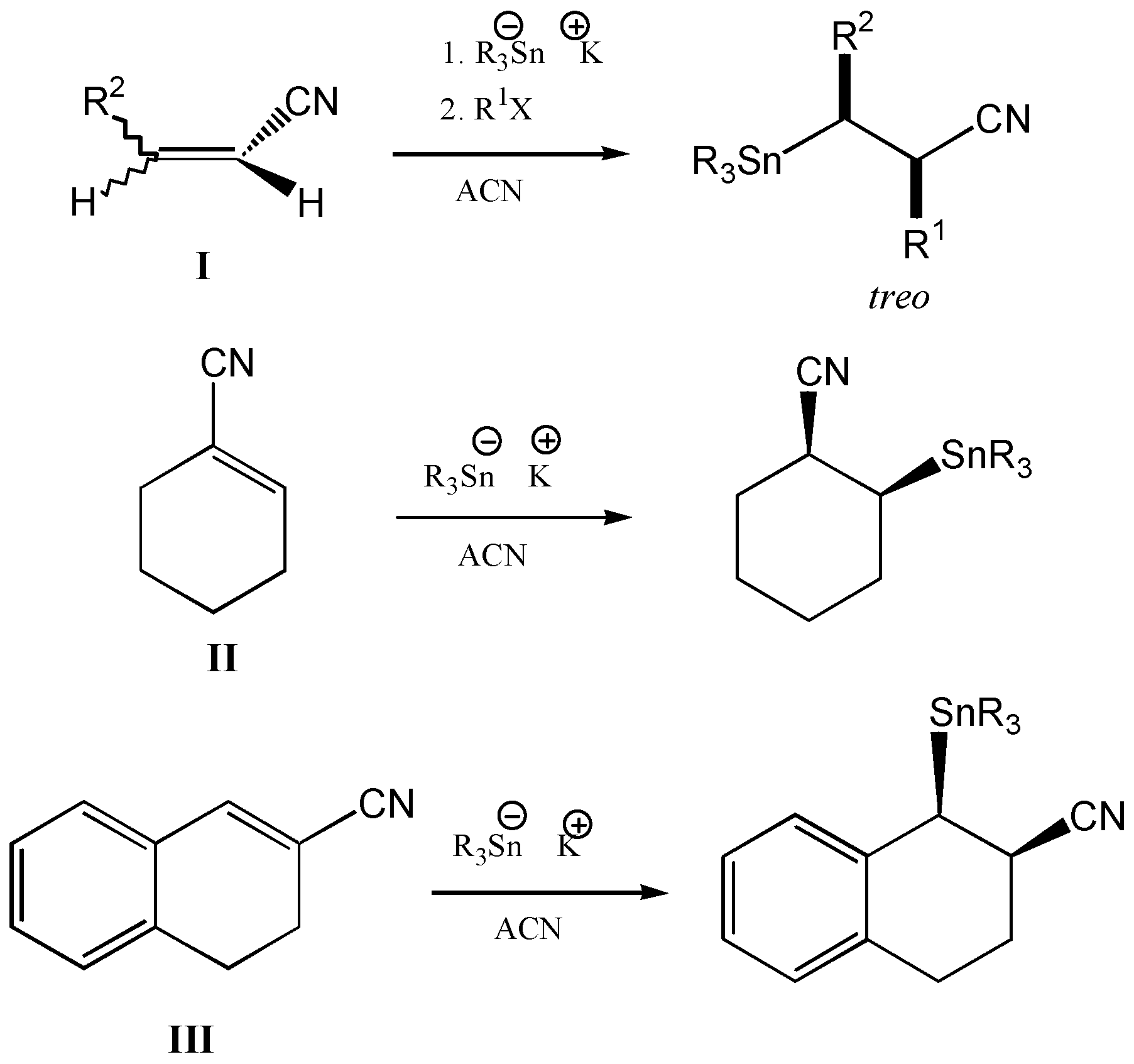
The diastereocontrol observed in the addition of stannyl anions to activated nitriles arises from stereoelectronic and steric effects.
Acknowledgements
This work was partially supported by CIC, CONICET and UNS (Argentina). The authors thank Dr. M.González Sierra (IQUIOS, Argentina) for the NMR spectra.
References and Notes
- Chopa, A.B.; Murray, A.P.; Lockhart, M.T. Evidence of single electron transfer in the dias-tereoselective synthesis of β-stannylketones. J. Organomet. Chem. 1999, 585, 35. [Google Scholar] [CrossRef]
- Davies, A.G. Organotin Chemistry; VCH, 1995. [Google Scholar]
- Murray, A.P. Thesis, 1999.