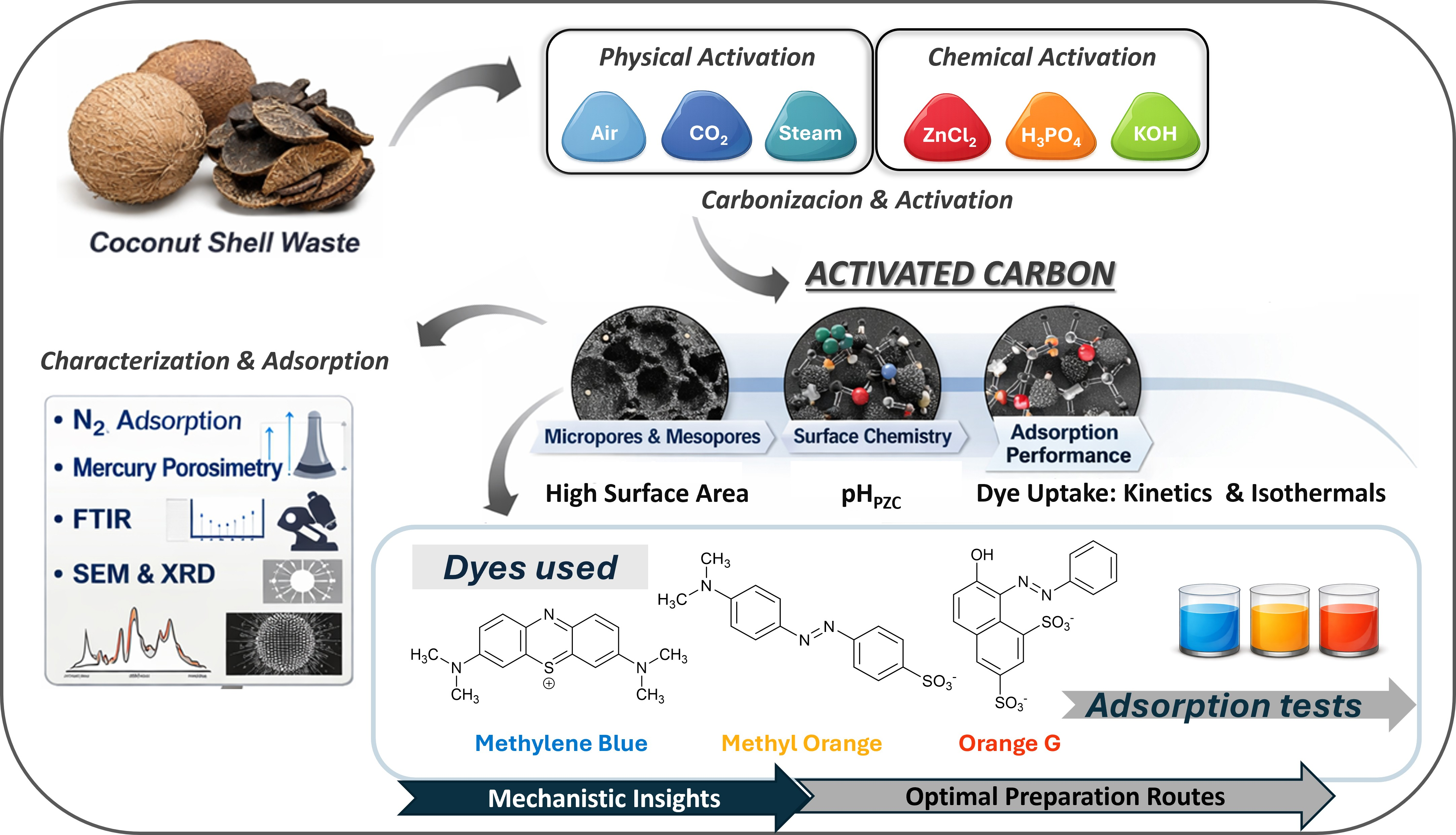
Coconut Shell-Derived Activated Carbons: Preparation, Physicochemical Properties, and Dye Removal from Water

 ,
,  ,
,  and
and
Abstract
1. Introduction

| Activation Method | Activating Agent | Impregnation/Ratio (%), T (°C), t (h) | Carbonization * Atmosphere, T (°C), t (h) | Activation/T (°C), t (h) | SBET/m2 g−1 | Ref. |
|---|---|---|---|---|---|---|
| Physical | CO2 | 800, 1 | 720 | [15] | ||
| Chemical and Physical | KCl, KNO3, KOH, K2CO3, K3PO4/CO2 | 5.5, 70 | 400–1550 | [15] | ||
| Physical | CO2 | 800 | [16] | |||
| Chemical and Physical | KOH, CO2 H3PO4, CO2 | 5.5 3.0 | 751–1360 | [16] | ||
| Chemical | KOH | 0.25–0.75, 800, 2 | 400–800, 1–3 | 1186–245 | [17] | |
| Physical | CO2 | 900, 1 | 900, 1–1.5 | >350~1800 | [18] | |
| Pyrolysis | N2 | 250–850, 1 | 663 | [19] | ||
| Physical | O2 (air) | 800 | 700 | [20] | ||
| Physical | H2O (steam) | 900, 0.5 | 2114 | [21] | ||
| Chemical | ZnCl2 | 1:1, 80, 14 | 500, 3 | 266 | [21] | |
| Physical | H2O (steam) | 1000 | [22] | |||
| Chemical | ZnCl2 | 0.1–0.5, 24 | 700–800, 0.5 | [23] | ||
| Physical | CO2 | 600, 2 | 186 | [24] | ||
| Chemical and Physical | KOH, CO2 | 1:1, 110, 12 | 700, 1 | 850, 2 | 1026 | [25] |
| Physical | CO2 | 900, 1 | 1667 | [26] | ||
| Physical | CO2 | 900, 1.5 | 2000 | [27] | ||
| Chemical | NaOH | 1:1–3:1 | 130–500, 1–2 | 783–2825 | [28] | |
| Chemical | H2SO4 | 12 M, 300, 1 | 250–850, 1 | 16 | [29] | |
| Physical | CO2 | 850, 2 | 750, ≠t | [30] | ||
| Chemical | H3PO4, ZnCl2 | 2 mg/g, 85, 2 | 2 | [30] | ||
| Chemical and Physical | ZnCl2 y CO2 | [31] | ||||
| Physical | CO2 | 850, 5 | [32] | |||
| Pyrolysis | N2 | 850, 0.5 | 229 | [33] | ||
| Physical | CO2 | 800, 1 | 1327 | [34] | ||
| Chemical | H3PO4 | 1:1 | 500, 2 | 483 | [35] | |
| Chemical | KOH | 1:3 | 1650 | [36] | ||
| Chemical | H2SO4 | 1:2 (6N), 24 | 220, 2 | 509 | [37] | |
| Chemical and Physical | KOH, CO2 | 1:5 | 700, 2 | 478 | [38] | |
| Chemical | H2SO4 | 1: 3 (2N), 24 | 818 | [39] | ||
| Chemical | NaOH | 1:1, 3 | 400, 1 | 1000, 5 | 520 | [40] |
| Physical | H2O (steam) | 800, 0.5 | 1011 | [41] | ||
| Chemical | ZnCl2 | 1:1 | 500, 1 | 1223 | [41] | |
| Chemical | H2SO4 | 422 | [42] | |||
| Chemical | NaOH | 1:1, 105, 4 | 600, 1 | 876 | [43] | |
| Chemical and Physical | ZnCl2 y CO2 | 4:1 | 800, 2 | 1796 | [44] | |
| Chemical | KOH | 400, 4 | 250 | [45] | ||
| Chemical | H2SO4 | H2SO4, 24 | 500, 2 | [46] | ||
| Pyrolysis | 900, 6 | 1194 | [47] | |||
| Chemical | KOH | 1:4 | 700, 3 | 1148 | [48] | |
| Chemical | K2SO3 | 1430 | [49] | |||
| Physical | CO2 | 800, 1 | 362 | [50] | ||
| Chemical and Physical | KOH, CO2 | 750 | [50] | |||
| Chemical | CH3CO3H | 100, 3 | 411 | [51] | ||
| Chemical and Physical | NaOH y CO2 | 3:1 | 700, 1 | 2056 | [52] | |
| Physical | Steam | 850, 1 | 1042 | [53] | ||
| Chemical | HNO3, NaOH, KMnO4, FeSO4 | ≤982 | [54] | |||
| Pyrolysis | Hydrothermal 180, 12 | 287 | [55] | |||
| Chemical | KOH | (1:1, 1:2, 1:3), 90, 2 | 800, 4 | 1178–1567 | [55] | |
| Physical | CO2 | Microwave | 675 | [56] | ||
| Chemical | Fe2O3 Fe2O3 + HCl | 950–1050, 1 | 250–1200 | [57] | ||
| Chemical | NaOH, ZnCl2, H3PO4 | 1:4, 85, 2 | 600, 3 | 516, 42, 23 | [2] | |
| Physical | CO2 | Microwave | 626 | [58] | ||
| Chemical | KOH | 1:1, 700–800 | 973–1726 | [59] | ||
| Chemical | KOH KOH + GO | Hydrothermal 500, 2 | 478, 278 | [60] | ||
| Chemical | NaOH, H2SO4 | 2N, 12 | 600, 2 | 345, 40 | [61] | |
| Physical | CO2 | 800, 4 | 800, 4 | 602 | [62] | |
| Chemical | ZnCl2 | 2:5, 80, 4 | 600 | 1391 | [62] | |
| Chemical | ZnCl2, H3PO4 | (1:1, 1:3) | 600–900, 1 | [63] |
2. Results and Discussion
2.1. Physicochemical Characterization of Coconut Shell Precursor
2.2. Carbonized Products
2.2.1. Textural Characterization of Carbonized Products
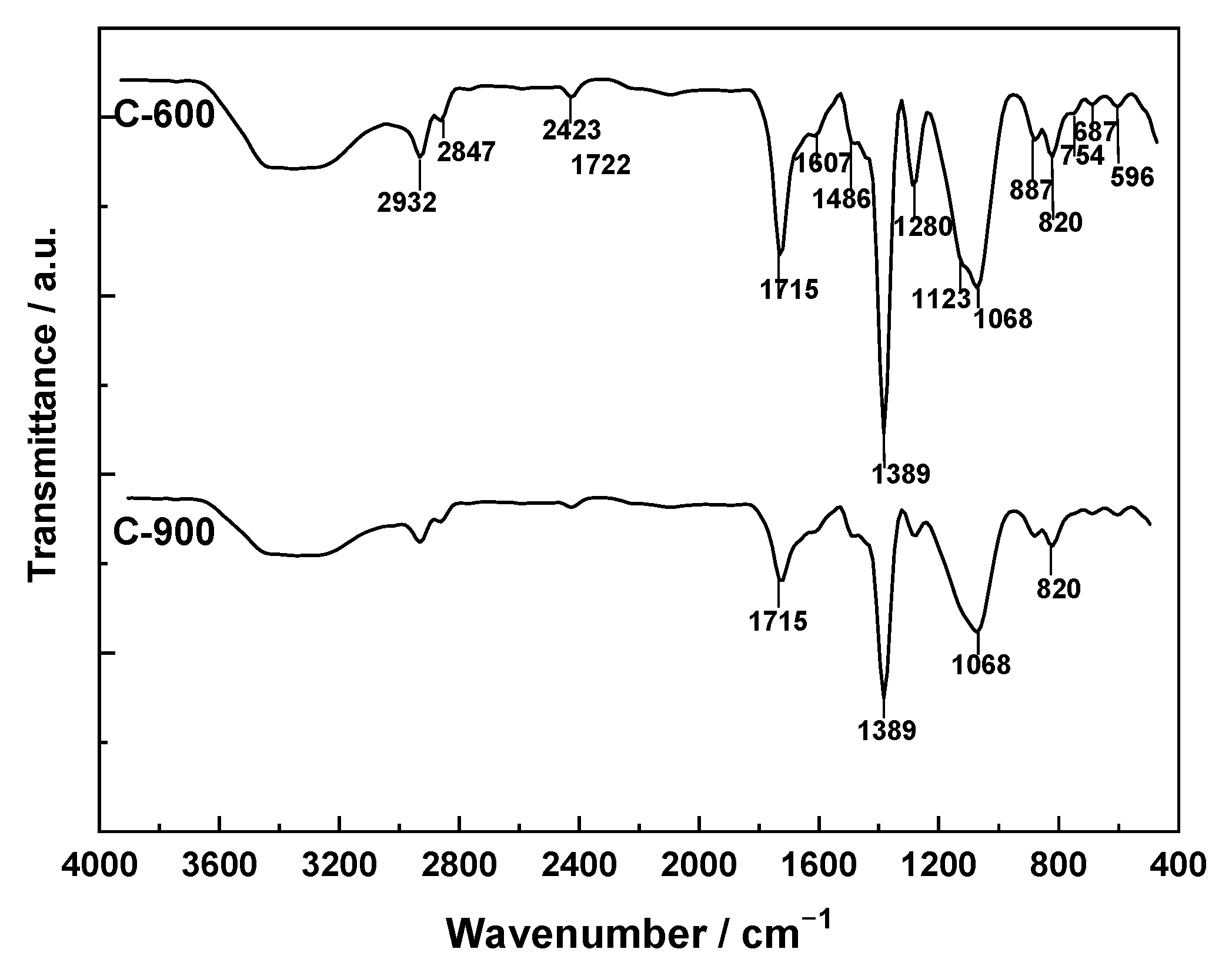
2.2.2. Surface Chemical Characterization of Carbonized Products
2.3. Physically Activated Carbons
2.3.1. Textural Characterization of Physically Activated Carbons
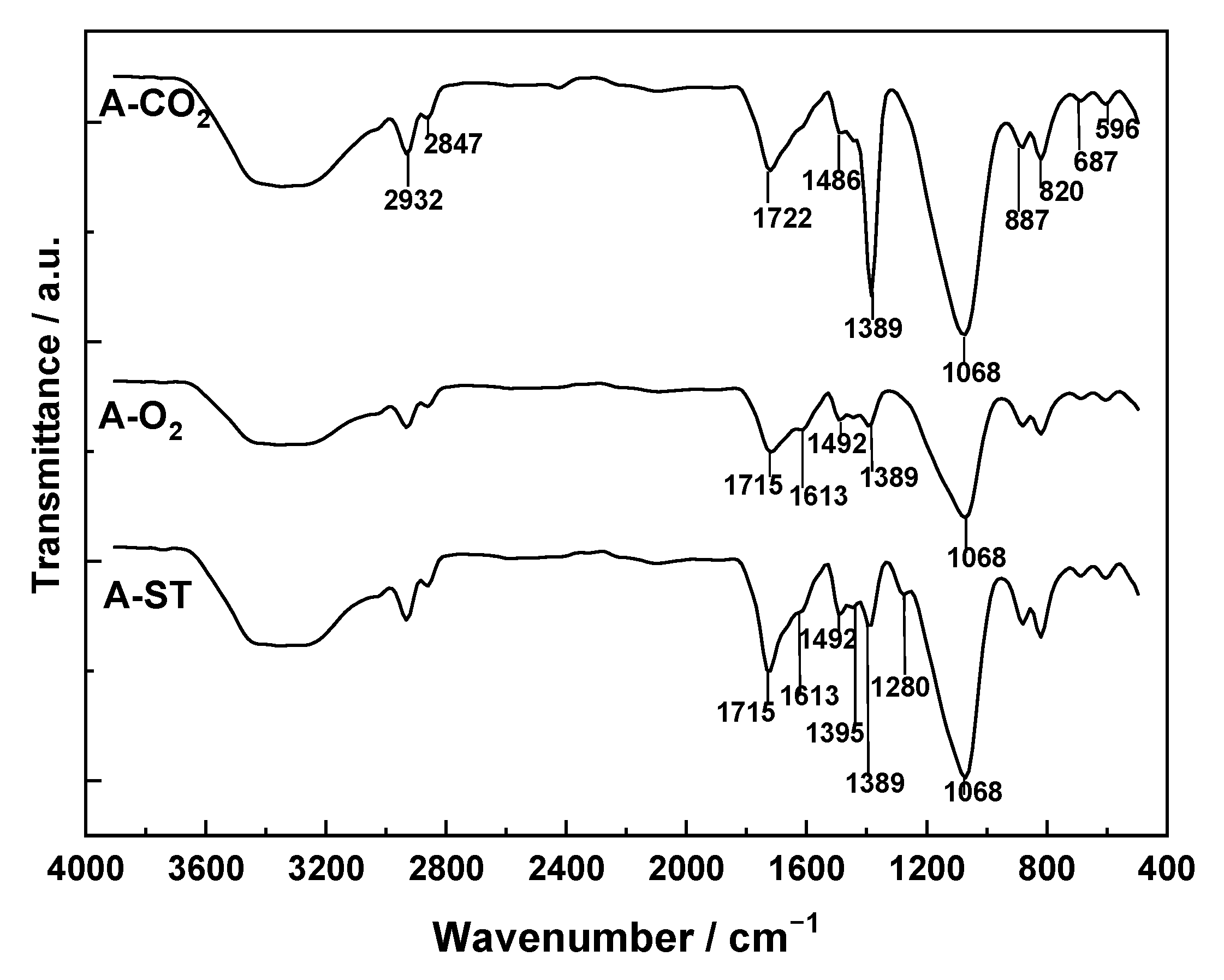
2.3.2. Surface Chemical Characterization of Physically Activated Carbons
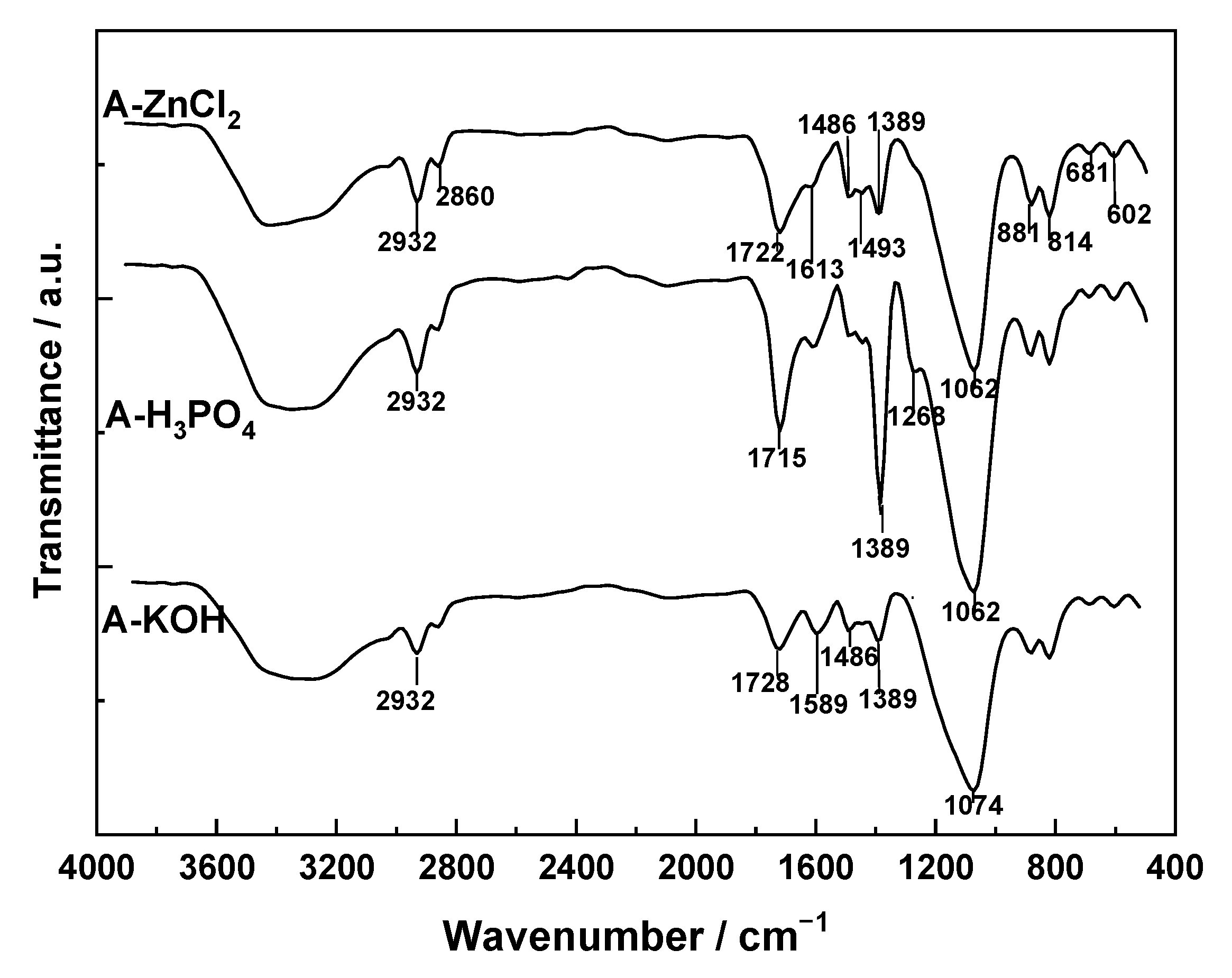
2.4. Chemically Activated Carbons
2.5. Comparative Textural and Chemical Characterization of All Samples
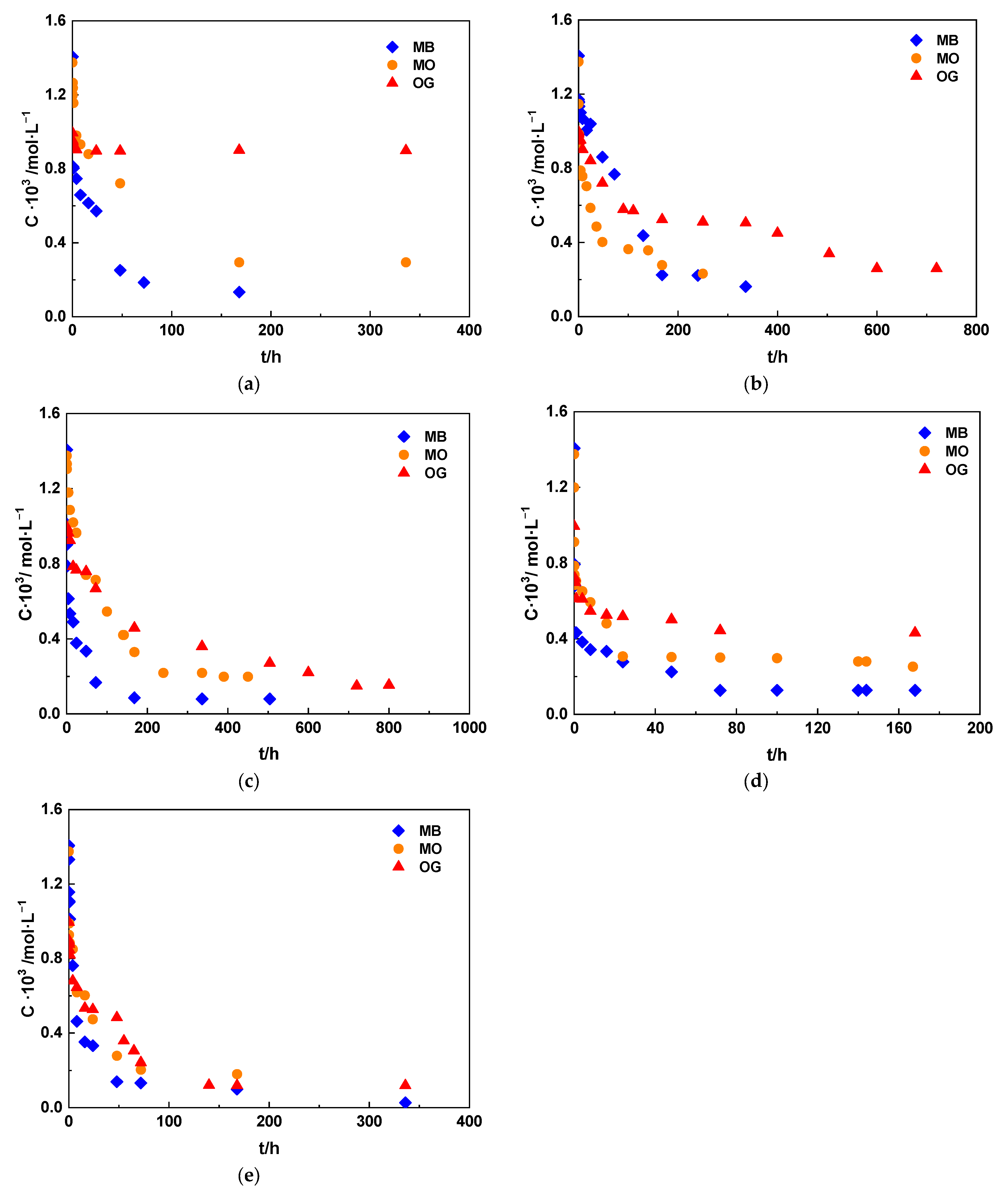
2.6. Adsorption of Dyes
2.6.1. Comparison of Results
2.6.2. Adsorption Mechanism of the Dyes
3. Materials and Methods
3.1. Materials and Reagents
3.2. Preparation of Activated Carbons
3.2.1. Carbonization
3.2.2. Physical Activation
3.2.3. Chemical Activation
3.3. Characterization
3.3.1. Elemental Analysis and Ash Content
3.3.2. X-Ray Diffraction and X-Ray Fluorescence
3.3.3. Scanning Electron Microscopy (SEM)
3.3.4. N2 Adsorption–Desorption at −196 °C
3.3.5. Mercury Porosimetry and Density
3.3.6. FTIR Spectroscopy
3.3.7. Point of Zero Charge (pHpzc)
3.3.8. Yields of Chemical Activations
- Yield of the impregnation treatment of CS:
- Yield of the carbonization/activation process of the impregnated products:
- Yield of the overall activated carbon preparation process:
3.4. Batch Adsorption Experiments
3.4.1. Kinetic Studies
3.4.2. Equilibrium Isotherms
3.5. Analytical Determination of Dyes
4. Conclusions
Supplementary Materials
Author Contributions
Funding
Institutional Review Board Statement
Informed Consent Statement
Data Availability Statement
Acknowledgments
Conflicts of Interest
Abbreviations
| A-CO2 | Physically activated carbon with CO2 |
| A-ST | Physically activated carbon with steam |
| A-H3PO4 | Chemically activated carbon with H3PO4 |
| A-KOH | Chemically activated carbon with KOH |
| A-O2 | Physically activated carbon with O2 |
| A-ZnCl2 | Chemically activated carbon with ZnCl2 |
| C-600 | Char heated to 600 °C |
| C-900 | Char heated to 900 °C |
| CS | Coconut shell |
| MB | Methylene Blue |
| MO | Methyl Orange |
| OG | Orange G |
| pHpzc | Point of zero charge |
| RA | Yield of the carbonization/activation process of the impregnated products |
| RI | Yield of the impregnation treatment of CS |
| RP | Yield of the overall activated carbon preparation process |
| SAIUEx | Research Support Service of the University of Extremadura, Spain |
| SBET | Specific surface area, calculated by the Brunauer–Emmett–Teller (BET) adsorption model |
| SEM | Scanning electron microscopy |
| TPSA | Topological polar surface area |
| Vma-p | Macropore volume (mercury intrusion) |
| Vme | Mesopore volume (N2 adsorption isotherm) |
| Vme-p | Mesopore volume (mercury intrusion) |
| Vmi | Micropore volume (N2 adsorption isotherm) |
| VT | Total pore volume |
| W0 | Micropore volume (N2 adsorption isotherm, Dubinin) |
| WDXRF | Wavelength-dispersive X-ray fluorescence |
| XRD | Powder X-ray diffraction |
| ρHg | Density of mercury |
References
- FAOSTAT. Available online: https://www.fao.org/faostat/en/#data/QCL (accessed on 27 November 2025).
- Sujiono, E.H.; Zabrian, D.; Zharvan, V.; Humairah, N.A. Fabrication and Characterization of Coconut Shell Activated Carbon Using Variation Chemical Activation for Wastewater Treatment Application. Results Chem. 2022, 4, 100291. [Google Scholar] [CrossRef]
- Ahiduzzaman, M.; Sadrul Islam, A.K.M. Preparation of Porous Bio-Char and Activated Carbon from Rice Husk by Leaching Ash and Chemical Activation. Springerplus 2016, 5, 1248. [Google Scholar] [CrossRef] [PubMed]
- Kumar, N.; Pandey, A.; Sharma, Y.C. A Review on Sustainable Mesoporous Activated Carbon as Adsorbent for Efficient Removal of Hazardous Dyes from Industrial Wastewater. J. Water Process Eng. 2023, 54, 104054. [Google Scholar] [CrossRef]
- Lawtae, P.; Tangsathitkulchai, C. The Use of High Surface Area Mesoporous-Activated Carbon from Longan Seed Biomass for Increasing Capacity and Kinetics of Methylene Blue Adsorption from Aqueous Solution. Molecules 2021, 26, 6521. [Google Scholar] [CrossRef]
- Gao, Y.; Yue, Q.; Xu, S.; Gao, B. Activated Carbons with Well-Developed Mesoporosity Prepared by Activation with Different Alkali Salts. Mater. Lett. 2015, 146, 34–36. [Google Scholar] [CrossRef]
- Dimitrakou, A.; Koutselas, I.B.; Karakassides, M.A.; Salmas, C.E.; Dimos, K. Waste Valorization towards Hierarchical Porous Carbon with Ultra-High Surface Area and Dye Adsorption Efficiency. Int. J. Environ. Sci. Technol. 2025, 22, 4027–4042. [Google Scholar] [CrossRef]
- Narayanan, V.; Singh, G.; Ruban, A.M.; Baskar, A.; Bahadur, R.; Perumalsamy, V.; Ramadass, K.; Yang, J.-H.; Mahasivam, S.; Bansal, V.; et al. Hierarchically Architectured Nanoporous Biocarbons Prepared via Dual Chemical Activation for Applicability in CO2 Capture and Supercapacitors. ACS Appl. Mater. Interfaces 2025, 17, 39281–39290. [Google Scholar] [CrossRef]
- Hu, Z.; Guo, H.; Srinivasan, M.P.; Ni, Y. A Simple Method for Developing Mesoporosity in Activated Carbon. Sep. Purif. Technol. 2003, 31, 47–52. [Google Scholar] [CrossRef]
- Periyasamy, A.P. A Review of Bioremediation of Textile Dye Containing Wastewater. Clean. Water 2025, 4, 100092. [Google Scholar] [CrossRef]
- Mirza, N.R.; Huang, R.; Du, E.; Peng, M.; Pan, Z.; Ding, H.; Shan, G.; Ling, L.; Xie, Z. A Review of the Textile Wastewater Treatment Technologies with Special Focus on Advanced Oxidation Processes (AOPs), Membrane Separation and Integrated AOP-Membrane Processes. Desalin. Water Treat. 2020, 206, 83–107. [Google Scholar] [CrossRef]
- Mukherjee, P.; Sharma, R.S.; Mishra, V. Deciphering the Ecological Impact of Azo Dye Pollution through Microbial Community Analysis in Water–Sediment Microcosms. Environ. Sci. Pollut. Res. 2024. [Google Scholar] [CrossRef] [PubMed]
- Lekhak, U.M. Ecotoxicity of Synthetic Dyes; Elsevier: Amsterdam, The Netherlands, 2023. [Google Scholar]
- Tan, I.A.W.; Ahmad, A.L.; Hameed, B.H. Adsorption of Basic Dye on High-Surface-Area Activated Carbon Prepared from Coconut Husk: Equilibrium, Kinetic and Thermodynamic Studies. J. Hazard. Mater. 2008, 154, 337–346. [Google Scholar] [CrossRef] [PubMed]
- Laine, J.; Calafat, A. Factors Affecting the Preparation of Activated Carbons from Coconut Shell Catalized by Potassium. Carbon 1991, 29, 949–953. [Google Scholar] [CrossRef]
- Laine, J.; Calafat, A.; Labady, M. Preparation and Characterization of Activated Carbons from Coconut Shell Impregnated with Phosphoric Acid. Carbon 1989, 27, 191–195. [Google Scholar] [CrossRef]
- Hu, Z.; Srinivasan, M.P. Preparation of High-Surface-Area Activated Carbons from Coconut Shell. Microporous Mesoporous Mater. 1999, 27, 11–18. [Google Scholar] [CrossRef]
- Yoshizawa, N.; Maruyama, K.; Yamada, Y.; Zielinska-Blajet, M. XRD Evaluation of CO2 Activation Process of Coal- and Coconut Shell-Based Carbons. Fuel 2000, 79, 1461–1466. [Google Scholar] [CrossRef]
- Su, W.; Zhou, L.; Zhou, Y. Preparation of Microporous Activated Carbon from Coconut Shells without Activating Agents. Carbon 2003, 41, 861–863. [Google Scholar] [CrossRef]
- Su, W.; Zhou, L.; Zhou, Y. Preparation of Microporous Activated Carbon from Raw Coconut Shell by Two-Step Procedure. Chin. J. Chem. Eng. 2006, 14, 266–269. [Google Scholar] [CrossRef]
- Azevedo, D.C.S.; Araújo, J.C.S.; Bastos-Neto, M.; Torres, A.E.B.; Jaguaribe, E.F.; Cavalcante, C.L. Microporous Activated Carbon Prepared from Coconut Shells Using Chemical Activation with Zinc Chloride. Microporous Mesoporous Mater. 2007, 100, 361–364. [Google Scholar] [CrossRef]
- Li, W.; Yang, K.; Peng, J.; Zhang, L.; Guo, S.; Xia, H. Effects of Carbonization Temperatures on Characteristics of Porosity in Coconut Shell Chars and Activated Carbons Derived from Carbonized Coconut Shell Chars. Ind. Crop. Prod. 2008, 28, 190–198. [Google Scholar] [CrossRef]
- Afrane, G.; Achaw, O.W. Effect of the Concentration of Inherent Mineral Elements on the Adsorption Capacity of Coconut Shell-Based Activated Carbons. Bioresour. Technol. 2008, 99, 6678–6682. [Google Scholar] [CrossRef] [PubMed]
- Guo, S.; Peng, J.; Li, W.; Yang, K.; Zhang, L.; Zhang, S.; Xia, H. Effects of CO2 Activation on Porous Structures of Coconut Shell-Based Activated Carbons. Appl. Surf. Sci. 2009, 255, 8443–8449. [Google Scholar] [CrossRef]
- Mohd Din, A.T.; Hameed, B.H.; Ahmad, A.L. Batch Adsorption of Phenol onto Physiochemical-Activated Coconut Shell. J. Hazard. Mater. 2009, 161, 1522–1529. [Google Scholar] [CrossRef] [PubMed]
- Yang, K.; Peng, J.; Xia, H.; Zhang, L.; Srinivasakannan, C.; Guo, S. Textural Characteristics of Activated Carbon by Single Step CO2 Activation from Coconut Shells. J. Taiwan Inst. Chem. Eng. 2010, 41, 367–372. [Google Scholar] [CrossRef]
- Yang, K.; Peng, J.; Srinivasakannan, C.; Zhang, L.; Xia, H.; Duan, X. Preparation of High Surface Area Activated Carbon from Coconut Shells Using Microwave Heating. Bioresour. Technol. 2010, 101, 6163–6169. [Google Scholar] [CrossRef]
- Cazetta, A.L.; Vargas, A.M.M.; Nogami, E.M.; Kunita, M.H.; Guilherme, M.R.; Martins, A.C.; Silva, T.L.; Moraes, J.C.G.; Almeida, V.C. NaOH-Activated Carbon of High Surface Area Produced from Coconut Shell: Kinetics and Equilibrium Studies from the Methylene Blue Adsorption. Chem. Eng. J. 2011, 174, 117–125. [Google Scholar] [CrossRef]
- Sartape, A.; Mandhare, A.; Salvi, P.; Pawar, D.; Raut, P.; Anuse, M.; Kolekar, S. Removal of Bi (III) with Adsorption Technique Using Coconut Shell Activated Carbon. Chin. J. Chem. Eng. 2012, 20, 768–775. [Google Scholar] [CrossRef]
- Prauchner, M.J.; Rodríguez-Reinoso, F. Chemical versus Physical Activation of Coconut Shell: A Comparative Study. Microporous Mesoporous Mater. 2012, 152, 163–171. [Google Scholar] [CrossRef]
- Ahmadpour, A.; Okhovat, A.; Darabi Mahboub, M.J. Pore Size Distribution Analysis of Activated Carbons Prepared from Coconut Shell Using Methane Adsorption Data. J. Phys. Chem. Solids 2013, 74, 886–891. [Google Scholar] [CrossRef]
- Geng, X.; Li, L.; Zhang, M.; An, B.; Zhu, X. Influence of Reactivation on the Electrochemical Performances of Activated Carbon Based on Coconut Shell. J. Environ. Sci. 2013, 25, S110–S117. [Google Scholar] [CrossRef]
- Ouyang, S.; Xu, S.; Song, N.; Jiao, S. Coconut Shell-Based Carbon Adsorbents for Ventilation Air Methane Enrichment. Fuel 2013, 113, 420–425. [Google Scholar] [CrossRef]
- Ello, A.S.; De Souza, L.K.C.; Trokourey, A.; Jaroniec, M. Coconut Shell-Based Microporous Carbons for CO2 Capture. Microporous Mesoporous Mater. 2013, 180, 280–283. [Google Scholar] [CrossRef]
- Njoku, V.O.; Islam, M.A.; Asif, M.; Hameed, B.H. Preparation of Mesoporous Activated Carbon from Coconut Frond for the Adsorption of Carbofuran Insecticide. J. Anal. Appl. Pyrolysis 2014, 110, 172–180. [Google Scholar] [CrossRef]
- Raj, K.G.; Joy, P.A. Coconut Shell Based Activated Carbon–Iron Oxide Magnetic Nanocomposite for Fast and Efficient Removal of Oil Spills. J. Environ. Chem. Eng. 2015, 3, 2068–2075. [Google Scholar] [CrossRef]
- Sophia, A.C.; Bhalambaal, V.M. Utilization of Coconut Shell Carbon in the Anode Compartment of Microbial Desalination Cell (MDC) for Enhanced Desalination and Bio-Electricity Production. J. Environ. Chem. Eng. 2015, 3, 2768–2776. [Google Scholar] [CrossRef]
- Mohammed, J.; Nasri, N.S.; Ahmad Zaini, M.A.; Hamza, U.D.; Ani, F.N. Adsorption of Benzene and Toluene onto KOH Activated Coconut Shell Based Carbon Treated with NH3. Int. Biodeterior. Biodegrad. 2015, 102, 245–255. [Google Scholar] [CrossRef]
- Singh, N.; Balomajumder, C. Simultaneous Removal of Phenol and Cyanide from Aqueous Solution by Adsorption onto Surface Modified Activated Carbon Prepared from Coconut Shell. J. Water Process Eng. 2016, 9, 233–245. [Google Scholar] [CrossRef]
- Zhu, Y.; Kolar, P. Investigation of Adsorption of P-Cresol on Coconut Shell-Derived Activated Carbon. J. Taiwan Inst. Chem. Eng. 2016, 68, 138–146. [Google Scholar] [CrossRef]
- Hidayu, A.R.; Muda, N. Preparation and Characterization of Impregnated Activated Carbon from Palm Kernel Shell and Coconut Shell for CO2 Capture. Procedia Eng. 2016, 148, 106–113. [Google Scholar] [CrossRef]
- Endut, A.; Abdullah, S.H.Y.S.; Hanapi, N.H.M.; Hamid, S.H.A.; Lananan, F.; Kamarudin, M.K.A.; Umar, R.; Juahir, H.; Khatoon, H. Optimization of Biodiesel Production by Solid Acid Catalyst Derived from Coconut Shell via Response Surface Methodology. Int. Biodeterior. Biodegrad. 2017, 124, 250–257. [Google Scholar] [CrossRef]
- Islam, M.A.; Ahmed, M.J.; Khanday, W.A.; Asif, M.; Hameed, B.H. Mesoporous Activated Coconut Shell-Derived Hydrochar Prepared via Hydrothermal Carbonization-NaOH Activation for Methylene Blue Adsorption. J. Environ. Manag. 2017, 203, 237–244. [Google Scholar] [CrossRef]
- Jayaraman, S.; Jain, A.; Ulaganathan, M.; Edison, E.; Srinivasan, M.P.; Balasubramanian, R.; Aravindan, V.; Madhavi, S. Li-Ion vs. Na-Ion Capacitors: A Performance Evaluation with Coconut Shell Derived Mesoporous Carbon and Natural Plant Based Hard Carbon. Chem. Eng. J. 2017, 316, 506–513. [Google Scholar] [CrossRef]
- Thakur, A.K.; Choudhary, R.B.; Majumder, M.; Gupta, G. In-Situ Integration of Waste Coconut Shell Derived Activated Carbon/Polypyrrole/Rare Earth Metal Oxide (Eu2O3): A Novel Step Towards Ultrahigh Volumetric Capacitance. Electrochim. Acta 2017, 251, 532–545. [Google Scholar] [CrossRef]
- Aljeboree, A.M.; Alshirifi, A.N.; Alkaim, A.F. Kinetics and Equilibrium Study for the Adsorption of Textile Dyes on Coconut Shell Activated Carbon. Arab. J. Chem. 2017, 10, S3381–S3393. [Google Scholar] [CrossRef]
- Sun, K.; Leng, C.Y.; Jiang, J.C.; Bu, Q.; Lin, G.F.; Lu, X.C.; Zhu, G.Z. Microporous Activated Carbons from Coconut Shells Produced by Self-Activation Using the Pyrolysis Gases Produced from Them, That Have an Excellent Electric Double Layer Performance. New Carbon Mater. 2017, 32, 451–459. [Google Scholar] [CrossRef]
- Talat, M.; Mohan, S.; Dixit, V.; Singh, D.K.; Hasan, S.H.; Srivastava, O.N. Effective Removal of Fluoride from Water by Coconut Husk Activated Carbon in Fixed Bed Column: Experimental and Breakthrough Curves Analysis. Groundw. Sustain. Dev. 2018, 7, 48–55. [Google Scholar] [CrossRef]
- Yue, L.; Xia, Q.; Wang, L.; Wang, L.; DaCosta, H.; Yang, J.; Hu, X. CO2 Adsorption at Nitrogen-Doped Carbons Prepared by K2CO3 Activation of Urea-Modified Coconut Shell. J. Colloid Interface Sci. 2018, 511, 259–267. [Google Scholar] [CrossRef]
- Purnomo, C.W.; Kesuma, E.P.; Perdana, I.; Aziz, M. Lithium Recovery from Spent Li-Ion Batteries Using Coconut Shell Activated Carbon. Waste Manag. 2018, 79, 454–461. [Google Scholar] [CrossRef]
- Fang, R.; Huang, H.; Ji, J.; He, M.; Feng, Q.; Zhan, Y.; Leung, D.Y.C. Efficient MnOx Supported on Coconut Shell Activated Carbon for Catalytic Oxidation of Indoor Formaldehyde at Room Temperature. Chem. Eng. J. 2018, 334, 2050–2057. [Google Scholar] [CrossRef]
- Sesuk, T.; Tammawat, P.; Jivaganont, P.; Somton, K.; Limthongkul, P.; Kobsiriphat, W. Activated Carbon Derived from Coconut Coir Pith as High Performance Supercapacitor Electrode Material. J. Energy Storage 2019, 25, 100910. [Google Scholar] [CrossRef]
- Romero Millán, L.M.; Sierra-Vargas, F.E.; Nzihou, A. Characterization of Steam Gasification Biochars from Lignocellulosic Agrowaste Towards Soil Applications. Waste Biomass Valoriz. 2021, 12, 4141–4155. [Google Scholar] [CrossRef]
- Deng, Z.; Sun, S.; Li, H.; Pan, D.; Patil, R.R.; Guo, Z.H.; Seok, I.I. Modification of Coconut Shell-Based Activated Carbon and Purification of Wastewater. Adv. Compos. Hybrid Mater. 2021, 4, 65–73. [Google Scholar] [CrossRef]
- Lee, K.; Lim, M.S.W.; Hong, Z.; Chong, S.; Tiong, T.J.; Pan, G.; Huang, C. Coconut Shell-Derived Activated Carbon for High-Performance Solid-State Supercapacitors. Energies 2021, 14, 4546. [Google Scholar] [CrossRef]
- Yusop, M.F.M.; Erniza, M.J.J.; Mohd Din, A.T.; Bello, O.S.; Ahmad, M.A. Single-Stage Optimized Microwave-Induced Activated Carbon from Coconut Shell for Cadmium Adsorption. Chem. Eng. Technol. 2022, 45, 1943–1951. [Google Scholar] [CrossRef]
- Narita, C.Y.; Lorenzo Fierro, S.; Castro Muñiz, A.; Mourão, M.B.; Suárez García, F. Carbones Activados Preparados Por Carbonización de Mezclas de Biomasa y Óxido de Hierro. In Proceedings of the XV Reunión del Grupo Español del Carbón, Granada, Spain, 24–27 April 2022; Grupo Español del Carbón: Zaragoza, Spain, 2022. [Google Scholar]
- Yusop, M.F.M.; Erniza, M.J.J.; Ahmad, M.A. Single-Stage Microwave Assisted Coconut Shell Based Activated Carbon for Removal of Zn(II) Ions from Aqueous Solution—Optimization and Batch Studies. Arab. J. Chem. 2022, 15, 104011. [Google Scholar] [CrossRef]
- Bai, J.; Huang, J.; Yu, Q.; Demir, M.; Amin, M.U.; Altay, B.N.; Hu, X.; Wang, L. Fabrication of Coconut Shell-Derived Porous Carbons for CO2 Adsorption Application. Front. Chem. Sci. Eng. 2023, 17, 1122–1130. [Google Scholar] [CrossRef]
- Chan, A.A.; Abdul Raman, A.A.; Chong, W.L.; Buthiyappan, A. Graphene Oxide Impregnated Activated Carbon Derived from Coconut Shell through Hydrothermal Carbonization for Cationic Dye Removal: Adsorptive Performance, Kinetics, and Chemistry of Interaction. J. Clean. Prod. 2024, 437, 140655. [Google Scholar] [CrossRef]
- Saleem, J.; Moghal, Z.K.B.; Pradhan, S.; Gordon, M. High-Performance Activated Carbon from Coconut Shells for Dye Removal: Study of Isotherm and Thermodynamics. RSC Adv. 2024, 14, 33797–33808. [Google Scholar] [CrossRef]
- Sosa, J.E.; Ribeiro, R.P.P.L.; Matos, I.; Bernardo, M.; Fonseca, I.M.; Mota, J.P.B.; Araújo, J.M.M.; Pereiro, A.B. Coconut Shell Derived Activated Carbon for Effective Separation of Greenhouse Gases. Int. J. Refrig. 2025, 176, 66–78. [Google Scholar] [CrossRef]
- Raut, E.R.; Bedmohata, M.A.; Chaudhari, A.R. Optimization of Preparation Conditions of Coconut Shell-Based Activated Carbon Using H3PO4 and ZnCl2. Curr. Anal. Chem. 2025, 21, 1105–1113. [Google Scholar] [CrossRef]
- Pereira, M.F.R.; Soares, S.F.; De Melo Órfão, J.J.; Figueiredo, J.L. Adsorption of Dyes on Activated Carbons: Influence of Surface Chemical Groups. Carbon 2003, 41, 811–821. [Google Scholar] [CrossRef]
- Faria, P.C.C.; De Melo Órfão, J.J.; Pereira, M.F.R. Adsorption of Anionic and Cationic Dyes on Activated Carbons with Different Surface Chemistries. Water Res. 2004, 38, 2043–2052. [Google Scholar] [CrossRef] [PubMed]
- James, A.; Yadav, D. Valorization of Coconut Waste for Facile Treatment of Contaminated Water: A Comprehensive Review (2010–2021). Environ. Technol. Innov. 2021, 24, 102075. [Google Scholar] [CrossRef]
- Yunos, N.F.M.; Zaharia, M.; Ahmad, K.R.; Nath, D.C.D.; Iwase, M.; Sahajwalla, V. Structural Transformation of Agricultural Waste/Coke Blends and Their Implications during High Temperature Processes. ISIJ Int. 2011, 51, 1185–1193. [Google Scholar] [CrossRef]
- Stutzman, P.E.; Feng, P.; Bullard, J.W. Phase Analysis of Portland Cement by Combined Quantitative X-Ray Powder Diffraction and Scanning Electron Microscopy. J. Res. Natl. Inst. Stand. Technol. 2016, 121, 47–107. [Google Scholar] [CrossRef]
- Sarkar, S.; Das, S.K. Removal of Hexavalent Chromium from Aqueous Solution Using Natural Adsorbents-Column Studies. Int. J. Eng. Res. Technol. 2016, 5, 370–377. [Google Scholar]
- Van der Marel, H.W.; Beutelspacher, H. Atlas of Infrared Spectroscopy of Clay Minerals and Their Admixtures; Elsevier: Amsterdam, The Netherlands, 1976; Volume 12. [Google Scholar]
- Yang, H.; Yan, R.; Chen, H.; Lee, D.H.; Zheng, C. Characteristics of Hemicellulose, Cellulose and Lignin Pyrolysis. Fuel 2007, 86, 1781–1788. [Google Scholar] [CrossRef]
- Gómez-Serrano, V.; Piriz-Almeida, F.; Durán-Valle, C.J.; Pastor-Villegas, J. Formation of Oxygen Structures by Air Activation. A Study by FT-IR Spectroscopy. Carbon 1999, 37, 1517–1528. [Google Scholar] [CrossRef]
- Gomez-Serrano, V.; Pastor-Villegas, J.; Perez-Florindo, A.; Duran-Valle, C.; Valenzuela-Calahorro, C. FT-IR Study of Rockrose and of Char and Activated Carbon. J. Anal. Appl. Pyrolysis 1996, 36, 71–80. [Google Scholar] [CrossRef]
- Achaw, O.-W.; Achaw, O.-W. A Study of the Porosity of Activated Carbons Using the Scanning Electron Microscope. In Scanning Electron Microscopy; InTech: London, UK, 2012. [Google Scholar] [CrossRef]
- Brunauer, S.; Deming, L.S.; Deming, W.E.; Teller, E. On a Theory of the van Der Waals Adsorption of Gases. J. Am. Chem. Soc. 1940, 62, 1723–1732. [Google Scholar] [CrossRef]
- Thommes, M.; Kaneko, K.; Neimark, A.V.; Olivier, J.P.; Rodríguez-Reinoso, F.; Rouquérol, J.; Sing, K.S.W. Physisorption of Gases, with Special Reference to the Evaluation of Surface Area and Pore Size Distribution (IUPAC Technical Report). Pure Appl. Chem. 2015, 87, 1051–1069. [Google Scholar] [CrossRef]
- Sandía-Manchado, J.A.; Alexandre-Franco, M. Meso- and Macroporosity in Carbonaceous Materials Prepared by Thermal and Chemical Treatment of Lignocellulosic Materials. Adsorption of Cu(II) and Zn(II). Boletín Grupo Español Carbón 2017, 45, 8–15. [Google Scholar]
- Toy, A.D.F. Comprehensive Inorganic Chemistry; Bailar, J.C., Jr., Emeléus, H.J., Nyholm, R., Trotman-Dickenson, A.F., Eds.; Pergamon Press: Oxford, UK, 1973; Volume 2. [Google Scholar]
- Minakshi, M.; Samayamanthry, A.; Whale, J.; Aughterson, R.; Shinde, P.A.; Ariga, K.; Kumar Shrestha, L. Phosphorous—Containing Activated Carbon Derived From Natural Honeydew Peel Powers Aqueous Supercapacitors. Chem. Asian J. 2024, 19, e202400622. [Google Scholar] [CrossRef] [PubMed]
- Minakshi, M.; Mujeeb, A.; Whale, J.; Evans, R.; Aughterson, R.; Shinde, P.A.; Ariga, K.; Shrestha, L.K. Synthesis of Porous Carbon Honeycomb Structures Derived from Hemp for Hybrid Supercapacitors with Improved Electrochemistry. Chempluschem 2024, 89, e202400408. [Google Scholar] [CrossRef] [PubMed]
- Jankowska, H.; Swiatkowski, A. Structure and Chemical Nature of Surface. In Active Carbon; Ellis Horwood Series in Physical Chemistry; Scientific Research Publishing: Wuhan, China, 1991; pp. 106–107. [Google Scholar]
- García-Galán, M.D.M.; Fernández-Blanco, C.A.; Cuerda-Correa, E.M.; Garrido-Zoido, J.M.; Alexandre-Franco, M.F. Waste Surgical Masks as Precursors of Activated Carbon: A Circular Economy Approach to Mitigate the Impact of Microplastics and Emerging Dye Contaminants. Materials 2025, 18, 4115. [Google Scholar] [CrossRef] [PubMed]
- Troca-Torrado, C.; Alexandre-Franco, M.; Fernández-González, C.; Alfaro-Domínguez, M.; Gómez-Serrano, V. Carbonaceous Adsorbents from Polymers-Rubber and Plastic Wastes for Adsorption of Methylene Blue. Express Polym. Lett. 2022, 16, 1280–1303. [Google Scholar] [CrossRef]
- Ertl, P.F.; Rohde, B.; Selzer, P.M. Fast Calculation of Molecular Polar Surface Area as a Sum of Fragment-Based Contributions and Its Application to the Prediction of Drug Transport Properties. J. Med. Chem. 2000, 43, 3714–3717. [Google Scholar] [CrossRef]
- Caron, G.; Ermondi, G. Molecular Descriptors for Polarity: The Need for Going beyond Polar Surface Area. Future Med. Chem. 2016, 8, 2013–2016. [Google Scholar] [CrossRef]
- PubChem. Available online: https://pubchem.ncbi.nlm.nih.gov/ (accessed on 27 November 2025).
- Lopez-Ramon, M.V.; Stoeckli, F.; Moreno-Castilla, C.; Carrasco-Marin, F. On the Characterization of Acidic and Basic Surface Sites on Carbons by Various Techniques. Carbon 1999, 37, 1215–1221. [Google Scholar] [CrossRef]




| Sample | C | H | N | O | S | Ash |
|---|---|---|---|---|---|---|
| CS | 46.80 | 6.52 | 0.06 | 46.59 | 0.03 | 0.45 |
| C-600 | 86.2 | 2.83 | 0.42 | 0.55 | 1.28 | |
| C-900 | 86.7 | 1.52 | 0.56 | 11.22 | 1.03 | |
| A-O2 | 70.3 | 2.32 | 0.36 | 27.29 | 0.80 | |
| A-CO2 | 88.7 | 1.03 | 0.54 | 9.73 | 0.79 | |
| A-ST | 87.9 | 1.29 | 0.44 | 10.37 | 1.46 | |
| A-ZnCl2 | 82.4 | 2.50 | 0.30 | 14.80 | 0.94 | |
| A-H3PO4 | 79.5 | 2.23 | 0.39 | 17.88 | 3.34 | |
| A-KOH | 77.1 | 1.68 | 1.68 | 19.54 | 2.32 |
| Wavenumber/cm−1 | Vibration Mode * | Functional Group/Assignment |
|---|---|---|
| 3429 | ν(O–H) | –OH (hydroxyl groups) |
| 2924, 2873 | ν(C–H) | –CH3, –CH2– |
| 1729 | ν(C=O) | Ketone, aldehyde, acid, ester |
| 1633 | ν(C=C) | Aliphatic/aromatic ring |
| 1499, 1447 | ν(C=C) | Aromatic |
| 1447, 1381 | δ(C–H) | –CH3, –CH2– |
| δ(O–H), ν(C=O) | Carbonyl | |
| 1247 | ν(=C–O–C) | Ether |
| 1062 | ν(C–O) | Ester, ether, alcohol |
| 900–700 | γ(C–H) | Aromatic |
| 700–400 | ν(C–C) |
| Sample | Method/Overall Yield (%) * | SBET /m2 g−1 | W0 /cm3 g−1 | Vmi /cm3 g−1 | Vme /cm3 g−1 | Vme-p /cm3 g−1 | Vma-p /cm3 g−1 | ρHg /cm3 g−1 | VT /cm3 g−1 | pHpzc |
|---|---|---|---|---|---|---|---|---|---|---|
| C-600 | Carbonized 33.0 | 7 | 0.01 | 0.00 | 0.00 | 0.05 | 0.06 | 1.31 | 0.12 | — |
| C-900 | Carbonized 23.2 | 129 | 0.07 | 0.06 | 0.04 | 0.00 | 0.00 | 1.07 | 0.07 | — |
| A-O2 | Physical 40.2 | 270 | 0.12 | 0.13 | 0.06 | 0.00 | 0.11 | 1.37 | 0.25 | 5.25 |
| A-CO2 | Physical 63.2 | 618 | 0.33 | 0.32 | 0.08 | 0.06 | 0.08 | 1.11 | 0.47 | 8.25 |
| A-ST | Physical 52.2 | 738 | 0.39 | 0.38 | 0.07 | 0.01 | 0.01 | 1.11 | 0.41 | 9.25 |
| A-ZnCl2 | Chemical 28.3 | 992 | 0.53 | 0.50 | 0.07 | 0.08 | 0.07 | 1.01 | 0.68 | 4.44 |
| A-H3PO4 | Chemical 22.3 | 1798 | 0.60 | 0.64 | 0.61 | 0.44 | 0.16 | 0.64 | 1.20 | 2.49 |
| A-KOH | Chemical 3.0 | 1600 | 0.70 | 0.74 | 0.22 | 0.00 | 0.85 | 0.33 | 1.55 | 5.80 |
| Wavenumber/cm−1 | Vibration Mode * | Functional Group/Assignment |
|---|---|---|
| 3500 | ν(O–H) | –OH (hydroxyl groups) |
| 2932, 2847 | ν(C–H) | –CH3, –CH2– |
| 1729 | ν(C=O) | Carboxylic acid |
| 1607, 1486 | ν(C=C) | Aliphatic/aromatic ring |
| 1499, 1447 | ν(C=C) | Aromatic |
| 1447, 1389 | δ(C–H) | –CH3, –CH2– |
| δ(O–H), ν(C=O) | Carbonyl | |
| 1280 | ν(=C–O) | Phenolic –OH |
| 1123, 1068 | ν(C–O) | Ether-type structures |
| 900–700 | γ(C–H) | Aromatic |
| 700–400 | ν(C–C) |
| Sample | RI | RA | RP |
|---|---|---|---|
| A-ZnCl2 | 116 | 24.4 | 28.3 |
| A-H3PO4 | 155 | 14.4 | 22.3 |
| A-KOH | 161 | 1.08 | 3.04 |
Disclaimer/Publisher’s Note: The statements, opinions and data contained in all publications are solely those of the individual author(s) and contributor(s) and not of MDPI and/or the editor(s). MDPI and/or the editor(s) disclaim responsibility for any injury to people or property resulting from any ideas, methods, instructions or products referred to in the content. |
© 2026 by the authors. Licensee MDPI, Basel, Switzerland. This article is an open access article distributed under the terms and conditions of the Creative Commons Attribution (CC BY) license.
Share and Cite
Cachola Maldito Lowden, V.M.; Alexandre-Franco, M.F.; Garrido-Zoido, J.M.; Cuerda-Correa, E.M.; Gómez-Serrano, V. Coconut Shell-Derived Activated Carbons: Preparation, Physicochemical Properties, and Dye Removal from Water. Molecules 2026, 31, 263. https://doi.org/10.3390/molecules31020263
Cachola Maldito Lowden VM, Alexandre-Franco MF, Garrido-Zoido JM, Cuerda-Correa EM, Gómez-Serrano V. Coconut Shell-Derived Activated Carbons: Preparation, Physicochemical Properties, and Dye Removal from Water. Molecules. 2026; 31(2):263. https://doi.org/10.3390/molecules31020263
Chicago/Turabian StyleCachola Maldito Lowden, Vanda María, María Francisca Alexandre-Franco, Juan Manuel Garrido-Zoido, Eduardo Manuel Cuerda-Correa, and Vicente Gómez-Serrano. 2026. "Coconut Shell-Derived Activated Carbons: Preparation, Physicochemical Properties, and Dye Removal from Water" Molecules 31, no. 2: 263. https://doi.org/10.3390/molecules31020263
APA StyleCachola Maldito Lowden, V. M., Alexandre-Franco, M. F., Garrido-Zoido, J. M., Cuerda-Correa, E. M., & Gómez-Serrano, V. (2026). Coconut Shell-Derived Activated Carbons: Preparation, Physicochemical Properties, and Dye Removal from Water. Molecules, 31(2), 263. https://doi.org/10.3390/molecules31020263