Synthesis and Application of a Glucoconjugated Organometallic Rhenium Complex as an IR Imaging Probe for Glycolytic Cancer Cells

 ,
,  , , ,
, , ,  ,
,  , ,
, ,  and
and 
Abstract
1. Introduction
2. Results and Discussion
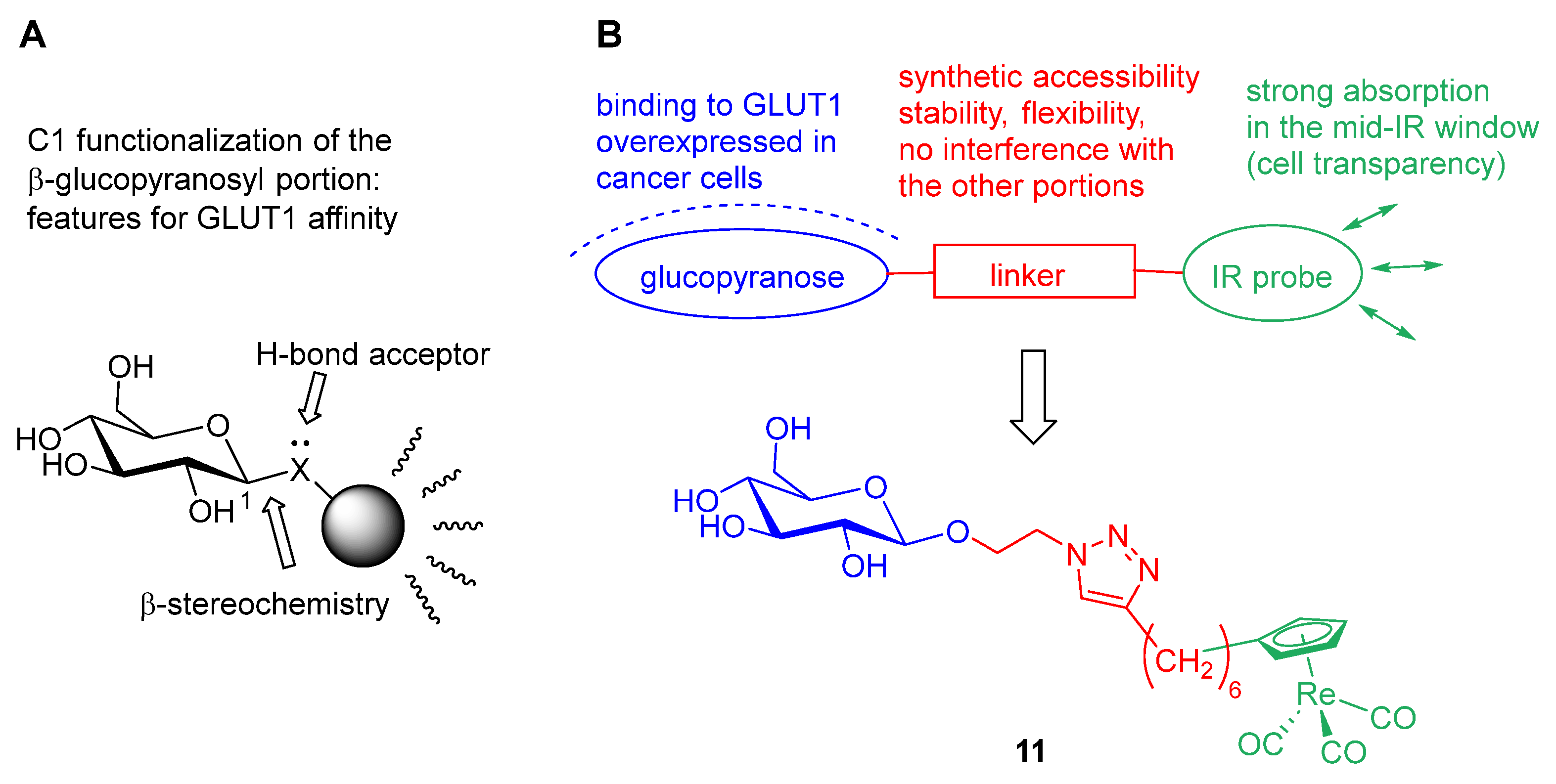
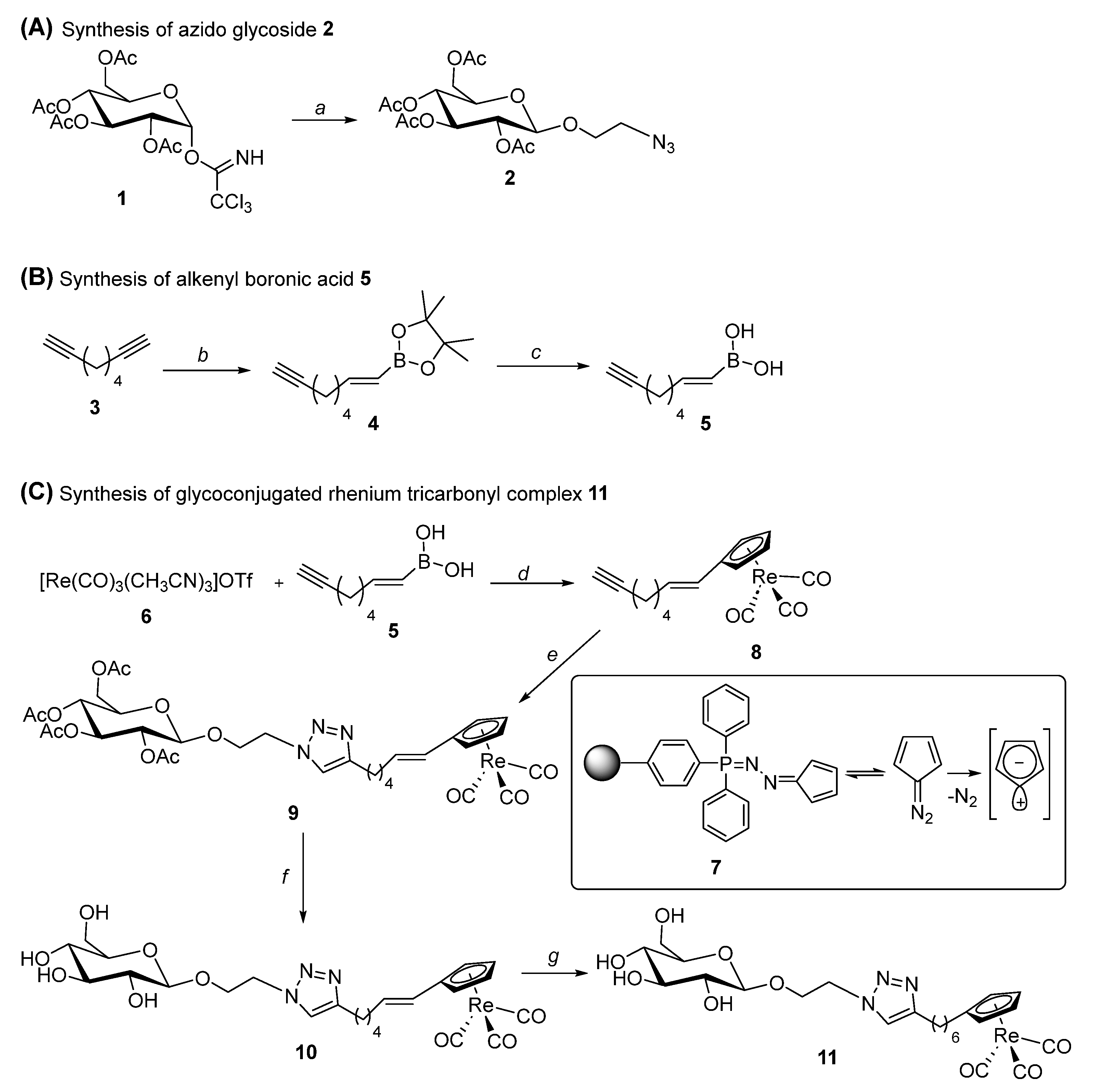
2.1. Design, Synthesis and Characterization of Rhenium Cyclopentadienyl Glucoconjugate 11
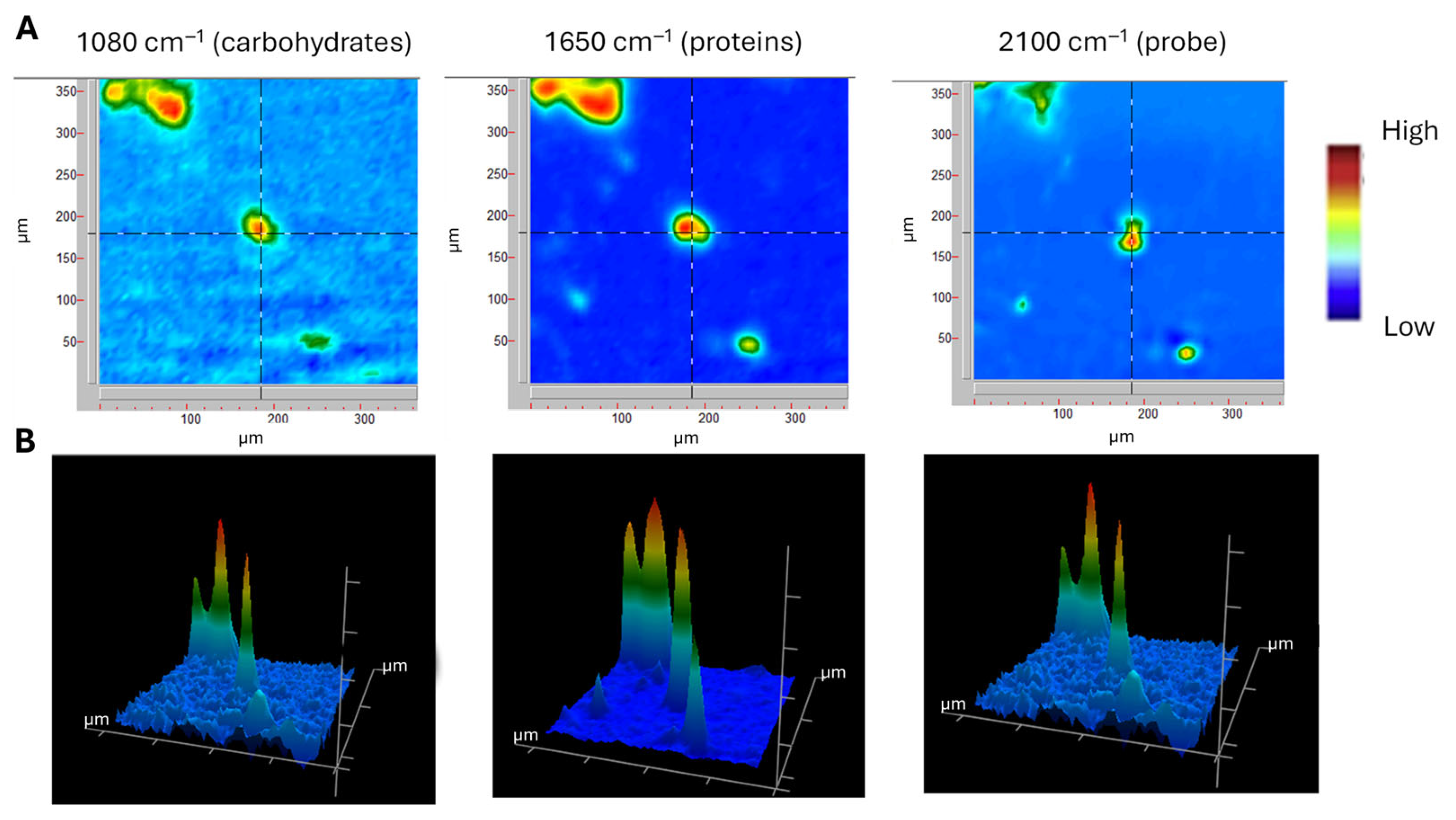
2.2. In Vitro FTIR Microscope Imaging and Detection of Pancreatic Ductal Adenocarcinoma (PDAC) Cells
3. Materials and Methods
3.1. Synthesis: General Procedures and Materials
3.1.1. Procedure for the Synthesis of Compound 2
- (2R,3R,4S,5R,6R)-2-(Acetoxymethyl)-6-(2-azidoethoxy)tetrahydro-2H-pyran-3,4,5-triyl triacetate (2). White solid. 45% yield from 1. 1H NMR (CDCl3) δ (ppm): 1.98 (s, 3H), 2.01 (s, 3H), 2.03 (s, 3H), 2.07 (s, 3H), 3.23–3.29 (m, 1H), 3.45–3.51 (m, 1H), 3.64–3.71 (m, 2H), 3.99–4.04 (m, 1H), 4.16 (dd, 1H, J = 12.0, 2.4 Hz), 4.25 (dd, 1H, J = 12.0, 4.4 Hz), 4.58 (d, 1H, J = 8.0 Hz), 5.03 (dd, 1H, J = 9.6, 8.0 Hz), 5.10 (t, 1H, J = 9.6 Hz), 5.21 (t, 1H, J = 9.6 Hz).
3.1.2. Procedure for the Synthesis of Compound 4
- (E)-4,4,5,5-Tetramethyl-2-(pent-1-en-4-yn-1-yl)-1,3,2-dioxaborolane (4). Yellow oil. 32% yield from 3. 1H NMR (CDCl3) δ (ppm): 1.26 (s, 12H), 1.50–1.58 (m, 4H), 1.93 (t, 1H, J = 2.6 Hz), 2.13–2.22 (m, 4H), 5.44 (dt, 1H, J = 17.9, 1.6 Hz), 6.62 (dt, 1H, J = 17.9, 6.4 Hz).
3.1.3. Procedure for the Synthesis of Compound 5
- (E)-Pent-1-en-4-yn-1-ylboronic acid (5). Yellow solid. 92% yield from 4. 1H NMR (CDCl3) δ (ppm): 1.51–1.64 (m, 4H), 1.95 (t, 1H, J = 2.6 Hz), 2.16–2.28 (m, 4H), 5.55 (d, 1H, J = 17.6 Hz), 6.95 (dt, 1H, J = 17.7, 6.5 Hz).
3.1.4. Procedure for the Synthesis of Compound 8
- 1-(Oct-1-en-7-ynyl)-cyclopentadienyl tricarbonyl rhenium (8). Yellow oil. 14% yield from 5 and 6. 1H NMR (CDCl3) δ (ppm): 1.59–1.57 (m, 4H), 1.95 (t, 1H, J = 2.7 Hz), 2.12–2.23 (m, 4H), 5.27 (pseudo t, 2H, J = 2.2 Hz), 5.41 (pseudo t, 2H, J = 2.2 Hz), 5.94–5.97 (m, 2H).
3.1.5. Procedure for the Synthesis of Compound 9
- ((E)-6-(1-(2-(1-(2,3,4,6-tetra-O-Acetyl-β-D-glucopyranoside))ethyl)-1H-1,2,3-triazol-4-yl)hex-1-en-1-yl)cyclopentadienyl tricarbonyl rhenium (9). Off-white solid. 80% Yield from 2 and 8. 1H NMR (CDCl3) δ (ppm): 1.44–1.53 (m, 2H), 1.65–1.74 (m, 2H), 1.95 (s, 3H), 2.00 (s, 3H), 2.03 (s, 3H), 2.09 (s, 3H), 2.14–2.20 (m, 2H), 2.66–2.75 (m, 2H), 3.66–3.73 (m, 1H), 3.87–3.96 (m, 1H), 4.09–4.16 (m, 2H), 4.18–4.28 (m, 2H), 4.47 (d, 1H, J = 8.0 Hz), 4.53–4.61 (m, 1H), 4.99 (dd, 1H, J = 9.6, 8.0 Hz), 5.04–5.10 (m, 1H), 5.15–5.21 (m, 1H), 5.27 (pseudo t, 2H, J = 2.2 Hz), 5.42 (pseudo t, 2H, J = 2.2 Hz), 5.94–5.98 (m, 2H), 7.35 (s, 1H). 13C-NMR (CDCl3) δ (ppm): 20.71 (4C), 20.77, 20.88, 28.71 (2C), 32.29 (2C), 61.90, 68.36, 71.12, 72.14, 72.63 (2C), 81.02, 84.03 (2C), 84.04 (2C), 100.70, 107.18, 120.58, 133.52, 169.41, 169.56, 170.25, 170.72, 194.52 (3C).
3.1.6. Procedure for the Synthesis of Compound 10
- ((E)-6-(1-(2-(1-β-D-Glucopyranoside)ethyl)-1H-1,2,3-triazol-4-yl)hex-1-en-1-yl) cyclopentadienyl tricarbonyl rhenium (10). White solid. 83% yield from 9. 1H NMR (CD3OD) δ (ppm): 1.47 (quint, 2H, J = 7.5 Hz, CH2), 1.69 (quint, 2H, J = 7.6 Hz, CH2), 2.14–2.22 (m, 2H, CH2), 2.70 (t, 2H, J = 7.5 Hz, CH2), 3.18 (dd, 1H, J = 9.1, 7.8 Hz, Glc-H), 3.24–3.29 (m, 2H, 2×Glc-H), 3.32–3.37 (m, 1H, Glc-H), 3.61–3.69 (m, 1H, Glc-H), 3.86 (dd, 1H, J = 11.9, 1.5 Hz, Glc-H), 3.98 (dt, 1H, J = 11.7, 5.2 Hz, one of the two diastereotopic Alk-CH2-O-Glc), 4.23 (dt, 1H, J = 11.7, 4.9 Hz, one of the two diastereotopic Alk-CH2-O-Glc), 4.30 (d, 1H, J = 7.8 Hz, anomeric Glc-H1), 4.60 (t, 2H, J = 5.1 Hz, CH2-triazole), 5.43 (pseudo t, 2H, J = 2.2 Hz, Cp), 5.66 (pseudo t, 2H, J = 2.2 Hz, Cp), 5.99–6.13 (m, 2H, -HC=CH-), 7.86 (s, 1H, H-triazole). 13C NMR (CD3OD) δ (ppm): 26.06 (CH2), 29.62 (CH2), 29.90 (CH2), 33.16 (CH2), 51.50 (Alk-CH2-triazole), 62.73 (Alk-CH2-O-Glc), 69.13 (Glc), 71.56 (Glc), 74.97 (Glc), 77.97 (Glc), 78.09 (Glc), 82.41 (2×Cp-CH), 85.32 (2×Cp-CH), 104.59 58 (anomeric Glc-C1), 108.57 (Cp-C), 121.91 (vinylic=CH), 124.27 (CH-triazole), 134.27 (vinylic=CH), 148.89 (C-triazole), 195.90 (3×CO). FTIR: 1897, 2007, 2851, 2919, 3386 cm−1. HPLC analysis: retention time = 10.773 min; peak area, 96% (254 nm). HRMS: m/z for C24H30N3O9ReNa [M + Na]+ calculated: 714.14373, found: 714.14240.
3.1.7. Procedure for Compound 11
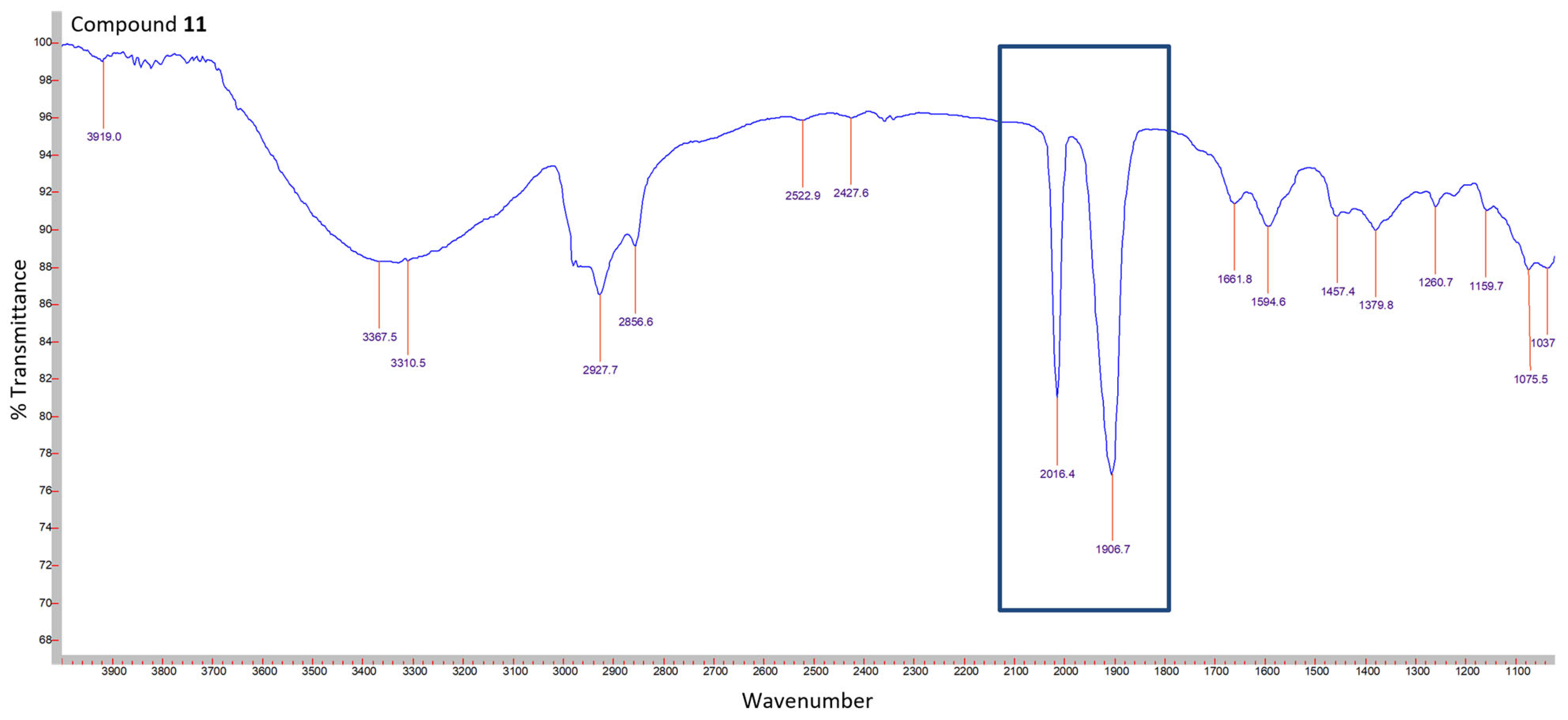
- (6-(1-(2-(1-β-D-Glucopyranoside)ethyl)-1H-1,2,3-triazol-4-yl)hexyl)cyclopentadienyl tricarbonyl rhenium (11). White solid. 79% yield from 10. 1H NMR (CD3OD) δ (ppm): 1.36–1.46 (m, 4H, 2×CH2), 1.49–1.59 (m, 2H, CH2), 1.63–1.73 (m, 2H, CH2), 2.43 (pseudo t, 2H, J = 7.7 Hz, CH2), 2.69 (t, 2H, J = 7.6 Hz, CH2), 3.17 (dd, 1H, J = 9.0, 7.7 Hz, Glc-H), 3.24–3.29 (m, 2H, 2×Glc-H), 3.32–3.38 (m, 1H, Glc-H), 3.62–3.68 (m, 1H, Glc-H, 3.87 (dd, 1H, J = 11.8, 1.6 Hz, Glc-H), 3.98 (dt, 1H, J = 11.4, 5.3 Hz, one of the two diastereotopic Alk-CH2-O-Glc), 4.23 (dt, 1H, J = 11.7, 5.1 Hz, one of the two diastereotopic Alk-CH2-O-Glc), 4.30 (d, 1H, J = 7.8 Hz, anomeric Glc-H1), 4.60 (t, 2H, J = 5.1 Hz, CH2-triazole), 5.39 (pseudo t, 2H, J = 2.1 Hz. Cp), 5.44 (pseudo t, 2H, J = 2.1 Hz, Cp), 7.86 (s, 1H, H-triazole). 13C NMR (CD3OD) δ (ppm): 26.21 (CH2), 29.10 (CH2), 29.86 (CH2), 30.04 (CH2), 30.39 (CH2), 32.78 (CH2), 51.50 (Alk-CH2-triazole), 62.72 (Alk-CH2-O-Glc), 69.14 (Glc), 71.57 (Glc), 74.97 (Glc), 77.97 (Glc), 78.09 (Glc), 84.54 (2×Cp-CH), 84.90 (2×Cp-CH), 104.58 (anomeric Glc-C1), 113.27 (Cp-C), 124.24 (CH-triazole), 149.01 (C-triazole), 196.08 (3×CO). FTIR: 1907, 2016, 2857, 2928, 3338, 3368 cm−1. HPLC analysis: retention time = 10.979 min; peak area = 95% (254 nm). HRMS: m/z for C24H32N3O9ReNa [M + Na]+ calculated: 716.15938, found: 716.15826.
3.2. In Vitro FTIR Microscope Imaging and Detection of Portions (Cells/Tissues) of Pancreatic Adenocarcinoma (PDAC)
3.3. Evaluation of Inhibition of Cell Growth Using the Sulforhodamine B (SRB) Assay
4. Conclusions
Supplementary Materials
Author Contributions
Funding
Institutional Review Board Statement
Informed Consent Statement
Data Availability Statement
Acknowledgments
Conflicts of Interest
Abbreviations
| ATP | Adenosine Triphosphate |
| Cp[Re(CO)3] | Cyclopentadienylrhenium(I) Tricarbonyl |
| FDG | Fluorodeoxyglucose |
| FPA | Focal Panel Array |
| FTIR | Fourier Transform Infrared Spectroscopy |
| GLUT1 | Glucose Transporter 1 |
| HPDE | Human Pancreatic Duct Epithelial Cells |
| HPLC | High Performance Liquid Chromatography |
| HRMS | High-Resolution Mass Spectrometry |
| IR | Infrared |
| NMR | Nuclear Magnetic Resonance |
| PCC-PDAC | Primary Cell Cultures of Pancreatic Ductal Adenocarcinoma |
| PCR | Polymerase Chain Reaction |
| PDAC | Pancreatic Ductal Adenocarcinoma |
| PET | Positron Emission Tomography |
| ppm | parts per million |
| RT | Room Temperature |
| TLC | Thin Layer Chromatography |
| UV | Ultraviolet |
References
- Baker, M.J.; Trevisan, J.; Bassan, P.; Bhargava, R.; Butler, H.J.; Dorling, K.M.; Fielden, P.R.; Fogarty, S.W.; Fullwood, N.J.; Heys, K.A.; et al. Using Fourier Transform IR Spectroscopy to Analyze Biological Materials. Nat. Protoc. 2014, 9, 1771–1791. [Google Scholar] [CrossRef] [PubMed]
- Clède, S.; Policar, C. Metal–Carbonyl Units for Vibrational and Luminescence Imaging: Towards Multimodality. Chem.—A Eur. J. 2015, 21, 942–958. [Google Scholar] [CrossRef] [PubMed]
- Mull, E.S.; Sattigeri, V.J.; Rodriguez, A.L.; Katzenellenbogen, J.A. Aryl Cyclopentadienyl Tricarbonyl Rhenium Complexes: Novel Ligands for the Estrogen Receptor with Potential Use as Estrogen Radiopharmaceuticals. Bioorg. Med. Chem. 2002, 10, 1381–1398. [Google Scholar] [CrossRef] [PubMed]
- Peran, I.; Oudenhoven, T.; Woys, A.M.; Watson, M.D.; Zhang, T.O.; Carrico, I.; Zanni, M.T.; Raleigh, D.P. General Strategy for the Bioorthogonal Incorporation of Strongly Absorbing, Solvation-Sensitive Infrared Probes into Proteins. J. Phys. Chem. B 2014, 118, 7946–7953. [Google Scholar] [CrossRef]
- Abdolahi Sanati, B.; Trung, T.S.B.; Bonnaventure, D.; Ebrahim, A.M.; Rauk, A.; Jalilehvand, F. Synthesis and Structural Characterization of a Glycoconjugated Re(CO)3+ Complex and Its Tendency for CO Release. Inorg. Chem. 2025, 64, 16347–16360. [Google Scholar] [CrossRef]
- Cai, K.; Chen, S.; Zhu, C.; Li, L.; Yu, C.; He, Z.; Sun, C. FOXD1 Facilitates Pancreatic Cancer Cell Proliferation, Invasion, and Metastasis by Regulating GLUT1-Mediated Aerobic Glycolysis. Cell Death Dis. 2022, 13, 765. [Google Scholar] [CrossRef]
- Bononi, G.; Masoni, S.; Di Bussolo, V.; Tuccinardi, T.; Granchi, C.; Minutolo, F. Historical Perspective of Tumor Glycolysis: A Century with Otto Warburg. Semin. Cancer Biol. 2022, 86, 325–333. [Google Scholar] [CrossRef]
- Cao, S.; Chen, Y.; Ren, Y.; Feng, Y.; Long, S. GLUT1 Biological Function and Inhibition: Research Advances. Future Med. Chem. 2021, 13, 1227–1243. [Google Scholar] [CrossRef]
- Bononi, G.; Iacopini, D.; Cicio, G.; Di Pietro, S.; Granchi, C.; Di Bussolo, V.; Minutolo, F. Glycoconjugated Metal Complexes as Cancer Diagnostic and Therapeutic Agents. ChemMedChem 2021, 16, 30–64. [Google Scholar] [CrossRef]
- Iacopini, D.; Vančo, J.; Di Pietro, S.; Bordoni, V.; Zacchini, S.; Marchetti, F.; Dvořák, Z.; Malina, T.; Biancalana, L.; Trávníček, Z.; et al. New Glycoconjugation Strategies for Ruthenium(II) Arene Complexes via Phosphane Ligands and Assessment of Their Antiproliferative Activity. Bioorg. Chem. 2022, 126, 105901. [Google Scholar] [CrossRef]
- Larson, S.M.; Schwartz, L.H. 18F-FDG PET as a Candidate for “Qualified Biomarker”: Functional Assessment of Treatment Response in Oncology. J. Nucl. Med. 2006, 47, 901–903. [Google Scholar]
- Calvaresi, E.C.; Hergenrother, P.J. Glucose Conjugation for the Specific Targeting and Treatment of Cancer. Chem. Sci. 2013, 4, 2319. [Google Scholar] [CrossRef] [PubMed]
- Braunwald, E. Gliflozins in the Management of Cardiovascular Disease. N. Engl. J. Med. 2022, 386, 2024–2034. [Google Scholar] [CrossRef] [PubMed]
- Singh, S.; Aggarwal, A.; Bhupathiraju, N.V.S.D.K.; Arianna, G.; Tiwari, K.; Drain, C.M. Glycosylated Porphyrins, Phthalocyanines, and Other Porphyrinoids for Diagnostics and Therapeutics. Chem. Rev. 2015, 115, 10261–10306. [Google Scholar] [CrossRef] [PubMed]
- Rostovtsev, V.V.; Green, L.G.; Fokin, V.V.; Sharpless, K.B. A Stepwise Huisgen Cycloaddition Process: Copper(I)-Catalyzed Regioselective “Ligation” of Azides and Terminal Alkynes. Angew. Chem. Int. Ed. 2002, 41, 2596–2599. [Google Scholar] [CrossRef]
- Cheng, H.; Cao, X.; Xian, M.; Fang, L.; Cai, T.B.; Ji, J.J.; Tunac, J.B.; Sun, D.; Wang, P.G. Synthesis and Enzyme-Specific Activation of Carbohydrate−Geldanamycin Conjugates with Potent Anticancer Activity. J. Med. Chem. 2005, 48, 645–652. [Google Scholar] [CrossRef]
- Dong, Y.; Liang, X.; Yuan, H.; Qi, S.; Chen, F.; Wang, D. Potential Green Fungicide: 16-Oxo-1-Oxa-4-Azoniacyclohexadecan-4-Ium Tetrafluoroborate. Green Chem. 2008, 10, 990. [Google Scholar] [CrossRef]
- Minutolo, F.; Katzenellenbogen, J.A. Three-Component Synthesis of Substituted η5-Cyclopentadienyltricarbonylrhenium Complexes: Scope, Limitations, and Mechanistic Interpretations. Organometallics 1999, 18, 2519–2530. [Google Scholar] [CrossRef]
- Minutolo, F.; Katzenellenbogen, J.A. A Polymer-Supported Phosphazine as a Stable and Practical Reagent in the Three-Component Synthesis of Substituted (Cyclopentadienyl)Tricarbonylrhenium Complexes. Angew. Chem. Int. Ed. 1999, 38, 1617–1620. [Google Scholar] [CrossRef]
- Furukawa, T.; Duguid, W.P.; Rosenberg, L.; Viallet, J.; Galloway, D.A.; Tsao, M.S. Long-Term Culture and Immortalization of Epithelial Cells from Normal Adult Human Pancreatic Ducts Transfected by the E6E7 Gene of Human Papilloma Virus 16. Am. J. Pathol. 1996, 148, 1763–1770. [Google Scholar]
- Minutolo, F.; Katzenellenbogen, J.A. A Convenient Three-Component Synthesis of Substituted Cyclopentadienyl Tricarbonyl Rhenium Complexes. J. Am. Chem. Soc. 1998, 120, 4514–4515. [Google Scholar] [CrossRef]
- Avan, A.; Caretti, V.; Funel, N.; Galvani, E.; Maftouh, M.; Honeywell, R.J.; Lagerweij, T.; Van Tellingen, O.; Campani, D.; Fuchs, D.; et al. Crizotinib Inhibits Metabolic Inactivation of Gemcitabine in c-Met–Driven Pancreatic Carcinoma. Cancer Res. 2013, 73, 6745–6756. [Google Scholar] [CrossRef]
- Sciarrillo, R.; Wojtuszkiewicz, A.; Kooi, I.E.; Gómez, V.E.; Boggi, U.; Jansen, G.; Kaspers, G.-J.; Cloos, J.; Giovannetti, E. Using RNA-Sequencing to Detect Novel Splice Variants Related to Drug Resistance in In Vitro Cancer Models. J. Vis. Exp. 2016, 2016, e54714. [Google Scholar] [CrossRef]


Disclaimer/Publisher’s Note: The statements, opinions and data contained in all publications are solely those of the individual author(s) and contributor(s) and not of MDPI and/or the editor(s). MDPI and/or the editor(s) disclaim responsibility for any injury to people or property resulting from any ideas, methods, instructions or products referred to in the content. |
© 2025 by the authors. Licensee MDPI, Basel, Switzerland. This article is an open access article distributed under the terms and conditions of the Creative Commons Attribution (CC BY) license.
Share and Cite
Bononi, G.; Paltrinieri, E.; Fortunato, S.; Cicio, G.; Di Giovanni, N.; Lencioni, G.; Funel, N.; Giovannetti, E.; Granchi, C.; Di Bussolo, V.; et al. Synthesis and Application of a Glucoconjugated Organometallic Rhenium Complex as an IR Imaging Probe for Glycolytic Cancer Cells. Molecules 2026, 31, 28. https://doi.org/10.3390/molecules31010028
Bononi G, Paltrinieri E, Fortunato S, Cicio G, Di Giovanni N, Lencioni G, Funel N, Giovannetti E, Granchi C, Di Bussolo V, et al. Synthesis and Application of a Glucoconjugated Organometallic Rhenium Complex as an IR Imaging Probe for Glycolytic Cancer Cells. Molecules. 2026; 31(1):28. https://doi.org/10.3390/molecules31010028
Chicago/Turabian StyleBononi, Giulia, Erica Paltrinieri, Serena Fortunato, Gaspare Cicio, Nicola Di Giovanni, Giulia Lencioni, Niccola Funel, Elisa Giovannetti, Carlotta Granchi, Valeria Di Bussolo, and et al. 2026. "Synthesis and Application of a Glucoconjugated Organometallic Rhenium Complex as an IR Imaging Probe for Glycolytic Cancer Cells" Molecules 31, no. 1: 28. https://doi.org/10.3390/molecules31010028
APA StyleBononi, G., Paltrinieri, E., Fortunato, S., Cicio, G., Di Giovanni, N., Lencioni, G., Funel, N., Giovannetti, E., Granchi, C., Di Bussolo, V., & Minutolo, F. (2026). Synthesis and Application of a Glucoconjugated Organometallic Rhenium Complex as an IR Imaging Probe for Glycolytic Cancer Cells. Molecules, 31(1), 28. https://doi.org/10.3390/molecules31010028