


Cyclic Amide-Linked Oxazolidinone Triazoles as Inhibitors of the T-Box Riboswitch

 , and
, and
Abstract
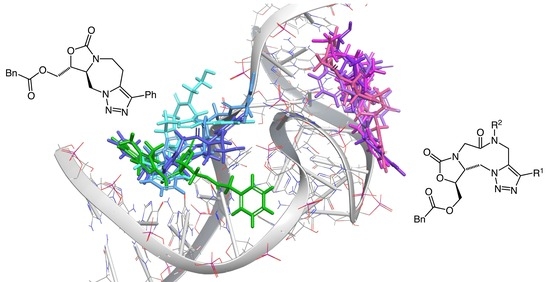
1. Introduction
2. Results
3. Materials and Methods
3.1. General Experimental
3.2. General Procedure A: Deprotection and Acylation Reaction
- ((11S,11aR)-5-benzyl-3-methyl-6,9-dioxo-4,5,6,7,9,11,11a,12-octahydrooxazolo[3,4-a][1,2,3]triazolo[1,5-d][1,4,7]triazonin-11-yl)methyl 2-phenylacetate (3a). Synthesized from triazole 9a (120 mg, 0.20 mmol) using general procedure A. The crude product was purified by column chromatography (55% EtOAc in hexanes) to afford 58 mg (61%) of 3a as a white solid, mp 115.0–116.0 °C; [α]D25 −73.714 (c = 0.175, CHCl3). 1H NMR (500 MHz, CDCl3) δ 7.42–7.24 (m, 8H), 7.15–7.09 (m, 2H), 5.00 (d, J = 14.2 Hz, 1H), 4.83 (d, J = 16.6 Hz, 1H), 4.67 (d, J = 17.7 Hz, 1H), 4.48 (d, J = 15.6 Hz, 1H), 4.38 (q, J = 3.8 Hz, 1H), 4.27 (d, J = 3.5 Hz, 2H), 4.25–4.21 (m, 1H), 4.22–4.17 (m, 1H), 3.87–3.78 (m, 2H), 3.67 (d, J = 6.4 Hz, 3H), 2.17 (s, 3H). 13C NMR (125 MHz, CDCl3) δ 170.9, 168.1, 155.6, 142.9, 134.6, 133.3, 129.5, 129.4, 129.1, 128.9, 128.7, 128.1, 127.7, 72.8, 63.4, 57.7, 50.2, 49.0, 48.9, 41.4, 40.9, 10.3. HRMS: calculated for C26H27N5O5·H+, 490.2085; found, 490.2102. HPLC (254 nm, method B) 3.00 min, 98%.
- ((11S,11aR)-5-(2-(benzyloxy)ethyl)-3-methyl-6,9-dioxo-4,5,6,7,9,11,11a,12-octahydrooxazolo[3,4-a][1,2,3]triazolo[1,5-d][1,4,7]triazonin-11-yl)methyl 2-phenylacetate (3b). Synthesized from triazole 9b (0.27 g, 0.41 mmol) using general procedure A. The crude product was purified by column chromatography (70% EtOAc in hexanes) to afford 180 mg (85%) of 3b as a white solid, mp 114.0–116.0 °C; [α]D25 −76.3 (c 0.35, CHCl3); 1H NMR (500 MHz, CDCl3) δ 7.41–7.21 (m, 10H), 4.80 (d, J = 7.8 Hz, 1H), 4.77 (d, J = 8.8 Hz, 1H), 4.65 (d, J = 17.7 Hz, 1H), 4.48–4.35 (m, 3H), 4.35 (d, J = 3.6 Hz, 2H), 4.27 (d, J = 3.4 Hz, 2H), 3.78–3.74 (m, 1H), 3.66 (s, 2H), 3.65–3.57 (m, 3H), 3.42 (d, J = 16.4 Hz, 1H), 3.33–3.24 (m, 1H), 2.21 (s, 3H); 13C NMR (125 MHz, CDCl3) δ 170.8, 168.4, 155.6, 142.7, 137.5, 133.3, 129.3, 129.1, 128.6, 128.1, 127.8, 127.7, 73.4, 72.8, 68.3, 63.4, 57.7, 57.6, 49.0, 48.9, 43.3, 41.3, 10.2. HRMS: calculated for C28H31N5O6·Na+, 556.21665; found, 556.21820. HPLC (254 nm, method B) 3.31 min, 100%.
- ((11S,11aR)-5-benzyl-6,9-dioxo-3-phenyl-4,5,6,7,9,11,11a,12-octahydrooxazolo[3,4-a][1,2,3]triazolo[1,5-d][1,4,7]triazonin-11-yl)methyl 2-phenylacetate (3c). Synthesized from triazole 9c (0.12 g, 0.18 mmol) using general procedure A. The crude product was purified by column chromatography (45% EtOAc in hexanes) to afford 0.056 g (56%) of 3c as a white solid, mp 122.0–124.0 °C; [α]D25 −65.4 (c 0.19, CHCl3); 1H NMR (500 MHz, CDCl3) δ 7.46–7.10 (m, 14H), 6.92 (d, J = 7.4 Hz, 2H), 4.86 (d, J = 16.7 Hz, 1H), 4.70 (d, J = 14.3 Hz, 1H), 4.53–4.45 (m, 2H), 4.41 (q, J = 3.9 Hz, 1H), 4.29–4.25 (m, 2H), 4.23 (dd, J = 15.6, 2.7 Hz, 1H), 4.06 (d, J = 14.2 Hz, 1H), 3.87–3.82 (m, 1H), 3.67 (s, 2H), 3.53 (d, J = 16.7 Hz, 1H); 13C NMR (125 MHz, CDCl3) δ 170.8, 167.9, 155.4, 147.2, 134.1, 133.2, 129.5, 129.3, 129.0, 128.9, 128.8, 128.4, 128.3, 128.1, 127.6, 72.7, 63.4, 57.5, 50.6, 49.2, 48.8, 42.2, 41.2. HRMS: calculated for C31H29N5O5·H+, 552.2242; found, 552.2268; HPLC (254 nm, method B) 4.4 min, 99%.
- ((11S,11aR)-5-(2-(benzyloxy)ethyl)-6,9-dioxo-3-phenyl-4,5,6,7,9,11,11a,12-octahydrooxazolo[3,4-a][1,2,3]triazolo[1,5-d][1,4,7]triazonin-11-yl)methyl 2-phenylacetate (3d). Synthesized from triazole 9d (0.29 g, 0.40 mmol) using general procedure A. The crude product was purified by column chromatography (57.5% EtOAc in hexanes) to afford 0.22 g (91%) of 3d as a white solid, mp 127.0–128.3 °C; [α]D25 −48.219 (c 0.36, CHCl3); 1H NMR (500 MHz, CDCl3) δ 7.55–7.49 (m, 2H), 7.44–7.27 (m, 11H), 7.14–7.09 (m, 2H), 5.03 (d, J = 17.9 Hz, 1H), 4.85 (t, J = 17.3 Hz, 2H), 4.54 (s, 2H), 4.46 (q, J = 3.9 Hz, 1H), 4.29 (d, J = 3.5 Hz, 2H), 4.24 (s, 2H), 3.85–3.81 (m, 1H), 3.68 (s, 2H), 3.56–3.48 (m, 3H), 3.45 (d, J = 16.9 Hz, 1H), 3.43–3.36 (m, 1H); 13C NMR (125 MHz, CDCl3) δ 170.9, 168.6, 155.6, 147.0, 137.4, 133.3, 129.8, 129.4, 129.1, 129.1, 128.9, 128.8, 128.6, 128.2, 127.9, 127.7, 73.2, 72.9, 67.9, 63.6, 57.6, 49.4, 48.9, 47.6, 44.3, 41.3. HRMS: calculated for C33H33N5O6·H+, 596.2504; found, 596.2526; HPLC (254 nm, method B) 5.1 min, 100%.
- ((11R,11aS)-5-benzyl-3-methyl-6,9-dioxo-4,5,6,7,9,11,11a,12-octahydrooxazolo[3,4-a][1,2,3]triazolo[1,5-d][1,4,7]triazonin-11-yl)methyl 2-phenylacetate (3e). Synthesized from triazole 9e (120 mg, 0.20 mmol) using general procedure A. The crude product was purified by column chromatography (55% EtOAc in hexanes) to afford 61 mg (63%) of 3e as a white solid; mp 115.0–116.0 °C; [α]D25 +73.143 (c 0.18, CHCl3); 1H NMR (500 MHz, CDCl3) δ 7.42–7.24 (m, 8H), 7.15–7.09 (m, 2H), 5.00 (d, J = 14.2 Hz, 1H), 4.83 (d, J = 16.6 Hz, 1H), 4.67 (d, J = 17.7 Hz, 1H), 4.48 (d, J = 15.6 Hz, 1H), 4.38 (q, J = 3.8 Hz, 1H), 4.27 (d, J = 3.5 Hz, 2H), 4.25–4.21 (m, 1H), 4.22–4.17 (m, 1H), 3.87–3.78 (m, 2H), 3.67 (d, J = 6.4 Hz, 3H), 2.17 (s, 3H); 13C NMR (125 MHz, CDCl3) δ 170.9, 168.1, 155.6, 142.9, 134.6, 133.3, 129.5, 129.4, 129.1, 128.9, 128.7, 128.1, 127.7, 72.8, 63.4, 57.7, 50.2, 49.0, 48.9, 41.4, 40.9, 10.3. HRMS: calculated for C26H27N5O5·H+, 490.2085; found, 490.2102; HPLC (254 nm, method B) 3.0 min, 98%.
- ((11R,11aS)-5-(2-(benzyloxy)ethyl)-3-methyl-6,9-dioxo-4,5,6,7,9,11,11a,12-octahydrooxazolo[3,4-a][1,2,3]triazolo[1,5-d][1,4,7]triazonin-11-yl)methyl 2-phenylacetate (3f). Synthesized from triazole 9f (0.26 g, 0.40 mmol) using general procedure A. The crude product was purified by column chromatography (70% EtOAc in hexanes) to afford 0.16 g (74%) of 3f as a white solid, mp 114.0–116.0 °C; [α]D25 +75.775 (c 0.355, CHCl3); 1H NMR (500 MHz, CDCl3) δ 7.41–7.21 (m, 10H), 4.80 (d, J = 7.8 Hz, 1H), 4.77 (d, J = 8.8 Hz, 1H), 4.65 (d, J = 17.7 Hz, 1H), 4.48–4.35 (m, 3H), 4.35 (d, J = 3.6 Hz, 2H), 4.27 (d, J = 3.4 Hz, 2H), 3.78–3.74 (m, 1H), 3.66 (s, 2H), 3.65–3.57 (m, 3H), 3.42 (d, J = 16.4 Hz, 1H), 3.33–3.24 (m, 1H), 2.21 (s, 3H). 13C NMR (125 MHz, CDCl3) δ 170.8, 168.4, 155.6, 142.7, 137.5, 133.3, 129.3, 129.1, 128.6, 128.1, 127.8, 127.7, 73.4, 72.8, 68.3, 63.4, 57.7, 57.6, 49.0, 48.9, 43.3, 41.3, 10.2. HRMS: calculated for C28H31N5O6·Na+, 556.2167; found, 556.2182. HPLC (254 nm, method B) 3.3 min, 100%.
- ((11R,11aS)-5-benzyl-6,9-dioxo-3-phenyl-4,5,6,7,9,11,11a,12-octahydrooxazolo[3,4-a][1,2,3]triazolo[1,5-d][1,4,7]triazonin-11-yl)methyl 2-phenylacetate (3g). Synthesized from triazole 9g (0.10 g, 0.15 mmol) using general procedure A. The crude product was purified by column chromatography (40% EtOAc in toluene) to afford 0.039 g (47%) of 3g as a white solid, mp 122.0–124.0 °C; [α]D25 +64.571 (c 0.175, CHCl3); 1H NMR (500 MHz, CDCl3) δ 7.46–7.10 (m, 14H), 6.92 (d, J = 7.4 Hz, 2H), 4.86 (d, J = 16.7 Hz, 1H), 4.70 (d, J = 14.3 Hz, 1H), 4.53–4.45 (m, 2H), 4.41 (q, J = 3.9 Hz, 1H), 4.29–4.25 (m, 2H), 4.23 (dd, J = 15.6, 2.7 Hz, 1H), 4.06 (d, J = 14.2 Hz, 1H), 3.87–3.82 (m, 1H), 3.67 (s, 2H), 3.53 (d, J = 16.7 Hz, 1H). 13C NMR (125 MHz, CDCl3) δ 170.8, 167.9, 155.4, 147.2, 134.1, 133.2, 129.5, 129.3, 129.0, 128.9, 128.8, 128.4, 128.3, 128.2, 127.6, 72.7, 63.4, 57.5, 50.6, 49.2, 48.8, 42.2, 41.2. HRMS: calculated for C31H29N5O5·H+, 552.2242; found, 552.2269; HPLC (254 nm, method B) 4.4 min, 99%.
- ((11R,11aS)-5-(2-(benzyloxy)ethyl)-6,9-dioxo-3-phenyl-4,5,6,7,9,11,11a,12-octahydrooxazolo[3,4-a][1,2,3]triazolo[1,5-d][1,4,7]triazonin-11-yl)methyl 2-phenylacetate (3h). Synthesized from triazole 9h (0.25 g, 0.35 mmol) using general procedure A. The crude product was purified by column chromatography (52.5% EtOAc in hexanes) to afford 0.11 g (54%) of 3h as a white solid, mp 127.0–128.3 °C; [α]D25 +48.1 (c 0.36, CHCl3); 1H NMR (500 MHz, CDCl3) δ 7.55–7.49 (m, 2H), 7.44–7.27 (m, 11H), 7.14–7.09 (m, 2H), 5.03 (d, J = 17.9 Hz, 1H), 4.85 (t, J = 17.3 Hz, 2H), 4.54 (s, 2H), 4.46 (q, J = 3.9 Hz, 1H), 4.29 (d, J = 3.5 Hz, 2H), 4.24 (s, 2H), 3.85–3.81 (m, 1H), 3.68 (s, 2H), 3.56–3.48 (m, 3H), 3.45 (d, J = 16.9 Hz, 1H), 3.43–3.36 (m, 1H); 13C NMR (125 MHz, CDCl3) δ 170.9, 168.6, 155.6, 147.0, 137.4, 133.3, 129.8, 129.4, 129.1, 129.0, 128.9, 128.8, 128.6, 128.2, 127.9, 127.7, 73.2, 72.9, 67.9, 63.6, 57.60, 49.4, 48.9, 47.6, 44.3, 41.3. HRMS: calculated for C33H33N5O6·H+, 596.2504; found, 596.2526. HPLC (254 nm, method B) 5.1 min, 100%.
3.3. General Procedure B: Debenzylation
- ((11S,11aR)-5-(2-hydroxyethyl)-3-methyl-6,9-dioxo-4,5,6,7,9,11,11a,12-octahydrooxazolo[3,4-a][1,2,3]triazolo[1,5-d][1,4,7]triazonin-11-yl)methyl 2-phenylacetate (3i). Synthesized from ester 3b (0.075 g, 0.14 mmol) using general procedure B. The crude product was purified by column chromatography (3% iPrOH in EtOAc) to afford 0.029 g (47%) of 3i as a white solid, mp 126.2–128.0 °C; [α]D25 −97.7 (c 0.13, CHCl3); 1H NMR (500 MHz, CDCl3) δ 7.41–7.23 (m, 5H), 4.89–4.80 (m, 2H), 4.60–4.45 (m, 3H), 4.45–4.40 (m, 1H), 4.29 (d, J = 3.5 Hz, 2H), 3.84–3.77 (m, 2H), 3.77–3.70 (m, 1H), 3.67 (s, 2H), 3.59 (dd, J = 14.2, 4.2 Hz, 1H), 3.44 (d, J = 16.2 Hz, 1H), 3.26–3.17 (m, 1H), 2.28 (s, 3H); 13C NMR (125 MHz, CDCl3) δ 170.9, 169.4, 155.7, 142.9, 133.3, 129.4, 129.1, 128.4, 127.7, 72.9, 63.4, 61.1, 57.7, 57.7, 50.2, 49.1, 48.9, 43.7, 41.4, 10.4. HRMS: calculated for C21H25N5O6·H+, 444.1877; found, 444.1891. HPLC (254 nm, method B) 2.4 min, 100%.
- ((11S,11aR)-5-(2-hydroxyethyl)-6,9-dioxo-3-phenyl-4,5,6,7,9,11,11a,12-octahydrooxazolo[3,4-a][1,2,3]triazolo[1,5-d][1,4,7]triazonin-11-yl)methyl 2-phenylacetate (3j). Synthesized from ester 3d (0.076 g, 0.127 mmol) using general procedure B. The crude product was purified by column chromatography (80:20:2, EtOAc:hexanes:Et3N) to afford 0.015 g (23%) of 3j as a white solid, mp (decomposed) 186.9–187.5 °C; [α]D25 −58.8 (c 0.08, CHCl3). 1H NMR (500 MHz, CDCl3) δ 7.54–7.26 (m, 10H), 5.11 (d, J = 17.8 Hz, 1H), 4.87 (d, J = 16.8 Hz, 1H), 4.71 (d, J = 18.0 Hz, 1H), 4.68–4.59 (m, 2H), 4.47 (q, J = 3.8 Hz, 1H), 4.30 (t, J = 3.2 Hz, 2H), 3.91–3.86 (m, 1H), 3.76–3.68 (m, 1H), 3.68 (s, 2H), 3.67–3.59 (m, 1H), 3.51–3.45 (m, 2H), 3.32–3.24 (m, 1H). 13C NMR (125 MHz, CDCl3) δ 170.8, 169.6, 155.5, 147.1, 133.2, 129.5, 129.3, 129.0, 128.8, 128.4, 128.2, 127.6, 72.8, 63.4, 60.7, 57.5, 50.3, 49.4, 48.7, 44.4, 41.2. HRMS: calculated for C26H27N5O6·H+, 506.2034; found, 506.2050. HPLC (254 nm, method B) 2.7 min, 100%.
- ((11R,11aS)-5-(2-hydroxyethyl)-3-methyl-6,9-dioxo-4,5,6,7,9,11,11a,12-octahydrooxazolo[3,4-a][1,2,3]triazolo[1,5-d][1,4,7]triazonin-11-yl)methyl 2-phenylacetate (3k). Synthesized from ester 3f (0.052 g, 0.098 mmol) using general procedure B. The crude product was purified by column chromatography (3% iPrOH in EtOAc) to afford 0.018 g (42%) of 3k as a white solid, mp 126.2–128.0 °C; [α]D25 +99.2 (c 0.12, CHCl3); 1H NMR (500 MHz, CDCl3) δ 7.41–7.23 (m, 5H), 4.89–4.80 (m, 2H), 4.60–4.45 (m, 3H), 4.45–4.40 (m, 1H), 4.29 (d, J = 3.5 Hz, 2H), 3.84–3.77 (m, 2H), 3.77–3.70 (m, 1H), 3.67 (s, 2H), 3.59 (dd, J = 14.2, 4.2 Hz, 1H), 3.44 (d, J = 16.2 Hz, 1H), 3.26–3.17 (m, 1H), 2.28 (s, 3H). 13C NMR (125 MHz, CDCl3) δ 170.9, 169.4, 155.6, 142.9, 133.3, 129.4, 129.1, 128.4, 127.7, 72.9, 63.4, 61.1, 57.7, 57.7, 50.2, 49.1, 48.9, 43.7, 41.4, 10.4. HRMS: calculated for C21H25N5O6·H+, 444.1877; found, 444.1891. HPLC (254 nm, method B) 2.4 min, 100%.
- (11R,11aS)-5-(2-hydroxyethyl)-6,9-dioxo-3-phenyl-4,5,6,7,9,11,11a,12-octahydrooxazolo[3,4-a][1,2,3]triazolo[1,5-d][1,4,7]triazonin-11-yl)methyl 2-phenylacetate (3l). Synthesized from ester 3h (0.052 g, 0.084 mmol) using the general procedure for debenzylation. The crude product was purified by column chromatography (85% EtOAc in hexanes) to afford 0.032 g (73%) of 3l as a white solid, mp (decomposed) 186.9–187.5 °C; [α]D25 +58.8 (c 0.09, CHCl3); 1H NMR (500 MHz, CDCl3) δ 7.54–7.26 (m, 10H), 5.11 (d, J = 17.8 Hz, 1H), 4.87 (d, J = 16.8 Hz, 1H), 4.71 (d, J = 18.0 Hz, 1H), 4.68–4.59 (m, 2H), 4.47 (q, J = 3.8 Hz, 1H), 4.30 (t, J = 3.2 Hz, 2H), 3.91–3.86 (m, 1H), 3.76–3.68 (m, 1H), 3.68 (s, 2H), 3.67–3.59 (m, 1H), 3.51–3.45 (m, 2H), 3.32–3.24 (m, 1H); 13C NMR (125 MHz, CDCl3) δ 170.8, 169.6, 155.5, 147.1, 133.2, 129.5, 129.3, 129.0, 128.8, 128.4, 128.2, 127.6, 72.9, 63.4, 60.7, 57.5, 50.3, 49.4, 48.7, 44.4, 41.2. HRMS: calculated for C26H27N5O6·H+, 506.2034; found, 506.2050. HPLC (254 nm, method B) 2.7 min, 100%.
3.4. General Procedure C: Alkylation of Oxazolidinone
- 2-((4R,5S)-4-(azidomethyl)-2-oxo-5-((trityloxy)methyl)oxazolidin-3-yl)-N-benzyl-N-(but-2-yn-1-yl)acetamide (4a). Synthesized from enantiopure azide 5a (0.51 g, 1.23 mmol) and 6a (0.35 g, 1.48 mmol) using general procedure C. The crude product was purified by column chromatography (22.5% EtOAc in hexanes) to afford 0.47 g (63%) of 4a as a white solid, mp 52.4–56.5 °C; [α]D25 +4.5 (c 0.36, CHCl3); 1H NMR (500 MHz, CDCl3) δ 7.47–7.22 (m, 20H), 4.79–4.52 (m, 2H), 4.33 (dd, J = 62.4, 16.9 Hz, 1H), 4.22–3.82 (m, 5H), 3.64–3.35 (m, 4H), 1.80 (d, J = 12.0 Hz, 3H). 13C NMR (125 MHz, CDCl3) δ 167.1, 166.9, 157.8, 143.4, 136.3, 135.7, 129.1, 128.7, 128.6, 128.4, 128.0, 127.7, 127.3, 126.6, 87.3, 81.3, 80.5, 75.7, 73.3, 72.8, 64.1, 57.6, 52.2, 52.1, 49.4, 48.9, 44.5, 44.3, 36.2, 35.4, 3.5, 3.5. HRMS: calculated for C37H35N5O4·Na+, 636.2581; found, 636.2587; HPLC (254 nm, method B) 8.1 min, 99%.
- 2-((4R,5S)-4-(azidomethyl)-2-oxo-5-((trityloxy)methyl)oxazolidin-3-yl)-N-(2-(benzyloxy)ethyl)-N-(but-2-yn-1-yl)acetamide (4b). Synthesized from enantiopure azide 5a (0.75 g, 1.81 mmol) and 6b (0.61 g, 2.17 mmol) using general procedure C. The crude product was purified by column chromatography (25% EtOAc in hexanes) to afford 0.55 g (46%) of 4b as a white solid, mp 45.9–48.3 °C; [α]D25 +10.5 (c 0.32, CHCl3). 1H NMR (500 MHz, CDCl3) δ 7.46–7.40 (m, 7H), 7.34–7.29 (m, 11H), 7.24 (d, J = 7.3 Hz, 2H), 4.55–4.44 (m, 2H), 4.38–4.28 (m, 1H), 4.27–4.11 (m, 2H), 4.13–4.02 (m, 2H), 3.85 (dd, J = 57.6, 5.3 Hz, 1H), 3.77–3.52 (m, 4H), 3.38 (ddd, J = 27.8, 10.1, 5.3 Hz, 3H), 3.06 (ddd, J = 67.2, 13.2, 4.1 Hz, 1H), 1.83–1.76 (m, 3H); 13C NMR (125 MHz, CDCl3) δ 167.5, 158.0, 143.6, 143.4, 137.8, 128.8, 128.7, 128.2, 128.1, 127.5, 127.4, 87.4, 80.3, 78.0, 75.8, 73.8, 67.7, 64.4, 57.6, 54.0, 51.0, 46.4, 35.2, 3.6. HRMS: calculated for C39H39N5O5·Na+, 680.2843; found, 680.2843. HPLC (254 nm, method B) 9.9 min, 93%.
- 2-((4R,5S)-4-(azidomethyl)-2-oxo-5-((trityloxy)methyl)oxazolidin-3-yl)-N-benzyl-N-(3-phenylprop-2-yn-1-yl)acetamide (4c). Synthesized from enantiopure azide 5a (0.45 g, 1.09 mmol) and 6c (0.39 g, 1.3 mmol) using general procedure C. The crude product was purified by column chromatography (20% EtOAc in hexanes) to afford 0.63 g (86%) of 4c as a white solid, mp 55.6–66.0 °C; [α]D25 +2.9 (c 0.39, EtOAc); 1H NMR (500 MHz, CDCl3) δ 7.46–7.21 (m, 25H), 4.84–4.63 (m, 2H), 4.58–4.44 (m, 1H), 4.44–4.14 (m, 3H), 4.04–3.89 (m, 2H), 3.54 (ddd, J = 46.9, 12.8, 3.7 Hz, 1H), 3.48–3.37 (m, 3H). 13C NMR (125 MHz, CDCl3) δ 167.3, 157.9, 143.4, 133.2, 131.7, 130.0, 129.1, 128.7, 128.6, 128.3, 127.9, 127.3, 126.7, 87.3, 85.2, 84.6, 83.6, 82.9, 75.8, 64.1, 57.7, 52.2, 49.5, 44.5, 36.9, 35.9. HRMS: calculated for C42H37N5O4·Na+, 698.2739; found, 698.2749; HPLC (254 nm, method B) 10.0 min, 95%.
- 2-((4R,5S)-4-(azidomethyl)-2-oxo-5-((trityloxy)methyl)oxazolidin-3-yl)-N-(2-(benzyloxy)ethyl)-N-(3-phenylprop-2-yn-1-yl)acetamide (4d). Synthesized from enantiopure azide 5a (0.66 g, 1.59 mmol) and 6d (0.65 g, 1.9 mmol) using general procedure C. The crude product was purified by column chromatography (30% EtOAc in hexanes) to afford 0.40 g (60%) of 4d as a white solid, mp 50.2–52.9 °C; [α]D25 +7.4 (c 0.29, CHCl3). 1H NMR (500 MHz, CDCl3) δ 7.47–7.37 (m, 8H), 7.31 (dq, J = 7.5, 4.7 Hz, 14H), 7.26–7.21 (m, 3H), 4.56–4.44 (m, 3H), 4.44–4.32 (m, 2H), 4.26–4.16 (m, 1H), 4.16–4.06 (m, 1H), 3.92–3.62 (m, 5H), 3.58–3.34 (m, 3H), 3.07 (ddd, J = 64.1, 13.2, 4.2 Hz, 1H). 13C NMR (125 MHz, CDCl3) δ 167.5, 157.9, 143.6, 137.7, 131.8, 128.7, 128.6, 128.5, 128.5, 128.4, 128.1, 128.0, 127.7, 127.3, 87.3, 84.3, 84.1, 75.7, 73.8, 67.7, 64.3, 57.6, 50.9, 46.6, 43.9, 35.6. HRMS: calculated for C44H41N5O5·Na+, 742.2999; found, 742.3037. HPLC (254 nm, method B) 10.4 min, 93%.
- 2-((4S,5R)-4-(azidomethyl)-2-oxo-5-((trityloxy)methyl)oxazolidin-3-yl)-N-benzyl-N-(but-2-yn-1-yl)acetamide (4e). Synthesized from enantiopure azide 5b (0.51 g, 1.22 mmol) and 6a (0.35 g, 1.47 mmol) using general procedure C. The crude product was purified by column chromatography (22.5% EtOAc in hexanes) to afford 0.43 g (58%) of 4e as a white solid, mp 52.4–56.5 °C; [α]D25 −4.6 (c 0.35, CHCl3). 1H NMR (500 MHz, CDCl3) δ 7.47–7.22 (m, 20H), 4.79–4.52 (m, 2H), 4.33 (dd, J = 62.4, 16.9 Hz, 1H), 4.22–3.82 (m, 5H), 3.64–3.35 (m, 4H), 1.80 (d, J = 12.0 Hz, 3H). 13C NMR (125 MHz, CDCl3) δ 167.1, 166.9, 157.8, 143.4, 136.3, 135.7, 129.1, 128.7, 128.6, 128.4, 128.0, 127.7, 127.3, 126.6, 87.3, 81.3, 80.5, 75.7, 73.3, 72.8, 64.1, 57.6, 52.2, 52.1, 49.4, 48.9, 44.5, 44.3, 36.2, 35.4, 3.5, 3.5. HRMS: calculated for C37H35N5O4·Na+, 636.2581; found, 636.2587; HPLC (254 nm, method B) 8.1 min, 99%.
- 2-((4S,5R)-4-(azidomethyl)-2-oxo-5-((trityloxy)methyl)oxazolidin-3-yl)-N-(2-(benzyloxy)ethyl)-N-(but-2-yn-1-yl)acetamide (4f). Synthesized from enantiopure azide 5b (0.75 g, 1.81 mmol) and 6c (0.61 g, 2.17 mmol) using the general procedure for making azidoalkynes. The crude product was purified by column chromatography (30% EtOAc in hexanes) to afford 0.91 g (76%) of 4f as a white solid, mp 45.9–48.3 °C; [α]D25 −10.2 (c 0.33, CHCl3); 1H NMR (500 MHz, CDCl3) δ 7.46–7.40 (m, 7H), 7.34–7.29 (m, 11H), 7.24 (d, J = 7.3 Hz, 2H), 4.55–4.44 (m, 2H), 4.38–4.28 (m, 1H), 4.27–4.11 (m, 2H), 4.13–4.02 (m, 2H), 3.85 (dd, J = 57.6, 5.3 Hz, 1H), 3.77–3.52 (m, 4H), 3.38 (ddd, J = 27.8, 10.1, 5.3 Hz, 3H), 3.06 (ddd, J = 67.2, 13.2, 4.1 Hz, 1H), 1.83–1.76 (m, 3H). 13C NMR (125 MHz, CDCl3) δ 167.5, 158.0, 143.6, 143.4, 137.8, 128.8, 128.7, 128.2, 128.1, 127.5, 127.4, 87.4, 80.3, 78.0, 75.8, 73.8, 67.7, 64.4, 57.6, 54.1, 51.0, 46.4, 35.2, 3.6. HRMS: calculated for C39H39N5O5·Na+, 680.2843; found, 680.2843; HPLC (254 nm, method B) 9.9 min, 93%.
- 2-((4S,5R)-4-(azidomethyl)-2-oxo-5-((trityloxy)methyl)oxazolidin-3-yl)-N-benzyl-N-(3-phenylprop-2-yn-1-yl)acetamide (4g). Synthesized from enantiopure azide 5b (0.45 g, 1.09 mmol) and 6c (0.39 g, 1.3 mmol) using general procedure C. The crude product was purified by column chromatography (5% EtOAc in toluene) to afford 0.69 g (93%) of 4g as a white solid, mp 55.6–66.0 °C; [α]D25 −2.9 (c 0.38, EtOAc); 1H NMR (500 MHz, CDCl3) δ 7.46–7.21 (m, 25H), 4.84–4.63 (m, 2H), 4.58–4.44 (m, 1H), 4.44–4.14 (m, 3H), 4.04–3.89 (m, 2H), 3.54 (ddd, J = 46.9, 12.8, 3.7 Hz, 1H), 3.48–3.37 (m, 3H). 13C NMR (125 MHz, CDCl3) δ 167.3, 157.9, 143.4, 133.2, 131.7, 130.0, 129.1, 128.8, 128.6, 128.3, 127.9, 127.3, 126.7, 87.3, 85.2, 84.6, 83.6, 82.9, 75.8, 64.1, 57.7, 52.2, 49.5, 44.5, 36.9, 35.9. HRMS: calculated for C42H37N5O4·Na+, 698.2739; found, 698.2749; HPLC (254 nm, method B) 10.0 min, 95%.
- 2-((4S,5R)-4-(azidomethyl)-2-oxo-5-((trityloxy)methyl)oxazolidin-3-yl)-N-(2-(benzyloxy)ethyl)-N-(3-phenylprop-2-yn-1-yl)acetamide (4h). Synthesized from enantiopure azide 5b (0.70 g, 1.69 mmol) and 6d (0.70 g, 2.03 mmol) using general procedure C. The crude product was purified by column chromatography (30% EtOAc in hexanes) to afford 1.01 g (83%) of 4h as a white solid, mp 50.2–52.9 °C; [α]D25 −7.6 (c 0.29, CHCl3); 1H NMR (500 MHz, CDCl3) δ 7.47–7.37 (m, 8H), 7.31 (dq, J = 7.5, 4.7 Hz, 14H), 7.26–7.21 (m, 3H), 4.56–4.44 (m, 3H), 4.44–4.32 (m, 2H), 4.26–4.16 (m, 1H), 4.16–4.06 (m, 1H), 3.92–3.62 (m, 5H), 3.58–3.34 (m, 3H), 3.07 (ddd, J = 64.1, 13.2, 4.2 Hz, 1H). 13C NMR (125 MHz, CDCl3) δ 167.5, 157.9, 143.6, 137.7, 131.8, 128.7, 128.6, 128.5, 128.5, 128.4, 128.1, 128.0, 127.7, 127.3, 87.3, 84.3, 84.1, 75.7, 73.8, 67.7, 64.3, 57.6, 50.9, 46.6, 43.9, 35.6. HRMS: calculated for C44H41N5O5·Na+, 742.2999; found, 742.3037; HPLC (254 nm, method B) 10.4 min, 93%.
3.5. General Procedure C: Preparation of α-Chloroamides
- N-benzyl-N-(but-2-yn-1-yl)-2-chloroacetamide (6a). Synthesized from amine 7a (0.30 g, 1.9 mmol) using general procedure C. The crude product was purified by column chromatography (10% EtOAc in hexanes) to afford 0.36 g (80%) of 6a. 1H NMR (300 MHz, CDCl3) δ 7.42–7.20 (m, 5H), 4.72 (s, 1H), 4.69 (s, 1H), 4.24 (s, 1H), 4.18 (s, 1H), 4.10 (s, 1H), 3.94 (d, J = 2.6 Hz, 1H), 1.86–1.76 (m, 3H). 13C NMR (125 MHz, CDCl3) δ 167.0, 136.6, 129.3, 129.1, 129.0, 128.9, 128.9, 128.6, 128.4, 128.2, 128.2, 128.1, 128.0, 127.9, 127.8, 127.1, 81.7, 80.9, 73.4, 50.7, 49.2, 44.1, 42.9, 41.7, 37.4, 35.8, 3.7. HRMS: calculated for C13H14ClNO·H+, 236.0837; found, 236.0837. HPLC (254 nm, method B) 3.4 min, 100%.
- N-(2-(benzyloxy)ethyl)-N-(but-2-yn-1-yl)-2-chloroacetamide (6b). Synthesized from 7b (0.45 g, 2.21 mmol) using general procedure C. The crude product was purified by column chromatography (15% EtOAc in hexanes) to afford 0.37 g (59%) of 6b. 1H NMR (500 MHz, CDCl3) δ 7.39–7.27 (m, 5H), 4.57 (d, J = 2.5 Hz, 2H), 4.28 (d, J = 2.0 Hz, 1H), 4.17 (d, J = 3.9 Hz, 4H), 4.11 (s, 1H), 3.29 (dd, J = 19.0, 7.6 Hz, 2H), 2.12–1.94 (m, 1H), 0.94 (dd, J = 21.5, 6.7 Hz, 6H); 13C NMR (125 MHz, CDCl3) δ 166.7, 166.3, 137.2, 136.9, 128.3, 128.2, 127.8, 127.8, 127.7, 80.8, 80.8, 80.5, 79.7, 71.7, 71.3, 57.2, 57.1, 54.8, 53.7, 41.3, 40.9, 38.1, 35.3, 26.9, 26.6, 19.8, 19.7; HRMS: calculated for C15H18ClNO2·H+, 280.1098; found, 280.1099; HPLC (254 nm, method B) 3.5 min, 100%.
- N-benzyl-2-chloro-N-(3-phenylprop-2-yn-1-yl)acetamide (6c). Synthesized from 7c (0.35 g, 1.59 mmol) using general procedure C. The crude product was purified by column chromatography (80% CH2Cl2 in hexanes) to afford 0.28 g (60%) of 6c. 1H NMR (300 MHz, CDCl3) δ 7.45–7.25 (m, 10H), 4.78 (d, J = 7.1 Hz, 2H), 4.48 (s, 1H), 4.27 (d, J = 13.8 Hz, 2H), 4.14 (s, 1H); 13C NMR (125 MHz, CDCl3) δ 166.8, 136.0, 135.5, 131.7, 130.1, 129.1, 128.8, 128.8, 128.5, 128.4, 128.4, 128.3, 128.3, 128.1, 127.8, 126.8, 122.4, 121.9, 85.2, 84.6, 83.2, 82.6, 50.6, 49.1, 41.3, 37.5, 35.9; HRMS: calculated for C18H16ClNO·H+, 298.0993; found, 298.0993; HPLC (254 nm, method B) 4.9 min, 95%.
- N-(2-(benzyloxy)ethyl)-2-chloro-N-(3-phenylprop-2-yn-1-yl)acetamide (6d). Synthesized from 7d (0.70 g, 2.64 mmol) using general procedure C. The crude product was purified by column chromatography (15% EtOAc in hexanes) to afford 0.61 g (67%) of 6d. 1H NMR (500 MHz, CDCl3) δ 7.40–7.27 (m, 10H), 4.53 (s, 2H), 4.49 (s, 2H), 4.26 (d, J = 11.1 Hz, 2H), 3.80–3.75 (m, 2H), 3.73–3.70 (m, 2H); 13C NMR (125 MHz, CDCl3) δ 166.9, 166.5, 137.9, 137.5, 131.6, 128.6, 128.4, 128.2, 127.7, 127.4, 122.4, 121.9, 84.1, 83.8, 83.3, 73.3, 73.1, 68.5, 67.3, 47.3, 46.7, 41.4, 39.8, 35.9; HRMS: calculated for C20H20ClNO2·H+, 342.1255; found, 342.1255; HPLC (254 nm, method B) 5.0, 87%.
3.6. General Procedure E: Intramolecular Dipolar Cyclization (9)
- (11S,11aR)-5-benzyl-3-methyl-11-((trityloxy)methyl)-4,5,11a,12-tetrahydrooxazolo [3,4-a][1,2,3]triazolo[1,5-d][1,4,7]triazonine-6,9(7H,11H)-dione (8a). Synthesized from azidoalkyne 4a (0.29 g, 0.48 mmol) using general procedure E. The crude product was purified by column chromatography (40% EtOAc in hexanes) to afford 0.28 g (97%) of 8a as a white solid, mp 168.0–169.0 °C; [α]D25 −32.0 (c 0.3, CHCl3); 1H NMR (500 MHz, CDCl3) δ 7.38 (d, J = 7.8 Hz, 6H), 7.35–7.29 (m, 9H), 7.29–7.24 (m, 3H), 7.19–7.11 (m, 2H), 5.08 (dd, J = 25.7, 15.3 Hz, 2H), 4.78 (d, J = 17.7 Hz, 1H), 4.49 (d, J = 15.4 Hz, 1H), 4.36 (q, J = 3.6 Hz, 1H), 4.30–4.21 (m, 2H), 4.01–3.96 (m, 1H), 3.94 (d, J = 16.5 Hz, 1H), 3.82 (d, J = 14.3 Hz, 1H), 3.49 (dd, J = 10.6, 3.7 Hz, 1H), 3.08 (dd, J = 10.6, 2.8 Hz, 1H), 2.17 (s, 3H); 13C NMR (125 MHz, CDCl3) δ 168.5, 156.4, 143.1, 134.6, 129.1, 128.8, 128.6, 128.5, 128.2, 128.0, 127.9, 127.5, 87.2, 74.6, 63.2, 57.9, 50.0, 49.5, 49.1, 41.1, 10.2. HRMS: calculated for C37H35N5O4·Na+, 636.2581; found, 636.2589; HPLC (254 nm, method B) 5.8 min, 94%.
- (11S,11aR)-5-(2-(benzyloxy)ethyl)-3-methyl-11-((trityloxy)methyl)-4,5,11a,12-tetrahydrooxazolo[3,4-a][1,2,3]triazolo[1,5-d][1,4,7]triazonine-6,9(7H,11H)-dione (8b). Synthesized from azidoalkyne 4b (0.50 g, 0.76 mmol) using general procedure E. The crude product was purified by column chromatography (60% EtOAc in hexanes) to afford 0.32 g (64%) of 8b as a white solid, mp 209.0–211.0 °C; [α]D25 −25.0 (c 0.3, CHCl3); 1H NMR (500 MHz, CDCl3) δ 7.38–7.24 (m, 24H), 5.06 (d, J = 16.8 Hz, 1H), 4.89 (d, J = 17.7 Hz, 1H), 4.69 (d, J = 17.7 Hz, 1H), 4.49–4.37 (m, 2H), 4.36 (s, 3H), 3.95–3.91 (m, 1H), 3.85 (d, J = 16.2 Hz, 1H), 3.70–3.63 (m, 1H), 3.64–3.59 (m, 2H), 3.48 (dd, J = 10.7, 3.8 Hz, 1H), 3.28 (dt, J = 13.2, 6.2 Hz, 1H), 3.07 (dd, J = 10.8, 2.8 Hz, 1H), 2.22 (s, 3H); 13C NMR (125 MHz, CDCl3) δ 168.8, 156.4, 143.1, 142.6, 137.5, 128.6, 128.6, 128.5, 128.2, 128.1, 127.8, 127.5, 87.2, 74.6, 73.4, 68.4, 63.2, 57.9, 49.5, 49.2, 47.3, 43.5, 10.2; HRMS: calculated for C39H39N5O5·H+, 658.3024; found, 658.3050; HPLC (254 nm, method B) 8.6 min, 98%.
- (11R,11aS)-5-benzyl-3-phenyl-11-((trityloxy)methyl)-4,5,11a,12-tetrahydrooxazolo [3,4-a][1,2,3]triazolo[1,5-d][1,4,7]triazonine-6,9(7H,11H)-dione (8c). Synthesized from azidoalkyne 4c (0.29 g, 0.43 mmol) using general procedure E. The crude product was purified by column chromatography (30% EtOAc in hexanes) to afford 0.28 g (97%) of 8c as a white solid, mp (decomposed) 241 °C; [α]D25 +3.1 (c 0.4, CHCl3); 1H NMR (500 MHz, CDCl3) δ 7.45–7.12 (m, 23H), 6.97–6.92 (m, 2H), 5.15 (d, J = 16.6 Hz, 1H), 5.05 (d, J = 17.9 Hz, 1H), 4.77 (d, J = 14.2 Hz, 1H), 4.57–4.49 (m, 2H), 4.37 (q, J = 3.5 Hz, 1H), 4.30 (dd, J = 15.4, 2.6 Hz, 1H), 4.06 (d, J = 14.2 Hz, 1H), 4.04–4.02 (m, 1H), 3.98 (d, J = 16.6 Hz, 1H), 3.50 (dd, J = 10.6, 3.8 Hz, 1H), 3.08 (dd, J = 10.7, 2.8 Hz, 1H); 13C NMR (125 MHz, CDCl3) δ 168.4, 156.4, 143.1, 134.2, 129.7, 128.9, 128.8, 128.8, 128.5, 128.5, 128.3, 127.6, 87.3, 74.6, 63.3, 57.8, 50.6, 49.7, 49.1, 42.4; HRMS: calculated for C42H37N5O4·Na+, 698.2738; found, 698.2752; HPLC (254 nm, method B) 8.0 min, 98%.
- (11R,11aS)-5-(2-(benzyloxy)ethyl)-3-phenyl-11-((trityloxy)methyl)-4,5,11a,12-tetrahydrooxazolo[3,4-a][1,2,3]triazolo[1,5-d][1,4,7]triazonine-6,9(7H,11H)-dione (8d). Synthesized from azidoalkyne 4d (0.53 g, 0.73 mmol) using general procedure E. The crude product was purified by column chromatography (35% EtOAc in hexanes) to afford 0.34 g (65%) of 8d as a white solid, mp 211.0–213.0 °C; [α]D25 +16.7 (c 0.3, CHCl3); 1H NMR (500 MHz, CDCl3) δ 7.54 (dd, J = 7.5, 2.2 Hz, 2H), 7.44–7.36 (m, 9H), 7.35–7.23 (m, 12H), 7.11 (dd, J = 7.1, 2.5 Hz, 2H), 5.12 (t, J = 17.3 Hz, 2H), 4.90 (d, J = 17.9 Hz, 1H), 4.60–4.49 (m, 2H), 4.41 (q, J = 3.5 Hz, 1H), 4.24 (s, 2H), 3.99 (dt, J = 4.1, 2.0 Hz, 1H), 3.89 (d, J = 16.6 Hz, 1H), 3.56–3.46 (m, 4H), 3.45–3.35 (m, 1H), 3.09 (dd, J = 10.7, 2.8 Hz, 1H); 13C NMR (125 MHz, CDCl3) δ 169.0, 156.4, 146.9, 143.1, 137.4, 129.9, 129.0, 128.8, 128.7, 128.6, 128.5, 128.3, 128.2, 127.9, 127.7, 127.6, 87.3, 74.7, 73.3, 68.0, 63.3, 57.9, 49.8, 49.1, 47.6, 44.5; HRMS: calculated for C44H41N5O5·H+, 720.3180; found, 720.3161; HPLC (254 nm, method B) 8.7 min, 100%.
- (11R,11aS)-5-benzyl-3-methyl-11-((trityloxy)methyl)-4,5,11a,12-tetrahydrooxazolo [3,4-a][1,2,3]triazolo[1,5-d][1,4,7]triazonine-6,9(7H,11H)-dione (8e). Synthesized from azidoalkyne 4a (0.35 g, 0.58 mmol) using general procedure E. The crude product was purified by column chromatography (40% EtOAc in hexanes) to afford 0.24 g (68%) of 8e as a white solid, mp 168.0–169.0 °C; [α]D25 +32.6 (c 0.3, CHCl3); 1H NMR (500 MHz, CDCl3) δ 7.38 (d, J = 7.8 Hz, 6H), 7.35–7.29 (m, 9H), 7.29–7.24 (m, 3H), 7.19–7.11 (m, 2H), 5.08 (dd, J = 25.7, 15.3 Hz, 2H), 4.78 (d, J = 17.7 Hz, 1H), 4.49 (d, J = 15.4 Hz, 1H), 4.36 (q, J = 3.6 Hz, 1H), 4.30–4.21 (m, 2H), 4.01–3.96 (m, 1H), 3.94 (d, J = 16.5 Hz, 1H), 3.82 (d, J = 14.3 Hz, 1H), 3.49 (dd, J = 10.6, 3.7 Hz, 1H), 3.08 (dd, J = 10.6, 2.8 Hz, 1H), 2.17 (s, 3H); 13C NMR (125 MHz, CDCl3) δ 168.5, 156.4, 143.1, 134.6, 129.1, 128.8, 128.6, 128.5, 128.2, 128.0, 127.9, 127.5, 87.2, 74.6, 63.2, 57.9, 50.0, 49.5, 49.1, 41.1, 10.2; HRMS: calculated for C37H35N5O4·Na+, 636.2581; found, 636.2589; HPLC (254 nm, method B) 5.8 min, 94%.
- (11R,11aS)-5-(2-(benzyloxy)ethyl)-3-methyl-11-((trityloxy)methyl)-4,5,11a,12-tetrahydrooxazolo[3,4-a][1,2,3]triazolo[1,5-d][1,4,7]triazonine-6,9(7H,11H)-dione (8f). Synthesized from azidoalkyne 4b (0.51 g, 0.78 mmol) using general procedure E. The crude product was purified by column chromatography (60% EtOAc in hexanes) to afford 0.32 g (61%) of 8f as a white solid, mp 209.0–211.0 °C; [α]D25 +24.6 (c 0.3, CHCl3); 1H NMR (500 MHz, CDCl3) δ 7.38–7.24 (m, 24H), 5.06 (d, J = 16.8 Hz, 1H), 4.89 (d, J = 17.7 Hz, 1H), 4.69 (d, J = 17.7 Hz, 1H), 4.49–4.37 (m, 2H), 4.36 (s, 3H), 3.95–3.91 (m, 1H), 3.85 (d, J = 16.2 Hz, 1H), 3.70–3.63 (m, 1H), 3.64–3.59 (m, 2H), 3.48 (dd, J = 10.7, 3.8 Hz, 1H), 3.28 (dt, J = 13.2, 6.2 Hz, 1H), 3.07 (dd, J = 10.8, 2.8 Hz, 1H), 2.22 (s, 3H); 13C NMR (125 MHz, CDCl3) δ 168.8, 156.4, 143.1, 142.6, 137.5, 128.6, 128.6, 128.5, 128.2, 128.1, 127.8, 127.5, 87.2, 74.6, 73.4, 68.4, 63.2, 58.0, 49.5, 49.2, 47.3, 43.5, 10.21; HRMS: calculated for C39H39N5O5·H+, 658.3024; found, 658.3050; HPLC (254 nm, method B) 8.6 min, 98%.
- (11R,11aS)-5-benzyl-3-phenyl-11-((trityloxy)methyl)-4,5,11a,12-tetrahydrooxazolo [3,4-a][1,2,3]triazolo[1,5-d][1,4,7]triazonine-6,9(7H,11H)-dione (8g). Synthesized from azidoalkyne 4c (0.34 g, 0.51 mmol) using general procedure E. The crude product was purified by column chromatography (30% EtOAc in hexanes) to afford 0.25 g (71%) of 8g as a white solid, mp (decomposed) 241 °C; [α]D25 −3.4 (c 0.4, CHCl3;); 1H NMR (500 MHz, CDCl3) δ 7.45–7.12 (m, 23H), 6.97–6.92 (m, 2H), 5.15 (d, J = 16.6 Hz, 1H), 5.05 (d, J = 17.9 Hz, 1H), 4.77 (d, J = 14.2 Hz, 1H), 4.57–4.49 (m, 2H), 4.37 (q, J = 3.5 Hz, 1H), 4.30 (dd, J = 15.4, 2.6 Hz, 1H), 4.06 (d, J = 14.2 Hz, 1H), 4.04–4.02 (m, 1H), 3.98 (d, J = 16.6 Hz, 1H), 3.50 (dd, J = 10.6, 3.8 Hz, 1H), 3.08 (dd, J = 10.7, 2.8 Hz, 1H); 13C NMR (125 MHz, CDCl3) δ 168.4, 156.4, 143.1, 134.2, 129.7, 128.9, 128.9, 128.8, 128.5, 128.5, 128.3, 127.6, 87.3, 74.6, 63.3, 57.8, 50.6, 49.7, 49.1, 42.4; HRMS: calculated for C42H37N5O4·Na+, 698.2738; found, 698.2752; HPLC (254 nm, method B) 8.0 min, 98%.
- (11R,11aS)-5-(2-(benzyloxy)ethyl)-3-phenyl-11-((trityloxy)methyl)-4,5,11a,12-tetrahydrooxazolo[3,4-a][1,2,3]triazolo[1,5-d][1,4,7]triazonine-6,9(7H,11H)-dione (8h). Synthesized from azidoalkyne 4d (0.50 g, 0.70 mmol) using general procedure E. The crude product was purified by column chromatography (40% EtOAc in hexanes) to afford 0.37 g (73%) of 8h as a white solid, mp 211.0–213.0 °C; [α]D25 −16.3 (c 0.3, CHCl3); 1H NMR (500 MHz, CDCl3) δ 7.54 (dd, J = 7.5, 2.2 Hz, 2H), 7.44–7.36 (m, 9H), 7.35–7.23 (m, 12H), 7.11 (dd, J = 7.1, 2.5 Hz, 2H), 5.12 (t, J = 17.3 Hz, 2H), 4.90 (d, J = 17.9 Hz, 1H), 4.60–4.49 (m, 2H), 4.41 (q, J = 3.5 Hz, 1H), 4.24 (s, 2H), 3.99 (dt, J = 4.1, 2.0 Hz, 1H), 3.89 (d, J = 16.6 Hz, 1H), 3.56–3.46 (m, 4H), 3.45–3.35 (m, 1H), 3.09 (dd, J = 10.7, 2.8 Hz, 1H). 13C NMR (125 MHz, CDCl3) δ 169.0, 156.4, 146.9, 143.1, 137.4, 129.9, 129.0, 128.8, 128.7, 128.6, 128.5, 128.3, 128.2, 127.9, 127.7, 127.6, 87.3, 74.7, 73.3, 68.0, 63.3, 57.9, 49.8, 49.1, 47.6, 44.5. HRMS: calculated for C44H41N5O5·H+, 720.3180; found, 720.3161; HPLC (254 nm, method B) 8.7 min, 100%.
3.7. Transcription Assays
3.8. Computational Docking
Supplementary Materials
Author Contributions
Funding
Institutional Review Board Statement
Informed Consent Statement
Data Availability Statement
Conflicts of Interest
Abbreviations
| RNA | ribonucleic acid |
| tRNA | transfer ribonucleic acid |
| TLC | thin-layer chromatography |
| COVID | coronavirus disease |
| HPLC | high-pressure liquid chromatography |
| NMR | nuclear magnetic resonance |
References
- Antimicrobial Resistance Collaborators. Global burden of bacterial antimicrobial resistance in 2019: A systematic analysis. Lancet 2022, 399, 629–655. [Google Scholar] [CrossRef]
- U.S. Department of Health and Human Services, CDC. COVID-19: U.S. Impact on Antimicrobial Resistance, Special Report; U.S. Department of Health and Human Services, CDC: Atlanta, GA, USA, 2022. [Google Scholar] [CrossRef]
- U.S. Department of Health and Human Services, CDC. Antibiotic Resistance Threats in the United States; U.S. Department of Health and Human Services, CDC: Atlanta, GA, USA, 2019. [Google Scholar] [CrossRef]
- Panchal, V.; Brenk, R. Riboswitches as Drug Targets for Antibiotics. Antibiotics 2021, 10, 45. [Google Scholar] [CrossRef]
- Giarimoglou, N.; Kouvela, A.; Maniatis, A.; Papakyriakou, A.; Zhang, J.; Stamatopoulou, V.; Stathopoulos, C. A Riboswitch-Driven Era of New Antibacterials. Antibiotics 2022, 11, 1243. [Google Scholar] [CrossRef] [PubMed]
- Motika, S.E.; Ulrich, R.J.; Geddes, E.J.; Lee, H.Y.; Lau, G.W.; Hergenrother, P.J. Gram-Negative Antibiotic Active Through Inhibition of an Essential Riboswitch. J. Am. Chem. Soc. 2020, 142, 10856–10862. [Google Scholar] [CrossRef]
- Fukunaga, K.; Dhamodharan, V.; Miyahira, N.; Nomura, Y.; Mustafina, K.; Oosumi, Y.; Takayama, K.; Kanai, A.; Yokobayashi, Y. Small-Molecule Aptamer for Regulating RNA Functions in Mammalian Cells and Animals. J. Am. Chem. Soc. 2023, 145, 7820–7828. [Google Scholar] [CrossRef]
- Crielaard, S.; Maassen, R.; Vosman, T.; Rempkens, I.; Velema, W.A. Affinity-Based Profiling of the Flavin Mononucleotide Riboswitch. J. Am. Chem. Soc. 2022, 144, 10462–10470. [Google Scholar] [CrossRef]
- Connelly, C.M.; Numata, T.; Boer, R.E.; Moon, M.H.; Sinniah, R.S.; Barchi, J.J.; Ferre-D’Amare, A.R.; Schneekloth, J.J.S. Synthetic ligands for PreQ riboswitches provide structural and mechanistic insights into targeting RNA tertiary structure. Nature Commun. 2019, 10, 1501. [Google Scholar] [CrossRef] [PubMed]
- Huang, L.; Wang, J.; Wilson, T.J.; Lilley, D.M.J. Structure-guided design of a high-affinity ligand for a riboswitch. RNA 2019, 25, 423–430. [Google Scholar] [CrossRef] [PubMed]
- Henkin, T.M. The T box riboswitch: A novel regulatory RNA that utilizes tRNA as its ligand. Biochim. Biophys. Acta-Gene Regul. Mech. 2014, 1839, 959–963. [Google Scholar] [CrossRef]
- Zhang, J. Unboxing the T-box riboswitches-A glimpse into multivalent and multimodal RNA-RNA interactions. Wiley Interdiscip. Rev. RNA 2020, 11, e1600. [Google Scholar] [CrossRef]
- Nikonowicz, E.P.; Pardi, A. An efficient procedure for assignment of the proton, carbon and nitrogen resonances in 13C/15N labeled nucleic acids. J. Mol. Biol. 1993, 232, 1141–1156. [Google Scholar] [CrossRef]
- Anupam, R.; Nayek, A.; Green, N.J.; Grundy, F.J.; Henkin, T.M.; Means, J.A.; Bergmeier, S.C.; Hines, J.V. 4,5-disubstituted oxazolidinones: High afffinity molecular effectors of RNA function. Bioorg. Med. Chem. Lett. 2008, 18, 3541–3544. [Google Scholar] [CrossRef]
- Orac, C.M.; Zhou, S.; Means, J.A.; Boehm, D.; Bergmeier, S.C.; Hines, J.V. Synthesis and Stereospecificity of 4,5-Disubstituted Oxazolidinone Ligands Binding to T-box Riboswitch RNA. J. Med. Chem. 2011, 54, 6786–6795. [Google Scholar] [CrossRef]
- Seyler, T.M.; Moore, C.; Kim, H.; Ramachandran, S.; Agris, P.F. A new promising anti-infective agent inhibits biofilm growth by targeting simultaneously a conserved RNA function that controls multiple genes. Antibiotics 2021, 10, 41. [Google Scholar] [CrossRef]
- Frohlich, K.M.; Weintraub, S.F.; Bell, J.T.; Todd, G.C.; Väre, V.Y.P.; Schneider, R.; Kloos, Z.A.; Tabe, E.S.; Cantara, W.A.; Stark, C.J.; et al. Discovery of Small-Molecule Antibiotics against a Unique tRNA-Mediated Regulation of Transcription in Gram-Positive Bacteria. ChemMedChem 2019, 14, 758–769. [Google Scholar] [CrossRef]
- Zhou, S.; Means, J.A.; Acquaah-Harrison, G.; Bergmeier, S.C.; Hines, J.V. Characterization of a 1,4-disubstituted 1,2,3-triazole binding to T box antiterminator RNA. Bioorg. Med. Chem. 2012, 20, 1298–1302. [Google Scholar] [CrossRef]
- Armstrong, I.; Aldhumani, A.H.; Schopis, J.L.; Fang, F.; Parsons, E.; Zenga, C.; Hossain, M.I.; Bergmeier, S.C.; Hines, J.V. RNA drug discovery: Conformational restriction enhances specific modulation of the T-box riboswitch function. Bioorg. Med. Chem. 2020, 28, 115696. [Google Scholar] [CrossRef]
- Hossain, M.I.; Myers, M.; Herath, D.; Aldhumani, A.H.; Boesger, H.; Hines, J.V. 4-Aminoquinolines modulate RNA structure and function: Pharmacophore implications of a conformationally restricted polyamine. Biochem. Biophys. Res. Commun. 2023, 644, 55–61. [Google Scholar] [CrossRef]
- Eubanks, C.S.; Forte, J.E.; Kapral, G.J.; Hargrove, A.E. Small molecule-based pattern recognition to classify RNA structure. J. Am. Chem. Soc. 2017, 139, 409–416. [Google Scholar] [CrossRef]
- Hirata, Y.; Yukawa, T.; Kashihara, N.; Nakao, Y.; Hiyama, T. Nickel-Catalyzed Carbocyanation of Alkynes with Allyl Cyanides. J. Am. Chem. Soc. 2009, 131, 10964–10973. [Google Scholar] [CrossRef]
- Wang, L.; Cai, C. Reusable Polymer-Anchored Amino Acid Copper Complex for the Synthesis of Propargylamines. J. Chem. Res. 2008, 2008, 538–541. [Google Scholar] [CrossRef]
- Bergmeier, S.C.; Arason, K.M. A convenient one-pot method for the conversion of triphenylmethyl ethers to esters. Tetrahedron Lett. 2000, 41, 5799–5802. [Google Scholar] [CrossRef]
- Zeng, C.; Zhou, S.; Bergmeier, S.C.; Hines, J.V. Factors that influence T box riboswitch efficacy and tRNA affinity. Bioorg. Med. Chem. 2015, 23, 5702–5708. [Google Scholar] [CrossRef]
- Gerdeman, M.S.; Henkin, T.M.; Hines, J.V. Solution structure of the B. subtilis T box antiterminator RNA: Seven-nucleotide bulge characterized by stacking and flexibility. J. Mol. Biol. 2003, 326, 189–201. [Google Scholar] [CrossRef] [PubMed]
- Li, S.; Sun, A.; Lehmann, J.; Stamatopoulou, V.; Giarimoglou, N.; Henderson, F.E.; Fan, L.; Pintilie, G.D.; Zhang, K.; Chen, M.; et al. Structural basis of amino acid surveillance by higher-order tRNA-mRNA interactions. Nat. Struct. Mol. Biol. 2019, 26, 1094–1105. [Google Scholar] [CrossRef]
- Oda, S.; Sam, B.; Krische, M.J. Hydroaminomethylation beyond Carbonylation: Allene-Imine Reductive Coupling by Ruthenium-Catalyzed Transfer Hydrogenation. Angew. Chem. Int. Ed. 2015, 54, 8525–8528. [Google Scholar] [CrossRef] [PubMed]


Disclaimer/Publisher’s Note: The statements, opinions and data contained in all publications are solely those of the individual author(s) and contributor(s) and not of MDPI and/or the editor(s). MDPI and/or the editor(s) disclaim responsibility for any injury to people or property resulting from any ideas, methods, instructions or products referred to in the content. |
© 2025 by the authors. Licensee MDPI, Basel, Switzerland. This article is an open access article distributed under the terms and conditions of the Creative Commons Attribution (CC BY) license.
Share and Cite
Parsons, E.; Aldhumani, A.H.; Fairchild, E.A.; Adegbite, O.B.; Roberts, J.M.; Hines, J.V.; Bergmeier, S.C. Cyclic Amide-Linked Oxazolidinone Triazoles as Inhibitors of the T-Box Riboswitch. Molecules 2026, 31, 29. https://doi.org/10.3390/molecules31010029
Parsons E, Aldhumani AH, Fairchild EA, Adegbite OB, Roberts JM, Hines JV, Bergmeier SC. Cyclic Amide-Linked Oxazolidinone Triazoles as Inhibitors of the T-Box Riboswitch. Molecules. 2026; 31(1):29. https://doi.org/10.3390/molecules31010029
Chicago/Turabian StyleParsons, Eric, Ali H. Aldhumani, Emily A. Fairchild, Oluwaseun B. Adegbite, Jessica M. Roberts, Jennifer V. Hines, and Stephen C. Bergmeier. 2026. "Cyclic Amide-Linked Oxazolidinone Triazoles as Inhibitors of the T-Box Riboswitch" Molecules 31, no. 1: 29. https://doi.org/10.3390/molecules31010029
APA StyleParsons, E., Aldhumani, A. H., Fairchild, E. A., Adegbite, O. B., Roberts, J. M., Hines, J. V., & Bergmeier, S. C. (2026). Cyclic Amide-Linked Oxazolidinone Triazoles as Inhibitors of the T-Box Riboswitch. Molecules, 31(1), 29. https://doi.org/10.3390/molecules31010029



