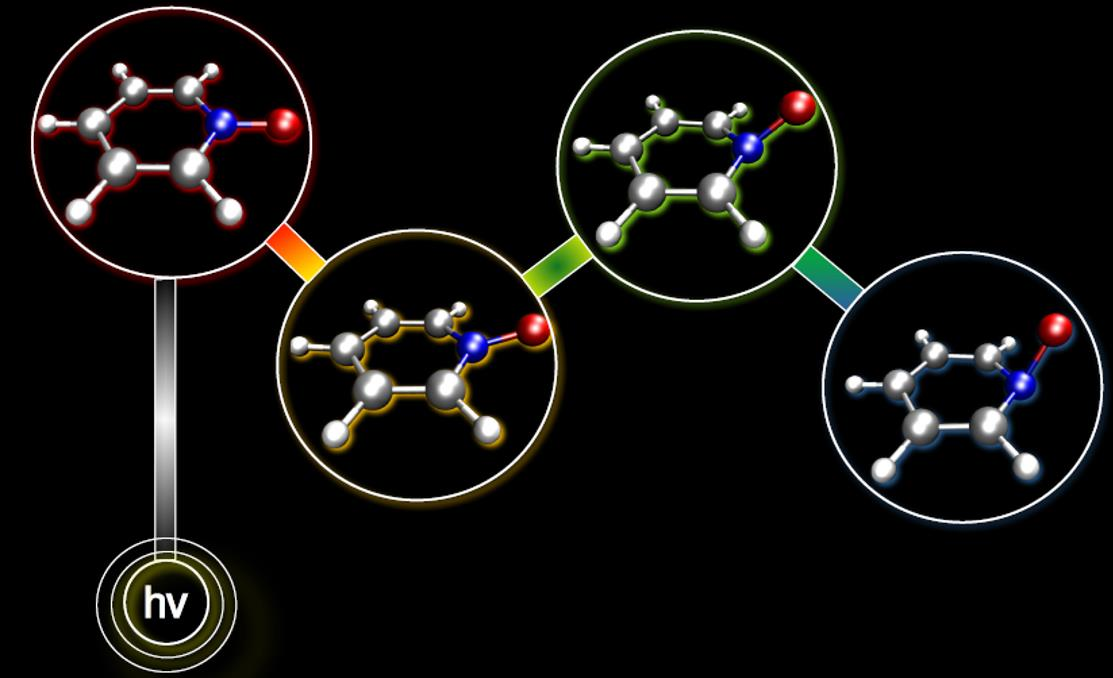
Photochemical Rearrangements of Pyridine N-Oxides: Pathways to Oxaziridine Derivatives

 , , ,
, , ,  , , , ,
  and
and
Abstract
1. Introduction
2. Results and Discussion
3. Materials and Methods
4. Conclusions
Supplementary Materials
Author Contributions
Funding
Institutional Review Board Statement
Informed Consent Statement
Data Availability Statement
Acknowledgments
Conflicts of Interest
References
- Poole, J.S. Recent advances in the photochemistry of heterocyclic N-oxides and their derivatives. In Heterocyclic N-Oxides; Springer: Berlin/Heidelberg, Germany, 2017; pp. 111–151. [Google Scholar]
- Xu, C.; Chen, Y.; Tang, D.; Li, X.; Xu, Z. Skeletal editing of pyridine for ring transformations. Green Synth. Catal. 2025; in press. [Google Scholar] [CrossRef]
- D’Auria, M.; Emanuele, L. The photochemical isomerization in pyridazine-N-oxide derivatives. Tetrahedron 2024, 164, 134173. [Google Scholar] [CrossRef]
- Basistyi, V.S.; Frederich, J.H. Pyridazine N-oxides as photoactivatable surrogates for reactive oxygen species. Org. Lett. 2022, 24, 1907–1912. [Google Scholar] [CrossRef] [PubMed]
- Beatty, J.W.; Douglas, J.J.; Miller, R.; McAtee, R.C.; Cole, K.P.; Stephenson, C.R. Photochemical perfluoroalkylation with pyridine N-oxides: Mechanistic insights and performance on a kilogram scale. Chem 2016, 1, 456–472. [Google Scholar] [CrossRef] [PubMed]
- Cai, C.Y.; Chen, S.J.; Merchant, R.R.; Kanda, Y.; Qin, T. C3 Selective Hydroxylation of Pyridines via Photochemical Valence Isomerization of Pyridine N-Oxides. J. Am. Chem. Soc. 2024, 146, 24257–24264. [Google Scholar] [CrossRef]
- Satheesh, V.; Deng, Y. Recent Advances in Synthetic Methods by Photocatalytic Single-Electron Transfer Chemistry of Pyridine N-Oxides. J. Org. Chem. 2024, 89, 11864–11874. [Google Scholar] [CrossRef]
- Singh, J.; Patel, R.I.; Sharma, A. Visible-Light-Mediated C-2 Functionalization and Deoxygenative Strategies in Heterocyclic N-Oxides. Adv. Synth. Catal. 2022, 364, 2289–2306. [Google Scholar] [CrossRef]
- Kjellberg, M.; Ohleier, A.; Thuéry, P.; Nicolas, E.; Anthore-Dalion, L.; Cantat, T. Photocatalytic deoxygenation of N–O bonds with rhenium complexes: From the reduction of nitrous oxide to pyridine N-oxides. Chem. Sci. 2021, 12, 10266–10272. [Google Scholar] [CrossRef]
- Güdük, R.; Kehl, N.; Stavagna, C.; Tilby, M.J.; Turner, O.; Ruffoni, A.; Caldora, H.P.; Leonori, D. A three-step strategy for the conversion of pyridines into benzonitriles. Nat. Synth. 2025, 4, 848–858. [Google Scholar] [CrossRef]
- Habib, I.; Singha, K.; Hossain, M. Recent Progress on Pyridine N-Oxide in Organic Transformations: A Review. ChemistrySelect 2023, 8, e202204099. [Google Scholar] [CrossRef]
- Albini, A.; Alpegiani, M. The photochemistry of the N-oxide function. Chem. Rev. 1984, 84, 43–71. [Google Scholar] [CrossRef]
- Lohse, C.; Hagedorn, L.; Albini, A.; Fasani, E. Photochemistry of pyridine n-oxides. Tetrahedron 1988, 44, 2591–2600. [Google Scholar] [CrossRef]
- Alkaitis, A.; Calvin, M. The photochemistry of pyridine N-oxide. Chem. Commun. 1968, 292–294. [Google Scholar] [CrossRef][Green Version]
- Harada, T.; Tajima, M.; Hoshino, M. Photochemical reactions of 1,10-phenanthroline N-oxide in solutions and mechanistic studies by DFT calculations. J. Photochem. Photobiol. A Chem. 2023, 435, 114336. [Google Scholar] [CrossRef]
- Ha, T.K. Ab initio SCF and CI study of the electronic spectrum of pyridine N-oxide. Theor. Chim. Acta 1977, 43, 337–349. [Google Scholar] [CrossRef]
- Seibold, K.; Wagnière, G.; Labhart, H. Zur Deutung des UV.-Spektrums von Pyridin-N-oxid. Helv. Chim. Acta 1969, 52, 789–796. [Google Scholar] [CrossRef]
- Kaneko, C.; Yamada, S.; Ishikawa, H. Irradiation of N-oxides of α-cyanoazanaphthalenes in an aprotic solvent. Tetrahedron Lett. 1966, 7, 2145–2150. [Google Scholar] [CrossRef]
- Yamada, S.; Ishikawa, M.; Kaneko, C. Photolysis of 2,7-dimethylacridine 10-oxide. Tetrahedron Lett. 1972, 13, 971–976. [Google Scholar] [CrossRef]
- Hurlow, E.E.; Lin, J.B.; Dweck, M.J.; Nuryyeva, S.; Feng, Z.; Allred, T.K.; Houk, K.; Harran, P.G. Photorearrangement of [8]-2,6-pyridinophane N-oxide. J. Am. Chem. Soc. 2020, 142, 20717–20724. [Google Scholar] [CrossRef]
- Boudry, E.; Bourdreux, F.; Marrot, J.; Moreau, X.; Ghiazza, C. Dearomatization of Pyridines: Photochemical Skeletal Enlargement for the Synthesis of 1,2-Diazepines. J. Am. Chem. Soc. 2024, 146, 2845–2854. [Google Scholar] [CrossRef]
- D’Auria, M.; Racioppi, R. The photochemical isomerization of 2-picoline N-oxide, 4,6-dimethylpyrimidine N-oxide and 2-methoxypyrimidine N-oxide. A DFT study. Tetrahedron 2025, 177, 134583. [Google Scholar] [CrossRef]
- Aloisi, G.G.; Favaro, G. Photorearrangement of quinoline 1-oxides: Relevance of ground and excited state basicity and effect of heavy atom quenchers. J. Chem. Soc. Perkin Trans. 1976, 2, 456–460. [Google Scholar] [CrossRef]
- Bellamy, F.; Martz, P.; Streith, J. Pyrimidine mono-n-oxide photochemistry (1,2). Tetrahedron Lett. 1974, 15, 3189–3192. [Google Scholar] [CrossRef]
- Gadzhiev, O.B.; Ignatov, S.K.; Krisyuk, B.E.; Maiorov, A.V.; Gangopadhyay, S.; Masunov, A.E. Quantum chemical study of the initial step of ozone addition to the double bond of ethylene. J. Phys. Chem. A 2012, 116, 10420–10434. [Google Scholar] [CrossRef]
- Kubas, A.; Hoffmann, F.; Heck, A.; Oberhofer, H.; Elstner, M.; Blumberger, J. Electronic couplings for molecular charge transfer: Benchmarking CDFT, FODFT, and FODFTB against high-level ab initio calculations. J. Chem. Phys. 2014, 140, 104105. [Google Scholar] [CrossRef]
- Park, J.W. Analytical gradient theory for quasidegenerate N-electron valence state perturbation theory (QD-NEVPT2). J. Chem. Theory Comput. 2019, 16, 326–339. [Google Scholar] [CrossRef]
- Dyumaev, K.; Vinogradova, N.; Lokhov, R.; Elinson, G. Absorption spectra of some pyridine and pyridine N-oxide derivatives in oleum. Chem. Heterocycl. Compd. 1973, 9, 888–890. [Google Scholar] [CrossRef]
- Jaffe, H. The Ultraviolet Absorption Spectra of Substituted Pyridine 1-Oxides and their Conjugate Acids. J. Am. Chem. Soc. 1955, 77, 4451–4453. [Google Scholar] [CrossRef]
- Herlocker, D.W.; Drago, R.S.; Meek, V.I. A study of the donor properties of 4-substituted pyridine N-oxides. Inorg. Chem. 1966, 5, 2009–2015. [Google Scholar] [CrossRef]
- Quagliano, J.; Fujita, J.; Franz, G.; Phillips, D.; Walmsley, J.; Tyree, S. The donor properties of pyridine N-oxide. J. Am. Chem. Soc. 1961, 83, 3770–3773. [Google Scholar] [CrossRef]
- Spence, G.G.; Taylor, E.C.; Buchardt, O. Photochemical reactions of azoxy compounds, nitrones, and aromatic amine N-oxides. Chem. Rev. 1970, 70, 231–265. [Google Scholar] [CrossRef]
- Wiley, R.H.; Slaymaker, S.C. Pyrimidine N-oxides and their infrared absorption characteristics. J. Am. Chem. Soc. 1957, 79, 2233–2236. [Google Scholar] [CrossRef]
- Domingo, L.R. A new C–C bond formation model based on the quantum chemical topology of electron density. RSC Adv. 2014, 4, 32415–32428. [Google Scholar] [CrossRef]
- Frisch, M.J.; Trucks, G.W.; Schlegel, H.B.; Scuseria, G.E.; Robb, M.A.; Cheeseman, J.R.; Scalmani, G.; Barone, V.; Petersson, G.A.; Nakatsuji, H.; et al. Gaussian 16, Revision B.01; Gaussian, Inc.: Wallingford, CT, USA, 2016. [Google Scholar]
- Neese, F. The ORCA program system. Wiley Interdiscip. Rev. Comput. Mol. Sci. 2012, 2, 73–78. [Google Scholar] [CrossRef]
- Malmqvist, P.Å.; Roos, B.O. The CASSCF state interaction method. Chem. Phys. Lett. 1989, 155, 189–194. [Google Scholar] [CrossRef]
- Dunning, T.H., Jr.; Hay, P.J. Gaussian basis sets for molecular calculations. In Methods of Electronic Structure Theory; Springer: Berlin/Heidelberg, Germany, 1977; Volume 3, pp. 1–27. [Google Scholar]
- Takano, Y.; Houk, K. Benchmarking the conductor-like polarizable continuum model (CPCM) for aqueous solvation free energies of neutral and ionic organic molecules. J. Chem. Theory Comput. 2005, 1, 70–77. [Google Scholar] [CrossRef]
- Jónsson, H.; Mills, G.; Jacobsen, K.W. Nudged elastic band method for finding minimum energy paths of transitions. In Classical and Quantum Dynamics in Condensed Phase Simulations; World Scientific: Singapore, 1998; pp. 385–404. [Google Scholar]
- Fukui, K. The path of chemical reactions-the IRC approach. Accounts Chem. Res. 1981, 14, 363–368. [Google Scholar] [CrossRef]
- Becke, A.D.; Edgecombe, K.E. A simple measure of electron localization in atomic and molecular systems. J. Chem. Phys. 1990, 92, 5397–5403. [Google Scholar] [CrossRef]
- Feixas, F.; Matito, E.; Duran, M.; Sola, M.; Silvi, B. Electron localization function at the correlated level: A natural orbital formulation. J. Chem. Theory Comput. 2010, 6, 2736–2742. [Google Scholar] [CrossRef]
- Silvi, B. How topological partitions of the electron distributions reveal delocalization. Phys. Chem. Chem. Phys. 2004, 6, 256–260. [Google Scholar] [CrossRef]
- Tsirelson, V.; Stash, A. Determination of the electron localization function from electron density. Chem. Phys. Lett. 2002, 351, 142–148. [Google Scholar] [CrossRef]
- Ayarde-Henríquez, L.; Guerra, C.; Duque-Noreña, M.; Rincón, E.; Pérez, P.; Chamorro, E. Are There Only Fold Catastrophes in the Diels–Alder Reaction Between Ethylene and 1, 3-Butadiene? J. Phys. Chem. A 2021, 125, 5152–5165. [Google Scholar] [CrossRef] [PubMed]
- Polo, V.; Andres, J.; Berski, S.; Domingo, L.R.; Silvi, B. Understanding reaction mechanisms in organic chemistry from catastrophe theory applied to the electron localization function topology. J. Phys. Chem. A 2008, 112, 7128–7136. [Google Scholar] [CrossRef] [PubMed]
- Berski, S.; Andrés, J.; Silvi, B.; Domingo, L.R. The joint use of catastrophe theory and electron localization function to characterize molecular mechanisms. a density functional study of the Diels-Alder reaction between ethylene and 1,3-butadiene. J. Phys. Chem. A 2003, 107, 6014–6024. [Google Scholar] [CrossRef]
- Guerra, C.; Ayarde-Henríquez, L.; Rodriguez-Nuñez, Y.A.; Chamorro, E.; Ensuncho, A.E. Mechanistic insights into benzyne formation via 1,2-di-iodobenzene photolysis. New J. Chem. 2023, 47, 21270–21275. [Google Scholar] [CrossRef]
- Guerra, C.; Ayarde-Henríquez, L.; Duque-Noreña, M.; Chamorro, E. Photochemically induced 1,3-butadiene ring-closure from the topological analysis of the electron localization function viewpoint. ChemPhysChem 2022, 23, e202200217. [Google Scholar] [CrossRef]
- Ayarde-Henríquez, L.; Lupi, J.; Dooley, S. Hemicellulose pyrolysis: Mechanism and kinetics of functionalized xylopyranose. Phys. Chem. Chem. Phys. 2024, 26, 12820–12837. [Google Scholar] [CrossRef]
- Ayarde-Henríquez, L.; Guerra, C.; Pérez, P.; Chamorro, E. Towards a unified fold-cusp model for bond polarity scaling: Electron rearrangements in the pyrolytic isomerization of cubane to cyclooctatetraene. J. Mol. Model. 2025, 31, 45. [Google Scholar] [CrossRef]
- Guerra, C.; Rodríguez-Núñez, Y.A.; Taborda-Martínez, M.E.; Bacho, M.; Miranda-Pastrana, R.; Ensuncho, A.E. Theoretical exploration of the 4π-photocyclization mechanism of α-tropone derivatives. New J. Chem. 2024, 48, 17633–17640. [Google Scholar] [CrossRef]




| System | Wavelength (nm) | Energy (eV) | Focs |
|---|---|---|---|
| NOx | 304 | 4.08 | 0.01 |
| NOx m-CH3 | 285 | 4.35 | 0.02 |
| NOx o-CH3 | 290 | 4.27 | 0.01 |
| NOx p-CH3 | 296 | 4.19 | 0.01 |
| NOx m-Cl | 301 | 4.11 | 0.01 |
| NOx o-Cl | 301 | 4.12 | 0.03 |
| NOx p-Cl | 318 | 3.90 | 0.01 |
| NOx m-NO2 | 327 | 3.79 | 0.03 |
| NOx o-NO2 | 296 | 4.19 | 0.03 |
| NOx p-NO2 | 290 | 4.27 | 0.02 |
| NOx m-OH | 286 | 4.33 | 0.03 |
| NOx o-OH | 278 | 4.46 | 0.04 |
| NOx p-OH | 324 | 3.82 | 0.04 |
| System | N-O (Å) | C-O (Å) | N-C (Å) | |
|---|---|---|---|---|
| R() | 1.24 | 2.27 | 1.36 | 0 |
| Int() | 1.29 | 2.31 | 1.38 | 0.02 |
| MECI() | 1.40 | 2.05 | 1.39 | 59.35 |
| P() | 1.38 | 1.59 | 1.42 | 53.80 |
| System | |||
|---|---|---|---|
| NOx | −7.00 | 11.04 | −36.05 |
| NOx-m-CH3 | −18.14 | 10.67 | −34.31 |
| NOx-o-CH3 | −21.92 | 13.60 | −31.45 |
| NOx-p-CH3 | −16.53 | 13.27 | −34.37 |
| NOx-m-Cl | −17.77 | 14.55 | −35.60 |
| NOx-o-Cl | −25.01 | 15.15 | −35.41 |
| NOx-p-Cl | −1.53 | 11.60 | −36.49 |
| NOx-m-NO2 | 6.08 | 10.50 | −35.71 |
| NOx-o-NO2 | −4.79 | 3.39 | −43.95 |
| NOx-p-NO2 | −3.48 | 4.11 | −41.62 |
| NOx-m-OH | −13.79 | 8.17 | −36.06 |
| NOx-o-OH | −33.79 | 15.98 | −37.37 |
| NOx-p-OH | −7.07 | 18.87 | −32.72 |
| System | Ethanol | Benzene | ||
|---|---|---|---|---|
| Nox | 4.2 | −10.8 | 4.2 | −10.4 |
| Nox-m-CH3 | 4.0 | −10.1 | 5.1 | −9.8 |
| Nox-o-CH3 | 3.6 | −10.9 | 3.9 | −11.5 |
| Nox-p-CH3 | 4.8 | −10.7 | 4.0 | −10.3 |
| Nox-m-Cl | 0.6 | −15.0 | 1.6 | −17.7 |
| Nox-o-Cl | 12.1 | −12.5 | 7.1 | −9.0 |
| Nox-p-Cl | 2.1 | −13.6 | 0.5 | −15.4 |
| Nox-m-NO2 | −12.2 | −15.6 | −1.8 | −24.1 |
| Nox-o-NO2 | −6.4 | −8.2 | −5.9 | −14.7 |
| Nox-p-NO2 | −6.5 | −16.7 | −4.8 | −8.2 |
| Nox-m-OH | 5.6 | −9.5 | 3.6 | −9.7 |
| Nox-o-OH | 7.2 | −11.5 | 5.3 | −8.9 |
| Nox-p-OH | 1.5 | −13.2 | 1.1 | −12.9 |
Disclaimer/Publisher’s Note: The statements, opinions and data contained in all publications are solely those of the individual author(s) and contributor(s) and not of MDPI and/or the editor(s). MDPI and/or the editor(s) disclaim responsibility for any injury to people or property resulting from any ideas, methods, instructions or products referred to in the content. |
© 2025 by the authors. Licensee MDPI, Basel, Switzerland. This article is an open access article distributed under the terms and conditions of the Creative Commons Attribution (CC BY) license (https://creativecommons.org/licenses/by/4.0/).
Share and Cite
Guerra, C.J.; Rodríguez-Núñez, Y.A.; Polo-Cuadrado, E.; Bacho, M.; Soto-Delgado, J.; Fuentes-Guerrero, V.B.; Torres-Olguín, E.I.; Fica-Cornejo, C.A.; Rodríguez-García, D.; Taborda-Martínez, M.E.; et al. Photochemical Rearrangements of Pyridine N-Oxides: Pathways to Oxaziridine Derivatives. Molecules 2025, 30, 4776. https://doi.org/10.3390/molecules30244776
Guerra CJ, Rodríguez-Núñez YA, Polo-Cuadrado E, Bacho M, Soto-Delgado J, Fuentes-Guerrero VB, Torres-Olguín EI, Fica-Cornejo CA, Rodríguez-García D, Taborda-Martínez ME, et al. Photochemical Rearrangements of Pyridine N-Oxides: Pathways to Oxaziridine Derivatives. Molecules. 2025; 30(24):4776. https://doi.org/10.3390/molecules30244776
Chicago/Turabian StyleGuerra, Cristian J., Yeray A. Rodríguez-Núñez, Efraín Polo-Cuadrado, Mitchell Bacho, Jorge Soto-Delgado, Victor B. Fuentes-Guerrero, Eduardo I. Torres-Olguín, Cristopher A. Fica-Cornejo, Daniela Rodríguez-García, Manuel E. Taborda-Martínez, and et al. 2025. "Photochemical Rearrangements of Pyridine N-Oxides: Pathways to Oxaziridine Derivatives" Molecules 30, no. 24: 4776. https://doi.org/10.3390/molecules30244776
APA StyleGuerra, C. J., Rodríguez-Núñez, Y. A., Polo-Cuadrado, E., Bacho, M., Soto-Delgado, J., Fuentes-Guerrero, V. B., Torres-Olguín, E. I., Fica-Cornejo, C. A., Rodríguez-García, D., Taborda-Martínez, M. E., Ayarde-Henríquez, L., & Ensuncho, A. E. (2025). Photochemical Rearrangements of Pyridine N-Oxides: Pathways to Oxaziridine Derivatives. Molecules, 30(24), 4776. https://doi.org/10.3390/molecules30244776