Bis-Iridoids: Occurrence, Chemophenetic Evaluation and Biological Activities—A Review

 ,
,  ,
, 
Abstract
1. Introduction
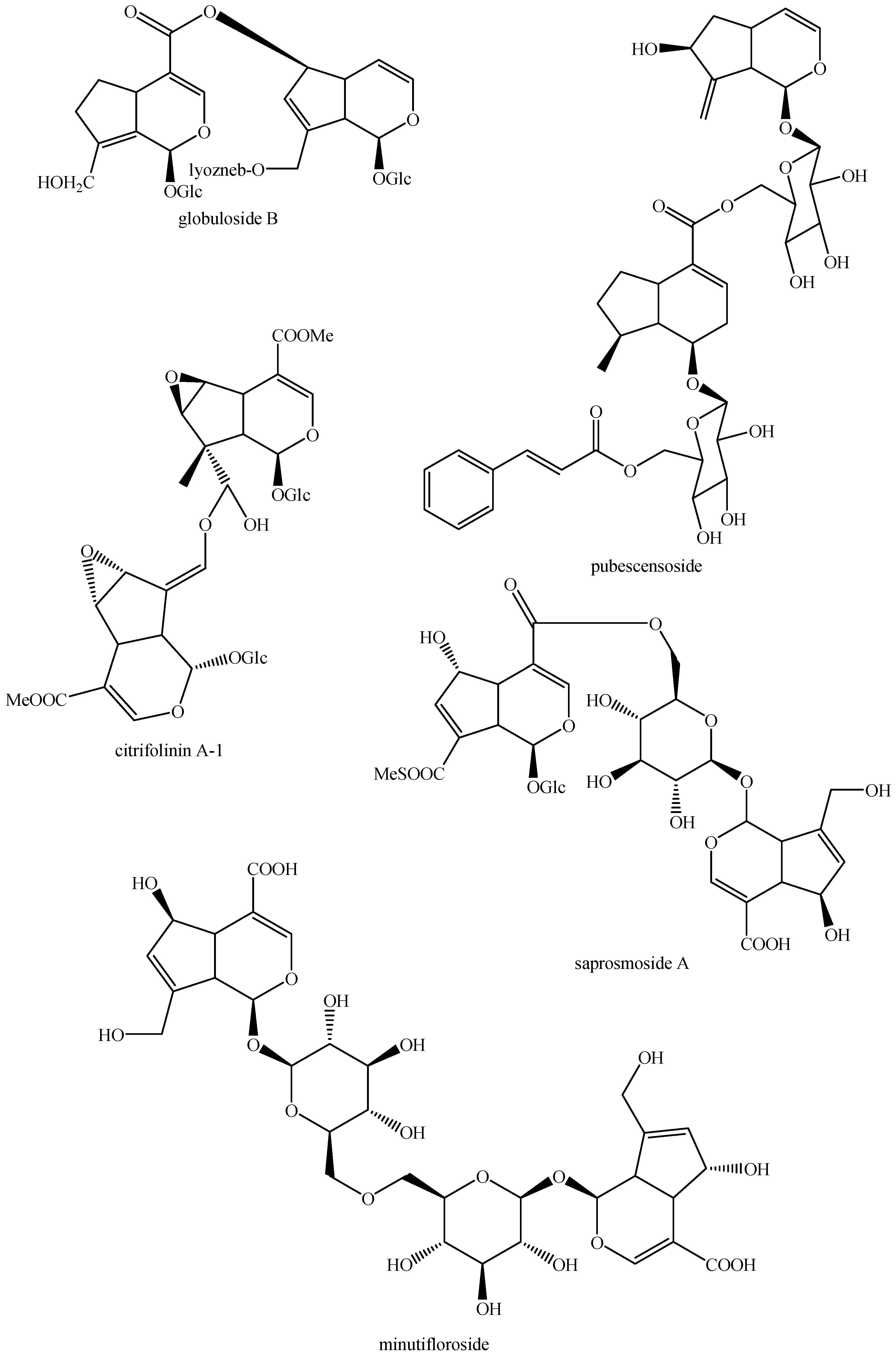
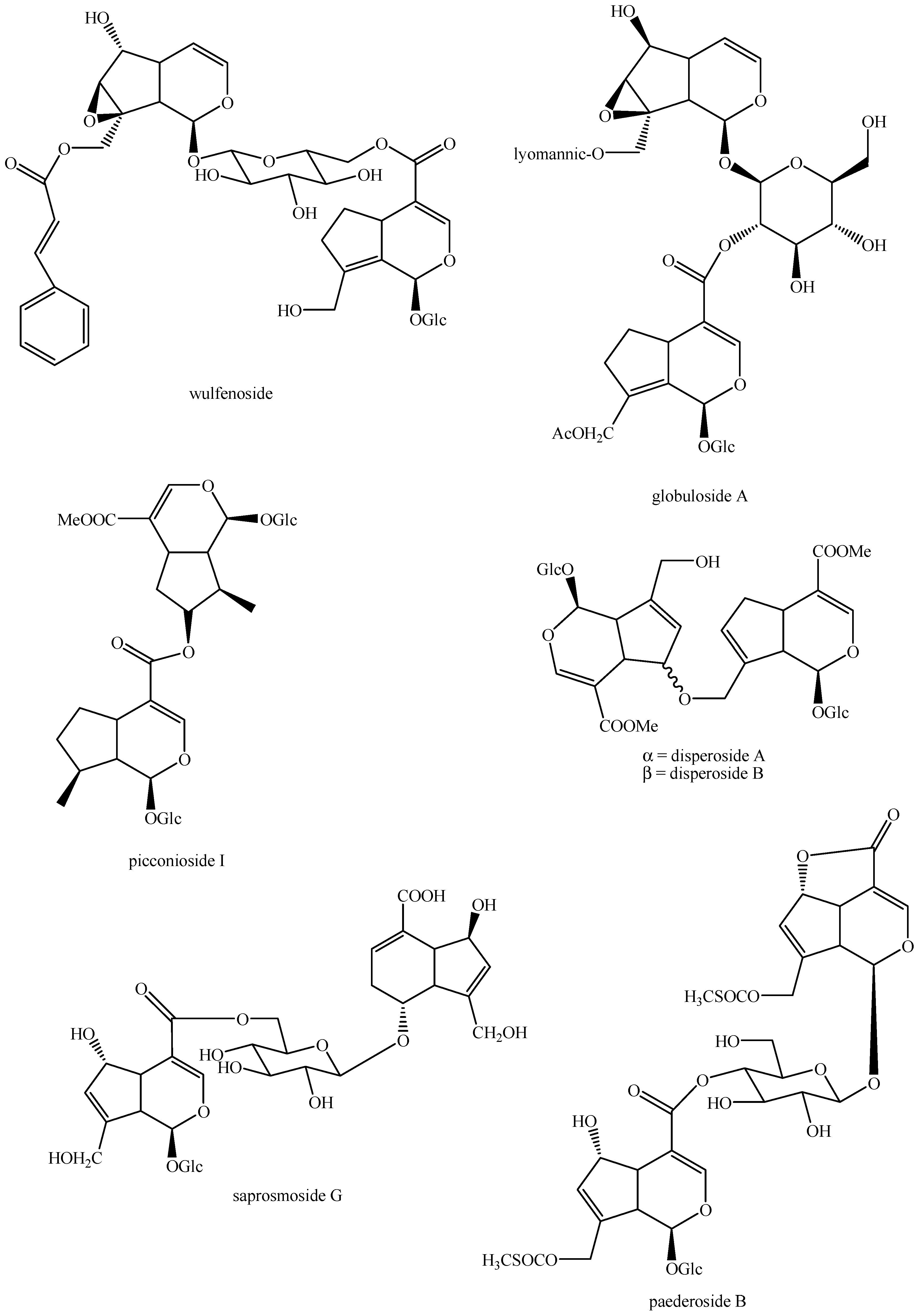
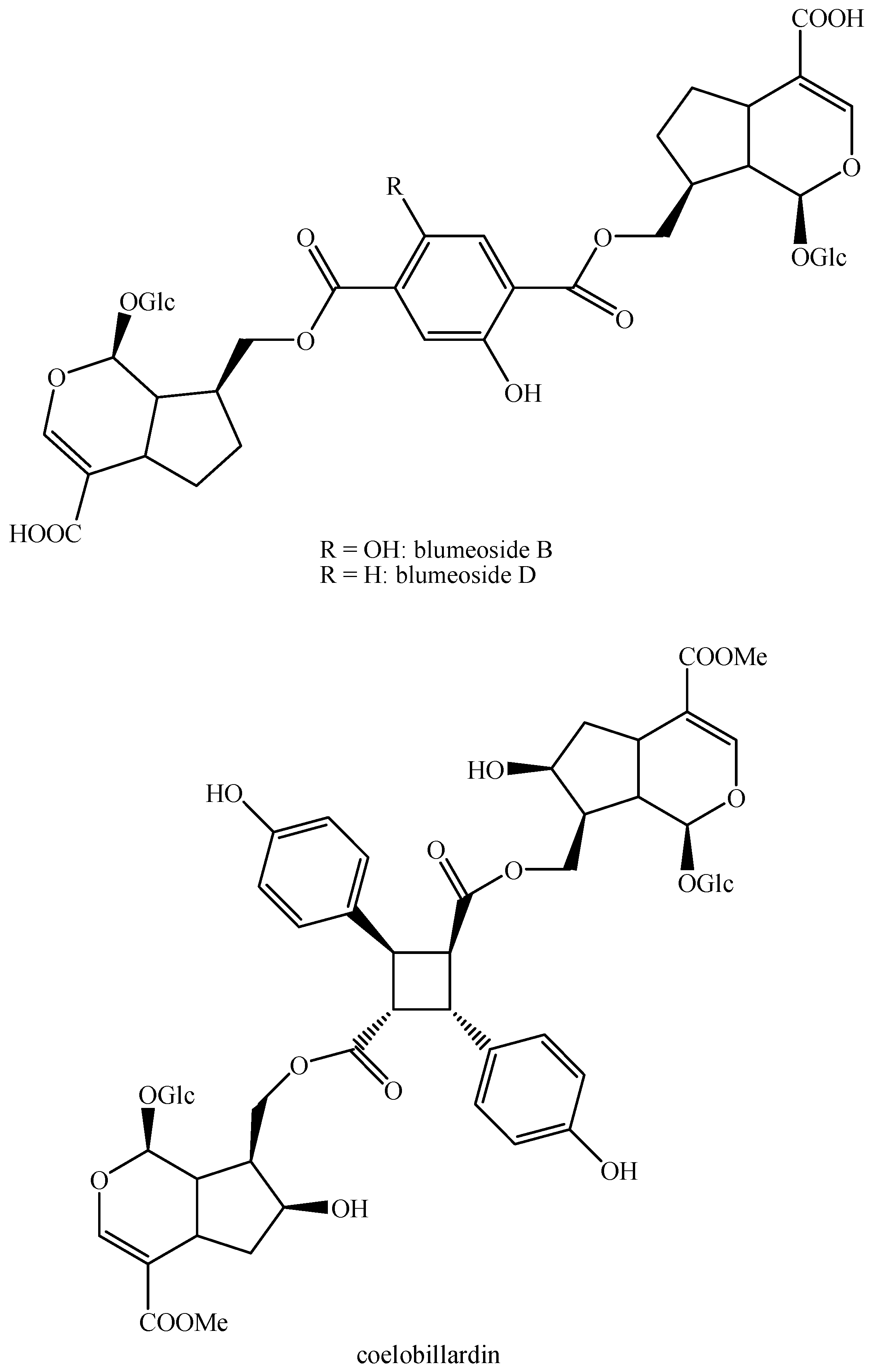
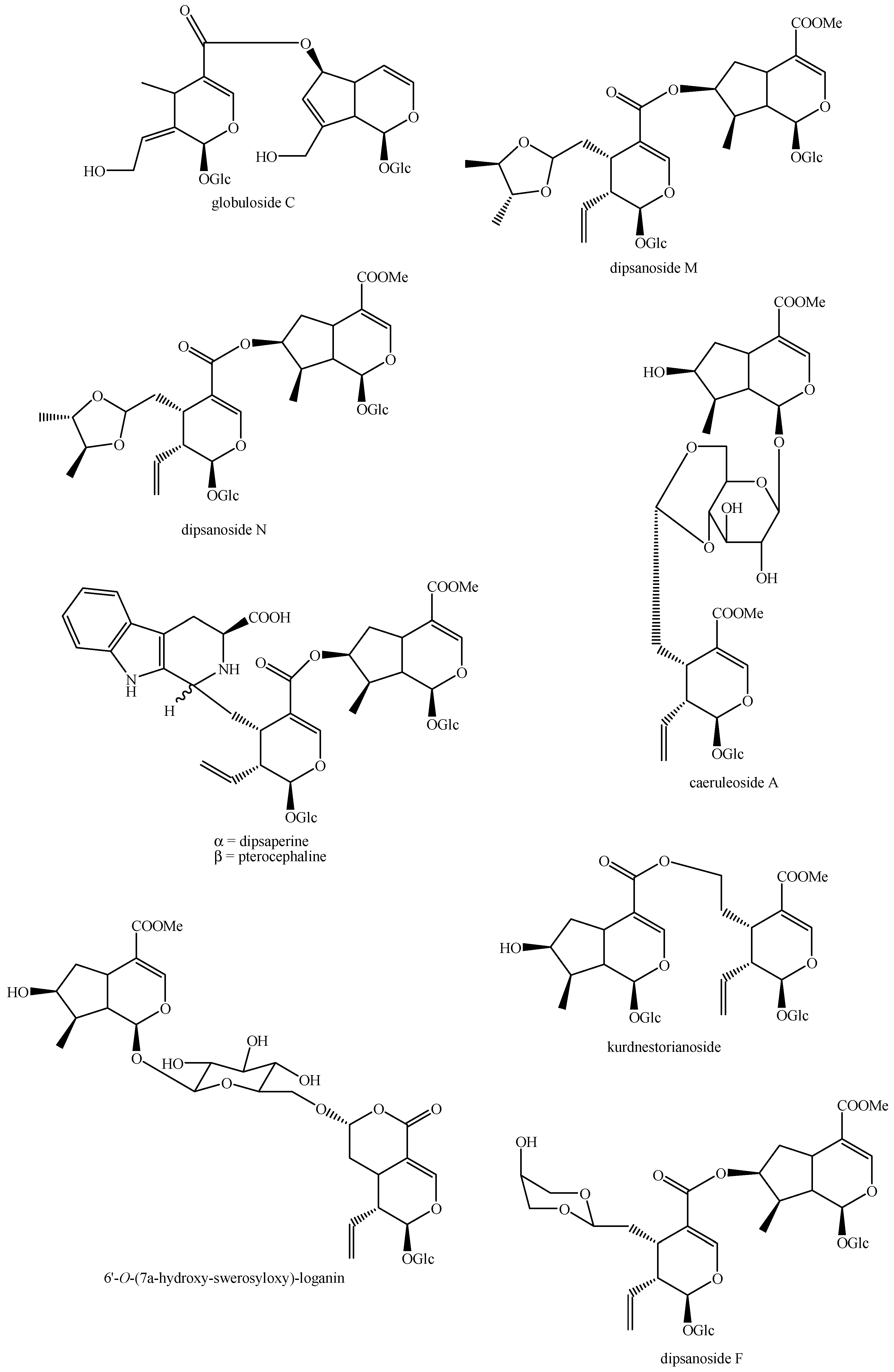
2. Occurrence of Bis-Iridoids in Plants
3. Chemophenetic Evaluation of Bis-Iridoids
4. Biological Activities of Bis-Iridoids
5. Conclusions
Author Contributions
Funding
Conflicts of Interest
References
- Bianco, A. The Chemistry of Iridoids. Stud. Nat. Prod. Chem. 1990, 7, 439–487. [Google Scholar]
- Dinda, B.; Debnath, S.; Harigaya, Y. Naturally occurring iridoids. A review, part 1. Chem. Pharm. Bull. 2007, 55, 159–222. [Google Scholar] [CrossRef] [Scilit] [PubMed]
- Dinda, B.; Debnath, S.; Harigaya, Y. Naturally occurring secoiridoids and bioactivity of naturally occurring iridoids and secoiridoids. A review, Part 2. Chem. Pharm. Bull. 2007, 55, 689–728. [Google Scholar] [CrossRef] [Scilit] [PubMed]
- Dinda, B.; Chowdhury, D.R.; Mohanta, B.C. Naturally occurring iridoids, secoiridoids and their bioactivity. An updated review, part 3. Chem. Pharm. Bull. 2009, 57, 765–796. [Google Scholar] [CrossRef] [Scilit] [PubMed]
- Dinda, B.; Debnath, S.; Banika, R. Naturally occurring iridoids and secoiridoids. An updated review, part 4. Chem. Pharm. Bull. 2011, 59, 803–833. [Google Scholar] [CrossRef] [Scilit] [PubMed]
- Inouye, H.; Uesato, S. Progress in the Chemistry of Organic Natural Products; Zechmeister, L., Herz, W., Eds.; Springer: New York, NY, USA, 1986; Volume 50, p. 169. [Google Scholar]
- Ghisalberti, E.L. Biological and pharmacological activity of naturally occurring iridoids and secoiridoids. Phytomedicine 1998, 5, 147–163. [Google Scholar] [CrossRef] [Scilit] [PubMed]
- Tundis, R.; Loizzo, M.R.; Menichini, F.; Statti, G.A.; Menichini, F. Biological and pharmacological activities of iridoids: Recent developments. Mini-Rev. Med. Chem. 2008, 8, 399–420. [Google Scholar] [CrossRef] [Scilit]
- Wang, C.; Gong, X.; Bo, A.; Zhang, L.; Zhang, M.; Zang, E.; Zhang, C.; Li, M. Iridoids: Research advances in their phytochemistry, biological activities, and pharmacokinetics. Molecules 2020, 25, 287. [Google Scholar] [CrossRef] [Scilit]
- Mao, X.-D.; Chou, G.-X.; Zhao, S.-M.; Zhang, C.-G. New iridoid glucosides from Caryopteris incana (Thunb.) Miq. and their α-glucosidase inhibitory activities. Molecules 2016, 21, 1749. [Google Scholar] [CrossRef] [Scilit]
- Tomassini, L.; Fddai, S.; Serafini, M.; Cometa, M.F. Bis-iridoid glucosides from Abelia chinensis. J. Nat. Prod. 2000, 63, 998–999. [Google Scholar] [CrossRef] [Scilit]
- Lehbili, M.; Magid, A.A.; Hubert, J.; Kabouche, A.; Voutquenne-Nazabadioko, L.; Renault, J.-H.; Nuzillard, J.-M.; Morjani, H.; Abedini, A.; Gangloff, S.C.; et al. Two new bis-iridoids isolated from Scabiosa stellata and their antibacterial, antioxidant, anti-tyrosinase and cytotoxic activities. Fitoterapia 2018, 125, 41–48. [Google Scholar] [CrossRef] [Scilit] [PubMed]
- Machida, K.; Sasaki, H.; Iijima, T.; Kikuchi, M. Studies on the constituents of Lonicera species. XVII. New iridoid glycosides of the stems and leaves of Lonicera japonica Thunb. Chem. Pharm. Bull. 2002, 50, 1041–1044. [Google Scholar] [CrossRef] [Scilit]
- Chulia, A.J.; Vercauterent, J.; Mariotte, A.M. Iridoids and flavones from Gentiana depressa. Phytochemistry 1996, 42, 139–143. [Google Scholar] [CrossRef] [Scilit]
- Liu, Z.-X.; Liu, C.-T.; Liu, Q.-B.; Ren, J.; Li, L.-Z.; Huang, X.-X.; Wang, Z.-Z.; Song, S.-J. Iridoid glycosides from the flower buds of Lonicera japonica and their nitric oxide production and α-glucosidase inhibitory activities. J. Funct. Foods 2015, 18, 512–519. [Google Scholar] [CrossRef] [Scilit]
- Yang, R.; Hao, H.; Li, J.; Xuan, J.; Xia, M.-F.; Zhang, Y.-Q. Three new secoiridoid glycosides from the flower buds of Lonicera japonica. Chin. J. Nat. Med. 2020, 18, 70–74. [Google Scholar] [PubMed]
- Zhang, J.; Huang, S.; Shan, L.; Chen, L.; Zhang, Y.; Zhou, X. New iridoid glucoside from Pterocephalus hookeri. Chin. J. Org. Chem. 2015, 35, 2441–2444. [Google Scholar] [CrossRef] [Scilit]
- Zhang, J.; Yu, X.; Yang, R.; Zheng, B.; Zhang, Y.; Zhang, F. Quality evaluation of Lonicerae Japonicae Flos from different origins based on high-performance liquid chromatography (HPLC) fingerprinting and multicomponent quantitative analysis combined with chemical pattern recognition. Phytochem. Anal. 2024, 35, 647–663. [Google Scholar] [CrossRef] [Scilit]
- Wang, Y.; Li, L.; Ji, W.; Liu, S.; Fan, J.; Lu, H.; Wang, X. Metabolomics analysis of different tissues of Lonicera japonica Thunb. based on liquid chromatography with mass spectrometry. Metabolites 2023, 13, 186. [Google Scholar] [CrossRef] [Scilit]
- Kang, K.B.; Kang, S.-J.; Kim, M.S.; Lee, D.Y.; Han, S.I.; Kim, T.B.; Park, J.Y.; Kim, J.; Yang, T.-J.; Sung, S.H. Chemical and genomic diversity of six Lonicera species occurring in Korea. Phytochemistry 2018, 155, 126–135. [Google Scholar] [CrossRef] [Scilit]
- Wan, J.; Jiang, C.-X.; Tang, Y.; Ma, G.-L.; Tong, Y.-P.; Jin, Z.-X.; Zang, Y.; Osman, E.E.A.; Li, J.; Xiong, J.; et al. Structurally diverse glycosides of secoiridoid, bisiridoid, and triterpene-bisiridoid conjugates from the flower buds of two Caprifoliaceae plants and their ATP-citrate lyase inhibitory activities. Bioorg. Chem. 2022, 120, 105630. [Google Scholar] [CrossRef] [Scilit]
- Murai, F.; Tagawa, M.; Matsuda, S.; Kikuchis, T.; Uesato, S.; Inouye, K. Abeliosides A And B, secoiridoid glucosides from Abelia grandiflora. Phytochemisty 1985, 24, 2329–2335. [Google Scholar] [CrossRef] [Scilit]
- Win, N.N.; Kodama, T.; Lae, K.Z.W.; Win, Y.Y.; Ngwe, H.; Abe, I.; Morita, H. Bis-iridoid and iridoid glycosides: Viral protein R inhibitors from Picrorhiza kurroa collected in Myanmar. Fitoterapia 2019, 134, 101–107. [Google Scholar] [CrossRef] [Scilit] [PubMed]
- Dong, Z.; Xiong, Y.; Zhang, R.; Qiu, Y.; Meng, F.; Liao, Z.; Lan, X.; Chen, M. Ptehosides A-I: Nine undescribed iridoids with in vitro cytotoxicity from the whole plant of Pterocephalus hookeri (C.B. Clarke) Höeck. Phytochemistry 2024, 223, 114144. [Google Scholar] [CrossRef] [Scilit] [PubMed]
- Itoh, A.; Fujii, K.; Tomatsu, S.; Takao, C.; Tanahashi, T.; Nagakura, N.; Chen, C.-C. Six secoiridoid glucosides from Adina racemosa. J. Nat. Prod. 2003, 66, 1212–1216. [Google Scholar] [CrossRef] [Scilit]
- Hu, J.-F.; Starks, C.M.; Williams, R.B.; Rice, S.M.; Norman, V.L.; Olson, K.M.; Hough, G.W.; Goering, M.G.; ONeil-Johnson, M.; Eldridge, G.R. Secoiridoid glycosides from the pitcher plant Sarracenia alata. Helv. Chim. Acta 2009, 92, 273–280. [Google Scholar] [CrossRef] [Scilit]
- Ghani, E.M.A.; El Sayed, A.M.; Tadros, S.H.; Soliman, F.M. Chemical and biological analysis of the bioactive fractions of the leaves of Scaevola taccada (Gaertn.) Roxb. Int. J. Pharma. Pharm. Sci. 2021, 13, 35–41. [Google Scholar] [CrossRef] [Scilit]
- Bianco, A.; Guiso, M.; Martino, M.; Nicoletti, M.; Serafini, M.; Tomassini, L.; Mossa, L.; Poli, F. Iridoids from endemic Sardinian Linaria species. Phytochemistry 1996, 42, 89–91. [Google Scholar] [CrossRef] [Scilit]
- Bianco, A.; Passacantilli, P.; Righi, G.; Nicoletti, M.; Serafini, M.; Garbarino, J.A.; Gambaro, V. Argylioside, a dimeric iridoid glucoside from Argylia radiata. Phytochemistry 1986, 25, 946–948. [Google Scholar] [CrossRef] [Scilit]
- Bianco, A.; Marini, E.; Nicoletti, M.; Foddai, S.; Garbarino, J.A.; Piovano, M.; Chamy, M.T. Bis-iridoid glucosides from the roots of Argylia radiata. Phytochemistry 1992, 31, 4203–4206. [Google Scholar] [CrossRef] [Scilit]
- Müller, A.A.; Kufer, K.K.; Dietl, K.G.; Weigend, M. A dimeric iridoid from Loasa acerifolia. Phytochemistry 1998, 49, 1705–1707. [Google Scholar] [CrossRef] [Scilit]
- Park, A.; Kim, H.J.; Lee, J.S.; Woo, E.-R.; Park, H.; Lee, Y.S. New iridoids from Asperula maximowiczii. J. Nat. Prod. 2002, 65, 1363–1366. [Google Scholar] [CrossRef] [Scilit] [PubMed]
- Xu, Y.; Zeng, J.; Wang, L.; Xu, Y.; He, X.; Wang, Y. Anti-inflammatory iridoid glycosides from Paederia scandens (Lour.) Merrill. Phytochemistry 2023, 212, 113705. [Google Scholar] [CrossRef] [Scilit] [PubMed]
- Kılınc, H.; Masullo, M.; Lauro, G.; D’Urso, G.; Alankus, O.; Bifulco, G.; Piacente, S. Scabiosa atropurpurea: A rich source of iridoids with α-glucosidase inhibitory activity evaluated by in vitro and in silico studies. Phytochemistry 2023, 205, 113471. [Google Scholar] [CrossRef] [Scilit] [PubMed]
- Benkrief, R.; Ranarivelo, Y.; Skaltsounis, A.-L.; Tillequin, F.; Koch, M.; Pusset, J.; Sévenet, T. Monoterpene alkaloids, iridoids and phenylpropanoid glycosides from Osmanthus ustrocaledonica. Phytochemistry 1998, 47, 825–832. [Google Scholar] [CrossRef] [Scilit]
- Itoh, A.; Tanaka, Y.; Nagakura, N.; Akita, T.; Nishi, T.; Tanahashi, T. Phenolic and iridoid glycosides from Strychnos axillaris. Phytochemistry 2008, 69, 1208–1214. [Google Scholar] [CrossRef] [Scilit]
- Cuendet, M.; Hostettmann, K.; Potterat, O.; Dyatmiko, W. Iridoid glucosides with free radical scavenging properties from Fagraea blumei. Helv. Chim. Acta 1997, 80, 1144–1152. [Google Scholar] [CrossRef] [Scilit]
- Machida, K.; Asano, J.; Kikuchi, M. Caeruleosides A and B, bis-iridoid glucosides from Lonicera caerulea. Phytochemistry 1995, 39, 111–1140. [Google Scholar] [CrossRef] [Scilit]
- Sévenet, T.; Thal, C.; Potier, P. Isolement et structure du cantleyoside: Nouveau glucoside terpénique de Cantleya corniculata (Becc.) Howard, (Icacinacées). Tetrahedron 1971, 27, 663–668. [Google Scholar] [CrossRef] [Scilit]
- Endo, T.; Sasaki, H.; Taguchi, M.H. Studies on the constituents of Scabiosa japonica Miq. Yakugaku Zasshi 1976, 96, 246–248. [Google Scholar] [CrossRef] [Scilit]
- Jensen, W.R.; Lyse-Petersen, S.E.; Nielsen, B.J. Novel bis-iridoid glucosides from Dipsacus sylvestris. Phytochemistry 1979, 18, 273–277. [Google Scholar] [CrossRef] [Scilit]
- Oszmiański, J.; Wojdyło, A.; Juszczyk, P.; Nowicka, P. Roots and leaf extracts of Dipsacus fullonum L. and their biological activities. Plants 2020, 9, 78. [Google Scholar] [CrossRef] [Scilit] [PubMed]
- Skaltsounis, A.L.; Sbahi, S.; Demetzos, C.; Pusset, J. Plants in New Caledonia. Iridoids from Scaevola montana Labill. Ann. Pharma. Franc. 1989, 47, 249–254. [Google Scholar]
- Skaltsounis, A.-L.; Tillequin, F.; Koch, M.; Pusset, J.; Chauvière, G. Iridoids from Scaevola racemigera. Planta Med. 1989, 55, 191–192. [Google Scholar] [CrossRef] [Scilit] [PubMed]
- Kocsis, Á.; Szabó, L.F.; Podanyi, B. New bis-iridoids from Dipsacus laciniatus. J. Nat. Prod. 1993, 56, 1486–1499. [Google Scholar] [CrossRef] [Scilit]
- Pasi, S.; Aligiannis, N.; Chinou, I.B.; Skaltsounis, A.L. Chemical constituents and their antimicrobial activity from the roots of Cephalaria ambrosioides. In Natural Products in the New Millennium: Prospects and Industrial Application; Proceedings of the Phytochemical Society of Europe; Rauter, A.P., Palma, F.B., Justino, J., Araújo, M.E., dos Santos, S.P., Eds.; Springer: Dordrecht, The Netherlands, 2002; Volume 47. [Google Scholar]
- Papalexandrou, A.; Magiatis, P.; Perdetzoglou, D.; Skaltsounis, A.-L.; Chinou, I.B.; Harvala, C. Iridoids from Scabiosa variifolia (Dipsacaceae) growing in Greece. Biochem. Syst. Ecol. 2003, 31, 91–93. [Google Scholar] [CrossRef] [Scilit]
- Tian, X.-Y.; Wang, Y.-H.; Liu, H.-Y.; Yu, S.-S.; Fang, W.-S. On the chemical constituents of Dipsacus asper. Chem. Pharm. Bull. 2007, 55, 1677–1681. [Google Scholar] [CrossRef] [Scilit] [PubMed]
- Ji, D.; Zhang, C.; Li, J.; Yang, H.; Shen, J.; Yang, Z. A new iridoid glycoside from the roots of Dipsacus asper. Molecules 2012, 17, 1419–1424. [Google Scholar] [CrossRef] [Scilit] [PubMed]
- Li, F.; Tanaka, K.; Watanabe, S.; Tezuka, Y.; Saiki, I. Dipasperoside A, a novel pyridine alkaloid-coupled iridoid glucoside from the roots of Dipsacus asper. Chem. Pharm. Bull. 2013, 61, 1318–1322. [Google Scholar] [CrossRef] [Scilit]
- Ling, T.; Liu, K.; Zhang, Q.; Liao, L.; Lu, Y. High performance liquid chromatography coupled to electrospray ionization and quadrupole time-of-flight–mass spectrometry as a powerful analytical strategy for systematic analysis and improved characterization of the major bioactive constituents from Radix Dipsaci. J. Pharma. Biomed. Anal. 2014, 98, 120–129. [Google Scholar]
- Sun, X.; Zhang, Y.; Yang, Y.; Liu, J.; Zheng, W.; Ma, B.; Guo, B. Qualitative and quantitative analysis of furofuran lignans, iridoid glycosides, and phenolic acids in Radix Dipsaci by UHPLC-Q-TOF/MS and UHPLC-PDA. J. Pharma. Biomed. Anal. 2018, 154, 40–47. [Google Scholar] [CrossRef] [Scilit] [PubMed]
- Itoh, A.; Oya, N.; Kawaguchi, E.; Nishio, S.; Tanaka, Y.; Kawachi, E.; Akita, T.; Nishi, T.; Tanahashi, T. Secoiridoid glucosides from Strychnos spinosa. J. Nat. Prod. 2005, 68, 1434–1436. [Google Scholar] [CrossRef] [Scilit] [PubMed]
- Itoh, A.; Tanaka, Y.; Nagakura, N.; Nishi, T.; Tanahashi, T. A quinic acid ester from Strychnos lucida. J. Nat. Med. 2006, 60, 146–148. [Google Scholar] [CrossRef] [Scilit]
- Gülcemal, D.; Masullo, M.; Alankuş, O.; Ïkan, Ç.; Karayıldırım, T.; Şenol, S.G.; Piacente, S.; Bedir, E. Monoterpenoid glucoindole alkaloids and iridoids from Pterocephalus pinardii. Magn. Reson. Chem. 2010, 48, 239–243. [Google Scholar] [CrossRef] [Scilit] [PubMed]
- Mustafayeva, K.; Mahiou-Leddet, V.; Suleymanov, T.; Kerimov, Y.; Ollivier, E.; Elias, R. Chemical constituents from the roots of Cephalaria kotschyi. Chem. Nat. Compd. 2011, 47, 839–842. [Google Scholar] [CrossRef] [Scilit]
- Garaev, E.E.; Mahiou-Leddet, V.; Mabrouki, F.; Herbette, G.; Garaev, E.A.; Ollivier, E. Chemical constituents from roots of Cephalaria media. Chem. Nat. Compd. 2014, 50, 756–758. [Google Scholar] [CrossRef] [Scilit]
- Wu, Y.; Yin, Y.; Li, Y.; Guo, F.; Zhu, G. Secoiridoid/iridoid subtype bis-iridoids from Pterocephalus hookeri. Magn. Reson. Chem. 2014, 52, 734–738. [Google Scholar] [CrossRef] [Scilit]
- Chen, Y.; Yu, H.; Guo, F.; Wu, Y.; Li, Y. Antinociceptive and anti-inflammatory activities of a standardized extract of bis-iridoids from Pterocephalus hookeri. J. Ethnopharmacol. 2018, 216, 233–238. [Google Scholar] [CrossRef] [Scilit]
- Li, G.-Q.; Sheng, D.-L. Chemical constituents from Pterocephalus hookeri and their neuroprotection activities. Chin. Trad. Pat. Med. 2018, 12, 1329–1335. [Google Scholar]
- Huang, S.; Zhang, J.; Shan, L.; Zhang, Y.; Zhou, X. A novel tetrairidoid glucoside from Pterocephalus hookeri. Heterocycles 2017, 94, 485–491. [Google Scholar]
- Guo, C.; Wu, Y.; Zhu, Y.; Wang, Y.; Tian, L.; Lu, Y.; Han, C.; Zhu, G. In vitro and in vivo antitumor effects of n-butanol extracts of Pterocephalus hookeri on Hep3B cancer cell. Evid.-Based Complement. Altern. Med. 2015, 2015, 159132. [Google Scholar]
- Shen, X.-F.; Zeng, Y.; Li, J.-C.; Tang, C.; Zhang, Y.; Meng, X.-L. The anti-arthritic activity of total glycosides from Pterocephalus hookeri, a traditional Tibetan herbal medicine. Pharma. Biol. 2017, 55, 560–570. [Google Scholar] [CrossRef] [Scilit] [PubMed]
- Tang, C.; Li, H.-J.; Fan, G.; Kuang, T.-T.; Meng, X.-L.; Zou, Z.-M.; Zhang, Y. Network pharmacology and UPLC-Q-TOF/MS studies on the anti-arthritic mechanism of Pterocephalus hookeri. Tropic. J. Pharma. Res. 2018, 17, 1095–1110. [Google Scholar] [CrossRef] [Scilit]
- Wang, W.-X.; Luo, S.-Y.; Wang, Y.; Xiang, L.; Liu, X.-H.; Tang, C.; Zhang, Y. Pterocephanoside A, a new iridoid from a traditional Tibetan medicine, Pterocephalus hookeri. J. Asian Nat. Prod. Res. 2021, 23, 1189–1196. [Google Scholar] [CrossRef] [Scilit] [PubMed]
- Zeng, Z.; Sun, Z.; Wu, C.-Y.; Long, F.; Shen, H.; Zhou, J.; Li, S.-L. Quality evaluation of Pterocephali Herba through simultaneously quantifying 18 bioactive components by UPLC-TQ-MS/MS analysis. J. Pharma. Biomed. Anal. 2024, 238, 115828. [Google Scholar] [CrossRef] [Scilit] [PubMed]
- Abdullah, F.O.; Hussain, F.H.S.; Clericuzio, M.; Porta, A.; Vidari, G. New iridoid dimer and other constituents from the traditional Kurdish plant Pterocephalus nestorianus Nábelek. Chem. Biodivers. 2017, 14, e1600281. [Google Scholar] [CrossRef] [Scilit]
- Polat, E.; Alankus-Caliskan, Ö.; Karayildirim, T.; Bedir, E. Iridoids from Scabiosa atropurpurea L. subsp. maritima Arc. (L.). Biochem. Syst. Ecol. 2010, 38, 253–255. [Google Scholar] [CrossRef] [Scilit]
- Ben Toumia, I.; Sobeh, M.; Ponassi, M.; Banelli, B.; Dameriha, A.; Wink, M.; Chekir Ghedira, L.; Rosano, C. A methanol extract of Scabiosa atropurpurea enhances doxorubicin cytotoxicity against resistant colorectal cancer cells in vitro. Molecules 2020, 25, 5265. [Google Scholar] [CrossRef] [Scilit]
- Graikou, K.; Aligiannis, N.; Chinou, I.B.; Harvala, C. Cantleyoside-dimethyl-acetal and other iridoid glucosides from Pterocephalus perennis and antimicrobial activities. Z. Naturforsch. C 2002, 57, 95–99. [Google Scholar] [CrossRef] [Scilit]
- Takagi, S.; Yamaki, M.; Yumioka, E.; Nishimura, T.; Sakina, K. Studies on the constituents of Erythraea centaurium (Linne) Persoon. 2. The structure of centauroside, a new bis-secoiridoid glucoside. Yakugaku Zasshi 1982, 102, 313–317. [Google Scholar] [CrossRef] [Scilit]
- Ryuk, J.A.; Lee, H.W.; Ko, B.S. Discrimination of Lonicera japonica and Lonicera confusa using chemical analysis and genetic marker. Kor. J. Herbol. 2012, 7, 15–21. [Google Scholar] [CrossRef] [Scilit]
- Cai, Z.; Liao, H.; Wang, C.; Chen, J.; Tan, M.; Mei, Y.; Wei, L.; Chen, H.; Yang, R.; Liu, X. A comprehensive study of the aerial parts of Lonicera japonica Thunb. based on metabolite profiling coupled with PLS-DA. Phytochem. Anal. 2020, 31, 786–800. [Google Scholar] [CrossRef] [Scilit]
- Song, Y.; Li, S.-L.; Wu, M.-H.; Li, H.-J.; Li, P. Qualitative and quantitative analysis of iridoid glycosides in the flower buds of Lonicera species by capillary high performance liquid chromatography coupled with mass spectrometric detector. Anal. Chim. Acta 2006, 564, 211–218. [Google Scholar] [CrossRef] [Scilit]
- Chen, J.; Song, Y.; Li, P. Capillary high-performance liquid chromatography with mass spectrometry for simultaneous determination of major flavonoids, iridoid glucosides and saponins in Flos Lonicerae. J. Chromatogr. A 2007, 1157, 217–226. [Google Scholar] [CrossRef] [Scilit]
- Ren, M.-T.; Chen, J.; Song, Y.; Sheng, L.-S.; Li, P.; Qi, L.-W. Identification and quantification of 32 bioactive compounds in Lonicera species by high performance liquid chromatography coupled with time-of-flight mass spectrometry. J. Pharma. Biomed. Anal. 2008, 48, 1351–1360. [Google Scholar] [CrossRef] [Scilit] [PubMed]
- Chen, C.-Y.; Qi, L.-W.; Li, H.-Y.; Li, P.; Yi, L.; Ma, H.-L.; Tang, D. Simultaneous determination of iridoids, phenolic acids, flavonoids, and saponins in Flos Lonicerae and Flos Lonicerae Japonicae by HPLC-DAD-ELSD coupled with principal component analysis. J. Sep. Sci. 2007, 30, 3181–3192. [Google Scholar] [CrossRef] [Scilit] [PubMed]
- Qian, Z.-M.; Li, H.-J.; Li, P.; Ren, M.-T.; Tang, D. Simultaneous qualitation and quantification of thirteen bioactive compounds in Flos Lonicerae by High-Performance Liquid Chromatography with Diode Array Detector and Mass Spectrometry. Chem. Pharm. Bull. 2007, 55, 1073–1076. [Google Scholar] [CrossRef] [Scilit] [PubMed]
- Ryu, S.; Jeon, J.-E.; Kang, G.W.; Kang, S.S.; Shin, J. Simultaneous analysis of bioactive metabolites from Lonicera japonica flower buds by HPLC-DAD-MS/MS. Yakhak Hoeji 2008, 52, 446–451. [Google Scholar]
- Lee, E.-J.; Lee, J.-Y.; Kim, J.-S.; Kang, S.-S. Phytochemical studies on Lonicerae flos (1)-isolation of iridoid glycosides and other constituents. Nat. Prod. Sci. 2010, 16, 32–38. [Google Scholar]
- Qi, J.; Chen, Y.-H.; Wang, Y.; Chen, X.; Wang, L.; Hu, Y.-J.; Yu, B.-Y. Screening of peroxynitrite scavengers in Flos Lonicerae by using two new methods, an HPLC-DAD-CL technique and a peroxynitrite spiking test followed by HPLC-DAD analysis. Phytochem. Anal. 2016, 27, 57–63. [Google Scholar] [CrossRef] [Scilit]
- Gu, L.; Xie, X.; Wang, B.; Jin, Y.; Wang, L.; Yin, G.; Wang, J.; Bi, K.; Wang, T. Chemical pattern recognition for quality analysis of Lonicerae Japonicae Flos and Lonicerae Flos based on ultra-high performance liquid chromatography and anti-SARS-CoV2 main protease activity. Front. Pharmacol. 2022, 12, 810748. [Google Scholar] [CrossRef] [Scilit]
- Li, R.-J.; Kuang, X.-P.; Wang, W.-J.; Wan, C.-P.; Li, W.-X. Comparison of chemical constitution and bioactivity among different parts of Lonicera japonica Thunb. J. Sci. Food Agric. 2020, 100, 614–622. [Google Scholar] [CrossRef] [Scilit] [PubMed]
- Zhao, H.; Laib, C.; Zhang, M.; Zhou, S.; Liu, Q.; Wang, D.; Geng, Y.; Wang, X. An improved 2D-HPLC-UF-ESI-TOF/MS approach for enrichment and comprehensive characterization of minor neuraminidase inhibitors from Flos Lonicerae Japonicae. J. Pharma. Biomed. Anal. 2019, 175, 112758. [Google Scholar] [CrossRef] [Scilit] [PubMed]
- Zhang, X.; Yu, X.; Sun, X.; Meng, X.; Fan, J.; Zhang, F.; Zhang, Y. Comparative study on chemical constituents of different medicinal parts of Lonicera japonica Thunb. based on LC-MS combined with multivariate statistical analysis. Heliyon 2024, 10, e31722. [Google Scholar] [CrossRef] [Scilit] [PubMed]
- Ye, J.; Su, J.; Chen, K.; Liu, H.; Yang, X.; He, Y.; Zhang, W. Comparative investigation on chemical constituents of flower bud, stem and leaf of Lonicera japonica Thunb. by HPLC–DAD–ESI–MS/MSn and GC–MS. J. Anal. Chem. 2014, 69, 777–784. [Google Scholar] [CrossRef] [Scilit]
- Zidorn, C.; Ellmerer, E.P.; Ziller, A.; Stuppner, H. Occurence of (E)-aldosecologanin in Kissenia capensis (Loasaceae). Biochem. Syst. Ecol. 2004, 32, 761–763. [Google Scholar] [CrossRef] [Scilit]
- Chai, X.; Su, Y.-F.; Zheng, Y.-H.; Yan, S.-L.; Zhang, X.; Gao, X.-M. Iridoids from the roots of Triosteum pinnatifidum. Biochem. Syst. Ecol. 2010, 38, 210–212. [Google Scholar] [CrossRef] [Scilit]
- Ding, Z.; Liu, Y.; Ruan, J.; Yang, S.; Yu, H.; Chen, M.; Zhang, Y.; Wang, T. Bioactive constituents from the whole plants of Gentianella acuta (Michx.) Hulten. Molecules 2017, 22, 1309. [Google Scholar] [CrossRef] [Scilit] [PubMed]
- Akşit, H.; Gozcü, S.; Altay, A. Isolation and cytotoxic activities of undescribed iridoid and xanthone glycosides from Centaurium erythraea Rafn. (Gentianaceae). Phytochemistry 2023, 205, 113484. [Google Scholar] [CrossRef] [Scilit]
- Wang, Y.; Wei, Q.; Yang, L.; Liu, Z.-L. Iridoid glucosides from Chinese herb Lonicera chrysatha and their antitumor activity. J. Chem. Res. 2003, 676–677. [Google Scholar] [CrossRef] [Scilit]
- Sang, S.; Liu, G.; He, K.; Zhu, N.; Dong, Z.; Zheng, Q.; Rosen, R.T.; Ho, C.-T. New unusual iridoids from the leaves of noni (Morinda citrifolia L.) show inhibitory effect on ultraviolet B-induced transcriptional activator protein-1 (AP-1) activity. Bioorg. Med. Chem. 2003, 11, 2499–2502. [Google Scholar] [CrossRef] [Scilit]
- Sunghwa, F.; Koketsu, M. Phenolic and bis-iridoid glycosides from Strychnos cocculoides. Nat. Prod. Res. 2009, 23, 1408–1415. [Google Scholar] [CrossRef] [Scilit] [PubMed]
- Yu, Z.-P.; Wang, Y.-Y.; Yu, S.-J.; Bao, J.; Yu, J.-H.; Zhang, H. Absolute structure assignment of an iridoid-monoterpenoid indole alkaloid hybrid from Dipsacus asper. Fitoterapia 2019, 135, 99–106. [Google Scholar] [CrossRef] [Scilit] [PubMed]
- Magiatis, P.; Skaltsounis, A.-L.; Tillequin, F.; Seguin, E.; Cosson, J.-P. Coelobillardin, an iridoid glucoside dimer from Coelospermum billardieri. Phytochemistry 2002, 60, 415–418. [Google Scholar] [CrossRef] [Scilit] [PubMed]
- Gao, R.-R.; Liu, Z.-F.; Yang, X.-F.; Song, Y.-L.; Cui, X.-Y.; Yang, J.-Y.; Lu, C.-H.; Shen, Y.-M. Specialised metabolites as chemotaxonomic markers of Coptosapelta diffusa, supporting its delimitation as sisterhood phylogenetic relationships with Rubioideae. Phytochemistry 2021, 192, 112929. [Google Scholar] [CrossRef] [Scilit]
- Hao, Z.-Y.; Wang, X.-L.; Yang, M.; Cao, B.; Zeng, M.-N.; Zhou, S.-Q.; Li, M.; Cao, Y.-G.; Xie, S.-S.; Zheng, X.-K.; et al. Minor iridoid glycosides from the fruits of Cornus officinalis Sieb. et Zucc. and their anti-diabetic bioactivities. Phytochemistry 2023, 205, 113505. [Google Scholar] [CrossRef] [Scilit]
- Peng, Z.-C.; He, J.; Pan, X.-G.; Zhang, J.; Wang, Y.-M.; Ye, X.-S.; Xia, C.-Y.; Lian, W.-W.; Yan, Y.; He, X.-L.; et al. Secoiridoid dimers and their biogenetic precursors from the fruits of Cornus officinalis with potential therapeutic effects on type 2 diabetes. Bioorg. Chem. 2021, 117, 105399. [Google Scholar] [CrossRef] [Scilit]
- Ye, X.-S.; He, J.; Cheng, Y.-C.; Zhang, L.; Qiao, H.-Y.; Pan, X.-G.; Zhang, J.; Liu, S.-N.; Zhang, W.-K.; Xu, J.-K. Cornusides A−O, bioactive iridoid glucoside dimers from the fruit of Cornus officinalis. J. Nat. Prod. 2017, 80, 3103–3111. [Google Scholar] [CrossRef] [Scilit]
- Yang, M.; Hao, Z.; Wang, X.; Zhou, S.; Xiao, C.; Zhu, D.; Yang, Y.; Wei, J.; Zheng, X.; Feng, W. Four undescribed iridoid glycosides with antidiabetic activity from fruits of Cornus officinalis Sieb. Et Zucc. Fitoterapia 2023, 165, 105393. [Google Scholar] [CrossRef] [Scilit]
- Wang, F.; Chi, J.; Guo, H.; Wang, J.; Wang, P.; Li, Y.-X.; Wang, Z.-M.; Dai, L.-P. Revealing the effects and mechanism of wine processing on Corni Fructus using chemical characterization integrated with multi-dimensional analyses. J. Chromatogr. A 2024, 1730, 465100. [Google Scholar] [CrossRef] [Scilit]
- Gallo, F.R.; Palazzino, G.; Federici, E.; Iurilli, R.; Delle Monache, F.; Chifundera, K.; Galeffi, C. Oligomeric secoiridoid glucosides from Jasminum abyssinicum. Phytochemistry 2006, 67, 504–510. [Google Scholar] [CrossRef] [Scilit]
- Dudek, M.K.; Michalak, B.; Woźniak, M.; Czerwińska, M.E.; Filipek, A.; Granica, S.; Kiss, A.K. Hydroxycinnamoyl derivatives and secoiridoid glycoside derivatives from Syringa vulgaris flowers and their effects on the pro-inflammatory responses of human neutrophils. Fitoterapia 2017, 121, 194–205. [Google Scholar] [CrossRef] [Scilit] [PubMed]
- Chulia, A.J.; Vercauterent, J.; Mariotte, A.M. Depresteroside, A mixed iridoid-secoiridoid structure from Gentiana depressa. Phytochemistry 1994, 36, 377–382. [Google Scholar] [CrossRef] [Scilit]
- Kırmızıbekmez, H.; Kúsz, N.; Bérdi, P.; Zupkó, I.; Hohmann, J. New iridoids from the roots of Valeriana dioscoridis Sm. Fitoterapia 2018, 130, 73–78. [Google Scholar] [CrossRef] [Scilit] [PubMed]
- Duan, X.-Y.; Ai, L.-Q.; Qian, C.-Z.; Zhang, M.-D.; Mei, R.-Q. The polymer iridoid glucosides isolated from Dipsacus asper. Phytochem. Lett. 2019, 33, 17–21. [Google Scholar] [CrossRef] [Scilit]
- Sun, X.; Ma, G.; Zhang, D.; Huang, W.; Ding, G.; Hu, H.; Tu, G.; Guo, B. New lignans and iridoid glycosides from Dipsacus asper Wall. Molecules 2015, 20, 2165–2175. [Google Scholar] [CrossRef] [Scilit]
- Li, F.; Nishidono, Y.; Tanaka, K.; Watanabe, A.; Tezuk, Y. A new monoterpenoid glucoindole alkaloid from Dipsacus asper. Nat. Prod. Comm. 2020, 15, 1934578X20917292. [Google Scholar] [CrossRef] [Scilit]
- Cao, Y.G.; Ren, Y.-J.; Liu, Y.-L.; Wang, M.-N.; He, C.; Chen, X.; Fan, X.-L.; Zhang, Y.-L.; Hao, Z.-Y.; Li, H.-W.; et al. Iridoid glycosides and lignans from the fruits of Gardenia jasminoides Eills. Phytochemistry 2021, 190, 112893. [Google Scholar] [CrossRef] [Scilit] [PubMed]
- Cambie, R.C.; Rutledge, P.S.; Wellington, K.D. Chemistry of Fijian plants. 13.1 Floribundal, a nonglycosidic bisiridoid, and six novel fatty esters of δ-amyrin from Scaevola floribunda. J. Nat. Prod. 1997, 60, 1303–1306. [Google Scholar] [CrossRef] [Scilit]
- He, Z.-D.; Ueda, S.; Inoue, K.; Akaji, M.; Fujita, T.; Yang, C.-R. Secoiridoid glucosides from Fraxinus malacophylla. Phytochemistry 1994, 35, 177–181. [Google Scholar]
- Guo, J.; Liu, S.; Guo, Y.; Bai, L.; Ho, C.-T.; Bai, N. Chemical characterization, multivariate analysis and comparison of biological activities of different parts of Fraxinus mandshurica. Biomed. Chromatogr. 2024, 38, e5861. [Google Scholar] [CrossRef] [Scilit]
- Sondheimer, E.; Blank, G.E.; Galson, E.C.; Sheets, F.M. Metabolically active glucosides in Oleaceae seeds. Plant Physiol. 1970, 45, 658–662. [Google Scholar] [CrossRef] [Scilit] [PubMed]
- LaLonde, R.T.; Wong, C.; Tsai, A.I.-M. Polyglucosidic metabolites of Oleaceae. The chain sequence of oleoside aglucon, tyrosol, and glucose units in three metabolites from Fraxinus americana. J. Amer. Chem. Soc. 1976, 98, 3007–3013. [Google Scholar] [CrossRef] [Scilit]
- Bai, N.; He, K.; Ibarra, A.; Bily, A.; Roller, M.; Chen, X.; Rühl, R. Iridoids from Fraxinus excelsior with adipocyte differentiation-inhibitory and PPARr activation activity. J. Nat. Prod. 2010, 73, 2–6. [Google Scholar] [CrossRef] [Scilit] [PubMed]
- Fu, G.; Ip, F.C.F.; Pang, H.; Ip, N.Y. New secoiridoid glucosides from Ligustrum lucidum induce ERK and CREB phosphorylation in cultured cortical neurons. Planta Med. 2010, 76, 998–1003. [Google Scholar] [CrossRef] [Scilit] [PubMed]
- Yang, N.-N.; Xu, X.-H.; Ren, D.-C.; Duan, J.-A.; Xie, N.; Tian, L.-J.; Qian, S.-H. Secoiridoid constituents from the fruits of Ligustrum lucidum. Helv. Chim. Acta 2010, 93, 65–71. [Google Scholar] [CrossRef] [Scilit]
- Zhang, D.; Sun, L.; Mao, B.; Zhao, D.; Cui, Y.; Sun, L.; Zhang, Y.; Zhao, X.; Zhao, P.; Zhang, X. Analysis of chemical variations between raw and wine processed Ligustri Lucidi Fructus by ultra-high-performance liquid chromatography–Q-Exactive Orbitrap/MS combined with multivariate statistical analysis approach. Biomed. Chromatogr. 2021, 35, 5025. [Google Scholar] [CrossRef] [Scilit]
- Huang, X.-J.; Wang, J.; Yin, Z.-Q.; Ye, W.-C. Two new dimeric secoiridoid glycosides from the fruits of Ligustrum lucidum. J. Asian. Nat. Prod. Res. 2010, 12, 685–690. [Google Scholar] [CrossRef] [Scilit]
- Tang, W.; Cao, J.; Zhang, X.; Zhao, Y. Osmanthus fragrans seeds, a source of secoiridoid glucosides and its antioxidizing and novel platelet-aggregation inhibiting function. J. Func. Foods 2015, 14, 337–344. [Google Scholar] [CrossRef] [Scilit]
- Ngo, Q.-M.T.; Lee, H.-S.; Nguyen, V.-T.; Kim, J.A.; Woo, M.-H.; Min, B.S. Chemical constituents from the fruits of Ligustrum japonicum and their inhibitory effects on T cell activation. Phytochemistry 2017, 141, 147–155. [Google Scholar] [CrossRef] [Scilit]
- Kim, H.; Karadeniz, F.; Kong, C.-S.; Seo, Y. Evaluation of MMP inhibitors isolated from Ligustrum japonicum fructus. Molecules 2019, 24, 604. [Google Scholar] [CrossRef] [Scilit]
- Guo, S.; Zhao, H.; Ma, Z.; Zhang, S.; Li, M.; Zheng, Z.; Ren, X.; Ho, C.-T.; Bai, N. Anti-obesity and gut microbiota modulation effect of secoiridoid-enriched extract from Fraxinus mandshurica seeds on high-fat diet-fed mice. Molecules 2020, 25, 4001. [Google Scholar] [CrossRef] [Scilit]
- Tanahashi, T.; Takenaka, Y.; Nagakura, N. Two dimeric secoiridoid glucosides from Jasminum polyanthum. Phytochemistry 1996, 41, 1341–1345. [Google Scholar] [CrossRef] [Scilit]
- Çaliş, I.; Kirmizibekmez, H.; Sticher, O. Iridoid glycosides from Globularia trichosantha. J. Nat. Prod. 2001, 64, 60–64. [Google Scholar] [CrossRef] [Scilit] [PubMed]
- Tundis, R.; Peruzzi, L.; Colica, C.; Menichini, F. Iridoid and bisiridoid glycosides from Globularia meridionalis (Podp.) O. Schwarz aerial and underground parts. Biochem. Syst. Ecol. 2012, 40, 71–74. [Google Scholar] [CrossRef] [Scilit]
- Friščić, M.; Bucar, F.; Pilepić, K.H. LC-PDA-ESI-MSn analysis of phenolic and iridoid compounds from Globularia spp. J. Mass Spectrom. 2016, 51, 1211–1236. [Google Scholar] [CrossRef] [Scilit]
- Frišcíc, M.; Petlevski, R.; Kosalec, I.; Maduníc, J.; Matulíc, M.; Bucar, F.; Pilepíc, K.H.; Maleš, Ž. Globularia alypum L. and related species: LC-MS profiles and antidiabetic, antioxidant, anti-inflammatory, antibacterial and anticancer potential. Pharmaceuticals 2022, 15, 506. [Google Scholar] [CrossRef] [Scilit]
- Kirmizibekmez, H.; Çaliş, I.; Akbay, P.; Sticher, O. Iridoid and bisiridoid glycosides from Globularia cordifolia. Z. Naturforsch. C 2003, 58, 337–341. [Google Scholar] [CrossRef] [Scilit]
- Wu, Y.; Lu, J.; Lu, X.Q.Y.; Li, R.; Guo, J.; Guo, F.; Li, Y. Monoterpenoids and triterpenoids from Pterocephalus hookeri with NF-kB inhibitory activity. Phytochem. Lett. 2015, 13, 30–34. [Google Scholar] [CrossRef] [Scilit]
- Sakamoto, S.; Machida, K.; Kikuchi, M. Ilicifoliosides A and B, bis-secoiridoid glycosides from Osmanthus ilicifolius. Heterocycles 2007, 74, 937–941. [Google Scholar]
- Dinda, B.; Debnath, S.; Majumder, S.; Arima, S.; Sato, N.; Harigaya, Y. A new bisiridoid glucoside from Mussaenda incana. Chin. Chem. Lett. 2006, 10, 1331–1334. [Google Scholar]
- Otsuka, H. Iridolinarins A, B, and C: Iridoid esters of an iridoid glucoside from Linaria japonica. J. Nat. Prod. 1994, 57, 357–362. [Google Scholar] [CrossRef] [Scilit]
- Tanahashi, T.; Takenaka, Y.; Akimoto, M.; Okuda, A.; Kusunoki, Y.; Suekawa, C.; Nagakua, N. Six secoiridoid glucosides from Jasminum polyanthum. Chem. Pharm. Bull. 1997, 45, 367–372. [Google Scholar] [CrossRef] [Scilit]
- Pérez-Bonilla, M.; Salido, S.; van Beek, T.A.; de Waard, P.; Linares-Palomino, P.J.; Sánchez, A.; Altarejos, J. Isolation of antioxidative secoiridoids from olive wood (Olea europaea L.) guided by on-line HPLC-DAD-radical scavenging detection. Food Chem. 2011, 124, 36–41. [Google Scholar] [CrossRef] [Scilit]
- Salido, S.; Perez-Bonilla, M.; Adams, R.P.; Altarejos, J. Phenolic components and antioxidant activity of wood extracts from 10 main Spanish olive cultivars. J. Agric. Food Chem. 2015, 63, 6493–6500. [Google Scholar] [CrossRef] [Scilit] [PubMed]
- Ge, W.; Li, H.-B.; Fang, H.; Yang, B.; Huang, W.-Z.; Xiao, W.; Wang, Z.-Z. A new dimeric secoiridoids derivative, japonicaside E, from the flower buds of Lonicera japonica. Nat. Prod. Res. 2019, 33, 53–58. [Google Scholar] [CrossRef] [Scilit] [PubMed]
- Li, H.-B.; Yu, Y.; Wang, Z.-Z.; Dai, Y.; Gao, H.; Xiao, W.; Yao, X.-S. Iridoid and bis-iridoid glucosides from the fruit of Gardenia jasminoides. Fitoterapia 2013, 88, 7–11. [Google Scholar] [CrossRef] [Scilit] [PubMed]
- Guo, Z.-Y.; Li, P.; Huang, W.; Wang, J.-J.; Liu, Y.-J.; Liu, B.; Wang, Y.-L.; Wu, S.-B.; Kennelly, E.J.; Long, C.-L. Antioxidant and anti-inflammatory caffeoyl phenylpropanoid and secoiridoid glycosides from Jasminum nervosum stems, a Chinese folk medicine. Phytochemistry 2014, 106, 124–133. [Google Scholar] [CrossRef] [Scilit]
- Tanahashi, T.; Takenaka, Y.; Nagakura, N.; Nishi, T. Secoiridoid glucosides esterified with a cyclopentanoid monoterpene unit from Jasminum nudiflorum. Chem. Pharm. Bull. 2000, 48, 1200–1204. [Google Scholar] [CrossRef] [Scilit]
- Takenaka, Y.; Tanahashi, T.; Taguchi, H.; Nagakura, N.; Nishi, T. Nine new secoiridoid glucosides from Jasminum nudiflorum. Chem. Pharm. Bull. 2002, 50, 384–389. [Google Scholar] [CrossRef] [Scilit]
- Park, K.J.; Suh, W.S.; Subedi, L.; Kim, S.Y.; Choi, S.U.; Lee, K.R. Secoiridoid glucosides from the twigs of Syringa oblata var. dilatata and their neuroprotective and cytotoxic activities. Chem. Pharm. Bull. 2017, 65, 359–364. [Google Scholar]
- El-Shiekh, R.A.; Saber, F.R.; Abdel-Sattar, E.A. In vitro anti-hypertensive activity of Jasminum grandiflorum subsp. floribundum (Oleaceae) in relation to its metabolite profile as revealed via UPLC-HRMS analysis. J. Chromatogr. B 2020, 1158, 122334. [Google Scholar]
- Bi, X.; Li, W.; Sasaki, T.; Li, Q.; Mitsuhata, N.; Asada, Y.; Zhang, Q.; Koike, K. Secoiridoid glucosides and related compounds from Syringa reticulata and their antioxidant activities. Bioorg. Med. Chem. Lett. 2011, 21, 6426–6429. [Google Scholar] [CrossRef] [Scilit] [PubMed]
- Shen, Y.-C.; Hsieh, P.-W. Four new secoiridoid glucosides from Jasminum urophyllum. J. Nat. Prod. 1997, 60, 453–457. [Google Scholar] [CrossRef] [Scilit]
- Tanahashi, T.; Takenaka, Y.; Nagakura, N.; Nishi, T. Three secoiridoid glucosides from Jasminum nudiflorum. J. Nat. Prod. 1999, 62, 1311–1315. [Google Scholar] [CrossRef] [Scilit]
- Shen, Y.-C.; Hsieh, P.-W. Secoiridoid glucosides from Jasminum urophyllum. Phytochemistry 1997, 46, 1197–1201. [Google Scholar] [CrossRef]
- Handjieva, N.; Tersieva, L.; Popov, S.; Evstatieva, L. Two iridoid glucosides, 5-O-menthiafoloylkickxioside and kickxin, from Kickxia dum. species. Phytochemistry 1995, 39, 925–927. [Google Scholar] [CrossRef] [Scilit]
- Kita, M.; Kigoshi, H.; Uemura, D. Isolation and Structure of Korolkoside, a bis-iridoid glucoside from Lonicera korolkovii. J. Nat. Prod. 2001, 64, 1090–1092. [Google Scholar] [CrossRef] [Scilit]
- Yu, J.-Q.; Wang, Z.-P.; Zhu, H.; Li, G.; Wang, X. Chemical constituents of Lonicera japonica roots and their anti-inflammatory effects. Acta Pharm. Sin. 2016, 51, 1110–1116. [Google Scholar]
- Sarıkahya, N.B.; Pekmez, M.; Arda, N.; Kayce, P.; Karabay Yavasoğlu, N.Ü.; Kırmızıgül, S. Isolation and characterization of biologically active glycosides from endemic Cephalaria species in Anatolia. Phytochem. Lett. 2011, 4, 415–420. [Google Scholar] [CrossRef] [Scilit]
- Sarikahya, N.B.; Kirmizigül, S. Novel biologically active glycosides from the aerial parts of Cephalaria gazipashensis. Turk. J. Chem. 2012, 36, 323–334. [Google Scholar] [CrossRef] [Scilit]
- Tomassini, L.; Foddai, S.; Nicoletti, M. Iridoids from Dipsacus ferox (Dipsacaceae). Biochem. Syst. Ecol. 2004, 32, 1083–1085. [Google Scholar] [CrossRef] [Scilit]
- Khaled, N.; Ibrahim, N.; Ali, A.E.; Youssef, F.S.; El-Ahmady, S.H. LC-qTOF-MS/MS phytochemical profiling of Tabebuia impetiginosa (Mart. Ex DC.) Standl. leaf and assessment of its neuroprotective potential in rats. J. Ethnopharmacol. 2024, 331, 118292. [Google Scholar] [CrossRef] [Scilit]
- Podanyi, B.; Reid, R.S.; Kocsis, A.; Szabó, L. Laciniatoside V: A new bis-iridoid glucoside. isolation and structure elucidation by 2D NMR spectroscopy. J. Nat. Prod. 1989, 52, 135–142. [Google Scholar] [CrossRef] [Scilit]
- Sarikahya, N.B.; Goren, A.C.; Kirmizigul, S. Simultaneous determination of several flavonoids and phenolic compounds in nineteen different Cephalaria species by HPLC-MS/MS. J. Pharma. Biomed. Anal. 2019, 173, 120–125. [Google Scholar] [CrossRef] [Scilit]
- Al-Hamoud, G.A.; Orfali, R.S.; Takeda, Y.; Sugimoto, S.; Yamano, Y.; Al Musayeib, N.M.; Fantoukh, O.I.; Amina, M.; Otsuka, H.; Matsunami, K. Lasianosides F–I: A new iridoid and three new bis-iridoid glycosides from the leaves of Lasianthus verticillatus (Lour.) Merr. Molecules 2020, 25, 2798. [Google Scholar] [CrossRef] [Scilit] [PubMed]
- Zhang, Y.; Xiong, H.; Bi, J.; Zhao, G.; Yang, Y.; Chen, X.; Li, Y.; Zhang, C.; Zhang, G. An HPLC method for simultaneous quantitative determination of seven secoiridoid glucosides separated from the roots of Ilex pubescens. Biomed. Chromatogr. 2017, 31, e3995. [Google Scholar] [CrossRef] [Scilit] [PubMed]
- Mitsunaga, K.; Koike, K.; Fukuda, H.; Ishii, K.; Ohmoto, T. Ligustrinoside, a new bisiridoid glucoside from Strychnos ligustrina. Chem. Pharm. Bull. 1991, 39, 2737–2738. [Google Scholar] [CrossRef] [Scilit]
- Hamburger, M.; Hostettmann, M.; Stoeckli-evans, H.; Solis, P.; Gupta, M.; Hostettmann, K. A novel type of dimeric secoiridoid glucoside from Lisianthus jefensis. Planta Med. 1989, 55, 631. [Google Scholar] [CrossRef] [Scilit]
- Müller, A.A.; Weigend, M. Loasafolioside, a minor iridoid dimer from the leaves of Loasa acerifolia. Phytochemistry 1999, 50, 615–618. [Google Scholar] [CrossRef] [Scilit]
- Jia, Z.-J.; Liu, Z.-M. Phenylpropanoid and iridoid glycosides from Pedicularis longiflora. Phytochemistry 1992, 31, 3125–3127. [Google Scholar]
- de Moura, V.M.; Ribeiro, M.A.S.; Corrêa, J.G.S.; Peixoto, M.A.; Souza, G.K.; Morais, D.; Bonfim-Mendonça, P.S.; Svidzinski, T.I.E.; Pomini, A.M.; Meurerd, E.C.; et al. Minutifloroside, a new bis-iridoid glucoside with antifungal and antioxidant activities and other constituents from Pacourea minutiflora. J. Braz. Chem. Soc. 2020, 31, 505–511. [Google Scholar]
- Zhang, Y.-J.; Liu, Y.-Q.; Pu, X.-Y.; Yang, C.-R. Iridoidal glycosides from Jasminum sambac. Phytochemistry 1995, 38, 899–903. [Google Scholar] [CrossRef] [Scilit]
- Somanadhan, B.; Wagner Smitt, U.; George, V.; Pushpangadan, P.; Rajasekharan, S.; Duus, J.O.; Nyman, U.; Olsen, C.E.; Jaroszewski, J.W. Angiotensin converting enzyme (ACE) inhibitors from Jasminum azoricum and Jasminum grandiflorum. Planta Med. 1998, 64, 246–250. [Google Scholar] [CrossRef] [Scilit]
- Shen, Y.-C.; Chen, C.-F.; Gao, J.; Zhao, C.; Chen, C.-Y. Secoiridoids glycosides from some selected Jasminum spp. J. Chin. Chem. Soc. 2000, 47, 367–372. [Google Scholar] [CrossRef] [Scilit]
- Yang, M.; Hao, Z.; Wang, X.; Zhou, S.; Zhu, D.; Yang, Y.; Wei, J.; Li, M.; Zheng, X.; Feng, W. Neocornuside A–D, four novel iridoid glycosides from fruits of Cornus officinalis and their antidiabetic activity. Molecules 2022, 27, 4732. [Google Scholar] [CrossRef] [Scilit]
- Tanahashi, T.; Takenaka, Y.; Nagakura, N. Three secoiridoid glucosides esterified with a linear monoterpene unit and a dimeric secoiridoid glucoside from Jasminum polyanthum. J. Nat. Prod. 1997, 60, 514–518. [Google Scholar] [CrossRef] [Scilit]
- Li, Y.-C.; Yang, J.; Li, J.-K.; Liang, X.-H.; Sun, J.-L. Two new secoiridoid glucosides from the twigs of Cornus officinalis. Chem. Nat. Compd. 2016, 52, 647–650. [Google Scholar] [CrossRef] [Scilit]
- Filipek, A.; Wyszomierska, J.; Michalak, B.; Kiss, A.K. Syringa vulgaris bark as a source of compounds affecting the release of inflammatory mediators from human neutrophils and monocytes/macrophages. Phytochem. Lett. 2019, 30, 309–313. [Google Scholar] [CrossRef] [Scilit]
- Fukuyama, Y.; Koshino, K.; Hasegawa, T.; Yamada, T.; Nakagawa, L. New secoiridoid glucosides from Ligustrum japonicum. Planta Med. 1987, 53, 427–431. [Google Scholar] [CrossRef] [Scilit]
- Sung, S.H.; Kim, E.S.; Lee, K.Y.; Lee, M.K.; Kim, Y.C. A new neuroprotective compound of Ligustrum japonicum leaves. Planta Med. 2006, 72, 62–64. [Google Scholar] [CrossRef] [Scilit]
- Kikuchi, M.; Yamauchi, Y.; Takahashi, Y.; Sugiyama, M. Studies on the constituents of Ligustrum species. XIV. Structures of secoiridoid glycosides from the leaves of Ligustrum obtusifolium Sieb. et Zucc. J. Pharm. Soc. Jpn. 1989, 109, 460–463. [Google Scholar] [CrossRef] [Scilit]
- Yang, G.-M. HPLC fingerprints of crude and processed Ligustri Lucidi Fructus. Chin. Trad. Herb. Drugs 2016, 24, 760–766. [Google Scholar]
- Jiao, M.; Shi, X.; Han, Y.; Xu, R.; Zhao, S.; Jia, P.; Zheng, X.; Li, X.; Xiao, C. The screened compounds from Ligustri Lucidi Fructus using the immobilized calcium sensing receptor column exhibit osteogenic activity in vitro. J. Pharma. Biomed. Anal. 2024, 245, 116192. [Google Scholar] [CrossRef] [Scilit] [PubMed]
- Wozniak, M.; Michalak, B.; Wyszomierska, J.; Dudek, M.K.; Kiss, A.K. Effects of Phytochemically characterized extracts from Syringa vulgaris and isolated secoiridoids on mediators of inflammation in a human neutrophil model. Front. Pharmacol. 2018, 9, 349. [Google Scholar] [CrossRef] [Scilit] [PubMed]
- Otsuka, H. Two new iridoid glucosides from Paederia scandens (Lour.) Merr. var. mairei (Leveille) Hara. Nat. Med. 2002, 56, 59–62. [Google Scholar]
- Lu, C.-C.; Wang, J.-H.; Fang, D.-M.; Wu, Z.-J.; Zhang, G.-L. Analyses of the iridoid glucoside dimers in Paederia scandens using HPLC-ESI-MS/MS. Phytochem. Anal. 2013, 24, 407–412. [Google Scholar] [CrossRef] [Scilit]
- Zou, X.; Peng, S.; Liu, X.; Bai, B.; Ding, L. Sulfur-containing iridoid glucosides from Paederia scandens. Fitoterapia 2006, 77, 374–377. [Google Scholar] [CrossRef] [Scilit]
- Zhou, Y.; Zou, X.; Liu, X.; Peng, S.-L.; Ding, L.-S. Multistage electrospray ionization mass spectrometric analyses of sulfur-containing iridoid glucosides in Paederia scandens. Rapid Commun. Mass Spectrom. 2007, 21, 1375–1385. [Google Scholar] [CrossRef] [Scilit]
- Liu, Z.-H.; Hou, B.; Yang, L.; Ma, R.-J.; Li, J.-Y.; Hu, J.-M.; Zhou, J. Iridoids and bis-iridoids from Patrinia scabiosaefolia. RSC Adv. 2017, 7, 24940–24949. [Google Scholar] [CrossRef] [Scilit]
- Liu, Z.; Niu, Y.; Zhou, L.; Meng, L.; Chen, S.; Wang, M.; Hu, J.; Kang, W. Nine unique iridoids and iridoid glycosides from Patrinia scabiosaefolia. Front. Chem. 2021, 9, 657028. [Google Scholar] [CrossRef] [Scilit]
- Kaweetripob, W.; Thongnest, S.; Boonsombat, J.; Batsomboon, P.; Salae, A.W.; Prawat, H.; Mahidol, C.; Ruchirawat, S. Phukettosides A–E, mono- and bis-iridoid glycosides, from the leaves of Morinda umbellata L. Phytochemistry 2023, 216, 113890. [Google Scholar] [CrossRef] [Scilit] [PubMed]
- Damtoft, S.; Franzyk, H.; Jensen, S.R. Iridoid glucosides from Picconia excelsa. Phytochemistry 1997, 45, 743–750. [Google Scholar] [CrossRef] [Scilit]
- Lien, D.T.M.; Phung, N.K.P.; Diem, T.A.; Nhung, N.T.; Nhan, L.C.; Du, N.X.; Dung, N.T.M. Identification of compounds from ethylacetate of Leonotis nepetifolia (L.) R.Br. (Lamiaceae). J. Sci. Technol. Food 2020, 20, 62–71. [Google Scholar]
- Morikawa, T.; Nakanishi, Y.; Inoue, N.; Manse, Y.; Matsuura, H.; Hamasaki, S.; Yoshikawa, M.; Muraoka, O.; Ninomiya, K. Acylated iridoid glycosides with hyaluronidase inhibitory activity from the rhizomes of Picrorhiza kurroa Royle ex Benth. Phytochemistry 2020, 169, 112185. [Google Scholar] [CrossRef] [Scilit]
- El-Hawary, S.S.; El-Hefnawy, H.M.; Osman, S.M.; Mostafa, E.S.; Mokhtar, F.A.; El-Raey, M.A. Chemical profile of two Jasminum sambac L.(Ait) cultivars cultivated in Egypt-their mediated silver nanoparticles synthesis and selective cytotoxicity. Int. J. Appl. Pharm. 2019, 11, 154–164. [Google Scholar] [CrossRef] [Scilit]
- El-Hawary, S.S.; El-Hefnawy, H.M.; Osman, S.M.; El-Raey, M.A.; Mokhtar, F.A.; Ibrahim, H.A. Antioxidant, anti-inflammatory and cytotoxic activities of Jasminum multiflorum (Burm. F.) Andrews leaves towards MCF-7 breast cancer and HCT 116 colorectal cell lines and identification of bioactive metabolites. Anti-Cancer Ag. Med. Chem. 2021, 21, 2572–2582. [Google Scholar] [CrossRef] [Scilit]
- Sudo, H.; Takushi, A.; Hirata, E.; Ide, T.; Otsuka, H.; Takeda, Y. Premnaodorosides D-G: Acyclic monoterpenediols iridoid glucoside diesters from leaves of Premna subscandens. Phytochemistry 1999, 52, 1495–1499. [Google Scholar] [CrossRef] [Scilit]
- Elmaidomy, A.H.; Alhadrami, H.A.; Amin, E.; Aly, H.F.; Othman, A.M.; Rateb, M.E.; Hetta, M.H.; Abdelmohsen, U.R.; Hassan, H.M. Anti-inflammatory and antioxidant activities of terpene- and polyphenol-rich Premna odorata leaves on alcohol-inflamed female Wistar albino rat liver. Molecules 2020, 25, 3116. [Google Scholar] [CrossRef] [Scilit]
- Wu, Y.-C.; Ying, Y.-J.; Guo, F.-J.; Zhu, G.-F. Bis-iridoid and lignans from traditional Tibetan herb Pterocephalus hookeri. Biochem. Syst. Ecol. 2014, 56, 209–212. [Google Scholar] [CrossRef] [Scilit]
- Wu, Y.-C.; Guo, C.-X.; Zhu, Y.-Z.; Li, Y.-M.; Guo, F.-J.; Zhu, G.-F. Four new bis-iridoids isolated from the traditional Tibetan herb Pterocephalus hookeri. Fitoterapia 2014, 98, 104–109. [Google Scholar] [CrossRef] [Scilit]
- Xu, D.-F.; Miao, L.; Zhang, J.-S.; Zhang, H. Bis-iridoids from Pterocephalus hookeri and evaluation of their anti-inflammatory activity. Chem. Biodiversity 2022, 19, e202100952. [Google Scholar] [CrossRef] [Scilit]
- Mahran, E.; Hosny, M.; El-Hela, A.; Boroujerdi, A. New iridoid glycosides from Anarrhinum pubescens. Nat. Prod. Res. 2019, 33, 3057–3064. [Google Scholar] [CrossRef] [Scilit] [PubMed]
- Zhang, Y.; Deng, B.; Cui, Y.; Chen, X.; Bi, J.; Zhang, G. Two new secoiridoid glucosides and a new lignan from the roots of Ilex pubescens. J. Nat. Med. 2018, 72, 946–953. [Google Scholar] [CrossRef] [Scilit] [PubMed]
- Bianco, A.; Passacantilli, P.; Rispoli, C.; Nicoletti, M.; Messana, I.; Garbarino, J.A.; Gambaro, V. Radiatoside, a new bisiridoid from Argylza radiata. J. Nat. Prod. 1986, 49, 519–521. [Google Scholar] [CrossRef] [Scilit]
- Bianco, A.; Passacantilli, P.; Righi, G.; Nicoletti, M.; Serafini, M.; Garbarino, J.A.; Gambaro, V.; Chamy, M.C. Radiatoside B and C, two new bisiridoid glucosides from Argylia radiata. Planta Med. 1987, 53, 385–386. [Google Scholar] [CrossRef] [Scilit] [PubMed]
- Bianco, A.; Passacantilli, P.; Garbarino, J.A.; Gambaro, V.; Serafini, M.; Nicoletti, M.; Rispoli, C.; Righi, G. A new non-glycosidic iridoid and a new bisiridoid from Argylia radiata. Planta Med. 1991, 57, 286–287. [Google Scholar] [CrossRef] [Scilit]
- Hamerski, L.; Furlan, M.; Silva, D.H.S.; Cavalheiro, A.J.; Nogueira Eberlin, M.; Tomazel, D.M.; da Silva Bolzani, V. Iridoid glucosides from Randia spinosa (Rubiaceae). Phytochemistry 2003, 63, 397–400. [Google Scholar] [CrossRef] [Scilit]
- Xiao, W.; Li, S.; Niu, X.; Zhao, Y.; Sun, H. Rapulasides A and B: Two novel intermolecular rearranged biiridoid glucosides from the roots of Heracleum rapula. Tetrahedr. Lett. 2005, 46, 5743–5746. [Google Scholar] [CrossRef] [Scilit]
- Chang, F.-P.; Huang, S.-S.; Lee, T.-H.; Chang, C.-I.; Kuo, T.-F.; Huang, G.-J.; Kuo, Y.-H. Four new iridoid metabolites have been isolated from the stems of Neonauclea reticulata (Havil.) Merr. with anti-inflammatory activities on LPS-induced RAW264.7 cells. Molecules 2019, 24, 4271. [Google Scholar] [CrossRef] [Scilit]
- Zhou, Z.; Yin, W.; Zhang, H.; Feng, Z.; Xia, J. A new iridoid glycoside and potential MRB inhibitory activity of isolated compounds from the rhizomes of Cyperus rotundus L. Nat. Prod. Res. 2013, 27, 1732–1736. [Google Scholar] [CrossRef] [Scilit]
- Zhou, Z.; Zhang, H. Phenolic and iridoid glycosides from the rhizomes of Cyperus rotundus L. Med. Chem. Res. 2013, 22, 4830–4835. [Google Scholar] [CrossRef] [Scilit]
- Takenaka, Y.; Okazaki, N.; Tanahashi, T.; Nagakura, N.; Nishi, T. Secoiridoid and iridoid glucosides from Syringa afghanica. Phytochemistry 2002, 59, 779–787. [Google Scholar] [CrossRef] [Scilit] [PubMed]
- Wu, S.-J.; Chan, Y.-Y. Five new iridoids from roots of Salvia digitaloides. Molecules 2014, 19, 15521–15534. [Google Scholar] [CrossRef] [Scilit] [PubMed]
- Ling, S.-K.; Komorita, A.; Tanaka, T.; Fujioka, T.; Mihashi, K.; Kouno, I. Sulfur-containing bis-iridoid glucosides and iridoid glucosides from Saprosma scortechinii. J. Nat. Prod. 2002, 65, 656–660. [Google Scholar] [CrossRef] [Scilit]
- Ling, S.-K.; Komorita, A.; Tanaka, T.; Fujioka, T.; Mihashi, K.; Kouno, I. Iridoids and anthraquinones from the Malaysian medicinal plant, Saprosma scortechinii (Rubiaceae). Chem. Pharm. Bull. 2002, 50, 1035–1040. [Google Scholar] [CrossRef] [Scilit]
- Scott Brown, A.S.; Veitch, N.C.; Simmonds, M.S.J. Leaf chemistry and foliage avoidance by the thrips Frankliniella occidentalis and Heliothrips haemorrhoidalis in Glasshouse Collections. J. Chem. Ecol. 2011, 37, 301–310. [Google Scholar] [CrossRef] [Scilit]
- Rodriguez, S.; Wolfender, J.-L.; Hostettmann, K.; Stoeckli-Evans, H.; Gupt, M.P. Monoterpene dimers from Lisianthius seemannii. Helv. Chim. Acta 1998, 81, 1393–1403. [Google Scholar] [CrossRef] [Scilit]
- Bendamene, S.; Boutaghane, N.; Sayagh, C.; Magid, A.A.; Kabouche, Z.; Bensouici, C.; Voutquenne-Nazabadioko, L. Bis-iridoids and other constituents from Scabiosa semipapposa. Phytochem. Lett. 2022, 49, 202–210. [Google Scholar] [CrossRef] [Scilit]
- Çaliş, Í.; Ersoz, T.; Chulla, A.J.; Rüedi, P. Septemfidoside: A new bis-iridoid diglucoside from Gentiana septemfida. J. Nat. Prod. 1992, 55, 385–388. [Google Scholar] [CrossRef] [Scilit]
- Olennikov, D.N.; Gadimli, A.I.; Isaev, J.I.; Kashchenko, N.I.; Prokopyev, A.S.; Kataeva, T.N.; Chirikova, N.K.; Vennos, C. Caucasian Gentiana species: Untargeted LC-MS metabolic profiling, antioxidant and digestive enzyme inhibiting activity of six plants. Metabolites 2019, 9, 271. [Google Scholar] [CrossRef] [Scilit]
- Takeda, Y.; Masuda, T.; Honda, G.; Takaishi, Y.; Ito, M.; Ashurmetov, O.A.; Khodzhimatov, O.K.; Otsuka, H. Secoiridoid glycosides from Gentiana olivieri. Chem. Pharm. Bull. 1999, 47, 1338–1340. [Google Scholar] [CrossRef] [Scilit]
- Balijagić, J.; Janković, T.; Zdunić, G.; Bošković, J.; Šavikin, K.; Gođevac, D.; Stanojković, T.; Jovančević, M.; Menković, N. Chemical profile, radical scavenging and cytotoxic activity of yellow gentian leaves (Genitaneae luteae folium) grown in northern regions of Montenegro. Nat. Prod. Comm. 2012, 7, 1487–1490. [Google Scholar] [CrossRef] [Scilit]
- Geng, C.-A.; Jiang, Z.-Y.; Ma, Y.-B.; Luo, J.; Zhang, Z.-M.; Wang, H.-L.; Shen, Y.; Zuo, A.-X.; Zhou, J.; Chen, J.-J. Swerilactones A and B, anti-HBV new lactones from a traditional Chinese Herb: Swertia mileensis as a treatment for viral hepatitis. Org. Lett. 2009, 11, 4120–4123. [Google Scholar] [CrossRef] [Scilit] [PubMed]
- Geng, C.-A.; Zhang, X.-M.; Ma, Y.-B.; Jiang, Z.-Y.; Liu, J.-F.; Zhou, J.; Chen, J.-J. Three new secoiridoid glycoside dimers from Swertia mileensis. J. Asian Nat. Prod. Res. 2010, 12, 542–548. [Google Scholar] [CrossRef] [Scilit] [PubMed]
- He, K.; Ma, Y.-B.; Cao, T.-W.; Wang, H.-L.; Jiang, G.-Q.; Geng, C.-A.; Zhang, X.-M.; Chen, J.-J. Seven new secoiridoids with anti-hepatitis b virus activity from Swertia angustifolia. Planta Med. 2012, 78, 814–820. [Google Scholar] [CrossRef] [Scilit]
- Capasso, A.; Urrunaga, R.; Garofalo, L.; Sorrentino, L.; Aquino, R. Phytochemical and pharmacological studies on medicinal herb Acicarpha tribuloides. Int. J. Pharmacog. 1996, 34, 255–261. [Google Scholar] [CrossRef] [Scilit]
- Yang, Z.-G.; Ding, K.; Xu, G.; Shen, Y.; Meng, Z.-G.; Yang, S.-C. Chemical constituents of Dipsacus asper. J. Chin. Med. Mat. 2012, 35, 1789–1792. [Google Scholar]
- Saar-Reisma, P.; Koel, M.; Tarto, R.; Vaher, M. Extraction of bioactive compounds from Dipsacus fullonum leaves using deep eutectic solvents. J. Chromatogr. A 2022, 1677, 463330. [Google Scholar] [CrossRef] [Scilit]
- Saar-Reisma, P.; Bragin, O.; Kuhtinskaja, M.; Reile, I.; Laanet, P.R.; Kulp, M.; Vaher, M. Extraction and fractionation of bioactives from Dipsacus fullonum L. leaves and evaluation of their anti-Borrelia activity. Pharmaceuticals 2022, 15, 87. [Google Scholar] [CrossRef] [Scilit]
- Gao, Y.; Li, W.-J.; Li, C.-Y.; Fang, G.; Zhang, Y. UFLC-PDA fingerprint of Tibetan medicine Pterocephalus hookeri. China J. Chin. Mat. Med. 2014, 39, 1185–1189. [Google Scholar]
- Abu-Reidah, I.M.; Arráez-Román, D.; Al-Nuri, M.; Warad, I.; Segura-Carretero, A. Untargeted metabolite profiling and phytochemical analysis of Micromeria fruticosa L. (Lamiaceae) leaves. Food Chem. 2019, 279, 128–143. [Google Scholar] [CrossRef] [Scilit] [PubMed]
- Nicoletti, M.; Di Fabio, T.A.; Serafini, M.; Garbarino, J.A.; Piovano, M.; Chamy, M.C. Iridoids from Loasa tricolor. Biochem. Sys. Ecol. 1991, 19, 167–170. [Google Scholar] [CrossRef] [Scilit]
- Müller, A.A.; Weigend, M. Iridoids from Loasa acerifolia. Phytochemistry 1998, 49, 131–135. [Google Scholar] [CrossRef] [Scilit]
- Ma, W.-G.; Wang, D.-Z.; Zeng, Y.-L.; Yang, C.-R. Iridoidal glycosides from Triplostegia grandiflora. Plant Divers. 1992, 14, 1223–1225. [Google Scholar]
- Sun, X.-G.; Sun, X.-G.; Huang, W.-H.; Huang, W.-H.; Guo, B.-L.; Guo, B.-L. Chemical constituents of Dipsaci Radix. Drugs Clin. 2014, 29, 459–464. [Google Scholar]
- Hong, Z.-H. Analysis of components of crude and sweated Dipsaci Radix by UPLC-Triple-TOF/MS. Chin. Trad. Herb. Drugs 2020, 24, 1233–1241. [Google Scholar]
- Li, W.; Gao, Y.; Chen, Y.; Wang, Y.; Zhang, Y. Simultaneous determination of five active chemical components in Tibetan medicine Pterocephalus hookeri Hoeck by UFLC-PDA. World Sci. Technol. Mod. Trad. Chin. Med. 2014, 12, 161–166. [Google Scholar]
- Zhu, K.-C.; Ma, C.-H.; Ye, G.; Fan, M.-S.; Huang, C.-G. Two new secoiridoid glycosides from Tripterospermum chinense. Helv. Chim. Acta 2007, 90, 291–296. [Google Scholar] [CrossRef] [Scilit]
- Zhang, T.; Li, J.; Li, B.; Chen, L.; Yin, H.-L.; Liu, S.-J.; Tian, Y.; Dong, J.-X. Two novel secoiridoid glucosides from Tripterospermum chinense. J. Asian Nat. Prod. Res. 2012, 14, 1097–1102. [Google Scholar] [CrossRef] [Scilit] [PubMed]
- Hase, T.; Takao, H.; Iwagawa, T. The bitter iridoids from Viburnum urceolatum. Phytochemistry 1983, 22, 1977–1982. [Google Scholar] [CrossRef] [Scilit]
- Quan, L.-Q.; Hegazy, A.-M.; Zhang, Z.-J.; Zhao, X.-D.; Li, H.-M.; Li, R.-T. Iridoids and bis-iridoids from Valeriana jatamansi and their cytotoxicity against human glioma stem cells. Phytochemistry 2020, 175, 112372. [Google Scholar] [CrossRef] [Scilit] [PubMed]
- Arnold, U.W.; Zidorn, C.; Ellmerer, E.P.; Stuppner, H. Iridoid and phenolic glycosides from Wulfenia carinthiaca. Z. Naturforsch. C 2002, 57, 969–975. [Google Scholar] [CrossRef] [Scilit] [PubMed]
- Takeda, Y.; Shimidzu, H.; Mizuno, K.; Inouchi, S.; Masuda, T.; Hirata, E.; Shinzato, T.; Aramoto, M.; Otsuka, H. An iridoid glucoside dimer and a non-glycosidic iridoid from the leaves of Lasianthus wallichii. Chem. Pharm. Bull. 2002, 50, 1395–1397. [Google Scholar] [CrossRef] [Scilit] [PubMed]
- Mansour, A.B.; Porter, E.A.; Kite, G.C.; Simmonds, M.J.; Abdelhedi, R.; Bouaziz, M. Phenolic profile characterization of chemlali olive stones by liquid chromatography-ion trap mass spectrometry. J. Agric. Food Chem. 2015, 63, 1990–1995. [Google Scholar] [CrossRef] [Scilit] [PubMed]
- Quang, D.N.; Hashimoto, T.; Tanaka, M.; Dung, N.X.; Asakawa, Y. Iridoid glucosides from roots of Vietnamese Paederia scandens. Phytochemistry 2002, 60, 505–514. [Google Scholar] [CrossRef] [Scilit] [PubMed]
- Attia, A.A.; Abd El-Mawla, A.M.A. A new secoiridoid glucoside from Jasminum azoricum L. Bull. Pharm. Sci. Assiut Univ. 2003, 26, 1–3. [Google Scholar] [CrossRef] [Scilit]
- Venditti, A. What is and what should never be: Artifacts, improbable phytochemicals, contaminants and natural products. Nat. Prod. Res. 2020, 34, 1014–1031. [Google Scholar] [CrossRef] [Scilit]
- Verma, N.; Shukla, S. Impact of various factors responsible for fluctuation in plant secondary metabolites. J. Appl. Res. Med. Arom. Plants 2015, 2, 105–113. [Google Scholar] [CrossRef] [Scilit]
- Ashraf, M.A.; Iqbal, M.; Rasheed, R.; Hussain, I.; Riaz, M.; Arif, M.S. Environmental stress and secondary metabolites in plants: An overview. In Plant Metabolites and Regulation Under Environmental Stress; Academic Press: Cambridge, MA, USA, 2018; pp. 153–167. [Google Scholar]
- Dinda, B. Pharmacology and Applications of Naturally Occurring Iridoids; Springer: Berlin, Germany, 2019. [Google Scholar]
- Frezza, C.; Venditti, A.; Serafini, M.; Bianco, A. Phytochemistry, chemotaxonomy, ethnopharmacology, and nutraceutics of Lamiaceae. Stud. Nat. Prod. Chem. 2019, 62, 125–178. [Google Scholar]
- Martins, D.; Nunez, C.V. Secondary mtabolites from Rubiaceae species. Molecules 2015, 20, 13422–13495. [Google Scholar] [CrossRef] [Scilit]
- Jensen, S.R. Systematic implications of the distribution of iridoids and other chemical compounds in the Loganiaceae and other families of the Asteridae. Ann. Missouri Bot. Gar. 1992, 79, 284–302. [Google Scholar] [CrossRef] [Scilit]

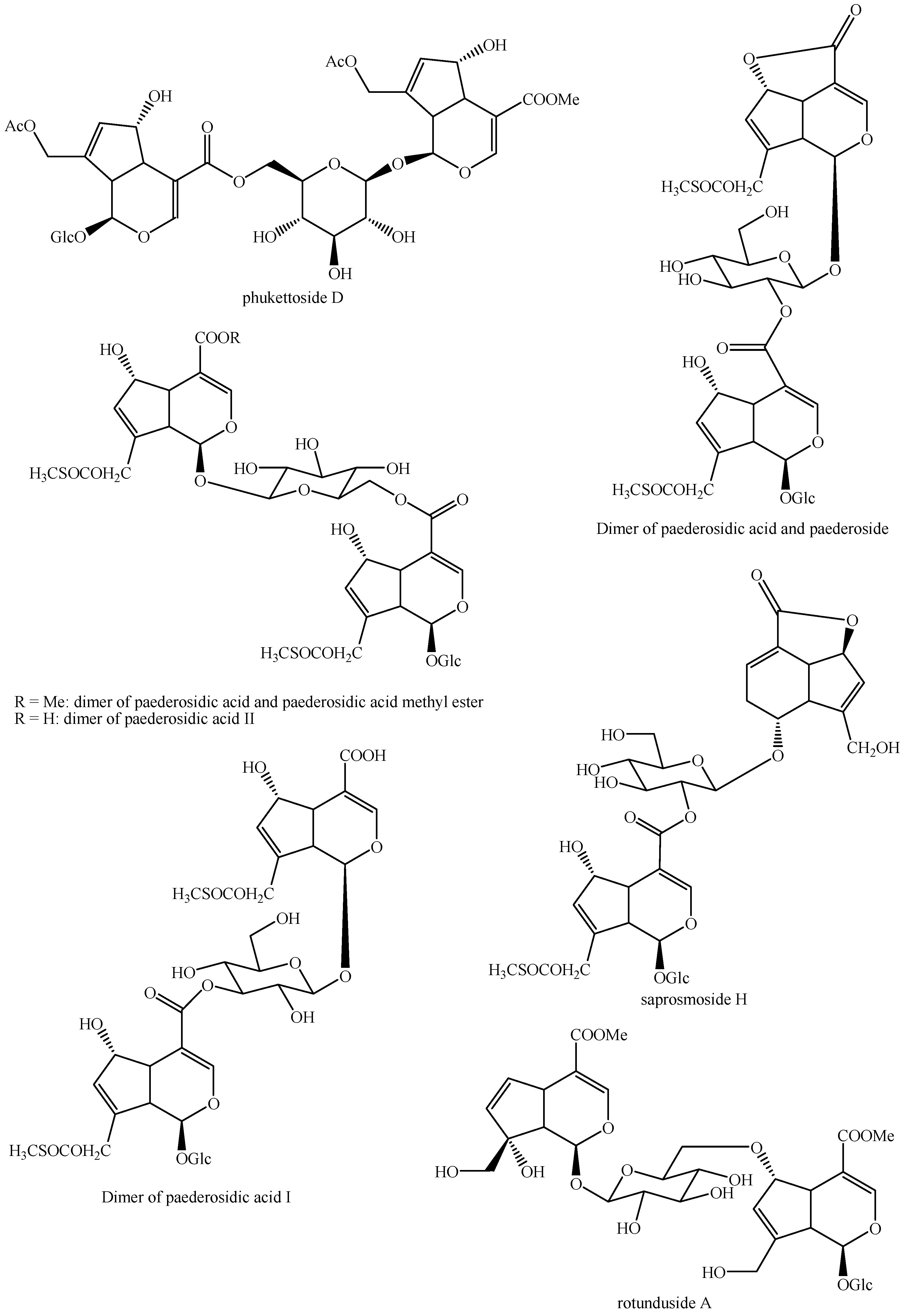


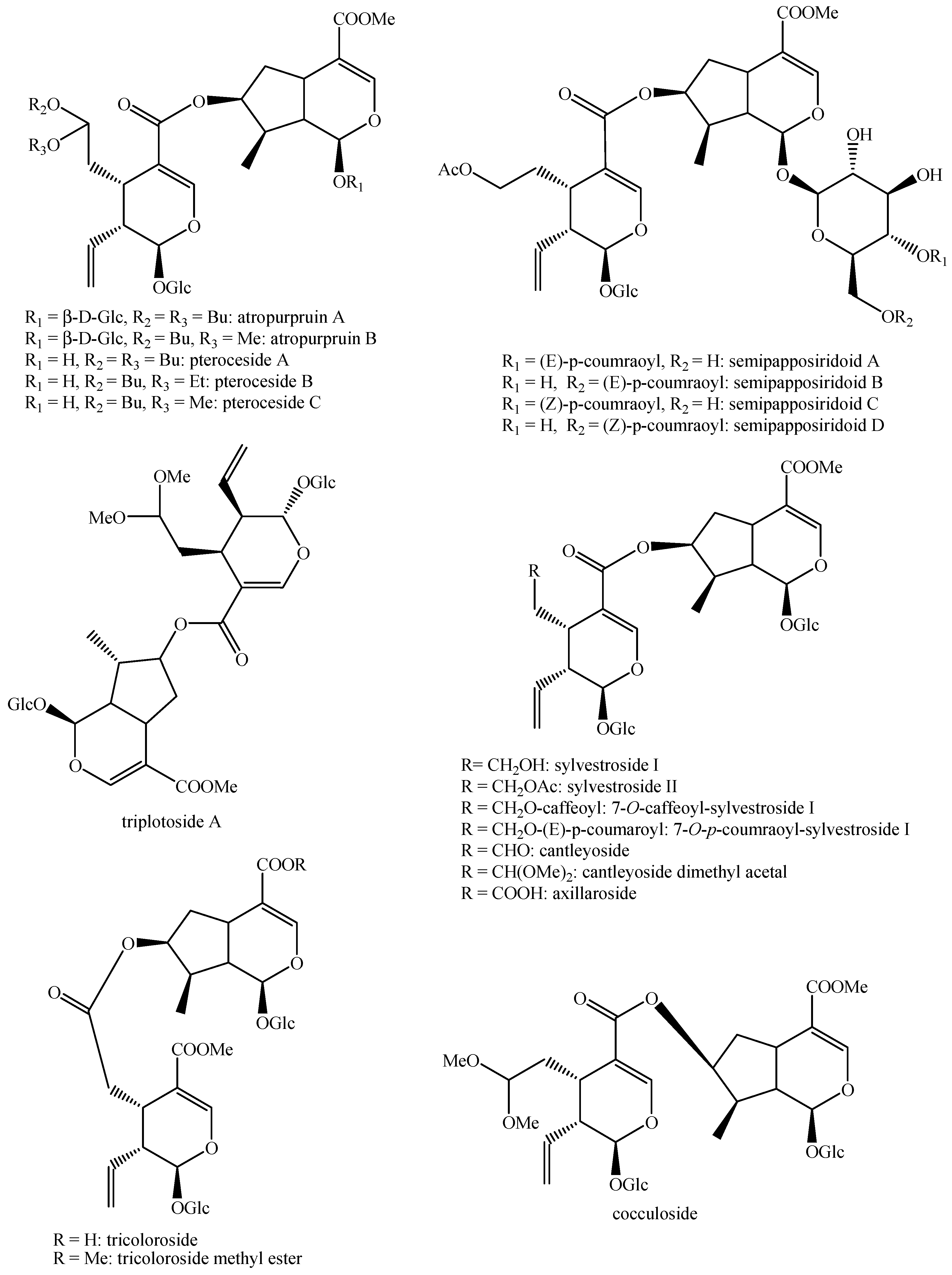
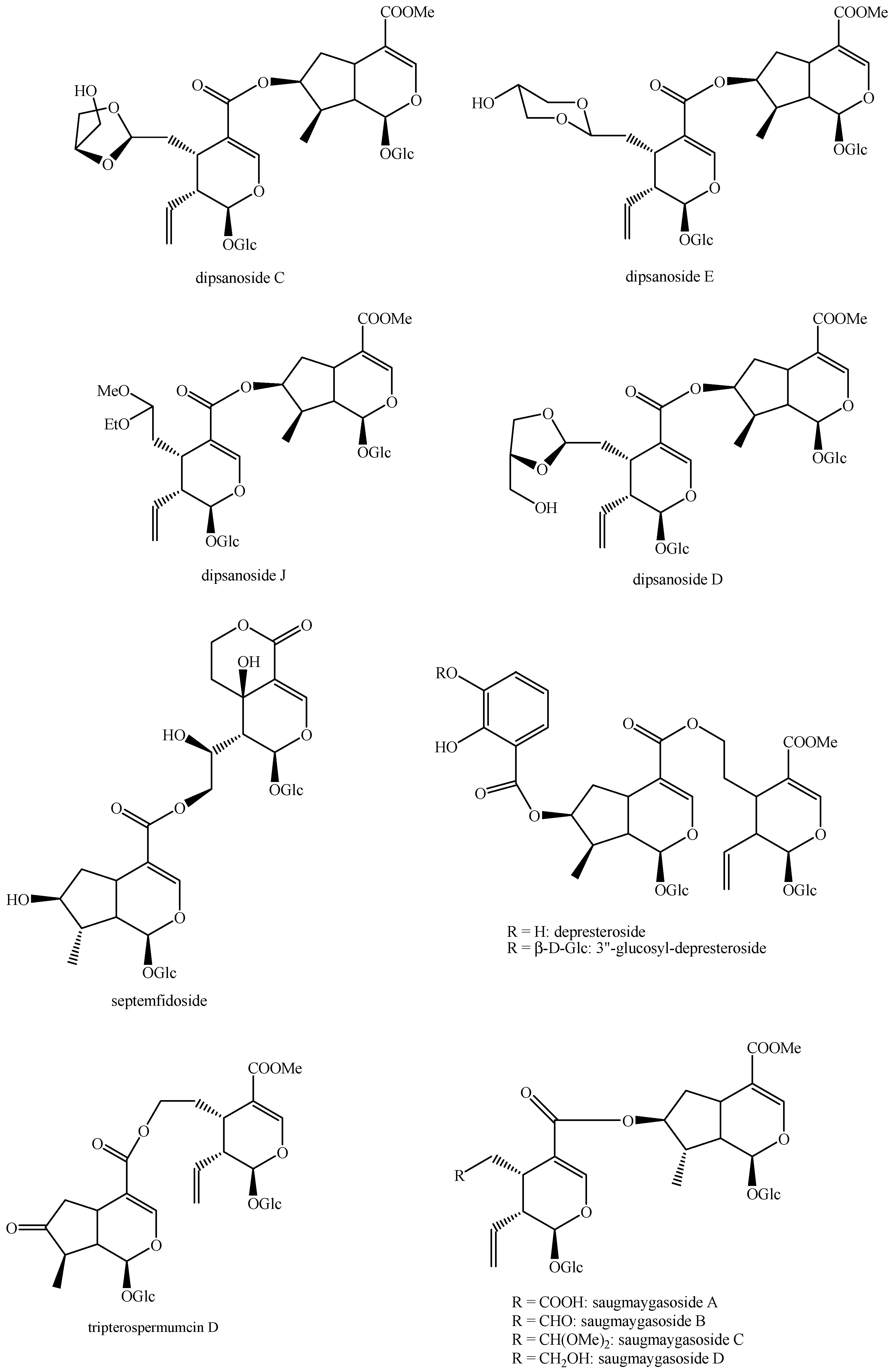


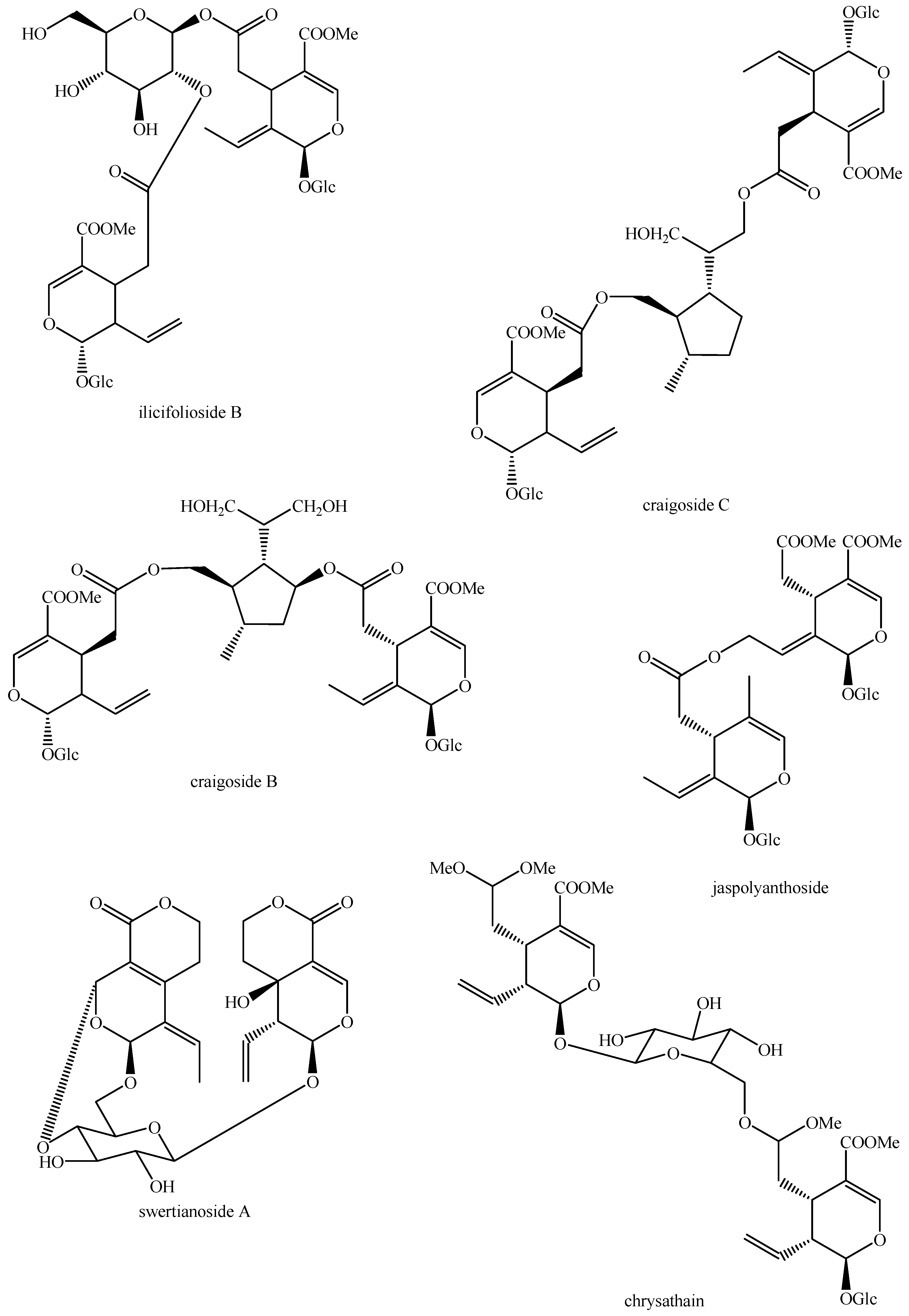


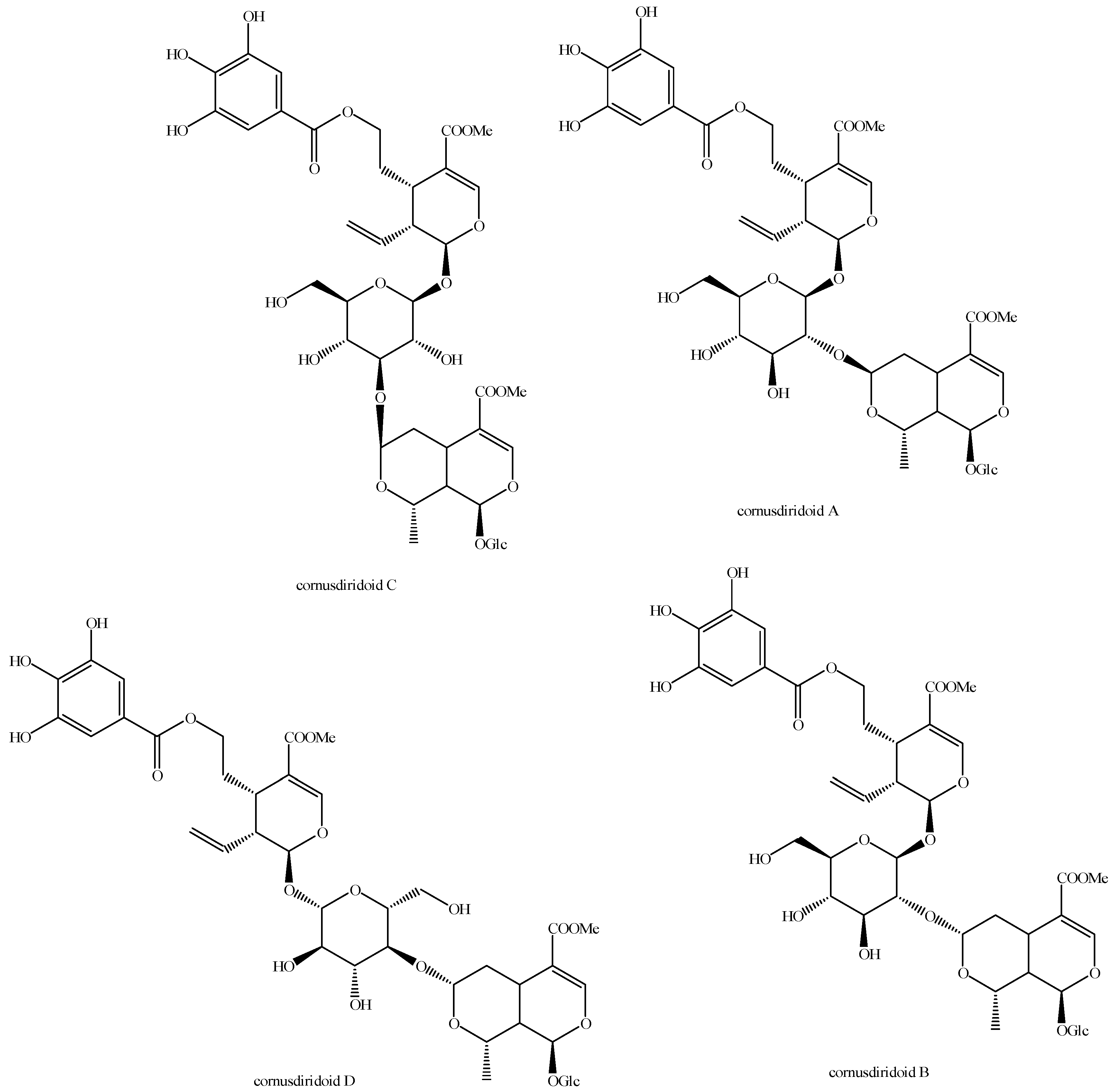


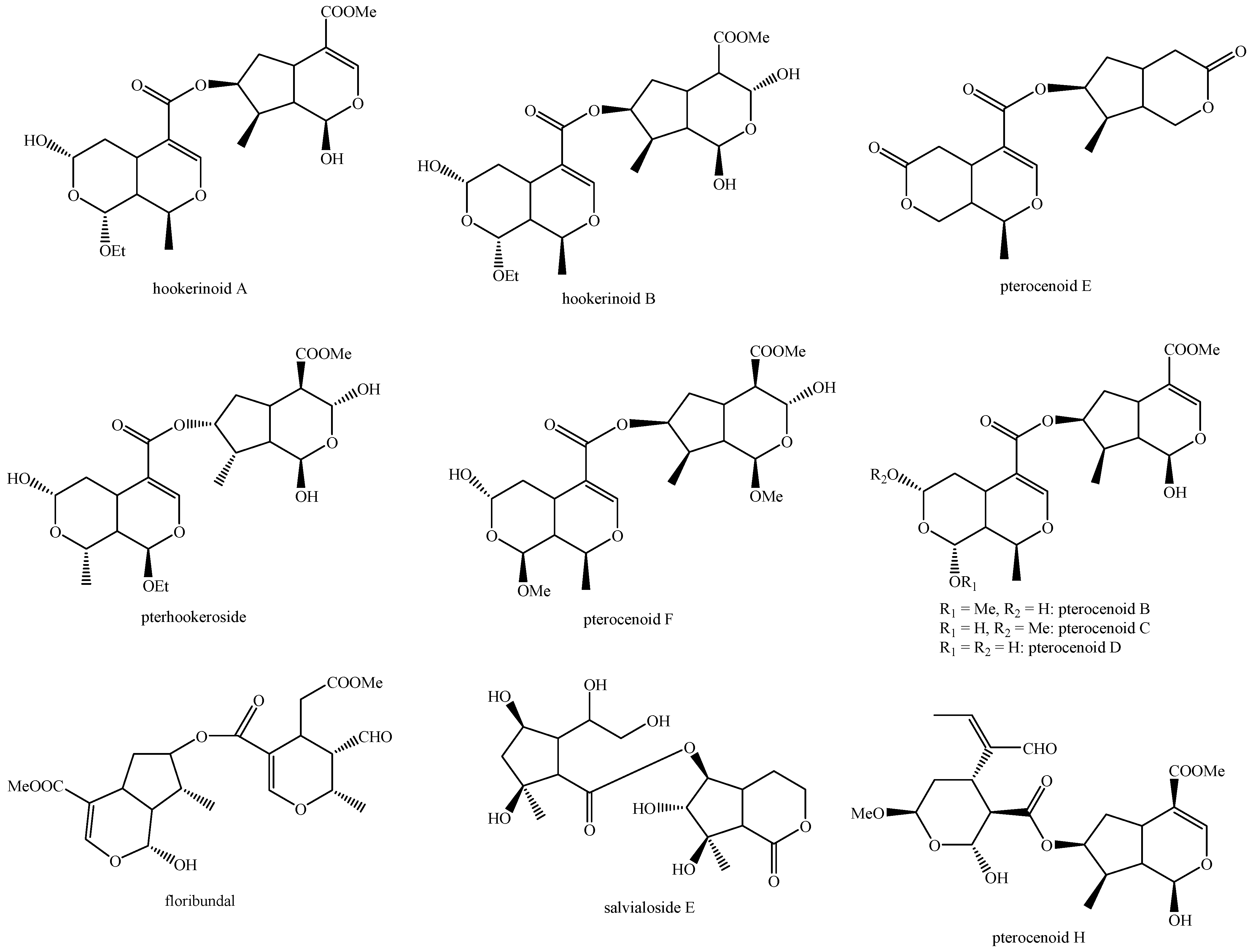


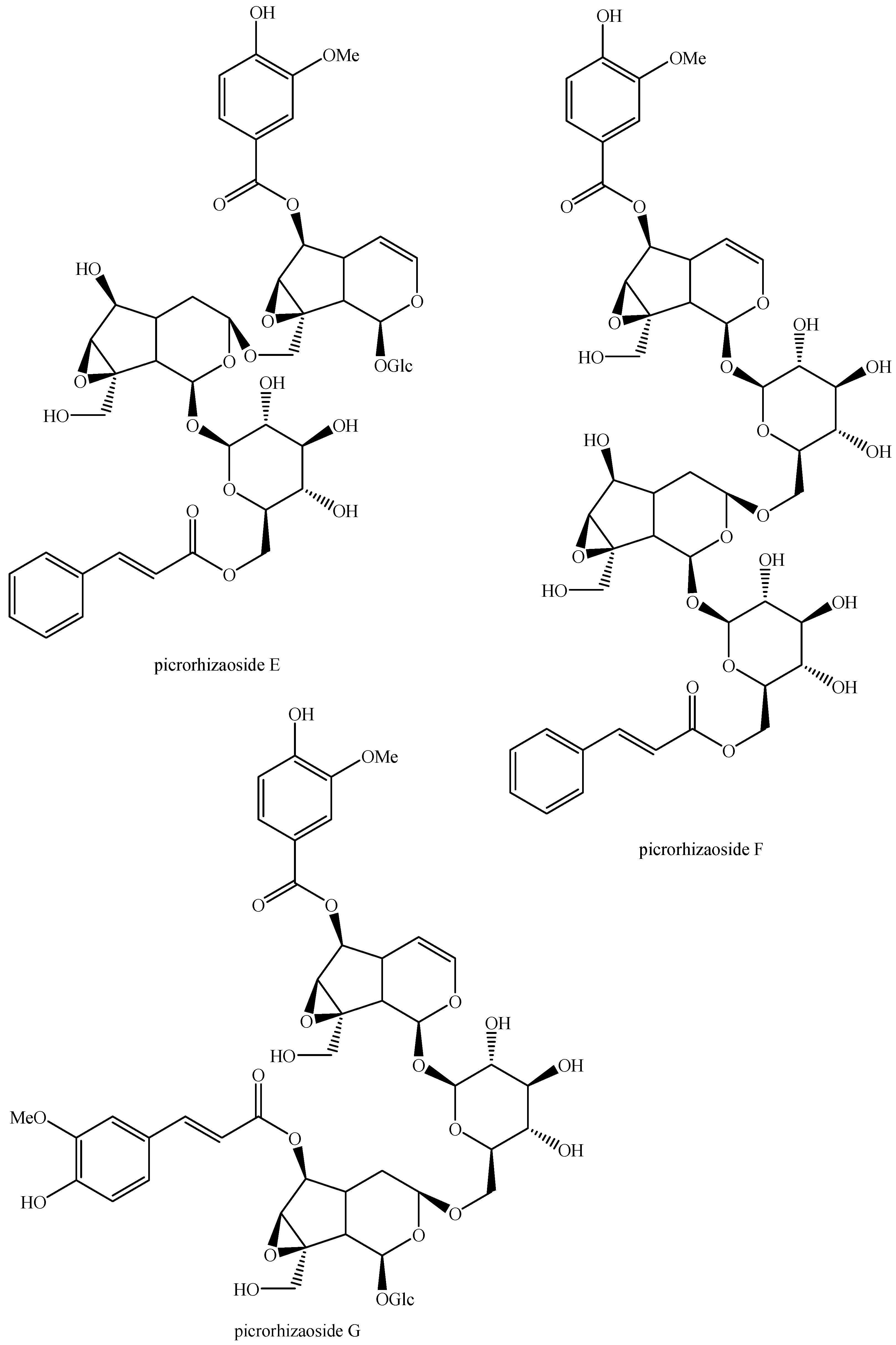



| Name of the Compound | Plant Species | Studied Organ | Collection Area | Methodology of Extraction, Separation and Identification | Reference |
|---|---|---|---|---|---|
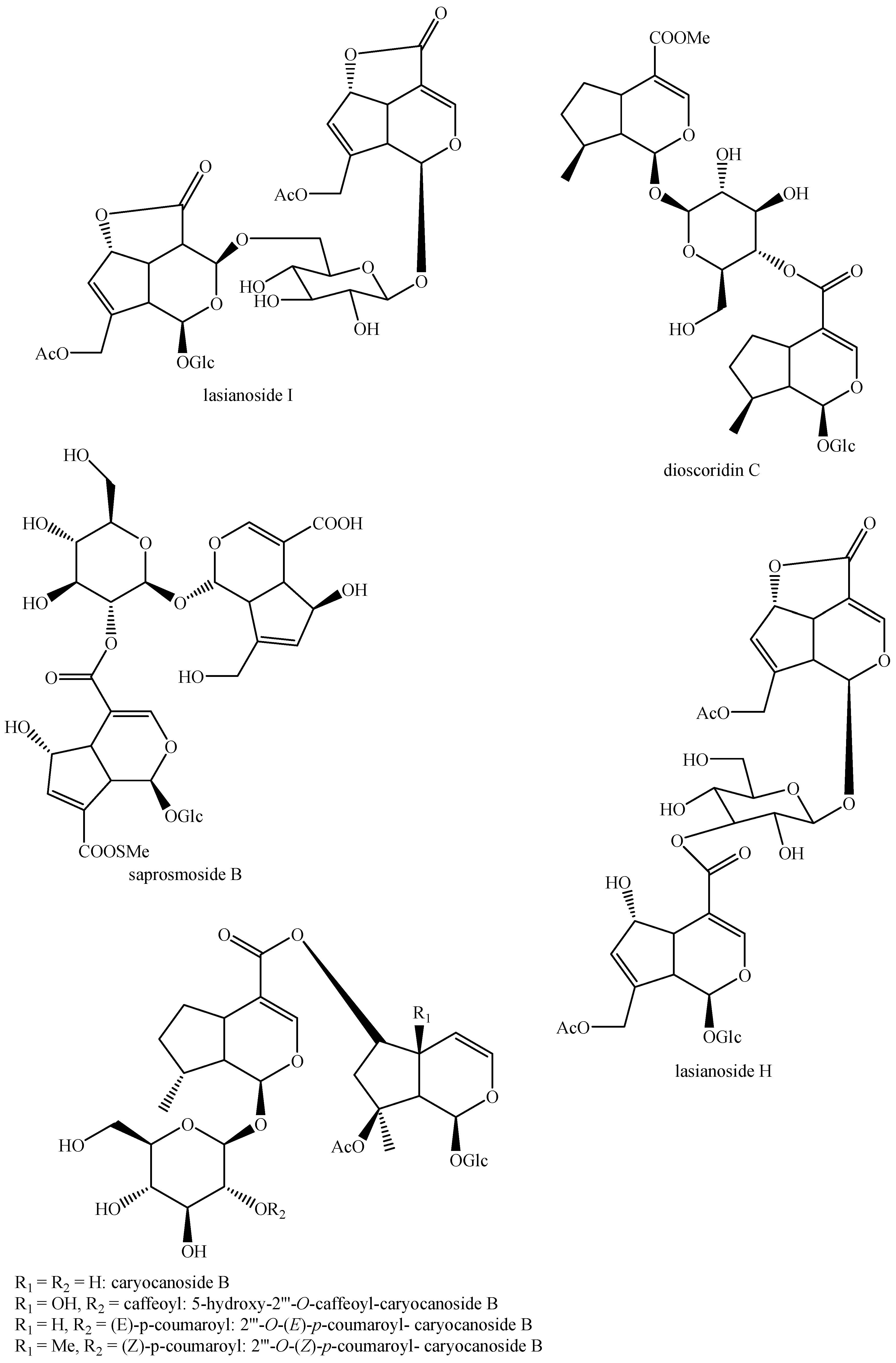
| 5-hydroxy-2‴-O-caffeoyl-caryocanoside B (Figure 5) | Caryopteris incana (Thunb. ex Houtt.) Miq. | Whole plant | China | SE, PP, CC, α[D], IR, NMR, HR-MS | [10] |
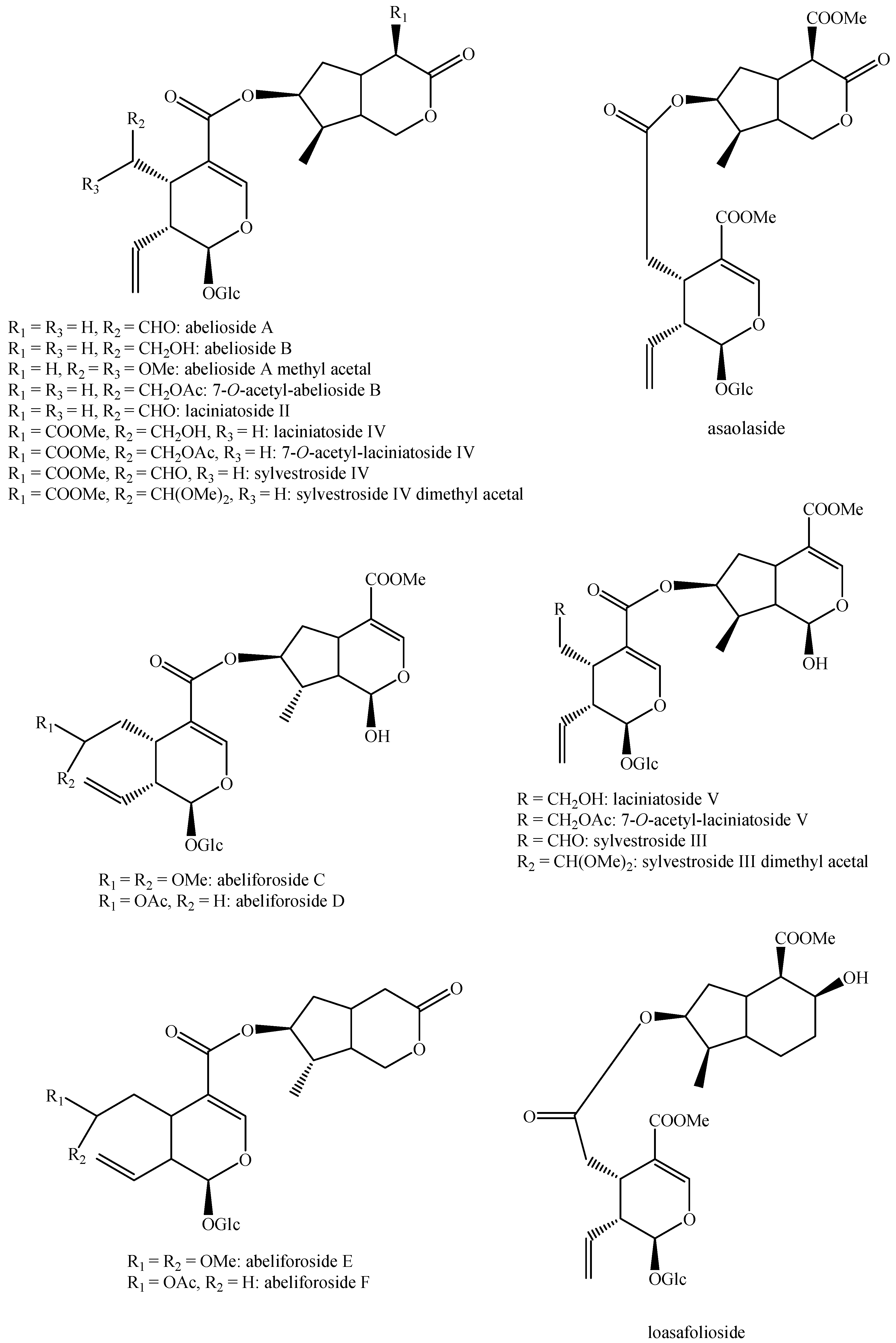
| 7-O-acetyl-abelioside B (Figure 30) | Linnaea chinensis A.Braun & Vatke | Aerial parts | Italy | SE, PP, CC, α[D], IR, UV, NMR, MS | [11] |
| 7-O-acetyl-laciniatoside IV (Figure 30) | Linnaea chinensis A.Braun & Vatke | Aerial parts | Italy | SE, PP, CC, α[D], IR, UV, NMR, MS | [11] |
| 7-O-acetyl-laciniatoside V (Figure 30) | Linnaea chinensis A.Braun & Vatke | Aerial parts | Italy | SE, PP, CC, α[D], IR, UV, NMR, MS | [11] |
| 7-O-caffeoyl- sylvestroside I (Figure 9) | Lomelosia stellata (L.) Raf. | Whole plant | Algeria | SE, CC, CPC, rp-FC, HPLC-UV, α[D], UV, NMR, HR-MS | [12] |
| 7-O-(p-coumaroyl)-sylvestroside I (Figure 9) | Lomelosia stellata (L.) Raf. | Whole plant | Algeria | SE, CC, CPC, rp-FC, HPLC-UV, α[D], UV, NMR, HR-MS | [12] |
| 6′-O-(7α-hydroxy-swerosyloxy)-loganin (Figure 11) | Lonicera japonica Thunb. | Stems and leaves | Japan (purchased from a company) | SE, PP, VV, p-HPLC-UV, NMR | [13] |
| 2‴-O-(E)-p-coumaroyl-caryocanoside B (Figure 5) | Caryopteris incana (Thunb. ex Houtt.) Miq | Whole plant | China | SE, PP, CC, p-HPLC-UV, α[D], IR, NMR, HR-MS | [10] |
| 2‴-O-(Z)-p-coumaroyl-caryocanoside B (Figure 5) | Caryopteris incana (Thunb. ex Houtt.) Miq. | Whole plant | China | SE, PP, CC, p-HPLC-UV, α[D], IR, NMR, HR-MS | [10] |
| 3″-glucosyl-depresteroside (Figure 10) | Gentiana depressa D.Don | Aerial parts | Nepal | DP, SE, PP, CC, CCTLC, sp-HPLC-UV, UV, NMR, MS | [14] |
| (Z)-aldosecologanin (Figure 17) | Lonicera japonica Thunb. | Stems and leaves | Japan (purchased from a company) | SE, PP, CC, p-HPLC-UV, α[D], UV, NMR, HR-MS | [13] |
| Flower buds | China | HSE, CC, p-HPLC-UV, NMR | [15] | ||
| China (purchased from a company) | SE, PP, CC, sp-HPLC-UV, NMR | [16] | |||
| China (different populations) | USE, HPLC-MSn | [17] | |||
| SE, HPLC-PDA | [18] | ||||
| China (different populations) | USE, UHPLC-MSn | [19] | |||
| Aerial parts | China (cultivated) | USE, UHPLC-MSn | [20] | ||
| Roots | China (cultivated) | USE, UHPLC-MSn | [20] | ||
| Flowers | China (different populations) | USE, UHPLC-MSn | [19] | ||
| Stems | China (different populations) | USE, UHPLC-MSn | [19] | ||
| Leaves | China (different populations) | USE, UHPLC-MSn | [19] | ||
| Lonicera ferdinandi Franch. | Aerial parts | China (cultivated) | USE, UHPLC-MSn | [20] | |
| Roots | China (cultivated) | USE, UHPLC-MSn | [20] | ||
| Lonicera maximowiczii subsp. sachalinensis (Fr.Schmidt) Nedol. | Aerial parts | China (cultivated) | USE, UHPLC-MSn | [20] | |
| Roots | China (cultivated) | USE, UHPLC-MSn | [20] | ||
| Lonicera maackii (Rupr.) Maxim. | Aerial parts | China (cultivated) | USE, UHPLC-MSn | [20] | |
| Roots | China (cultivated) | USE, UHPLC-MSn | [20] | ||
| Lonicera morrowii A.Gray | Aerial parts | China (cultivated) | USE, UHPLC-MSn | [20] | |
| Roots | China (cultivated) | USE, UHPLC-MSn | [20] | ||
| Lonicera praeflorens Batalin | Aerial parts | China (cultivated) | USE, UHPLC-MSn | [20] | |
| Roots | China (cultivated) | USE, UHPLC-MSn | [20] | ||
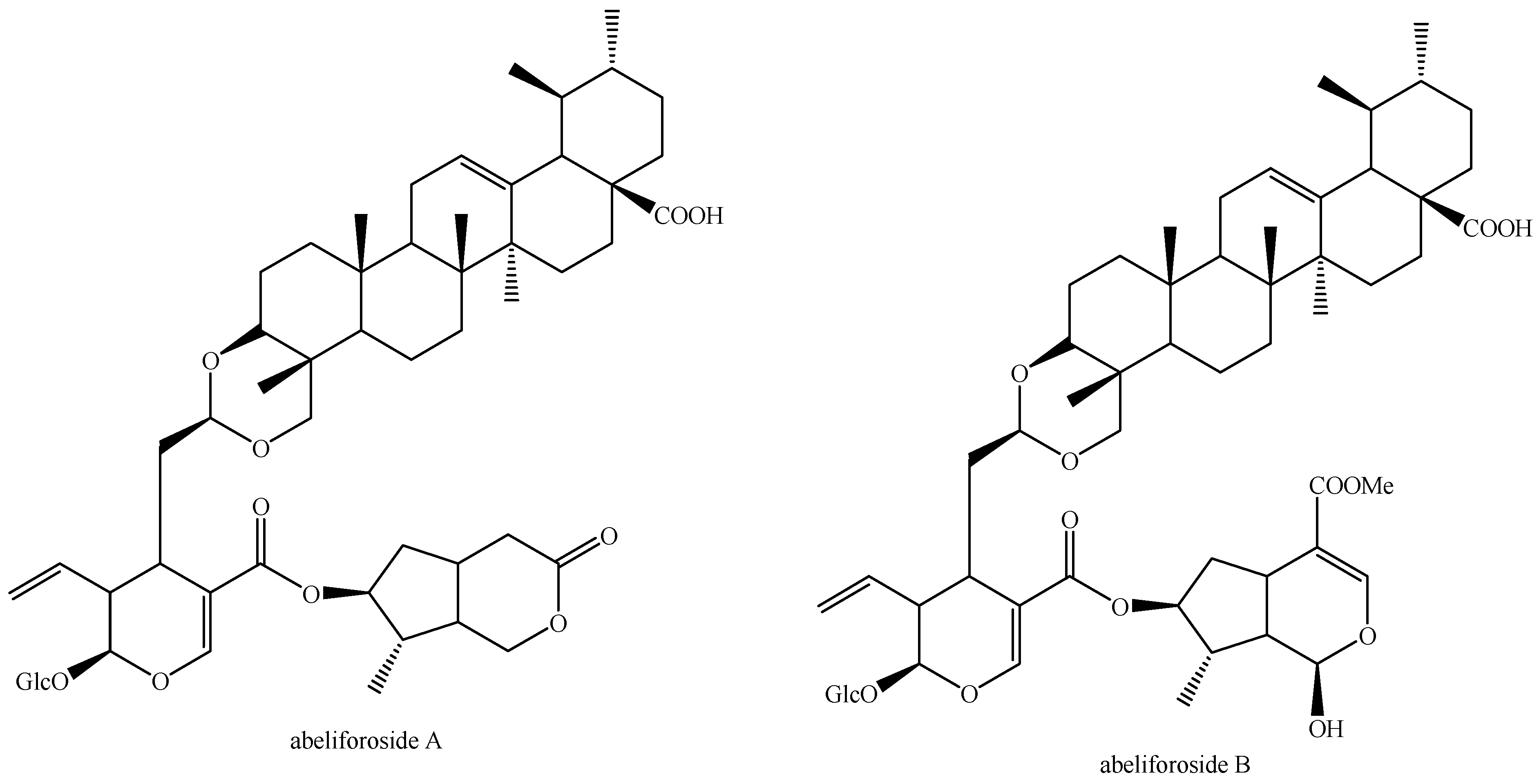
| Abeliforoside A (Figure 35) | Abelia grandiflora (Rovelli ex André) Rehder | Flower buds | China | SE, PP, CC, sp-HPLC-UV, α[D], IR, UV, NMR, HR-MS | [21] |
| Abeliforoside B (Figure 35) | Abelia grandiflora (Rovelli ex André) Rehder | Flower buds | China | SE, PP, CC, sp-HPLC-UV, α[D], IR, UV, NMR, HR-MS | [21] |
| Abeliforoside C (Figure 30) | Abelia grandiflora (Rovelli ex André) Rehder | Flower buds | China | SE, PP, CC, sp-HPLC-UV, α[D], IR, UV, NMR, HR-MS | [21] |
| Abeliforoside D (Figure 30) | Abelia grandiflora (Rovelli ex André) Rehder | Flower buds | China | SE, PP, CC, sp-HPLC-UV, α[D], IR, UV, NMR, HR-MS | [21] |
| Abeliforoside E (Figure 30) | Abelia grandiflora (Rovelli ex André) Rehder | Flower buds | China | SE, PP, CC, sp-HPLC-UV, α[D], IR, UV, NMR, HR-MS | [21] |
| Abeliforoside F (Figure 30) | Abelia grandiflora (Rovelli ex André) Rehder | Flower buds | China | SE, PP, CC, sp-HPLC-UV, α[D], IR, UV, NMR, HR-MS | [21] |
| Abelioside A (Figure 30) | Abelia grandiflora (Rovelli ex André) Rehder | Leaves | Japan | HSE, PP, ACT, CC, p-TLC, α[D], IR, UV, NMR | [22] |
| Picrorhiza kurroa Royle ex Benth. | Stems | Myanmar | USE, PP, CC, sp-HPLC-UV, NMR | [23] | |
| Abelioside A methyl acetal (Figure 30) | Abelia grandiflora (Rovelli ex André) Rehder | Leaves | Japan | HSE, PP, ACT, CC, p-TLC, α[D], IR, UV, NMR | [22] |
| Pterocephalus hookeri (C.B.Clarke) E.Pritz. | Whole plant | Tibet | SE, PP, CC, sp-HPLC-UV, NMR | [24] | |
| Abelioside B (Figure 30) | Picrorhiza kurroa Royle ex Benth. | Stems | Myanmar | USE, PP, CC, sp-HPLC-UV, NMR | [23] |
| Abelia grandiflora (Rovelli ex André) Rehder | Leaves | Japan | HSE, PP, ACT, CC, p-TLC, α[D], IR, UV, NMR | [22] | |
| Adinoside D (Figure 16) | Adina racemosa (Siebold & Zucc.) Miq. | Leaves, flowers and twigs | Taiwan (obtained from a botanical garden) | HSE, PP, CC, rp-MPLC, p-HPLC-UV, p-TLC, α[D], IR, UV, NMR, HR-MS | [25] |
| Adinoside E (Figure 16) | Adina racemosa (Siebold & Zucc.) Miq. | Leaves, flowers and twigs | Taiwan (obtained from a botanical garden) | HSE, PP, CC, rp-MPLC, p-HPLC-UV, p-TLC, α[D], IR, UV, NMR, HR-MS | [25] |
| Alatenoside (Figure 21) | Sarracenia alata (Alph.Wood) Alph.Wood | Whole plant | USA | SE, PP, p-rp-HPLC-UV, HPLC-ELSD, α[D], UV, NMR, HR-MS | [26] |
| Alatinoside (Figure 21) | Sarracenia alata (Alph.Wood) Alph.Wood | Whole plant | USA | SE, PP, p-rp-HPLC-UV, HPLC-ELSD, α[D], UV, NMR, HR-MS | [26] |
| Aldosecolohanin B (Figure 19) | Lonicera japonica Thunb. | Flower buds | China (purchased from a company) | SE, PP, CC, sp-HPLC-UV, α[D], IR, UV, NMR, HR-MS | [16] |
| Aldosecolohanin C (Figure 19) | Lonicera japonica Thunb. | Flower buds | China (purchased from a company) | SE, PP, CC, sp-HPLC-UV, α[D], IR, UV, NMR, HR-MS | [16] |
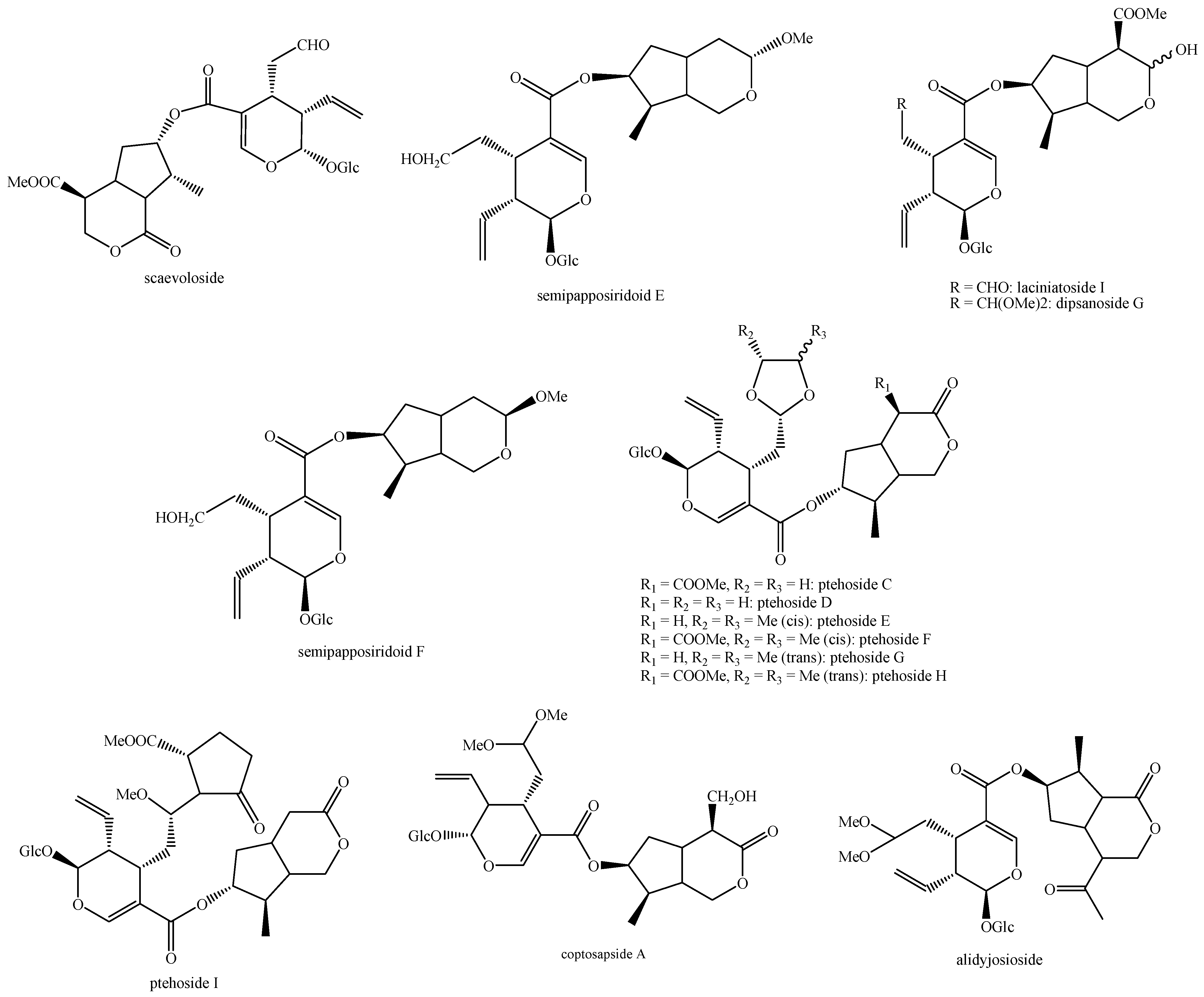
| Alidyjosioside (Figure 31) | Scaevola taccada (Gaertn.) Roxb. | Leaves | Egypt (obtained from a botanical garden) | SE, PP, VLC, CC, MP, NMR, | [27] |
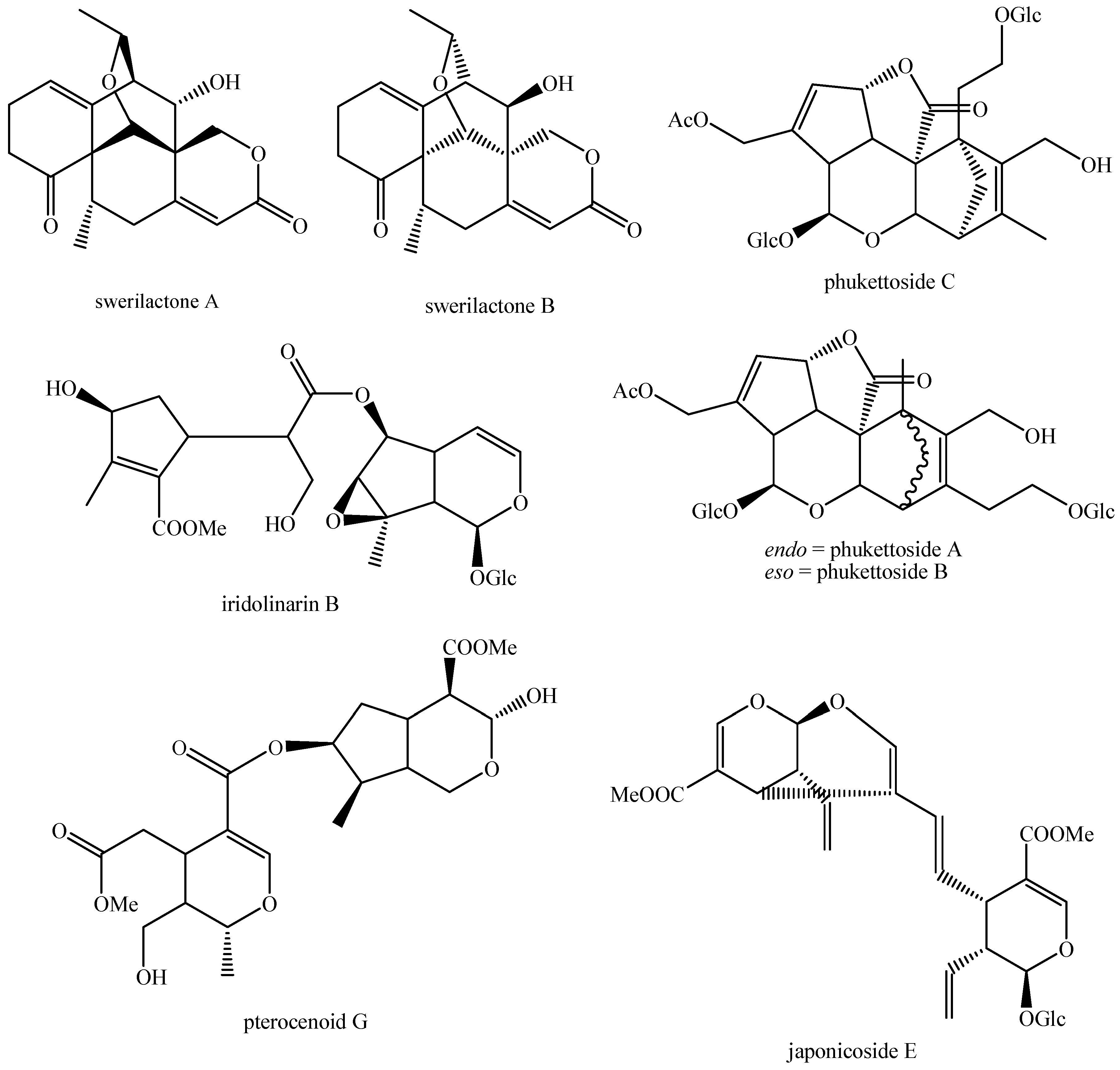
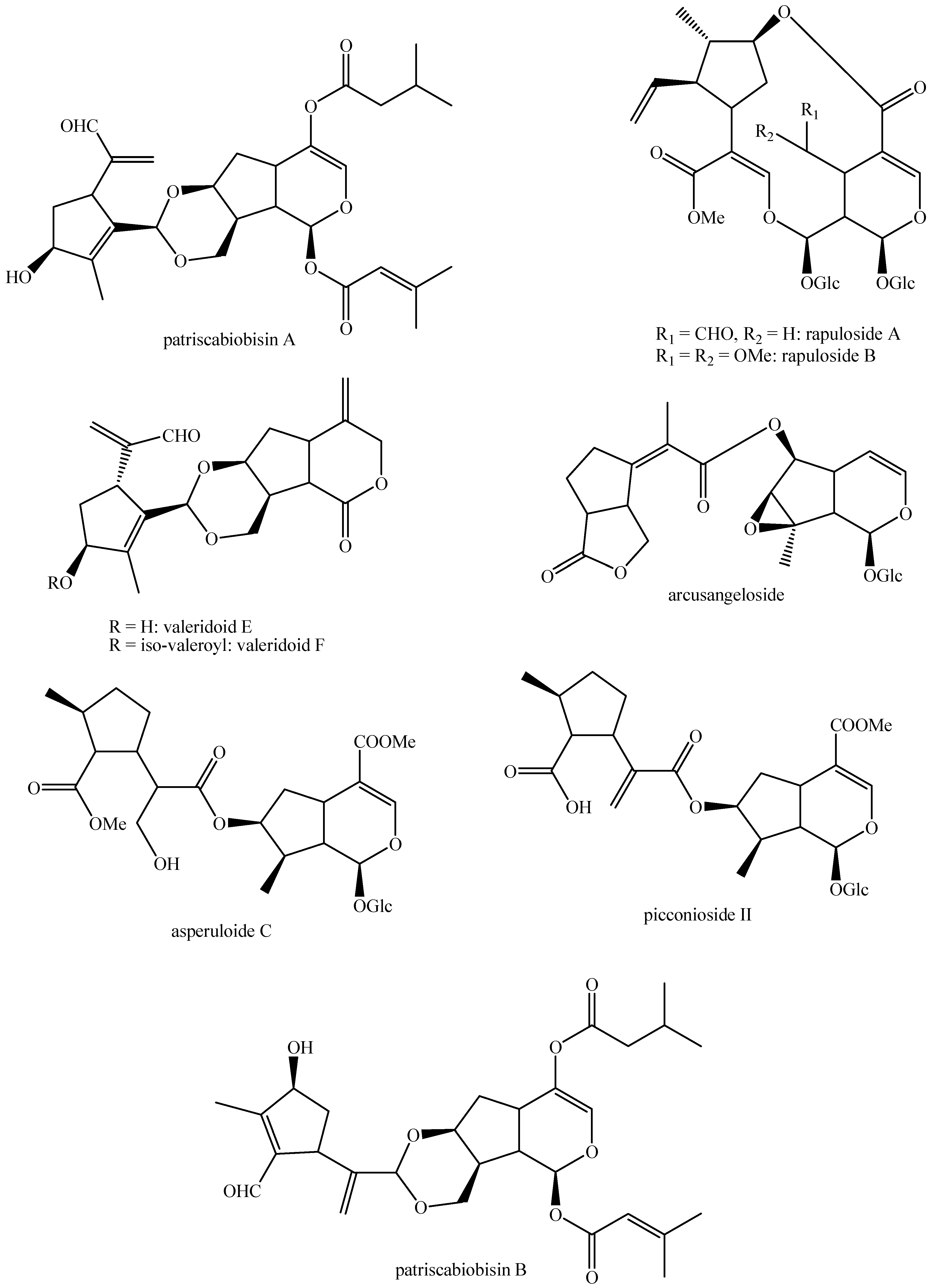
| Arcusangeloside (Figure 34) | Linaria arcusangeli Atzei & Camarda | Whole plant | Italy | SE, ACT, CC, α[D], IR, UV, NMR, MS | [28] |
| Linaria flava subsp. sardoa (Sommier) Arrigoni | Whole plant | Italy | SE, ACT, CC, α[D], IR, UV, NMR, MS | [28] | |
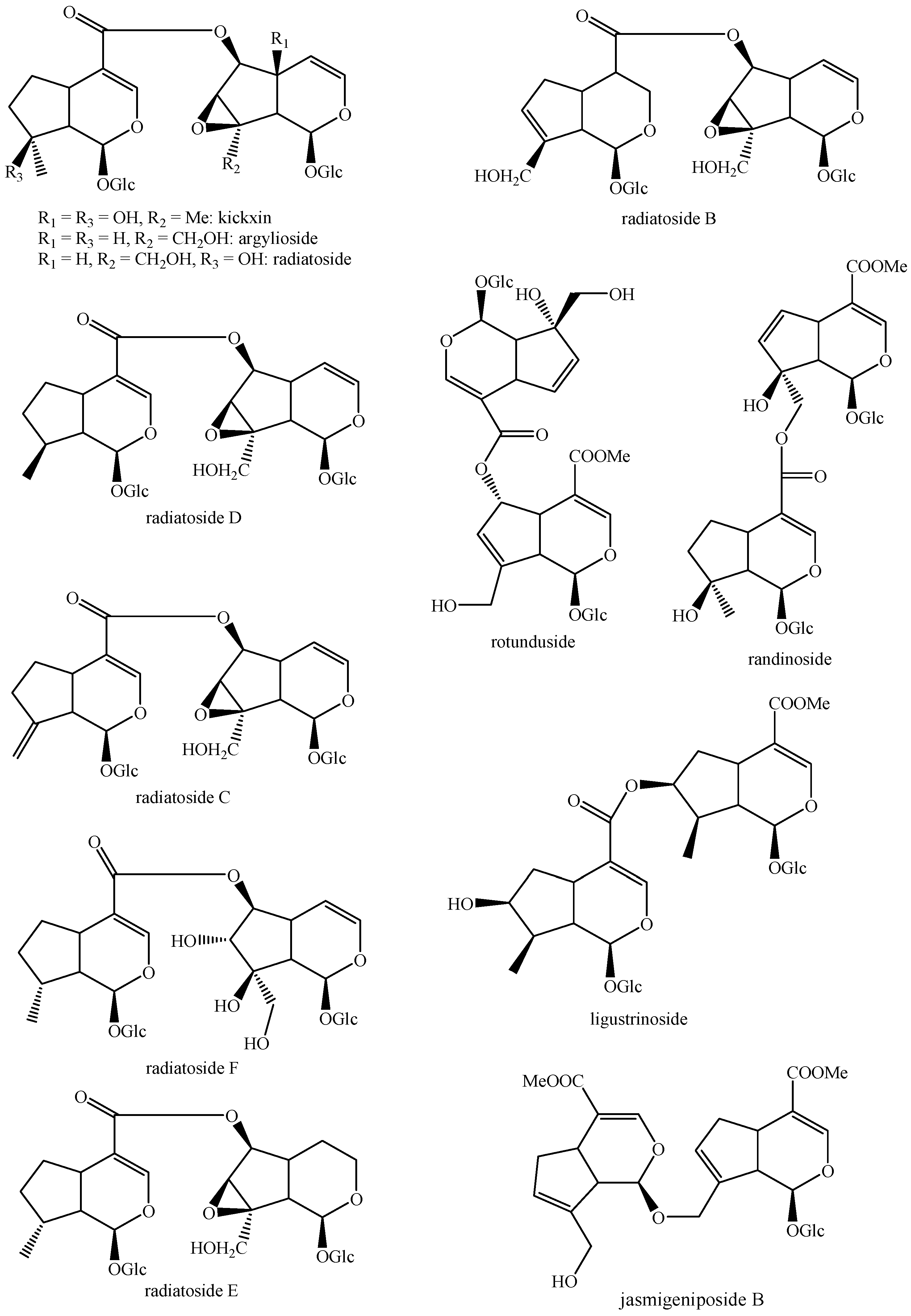
| Argylioside (Figure 1) | Argylia radiata (L.) D.Don | Whole plant | Chile | SE, ACT, CC, rp-LPLC, α[D], IR, UV, NMR | [29] |
| SE, CC, NMR | [30] | ||||
| Asaolaside (Figure 30) | Loasa acerifolia Dombey ex A.Juss. | Leaves | Germany (obtained from a botanical garden) | SXE, PP, CC, sp-HPLC-UV, α[D], IR, UV, NMR, MS | [31] |
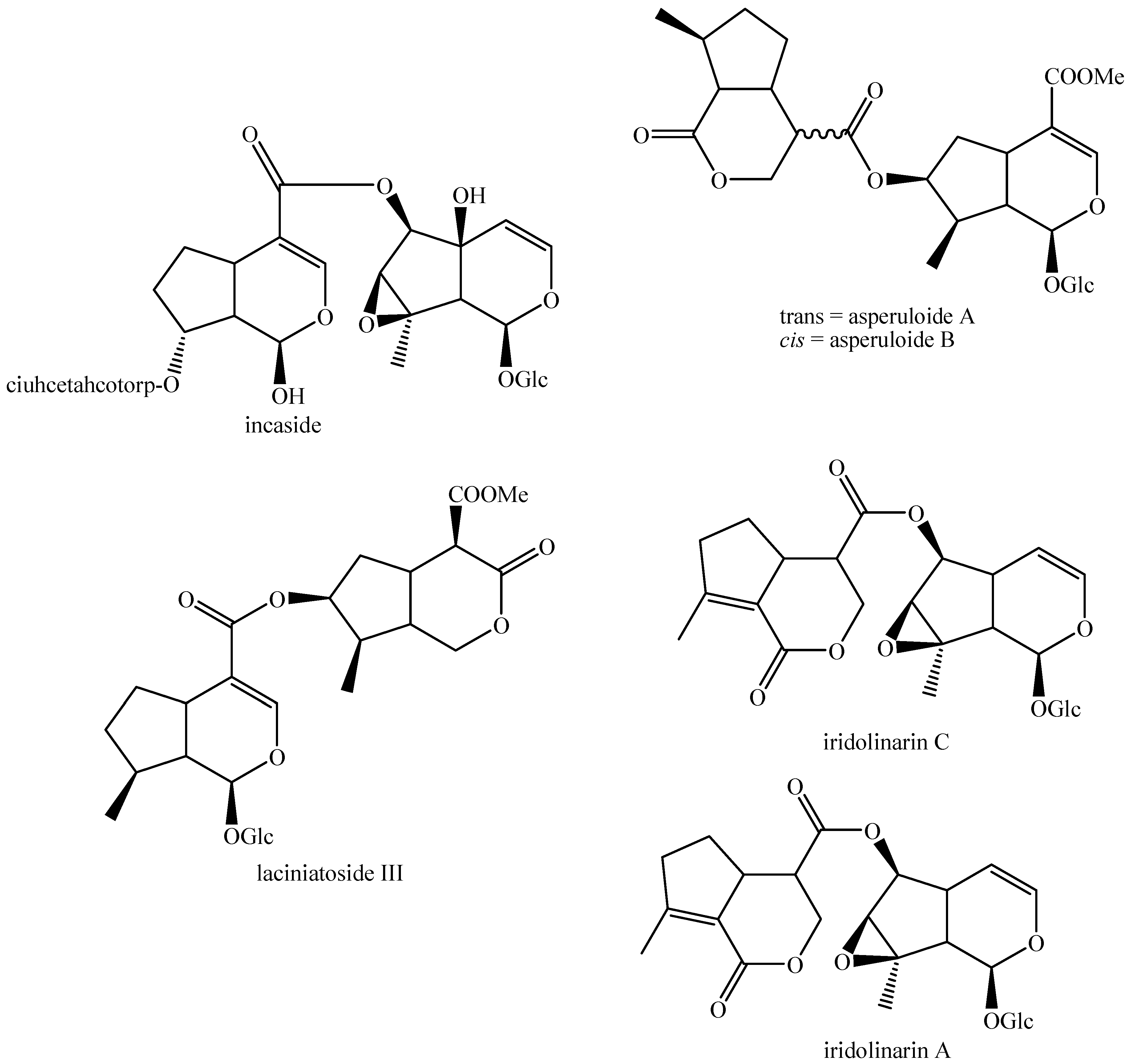
| Asperuloide A (Figure 29) | Galium maximowiczii (Kom.) Pobed. | Whole plant | South Korea | SE, PP, CC, p-HPLC-UV, α[D], IR, UV, NMR, MS | [32] |
| Asperuloide B (Figure 29) | Galium maximowiczii (Kom.) Pobed. | Whole plant | South Korea | SE, PP, CC, p-HPLC-UV, α[D], IR, UV, NMR, MS | [32] |
| Asperuloide C (Figure 34) | Galium maximowiczii (Kom.) Pobed. | Whole plant | South Korea | SE, PP, CC, p-HPLC-UV, α[D], IR, UV, NMR, MS | [32] |
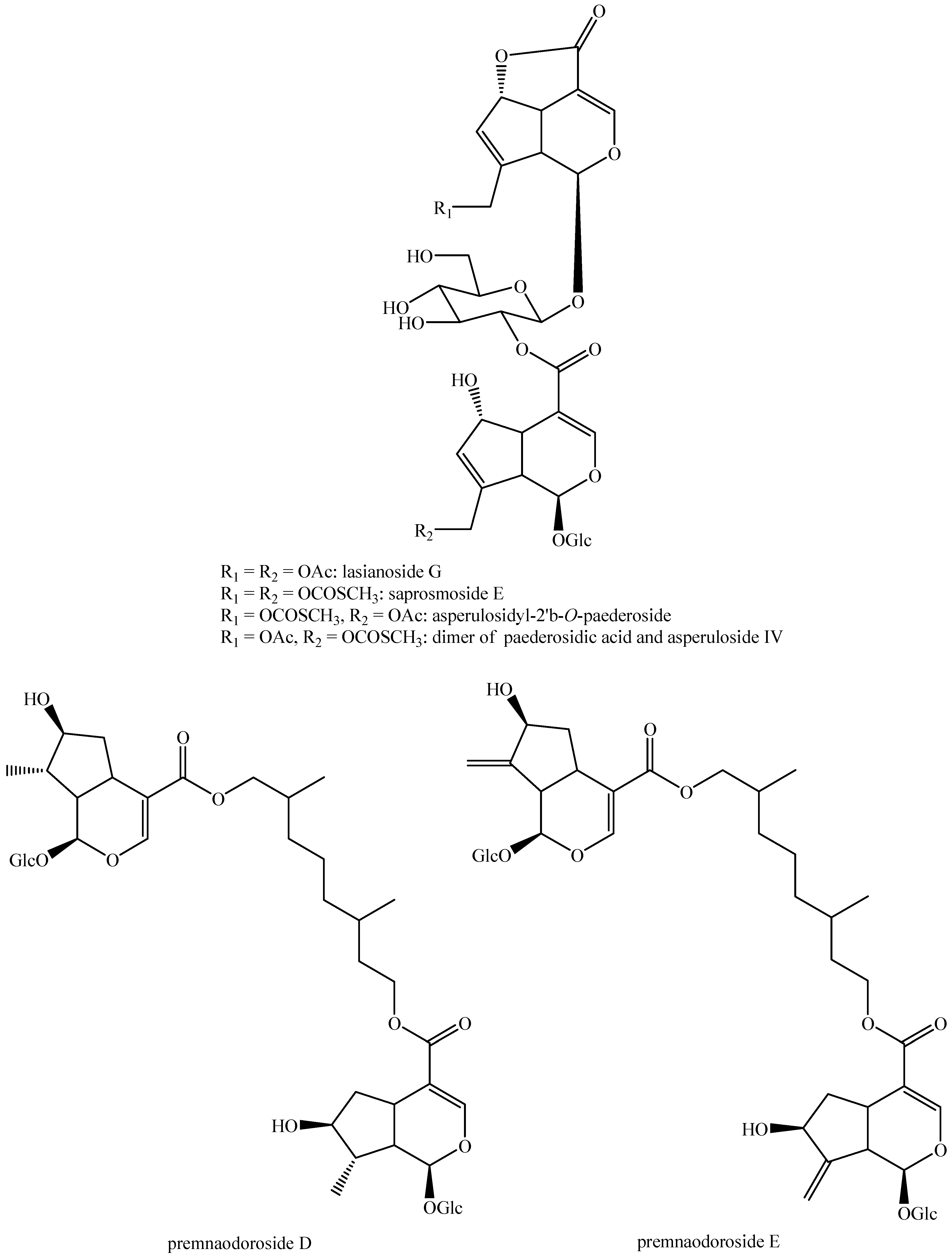
| Asperulosidyl-2’b-O-paederoside (Figure 4) | Paederia foetida L. | Aerial parts | China | SER, CC, sp-HPLC-UV, α[D], IR, NMR, HR-MS | [33] |
| Atropurpurin A (Figure 9) | Scabiosa atropurpurea L. | Whole plant | Turkey | SE, CC, sp-HPLC-UV, HPLC-MSn, NMR | [34] |
| Atropurpurin B (Figure 9) | Scabiosa atropurpurea L. | Whole plant | Turkey | SE, CC, sp-HPLC-UV, HPLC-MSn, NMR | [34] |
| Austrosmoside (Figure 23) | Osmanthus austrocaledonicus (Vieill.) Knobl. | Aerial parts | New Caledonia | DP, CC, CC, VLC, α[D], UV, NMR, HR-MS | [35] |
| Axillaroside (Figure 9) | Strychnos axillaris Colebr. | Bark and wood | Thailand | SER, PP, rp-MPLC, p-HPLC-UV, α[D], IR, NMR, HR-MS | [36] |
| Blumeoside B (Figure 8) | Fagraea blumei G.Don | Stem bark | Indonesia | SE, CC, CPC, HPLC-DAD, α[D], IR, NMR, MS | [37] |
| Blumeoside D (Figure 8) | Fagraea blumei G.Don | Stem bark | Indonesia | SE, CC, CPC, HPLC-DAD, α[D], IR, NMR, MS | [37] |
| Caeruleoside A (Figure 11) | Lonicera caerulea L. | Leaves | Japan | SE, PP, CC, p-HPLC-UV, α[D], IR, UV, NMR, MS | [38] |
| Caeruleoside B (Figure 18) | Lonicera caerulea L. | Leaves | Japan | SE, PP, CC, p-HPLC-UV, α[D], IR, UV, NMR, MS | [38] |
| Cantleyoside (Figure 9) | Cantleya corniculata (Becc.) R.A.Howard | n.a. | n.a. | n.a. | [39] |
| Scabiosa japonica Miq. | Roots | Japan | HSE, PP, CC, MP, α[D], IR, UV, NMR | [40] | |
| Dipsacus fullonum L. | Seeds | Denmark | SE, p-TLC, α[D], UV, NMR | [41] | |
| Leaves | Poland | USE, UHPLC-PDA-MSn | [42] | ||
| Roots | Poland | USE, UHPLC-PDA-MSn | [42] | ||
| Abelia grandiflora (Rovelli ex André) Rehder | Leaves | Japan | HSE, PP, ACT, CC, p-TLC, PLC, NMR | [22] | |
| Linnaea spathulata Graebn. | Leaves | Japan | SE, ACT, p-TLC, NMR | [22] | |
| Linnaea serrata Graebn. | Leaves | Japan | SE, ACT, p-TLC, NMR | [22] | |
| Scaevola montana Labill. | Aerial parts | New Caledonia | SE, CC, NMR | [43] | |
| Scaevola racemigera Däniker | Aerial parts | New Caledonia | SE, CC, NMR | [44] | |
| Dipsacus laciniatus L. | Roots | Hungary | SE, PP, CCD, CC, α[D], IR, UV, NMR | [45] | |
| Cephalaria ambrosioides (Sm.) Roem. & Schult. | Roots | Greece | SE, PP, CC, rp-CC, NMR | [46] | |
| Lomelosia variifolia (Boiss.) Greuter & Burdet | Flowering aerial parts | Greece | SE, VLC, rp-MPLC, NMR, MS | [47] | |
| Dipsacus inermis Wall. | Roots | China | HSE, PP, CC, rp-CC, p-TLC, rp-HPLC-UV, NMR | [48] | |
| SER, PP, CC, NMR | [49] | ||||
| China (purchased from a company) | SER, PP, MPLC, p-TLC, NMR | [50] | |||
| Dried Roots | China (purchased from a company) | USE, HPLC-MSn | [51] | ||
| China (different populations) | SE, CC, UHPLC-PDA, UHPLC-MSn | [52] | |||
| Strychnos spinosa Lam. | Branches | Japan (cultivated) | HSE, PP, rp-MPLC, p-HPLC-UV, p-TLC, NMR | [53] | |
| Strychnos lucida R.Br. | Bark and wood | Thailand | HSE, PP, MPLC, rp-MPLC, p-HPLC-UV, NMR | [54] | |
| Strychnos axillaris Colebr. | Bark and wood | Thailand | SER, PP, rp-MPLC, p-HPLC-UV, NMR | [36] | |
| Pterocephalus pinardi Boiss. | Aerial parts | Turkey | SE, PP, rp-VLC, CC, MPLC, NMR | [55] | |
| Cephalaria kotschyi Boiss. & Hohen. | Dried roots | Azerbaijan | SE, FC, LPLC, NMR | [56] | |
| Cephalaria media Litv. | Dried roots | Azerbaijan | SE, CC, rp-CC, TLC, NMR | [57] | |
| Pterocephalus hookeri (C.B.Clarke) E.Pritz. | Underground parts | Tibet | SER, PP, CC rp-CC, NMR | [58] | |
| SER, PP, TLC, sp-HPLC-MS, NMR | [59] | ||||
| n.a. | n.a. | n.a. | [60] | ||
| Whole plant | China | SE, PP, CC, rp-CC, NMR | [61] | ||
| SE, PP, HPLC-UV | [62] | ||||
| SER, CC, UPLC-PDA | [63] | ||||
| USE, UPLC-MSn | [64] | ||||
| Tibet | SE, PP, CC, p-HPLC-UV, p-TLC, NMR | [65] | |||
| Tibet | SE, PP, CC, sp-HPLC-UV, NMR | [24] | |||
| China (different populations) | USE, UPLC-MSn | [66] | |||
| Pterocephalus nestorianus Nábelek | Roots | Iraq | DP, SE, PP, MPLC, p-TLC, NMR | [67] | |
| Scabiosa atropurpurea L. | Roots | Turkey | HSE, rp-CC, CC, NMR, MS | [68] | |
| Whole plant | SE, CC, sp-HPLC-UV, HPLC-MSn | [34] | |||
| Leaves | Tunisia | SE, DP, HPLC-MSn | [69] | ||
| Cantleyoside dimethyl acetal (Figure 9) | Scaevola montana Labill. | Aerial parts | New Caledonia | SE, CC, NMR | [43] |
| Pterocephalus pterocephalus (L.) Dörfl. | Aerial parts | Greece | SE, CC, rp-CC, α[D], NMR, MS | [70] | |
| Pterocephalus pinardi Boiss. | Aerial parts | Turkey | SE, PP, rp-VLC, CC, MPLC, NMR | [55] | |
| Scabiosa atropurpurea L. | Whole plant | Turkey | SE, CC, sp-HPLC-UV, HPLC-MSn, NMR | [34] | |
| Caryocanoside B (Figure 5) | Caryopteris incana (Thunb. ex Houtt.) Miq. | Whole plant | China | SE, PP, CC, p-TLC, α[D], IR, NMR, HR-MS | [10] |
| Centauroside (Figure 21) | Centaurium erythraea Rafn | n.a. | n.a. | n.a. | [71] |
| Lonicera japonica Thunb. | Stems and leaves | Japan (purchased from a company) | SE, PP, VV, p-HPLC-UV, α[D], UV, NMR, HR-MS | [13] | |
| Dried flowers | South Korea (different populations) | USE, HPLC-UV | [72] | ||
| South Korea (different commercial samples) | USE, HPLC-UV | ||||
| Caulis | China (different populations) | USE, UFLC-MSn | [73] | ||
| China (samples purchased from different companies) | USE, UFLC-MSn | ||||
| Flowers | China (different populations) | USE, UFLC-MSn | [73] | ||
| China (samples purchased from different companies) | USE, UFLC-MSn | ||||
| China (different populations) | USE, UHPLC-MSn | [19] | |||
| Flower buds | China | SER, HPLC-MSn | [74] | ||
| China | DP, SER, HPLC-DAD-MSn | [75] | |||
| SER, HPLC-MS | [76] | ||||
| China (different cultivated populations) | USE, HPLC-DAD-ELSD | [77] | |||
| China (commercial samples) | USE, HPLC-DAD-ELSD | [77] | |||
| SE, HPLC-DAD, HPLC-MS | [78] | ||||
| China and Korea (commercial samples) | SE, HPLC-DAD-MS | [79] | |||
| China | n.a. | [80] | |||
| HSE, CC, p-HPLC-UV, NMR | [15] | ||||
| USE, HPLC-DAD-CL, HPLC-DAD-MSn | [81] | ||||
| China (different populations) | USE, HPLC-MSn | [17] | |||
| HSE, UHPLC-UV | [82] | ||||
| USE, UFLC-MSn | [73] | ||||
| SE, HPLC-PDA | [18] | ||||
| USE, UHPLC-MSn | [19] | ||||
| China (purchased from a company) | USE, rp-UHPLC-PDA-MSn | [83] | |||
| USE, 2D-HPLC-UF-MS | [84] | ||||
| SE, PP, CC, sp-HPLC-UV, NMR | [16] | ||||
| China (samples purchased from different companies) | USE, UFLC-MSn | [73] | |||
| China (cultivated) | USE, UPLC-MSn | [85] | |||
| Leaves | South Korea (different populations) | USE, HPLC-UV | [72] | ||
| China (purchased from a company) | USE, HPLC-DAD-MSn | [86] | |||
| China | USE, rp-UHPLC-PDA-MSn | [83] | |||
| China (different populations) | USE, UFLC-MSn | [73] | |||
| USE, UHPLC-MSn | [19] | ||||
| China (cultivated) | USE, UPLC-MSn | [85] | |||
| Aerial parts | China (cultivated) | USE, UHPLC-MSn | [20] | ||
| Roots | China (cultivated) | USE, UHPLC-MSn | [20] | ||
| Stems | China | USE, rp-UHPLC-PDA-MSn | [83] | ||
| China (different populations) | USE, UHPLC-MSn | [19] | |||
| Branches | China (cultivated) | USE, UPLC-MSn | [85] | ||
| Fruits | China (cultivated) | USE, UPLC-MSn | [85] | ||
| Kissenia capensis Endl. | Aerial parts | Namibia | SE, PP, CC, rp-CC, sp-rp-HPLC-UV, NMR, MS | [87] | |
| Strychnos spinosa Lam. | Branches | Japan (cultivated) | HSE, PP, rp-MPLC, p-HPLC-UV, p-TLC, NMR | [53] | |
| Lonicera confusa DC. | Flower buds | China (different cultivated populations) | USE, HPLC-DAD-ELSD | [77] | |
| China | DP, SER, HPLC-DAD-MSn | [75] | |||
| China (different populations) | SER, HPLC-MS | [76] | |||
| Dried flowers | South Korea (different populations) | USE, HPLC-UV | [72] | ||
| South Korea (different commercial samples) | USE, HPLC-UV | [72] | |||
| Lonicera ferdinandi Franch. | Aerial parts | China (cultivated) | USE, UHPLC-MSn | [20] | |
| Roots | China (cultivated) | USE, UHPLC-MSn | [20] | ||
| Lonicera hypoglauca Miq. | Flower buds | China (different cultivated populations) | USE, HPLC-DAD-ELSD | [77] | |
| China | DP, SER, HPLC-DAD-MSn | [75] | |||
| SER, HPLC-MS | [76] | ||||
| Lonicera macrantha Spreng. | Flower buds | China (different cultivated populations) | USE, HPLC-DAD-ELSD | [77] | |
| China (different populations) | DP, SER, HPLC-DAD-MSn | [75] | |||
| SER, HPLC-MS | [76] | ||||
| HSE, UHPLC-UV | [82] | ||||
| Lonicera maackii (Rupr.) Maxim. | Aerial parts | China (cultivated) | USE, UHPLC-MSn | [20] | |
| Roots | China (cultivated) | USE, UHPLC-MSn | [20] | ||
| Lonicera maximowiczii subsp. sachalinensis (Fr.Schmidt) Nedol. | Aerial parts | China (cultivated) | USE, UHPLC-MSn | [20] | |
| Roots | China (cultivated) | USE, UHPLC-MSn | [20] | ||
| Lonicera praeflorens Batalin | Aerial parts | China (cultivated) | USE, UHPLC-MSn | [20] | |
| Roots | China (cultivated) | USE, UHPLC-MSn | [20] | ||
| Lonicera rupicola var. syringantha (Maxim.) Zabel | Flower buds | China | SER, HPLC-MS | [76] | |
| Lonicera similis Hemsl. ex F.B.Forbes & Hemsl. | Flower buds | China | SER, HPLC-MS | [76] | |
| Triosteum pinnatifidum Maxim. | Roots | China | SER, PP, CC, NMR | [88] | |
| Gentianella amarella subsp. acuta (Michx.) J.M.Gillett | Whole plant | China | SER, PP, CC, p-HPLC-UV, NMR | [89] | |
| Lonicera morrowii A.Gray | Roots | South Korea (obtained from a botanical garden) | USE, PP, CC, p-HPLC-UV, NMR | [20] | |
| Aerial parts | China (cultivated) | USE, UHPLC-MSn | [20] | ||
| Roots | China (cultivated) | USE, UHPLC-MSn | [20] | ||
| Centauroside A (Figure 21) | Centaurium erythraea Rafn | Whole plant | Turkey | SE, CC, rp-FC, α[D], IR, UV, NMR, HR-MS | [90] |
| Chrysathain (Figure 22) | Lonicera chrysantha Turcz. ex Ledeb. | Leaves | China | SE, CC, α[D], NMR, HR-MS | [91] |
| Citrifolinin A-1 (Figure 6) | Morinda citrifolia L. | Leaves | India | HSE, PP, CC, rp-CC, NMR, MS | [92] |
| Cocculoside (Figure 9) | Strychnos cocculoides Baker | Stem bark | Tanzania | SE, VLC, CC, α[D], IR, UV, NMR, MS | [93] |
| Dipsacus inermis Wall. | Roots | China (purchased from a local market) | SE, PP, CC, rp-CC, sp-HPLC-UV, NMR | [94] | |
| Coelobillardin (Figure 8) | Coelospermum balansanum Baill. | Aerial parts | New Caledonia | SE, CC, MPLC, α[D], IR, UV, NMR, HR-MS | [95] |
| Coptosapside A (Figure 31) | Coptosapelta diffusa (Champ. ex Benth.) Steenis | Aerial parts | China | SE, PP, MPLC, CC, α[D], IR, UV, NMR, HR-MS | [96] |
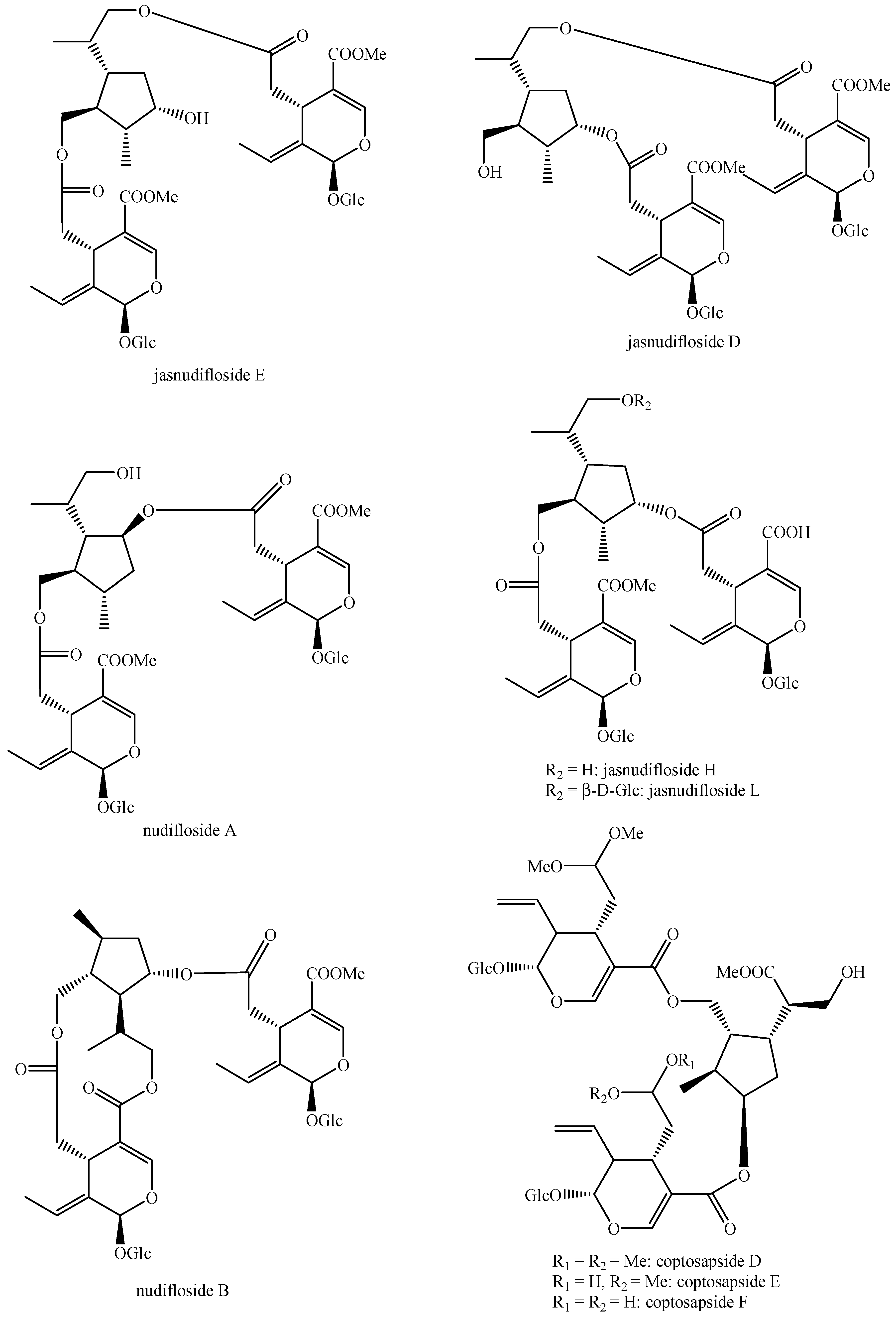
| Coptosapside D (Figure 14) | Coptosapelta diffusa (Champ. ex Benth.) Steenis | Aerial parts | China | SE, PP, MPLC, CC, α[D], IR, UV, NMR, HR-MS | [96] |
| Coptosapside E (Figure 14) | Coptosapelta diffusa (Champ. ex Benth.) Steenis | Aerial parts | China | SE, PP, MPLC, CC, α[D], IR, UV, NMR, HR-MS | [96] |
| Coptosapside F (Figure 14) | Coptosapelta diffusa (Champ. ex Benth.) Steenis | Aerial parts | China | SE, PP, MPLC, CC, α[D], IR, UV, NMR, HR-MS | [96] |
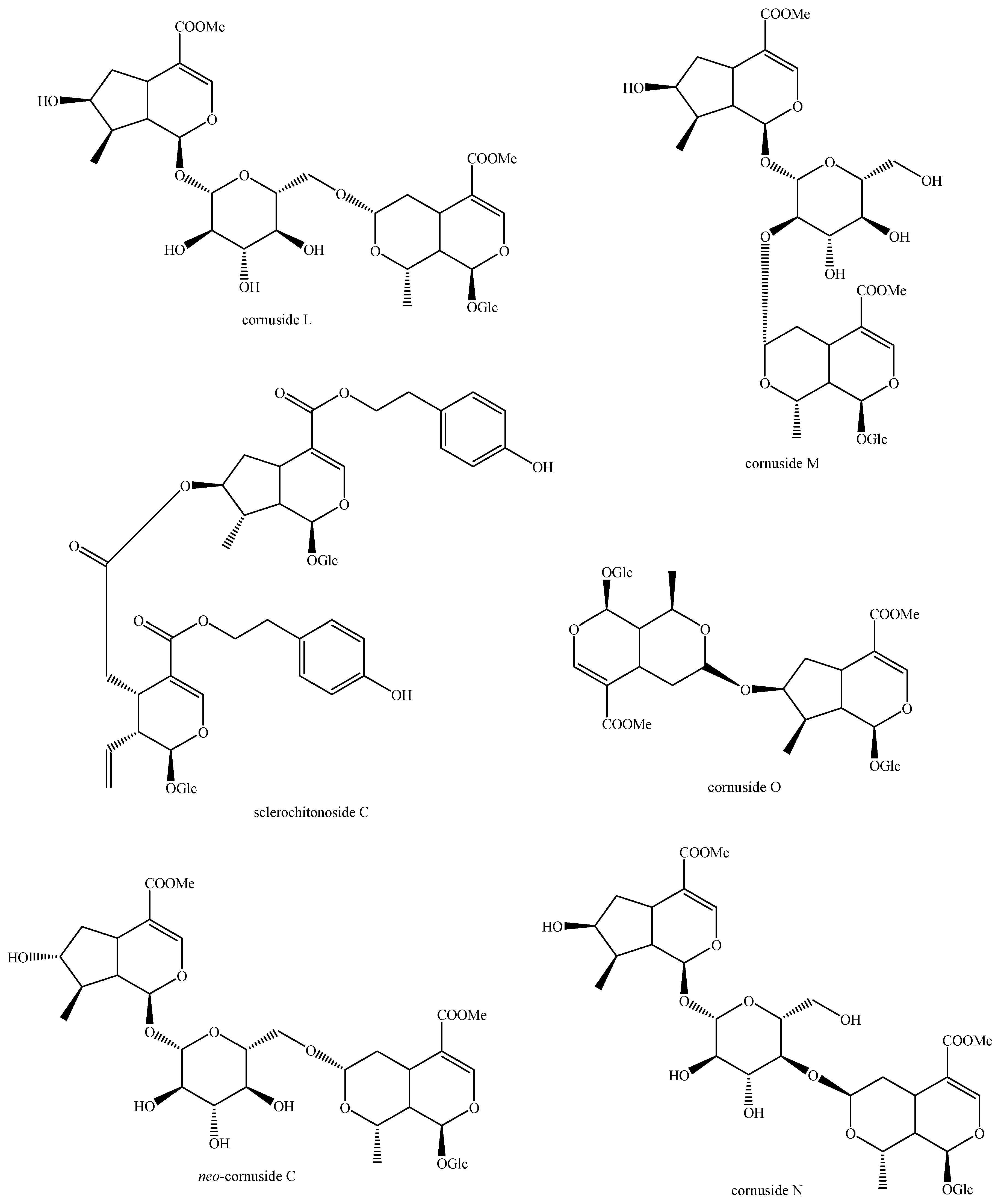
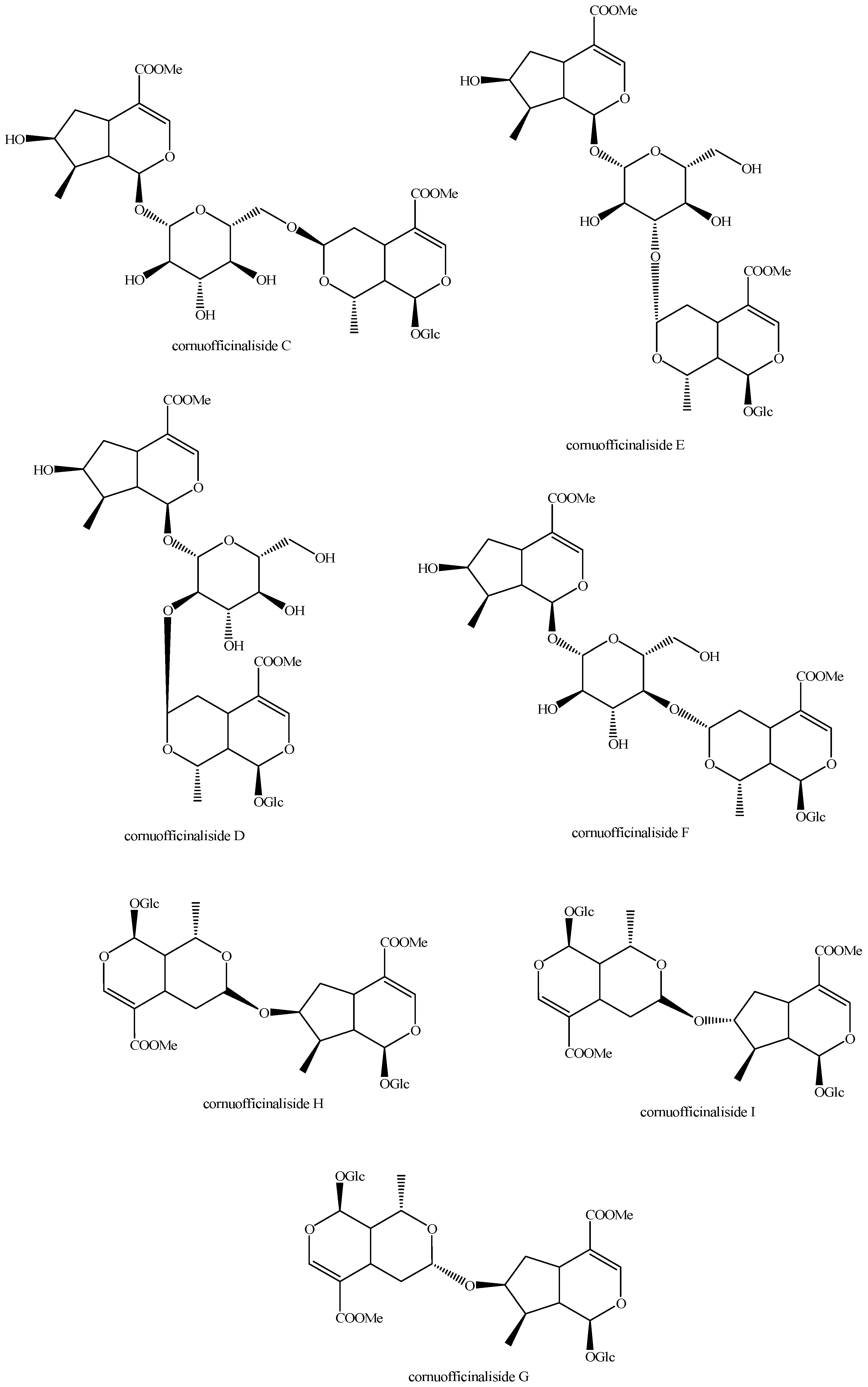
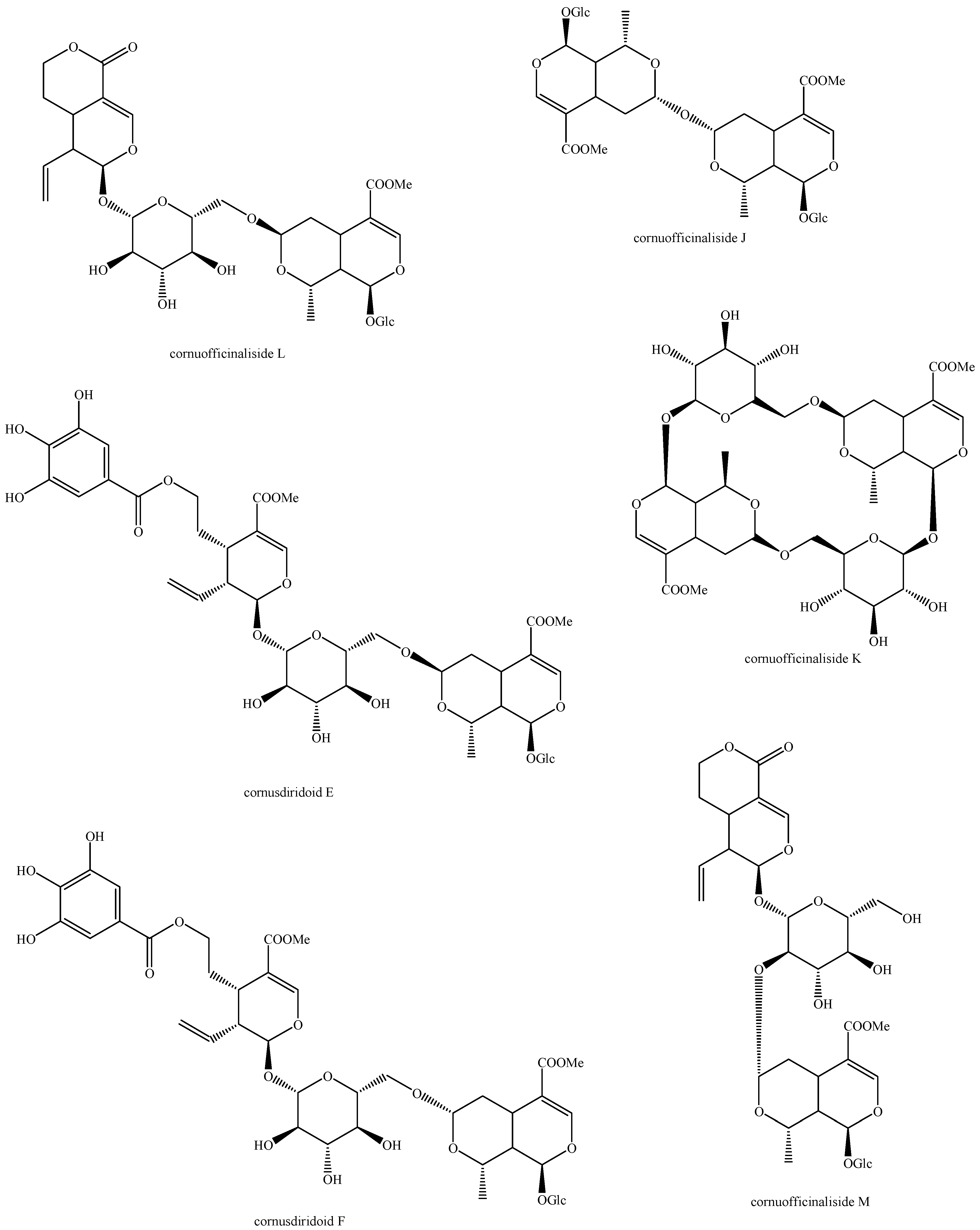
| Cornuofficinaliside C (Figure 13) | Cornus officinalis Siebold & Zucc. | Fruits | China | SE, CC, PP, sp-HPLC-UV, α[D], IR, UV, NMR, HR-MS | [97] |
| Cornuofficinaliside D (Figure 13) | Cornus officinalis Siebold & Zucc. | Fruits | China | SE, CC, PP, sp-HPLC-UV, α[D], IR, UV, NMR, HR-MS | [97] |
| Cornuofficinaliside E (Figure 13) | Cornus officinalis Siebold & Zucc. | Fruits | China | SE, CC, PP, sp-HPLC-UV, α[D], IR, UV, NMR, HR-MS | [97] |
| Cornuofficinaliside F (Figure 13) | Cornus officinalis Siebold & Zucc. | Fruits | China | SE, CC, PP, sp-HPLC-UV, α[D], IR, UV, NMR, HR-MS | [97] |
| Cornuofficinaliside G (Figure 13) | Cornus officinalis Siebold & Zucc. | Fruits | China | SE, CC, PP, sp-HPLC-UV, α[D], IR, UV, NMR, HR-MS | [97] |
| Cornuofficinaliside H (Figure 13) | Cornus officinalis Siebold & Zucc. | Fruits | China | SE, CC, PP, sp-HPLC-UV, α[D], IR, UV, NMR, HR-MS | [97] |
| Cornuofficinaliside I (Figure 13) | Cornus officinalis Siebold & Zucc. | Fruits | China | SE, CC, PP, sp-HPLC-UV, α[D], IR, UV, NMR, HR-MS | [97] |
| Cornuofficinaliside J (Figure 26) | Cornus officinalis Siebold & Zucc. | Fruits | China | SE, CC, PP, sp-HPLC-UV, α[D], IR, UV, NMR, HR-MS | [97] |
| Cornuofficinaliside K (Figure 26) | Cornus officinalis Siebold & Zucc. | Fruits | China | SE, CC, PP, sp-HPLC-UV, α[D], IR, UV, NMR, HR-MS | [97] |
| Cornuofficinaliside L (Figure 26) | Cornus officinalis Siebold & Zucc. | Fruits | China | SE, CC, PP, sp-HPLC-UV, α[D], IR, UV, NMR, HR-MS | [97] |
| Cornuofficinaliside M (Figure 26) | Cornus officinalis Siebold & Zucc. | Fruits | China | SE, CC, PP, sp-HPLC-UV, α[D], IR, UV, NMR, HR-MS | [97] |
| Cornusdiridoid A (Figure 25) | Cornus officinalis Siebold & Zucc. | Fruits | China | HSE, CC, sp-HPLC-UV, α[D], IR, UV, NMR, HR-MS | [98] |
| China (purchased from a local market) | SER, PP, CC, sp-HPLC-UV, NMR | [99] | |||
| Cornusdiridoid B (Figure 25) | Cornus officinalis Siebold & Zucc. | Fruits | China | HSE, CC, sp-HPLC-UV, α[D], IR, UV, NMR, HR-MS | [98] |
| Cornusdiridoid C (Figure 25) | Cornus officinalis Siebold & Zucc. | Fruits | China | HSE, CC, sp-HPLC-UV, α[D], IR, UV, NMR, HR-MS | [98] |
| Cornusdiridoid D (Figure 25) | Cornus officinalis Siebold & Zucc. | Fruits | China | HSE, CC, sp-HPLC-UV, α[D], IR, UV, NMR, HR-MS | [98] |
| Cornusdiridoid E (Figure 26) | Cornus officinalis Siebold & Zucc. | Fruits | China | HSE, CC, sp-HPLC-UV, α[D], IR, UV, NMR, HR-MS | [98] |
| Cornusdiridoid F (Figure 26) | Cornus officinalis Siebold & Zucc. | Fruits | China | HSE, CC, sp-HPLC-UV, α[D], IR, UV, NMR, HR-MS | [98] |
| Cornuside A (Figure 24) | Cornus officinalis Siebold & Zucc. | Fruits | China | SER, CC, p-HPLC-UV, α[D], IR, UV, NMR, HR-MS | [99] |
| China (purchased from a local market) | SER, PP, CC, sp-HPLC-UV, NMR | [100] | |||
| China (different populations purchased from a company) | HSE, UHPLC-MSn | [101] | |||
| Cornuside B (Figure 24) | Cornus officinalis Siebold & Zucc. | Fruits | China | SER, CC, p-HPLC-UV, α[D], IR, UV, NMR, HR-MS | [99] |
| Cornuside C (Figure 24) | Cornus officinalis Siebold & Zucc. | Fruits | China | SER, CC, p-HPLC-UV, α[D], IR, UV, NMR, HR-MS | [99] |
| Cornuside D (Figure 24) | Cornus officinalis Siebold & Zucc. | Fruits | China | SER, CC, p-HPLC-UV, α[D], IR, UV, NMR, HR-MS | [99] |
| Cornuside E (Figure 24) | Cornus officinalis Siebold & Zucc. | Fruits | China | SER, CC, p-HPLC-UV, α[D], IR, UV, NMR, HR-MS | [99] |
| China (purchased from a local market) | SER, PP, CC, sp-HPLC-UV, NMR | [100] | |||
| China (different populations purchased from a company) | HSE, UHPLC-MSn | [101] | |||
| Cornuside F (Figure 24) | Cornus officinalis Siebold & Zucc. | Fruits | China | SER, CC, p-HPLC-UV, α[D], IR, UV, NMR, HR-MS | [99] |
| Cornuside G (Figure 24) | Cornus officinalis Siebold & Zucc. | Fruits | China | SER, CC, p-HPLC-UV, α[D], IR, UV, NMR, HR-MS | [99] |
| Cornuside H (Figure 24) | Cornus officinalis Siebold & Zucc. | Fruits | China | SER, CC, p-HPLC-UV, α[D], IR, UV, NMR, HR-MS | [99] |
| Cornuside I (Figure 24) | Cornus officinalis Siebold & Zucc. | Fruits | China | SER, CC, p-HPLC-UV, α[D], IR, UV, NMR, HR-MS | [99] |
| Cornuside J (Figure 24) | Cornus officinalis Siebold & Zucc. | Fruits | China | SER, CC, p-HPLC-UV, α[D], IR, UV, NMR, HR-MS | [99] |
| Cornuside K (Figure 24) | Cornus officinalis Siebold & Zucc. | Fruits | China | SER, CC, p-HPLC-UV, α[D], IR, UV, NMR, HR-MS | [99] |
| China (purchased from a local market) | SER, PP, CC, sp-HPLC-UV, NMR | [100] | |||
| Cornuside L (Figure 12) | Cornus officinalis Siebold & Zucc. | Fruits | China | SER, CC, p-HPLC-UV, α[D], IR, UV, NMR, HR-MS | [99] |
| China (different populations purchased from a company) | HSE, UHPLC-MSn | [101] | |||
| Cornuside M (Figure 12) | Cornus officinalis Siebold & Zucc. | Fruits | China | SER, CC, p-HPLC-UV, α[D], IR, UV, NMR, HR-MS | [99] |
| China (different populations purchased from a company) | HSE, UHPLC-MSn | [101] | |||
| Cornuside N (Figure 12) | Cornus officinalis Siebold & Zucc. | Fruits | China | SER, CC, p-HPLC-UV, α[D], IR, UV, NMR, HR-MS | [99] |
| China (different populations purchased from a company) | HSE, UHPLC-MSn | [101] | |||
| Cornuside O (Figure 12) | Cornus officinalis Siebold & Zucc. | Fruits | China | SER, CC, p-HPLC-UV, α[D], IR, UV, NMR, HR-MS | [99] |
| China | SE, CC, PP, sp-HPLC-UV, α[D], IR, UV, NMR, HR-MS | [97] | |||
| Craigoside B (Figure 22) | Jasminum abyssinicum Hochst. ex DC. | Root bark | Congo | SE, PP, CCD, α[D], UV, CD, NMR, HR-MS | [102] |
| Craigoside C (Figure 22) | Jasminum abyssinicum Hochst. ex DC. | Root bark | Congo | SE, PP, CCD, α[D], UV, CD, NMR, HR-MS | [102] |
| Demethyl-hydroxy-oleonuezhenide | Syringa vulgaris L. | Flowers | Poland | HSE, CC, p-HPLC-UV, α[D], UV, NMR, HR-MS | [103] |
| Demethyl-oleonuezhenide | Syringa vulgaris L. | Flowers | Poland | HSE, CC, p-HPLC-UV, α[D], UV, NMR, HR-MS | [103] |
| Depresteroside (Figure 10) | Gentiana depressa D.Don | Aerial parts | Nepal | DP, SE, PP, CC, CCTLC, UV, NMR, MSn | [104] |
| Dioscoridin C (Figure 5) | Valeriana italica Lam. | Roots | Turkey | HSE, PP, CC, MPLC, α[D], IR, UV, NMR, HR-MS | [105] |
| Dipsanoside C (Figure 10) | Dipsacus inermis Wall. | Dried roots | China | HSE, PP, CC, rp-CC, p-TLC, rp-HPLC-UV, α[D], IR, UV, NMR, HR-MS | [48] |
| Dipsanoside D (Figure 10) | Dipsacus inermis Wall. | Dried roots | China | HSE, PP, CC, rp-CC, p-TLC, rp-HPLC-UV, α[D], IR, UV, NMR, HR-MS | [48] |
| Dipsanoside E (Figure 10) | Dipsacus inermis Wall. | Dried roots | China | HSE, PP, CC, rp-CC, p-TLC, rp-HPLC-UV, α[D], IR, UV, NMR, HR-MS | [48] |
| Dipsanoside F (Figure 11) | Dipsacus inermis Wall. | Dried roots | China | HSE, PP, CC, rp-CC, p-TLC, rp-HPLC-UV, α[D], IR, UV, NMR, HR-MS | [48] |
| Dipsanoside G (Figure 31) | Dipsacus inermis Wall. | Dried roots | China | HSE, PP, CC, rp-CC, p-TLC, rp-HPLC-UV, α[D], IR, UV, NMR, HR-MS | [48] |
| Dipsanoside J (Figure 10) | Dipsacus inermis Wall. | Dried roots | China | HSE, PP, CC, p-TLC, p-rp-HPLC-UV, α[D], IR, NMR, HR-MS | [106] |
| Dipsanoside M (Figure 11) | Dipsacus inermis Wall. | Dried roots | China | SER, CC, rp-CC, rp-FC, p-HPLC-UV, α[D], IR, UV, NMR, HR-MS | [107] |
| Dipsanoside N (Figure 11) | Dipsacus inermis Wall. | Dried roots | China | SER, CC, rp-CC, rp-FC, p-HPLC-UV, α[D], IR, UV, NMR, HR-MS | [107] |
| Dipsaperine (Figure 11) | Dipsacus inermis Wall. | Roots | China (purchased from a local market) | SE, PP, CC, rp-CC, sp-HPLC-UV, α[D], IR, UV, ECD, NMR, HR-MS | [94] |
| SER, PP, MPLC, p-HPLC-UV, α[D], IR, UV, NMR, HR-MS | [108] | ||||
| Disperoside A (Figure 7) | Gardenia jasminoides J.Ellis | Fruits | China | SE, PP, CC, sp-HPLC-UV, α[D], IR, UV, NMR, HR-MS | [109] |
| Disperoside B (Figure 7) | Gardenia jasminoides J.Ellis | Fruits | China | SE, PP, CC, sp-HPLC-UV, α[D], IR, UV, NMR, HR-MS | [109] |
| Floribundal (Figure 28) | Scaevola floribunda A.Gray | Heartwood | Japan | SXE, PP, VLC, MP, α[D], IR, UV, NMR, MS | [110] |
| Fraximalacoside (Figure 18) | Fraxinus malacophylla Hemsl. | Leaves | China (obtained from a botanical garden) | HSE, PP, CC, HPLC-UV, α[D], IR, UV, NMR, MS | [111] |
| Fraxinus mandshurica Rupr. | Whole plant | China (different populations) | USE, HPLC-DAD, UPLC-MS | [112] | |
| GI-3 (Figure 17) | Fraxinus americana L. | Seeds | USA | SE, PP, CC, MP, α[D], TLC | [113] |
| Leaves | SE, CC, TLC, IR, UV, NMR | [114] | |||
| Fraxinus excelsior L. | Seeds | USA | SE, PP, CC, MP, α[D], TLC | [113] | |
| Morocco | HSE, PP, CC, HPLC-UV, NMR | [115] | |||
| Fraxinus ornus L. | Seeds | USA | SE, PP, CC, MP, α[D], TLC | [113] | |
| Fraxinus pennsylvanica Marshall | Seeds | USA | SE, PP, CC, MP, α[D], TLC | [113] | |
| Olea europaea L. | Seeds | USA | SE, PP, CC, MP, α[D], TLC | [113] | |
| Syringa vulgaris L. | Seeds | USA | SE, PP, CC, MP, α[D], TLC | [113] | |
| Ligustrum lucidum W.T.Aiton | Dried fruits | China | SE, PP, CC, p-HPLC-UV, NMR | [116] | |
| SER, PP, CC, NMR | [117] | ||||
| USE, UHPLC-MSn | [118] | ||||
| Fruits | SER, PP, CC, p-HPLC-UV, MP, α[D], IR, UV, NMR, HR-MS | [119] | |||
| Osmanthus fragrans Lour. | Seeds | China | SE, PP, CC, NMR | [120] | |
| Ligustrum japonicum Thunb. | Fruits | South Korea | SER, PP, CC, α[D], IR, UV, NMR, HR-MS | [121] | |
| Dried fruits | South Korea | SE, PP, CC, rp-HPLC-UV, NMR, MS | [122] | ||
| Fraxinus mandshurica Rupr. | Seeds | China (purchased from a company) | SE, PP, CC, HPLC-DAD, NMR | [123] | |
| GI-5 (Figure 17) | Fraxinus americana L. | Seeds | USA | SE, PP, CC, MP, α[D], TLC | [113] |
| Leaves | SE, CC, TLC, IR, UV, NMR | [114] | |||
| Fraxinus excelsior L. | Seeds | USA | SE, PP, CC, MP, α[D], TLC | [113] | |
| Morocco | HSE, PP, CC, HPLC-UV, NMR | [115] | |||
| Fraxinus ornus L. | Seeds | USA | SE, PP, CC, MP, α[D], TLC | [113] | |
| Fraxinus pennsylvanica Marshall | Seeds | USA | SE, PP, CC, MP, α[D], TLC | [113] | |
| Olea europaea L. | Seeds | USA | SE, PP, CC, MP, α[D], TLC | [113] | |
| Syringa vulgaris L. | Seeds | USA | SE, PP, CC, MP, α[D], TLC | [113] | |
| Jasminum polyanthum Franch. | Flowers | China (purcahsed from a company) | HSE, PP, CC, p-HPLC, α[D], IR, UV, NMR, HR-MS | [124] | |
| Fraxinus mandshurica Rupr. | Seeds | China (purchased from a company) | SE, PP, CC, HPLC-DAD, NMR | [123] | |
| Globuloside A (Figure 7) | Globularia trichosantha Fisch. & C.A.Mey. | Underground parts | Turkey | HSE, PP, rp-VLC, CC, MPLC, α[D], IR, NMR, MS | [125] |
| Globularia meridionalis (Podp.) O.Schwarz | Aerial parts | Italy | SE, PP, CC, NMR | [126] | |
| Globularia alypum L. | Aerial parts | Croatia | SER, HPLC-PDA, HPLC-PDA-MSn | [127] | |
| Leaves | Croatia | USE, HPLC-PDA-MSn | [128] | ||
| SXE, HPLC-PDA-MSn | |||||
| Globuloside B (Figure 6) | Globularia trichosantha Fisch. & C.A.Mey. | Underground parts | Turkey | HSE, PP, rp-VLC, CC, MPLC, α[D], IR, UV, NMR, MS | [125] |
| Globularia meridionalis (Podp.) O.Schwarz | Aerial parts | Italy | SE, PP, CC, NMR | [126] | |
| Globuloside C (Figure 11) | Globularia cordifolia L. | Roots and rhizomes | Turkey | HSE, PP, VLC, MPLC, CC, α[D], IR, UV, NMR, HR-MS | [129] |
| Hookerinoid A (Figure 28) | Pterocephalus hookeri (C.B.Clarke) E.Pritz. | Underground parts | China | SER, PP, CC, sp-HPLC-UV, α[D], IR, UV, NMR, HR-MS | [130] |
| Hookerinoid B (Figure 28) | Pterocephalus hookeri (C.B.Clarke) E.Pritz. | Underground parts | China | SER, PP, CC, sp-HPLC-UV, α[D], IR, UV, NMR, HR-MS | [130] |
| Hydroxy-oleonuezhenide | Syringa vulgaris L. | Flowers | Poland | HSE, CC, p-HPLC-UV, α[D], UV, NMR, HR-MS | [103] |
| Ilicifolioside A (Figure 19) | Osmanthus heterophyllus (G.Don) P.S.Green | Leaves | Japan | SE, PP, CC, p-HPLC-UV, α[D], UV, NMR, HR-MS | [131] |
| Ilicifolioside B (Figure 22) | Osmanthus heterophyllus (G.Don) P.S.Green | Leaves | Japan | SE, PP, CC, p-HPLC-UV, α[D], UV, NMR, HR-MS | [131] |
| Incaside (Figure 29) | Mussaenda incana Wall. | Stem bark | n.a. | n.a. | [132] |
| Iridolinarin A (Figure 29) | Linaria japonica Miq. | Whole plant | Japan | SE, PP, CC, α[D], IR, UV, NMR, HR-MS | [133] |
| Iridolinarin B (Figure 33) | Linaria japonica Miq. | Whole plant | Japan | SE, PP, CC, α[D], IR, UV, NMR, HR-MS | [133] |
| Iridolinarin C (Figure 29) | Linaria japonica Miq. | Whole plant | Japan | SE, PP, CC, α[D], IR, UV, NMR, HR-MS | [133] |
| Iso-jaspolyoside A (Figure 17) | Jasminum polyanthum Franch. | Flowers | China (purcahsed from a company) | HSE, PP, CC, p-TLC, p-HPLC-UV, α[D], IR, UV, NMR, HR-MS | [134] |
| Olea europaea L. | Wood | Spain | SER, CC, rp-HPLC-DAD, NMR | [135] | |
| Spain (different populations) | SE, HPLC-DAD, HPLC-DAD-MS | [136] | |||
| Iso-jaspolyoside B (Figure 18) | Jasminum polyanthum Franch. | Flowers | China (purcahsed from a company) | HSE, PP, CC, p-TLC, p-HPLC-UV, α[D], IR, UV, NMR, HR-MS | [134] |
| Iso-jaspolyoside C (Figure 18) | Jasminum polyanthum Franch. | Flowers | China (purcahsed from a company) | HSE, PP, CC, p-TLC, p-HPLC-UV, α[D], IR, UV, NMR, HR-MS | [134] |
| Iso-oleonuzhenide (Figure 15) | Ligustrum lucidum W.T.Aiton | Dried fruits | China | SE, PP, CC, p-HPLC-UV, α[D], IR, UV, NMR, HR-MS | [116] |
| Ligustrum japonicum Thunb. | Fruits | South Korea | SER, PP, CC, rp-CC, α[D], IR, UV, NMR, HR-MS | [121] | |
| Fraxinus mandshurica Rupr. | Seeds | China (purchased from a company) | SE, PP, CC, HPLC-DAD, NMR | [123] | |
| Japonicoside E (Figure 33) | Lonicera japonica Thunb. | Flower buds | China (purchased from a company) | SER, CC, p-HPLC-UV, sp-HPLC-UV, α[D], IR, UV, NMR, HR-MS | [137] |
| Jasmigeniposide B (Figure 1) | Gardenia jasminoides J.Ellis | Fruits | China (purchased from a company) | SER, PP, CC, rp-HPLC-UV, α[D], IR, UV, NMR, HR-MS | [138] |
| Jasnervoside F (Figure 20) | Jasminum nervosum Lour. | Stems | China (purchased from a local market) | SER, PP, CC, α[D], IR, UV, NMR, HR-MS | [139] |
| Jasnudifloside D (Figure 14) | Jasminum nudiflorum Lindl. | Stems | Japan (obtained from a botanical garden) | HSE, PP, CC, p-HPLC-UV, α[D], IR, UV, NMR, HR-MS | [140] |
| Jasnudifloside E (Figure 14) | Jasminum nudiflorum Lindl. | Stems | Japan (obtained from a botanical garden) | HSE, PP, CC, p-HPLC-UV, α[D], IR, UV, NMR, HR-MS | [140] |
| Jasnudifloside H (Figure 14) | Jasminum nudiflorum Lindl. | Leaves | Japan (obtained from a botanical garden) | HSE, PP, CC, p-TLC, p-HPLC-UV, α[D], IR, UV, NMR, HR-MS | [141] |
| Jasnudifloside L (Figure 14) | Jasminum nudiflorum Lindl. | Leaves | Japan (obtained from a botanical garden) | HSE, PP, CC, p-TLC, p-HPLC-UV, α[D], IR, UV, NMR, HR-MS | [141] |
| Jaspolyanoside (Figure 23) | Jasminum polyanthum Franch. | Flowers | China (purcahsed from a company) | HSE, PP, CC, p-TLC, p-HPLC-UV, α[D], IR, UV, NMR, HR-MS | [134] |
| Olea europaea L. | Wood | Spain | SER, CC, rp-HPLC-DAD, NMR | [135] | |
| Spain (different populations) | SE, HPLC-DAD, HPLC-DAD-MS | [136] | |||
| Syringa oblata subsp. dilatata (Nakai) P.S.Green & M.C.Chang | Twigs | South Korea | SE, PP, CC, rp-CC, rp-HPLC-UV, NMR | [142] | |
| Fraxinus mandshurica Rupr. | Seeds | China (purchased from a company) | SE, PP, CC, HPLC-DAD, NMR | [123] | |
| Jaspolyanthoside (Figure 22) | Jasminum polyanthum Franch. | Flowers | China (purcahsed from a company) | HSE, PP, CC, p-HPLC-UV, α[D], IR, UV, NMR, HR-MS | [124] |
| Jasminum nervosum Lour. | Stems | China (purchased from a local market) | SER, PP, CC, α[D], IR, UV, NMR, HR-MS | [139] | |
| Jasminum grandiflorum subsp. floribundum (R.Br. ex Fresen.) P.S.Green | Aerial parts | Saudi Arabia | USE, PP, HPLC-DAD, UPLC-HR-MS | [143] | |
| Jaspolyoside (Figure 23) | Jasminum polyanthum Franch. | Flowers | China (purchased from a company) | HSE, PP, CC, p-HPLC, α[D], IR, UV, NMR, HR-MS | [124] |
| Syringa reticulata (Blume) H.Hara | Bark | China | SE, PP, CC, rp-CC, NMR | [144] | |
| Olea europaea L. | Wood | Spain | SER, CC, rp-HPLC-DAD, NMR | [135] | |
| Spain (different populations) | SE, HPLC-DAD, HPLC-DAD-MS | [136] | |||
| Syringa oblata subsp. dilatata (Nakai) P.S.Green & M.C.Chang | Twigs | South Korea | SE, PP, CC, rp-CC, rp-HPLC-UV, NMR | [142] | |
| Jasuroside A (Figure 20) | Jasminum urophyllum Hemsl. | Whole plant | Taiwan | SE, PP, CC, CPC, p-TLC, α[D], IR, UV, NMR, MS | [145] |
| Jasminum nudiflorum Lindl. | Leaves and stems | Japan (obtained from a botanical garden) | HSE, PP, CC, p-TLC, α[D], IR, UV, NMR, HR-MS | [146] | |
| Jasuroside C (Figure 20) | Jasminum urophyllum Hemsl. | Whole plant | Taiwan | SE, PP, CC, CPC, p-TLC, α[D], IR, UV, NMR, MS | [145] |
| Jasminum nudiflorum Lindl. | Leaves and stems | Japan (obtained from a botanical garden) | HSE, PP, CC, p-TLC, α[D], IR, UV, NMR, HR-MS | [146] | |
| Jasuroside G (Figure 20) | Jasminum urophyllum Hemsl. | Leaves and stems | Taiwan | SE, PP, CC, rp-CC, α[D], IR, UV, NMR, MS | [147] |
| Kickxin (Figure 1) | Kickxia commutata (Bernh. ex Rchb.) Fritsch | Flowering aerial parts | Bulgaria | SE, ACT, CC, α[D], NMR | [148] |
| Kickxia elatine (L.) Dumort. | Flowering aerial parts | Bulgaria | SE, ACT, CC, α[D], NMR | [148] | |
| Kickxia spuria (L.) Dumort. | Flowering aerial parts | Bulgaria | SE, ACT, CC, α[D], NMR | [148] | |
| Korolkoside (Figure 17) | Lonicera korolkowii Stapf | Aerial parts | Japan (purchased from a company) | SE, PP, CC, rp-HPLC-UV, α[D], NMR, HR-MS | [149] |
| Lonicera japonica Thunb. | n.a. | n.a. | n.a. | [150] | |
| Kurdnestorianoside (Figure 11) | Pterocephalus nestorianus Nábelek | Flowers | Iraq | DP, SE, MPLC, α[D], IR, UV, NMR, HR-MS | [67] |
| Laciniatoside I (Figure 31) | Dipsacus laciniatus L. | Aerial parts | Hungary | SE, PP, CCD, CC, α[D], IR, UV, NMR | [45] |
| Cephalaria scoparia Contandr. & Quézel | Whole plant | Turkey | SE, PP, rp-MPLC, MPLC, NMR | [151] | |
| Cephalaria gazipashensis Sümbül | Aerial parts | Turkey | SE, PP, DF, rp-VLC, CC, MPLC, NMR | [152] | |
| Pterocephalus hookeri (C.B.Clarke) E.Pritz. | Underground parts | Tibet | SER, PP, CC rp-CC, NMR | [58] | |
| Underground parts | Tibet | SER, PP, TLC, sp-HPLC-MS, NMR | [59] | ||
| n.a. | n.a. | n.a. | [60] | ||
| Whole plant | China | USE, UPLC-MSn | [64] | ||
| Laciniatoside II (Figure 30) | Dipsacus laciniatus L. | Aerial parts | Hungary | SE, PP, CCD, CC, α[D], IR, UV, NMR | [45] |
| Linnaea chinensis A.Braun & Vatke | Aerial parts | Italy | SE, PP, CC, NMR | [11] | |
| Dipsacus ferox Loisel. | Leaves and branches | Italy | SE, CC, NMR | [153] | |
| Pterocephalus hookeri (C.B.Clarke) E.Pritz. | Underground parts | Tibet | SER, PP, CC rp-CC, NMR | [58] | |
| Underground parts | Tibet | SER, PP, TLC, sp-HPLC-MS, NMR | [59] | ||
| n.a. | n.a. | n.a. | [60] | ||
| Whole plant | China | SE, PP, HPLC-UV | [62] | ||
| USE, UPLC-MSn | [64] | ||||
| Tibet | SE, PP, CC, sp-HPLC-UV, NMR | [24] | |||
| Handroanthus impetiginosus (Mart. ex DC.) Mattos | Leaves | Egypt (obtained from a botanical garden) | PE, PP, HPLC-MSn | [154] | |
| Laciniatoside III (Figure 29) | Dipsacus laciniatus L. | Aerial parts | Hungary | SE, PP, CCD, CC, α[D], IR, UV, NMR | [45] |
| Laciniatoside IV (Figure 30) | Dipsacus laciniatus L. | Aerial parts | Hungary | SE, PP, CCD, CC, α[D], IR, UV, NMR | [45] |
| Laciniatoside V (Figure 30) | Dipsacus laciniatus L. | Flowering aerial parts | Hungary | SE, CC, CCC, α[D], IR, UV, NMR | [155] |
| Aerial parts | SE, PP, CCD, CC, α[D], IR, UV, NMR | [45] | |||
| Cephalaria balansae Raus | Whole plant | Turkey | USE, PP, HPLC-MSn | [156] | |
| Cephalaria elmaliensis Hub.-Mor. & V.A.Matthews | Whole plant | Turkey | USE, PP, HPLC-MSn | [156] | |
| Cephalaria isaurica V.A.Matthews | Whole plant | Turkey | USE, PP, HPLC-MSn | [156] | |
| Cephalaria scoparia Contandr. & Quézel | Whole plant | Turkey | USE, PP, HPLC-MSn | [156] | |
| Cephalaria speciosa Boiss. & Kotschy | Whole plant | Turkey | USE, PP, HPLC-MSn | [156] | |
| Cephalaria stellipilis Boiss. | Whole plant | Turkey | USE, PP, HPLC-MSn | [156] | |
| Cephalaria sumbuliana Göktürk | Whole plant | Turkey | USE, PP, HPLC-MSn | [156] | |
| Scabiosa atropurpurea L. | Whole plant | Turkey | SE, CC, sp-HPLC-UV, HPLC-MSn, NMR | [34] | |
| Lasianoside G (Figure 4) | Lasianthus verticillatus (Lour.) Merr. | Levaes | Japan | SE, PP, rp-CC, HPLC-UV, α[D], IR, UV, NMR, MS | [157] |
| Lasianoside H (Figure 5) | Lasianthus verticillatus (Lour.) Merr. | Levaes | Japan | SE, PP, rp-CC, HPLC-UV, α[D], IR, UV, NMR, MS | [157] |
| Lasianoside I (Figure 5) | Lasianthus verticillatus (Lour.) Merr. | Levaes | Japan | SE, PP, rp-CC, HPLC-UV, α[D], IR, UV, NMR, MS | [157] |
| Liguside A (Figure 20) | Ligustrum lucidum W.T.Aiton | Fruits | China | SER, PP, CC, p-HPLC-UV, MP, α[D], IR, UV, NMR, HR-MS | [119] |
| Liguside B (Figure 20) | Ligustrum lucidum W.T.Aiton | Fruits | China | SER, PP, CC, p-HPLC-UV, MP, α[D], IR, UV, NMR, HR-MS | [119] |
| Ilex pubescens Hook. & Arn. | Roots | China (purchased from a company) | SE, PP, CC, rp-HPLC-UV, NMR, HR-MS | [158] | |
| Ligustrinoside (Figure 1) | Strychnos lucida R.Br. | Wood | Indonesia | SE, PP, CC, MPLC, α[D], IR, UV, NMR, MS | [159] |
| Lisianthoside (Figure 23) | Lisianthius jefensis A.Robyns & T.S.Elias | n.r. | n.r. | SE, CC, sp-HPLC-UV, NMR | [160] |
| Dipsacus inermis Wall. | Roots | China | HSE, PP, CC, rp-CC, p-TLC, rp-HPLC-UV, NMR | [48] | |
| Loasafolioside (Figure 30) | Loasa acerifolia Dombey ex A.Juss. | Leaves | Germany (obtained from a botanical garden) | SXE, PP, CC, sp-HPLC-UV, α[D], IR, UV, NMR, MS | [161] |
| Longifloroside (Figure 3) | Pedicularis longiflora Rudolph | Whole plant | China | SE, SER, DP, PP, CC, NMR, MS | [162] |
| Minutifloroside (Figure 6) | Palicourea minutiflora (Müll.Arg.) C.M.Taylor | Leaves and branches | Brazil | SE, PP, CC, α[D], NMR, HR-MS | [163] |
| Molihuaside A (Figure 16) | Jasminum sambac (L.) Aiton | Flowers | China | SER, PP, CC, rp-CC, MP, α[D], IR, UV, NMR, MS | [164] |
| Jasminum flexile Vahl | Aerial parts | India | SE, PP, CC, p-TLC, NMR, MS | [165] | |
| Molihuaside C (Figure 16) | Jasminum sambac (L.) Aiton | Flowers | China | SER, PP, CC, rp-CC, MP, α[D], IR, UV, NMR, MS | [164] |
| Molihuaside D (Figure 16) | Jasminum sambac (L.) Aiton | Flowers | China | SER, PP, CC, rp-CC, MP, α[D], IR, UV, NMR, MS | [164] |
| Leaves and stems | Taiwan | SE, PP, CC, p-TLC, α[D], NMR | [166] | ||
| Molihuaside E (Figure 16) | Jasminum sambac (L.) Aiton | Flowers | China | SER, PP, CC, rp-CC, MP, α[D], IR, UV, NMR, MS | [164] |
| Neo-cornuside C (Figure 12) | Cornus officinalis Siebold & Zucc. | Fruits | China | SER, PP, CC, sp-HPLC-UV, α[D], IR, UV, NMR, HR-MS | [167] |
| Neo-cornuside D (Figure 23) | Cornus officinalis Siebold & Zucc. | Fruits | China | SER, PP, CC, sp-HPLC-UV, α[D], IR, UV, NMR, HR-MS | [167] |
| Neo-cornuside F (Figure 23) | Cornus officinalis Siebold & Zucc. | Fruits | China (purchased from a local market) | SER, PP, CC, sp-HPLC-UV, α[D], IR, UV, NMR, HR-MS | [100] |
| Neo-polyanoside (Figure 15) | Jasminum polyanthum Franch. | Flowers | China (purcahsed from a company) | HSE, PP, CC, p-TLC, p-HPLC-UV, α[D], IR, UV, NMR, HR-MS | [168] |
| Nudifloside A (Figure 14) | Jasminum nudiflorum Lindl. | Stems | Japan (obtained from a botanical garden) | HSE, PP, CC, p-HPLC-UV, α[D], IR, UV, NMR, HR-MS | [140] |
| Nudifloside B (Figure 14) | Jasminum nudiflorum Lindl. | Stems | Japan (obtained from a botanical garden) | HSE, PP, CC, p-HPLC-UV, α[D], IR, UV, NMR, HR-MS | [140] |
| Officinaloside A (Figure 21) | Cornus officinalis Siebold & Zucc. | Twigs | China | SE, PP, CC, rp-CC, HPLC-UV, α[D], IR, UV, NMR, HR-MS | [169] |
| Oleoneonuezhenide | Syringa vulgaris L. | Bark | Poland | HSE, HPLC-DAD-MSn | [170] |
| Oleonuezhenide (Figure 15) | Ligustrum japonicum Thunb. | Fruits | Japan (purchased from a company) | SE, PP, CC, rp-CC, α[D], IR, UV, NMR, MS | [171] |
| Leaves | South Korea | USE, PP, CC, rp-CC, sp-HPLC-UV, NMR | [172] | ||
| Ligustrum obtusifolium Siebold & Zucc. | Leaves | n.a. | n.a. | [173] | |
| Ligustrum lucidum W.T.Aiton | Fruits | China | SER, PP, CC, p-HPLC-UV, MP, α[D], IR, UV, NMR, HR-MS | [119] | |
| Dried fruits | SE, PP, CC, NMR | [116] | |||
| n.a. | n.a. | [174] | |||
| China | USE, UHPLC-MSn | [113] | |||
| China (purchased from a company) | SE, CC, HPLC-DAD, HPLC-MS | [175] | |||
| Ilex pubescens Hook. & Arn. | Roots | China (purchased from a company) | SE, PP, CC, rp-HPLC-UV, NMR, HR-MS | [158] | |
| Syringa oblata subsp. dilatata (Nakai) P.S.Green & M.C.Chang | Twigs | South Korea | SE, PP, CC, rp-CC, rp-HPLC-UV, NMR | [142] | |
| Ligustrum japonicum Thunb. | Dried fruits | South Korea | SE, PP, CC, rp-HPLC-UV, NMR, MS | [122] | |
| Syringa vulgaris L. | Flowers | Poland | HSE, CC, p-HPLC-UV, α[D], UV, NMR, HR-MS | [103] | |
| Whole plant | HSE, HPLC-DAD-MSn | [176] | |||
| Bark | HSE, HPLC-DAD-MSn | [170] | |||
| Paederoscandoside (Figure 3) | Paederia foetida L. | n.a. | n.a. | n.a. | [177] |
| Stems | China (purchased from a company) | SE, PP, CC, p-HPLC-UV, NMR | [178] | ||
| Aerial parts | China | SER, CC, sp-HPLC-UV, NMR | [33] | ||
| Paederoside B (Figure 7) | Paederia foetida L. | Stems | China | SE, PP, CC, rp-CC, HPLC-UV, α[D], IR, UV, NMR, HR-MS | [179] |
| Whole plant | SER, PP, HPLC-MSn, HR-MSn | [180] | |||
| Stems | China (purchased from a company) | SE, PP, CC, HPLC-MS | [178] | ||
| Patriscabiobisin A (Figure 34) | Patrinia scabiosifolia Link | Whole plant | China | SE, PP, CC, sp-HPLC-UV, α[D], IR, UV, NMR, HR-MS | [181] |
| Patriscabiobisin B (Figure 34) | Patrinia scabiosifolia Link | Whole plant | China | SE, PP, CC, sp-HPLC-UV, α[D], IR, UV, NMR, HR-MS | [181] |
| Patriscabiobisin C (Figure 27) | Patrinia scabiosifolia Link | Whole plant | China | SE, PP, CC, sp-HPLC-UV, α[D], IR, UV, NMR, HR-MS | [181] |
| SE, PP, CC, sp-HPLC-UV, α[D], IR, UV, NMR, HR-MS | [182] | ||||
| Phukettoside A (Figure 33) | Gynochthodes umbellata (L.) Razafim. & B.Bremer | Leaves | Thailand | SE, CC, p-HPLC-UV, α[D], IR, UV, NMR, HR-MS | [183] |
| Phukettoside B (Figure 33) | Gynochthodes umbellata (L.) Razafim. & B.Bremer | Leaves | Thailand | SE, CC, p-HPLC-UV, α[D], IR, UV, NMR, HR-MS | [183] |
| Phukettoside C (Figure 33) | Gynochthodes umbellata (L.) Razafim. & B.Bremer | Leaves | Thailand | SE, CC, p-HPLC-UV, α[D], IR, UV, NMR, HR-MS | [183] |
| Phukettoside D (Figure 2) | Gynochthodes umbellata (L.) Razafim. & B.Bremer | Leaves | Thailand | SE, CC, p-HPLC-UV, α[D], IR, UV, NMR, HR-MS | [183] |
| Picconioside I (Figure 7) | Picconia excelsa (Aiton) DC. | Foliage | Spain | SE, PP, CC, α[D], NMR | [184] |
| Strychnos lucida R.Br. | Bark and wood | Thailand | HSE, PP, MPLC, rp-MPLC, p-HPLC-UV, NMR | [54] | |
| Leonotis nepetifolia (L.) R.Br. | Aerial parts | Vietnam | SE, PP, CC, rp-CC, NMR, MS | [185] | |
| Picconioside II (Figure 34) | Galium maximowiczii (Kom.) Pobed. | Whole plant | South Korea | SE, PP, CC, p-HPLC-UV, NMR | [32] |
| Picrorhizaoside E (Figure 32) | Picrorhiza kurroa Royle ex Benth. | Rhizomes | China (cultivated) | SER, PP, CC, rp-CC, HPLC-UV, α[D], IR, UV, NMR, HR-MS | [186] |
| Picrorhizaoside F (Figure 32) | Picrorhiza kurroa Royle ex Benth. | Rhizomes | China (cultivated) | SER, PP, CC, rp-CC, HPLC-UV, α[D], IR, UV, NMR, HR-MS | [186] |
| Picrorhizaoside G (Figure 32) | Picrorhiza kurroa Royle ex Benth. | Rhizomes | China (cultivated) | SER, PP, CC, rp-CC, HPLC-UV, α[D], IR, UV, NMR, HR-MS | [186] |
| Polyanoside (Figure 15) | Jasminum polyanthum Franch. | Flowers | China (purcahsed from a company) | HSE, PP, CC, p-TLC, p-HPLC-UV, α[D], IR, UV, NMR, HR-MS | [134] |
| Jasminum sambac (L.) Ait | Leaves | Egypt (different populations) | PE, HPLC-PDA-MSn | [187] | |
| Jasminum multiflorum (Burm.f.) Andrews | Leaves | Egypt | PE, PP, VLC, HPLC-PDA-MSn | [188] | |
| Premnaodoroside D (Figure 4) | Premna odorata Blanco | Leaves | Japan | SE, PP, CC, rp-CC, DCCC, HPLC-UV, α[D], IR, UV, NMR, HR-MS | [189] |
| Leaves | Egypt | SE, PP, HPLC-MS | [190] | ||
| Premnaodoroside E (Figure 4) | Premna odorata Blanco | Leaves | Japan | SE, PP, CC, rp-CC, DCCC, HPLC-UV, α[D], IR, UV, NMR, HR-MS | [189] |
| Premnaodoroside F | Premna odorata Blanco | Leaves | Japan | SE, PP, CC, rp-CC, DCCC, HPLC-UV, α[D], IR, UV, NMR, HR-MS | [189] |
| Premnaodoroside G | Premna odorata Blanco | Leaves | Japan | SE, PP, CC, rp-CC, DCCC, HPLC-UV, α[D], IR, UV, NMR, HR-MS | [189] |
| Ptehoside C (Figure 31) | Pterocephalus hookeri (C.B.Clarke) E.Pritz. | Whole plant | Tibet | SE, PP, CC, sp-HPLC-UV, α[D], IR, UV, NMR, HR-MS | [24] |
| Ptehoside D (Figure 31) | Pterocephalus hookeri (C.B.Clarke) E.Pritz. | Whole plant | Tibet | SE, PP, CC, sp-HPLC-UV, α[D], IR, UV, NMR, HR-MS | [24] |
| Ptehoside E (Figure 31) | Pterocephalus hookeri (C.B.Clarke) E.Pritz. | Whole plant | Tibet | SE, PP, CC, sp-HPLC-UV, α[D], IR, UV, NMR, HR-MS | [24] |
| Ptehoside F (Figure 31) | Pterocephalus hookeri (C.B.Clarke) E.Pritz. | Whole plant | Tibet | SE, PP, CC, sp-HPLC-UV, α[D], IR, UV, NMR, HR-MS | [24] |
| Ptehoside G (Figure 31) | Pterocephalus hookeri (C.B.Clarke) E.Pritz. | Whole plant | Tibet | SE, PP, CC, sp-HPLC-UV, α[D], IR, UV, NMR, HR-MS | [24] |
| Ptehoside H (Figure 31) | Pterocephalus hookeri (C.B.Clarke) E.Pritz. | Whole plant | Tibet | SE, PP, CC, sp-HPLC-UV, α[D], IR, UV, NMR, HR-MS | [24] |
| Ptehoside I (Figure 31) | Pterocephalus hookeri (C.B.Clarke) E.Pritz. | Whole plant | Tibet | SE, PP, CC, sp-HPLC-UV, α[D], IR, UV, NMR, HR-MS | [24] |
| Pterhookeroside (Figure 28) | Pterocephalus hookeri (C.B.Clarke) E.Pritz. | Underground parts | Tibet | SER, PP, CC, sp-HPLC-UV, α[D], IR, UV, NMR, HR-MS | [191] |
| Pterocenoid B (Figure 28) | Pterocephalus hookeri (C.B.Clarke) E.Pritz. | Underground parts | Tibet | SER, PP, CC, sp-HPLC-UV, α[D], IR, UV, NMR, HR-MS | [192] |
| Whole plant | China | SE, PP, CC, rp-CC, HPLC-UV, NMR | [193] | ||
| Pterocenoid C (Figure 28) | Pterocephalus hookeri (C.B.Clarke) E.Pritz. | Underground parts | Tibet | SER, PP, CC, sp-HPLC-UV, α[D], IR, UV, NMR, HR-MS | [192] |
| Pterocenoid D (Figure 28) | Pterocephalus hookeri (C.B.Clarke) E.Pritz. | Underground parts | Tibet | SER, PP, CC, sp-HPLC-UV, α[D], IR, UV, NMR, HR-MS | [192] |
| Pterocenoid E (Figure 28) | Pterocephalus hookeri (C.B.Clarke) E.Pritz. | Whole plant | China | SE, PP, CC, rp-CC, HPLC-UV, α[D], UV, NMR, HR-MS | [193] |
| Pterocenoid F (Figure 28) | Pterocephalus hookeri (C.B.Clarke) E.Pritz. | Whole plant | China | SE, PP, CC, rp-CC, HPLC-UV, α[D], UV, NMR, HR-MS | [193] |
| Pterocenoid G (Figure 33) | Pterocephalus hookeri (C.B.Clarke) E.Pritz. | Whole plant | China | SE, PP, CC, rp-CC, HPLC-UV, α[D], UV, NMR, HR-MS | [193] |
| Pterocenoid H (Figure 28) | Pterocephalus hookeri (C.B.Clarke) E.Pritz. | Whole plant | China | SE, PP, CC, rp-CC, HPLC-UV, α[D], UV, NMR, HR-MS | [193] |
| Pterocephaline (Figure 11) | Pterocephalus pinardi Boiss. | Aerial parts | Turkey | SE, PP, rp-VLC, CC, α[D], IR, NMR, HR-MS | [55] |
| Pterocephalus hookeri (C.B.Clarke) E.Pritz. | Whole plant | China | USE, UPLC-MSn | [64] | |
| Dipsacus inermis Wall. | Roots | China | HSE, PP, CC, p-TLC, p-rp-HPLC-UV, NMR | [106] | |
| China (purchased from a local market) | SER, PP, MPLC, p-HPLC-UV, α[D], IR, UV, NMR, HR-MS | [108] | |||
| Pteroceside A (Figure 9) | Pterocephalus hookeri (C.B.Clarke) E.Pritz. | Underground parts | Tibet | SER, PP, CC, rp-CC, sp-HPLC-UV, α[D], IR, UV, NMR, HR-MS | [58] |
| Scabiosa atropurpurea L. | Whole plant | Turkey | SE, CC, sp-HPLC-UV, HPLC-MSn, NMR | [34] | |
| Pteroceside B (Figure 9) | Pterocephalus hookeri (C.B.Clarke) E.Pritz. | Underground parts | Tibet | SER, PP, CC, rp-CC, sp-HPLC-UV, α[D], IR, UV, NMR, HR-MS | [58] |
| Pteroceside C (Figure 9) | Pterocephalus hookeri (C.B.Clarke) E.Pritz. | Underground parts | Tibet | SER, PP, CC, rp-CC, sp-HPLC-UV, α[D], IR, UV, NMR, HR-MS | [58] |
| Scabiosa atropurpurea L. | Whole plant | Turkey | SE, CC, sp-HPLC-UV, HPLC-MSn, NMR | [34] | |
| Pubescensoside (Figure 6) | Anarrhinum forskaohlii subsp. pubescens D.A.Sutton | Aerial parts | Egypt | SE, DP, PP, CC, NMR, HR-MS | [194] |
| Pubzenoside (Figure 23) | Ilex pubescens Hook. & Arn. | Roots | China (purchased from a company) | SER, PP, CC, rp-HPLC-UV, α[D], IR, UV, NMR, HR-MS | [195] |
| Radiatoside (Figure 1) | Argylia radiata (L.) D.Don | Whole plant | Chile | SE, ACT, PC, TLC, CC, α[D], IR, UV, NMR | [196] |
| Radiatoside B (Figure 1) | Argylia radiata (L.) D.Don | Whole plant | Chile | SE, ACT, PC, TLC, CC, α[D], IR, UV, NMR | [197] |
| Radiatoside C (Figure 1) | Argylia radiata (L.) D.Don | Whole plant | Chile | SE, ACT, PC, TLC, CC, α[D], IR, UV, NMR | [197] |
| Radiatoside D (Figure 1) | Argylia radiata (L.) D.Don | Whole plant | Chile | SE, ACT, PC, TLC, α[D], IR, UV, NMR | [198] |
| Radiatoside E (Figure 1) | Argylia radiata (L.) D.Don | Whole plant | Chile | SE, CC, α[D], IR, UV, NMR, MS | [30] |
| Radiatoside F (Figure 1) | Argylia radiata (L.) D.Don | Whole plant | Chile | SE, CC, α[D], IR, UV, NMR, MS | [30] |
| Randinoside (Figure 1) | Catunaregam spinosa (Thunb.) Tirveng. | Stems | Brazil | SE, PP, CC, p-HPLC-UV, α[D], IR, UV, NMR, HR-MS | [199] |
| Rapulaside A (Figure 34) | Heracleum rapula Franch. | Roots | China | SE, PP, CC, p-HPLC-UV, α[D], NMR, MS | [200] |
| Rapulaside B (Figure 34) | Heracleum rapula Franch. | Roots | China | SE, PP, CC, p-HPLC-UV, α[D], NMR, MS | [200] |
| Reticunin A (Figure 27) | Neonauclea reticulata (Havil.) Merr. | Stems | Taiwan | SE, PP, CC, HPLC-UV, α[D], IR, UV, NMR, HR-MS | [201] |
| Reticunin B (Figure 27) | Neonauclea reticulata (Havil.) Merr. | Stems | Taiwan | SE, PP, CC, HPLC-UV, α[D], IR, UV, NMR, HR-MS | [201] |
| Rotunduside (Figure 1) | Cyperus rotundus L. | Rhizomes | China | SER, PP, CC, α[D], IR, NMR, HR-MS | [202] |
| Rotunduside A (Figure 2) | Cyperus rotundus L. | Rhizomes | China | SER, PP, CC, α[D], IR, NMR, HR-MS | [203] |
| Safghanoside G (Figure 19) | Syringa persica L. | Leaves | Japan (obtained from a botanical garden) | HSE, PP, CC, p-TLC, p-HPLC-UV, α[D], IR, UV, NMR, HR-MS | [204] |
| Fraxinus mandshurica Rupr. | Seeds | China (purchased from a company) | SE, PP, CC, HPLC-DAD, NMR | [123] | |
| Safghanoside H (Figure 19) | Syringa persica L. | Leaves | Japan (obtained from a botanical garden) | HSE, PP, CC, p-TLC, p-HPLC-UV, α[D], IR, UV, NMR, HR-MS | [204] |
| Salvialoside E (Figure 28) | Salvia digitaloides Diels | Roots | China | SER, PP, CC, α[D], IR, UV, NMR, HR-MS | [205] |
| Saprosmoside A (Figure 6) | Saprosma scortechinii King & Gamble | Leaves and stems | Malaysia | SE, PP, CC, α[D], IR, UV, NMR, HR-MS | [206] |
| Saprosmoside B (Figure 5) | Saprosma scortechinii King & Gamble | Leaves and stems | Malaysia | SE, PP, CC, α[D], IR, UV, NMR, HR-MS | [206] |
| Saprosmoside C (Figure 3) | Saprosma scortechinii King & Gamble | Leaves and stems | Malaysia | SE, PP, CC, α[D], IR, UV, NMR, HR-MS | [206] |
| Saprosmoside D (Figure 3) | Saprosma scortechinii King & Gamble | Leaves and stems | Malaysia | SE, PP, CC, α[D], IR, UV, NMR, HR-MS | [206] |
| Paederia foetida L. | Stems | China (purchased from a company) | SE, PP, CC, p-HPLC-UV, NMR | [178] | |
| Saprosmoside E (Figure 4) | Saprosma scortechinii King & Gamble | Leaves and stems | Malaysia | SE, PP, CC, α[D], IR, UV, NMR, HR-MS | [206] |
| Paederia foetida L. | Stems | China | SE, PP, CC, rp-CC, NMR | [179] | |
| Whole plant | SER, PP, HPLC-MSn, HR-MSn | [180] | |||
| Stems | China (purchased from a company) | SE, PP, CC, p-HPLC-UV, NMR | [178] | ||
| Aerial parts | China | SER, CC, sp-HPLC-UV, NMR | [33] | ||
| Saprosmoside F (Figure 3) | Saprosma scortechinii King & Gamble | Leaves and stems | Malaysia | SE, PP, CC, α[D], IR, UV, NMR, HR-MS | [206] |
| Paederia foetida L. | Stems | China (purchased from a company) | SE, PP, CC, HPLC-MS | [178] | |
| Aerial parts | China | SER, CC, sp-HPLC-UV, NMR | [33] | ||
| Saprosmoside G (Figure 7) | Saprosma scortechinii King & Gamble | Leaves and stems | Malaysia | SE, PP, CC, α[D], IR, UV, NMR, HR-MS | [207] |
| Saprosmoside H (Figure 2) | Saprosma scortechinii King & Gamble | Leaves and stems | Malaysia | SE, PP, CC, α[D], IR, UV, NMR, HR-MS | [207] |
| Saungmaygaoside A (Figure 10) | Picrorhiza kurroa Royle ex Benth. | Stems | Myanmar | USE, PP, CC, p-TLC, α[D], IR, UV, NMR, HR-MS | [23] |
| Saungmaygaoside B (Figure 10) | Picrorhiza kurroa Royle ex Benth. | Stems | Myanmar | USE, PP, CC, sp-HPLC-UV, α[D], IR, UV, NMR, HR-MS | [23] |
| Saungmaygaoside C (Figure 10) | Picrorhiza kurroa Royle ex Benth. | Stems | Myanmar | USE, PP, CC, sp-HPLC-UV, α[D], IR, UV, NMR, HR-MS | [23] |
| Saungmaygaoside D (Figure 10) | Picrorhiza kurroa Royle ex Benth. | Stems | Myanmar | USE, PP, CC, p-TLC, α[D], IR, UV, NMR, HR-MS | [23] |
| Scaevoloside (Figure 31) | Scaevola racemigera Däniker | Aerial parts | New Caledonia | SE, CC, α[D], IR, UV, NMR | [44] |
| Sclerochitonoside C (Figure 12) | Sclerochiton harveyanus Nees | Leaves | England (obtained from a botanical garden) | SE, PP, CC, HPLC-UV, NMR, MS | [208] |
| Seemannoside A (Figure 18) | Lisianthius seemanii Perkins | Aerial parts | Panama | SE, CC, rp-MPLC, sp-HPLC-UV-NMR, MP, α[D], IR, MS | [209] |
| Seemannoside B (Figure 18) | Lisianthius seemanii Perkins | Aerial parts | Panama | SE, CC, rp-MPLC, sp-HPLC-UV-NMR, MP, α[D], IR, MS | [209] |
| Semipapposiridoid A (Figure 9) | Scabiosa semipapposa Salzm. ex DC. | Aerial parts | Algeria | SE, rp-VLC, FC, rp-MPLC, α[D], IR, UV, NMR, HR-MS | [210] |
| Semipapposiridoid B (Figure 9) | Scabiosa semipapposa Salzm. ex DC. | Aerial parts | Algeria | SE, rp-VLC, FC, rp-MPLC, α[D], IR, UV, NMR, HR-MS | [210] |
| Semipapposiridoid C (Figure 9) | Scabiosa semipapposa Salzm. ex DC. | Aerial parts | Algeria | SE, rp-VLC, FC, rp-MPLC, α[D], IR, UV, NMR, HR-MS | [210] |
| Semipapposiridoid D (Figure 9) | Scabiosa semipapposa Salzm. ex DC. | Aerial parts | Algeria | SE, rp-VLC, FC, rp-MPLC, α[D], IR, UV, NMR, HR-MS | [210] |
| Semipapposiridoid E (Figure 31) | Scabiosa semipapposa Salzm. ex DC. | Aerial parts | Algeria | SE, rp-VLC, FC, rp-MPLC, α[D], IR, UV, NMR, HR-MS | [210] |
| Semipapposiridoid F (Figure 31) | Scabiosa semipapposa Salzm. ex DC. | Aerial parts | Algeria | SE, rp-VLC, FC, rp-MPLC, α[D], IR, UV, NMR, HR-MS | [210] |
| Septemfidoside (Figure 10) | Gentiana septemfida Pall. | Aerial parts | Turkey | SE, PP, CC, MPLC, α[D], IR, UV, NMR, HR-MS | [211] |
| Whole plant | Azerbaijan | SE, HPLC-DAD, HPLC-DAD-MSn | [212] | ||
| Gentiana olivieri Griseb. | Whole plant | Uzbekistan | SE, SER, PP, CC, p-HPLC-UV, NMR | [213] | |
| Gentiana lutea L. | Leaves | Montenegro (different populations) | USE, HPLC-DAD, HPLC-MSn | [214] | |
| Lomelosia stellata (L.) Raf. | Whole plant | Algeria | SE, CC, CPC, FC, HPLC-UV, NMR | [12] | |
| Strychoside A (Figure 17) | Strychnos spinosa Lam. | Branches | Japan (cultivated) | HSE, PP, rp-MPLC, p-HPLC-UV, p-TLC, α[D], IR, UV, NMR, HR-MS | [53] |
| Swerilactone A (Figure 33) | Swertia mileensis T.N.Ho & W.L.Shih | Whole plant | China | SER, PP, CC, rp-CC, MP, α[D], IR, UV, NMR, HR-MS | [215] |
| Swerilactone B (Figure 33) | Swertia mileensis T.N.Ho & W.L.Shih | Whole plant | China | SER, PP, CC, rp-CC, MP, α[D], IR, UV, NMR, HR-MS | [215] |
| Swerilactoside A (Figure 21) | Swertia mileensis T.N.Ho & W.L.Shih | Whole plant | China | SER, PP, CC, sp-HPLC-UV, α[D], IR, UV, NMR, HR-MS | [216] |
| Swerilactoside B (Figure 21) | Swertia mileensis T.N.Ho & W.L.Shih | Whole plant | China | SER, PP, CC, sp-HPLC-UV, α[D], IR, UV, NMR, HR-MS | [216] |
| Swerilactoside C (Figure 21) | Swertia mileensis T.N.Ho & W.L.Shih | Whole plant | China | SER, PP, CC, α[D], IR, UV, NMR, HR-MS | [216] |
| Swertianoside A (Figure 22) | Swertia angustifolia Buch.-Ham. ex D.Don | Whole plant | China | SER, PP, CC, α[D], IR, UV, NMR, HR-MS | [217] |
| Sylvestroside I (Figure 9) | Dipsacus fullonum L. | Seeds | Denmark | SE, p-TLC, α[D], UV, NMR | [41] |
| Acicarpha tribuloides Juss. | Aerial parts | Peru | SE, PP, CC, HPLC-UV, α[D], NMR, MS | [218] | |
| Linnaea chinensis A.Braun & Vatke | Aerial parts | Italy | SE, PP, CC, NMR | [11] | |
| Strychnos lucida R.Br. | Bark and wood | Thailand | HSE, PP, MPLC, rp-MPLC, p-HPLC-UV, NMR | [54] | |
| Pterocephalus hookeri (C.B.Clarke) E.Pritz. | Underground parts | Tibet | SER, PP, CC rp-CC, NMR | [58] | |
| Aerial parts | n.a. | n.a. | [17] | ||
| Whole plant | China | SE, PP, HPLC-UV | [62] | ||
| SER, CC, UPLC-PDA | [63] | ||||
| Underground parts | Tibet | SER, PP, TLC, sp-HPLC-MS, NMR | [59] | ||
| n.a. | n.a. | n.a. | [60] | ||
| Whole plant | China | USE, UPLC-MSn | [64] | ||
| Whole plant | Tibet | SE, PP, CC, p-HPLC-UV, p-TLC, NMR | [65] | ||
| China (different populations) | USE, UPLC-MSn | [66] | |||
| Lomelosia stellata (L.) Raf. | Whole plant | Algeria | SE, CC, CPC, FC, HPLC-UV, NMR | [12] | |
| Scabiosa atropurpurea L. | Whole plant | Turkey | SE, CC, sp-HPLC-UV, HPLC-MSn | [34] | |
| Dipsacus inermis Wall. | Roots | China (purchased from a company) | SER, PP, MPLC, p-TLC, NMR | [50] | |
| Dried Roots | China (different populations) | SE, CC, UHPLC-PDA, UHPLC-MSn | [52] | ||
| n.a. | n.a. | n.a. | [219] | ||
| Scabiosa semipapposa Salzm. ex DC. | Aerial parts | Algeria | SE, rp-VLC, FC, rp-MPLC, NMR | [210] | |
| Sylvestroside II (Figure 9) | Dipsacus fullonum L. | Seeds | Denmark | SE, p-TLC, α[D], UV, NMR | [41] |
| Abelia grandiflora (Rovelli ex André) Rehder | Leaves | Japan | HSE, PP, ACT, CC, p-TLC, PLC, NMR | [22] | |
| Linnaea chinensis A.Braun & Vatke | Aerial parts | Italy | SE, PP, CC, NMR | [11] | |
| Scabiosa semipapposa Salzm. ex DC. | Aerial parts | Algeria | SE, rp-VLC, FC, rp-MPLC, NMR | [210] | |
| Sylvestroside III (Figure 30) | Dipsacus fullonum L. | Seeds | Denmark | SE, p-TLC, α[D], UV, NMR | [41] |
| Leaves | Poland | USE, UHPLC-PDA-MSn | [42] | ||
| Roots | Poland | USE, UHPLC-PDA-MSn | [42] | ||
| Leaves | Estonia | DESE, HPLC-DAD-MS | [220] | ||
| Leaves | Estonia | SE, CC, rp-FC, HPLC-DAD-MS, NMR | [221] | ||
| Scaevola montana Labill. | Aerial parts | New Caledonia | SE, CC, NMR | [43] | |
| Scaevola racemigera Däniker | Aerial parts | New Caledonia | SE, CC, NMR | [44] | |
| Dipsacus laciniatus L. | Aerial parts | Hungary | SE, PP, CCD, CC, α[D], IR, UV, NMR | [45] | |
| Acicarpha tribuloides Juss. | Aerial parts | Peru | SE, PP, CC, HPLC-UV, α[D], NMR, MS | [218] | |
| Linnaea chinensis A.Braun & Vatke | Aerial parts | Italy | SE, PP, CC, NMR | [11] | |
| Pterocephalus hookeri (C.B.Clarke) E.Pritz. | Underground parts | Tibet | SER, PP, CC rp-CC, NMR | [58] | |
| n.a. | n.a. | n.a. | [222] | ||
| Underground parts | Tibet | SER, PP, TLC, sp-HPLC-MS, NMR | [59] | ||
| n.a. | n.a. | n.a. | [60] | ||
| Whole plant | China | SE, PP, HPLC-UV | [62] | ||
| USE, UPLC-MSn | [64] | ||||
| Scabiosa atropurpurea L. | Whole plant | Turkey | SE, CC, sp-HPLC-UV, HPLC-MSn | [34] | |
| Sylvestroside III dimethyl acetal (Figure 30) | Scaevola montana Labill. | Aerial parts | New Caledonia | SE, CC, NMR | [43] |
| Pterocephalus hookeri (C.B.Clarke) E.Pritz. | Underground parts | Tibet | SER, PP, CC rp-CC, NMR | [58] | |
| n.a. | n.a. | n.a. | [60] | ||
| Underground parts | Tibet | SER, PP, TLC, sp-HPLC-MS, NMR | [59] | ||
| Scabiosa atropurpurea L. | Whole plant | Turkey | SE, CC, sp-HPLC-UV, HPLC-MSn | [34] | |
| Sylvestroside IV (Figure 30) | Dipsacus fullonum L. | Seeds | Denmark | SE, p-TLC, α[D], UV, NMR | [41] |
| Leaves | Estonia | DESE, HPLC-DAD-MS | [220] | ||
| Leaves | Estonia | SE, CC, rp-FC, HPLC-DAD-MS, NMR | [221] | ||
| Dipsacus laciniatus L. | Aerial parts | Hungary | SE, PP, CCD, CC, α[D], IR, UV, NMR | [45] | |
| Dipsacus ferox Loisel. | Leaves and branches | Italy | SE, CC, NMR | [153] | |
| Pterocephalus hookeri (C.B.Clarke) E.Pritz. | Underground parts | Tibet | SER, PP, CC rp-CC, NMR | [58] | |
| Underground parts | Tibet | SER, PP, TLC, sp-HPLC-MS, NMR | [59] | ||
| n.a. | n.a. | n.a. | [60] | ||
| Whole plant | China | SE, PP, HPLC-UV | [62] | ||
| Tibet | SE, PP, CC, sp-HPLC-UV, NMR | [24] | |||
| Scabiosa atropurpurea L. | Whole plant | Turkey | SE, CC, sp-HPLC-UV, HPLC-MSn | [34] | |
| Sylvestroside IV dimethyl acetal (Figure 30) | Pterocephalus hookeri (C.B.Clarke) E.Pritz. | Underground parts | Tibet | SER, PP, CC rp-CC, NMR | [58] |
| Underground parts | Tibet | SER, PP, TLC, sp-HPLC-MS, NMR | [59] | ||
| n.a. | n.a. | n.a. | [60] | ||
| Whole plant | Tibet | SE, PP, CC, sp-HPLC-UV, NMR | [24] | ||
| Picrorhiza kurroa Royle ex Benth. | Stems | Myanmar | USE, PP, CC, sp-HPLC-UV, NMR | [23] | |
| Clinopodium serpyllifolium subsp. fruticosum (L.) Bräuchler | Leaves | Palestine | DP, USE, UHPLC-DAD-MSn | [223] | |
| Tricoloroside (Figure 9) | Loasa tricolor Ker Gawl. | Whole plant | Chile | SE, ACT, CC, MP, α[D], IR, UV, NMR | [224] |
| Tricoloroside methyl ester (Figure 9) | Loasa acerifolia Dombey ex A.Juss. | Leaves | Germany (obtained from a botanical garden) | SXE, PP, CC, sp-HPLC-UV, α[D], IR, UV, NMR, MS | [225] |
| Triplostoside A (Figure 9) | Triplostegia glandulifera Wall. ex DC. | Roots | n.a. | n.a. | [226] |
| Strychnos spinosa Lam. | Branches | Japan (cultivated) | HSE, PP, rp-MPLC, p-HPLC-UV, p-TLC, NMR | [53] | |
| Strychnos lucida R.Br. | Bark and wood | Thailand | HSE, PP, MPLC, rp-MPLC, p-HPLC-UV, NMR | [54] | |
| Dipsacus inermis Wall. | Roots | China | HSE, PP, CC, rp-CC, p-TLC, rp-HPLC-UV, NMR | [48] | |
| HSE, PP, CC, p-TLC, p-rp-HPLC-UV, NMR | [106] | ||||
| China (purchased from a company) | SER, PP, MPLC, p-TLC, NMR | [50] | |||
| n.a. | n.a. | n.a. | [219] | ||
| Dried Roots | China (purchased from a company) | USE, HPLC-MSn | [51] | ||
| n.a. | n.a. | [227] | |||
| China (different populations) | SE, CC, UHPLC-PDA, UHPLC-MSn | [52] | |||
| n.a. | n.a. | [228] | |||
| Strychnos axillaris Colebr. | Bark and wood | Thailand | SER, PP, rp-MPLC, p-HPLC-UV, NMR | [36] | |
| Pterocephalus hookeri (C.B.Clarke) E.Pritz. | Whole plant | China | SE, PP, CC, rp-CC, NMR | [61] | |
| USE, UPLC-MSn | [64] | ||||
| n.a. | n.a. | n.a. | [222] | ||
| n.a. | n.a. | n.a. | [229] | ||
| n.a. | n.a. | n.a. | [60] | ||
| Whole plant | Tibet | SE, PP, CC, p-HPLC-UV, p-TLC, NMR | [65] | ||
| Scabiosa semipapposa Salzm. ex DC. | Aerial parts | Algeria | SE, rp-VLC, FC, rp-MPLC, NMR | [210] | |
| Tripterospermumcin B methyl acetal (Figure 19) | Tripterospermum chinense (Migo) Harry Sm. | Aerial parts | China | SE, PP, CC, α[D], IR, UV, NMR, HR-MS | [230] |
| SER, PP, CC, p-HPLC-UV, NMR | [231] | ||||
| Tripterospermumcin D (Figure 10) | Tripterospermum chinense (Migo) Harry Sm. | Aerial parts | China | SER, PP, CC, p-HPLC-UV, α[D], IR, UV, NMR, HR-MS | [231] |
| Urceolatoside A (Figure 27) | Viburnum urceolatum Siebold & Zucc. | Leaves | Japan | SE, PP, CC, α[D], MP, IR, UV, NMR | [232] |
| Urceolatoside B (Figure 27) | Viburnum urceolatum Siebold & Zucc. | Leaves | Japan | SE, PP, CC, α[D], MP, IR, UV, NMR | [232] |
| Urceolatoside C (Figure 27) | Viburnum urceolatum Siebold & Zucc. | Leaves | Japan | SE, PP, CC, α[D], MP, IR, UV, NMR | [232] |
| Valeridoid B (Figure 27) | Valeriana jatamansi Jones | Roots and rhizomes | China (purchased from a local market) | SE, PP, CC, p-TLC, α[D], IR, UV, NMR, HR-MS | [233] |
| Valeridoid C (Figure 27) | Valeriana jatamansi Jones | Roots and rhizomes | China (purchased from a local market) | SE, PP, CC, sp-HPLC-UV, α[D], IR, UV, NMR, HR-MS | [233] |
| Valeridoid D (Figure 27) | Valeriana jatamansi Jones | Roots and rhizomes | China (purchased from a local market) | SE, PP, CC, sp-HPLC-UV, α[D], IR, UV, NMR, HR-MS | [233] |
| Valeridoid E (Figure 34) | Valeriana jatamansi Jones | Roots and rhizomes | China (purchased from a local market) | SE, PP, CC, sp-HPLC-UV, α[D], IR, UV, NMR, HR-MS | [233] |
| Valeridoid F (Figure 34) | Valeriana jatamansi Jones | Roots and rhizomes | China (purchased from a local market) | SE, PP, CC, sp-HPLC-UV, α[D], IR, UV, NMR, HR-MS | [233] |
| Wulfenoside (Figure 7) | Wulfenia carinthiaca Jacq. | Underground parts | Austria | SE, CC, HPLC-UV, α[D], IR, UV, NMR, HR-MS | [234] |
| Dimer of alpinoside and alpinoside | Globularia alypum L. | Aerial parts | Croatia | SER, HPLC-PDA, HPLC-PDA-MSn | [127] |
| Leaves | Croatia | USE, HPLC-PDA-MSn | [128] | ||
| Dimer of aperuloside and asperulosidic acid (Figure 3) | Lasianthus attenuatus var. attenuatus | Leaves | Japan | SE, PP, CC, HPLC-UV, α[D], IR, UV, NMR, HR-MS | [235] |
| Lasianthus verticillatus (Lour.) Merr. | Leaves | Japan | SE, PP, rp-CC, HPLC-UV, α[D], IR, UV, NMR, MS | [152] | |
| Dimer of nuezhenide and 11-methyl-oleoside | Olea europaea L. | Fruits | Tunisia (cultivated) | SE, HPLC-UV, UHPLC-MSn | [236] |
| Dimer of oleoside and 11-methyl-oleoside | Olea europaea L. | Fruits | Tunisia (cultivated) | SE, HPLC-UV, UHPLC-MSn | [236] |
| Dimer of paederosidic acid I (Figure 2) | Paederia foetida L. | Roots | Vietnam | SXE, PP, CC, rp-HPLC-UV, α[D], IR, UV, NMR, MS | [237] |
| Stems | China (purchased from a company) | SE, PP, HPLC-MSn | [178] | ||
| Dimer of paederosidic acid II (Figure 2) | Paederia foetida L. | Stems | China (purchased from a company) | SE, PP, HPLC-MSn | [178] |
| Dimer of paederosidic acid and asperuloside I (Figure 3) | Paederia foetida L. | Stems | China (purchased from a company) | SE, PP, CC, HPLC-MSn | [178] |
| Dimer of paederosidic acid and asperuloside II (Figure 3) | Paederia foetida L. | Stems | China (purchased from a company) | SE, PP, HPLC-MSn | [178] |
| Dimer of paederosidic acid and asperuloside III (Figure 3) | Paederia foetida L. | Stems | China | SE, PP, HPLC-MSn | [178] |
| China (purchased from a company) | SE, PP, HPLC-MSn | [178] | |||
| Dimer of paederosidic acid and asperuloside IV (Figure 4) | Paederia foetida L. | Stems | China (purchased from a company) | SE, PP, HPLC-MSn | [178] |
| Dimer of paederosidic acid and paederoside (Figure 2) | Paederia foetida L. | Roots | Vietnam | SXE, PP, CC, rp-HPLC-UV, α[D], IR, UV, NMR, MS | [237] |
| Dimer of paederosidic acid and paederosidic acid methyl ester (Figure 2) | Paederia foetida L. | Roots | Vietnam | SXE, PP, CC, rp-HPLC-UV, α[D], IR, UV, NMR, MS | [237] |
| Iridoid glycoside dimer I (Figure 16) | Jasminum azoricum L. | Leaves | Egypt (obtained from a botanical garden) | HSE, PP, CC, α[D], MP, IR, UV, NMR, MS | [238] |
| Compound | Type of Biological Activity | Employed Methodology or Cells or Strains | Effectiveness Value | Positive Control with Effectiveness Value | Reference |
|---|---|---|---|---|---|
| (3R,5S)-5-carboxy-vincosidic acid 22-loganin ester | Anti-inflammatory | Inhibition of NO production in LPS-activated RAW264.7 macrophage cells | IC50 = 21.3 μM | L-NMMA (IC50 = 22.6 μM) | [108] |
| 5-hydroxy-2‴-O-caffeoyl-caryocanoside B | Enzymatic | α-glucosidase | No effect | Acarbose (IC50 = 3.49 μM) | [10] |
| 7-O-caffeoyl-sylvestroside I | Antioxidant | DPPH· | No effect | Ascorbic acid (IC50 = 6.3 μg/mL) | [12] |
| Antibacterial | Enterococcus faecalis ATCC1054 | MIC = 31.2 μg/mL | Gentamycin (MIC = 16 μg/mL) | ||
| Vancomycin (MIC > 64 μg/mL) | |||||
| Staphylococcus aureus CIP53.154 | MIC = 62.5 μg/mL | Gentamycin (MIC = 4 μg/mL) | |||
| Vancomycin (MIC > 64 μg/mL) | |||||
| Escherichia coli CIP54.127 | MIC = 250 μg/mL | Gentamycin (MIC = 4 μg/mL) | |||
| Vancomycin (MIC > 16 μg/mL) | |||||
| Staphylococcus epidermis | MIC = 31.2 μg/mL | Gentamycin (MIC = 0.25 μg/mL) | |||
| Vancomycin (MIC = 4 μg/mL) | |||||
| Pseudomonas aeruginosa ATCC9027 | MIC = 125 μg/mL | Gentamycin (MIC = 8 μg/mL) | |||
| Vancomycin (MIC > 64 μg/mL) | |||||
| Antitumoral | HT1080 (MTT assay) | IC50 = 35.9 μg/mL | Not reported | ||
| Enzymatic | Mushroom anti-tyrosinase | No effect | Kojic acid (IC50 = 6.8 μg/mL) | ||
| 7-O-(p-coumaroyl)-sylvestroside I | Antioxidant | DPPH· | No effect | Ascorbic acid (IC50 = 6.3 μg/mL) | [12] |
| Antibacterial | Enterococcus faecalis ATCC1054 | MIC = 31.2 μg/mL | Gentamycin (MIC = 16 μg/mL) | ||
| Vancomycin (MIC > 64 μg/mL) | |||||
| Staphylococcus aureus CIP53.154 | MIC = 62.5 μg/mL | Gentamycin (MIC = 4 μg/mL) | |||
| Vancomycin (MIC > 64 μg/mL) | |||||
| Escherichia coli CIP54.127 | MIC = 125 μg/mL | Gentamycin (MIC = 4 μg/mL) | |||
| Vancomycin (MIC > 16 μg/mL) | |||||
| Staphylococcus epidermis | MIC = 31.2 μg/mL | Gentamycin (MIC = 0.25 μg/mL) | |||
| Vancomycin (MIC = 4 μg/mL) | |||||
| Pseudomonas aeruginosa ATCC9027 | MIC = 125 μg/mL | Gentamycin (MIC = 8 μg/mL) | |||
| Vancomycin (MIC > 64 μg/mL) | |||||
| Antitumoral | HT1080 (MTT assay) | No effect | Not reported | ||
| Enzymatic | Mushroom anti-tyrosinase | No effect | Kojic acid (IC50 = 6.8 μg/mL) | ||
| 2‴-O-(E)-p-coumaroyl-caryocanoside B | Enzymatic | α-glucosidase | No effect | Acarbose (IC50 = 3.49 μM) | [10] |
| 2‴-O-(Z)-p-coumaroyl-caryocanoside B | Enzymatic | α-glucosidase | IC50 = 0.38 μM | Acarbose (IC50 = 3.49 μM) | [10] |
| (Z)-aldosecologanin | Anti-inflammatory | Inhibition of NO production in LPS-stimulated RAW 264.7 | IC50 = 7.96 μM | Mino (IC50 = 20.07 μM) | [15] |
| Enzymatic | α-glucosidase | IC50 = 0.62 μM | Acarbose (IC50 = 4.32 μM) | ||
| Abeliforoside C | Enzymatic | ATP-citrate lyase | No effect | BMS303141 (IC50 = 0.2 μM) | [21] |
| Acetyl-CoA carboxylase | No effect | ND-630 (IC50 = 1.6 nM) | |||
| Abeliforoside D | Enzymatic | ATP-citrate lyase | No effect | BMS303141 (IC50 = 0.2 μM) | [21] |
| Acetyl-CoA carboxylase | No effect | ND-630 (IC50 = 1.6 nM) | |||
| Abeliforoside E | Enzymatic | ATP-citrate lyase | No effect | BMS303141 (IC50 = 0.2 μM) | [21] |
| Acetyl-CoA carboxylase | No effect | ND-630 (IC50 = 1.6 nM) | |||
| Abeliforoside F | Enzymatic | ATP-citrate lyase | No effect | BMS303141 (IC50 = 0.2 μM) | [21] |
| Acetyl-CoA carboxylase | No effect | ND-630 (IC50 = 1.6 nM) | |||
| Abelioside A | Antiviral | Inhibition of the expression of Vpr in TREx-HeLa-Vpr cells | Cell proliferation % = 107% (at the concentration of 10 μM) | Damnacanthal (Cell proliferation % = 158% at the concentration of 10 μM) | [23] |
| Abelioside B | Antiviral | Inhibition of the expression of Vpr in TREx-HeLa-Vpr cells | Cell proliferation % = 129% (at the concentration of 10 μM) | Damnacanthal (Cell proliferation % = 158% at the concentration of 10 μM) | [23] |
| Abelioside A methyl acetal | Antitumoral | Caco2 (MTT assay) | IC50 = 5.49 μM | Paclitaxel (IC50 = 2.63 μM) | [24] |
| Huh-7 (MTT assay) | IC50 = 8.49 μM | Paclitaxel (IC50 = 1.71 μM) | |||
| SW982 (MTT assay) | IC50 = 7.91 μM | Paclitaxel (IC50 = 1.99 μM) | |||
| Asperulosidyl-2’b-O-paederoside | Anti-inflammatory | Inhibition of NO production in LPS-activated RAW264.7 macrophage cells | IC50 = 49.76 μM | Indomethacin (IC50 = 23.93 μM) | [108] |
| Atropurpurin A | Enzymatic | α-glucosidase from Saccharomyces cerevisiae | IC50 = 86.96 μM | Acarbose (IC50 = 175.00 μM) | [34] |
| Atropurpurin B | Enzymatic | α-glucosidase from Saccharomyces cerevisiae | IC50 = 92.59 μM | Acarbose (IC50 = 175.00 μM) | [34] |
| Blumeoside B | Antioxidant | Bleaching of the H2O-soluble carotenoid crocin | Low effect (value not reported) | Rutin (value not reported) | [37] |
| Gallic acid (value not reported) | |||||
| DPPH· | No effect | Quercetin (value not reported) | |||
| BHT (value not reported) | |||||
| Blumeoside D | Antioxidant | Bleaching of the H2O-soluble carotenoid crocin | Low effect (value not reported) | Rutin (value not reported) | [37] |
| Similar effect (value not reported) | Gallic acid (value not reported) | ||||
| DPPH· | No effect | Quercetin (value not reported) | |||
| BHT (value not reported) | |||||
| Cantleyoside | Antitumoral | Caco2 (MTT assay) | No effect | Paclitaxel (IC50 = 2.63 μM) | [24] |
| Huh-7 (MTT assay) | Paclitaxel (IC50 = 1.71 μM) | ||||
| SW982 (MTT assay) | Paclitaxel (IC50 = 1.99 μM) | ||||
| A549 (MTT assay) | Florouracil (IC50 = 0.177 μg/mL) | [48] | |||
| Bel7402 (MTT assay) | Florouracil (IC50 = 0.542 μg/mL) | ||||
| BGC-823 (MTT assay) | Florouracil (IC50 = 0.695 μg/mL) | ||||
| HCT-8 (MTT assay) | Florouracil (IC50 = 0.67 μg/mL) | ||||
| A2780 (MTT assay) | Florouracil (IC50 = 0.569 μg/mL) | ||||
| MCF-7 (MTT assay) | IC50 > 50 μM | Not reported | [61] | ||
| HepG2 (MTT assay) | |||||
| H460 (MTT assay) | |||||
| Enzymatic | α-glucosidase from Saccharomyces cerevisiae | IC50 = 30.2 μM | Acarbose (IC50 = 175.00 μM) | [34] | |
| Neuroprotective | Aβ25–35 induced cell death in PC12 cells | Inhibition % = 23.17% (at the concentration of 10 μM) | Salvianolic acid B (Inhibition % = 18.28% at the concentration of 10 μM) | [49] | |
| Anti-inflammatory | Inhibition of NO production in LPS-activated RAW264.7 macrophage cells | IC50 > 50 μM | L-NMMA (IC50 = 22.6 μM) | [50] | |
| IC50 = 89.48 μM | L-NMMA (IC50 = 19.36 μM) | [65] | |||
| Anti-arthritic | Inhibition of NO production in LPS-stimulated human rheumatoid arthritis fibroblast synovial cells | Good effect (values not reported) | Not reported | [115] | |
| Inhibition of TNF-α production in LPS-stimulated human rheumatoid arthritis fibroblast synovial cells | |||||
| Inhibition of IL-1β/6 production in LPS-stimulated human rheumatoid arthritis fibroblast synovial cells | |||||
| Cantleyoside dimethyl acetal | Enzymatic | α-glucosidase from Saccharomyces cerevisiae | IC50 = 35.64 μM | Acarbose (IC50 = 175.00 μM) | [34] |
| Antibacterial | Staphylococcus aureus ATCC25923 | DIZ = 11 mm | Amoxicillin (DIZ = 21 mm) | [70] | |
| Clavulanic acid (DIZ = 22 mm) | |||||
| Staphylococcus epidermidis ATCC12228 | DIZ = 12 mm | Amoxicillin (DIZ = 21 mm) | |||
| Clavulanic acid (DIZ = 24 mm) | |||||
| Pseudomonas aeruginosa ATCC27853 | DIZ = 10 mm | Amoxicillin (DIZ = 25 mm) | |||
| Clavulanic acid (DIZ = 20 mm) | |||||
| Escherichia coli ATCC25922 | DIZ = 10 mm | Amoxicillin (DIZ = 22 mm) | |||
| Clavulanic acid (DIZ = 23 mm) | |||||
| Enterobacter cloacae ATCC13047 | DIZ = 8 mm | Amoxicillin (DIZ = 23 mm) | |||
| Clavulanic acid (DIZ = 25 mm) | |||||
| Klebsiella pneumoniae ATCC13883 | DIZ = 10 mm | Amoxicillin (DIZ = 24 mm) | |||
| Clavulanic acid (DIZ = 22 mm) | |||||
| Antifungal | Candida albicans ATCC10231 | DIZ = 9 mm | Amphotericin (DIZ = 23 mm) | ||
| Candida tropicalis ATCC13801 | DIZ = 10 mm | Amphotericin (DIZ = 24 mm) | |||
| Candida glabrata ATCC28838 | DIZ = 10 mm | Amphotericin (DIZ = 25 mm) | |||
| Caryocanoside B | Enzymatic | α-glucosidase | No effect | Acarbose (IC50 = 3.49 μM) | [10] |
| Centauroside | Antioxidant | Peroxy-nitrite spiking test | No effect | Not reported | [81] |
| Anti-inflammatory | Inhibition of NO production in LPS-stimulated RAW 264.7 | IC50 = 12.6 μM | Mino (IC50 = 20.07 μM) | [15] | |
| Enzymatic | α-glucosidase | IC50 = 1.08 μM | Acarbose (IC50 = 4.32 μM) | ||
| Muscle contraction | Intestine tissue motility in mice | Relative frequency motility % = 98.4% | Loperamide hydrochloride (Relative frequency motility % = 82.7% | [89] | |
| Centauroside A | Antitumoral | MCF-7 | No effect | Carboplatin (IC50 = 17.5 μM) | [90] |
| MDA-MB-453 | No effect | Carboplatin (IC50 = 12.5 μM) | |||
| 3T3-L1 | IC50 = 152.7 μM | Carboplatin (IC50 = 16.1 μM) | |||
| Chrysathain | Antitumoral | HL-60 (MTT assay) | IC50~70 μg/mL | Etoposide (IC50 not reported) | [91] |
| Citrifolinin A-1 | Enzymatic | Inhibition of UVB-induced Transcriptional Activator Protein-1 activity | No effect | Not reported | [92] |
| Cocculoside | Antitumoral | A549 | No effect | Adriamycin (value not reported) | [94] |
| H157 | |||||
| HepG2 | |||||
| MCF-7 | |||||
| Enzymatic | Acetylcholinesterase | No effect | Tacrine (value not reported) | ||
| Coptosapside A | Antibacterial | Salmonella enterica serovar (broth microdilution method) | No effect | Kanamycin (MIC = 0.39 mg/mL) | [96] |
| Typhimurium UK-1 χ8956 (broth microdilution method) | |||||
| Pseudomonas aeruginosa PA01 (broth microdilution method) | |||||
| Proteusbacillus vulgaris CPCC160013 (broth microdilution method) | |||||
| Escherichia coli CICC10003 (broth microdilution method) | |||||
| Mycobacterium smegmatis mc2155 (broth microdilution method) | |||||
| Staphylococcus aureus ATCC25923 (broth microdilution method) | |||||
| Coptosapside B | Antibacterial | Salmonella enterica serovar (broth microdilution method) | No effect | Kanamycin (MIC = 0.39 mg/mL) | [96] |
| Typhimurium UK-1 χ8956 (broth microdilution method) | |||||
| Pseudomonas aeruginosa PA01 (broth microdilution method) | |||||
| Proteusbacillus vulgaris CPCC160013 (broth microdilution method) | |||||
| Escherichia coli CICC10003 (broth microdilution method) | |||||
| Mycobacterium smegmatis mc2155 (broth microdilution method) | |||||
| Staphylococcus aureus ATCC25923 (broth microdilution method) | |||||
| Coptosapside C | Antibacterial | Salmonella enterica serovar (broth microdilution method) | No effect | Kanamycin (MIC = 0.39 mg/mL) | [96] |
| Typhimurium UK-1 χ8956 (broth microdilution method) | |||||
| Pseudomonas aeruginosa PA01 (broth microdilution method) | |||||
| Proteusbacillus vulgaris CPCC160013 (broth microdilution method) | |||||
| Escherichia coli CICC10003 (broth microdilution method) | |||||
| Mycobacterium smegmatis mc2155 (broth microdilution method) | |||||
| Staphylococcus aureus ATCC25923 (broth microdilution method) | |||||
| Coptosapside D | Antibacterial | Salmonella enterica serovar (broth microdilution method) | No effect | Kanamycin (MIC = 0.39 mg/mL) | [96] |
| Typhimurium UK-1 χ8956 (broth microdilution method) | |||||
| Pseudomonas aeruginosa PA01 (broth microdilution method) | |||||
| Proteusbacillus vulgaris CPCC160013 (broth microdilution method) | |||||
| Escherichia coli CICC10003 (broth microdilution method) | |||||
| Mycobacterium smegmatis mc2155 (broth microdilution method) | |||||
| Staphylococcus aureus ATCC25923 (broth microdilution method) | |||||
| Coptosapside E | Antibacterial | Salmonella enterica serovar (broth microdilution method) | No effect | Kanamycin (MIC = 0.39 mg/mL) | [96] |
| Typhimurium UK-1 χ8956 (broth microdilution method) | |||||
| Pseudomonas aeruginosa PA01 (broth microdilution method) | |||||
| Proteusbacillus vulgaris CPCC160013 (broth microdilution method) | |||||
| Escherichia coli CICC10003 (broth microdilution method) | |||||
| Mycobacterium smegmatis mc2155 (broth microdilution method) | |||||
| Staphylococcus aureus ATCC25923 (broth microdilution method) | |||||
| Coptosapside F | Antibacterial | Salmonella enterica serovar (broth microdilution method) | No effect | Kanamycin (MIC = 0.39 mg/mL) | [96] |
| Typhimurium UK-1 χ8956 (broth microdilution method) | |||||
| Pseudomonas aeruginosa PA01 (broth microdilution method) | |||||
| Proteusbacillus vulgaris CPCC160013 (broth microdilution method) | |||||
| Escherichia coli CICC10003 (broth microdilution method) | |||||
| Mycobacterium smegmatis mc2155 (broth microdilution method) | |||||
| Staphylococcus aureus ATCC25923 (broth microdilution method) | |||||
| Cornuofficinaliside C | Antidiabetic | Relative glucose consumption in insulin-induced HepG2 cells | Consumption = 0.624 mM/OD at the concentration of 10 μM | Rosiglitazone (1.33 (mM/OD at the concentration of 10 μM) | [97] |
| Cornuofficinaliside D | Antidiabetic | Relative glucose consumption in insulin-induced HepG2 cells | Consumption = 0.887 mM/OD at the concentration of 10 μM | Rosiglitazone (1.33 (mM/OD at the concentration of 10 μM) | [97] |
| Cornuofficinaliside E | Antidiabetic | Relative glucose consumption in insulin-induced HepG2 cells | Consumption = 0.595 mM/OD at the concentration of 10 μM | Rosiglitazone (1.33 (mM/OD at the concentration of 10 μM) | [97] |
| Cornuofficinaliside F | Antidiabetic | Relative glucose consumption in insulin-induced HepG2 cells | Consumption = 1.493 mM/OD at the concentration of 10 μM | Rosiglitazone (1.33 (mM/OD at the concentration of 10 μM) | [97] |
| Cornuofficinaliside G | Antidiabetic | Relative glucose consumption in insulin-induced HepG2 cells | Consumption = 0.841 mM/OD at the concentration of 10 μM | Rosiglitazone (1.33 (mM/OD at the concentration of 10 μM) | [97] |
| Cornuofficinaliside H | Antidiabetic | Relative glucose consumption in insulin-induced HepG2 cells | Consumption = 3.249 mM/OD at the concentration of 10 μM | Rosiglitazone (1.33 (mM/OD at the concentration of 10 μM) | [97] |
| Cornuofficinaliside I | Antidiabetic | Relative glucose consumption in insulin-induced HepG2 cells | Consumption = 0.704 mM/OD at the concentration of 10 μM | Rosiglitazone (1.33 (mM/OD at the concentration of 10 μM) | [97] |
| Cornuofficinaliside J | Antidiabetic | Relative glucose consumption in insulin-induced HepG2 cells | Consumption = 1.063 mM/OD at the concentration of 10 μM | Rosiglitazone (1.33 (mM/OD at the concentration of 10 μM) | [97] |
| Cornuofficinaliside K | Antidiabetic | Relative glucose consumption in insulin-induced HepG2 cells | Consumption = 0.716 mM/OD at the concentration of 10 μM | Rosiglitazone (1.33 (mM/OD at the concentration of 10 μM) | [97] |
| Cornuofficinaliside L | Antidiabetic | Relative glucose consumption in insulin-induced HepG2 cells | Consumption = 1.886 mM/OD at the concentration of 10 μM | Rosiglitazone (1.33 (mM/OD at the concentration of 10 μM) | [97] |
| Cornuofficinaliside M | Antidiabetic | Relative glucose consumption in insulin-induced HepG2 cells | Consumption = 0.652 mM/OD at the concentration of 10 μM | Rosiglitazone (1.33 (mM/OD at the concentration of 10 μM) | [97] |
| Cornusdiridoid A | Antidiabetic | Relative glucose consumption in insulin-induced HepG2 cells | EC50 = 15.31 μM | Rosiglitazone (EC50 = 3.35 μM) | [100] |
| Antioxidant | DPPH· | No effect | Trolox (IC50 = 33.12 μM) | [98] | |
| ABTS·+ | IC50 = 79.24 μM | Trolox (IC50 = 23.2 μM) | |||
| Enzymatic | α-glucosidase | IC50 = 243.5 μM | Acarbose (IC50 = 276.3 μM) | ||
| Anti-inflammatory | Inhibition of LPS-induced NO production in RAW 264.7 cells | IC50 = 28.87 μM | Indomethacin (IC50 = 48.32 μM) | ||
| Cornusdiridoid B | Antioxidant | DPPH· | IC50 = 78.25 μM | Trolox (IC50 = 33.12 μM) | [98] |
| ABTS·+ | IC50 = 44.16 μM | Trolox (IC50 = 23.2 μM) | |||
| Enzymatic | α-glucosidase | IC50 = 251.9 μM | Acarbose (IC50 = 276.3 μM) | ||
| Anti-inflammatory | Inhibition of LPS-induced NO production in RAW 264.7 cells | IC50 = 29.52 μM | Indomethacin (IC50 = 48.32 μM) | ||
| Cornusdiridoid C | Antioxidant | DPPH· | IC50 = 44.89 μM | Trolox (IC50 = 33.12 μM) | [98] |
| ABTS·+ | No effect | Trolox (IC50 = 23.2 μM) | |||
| Enzymatic | α-glucosidase | IC50 = 267.1 μM | Acarbose (IC50 = 276.3 μM) | ||
| Anti-inflammatory | Inhibition of LPS-induced NO production in RAW 264.7 cells | No effect | Indomethacin (IC50 = 48.32 μM) | ||
| Cornusdiridoid D | Antioxidant | DPPH· | No effect | Trolox (IC50 = 33.12 μM) | [98] |
| ABTS·+ | IC50 = 48.99 μM | Trolox (IC50 = 23.2 μM) | |||
| Enzymatic | α-glucosidase | IC50 = 516.3 μM | Acarbose (IC50 = 276.3 μM) | ||
| Anti-inflammatory | Inhibition of LPS-induced NO production in RAW 264.7 cells | IC50 = 34.12 μM | Indomethacin (IC50 = 48.32 μM) | ||
| Cornusdiridoid E | Antioxidant | DPPH· | IC50 = 36.60 μM | Trolox (IC50 = 33.12 μM) | [98] |
| ABTS·+ | IC50 = 48.99 μM | Trolox (IC50 = 23.2 μM) | |||
| Enzymatic | α-glucosidase | No effect | Acarbose (IC50 = 276.3 μM) | ||
| Anti-inflammatory | Inhibition of LPS-induced NO production in RAW 264.7 cells | No effect | Indomethacin (IC50 = 48.32 μM) | ||
| Cornusdiridoid F | Antioxidant | DPPH· | IC50 = 60.17 μM | Trolox (IC50 = 33.12 μM) | [98] |
| ABTS·+ | IC50 = 17.10 μM | Trolox (IC50 = 23.2 μM) | |||
| Enzymatic | α-glucosidase | No effect | Acarbose (IC50 = 276.3 μM) | ||
| Anti-inflammatory | Inhibition of LPS-induced NO production in RAW 264.7 cells | IC50 = 26.84 μM | Indomethacin (IC50 = 48.32 μM) | ||
| Cornuside A | Antidiabetic | Relative glucose consumption in insulin-induced HepG2 cells | No effect | Rosiglitazone (EC50 = 3.35 μM) | [100] |
| Anti-inflammatory | Inhibition of the activation of IL-6-induced STAT3 in HepG2 cells | No effect | Genistein (IC50 = 24.8 μM) | [99] | |
| Cornuside B | Anti-inflammatory | Inhibition of the activation of IL-6-induced STAT3 in HepG2 cells | No effect | Genistein (IC50 = 24.8 μM) | [99] |
| Cornuside C | Anti-inflammatory | Inhibition of the activation of IL-6-induced STAT3 in HepG2 cells | IC50 = 11.9 μM | Genistein (IC50 = 24.8 μM) | [99] |
| Cornuside D | Anti-inflammatory | Inhibition of the activation of IL-6-induced STAT3 in HepG2 cells | IC50 = 79.1 μM | Genistein (IC50 = 24.8 μM) | [99] |
| Cornuside E | Antidiabetic | Relative glucose consumption in insulin-induced HepG2 cells | No effect | Rosiglitazone (EC50 = 3.35 μM) | [100] |
| Anti-inflammatory | Inhibition of the activation of IL-6-induced STAT3 in HepG2 cells | IC50 = 47.0 μM | Genistein (IC50 = 24.8 μM) | [99] | |
| Cornuside F | Anti-inflammatory | Inhibition of the activation of IL-6-induced STAT3 in HepG2 cells | IC50 = 29.7 μM | Genistein (IC50 = 24.8 μM) | [99] |
| Cornuside G | Anti-inflammatory | Inhibition of the activation of IL-6-induced STAT3 in HepG2 cells | IC50 = 27.6 μM | Genistein (IC50 = 24.8 μM) | [99] |
| Cornuside H | Anti-inflammatory | Inhibition of the activation of IL-6-induced STAT3 in HepG2 cells | IC50 = 19.4 μM | Genistein (IC50 = 24.8 μM) | [99] |
| Cornuside I | Anti-inflammatory | Inhibition of the activation of IL-6-induced STAT3 in HepG2 cells | IC50 = 21.9 μM | Genistein (IC50 = 24.8 μM) | [99] |
| Cornuside J | Anti-inflammatory | Inhibition of the activation of IL-6-induced STAT3 in HepG2 cells | IC50 = 43.0 μM | Genistein (IC50 = 24.8 μM) | [99] |
| Cornuside K | Antidiabetic | Relative glucose consumption in insulin-induced HepG2 cells | EC50 = 70.43 μM | Rosiglitazone (EC50 = 3.35 μM) | [100] |
| Anti-inflammatory | Inhibition of the activation of IL-6-induced STAT3 in HepG2 cells | No effect | Genistein (IC50 = 24.8 μM) | [99] | |
| Cornuside L | Anti-inflammatory | Inhibition of the activation of IL-6-induced STAT3 in HepG2 cells | IC50 = 12.2 μM | Genistein (IC50 = 24.8 μM) | [99] |
| Cornuside M | Anti-inflammatory | Inhibition of the activation of IL-6-induced STAT3 in HepG2 cells | IC50 = 40.5 μM | Genistein (IC50 = 24.8 μM) | [99] |
| Cornuside N | Anti-inflammatory | Inhibition of the activation of IL-6-induced STAT3 in HepG2 cells | IC50 = 52.6 μM | Genistein (IC50 = 24.8 μM) | [99] |
| Cornuside O | Anti-inflammatory | Inhibition of the activation of IL-6-induced STAT3 in HepG2 cells | IC50 = 71.9 μM | Genistein (IC50 = 24.8 μM) | [99] |
| Demethyl-hydroxy-oleonuezhenide | Anti-inflammatory | Inhibition of CD11b expression in cytochalasin A and f-MLP stimulated neutrophils | Inhibition % = 1.5% (at the concentration of 50 μM) | Quercetin (No effect) | [103] |
| Oleuropein (Inhibition % = 19.5% at the concentration of 50 μM) | |||||
| Inhibition of ROS production in f-MLP stimulated neutrophils | Inhibition % = 59% (at the concentration of 50 μM) | Quercetin (Inhibition % = 93.2% at the concentration of 50 μM) | |||
| Oleuropein (Inhibition % = 73.7% at the concentration of 50 μM) | |||||
| Inhibition of IL-8 expression in LPS stimulated macrophages | Inhibition % = 47.6% (at the concentration of 50 μM) | Quercetin (Inhibition % = 78.3% at the concentration of 50 μM) | |||
| Oleuropein (Inhibition % = 13.5% at the concentration of 50 μM) | |||||
| Inhibition of IL-10 expression in LPS stimulated macrophages | No effect | Oleuropein (Induction % = +172% at the concentration of 50 μM) | |||
| Inhibition of TNF-α expression in LPS stimulated macrophages | Inhibition % = 38.1% (at the concentration of 50 μM) | Quercetin (Inhibition % = 91.1% at the concentration of 50 μM) | |||
| Oleuropein (Inhibition % = 71.7% at the concentration of 50 μM) | |||||
| Demethyl-oleonuezhenide | Anti-inflammatory | Inhibition of CD11b expression in cytochalasin A and f-MLP stimulated neutrophils | No effect | Quercetin (No effect) | [103] |
| Oleuropein (Inhibition % = 19.5% at the concentration of 50 μM) | |||||
| Inhibition of ROS production in f-MLP stimulated neutrophils | Inhibition % = 44.4% (at the concentration of 50 μM) | Quercetin (Inhibition % = 93.2% at the concentration of 50 μM) | |||
| Oleuropein (Inhibition % = 73.7% at the concentration of 50 μM) | |||||
| Inhibition of IL-8 expression in LPS stimulated macrophages | Inhibition % = 62.3% (at the concentration of 50 μM) | Quercetin (Inhibition % = 78.3% at the concentration of 50 μM) | |||
| Oleuropein (Inhibition % = 13.5% at the concentration of 50 μM) | |||||
| Inhibition of IL-10 expression in LPS stimulated macrophages | Induction % = +65.4% (at the concentration of 50 μM) | Oleuropein (Induction % = +172% at the concentration of 50 μM) | |||
| Inhibition of TNF-α expression in LPS stimulated macrophages | Inhibition % = 16.2% (at the concentration of 50 μM) | Quercetin (Inhibition % = 91.1% at the concentration of 50 μM) | |||
| Oleuropein (Inhibition % = 71.7% at the concentration of 50 μM) | |||||
| Dioscoridin C | Antitumoral | HeLa (MTT assay) | Inhibition % = 12.23% (at the concentration of 30 μM) | Cisplatin (Inhibition % = 99.93% at the concentration of 30 μM) | [105] |
| A2780 (MTT assay) | Inhibition % = 12.29% (at the concentration of 30 μM) | Cisplatin (Inhibition % = 95.02% at the concentration of 30 μM) | [105] | ||
| T47D (MTT assay) | Inhibition % = 33.42% (at the concentration of 30 μM) | Cisplatin (Inhibition % = 57.95% at the concentration of 30 μM) | [105] | ||
| Dipsanoside C | Antitumoral | A549 (MTT assay) | No effect | Florouracil (IC50 = 0.177 μg/mL) | [48] |
| Bel7402 (MTT assay) | Florouracil (IC50 = 0.542 μg/mL) | ||||
| BGC-823 (MTT assay) | Florouracil (IC50 = 0.695 μg/mL) | ||||
| HCT-8 (MTT assay) | Florouracil (IC50 = 0.67 μg/mL) | ||||
| A2780 (MTT assay) | Florouracil (IC50 = 0.569 μg/mL) | ||||
| Dipsanoside D | Antitumoral | A549 (MTT assay) | No effect | Florouracil (IC50 = 0.177 μg/mL) | [48] |
| Bel7402 (MTT assay) | Florouracil (IC50 = 0.542 μg/mL) | ||||
| BGC-823 (MTT assay) | Florouracil (IC50 = 0.695 μg/mL) | ||||
| HCT-8 (MTT assay) | Florouracil (IC50 = 0.67 μg/mL) | ||||
| A2780 (MTT assay) | Florouracil (IC50 = 0.569 μg/mL) | ||||
| Dipsanoside E | Antitumoral | A549 (MTT assay) | No effect | Florouracil (IC50 = 0.177 μg/mL) | [48] |
| Bel7402 (MTT assay) | Florouracil (IC50 = 0.542 μg/mL) | ||||
| BGC-823 (MTT assay) | Florouracil (IC50 = 0.695 μg/mL) | ||||
| HCT-8 (MTT assay) | Florouracil (IC50 = 0.67 μg/mL) | ||||
| A2780 (MTT assay) | Florouracil (IC50 = 0.569 μg/mL) | ||||
| Dipsanoside F | Antitumoral | A549 (MTT assay) | No effect | Florouracil (IC50 = 0.177 μg/mL) | [48] |
| Bel7402 (MTT assay) | Florouracil (IC50 = 0.542 μg/mL) | ||||
| BGC-823 (MTT assay) | Florouracil (IC50 = 0.695 μg/mL) | ||||
| HCT-8 (MTT assay) | Florouracil (IC50 = 0.67 μg/mL) | ||||
| A2780 (MTT assay) | Florouracil (IC50 = 0.569 μg/mL) | ||||
| Dipsanoside G | Antitumoral | A549 (MTT assay) | No effect | Florouracil (IC50 = 0.177 μg/mL) | [48] |
| Bel7402 (MTT assay) | Florouracil (IC50 = 0.542 μg/mL) | ||||
| BGC-823 (MTT assay) | Florouracil (IC50 = 0.695 μg/mL) | ||||
| HCT-8 (MTT assay) | Florouracil (IC50 = 0.67 μg/mL) | ||||
| A2780 (MTT assay) | Florouracil (IC50 = 0.569 μg/mL) | ||||
| Dipsanoside J | Anti-inflammatory | Inhibition of LPS-induced NO production in RAW264.7 macrophages | No effect | Not reported | [106] |
| Dipsanoside M | Antiviral | HIV-1 integrase inhibition activities (microplate screening assay) | IC50 = 84.03 μM | Baicalein (IC50 = 1.37 μM) | [107] |
| Dipsanoside N | Antiviral | HIV-1 integrase inhibition activities (microplate screening assay) | IC50 = 92.67 μM | Baicalein (IC50 = 1.37 μM) | [107] |
| Dipasaperine | Antitumoral | A549 | No effect | Adriamycin (value not reported) | [94] |
| H157 | |||||
| HepG2 | |||||
| MCF-7 | |||||
| Enzymatic | Acetylcholinesterase | No effect | Tacrine (value not reported) | ||
| Anti-inflammatory | Inhibition of NO production in LPS-activated RAW264.7 macrophage cells | IC50 = 20.5 μM | L-NMMA (IC50 = 22.6 μM) | [108] | |
| Disperoside A | Enzymatic | A-glucosidase | IC50 > 50 μM | Not reported | [109] |
| Disperoside B | Enzymatic | A-glucosidase | IC50 > 50 μM | Not reported | [109] |
| GI-3 | Enzymatic | MMP-2 | IC50 < 100 μM | Doxycycline (IC50 > 100 μM) | [122] |
| MMP-9 | IC50 < 100 μM | ||||
| Immunosupressive | Inhibition of IL-2 production in T activated cells after treatment with PMA | No effect | Not reported | [121] | |
| Weight losing | Adipogenesis inhibition | Inhibition % = 2.1% (at the concentration of 1 mg/mL) | Not reported | [115] | |
| Activation of PPARα-mediated pathways | Activation % = 21.0% (at the concentration of 10−4 M) | WY14,643 (Activation % = 100% at the concentration of 10−5 M) | |||
| GTS inhibition in 3T3-L1 preadipocytes | No effect | Not reported | |||
| Pain killing | Induction of ERK and CREB phosphorylation in primary cortical neuron | No effect | Not reported | [116] | |
| GI-5 | Weight losing | Adipogenesis inhibition | Inhibition % = 100% (at the concentration of 1 mg/mL) | Not reported | [115] |
| Activation of PPARα-mediated pathways | Activation % = 14.2% (at the concentration of 10−4 M) | WY14,643 (Activation % = 100% at the concentration of 10−5 M) | |||
| GTS inhibition in 3T3-L1 preadipocytes | No effect | Not reported | |||
| Hydroxy-oleonuezhenide | Anti-inflammatory | Inhibition of CD11b expression in cytochalasin A and f-MLP stimulated neutrophils | Inhibition % = 12.8% (at the concentration of 50 μM) | Quercetin (No effect) | [103] |
| Oleuropein (Inhibition % = 19.5% at the concentration of 50 μM) | |||||
| Inhibition of ROS production in f-MLP stimulated neutrophils | Inhibition % = 59% (at the concentration of 50 μM) | Quercetin (Inhibition % = 93.2% at the concentration of 50 μM) | |||
| Oleuropein (Inhibition % = 73.7% at the concentration of 50 μM) | |||||
| Inhibition of IL-8 expression in LPS stimulated macrophages | Inhibition % = 48.6% (at the concentration of 50 μM) | Quercetin (Inhibition % = 78.3% at the concentration of 50 μM) | |||
| Oleuropein (Inhibition % = 13.5% at the concentration of 50 μM) | |||||
| Inhibition of IL-10 expression in LPS stimulated macrophages | Induction % = +58.9% (at the concentration of 50 μM) | Oleuropein (Induction % = +172% at the concentration of 50 μM) | |||
| Inhibition of TNF-α expression in LPS stimulated macrophages | Inhibition % = 11.8% (at the concentration of 50 μM) | Quercetin (Inhibition % = 91.1% at the concentration of 50 μM) | |||
| Oleuropein (Inhibition % = 71.7% at the concentration of 50 μM) | |||||
| Hookerinoid A | Anti-inflammatory | Inhibition of NF-kB pathway in a luciferase reporter gene | LC50 = 18 mM | Not reported | [130] |
| Hookerinoid B | Anti-inflammatory | Inhibition of NF-kB pathway in a luciferase reporter gene | LC50 = 16 mM | Not reported | [130] |
| Iso-jaspolyoside A | Antioxidant | DPPH· | EC50 = 100 μg/mL | BHT (EC50 = 111 μg/mL) | [135] |
| Iso-oleonuzhenide | Pain killing | Induction of ERK and CREB phosphorylation in primary cortical neuron | Not reported | Not reported | [116] |
| Immunosupressive | Inhibition of IL-2 production in T activated cells after treatment with PMA | No effect | Not reported | [121] | |
| Jasmigeniposide B | Antiviral | H1N1 | No effect | Not reported | [138] |
| H3N2 | |||||
| EV-71 | |||||
| Japonicoside E | Anti-inflammatory | Inhibition of PGE2 in LPS-stimulated Raw 246.7 cells | No effect | Not reported | [137] |
| Jasnervoside F | Antioxidant | DPPH· | Inhibition % = 28.31% (at the concentration of 5 μg/mL) | Ascorbic acid (IC50 = 0.88 μg/mL) | [139] |
| Anti-inflammatory | Inhibition of NO production in LPS-treated BV2 cells | Inhibition % = 43.15% (at the concentration of 10 μM) | Curcumin (Inhibition % = 41.78% at the concentration of 1 μM) | ||
| Inhibition of TNF-α production in LPS-treated BV2 cells | Inhibition % = 13.8% (at the concentration of 10 μM) | Curcumin (Inhibition % = 60.37% at the concentration of 1 μM) | |||
| Inhibition of IL-1b production in LPS-treated BV2 cells | Inhibition % = 23.35% (at the concentration of 10 μM) | Curcumin (Inhibition % = 46.67% at the concentration of 1 μM) | |||
| Antitumoral | A-549 | No effect | Florouracil (value not reported) | ||
| HC-T8 | |||||
| BEL-7402 | |||||
| Jaspolyanoside | Antioxidant | DPPH· | EC50 = 711 μg/mL | BHT (EC50 = 111 μg/mL) | [135] |
| Neuroprotection | NGF secretion in C6 cells | Secretion % = 114.4% (at the concentration of 50 μg/mL) | 6-shogaol (Secretion % = 168.58%) | [142] | |
| Jaspolyoside | Antioxidant | DPPH· | EC50 = 51 μg/mL | BHT (EC50 = 111 μg/mL) | [135] |
| No effect | BHA (EC50 = 26.46 μg/mL) | [144] | |||
| Superoxide anion | EC50 = 4.97 μM | BHA (EC50 = 16.5 μg/mL) | [144] | ||
| Neuroprotection | NGF secretion in C6 cells | Secretion % = 171.64 % (at the concentration of 50 μg/mL) | 6-shogaol (Secretion % = 168.58%) | [142] | |
| Korolkoside | Toxicity | Mice | Not lethal but weakening (LD50 not calculated) | Not reported | [149] |
| Laciniatoside I | Antibacterial | Staphylococcus aureus | MIC = 64 μg/mL | Gentamycin (MIC = 1 μg/mL) | [151] |
| Staphylococcus epidermidis | MIC = 32 μg/mL | ||||
| Salmonella typhimurium | MIC = 64 μg/mL | ||||
| Escherichia coli | MIC = 16 μg/mL | ||||
| Bacillus cereus | MIC = 16 μg/mL | Gentamycin (MIC = 4 μg/mL) | |||
| Klebsiella pneumoniae | MIC = 32 μg/mL | ||||
| Enterococcus faecalis | MIC = 16 μg/mL | Gentamycin (MIC = 16 μg/mL) | |||
| Pseudomonas aeruginosa | MIC = 16 μg/mL | Gentamycin (MIC = 2 μg/mL) | |||
| Laciniatoside II | Antitumoral | Caco2 (MTT assay) | No effect | Paclitaxel (IC50 = 2.63 μM) | [24] |
| Huh-7 (MTT assay) | Paclitaxel (IC50 = 1.71 μM) | ||||
| SW982 (MTT assay) | Paclitaxel (IC50 = 1.99 μM) | ||||
| Laciniatoside V | Enzymatic | α-glucosidase from Saccharomyces cerevisiae | IC50 = 25.01 μM | Acarbose (IC50 = 175.00 μM) | [34] |
| Lisianthoside | Toxicity | Brine shrimp | LC50 = 150 ppm | Not reported | [160] |
| Antifungal | Cladosporium cucumcvinum | No effect | Propiconazole (MIC = 1 μg/mL) | [209] | |
| Antitumoral | A549 (MTT assay) | No effect | Florouracil (IC50 = 0.177 μg/mL) | [48] | |
| Bel7402 (MTT assay) | Florouracil (IC50 = 0.542 μg/mL) | ||||
| BGC-823 (MTT assay) | Florouracil (IC50 = 0.695 μg/mL) | ||||
| HCT-8 (MTT assay) | Florouracil (IC50 = 0.67 μg/mL) | ||||
| A2780 (MTT assay) | Florouracil (IC50 = 0.569 μg/mL) | ||||
| Minutifloroside | Antioxidant | DPPH· | Not reported | Not reported | [163] |
| Antifungal | Candida albicans ATCC90028 | MIC = 9.765 μg/mL | Fluconazole (MIC not reported) | ||
| Candida glabrata ATCC90030 | MIC = 1250 μg/mL | ||||
| Neo-cornuside C | Antidiabetic | Relative glucose consumption in insulin-induced HepG2 cells | EC50 = 1.275 μM | Rosiglitazone (EC50 = 1.127 μM) | [167] |
| Neo-cornuside D | Antidiabetic | Relative glucose consumption in insulin-induced HepG2 cells | No effect | Rosiglitazone (EC50 = 1.127 μM) | [167] |
| Neo-cornuside F | Antidiabetic | Relative glucose consumption in insulin-induced HepG2 cells | EC50 = 40.12 μM | Rosiglitazone (EC50 = 3.35 μM) | [167] |
| Officinaloside A | Antibacterial | Bacillus cereus | MIC = 25 μg/mL | Ampicillin (MIC = 6.25 μg/mL) | [169] |
| Bacillus subtilis | MIC = 12.5 μg/mL | ||||
| Staphylococcus aureus | MIC = 50 μg/mL | Ampicillin (MIC = 12.5 μg/mL) | |||
| Escherichia coli | No effect | Ampicillin (No effect) | |||
| Oleonuezhenide | Anti-inflammatory | Inhibition of CD11b expression in cytochalasin A and f-MLP stimulated neutrophils | Inhibition % = 2% (at the concentration of 50 μM) | Quercetin (No effect) | [103] |
| Oleuropein (Inhibition % = 19.5% at the concentration of 50 μM) | |||||
| Inhibition of ROS production in f-MLP stimulated neutrophils | Inhibition % = 42.4% (at the concentration of 50 μM) | Quercetin (Inhibition % = 93.2% at the concentration of 50 μM) | |||
| Oleuropein (Inhibition % = 73.7% at the concentration of 50 μM) | |||||
| Inhibition of IL-8 expression in LPS stimulated macrophages | Inhibition % = 40% (at the concentration of 50 μM) | Quercetin (Inhibition % = 78.3% at the concentration of 50 μM) | |||
| Oleuropein (Inhibition % = 13.5% at the concentration of 50 μM) | |||||
| Induction of IL-10 expression in LPS stimulated macrophages | Induction % = +89.6% (at the concentration of 50 μM) | Oleuropein (Induction % = +172% at the concentration of 50 μM) | |||
| Inhibition of TNF-α expression in LPS stimulated macrophages | Inhibition % = 10.9% (at the concentration of 50 μM) | Quercetin (Inhibition % = 91.1% at the concentration of 50 μM) | |||
| Oleuropein (Inhibition % = 71.7% at the concentration of 50 μM) | |||||
| Enzymatic | MMP-2 | IC50 < 100 μM | Doxycycline (IC50 > 100 μM) | [122] | |
| MMP-9 | IC50 < 100 μM | ||||
| Pain killing | Induction of ERK and CREB phosphorylation in primary cortical neuron | No effect | Not reported | [116] | |
| Neuroptrection | 6-OHDA-induced in SH-SY5Y cells | Relative protection % = 42.8 (at the concentration of 10 μg/mL) | EGGG (Relative protection % = 72.0 at the concentration of 10 μg/mL) | [172] | |
| NGF secretion in C6 cells | Secretion % = 72.39% (at the concentration of 50 μg/mL) | 6-shogaol (Secretion % = 168.58%) | [142] | ||
| Osteogenic | MC3T3-E1 proliferation | Proliferation % = 10% (at the concentration of 5 μM) | Alendronate sodium (cell proliferation % = 5% at the concentration of 5 μM) | [175] | |
| ALP in MC3T3-E1 cells | Activity % = +25% (at the concentration of 5 μM) | Alendronate sodium (activity % = +10% (at the concentration of 5 μM) | |||
| Paederoscandoside | Anti-inflammatory | Inhibition of NO production in LPS-activated RAW264.7 macrophage cells | IC50 = 37.41 μM | Indomethacin (IC50 = 23.93 μM) | [108] |
| Patriscabiobisin A | Antitumoral | HL-60 (MTT assay) | IC50 = 17.9 μM | Cisplatin (IC50 = 2.8 μM) | [181] |
| Paclitaxel (IC50 < 0.008 μM) | |||||
| SMMC-7721 (MTT assay) | IC50 = 19.7 μM | Cisplatin (IC50 = 5.9 μM) | |||
| Paclitaxel (IC50 < 0.008 μM) | |||||
| MCF-7 (MTT assay) | IC50 = 23.9 μM | Cisplatin (IC50 = 20.4 μM) | |||
| Paclitaxel (IC50 < 0.008 μM) | |||||
| SW-480 (MTT assay) | IC50 = 17.6 μM | Cisplatin (IC50 = 7.6 μM) | |||
| Paclitaxel (IC50 < 0.008 μM) | |||||
| Enzymatic | Acetylcholinesterase | Inhibitory % = 36.03% (at the concentration of 50 μM) | Tacrine (Inhibitory % = 51.01% at the concentration of 0.4 μM) | ||
| Patriscabiobisin B | Antitumoral | HL-60 (MTT assay) | No effect | Cisplatin (IC50 = 2.8 μM) Paclitaxel (IC50 < 0.008 μM) | [181] |
| SMMC-7721 (MTT assay) | Cisplatin (IC50 = 5.9 μM) Paclitaxel (IC50 < 0.008 μM) | ||||
| MCF-7 (MTT assay) | Cisplatin (IC50 = 20.4 μM) Paclitaxel (IC50 < 0.008 μM) | ||||
| SW-480 (MTT assay) | Cisplatin (IC50 = 7.6 μM) Paclitaxel (IC50 < 0.008 μM) | ||||
| Enzymatic | Acetylcholinesterase | Inhibitory % = 21.91% (at the concentration of 50 μM) | Tacrine (Inhibitory % = 51.01% at the concentration of 0.4 μM) | ||
| Patriscabiobisin C | Antitumoral | HL-60 (MTT assay) | No effect | Cisplatin (IC50 = 2.8 μM) | [181] |
| Paclitaxel (IC50 < 0.008 μM) | |||||
| HL-60 | Not reported | [182] | |||
| SMMC-7721 (MTT assay) | No effect | Cisplatin (IC50 = 5.9 μM) | [181] | ||
| Paclitaxel (IC50 < 0.008 μM) | |||||
| SMMC-7721 | Not reported | [182] | |||
| MCF-7 (MTT assay) | No effect | Cisplatin (IC50 = 20.4 μM) | [181] | ||
| Paclitaxel (IC50 < 0.008 μM) | |||||
| MCF-7 | Not reported | [182] | |||
| SW-480 (MTT assay) | No effect | Cisplatin (IC50 = 7.6 μM) | [181] | ||
| Paclitaxel (IC50 < 0.008 μM) | |||||
| SW-480 | No effect | Not reported | [182] | ||
| Enzymatic | Acetylcholinesterase | Inhibitory % = 37.87% (at the concentration of 50 μM) | Tacrine (Inhibitory % = 51.01% at the concentration of 0.4 μM) | [181] | |
| Phukettoside A | Antioxidant | DPPH· | No effect | Ascorbic acid (IC50 = 32.2 μM) | [183] |
| Xanthine oxidase | Allopurinol (IC50 = 4.6 μM) | ||||
| HL-60 antioxidant | Superoxide dismutase (Inhibition % = 100% at the dose of 60 U/mL) | ||||
| LOX | Nor-dihydro-guaiaretic acid (IC50 = 4.5 μM) | ||||
| Aromatase | Letrozole (IC50 = 1.4 nM) | ||||
| Superoxide anion radical formation (XXO assay) | Gallic acid (IC50 = 2.9 μM) | ||||
| Antitumoral | HuCCA-1 (MTT assay) | No effect | Doxorubicin (IC50 = 0.79 μM) | ||
| A549 (MTT assay) | Doxorubicin (IC50 = 0.19 μM) | ||||
| HeLa (MTT assay) | Doxorubicin (IC50 = 0.16 μM) | ||||
| HepG2 (MTT assay) | Doxorubicin (IC50 = 0.33 μM) | ||||
| MRC-5 (MTT assay) | Doxorubicin (IC50 = 1.31 μM) | ||||
| MDA-MB-231 | Doxorubicin (IC50 = 1.18 μM) | ||||
| MOLT-3 | Etoposide (IC50 = 0.018 μM) | ||||
| Phukettoside B | Antioxidant | DPPH· | No effect | Ascorbic acid (IC50 = 32.2 μM) | [183] |
| Xanthine oxidase | Allopurinol (IC50 = 4.6 μM) | ||||
| HL-60 antioxidant | Superoxide dismutase (Inhibition % = 100% at the dose of 60 U/mL) | ||||
| LOX | Nor-dihydro-guaiaretic acid (IC50 = 4.5 μM) | ||||
| Aromatase | Letrozole (IC50 = 1.4 nM) | ||||
| Superoxide anion radical formation (XXO assay) | Gallic acid (IC50 = 2.9 μM) | ||||
| Antitumoral | HuCCA-1 (MTT assay) | No effect | Doxorubicin (IC50 = 0.79 μM) | ||
| A549 (MTT assay) | Doxorubicin (IC50 = 0.19 μM) | ||||
| HeLa (MTT assay) | Doxorubicin (IC50 = 0.16 μM) | ||||
| HepG2 (MTT assay) | Doxorubicin (IC50 = 0.33 μM) | ||||
| MRC-5 (MTT assay) | Doxorubicin (IC50 = 1.31 μM) | ||||
| MDA-MB-231 | Doxorubicin (IC50 = 1.18 μM) | ||||
| MOLT-3 | Etoposide (IC50 = 0.018 μM) | ||||
| Phukettoside C | Antioxidant | DPPH· | No effect | Ascorbic acid (IC50 = 32.2 μM) | [183] |
| Xanthine oxidase | Allopurinol (IC50 = 4.6 μM) | ||||
| HL-60 antioxidant | Superoxide dismutase (Inhibition % = 100% at the dose of 60 U/mL) | ||||
| LOX | Nor-dihydro-guaiaretic acid (IC50 = 4.5 μM) | ||||
| Aromatase | Letrozole (IC50 = 1.4 nM) | ||||
| Superoxide anion radical formation (XXO assay) | Gallic acid (IC50 = 2.9 μM) | ||||
| Antitumoral | HuCCA-1 (MTT assay) | No effect | Doxorubicin (IC50 = 0.79 μM) | ||
| A549 (MTT assay) | Doxorubicin (IC50 = 0.19 μM) | ||||
| HeLa (MTT assay) | Doxorubicin (IC50 = 0.16 μM) | ||||
| HepG2 (MTT assay) | Doxorubicin (IC50 = 0.33 μM) | ||||
| MRC-5 (MTT assay) | Doxorubicin (IC50 = 1.31 μM) | ||||
| MDA-MB-231 | Doxorubicin (IC50 = 1.18 μM) | ||||
| MOLT-3 | Etoposide (IC50 = 0.018 μM) | ||||
| Phukettoside D | Antioxidant | DPPH· | No effect | Ascorbic acid (IC50 = 32.2 μM) | [183] |
| Xanthine oxidase | Allopurinol (IC50 = 4.6 μM) | ||||
| HL-60 antioxidant | Superoxide dismutase (Inhibition % = 100% at the dose of 60 U/mL) | ||||
| LOX | Nor-dihydro-guaiaretic acid (IC50 = 4.5 μM) | ||||
| Aromatase | Letrozole (IC50 = 1.4 nM) | ||||
| Superoxide anion radical formation (XXO assay) | Gallic acid (IC50 = 2.9 μM) | ||||
| Antitumoral | HuCCA-1 (MTT assay) | No effect | Doxorubicin (IC50 = 0.79 μM) | ||
| A549 (MTT assay) | Doxorubicin (IC50 = 0.19 μM) | ||||
| HeLa (MTT assay) | Doxorubicin (IC50 = 0.16 μM) | ||||
| HepG2 (MTT assay) | Doxorubicin (IC50 = 0.33 μM) | ||||
| MRC-5 (MTT assay) | Doxorubicin (IC50 = 1.31 μM) | ||||
| MDA-MB-231 | Doxorubicin (IC50 = 1.18 μM) | ||||
| MOLT-3 | Etoposide (IC50 = 0.018 μM) | ||||
| Picconioside I | Enzymatic | A-glucosidase | Inhibition % = 63.8% | Acarbose (Inhibition % = 95.1%) | [185] |
| Picrorhizaoside E | Enzymatic | Hyaluronidase | IC50 = 35.8 μg/mL | Disodium cromoglycate (IC50 = 64.8 μg/mL) | [186] |
| Ketotifen fumarate (IC50 = 76.5 μg/mL) | |||||
| Tranilast (IC50 = 227 μg/mL) | |||||
| Picrorhizaoside F | Enzymatic | Hyaluronidase | No effect | Disodium cromoglycate (IC50 = 64.8 μg/mL) | [186] |
| Ketotifen fumarate (IC50 = 76.5 μg/mL) | |||||
| Tranilast (IC50 = 227 μg/mL) | |||||
| Picrorhizaoside G | Enzymatic | Hyaluronidase | No effect | Disodium cromoglycate (IC50 = 64.8 μg/mL) | [186] |
| Ketotifen fumarate (IC50 = 76.5 μg/mL) | |||||
| Tranilast (IC50 = 227 μg/mL) | |||||
| Ptehoside C | Antitumoral | Caco2 (MTT assay) | No effect | Paclitaxel (IC50 = 2.63 μM) | [24] |
| Huh-7 (MTT assay) | Paclitaxel (IC50 = 1.71 μM) | ||||
| SW982 (MTT assay) | Paclitaxel (IC50 = 1.99 μM) | ||||
| Ptehoside D | Antitumoral | Caco2 (MTT assay) | No effect | Paclitaxel (IC50 = 2.63 μM) | [24] |
| Huh-7 (MTT assay) | Paclitaxel (IC50 = 1.71 μM) | ||||
| SW982 (MTT assay) | Paclitaxel (IC50 = 1.99 μM) | ||||
| Ptehoside E | Antitumoral | Caco2 (MTT assay) | No effect | Paclitaxel (IC50 = 2.63 μM) | [24] |
| Huh-7 (MTT assay) | Paclitaxel (IC50 = 1.71 μM) | ||||
| SW982 (MTT assay) | Paclitaxel (IC50 = 1.99 μM) | ||||
| Ptehoside F | Antitumoral | Caco2 (MTT assay) | No effect | Paclitaxel (IC50 = 2.63 μM) | [24] |
| Huh-7 (MTT assay) | Paclitaxel (IC50 = 1.71 μM) | ||||
| SW982 (MTT assay) | Paclitaxel (IC50 = 1.99 μM) | ||||
| Ptehoside G | Antitumoral | Caco2 (MTT assay) | No effect | Paclitaxel (IC50 = 2.63 μM) | [24] |
| Huh-7 (MTT assay) | Paclitaxel (IC50 = 1.71 μM) | ||||
| SW982 (MTT assay) | Paclitaxel (IC50 = 1.99 μM) | ||||
| Ptehoside H | Antitumoral | Caco2 (MTT assay) | No effect | Paclitaxel (IC50 = 2.63 μM) | [24] |
| Huh-7 (MTT assay) | Paclitaxel (IC50 = 1.71 μM) | ||||
| SW982 (MTT assay) | Paclitaxel (IC50 = 1.99 μM) | ||||
| Pterocephaline | Anti-inflammatory | Inhibition of LPS-induced NO production in RAW264.7 macrophages | No effect | Not reported | [101] |
| Pterocenoid B | Anti-inflammatory | Inhibition of NO release in RAW264.7 macrophages | IC50 = 36.0 μM | Quercetin (IC50 = 22.8 μM) | [193] |
| Inhibition of the production of TNF-α in in LPS-induced RAW264.7 macrophages | Inhibition %~60% (at the concentration of 50 μM) | Not reported | |||
| Inhibition of TNF-induced NF-κB activation in a luciferase reporter gene | Not reported | Not reported | [192] | ||
| Pterocenoid C | Anti-inflammatory | Inhibition of TNF-induced NF-κB activation in a luciferase reporter gene | Not reported | Not reported | [192] |
| Pterocenoid E | Anti-inflammatory | Inhibition of NO release in RAW264.7 macrophages | No effect | Quercetin (IC50 = 22.8 μM) | [193] |
| Pterocenoid F | Anti-inflammatory | Inhibition of NO release in RAW264.7 macrophages | No effect | Quercetin (IC50 = 22.8 μM) | [193] |
| Pterocenoid G | Anti-inflammatory | Inhibition of NO release in RAW264.7 macrophages | No effect | Quercetin (IC50 = 22.8 μM) | [193] |
| Pterocenoid H | Anti-inflammatory | Inhibition of NO release in RAW264.7 macrophages | No effect | Quercetin (IC50 = 22.8 μM) | [193] |
| Pteroceside A | Enzymatic | α-glucosidase from Saccharomyces cerevisiae | IC50 = 38.46 μM | Acarbose (IC50 = 175.00 μM) | [34] |
| Pteroceside C | Enzymatic | α-glucosidase from Saccharomyces cerevisiae | IC50 = 82.01 μM | Acarbose (IC50 = 175.00 μM) | [34] |
| Pubescensoside | Antitumoral | A459 (MTT assay) | IC50 = 13.9 μg/mL | Not reported | [194] |
| Rapulaside A | Platelet aggregation | Effect after induction by PAF in rabbits | Aggregation % = 42.9% | BN52021 (Aggregation % = 0.6%) | [200] |
| Effect after induction by AA in rabbits | Aggregation % = 69.2% | Aspirin (Aggregation % = 4.7%) | |||
| Effect after induction by ADP in rabbits | Aggregation % = 68.9% | Aspirin (Aggregation % = 65.9%) | |||
| Rapulaside B | Platelet aggregation | Effect after induction by PAF in rabbits | Aggregation % = 53.9% | BN52021 (Aggregation % = 0.6%) | [200] |
| Effect after induction by AA in rabbits | Aggregation % = 73.6% | Aspirin (Aggregation % = 4.7%) | |||
| Effect after induction by ADP in rabbits | Aggregation % = 66.8% | Aspirin (Aggregation % = 65.9%) | |||
| Reticunin A | Anti-inflammatory | Inhibition of NO production in LPS-stimulated RAW264.7 macrophages | No effect | Indomethacin (IC50 = 46.71 μg/mL) | [201] |
| Reticunin B | Anti-inflammatory | Inhibition of NO production in LPS-stimulated RAW264.7 macrophages | No effect | Indomethacin (IC50 = 46.71 μg/mL) | [201] |
| Rotunduside | Antibacterial | Inhibitory activity on MRB (chemiluminescence) | IC50 = 198.09 μmol/L | Rutin (IC50 = 15.07 μmol/L) | [202] |
| Dexamethasone (IC50 = 355.14 μmol/L) | |||||
| Rotundoside A | Antibacterial | Inhibitory activity on MRB (chemiluminescence) | IC50 = 217.13 μmol/L | Rutin (IC50 = 15.07 μmol/L) | [203] |
| Dexamethasone (IC50 = 355.14 μmol/L) | |||||
| Saprosmoside E | Anti-inflammatory | Inhibition of NO production in LPS-activated RAW264.7 macrophage cells | No effect | Indomethacin (IC50 = 23.93 μM) | [108] |
| Saprosmoside F | Anti-inflammatory | Inhibition of NO production in LPS-activated RAW264.7 macrophage cells | IC50 = 39.57 μM | Indomethacin (IC50 = 23.93 μM) | [108] |
| Saungmaygaoside A | Antiviral | Inhibition of the expression of Vpr in TREx-HeLa-Vpr cells | Cell proliferation % = 79% (at the concentration of 10 μM) | Damnacanthal (Cell proliferation % = 158% at the concentration of 10 μM) | [23] |
| Saungmaygaoside B | Antiviral | Inhibition of the expression of Vpr in TREx-HeLa-Vpr cells | Cell proliferation % = 105% (at the concentration of 10 μM) | ||
| Saungmaygaoside C | Antiviral | Inhibition of the expression of Vpr in TREx-HeLa-Vpr cells | Cell proliferation % = 120% (at the concentration of 10 μM) | ||
| Saungmaygaoside D | Antiviral | Inhibition of the expression of Vpr in TREx-HeLa-Vpr cells | Cell proliferation % = 144% (at the concentration of 10 μM) | ||
| Sclerochitonoside C | Insecticidal | Mortality of immature Frankliniella occidentalis | Mortality % = 15% (at the concentration of 0.10 mM) | Not reported | [208] |
| Seemannoside A | Antifungal | Cladosporium cucumcvinum | No effect | Propiconazole (MIC = 1 μg/mL) | [209] |
| Seemannoside B | Antifungal | Cladosporium cucumcvinum | No effect | Propiconazole (MIC = 1 μg/mL) | [209] |
| Septemfidoside | Antioxidant | DPPH· | No effect | Ascorbic acid (IC50 = 6.3 μg/mL) | [12] |
| Antibacterial | Enterococcus faecalis ATCC1054 | MIC = 125 μg/mL | Gentamycin (MIC = 16 μg/mL) | ||
| Vancomycin (MIC > 64 μg/mL) | |||||
| Staphylococcus aureus CIP53.154 | MIC = 250 μg/mL | Gentamycin (MIC = 4 μg/mL) | |||
| Vancomycin (MIC > 64 μg/mL) | |||||
| Escherichia coli CIP54.127 | MIC = 500 μg/mL | Gentamycin (MIC = 4 μg/mL) | |||
| Vancomycin (MIC > 16 μg/mL) | |||||
| Staphylococcus epidermis | MIC = 250 μg/mL | Gentamycin (MIC = 0.25 μg/mL) | |||
| Vancomycin (MIC = 4 μg/mL) | |||||
| Pseudomonas aeruginosa ATCC9027 | MIC = 250 μg/mL | Gentamycin (MIC = 8 μg/mL) | |||
| Vancomycin (MIC > 64 μg/mL) | |||||
| Antitumoral | HT1080 (MTT assay) | No effect | Not reported | ||
| Enzymatic | Mushroom anti-tyrosinase | No effect | Kojic acid (IC50 = 6.8 μg/mL) | ||
| Sylvestroside I | Antioxidant | DPPH· | No effect | Ascorbic acid (IC50 = 6.3 μg/mL) | [12] |
| Antibacterial | Enterococcus faecalis ATCC1054 | MIC = 500 μg/mL | Gentamycin (MIC = 16 μg/mL) | ||
| Vancomycin (MIC > 64 μg/mL) | |||||
| Staphylococcus aureus CIP53.154 | MIC = 62.5 μg/mL | Gentamycin (MIC = 4 μg/mL) | |||
| Vancomycin (MIC > 64 μg/mL) | |||||
| Escherichia coli CIP54.127 | MIC = 62.5 μg/mL | Gentamycin (MIC = 4 μg/mL) | |||
| Vancomycin (MIC > 16 μg/mL) | |||||
| Staphylococcus epidermis | MIC = 125 μg/mL | Gentamycin (MIC = 0.25 μg/mL) | |||
| Vancomycin (MIC = 4 μg/mL) | |||||
| Pseudomonas aeruginosa ATCC9027 | MIC = 125 μg/mL | Gentamycin (MIC = 8 μg/mL) | |||
| Vancomycin (MIC > 64 μg/mL) | |||||
| Antitumoral | HT1080 (MTT assay) | No effect | Not reported | ||
| Enzymatic | Mushroom anti-tyrosinase | No effect | Kojic acid (IC50 = 6.8 μg/mL) | ||
| Spasmolytic | Inhibitory effects on the electrically-induced contractions in guinea-pig ileum | Inhibition % > 45% (at the concentration of 0.001 M) | Vancomycin (MIC > 64 μg/mL) | [218] | |
| Anti-inflammatory | Inhibition of NO production in LPS-activated RAW264.7 macrophage cells | IC50 > 50 μM | L-NMMA (IC50 = 22.6 μM) | [50] | |
| IC50 = 101.42 μM | L-NMMA (IC50 = 19.36 μM) | [65] | |||
| Sylvestroside III | Spasmolytic | Inhibitory effects on the electrically-induced contractions in guinea-pig ileum | Inhibition % > 40% (at the concentration of 0.001 M) | Vancomycin (MIC > 64 μg/mL) | [218] |
| Sylvestroside IV | Antitumoral | Caco2 (MTT assay) | IC50 = 7.27 μM | Paclitaxel (IC50 = 2.63 μM) | [24] |
| Huh-7 (MTT assay) | IC50 = 11.41 μM | Paclitaxel (IC50 = 1.71 μM) | |||
| SW982 (MTT assay) | IC50 = 7.23 μM | Paclitaxel (IC50 = 1.99 μM) | |||
| Sylvestroside IV dimethyl acetal | Antiviral | Inhibition of the expression of Vpr in TREx-HeLa-Vpr cells | Cell proliferation % = 171% (at the concentration of 10 μM) | Damnacanthal (Cell proliferation % = 158% at the concentration of 10 μM) | [23] |
| Antitumoral | Caco2 (MTT assay) | No effect | Paclitaxel (IC50 = 2.63 μM) | [24] | |
| Huh-7 (MTT assay) | No effect | Paclitaxel (IC50 = 1.71 μM) | |||
| SW982 (MTT assay) | No effect | Paclitaxel (IC50 = 1.99 μM) | |||
| Swerilactone A | Antiviral | HBV virus (inhibition of the secretion of HBsAg in HepG 2.2.15 cells) | IC50 = 3.66 mM | Not reported | [215] |
| HBV virus (inhibition of the secretion of HBeAg in HepG 2.2.15 cells) | IC50 = 3.58 mM | ||||
| Swerilactone B | Antiviral | HBV virus (inhibition of the secretion of HBsAg in HepG 2.2.15 cells) | No effect | Not reported | [215] |
| HBV virus (inhibition of the secretion of HBeAg in HepG 2.2.15 cells) | |||||
| Swertianoside A | Antiviral | Hepatitis B virus effects (inhibition on the secretion of HBsAg) | IC50 = 0.18 mM | Tenofovir (IC50 = 1.31 mM) | [217] |
| Hepatitis B virus effects (inhibition on the secretion of HBeAg) | IC50 = 0.12 mM | Tenofovir (IC50 = 1.15 mM) | [217] | ||
| Triplostoside A | Anti-inflammatory | Inhibition of NO production in LPS-activated RAW264.7 macrophage cells | No effect | Not reported | [106] |
| No effect | L-NMMA (IC50 = 19.36 μM) | [65] | |||
| IC50 > 50 μM | L-NMMA (IC50 = 22.6 μM) | [50] | |||
| Antitumoral | A549 (MTT assay) | No effect | Florouracil (IC50 = 0.177 μg/mL) | [48] | |
| Bel7402 (MTT assay) | Florouracil (IC50 = 0.542 μg/mL) | ||||
| BGC-823 (MTT assay) | Florouracil (IC50 = 0.695 μg/mL) | ||||
| HCT-8 (MTT assay) | Florouracil (IC50 = 0.67 μg/mL) | ||||
| A2780 (MTT assay) | Florouracil (IC50 = 0.569 μg/mL) | ||||
| Valeridoid B | Antitumoral | GSC-3 (MTT assay) | No effect | Not reported | [233] |
| GSC-12 (MTT assay) | |||||
| GSC-18 (MTT assay) | |||||
| Valeridoid C | Antitumoral | GSC-3 (MTT assay) | No effect | Not reported | [233] |
| GSC-12 (MTT assay) | |||||
| GSC-18 (MTT assay) | |||||
| Valeridoid D | Antitumoral | GSC-3 (MTT assay) | No effect | Not reported | [233] |
| GSC-12 (MTT assay) | |||||
| GSC-18 (MTT assay) | |||||
| Valeridoid E | Antitumoral | GSC-3 (MTT assay) | No effect | Not reported | [233] |
| GSC-12 (MTT assay) | |||||
| GSC-18 (MTT assay) | |||||
| Valeridoid F | Antitumoral | GSC-3 (MTT assay) | IC50 = 42.42 μM | Not reported | [233] |
| GSC-12 (MTT assay) | IC50 = 41.4 μM | ||||
| GSC-18 (MTT assay) | IC50 = 47.55 μM |
Disclaimer/Publisher’s Note: The statements, opinions and data contained in all publications are solely those of the individual author(s) and contributor(s) and not of MDPI and/or the editor(s). MDPI and/or the editor(s) disclaim responsibility for any injury to people or property resulting from any ideas, methods, instructions or products referred to in the content. |
© 2024 by the authors. Licensee MDPI, Basel, Switzerland. This article is an open access article distributed under the terms and conditions of the Creative Commons Attribution (CC BY) license (https://creativecommons.org/licenses/by/4.0/).
Share and Cite
Frezza, C.; Venditti, A.; De Vita, D.; Guiso, M.; Bianco, A. Bis-Iridoids: Occurrence, Chemophenetic Evaluation and Biological Activities—A Review. Molecules 2024, 29, 5646. https://doi.org/10.3390/molecules29235646
Frezza C, Venditti A, De Vita D, Guiso M, Bianco A. Bis-Iridoids: Occurrence, Chemophenetic Evaluation and Biological Activities—A Review. Molecules. 2024; 29(23):5646. https://doi.org/10.3390/molecules29235646
Chicago/Turabian StyleFrezza, Claudio, Alessandro Venditti, Daniela De Vita, Marcella Guiso, and Armandodoriano Bianco. 2024. "Bis-Iridoids: Occurrence, Chemophenetic Evaluation and Biological Activities—A Review" Molecules 29, no. 23: 5646. https://doi.org/10.3390/molecules29235646
APA StyleFrezza, C., Venditti, A., De Vita, D., Guiso, M., & Bianco, A. (2024). Bis-Iridoids: Occurrence, Chemophenetic Evaluation and Biological Activities—A Review. Molecules, 29(23), 5646. https://doi.org/10.3390/molecules29235646