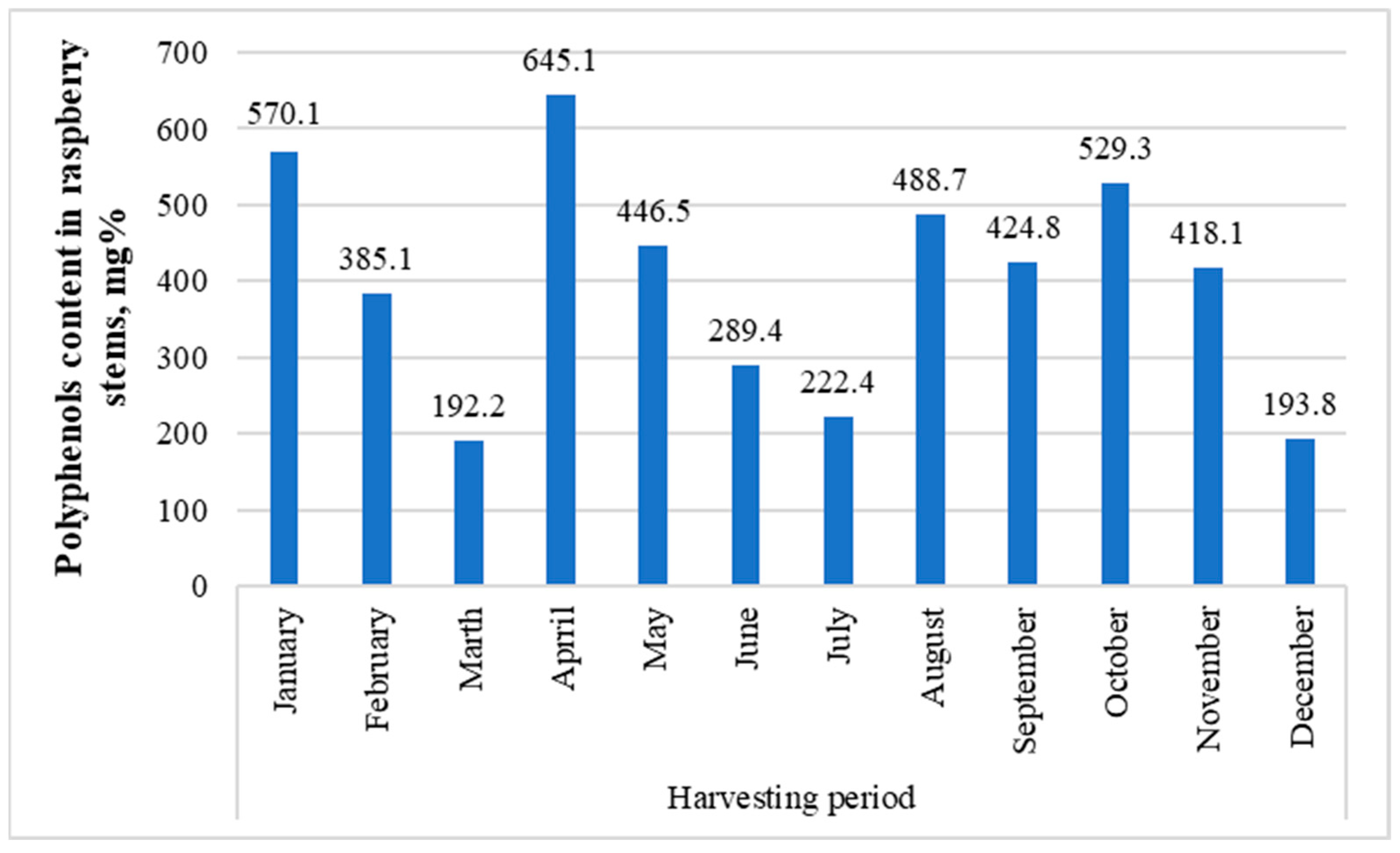
Polyphenolic Compounds in the Stems of Raspberry (Rubus idaeus) Growing Wild and Cultivated

 ,
,  , ,
, ,
Abstract
1. Introduction
2. Results
3. Discussion
4. Materials and Methods
4.1. Raw Materials
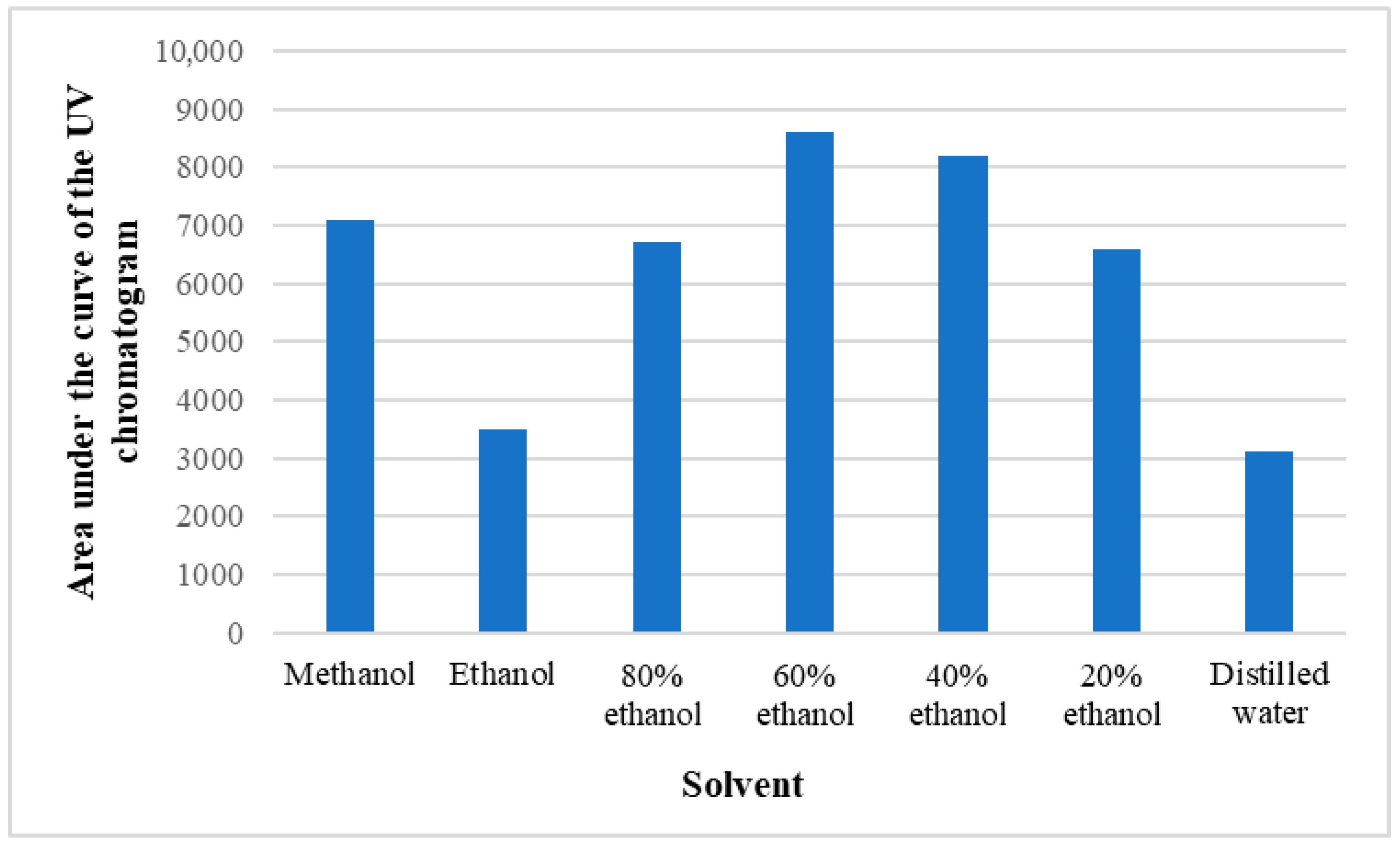
4.2. Preliminary Test to Determine a Suitable Solvent
4.3. Extraction and HPLC/MS Analysis of Polyphenolic Compounds in Raspberry Stems
5. Conclusions
Author Contributions
Funding
Institutional Review Board Statement
Informed Consent Statement
Data Availability Statement
Conflicts of Interest
Appendix A

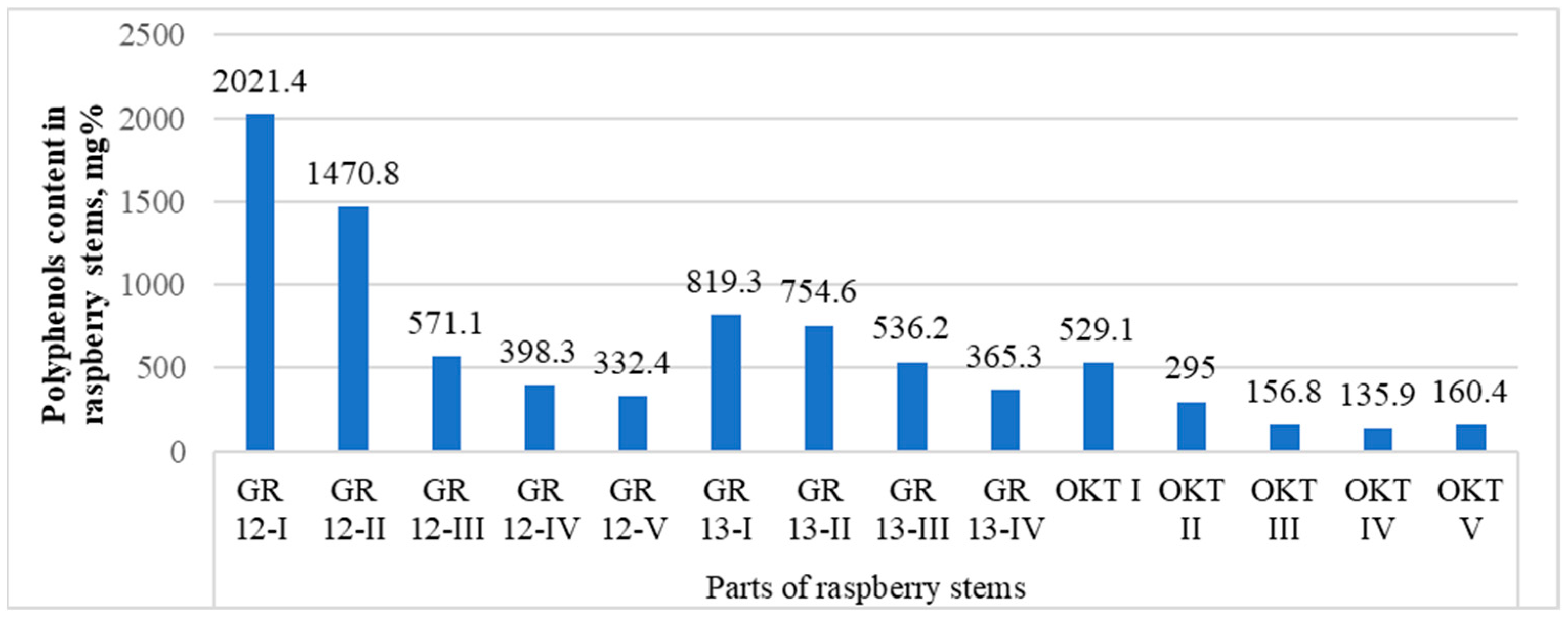
| Compound | GR 12 I | GR 12 II | GR 12 III | GR 12 IV | GR 12 V | GR 13 I | GR 13 II | GR 13 III | GR 13 IV | OCT I | OCT II | OCT III | OCT IV | OCT V |
|---|---|---|---|---|---|---|---|---|---|---|---|---|---|---|
| Dihydroxybenzoic acid hexoside 1 | 47.9 | 56.1 | 212.7 | 139.2 | 38.5 | 49.2 | 146.8 | 55.8 | 34.5 | - | - | - | - | - |
| Dihydroxybenzoic acid hexoside 2 | 18.1 | - | 22.6 | 67.1 | - | 32.6 | 28.6 | 21.1 | 16.4 | - | - | - | - | - |
| Pentozide of protocatechuic acid | 98.4 | 85.5 | 1052.6 | 516.4 | 173.9 | 402.8 | 292.2 | 170.6 | 72.4 | - | - | - | - | - |
| Hydroxybenzoic acid hexoside | 8.2 | - | 11.1 | 42.5 | - | 22.4 | 17.8 | 20.6 | 8.7 | - | - | - | - | - |
| Procyanidin B(1) | 3.5 | 3.2 | 3.5 | 8.2 | 6.2 | 12.6 | 9.8 | 5.9 | 4.2 | 5.0 | 5.1 | 2.5 | - | - |
| Dihydroxyferulic acid glycoside | - | - | 22.7 | 14.3 | 1.5 | - | - | - | - | - | 4.0 | 2.1 | - | - |
| Catechin | 1.9 | 1.7 | 7.1 | 16.3 | 6.3 | 10.1 | 5.4 | 4.8 | 4.1 | 23.9 | 8.3 | 2.4 | 2.5 | 2.6 |
| Chlorogenic acid | - | - | 1.4 | 1.0 | - | 0.8 | - | - | - | 2.4 | 1.4 | - | - | - |
| Procyanidin B(2) | 69.8 | 64.4 | 53.6 | 150.2 | 110.7 | 88.5 | 85.5 | 85.2 | 83.5 | 109.4 | 91.3 | 53.2 | 59.2 | 80.0 |
| Procyanidin B(3) | 4.7 | 3.5 | 15.3 | 32.1 | 7.8 | 13.0 | 9.3 | 8.9 | 6.9 | 13.1 | 9.2 | 5.2 | 5.3 | 7.6 |
| Neochlorogenic acid | - | - | 0.9 | - | - | - | - | - | - | 0.9 | - | - | - | - |
| Quercetin 3-glucuronide-glucoside | - | - | 1.2 | 0.5 | - | - | - | - | - | 0.1 | ˂0.1 | - | - | - |
| Epicatechin | 60.1 | 52.1 | 54.7 | 124.5 | 87.5 | 65.6 | 64.0 | 64.7 | 58.7 | 42.4 | 38.0 | 25.0 | 25.0 | 31.0 |
| p-Coumaroyl quinic acid 1 | - | - | 7.6 | 2.0 | - | - | - | - | - | 46.9 | 18.1 | 4.0 | - | - |
| p-Coumaric acid glycoside | 2.4 | 2.4 | 51.8 | 19.7 | 4.6 | 4.6 | 2.5 | 2.0 | 2.0 | 23.4 | 14.3 | 4.6 | 2.6 | 1.9 |
| p-Coumaroyl quinic acid 2 | - | - | 3.7 | 1.3 | - | - | - | - | - | 31.4 | 13.0 | 2.3 | 1.3 | - |
| Quercetin glucorhamnoside | - | - | 0.4 | ˂0.1 | - | - | - | - | - | 0.2 | ˂0.1 | - | - | - |
| Quercetin pentoside | - | - | ˂0.1 | ˂0.1 | - | - | - | - | - | ˂0.1 | 0.2 | - | - | - |
| Quercetin pentoside 1 | 3.1 | 2.5 | 6.0 | 4.5 | 3.4 | 2.2 | 2.2 | 2.2 | 2.0 | 0.7 | 0.9 | 1.3 | 1.1 | 1.1 |
| Ellagic acid | 19.9 | 13.1 | 67.2 | 47.5 | 27.6 | 40.2 | 21.8 | 24.0 | 18.2 | 10.8 | 12.1 | 14.9 | 15.0 | 11.9 |
| Quercetin pentoside 2 | 3.7 | 3.0 | 10.0 | 6.6 | 4.7 | 7.2 | 5.4 | 5.5 | 4.8 | 2.0 | 2.0 | 2.4 | 2.2 | 2.3 |
| Quercetin rutinoside dicaffeic acid | - | - | - | - | - | - | - | - | - | 0.6 | 0.5 | - | - | 1.0 |
| Hyperoside | 0.6 | 0.2 | 10.5 | 17.7 | 2.0 | 1.0 | 0.5 | ˂0.1 | ˂0.1 | 26.9 | 1.8 | ˂0.1 | - | - |
| Quercetin 4’-glucuronide | 0.1 | ˂0.1 | 108.0 | 82.3 | 6.0 | 1.1 | 0.1 | ˂0.1 | ˂0.1 | 43.1 | 24.2 | 1.8 | ˂0.1 | ˂0.1 |
| Isoquercetin | ˂0.1 | ˂0.1 | ˂0.1 | ˂0.1 | ˂0.1 | 0.2 | ˂0.1 | ˂0.1 | ˂0.1 | 47.0 | 3.2 | 0.4 | ˂0.1 | ˂0.1 |
| Quercetin 7-glucuronide | 0.1 | ˂0.1 | 2.8 | 2.4 | 0.4 | 0.4 | ˂0.1 | ˂0.1 | ˂0.1 | 0.5 | 0.1 | ˂0.1 | ˂0.1 | ˂0.1 |
| Quercetin pentoside 3 | - | ˂0.1 | 0.1 | ˂0.1 | - | - | - | - | 12.3 | 6.9 | 1.1 | ˂0.1 | - | |
| Quercetin 3-(6”-(3-hydroxy-3-methyl-glutaryl)hexoside) 1 | ˂0.1 | ˂0.1 | 0.8 | 0.3 | ˂0.1 | ˂0.1 | - | ˂0.1 | - | 0.6 | 0.3 | - | - | - |
| Kaempferol hexoside | 1.3 | 1.1 | 3.5 | 1.1 | 1.6 | 1.8 | 1.6 | 2.0 | 1.6 | ˂0.1 | - | - | - | - |
| Quercetin hexoside malonate | - | - | 0.1 | 0.1 | - | ˂0.1 | - | - | - | 14.8 | 0.7 | ˂0.1 | - | - |
| Isorhamnetin hexoside 1 | ˂0.1 | ˂0.1 | 3.0 | 2.2 | 0.2 | 0.6 | ˂0.1 | ˂0.1 | ˂0.1 | 1.1 | 0.6 | ˂0.1 | ˂0.1 | ˂0.1 |
| Quercetin 3-(6”-(3-hydroxy-3-methyl-glutaryl)hexoside) 2 | ˂0.1 | - | 0.4 | 0.3 | ˂0.1 | - | - | - | - | 0.2 | ˂0.1 | - | - | - |
| Isorhamnetin pentoside 1 | - | - | - | 1.2 | - | - | - | - | - | 0.3 | 0.3 | 0.4 | 0.2 | 0.3 |
| Kaempferol glucuronide | ˂0.1 | - | 2.5 | 1.8 | ˂0.1 | ˂0.1 | - | - | - | 7.5 | 0.1 | - | - | - |
| Isorhamnetin rhamnoside 1 | 0.6 | 0.6 | 2.7 | 2.1 | 0.8 | 2.5 | 2.0 | 2.2 | 2.2 | 13.1 | 0.9 | 0.8 | 0.6 | 0.4 |
| Dicaffeic acid derivative | 7.1 | 3.0 | 66.4 | 28.4 | 16.0 | 6.4 | 6.6 | 3.9 | - | - | - | - | - | - |
| Isorhamnetin pentoside 2 | 0.1 | ˂0.1 | ˂0.1 | ˂0.1 | 0.1 | 0.8 | 0.5 | 0.7 | 0.7 | ˂0.1 | 0.1 | 0.1 | 0.2 | 0.2 |
| Rhamnetin/isorhamnetin | 0.3 | 0.1 | 1.9 | 0.8 | 0.5 | 1.4 | 0.7 | 0.8 | 0.6 | 0.2 | 0.3 | 0.3 | 0.2 | 0.2 |
| Acetylarabinoside of ellagoic acid | 25.7 | 22.3 | 115.8 | 71.3 | 37.3 | 19.4 | 16.8 | 18.3 | 12.7 | 21.6 | 15.1 | 16.8 | 13.4 | 11.0 |
| Acetylxyloside of ellagic acid | 15.8 | 13.8 | 67.6 | 42.8 | 24.9 | 25.3 | 29.8 | 31.6 | 27.3 | 17.5 | 14.9 | 12.1 | 6.1 | 8.1 |
| Dicaffeoyl quinic acid | - | - | 1.2 | - | - | - | - | - | - | 1.4 | 1.2 | - | - | - |
| Isorhamnetin rhamnoside | - | - | 2.1 | 1.5 | - | 1.3 | 0.5 | - | - | 0.2 | - | - | - | - |
| Isorhamnetin rhamnoside 2 | 1.5 | 1.2 | 8.5 | 4.6 | 2.7 | 1.9 | 1.5 | 1.9 | 1.2 | 1.1 | 0.7 | 0.4 | 0.3 | 0.2 |
| Chlorogenic acid rhamnoside | - | - | 1.1 | - | - | - | - | - | - | 2.5 | 1.7 | - | - | - |
| Isorhamnetin rhamnoside 3 | 0.8 | 0.5 | 4.0 | 2.6 | 1.7 | 1.2 | 1.0 | 1.3 | 0.9 | ˂0.1 | ˂0.1 | ˂0.1 | ˂0.1 | ˂0.1 |
| Quercetin | - | - | 0.4 | 5.3 | 0.5 | 0.2 | 0.1 | - | - | 0.1 | 0.3 | ˂0.1 | - | - |
| Neochlorogenic acid rhamnoside | - | - | - | - | - | - | - | - | - | 1.4 | 1.8 | 1.1 | - | - |
| Isorhamnetin rhamnoside 6 | 0.1 | ˂0.1 | 1.9 | 0.9 | 0.3 | ˂0.1 | ˂0.1 | ˂0.1 | ˂0.1 | 2.2 | ˂0.1 | ˂0.1 | ˂0.1 | - |
| Isorhamnetin rhamnoside 7 | 2.5 | 2.1 | 9.9 | 7.3 | 3.6 | 2.4 | 1.8 | 2.4 | 1.7 | - | 1.4 | 1.0 | 0.6 | 0.7 |
| Total: | 2089.6 | 1486.9 | 936.9 | 878.6 | 382.6 | 819.3 | 754.6 | 536.2 | 365.3 | 529.1 | 295.0 | 156.8 | 135.9 | 160.4 |
Appendix B
| Pairs of Compounds | Correlation Coefficient, r |
|---|---|
| Procyanidin-catechin | |
| Procyanidin B(1)-Epicatechin | 0.60 |
| Procyanidin B(1)-Procyanidin B(2) | 0.64 |
| Procyanidin B(3)-Epicatechin | 0.76 |
| Procyanidin B(2)-Procyanidin B(3) | 0.78 |
| Procyanidin B(2)-Epicatechin | 0.93 |
| Procyanidin-flavonols | |
| Procyanidin B(2)-Isorhamnetin rhamnoside 7 | 0.60 |
| Procyanidin B(3)-Isorhamnetin hexoside 1 | 0.62 |
| Procyanidin B(3)-Isorhamnetin rhamnoside | 0.71 |
| Procyanidin B(3)-Isoquercetin | 0.73 |
| Benzoic acid derivatives-Ellagic acid derivatives | |
| Dihydroxybenzoic acid hexoside 2-Ellagic acid | 0.62 |
| Ellagic acid acetylarabinoside-Acetylxyloside of ellagic acid | 0.64 |
| Dihydroxybenzoic acid hexoside 2-Hydroxybenzoic acid hexoside | 0.70 |
| Hydroxycinnamic acids derivatives | |
| Chlorogenic acid-Dicaffeoyl quinic acid | 0.70 |
| Chlorogenic acid-Neochlorogenic acid | 0.79 |
| Chlorogenic acid-Chlorogenic acid rhamnoside | 0.73 |
| Chlorogenic acid rhamnoside-Neochlorogenic acid rhamnoside | 0.97 |
| p-Coumaroyl quinic acid 1-p-coumaroyl quinic acid 2 | 0.97 |
| Hydroxycinnamic acids derivatives-catechin–procyanidin | |
| Dihydroferulic acid glycoside-Epicatechin | 0.61 |
| Dihydroferulic acid glycoside-Procyanidin B(2) | 0.63 |
| Dihydroxybenzoic acid derivatives-flavonols | |
| Dihydroxybenzoic acid hexoside 2-Isorhamnetin rhamnoside 6 | 0.62 |
| Dihydroxybenzoic acid hexoside 2-Isorhamnetin rhamnoside 1 | 0.63 |
| Dihydroxybenzoic acid hexoside 1-Quercetin | 0.64 |
| Dihydroxybenzoic acid hexoside 2-Isorhamnetin rhamnoside 2 | 0.64 |
| Dihydroxybenzoic acid hexoside 2-Quercetin pentoside 1 | 0.66 |
| Dihydroxybenzoic acid hexoside 2-Isorhamnetin rhamnoside 3 | 0.66 |
| Dihydroxybenzoic acid hexoside 2-Quercetin pentoside 3 | 0.72 |
| Hydroxybenzoic acid hexoside-Hyperoside | 0.78 |
| Hydroxybenzoic acid hexoside-Quercetin 3-(6″-(3-hydroxy-3-methylglutaryl)hexoside) 1 | 0.84 |
| Ellagic acid derivatives-flavonols | |
| Quercetin 3-glucuronide-glucoside-Acetylxyloside of ellagic acid | 0.61 |
| Quercetin hexoside malonate-Acetylxyloside of ellagic acid | 0.64 |
| Acetylxyloside of ellagic acid-Isorhamnetin rhamnoside 7 | 0.65 |
| Quercetin pentoside 1-Acetylxyloside of ellagic acid | 0.66 |
| Ellagic acid acetylarabinoside-Isorhamnetin rhamnoside 6 | 0.70 |
| Quercetin pentoside 1-Ellagic acid acetylarabinoside | 0.71 |
| Ellagic acid acetylarabinoside-Isorhamnetin rhamnoside 3 | 0.76 |
| Isorhamnetin rhamnoside 1-Ellagic acid acetylarabinoside | 0.78 |
| Ellagic acid-Rhamnetin/isorhamnetin | 0.87 |
| Ellagic acid-Quercetin pentoside 2 | 0.88 |
| Hydroxycinnamic acids derivatives-flavonols | |
| Dihydroferulic acid glycoside-Isorhamnetin rhamnoside 7 | 0.60 |
| Neochlorogenic acid-Quercetin hexoside malonate | 0.60 |
| Quercetin 3-(6″-(3-hydroxy-3-methylglutaryl)hexoside) 2-Neochlorogenic acid rhamnoside | 0.60 |
| Dihydroferulic acid glycoside-Rhamnetin/isorhamnetin | 0.61 |
| Chlorogenic acid-Isorhamnetin rhamnoside 7 | 0.61 |
| Chlorogenic acid-Quercetin | 0.62 |
| Neochlorogenic acid-Isorhamnetin rhamnoside | 0.64 |
| Chlorogenic acid rhamnoside-Isorhamnetin rhamnoside 7 | 0.64 |
| Chlorogenic acid-Isorhamnetin pentoside 1 | 0.64 |
| p-Coumaroyl quinic acid 1-Isorhamnetin hexoside 1 | 0.68 |
| Dihydroferulic acid glycoside-Isorhamnetin pentoside 1 | 0.68 |
| Ellagic acid acetylarabinoside-Isorhamnetin rhamnoside 2 | 0.68 |
| Neochlorogenic acid-Isorhamnetin hexoside 1 | 0.70 |
| Quercetin 3-(6″-(3-hydroxy-3-methylglutaryl)hexoside) 1-Neochlorogenic acid rhamnoside | 0.68 |
| Chlorogenic acid-Isorhamnetin hexoside 1 | 0.73 |
| Quercetin hexoside malonate-Dicaffeoyl quinic acid | 0.73 |
| p-Coumaric acid glycoside-Quercetin pentoxoside | 0.76 |
| Dicafeoyl quinic acid-Quercetin | 0.78 |
| Kempferol glycoside-Dicafeoyl quinic acid | 0.78 |
| Chlorogenic acid-Isorhamnetin rhamnoside | 0.78 |
| Chlorogenic acid-Quercetin 3-glucuronide-glucoside | 0.81 |
| Neochlorogenic acid-Isorhamnetin rhamnoside 7 | 0.87 |
| Quercetin 3-glucuronide-glucoside-Dicafeoyl quinic acid | 0.86 |
| Dicafeoyl quinic acid-Isorhamnetin rhamnoside 7 | 0.94 |
| Neochlorogenic acid rhamnoside-Isorhamnetin rhamnoside 7 | 1.00 |
| Flavonols-flavonols | |
| Quercetin pentoside 1-Kempferol glycoside | 0.60 |
| Quercetin 4’-glucuronide-Isorhamnetin rhamnoside | 0.62 |
| Quercetin glucoramnoside-Isorhamnetin rhamnoside 7 | 0.64 |
| Quercetin pentoxoside-Hyperoside | 0.64 |
| Isoquercetin-Isorhamnetin pentoside 1 | 0.64 |
| Isoquercetin-Isorhamnetin rhamnoside 7 | 0.64 |
| Quercetin glucorhamnoside-Isorhamnetin pentoside 1 | 0.65 |
| Quercetin 4’-glucuronide-Kempferol glucuronide | 0.65 |
| Isorhamnetin rhamnoside-Isorhamnetin rhamnoside 7 | 0.65 |
| Quercetin 3-glucuronide-glucoside-Quercetin 3-(6″-(3-hydroxy-3-methylglutaryl)hexoside) 2 | 0.66 |
| Quercetin 4’-glucuronide-Isorhamnetin pentoside 1 | 0.66 |
| Quercetin 3-(6″-(3-hydroxy-3-methylglutaryl)hexoside) 2-Kempferol glucuronide | 0.67 |
| Quercetin 3-glucuronide-glucoside-Kempferol glucuronide | 0.68 |
| Quercetin 4’-glucuronide-Isoquercetin | 0.68 |
| Isoquercetin-Isorhamnetin hexoside 1 | 0.68 |
| Quercetin hexoside malonate-Isorhamnetin hexoside 1 | 0.68 |
| Quercetin pentoside 1-Isorhamnetin rhamnoside 6 | 0.69 |
| Quercetin hexoside malonate-Kempferol glucuronide | 0.69 |
| Quercetin hexoside malonate-Quercetin | 0.69 |
| Quercetin 3-glucuronide-glucoside-Quercetin | 0.70 |
| Quercetin glucorhamnoside-Isorhamnetin pentoside 2 | 0.70 |
| Quercetin pentoside 3-Isorhamnetin rhamnoside 7 | 0.70 |
| Kempferol glycoside-Quercetin | 0.70 |
| Quercetin pentoside 2-Rhamnetin/isorhamnetin | 0.71 |
| Quercetin 4’-glucuronide-Quercetin hexoside malonate | 0.71 |
| Quercetin hexoside malonate-Quercetin 3-(6″-(3-hydroxy-3-methylglutaryl)hexoside) 2 | 0.71 |
| Quercetin glucoramnoside-Kempferol glucuronide | 0.72 |
| Isorhamnetin hexoside 1-Isorhamnetin rhamnoside | 0.72 |
| Quercetin 3-glucuronide-glucoside-Isorhamnetin pentoside 1 | 0.73 |
| Isoquercetin-Quercetin hexoside malonate | 0.73 |
| Quercetin 3-glucuronide-glucoside-Isorhamnetin rhamnoside | 0.74 |
| Isoquercetin-Kempferol glucuronide | 0.75 |
| Quercetin 3-(6″-(3-hydroxy-3-methylglutaryl)hexoside) 2-Isorhamnetin rhamnoside | 0.75 |
| Isorhamnetin pentoside 1-Isorhamnetin pentoside 2 | 0.75 |
| Quercetin hexoside malonate-Isorhamnetin rhamnoside | 0.76 |
| Isorhamnetin rhamnoside-Isorhamnetin rhamnoside 7 | 0.77 |
| Quercetin pentoside 1-Isorhamnetin rhamnoside 1 | 0.78 |
| Quercetin pentoside 1-Isorhamnetin rhamnoside 2 | 0.78 |
| Quercetin pentoside 1-Isorhamnetin rhamnoside 3 | 0.78 |
| Quercetin 3-glucuronide-glucoside-Kempferol glycoside | 0.79 |
| Quercetin glucoramnoside-Quercetin pentoxoside | 0.80 |
| Quercetin 3-(6″-(3-hydroxy-3-methylglutaryl)hexoside) 2-Isorhamnetin rhamnoside 7 | 0.81 |
| Hyperoside-Quercetin 3-(6″-(3-hydroxy-3-methylglutaryl)hexoside) 1 | 0.82 |
| Isoquercetin-Quercetin 3-(6″-(3-hydroxy-3-methylglutaryl)hexoside) 2 | 0.83 |
| Isorhamnetin pentoside 1-Isorhamnetin rhamnoside 7 | 0.83 |
| Quercetin glucoramnoside-Quercetin 3-(6″-(3-hydroxy-3-methylglutaryl)hexoside) 2 | 0.84 |
| Kempferol glucuronide-Isorhamnetin rhamnoside | 0.84 |
| Isorhamnetin rhamnoside 2-Isorhamnetin rhamnoside 6 | 0.84 |
| Quercetin hexoside malonate-Isorhamnetin rhamnoside 7 | 0.85 |
| Quercetin 3-(6″-(3-hydroxy-3-methylglutaryl)hexoside) 2-Isorhamnetin pentoside 1 | 0.85 |
| Isorhamnetin rhamnoside 7-Isorhamnetin rhamnoside 6 | 0.85 |
| Isorhamnetin pentoside 1-Isorhamnetin rhamnoside | 0.86 |
| Isorhamnetin pentoside 1-Kempferol glucuronide | 0.87 |
| Isorhamnetin rhamnoside 1-Isorhamnetin rhamnoside 2 | 0.88 |
| Isorhamnetin rhamnoside 1-Isorhamnetin rhamnoside 3 | 0.88 |
| Isorhamnetin rhamnoside 2-Isorhamnetin rhamnoside 3 | 0.89 |
| Isorhamnetin rhamnoside 1-Isorhamnetin rhamnoside 6 | 0.91 |
| Quercetin 3-glucuronide-glucoside-Quercetin hexoside malonate | 0.92 |
| Isoquercetin-Isorhamnetin rhamnoside | 0.92 |
| Quercetin-Isorhamnetin rhamnoside 7 | 0.92 |
| Quercetin 3-glucuronide-glucoside-Isorhamnetin rhamnoside 7 | 0.97 |
| Pairs of Compounds | Correlation Coefficient, r |
|---|---|
| Hydroxybenzoic acid hexoside-Isorhamnetin rhamnoside 7 | −0.74 |
| Neochlorogenic acid rhamnoside-Isorhamnetin rhamnoside 6 | −0.78 |
| Neochlorogenic acid-Quercetin pentoside | −0.80 |
| Isorhamnetin rhamnoside 1-Neochlorogenic acid rhamnoside | −0.82 |
| Quercetin pentoxoside-Isorhamnetin rhamnoside 7 | −1.0 |
Appendix C
| Variety | Place of Selection | Cross Made | Fruit | Bush |
|---|---|---|---|---|
| Aita | Polli Horticultural Research Centre, Estonia | Seedlings of Johannes Parksepp Nr. 2–64–24 × ‘Glen Clova’. | Early maturing, light red, big (average 3.7 g), round, druplets cohering firmly, easy cropping | Moderately growing, young canes, light green with weak spines; fruiting canes are light brown. |
| Alvi | Seedling of 67-60-12 × ‘Novost Kuzmina’. | ather late, dark red, bright, big (average 3.5 g), conical, druplets cohering firmly, with good quality | Moderately growing, young canes light green with few spines; fruiting canes are greyish brown. | |
| Helkal | Seedlings of the breeder 67-60-12 (‘Golden Queen’ × ‘Spirina Belaja’) × ‘Novost Kuzmina’ | Midseason, orange yellow, big (average 3.5 g), round conical, druplets cohering firmly | Moderately strong, producing numerous erect canes, which are light green, covered thickly with spines; fruiting canes are light brown. | |
| Espe | ‘Deutschland’ and ‘Novost Kuzmina’ | Red, blunt-cone-shaped fruits are medium ripe and medium in size (average of 2.5 g). The partial fruits are well joined and firmly attached to the base of the flower. | Erect stems are high and their stems slightly curled. Light green shoots are strong, have single weak spikes. The second-year stems are light brown. | |
| Toмo | ‘Superlative’ × ‘Novost Kuzmina’ | Midseason, dark red, medium, round or oblate, and druplets that cohere firmly. | Moderately growing, producing medium or numerous erect canes, which are light green with few weak spines; the fruiting cane is light brown with a grey tinge. | |
| Siveli | ‘Golden Queen’ × ‘Spirina belaja’ × ‘Novost kuzmina’ | Red fruits are medium-sized and round or broad–round; partial fruits are well joined, relatively resistant to collapse; | The height of the erect stem is average. The shoots are light green with weak spikes, which are more sparsely located at the top of the stem. In the second year, the stems are light brown with a grayish tinge, | |
| Polka | dark red are large and conical. | medium-growing, upright, and high-yielding. | ||
| Glen Ample | Scotland | Crossbreeding ‘Glen Rosa’ and ‘Meeker’ | Large, conical, bright red berries that can weigh up to 3gm. | Stems are strong, erect, and spine-free. |
| Herbert | Canada | The fruits are round. | The growth of stems is moderate, shoots have a slightly purple bark, and on the branch many sharp spikes are only located in the top part. Bright red spikes are very sharp. |
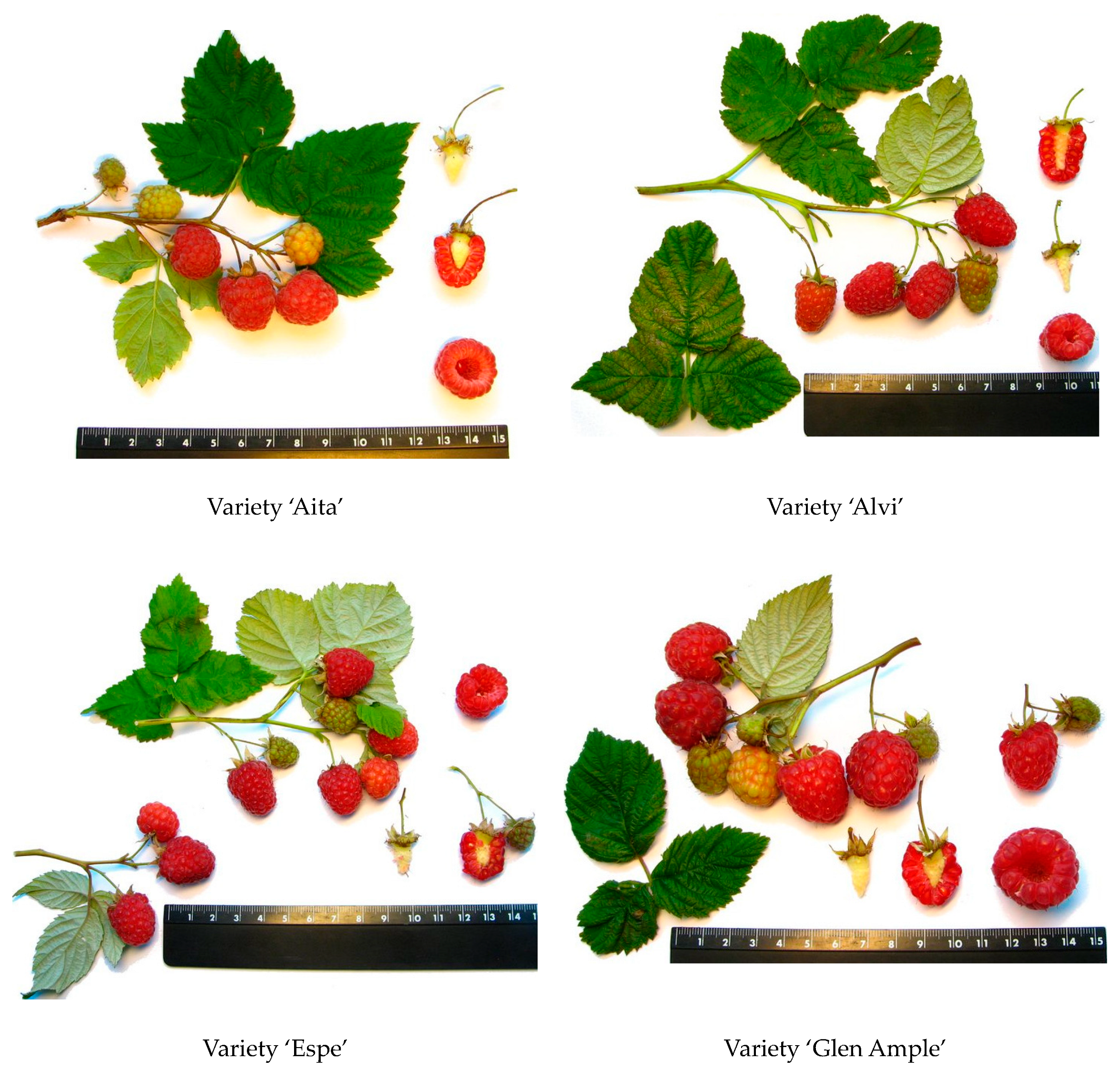
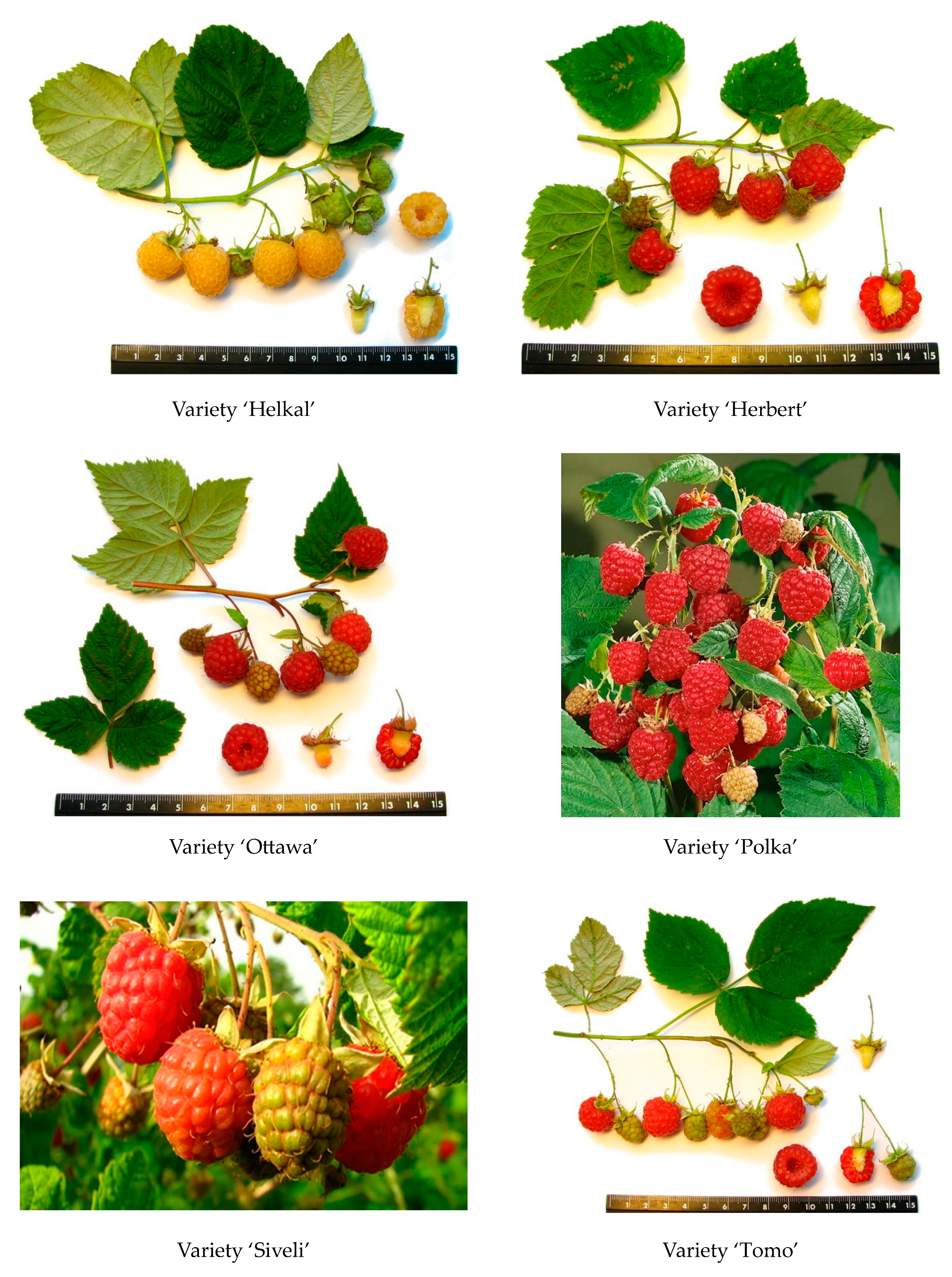
References
- WFO. Rubus idaeus L. Published on the Internet. 2024. Available online: http://www.worldfloraonline.org/taxon/wfo-0001000827 (accessed on 20 September 2024).
- Funt, R.C.; Hall, H.K. Raspberries, 23rd ed.; Crop production science in horticulture series; Cabi: Wallingford, UK, 2013; 282p, ISBN 978-1-84593-791-1. [Google Scholar]
- TRIDGE. Digital Platform that Combines Technology and Human Network to Connect Buyers and Suppliers Globally. Available online: https://www.tridge.com/intelligences/raspberry (accessed on 6 June 2024).
- Ispiryan, A.; Viškelis, J.; Viškelis, P. Red Raspberry (Rubus idaeus L.) Seed Oil: A Review. Plants 2021, 10, 944. [Google Scholar] [CrossRef] [PubMed]
- Pieszka, M.; Tombarkiewicz, B.; Roman, A.; Migdał, W.; Niedziółka, J. Effect of Bioactive Substances Found in Rapeseed, Raspberry and Strawberry Seed Oils on Blood Lipid Profile and Selected Parameters of Oxidative Status in Rats. Environ. Toxicol. Pharmacol. 2013, 36, 1055–1062. [Google Scholar] [CrossRef] [PubMed]
- Määttä-Riihinen, K.R.; Kamal-Eldin, A.; Törrönen, A.R. Identification and Quantification of Phenolic Compounds in Berries of Fragaria and Rubus Species (Family Rosaceae). J. Agric. Food Chem. 2004, 52, 6178–6187. [Google Scholar] [CrossRef]
- Lee, J.; Dossett, M.; Finn, C.E. Rubus Fruit Phenolic Research: The Good, the Bad, and the Confusing. Food Chem. 2012, 130, 785–796. [Google Scholar] [CrossRef]
- Lopez-Corona, A.V.; Valencia-Espinosa, I.; González-Sánchez, F.A.; Sánchez-López, A.L.; Garcia-Amezquita, L.E.; Garcia-Varela, R. Antioxidant, Anti-Inflammatory and Cytotoxic Activity of Phenolic Compound Family Extracted from Raspberries (Rubus idaeus): A General Review. Antioxidants 2022, 11, 1192. [Google Scholar] [CrossRef]
- Mullen, W.; Yokota, T.; Lean, M.E.J.; Crozier, A. Analysis of Ellagitannins and Conjugates of Ellagic Acid and Quercetin in Raspberry Fruits by LC–MSn. Phytochemistry 2003, 64, 617–624. [Google Scholar] [CrossRef] [PubMed]
- De Ancos, B.; Ibañez, E.; Reglero, G.; Cano, M.P. Frozen Storage Effects on Anthocyanins and Volatile Compounds of Raspberry Fruit. J. Agric. Food Chem. 2000, 48, 873–879. [Google Scholar] [CrossRef]
- Kosmala, M.; Zduńczyk, Z.; Juśkiewicz, J.; Jurgoński, A.; Karlińska, E.; Macierzyński, J.; Jańczak, R.; Rój, E. Chemical Composition of Defatted Strawberry and Raspberry Seeds and the Effect of These Dietary Ingredients on Polyphenol Metabolites, Intestinal Function, and Selected Serum Parameters in Rats. J. Agric. Food Chem. 2015, 63, 2989–2996. [Google Scholar] [CrossRef]
- Schulz, M.; Chim, J.F. Nutritional and Bioactive Value of Rubus Berries. Food Biosci. 2019, 31, 100438. [Google Scholar] [CrossRef]
- Del Bo’, C.; Martini, D.; Porrini, M.; Klimis-Zacas, D.; Riso, P. Berries and Oxidative Stress Markers: An Overview of Human Intervention Studies. Food Funct. 2015, 6, 2890–2917. [Google Scholar] [CrossRef]
- Beekwilder, J.; Hall, R.D.; Ric Vos, C.H.D. Identification and Dietary Relevance of Antioxidants from Raspberry. BioFactors 2005, 23, 197–205. [Google Scholar] [CrossRef] [PubMed]
- Rao, A.V.; Snyder, D.M. Raspberries and Human Health: A Review. J. Agric. Food Chem. 2010, 58, 3871–3883. [Google Scholar] [CrossRef] [PubMed]
- Clegg, M.E.; Pratt, M.; Meade, C.M.; Henry, C.J.K. The Addition of Raspberries and Blueberries to a Starch-Based Food Does Not Alter the Glycaemic Response. Br. J. Nutr. 2011, 106, 335–338. [Google Scholar] [CrossRef]
- Çekiç, Ç.; Özgen, M. Comparison of Antioxidant Capacity and Phytochemical Properties of Wild and Cultivated Red Raspberries (Rubus idaeus L.). J. Food Composit. Anal. 2010, 23, 540–544. [Google Scholar] [CrossRef]
- Beekwilder, J.; Jonker, H.; Meesters, P.; Hall, R.D.; Van Der Meer, I.M.; Ric De Vos, C.H. Antioxidants in Raspberry: On-Line Analysis Links Antioxidant Activity to a Diversity of Individual Metabolites. J. Agric. Food Chem. 2005, 53, 3313–3320. [Google Scholar] [CrossRef]
- Bobinaitė, R.; Viskelis, P.; Bobinas, Č.; Mieželienė, A.; Alenčikienė, G.; Venskutonis, P.R. Raspberry Marc Extracts Increase Antioxidative Potential, Ellagic Acid, Ellagitannin and Anthocyanin Concentrations in Fruit Purees. LWT-Food Sci. Technol. 2016, 66, 460–467. [Google Scholar] [CrossRef]
- Burton-Freeman, B.M.; Sandhu, A.K.; Edirisinghe, I. Red Raspberries and Their Bioactive Polyphenols: Cardiometabolic and Neuronal Health Links. Advan. Nutrit. 2016, 7, 44–65. [Google Scholar] [CrossRef]
- Garcia, G.; Nanni, S.; Figueira, I.; Ivanov, I.; McDougall, G.J.; Stewart, D.; Ferreira, R.B.; Pinto, P.; Silva, R.F.M.; Brites, D.; et al. Bioaccessible (Poly)Phenol Metabolites from Raspberry Protect Neural Cells from Oxidative Stress and Attenuate Microglia Activation. Food Chem. 2017, 215, 274–283. [Google Scholar] [CrossRef]
- Fu, Z.; Wei, Z.; Miao, M. Effects of Total Flavonoids of Raspberry on Perimenopausal Model in Mice. Saudi J. Biol. Sci. 2018, 25, 487–492. [Google Scholar] [CrossRef]
- Chen, L.; Xin, X.; Zhang, H.; Yuan, Q. Phytochemical Properties and Antioxidant Capacities of Commercial Raspberry Varieties. J. Funct. Foods 2013, 5, 508–515. [Google Scholar] [CrossRef]
- Fotschki, B.; Jurgoński, A.; Juśkiewicz, J.; Zduńczyk, Z. Dietary Supplementation with Raspberry Seed Oil Modulates Liver Functions, Inflammatory State, and Lipid Metabolism in Rats. J. Nutrit. 2015, 145, 1793–1799. [Google Scholar] [CrossRef] [PubMed]
- Noratto, G.D.; Chew, B.P.; Atienza, L.M. Red Raspberry (Rubus idaeus L.) Intake Decreases Oxidative Stress in Obese Diabetic (Db/Db) Mice. Food Chem. 2017, 227, 305–314. [Google Scholar] [CrossRef] [PubMed]
- Jia, H.; Liu, J.; Ufur, H.; He, G.; Liqian, H.; Chen, P. The Antihypertensive Effect of Ethyl Acetate Extract from Red Raspberry Fruit in Hypertensive Rats. Phcog. Mag. 2011, 7, 19. [Google Scholar] [CrossRef] [PubMed]
- Mullen, W.; McGinn, J.; Lean, M.E.J.; MacLean, M.R.; Gardner, P.; Duthie, G.G.; Yokota, T.; Crozier, A. Ellagitannins, Flavonoids, and Other Phenolics in Red Raspberries and Their Contribution to Antioxidant Capacity and Vasorelaxation Properties. J. Agric. Food Chem. 2002, 50, 5191–5196. [Google Scholar] [CrossRef] [PubMed]
- Chen, W.; Su, H.; Huang, Z.; Feng, L.; Nie, H. Neuroprotective Effect of Raspberry Extract by Inhibiting Peroxynitrite-Induced DNA Damage and Hydroxyl Radical Formation. Food Res. Int. 2012, 49, 22–26. [Google Scholar] [CrossRef]
- Puupponen-Pimia, R.; Nohynek, L.; Meier, C.; Kahkonen, M.; Heinonen, M.; Hopia, A.; Oksman-Caldentey, K.-M. Antimicrobial Properties of Phenolic Compounds from Berries. J. Appl. Microbiol. 2001, 90, 494–507. [Google Scholar] [CrossRef]
- Chwil, M.; Kostryco, M. Bioactive Compounds and Antioxidant Activity of Rubus idaeus L. Leaves. Acta Sci. Pol. Hortorum Cultus 2018, 17, 135–147. [Google Scholar] [CrossRef]
- Costea, T.; Lupu, A.R.; Vlase, L.; Nencu, I.; Gird, C.E. Phenolic Content and Antioxidant Activity of a Raspberry Leaf Dry Extract. Rom. Biotechnol. Lett. 2016, 21, 11345–11356. [Google Scholar]
- De Santis, D.; Carbone, K.; Garzoli, S.; Laghezza Masci, V.; Turchetti, G. Bioactivity and Chemical Profile of Rubus idaeus L. Leaves Steam-Distill. Extract. Foods 2022, 11, 1455. [Google Scholar] [CrossRef]
- Li, Z.-H.; Guo, H.; Xu, W.-B.; Ge, J.; Li, X.; Alimu, M.; He, D.-J. Rapid Identification of Flavonoid Constituents Directly from PTP1B Inhibitive Extract of Raspberry (Rubus idaeus L.) Leaves by HPLC–ESI–QTOF–MS-MS. J. Chromatogr. Sci. 2016, 54, 805–810. [Google Scholar] [CrossRef]
- Pavlovic, M.; Kovacevic, N.; Tzakou, O.; Couladis, M. The Essential Oil of Valeriana officinalis L. s.l. Growing Wild in Western Serbia. J. Essent. Oil Resh. 2004, 16, 397–399. [Google Scholar] [CrossRef]
- Ponder, A.; Hallmann, E. Phenolics and Carotenoid Contents in the Leaves of Different Organic and Conventional Raspberry (Rubus idaeus L.) Cultivars and Their In Vitro Activity. Antioxidants 2019, 8, 458. [Google Scholar] [CrossRef] [PubMed]
- Tian, Y.; Liimatainen, J.; Alanne, A.-L.; Lindstedt, A.; Liu, P.; Sinkkonen, J.; Kallio, H.; Yang, B. Phenolic Compounds Extracted by Acidic Aqueous Ethanol from Berries and Leaves of Different Berry Plants. Food Chem. 2017, 220, 266–281. [Google Scholar] [CrossRef]
- Venskutonis, P.R.; Dvaranauskaite, A.; Labokas, J. Radical Scavenging Activity and Composition of Raspberry (Rubus idaeus) Leaves from Different Locations in Lithuania. Fitoterapia 2007, 78, 162–165. [Google Scholar] [CrossRef] [PubMed]
- Gudej, J.; Tomczyk, M. Determination of Flavonoids, Tannins and Ellagic Acid in Leaves from Rubus L. Species. Arch. Pharm. Res. 2004, 27, 1114–1119. [Google Scholar] [CrossRef]
- Durgo, K.; Belščak-Cvitanović, A.; Stančić, A.; Franekić, J.; Komes, D. The Bioactive Potential of Red Raspberry (Rubus idaeus L.) Leaves in Exhibiting Cytotoxic and Cytoprotective Activity on Human Laryngeal Carcinoma and Colon Adenocarcinoma. J. Med. Food 2012, 15, 258–268. [Google Scholar] [CrossRef]
- Pavlović, A.V.; Papetti, A.; Zagorac, D.Č.D.; Gašić, U.M.; Mišić, D.M.; Tešić, Ž.L.; Natić, M.M. Phenolics Composition of Leaf Extracts of Raspberry and Blackberry Cultivars Grown in Serbia. Ind. Crops Prod. 2016, 87, 304–314. [Google Scholar] [CrossRef]
- Council of Europe’s European Directorate for the Quality of Medicines and HealthCare (EDQM). European Pharmacopoeia, 11th ed.; Council of Europe: Strasbourg, France, 2022. [Google Scholar]
- European Medicines Agency. Assessment Report on Rubus idaeus L., Folium; EMA: Amsterdam, The Netherlands, 2014. [Google Scholar]
- Maslov, O.; Komisarenko, M.; Kolisnyk, S.; Derymedvid, L. Evaluation of Anti-Inflammatory, Antioxidant Activities and Molecular Docking Analysis of Rubus idaeus Leaf Extract. Jordan J. Pharm. Sci. 2024, 17, 105–122. [Google Scholar] [CrossRef]
- Dudzinska, D.; Bednarska, K.; Boncler, M.; Luzak, B.; Watala, C. The Influence of Rubus idaeus and Rubus caesius Leaf Extracts on Platelet Aggregation in Whole Blood. Cross-Talk of Platelets and Neutrophils. Platelets 2016, 27, 433–439. [Google Scholar] [CrossRef]
- Bernard, C.; Juin, C.; Vitry, M.; Le, V.T.D.; Verdon, J.; Toullec, A.-S.; Imbert, C.; Girardot, M. Can Leaves and Stems of Rubus idaeus L. Handle Candida Albicans Biofilms? Pharmaceuticals 2020, 13, 477. [Google Scholar] [CrossRef]
- Maslov, O.; Komisarenko, M.; Ponomarenko, S.; Horopashna, D.; Osolodchenko, T.; Kolisnyk, S.; Derymedvid, L.; Shovkova, Z.; Akhmedov, E. Investigation the Influence of Biologically Active Compounds on the Antioxidant, Antibacterial and Anti-Inflammatory Activities of Red Raspberry (Rubus idaeous L.) Leaf Extract. Curr. Issues Pharm. Med. Sci. 2022, 35, 229–235. [Google Scholar] [CrossRef]
- Maslov, O.; Komisarenko, M.; Ponomarenko, S.; Kolisnyk, S.; Osolodchenko, T.; Golik, M. Antimicrobial, Antifungal, Antioxidant Activity and Phytochemical Investigation of Phenolcarboxylic Acids by GC–MS of Raspberry (Rubus idaeus L.) Shoot Lipophilic Extract. Eur. Pharm. J. 2024, 71, 26–31. [Google Scholar] [CrossRef]
- Denev, P.; Kratchanova, M.; Ciz, M.; Lojek, A.; Vasicek, O.; Blazheva, D.; Nedelcheva, P.; Vojtek, L.; Hyrsl, P. Antioxidant, Antimicrobial and Neutrophil-Modulating Activities of Herb Extracts. Acta Biochim. Pol. 2014, 61, 359–367. [Google Scholar] [CrossRef] [PubMed]
- Maslov, O.; Komisarenko, M.; Kolisnyk, S.; Kostina, T.; Golik, M.; Moroz, V.; Tarasenko, D.; Akhmedov, E. Investigation of the Extraction Dynamic of the Biologically Active Substances of the Raspberry (Rubus idaeus L.) Shoots. Curr. Issues Pharm. Med. Sci. 2023, 36, 194–198. [Google Scholar] [CrossRef]
- Mohammad Rahimi, H.; Khosravi, M.; Hesari, Z.; Sharifdini, M.; Mirjalali, H.; Zali, M.R. Anti-Toxoplasma Activity and Chemical Compositions of Aquatic Extract of Mentha pulegium L. and Rubus idaeus L.: An in Vitro Study. Food Sci. Nutrit. 2020, 8, 3656–3664. [Google Scholar] [CrossRef]
- Garjonyte, R.; Budiene, J.; Labanauskas, L.; Judzentiene, A. In Vitro Antioxidant and Prooxidant Activities of Red Raspberry (Rubus idaeus L.) Stem Extracts. Molecules 2022, 27, 4073. [Google Scholar] [CrossRef]
- Ispiryan, A.; Atkociuniene, V.; Makstutiene, N.; Sarkinas, A.; Salaseviciene, A.; Urbonaviciene, D.; Viskelis, J.; Pakeltiene, R.; Raudone, L. Correlation between Antimicrobial Activity Values and Total Phenolic Content/Antioxidant Activity in Rubus idaeus L. Plants 2024, 13, 504. [Google Scholar] [CrossRef]
- Parmar, I.; Rupasinghe, H. Antioxidant Capacity and Anti-Diabetic Activity of Wild Berry Stem Infusions. Eur. J. Med. Plants 2015, 8, 11–28. [Google Scholar] [CrossRef]
- Raal, A. Maailma Ravimtaimede Entsüklopeedia; Eesti Entsüklopeediakirjastus: Tallinn, Estonia, 2010. [Google Scholar]
- Maslov, O.Y.; Komisarenko, M.A.; Golik, M.Y.; Kolisnyk, S.V.; Altukhov, A.A.; Baiurka, S.V.; Karpushina, S.A.; Tkachenko, O.; Iuliia, K. Study of Total Antioxidant Capacity of Red Raspberry (Rubus idaeous L.) Shoots. Vitae 2023, 30. [Google Scholar] [CrossRef]
- Gorbunova, T. Ravimine Taimedega; Tallinna Raamatutrükikoda: Tallinn, Estonia, 1995. [Google Scholar]
- Raal, A. Eesti Põhiravimtaimed; Tartu Ülikool: Tartu, Estonia, 2005. [Google Scholar]
- Sõukand, R.; Kalle, R. (Eds.) HERBA: Historistlik Eesti Rahvameditsiini Botaaniline Andmebaas. Võrguteavik. Tartu: EKM Teaduskirjastus. 2008. Available online: http://herba.folklore.ee (accessed on 1 June 2024).
- Vlasova, I.; Gontova, T.; Grytsyk, L.; Zhumashova, G.; Sayakova, G.; Boshkayeva, A.; Shanaida, M.; Koshovyi, O. Determination of Standardization Parameters of Oxycoccus macrocarpus (Ait.) Pursh and Oxycoccus Palustris Pers. Leaves. Sci. Pharm. Sci. 2022, 3, 48–57. [Google Scholar] [CrossRef]
- Krauze-Baranowska, M.; Głód, D.; Kula, M.; Majdan, M.; Hałasa, R.; Matkowski, A.; Kozłowska, W.; Kawiak, A. Chemical Composition and Biological Activity of Rubus idaeus Shoots—A Traditional Herbal Remedy of Eastern Europe. BMC Complement. Altern. Med. 2014, 14, 480. [Google Scholar] [CrossRef] [PubMed]
- Kula, M.; Głód, D.; Krauze-Baranowska, M. Two-Dimensional Liquid Chromatography (LC) of Phenolic Compounds from the Shoots of Rubus idaeus ‘Glen Ample’ Cultivar Variety. J. Pharm. Biomed. Anal. 2016, 121, 99–106. [Google Scholar] [CrossRef] [PubMed]
- Tosun, M.; Ercisli, S.; Karlidag, H.; Sengul, M. Characterization of Red Raspberry (Rubus idaeus L.) Genotypes for Their Physicochemical Properties. J. Food Sci. 2009, 74, C575–C579. [Google Scholar] [CrossRef]
- Veljkovic, B.; Djordjevic, N.; Dolicanin, Z.; Licina, B.; Topuzovic, M.; Stankovic, M.; Zlatic, N.; Dajic-Stevanovic, Z. Antioxidant and Anticancer Properties of Leaf and Fruit Extracts of the Wild Raspberry (Rubus idaeus L.). Not. Bot. Horti Agrobot. 2018, 47, 359–367. [Google Scholar] [CrossRef]
- Wang, S.Y.; Lin, H.-S. Antioxidant Activity in Fruits and Leaves of Blackberry, Raspberry, and Strawberry Varies with Cultivar and Developmental Stage. J. Agric. Food Chem. 2000, 48, 140–146. [Google Scholar] [CrossRef]
- Wu, L.; Liu, Y.; Qin, Y.; Wang, L.; Wu, Z. HPLC-ESI-qTOF-MS/MS Characterization, Antioxidant Activities and Inhibitory Ability of Digestive Enzymes with Molecular Docking Analysis of Various Parts of Raspberry (Rubus ideaus L.). Antioxidants 2019, 8, 274. [Google Scholar] [CrossRef]
- Marzullo, L.; Ochkur, O.; Orlandini, S.; Renai, L.; Gotti, R.; Koshovyi, O.; Furlanetto, S.; Del Bubba, M. Quality by Design in Optimizing the Extraction of (Poly)Phenolic Compounds from Vaccinium Myrtillus Berries. J. Chromatogr. A 2022, 1677, 463329. [Google Scholar] [CrossRef]
- Melnyk, N.; Pawłowska, K.A.; Ziaja, M.; Wojnowski, W.; Koshovyi, O.; Granica, S.; Bazylko, A. Characterization of Herbal Teas Containing Lime Flowers–Tiliae Flos by HPTLC Method with Chemometric Analysis. Food Chem. 2021, 346, 128929. [Google Scholar] [CrossRef]
- Council of Europe’s European Directorate for the Quality of Medicines and HealthCare (EDQM). European Pharmacopoeia; Council of Europe: Strasbourg, France, 2023. [Google Scholar]
- Raal, A.; Kuiv, K.; Ilina, T.; Kovalyova, A.; Avidzba, Y.; Koshovyi, O.; Püssa, T. A Qualitative and Quantitative Analysis of Polyphenolic Compounds in Five Epilobium spp. with a Possible Potential to Alleviate Benign Prostatic Hyperplasia. Sci. Pharm. Sci. 2024, 3, 37–46. [Google Scholar] [CrossRef]
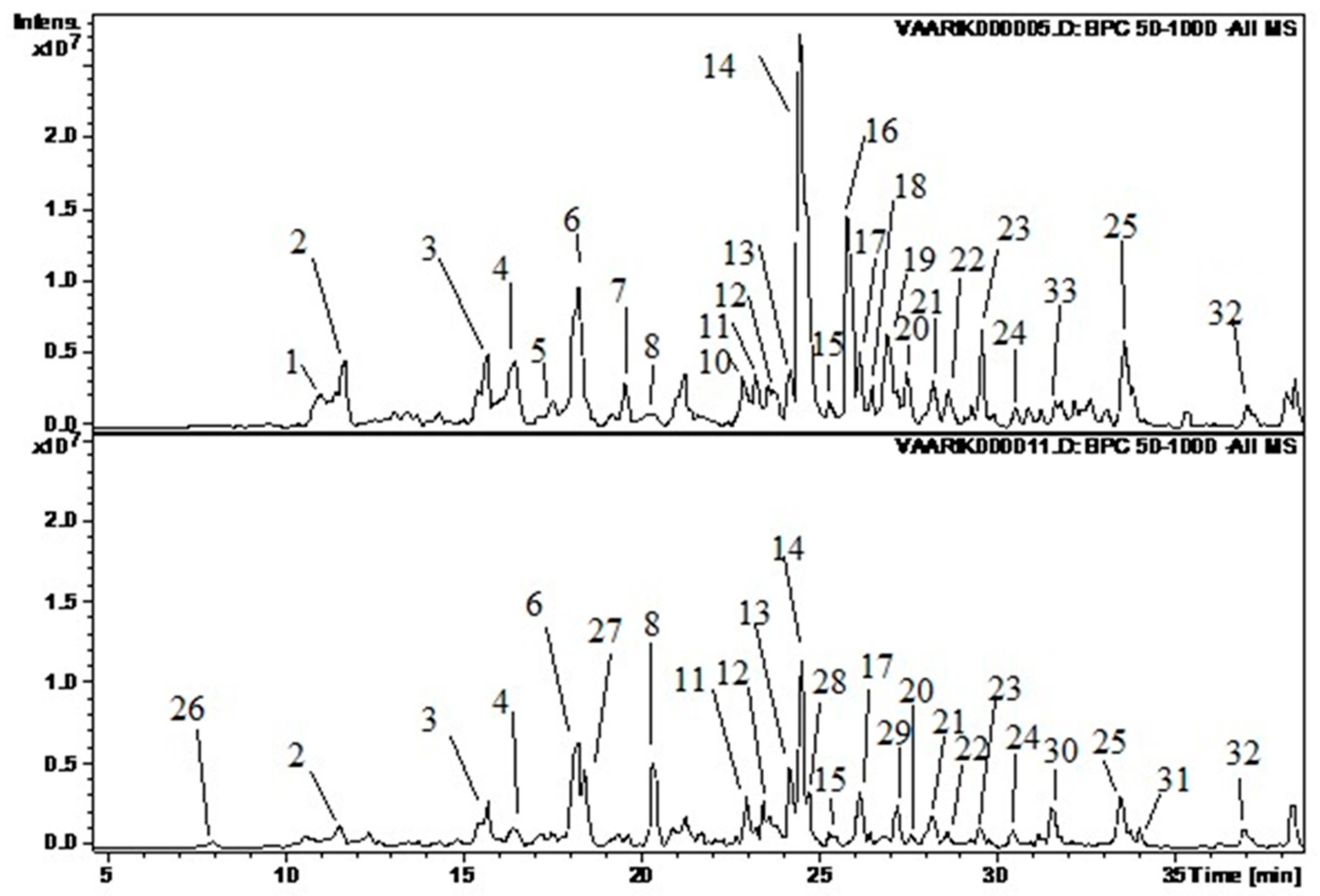

| Rt | m/z (M-H)− | m/z of Main Collision Fragments | Compound |
|---|---|---|---|
| 8.1 | 315 | 153;109 | Dihydroxybenzoic acid hexoside 1 |
| 11.8 | 315 | 297;153;109 | Dihydroxybenzoic acid hexoside 2 |
| 12.0 | 285 | 153;109 | Protocatechuic acid pentoside |
| 13.8 | 299 | 179;137;135 | Hydroxybenzoic acid hexoside |
| 14.7 | 577 | 559;451;425;407;289 | Procyanidin B(1) |
| 14.8 | 357 | 195;339 | Dihydroxyferulic acid glucoside |
| 15.1 | 289 | 245;205;179;125 | Catechin |
| 16.0 | 353 | 191;179;135 | Chlorogenic acid |
| 16.7 | 577 | 559;451;425;407;289 | Procyanidin B(2) |
| 17.7 | 577 | 559;451;425;407;289 | Procyanidin B(3) |
| 18.2 | 353 | 191;179;135 | Neochlorogenic acid |
| 18.5 | 639 | 463;301 | Quercetin 3-glucuronide-glucoside |
| 18.6 | 289 | 245;205;179;125 | Epicatechin |
| 18.8 | 337 | 191;163;173;301 | p-Coumaroyl quinic acid 1 |
| 19.6 | 325 | 163;119;289 | p-Coumaric acid hexoside |
| 20.7 | 337 | 191;163;173;301 | p-Coumaroyl quinic acid 2 |
| 23.1 | 609 | 301;302;431;179 | Quercetin glucorhamnoside |
| 23.2 | 595 | 463;343;301;300;179 | Quercetin pentohexoside (rumarin) |
| 23.4 | 433 | 301;300;151 | Quercetin pentoside 1 |
| 23.9 | 301 | 229;257;185;284 | Ellagic acid |
| 23.9 | 433 | 300;302;387;161 | Quercetin pentoside 2 * |
| 24.4 | 463 | 301;179;343;271 | Quercetin galactoside (hyperoside) |
| 24.6 | 477 | 301;179 | Quercetin 4’-glucuronide |
| 24.6 | 567 | 341;329;521;279 | Unknown 1 |
| 24.6 | 609 | 301;343;271;179 | Quercetin rutinoside (rutin) |
| 24.8 | 499 | 475;463;489 | Unknown 2 |
| 24.9 | 463 | 301;271;179;355;161 | Quercetin glucoside (isoquercetin) |
| 25.6 | 477 | 301;323;221;179;161 | Quercetin 7-glucuronide |
| 26.0 | 433 | 300;301;151;179 | Quercetin pentoside 3 |
| 26.2 | 447 | 285;255 | Kaempferol hexoside |
| 26.2 | 505 | 463;301;300;271 | Quercetin acetylhexoside 1 |
| 26.2 | 607 | 463;301;151;545;505 | Quercetin 3-[6”-(3-hydroxy-3-methylglutaryl)-hexoside] 1 |
| 26.4 | 477 | 315;153;433 | Isorhamnetin hexoside 1 |
| 26.8 | 447 | 315;300 | Isorhamnetin pentoside 1 |
| 26.8 | 607 | 463;301;151;545;505 | Quercetin 3-[6”-(3-hydroxy-3-methylglutaryl)-hexoside] 2 |
| 26.9 | 505 | 461;301;300;271;179 | Quercetin acetylhexoside 2 |
| 27.0 | 461 | 285;323;357;175 | Kaempferol glucuronide |
| 27.2 | 475 | 301;300;315;153 | Isorhamnetin rhamnoside 1 |
| 27.3 | 477 | 301 | Quercetin 3-glucuronide |
| 27.4 | 567 | 521;179;559;341;390 | Dicaffeic acid derivative * |
| 27.5 | 447 | 315;300 | Isorhamnetin pentoside 2 |
| 27.7 | 315 | 300;301;271;153 | Rhamnetin or isorhamnetin * |
| 28.2 | 505 | 323;389;301;179;161 | Acetyl hexoside |
| 28.3 | 475 | 415;300;301;185 | Ellagic acid acetylarabinoside * |
| 28.3 | 571 | 523;345;357;195;493 | Quercetin-3-glucuronide |
| 28.7 | 475 | 300;301;323 | Ellagic acid acetylxyloside * |
| 28.7 | 515 | 353;191;179;317;299 | Dicaffeoyl quinic acid |
| 29.6 | 461 | 301;315;159;179;151 | Isorhamnetin rhamnoside 1 * |
| 29.8 | 571 | 523;345;357;195;493 | Unknown 3 |
| 30.4 | 489 | 315;429;300 | Isorhamnetin rhamnoside 2 * |
| 31.6 | 499 | 353;173;203;255 | Chlorogenic acid rhamnoside * |
| 31.7 | 489 | 315;429;300 | Isorhamnetin rhamnoside 3 * |
| 31.8 | 301 | 151;179;257;211 | Quercetin |
| 32.1 | 517 | 300;457;179 | Unknown 4 |
| 32.6 | 489 | 315;429;300 | Isorhamnetin rhamnoside 4 * |
| 33.4 | 585 | 537;359;330;223 | Unknown 5 |
| 33.5 | 517 | 300;457;179 | Unknown 6 |
| 33.8 | 585 | 537;359;330;223 | Unknown 7 |
| 34.1 | 499 | 353;173;460;256 | Unknown 8 |
| 35.8 | 531 | 471;300;314;411;456 | Isorhamnetin C-hexoside 1 * |
| 36.9 | 531 | 315;300;411;471 | Isorhamnetin C-hexoside 2 *1 |
| 38.0 | 531 | 315;300;471;411 | Isorhamnetin C-hexoside 3 * |
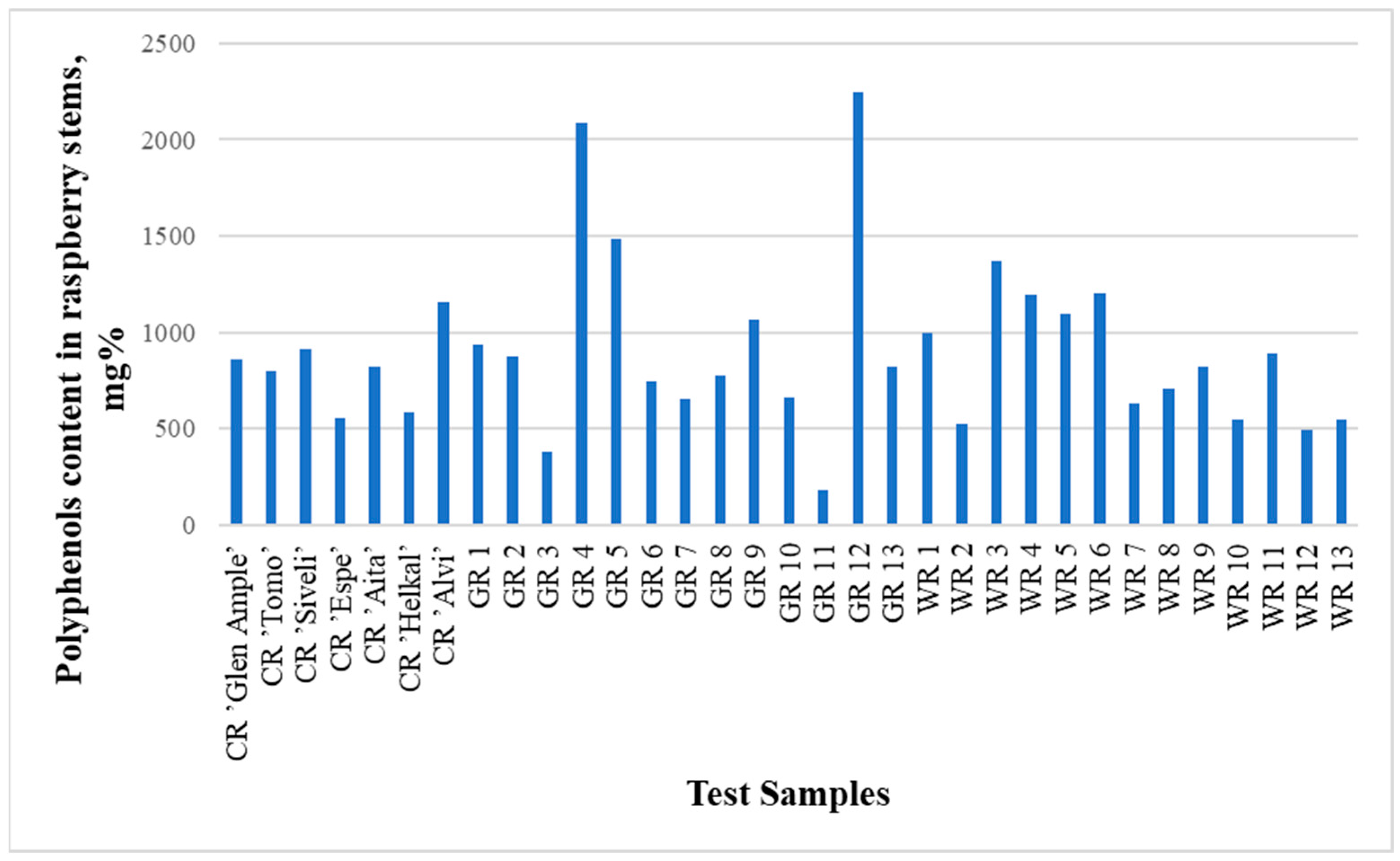
| Compound | CR ‘Glen Ample’ | CR ‘Tomo’ | CR ‘Siveli’ | CR ‘Espe’ | CR ‘Aita’ | CR ‘Helkal’ | CR ‘Alvi’ |
|---|---|---|---|---|---|---|---|
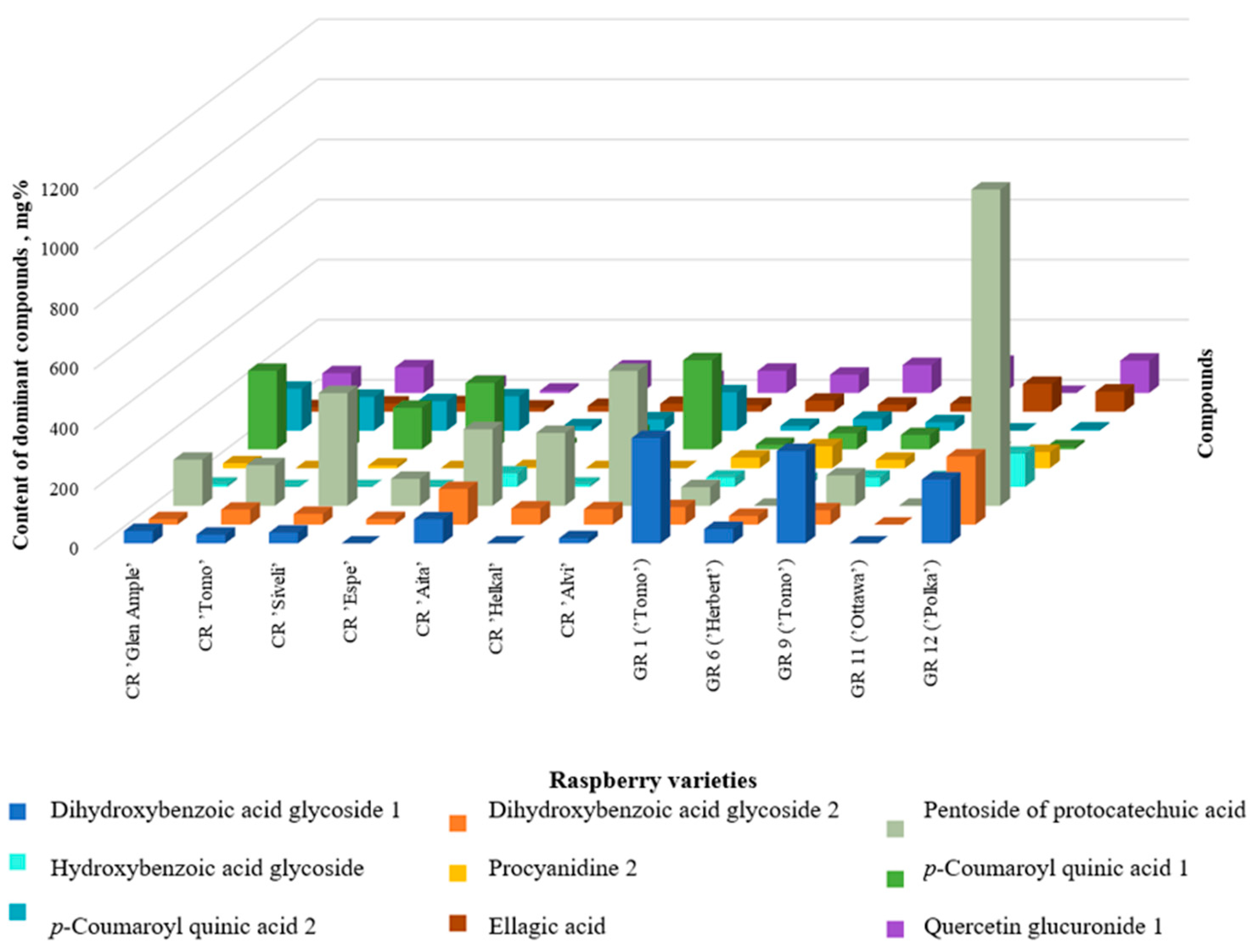
| Dihydroxybenzoic acid hexoside 1 | 41.5 | 29.3 | 36.1 | - | 80.5 | - | 17.5 |
| Dihydroxybenzoic acid hexoside 2 | 18.1 | 49.9 | 35.7 | 18.5 | 118.5 | 53.5 | 51.1 |
| Protocatechuic acid pentoside | 153.6 | 135.1 | 375.0 | 89.8 | 254.8 | 242.7 | 448.8 |
| Hydroxybenzoic acid hexoside | 8.2 | - | - | - | 45.3 | 8.3 | - |
| Procyanidin B(1) | 2.4 | - | - | - | - | - | - |
| Dihydroxyferulic acid glycoside | - | - | 2.0 | - | - | - | - |
| Catechin | 7.8 | 7.7 | 15.2 | 2.3 | 7.8 | 6.8 | 2.7 |
| Chlorogenic acid | 5.6 | - | 3.0 | 7.2 | 1.2 | 1.5 | 5.2 |
| Procyanidin B(2) | 16.3 | - | 8.9 | - | 3.6 | - | - |
| Procyanidin B(3) | 4.8 | 5.9 | 3.2 | 2.2 | 8.6 | 5.1 | 2.5 |
| Neochlorogenic acid | 1.0 | 5.9 | 1.0 | 1.0 | - | 0.8 | 1.0 |
| Quercetin 3-glucuronide-glucoside | ˂0.1 | 0.1 | - | ˂0.1 | 0.6 | - | ˂0.1 |
| Epicatechin | 2.9 | 2.0 | 2.8 | 0.4 | 2.3 | 2.6 | 1.5 |
| p-Coumaroyl quinic acid 1 | 261.5 | 175.9 | 138.5 | 220.9 | 14.7 | 57.8 | 296.8 |
| p-Coumaric acid glycoside | - | 8.4 | 10.5 | 34.7 | - | 2.2 | 9.5 |
| p-Coumaroyl quinic acid 2 | 139.2 | 112.1 | 98.0 | 114.1 | 14.5 | 37.1 | 127.4 |
| Quercetin glucoramnoside | ˂0.1 | 1.5 | 0.1 | - | 1.3 | ˂0.1 | 0.1 |
| Quercetin pentoside | - | ˂0.1 | - | - | 0.1 | - | - |
| Quercetin pentoside 1 | 2.1 | 1.9 | 2.3 | 0.8 | 2.4 | 1.5 | 1.5 |
| Ellagic acid | 15.1 | 27.34 | 28.2 | 14.2 | 19.6 | 26.8 | 22.0 |
| Quercetin pentoside 2 | 4.6 | 5.6 | 6.2 | 4.0 | 3.8 | 5.8 | 5.1 |
| Hyperoside | 0.6 | 2.6 | 1.2 | 1.3 | 2.0 | 1.2 | 1.4 |
| Quercetin rutinoside (rutin) | 24.3 | 4.1 | 1.6 | 2.2 | 5.8 | 2.2 | 3.1 |
| Quercetin 4’-glucuronide | 65.7 | 85.9 | 34.4 | 7.8 | 84.9 | 49.6 | 74.0 |
| Isoquercetin | 4.3 | 13.3 | 6.1 | 0.4 | 14.9 | 3.1 | 2.8 |
| Quercetin 7-glucuronide | 0.1 | 0.1 | 0.2 | - | ˂0.1 | ˂0.1 | - |
| Quercetin pentoside 3 | 0.1 | 39.8 | 17.3 | ˂0.1 | 51.9 | 27.7 | 16.2 |
| Quercetin 3-(6”-(3-hydroxy-3-methylglutaryl)hexoside) 1 | 0.4 | 3.1 | 1.0 | 5.6 | 5.5 | 2.8 | ˂0.1 |
| Kaempferol hexoside | 1.6 | - | 1.1 | 0.2 | - | 0.5 | 0.9 |
| Quercetin hexoside malonate | 0.5 | - | - | ˂0.1 | ˂0.1 | ˂0.1 | 0.5 |
| Isorhamnetin hexoside 1 | ˂0.1 | ˂0.1 | ˂0.1 | ˂0.1 | 0.2 | ˂0.1 | ˂0.1 |
| Quercetin 3-(6”-(3-hydroxy-3-methylglutaryl)hexoside) 2 | - | 2.5 | 0.1 | - | 2.5 | 0.5 | ˂0.1 |
| Isorhamnetin pentoside 1 | 5.8 | - | ˂0.1 | ˂0.1 | ˂0.1 | ˂0.1 | - |
| Kaempferol glucuronide | 3.6 | 1.2 | 0.5 | 0.2 | 1.8 | 0.6 | 1.4 |
| Isorhamnetin rhamnoside 1 | 2.4 | 3.4 | 3.5 | 1.1 | 4.6 | 2.3 | 2.7 |
| Dicaffeic acid derivative | 7.0 | 14.2 | 18.0 | - | 20.0 | 7.3 | - |
| Isorhamnetin pentoside 2 | ˂0.1 | 1.3 | 0.2 | ˂0.1 | 1.3 | ˂0.1 | 0.8 |
| Rhamnetin/isorhamnetin | ˂0.1 | 0.6 | 0.4 | 0.2 | 0.2 | 0.3 | 0.2 |
| Ellagic acid acetylarabinoside | 37.9 | 38.9 | 39.0 | 13.6 | 36.8 | 24.5 | 28.6 |
| Acetylxyloside of ellagic acid | 12.2 | 6.6 | 10.1 | 0.3 | 2.8 | 4.5 | 17.3 |
| Dicaffeoyl quinic acid | 1.3 | 1.2 | 1.2 | 1.6 | 1.2 | - | 1.4 |
| Isorhamnetin rhamnoside | ˂0.1 | ˂0.1 | ˂0.1 | ˂0.1 | ˂0.1 | - | ˂0.1 |
| Isorhamnetin rhamnoside 2 | 1.5 | 2.6 | 2.6 | 0.7 | 2.6 | 1.3 | 2.2 |
| Chlorogenic acid rhamnoside | 3.3 | 2.1 | 1.6 | 7.8 | 1.2 | 1.1 | 2.9 |
| Isorhamnetin rhamnoside 3 | 0.7 | 1.2 | 1.2 | 0.3 | 1.2 | 0.4 | 0.6 |
| Quercetin | 0.1 | 0.8 | 0.2 | 0.1 | 0.2 | 0.2 | 0.8 |
| Neochlorogenic acid rhamnoside | 1.7 | 1.3 | 1.1 | 3.4 | - | - | 1.5 |
| Isorhamnetin rhamnoside 6 | 3.2 | 3.7 | 4.1 | 0.6 | 4.2 | 1.6 | 2.5 |
| Isorhamnetin rhamnoside 7 | ˂0.1 | - | ˂0.1 | - | ˂0.1 | - | 0.8 |
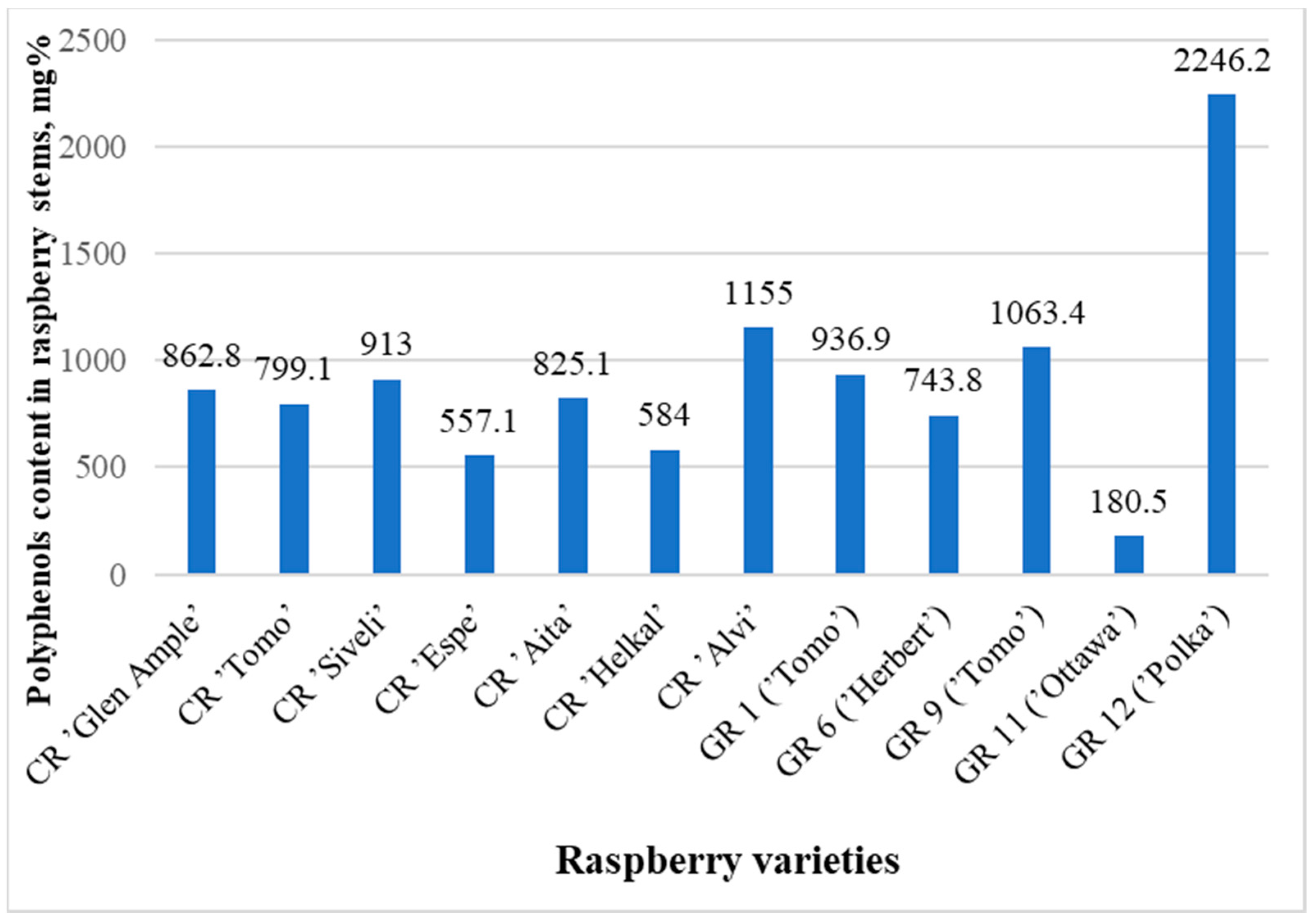
| Total: | 862.8 | 799.1 | 913.0 | 557.1 | 825.1 | 584.0 | 1155.0 |
| Compound | Garden Raspberry | ||||||||||||
|---|---|---|---|---|---|---|---|---|---|---|---|---|---|
| GR 1 | GR 2 | GR 3 | GR 4 | GR 5 | GR 6 | GR 7 | GR 8 | GR 9 | GR 10 | GR 11 | GR 12 | GR 13 | |
| Dihydroxybenzoic acid hexoside 1 | 350.7 | 132.5 | - | 93.6 | 124.6 | 48.2 | 35.4 | 55.0 | 307.7 | 63.1 | - | 212.7 | 49.2 |
| Dihydroxybenzoic acid hexoside 2 | 58.0 | 66.3 | - | 88.7 | - | 28.8 | 27.2 | 28.9 | 47.4 | 32.4 | - | 226.8 | 32.7 |
| Pentoside of protocatechuic acid | 62.2 | 373.2 | 134.3 | 1233.7 | 1077.7 | - | 278.3 | 297.4 | 101.5 | 262.1 | - | 1052.6 | 402.8 |
| Hydroxybenzoic acid hexoside | 31.7 | 35.4 | - | 45.3 | - | 24.2 | - | 52.0 | 31.4 | - | 29.4 | 111.1 | 22.4 |
| Procyanidin B(1) | 7.2 | - | - | 4.1 | - | 4.4 | 2.8 | 2.5 | 3.1 | 4.8 | 4.1 | 3.5 | 12.6 |
| Dihydroxyferulic acid glycoside | 19.7 | 5.3 | - | 24.1 | 9.3 | 15.4 | 2.6 | 27.8 | 8.4 | 3.0 | - | 22.7 | - |
| Catechin | 0.8 | 0.7 | 0.3 | 1.7 | 0.5 | 2.5 | 1.4 | 0.8 | 2.4 | 10.8 | 1.4 | 7.1 | 10.1 |
| Chlorogenic acid | 6.2 | 2.0 | 1.2 | 11.2 | 1.2 | 8.6 | 2.8 | 1.4 | 5.5 | 1.0 | - | 1.4 | 0.8 |
| Procyanidin B(2) | 35.1 | 20.0 | 2.2 | 62.6 | 16.7 | 72.9 | 11.7 | 32.8 | 27.6 | 50.6 | 6.4 | 53.6 | 88.5 |
| Procyanidin B(3) | 6.9 | 4.8 | - | 16.3 | 5.6 | 30.3 | 2.8 | 7.0 | 6.0 | 15.4 | 8.2 | 15.3 | 13.0 |
| Neochlorogenic acid | 1.2 | 1.0 | 0.9 | 1.7 | - | 2.0 | 1.0 | - | 1.2 | 0.8 | - | 0.9 | - |
| Quercetin 3-glucuronide-glucoside | 1.0 | ˂0.1 | ˂0.1 | 7.9 | ˂0.1 | 2.7 | ˂0.1 | ˂0.1 | 4.0 | 0.2 | - | 1.2 | - |
| Epicatechin | 22.3 | 8.1 | 1.1 | 34.7 | 11.7 | 46.6 | 4.8 | 26.6 | 15.0 | 42.2 | 2.7 | 54.7 | 65.6 |
| p-Coumaroyl quinic acid 1 | 15.2 | 11.6 | 49.7 | 18.3 | 1.2 | 53.3 | 21.7 | 1.5 | 48.1 | 6.0 | - | 7.6 | - |
| p-Coumaric acid glycoside | 24.2 | 6.2 | 4.2 | 10.6 | 2.8 | 27.6 | 7.8 | 3.1 | 52.0 | 38.3 | 6.2 | 51.8 | 4.6 |
| p-Coumaroyl quinic acid 2 | 15.5 | 9.2 | 32.4 | 12.5 | 1.7 | 39.0 | 17.8 | 1.8 | 27.7 | 5.6 | - | 3.7 | - |
| Quercetin glucoramnoside | 1.9 | 1.2 | 0.3 | 4.2 | 1.0 | 1.2 | 0.1 | 2.1 | 2.8 | ˂0.1 | - | 0.4 | - |
| Quercetin pentoxoside | 0.9 | - | - | 0.6 | 0.3 | 0.9 | ˂0.1 | 1.0 | 1.8 | - | - | ˂0.1 | - |
| Quercetin pentoside 1 | 3.4 | 3.0 | 0.8 | 4.5 | 2.6 | 1.6 | 2.1 | 2.4 | 3.3 | 2.4 | 0.3 | 6.0 | 2.2 |
| Ellagic acid | 36.9 | 19.9 | 35.5 | 44.4 | 29.5 | 24.00 | 21.4 | 25.1 | 26.8 | 15.1 | 92.8 | 67.2 | 40.2 |
| Quercetin pentoside 2 | 7.0 | 4.7 | 6.10 | 9.2 | 6.9 | 5.6 | 5.9 | 6.4 | 6.6 | 2.6 | 14.9 | 10.0 | 7.2 |
| Hyperoside | 2.7 | 1.9 | 2.3 | 4.0 | 6.4 | 2.3 | 2.1 | 7.4 | 3.7 | ˂0.1 | - | ˂0.1 | 0.1 |
| Quercetin rutinoside (rutin) | 4.1 | 1.9 | 1.5 | 4.2 | 22.7 | 15.1 | 16.7 | 8.1 | 7.5 | - | - | - | 1.0 |
| Quercetin 4’-glucuronide | 61.1 | 32.8 | 45.9 | 105.5 | 54.6 | 93.2 | 54.5 | 36.8 | 100.6 | - | ˂0.1 | 107.9 | 1.1 |
| Isoquercetin | 5.0 | 4.8 | 1.9 | 28.5 | 7.1 | 48.1 | 5.0 | 4.3 | 19.9 | 8.0 | - | 10.5 | 0.2 |
| Quercetin 7-glucuronide | 0.6 | 1.0 | - | 2.3 | 1.1 | 2.5 | - | 0.8 | 2.1 | 57.0 | ˂0.1 | 2.8 | 0.4 |
| Quercetin pentoside 3 | 21.5 | 14.6 | 11.9 | 33.9 | 0.6 | 0.1 | 5.4 | ˂0.1 | 43.6 | ˂0.1 | - | ˂0.1 | - |
| Quercetin 3-(6”-(3-hydroxy-3-methyl-glutaryl)hexoside 1 | 2.2 | 3.1 | 1.3 | 2.4 | 10.4 | 2.2 | 3.5 | 1.2 | 4.4 | ˂0.1 | ˂0.1 | 0.4 | ˂0.1 |
| Kaempferol hexoside | ˂0.1 | - | - | 8.4 | 1.3 | 0.8 | 0.6 | 0.5 | ˂0.1 | 0.5 | 0.1 | 3.5 | 1.8 |
| Quercetin hexoside malonate | 1.2 | 0.1 | 0.2 | 5.5 | 2.8 | 3.4 | 2.4 | 1.8 | 5.1 | 1.2 | - | 1.8 | ˂0.1 |
| Isorhamnetin hexoside 1 | 2.3 | 0.8 | - | 3.2 | 2.0 | 6.7 | 0.2 | 1.5 | 5.3 | 0.6 | ˂0.1 | 3.0 | 0.6 |
| Quercetin 3-(6”-(3-hydroxy-3-methyl-glutaryl)hexoside 2 | 0.8 | 1.8 | 0.4 | 3.7 | 0.3 | ˂0.1 | - | - | ˂0.1 | - | ˂0.1 | 0.8 | - |
| Isorhamnetin pentoside 1 | 2.1 | 1.2 | 0.6 | 4.7 | 2.7 | 5.1 | 1.7 | 2.6 | 2.4 | 0.4 | 0.3 | - | - |
| Kaempferol glucuronide | 1.9 | 0.5 | 1.0 | 5.6 | 3.3 | 6.7 | 2.1 | 2.3 | 2.6 | 1.5 | - | 2.5 | ˂0.1 |
| Isorhamnetin rhamnoside 1 | 3.5 | ˂0.1 | 1.9 | 3.4 | 3.3 | 1.7 | 4.1 | 3.5 | 2.8 | 3.1 | 0.3 | 6.9 | 2.5 |
| Dicaffeic acid derivative | 29.7 | 59.0 | 10.2 | 19.9 | 5.7 | 37.9 | 4.0 | 32.2 | 30.8 | 10.4 | 4.0 | 66.4 | 6.4 |
| Isorhamnetin pentoside 2 | 0.4 | ˂0.1 | 0.8 | ˂0.1 | - | - | - | ˂0.1 | 0.5 | - | - | ˂0.1 | 0.8 |
| Rhamnetin/isorhamnetin | 0.6 | 0.3 | 1.4 | 1.4 | 0.9 | 1.4 | 0.5 | 0.4 | 0.5 | 0.2 | 3.9 | 1.9 | 1.4 |
| Ellagic acid acetylarabinoside | 31.1 | 21.8 | 18.7 | 50.5 | 28.6 | 28.6 | 46.0 | 53.1 | 34.1 | 12.9 | 3.1 | 67.6 | 19.4 |
| Acetylxyloside of ellagic acid | 42.3 | 19.7 | 6.7 | 43.5 | 30.3 | 30.1 | 44.8 | 35.0 | 48.6 | 4.2 | 1.3 | 34.8 | 25.3 |
| Dicaffeoyl quinic acid | 2.3 | 1.5 | 1.2 | 4.2 | 1.5 | 1.6 | 1.4 | 1.2 | 2.8 | - | - | 1.2 | - |
| Isorhamnetin rhamnoside | 0.7 | 0.3 | - | 6.6 | 1.6 | 7.6 | ˂0.1 | 0.6 | 2.8 | 0.1 | ˂0.1 | 2.1 | 1.3 |
| Isorhamnetin rhamnoside 2 | 3.1 | 1.2 | 1.5 | 3.6 | 2.3 | 0.9 | 2.6 | 2.5 | 2.67 | 2.1 | 0.3 | 8.5 | 1.9 |
| Chlorogenic acid rhamnoside | 2.2 | 1.3 | 1.6 | 3.7 | 1.1 | 3.9 | 2.2 | - | 2.8 | - | - | 1.1 | - |
| Isorhamnetin rhamnoside 3 | 1.5 | 0.5 | 0.3 | 1.0 | 0.6 | 0.3 | 1.3 | 1.2 | 1.0 | 0.6 | 0.1 | 4.0 | 1.2 |
| Quercetin | 1.7 | 0.1 | 0.6 | 1.8 | 0.7 | 0.9 | 0.2 | 0.1 | 1.9 | 0.2 | 0.1 | 0.4 | ˂0.1 |
| Neochlorogenic acid rhamnoside | 1.5 | 1.2 | - | 1.6 | - | 1.8 | 1.4 | - | 1.6 | - | - | - | - |
| Isorhamnetin rhamnoside 6 | 3.3 | 2.5 | 1.78 | 3.2 | 2.0 | 1.3 | 3.3 | 2.9 | 3.4 | 3.5 | 0.4 | 7.5 | - |
| Isorhamnetin rhamnoside 7 | ˂0.1 | ˂0.1 | 0.2 | 3.7 | ˂0.1 | - | ˂0.1 | ˂0.1 | ˂0.1 | ˂0.1 | ˂0.1 | 0.5 | 2.4 |
| Total: | 936.9 | 878.6 | 382.6 | 2089.6 | 1486.9 | 743.8 | 653.8 | 775.4 | 1063.4 | 662.8 | 180.5 | 2246.2 | 819.2 |
| Compound | Wild Raspberry | ||||||||||||
|---|---|---|---|---|---|---|---|---|---|---|---|---|---|
| WR 1 | WR 2 | WR 3 | WR 4 | WR 5 | WR 6 | WR 7 | WR 8 | WR 9 | WR 10 | WR 11 | WR 12 | WR 13 | |
| Dihydroxybenzoic acid hexoside 1 | 141.0 | 23.4 | - | 98.5 | 123.3 | 106.1 | - | 74.0 | 15.9 | 22.7 | 55.7 | 17.2 | - |
| Dihydroxybenzoic acid hexoside 2 | 36.5 | 76.4 | 176.5 | 59.8 | 36.4 | 74.8 | - | 84.6 | - | 19.5 | 21.3 | 13.8 | 32.0 |
| Pentozide of protocatechuic acid | 456.9 | 130.6 | 530.1 | 517.7 | 742.6 | 793.5 | 199.4 | 294.1 | 457.3 | 185.3 | 597.1 | 224.2 | 175.9 |
| Hydroxybenzoic acid hexoside | - | 72.3 | 300.8 | 41.0 | - | 40.8 | - | - | - | - | - | - | - |
| Procyanidin B(1) | 2.1 | - | 2.3 | - | - | - | 3.6 | - | 5.7 | 3.0 | 1.7 | - | - |
| Dihydroxyferulic acid glycoside | 9.8 | 1.4 | 10.2 | 19.1 | - | - | - | 1.9 | - | 1.5 | - | 2.0 | - |
| Catechin | 0.5 | 0.8 | 0.5 | 1.4 | 0.7 | 0.3 | 1.6 | 4.1 | 1.5 | 6.0 | 0.7 | 0.8 | 0.6 |
| Chlorogenic acid | 6.1 | 1.4 | 2.4 | 3.2 | 1.0 | 0.8 | - | 1.2 | - | 1.4 | 0.8 | 2.4 | 2.1 |
| Procyanidin B(2) | 18.2 | 4.5 | 25.4 | 27.9 | 6.7 | 9.5 | 56.8 | 14.6 | 93.0 | 24.3 | 20.5 | 4.2 | 2.8 |
| Procyanidin B(3) | 8.2 | 3.2 | 7.8 | 9.9 | 3.6 | 4.2 | 9.6 | 7.1 | 15.6 | 9.8 | 4.7 | 3.0 | 2.2 |
| Neochlorogenic acid | 1.8 | - | 0.9 | 0.9 | - | - | - | - | - | - | - | 0.9 | - |
| Quercetin 3-glucuronide-glucoside | ˂0.1 | ˂0.1 | 1.2 | 3.6 | ˂0.1 | ˂0.1 | - | 0.1 | - | ˂0.1 | - | - | - |
| Epicatechin | 19.1 | 3.0 | 13.6 | 25.8 | 4.2 | 3.0 | 18.1 | 17.8 | 81.9 | 17.8 | 7.9 | 6.5 | 2.1 |
| p-Coumaroyl quinic acid 1 | 65.8 | 15.4 | 2.7 | 2.3 | 4.3 | - | - | 7.4 | - | 16.4 | - | 37.4 | 109.8 |
| p-Coumaric acid glycoside | - | 6.3 | 11.3 | 39.4 | 48.4 | 2.1 | 43.2 | 6.1 | 21.9 | 36.5 | 16.5 | 39.5 | 78.3 |
| p-Coumaroyl quinic acid 2 | 62.9 | 9.4 | 2.5 | 3.1 | 3.7 | - | - | 3.7 | - | 12.3 | - | 29.2 | 60.0 |
| Quercetin glucoramnoside | - | ˂0.1 | 0.5 | 8.4 | - | ˂0.1 | - | - | 0.1 | ˂0.1 | ˂0.1 | - | - |
| Quercetin pentoxoside | 0.4 | ˂0.1 | ˂0.1 | 2.7 | - | - | - | ˂0.1 | ˂0.1 | ˂0.1 | - | - | - |
| Quercetin pentoside 1 | 1.2 | 2.1 | 3.1 | 3.5 | 1.1 | 2.6 | 4.3 | 1.3 | 2.2 | 2.6 | 2.5 | 1.5 | 1.0 |
| Ellagic acid | 24.9 | 18.6 | 31.2 | 21.0 | 14.6 | 27.2 | 82.8 | 26.8 | 48.4 | 24.2 | 31.3 | 27.2 | 15.9 |
| Quercetin pentoside 2 | 1.4 | 1.9 | 6.5 | 4.8 | 4.0 | 4.9 | 23.1 | 4.7 | 7.2 | 5.0 | 6.4 | 5.4 | 2.5 |
| Hyperoside | 5.3 | 6.3 | 16.6 | 12.2 | 3.5 | 7.4 | 0.1 | 2.8 | 0.5 | ˂0.1 | - | 5.9 | 6.2 |
| Quercetin rutinoside (rutin) | 4.1 | 4.9 | 10.2 | 6.1 | 2.5 | 4.2 | - | 1.7 | - | 2.1 | 0.5 | 4.5 | 4.0 |
| Quercetin 4’-glucuronide | 17.5 | 40.0 | 63.7 | 83.1 | 12.5 | 21.3 | 0.9 | 67.2 | 3.8 | 67.4 | 12.7 | 6.7 | 16.9 |
| Isoquercetin | 4.0 | 4.9 | 7.1 | 16.5 | 2.3 | 2.8 | 1.9 | 4.7 | 3.0 | 14.9 | 1.6 | 2.3 | 1.9 |
| Quercetin 7-glucuronide | 0.8 | - | 1.5 | 2.3 | ˂0.1 | 0.4 | 1.4 | - | 1.4 | - | 1.0 | ˂0.1 | - |
| Quercetin pentoside 3 | ˂0.1 | ˂0.1 | ˂0.1 | 22.8 | 3.9 | ˂0.1 | - | 16.6 | ˂0.1 | - | - | 0.1 | ˂0.1 |
| Quercetin 3-(6”-(3-hydroxy-3-methyl-glutaryl)hexoside) 1 | 5.3 | 3.9 | 24.6 | 9.1 | 0.4 | 6.9 | 0.2 | 2.1 | 0.1 | ˂0.1 | ˂0.1 | 2.4 | 8.9 |
| Kaempferol hexoside | ˂0.1 | 1.0 | 0.5 | 0.4 | 0.1 | 0.1 | - | ˂0.1 | 0.9 | 1.3 | 3.0 | 1.6 | 1.2 |
| Quercetin hexoside malonate | ˂0.1 | 1.3 | 1.5 | 3.5 | 0.5 | 0.8 | ˂0.1 | 0.6 | ˂0.1 | 2.8 | ˂0.1 | 0.3 | 0.1 |
| Isorhamnetin hexoside 1 | 3.0 | ˂0.1 | ˂0.1 | 1.6 | 0.2 | 0.7 | 3.7 | 0.1 | 3.0 | ˂0.1 | 0.7 | ˂0.1 | ˂0.1 |
| Quercetin 3-(6”-(3-hydroxy-3-methyl-glutaryl)hexoside) 2 | ˂0.1 | - | 0.8 | 4.3 | ˂0.1 | ˂0.1 | - | 0.4 | ˂0.1 | 2.6 | 0.8 | - | ˂0.1 |
| Isorhamnetin pentoside 1 | 0.8 | 1.4 | 1.5 | 4.8 | 1.5 | 0.9 | 1.9 | 1.1 | ˂0.1 | - | - | 1.1 | 0.7 |
| Kaempferol glucuronide | 0.8 | 2.2 | 2.5 | 7.3 | 1.0 | 0.8 | ˂0.1 | 1.5 | 0.4 | 1.5 | 0.3 | 0.6 | 1.1 |
| Isorhamnetin rhamnoside 1 | 1.9 | 4.0 | 2.9 | 3.5 | 2.8 | 3.7 | 4.6 | 2.2 | 1.0 | 4.0 | 3.0 | 2.3 | 1.8 |
| Dicaffeic acid derivative | 38.5 | 7.4 | 9.6 | 41.1 | 11.1 | 12.5 | 12.3 | - | 2.2 | 4.9 | 23.5 | 10.0 | 2.7 |
| Isorhamnetin pentoside 2 | 0.1 | ˂0.1 | 0.4 | 1.9 | 1.0 | 0.1 | 1.0 | 0.3 | 0.5 | ˂0.1 | 2.8 | 0.8 | ˂0.1 |
| Rhamnetin/isorhamnetin | 0.8 | 0.2 | 0.4 | 0.9 | 0.3 | 1.1 | 2.7 | 0.2 | 2.9 | 0.6 | 1.6 | 0.6 | 1.0 |
| Acetylarabinoside of ellagic acid | 26.8 | 48.7 | 48.1 | 40.3 | 39.0 | 43.2 | 80.8 | 34.4 | 26.2 | 38.9 | 41.0 | 24.4 | 13.2 |
| Acetylxyloside of ellagoic acid | 16.6 | 14.0 | 34.3 | 19.9 | 11.7 | 19.2 | 69.1 | 12.8 | 25.7 | 9.9 | 23.2 | 4.8 | ˂0.1 |
| Dicaffeoyl quinic acid | 2.2 | - | 2.3 | 1.7 | - | - | - | 1.1 | - | - | - | 1.1 | - |
| Isorhamnetin rhamnoside | 1.1 | ˂0.1 | 2.1 | 3.6 | ˂0.1 | 0.8 | 1.8 | 0.1 | 1.2 | ˂0.1 | 0.3 | - | - |
| Isorhamnetin rhamnoside 2 | 1.5 | 2.8 | 2.2 | 3.8 | 2.7 | 2.8 | 2.9 | 1.8 | 0.5 | 3.4 | 3.2 | 1.9 | 1.3 |
| Chlorogenic acid rhamnoside | 5.4 | 1.3 | 1.4 | 1.1 | - | - | - | - | - | - | - | 1.4 | 1.3 |
| Isorhamnetin rhamnoside 3 | 0.5 | 1.2 | 0.9 | 1.0 | 0.9 | 1.6 | 2.3 | 0.6 | 0.4 | 1.3 | 0.8 | 0.5 | 0.4 |
| Quercetin | 0.8 | 0.2 | 0.6 | 0.9 | - | ˂0.1 | 0.2 | 0.3 | 0.3 | 0.4 | ˂0.1 | 0.2 | 0.1 |
| Neochlorogenic acid rhamnoside | 2.8 | - | - | - | - | - | - | - | - | - | - | - | - |
| Isorhamnetin rhamnoside 6 | 2.0 | 4.6 | 3.4 | 3.1 | 3.0 | 4.2 | 3.9 | 3.0 | 0.6 | 5.1 | 2.1 | 1.6 | 1.7 |
| Isorhamnetin rhamnoside 7 | - | - | ˂0.1 | 2.0 | 1.9 | ˂0.1 | ˂0.1 | 0.8 | - | ˂0.1 | 1.4 | 0.4 | ˂0.1 |
| Total: | 999.3 | 520.8 | 1368.4 | 1192.8 | 1097.4 | 1205.2 | 634.1 | 705.9 | 825.0 | 549.1 | 890.3 | 490.5 | 549.7 |
| Sample | Origin |
|---|---|
| CR 1 (‘Glen Ample’) | EMÜ Centre for Horticultural Research, Polli, Karksi parish, Viljandi County |
| CR 2 (‘Tomo’) | EMÜ Centre for Horticultural Research, Polli, Karksi parish, Viljandi County |
| CR 3 (‘Siveli’) | EMÜ Centre for Horticultural Research, Polli, Karksi parish, Viljandi County |
| CR 4 (‘Espe’) | EMÜ Centre for Horticultural Research, Polli, Karksi parish, Viljandi County |
| CR 5 (‘Aita’) | EMÜ Centre for Horticultural Research, Polli, Karksi parish, Viljandi County |
| CR 6 (‘Helkal’) | EMÜ Centre for Horticultural Research, Polli, Karksi parish, Viljandi County |
| CR 7 (‘Alvi’) | EMÜ Centre for Horticultural Research, Polli, Karksi parish, Viljandi County |
| GR 1 (‘Tomo’) | Simmi farm, Kivilõppe village, Tarvastu parish, Viljandi County |
| GR 2 | Iisaku, Iisaku parish, Ida-Viru County |
| GR 3 | Kadarbiku village, Taebla parish, Lääne County |
| GR 4 | Kadarbiku village, Taebla parish, Lääne County |
| GR 5 | Vanamõisa farm, Kolila village, Ridala parish, Lääne County |
| GR 6 (‘Herbert’) | Soe village, Tarvastu parish, Viljandi County |
| GR 7 | Soe village, Tarvastu parish, Viljandi County |
| GR 8 | Paeküla, Märjamaa parish, Rapla County |
| GR 9 (‘Tomo’) | Rüssa farm, Kivilõppe village, Tarvastu parish, Viljandi County |
| GR 10 | Raudtee street, Tõrva city, Valga County |
| GR 11 (‘Ottawa’) | Raudtee street, Tõrva city, Valga County |
| GR 12 (‘Polka’) | Rebase Street, Tartu, Tartu County |
| GR 13 | Rebase Street, Tartu, Tartu County |
| WR 1 | Paju otsas, Simmi farm, Kivilõppe village, Tarvastu parish, Viljandi County |
| WR 2 | Simmi Forest, Kivilõppe village, Tarvastu parish, Viljandi County |
| WR 3 | Härma quarry, Helme parish, Valga county |
| WR 4 | Palu mets, Järveküla, Tarvastu parish, Viljandi County |
| WR 5 | Iisaku Forest, Iisaku Parish, Ida-Viru County |
| WR 6 | Vanamõisa lakeside, Tõrva city, Valga county |
| WR 7 | Kadarbiku village, Taebla parish, Lääne County |
| WR 8 | Vasara village, Viljandi parish, Viljandi County |
| WR 9 | Kolila village, Ridala parish, Lääne County |
| WR 10 | Lake Võrtsjärve, Kivilõppe village, Tarvastu parish, Viljandi County |
| WR 11 | Rüssa Forest, Kivilõppe village, Tarvastu parish, Viljandi County |
| WR 12 | Rulli village, Põdrala parish, Valga County |
| WR 13 | Ahimäe village, Karksi parish, Viljandi County |
Disclaimer/Publisher’s Note: The statements, opinions and data contained in all publications are solely those of the individual author(s) and contributor(s) and not of MDPI and/or the editor(s). MDPI and/or the editor(s) disclaim responsibility for any injury to people or property resulting from any ideas, methods, instructions or products referred to in the content. |
© 2024 by the authors. Licensee MDPI, Basel, Switzerland. This article is an open access article distributed under the terms and conditions of the Creative Commons Attribution (CC BY) license (https://creativecommons.org/licenses/by/4.0/).
Share and Cite
Raal, A.; Vahtra, A.; Koshovyi, O.; Ilina, T.; Kovalyova, A.; Püssa, T. Polyphenolic Compounds in the Stems of Raspberry (Rubus idaeus) Growing Wild and Cultivated. Molecules 2024, 29, 5016. https://doi.org/10.3390/molecules29215016
Raal A, Vahtra A, Koshovyi O, Ilina T, Kovalyova A, Püssa T. Polyphenolic Compounds in the Stems of Raspberry (Rubus idaeus) Growing Wild and Cultivated. Molecules. 2024; 29(21):5016. https://doi.org/10.3390/molecules29215016
Chicago/Turabian StyleRaal, Ain, Anni Vahtra, Oleh Koshovyi, Tetiana Ilina, Alla Kovalyova, and Tõnu Püssa. 2024. "Polyphenolic Compounds in the Stems of Raspberry (Rubus idaeus) Growing Wild and Cultivated" Molecules 29, no. 21: 5016. https://doi.org/10.3390/molecules29215016
APA StyleRaal, A., Vahtra, A., Koshovyi, O., Ilina, T., Kovalyova, A., & Püssa, T. (2024). Polyphenolic Compounds in the Stems of Raspberry (Rubus idaeus) Growing Wild and Cultivated. Molecules, 29(21), 5016. https://doi.org/10.3390/molecules29215016