


Abstract
Constitutive relations are fundamental and essential to characterize physical systems. By utilizing the -deformed functions, some constitutive relations are generalized. We here show some applications of the Kaniadakis distributions, based on the inverse hyperbolic sine function, to some topics belonging to the realm of statistical physics and natural science.
1. Introduction
The -exponential function [1,2,3] is defined by:
for a real deformation parameter . The inverse function, i.e., the -deformed logarithmic function, is defined by:
Both -deformed functions are important ingredients of the generalized statistical physics based on -entropy [1,2,3]. This influences a wide range of scientific fields, and, based on the -deformed functions (Appendix A), several basic fields developed over two decades. Kaniadakis [4] provided the theoretical foundations and mathematical formalism generated by the -deformed functions, and some references, including many fields of applications. Recently, the usefulness of the -statistics was demonstrated for the analysis [5] of epidemics and pandemics.
Constitutive relations are fundamental and essential to characterize physical systems. They are combined with the other equations of the physical laws in order to solve physical problems. There are well-known examples of linear constitutive relations, such as the following: Hooke’s law , for the tensile, or compressive, force F of a spring with a spring constant against the change in its length x; Ohm’s law for the voltage V of an electrical conductor with resistance R under an electric current I, and so on. However, as a real spring deviates from Hooke’s law, we know that any linear constitutive relation describes an idealized situation, and it is merely a linearized- and/or approximated- relation to describe some real physical properties. Hence, in general, non-linearity plays a crucial role to describe more realistic physical systems.
The -exponential function (1) can be regarded as a useful tool (or device) to make such non-linear constitutive relations for a better description of real physical systems. For example, consider the following -deformation of Hooke’s law:
which reduces to the original Hooke’s law in the limit of . For any linear constitutive relation, we can apply this type of the -deformation. For example, Ohm’s law can be cast into the following form: . By changing the exponential function with the -exponential function, we obtain the -deformed version of Ohm’s law: . In this research, we focused on this type of the -deformation of a physical quantity (say A), i.e.,
Throughout this paper, we call this -deformation the arsinh-type deformation of a physical quantity A.
Another type of the -deformation can be:
which is called here the sinh-type deformation. In Reference [6], the thermodynamic stability of the -generalization of Boltzmann entropy was studied. The -generalization was rewritten in the form:
which could be regarded as the sinh-type deformation of Boltzmann entropy . Recently, in cosmology, Lymperis et al. [7] modified Bekenstein–Hawking entropy as follows:
which was obviously the sinh-type deformation of .
In this paper we considered the arsinh-type deformations against some constitutive relations in the field of statistical physics and natural sciences. In our previous work [8] we studied a thermal particle under a velocity-dependent potential which could be regarded as a deformation of Rayleigh’s dissipation function [9] and showed that the probability distribution function (pdf) for the stationary-state of this thermal particle was a -deformed Gaussian pdf. It was considered the canonical pdf , in the velocity space, of a thermal particle with unit mass () in the -deformed confining potential :
where is a coldness (or inverse temperature). This -deformed potential was rewritten, in the momentum–space, as:
which was the arsinh type deformation of the quantity (the ratio of the kinetic energy to the mean thermal energy ). In other words, we considered the following -deformation of the Boltzmann factor for an equilibrium state with the energy U:
One may wonder why the inverse hyperbolic sine function (arsinh) plays a role. In many different fields of sciences, there is no doubt that the exponential and logarithmic functions are important and fundamental. Since the inverse hyperbolic sine function and logarithmic function are mutually related as:
for a positive real x, we think both functions are important. By using the second relation, for any real parameter , we have:
Note that this relation corresponds to the arsinh-type deformation of and is equivalent to definition (2) of the -deformed logarithmic function that can be regarded as the sinh-type of -deformation of . Kaniadakis already discussed this issue in section II of Reference [2] from the viewpoint of deformed algebra.
On the other hand, Pistone [10] was the first one to study the -exponential model in the field of information geometry [11], and later, through our research activities [8,12,13], we realized that there exist some relations among statistical physics, thermodynamics, mathematical biology, and information geometry. Harper [14,15] pointed out that the replicator equation (RE) [16] in mathematical biology or in an evolutional game theory [17] is related with information geometry and a general form of the Lotka–Volterra (gLV) equation as briefly explained in Appendix B. The gLV equations [14,15,18,19]:
are used to model the competition dynamics of the populations of n biological species. The Gompertz function [20] is a type of mathematical model for time evolution. Historically, he studied human mortality and proposed his law of human mortality in which he assumed that a person’s resistance to death decreases as his or her years increase. His law is now called Gompertz rule (or law) and we would like to point out the relation of his function and his rule to some important quantities concerning statistical physics.
The rest of the paper is organized as follows. In Section 2, we briefly explain Gompertz function, and the gLV equations, which are important in mathematical biology (or evolutional game theory). Their relations to thermal physics are pointed out. Section 3 considers the thermal density operator, which is characterized by the so-called Bloch equation [21,22] for thermal states, and we show that the Bloch equation can be regarded as a Gompertz rule after the parameter transformation to . In Section 4, we discuss the arsinh-type deformation from the viewpoint of the -addition. In Section 5, we study the numerical simulations of the thermostat algorithm for the Hamiltonian with the -deformed kinetic energy, which can be regarded as the arsinh type of the -deformation of the ratio as shown in (10). The final section is devoted to our conclusions.
2. Gompertz Functions and Gompertz Rule
Here we would like to point out that there exist relations between evolutional game dynamics and thermal physics. In evolutional game theory [17], evolutional game dynamics is described by a RE. The gLV equations are related to REs, as shown in Appendix B. On the other hand, Gompertz function is a mathematical model describing an evolutional curve. Gompertz function (or Gompertz curve) [20] is a type of mathematical model for a time series. Gompertz function is a sigmoid function and is given by:
where C and K are positive constants. A distinctive feature of Gompertz function is its double exponential t-dependency. His function is nowadays used in many different areas to model time evolution of populations where growth is slowest at the start and end of a period. For example, Reference [23] applied Gompertz model to describe the growth dynamics of the COVID-19 pandemic. Gompertz [20] studied human mortality by working out a series of mortality tables, and this suggested to him his law of human mortality, in which he assumed that a person’s resistance to death decreases as age increases. The rule of his model is called Gompertz rule which states that:
The solution of the Gompertz rule is the Gompertz function (14), if we set and .
If we choose and assume , the gLV Equation (13) becomes:
which can be regarded as the Gompertz rule (15) with for each . Consequently, its solution is the Gompertz function:
Now, by changing the parameter t to , we have so that the limit corresponds to , and each constant is introduced as:
where is the shorthand notation of with . Then, the solution in (17) can be expressed as a quantity very familiar to statistical physics:
that is the Boltzmann factor. The corresponding Gompertz rule (15) for is equivalent to:
Having described the relation between the Gompertz rule and the Boltzmann factor in statistical physics, in the next section we discuss a -deformation of the Bloch equation for thermal states.
3. Bloch Equation for Thermal States
For a given Hamiltonian and the corresponding eigenvalues and eigenstate , which are related in:
and assuming the completeness relation , the density operator for a canonical ensemble is constructed as:
In order to determine the canonical density matrix, we have to solve the eigenvalue Equation (21) and to sum over all the states. This needs heavy calculations in general. Note that is un-normalized and its trace is , which is the partition function.
The Bloch equation [21,22] for thermal states is known as:
which can be regarded as the diffusion equation in imaginary time , and it has a similar form as Schrödinger equation and diffusion equation. Bloch Equation (23) offers an alternative route to determine the density operator . The initial () condition is provided if we know the eigenstates in the high-temperature limit.
Now, by multiplying to both sides of (23), we have:
Changing the parameter to , it follows:
This is the same form of the Gompertz rule (15). In this way, the Bloch equation can be considered as a sort of Gompertz rule.
Next, let us consider the -deformed density operator:
This leads to the following -deformation of the Bloch equation:
Again, by changing the parameter to and using the relation (A3), we have:
which can be regarded as a -deformation of the Gompertz rule.
Differentiating (27), again with respect to , we obtain the following nonlinear differential equation:
This differential equation reminds us of the research work [24] on the quantum free particle on the two-dimensional hyperbolic plane. The relevant two-dimensional Schrödinger equation was separable in the -dependent coordinate system with . The Schrödinger equation for the first partial Hamiltonian leads to the following differential equation with the variable alone:
In the limit of , this differential equation reduces to the standard time-independent Schrödinger equation: . Cariñena et al. [24] obtained the solution of the differential Equation (30) as the -deformed plane wave (in our notations):
which is regarded as an arsinh-type deformation.
4. The -Addition and the Law of Large Number
Next, we considered the -addition from the viewpoint of the law of large numbers (LLN), which plays a central role in probability, statistics, and statistical physics [25]. The -addition [4] is defined by:
This deformation of the additive rule comes from the addition rule of the inverse hyperbolic sine function as follows. For , the addition rule is written as:
By setting and , we obtain:
This relation is equivalent to the definition (32). The additive relation (34) is readily generalized to:
By applying this relation to the Boltzmann factor with respect to the -deformed kinetic energy [8] with :
we have:
Note that the -exponential of the -summation of each term in the second line is expressed as a factorized form in the last line.
It is well known that LLN plays a fundamental role in statistical physics [25]. apiński [26] showed that the standard LLN yielded the most probable state of the system, which equaled the point of maximum of the entropy and this point could be either Maxwell–Boltzmann statistics or Bose–Einstein statistics, or Zipf–Mandelbort law. McKeague [27] studied the central limit theorems under the special theory of relativity based on the -additivity. Scarfone [28] studied the -deformation of Fourier transform and discussed the limiting distribution of the -sum of statistically independent variables. The -additivity extension of the strong LLN was shown in [27] and it stated that if were iid with finite mean, then:
where a.s. stands for almost surely, i.e., the above sequence of the random variables converges almost surely, and is the standard average of the random variable X. Of course, in the limit of , the relation (38) reduced to the standard strong LLN. Note that the converged value in (38) was the arsinh-type deformation of the average . In this way, the -additivity extension of the strong LLN supports the arsinh-type deformation of the average of a stochastic variable X.
5. Contact Density Dynamics
Nosé-Hoover (NH) thermostat [29,30] is a famous deterministic algorithm for constant-temperature molecular dynamics simulations. Based on the idea of NH thermostat, several improved versions were proposed. Among them, contact density dynamics (CDD) [31] is an algorithm based on contact Hamiltonian systems and generates any prescribed target distribution in physical phase space. The dynamical equations of CDD are the following:
where S is the thermostatting variable, and are the i-th component () of n-dimensional vectors, respectively. Here denotes the contact Hamiltonian which is formed as:
with a target distribution on -dimensional -space and a normalized distribution for the thermostatting variable S. As in the case of Reference [29,30], we also chose as the logistic distribution with scale 1 and mean :
Utilizing this CDD algorithm, the -deformed exponential distributions were simulated. The target distribution was the one-dimensional () -deformed Gaussian function:
where the associated Hamiltonian was:
and the normalization factor [4] was:
In general, the kinetic energy can be defined by:
where denotes the constitutive relation between the velocity v and the canonical momentum p. In the standard case of with , we have . In the case of the Hamiltonian (43), from (39a) we have:
It is worthwhile to note that the had a (or temperature) dependency when . Then the corresponding kinetic energy was the first term in (43), which could be regarded as a -deformation of the standard kinetic energy .
We performed a number of CDD simulations for the target state (42) with different parameters and initial conditions. As an example, Figure 1 shows the phase space orbit and the histogram of the frequencies of the momentum p for a typical result of the CDD simulation of the target state (42) with , . The initial conditions used are also denoted in the figure captions.
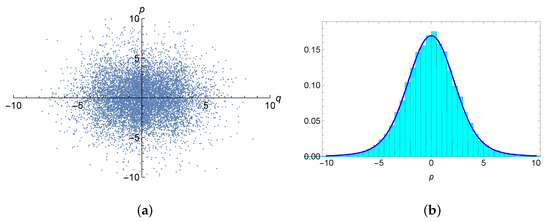
Figure 1.
The simulated results of the CDD simulations of the target distribution (41) with and . (a) the phase (q-p) space orbit of the -deformed distribution. The points of a simulated orbit with the initial condition (, and are shown. (b) the histogram of the frequencies for p and the corresponding momentum -distribution (blue solid curve).
The CDD simulated result obeys ergodicity, as can be seen from the well distributed points in the phase space in Figure 1a. Note that the momentum distribution in the histogram of Figure 1b was well fitted with the –Gaussian distribution, which was cased by the arsinh-type deformation of the kinetic energy .
Note also that for the -deformed Hamiltonian (42), we have [8]:
which reminds us of a generalization of equipartition theorem [32]: , where is the Hamiltonian of a system in thermal equilibrium with the temperature T.
6. Conclusions
We considered the -deformations of some quantities concerning statistical physics and pointed out some unexpected relations among different fields, such as statistical mechanics, mathematical biology and evolutional game theory. We especially focused on the arsinh-type deformation of the ratio of kinetic energy to the average thermal energy . With the help of the thermostat (CDD) algorithm we performed the relevant numerical simulations for the Hamiltonian with the arsinh-type deformation of kinetic energy term and showed the resultant momentum distribution was the –Gaussian distribution.
Finally, we would like to point out a relation which might be suggested for future research. Let us consider the -deformed energy density of state :
which is the -deformation of the energy density of state for the thermal reservoir with a constant-temperature (Boltzmann reservoir [33]). In other words, is regarded as the arsinh-type deformation of the ratio . The Boltzmann temperature for this -deformed thermal reservoir is given by:
Rearranging this relation leads to:
which reminds us of the relativistic energy–momentum relation: .
Author Contributions
Conceptualization, T.W. and A.M.S.; methodology, T.W.; software, T.W.; validation, T.W. and A.M.S.; formal analysis, T.W.; investigation, T.W. and A.M.S.; resources, T.W.; data curation, T.W.; writing—original draft preparation, T.W.; writing—review and editing, T.W. and A.M.S.; visualization, T.W.; supervision, T.W.; project administration, T.W.; funding acquisition, T.W. All authors have read and agreed to the published version of the manuscript.
Funding
The first named author (T.W.) was partially supported by the Japan Society for the Promotion of Science (JSPS) Grants-in-Aid for Scientific Research (KAKENHI) Grant Number 22K03431.
Informed Consent Statement
Not applicable.
Data Availability Statement
Not applicable.
Acknowledgments
The authors thank anonymous referees for their valuable comments.
Conflicts of Interest
The authors declare no conflict of interest.
Appendix A. Basics of the -Deformed Functions
Here we briefly review some -deformed functions and the associated useful relations [2,3]. Because all -deformed functions are symmetric under the sign change of the deformation parameter , i.e., changing to , throughout this paper we assume . In the limit, the -exponential function (1) and the -logarithmic function (2) reduce to the standard exponential function and logarithmic function , respectively
We next introduce another -deformed function:
which is the conjugate (or co-function) of , as similar as that is the co-function of . In the limit, this -deformed function reduces to the unit constant function . By using , the derivative of the -exponential is expressed as
and the derivative of -logarithm is expressed as
respectively.
When , the inverse function of exists, and given by
which is the co-function of .
The -entropy [2,3] is a -generalization of the Gibbs-Shannon entropy by replacing the standard logarithm with the -logarithm, i.e.,
Appendix B. Replicator Equations and the General Form of Lotka-Volterra Equations
We here summarize some known important facts in mathematical biology and evolutional game theory according to Ref. [14,15,19]. Consider a discrete probability distribution described by a set of n positive variables with the normalization , where each denotes the proportion of the i-th type in the total population. The RE for this distribution is given by
where is a fitness landscape and is the mean fitness. Replicator dynamics can be described as a time evolutional curve on the simplex with the matrix component of Shahshahani metric[16]g as
The inverse matrix is . Note that the n-simplex is -dimensional and the Shahshahani metric diverges on the boundary of the simplex. So this metric is valid only on the interior of .
There is a natural mapping: . Fisher metric is induced by the Shahshahani metric under this mapping.
It is known that the Shahshahani manifolds yields an interpretation of the RE. Theorem 1 in [14]: if the differential equation is a Euclidean gradient with , the RE (A7) is a gradient with respect to Shahshahani metric. A brief explanation is as follows. The gradient with respect to Shahshahani metric is
which is the first term in the left hand side of the RE (A7). The variable in the RE has to satisfy the normalization constraint (), i.e., the dynamics of each is restricted on the simplex . Recall that Shahshahani metric is valid only on the interior of . Indeed, the normalization constraint is satisfied during an time evolution as follows
The state is said to be evolutionarily stable state if for all in some neighborhood of ,
Let the potential , then we have
Hence the Kullback-Leibler divergence is a local Lyapunov function for the RE.
Next, if with and a normalization constant. From the normalization , we have
As a result we see that , and satisfies
Consequently, the exponential families are solutions of the RE.
If there is no constraint the corresponding dynamics is described by the gLV Equation (13). The gLV equations and REs are related as follows. Let each satisfies the gLV Equation (13). Changing the variable to as
which lead to the new normalized variables , i.e., . Then, we see that
Thus, the transformed variable in (A16) satisfies the RE.
References
- Kaniadakis, G.; Scarfone, A.M. A new one-parameter deformation of the exponential function. Physica A 2002, 305, 69–75. [Google Scholar] [CrossRef]
- Kaniadakis, G. Statistical mechanics in the context of special relativity. Phys. Rev. E 2002, 66, 56125. [Google Scholar] [CrossRef] [PubMed]
- Kaniadakis, G. Statistical mechanics in the context of special relativity II. Phys. Rev. E 2005, 72, 036108. [Google Scholar] [CrossRef] [PubMed]
- Kaniadakis, G. Theoretical foundations and mathematical formalism of the power-law tailed statistical distributions. Entropy 2013, 15, 3983–4010. [Google Scholar] [CrossRef]
- Kaniadakis, G.; Baldi, M.M.; Deisboeck, T.S.; Grisolia, G.; Hristopulos, D.T.; Scarfone, A.M.; Sparavigna, A.; Wada, T.; Lucia, U. The κ-statistics approach to epidemiology. Sci. Rep. 2020, 10, 19949. [Google Scholar] [CrossRef] [PubMed]
- Wada, T. Thermodynamic stabilities of the generalized Boltzmann entropies. Physica A 2004, 340, 126–130. [Google Scholar] [CrossRef]
- Lymperis, A.; Basilakos, S.; Saridakis, E.N. Modified cosmology through Kaniadakis horizon entropy. Eur. Phys. J. C 2021, 81, 1037. [Google Scholar] [CrossRef]
- Wada, T.; Scarfone, A.M.; Matsuzoe, H. On the canonical distributions of a thermal particle in a generalized velocity-dependent potential. Physica A 2020, 541, 123273. [Google Scholar] [CrossRef]
- Strutt (Lord Rayleigh), J.W. Some general theorems relating to vibrations. Proc. Lond. Math. Soc. 1871, s1–s4, 357–368. [Google Scholar] [CrossRef]
- Pistone, G. κ-exponential models from the geometrical viewpoint. Eur. Phys. J. B 2009, 70, 29–37. [Google Scholar] [CrossRef]
- Amari, S.-I. Information Geometry and Its Applications; Springer: Tokyo, Japan, 2016; Volume 194. [Google Scholar]
- Wada, T.; Scarfone, A.M. Information geometry on the κ-thermostatistics. Entropy 2015, 17, 1204–1217. [Google Scholar] [CrossRef]
- Wada, T.; Scarfone, A.M.; Matsuzoe, H. An eikonal equation approach to thermodynamics and the gradient flows in information geometry. Physica A 2021, 570, 125820. [Google Scholar] [CrossRef]
- Harper, M. Information geometry and evolutionary game theory. arXiv 2009, arXiv:0911.1383. [Google Scholar]
- Harper, M. Escort evolutionary game theory. Physica D 2011, 240, 1411–1415. [Google Scholar] [CrossRef]
- Sigmund, K. Gradients for replicator systems. In Dynamical Systems and Environmental Models: Proceedings of an International Workshop, Eisenach (GDR), Germany, 17–21 March 1986; Bothe, H.G., Ebeling, W., Kurzhanski, A.B., Peschel, M., Eds.; De Gruyter: Berlin, Germany, 1987; pp. 186–195. [Google Scholar]
- Hofbauer, J.; Sigmund, K. Evolutionary Games and Population Dynamics; Cambridge University Press: Cambridge, UK, 1998. [Google Scholar]
- Hernández-Bermejo, B.; Fairén, V. Lotka-Volterra representation of general nonlinear systems. Math. Biosci. 1997, 140, 1–32. [Google Scholar] [CrossRef]
- Baez, J.C. The fundamental theorem of natural selection. Entropy 2021, 23, 1436. [Google Scholar] [CrossRef]
- Gompertz, B. On the Nature of the Function Expressive of the Law of Human Mortality, and on a New Mode of Determining the Value of Life Contingencies. Philos. Trans. R. Soc. Lond. 1825, 115, 513–583. [Google Scholar] [CrossRef]
- Bloch, F. Zur Theorie des Austauschproblems und der Remanenzerscheinung der Ferromagnetika. Zeitschrift für Physik 1932, 74, 295. [Google Scholar] [CrossRef]
- Kirkwood, J.G. Quantum Statistics of Almost Classical Assemblies. Phys. Rev. 1933, 44, 31. [Google Scholar] [CrossRef]
- Pelinovsky, E.; Kokoulina, M.; Epifanova, A.; Kurkin, A.; Kurkina, O.; Tang, M.; Macau, E.; Kirillin, M. Gompertz model in COVID-19 spreading simulation. Chaos Solitons Fractals 2022, 154, 111699. [Google Scholar] [CrossRef]
- Cariñena, J.F.; Rañada, M.F.; and Santander, M. The quantum free particle on spherical and hyperbolic spaces: A curvature dependent approach. J. Math. Phys. 2011, 52, 072104. [Google Scholar] [CrossRef]
- Lewis, J.T.; Pfister, C.-E.; Sullivan, W.G. Entropy, concentration of probability and conditional limit theorems. Markov Process. Relat. Fields 1995, 1, 319–386. [Google Scholar]
- apiński, T.M. Law of large numbers unifying Maxwell-Boltzmann, Bose-Einstein and Zipf-Mandelbrot distributions, and related fluctuations. Physica A 2021, 572, 125909. [Google Scholar] [CrossRef]
- McKeague, I.W. Central limit theorems under special relativity. Stat. Probab. Lett. 2015, 99, 149–155. [Google Scholar] [CrossRef]
- Scarfone, A.M.; Matsuzoe, H. κ-deformed Fourier transform. Physica A 2017, 480, 63. [Google Scholar] [CrossRef]
- Nosé, S. A unified formulation of the constant temperature molecular-dynamics methods. J. Chem. Phys. 1984, 81, 511–519. [Google Scholar] [CrossRef]
- Hoover, W.G. Canonical dynamics: Equilibrium phase-space distributions. Phys. Rev. A 1985, 31, 1695–1697. [Google Scholar] [CrossRef]
- Bravetti, A.; Tapias, D. Thermostat algorithm for generating target state. Phys. Rev. E 2016, 93, 022139. [Google Scholar] [CrossRef]
- Tolman, R.C. A General Theory of Energy Partition with Applications to Quantum Theory. Phys. Rev. 1918, 11, 261–275. [Google Scholar] [CrossRef]
- Leff, H.S. The Boltzmann reservoir: A model constant-temperature environment. Am. J. Phys. 2000, 68, 521. [Google Scholar] [CrossRef]
Disclaimer/Publisher’s Note: The statements, opinions and data contained in all publications are solely those of the individual author(s) and contributor(s) and not of MDPI and/or the editor(s). MDPI and/or the editor(s) disclaim responsibility for any injury to people or property resulting from any ideas, methods, instructions or products referred to in the content. |
© 2023 by the authors. Licensee MDPI, Basel, Switzerland. This article is an open access article distributed under the terms and conditions of the Creative Commons Attribution (CC BY) license (https://creativecommons.org/licenses/by/4.0/).