


Abstract
This paper addresses the waveform design problem of cognitive radar for extended target estimation in the presence of signal-dependent clutter, subject to a peak-to-average power ratio (PAR) constraint. Owing to this kind of constraint and the convolution operation of the waveform in the time domain, the formulated optimization problem for maximizing the mutual information (MI) between the target and the received signal is a complex non-convex problem. To this end, an efficient waveform design method based on minimization–maximization (MM) technique is proposed. First, by using the MM approach, the original non-convex problem is converted to a convex problem concerning the matrix variable. Then a trick is used for replacing the matrix variable with the vector variable by utilizing the properties of the Toeplitz matrix. Based on this, the optimization problem can be solved efficiently combined with the nearest neighbor method. Finally, an acceleration scheme is used to improve the convergence speed of the proposed method. The simulation results illustrate that the proposed method is superior to the existing methods in terms of estimation performance when designing the constrained waveform.
1. Introduction
Cognitive radar (CR) is a new intelligent closed-loop radar system that can perceive the surrounding complicated electromagnetism environment in real time and make reasoning decisions on this basis [1,2]. In CR, adaptive transmitted waveform design based on the perceived prior knowledge of environment and target is one of the key technologies which can significantly improve the performance of target detection, parameter estimation, recognition, and tracking in complicated environments [3].
For each of these missions, there are corresponding valid waveform design methods [4]. When designing waveform for target estimation, minimum mean squared error (MMSE) criterion [5], the minimum Cramer-Rao lower bound (CRLB) criterion [6,7] and maximum mutual information (MI) [5,8,9] criterion are usually selected. However, the CRLB criterion is only suitable for situations in which the target information is unknown. Meanwhile, maximization of MI and the minimization of the MMSE lead to the same solution when the target information is known.
The authors in [10] proposed an estimation waveform design method based on MI in noise, in which the original non-convex problem was converted to a convex problem by using the convex optimization method. Considering the signal-dependent clutter, the waveform design methods for target estimation based on MI and MMSE were proposed in [11,12], respectively. It is worth noting that the envelope constraint on the transmitted waveform was not considered in any of those studies, which made it difficult to meet the hardware constraints and maximize the power efficiency [13]. For this reason, unimodular or low peak-to-average power ratio (PAR) waveform is always applied in radar systems [13,14]. Nevertheless, unimodular waveform may lead to the degradation of waveform performance [15]. To tackle this problem, some researchers had used a more general low-PAR constraint to replace the unimodular constraint to further improve the waveform performance [6,7,14,15,16,17,18].
In [6], subject to the constraint, a frequency domain based PAR waveform design method with the MI criterion was proposed. However, the algorithm in [6] can only find the envelope of optimal waveform spectrum. Since the spectral phase cannot be determined, the number of time domain signals that satisfy the unique waveform spectrum magnitude is infinite. Therefore, it may result in a decline of the waveform performance when the frequency domain waveform spectrum is transformed to the time domain waveform [19]. To solve this problem, an algorithm based on the sequence linear programming (SLP) in time domain was proposed in [20], and the original non-convex problem was converted a convex problem which could be solved efficiently. It is worth noting that the optimization problem in [20] is the relaxation of the original problem so the synthesized waveform may be still the suboptimal solution.
As is well known, the minorization–maximization (MM) method is a powerful optimization technique to solve the hard problem that is difficult to tackle directly [21]. The core principle of MM is to transform the original problem into a series of simple problems which can be tackled efficiently and converge to the stationary optimal solution of the original problem [22]. Motivated by the ascent property and superior convergence of MM, it has been applied in many fields [23,24,25,26,27].
In this paper, we propose an efficient low-PAR cognitive waveform design method based on the MM approach for target estimation, which is directly studied in the time domain. Based on the MM approach, the original non-convex problem is converted to a convex problem with respect to (w.r.t.) a matrix variable. To reduce computation cost, the convex problem is further converted to quadratic programming (QP) problem w.r.t. a vector variable by utilizing the properties of the Toeplitz matrix. Based on this, the QP problem is converted to a simple convex problem which can be tackled efficiently by using the nearest neighbor method. Finally, the squared iterative methods (SQUAREM) is used to improve the convergence speed of the proposed method. The simulation results demonstrate that the synthesized waveform can be obtained efficiently within the given low-PAR range and the proposed method has better estimation performance than the existing methods.
The remainder of the paper is organized as follows: Section 2 gives the baseband radar signal model. In Section 3, the optimal criterion based MI is formulated, and an efficient low-PAR waveform design method based on MM is proposed. A detailed performance analysis of the proposed method is provided in Section 4. Section 5 presents our simulation results. Finally, the conclusion is summarized in Section 6.
Notation: Scalars are represented by italic letters, vectors and matrices are denoted by boldface lowercase and uppercase letters, respectively. The superscripts in and represent the transpose and Hermitian transpose operations, respectively. denotes the element located in the th row and th column of . denotes the Toeplitz matrix mapping function of a vector, , , and represent the real part, imaginary part, modulus and 2-norm of a complex scalar/vector/matrix, respectively. is the set of complex-valued number. The symbol ‘’ and ‘*’ denote the Kronecker product and the convolution operation, respectively. Finally, denotes a circular symmetric complex Gaussian distribution with zero mean and the covariance matrix .
2. Signal Model
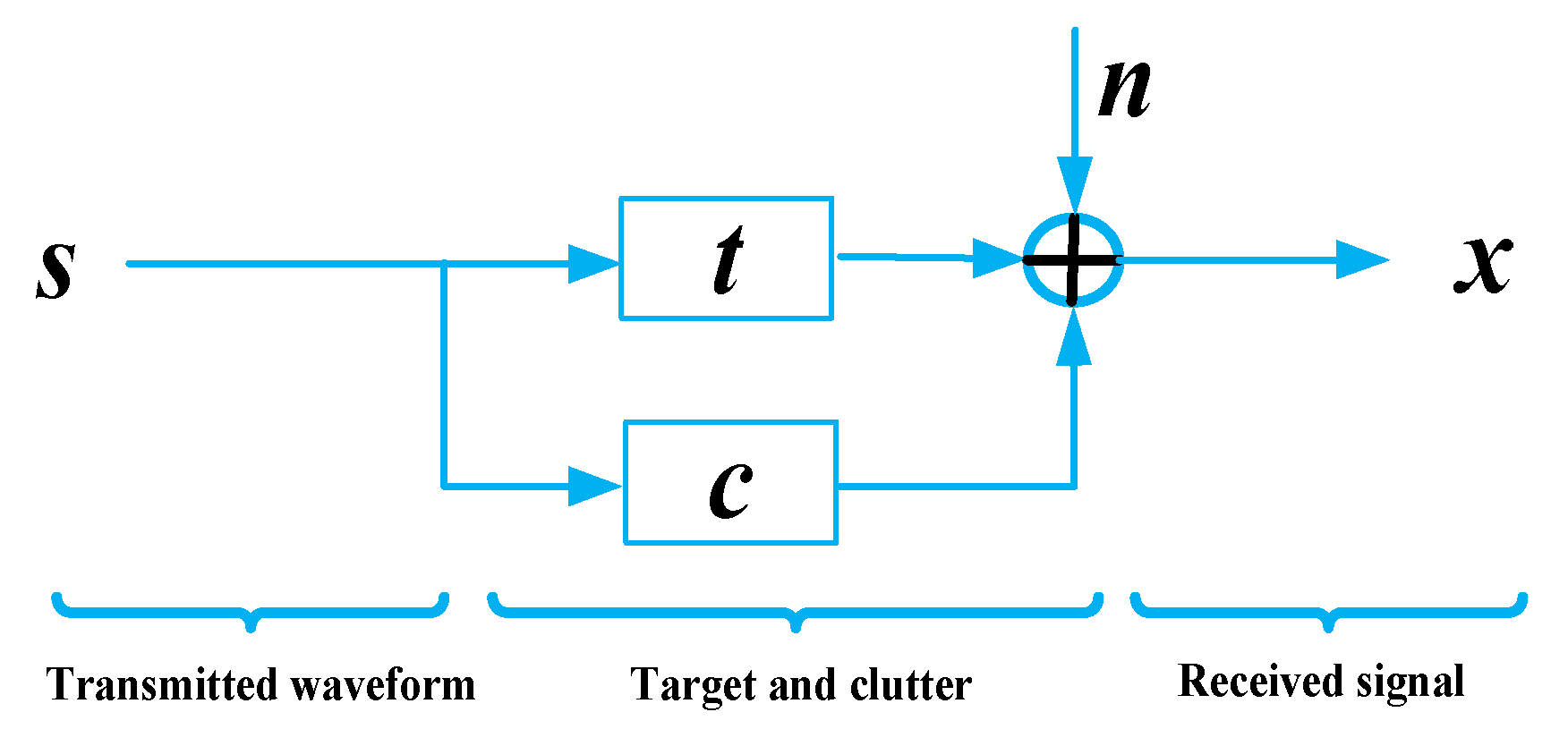
In this paper, we consider the waveform design of cognitive radar for target estimation in the presence of signal-dependent clutter. The scattering characteristic of the target is represented by the target impulse response (TIR) [28], and the signal-dependent clutter is represented by the clutter impulse response (CIR) [29]. Generally, the prior knowledge of the target and environment (noise and clutter) can be obtained by some cognitive methods [30,31] and is assumed to be known when designing waveform for simplicity. It is assumed that the influence of sidelobes has been mitigated by sidelobe blanking technology in front of the receiver. Meanwhile, we focus on the analysis of single-input single-output radar in this paper which can be straightforwardly extended to multiple-input multiple-output radar case. Then, the discrete baseband signal model is shown in Figure 1.
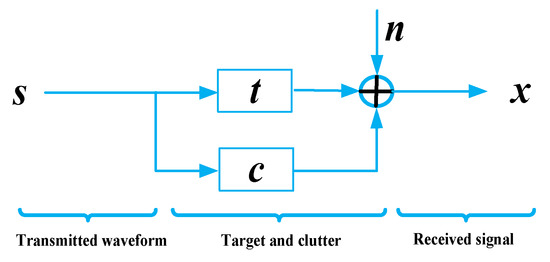
Figure 1.
Signal Model.
As illustrated in Figure 1, the target and clutter are modelled by the finite impulse response filter, and the waveform is assumed to be energy-limited. denotes a transmitted waveform with length and denote the TIR and CIR, respectively. According to the radar signal model in [8], it is assumed that to simplify the derivations. If , it is necessary to apply a zero-filling operation to the TIR to make the TIR and CIR sampling points equal. denotes the sum of the noise and the interference, . Let , and x is the echo with length . Then, the model can be described as:
where and can be obtained due to the reciprocity of the convolution operation. The convolution matrices and are Toeplitz matrices corresponding to and , respectively. We use the function ‘’ represents their mapping relationship in this paper, i.e., , . Taking transmitted waveform as an example, the convolution matrix can be written as:
3. Waveform Design Method
In this section, we utilize the MM technique to solve the estimation waveform design problem based on information theory.
3.1. MM Method
The MM method refers to the minorization–maximization method, which can transform the original complex problem into a series of simple problems that can be tackled efficiently and converge to the stationary optimal solution of the original problem [22]. Now we first give a brief description of MM. Consider a general maximization problem
where is a function which is difficult to solve directly. Then, the approximate function is commonly used to replace the original function . More precisely, MM can get the optimal solution of the iteration based on the known according to the following criterion.
where is said to minorize the function at the point , which satisfies
Then, it can be seen that the objective value is increased monotonically at every iteration, i.e.,
The first inequality and the third equality hold due to the properties of (5) and (6), respectively. The second inequality holds according to (4). Next, MM is utilized to solve the estimation waveform based on information theory.
3.2. Problem Formulation
In this paper, the maximization of MI between the received signal and target is used as the optimization criterion for waveform design. According to [28], supposing t, and are mutually independent and , , and . Then, the MI of received signal and target can be formulated as [32]:
where denotes the entropy of received signal when the Toeplitz matrix of transmit waveform is known, and denotes the entropy of when and TIR are known.
For the given , and obey the joint Gaussian distribution which can be expressed as:
Let , we can get
Then the entropy and can be expressed as:
Bring (11) and (12) into (8), the objective function can be written as:
To meet the hardware constraints and maximize the power efficiency, the PAR constraint must be considered. Let the total energy of the transmitted waveform be . Without any loss of generality, it can be assumed that . Then, PAR can be defined as:
where is the element of , and is a predefined parameter that denotes the maximum allowed PAR. Note that the PAR constraint is equivalent to a unimodular constraint when , while it becomes a redundant constraint when .
Then, the optimization problem can be formulated as:
It can be seen that the objective function in problem is non-convex, the two quadratic inequality constraints are nonhomogeneous [33]. So is a non-convex problem which is difficult to solve. Therefore, we need to transform into a convex problem.
3.3. Waveform Design
The key to solving is to convert the non-convex objective function into a convex function. First, the objective function in (13) can be reformulated as:
According to the Woodbury identity [34], we can have
where . Let and
According to the inversion identity of block matrix [34], the expression in (17) can be reformulated as:
So, we can recast the objective function of as follows:
The following lemma provides a way to solve the non-convex design problem by utilizing the MM approach.
Lemma 1:
For any full-column rank matrix, ifis a positive definite matrix, thenis convex w.r.t..
Then the proof of Lemma 1 can be found in [35]. Based on Lemma 1, we can find that is a full-column rank matrix and is a positive definite matrix, so we can know that is convex w.r.t. . Therefore, by using its tangent plane [33] with a given , this term can be minorized as:
where , the right-hand side of (21) is the first-order approximation of for a given at iteration. Let with the same partitioning as that of in (18), where , , and . Now the MM is applied to minorize the function of the left side in (21). Then, the right-hand side of (21) can be rewritten as:
where is the constant term.
Ignoring the constant term, and using the identity that [34], the problem can be recast as:
It can be seen that the objective function of (23) is still non-convex [33]. Then, let denotes the smallest eigenvalue of , so the problem can be rewritten as:
Then, the first constraint can be converted to a convex set by utilizing the Schur complement theorem [36] which is defined as follows:
Lemma 2.
(Schur complement theorem):Let, then we can getif and only ifand.
According to the Schur complement theorem, the first constraint of this problem is equivalent to
To make the optimization problem more intuitional, can be recast as:
where ‘’ represents the elements in the column, and the to rows of . We can see that the first inequality constraint is the linear inequality with regard to matrix variable . According to [33], any line is affine, so the first inequality constraint is a convex set. Then the second constraint belongs to a Euclidean ball, and the third constraint belongs to a norm ball, and both of them are convex set [33]. Therefore, the constraints of are convex sets with regard to matrix .
In addition, it is obvious that the objective function of is an auxiliary variable which is also convex. Hence, is a convex problem with regard to matrix variable and it can be solved by applying the interior point method [33] with CVX toolbox [37]. However, it has an approximate computational complexity of [38] at each iteration, which may bring a high computation cost especially when is large. Therefore, a fast optimization method is needed.
3.4. A Fast Optimization Method
To reduce the cost of computation, we should convert the original problem to a form that is easier to solve. First, we can convert the matrix variable to the form of vector. Then, the identities that and [39] can be used to recast the objective function in (23), which can be rewritten as:
where
For further simplification, considering that is a convolution matrix with Toeplitz structure (shown in (2)) which consists of , we can recast the right hand side of (27) as:
where
and , where can be expressed as:
Then the optimization problem can be further rewritten as:
where . It can be seen that is a quadratically constrained quadratic program (QCQP) problem, which can be solved by the power method-like in [26]. More precisely, can be reformulated as:
where consists of the first entries of , , let
Then , where is a constant that is larger than the maximum eigenvalue of to make sure that is positive definite. It can be seen that is a convex problem which can be solved by using the interior point method. However, we can find that the form of objective function and constraints of are the same as the nearest neighbor method with a lower complexity of [40]. Hence, can be solved efficiently.
Then, let denote the value of MI at iteration, the termination tolerance and the maximum iterative number. According to the above steps, the proposed MM-based method is summarized in Box 1.
Box 1. The proposed minimization–maximization (MM)-based method for low-PAR estimation waveform design.
- Step 0:
- Set , generate a random waveform , initialize the and .
- Step 1:
- Use (28) to update , and ;
- Step 2:
- Use (30) and (31) to update and ;
- Step 3:
- Use (32) to update , ;
- Step 4:
- , use (35) to update , ;
- Step 5:
- Get from the first entries of ;
- Step 6:
- Solve to update , set ;
- Step 7:
- Go back to step 1 until or the iteration number is larger than .
3.5. Acceleration Scheme
For the MM method, the convergence speed depends mainly on the minorized function. It is worth noting that the minorized function of the proposed method (as shown in the right-hand side of (21)) may be relatively loose as a lower bound of the original function. Therefore, although the computational cost of the proposed method is low at each iteration, the convergence speed may still be slow. For the purpose of accelerating the convergence speed, the acceleration scheme (SQUAREM) in [41] is adopted in this paper. Then, we give the modified version of SQUAREM according to the optimization problem we meet.
Let denote the fixed-point map of the proposed MM-based method which can be described as:
However, SQUAREM is not applicable to the case of the limited-energy and PAR constraints, and the monotonicity of the proposed method cannot be guaranteed by using SQUAREM. To this end, the first problem can be solved by using the nearest neighbor method to deal with , and the second problem can be tackled by utilizing a backtracking strategy. Then, the acceleration scheme based on SQUAREM is summarized in Box 2.
Box 2. The Acceleration scheme based on squared iterative methods (SQUAREM).
- Step 0:
- Set k = 0, generate a random waveform sk, initialize the τ and γ;
- Step 1:
- ;
- Step 2:
- ;
- Step 3:
- ;
- Step 4:
- ;
- Step 5:
- ;
- Step 6:
- ;
- Step 7:
- Solve to P5 update sk+1;
- Step 8:
- while do
- Step 9:
- ;
- Step 10:
- ;
- Step 11:
- Solve P5 to update sk+1;
- Step 12:
- end while
- Step 13:
- Set k = k + 1;
- Step 14:
- Go back to step 1 until or the iteration number is larger than γ.
4. Performance Analysis
4.1. Convergence
Let represent the minorized function (i.e., the objective function of ) which can be written as:
As is well known, is a QCQP problem. According to [42], it had been proved that under the PAR and transmitted energy constraints. Then, we can have
where denotes MI value of the original function at iteration. The first equality and the third inequality hold due to the properties of (6) and (5), respectively. Hence, we can know that the proposed method is monotonically increasing.
In addition, the waveform is energy-limited and its every point bounded with . Therefore, according to the Theorem 2.17 in [42] and the fact that and have the same gradient value when , we can know that at least one limit point exists and the MI of the synthesized waveform has its upper bound.
4.2. Computational Complexity
The proposed MM-based method converts the original problem into a simple problem which can be solved efficiently. In every iteration, updating , performing eigenvalue decomposition to obtain , and solving with the nearest neighbor method, which have complexities of , and , respectively. Therefore, the total computation complexity of the proposed method is in every iteration.
5. Simulation Results
In this section, several numerical simulations are performed to demonstrate the performance of the proposed method. Assuming that the length of the transmitted waveform is , the initial waveform is generated by a random phase-coded signal. The length of TIR and CIR are . Meanwhile, both the target and clutter are mutually independent circular symmetric complex Gaussian random vector, i.e., , [28], where and . According to [5], and are normalized covariance matrix, where and have the same structure. Hence, taking the as an example, is a diagonal matrix and is the unitary discrete Fourier transform (DFT) matrix with its entry given by
The noise is white Gaussian with zero mean and covariance matrix , where denotes the variance of noise. Then, we perform 300 Monte Carlo trials for each combination of parameters and the termination tolerance . The MATLAB 2013b version is used to perform the simulations with a standard PC (CPU Core i5-3230M 2.6GHz and 4GB RAM).
5.1. Effectiveness Verification
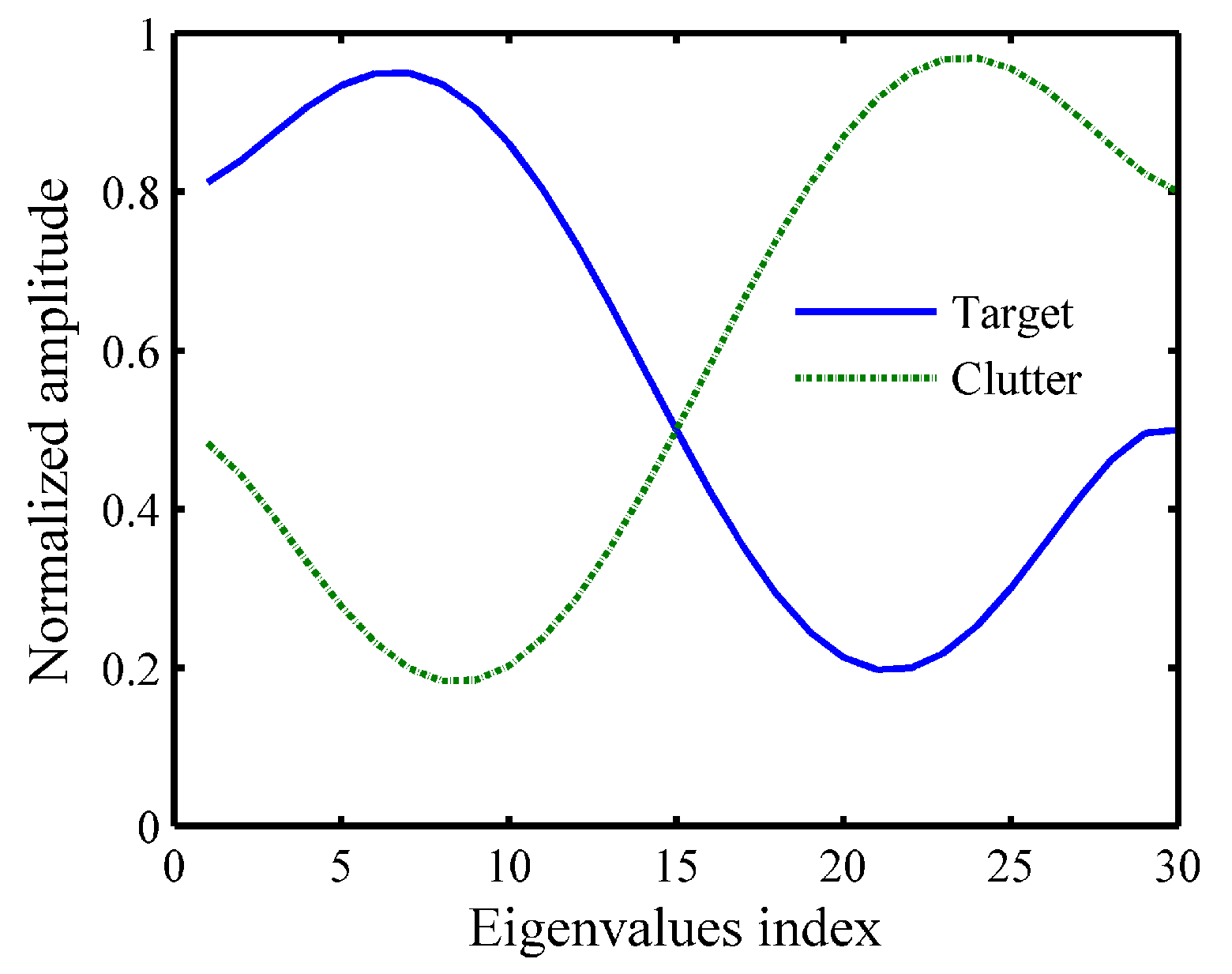
In this subsection, we demonstrate the effectiveness of the proposed method. First, we give the typical set of eigenvalues for the normalized matrices and as shown in Figure 2.
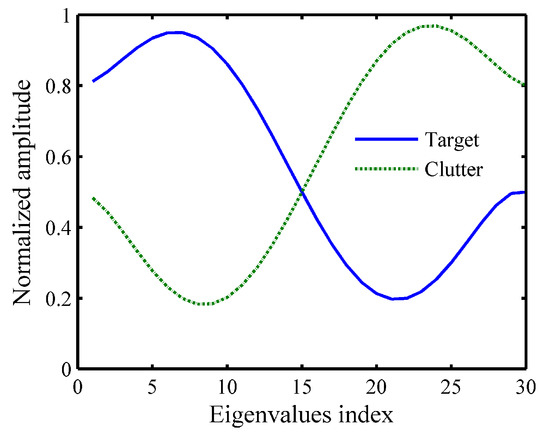
Figure 2.
Eigenvalues of the matrices and .
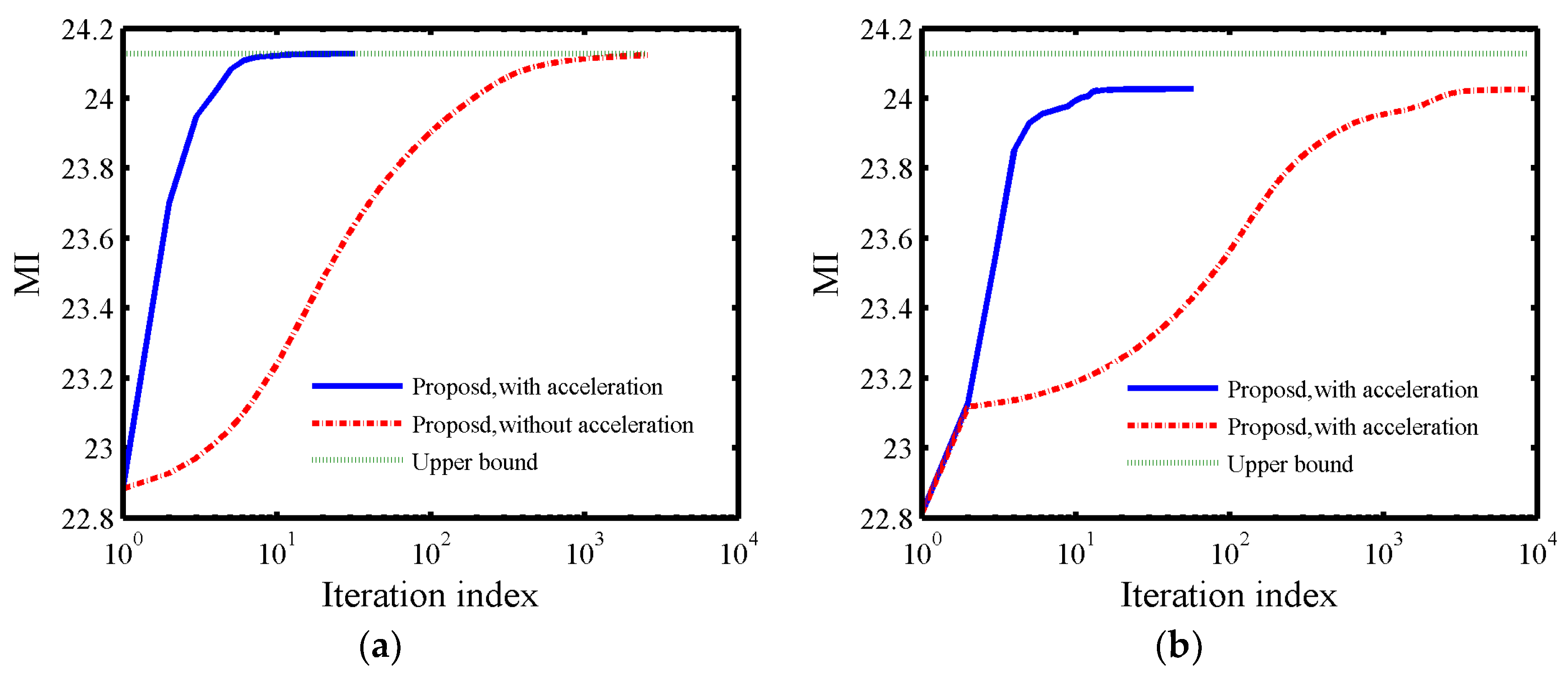
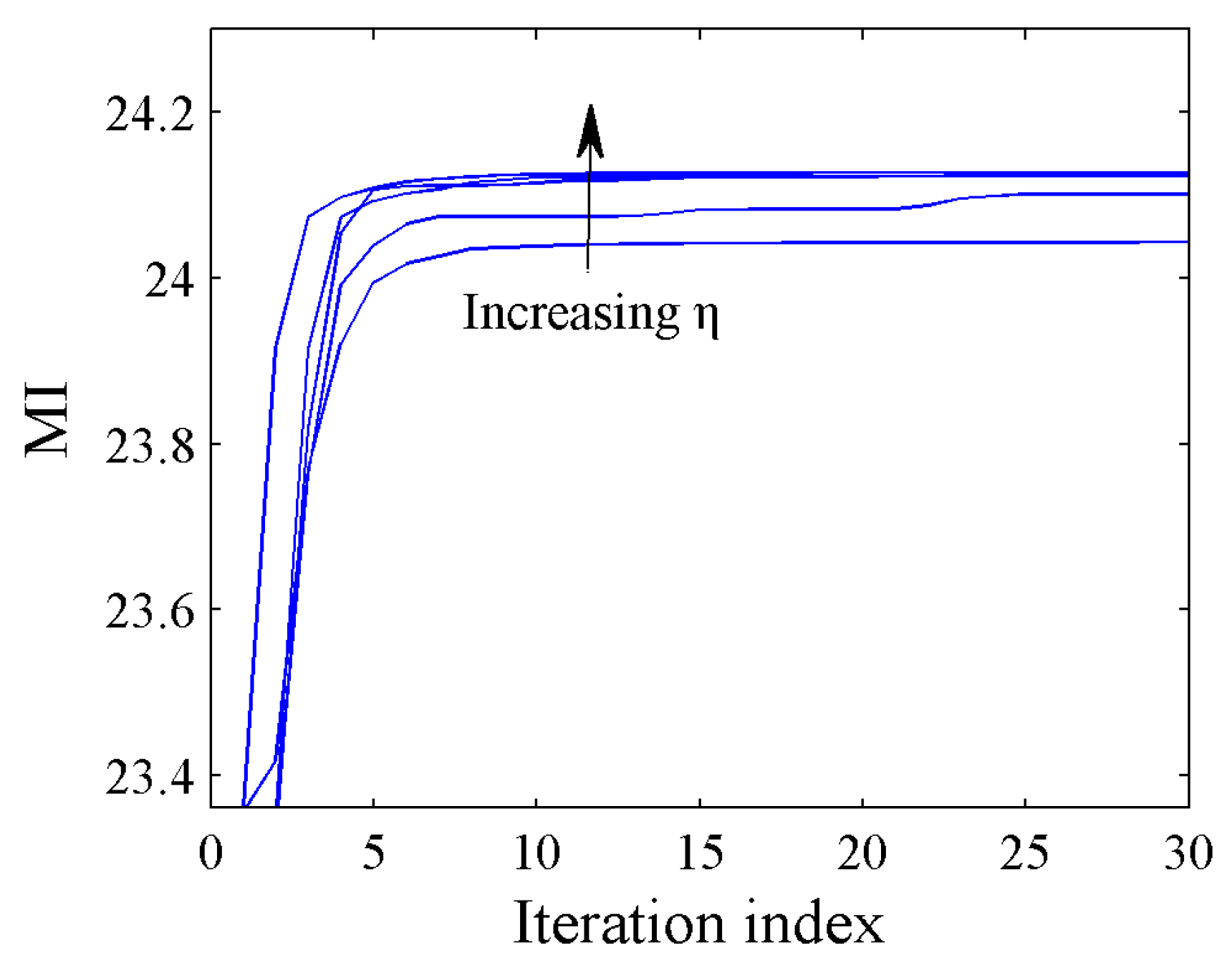
Let the total energy of waveform , and . Figure 3 shows the convergence of the proposed MM-based method. In addition, the upper bound is obtained by using the Lagrange multipliers method to solve under only the energy constraint. From Figure 3a ( which is equivalent to the energy constraint) and Figure 3b ( which is equivalent to the constant-modulus constraint), it can be seen that the accelerated case is much faster than the case without acceleration. Meanwhile, the MI of the synthesized waveform with can get the upper bound and the case with is about 0.07 away from the upper bound, this is because the large PAR value () has larger feasible set region than small PAR value ().
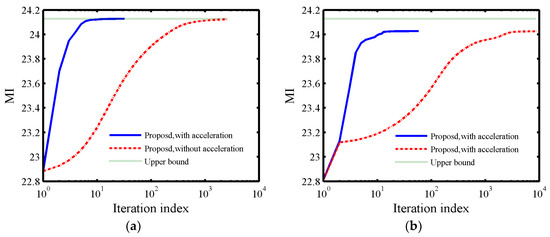
Figure 3.
The convergence of the proposed method, (a) and (b) .
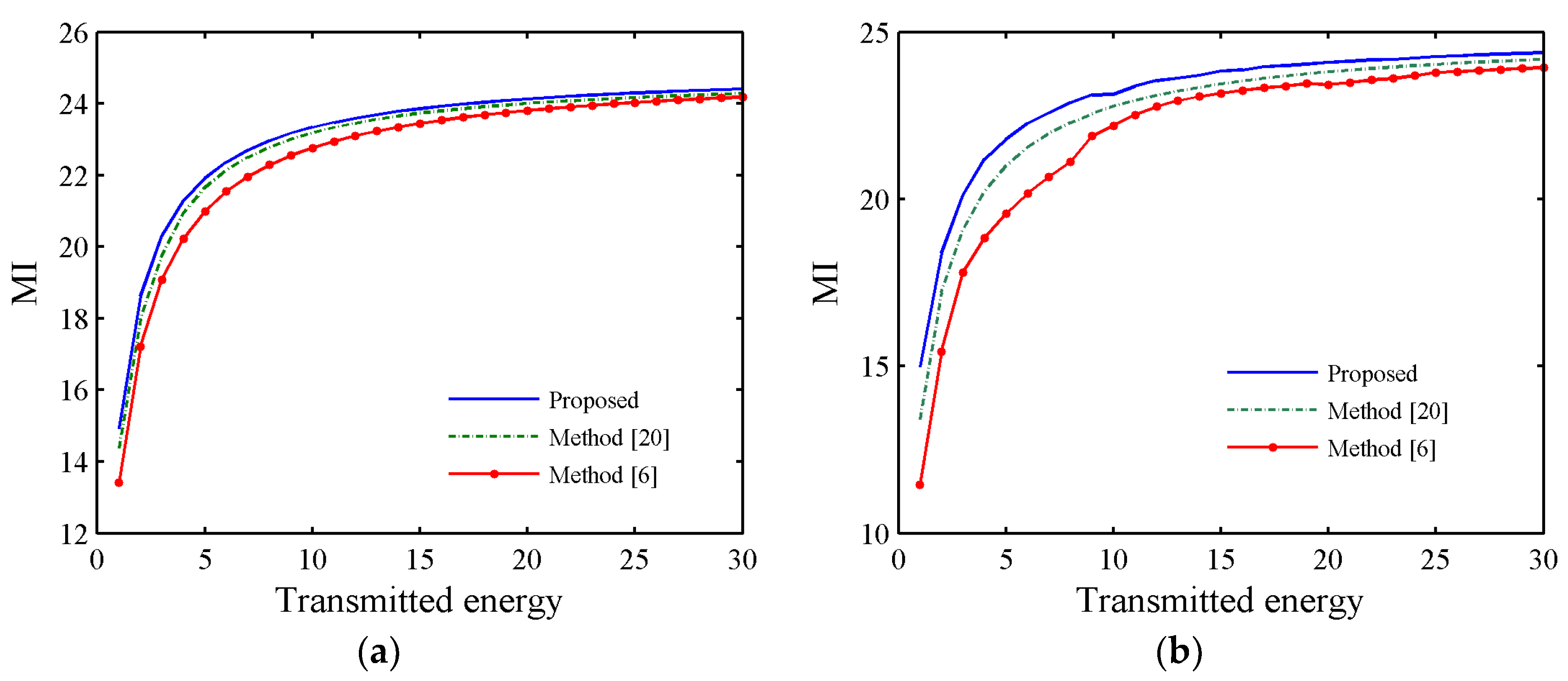
Let the transmitted energy range from 1 to 30, and . Then, Figure 4a,b shows the estimation performance comparison of the proposed method, the Sequence Linear Programming-based Waveform Design algorithm (SLPWD) in [20] and the frequency domain-based Cognitive REceiver and Waveform design algorithm (CREW(fre)) in [6] versus the transmitted energy with and (i.e., constant-modulus constraint), respectively.
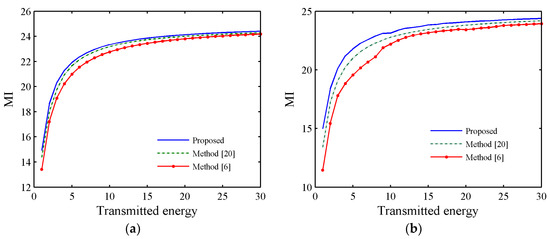
Figure 4.
Estimation performance of different waveforms versus transmitted energy, (a) , (b) .
From Figure 4 we can see that the MI of proposed method is larger than that of other methods. Meanwhile, the MI of SLPWD algorithm in [20] is larger than CREW(fre) algorithm in [6], this is because CREW(fre) addresses the waveform design in frequency domain and the waveform spectrum does not contain the phase information, which may result in a decline of the waveform performance when the waveform spectrum is converted to time domain.
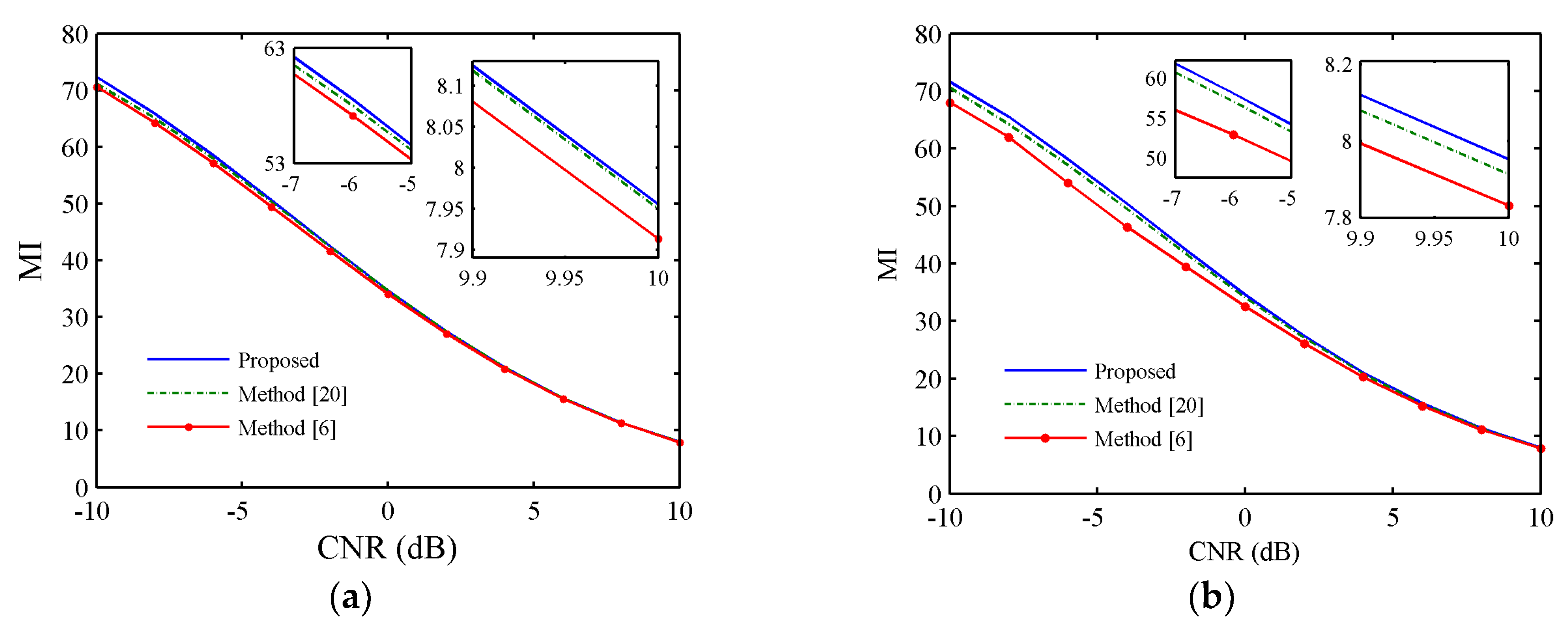
Let , , the clutter-noise-ration (CNR) ranges from −10 dB to 10 dB. Figure 5a,b shows the estimation performance of the proposed method, SLPWD in [20] and CREW(fre) in [6] versus CNR with and , respectively. It can be seen that the MI of the proposed method is better than the other methods. Hence, it demonstrates the effectiveness of the proposed method.

Figure 5.
Estimation performance comparison of different waveforms versus clutter-noise-ration (CNR), (a) , (b) .
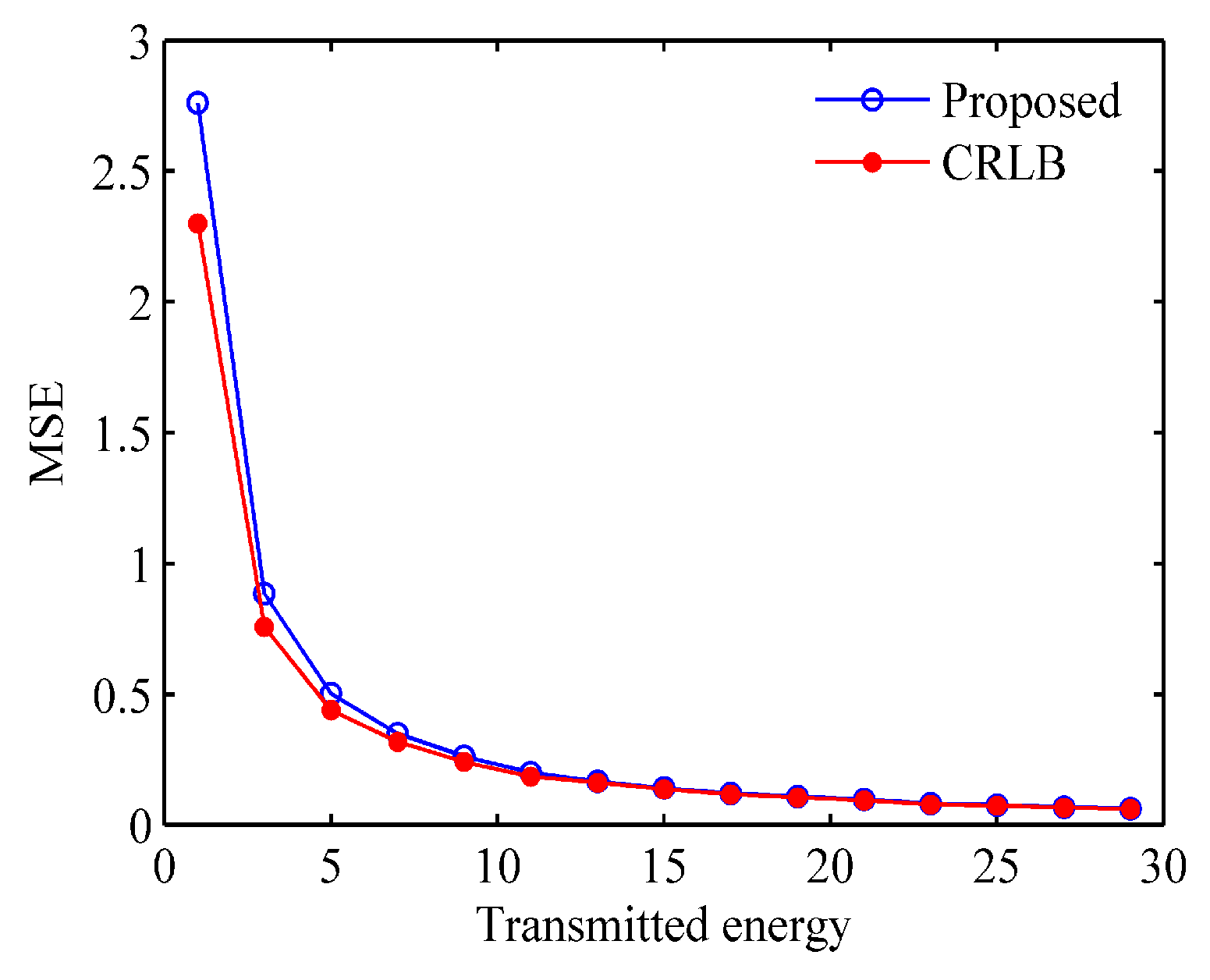
Figure 6 shows the performance assessment for the estimation of target with the proposed method. For the optimal waveform based on maximizing MI, mean squared error (MSE) will be used for performance assessment. In addition, we also compared with the CRLB. The MSE and CRLB for transmitted waveform are derived in Appendix A. From Figure 6 we can see that the estimated performance gets closer to the CRLB as the transmitted energy increases. So, it verifies that the waveform generated by the proposed method has good estimation performance.
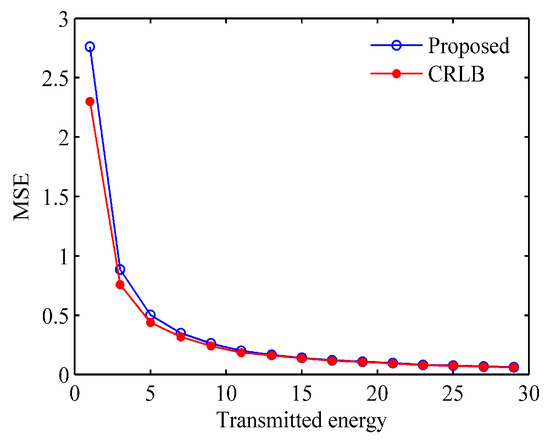
Figure 6.
The estimation performance assessment of the optimal waveform.
5.2. Influence of PAR
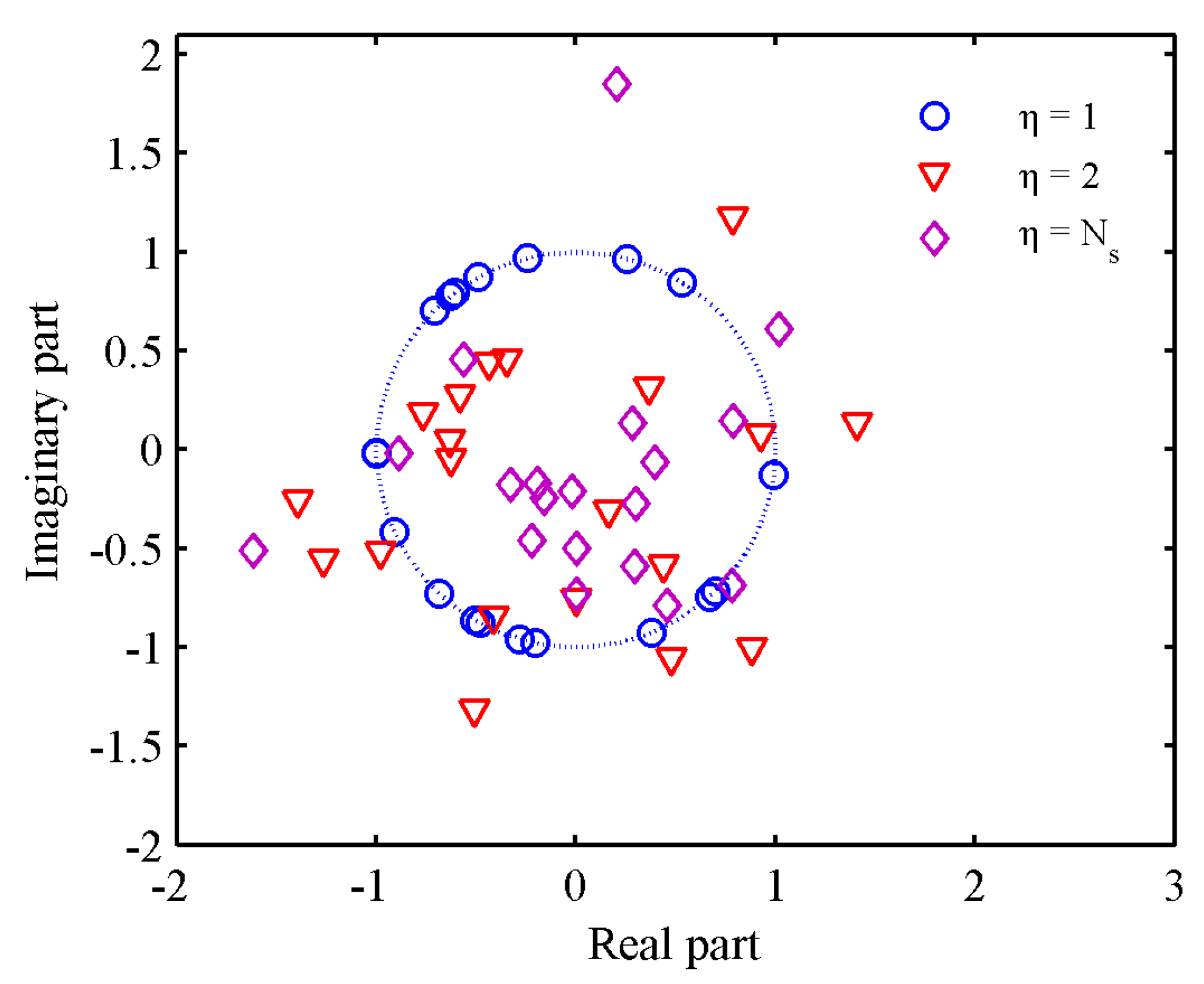
In this subsection, we discuss the influence of the PAR on the synthesized waveform. Figure 7 shows the MI of the synthesized waveforms under different PAR values. We can see that the curves can converge to their respective stationary values which become larger as increases, and this is because the feasible set region in becomes larger as increases. However, since the energy of the transmitted waveform is limited, the waveform performance has its upper bound. Then, we can also see that the curves can be monotonically convergent to the same stationary value and the curves almost overlap when . Figure 8 shows the real and imaginary parts of the waveforms under different PAR constraints. When , the distribution radii of the corresponding points are large, which is not favorable for practical applications. In contrast, the results obtained with are unimodular and lie on the unit circle. Meanwhile, the distribution radii of the waveform with are close to those of the waveform with , and the performance is very close to that of the waveform with , as shown in Figure 7. This result indicates that the low-PAR waveform (for example ) not only meet the hardware constraints but also have better estimation performance than a unimodular waveform. Hence, the low-PAR waveform is more suitable for practical applications.
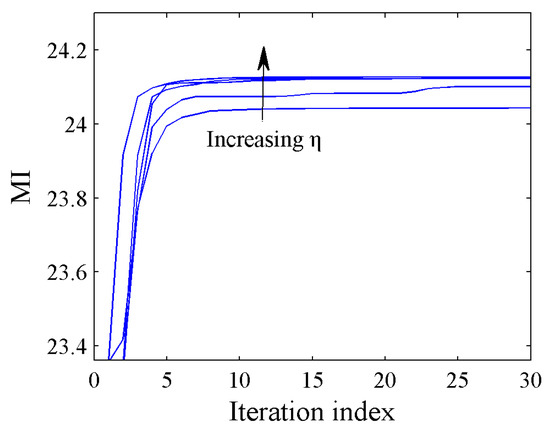
Figure 7.
Comparison of waveforms under different peak-to-average power ratio (PAR) constraints .
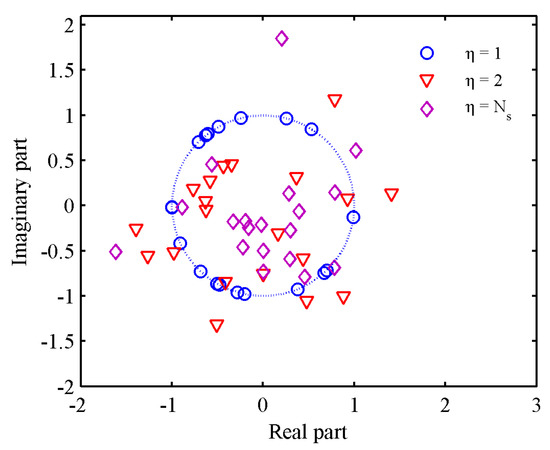
Figure 8.
Real and imaginary parts of waveforms with .
6. Conclusions
In this paper, we proposed an efficient low-PAR waveform design method of cognitive radar for the extended target estimation in the presence of signal-dependent clutter. To tackle the original non-convex problem in the time domain, an efficient method is proposed by using the MM technique. Meanwhile, to improve the convergence speed, an acceleration approach is given based on the SQUAREM. Numerical experiments demonstrate the effectiveness of the proposed method for the given PAR. Compared with the existing method, the proposed method demonstrates the advantage w.r.t. estimation performance. Moreover, the proposed method can be used in the waveform design of cognitive radar systems since the high computational efficiency will enable real-time waveform changes. Possible future research tracks include the extension to cases with low autocorrelation sidelobes and spectral constraints with imprecise prior information.
Author Contributions
Conceptualization, T.H. and C.C.; methodology, T.H.; software, T.H.; validation, T.H., C.C. and Y.G.; formal analysis, C.C.; investigation, Y.G.; resources, T.H.; data curation, T.H.; writing—original draft preparation, T.H.; writing—review and editing, T.H.; visualization, T.H.; supervision, C.C.; project administration, Y.G.
Funding
This research received no external funding.
Conflicts of Interest
The authors declare no conflict of interest.
Appendix A
MSE and CRLB for the transmitted waveform. Let . According to the reference [43], (p. 156), for the given x and S, the estimation of t can be written as:
Then the estimation error for t can be written as:
For the given S, the likelihood function of t can be written as:
The logarithmic form of (42) can be expressed as:
Differentiating objective function in (8) with respect to t, we can have
Then the error matrix can be expressed as:
So, the CRLB can be written as:
References
- Haykin, S. Cognitive radar: A way of the future. IEEE Trans. Signal Process. 2006, 23, 30–40. [Google Scholar] [CrossRef]
- Guerci, J.R. Cognitive radar: The knowledge-aided fully adaptive approach. In Proceedings of the 2010 IEEE Radar Conference, Norwood, MA, USA, 10–14 May 2010. [Google Scholar]
- Zhang, J.D.; Zhu, D.; Zhang, G. Adaptive compressed sensing radar oriented toward cognitive detection in dynamic sparse target scene. IEEE Trans. Signal Process. 2012, 60, 1718–1729. [Google Scholar] [CrossRef]
- Wang, L.L.; Wang, H.Q.; Wang, M.X.; Li, X. An overview of radar waveform optimization for target detection. J. Radars. 2016, 5, 487–498. [Google Scholar] [CrossRef]
- Yang, Y.; Blum, R.S. MIMO radar waveform design based on mutual information and minimum mean-square error estimation. IEEE Trans. Aerosp. Electron. Syst. 2007, 43, 330–343. [Google Scholar] [CrossRef]
- Petre, S.; He, H.; Li, J. Optimization of the receive filter and transmit sequence for active sensing. IEEE Trans. Signal Process. 2012, 60, 1730–1740. [Google Scholar] [CrossRef]
- Sen, S. PAPR-constrained pareto-optimal waveform design for OFDM-STAP radar. IEEE Trans. Geosci. Remote Sens. 2014, 52, 3658–3669. [Google Scholar] [CrossRef]
- Romero, R.A.; Bae, J.; Nathan, A.G. Theory and application of SNR and mutual information matched illumination waveforms. IEEE Trans. Aerosp. Electron. Syst. 2011, 47, 912–927. [Google Scholar] [CrossRef]
- Yao, Y.; Zhao, J.H.; Wu, L.N. Cognitive radar waveform optimization based on mutual information and Kalman filtering. Entropy 2018, 20, 653. [Google Scholar] [CrossRef]
- Xu, G. A method of waveform design for target detection and estimation. Princ. Mod. Radar. 2011, 33, 22–26. [Google Scholar] [CrossRef]
- Daniel, A.; Popescu, D.C. MIMO radar waveform design for multiple extended target estimation based on greedy SINR maximization. In Proceedings of the 2016 IEEE International Conference on Acoustics, Speech and Signal Processing (ICASSP), Shanghai, China, 20–25 March 2016; pp. 3006–3010. [Google Scholar] [CrossRef]
- Jiu, B.; Liu, H.W.; Zhang, L.; Wang, Y.H.; Luo, T. Wideband cognitive radar waveform optimization for joint target radar signature estimation and target detection. IEEE Trans. Aerosp. Electron. Syst. 2015, 51, 1530–1546. [Google Scholar] [CrossRef]
- Yue, W.Z.; Zhang, Y.; Liu, Y.M.; Xie, J.W. Radar constant-modulus waveform design with prior information of the extended target and clutter. Sensors 2016, 16, 889. [Google Scholar] [CrossRef] [PubMed]
- Cheng, Z.Y.; He, Z.S.; Liao, B.; Fang, M. MIMO radar waveform design with PAPR and similarity constraints. IEEE Trans. Signal Process. 2017, 66, 968–981. [Google Scholar] [CrossRef]
- Maio, A.D.; Huang, Y.W.; Piezzo, M.; Zhang, S.Z.; Farina, A. Design of optimized radar codes with a peak to average power ratio constraint. IEEE Trans. Signal Process. 2011, 59, 2683–2697. [Google Scholar] [CrossRef]
- Chen, P.; Wu, L.N.; Qi, C.H. Waveform optimization for target scattering coefficients estimation under detection and peak-to-average power ratio constraints in cognitive radar. Circuits Syst. Signal Process. 2015, 35, 163–184. [Google Scholar] [CrossRef]
- Tang, B. Efficient design algorithm of low PAR waveform wideband cognitive radar. Acta Aeronaut. Astronaut. Sin. 2016, 37, 688–694. [Google Scholar] [CrossRef]
- Tang, Y.H.; Zhang, Y.D.; Amin, M.G.; Sheng, W.X. Wideband multiple-input multiple-output radar waveform design with low peak-to-average ratio constraint. IET Radar Sonar Navig. 2016, 10, 325–332. [Google Scholar] [CrossRef]
- Zhang, X.W.; Wang, K.Z.; Liu, X.Z. Joint optimisation of transmit waveform and receive filter for cognitive radar. IET Radar Sonar Navig. 2018, 12, 11–20. [Google Scholar] [CrossRef]
- Hao, T.D.; Cui, C.; Gong, Y.; Sun, C.Y. Radar estimation waveform design under low-PAR constraints based on the sequence linear programming. J. Syst. Eng. Electron. 2017, 40, 2223–2229. [Google Scholar] [CrossRef]
- David, R.H.; Lange, K. A tutorial on MM algorithms. Am. Stat. 2004, 58, 30–37. [Google Scholar] [CrossRef]
- Razaviyayn, M.; Hong, M.Y.; Luo, Z.Q. A unified convergence analysis of block successive minimization methods for nonsmooth optimization. SIAM J. Optim. 2013, 23, 1126–1153. [Google Scholar] [CrossRef]
- Sun, Y.; Prabhu, B.; Palomar, D.P. Majorization-minimization algorithms in signal processing, communications, and machine learning. IEEE Trans. Signal Process. 2017, 65, 794–816. [Google Scholar] [CrossRef]
- Tang, B.; Tang, J.; Zhang, Y. Design of multiple-input-multiple-output radar waveforms for Rician target detection. IET Radar Sonar Navig. 2015, 10, 1583–1593. [Google Scholar] [CrossRef]
- Tang, B.; Naghsh, M.M.; Tang, J. Relative entropy-based waveform design for MIMO radar detection in the presence of clutter and interference. IEEE Trans. Signal Process. 2015, 63, 3783–3796. [Google Scholar] [CrossRef]
- Naghsh, M.M.; Modarres-Hashemi, M.M.; ShahbazPanahi, S.; Soltanalian, M.; Stoica, P. Unified optimization framework for multi-static radar code design using information-theoretic criteria. IEEE Trans. Signal Process. 2013, 61, 5401–5416. [Google Scholar] [CrossRef]
- Wu, L.L.; Prabhu, B.; Palomar, D.P. Cognitive radar-based sequence design via SINR maximization. IEEE Trans. Signal Process. 2017, 65, 779–793. [Google Scholar] [CrossRef]
- Harry, L.V.T. Detection, Estimation and Modulation Theory Radar Sonar Signal Processing and Gaussian Signals in Noise; John Wiley & Sons, Inc.: Hoboken, NJ, USA, 2001. [Google Scholar]
- Zhang, X.; Cui, C. Range-spread target detecting for cognitive radar based on track-before-detect. Int. J. Electron. 2013, 101, 74–87. [Google Scholar] [CrossRef]
- Aubry, A.; De Maio, A.; Jiang, B.; Zhang, S.Z. Ambiguity function shaping for cognitive radar via complex quartic optimization. IEEE Trans. Signal Process. 2013, 61, 5603–5619. [Google Scholar] [CrossRef]
- Tang, B.; Tang, J. Robust waveform design of wideband cognitive radar for extended target detection. In Proceedings of the 2016 IEEE International Conference on ICASSP, Shanghai, China, 20–25 March 2016; pp. 3096–3100. [Google Scholar]
- Cover, T.M.; Thomas, J.A. Elements of Information Theory, 2nd ed.; John Wiley and Sons Inc.: Hoboken, NJ, USA, 2016. [Google Scholar]
- Boyd, S.; Vandenberghe, V. Convex Sets Convex Optimization; Cambridge University Press: Cambridge, UK, 2004. [Google Scholar]
- Zhang, X.D. Matrix Analysis and Applications, 2nd ed.; Tsinghua University Press: Beijing, China, 2004. [Google Scholar]
- Naghsh, M.M.; Modarres-Hashemi, M.; Alaee, M.; Alian, E.H.M. An information theoretic approach to robust constrained code design for MIMO radars. IEEE Trans. Signal Process. 2017, 65, 3647–3661. [Google Scholar] [CrossRef]
- Horn, R.A.; Johnson, C.R. Matrix Analysis; Cambridge University Press: Cambridge, UK, 2012. [Google Scholar]
- Grant, M. CVX Matlab Software for Disciplined Convex Programming. Version 2.1. Available online: http://cvxr.com/cvx (accessed on 31 December 2018).
- Luo, Z.Q.; Ma, W.K.; So, A.M.C.; Ye, Y.Y.; Zhang, S.Z. Semidefinite relaxation of quadratic optimization problems. IEEE Signal Process. Mag. 2010, 27, 20–34. [Google Scholar] [CrossRef]
- Lutkepohl, H. Handbook of Matrices; John Wiley and Sons Inc.: New York, NY, USA, 1997. [Google Scholar]
- Tropp, J.A.; Dhillon, I.S.; Robert, W.H.; Thomas, S. Designing structured tight frames via an alternating projection method. IEEE Trans. Inform. Theory 2005, 51, 188–209. [Google Scholar] [CrossRef]
- Varadhan, R.; Roland, C. Simple and globally convergent methods for accelerating the convergence of any EM algorithm. Scand. J. Stat. 2008, 35, 335–353. [Google Scholar] [CrossRef]
- Soltanalian, M.; Tang, B.; Li, J.; Stoica, P. Joint design of the receive filter and transmit sequence for active sensing. IEEE Trans. Process. Lett. 2013, 20, 423–426. [Google Scholar] [CrossRef]
- Han, C.Z.; Zhu, Y.H.; Duan, Z.S.; Han, D.Q.; Liu, W.F. Milti-Source Information Fusion, 2nd ed.; Tsinghua University Press: Beijing, China, 2006. [Google Scholar]
© 2019 by the authors. Licensee MDPI, Basel, Switzerland. This article is an open access article distributed under the terms and conditions of the Creative Commons Attribution (CC BY) license (http://creativecommons.org/licenses/by/4.0/).