

Coherence Depletion in Quantum Algorithms


Abstract
1. Introduction
2. Resource Theory of Quantum Coherence
3. Grover’s Algorithm
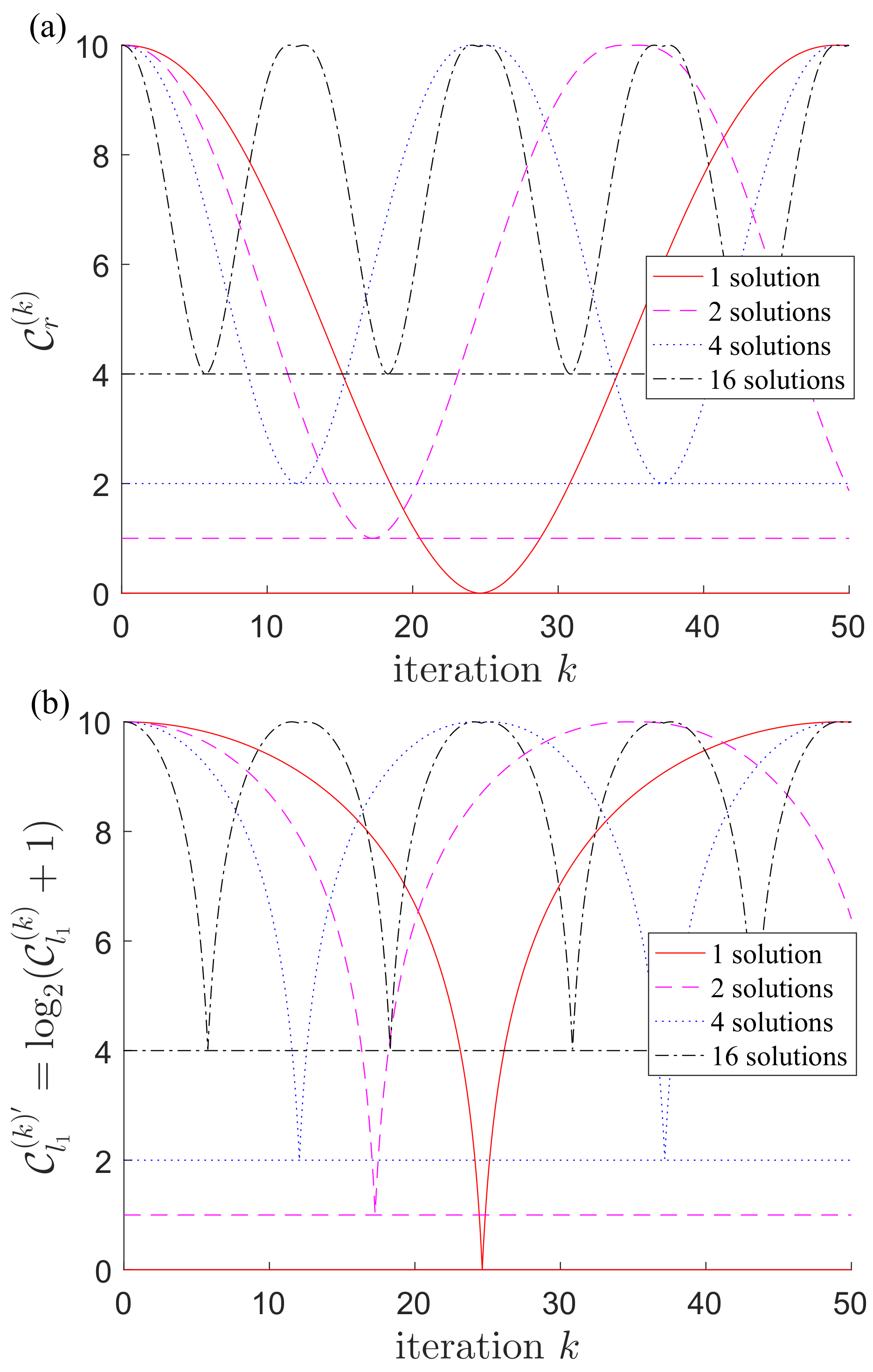
- corresponds to the minimal values in Figure 1, namely the solution state .
- corresponds to the maximal values in Figure 1. Because of the square in this solution, there are actually two peaks close to each other (not quite visible if the number of solutions M is small). The right peak corresponds to the superposition state , while the left one corresponds to .
- corresponds to the local minimal values between the two peaks in Figure 1. Because the distance between these two peaks is exactly 1 and we are considering discrete operations, so this local valley has no physical meaning.
- means that there is no solution, i.e., .
4. Deutsch–Jozsa Algorithm
- If is a constant function, thenthe coherence of which is .
- If is a balanced function, then
5. Shor’s Algorithm/Quantum Order-Finding
6. Discussion
7. Conclusions
Author Contributions
Funding
Acknowledgments
Conflicts of Interest
References
- Nielsen, M.A.; Chuang, I.L. Quantum Computation and Quantum Information, 10th ed.; Cambridge University Press: New York, NY, USA, 2011. [Google Scholar]
- Deutsch, D.; Jozsa, R. Rapid solution of problems by quantum computation. Proc. R. Soc. Lond. A 1992, 439, 553. [Google Scholar] [CrossRef] [Scilit]
- Deutsch, D. Quantum theory, the Church-Turing principle and the universal quantum computer. Proc. R. Soc. Lond. A 1985, 400, 97. [Google Scholar] [CrossRef] [Scilit]
- Shor, P.W. Algorithms for quantum computation: Discrete logarithms and factoring. In Proceedings of the 35th Annual Symposium on Foundations of Computer Science, Santa Fe, NM, USA, 20–22 November 1994; pp. 124–134. [Google Scholar] [CrossRef] [Scilit]
- Grover, L.K. A Fast Quantum Mechanical Algorithm for Database Search. In Proceedings of the 28th Annual ACM Symposium on Theory of Computing (STOC ’96), Philadelphia, PA, USA, 22–24 May 1996; ACM: New York, NY, USA, 1996; pp. 212–219. [Google Scholar] [CrossRef] [Scilit]
- Bennett, C.H.; Bernstein, E.; Brassard, G.; Vazirani, U. Strengths and Weaknesses of Quantum Computing. SIAM J. Comput. 1997, 26, 1510. [Google Scholar] [CrossRef] [Scilit]
- Knill, E.; Laflamme, R. Power of one bit of quantum information. Phys. Rev. Lett. 1998, 81, 5672. [Google Scholar] [CrossRef] [Scilit]
- Harrow, A.W.; Hassidim, A.; Lloyd, S. Quantum algorithm for linear systems of equations. Phys. Rev. Lett. 2009, 103, 150502. [Google Scholar] [CrossRef] [Scilit] [PubMed]
- Latorre, J.I.; Martín-Delgado, M.A. Majorization arrow in quantum-algorithm design. Phys. Rev. A 2002, 66, 022305. [Google Scholar] [CrossRef] [Scilit]
- Orús, R.; Latorre, J.I.; Martín-Delgado, M.A. Natural Majorization of the Quantum Fourier Transformation in Phase-Estimation Algorithms. Quantum Inf. Process. 2002, 1, 283. [Google Scholar] [CrossRef] [Scilit]
- Orús, R.; Latorre, J.I.; Martín-Delgado, M.A. Systematic analysis of majorization in quantum algorithms. Eur. Phys. J. D 2004, 29, 119. [Google Scholar] [CrossRef] [Scilit]
- Flamini, F.; Viggianiello, N.; Giordani, T.; Bentivegna, M.; Spagnolo, N.; Crespi, A.; Corrielli, G.; Osellame, R.; Martin-Delgado, M.A.; Sciarrino, F. Observation of photonic states dynamics in 3-D integrated Fourier circuits. J. Opt. 2018, 20, 074001. [Google Scholar] [CrossRef] [Scilit]
- Winter, A.; Yang, D. Operational Resource Theory of Coherence. Phys. Rev. Lett. 2016, 116, 120404. [Google Scholar] [CrossRef] [Scilit] [PubMed]
- Zhu, H.; Ma, Z.; Cao, Z.; Fei, S.M.; Vedral, V. Operational one-to-one mapping between coherence and entanglement measures. Phys. Rev. A 2017, 96, 032316. [Google Scholar] [CrossRef] [Scilit]
- Nielsen, M.A.; Kempe, J. Separable States Are More Disordered Globally than Locally. Phys. Rev. Lett. 2001, 86, 5184. [Google Scholar] [CrossRef] [Scilit] [PubMed]
- Jozsa, R. Quantum effects in algorithms. In Quantum Computing and Quantum Communications; Springer: Berlin/Heidelberg, Germany, 1999; pp. 103–112. [Google Scholar]
- Jozsa, R.; Linden, N. On the role of entanglement in quantum-computational speed-up. Proc. R. Soc. Lond. Ser. A Math. Phys. Eng. Sci. 2003, 459, 2011–2032. [Google Scholar] [CrossRef] [Scilit]
- Boyer, M.; Brodutch, A.; Mor, T. Entanglement and deterministic quantum computing with one qubit. Phys. Rev. A 2017, 95, 022330. [Google Scholar] [CrossRef] [Scilit]
- Datta, A.; Shaji, A.; Caves, C.M. Quantum discord and the power of one qubit. Phys. Rev. Lett. 2008, 100, 050502. [Google Scholar] [CrossRef] [Scilit] [PubMed]
- Hillery, M. Coherence as a resource in decision problems: The Deutsch-Jozsa algorithm and a variation. Phys. Rev. A 2016, 93, 012111. [Google Scholar] [CrossRef] [Scilit]
- Anand, N.; Pati, A.K. Coherence and entanglement monogamy in the discrete analogue of analog Grover search. arXiv, 2016; arXiv:1611.04542.
- Shi, H.L.; Liu, S.Y.; Wang, X.H.; Yang, W.L.; Yang, Z.Y.; Fan, H. Coherence depletion in the Grover quantum search algorithm. Phys. Rev. A 2017, 95, 032307. [Google Scholar] [CrossRef] [Scilit]
- Gühne, O.; Tóth, G. Entanglement detection. Phys. Rep. 2009, 474, 1–75. [Google Scholar] [CrossRef] [Scilit]
- Horodecki, R.; Horodecki, P.; Horodecki, M.; Horodecki, K. Quantum entanglement. Rev. Mod. Phys. 2009, 81, 865. [Google Scholar] [CrossRef] [Scilit]
- Horodecki, M.; Oppenheim, J. (Quantumness in the context of) resource theories. Int. J. Mod. Phys. B 2013, 27, 1345019. [Google Scholar] [CrossRef] [Scilit]
- Del Rio, L.; Kraemer, L.; Renner, R. Resource theories of knowledge. arXiv, 2015; arXiv:1511.08818.
- Coecke, B.; Fritz, T.; Spekkens, R.W. A mathematical theory of resources. Inf. Comput. 2016, 250, 59. [Google Scholar] [CrossRef] [Scilit]
- Streltsov, A.; Adesso, G.; Plenio, M.B. Colloquium: Quantum coherence as a resource. Rev. Mod. Phys. 2017, 89, 041003. [Google Scholar] [CrossRef] [Scilit]
- Streltsov, A.; Singh, U.; Dhar, H.S.; Bera, M.N.; Adesso, G. Measuring Quantum Coherence with Entanglement. Phys. Rev. Lett. 2015, 115, 020403. [Google Scholar] [CrossRef] [Scilit] [PubMed]
- Ma, J.; Yadin, B.; Girolami, D.; Vedral, V.; Gu, M. Converting Coherence to Quantum Correlations. Phys. Rev. Lett. 2016, 116, 160407. [Google Scholar] [CrossRef] [Scilit] [PubMed]
- Chitambar, E.; Hsieh, M.H. Relating the Resource Theories of Entanglement and Quantum Coherence. Phys. Rev. Lett. 2016, 117, 020402. [Google Scholar] [CrossRef] [Scilit] [PubMed]
- Yao, Y.; Xiao, X.; Ge, L.; Sun, C.P. Quantum coherence in multipartite systems. Phys. Rev. A 2015, 92, 022112. [Google Scholar] [CrossRef] [Scilit]
- Baumgratz, T.; Cramer, M.; Plenio, M.B. Quantifying Coherence. Phys. Rev. Lett. 2014, 113, 140401. [Google Scholar] [CrossRef] [Scilit] [PubMed]
- Zhu, H.; Hayashi, M.; Chen, L. Axiomatic and operational connections between the l1-norm of coherence and negativity. Phys. Rev. A 2018, 97, 022342. [Google Scholar] [CrossRef] [Scilit]
- Cleve, R.; Ekert, A.; Macchiavello, C.; Mosca, M. Quantum algorithms revisited. Proc. R. Soc. Lond. A 1998, 454, 339. [Google Scholar] [CrossRef] [Scilit]
- Parker, S.; Plenio, M.B. Entanglement simulations of Shor’s algorithm. J. Mod. Opt. 2002, 49, 1325. [Google Scholar] [CrossRef] [Scilit]
- Orús, R.; Latorre, J.I. Universality of entanglement and quantum-computation complexity. Phys. Rev. A 2004, 69, 052308. [Google Scholar] [CrossRef] [Scilit]
- Kendon, V.M.; Munro, W.J. Entanglement and its Role in Shor’s Algorithm. Quantum Inf. Comput. 2006, 6, 630–640. [Google Scholar]
- Azuma, H.; Bose, S.; Vedral, V. Entangling capacity of global phases and implications for the Deutsch-Jozsa algorithm. Phys. Rev. A 2001, 64, 062308. [Google Scholar] [CrossRef] [Scilit]
- Bruß, D.; Macchiavello, C. Multipartite entanglement in quantum algorithms. Phys. Rev. A 2011, 83, 052313. [Google Scholar] [CrossRef] [Scilit]
- Collins, D.; Kim, K.W.; Holton, W.C. Deutsch-Jozsa algorithm as a test of quantum computation. Phys. Rev. A 1998, 58, R1633. [Google Scholar] [CrossRef] [Scilit]
- Kenigsberg, D.; Mor, T.; Ratsaby, G. Quantum advantage without entanglement. Quantum Inf. Comput. 2006, 6, 606–615. [Google Scholar]
- Gurvits, L. Classical deterministic complexity of Edmonds’ Problem and quantum entanglement. In Proceedings of the Thirty-Fifth Annual ACM Symposium on Theory of Computing, San Diego, CA, USA, 9–11 June 2003; ACM Press: New York, NY, USA, 2003; pp. 10–19. [Google Scholar]
- Gharibian, S. Strong NP-hardness of the quantum separability problem. Quantum Inf. Comput. 2010, 10, 343–360. [Google Scholar]
© 2019 by the authors. Licensee MDPI, Basel, Switzerland. This article is an open access article distributed under the terms and conditions of the Creative Commons Attribution (CC BY) license (http://creativecommons.org/licenses/by/4.0/).
Share and Cite
Liu, Y.-C.; Shang, J.; Zhang, X. Coherence Depletion in Quantum Algorithms. Entropy 2019, 21, 260. https://doi.org/10.3390/e21030260
Liu Y-C, Shang J, Zhang X. Coherence Depletion in Quantum Algorithms. Entropy. 2019; 21(3):260. https://doi.org/10.3390/e21030260
Chicago/Turabian StyleLiu, Ye-Chao, Jiangwei Shang, and Xiangdong Zhang. 2019. "Coherence Depletion in Quantum Algorithms" Entropy 21, no. 3: 260. https://doi.org/10.3390/e21030260
APA StyleLiu, Y.-C., Shang, J., & Zhang, X. (2019). Coherence Depletion in Quantum Algorithms. Entropy, 21(3), 260. https://doi.org/10.3390/e21030260

