AI-Driven Consumer Research in Fashion: A Systematic and Bibliometric Review (2022–2025) and Future Research Agenda



Abstract
1. Introduction
Contribution Beyond Prior AI–Fashion Reviews
2. Methods
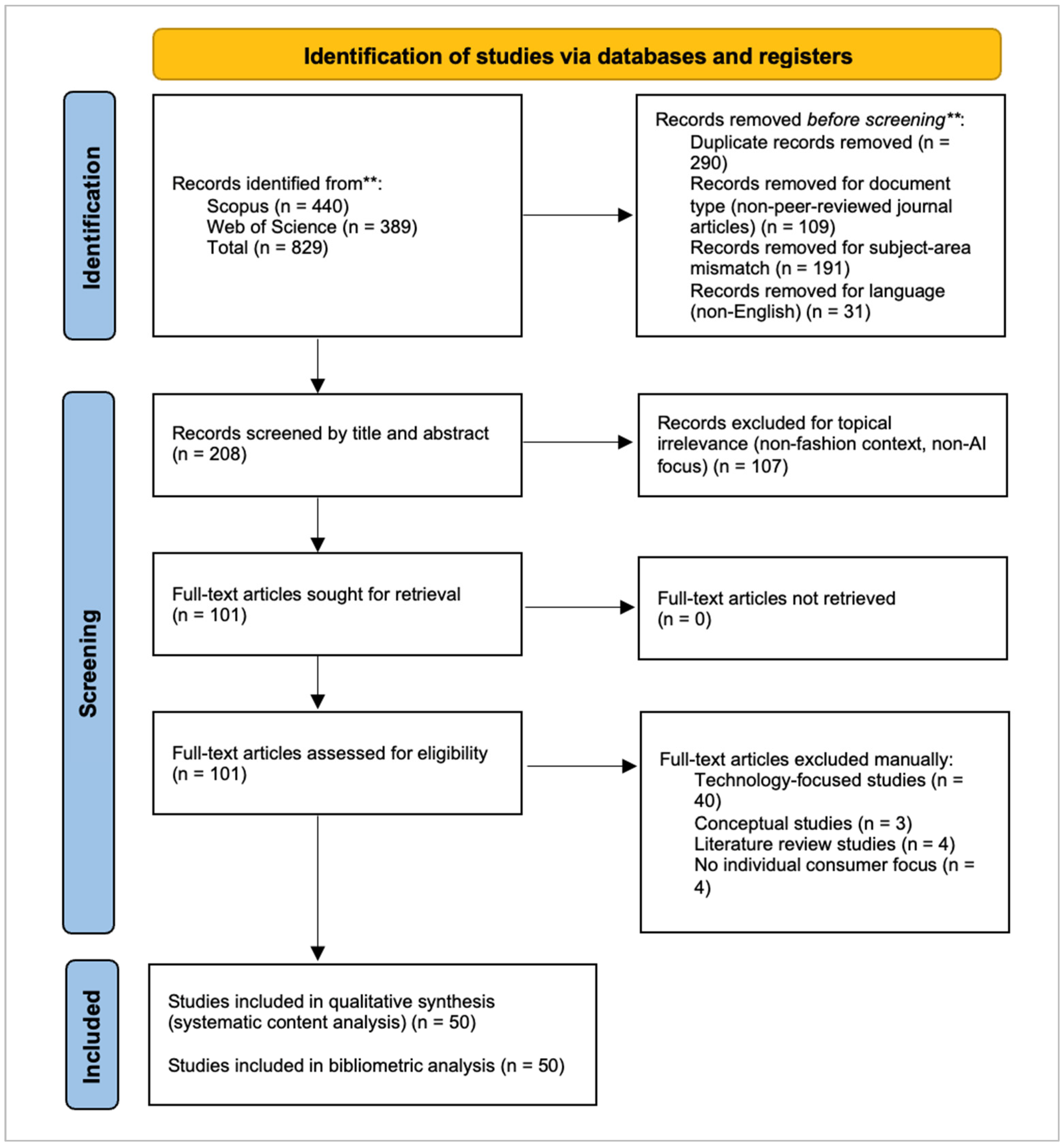
2.1. Literature Search and Selection Process
2.2. Literature Review Approaches
2.3. Risk of Bias and Certainty Assessment
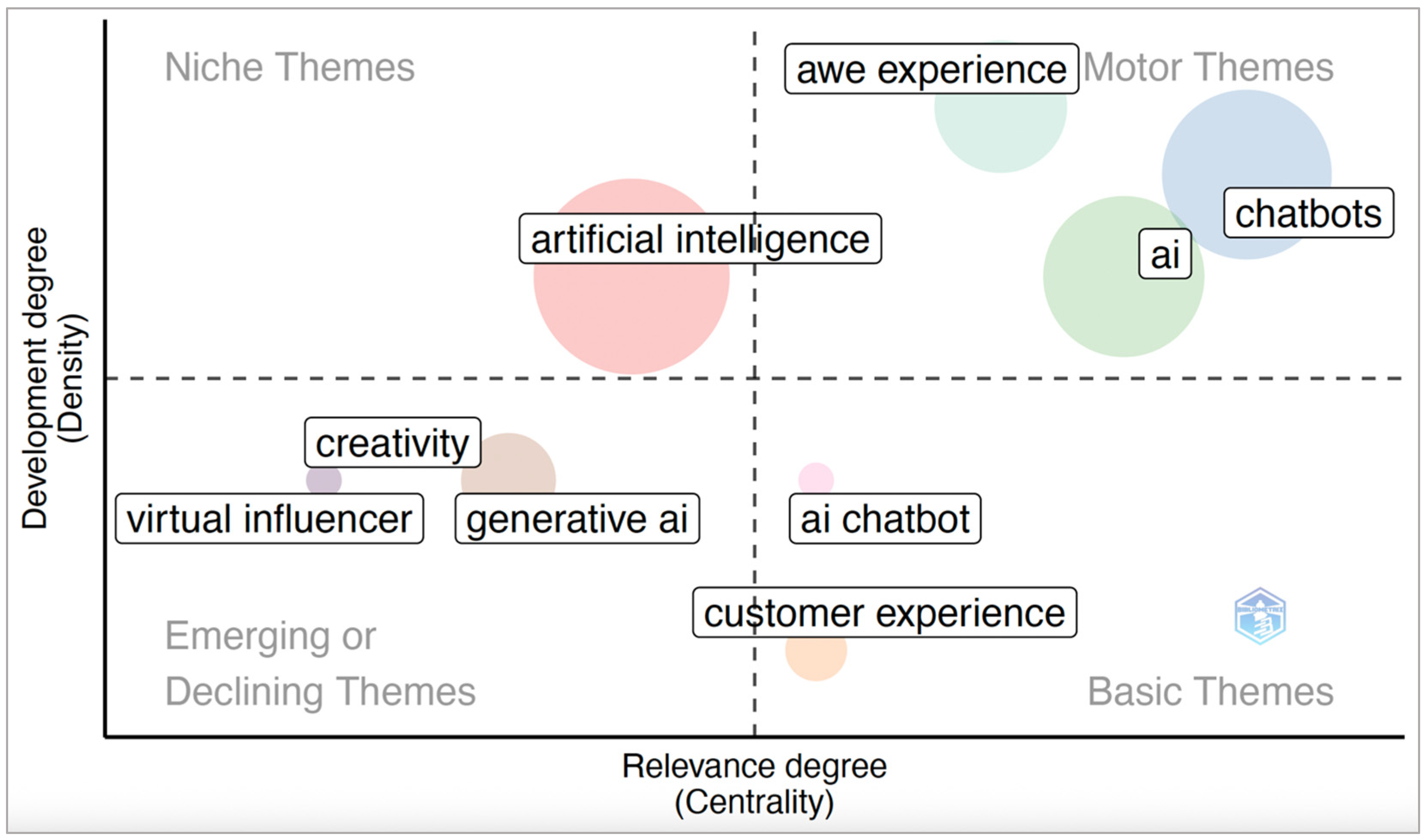
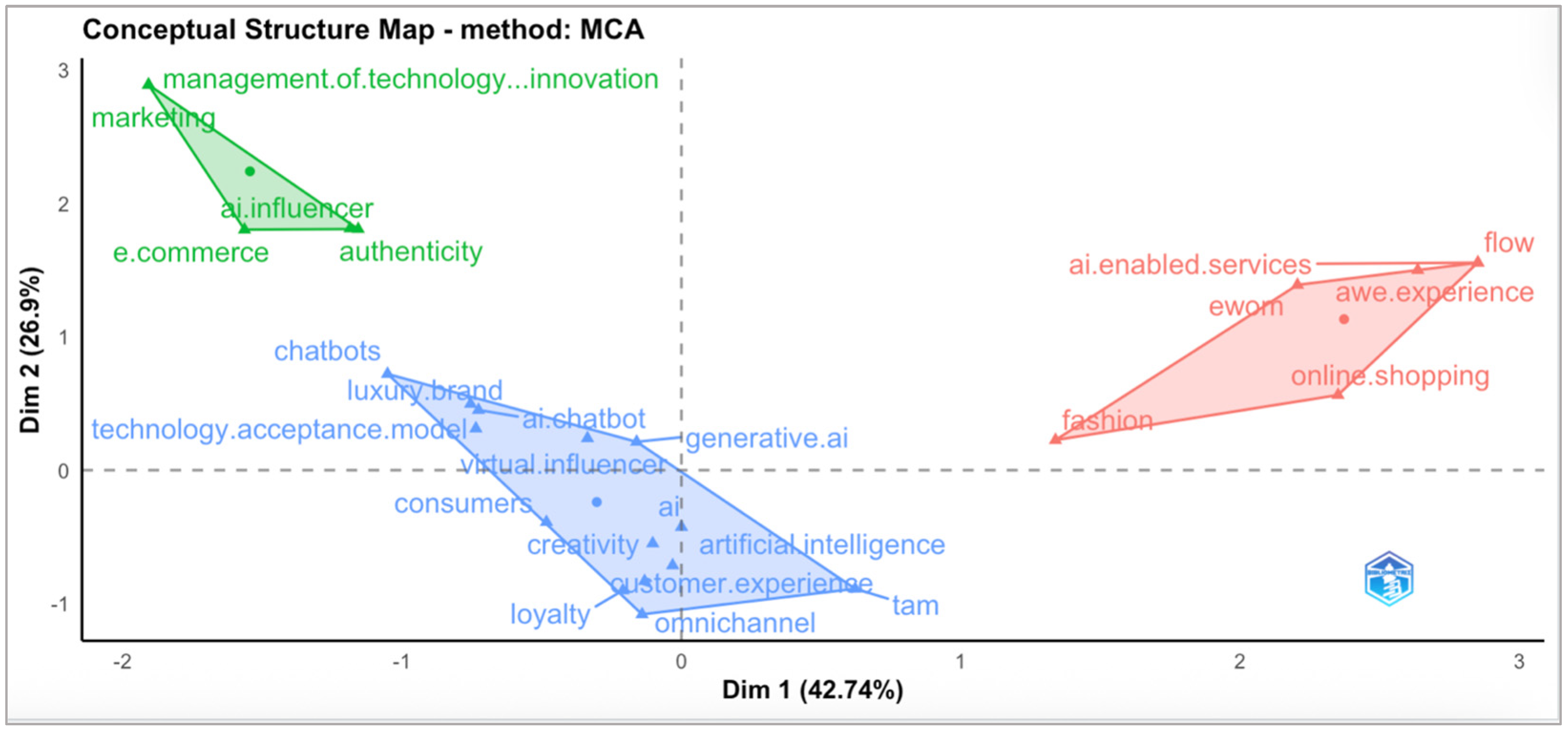
2.4. Publication Performance Characteristics of Selected Literature
3. Findings and Discussions
3.1. Thematic Research Landscape
3.2. Theoretical Landscape
3.3. Methodological Landscape
3.4. Overall Research Landscape and Discussion
3.4.1. Asymmetric Theoretical Anchoring Across Research Themes
3.4.2. AI-Powered Chatbots: Theoretical Consolidation and Emerging Tensions
3.4.3. AI Applications in General: Experiential Focus and Conceptual Ambiguity
3.4.4. AI-Driven Recommendations: Navigating Perceived Value and Consumer Concerns
3.4.5. Creative and Influencer-Oriented AI: Authenticity, Agency, and Symbolic Tensions
3.4.6. Wearable and In-Store AI: Embodiment, Surveillance, and Privacy Trade-Offs
4. Future Research Agenda
4.1. Fashion-Specific Future Research Agenda
4.2. Broader Implications for E-Commerce Scholarship and Practice
5. Conclusions and Limitations
Author Contributions
Funding
Institutional Review Board Statement
Informed Consent Statement
Data Availability Statement
Acknowledgments
Conflicts of Interest
References
- Hermann, E.; Puntoni, S. Artificial intelligence and consumer behavior: From predictive to generative AI. J. Bus. Res. 2024, 180, 114720. [Google Scholar] [CrossRef]
- Araújo, C.; Gonçalves, R.; Da Costa, R.L.; Dias, Á.; Pereira, L. Artificial intelligence in the digital customer journey. Int. J. Electron. Cust. Relatsh. Manag. 2022, 13, 248–271. [Google Scholar] [CrossRef]
- Calvo, A.V.; Franco, A.D.; Frasquet, M. The role of artificial intelligence in improving the omnichannel customer experience. Int. J. Retail. Distrib. Manag. 2023, 51, 1174–1194. [Google Scholar] [CrossRef]
- Pantano, E.; Serravalle, F.; Priporas, C.-V. The form of AI-driven luxury: How generative AI (GAI) and Large Language Models (LLMs) are transforming the creative process. J. Mark. Manag. 2024, 40, 1771–1790. [Google Scholar] [CrossRef]
- Zhang, Y.; Liu, C.; Xia, S. From hype to value: Harnessing generative AI in fashion retailing from a technology-organization-environment perspective. J. Electron. Bus. Digit. Econ. 2025, ahead-of-print. [Google Scholar] [CrossRef]
- Nah, F.; Cai, J.; Zheng, R.; Pang, N. An activity system-based perspective of generative AI: Challenges and research directions. AIS Trans. Hum.-Comput. Interact. 2023, 15, 247–267. [Google Scholar] [CrossRef]
- Schumacher, K.; Roberts, R. The Agentic Commerce Opportunity: How AI Agents are Ushering in a New Era for Consumers and Merchants. 2025. Available online: https://www.mckinsey.com/capabilities/quantumblack/our-insights/the-agentic-commerce-opportunity-how-ai-agents-are-ushering-in-a-new-era-for-consumers-and-merchants (accessed on 1 November 2025).
- Zhang, Y.; Liu, C. Unlocking the Potential of Artificial Intelligence in Fashion Design and E-Commerce Applications: The Case of Midjourney. J. Theor. Appl. Electron. Commer. Res. 2024, 19, 654–670. [Google Scholar] [CrossRef]
- Zhang, Y.; Liu, C. Unveiling how consumers accept digital-only fashion: An empirical examination building upon the functional theory of attitudes. J. Electron. Bus. Digit. Econ. 2025, 4, 54–72. [Google Scholar] [CrossRef]
- Harreis, H.; Koullias, T.; Roberts, R.; Te, K. Generative AI: Unlocking the Future of Fashion. 2023. Available online: https://www.mckinsey.com/industries/retail/our-insights/generative-ai-unlocking-the-future-of-fashion (accessed on 19 January 2024).
- Yeo, S.F.; Tan, C.L.; Kumar, A.; Tan, K.H.; Wong, J.K. Investigating the impact of AI-powered technologies on Instagrammers’ purchase decisions in digitalization era–A study of the fashion and apparel industry. Technol. Forecast. Soc. Change 2022, 177, 121551. [Google Scholar] [CrossRef]
- Sharma, K.; Trott, S.; Sahadev, S.; Singh, R. Emotions and consumer behaviour: A review and research agenda. Int. J. Consum. Stud. 2023, 47, 2396–2416. [Google Scholar] [CrossRef]
- Manzo, D.S.H.; Jiang, Y.; Elyan, E.; Isaacs, J. Artificial Intelligence-Based Conversational Agents Used for Sustainable Fashion: Systematic Literature Review. Int. J. Hum.-Comput. Interact. 2024, 41, 4640–4652. [Google Scholar]
- Shirkhani, S.; Mokayed, H.; Saini, R.; Chai, H.Y. Study of AI-Driven Fashion Recommender Systems. SN Comput. Sci. 2023, 4, 514. [Google Scholar] [CrossRef]
- Pereira, A.M.; Moura, J.A.B.; Costa, E.D.B.; Vieira, T.; Landim, A.R.; Bazaki, E.; Wanick, V. Customer models for artificial intelligence-based decision support in fashion online retail supply chains. Decis. Support Syst. 2022, 158, 113795. [Google Scholar] [CrossRef]
- Falagas, M.E.; Pitsouni, E.I.; Malietzis, G.A.; Pappas, G.; Kouranos, V.D.; Arencibia-Jorge, R.; Karageorgopoulos, D.E.; Reagan-Shaw, S.; Nihal, M.; Ahmad, N.; et al. Comparison of PubMed, Scopus, web of science, and Google scholar: Strengths and weaknesses. FASEB J. 2008, 22, 338–342. [Google Scholar] [CrossRef]
- Tranfield, D.; Denyer, D.; Smart, P. Towards a methodology for developing evidence-informed management knowledge by means of systematic review. Br. J. Manag. 2003, 14, 207–222. [Google Scholar] [CrossRef]
- Page, M.J.; McKenzie, J.E.; Bossuyt, P.M.; Boutron, I.; Hoffmann, T.C.; Mulrow, C.D.; Shamseer, L.; Tetzlaff, J.M.; Akl, E.A.; Brennan, S.E.; et al. The PRISMA 2020 statement: An updated guideline for reporting systematic reviews. BMJ 2021, 372, 71. [Google Scholar] [CrossRef]
- Mishra, R.; Singh, R.K.; Koles, B. Consumer decision-making in Omnichannel retailing: Literature review and future research agenda. Int. J. Consum. Stud. 2021, 45, 147–174. [Google Scholar] [CrossRef]
- Donthu, N.; Kumar, S.; Mukherjee, D.; Pandey, N.; Lim, W.M. How to conduct a bibliometric analysis: An overview and guidelines. J. Bus. Res. 2021, 133, 285–296. [Google Scholar] [CrossRef]
- Aria, M.; Misuraca, M.; Spano, M. Mapping the evolution of social research and data science on 30 years of social indicators research. Soc. Indic. Res. 2020, 149, 803–831. [Google Scholar] [CrossRef]
- Hong, Q.N.; Fàbregues, S.; Bartlett, G.; Boardman, F.; Cargo, M.; Dagenais, P.; Gagnon, M.-P.; Griffiths, F.; Nicolau, B.; O’cAthain, A.; et al. The Mixed Methods Appraisal Tool (MMAT) version 2018 for information professionals and researchers. Educ. Inf. 2018, 34, 285–291. [Google Scholar] [CrossRef]
- Lewin, S.; Booth, A.; Glenton, C.; Munthe-Kaas, H.; Rashidian, A.; Wainwright, M.; Bohren, M.A.; Tunçalp, Ö.; Colvin, C.J.; Garside, R.; et al. Applying GRADE-CERQual to qualitative evidence synthesis findings: Introduction to the series. Implement. Sci. 2018, 13, 2. [Google Scholar] [CrossRef] [PubMed]
- Ranjan, A.; Upadhyay, A.K. Value co-creation by interactive AI in fashion E-commerce. Cogent Bus. Manag. 2025, 12, 2440127. [Google Scholar] [CrossRef]
- Qi, L.; Ko, E.; Cho, M. AI chatbots with visual search: Impact on luxury fashion shopping behavior. J. Glob. Sch. Mark. Sci. Bridg. Asia World 2025, 35, 99–117. [Google Scholar]
- Kang, J.M.; Lee, J.Y.; Choi, D.; Koo, S.H. Artificial intelligence-powered chatbots in the fashion sector: The Affect–Behavior–Cognition model of attitudes. Fam. Consum. Sci. Res. J. 2024, 53, 5–24. [Google Scholar]
- Kang, J.-Y.M.; Choi, D. Artificial intelligence-powered digital solutions in the fashion industry: A mixed-methods study on AI-based customer services. Int. J. Fash. Des. Technol. Educ. 2024, 17, 162–176. [Google Scholar] [CrossRef]
- Shahzad, M.F.; Xu, S.; An, X.; Javed, I. Assessing the impact of AI-chatbot service quality on user e-brand loyalty through chatbot user trust, experience and electronic word of mouth. J. Retail. Consum. Serv. 2024, 79, 103867. [Google Scholar] [CrossRef]
- Myin, M.T.; Watchravesringkan, K. Investigating consumers’ adoption of AI chatbots for apparel shopping. J. Consum. Mark. 2024, 41, 314–327. [Google Scholar] [CrossRef]
- Mpinganjira, M.; Dlodlo, N.; Idemudia, E.C. Perceived experiential value and continued use intention of e-retail chatbots. Int. J. Retail. Distrib. Manag. 2024, 52, 121–135. [Google Scholar] [CrossRef]
- Jin, S.V.; Youn, S. Social Presence and Imagery Processing as Predictors of Chatbot Continuance Intention in Human-AI-Interaction. Int. J. Hum.-Comput. Interact. 2023, 39, 1874–1886. [Google Scholar] [CrossRef]
- Li, P.; Wu, C.; Spence, C. Comparing the influence of visual information and the perceived intelligence of voice assistants when shopping for sustainable clothing online. Humanit. Soc. Sci. Commun. 2023, 10, 727. [Google Scholar] [CrossRef]
- Kautish, P.; Purohit, S.; Filieri, R.; Dwivedi, Y.K. Examining the role of consumer motivations to use voice assistants for fashion shopping: The mediating role of awe experience and eWOM. Technol. Forecast. Soc. Change 2023, 190, 122407. [Google Scholar] [CrossRef]
- Huh, J.; Whang, C.; Kim, H.-Y. Building trust with voice assistants for apparel shopping: The effects of social role and user autonomy. J. Glob. Fash. Mark. 2023, 14, 5–19. [Google Scholar] [CrossRef]
- Oncioiu, I. Predicting the Use of Chatbots for Consumer Channel Selection in Multichannel Environments: An Exploratory Study. Systems 2023, 11, 522. [Google Scholar] [CrossRef]
- Jansom, A.; Srisangkhajorn, T.; Limarunothai, W. How chatbot e-services motivate communication credibility and lead to customer satisfaction: The perspective of Thai consumers in the apparel retailing context. Innov. Mark. 2022, 18, 13–25. [Google Scholar]
- Lou, C.; Kang, H.; Tse, C.H. Bots vs. humans: How schema congruity, contingency-based interactivity, and sympathy influence consumer perceptions and patronage intentions. Int. J. Advert. 2022, 41, 655–684. [Google Scholar] [CrossRef]
- Shin, E.; Yang, H. Effect of Chinese consumer characteristics on the attitude of AI-curated fashion service and the purchase intention of fashion products. J. Fash. Mark. Manag. 2025, 29, 20–37. [Google Scholar] [CrossRef]
- Sahne, S.S.K.; Daronkola, H.K. Enhancing loyalty in luxury fashion with AI: The mediation role of customer relationships. Asia-Pac. J. Bus. Adm. 2025, 17, 1441–1479. [Google Scholar]
- Ruiz-Viñals, C.; Pretel-Jiménez, M.; Arriaga, J.L.D.O.; Pérez, A.M. The Influence of Artificial Intelligence on Generation Z’s Online Fashion Purchase Intention. J. Theor. Appl. Electron. Commer. Res. 2024, 19, 2813–2827. [Google Scholar] [CrossRef]
- Das, P.; Das, S. Generative Adversarial Networks in Fashion Retailing and Customer Purchase Intention: An Extension of Theory of Consumption Value. Vision 2024. [Google Scholar] [CrossRef]
- Dhaliwal, A.; Pandey, P.K. Convergence of online flow and AI-enabled services: The impact on awe experience in e-tail customer journeys. Int. Rev. Retail. Distrib. Consum. Res. 2024, 35, 209–236. [Google Scholar]
- Guerra-Tamez, C.R.; Flores, K.K.; Serna-Mendiburu, G.M.; Robles, D.C.; Cortés, J.I. Decoding Gen Z: AI’s influence on brand trust and purchasing behavior. Front. Artif. Intell. 2024, 7, 1323512. [Google Scholar] [CrossRef]
- Khare, A.; Kautish, P.; Khare, A. The online flow and its influence on awe experience: An AI-enabled e-tail service exploration. Int. J. Retail. Distrib. Manag. 2023, 51, 713–735. [Google Scholar] [CrossRef]
- Rahman, M.S.; Bag, S.; Hossain, A.; Fattah, F.A.M.A.; Gani, M.O.; Rana, N.P. The new wave of AI-powered luxury brands online shopping experience: The role of digital multisensory cues and customers’ engagement. J. Retail. Consum. Serv. 2023, 72, 103273. [Google Scholar] [CrossRef]
- Kautish, P.; Khare, A. Investigating the moderating role of AI-enabled services on flow and awe experience. Int. J. Inf. Manag. 2022, 66, 102519. [Google Scholar] [CrossRef]
- Gerlich, M. The Shifting Influence: Comparing AI Tools and Human Influencers in Consumer Decision-Making. AI 2025, 6, 11. [Google Scholar] [CrossRef]
- Jiang, G.; Macintyre, L. Wardrobe Management Apps and Their Unintended Benefits for Fashion Sustainability and Well-Being: Insights from User Reviews. Sustainability 2025, 17, 4159. [Google Scholar] [CrossRef]
- Kim, S.S.-E.; Lehmann, D.R. The Effect of Variety in Past Consumption on Openness to Personalized Recommendation Services. J. Assoc. Consum. Res. 2024, 9, 295–305. [Google Scholar] [CrossRef]
- Bonetti, F.; Silva, E.S.; Pantano, E.; Marikyan, D. Starting a relationship with AI! Exploring consumer’s attitude towards digital human stylists. Int. J. Technol. Mark. 2024, 18, 371–398. [Google Scholar] [CrossRef]
- Sasanuma, K.; Yang, G.Y. Evaluating the Effectiveness of Recommendation Engines on Customer Experience Across Product Categories. Int. J. Technol. Hum. Interact. 2024, 20, 1–23. [Google Scholar] [CrossRef]
- Im, H.; Lee, G. Do consumers always believe humans create better boxes than AI? The context-dependent role of recommender creativity. Int. J. Retail. Distrib. Manag. 2023, 51, 1045–1060. [Google Scholar] [CrossRef]
- Kim, J.; Kang, S.; Bae, J. The effects of customer consumption goals on artificial intelligence driven recommendation agents: Evidence from Stitch Fix. Int. J. Advert. 2022, 41, 997–1016. [Google Scholar] [CrossRef]
- Bang, H.; Su, J. Who uses virtual wardrobes? Investigating the role of consumer traits in the intention to adopt virtual wardrobes. Sustainability 2022, 14, 1209. [Google Scholar] [CrossRef]
- Lee, G.; Kim, H. Algorithm fashion designer? ascribed mind and perceived design expertise of AI versus human. Psychol. Mark. 2025, 42, 255–273. [Google Scholar] [CrossRef]
- Lee, G.; Kim, H.-Y. Human vs. AI: The battle for authenticity in fashion design and consumer response. J. Retail. Consum. Serv. 2024, 77, 103690. [Google Scholar] [CrossRef]
- Xu, L.; Mehta, R. Technology devalues luxury? Exploring consumer responses to AI-designed luxury products. J. Acad. Mark. Sci. 2022, 50, 1135–1152. [Google Scholar] [CrossRef]
- Cheng, J.; Wang, J. Influencer-product attractiveness transference in interactive fashion marketing: The moderated moderating effect of speciesism against AI. J. Res. Interact. Mark. 2024, 19, 712–729. [Google Scholar] [CrossRef]
- Toyib, J.S.; Paramita, W. An authentic human-like figure: The success keys of AI fashion influencer. Cogent Bus. Manag. 2024, 11, 2380019. [Google Scholar] [CrossRef]
- Almasri, Y. Fashion Virtual Influencers: Antecedents Influencing Females’ Behavioral Intentions in Jordan. Dirasat: Hum. Soc. Sci. 2023, 50, 390–402. [Google Scholar] [CrossRef]
- Li, Z.; Song, X.; Guo, M.; Fang, L. Consumer-consumption-need theoretical model for smart clothing: Construction and empirical study for Chinese silver-haired population. J. Infrastruct. Policy Dev. 2024, 8, 6230. [Google Scholar] [CrossRef]
- Arachchi, H.A.D.M.; Samarasinghe, G.D. Intention to Adopt Intelligent Clothing in the Fashion Retail Industry: Extending the HISAM Model with Technology Readiness. Int. J. Hum.-Comput. Interact. 2024, 40, 6374–6388. [Google Scholar] [CrossRef]
- Chen, S.; Ye, J. Understanding consumers’ intentions to purchase smart clothing using PLS-SEM and fsQCA. PLoS ONE 2023, 18, e0291870. [Google Scholar] [CrossRef]
- Canhoto, A.I.; Keegan, B.J.; Ryzhikh, M. Snakes and Ladders: Unpacking the Personalisation-Privacy Paradox in the Context of AI-Enabled Personalisation in the Physical Retail Environment. Inf. Syst. Front. 2024, 26, 1005–1024. [Google Scholar] [CrossRef]
- El Abed, M.; Castro-Lopez, A. The impact of AI-powered technologies on aesthetic, cognitive and affective experience dimensions: A connected store experiment. Asia Pac. J. Mark. Logist. 2024, 36, 715–735. [Google Scholar] [CrossRef]
- Song, C.S.; Kim, Y.-K. The role of the human-robot interaction in consumers’ acceptance of humanoid retail service robots. J. Bus. Res. 2022, 146, 489–503. [Google Scholar] [CrossRef]
- Park, J.; Ahn, S. Traditional vs. AI-generated brand personalities: Impact on brand preference and purchase intention. J. Retail. Consum. Serv. 2024, 81, 104009. [Google Scholar] [CrossRef]
- Sands, S.; Demsar, V.; Ferraro, C.; Campbell, C.; Cohen, J. Inauthentic inclusion: Exploring how intention to use AI-generated diverse models can backfire. Psychol. Mark. 2024, 41, 1396–1413. [Google Scholar] [CrossRef]
- Kim, M.G.; Lee, K.C. Proposing the “Digital Agenticity Theory” to analyze user engagement in conversational AI chatbot. J. Bus. Res. 2025, 189, 115162. [Google Scholar]
- Cloarec, J.; Meyer-Waarden, L.; Munzel, A. Transformative privacy calculus: Conceptualizing the personalization-privacy paradox on social media. Psychol. Mark. 2024, 41, 1574–1596. [Google Scholar] [CrossRef]
- Jabbar, A.; Geebren, A.; Hussain, Z.; Dani, S.; Ul-Durar, S. Investigating individual privacy within CBDC: A privacy calculus perspective. Res. Int. Bus. Financ. 2023, 64, 101826. [Google Scholar] [CrossRef]
- Tang, Y.; Ning, X. Understanding user misrepresentation behavior on social apps: The perspective of privacy calculus theory. Decis. Support Syst. 2023, 165, 113881. [Google Scholar] [CrossRef]
- Zhang, Y.; Liu, C.; Xia, S. Investigating young consumers’ acceptance of hemp fiber textiles and apparel: An analysis of Partial Least Squares Structural Equation Modeling. Res. J. Text. Appar. 2024, 29, 999–1015. [Google Scholar] [CrossRef]



| Study | Review Scope | Methodological Approach | Temporal Focus | Key Emphasis |
|---|---|---|---|---|
| Manzo, Jiang [13] | AI-based conversational agents in sustainable fashion | Systematic literature review | Primarily pre-GenAI and early GenAI | Examines key techniques, platforms, and application domains of conversational agents in advancing sustainability within the fashion industry. |
| Shirkhani, Mokayed [14] | AI-driven fashion recommender systems | Technical and system-oriented review | Primarily pre-GenAI and early GenAI | Summarizes recent AI algorithmic performance and architecture in fashion recommender systems. |
| Pereira, Moura [15] | AI-based decision support in fashion supply chains | Model-driven and analytical review | Pre-GenAI | Explores AI-enabled customer model–recommendation system (CM/RS) combinations supporting decision-making in fashion retail supply chains. |
| This study | AI-driven consumer research in fashion | Systematic review combined with bibliometric analysis, guided by the TTM framework | 2022–2025 (GenAI era) | Provides the first integrated, TTM-guided synthesis of empirical consumer research in fashion, revealing structural landscape across research themes, theoretical foundations, and methodological approaches and proposing a TTM-informed future research agenda. |
| Research Theme Area | Research Focus | References |
|---|---|---|
| AI-powered chatbots (14) Certainty Rating: Moderate | AI-driven chatbots as stylists (1, 2025); AI chatbot service with visual search capability (1, 2025); Social media AI chatbots (3, 2022, 2024); Chatbot service in luxury consumption (1, 2024); Consumer response to chatbot services (4, 2022–2024); Voice-based AI chatbots (3, 2023); Investigate conditions that enable to optimize AI chatbot services (1, 2022) | Ranjan and Upadhyay [24], Qi, Ko [25], Kang, Lee [26], Kang and Choi [27], Shahzad, Xu [28], Myin and Watchravesringkan [29], Mpinganjira, Dlodlo [30], Jin and Youn [31], Li, Wu [32], Kautish, Purohit [33], Huh, Whang [34], Oncioiu [35], Jansom, Srisangkhajorn [36], Lou, Kang [37] |
| AI applications in general (12) Certainty Rating: Moderate | Consumers’ responses to AI-powered fashion services (6, 2022–2025); AI’s impact on luxury fashion consumption (2, 2023, 2025); AI’s influence on Gen Z consumers (2, 2024); GAN-fashion retailing (1, 2024); AI’s impact on consumers’ omnichannel experiences (1, 2023) | Shin and Yang [38], Khamoushi Sahne and Kalantari Daronkola [39], Ruiz-Viñals, Pretel-Jiménez [40], Das and Das [41], Pandey, Dhaliwal [42], Calvo, Franco [3], Guerra-Tamez, Kraul Flores [43], Khare, Kautish [44], Yeo, Tan [11], Araújo, Gonçalves [2], Rahman, Bag [45], Kautish and Khare [46] |
| AI-driven recommendations (8) Certainty Rating: Moderate | Compare AI Tools and Human Influencers (1, 2025); Wardrobe management (3, 2022–2025); New recommendation engines (2, 2023, 2024); Digital human stylists (1, 2024); AI-curation subscription services (1, 2023) | Gerlich [47], Jiang and Macintyre [48], Kim and Lehmann [49], Bonetti, Silva [50], Sasanuma and Yang [51], Im and Lee [52], Kim, Kang [53], Bang and Su [54] |
| AI-assisted product design and development (5) Certainty Rating: Low | Consumer responses to AI-designed products (3, 2024–2025); Consumer perceptions of AI-designed luxury products (2, 2022, 2024) | Lee and Kim [55], Zhang and Liu [8], Lee and Kim [56], Pantano, Serravalle [4], Xu and Mehta [57] |
| AI-powered virtual influencer (3) Certainty Rating: Low | Consumer responses to virtual influencer recommended products (2, 2023–2024); Consumer perceptions of AI influencers (1, 2024) | Cheng and Wang [58], Toyib and Paramita [59], Almasri [60] |
| Smart clothing (3) Certainty Rating: Moderate | Consumer responses and acceptance of smart clothing (3, 2023–2024) | Li, Song [61], Arachchi and Samarasinghe [62], Chen and Ye [63] |
| AI applications in physical stores (3) Certainty Rating: Moderate | AI-enabled personalization service in physical retailing (1, 2024); AI technology in connected retail environments (1, 2024); Retail Service Robot (1, 2022) | Canhoto, Keegan [64], El Abed and Castro-Lopez [65], Song and Kim [66] |
| AI-driven marketing content generation (2) Certainty Rating: Low | GenAI-generated brand images (1, 2024); AI-generated fashion models (1, 2024) | Park and Ahn [67], Sands, Demsar [68] |
| Theory/Framework | Key Constructs | References | Frequency |
|---|---|---|---|
| Technology Acceptance Model (TAM) [1] | Perceived usefulness, ease of use, attitude, and behavioral intention | Bonetti, Silva [50], Oncioiu [35], Chen and Ye [63], Qi, Ko [25], Shin and Yang [38], Li, Song [61], Myin and Watchravesringkan [29], Khamoushi Sahne and Kalantari Daronkola [39] | 8 |
| Stimulus–Organism–Response (SOR) [2] | Service quality, trust, Word-of-Mouth (WOM), anthropomorphism, experiential value, and awe experience | Shahzad, Xu [28], Mpinganjira, Dlodlo [30], Khare, Kautish [44], Rahman, Bag [45], Kautish, Purohit [33], Khamoushi Sahne and Kalantari Daronkola [39] | 6 |
| Broaden-and-Build Theory (BBT) [3] | Flow, awe experience, and WOM | Pandey, Dhaliwal [42], Kautish and Khare [46], Kautish, Purohit [33] | 3 |
| Functional–Expressive–Aesthetic Model (FEAM) [4] | Functionality, expressiveness, and aesthetics | Chen and Ye [63], Li, Song [8,61] | 3 |
| Attribution Theory (AT) [5] | Intrinsic/extrinsic motivation, authenticity, and social identity threat | Cheng and Wang [58], Sands, Demsar [68] | 2 |
| Mind Perception Theory (MPT) [6] | Experience, agency, and AI threat | Lee and Kim [55], Ranjan and Upadhyay [24] | 2 |
| Hedonic Information Systems Acceptance Model (HISAM) + Technology Readiness [7] | Perceived intelligence, automation, and personalization | Arachchi and Samarasinghe [62] | 1 |
| Theory of Consumption Value (TCV) [8] | Functional, emotional, epistemic, social, and conditional values | Das and Das [41] | 1 |
| Behavioral Reasoning Theory (BRT) [9] | Optimism, complexity, innovativeness, and advantage | Myin and Watchravesringkan [29] | 1 |
| Uses and Gratifications Theory (UGT) [10] | Service quality, empathy, and informational value | Kang and Choi [27] | 1 |
| Value Co-creation Theory (VCT) [11] | Anthropomorphism, credibility, and empathy | Ranjan and Upadhyay [24] | 1 |
| Affect–Behavior–Cognition (ABC) Model [12] | Hedonic motivation, attitude, and WOM | Kang, Lee [26] | 1 |
| Computers-Are-Social-Actors theory (CASA) [13] | Usefulness, capability, and robot anxiety | Song and Kim [66] | 1 |
| Media Equation Theory (MET) [14] | Human-likeness, social roles, and use autonomy | Huh, Whang [34] | 1 |
| Self-Verification Theory (SVT) [15] | Self-brand congruence, brand personality | Park and Ahn [67] | 1 |
| Engel-Kollat-Blackwell (EKB) Model [16] | Value, quality, risk, price, and emotional experience | Yeo, Tan [11] | 1 |
| Personalization-Privacy Paradox (PPP) [17] | Personalization, autonomy | Canhoto, Keegan [64] | 1 |
| Theory of Stereotyping (TS) [18] | Perceived creativity | Im and Lee [52] | 1 |
| Schema Theory (ST) [19] | Perceived authenticity, product fit | Lee and Kim [56] | 1 |
| Goal-Derived Theory (GDT) [20] | Gain goal, hedonic goal, and normative goal | Kim, Kang [53] | 1 |
| Technology Readiness and Acceptance Model (TRAM) [21] | Customer engagement, digital multisensory cues | Rahman, Bag [45] | 1 |
| Fishbein’s Attitude Theory (FAT) [22] | Socially responsible consumption behavior, personal innovativeness in information technology, and attitude toward virtual wardrobes | Bang and Su [54] | 1 |
| Research Streams | Research Method and Design | Data Collection |
|---|---|---|
| AI-powered chatbots (14) |
|
|
| AI applications in general (12) |
|
|
| AI-driven recommendations (8) |
|
|
| AI-assisted product design and development (5) |
|
|
| AI-powered virtual influencer (3) |
|
|
| Smart clothing (3) |
|
|
| AI applications in physical stores (3) |
|
|
| AI-driven marketing content generation (2) |
|
|
| Total research articles (50) |
|
|
| Research Theme | Theories Employed and Frequently Used Variables | Dominant Theories Used | Dominant Methods Used | Key Limitations and Research Gaps |
|---|---|---|---|---|
| AI-powered chatbots | TAM, SOR, VCT, MPT, UGT, ABC, BRT, BBT; anthropomorphism | TAM, SOR | Online survey; online experiment | Overemphasis on adoption and satisfaction; limited relational depth, ethical reflection, and longitudinal evidence; underdeveloped research on GenAI-enabled and multimodal chatbot features |
| AI applications in general | TAM, SOR, BBT, TCV, EKB, TRAM; awe, flow | TAM, SOR, BBT | Online survey | Broad and abstract treatment of AI; weak fashion specificity; AI often operationalized as a generic service rather than concrete fashion applications |
| AI-driven recommendations | TAM, TS, GDT, FAT | N/A | Online survey | Limited behavioral validation; underexplored research on consumers’ trade-offs (e.g., perceived benefits and risks, autonomy, transparency, and trust calibration) |
| AI-assisted product design and development | MPT, FEAM, ST | N/A | Online experiment | Limited attention to authorship, ownership, ethics, and human–AI co-creation boundaries |
| AI-powered virtual influencers | AT; anthropomorphism, authenticity | N/A; | Online survey | Limited cultural and longitudinal perspectives; underdeveloped theorization of authenticity and persuasion |
| Smart clothing | TAM, FEAM, HISAM + Technology Readiness | TAM, FEAM | Online survey | Predominantly adoption-focused; limited exploration of embodied experience, daily use, and post-adoption outcomes |
| AI applications in physical stores | CASA; personalization, privacy | N/A | N/A | Fragmented evidence base; insufficient replication of methods; limited integration of omnichannel journeys and contextual retail dynamics |
| AI-driven marketing content generation | AT, SVT | N/A | N/A | Very limited empirical base; underexplored governance, bias, inclusivity, and long-term brand implications |
| TTM Framework | Future Research Directions | Rationales | Research Question Examples |
|---|---|---|---|
| Theme Perspective | Extend and deepen research on advanced, AI-driven, specific applications in fashion |
|
|
| Investigate cross-theme combinations and comparisons |
|
| |
| Theory Perspective | Context-dependent expansion of theoretical frameworks |
|
|
| Apply multiple theoretical frameworks to specific consumer-facing scenarios |
|
| |
| Method Perspective | Adopt mixed-method research designs |
|
|
| Conduct fashion-specific experimental research |
|
| |
| Employing diverse and advanced data analysis approaches |
|
|
Disclaimer/Publisher’s Note: The statements, opinions and data contained in all publications are solely those of the individual author(s) and contributor(s) and not of MDPI and/or the editor(s). MDPI and/or the editor(s) disclaim responsibility for any injury to people or property resulting from any ideas, methods, instructions or products referred to in the content. |
© 2026 by the authors. Licensee MDPI, Basel, Switzerland. This article is an open access article distributed under the terms and conditions of the Creative Commons Attribution (CC BY) license.
Share and Cite
Zhang, Y.; Liu, C. AI-Driven Consumer Research in Fashion: A Systematic and Bibliometric Review (2022–2025) and Future Research Agenda. J. Theor. Appl. Electron. Commer. Res. 2026, 21, 74. https://doi.org/10.3390/jtaer21030074
Zhang Y, Liu C. AI-Driven Consumer Research in Fashion: A Systematic and Bibliometric Review (2022–2025) and Future Research Agenda. Journal of Theoretical and Applied Electronic Commerce Research. 2026; 21(3):74. https://doi.org/10.3390/jtaer21030074
Chicago/Turabian StyleZhang, Yanbo, and Chuanlan Liu. 2026. "AI-Driven Consumer Research in Fashion: A Systematic and Bibliometric Review (2022–2025) and Future Research Agenda" Journal of Theoretical and Applied Electronic Commerce Research 21, no. 3: 74. https://doi.org/10.3390/jtaer21030074
APA StyleZhang, Y., & Liu, C. (2026). AI-Driven Consumer Research in Fashion: A Systematic and Bibliometric Review (2022–2025) and Future Research Agenda. Journal of Theoretical and Applied Electronic Commerce Research, 21(3), 74. https://doi.org/10.3390/jtaer21030074