

Abstract
Discovery and identification of three bioactive compounds affecting endothelial function in Ginkgo biloba Extract (GBE) based on chromatogram-bioactivity correlation analysis. Three portions were separated from GBE via D101 macroporous resin and then re-combined to prepare nine GBE samples. 21 compounds in GBE samples were identified through UFLC-DAD-Q-TOF-MS/MS. Correlation analysis between compounds differences and endothelin-1 (ET-1) in vivo in nine GBE samples was conducted. The analysis results indicated that three bioactive compounds had close relevance to ET-1: Kaempferol-3-O-α-l-glucoside, 3-O-{2-O-{6-O-[P-OH-trans-cinnamoyl]-β-d-glucosyl}-α-rhamnosyl} Quercetin isomers, and 3-O-{2-O-{6-O-[P-OH-trans-cinnamoyl]-β-d-glucosyl}-α-rhamnosyl} Kaempferide. The discovery of bioactive compounds could provide references for the quality control and novel pharmaceuticals development of GRE. The present work proposes a feasible chromatogram-bioactivity correlation based approach to discover the compounds and define their bioactivities for the complex multi-component systems.
1. Introduction
Ginkgo biloba Extract (GBE), extracted from Ginkgo biloba leaves, is mainly composed of terpene trilactones, flavonoid heterosides, ginkgolic acids, phenolic acids, proanthocyanidins, etc. [1,2]. GBE can significantly decrease serum ET-1 to reverse endothelial dysfunction [3,4,5]. Nowadays, chromatographic fingerprint plays a vital role in the quality control of GBE, including for authenticity determination and chemical information analyses. However, existing GBE studies with fingerprint tech mainly focus on the chemical characteristics, but do not elaborate the correlation between compounds and their bioactive effects. Based on the hypothesis that bioactive effects varied with differences between compounds, chromatographic fingerprint and bioactive tests of nine re-combined GBE samples were conducted, and their correlations were further analyzed (Figure 1). Other than the usual methods of isolation, purification, and then biotests, this study provided a feasible approach for exploring the bioactive compounds in complex systems.
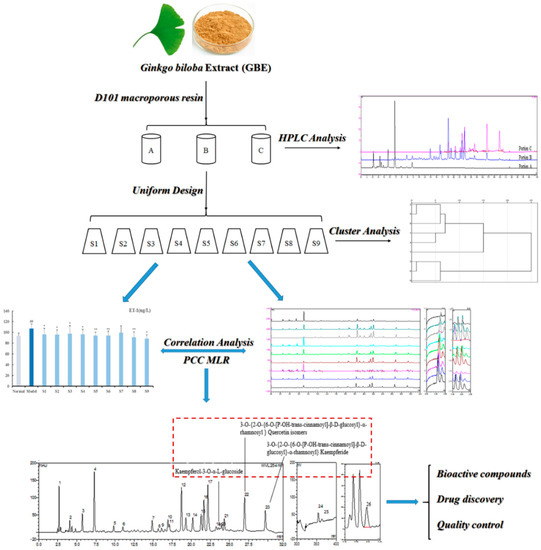
Figure 1.
Research process for discovery of bioactive compounds affecting endothelial function in GBE.
2. Results
2.1. GBE HPLC Fingerprint and Identification of Components
With optimized HPLC conditions, the standard GBE HPLC fingerprint (Figure 2) was established, and 21 compounds were identified or characterized through the HPLC-DAD-ELSD-MS/MS technique in our previous work [6] (Table 1). According to the retention time, UV spectra, and MS spectra of the reference standards, Protocatechuic acid (P4), Rutin (P12), Ginkgolide A (P24), Ginkgolide B (P25), and Bilobalide (P26) were identified unambiguously. The other compounds were characterized according to MS fragmentation pattern, UV spectra, and the reported literature.
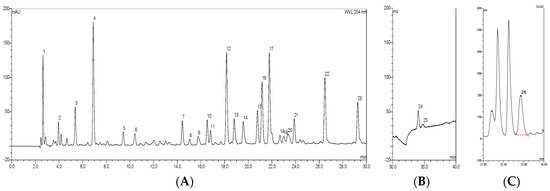
Figure 2.
The HPLC fingerprint of GBE with UV (A) and ELSD (B,C).

Table 1.
Identification of 21 compounds in GBE HPLC fingerprint by UFLC-DAD-Q-TOF-MS/MS.
2.2. Three Portions Separated from GBE and Nine Re-Combined GBE Samples
Portion A, portion B, and portion C were separated from GBE via D101 macroporous resin. They were re-combined with different compositions to get the nine GBE samples (Figure 3). In accordance with the optimized HPLC conditions, the HPLC fingerprints of the nine GBE samples (S1–S9) were constructed (Figure 4). 26 peak areas in nine GBE samples are shown in Table 2.
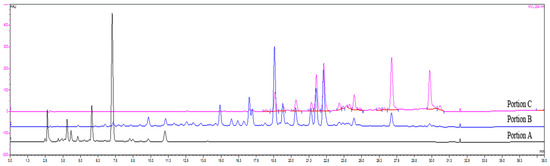
Figure 3.
The HPLC fingerprints of three portions separated from GBE via D101 macroporous resin.
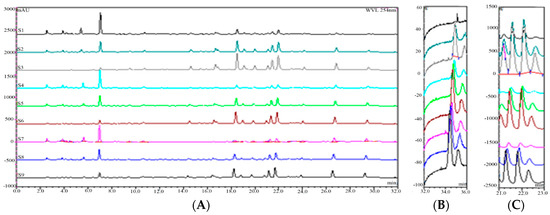
Figure 4.
The HPLC fingerprints of nine GBE samples with UV (A) and ELSD (B,C).
Table 2.
The 26 peak areas of the nine GBE samples.
2.3. Cluster Analysis of Nine GBE Samples
Based on the data of the 26 peak areas, Cluster analysis was performed in SPSS 19.0. The clustering method was Nearest Neighbor. The distance calculation method was Euclidean Distance. The rescaled distance cluster combine was defined as 5. Nine GBE samples could be divided into seven categories (Figure 5): S2 and S5 belonged to a class, S3 and S6 belonged to a class, and the remaining samples respectively represented a class each. Cluster analysis results indicated that the nine GBE samples had chemical differences in their compounds.
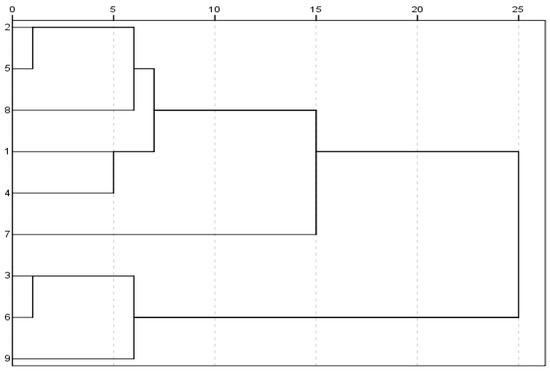
Figure 5.
The dendrogram of cluster analysis of the nine GBE samples.
2.4. ET-1 Biotests of Nine GBE Samples
Plasma ET-1 in vivo was detected in the 11 treatment groups (Table 3). Compared with the normal group, plasma ET-1 content significantly increased in the model group. Compared with the model group, plasma ET-1 content significantly decreased in the S1, S2, S3, S4, S5, S6, S8, and S9 groups, but not for the S7 group. Biotest results indicated that nine GBE samples showed biological differences for ET-1.
Table 3.
The content of ET-1 in plasma.
2.5. CA between Compound Differences and Biological Differences
Dimensionless data of the peak areas of 26 compounds and their ET-1 values are shown in Table S1. The Pearson correlation coefficients (PCC) are shown in Table 4. The results indicated that P18, P22, and P23 had a significantly positive relation with ET-1, but that P1, P2, P3, P4, and P6 were negatively correlated to ET-1.
Table 4.
PCCs between 26 components and ET-1.
The scores of the extracted C1 and C2 were used as the new independent variables (Table 5). The strict regression equation between C1, C2 and ET-1 was established as follows: ET-1 = 94.68 + 0.678 × C1 + 2.626 × C2 (R = 0.801, Sig. < 0.05).
Table 5.
The scores of two components C1 and C2.
In accordance with the rotated component matrix (Table S3), C1 and C2 were replaced by the 26 original independent variables (P1–P26). Regression coefficients (RC) of P1–P26 are shown in Table 6. The results were in accordance with the PC analysis, indicating that P18, P20, P22, P23, and P24 had a highly positive relation with ET-1, but that P1, P2, P3, P4, and P6 showed a negative correlation.
Table 6.
RC between 26 components and ET-1 (Model Sig. < 0.05).
3. Discussion
Current research methods for natural medicine mainly fall into two directions. The first is to separate single components or the active part and then assess the biological effects in vivo or in vitro; the second is to match up the compounds and bio-effects in the whole herb using computational modelling. It is understood that separating and assessing each compound one by one is almost impossible. Numerous existing studies of GBE focus on the chemical identification and the biological effects, separately, but not the correlation between them. ET-1 is a potent vasoconstrictor peptide released from endothelial cells [7]. Several studies have demonstrated that exposure to cold is associated with raised plasma ET-1 [8,9]. Thus, a rat model combined with subcutaneous injection of adrenaline and ice-bath was established, and similar data was observed in the present study.
GBE’s main bioactive constituents include flavonoid glycosides and terpene trilactones. Flavonoid glycosides were detected by HPLC-UV [10,11,12]. Terpene trilactones were detected by Evaporative Light Scattering Detector (ELSD) due to their poor UV absorption property. Thus, GBE’s chromatographic fingerprint was established by HPLC-UV-ELSD, in which 21 compounds were identified or characterized through the UFLC-DAD-Q-TOF-MS/MS technique. To prepare appropriate GBE samples with varying compounds, three portions were separated from GBE using D101 macroporous resin, and then re-combined to get nine GBE samples. The different ratios of the three portions were designed using a four-factor, nine-level Uniform Design (UD) method, which has been successfully applied to prepare different Chinese medicine samples [13,14]. To guarantee the differences of the GBE samples, cluster analysis was conducted that nine GBE samples could be divided into seven categories.
Correlation analysis was applied to discover and predict the compounds with bioactivities in our previous work [15,16]. The discovery of bioactive compounds was based on the hypothesis that the effect varies based on differences in the compounds. If a compound varies a little, while showing a big difference in the effect, the compound will be considered to have a close relevance; in the opposite case, the compound will be considered to have no effect contribution. In the cluster analysis, although S2 and S5, S3 and S6 belonged to a class, there were still relatively large differences among the discovered bioactive compounds, and this might be the reason behind the differences in effect among them. In this work, the Pearson Correlation and Multiple Linear Regression methods were used to evaluate the effect contribution of each compound, and the analysis results of the two methods were highly consistent. The connections between the identified compounds and ET-1 are presented dynamically in the electronic supplementary material (Compound-effect bubble chart). Kaempferol-3-O-α-l-glucoside (P18), 3-O-{2-O-{6-O-[P-OH-trans-cinnamoyl]-β-d-glucosyl}-α-rhamnosyl} Quercetin isomers (P22), and 3-O-{2-O-{6-O-[P-OH-trans-cinnamoyl]-β-d-glucosyl}-α-rhamnosyl} Kaempferide (P23) were significantly correlated to ET-1 (Figure 6). Numerous preclinical studies provide support for flavonoids exhibiting protective effects on endothelial dysfunction [17]. Quercetin, modified from quercetin flavonoid during metabolism, inhibits the overproduction and gene expression of ET-1 in vitro [18,19]. Kaempferol can improve the endothelial damage [20], but there is no direct evidence for either Kaempferol and Kaempferide on regulating ET-1. In GBE, not all the flavonoid glycosides have strong inhibitory activity on ET-1 release. As for terpene trilactones in GBE, Ginkgolide A and Ginkgolide B had a highly positive correlation, which also contributed to the effects. Moreover, P1, P2, P3, P4, and P6 from portion A were negatively correlated with ET-1. Despite having no statistical meaning, the results suggested that water-soluble constituents might induce endothelial dysfunction, but this needs further experiments to confirm.
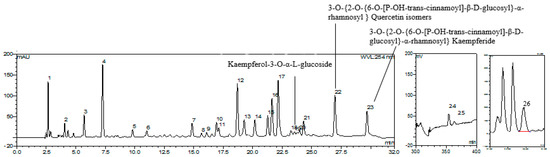
Figure 6.
Three core bioactive compounds of GBE related to ET-1.
4. Materials and Methods
4.1. Animals and Materials
Sprague-Dawley male rats, Specific pathogen-free, 250–300 g, were purchased from Guangdong Medical Laboratory Animal Center (SCXK-(Yue) 2013-0002). Rats were fed on standard laboratory diet and water and kept in environmentally controlled quarters with temperature maintained at 25 °C and a 12 h dark-light cycle for a week before use. Experiments were approved by the Animal Care and Use Committee of Sun Yat-sen University (2015062529) and performed in accordance with guidelines of Institutional Animal Care and Use Committee for U.S. institutions. GBE was manufactured by INDENA S.P.A (batch: 15271). GBE Injection, the sterile solution of GBE, was purchased from Yue Kang Pharmaceutical Group Co., Ltd. (batch: 05121108) (Beijing, China). Adrenalin (Adr) Hydrochloride Injection was purchased from Yuanda Medical (Harbin, China) Co., Ltd. (batch: 150412). 1,2-propanediol and absolute ethyl alcohol was purchased from Tianjin Fuyu Chemical Co., Ltd. (batch: 20141026) (Tianjin, China). Rat ET-1 Elisa Assay Kit was purchased from Nanjing Jiancheng Bioengineering Institute. D101 macroporous resin was purchased from Xi’an Butian Adsorption Materials Co., Ltd. (batch: 20140918) (Xi’an, China).
4.2. Preparation of GBE Samples
GBE (315 mg) was separated into three portions via D101 macroporous resin (20 g), with the eluent of 550 mL purified water (Portion A); 100 mL ethanol (40%, v/v, Portion B), and 100 mL absolute ethyl alcohol (Portion C). Each portion was evaporated with a rotary evaporator and dissolved in 1,2-propanediol (25%, g/mL) to 30 mL for HPLC analysis. According to a four-factor, nine-level UD (Table 7), three portions were re-combined to get nine GBE samples. GBE Samples were stored at 4 °C before use.
Table 7.
Volumes and percentage of three portions in nine GBE samples.
4.3. HPLC Fingerprint and Cluster Analysis
GBE analyses were performed on an UltiMate 3000 series Dual-Gradient Analytical LC System (Dionex, Thermo Fisher Scientific Inc., Waltham, MA, USA), equipped with DAD and ELSD. The HPLC-DAD-ELSD conditions were as follows [6]: Chromatographic separation was carried out using an Agilent zorbax SB C18 column (4.6 mm × 250 mm, 5 μm) as an analytical column and a Dionex Acclaim Polar Advantage C18 column (3.0 mm × 50 mm, 3 μm) as a pretreatment column, and operated at 25 °C; Mobile phase consisted of acetonitrile (A), tetrahydrofuran (B), formic acid (C, 0.1%, v/v) with a multi-step gradient elution (A: 0–27 min: 10%→28%, 27–27.1 min: 28%→1%, 27.1–40 min: 1%→25%; B: 0–27 min: 0%→0%, 27–27.1 min: 0%→15%, 27.1–40 min: 15%→15%; C: 0–27 min: 90%→78%, 27–27.1 min: 72%→84%, 27.1–40 min: 84%→60%) at a flow rate of 1.0 mL/min; Drift tube temperature of ELSD was set at 50 °C, and the nebulizing gas pressure was 3.5 bar with a gain value of 11; Sample volume was set at 10 μL. Data were controlled by Chromeleon 6.8 chromatography data system. 26 peak areas in the HPLC fingerprint were used for Cluster Analysis in SPSS 19.0 (IBM, Armonk, NY, USA). The clustering method was Nearest Neighbor, and the distance calculation method was Euclidean Distance. The rescaled distance cluster combine was set at 5.
4.4. Modelling and ET-1 Assay
Rats were randomly divided into eleven groups of normal (normal saline: NS, 7.2 mL/kg, n = 10) as blank, model (NS, 7.2 mL/kg, n = 10) as negative control, and nine GBE samples (7.2 mL/kg, n = 10), receiving intraperitoneal injection once daily for 7 consecutive days. After the 7th administration, the rats—except those in normal group—were subcutaneously injected with Adr (0.8 mg/kg). After 2 h, rats were kept in ice-water (0–2 °C) for 4 min, and 2 h later were subcutaneously re-injected with Adr (0.8 mg/kg). All the rats were fasted for 12 h. Blood was collected through abdominal aortic. Plasma ET-1 was detected by Elisa kit.
4.5. Correlation Analysis between Compound Difference and Bioactivity Difference
Pearson Correlation. 26 Peak areas were regarded as independent variables (P1–P26). Average ET-1 value was regarded as a dependent variable. Every value of the peak areas and ET-1 in Table 2 was divided by the average of each column to get dimensionless data (Table S1). Pearson Correlation was used to analyze the correlation among P1–P26 and ET-1. Multiple Linear Regression. 26 independent variables (P1–P26) were recombined into two mutual independent principal components, which were regarded as new independent variables (C1 and C2, contributing to 96.388% of the total variance, Table S2). The regression equation between two components (C1 and C2) and ET-1 parameter was constructed by a stepwise regression analysis approach. Once a strict regression equation was established (p < 0.05), C1 and C2 would be replaced by the 26 original independent variables (P1–P26) according to the rotated component matrix (Table S3). Then, the regression coefficients of P1–P26 were used to evaluate the effect contribution.
4.6. Statistical Analysis
Experimental data were presented as mean ± standard deviation and analyzed by One-Way Analysis of Variance. p-values less than 0.05 or 0.01 were considered statistically significant.
5. Conclusions
Kaempferol-3-O-α-l-glucoside, 3-O-{2-O-{6-O-[P-OH-trans-cinnamoyl]-β-d-glucosyl}-α-rhamnosyl} Quercetin isomers, and 3-O-{2-O-{6-O-[P-OH-trans-cinnamoyl]-β-d-glucosyl}-α-rhamnosyl} Kaempferide were discovered to have the closest relevance to ET-1, which has not been reported so far and could provide further reference for the quality control and novel pharmaceutical development of GRE. Moreover, this work proposes a feasible approach for the discovery and prediction of compounds and their bioactivities in complex systems, especially for traditional Chinese medicine. The specific process is as follows: prepare the samples by the re-combination of different parts; establish the HPLC fingerprints; evaluate the bio-effects in vivo; regard the compound differences and effect differences as mathematical variables; analyze the relevance between the variables to find key bioactive compounds.
Supplementary Materials
The following are available online at http://www.mdpi.com/1420-3049/23/5/1071/s1, Table S1: The dimensionless data of 26 peak areas and parameter ET-1 values; Table S2: The total variance explained of two Components; Table S3: The rotated component matrix; Compound-effect bubble chart.
Author Contributions
H.L. and L.-p.T. contributed equally. H.L., H.-l.Y., L.-p.T., and W.-w.S. conceived and designed the experiments; L.-p.T. and X.H. performed the experiments; H.L., L.-p.T., X.H., W.-j.Z., P.-b.L., W.P., and Z.W. analyzed the data; Y.-q.L. contributed reagents/materials/analysis tools; H.L. and L.-p.T. wrote the paper.
Acknowledgments
This work was supported by the grants of Guangdong Secondary Development Projects of Traditional Chinese Medicine (2017-No.19), Guangzhou Major Special Projects of People’s Livelihood (201803010082). The funders had no role in the study design, data collection and analysis, decision to publish, or preparation of the manuscript.
Conflicts of Interest
All the authors involved in this research have no competing interests in the submission of this manuscript. All the materials were exclusively for our experiments and did not represent any commercial company’s interests. There was no financial support from commercial companies. There are no patents, products in development or marketed products to declare. This information does not alter our adherence to all the Molecules policies on sharing data and materials.
Abbreviations
| GBE | Ginkgo biloba Extract |
| CA | Correlation analysis |
| ET-1 | endothelin-1 |
| PCC | Pearson correlation coefficients |
| RC | Regression coefficients |
| ELSD | Evaporative Light Scattering Detector |
| UD | Uniform Design |
| Adr | Adrenalin |
References
- Mckenna, D.J.; Jones, K.; Hughes, K. Efficacy, safety, and use of ginkgo biloba in clinical and preclinical applications. Altern. Ther. Health Med. 2001, 7, 70–90. [Google Scholar] [PubMed]
- Van Beek, T.A. Chemical analysis of ginkgo biloba leaves and extracts. J. Chromatogr. A 2002, 967, 21–55. [Google Scholar] [CrossRef]
- El-Boghdady, N.A. Increased cardiac endothelin-1 and nitric oxide in adriamycin-induced acute cardiotoxicity: Protective effect of ginkgo biloba extract. Indian J. Biochem. Biophys. 2013, 50, 202–209. [Google Scholar] [PubMed]
- Ou, H.C.; Hsieh, Y.L.; Yang, N.C.; Tsai, K.L.; Chen, K.L.; Tsai, C.S.; Chen, I.J.; Wu, B.T.; Lee, S.D. Ginkgo biloba extract attenuates oxldl-induced endothelial dysfunction via an ampk-dependent mechanism. J. Appl. Physiol. 2013, 114, 274–285. [Google Scholar] [CrossRef] [PubMed]
- Wu, Y.Z.; Li, S.Q.; Zu, X.G.; Du, J.; Wang, F.F. Ginkgo biloba extract improves coronary artery circulation in patients with coronary artery disease: Contribution of plasma nitric oxide and endothelin-1. Phytother. Res. 2008, 22, 734–739. [Google Scholar] [CrossRef] [PubMed]
- Huang, X.; Li, P.-L.; Liu, H.; Peng, W.; Wu, Z.; Su, W.-W. Quality re-evaluation of extract from ginkgo biloba leaves injection. Cent. South Pharm. 2016, 1, 24. [Google Scholar]
- Kumar, V.; Abbas, A.K.; Fausto, N.; Mitchell, R.N. Robbins Basic Pathology, 8th ed.; Elsevier: New York, NY, USA, 2007; pp. 403–406. [Google Scholar]
- Nakamura, H.; Matsuzaki, I.; Hatta, K.; Nagase, H.; Nobokuni, Y.; Kambayashi, Y.; Ogino, K. Blood endothelin-1 and cold-induced vasodilation in patients with primary raynauld’s phenomenon and workers with vibration-induced white finger. Int. Angiol. 2003, 22, 243–249. [Google Scholar] [PubMed]
- Yanagisawa, M.; Kurihara, H.; Kimura, S.; Tomobe, Y.; Kobayashi, M.; Mitsui, Y.; Yazaki, Y.; Goto, K.; Masaki, T. A novel potent vasoconstrictor peptide produced by vascular endothelial cells. Nature 1988, 332, 411–415. [Google Scholar] [CrossRef] [PubMed]
- Ji, Y.B.; Xu, Q.S.; Hu, Y.Z.; Heyden, Y.V. Development, optimization and validation of a fingerprint of ginkgo biloba extracts by high-performance liquid chromatography. J. Chromatogr. A 2005, 1066, 97–104. [Google Scholar] [CrossRef] [PubMed]
- Chen, P.; Ozcan, M.; Harnly, J. Chromatographic fingerprint analysis for evaluation of ginkgo biloba products. Anal. Bioanal. Chem. 2007, 389, 251–261. [Google Scholar] [CrossRef] [PubMed]
- Liang, Y.Z. Chromatographic fingerprint analysis--a rational approach for quality assessment of traditional chinese herbal medicine. J. Chromatogr. A 2006, 1112, 171–180. [Google Scholar]
- Liu, H.; Liang, J.P.; Li, P.B.; Peng, W.; Peng, Y.Y.; Zhang, G.M.; Xie, C.S.; Long, C.F.; Su, W.W. Core bioactive components promoting blood circulation in the traditional chinese medicine compound xueshuantong capsule (cxc) based on the relevance analysis between chemical hplc fingerprint and in vivo biological effects. PLoS ONE 2014, 9, e112675. [Google Scholar] [CrossRef] [PubMed]
- Wang, J.; Tong, X.; Li, P.; Liu, M.; Peng, W.; Cao, H.; Su, W. Bioactive components on immuno-enhancement effects in the traditional chinese medicine shenqi fuzheng injection based on relevance analysis between chemical hplc fingerprints and in vivo biological effects. J. Ethnopharmacol. 2014, 155, 405–415. [Google Scholar] [CrossRef] [PubMed]
- Hong, L.; Zheng, Y.F.; Li, C.Y.; Zheng, Y.Y.; Wang, D.Q.; Zhong, W.; Lin, H.; Wang, Y.G.; Li, P.B.; Wei, P. Discovery of anti-inflammatory ingredients in chinese herbal formula kouyanqing granule based on relevance analysis between chemical characters and biological effects. Sci. Rep. 2015, 5, 18080. [Google Scholar]
- Li, P.; Su, W.; Sha, Y.; Liao, Y.; Liao, Y.; Hong, L.; Li, P.; Wang, Y.; Wei, P.; Yao, H. Toward a scientific understanding of the effectiveness, material basis and prescription compatibility of a chinese herbal formula dan-hong injection. Sci. Rep. 2017, 7, 46266. [Google Scholar] [CrossRef] [PubMed]
- Hodgson, J.M.; Croft, K.D. Dietary flavonoids: Effects on endothelial function and blood pressure. J. Sci. Food Agric. 2006, 86, 2492–2498. [Google Scholar] [CrossRef]
- Zhao, X.; Gu, Z.; Attele, A.S.; Yuan, C.S. Effects of quercetin on the release of endothelin, prostacyclin and tissue plasminogen activator from human endothelial cells in culture. J. Ethnopharmacol. 1999, 67, 279–285. [Google Scholar] [CrossRef]
- Loke, W.M.; Hodgson, J.M.; Proudfoot, J.M.; Mckinley, A.J.; Puddey, I.B.; Croft, K.D. Pure dietary flavonoids quercetin and (−)-epicatechin augment nitric oxide products and reduce endothelin-1 acutely in healthy men. Am. J. Clin. Nutr. 2008, 88, 1018–1025. [Google Scholar] [CrossRef] [PubMed]
- Xiao, H.B.; Lu, X.Y.; Chen, X.J.; Sun, Z.L. Protective effects of kaempferol against endothelial damage by an improvement in nitric oxide production and a decrease in asymmetric dimethylarginine level. Eur. J. Pharmacol. 2009, 616, 213–222. [Google Scholar] [CrossRef] [PubMed]
Sample Availability: Samples of the compounds are not available from the authors. |
© 2018 by the authors. Licensee MDPI, Basel, Switzerland. This article is an open access article distributed under the terms and conditions of the Creative Commons Attribution (CC BY) license (http://creativecommons.org/licenses/by/4.0/).