


Abstract
Aluminum (Al) stress is a dominant obstacle for plant growth in acidic soil, which accounts for approximately 40–50% of the world’s potential arable land. The identification and characterization of Al stress response (Al-SR) genes in Arabidopsis, rice, and other plants have deepened our understanding of Al’s molecular mechanisms. However, as a crop sensitive to acidic soil, only eight Al-SR genes have been identified and functionally characterized in maize. In this review, we summarize the Al-SR genes in plants, including their classifications, subcellular localizations, expression organs, functions, and primarily molecular regulatory networks. Moreover, we predict 166 putative Al-SR genes in maize based on orthologue analyses, facilitating a comprehensive understanding of the impact of Al stress on maize growth and development. Finally, we highlight the potential applications of alleviating Al toxicity in crop production. This review deepens our understanding of the Al response in plants and provides a blueprint for alleviating Al toxicity in crop production.
1. Introduction
Acidic soil is globally widespread, encompassing approximately 40–50% of the world’s potentially arable lands, and it constrains crop production worldwide significantly [1,2]. As the most abundant metal element in the earth’s crust, aluminum (Al) mainly exists as insoluble aluminosilicates or Al oxides, which are non-toxic to plant growth, while it exhibits high toxicity toward plants of Al3+ in acidic environments (pH < 5.5) [3]. The predominant obstacle to plant growth in acidic soil is commonly attributed to Al toxicity [4]. Thus, the exploration of the toxic mechanism of Al stress and the characterization of the Al stress response (Al-SR) genes in plants will facilitate potential applications for alleviating Al stress, as well as the crop breeding of and genetic improvement in Al-tolerant varieties.
The effects of Al toxicity on plants are irreversible, even in the presence of a micromolar concentration of Al in the soil [4]. Al toxicity is associated with the interaction between Al and the cell walls, plasma membranes, and symplasms of apical root cells in plants [5]. The primary manifestation of Al stress on plants is the suppression of root elongation, subsequently leading to the restricted uptake of water and nutrients [6,7]. For self-protection, plants have evolved strategies to cope with Al stress, among which internal tolerance and external exclusion are widely considered the primary mechanisms [3,8]. So far, hundreds of Al-SR genes have been cloned in plants, represented by AtSTOP1 in Arabidopsis and OsART1 in rice [9,10,11,12,13,14,15,16,17]. However, as a crop sensitive to acidic soil [18], only a small number of Al-SR genes have been identified and functionally characterized in maize.
Here, we focus on the progress and perspective of Al-SR genes and their roles in the Al response in plants. Based on the cloned Al-SR genes, we propose the regulation mainly of networks of the Al response, utilizing AtSTOP1 and OsART1 as the key regulators in Arabidopsis and rice, respectively. Furthermore, we predict 166 putative Al-SR genes in maize based on orthologue and RNA-seq analyses. Moreover, we outline the potential strategies for alleviating Al stress in crop production, including crop rotation, the exogenous application of other elements, and molecular breeding.
2. Overview of Al-SR Genes in Plants
In Arabidopsis (76), rice (28), wheat (13), maize (8), and sorghum (5), at least 130 Al-SR genes have been cloned; however, compared to Arabidopsis and rice, fewer Al-SR genes have been functionally identified in maize (Figure 1A). To summarize the molecular mechanisms of the cloned Al-SR genes comprehensively, we classified these Al-SR genes into transporters, transcription factors, kinases/phosphatase, and those related to sugar metabolism, hormones, ROS metabolism, and other processes based on their functions, which contain 31, 30, 21, 8, 11, 10, and 19 genes, respectively (Figure 1B).
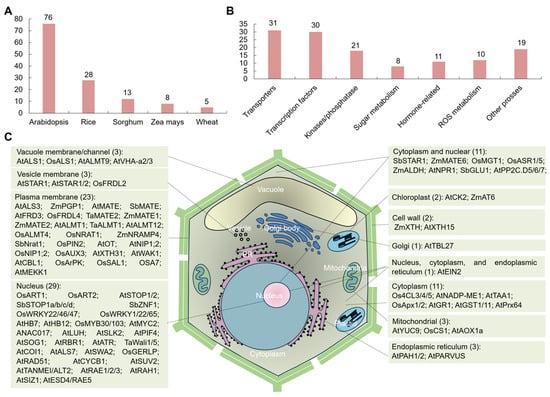
Figure 1.
Identified aluminum stress-related genes, their subcellular localizations, and their roles in plants, and the expression analysis of the cloned maize aluminum stress-related genes in different developmental stages of maize roots. (A) The cloned aluminum stress-related genes in Arabidopsis, rice, maize, wheat, and sorghum. (B) Classification of the cloned aluminum stress-related genes into transporters, transcription factors, kinases/phosphatase, and those related to sugar metabolism, hormones, ROS metabolism, and other processes. (C) The protein subcellular localizations of the aluminum stress-related genes in plants.
Among all the reported Al-SR genes, 90 were investigated for their protein subcellular localizations (Figure 1C). These proteins were localized in several organelles, such as the vacuole membrane/channel, vesicle membrane, plasma membrane, nucleus, etc. Among them, most proteins were localized in the nucleus (29), but fewer were localized in the Golgi (only one) (Figure 1C). These results indicate that the response to Al stress may take place in various organelles in plants.
Moreover, twelve Al-SR gene-encoding proteins were found to be localized in several organelles (e.g., the nucleus-, cytoplasm-, and endoplasmic reticulum-localized AtEIN2) (Figure 1C) [19]. SbSTAR1 [20,21], ZmMATE6 [22], OsMGT1 [23], OsASR1/5 [24], ZmALDH [25], AtNPR1 [19], SbGLU1 [20,21,26], and AtPP2C.D5/6/7 [27,28] were localized in the cytoplasm and nucleus, indicating that these genes may function in multiple organelles for Al stress.
Collectively, the protein subcellular localization information of Al-SR genes is largely consistent with their functions in the response to Al stress. Nevertheless, the detailed molecular mechanism of the response to Al stress is largely unclear and needs to be further investigated.
3. Al-SR Genes and Their Essential Roles in Plants
3.1. Transporters
Transporters are ubiquitous in all living organisms and constitute an integral component of the biological system [29]. In plants, there exists a diverse array of transporters, including ATP-binding cassette (ABC) transporters, multidrug and toxic compound extrusion (MATE) transporters, natural resistance-associated macrophage proteins (NRAMP), and so on [30].
Among the 31 Al-SR transporters, 8 ABC transporters have been identified (Table 1 and Table S1). For example, AtSTAR1, the ortholog of OsSTAR1 and SbSTAR1, interacts with AtALS3. These are all involved in the basic detoxification of Al [20,21,31,32]. OsSTAR2 interacts with OsSTAR1, forming heterodimers in response to Al stress in rice [32]. AtALS1 and OsALS1 interact to sequestrate Al into the vacuoles [33,34]. ZmPGP1 is associated with reducing auxin accumulation in the root tips to regulate Al stress in maize [35]. Nine MATE transporters, such as AtMATE, increase Al resistance and improve carbon-use efficiency for Al resistance and AtFRDL3-mediated efflux of citrate into the root vasculature in Arabidopsis [36,37,38,39]. OsFRDL2 is involved in the Al-induced secretion of citrate, and OsFRDL4 responds to aluminum tolerance by enhancing its expression in rice [40,41,42]. SbMATE mediates Al-activated citrate efflux from the root apices in sorghum [20,43,44,45,46,47,48,49,50,51]. ZmMATE1 and ZmMATE2 are involved in citrate efflux in oocytes, as demonstrated in experiments on maize [52,53]. ZmMATE6 enhances Al tolerance in transgenic Arabidopsis [22]. TaMATE2 is related to Al tolerance in bread wheat [54]. ZmMATE1 is the ortholog of AtFRDL3, OsFRDL2, and TaMATE2, which play similar roles in Al-SR. Malate can regulate plant physiology, thereby facilitating the alleviation of Al-induced stress. There are five identified malate transporters, including AtALMT1 [36,37,55,56,57,58], AtALMT9 [59,60,61], AtALMT12 [62,63], OsALMT4 [63,64], and TaALMT1 [57,65]. These participate in malate transport in response to Al stress in plants. In addition, there are four metal transporters, including OsNrat1 [66,67,68], OsMGT1 [23], SbNrat1 [69], and ZmNRAMP4 [70]; two auxin transporters, including OsPIN2 [71,72] and OsAUX3 [73]; one oxalate transporter, called AtOT [74]; and two aquaporins, including AtNIP1;2 [75,76] and OsNIP1;2 [77]. These are closely correlated to the response to Al stress. Taken together, transporters play vital roles in material transport and are involved in Al-SR in plants.

Table 1.
Functional classifications of the reported Al-SR genes in Arabidopsis, rice, wheat, maize, and sorghum.
3.2. Transcription Factor
The maize genome contains a total of 2216 protein-coding genes that have been predicted to be transcription factor (TF) genes [145]. Up to now, at least 30 Al-SR TF genes have been cloned in Arabidopsis, rice, sorghum, maize, and wheat (Table 1 and Table S1), including 10 zinc finger TFs of AtSTOP1 [11,12,14,85] and AtSTOP2 [88] in Arabidopsis. OsART1 [9,10,15,16,17,34] and OsART2 [9] in rice, SbSTOP1a/b/c/d [86] and SbZNF1 [48] in sorghum, and TaSTOP1 [87] in wheat. Among them, AtSTOP1 and its orthologs in other plants, including OsART1, and SbSTOP1a/b/c/d, play common roles in Al stress by regulating other functional genes. The six WRKY TFs, including AtWRKY46, work as transcriptional repressors of AtALMT1 [89], and AtWRKY47 is involved Al stress via the regulation of cell wall-modifying genes [90] in Arabidopsis. OsWRKY22 promotes Al tolerance by the activation of OsFRDL4 in rice [42]. SbWRKY1, SbWRKY22, and SbWRKY65 positively regulate Al tolerance in sorghum [20,48]. The two abscisic acid, stress, ripening-induced (ASR) family TFs of OsASR1 and OsASR5 work as complementary transcription factors in regulating Al-responsive genes in rice [24,91,92]. The two HD-Zip TFs of AtHB7and AtHB12 respond to Al stress by regulating root growth in Arabidopsis [93], and one basic-leucine zipper (bZIP) TF of SbHY5 facilitates light-induced aluminum tolerance in sorghum by activating the expression of SbMATE and SbSTOP1s [146]. The two MYB TFs of AtMYB103 positively regulate Al sensitivity by mediating the modulation of the O-acetylation level of cell wall xyloglucan and act upstream of TRICHOME BIREFRINGENCE-LIKE27 in Arabidopsis [96]. OsMYB30 is regulated by OsART1 to response aluminum resistance in cell-wall modification in rice [95]. The two NAC TFs of ANAC017 regulate Al tolerance through the modulation of genes involved in cell-wall modification [97]. AtSOG1 suppresses growth reduction in plants under Al stress [98,99]. The JA signaling regulator of MYC2, a bHLH transcription factor, upregulates the response to Al stress of Arabidopsis root tips [100]. Additionally, another four TFs, including AtLUH [101,102], AtSLK2 [101], AtPIF4 [7], and AtRBR1 [103], are also involved in Al tolerance in plants, indicating that these transcription factors may play core roles in plants under Al stress. However, further analysis is necessary for some TFs to gain a more comprehensive understanding, although the target genes of most TFs have been identified as responsive to Al stress.
3.3. Kinases/Phosphatase
Kinases and phosphatase play pivotal roles in plant stress response [146,147]. Up to now, at least 20 Al-SR kinases/phosphatase genes have been cloned in Arabidopsis, rice, sorghum, maize, wheat, and other plants (Table 1 and Table S1). The cell wall-associated receptor kinase AtWAK1 increases Al tolerance in terms of root growth [104]. The activity of AtCK2 kinase contributes to the development of Al toxicity tolerance, and regulates the DNA damage response (DDR) pathway by phosphorylating SOG1 [105]. The loss functions of AtRAE1, AtRAE2, AtRAE3/AtHPR1, and AtRAH1 reduce Al resistance by acting as an E3 ligase to regulate the stability of the target proteins, such as AtSTOP1 and AtALMT1 [35,106,107,108]. However, the loss function of AtESD4/RAE5 or AtSIZ1 increases the transcriptional-level AtALMT1, thereby enhancing the resistance to Al in atesd4/rae5 or atsiz1 [109,111,148,149]. The AtMEKKK1-MKK1/2-MPK4 cascade plays a crucial role in Al signaling and confers resistance to Al by enhancing AtSTOP1 accumulation through phosphorylation-mediated mechanisms in Arabidopsis [112,150]. OsSAL1, a member of the PP2C.D family, is the ortholog of AtPP2C.D5/D6/D7 in Arabidopsis. Remarkably, both the ossal1 mutant and the atpp2c.d5/d6/d7 triple mutant exhibit more Al resistance compared to the WT, suggesting conserved yet complex roles of these phosphatases in modulating plant stress responses [27,28]. Additionally, OsSAL1 interacts with and dephosphorylates the plasma membrane H+-ATPase OsA7 to exert negative regulation on its function in Al stress [27]. AtATR phosphorylates AtSUV2 in vivo under Al stress [114]. In addition, the expression of certain genes is influenced by Al stress and other stress. For instance, the atpah1/pah2 double mutant exhibits enhanced susceptibility to Al under low-phosphorus conditions [113]. The expression of OsArPK, an Al-related protein kinase gene, is induced in the roots following prolonged exposure to high concentrations of Al [115].
3.4. Sugar Metabolism
The cellular sugar status remains relatively stable under normal growth conditions but is adversely affected by various environmental perturbations [151,152]. In plants, at least eight Al-SR sugar metabolism-related genes have been cloned (Table 1 and Table S1). AtEXPA10 is an Al-inducible expansin gene that is regulated by AtART1 and plays an important role in modulating Al accumulation within root cell walls [116]. The expression of ZmXTH is significantly induced by Al toxicity, and the overexpression of ZmXTH in Arabidopsis enhances the tolerance to Al toxicity by reducing Al accumulation in both the roots and cell walls [117]. AtXTH15 and AtXTH31 are endo-trans-glucosylase-hydrolases and exhibit enhanced Al resistance in their mutants [118,119]. AtTBL27 influences the sensitivity of Arabidopsis to Al by modulating the Al-binding capacity in hemicellulose [96,120]. The identification of AtPME46 revealed its ability to reduce the binding of Al to cell walls, thereby alleviating Al-induced inhibition of root growth through the downregulation of PME enzyme activity [101]. Furthermore, the modified characteristics of hemicellulose contribute to its reduced Al accumulation in the atparvus mutant [121]. The β-1,3-glucanase SbGLU1 reduced callose deposition and increased tolerance to Al toxicity, highlighting the intricate interplay between cell wall components and aluminum stress responses in plants [20,26,122].
3.5. Hormone-Related Genes
Plant hormones occupy a central role in regulating essential aspects of growth, development, and adaptive responses to environmental stress [153]. At least 11 Al-SR hormone-related genes have been cloned in plants (Table 1 and Table S1). For example, AtEIN2 and AtNPR1 are ethylene and salicylic acid signal factors. The loss functions of AtEIN2 and AtNPR1 display more susceptibility to Al stress than WT [19]. The local biosynthesis of auxin regulated by YUCs in the root apex transition zone mediates the inhibition of root growth in response to Al stress [7]. AtTAA1 is specifically upregulated in the root apex TZ in response to Al treatment [7,124]. Additionally, AtCOI1-mediated Al-induced root growth inhibition under Al stress was controlled by ethylene [100]. AtSUR1 and AtSUR2 promote IAA biosynthesis and auxin conjugation, respectively, and the sur1 and sur2 mutants exhibit increased sensitivity to Al stress [118,125,126].
3.6. ROS Metabolism
Reactive oxygen species (ROS) serve as crucial signaling molecules that facilitate prompt cellular responses to various stimuli in plants [154]. The production of ROS is significantly increased in plants under biotic or abiotic stresses, disrupting the homeostasis of -OH, O2-, and H2O2. To maintain the balance of ROS in vivo, some enzymes and low-molecular-weight compounds participate in antioxidant mechanisms in plants, including superoxide dismutases (SODs), catalases (CATs), ascorbate peroxidases (APx), glutathione peroxidases (GPx), ascorbic acid, glutathione, and tocoferol [155]. Up to now, at least 10 Al-SR hormone-related genes have been cloned in Arabidopsis, rice, sorghum, maize, and wheat (Table 1 and Table S1).
In rice, H2O2 accumulation is significantly increased in OsApx1/2-silenced plants and presents higher Al tolerance than WT [127]. The overexpression of AtGR can maintain GSH levels, reinforcing the detoxification functions in plants and providing an efficient approach for enhancing Al tolerance [128]. The expressions of AtGST1 and AtGST11 are activated in response to Al stresses [129]. The AtPrx64 gene increases root growth and mitigates the accumulation of Al and ROS in the roots [130]. AtAOX1a mitigates Al-induced programmed cell death (PCD) by preserving mitochondrial function and enhancing the expression of protective functional genes [131]. ZmAT6 and ZmALDH confer Al tolerance via ROS scavenging and reduce Al accumulation in roots [25,132]. The involvement of AtNADP-ME1 in regulating malate levels in the root apex leads to an elevation in the content of this organic acid [133]. In general, these ROS metabolism genes dynamically respond to aluminum stress by meticulously regulating ROS homeostasis, ensuring plant survival and resilience under adverse conditions.
3.7. Other Processes
Apart from the Al stress-related genes mentioned above, several additional genes have been reported to regulate Al stress response in plants (Table 1 and Table S1). Examples include AtGRP3, which encodes a glycine-rich protein [134], AtVHA-a2/a3, which encodes a subunit of the vacuolar H+-ATPase (V-ATPase) [8], AtSUV2, a putative plant ATRIP homologue [114], and AtALT1, a thioesterase [78]. These negatively control Al stress in plants. AtCBL1, a calcineurin B-like calcium sensor [135], AtALS7, a ribosomal biogenesis factor [136], AtSWA2, a CCAAT-box binding factor [136], AtRAD51, a DNA repair family protein gene [103], AtCYCB1, a cyclin protein gene [103], AtTANMEI/ALT2, a WD40 protein gene [138], and AtPGIP1, a P450-dependent monooxygenase gene [139], positively regulate Al stress in Arabidopsis. OsGERLP [137], Os4CL3/4/5 [7,95,140,141,142], and OsCS1 [143] positively regulate Al stress in rice. Additionally, TaWali1 and TaWali5 positively regulate Al stress in wheat [144]. In a word, the response to Al stress is an intricate process, necessitating the coordination of multiple substances and genes.
4. The Primary Molecular Regulatory Network for the Cloned Al Stress-Related Genes in Plants
Plant response to Al stress is a fairly complicated process. Here, a molecular regulatory network for the cloned Al-SR genes in plants, which mainly include similar STOP1-related pathways in Arabidopsis and ART1-related pathways in rice, is summarized and updated, considering the functional properties (Figure 2).
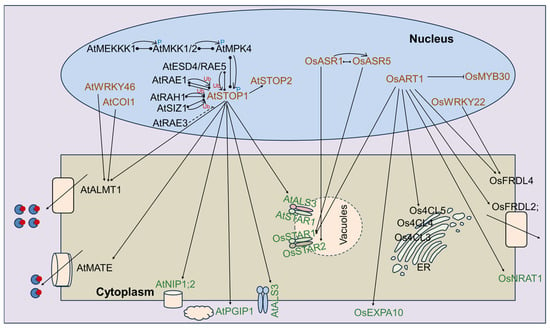
Figure 2.
The primary signaling pathways of the cloned aluminum stress-related genes involved in plants.
4.1. STOP1-Related Pathway in Arabidopsis
STOP1 (SENSITIVE TO PROTEIN RHIZOTOXICITY 1) is a zinc finger transcription factor that plays important roles in Al tolerance [11,12,14,54,85,86]. In Arabidopsis, AtSTOP1 plays a central role in Al tolerance because of its ability to connect upstream kinases and downstream target genes (Figure 2). The AtMEKKK1-AtMKK1/2-AtMPK4 cascade exerts a positive regulatory effect on AtSTOP1 phosphorylation and stability. The phosphorylation of AtSTOP1 diminishes its interaction with the F-box protein AtRAE1 [112]. AtRAE1 interacts with and facilitates the ubiquitin-26S proteasome pathway-mediated degradation of AtSTOP1, while Al stress induces the accumulation of AtSTOP1 [6]. Meanwhile, AtRAH1, AtSIZ1, and AtESD4/RAE5 interact with AtSTOP1 and regulate AtSTOP1 SUMOylation under Al stress [106,109,149]. Additionally, AtRAE3 regulates AtSTOP1 mRNA exports under Al stress [107]. AtSTOP2 works as a physiologically minor isoform of AtSTOP1, and AtSTOP2 is directly regulated by AtSTOP1 [88]. In addition, AtSTOP1 regulates malate transporter gene AtALMT1 [58], MATE transporter gene AtMATE [36,37], aquaporin gene AtNIP1;2 [75,76], P450-dependent monooxygenase gene AtPGIP1 [139], and ABC transporter gene AtALS1, and AtALS1 interacts with AtSTAR1 to form heterodimers [31].
4.2. ART1-Related Pathway in Rice
ART1 (Al resistance transcription factor 1), a C2H2-type zinc finger transcription factor, which is the ortholog of AtSTOP1, regulates the gene expressions associated with Al tolerance in rice [16]. OsART1 confers Al resistance by repressing the modification of cell wall properties regulated by OsMYB30, thereby enhancing the effect of Al resistance [95], and in turn repressing Os4CL5-dependent 4-coumaric acid accumulation, which is similar to the functions of Os4CL3 and Os4CL4 [7,140,141,142]. The MATE family protein genes of OsFRDL2 and OsFRDL4 are directly regulated by OsART1 and involved in the Al-induced secretion of citrate [40,41,42,80]. OsART1 directly regulates metal transporter gene OsNRAT1, and OsNRAT1 serves as the initial step in sequestering Al3+ into the vacuoles, thereby alleviating Al toxicity [66,67,68]. OsEXPA10, an Al-inducible expansion gene, is regulated by OsART1 and promotes Al accumulation in the root cell of rice [116]. Similar to AtSTOP1, OsART1 regulates OsSTAR1, which is orthologous with AtSTAR1. OsSTAR1 forms heterodimers with OsSTAR2 at tonoplasts [32]. In general, AtSTOP1 and OsART1 play pivotal roles in the response to Al stress in Arabidopsis and rice, making the STOP1/ART1-related pathways valuable models for studying Al stress in maize and other plant species.
5. Prediction of Putative Al Stress-Related Genes in Maize
Compared to Arabidopsis and rice, only eight maize Al stress-related genes have been identified in maize. Among them, five cloned Al stress-related genes encode transporters. For example, ZmPGP1, an ABCB transporter, mediated auxin efflux in an action, regulated Al stress, and was associated with reduced auxin accumulation in root tips [35,156]. ZmMATE1, ZmMATE2, and ZmMATE6 belong to the MATE family. Maize is Al-tolerant with a higher ZmMATE1 copy number; however, ZmMATE2 is involved in a novel Al-tolerance mechanism [52,53,79]. ZmMATE6 displays a greater Al-activated release of citrate from the roots and is significantly resistant to Al toxicity [22]. ZmNRAMP4 is a metal transporter that enhances Al tolerance via the cytoplasmic sequestration of Al in maize [70]. Translocating the expression of ZmXTH, a xyloglucan endotransglucosylase/hydrolase gene, enhances tolerance to Al toxicity by reducing the Al accumulation in the roots and cell wall in Arabidopsis [117]. Two Al stress-related genes belong to ROS metabolism genes. For example, ZmAT6 confers Al tolerance via ROS scavenging [132]. ZmALDH participates in Al-induced oxidative stress and Al accumulation in roots [25]. To discover more Al stress-related genes in maize, putative Al stress-related genes in maize are predicted based on ortholog analysis and maize root RNA-seq analyses. Here, a total of 166 putative maize genes associated with Al stress were identified by analyzing the orthologs of other plants based on the Ensembl Plants website (https://plants.ensembl.org/index.html, accessed on 26 February 2024). Those 166 putative Al stress-related genes in maize are distributed among the ten chromosomes of maize with variable numbers, from twelve on chromosome 6 and chromosome 10 to twenty-eight on chromosome 2 (Figure 3, Figure S1, and Table S1). The in silico mapping information can facilitate gene cloning and evolutionary studies of the Al stress-related genes in maize.
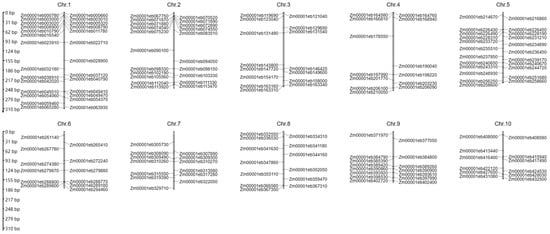
Figure 3.
The precise chromosomal locations of the 166 predicted aluminum stress-related genes in the maize genome.
6. Potential Applications to Alleviate Al Stress in Crop Production
The toxicity of Al poses a global challenge in acidic soils (pH < 5.5), leading to diminished crop growth and reduced productivity [1]. Previous studies have shown that Al have pleiotropic functions of beneficial or toxic effect to plants and other organisms, depending on factors such as the metal concentration, the chemical form of Al, the growth conditions, and the plant species [157]. Consequently, alleviating Al stress and even harnessing Al resources efficiently is imperative for sustainable agricultural production. To mitigate Al stress, we propose potential applications to alleviate Al stress in crop production based on the current research (Figure 4).
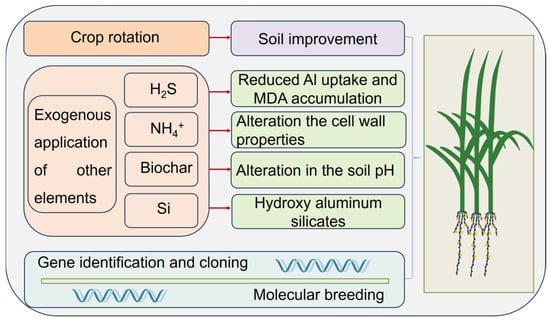
Figure 4.
Potential applications to alleviate aluminum stress in crop production.
In previous studies, crop rotation has been considered as an effective way to alleviate heavy-metal stress [158]. Implementing a crop rotation strategy that involves the selection of low Al-accumulating cultivars, along with effective water and manure management practices, to achieve the purpose of soil improvement, can potentially serve as an efficacious approach to mitigate Al-induced damage (Figure 4). Additionally, applying other exogenous elements in crop growth is also a viable method (Figure 4). For example, the alleviation of Al toxicity by H2S is associated with an increase in ATPase activity, as well as a reduction in Al uptake and oxidative stress in barley at the seedling stage [159]. The uptake of NH4+ leads to a decrease in pH, which in turn alters the properties of the cell wall and reduces the Al accumulation by NH4+-induced mechanisms, rather than through direct competition for binding sites between Al3+ and NH4+ [84]. The application of exogenous Si treatment results in the formation of hydroxy Al silicates within the apoplast of the root apex, thereby effectively detoxifying Al [160]. For breeders, the issue of crop Al toxic needs to be solved from the original source, such as the development of new Al-tolerant varieties by using molecular breeding techniques (Figure 4). In summary, it is imperative to explore more efficient and convenient approaches in order to alleviate the detrimental effects of Al stress on crop production, aiming for enhanced quality and yield.
7. Conclusions and Perspectives
Al stress is a significant hazard in plant growth in low-pH environments, and thus, it affects organ development and ultimately reduces the grain yield in crops [161]. Here, we systematically investigated the Al-SR genes and their roles in controlling the response of plants to Al. To date, most of the cloned Al-SR genes have been identified in Arabidopsis and rice, with a number of genes reported in maize (only eight). Here, we predicted 166 maize orthologs of Al-SR genes in other plants and determined their precise chromosome localizations in the maize genome (Figure 3). This research provides a batch of targets genes to study the molecular mechanisms and genetic improvement of the Al response of maize by using CRISPR/Cas9 mutagenesis or other biotechnologies. In acidic soil conditions, even trace amounts of Al can elicit severe and irreversible toxicity symptoms in higher plants, drastically hindering water and nutrient uptake, and thereby imposing considerable stress on plant growth [4]. Therefore, we provide some potentially effective applications for mitigating Al stress in crop production, aiming to cultivate healthy and high-yielding crops even under the challenging conditions imposed by Al toxicity. Therefore, the investigation of the functional mechanisms of Al-SR genes and the exploration of new methods to mitigate Al stress are formidable tasks to enhance the crop grain yield. These tasks should be given priority considerations in future work.
Supplementary Materials
The following supporting information can be downloaded at: https://www.mdpi.com/article/10.3390/ijms25169045/s1.
Author Contributions
Conceptualization, W.L. and C.F.; validation, C.F., J.W. and W.L.; formal analysis, C.F., J.W. and W.L.; resources, C.F. and J.W. writing—original draft preparation, C.F. and J.W.; writing—review and editing, W.L. and C.F.; visualization, W.L. and C.F.; supervision, W.L.; project administration, W.L. and C.F.; funding acquisition, W.L. All authors have read and agreed to the published version of the manuscript.
Funding
This research was funded by Key R&D and Promotion Projects in Henan Province (242102111164), the Henan Science & Technology Research and Development Plan Joint Fund (222301420106), the Zhongyuan Scholar Workstation of Henan Province (244400510009), and the Observation and Research Field Station of Taihang Mountain Forest Ecosystems of Henan Province, Xinxiang 453007, Henan, China.
Institutional Review Board Statement
Not applicable.
Informed Consent Statement
Not applicable.
Data Availability Statement
All data are shown in the main manuscript and in the Supplementary Materials.
Conflicts of Interest
The authors declare no conflicts of interest.
References
- Kochian, L.V.; Pineros, M.A.; Liu, J.; Magalhaes, J.V. Plant adaptation to acid soils: The molecular basis for crop aluminum resistance. Annu. Rev. Plant Biol. 2015, 66, 571–598. [Google Scholar] [CrossRef] [PubMed]
- Liu, C.; Jiang, M.; Yuan, M.M.; Wang, E.; Bai, Y.; Crowther, T.W.; Zhou, J.; Ma, Z.; Zhang, L.; Wang, Y.; et al. Root microbiota confers rice resistance to aluminium toxicity and phosphorus deficiency in acidic soils. Nat. Food 2023, 4, 912–924. [Google Scholar] [CrossRef] [PubMed]
- Ma, J.F. Syndrome of aluminum toxicity and diversity of aluminum resistance in higher plants. Int. Rev. Cytol. 2007, 264, 225–252. [Google Scholar] [CrossRef] [PubMed]
- Chauhan, D.K.; Yadav, V.; Vaculik, M.; Gassmann, W.; Pike, S.; Arif, N.; Singh, V.P.; Deshmukh, R.; Sahi, S.; Tripathi, D.K. Aluminum toxicity and aluminum stress-induced physiological tolerance responses in higher plants. Crit. Rev. Biotechnol. 2021, 41, 715–730. [Google Scholar] [CrossRef] [PubMed]
- Horst, W.J.; Wang, Y.; Eticha, D. The role of the root apoplast in aluminium-induced inhibition of root elongation and in aluminium resistance of plants: A review. Ann. Bot. 2010, 106, 185–197. [Google Scholar] [CrossRef] [PubMed]
- Zhang, Y.; Zhang, J.; Guo, J.; Zhou, F.; Singh, S.; Xu, X.; Xie, Q.; Yang, Z.; Huang, C. F-box protein RAE1 regulates the stability of the aluminum-resistance transcription factor STOP1 in Arabidopsis. Proc. Natl. Acad. Sci. USA 2019, 116, 319–327. [Google Scholar] [CrossRef] [PubMed]
- Liu, G.; Gao, S.; Tian, H.; Wu, W.; Robert, H.S.; Ding, Z. Local transcriptional control of YUCCA regulates auxin promoted root-growth inhibition in response to aluminium stress in Arabidopsis. PLoS Genet. 2016, 12, e1006360. [Google Scholar] [CrossRef]
- Zhang, F.; Yan, X.; Han, X.; Tang, R.; Chu, M.; Yang, Y.; Yang, Y.; Zhao, F.; Fu, A.; Luan, S.; et al. A defective vacuolar proton pump enhances aluminum tolerance by reducing vacuole sequestration of organic acids. Plant Physiol. 2019, 181, 743–761. [Google Scholar] [CrossRef]
- Che, J.; Tsutsui, T.; Yokosho, K.; Yamaji, N.; Ma, J.F. Functional characterization of an aluminum (Al)-inducible transcription factor, ART2, revealed a different pathway for Al tolerance in rice. New Phytol. 2018, 220, 209–218. [Google Scholar] [CrossRef] [PubMed]
- Arbelaez, J.D.; Maron, L.G.; Jobe, T.O.; Pineros, M.A.; Famoso, A.N.; Rebelo, A.R.; Singh, N.; Ma, Q.; Fei, Z.; Kochian, L.V.; et al. ALUMINUM RESISTANCE TRANSCRIPTION FACTOR 1 (ART1) contributes to natural variation in aluminum resistance in diverse genetic backgrounds of rice (O. sativa). Plant Direct. 2017, 1, e00014. [Google Scholar] [CrossRef]
- Godon, C.; Mercier, C.; Wang, X.; David, P.; Richaud, P.; Nussaume, L.; Liu, D.; Desnos, T. Under phosphate starvation conditions, Fe and Al trigger accumulation of the transcription factor STOP1 in the nucleus of Arabidopsis root cells. Plant J. 2019, 99, 937–949. [Google Scholar] [CrossRef] [PubMed]
- Huang, C. Activation and activity of STOP1 in aluminium resistance. J. Exp. Bot. 2021, 72, 2269–2272. [Google Scholar] [CrossRef]
- Iuchi, S.; Kobayashi, Y.; Koyama, H.; Kobayashi, M. STOP1, a Cys2/His2 type zinc-finger protein, plays critical role in acid soil tolerance in Arabidopsis. Plant Signal. Behav. 2008, 3, 128–130. [Google Scholar] [CrossRef]
- Le Poder, L.; Mercier, C.; Fevrier, L.; Duong, N.; David, P.; Pluchon, S.; Nussaume, L.; Desnos, T. Uncoupling aluminum toxicity from aluminum signals in the STOP1 pathway. Front. Plant Sci. 2022, 13, 785791. [Google Scholar] [CrossRef]
- Sun, L.M.; Che, J.; Ma, J.F.; Shen, R.F. Expression level of transcription factor ART1 is responsible for differential aluminum tolerance in indica rice. Plants 2021, 10, 634. [Google Scholar] [CrossRef]
- Yamaji, N.; Huang, C.F.; Nagao, S.; Yano, M.; Sato, Y.; Nagamura, Y.; Ma, J.F. A zinc finger transcription factor ART1 regulates multiple genes implicated in aluminum tolerance in rice. Plant Cell. 2009, 21, 3339–3349. [Google Scholar] [CrossRef]
- Tsutsui, T.; Yamaji, N.; Ma, J.F. Identification of a cis-acting element of ART1, a C2H2-type zinc-finger transcription factor for aluminum tolerance in rice. Plant Physiol. 2011, 156, 925–931. [Google Scholar] [CrossRef]
- Fageria, N.K.; Baligar, V.C. Growth and nutrient concentrations of common bean, lowland rice, corn, soybean, and wheat at different soil pH on an Inceptisol. J. Plant Nutr. 1999, 22, 1495–1507. [Google Scholar] [CrossRef]
- Zhang, Y.; He, Q.; Zhao, S.; Huang, L.; Hao, L. Arabidopsis ein2-1 and npr1-1 response to Al stress. Bull. Environ. Contam. Toxicol. 2014, 93, 78–83. [Google Scholar] [CrossRef]
- Guan, K.; Yang, Z.; Zhan, M.; Zheng, M.; You, J.; Meng, X.; Li, H.; Gao, J. Two sweet sorghum (Sorghum bicolor L.) WRKY transcription factors promote aluminum tolerance via the reduction in callose deposition. Int. J. Mol. Sci. 2023, 24, 288. [Google Scholar] [CrossRef] [PubMed]
- Gao, J.; Liang, Y.; Li, J.; Wang, S.; Zhan, M.; Zheng, M.; Li, H.; Yang, Z. Identification of a bacterial-type ATP-binding cassette transporter implicated in aluminum tolerance in sweet sorghum (Sorghum bicolor L.). Plant Signal. Behav. 2021, 16, 1916211. [Google Scholar] [CrossRef] [PubMed]
- Du, H.; Ryan, P.R.; Liu, C.; Li, H.; Hu, W.; Yan, W.; Huang, Y.; He, W.; Luo, B.; Zhang, X.; et al. ZmMATE6 from maize encodes a citrate transporter that enhances aluminum tolerance in transgenic Arabidopsis thaliana. Plant Sci. 2021, 311, 111016. [Google Scholar] [CrossRef]
- Chen, Z.C.; Yamaji, N.; Motoyama, R.; Nagamura, Y.; Ma, J.F. Up-regulation of a magnesium transporter gene OsMGT1 is required for conferring aluminum tolerance in rice. Plant Physiol. 2012, 159, 1624–1633. [Google Scholar] [CrossRef] [PubMed]
- Arenhart, R.A.; Schunemann, M.; Bucker, N.L.; Margis, R.; Wang, Z.Y.; Margis-Pinheiro, M. Rice ASR1 and ASR5 are complementary transcription factors regulating aluminium responsive genes. Plant Cell Environ. 2016, 39, 645–651. [Google Scholar] [CrossRef] [PubMed]
- Du Hanmei, L.C.J.X. Overexpression of the aldehyde dehydrogenase gene ZmALDH confers aluminum tolerance in Arabidopsis thaliana. Int. J. Mol. Sci. 2022, 23, 477. [Google Scholar] [CrossRef]
- Zhang, H.; Shi, W.L.; You, J.F.; Bian, M.D.; Qin, X.M.; Yu, H.; Liu, Q.; Ryan, P.R.; Yang, Z.M. Transgenic Arabidopsis thaliana plants expressing a β-1,3-glucanase from sweet sorghum (Sorghum bicolor L.) show reduced callose deposition and increased tolerance to aluminium toxicity. Plant Cell Environ. 2015, 38, 1178–1188. [Google Scholar] [CrossRef]
- Xie, W.; Liu, S.; Gao, H.; Wu, J.; Liu, D.; Kinoshita, T.; Huang, C.F. PP2C.D phosphatase SAL1 positively regulates aluminum resistance via restriction of aluminum uptake in rice. Plant Physiol. 2023, 192, 1498–1516. [Google Scholar] [CrossRef]
- Ren, H.; Park, M.Y.; Spartz, A.K.; Wong, J.H.; Gray, W.M. A subset of plasma membrane-localized PP2C.D phosphatases negatively regulate SAUR-mediated cell expansion in Arabidopsis. PLoS Genet. 2018, 14, e1007455. [Google Scholar] [CrossRef]
- Rees, D.C.; Johnson, E.; Lewinson, O. ABC transporters: The power to change. Nat. Rev. Mol. Cell Biol. 2009, 10, 218–227. [Google Scholar] [CrossRef]
- Devanna, B.N.; Jaswal, R.; Singh, P.K.; Kapoor, R.; Jain, P.; Kumar, G.; Sharma, Y.; Samantaray, S.; Sharma, T.R. Role of transporters in plant disease resistance. Physiol. Plant. 2021, 171, 849–867. [Google Scholar] [CrossRef]
- Huang, C.; Yamaji, N.; Ma, J.F. Knockout of a bacterial-type ATP-binding cassette transporter gene, AtSTAR1, results in increased aluminum sensitivity in Arabidopsis. Plant Physiol. 2010, 153, 1669–1677. [Google Scholar] [CrossRef] [PubMed]
- Huang, C.F.; Yamaji, N.; Mitani, N.; Yano, M.; Nagamura, Y.; Ma, J.F. Bacterial-type ABC transporter is involved in aluminum tolerance in rice. Plant Cell 2009, 21, 655–667. [Google Scholar] [CrossRef]
- Larsen, P.B.; Cancel, J.; Rounds, M.; Ochoa, V. Arabidopsis ALS1 encodes a root tip and stele localized half type ABC transporter required for root growth in an aluminum toxic environment. Planta 2007, 225, 1447–1458. [Google Scholar] [CrossRef]
- Huang, C.F.; Yamaji, N.; Chen, Z.; Ma, J.F. A tonoplast-localized half-size ABC transporter is required for internal detoxification of aluminum in rice. Plant J. 2012, 69, 857–867. [Google Scholar] [CrossRef]
- Zhang, M.; Lu, X.; Li, C.; Zhang, B.; Zhang, C.; Zhang, X.; Ding, Z. Auxin efflux carrier ZmPGP1 mediates root growth inhibition under aluminum stress. Plant Physiol. 2018, 177, 819–832. [Google Scholar] [CrossRef]
- Liu, J.; Luo, X.; Shaff, J.; Liang, C.; Jia, X.; Li, Z.; Magalhaes, J.; Kochian, L.V. A promoter-swap strategy between the AtALMT and AtMATE genes increased Arabidopsis aluminum resistance and improved carbon-use efficiency for aluminum resistance. Plant J. 2012, 71, 327–337. [Google Scholar] [CrossRef] [PubMed]
- Nakano, Y.; Kusunoki, K.; Maruyama, H.; Enomoto, T.; Tokizawa, M.; Iuchi, S.; Kobayashi, M.; Kochian, L.V.; Koyama, H.; Kobayashi, Y. A single-population GWAS identified AtMATE expression level polymorphism caused by promoter variants is associated with variation in aluminum tolerance in a local Arabidopsis population. Plant Direct 2020, 4, e00250. [Google Scholar] [CrossRef]
- Durrett, T.P.; Gassmann, W.; Rogers, E.E. The FRD3-mediated efflux of citrate into the root vasculature is necessary for efficient iron translocation. Plant Physiol. 2007, 144, 197–205. [Google Scholar] [CrossRef]
- Green, L.S.; Rogers, E.E. FRD3 controls iron localization in Arabidopsis. Plant Physiol. 2004, 136, 2523–2531. [Google Scholar] [CrossRef] [PubMed]
- Yokosho, K.; Yamaji, N.; Fujii-Kashino, M.; Ma, J.F. Functional analysis of a MATE gene OsFRDL2 revealed its involvement in Al-induced secretion of citrate, but a lower contribution to Al tolerance in rice. Plant Cell Physiol. 2016, 57, 976–985. [Google Scholar] [CrossRef]
- Yokosho, K.; Yamaji, N.; Ma, J.F. An Al-inducible MATE gene is involved in external detoxification of Al in rice. Plant J. 2011, 68, 1061–1069. [Google Scholar] [CrossRef]
- Li, G.Z.; Wang, Z.Q.; Yokosho, K.; Ding, B.; Fan, W.; Gong, Q.Q.; Li, G.X.; Wu, Y.R.; Yang, J.L.; Ma, J.F.; et al. Transcription factor WRKY22 promotes aluminum tolerance via activation of OsFRDL4 expression and enhancement of citrate secretion in rice (Oryza sativa). New Phytol. 2018, 219, 149–162. [Google Scholar] [CrossRef] [PubMed]
- Caniato, F.F.; Hamblin, M.T.; Guimaraes, C.T.; Zhang, Z.; Schaffert, R.E.; Kochian, L.V.; Magalhaes, J.V. Association mapping provides insights into the origin and the fine structure of the sorghum aluminum tolerance locus, AltSB. PLoS ONE 2014, 9, e87438. [Google Scholar] [CrossRef]
- Carvalho, G.; Schaffert, R.E.; Malosetti, M.; Viana, J.H.M.; Menezes, C.B.; Silva, L.A.; Guimaraes, C.T.; Coelho, A.M.; Kochian, L.V.; van Eeuwijk, F.A.; et al. The citrate transporter SbMATE is a major asset for sustainable grain yield for sorghum cultivated on acid soils. G3 Genes Genom. Genet. 2016, 6, 475–484. [Google Scholar] [CrossRef]
- Hufnagel, B.; Guimaraes, C.T.; Craft, E.J.; Shaff, J.E.; Schaffert, R.E.; Kochian, L.V.; Magalhaes, J.V. Exploiting sorghum genetic diversity for enhanced aluminum tolerance: Allele mining based on the AltSB locus. Sci. Rep. 2018, 8, 10094. [Google Scholar] [CrossRef]
- Magalhaes, J.V.; Liu, J.; Guimaraes, C.T.; Lana, U.G.; Alves, V.M.; Wang, Y.H.; Schaffert, R.E.; Hoekenga, O.A.; Pineros, M.A.; Shaff, J.E.; et al. A gene in the multidrug and toxic compound extrusion (MATE) family confers aluminum tolerance in sorghum. Nat. Genet. 2007, 39, 1156–1161. [Google Scholar] [CrossRef] [PubMed]
- Melo, J.O.; Lana, U.G.; Pineros, M.A.; Alves, V.M.; Guimaraes, C.T.; Liu, J.; Zheng, Y.; Zhong, S.; Fei, Z.; Maron, L.G.; et al. Incomplete transfer of accessory loci influencing SbMATE expression underlies genetic background effects for aluminum tolerance in sorghum. Plant J. 2013, 73, 276–288. [Google Scholar] [CrossRef]
- Melo, J.O.; Martins, L.; Barros, B.A.; Pimenta, M.R.; Lana, U.; Duarte, C.; Pastina, M.M.; Guimaraes, C.T.; Schaffert, R.E.; Kochian, L.V.; et al. Repeat variants for the SbMATE transporter protect sorghum roots from aluminum toxicity by transcriptional interplay in cis and trans. Proc. Natl. Acad. Sci. USA 2019, 116, 313–318. [Google Scholar] [CrossRef]
- Rupak Doshi, A.P.M.M. Functional characterization and discovery of modulators of SbMATE, the agronomically important aluminium tolerance transporter from Sorghum bicolor. Sci. Rep. 2017, 7, 17996. [Google Scholar] [CrossRef]
- Zhou, G.; Pereira, J.F.; Delhaize, E.; Zhou, M.; Magalhaes, J.V.; Ryan, P.R. Enhancing the aluminium tolerance of barley by expressing the citrate transporter genes SbMATE and FRD3. J. Exp. Bot. 2014, 65, 2381–2390. [Google Scholar] [CrossRef]
- Sivaguru, M.; Liu, J.; Kochian, L.V. Targeted expression of SbMATE in the root distal transition zone is responsible for sorghum aluminum resistance. Plant J. 2013, 76, 297–307. [Google Scholar] [CrossRef] [PubMed]
- Maron, L.G.; Guimaraes, C.T.; Kirst, M.; Albert, P.S.; Birchler, J.A.; Bradbury, P.J.; Buckler, E.S.; Coluccio, A.E.; Danilova, T.V.; Kudrna, D.; et al. Aluminum tolerance in maize is associated with higher MATE1 gene copy number. Proc. Natl. Acad. Sci. USA 2013, 110, 5241–5246. [Google Scholar] [CrossRef] [PubMed]
- Matonyei, T.K.; Barros, B.A.; Guimaraes, R.; Ouma, E.O.; Cheprot, R.K.; Apolinario, L.C.; Ligeyo, D.O.; Costa, M.; Were, B.A.; Kisinyo, P.O.; et al. Aluminum tolerance mechanisms in Kenyan maize germplasm are independent from the citrate transporter ZmMATE1. Sci. Rep. 2020, 10, 7320. [Google Scholar] [CrossRef]
- Garcia-Oliveira, A.L.; Benito, C.; Guedes-Pinto, H.; Martins-Lopes, P. Molecular cloning of TaMATE2 homoeologues potentially related to aluminium tolerance in bread wheat (Triticum aestivum L.). Plant Biol. 2018, 20, 817–824. [Google Scholar] [CrossRef]
- Hoekenga, O.A.; Maron, L.G.; Pineros, M.A.; Cançado, G.M.A.; Shaff, J.; Kobayashi, Y.; Ryan, P.R.; Dong, B.; Delhaize, E.; Sasaki, T. AtALMT1, which encodes a malate transporter, is identified as one of several genes critical for aluminum tolerance in Arabidopsis. Proc. Natl. Acad. Sci. USA 2006, 103, 9738–9743. [Google Scholar] [CrossRef] [PubMed]
- Kobayashi, Y.; Hoekenga, O.A.; Itoh, H.; Nakashima, M.; Saito, S.; Shaff, J.E.; Maron, L.G.; Piñeros, M.A.; Kochian, L.V.; Koyama, H. Characterization of AtALMT1 expression in aluminum-inducible malate release and its role for rhizotoxic stress tolerance in Arabidopsis. Plant Physiol. 2007, 145, 843–852. [Google Scholar] [CrossRef]
- Sasaki, T.; Tsuchiya, Y.; Ariyoshi, M.; Ryan, P.R.; Yamamoto, Y. A chimeric protein of aluminum-activated malate transporter generated from wheat and Arabidopsis shows enhanced response to trivalent cations. Biochim. Biophys. Acta-Biomembr. 2016, 1858, 1427–1435. [Google Scholar] [CrossRef]
- Tokizawa, M.; Kobayashi, Y.; Saito, T.; Kobayashi, M.; Iuchi, S.; Nomoto, M.; Tada, Y.; Yamamoto, Y.Y.; Koyama, H. SENSITIVE TO PROTON RHIZOTOXICITY1, CALMODULIN BINDING TRANSCRIPTION ACTIVATOR2, and other transcription factors are involved in ALUMINUM-ACTIVATED MALATE TRANSPORTER1 expression. Plant Physiol. 2015, 167, 991–1003. [Google Scholar] [CrossRef]
- Zhang, J.; Martinoia, E.; De Angeli, A. Cytosolic nucleotides block and regulate the Arabidopsis vacuolar anion channel AtALMT9. J. Biol. Chem. 2014, 289, 25581–25589. [Google Scholar] [CrossRef]
- Gilliham, M.; Xu, B. γ-aminobutyric acid may directly or indirectly regulate Arabidopsis ALMT9. Plant Physiol. 2022, 190, 1570–1573. [Google Scholar] [CrossRef]
- Zhang, J.; Baetz, U.; Krügel, U.; Martinoia, E.; De Angeli, A. Identification of a probable pore-forming domain in the multimeric vacuolar anion channel AtALMT91. Plant Physiol. 2013, 163, 830–843. [Google Scholar] [CrossRef] [PubMed]
- Furuichi, T.; Sasaki, T.; Tsuchiya, Y.; Ryan, P.R.; Delhaize, E.; Yamamoto, Y. An extracellular hydrophilic carboxy-terminal domain regulates the activity of TaALMT1, the aluminum-activated malate transport protein of wheat. Plant J. 2010, 64, 47–55. [Google Scholar] [CrossRef] [PubMed]
- Liu, J.; Zhou, M.; Delhaize, E.; Ryan, P.R. Altered expression of a malate-permeable anion channel, OsALMT4, disrupts mineral nutrition. Plant Physiol. 2017, 175, 1745–1759. [Google Scholar] [CrossRef] [PubMed]
- Liu, J.; Xu, M.; Estavillo, G.M.; Delhaize, E.; White, R.G.; Zhou, M.; Ryan, P.R. Altered expression of the malate-permeable anion channel OsALMT4 reduces the growth of rice under low radiance. Front. Plant. Sci. 2018, 9, 542. [Google Scholar] [CrossRef]
- Raman, H.; Ryan, P.R.; Raman, R.; Stodart, B.J.; Zhang, K.; Martin, P.; Wood, R.; Sasaki, T.; Yamamoto, Y.; Mackay, M.; et al. Analysis of TaALMT1 traces the transmission of aluminum resistance in cultivated common wheat (Triticum aestivum L.). Theor. Appl. Genet. 2008, 116, 343–354. [Google Scholar] [CrossRef] [PubMed]
- Li, J.Y.; Liu, J.; Dong, D.; Jia, X.; McCouch, S.R.; Kochian, L.V. Natural variation underlies alterations in nramp aluminum transporter (NRAT1) expression and function that play a key role in rice aluminum tolerance. Proc. Natl. Acad. Sci. USA 2014, 111, 6503–6508. [Google Scholar] [CrossRef] [PubMed]
- Lu, M.; Yang, G.; Li, P.; Wang, Z.; Fu, S.; Zhang, X.; Chen, X.; Shi, M.; Ming, Z.; Xia, J. Bioinformatic and functional analysis of a key determinant underlying the substrate selectivity of the Al transporter, Nrat1. Front. Plant Sci. 2018, 9, 606. [Google Scholar] [CrossRef]
- Tao, Y.; Niu, Y.; Wang, Y.; Chen, T.; Naveed, S.A.; Zhang, J.; Xu, J.; Li, Z. Genome-wide association mapping of aluminum toxicity tolerance and fine mapping of a candidate gene for Nrat1 in rice. PLoS ONE 2018, 13, e0198589. [Google Scholar] [CrossRef]
- Lu, M.; Wang, Z.; Fu, S.; Yang, G.; Shi, M.; Lu, Y.; Wang, X.; Xia, J. Functional characterization of the SbNrat1 gene in sorghum. Plant Sci. 2017, 262, 18–23. [Google Scholar] [CrossRef]
- Li, H.; Wang, N.; Hu, W.; Yan, W.; Jin, X.; Yu, Y.; Du, C.; Liu, C.; He, W.; Zhang, S. ZmNRAMP4 enhances the tolerance to aluminum stress in Arabidopsis thaliana. Int. J. Mol. Sci. 2022, 23, 8162. [Google Scholar] [CrossRef]
- Wu, D.; Shen, H.; Yokawa, K.; Baluska, F. Alleviation of aluminium-induced cell rigidity by overexpression of OsPIN2 in rice roots. J. Exp. Bot. 2014, 65, 5305–5315. [Google Scholar] [CrossRef]
- Wu, D.; Shen, H.; Yokawa, K.; Baluska, F. Overexpressing OsPIN2 enhances aluminium internalization by elevating vesicular trafficking in rice root apex. J. Exp. Bot. 2015, 66, 6791–6801. [Google Scholar] [CrossRef]
- Wang, M.; Qiao, J.; Yu, C.; Chen, H.; Sun, C.; Huang, L.; Li, C.; Geisler, M.; Qian, Q.; Jiang, A.; et al. The auxin influx carrier, OsAUX3, regulates rice root development and responses to aluminium stress. Plant Cell Environ. 2019, 42, 1125–1138. [Google Scholar] [CrossRef]
- Yang, Z.; Zhao, P.; Luo, X.; Peng, W.; Liu, Z.; Xie, G.; Wang, M.; An, F. An oxalate transporter gene, AtOT, enhances aluminum tolerance in Arabidopsis thaliana by regulating oxalate efflux. Int. J. Mol. Sci. 2023, 24, 4516. [Google Scholar] [CrossRef] [PubMed]
- Wang, Y.; Xiao, E.; Wu, G.; Bai, Q.; Xu, F.; Ji, X.; Li, C.; Li, L.; Liu, J. The roles of selectivity filters in determining aluminum transport by AtNIP1;2. Plant Signal. Behav. 2021, 16, 1991686. [Google Scholar] [CrossRef] [PubMed]
- Wang, Y.; Li, R.; Li, D.; Jia, X.; Zhou, D.; Li, J.; Lyi, S.M.; Hou, S.; Huang, Y.; Kochian, L.V.; et al. NIP1;2 is a plasma membrane-localized transporter mediating aluminum uptake, translocation, and tolerance in Arabidopsis. Proc Natl. Acad. Sci. USA 2017, 114, 5047–5052. [Google Scholar] [CrossRef] [PubMed]
- Wang, Y.; Yang, S.; Li, C.; Hu, T.; Hou, S.; Bai, Q.; Ji, X.; Xu, F.; Guo, C.; Huang, M.; et al. The plasma membrane-localized OsNIP1;2 mediates internal aluminum detoxification in rice. Front. Plant. Sci. 2022, 13, 970270. [Google Scholar] [CrossRef]
- Gabrielson, K.M.; Cancel, J.D.; Morua, L.F.; Larsen, P.B. Identification of dominant mutations that confer increased aluminium tolerance through mutagenesis of the Al-sensitive Arabidopsis mutant, als3-1. J. Exp. Bot. 2006, 57, 943–951. [Google Scholar] [CrossRef]
- Maron, L.G.; Pineros, M.A.; Guimaraes, C.T.; Magalhaes, J.V.; Pleiman, J.K.; Mao, C.; Shaff, J.; Belicuas, S.N.; Kochian, L.V. Two functionally distinct members of the MATE (multi-drug and toxic compound extrusion) family of transporters potentially underlie two major aluminum tolerance QTLs in maize. Plant J. 2010, 61, 728–740. [Google Scholar] [CrossRef]
- Yokosho, K.; Yamaji, N.; Fujii-Kashino, M.; Ma, J.F. Retrotransposon-mediated aluminum tolerance through enhanced expression of the citrate transporter OsFRDL4. Plant Physiol. 2016, 172, 2327–2336. [Google Scholar] [CrossRef]
- Zhang, W.H.; Ryan, P.R.; Sasaki, T.; Yamamoto, Y.; Sullivan, W.; Tyerman, S.D. Characterization of the TaALMT1 protein as an Al3+-activated anion channel in transformed tobacco (Nicotiana tabacum L.) cells. Plant Cell Physiol. 2008, 49, 1316–1330. [Google Scholar] [CrossRef] [PubMed]
- Yamaguchi, M.; Sasaki, T.; Sivaguru, M.; Yamamoto, Y.; Osawa, H.; Ahn, S.J.; Matsumoto, H. Evidence for the plasma membrane localization of Al-activated malate transporter (ALMT1). Plant Cell Physiol. 2005, 46, 812–816. [Google Scholar] [CrossRef]
- Raman, H.; Zhang, K.; Cakir, M.; Appels, R.; Garvin, D.F.; Maron, L.G.; Kochian, L.V.; Moroni, J.S.; Raman, R.; Imtiaz, M.; et al. Molecular characterization and mapping of ALMT1, the aluminium-tolerance gene of bread wheat (Triticum aestivum L.). Genome 2005, 48, 781–791. [Google Scholar] [CrossRef] [PubMed]
- Wang, W.; Zhao, X.Q.; Chen, R.F.; Dong, X.Y.; Lan, P.; Ma, J.F.; Shen, R.F. Altered cell wall properties are responsible for ammonium-reduced aluminium accumulation in rice roots. Plant Cell Environ. 2015, 38, 1382–1390. [Google Scholar] [CrossRef]
- Luchi, S.; Koyama, H.; Iuchi, A.; Kobayashi, Y.; Kitabayashi, S.; Kobayashi, Y.; Ikka, T.; Hirayama, T.; Shinozaki, K.; Kobayashi, M. Zinc finger protein STOP1 is critical for proton tolerance in Arabidopsis and coregulates a key gene in aluminum tolerance. Proc. Natl. Acad. Sci. USA 2007, 104, 9900–9905. [Google Scholar] [CrossRef]
- Huang, S.; Gao, J.; You, J.; Liang, Y.; Guan, K.; Yan, S.; Zhan, M.; Yang, Z. Identification of STOP1-like proteins associated with aluminum tolerance in sweet sorghum (Sorghum bicolor L.). Front. Plant Sci. 2018, 9, 258. [Google Scholar] [CrossRef]
- Garcia-Oliveira, A.L.; Benito, C.; Prieto, P.; de Andrade, M.R.; Rodrigues-Pousada, C.; Guedes-Pinto, H.; Martins-Lopes, P. Molecular characterization of TaSTOP1 homoeologues and their response to aluminium and proton (H+) toxicity in bread wheat (Triticum aestivum L.). BMC Plant Biol. 2013, 13, 134. [Google Scholar] [CrossRef]
- Kobayashi, Y.; Ohyama, Y.; Kobayashi, Y.; Ito, H.; Iuchi, S.; Fujita, M.; Zhao, C.; Tanveer, T.; Ganesan, M.; Kobayashi, M.; et al. STOP2 activates transcription of several genes for Al- and Low pH-tolerance that are regulated by STOP1 in Arabidopsis. Mol. Plant 2014, 7, 311–322. [Google Scholar] [CrossRef]
- Ding, Z.J.; Yan, J.Y.; Xu, X.Y.; Li, G.X.; Zheng, S.J. WRKY46 functions as a transcriptional repressor of ALMT1, regulating aluminum-induced malate secretion in Arabidopsis. Plant J. 2013, 76, 825–835. [Google Scholar] [CrossRef] [PubMed]
- Li, C.X.; Yan, J.Y.; Ren, J.Y.; Sun, L.; Xu, C.; Li, G.X.; Ding, Z.J.; Zheng, S.J. A WRKY transcription factor confers aluminum tolerance via regulation of cell wall modifying genes. J. Integr. Plant Biol. 2020, 62, 1176–1192. [Google Scholar] [CrossRef]
- Arenhart, R.A.; Bai, Y.; de Oliveira, L.F.; Neto, L.B.; Schunemann, M.; Maraschin, F.S.; Mariath, J.; Silverio, A.; Sachetto-Martins, G.; Margis, R.; et al. New insights into aluminum tolerance in rice: The ASR5 protein binds the STAR1 promoter and other aluminum-responsive genes. Mol. Plant 2014, 7, 709–721. [Google Scholar] [CrossRef] [PubMed]
- Rafael Augusto Arenharta, R.M.M.M. The rice ASR5 protein: A putative role in the response to aluminum photosynthesis disturbance. Plant. Signal. Behav. 2012, 10, 1263–1266. [Google Scholar] [CrossRef]
- Liu, Y.; Xu, J.; Guo, S.; Yuan, X.; Zhao, S.; Tian, H.; Dai, S.; Kong, X.; Ding, Z. AtHB7/12 regulate root growth in response to aluminum stress. Int. J. Mol. Sci. 2020, 21, 4080. [Google Scholar] [CrossRef] [PubMed]
- Zhan, M.; Gao, J.; You, J.; Guan, K.; Zheng, M.; Meng, X.; Li, H.; Yang, Z. The transcription factor SbHY5 mediates light to promote aluminum tolerance by activating SbMATE and SbSTOP1s expression. Plant Physiol. Biochem. 2023, 205, 108197. [Google Scholar] [CrossRef]
- Gao, L.J.; Liu, X.P.; Gao, K.K.; Cui, M.Q.; Zhu, H.H.; Li, G.X.; Yan, J.Y.; Wu, Y.R.; Ding, Z.J.; Chen, X.W.; et al. ART1 and putrescine contribute to rice aluminum resistance via OsMYB30 in cell wall modification. J. Integr. Plant Biol. 2023, 65, 934–949. [Google Scholar] [CrossRef] [PubMed]
- Wu, Q.; Tao, Y.; Huang, J.; Liu, Y.S.; Yang, X.Z.; Jing, H.K.; Shen, R.F.; Zhu, X.F. The MYB transcription factor MYB103 acts upstream of RICHOME BIREFRINGENCE-LIKE27 in regulating aluminum sensitivity by modulating theO-acetylation level of cell wall xyloglucan in Arabidopsis thaliana. Plant J. 2022, 111, 529–545. [Google Scholar] [CrossRef]
- Tao, Y.; Wan, J.X.; Liu, Y.S.; Yang, X.Z.; Shen, R.F.; Zhu, X.F. The NAC transcription factor ANAC017 regulates aluminum tolerance by regulating the cell wall-modifying genes. Plant Physiol. 2022, 189, 2517–2534. [Google Scholar] [CrossRef]
- Chen, P.; Sjogren, C.A.; Larsen, P.B.; Schnittger, A. A multi-level response to DNA damage induced by aluminium. Plant J. 2019, 98, 479–491. [Google Scholar] [CrossRef]
- Sjogren, C.A.; Bolaris, S.C.; Larsen, P.B. Aluminum-Dependent Terminal Differentiation of the Arabidopsis Root Tip Is Mediated through an ATR-, ALT2-, and SOG1-Regulated Transcriptional Response. Plant Cell 2015, 27, 2501–2515. [Google Scholar] [CrossRef]
- Yang, Z.; He, C.; Ma, Y.; Herde, M.; Ding, Z. Jasmonic acid enhances Al-induced root growth inhibition. Plant Physiol. 2016, 173, 1420–1433. [Google Scholar] [CrossRef]
- Geng, X.; Horst, W.J.; Golz, J.F.; Lee, J.E.; Ding, Z.; Yang, Z.B. LEUNIG_HOMOLOG transcriptional co-repressor mediates aluminium sensitivity through PECTIN METHYLESTERASE46-modulated root cell wall pectin methylesterification in Arabidopsis. Plant J. 2017, 90, 491–504. [Google Scholar] [CrossRef] [PubMed]
- Huang, J.; DeBowles, D.; Esfandiari, E.; Dean, G.; Carpita, N.C.; Haughn, G.W. The Arabidopsis transcription factor LUH/MUM1 is required for extrusion of seed coat mucilage. Plant Physiol. 2011, 156, 491–502. [Google Scholar] [CrossRef]
- Biedermann, S.; Harashima, H.; Chen, P.; Heese, M.; Bouyer, D.; Sofroni, K.; Schnittger, A. The retinoblastoma homolog RBR1 mediates localization of the repair protein RAD51 to DNA lesions in Arabidopsis. EMBO J. 2017, 36, 1279–1297. [Google Scholar] [CrossRef]
- Sivaguru, M.; Ezaki, B.; Zheng-Hui, H.; Tong, H. Aluminum-induced gene expression and protein localization of a cell wall-associated receptor kinase in Arabidopsis. Plant Physiol. 2003, 132, 2256–2266. [Google Scholar] [CrossRef]
- Wei, P.; Demulder, M.; David, P.; Eekhout, T.; Yoshiyama, K.O.; Nguyen, L.; Vercauteren, I.; Eeckhout, D.; Galle, M.; De Jaeger, G.; et al. Arabidopsis casein kinase 2 triggers stem cell exhaustion under Al toxicity and phosphate deficiency through activating the DNA damage response pathway. Plant Cell 2021, 33, 1361–1380. [Google Scholar] [CrossRef] [PubMed]
- Fang, Q.; Zhou, F.; Zhang, Y.; Singh, S.; Huang, C.F. Degradation of STOP1 mediated by the F-box proteins RAH1 and RAE1 balances aluminum resistance and plant growth in Arabidopsis thaliana. Plant J. 2021, 106, 493–506. [Google Scholar] [CrossRef]
- Zhu, Y.; Guo, J.; Zhang, Y.; Huang, C. The THO/TREX complex component RAE2/TEX1 is involved in the regulation of aluminum resistance and low phosphate response in Arabidopsis. Front. Plant Sci. 2021, 12, 698443. [Google Scholar] [CrossRef]
- Guo, J.; Zhang, Y.; Gao, H.; Li, S.; Wang, Z.; Huang, C. Mutation of HPR1 encoding a component of the THO/TREX complex reduces STOP1 accumulation and aluminium resistance in Arabidopsis thaliana. New Phytol. 2020, 228, 179–193. [Google Scholar] [CrossRef] [PubMed]
- Fang, Q.; Zhang, J.; Zhang, Y.; Fan, N.; van den Burg, H.A.; Huang, C.F. Regulation of aluminum resistance in arabidopsis involves the SUMOylation of the zinc finger transcription factor STOP1. Plant Cell 2020, 32, 3921–3938. [Google Scholar] [CrossRef]
- Motoda, H.; Sasaki, T.; Kano, Y.; Ryan, P.R.; Delhaize, E.; Matsumoto, H.; Yamamoto, Y. The membrane topology of ALMT1, an aluminum-activated malate transport protein in wheat (Triticum aestivum). Plant Signal. Behav. 2007, 2, 467–472. [Google Scholar] [CrossRef]
- Xu, J.; Zhu, J.; Liu, J.; Wang, J.; Ding, Z.; Tian, H. SIZ1 negatively regulates aluminum resistance by mediating the STOP1–ALMT1 pathway in Arabidopsis. J. Integr. Plant Biol. 2021, 63, 1147–1160. [Google Scholar] [CrossRef] [PubMed]
- Zhou, F.; Singh, S.; Zhang, J.; Fang, Q.; Li, C.; Wang, J.; Zhao, C.; Wang, P.; Huang, C.F. The MEKK1-MKK1/2-MPK4 cascade phosphorylates and stabilizes STOP1 to confer aluminum resistance in Arabidopsis. Mol. Plant. 2023, 16, 337–353. [Google Scholar] [CrossRef]
- Kobayashi, Y.; Kobayashi, Y.; Watanabe, T.; Shaff, J.E.; Ohta, H.; Kochian, L.V.; Wagatsuma, T.; Kinraide, T.B.; Koyama, H. Molecular and physiological analysis of Al3+ and H+ rhizotoxicities at moderately acidic conditions. Plant Physiol. 2013, 163, 180–192. [Google Scholar] [CrossRef]
- Sjogren, C.A.; Larsen, P.B. SUV2, which encodes an ATR-related cell cycle checkpoint and putative plant ATRIP, is required for aluminium-dependent root growth inhibition in Arabidopsis. Plant Cell Environ. 2017, 40, 1849–1860. [Google Scholar] [CrossRef]
- Liu, X.P.; Gao, L.J.; She, B.T.; Li, G.X.; Wu, Y.R.; Xu, J.M.; Ding, Z.J.; Ma, J.F.; Zheng, S.J. A novel kinase subverts aluminium resistance by boosting ornithine decarboxylase-dependent putrescine biosynthesis. Plant Cell Environ. 2022, 45, 2520–2532. [Google Scholar] [CrossRef] [PubMed]
- Che, J.; Yamaji, N.; Shen, R.F.; Ma, J.F. An Al-inducible expansin gene, OsEXPA10 is involved in root cell elongation of rice. Plant J. 2016, 88, 132–142. [Google Scholar] [CrossRef]
- Du, H.; Hu, X.; Yang, W.; Hu, W.; Yan, W.; Li, Y.; He, W.; Cao, M.; Zhang, X.; Luo, B.; et al. ZmXTH, a xyloglucan endotransglucosylase/hydrolase gene of maize, conferred aluminum tolerance in Arabidopsis. J. Plant Physiol. 2021, 266, 153520. [Google Scholar] [CrossRef] [PubMed]
- Zhu, X.F.; Lei, G.J.; Wang, Z.W.; Shi, Y.Z.; Braam, J.; Li, G.X.; Zheng, S.J. Coordination between apoplastic and symplastic detoxification confers plant aluminum resistance. Plant Physiol. 2013, 162, 1947–1955. [Google Scholar] [CrossRef]
- Zhu, X.F.; Shi, Y.Z.; Lei, G.J.; Fry, S.C.; Zhang, B.C.; Zhou, Y.H.; Braam, J.; Jiang, T.; Xu, X.Y.; Mao, C.Z.; et al. XTH31, encoding an in vitro XEH/XET-active enzyme, regulates aluminum sensitivity by modulating in vivo XET action, cell wall xyloglucan content, and aluminum binding capacity in Arabidopsis. Plant Cell 2012, 24, 4731–4747. [Google Scholar] [CrossRef]
- Zhu, X.F.; Sun, Y.; Zhang, B.C.; Mansoori, N.; Wan, J.X.; Liu, Y.; Wang, Z.W.; Shi, Y.Z.; Zhou, Y.H.; Zheng, S.J. TRICHOME BIREFRINGENCE-LIKE27 affects aluminum sensitivity by modulating the O-Acetylation of xyloglucan and aluminum-binding capacity in Arabidopsis. Plant Physiol. 2014, 166, 181–189. [Google Scholar] [CrossRef]
- Zhu, X.F.; Wan, J.X.; Wu, Q.; Zhao, X.S.; Zheng, S.J.; Shen, R.F. PARVUS affects aluminium sensitivity by modulating the structure of glucuronoxylan in Arabidopsis thaliana. Plant Cell Environ. 2017, 40, 1916–1925. [Google Scholar] [CrossRef]
- Gao, J.; Yan, S.; Yu, H.; Zhan, M.; Guan, K.; Wang, Y.; Yang, Z. Sweet sorghum (Sorghum bicolor L.) SbSTOP1 activates the transcription of a β-1,3-glucanase gene to reduce callose deposition under Al toxicity: A novel pathway for Al tolerance in plants. Biosci. Biotechnol. Biochem. 2019, 83, 446–455. [Google Scholar] [CrossRef]
- Liu, S.; Gao, H.; Wu, X.; Fang, Q.; Chen, L.; Zhao, F.J.; Huang, C.F. Isolation and characterization of an aluminum-resistant mutant in rice. Rice 2016, 9, 60. [Google Scholar] [CrossRef]
- Yang, Z.; Geng, X.; He, C.; Zhang, F.; Wang, R.; Horst, W.J.; Ding, Z. TAA1-regulated local auxin biosynthesis in the root-apex transition zone mediates the aluminum-induced inhibition of root growth in Arabidopsis. Plant Cell 2014, 26, 2889–2904. [Google Scholar] [CrossRef]
- Kong, W.; Li, Y.; Zhang, M.; Jin, F.; Li, J. A Novel Arabidopsis microRNA promotes IAA biosynthesis via the indole-3-acetaldoxime pathway by suppressing superroot1. Plant Cell Physiol. 2015, 56, 715–726. [Google Scholar] [CrossRef]
- Delarue, M.; Prinsen, E.; Onckelen, H.V.; Caboche, M.; Bellini, C. Sur2 mutations of Arabidopsis thaliana define a new locus involved in the control of auxin homeostasis. Plant J. 1998, 14, 603–611. [Google Scholar] [CrossRef] [PubMed]
- Rosa, S.B.; Caverzan, A.; Teixeira, F.K.; Lazzarotto, F.; Silveira, J.A.G.; Ferreira-Silva, S.L.; Abreu-Neto, J.; Margis, R.; Margis-Pinheiro, M. Cytosolic APx knockdown indicates an ambiguous redox responses in rice. Phytochemistry 2010, 71, 548–558. [Google Scholar] [CrossRef] [PubMed]
- Yin, L.; Mano, J.; Tanaka, K.; Wang, S.; Zhang, M.; Deng, X.; Zhang, S. High level of reduced glutathione contributes to detoxification of lipid peroxide-derived reactive carbonyl species in transgenic Arabidopsis overexpressing glutathione reductase under aluminum stress. Physiol. Plant. 2017, 161, 211–223. [Google Scholar] [CrossRef] [PubMed]
- Ezaki, B.; Suzuki, M.; Motoda, H.; Kawamura, M.; Nakashima, S.; Matsumoto, H. Mechanism of gene expression of Arabidopsis glutathione S-transferase, AtGST1, and AtGST11 in response to aluminum stress1. Plant Physiol. 2004, 134, 1672–1682. [Google Scholar] [CrossRef]
- Wu, Y.; Yang, Z.; How, J.; Xu, H.; Chen, L.; Li, K. Overexpression of a peroxidase gene (AtPrx64) of Arabidopsis thaliana in tobacco improves plant’s tolerance to aluminum stress. Plant Mol. Biol. 2017, 95, 157–168. [Google Scholar] [CrossRef]
- Liu, J.; Li, Z.; Wang, Y.; Xing, D. Overexpression of ALTERNATIVE OXIDASE1a alleviates mitochondria-dependent programmed cell death induced by aluminium phytotoxicity in Arabidopsis. J. Exp. Bot. 2014, 65, 4465–4478. [Google Scholar] [CrossRef] [PubMed]
- Du, H.; Huang, Y.; Qu, M.; Li, Y.; Hu, X.; Yang, W.; Li, H.; He, W.; Ding, J.; Liu, C.; et al. A maize ZmAT6 gene confers aluminum tolerance via reactive oxygen species scavenging. Front. Plant. Sci. 2020, 11, 1016. [Google Scholar] [CrossRef]
- Badia, M.B.; Maurino, V.G.; Pavlovic, T.; Arias, C.L.; Pagani, M.A.; Andreo, C.S.; Saigo, M.; Drincovich, M.F.; Gerrard, W.M. Loss of function of Arabidopsis NADP-malic enzyme 1 results in enhanced tolerance to aluminum stress. Plant J. 2020, 101, 653–665. [Google Scholar] [CrossRef] [PubMed]
- Mangeon, A.; Pardal, R.; Menezes-Salgueiro, A.D.; Duarte, G.L.; de Seixas, R.; Cruz, F.P.; Cardeal, V.; Magioli, C.; Ricachenevsky, F.K.; Margis, R.; et al. AtGRP3 is implicated in root size and aluminum response pathways in Arabidopsis. PLoS ONE 2016, 11, e0150583. [Google Scholar] [CrossRef]
- Ligaba-Osena, A.; Fei, Z.; Liu, J.; Xu, Y.; Shaff, J.; Lee, S.C.; Luan, S.; Kudla, J.; Kochian, L.; Pineros, M. Loss-of-function mutation of the calcium sensor CBL1 increases aluminum sensitivity in Arabidopsis. New Phytol. 2017, 214, 830–841. [Google Scholar] [CrossRef] [PubMed]
- Nezames, C.D.; Ochoa, V.; Larsen, P.B. Mutational loss of Arabidopsis SLOW WALKER2 results in reduced endogenous spermine concomitant with increased aluminum sensitivity. Funct. Plant Biol. 2012, 40, 67–78. [Google Scholar] [CrossRef] [PubMed]
- Miftahudin, M.; Roslim, D.I.; Fendiyanto, M.H.; Satrio, R.D.; Zulkifli, A.; Umaiyah, E.I.; Chikmawati, T.; Sulistyaningsih, Y.C.; Suharsono, S.; Hartana, A.; et al. OsGERLP: A novel aluminum tolerance rice gene isolated from a local cultivar in Indonesia. Plant Physiol. Biochem. 2021, 162, 86–99. [Google Scholar] [CrossRef] [PubMed]
- Nezames, C.D.; Sjogren, C.A.; Barajas, J.F.; Larsen, P.B. The Arabidopsis cell cycle checkpoint regulators TANMEI/ALT2 and ATR mediate the active process of aluminum-dependent root growth inhibition. Plant Cell 2012, 24, 608–621. [Google Scholar] [CrossRef] [PubMed]
- Agrahari, R.K.; Enomoto, T.; Ito, H.; Nakano, Y.; Yanase, E.; Watanabe, T.; Sadhukhan, A.; Iuchi, S.; Kobayashi, M.; Panda, S.K.; et al. Expression GWAS of PGIP1 identifies STOP1-dependent and STOP1-independent regulation of PGIP1 in aluminum stress signaling in Arabidopsis. Front. Plant Sci. 2021, 12, 774687. [Google Scholar] [CrossRef]
- Liu, S.; Zhao, L.; Liao, Y.; Luo, Z.; Wang, H.; Wang, P.; Zhao, H.; Xia, J.; Huang, C.F. Dysfunction of the 4-coumarate:coenzyme A ligase 4CL4 impacts aluminum resistance and lignin accumulation in rice. Plant J. 2020, 104, 1233–1250. [Google Scholar] [CrossRef]
- Xiao, X.; Hu, A.Y.; Dong, X.Y.; Shen, R.F.; Zhao, X.Q. Involvement of the 4-coumarate:coenzyme A ligase 4CL4 in rice phosphorus acquisition and rhizosphere microbe recruitment via root growth enlargement. Planta 2023, 258, 7. [Google Scholar] [CrossRef] [PubMed]
- Gui, J.; Shen, J.; Li, L. Functional characterization of evolutionarily divergent 4-coumarate: Coenzyme A ligases in rice. Plant Physiol. 2011, 157, 574–586. [Google Scholar] [CrossRef] [PubMed]
- Han, Y.; Zhang, W.; Zhang, B.; Zhang, S.; Wang, W.; Ming, F. One novel mitochondrial citrate synthase from Oryza sativa L. can enhance aluminum tolerance in transgenic tobacco. Mol. Biotechnol. 2009, 42, 299–305. [Google Scholar] [CrossRef]
- Garg, B.; Puranik, S.; Tuteja, N.; Prasad, M. Abiotic stress-responsive expression of wali1 and wali5 genes from wheat. Plant Signal. Behav. 2012, 7, 1393–1396. [Google Scholar] [CrossRef]
- Wan, X.; Wu, S.; Li, Z.; Dong, Z.; An, X.; Ma, B.; Tian, Y.; Li, J. Maize genic male-sterility genes and their applications in hybrid breeding: Progress and perspectives. Mol. Plant 2019, 12, 321–342. [Google Scholar] [CrossRef] [PubMed]
- Zhang, Y.; Tian, H.; Chen, D.; Zhang, H.; Sun, M.; Chen, S.; Qin, Z.; Ding, Z.; Dai, S. Cysteine-rich receptor-like protein kinases: Emerging regulators of plant stress responses. Trends Plant. Sci. 2023, 28, 776–794. [Google Scholar] [CrossRef]
- Vishal Varshney, J.S.V.M. Unlocking the plant ER stress code: IRE1-proteasome signaling cohort takes the lead. Trends Plant Sci. 2024, 6, 610–612. [Google Scholar] [CrossRef]
- Mercier, C.; Roux, B.; Have, M.; Le Poder, L.; Duong, N.; David, P.; Leonhardt, N.; Blanchard, L.; Naumann, C.; Abel, S.; et al. Root responses to aluminium and iron stresses require the SIZ1 SUMO ligase to modulate the STOP1 transcription factor. Plant J. 2021, 108, 1507–1521. [Google Scholar] [CrossRef]
- Fang, Q.; Zhang, J.; Yang, D.L.; Huang, C.F. The SUMO E3 ligase SIZ1 partially regulates STOP1 SUMOylation and stability in Arabidopsis thaliana. Plant Signal. Behav. 2021, 16, 1899487. [Google Scholar] [CrossRef]
- Petersen, M.; Brodersen, P.; Naested, H.; Andreasson, E.; Lindhart, U.; Johansen, B.; Nielsen, H.B.; Lacy, M.; Austin, M.J.; Parker, J.E.; et al. Arabidopsis map kinase 4 negatively regulates systemic acquired resistance. Cell 2000, 103, 1111–1120. [Google Scholar] [CrossRef]
- Kaur, H.; Manna, M.; Thakur, T.; Gautam, V.; Salvi, P. Imperative role of sugar signaling and transport during drought stress responses in plants. Physiol. Plant. 2021, 171, 833–848. [Google Scholar] [CrossRef]
- Breia, R.; Conde, A.; Badim, H.; Fortes, A.M.; Geros, H.; Granell, A. Plant SWEETs: From sugar transport to plant-pathogen interaction and more unexpected physiological roles. Plant Physiol. 2021, 186, 836–852. [Google Scholar] [CrossRef]
- Waadt, R.; Seller, C.A.; Hsu, P.; Takahashi, Y.; Munemasa, S.; Schroeder, J.I. Plant hormone regulation of abiotic stress responses. Nat. Rev. Mol. Cell Biol. 2022, 23, 680–694. [Google Scholar] [CrossRef]
- Mittler, R.; Zandalinas, S.I.; Fichman, Y.; Van Breusegem, F. Reactive oxygen species signalling in plant stress responses. Nat. Rev. Mol. Cell Biol. 2022, 23, 663–679. [Google Scholar] [CrossRef]
- Scandalios, J.G. The rise of ROS. Trends Biochem. Sci. 2022, 9, 483–486. [Google Scholar] [CrossRef]
- Henrichs, S.; Wang, B.; Fukao, Y.; Zhu, J.; Charrier, L.; Bailly, A.; Oehring, S.C.; Linnert, M.; Weiwad, M.; Endler, A.; et al. Regulation of ABCB1/PGP1-catalysed auxin transport by linker phosphorylation. EMBO J. 2012, 31, 2965–2980. [Google Scholar] [CrossRef] [PubMed]
- Bojórquez-Quintal, E.; Escalante-Magaña, C.; Echevarría-Machado, I.; Martínez-Estévez, M. Aluminum, a friend or foe of higher plants in acid soils. Front. Plant Sci. 2017, 8, 1767. [Google Scholar] [CrossRef]
- Rizwan, M.; Ali, S.; Adrees, M.; Rizvi, H.; Zia-Ur-Rehman, M.; Hannan, F.; Qayyum, M.F.; Hafeez, F.; Ok, Y.S. Cadmium stress in rice: Toxic effects, tolerance mechanisms, and management: A critical review. Environ. Sci. Pollut. Res. 2016, 23, 17859–17879. [Google Scholar] [CrossRef]
- Dawood, M.; Cao, F.; Jahangir, M.M.; Zhang, G.; Wu, F. Alleviation of aluminum toxicity by hydrogen sulfide is related to elevated ATPase, and suppressed aluminum uptake and oxidative stress in barley. J. Hazard. Mater. 2012, 209–210, 121–128. [Google Scholar] [CrossRef]
- Wang, Y.; Stass, A.; Horst, W.J. Apoplastic binding of aluminum is involved in silicon-induced amelioration of aluminum toxicity in maize. Plant Physiol. 2004, 136, 3762–3770. [Google Scholar] [CrossRef]
- Zhang, H.; Zhu, J.; Gong, Z.; Zhu, J. Abiotic stress responses in plants. Nat. Rev. Genet. 2022, 23, 104–119. [Google Scholar] [CrossRef] [PubMed]
Disclaimer/Publisher’s Note: The statements, opinions and data contained in all publications are solely those of the individual author(s) and contributor(s) and not of MDPI and/or the editor(s). MDPI and/or the editor(s) disclaim responsibility for any injury to people or property resulting from any ideas, methods, instructions or products referred to in the content. |
© 2024 by the authors. Licensee MDPI, Basel, Switzerland. This article is an open access article distributed under the terms and conditions of the Creative Commons Attribution (CC BY) license (https://creativecommons.org/licenses/by/4.0/).