


Associations between Children’s Physical Activity and Neighborhood Environments Using GIS: A Secondary Analysis from a Systematic Scoping Review
 ,
,  , ,
, ,  ,
,  , ,
, ,
Abstract
:1. Introduction
2. Methods
2.1. Information Sources, Search Terms, and Search Strategy
2.2. Eligibility Criteria
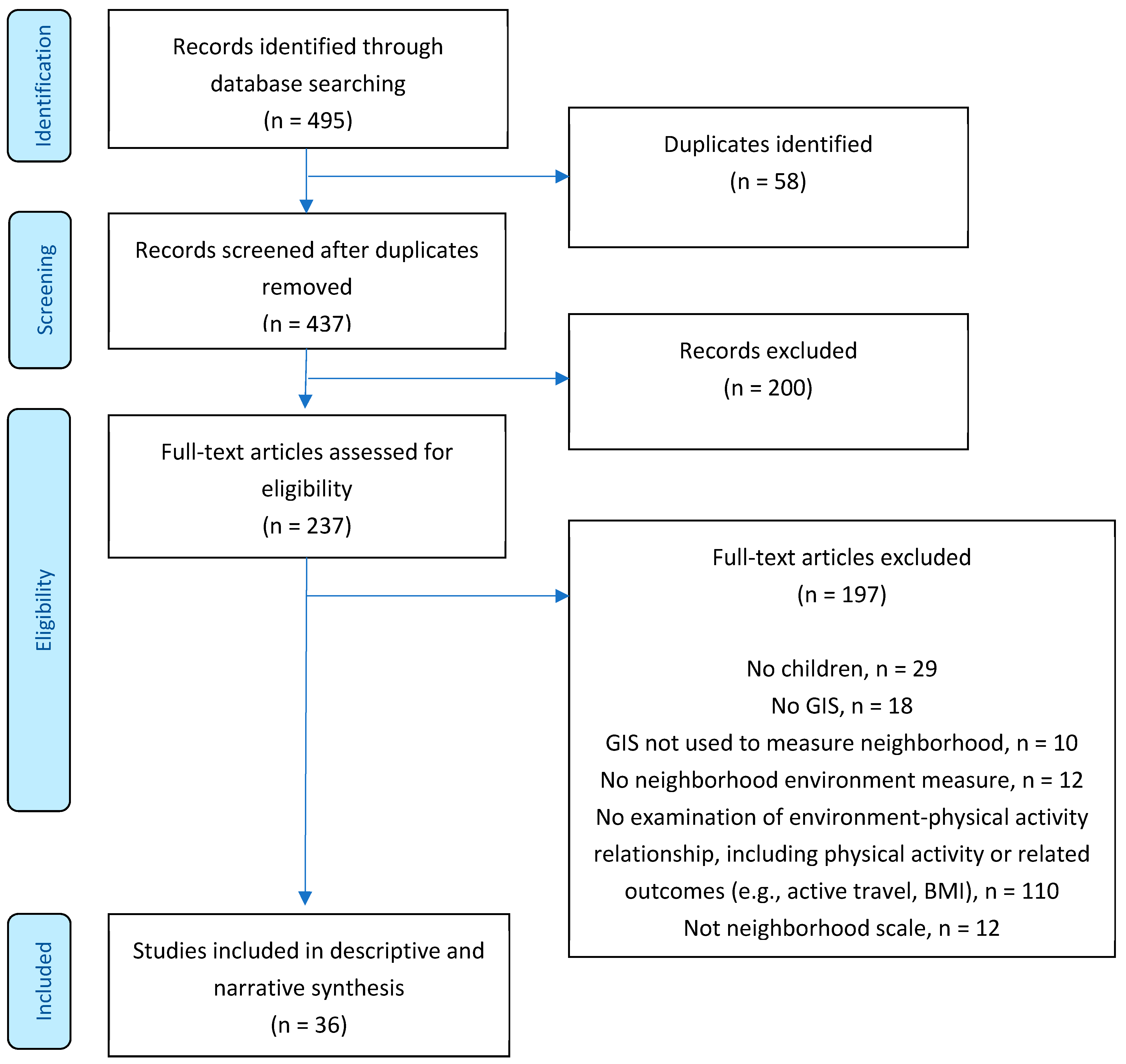
2.3. Selection of Sources of Evidence
2.4. Quality Assessment
2.5. Data Charting and Synthesis
3. Results
4. Discussion
5. Conclusions
Author Contributions
Funding
Institutional Review Board Statement
Informed Consent Statement
Acknowledgments
Conflicts of Interest
References
- Bull, F.C.; Al-Ansari, S.S.; Biddle, S.; Borodulin, K.; Buman, M.; Cardon, G.; Carty, C.; Chaput, J.-P.; Chastin, S.; Chou, R.; et al. World Health Organization 2020 guidelines on physical activity and sedentary behaviour. Br. J. Sports Med. 2020, 54, 1451–1462. [Google Scholar] [CrossRef]
- Strong, W.B.; Malina, R.M.; Blimkie, C.J.; Daniels, S.R.; Dishman, R.K.; Gutin, B.; Hergenroeder, A.C.; Must, A.; Nixon, P.A.; Pivarnik, J.M.; et al. Evidence Based Physical Activity for School-age Youth. J. Pediatr. 2005, 146, 732–737. [Google Scholar] [CrossRef] [PubMed]
- Brusseau, T.; Fairclough, S.J.; Lubans, D.R. The Routledge Handbook of Youth Physical Activity, 1st ed.; Routledge: New York, NY, USA, 2020. [Google Scholar]
- Aubert, S.; Barnes, J.D.; Aguilar-Farias, N.; Cardon, G.; Chang, C.-K.; Nyström, C.D.; Demetriou, Y.; Edwards, L.; Emeljanovas, A.; Gába, A.; et al. Report Card Grades on the Physical Activity of Children and Youth Comparing 30 Very High Human Development Index Countries. J. Phys. Act. Health 2018, 15, S298–S314. [Google Scholar] [CrossRef] [PubMed] [Green Version]
- Aubert, S.; Barnes, J.D.; Abdeta, C.; Nader, P.A.; Adeniyi, A.F.; Aguilar-Farias, N.; Tenesaca, D.S.A.; Bhawra, J.; Brazo-Sayavera, J.; Cardon, G.; et al. Global Matrix 3.0 Physical Activity Report Card Grades for Children and Youth: Results and Analysis from 49 Countries. J. Phys. Act. Health 2018, 15, S251–S273. [Google Scholar] [CrossRef] [Green Version]
- Sallis, J.F.; Kraft, K.; Linton, L.S. How the environment shapes physical activity: A transdisciplinary research agenda. Am. J. Prev. Med. 2002, 22, 208. [Google Scholar] [CrossRef]
- Sallis, J.F.; Cervero, R.B.; Ascher, W.; Henderson, K.A.; Kraft, M.K.; Kerr, J. An ecological approach to creating active living communities. Annu. Rev. Public Health 2006, 27, 297–322. [Google Scholar] [CrossRef] [PubMed] [Green Version]
- Frank, L.D.; Sallis, J.F.; Conway, T.L.; Chapman, J.E.; Saelens, B.E.; Bachman, W. Many pathways from land use to health—Associations between neighborhood walkability and active transportation, body mass index, and air quality. J. Am. Plann. Assoc. 2006, 72, 75–87. [Google Scholar] [CrossRef]
- Frank, L.D.; Saelens, B.; Powell, K.E.; Chapman, J.E. Stepping towards causation: Do built environments or neighborhood and travel preferences explain physical activity, driving, and obesity? Soc. Sci. Med. 2007, 65, 1898–1914. [Google Scholar] [CrossRef]
- Oliveira, A.F.; Moreira, C.; Abreu, S.; Mota, J.; Santos, R. Environmental determinants of physical activity in children: A systematic review. Arch. Exerc. Health Dis. 2014, 4, 254–261. [Google Scholar] [CrossRef]
- Ikeda, E.; Hinckson, E.; Witten, K.; Smith, M. Associations of children’s active school travel with perceptions of the physical environment and characteristics of the social environment: A systematic review. Health Place 2018, 54, 118–131. [Google Scholar] [CrossRef] [PubMed]
- Ding, D.; Sallis, J.F.; Kerr, J.; Lee, S.; Rosenberg, D.E. Neighborhood Environment and Physical Activity Among Youth: A Review. Am. J. Prev. Med. 2011, 41, 442–455. [Google Scholar] [CrossRef] [PubMed]
- Smith, M.; Hosking, J.; Woodward, A.; Witten, K.; Macmillan, A.; Field, A.; Baas, P.; Mackie, H. Systematic literature review of built environment effects on physical activity and active transport—An update and new findings on health equity. Int. J. Behav. Nutr. Phys. Act. 2017, 14, 1–27. [Google Scholar] [CrossRef] [PubMed]
- Olsen, J.R.; Mitchell, R.; McCrorie, P.; Ellaway, A. Children’s mobility and environmental exposures in urban landscapes: A cross-sectional study of 10–11 year old Scottish children. Soc. Sci. Med. 2019, 224, 11–22. [Google Scholar] [CrossRef]
- Kyttä, A.M.; Broberg, A.K.; Kahila, M.H. Urban Environment and Children’s Active Lifestyle: SoftGIS Revealing Children’s Behavioral Patterns and Meaningful Places. Am. J. Health Promot. 2012, 26, e137–e148. [Google Scholar] [CrossRef]
- Davison, K.K.; Lawson, C.T. Do attributes in the physical environment influence children’s physical activity? A review of the literature. Int. J. Behav. Nutr. Phys. Act. 2006, 3, 19. [Google Scholar] [CrossRef] [Green Version]
- Jia, P.; Zou, Y.; Wu, Z.; Zhang, D.; Wu, T.; Smith, M.; Xiao, Q. Street connectivity, physical activity, and childhood obesity: A systematic review and meta-analysis. Obes. Rev. 2019, 22. [Google Scholar] [CrossRef] [PubMed] [Green Version]
- Pan, X.; Zhao, L.; Luo, J.; Li, Y.; Zhang, L.; Wu, T.; Smith, M.; Dai, S.; Jia, P. Access to bike lanes and childhood obesity: A systematic review and meta-analysis. Obes. Rev. 2020, 22. [Google Scholar] [CrossRef]
- Lachowycz, K.; Jones, A.P.; Page, A.S.; Wheeler, B.W.; Cooper, A.R. What can global positioning systems tell us about the contribution of different types of urban greenspace to children’s physical activity? Health Place 2012, 18, 586–594. [Google Scholar] [CrossRef] [Green Version]
- Chertok, M.; Voukelatos, A.; Sheppeard, V.; Rissel, C. Comparison of air pollution exposure for five commuting modes in Sydney—Car, train, bus, bicycle and walking. Health Promot. J. Austr. 2004, 15, 63–67. [Google Scholar] [CrossRef] [Green Version]
- Reis, R.; Hunter, R.F.; Garcia, L.; Salvo, D. What the physical activity community can do for climate action and planetary health? J. Phys. Act. Health 2021, 19, 2–3. [Google Scholar] [CrossRef]
- Patz, J.A.; Siri, J.G. Toward Urban Planetary Health Solutions to Climate Change and Other Modern Crises. J. Hered. 2021, 98, 311–314. [Google Scholar] [CrossRef] [PubMed]
- Toner, A.; Lewis, J.S.; Stanhope, J.; Maric, F. Prescribing active transport as a planetary health intervention—benefits, challenges and recommendations. Phys. Ther. Rev. 2021, 26, 159–167. [Google Scholar] [CrossRef]
- Telama, R.; Yang, X.; Viikari, J.; Välimäki, I.; Wanne, O.; Raitakari, O. Physical activity from childhood to adulthood: A 21-year tracking study. Am. J. Prev. Med. 2005, 28, 267–273. [Google Scholar] [CrossRef]
- Trudeau, F.; Laurencelle, L.; Shephard, R.J. Tracking of Physical Activity from Childhood to Adulthood. Med. Sci. Sports Exerc. 2004, 36, 1937–1943. [Google Scholar] [CrossRef] [PubMed]
- Orstad, S.L.; McDonough, M.H.; Stapleton, S.; Altincekic, C.; Troped, P.J. A Systematic Review of Agreement Between Perceived and Objective Neighborhood Environment Measures and Associations With Physical Activity Outcomes. Environ. Behav. 2016, 49, 904–932. [Google Scholar] [CrossRef]
- Smith, M.; Cui, J.; Ikeda, E.; Mavoa, S.; Hasanzadeh, K.; Zhao, J.; Rinne, T.E.; Donnellan, N.; Kyttä, M. Objective measurement of children’s physical activity geographies: A systematic search and scoping review. Health Place 2020, 67, 102489. [Google Scholar] [CrossRef]
- Jia, P.; Yu, C.; Remais, J.V.; Stein, A.; Liu, Y.; Brownson, R.C.; Lakerveld, J.; Wu, T.; Yang, L.; Smith, M.; et al. Spatial Lifecourse Epidemiology Reporting Standards (ISLE-ReSt) statement. Health Place 2019, 61, 102243. [Google Scholar] [CrossRef]
- Richter, K.P.; Harris, K.J.; Paine-Andrews, A.; Fawcett, S.B.; Schmid, T.L.; Lankenau, B.H.; Johnston, J. Measuring the Health Environment for Physical Activity and Nutrition among Youth: A Review of the Literature and Applications for Community Initiatives. Prev. Med. 2000, 31, S98–S111. [Google Scholar] [CrossRef]
- Tricco, A.C.; Lillie, E.; Zarin, W.; O’Brien, K.K.; Colquhoun, H.; Levac, D.; Moher, D.; Peters, M.D.J.; Horsley, T.; Weeks, L.; et al. PRISMA Extension for Scoping Reviews (PRISMA-ScR): Checklist and Explanation. Ann. Intern. Med. 2018, 169, 467–473. [Google Scholar] [CrossRef] [Green Version]
- Hong, Q.N.; Pluye, P.; Fàbregues, S.; Bartlett, G.; Boardman, F.; Cargo, M.; Dagenais, P.; Gagnon, M.-P.; Griffiths, F.; Nicolau, B.; et al. Mixed Methods Appraisal Tool (MMAT), Version 2018; Canadian Intellectual Property Office, Industry Canada: Montréal, QC, Canada, 2018. [Google Scholar]
- Souto, R.Q.; Khanassov, V.; Hong, Q.N.; Bush, P.L.; Vedel, I.; Pluye, P. Systematic mixed studies reviews: Updating results on the reliability and efficiency of the mixed methods appraisal tool. Int. J. Nurs. Stud. 2015, 52, 500–501. [Google Scholar] [CrossRef] [PubMed]
- Pace, R.; Pluye, P.; Bartlett, G.; Macaulay, A.C.; Salsberg, J.; Jagosh, J.; Seller, R. Testing the reliability and efficiency of the pilot Mixed Methods Appraisal Tool (MMAT) for systematic mixed studies review. Int. J. Nurs. Stud. 2011, 49, 47–53. [Google Scholar] [CrossRef]
- Boone-Heinonen, J.; Gordon-Larsen, P. Life stage and sex specificity in relationships between the built and socioeconomic environments and physical activity. J. Epidemiol. Community Health 2010, 65, 847–852. [Google Scholar] [CrossRef] [PubMed]
- Boone-Heinonen, J.; Guilkey, D.K.; Evenson, K.R.; Gordon-Larsen, P. Residential self-selection bias in the estimation of built environment effects on physical activity between adolescence and young adulthood. Int. J. Behav. Nutr. Phys. Act. 2010, 7, 70. [Google Scholar] [CrossRef] [PubMed] [Green Version]
- Boone-Heinonen, J.; Popkin, B.M.; Song, Y.; Gordon-Larsen, P. What neighborhood area captures built environment features related to adolescent physical activity? Health Place 2010, 16, 1280–1286. [Google Scholar] [CrossRef] [Green Version]
- Bringolf-Isler, B.; Grize, L.; Mäder, U.; Ruch, N.; Sennhauser, F.H.; Braun-Fahrländer, C. Built environment, parents’ perception, and children’s vigorous outdoor play. Prev. Med. 2010, 50, 251–256. [Google Scholar] [CrossRef]
- Buck, C.; Kneib, T.; Tkaczick, T.; Konstabel, K.; Pigeot, I. Assessing opportunities for physical activity in the built environment of children: Interrelation between kernel density and neighborhood scale. Int. J. Health Geogr. 2015, 14, 1–16. [Google Scholar] [CrossRef] [PubMed] [Green Version]
- Cain, K.L.; Millstein, R.A.; Sallis, J.F.; Conway, T.L.; Gavand, K.A.; Frank, L.D.; Saelens, B.E.; Geremia, C.M.; Chapman, J.; Adams, M.A.; et al. Contribution of streetscape audits to explanation of physical activity in four age groups based on the Microscale Audit of Pedestrian Streetscapes (MAPS). Soc. Sci. Med. 2014, 116, 82–92. [Google Scholar] [CrossRef]
- Carlson, J.A.; Mitchell, T.B.; Saelens, B.E.; Staggs, V.S.; Kerr, J.; Frank, L.D.; Schipperijn, J.; Conway, T.L.; Glanz, K.; Chapman, J.E.; et al. Within-person associations of young adolescents’ physical activity across five primary locations: Is there evidence of cross-location compensation? Int. J. Behav. Nutr. Phys. Act. 2017, 14, 1. [Google Scholar] [CrossRef] [Green Version]
- Carlson, J.A.; Saelens, B.E.; Kerr, J.; Schipperijn, J.; Conway, T.L.; Frank, L.D.; Chapman, J.E.; Glanz, K.; Cain, K.L.; Sallis, J.F. Association between neighborhood walkability and GPS-measured walking, bicycling and vehicle time in adolescents. Health Place 2015, 32, 1–7. [Google Scholar] [CrossRef] [Green Version]
- Carlson, J.A.; Sallis, J.F.; Kerr, J.; Conway, T.L.; Cain, K.; Frank, L.D.; Saelens, B.E. Built environment characteristics and parent active transportation are associated with active travel to school in youth age 12–15. Br. J. Sports Med. 2014, 48, 1634–1639. [Google Scholar] [CrossRef]
- Carroll-Scott, A.; Gilstad-Hayden, K.; Rosenthal, L.; Peters, S.M.; McCaslin, C.; Joyce, R.; Ickovics, J.R. Disentangling neighborhood contextual associations with child body mass index, diet, and physical activity: The role of built, socioeconomic, and social environments. Soc. Sci. Med. 2013, 95, 106–114. [Google Scholar] [CrossRef] [PubMed] [Green Version]
- Carver, A.; Timperio, A.; Hesketh, K.; Crawford, D. Are safety-related features of the road environment associated with smaller declines in physical activity among youth? J. Urban Health 2010, 87, 29–43. [Google Scholar] [CrossRef] [PubMed] [Green Version]
- Carver, A.; Timperio, A.F.; Crawford, D.A. Bicycles gathering dust rather than raising dust—Prevalence and predictors of cycling among Australian schoolchildren. J. Sci. Med. Sport 2015, 18, 540–544. [Google Scholar] [CrossRef]
- Coughenour, C.; Burns, M.S. Community design impacts on health habits in low-income southern Nevadans. Am. J. Health Behav. 2016, 40, 534–544. [Google Scholar] [CrossRef]
- Dalton, M.A.; Longacre, M.R.; Drake, K.M.; Gibson, L.; Adachi-Mejia, A.M.; Swain, K.; Xie, H.; Owens, P.M. Built Environment Predictors of Active Travel to School Among Rural Adolescents. Am. J. Prev. Med. 2011, 40, 312–319. [Google Scholar] [CrossRef] [PubMed] [Green Version]
- De Meester, F.; Van Dyck, D.; De Bourdeaudhuij, I.; Deforche, B.; Sallis, J.F.; Cardon, G. Active living neighborhoods: Is neighborhood walkability a key element for Belgian adolescents? BMC Public Health 2012, 12, 7. [Google Scholar] [CrossRef] [Green Version]
- Dessing, D.; De Vries, S.I.; Hegeman, G.; Verhagen, E.; Van Mechelen, W.; Pierik, F.H. Children’s route choice during active transportation to school: Difference between shortest and actual route. Int. J. Behav. Nutr. Phys. Act. 2016, 13, 1–11. [Google Scholar] [CrossRef] [Green Version]
- DeWeese, R.S.; Ohri-Vachaspati, P.; Adams, M.A.; Kurka, J.; Han, S.Y.; Todd, M.; Yedidia, M.J. Patterns of food and physical activity environments related to children’s food and activity behaviors: A latent class analysis. Health Place 2017, 49, 19–29. [Google Scholar] [CrossRef] [PubMed]
- Helbich, M.; van Emmichoven, M.J.Z.; Dijst, M.J.; Kwan, M.-P.; Pierik, F.H.; de Vries, S.I. Natural and built environmental exposures on children’s active school travel: A Dutch global positioning system-based cross-sectional study. Health Place 2016, 39, 101–109. [Google Scholar] [CrossRef]
- Hinckson, E.; Cerin, E.; Mavoa, S.; Smith, M.; Badland, H.; Stewart, T.; Duncan, S.; Schofield, G. Associations of the perceived and objective neighborhood environment with physical activity and sedentary time in New Zealand adolescents. Int. J. Behav. Nutr. Phys. Act. 2017, 14, 145. [Google Scholar] [CrossRef] [Green Version]
- Ikeda, E.; Hinckson, E.; Witten, K.; Smith, M. Assessment of direct and indirect associations between children active school travel and environmental, household and child factors using structural equation modelling. Int. J. Behav. Nutr. Phys. Act. 2019, 16, 1–17. [Google Scholar] [CrossRef] [Green Version]
- Islam, M.Z.; Moore, R.; Cosco, N. Child-friendly, active, healthy neighborhoods: Physical characteristics and children’s time outdoors. Environ. Behav. 2014, 48, 711–736. [Google Scholar] [CrossRef]
- Jáuregui, A.; Soltero, E.; Santos-Luna, R.; Barrera, L.H.; Barquera, S.; Jauregui, E.; Lévesque, L.; Lopez-Taylor, J.; Ortiz-Hernández, L.; Lee, R. A Multisite Study of Environmental Correlates of Active Commuting to School in Mexican Children. J. Phys. Act. Health 2016, 13, 325–332. [Google Scholar] [CrossRef]
- E Laxer, R.; Janssen, I. The proportion of youths’ physical inactivity attributable to neighbourhood built environment features. Int. J. Health Geogr. 2013, 12, 31. [Google Scholar] [CrossRef] [PubMed] [Green Version]
- McGrath, L.J.; Hinckson, E.A.; Hopkins, W.G.; Mavoa, S.; Witten, K.; Schofield, G. Associations Between the Neighborhood Environment and Moderate-to-Vigorous Walking in New Zealand Children: Findings from the URBAN Study. Sports Med. 2016, 46, 1003–1017. [Google Scholar] [CrossRef] [PubMed]
- Mecredy, G.; Pickett, W.; Janssen, I. Street Connectivity is Negatively Associated with Physical Activity in Canadian Youth. Int. J. Environ. Res. Public Health 2011, 8, 3333–3350. [Google Scholar] [CrossRef] [PubMed]
- Mitchell, C.A.; Clark, A.F.; Gilliland, J.A. Built Environment Influences of Children’s Physical Activity: Examining Differences by Neighbourhood Size and Sex. Int. J. Environ. Res. Public Health 2016, 13, 130. [Google Scholar] [CrossRef] [PubMed]
- Mölenberg, F.J.; Noordzij, J.; Burdorf, A.; van Lenthe, F.J. New physical activity spaces in deprived neighborhoods: Does it change outdoor play and sedentary behavior? A natural experiment. Health Place 2019, 58, 102151. [Google Scholar] [CrossRef]
- Nordbø, E.C.A.; Raanaas, R.K.; Nordh, H.; Aamodt, G. Neighborhood green spaces, facilities and population density as predictors of activity participation among 8-year-olds: A cross-sectional GIS study based on the Norwegian mother and child cohort study. BMC Public Health 2019, 19, 1–22. [Google Scholar] [CrossRef] [PubMed] [Green Version]
- Oliver, M.; Badland, H.; Mavoa, S.; Witten, K.; Kearns, R.; Ellaway, A.; Hinckson, E.; Mackay, L.; Schluter, P.J. Environmental and socio-demographic associates of children’s active transport to school: A cross-sectional investigation from the URBAN Study. Int. J. Behav. Nutr. Phys. Act. 2014, 11, 70. [Google Scholar] [CrossRef] [Green Version]
- Sallis, J.F.; Cain, K.; Conway, T.L.; Gavand, K.A.; Millstein, R.A.; Geremia, C.M.; Frank, L.D.; Saelens, B.; Glanz, K.; King, A.C. Is Your Neighborhood Designed to Support Physical Activity? A Brief Streetscape Audit Tool. Prev. Chronic Dis. 2015, 12, E141. [Google Scholar] [CrossRef] [PubMed] [Green Version]
- Sallis, J.F.; Conway, T.L.; Cain, K.L.; Carlson, J.A.; Frank, L.D.; Kerr, J.; Glanz, K.; Chapman, J.E.; Saelens, B.E. Neighborhood built environment and socioeconomic status in relation to physical activity, sedentary behavior, and weight status of adolescents. Prev. Med. 2018, 110, 47–54. [Google Scholar] [CrossRef]
- Tucker, P.; Irwin, J.D.; Gilliland, J.; He, M.; Larsen, K.; Hess, P. Environmental influences on physical activity levels in youth. Health Place 2009, 15, 357–363. [Google Scholar] [CrossRef] [PubMed]
- van Loon, J.; Frank, L.D.; Nettlefold, L.; Naylor, P.J. Youth physical activity and the neighbourhood environment: Examining correlates and the role of neighbourhood definition. Soc. Sci. Med. 2014, 104, 107–115. [Google Scholar] [CrossRef] [PubMed]
- Villanueva, K.; Giles-Corti, B.; Bulsara, M.; McCormack, G.R.; Timperio, A.; Middleton, N.; Beesley, B.; Trapp, G. How far do children travel from their homes? Exploring children’s activity spaces in their neighborhood. Health Place 2012, 18, 263–273. [Google Scholar] [CrossRef] [PubMed]
- Wang, X.; Conway, T.L.; Cain, K.; Frank, L.D.; Saelens, B.; Geremia, C.; Kerr, J.; Glanz, K.; Carlson, J.A.; Sallis, J.F. Interactions of psychosocial factors with built environments in explaining adolescents’ active transportation. Prev. Med. 2017, 100, 76–83. [Google Scholar] [CrossRef]
- Smith, M.; Amann, R.; Cavadino, A.; Raphael, D.; Kearns, R.; Mackett, R.; Mackay, L.; Carroll, P.; Forsyth, E.; Mavoa, S.; et al. Children’s Transport Built Environments: A Mixed Methods Study of Associations between Perceived and Objective Measures and Relationships with Parent Licence for Independent Mobility in Auckland, New Zealand. Int. J. Environ. Res. Public Health 2019, 16, 1361. [Google Scholar] [CrossRef] [Green Version]
- Ikeda, E.; Stewart, T.; Garrett, N.; Egli, V.; Mandic, S.; Hosking, J.; Witten, K.; Hawley, G.; Tautolo, E.-S.; Rodda, J.; et al. Built environment associates of active school travel in New Zealand children and youth: A systematic meta-analysis using individual participant data. J. Transp. Health 2018, 9, 117–131. [Google Scholar] [CrossRef]
- Wong, B.Y.-M.; Faulkner, G.; Buliung, R. GIS measured environmental correlates of active school transport: A systematic review of 14 studies. Int. J. Behav. Nutr. Phys. Act. 2011, 8, 39. [Google Scholar] [CrossRef] [Green Version]
- Gunn, L.D.; Mavoa, S.; Boulange, C.; Hooper, P.; Kavanagh, A.; Giles-Corti, B. Designing healthy communities: Creating evidence on metrics for built environment features associated with walkable neighbourhood activity centres. Int. J. Behav. Nutr. Phys. Act. 2017, 14, 164. [Google Scholar] [CrossRef] [Green Version]
- Hooper, P.; Foster, S.; Bull, F.; Knuiman, M.; Christian, H.; Timperio, A.; Wood, L.; Trapp, G.; Boruff, B.; Francis, J.; et al. Living liveable? RESIDE’s evaluation of the “Liveable Neighborhoods” planning policy on the health supportive behaviors and wellbeing of residents in Perth, Western Australia. SSM Popul. Health 2020, 10, 100538. [Google Scholar] [CrossRef]
- Moreno, C.; Allam, Z.; Chabaud, D.; Gall, C.; Pratlong, F. Introducing the “15-Minute City”: Sustainability, Resilience and Place Identity in Future Post-Pandemic Cities. Smart Cities 2021, 4, 6. [Google Scholar] [CrossRef]
- Dunning, R.; Calafiore, A.; Nurse, A. 20-Minute Neighbourhood or 15-Minute City? Town and Country Planning, 16 June 2021. Available online: https://livrepository.liverpool.ac.uk/3127722/1/15MN_20MC.doc (accessed on 7 January 2022).
- Aldred, R.; Goodman, A. The Impact of Low Traffic Neighbourhoods on Active Travel, Car Use, and Perceptions of Local Environment during the COVID-19 Pandemic. Findings 2021, 21390. [Google Scholar] [CrossRef]
- Walker, H. The Shared Path; The Helen Clark Foundation: Wellington, New Zealand, 2020. [Google Scholar]
- Smith, M. Children’s perceptions of their neighbourhoods during COVID-19 lockdown in Aotearoa New Zealand. Child. Geogr. 2021, in press. [Google Scholar] [CrossRef]
- Lin, E.-Y.; Witten, K.; Oliver, M.; Carroll, P.; Asiasiga, L.; Badland, H.; Parker, K. Social and built-environment factors related to children’s independent mobility: The importance of neighbourhood cohesion and connectedness. Health Place 2017, 46, 107–113. [Google Scholar] [CrossRef]
- Kumar, P. Climate Change and Cities: Challenges Ahead. Front. Sustain. Cities 2021, 3. [Google Scholar] [CrossRef]
- United Nations. Transforming Our World: The 2030 Agenda for Sustainable Development A/RES/70/1; United Nations: Geneva, Switzerland, 2015. [Google Scholar]
- Burgoine, T.; Jones, A.P.; Namenek Brouwer, R.J.; Benjamin Neelon, S.E. Associations between BMI and home, school and route environmental exposures estimated using GPS and GIS: Do we see evidence of selective daily mobility bias in children? Int. J. Health Geogr. 2015, 14, 8. [Google Scholar] [CrossRef] [Green Version]
- Huang, D.; Brien, A.; Omari, L.; Culpin, A.; Smith, M.; Egli, V. Bus Stops Near Schools Advertising Junk Food and Sugary Drinks. Nutrients 2020, 12, 1192. [Google Scholar] [CrossRef] [PubMed]
- Vandevijvere, S.; Sushil, Z.; Exeter, D.J.; Swinburn, B. Obesogenic Retail Food Environments Around New Zealand Schools: A National Study. Am. J. Prev. Med. 2016, 51, e57–e66. [Google Scholar] [CrossRef] [PubMed]
- Frank, L.D.; Sallis, J.F.; Saelens, B.E.; Leary, L.; Cain, K.; Conway, T.L.; Hess, P.M. The development of a walkability index: Application to the Neighborhood Quality of Life Study. Br. J. Sports Med. 2010, 44, 924–933. [Google Scholar] [CrossRef] [PubMed]
- Giles-Corti, B.; Wood, G.; Pikora, T.; Learnihan, V.; Bulsara, M.; Van Niel, K.; Timperio, A.; McCormack, G.; Villanueva, K. School site and the potential to walk to school: The impact of street connectivity and traffic exposure in school neighbourhoods. Health Place 2011, 17, 545–550. [Google Scholar] [CrossRef] [PubMed]
- Moran, M.R.; Eizenberg, E.; Plaut, P. Getting to Know a Place: Built Environment Walkability and Children’s Spatial Representation of Their Home-School (h–s) Route. Int. J. Environ. Res. Public Health 2017, 14, 607. [Google Scholar] [CrossRef] [PubMed] [Green Version]

| Author (Year); Country | No. of Participants; Sex (% Female); Age in Years (y) | Socio-Economic and Ethnicity Characteristics | Physical Activity Outcome(s) | Key Findings * | MMAT Score |
|---|---|---|---|---|---|
| Boone-Heinonen and Gordon-Larsen [34]; USA | 12,701 at both time points; 51%; 11–22 y in wave 1 (1994/1995), 18–26 y in wave 3 (2001/2002) | Parental household income at wave 1 (mean ± SD): USD43,100 ± 1500; Ethnicity: White 68%, Black 16%, Asian 4%, Hispanic 12%; Highest parental education: Some college or higher 54% | MVPA (self-reported weekly frequency of skating, cycling, exercise, and active sports at wave 1, modified at wave 3 to include age-appropriate activities) | MVPA was positively related to landscape diversity in all participants, and negatively related to street connectivity in females only. | 4 |
| Boone-Heinonen, Guilkey [35]; USA | 12,701 at both time points; 51%; 11–22 y in wave 1 (1994/1995) 18–26 y in wave 3 (2001/2002) | Parental household income at wave 1 (mean ± SD): USD43,100 ± 1500 ; Ethnicity: White 68%, Black 16%, Asian 4%, Hispanic 12%; Highest parental education: <High school 15%, High school/GED 31%, Some college 29%, College or greater 25% | MVPA (self-reported weekly frequency of skating, cycling, exercise, and active sports at wave 1, modified slightly at wave 3 to include age-appropriate activities) | MVPA was higher with greater PA pay facilities in males only. | 5 |
| Boone-Heinonen, Popkin [36]; USA | 17,659; 50%; 11–22 y | Significant differences in income tertile by urbanicity, higher proportion of tertile 1 and lower proportion of tertile 3 in high-urban compared with lower-urbanized areas (direction of tertiles was unclear); Urbanicity: non-urban 39%, low-urban 36%, high-urban 24%. Significant differences in education level by urbanicity, lower education levels in high-urban compared with lower-urbanized areas | MVPA (self-reported weekly frequency of skating, cycling, exercise, and active sports) | MVPA was associated with intersection density in 1 km buffer (all in non-urban areas, males in high-urban areas), and count of PA resources in 3 km buffer (all in low-urban areas). Associations with weighted counts were similar to counts within 1–5 km. | 5 |
| Bringolf-Isler, Grize [37]; Switzerland | 1081; 49% (children), 54% (adolescents); 6–7 y, 9–10 y, 13–14 y | Maternal education: low 16%, medium 48%, high 36%; Car ownership: none 20%, one 66%, two or more 16% | Vigorous outdoor play (parent-reported, daily average) | Vigorous outdoor play was negatively associated with main street density, population, and building density in the 100 m home buffer. Comparable results were observed using 100 m, 200 m, and 500 m buffers. | 2 |
| Buck, Kneib [38]; Germany | 400; 52%; 2–9 y | Children living in urban environments only | MVPA (min/day, accelerometer) | MVPA was associated with the availability of public open spaces (school girls, pre-school children), public transit (school girls), and higher street connectivity (school girls). Stable results were found within a network-distance using kernel intensity measures from 750 m up to 1.5 km for school children and from 500 m up to 1 km for pre-school children. Different results were observed by buffer size using the simple intensity approach. | 4 |
| Cain, Millstein [39]; USA | 955; 50%; 6–16 y | Based on the recruitment strategy, approximately half of the participants should be from low income neighborhoods, and half from high income neighborhoods; Ethnicity: non-White 31% (children) and 33% (adolescents); Parent education: college degree 68% (children) and 64% (adolescents) | Walking and cycling to specified locations (parent-reported for children, self-reported for adolescents; average of usual frequency of trips) Average daily minutes of MVPA (accelerometer, non-school hours) Average daily minutes of MVPA in the neighborhood (children only, linking parent-completed daily location logs to accelerometer data, non-school hours) Neighborhood PA (parent-reported for children, self-reported for adolescents) | After adjusting for GIS-defined walkability, numerous observed microscale environmental variables were related to active travel and neighborhood PA. | 3 |
| Carlson, Mitchell [40]; USA | 528; 50%; 12–16 y | 50% resided in high-income neighborhoods; Ethnicity: White non-Hispanic 70%; Home neighborhood walkability: high-walkability 46% | Time and MVPA in specified locations (GPS and accelerometer) | MVPA in one location was mainly independent of MVPA in other locations (i.e., no compensation effect), except for higher at-school MVPA (less at home and other location MVPA) and higher home neighborhood MPVA (more at home MVPA). | 4 |
| Carlson, Saelens [41]; USA | 690; 51%;12–16 y | Based on the recruitment strategy, approximately half of the participants should be from low income neighborhoods, and half from high income neighborhoods; Ethnicity: White non-Hispanic 69%; Highest parental education: college degree 64%; Marital status: Parent married or living with partner 84.0%; Household car ownership (mean ± SD): 2.5 ± 1.0 | Walking and cycling travel time (min/day, GPS and accelerometer) Active travel mode share (daily walking + cycling minutes/total daily travel time × 100, GPS and accelerometer) | Walking time and active travel mode share were associated with residential density, intersection density, entertainment density, and walkability. Cycling time was associated with intersection density and walkability. | 3 |
| Carlson, Sallis [42]; USA | 294; 47%; 12–16 y | Based on the recruitment strategy, approximately half of the participants should be from low income neighborhoods, and half from high income neighborhoods; Ethnicity: Non-Hispanic Caucasian 69%; Highest parental education: college degree 62%; Marital status: married or living with partner 85%; Parental employment status: full-time 53%; Vehicles/driver in household (mean ± SD): 1.07 ± 0.39 | Active travel to/from school on average school week (self-reported), classified as none, occasional (1–4 trips), and habitual (5–10 trips) | Active travel to/from school was positively associated with street connectivity around home, residential density around home, and residential density around school; and negatively associated with distance to school. The odds of travelling actively occasionally or habitually reduced to 0.60 and 0.24, respectively, for every additional km in distance to school. | 4 |
| Carroll-Scott, Gilstad-Hayden [43]; USA | 1048; 53%; Mean ± SD: 10.9 ± 0.8 y | Free/reduced lunch eligibility 77%; Not food-secure 11%; Ethnicity: Non-white 89%; Primary language at home: not English 38% | Frequency of exercise (self-reported, PACE PA item) Number of hours of weekday screen time (usual duration of TV, video game, and computer (for fun) time on weekdays) | Screen time was negatively associated with living in more affluent neighborhoods. | 4 |
| Carver, Timperio [44]; Australia | 446 at both time points; 49% (children), 57% (adolescents); 8–9 y and 13–15 y in 2004; 10–11 y and 15–17 y in 2006 | Primary language at home: not English 38% | Frequency of walking/cycling trips per week, change in walking/cycling trips per week over time (parent-reported for children, self-reported for adolescents) Mean minutes per day of MVPA and change over time (accelerometer) | Change in active travel was associated with the number of traffic/pedestrian lights (in younger girls), length of walking tracks (younger and adolescent girls), and intersection density (adolescent boys). Change in MVPA was associated with slow points (younger boys before school) and speed humps (adolescent boys after school). | 3 |
| Carver, Timperio [45]; Australia | 640 (411 primary school-aged, 229 secondary school-aged); 51%; Mean ± SD: 11.6 ± 2.0 y | Primary-school-aged: urban 72% urban; Secondary-school-aged: urban 50% | Cycling at least once per week (self-reported) | The odds of cycling at least once per week were negatively associated with the number of sports facilities within the 5 km buffer and positively associated with living in neighborhoods with the top tertile of length of bike paths in 5 km buffer. | 3 |
| Coughenour and Burns [46]; USA | 71 (26 children aged 6–18 y); 66%; 6–94 y | Annual household income (N = 42 out of 44, 95%): <USD75,000; Ethnicity: Hispanic 39%; Black 27%; Caucasian 25% | MVPA (parent-reported moderate vigorous PA, such as “pushing a vacuum or climbing 1 flight of stairs” and “running, lifting heavy objects, and strenuous sports”) | No significant difference was observed in those meeting weekly PA recommendations by opportunities for PA in the neighborhood. | 3 |
| Dalton, Longacre [47]; USA | 1552; 52%; 12–17 y | Annual household income: >USD$75,000 38%; Ethnicity: Non-Hispanic Caucasian 92%; Highest parental education: bachelor degree or higher 38%; Single-parent household 19% | Active travel to/from school, defined as walking or biking to or from school at least 1 day per week during one or more season (self-reported) | Active school travel was associated with higher residential and intersection densities and lower distance to school (81% who lived within 1 mile of school were active travelers versus 30% of those who lived 2–3 miles from school). | 4 |
| De Meester, Van Dyck [48]; Belgium | 637; 50%; 13–15 y | Education level: college degree or higher 61%; Employment status: both parents employed 69% | MVPA and average counts/min (accelerometer), duration of PA behaviors in specific contexts and school-related active travel (self-reported) | MVPA and average PA counts/min were associated with walkability in adolescents residing in low SES areas only. Walking for transport during leisure time was negatively associated with neighborhood SES. | 3 |
| Dessing, de Vries [49]; The Netherlands | 184; 53%; 8–12 y | NR | Built environment characteristics (comparison of variables between route measures) Active travel to school | Children mainly traveled through residential areas on their way to school (>80% of the route). Actual walking routes had less traffic area, greater % water along route, fewer street lights/km, fewer zebra crossings, and lower % sidewalk along the route than estimated routes. Actual cycling routes had greater % recreational area, % water along route, traffic lights/km, junctions/km, % residential streets, fewer trees/km, street lights/km, street bumps/km, and zebra crossings/km, and lower % sidewalk along route and % pedestrian path than estimated routes. | 3 |
| DeWeese, Ohri-Vachaspati [50]; USA | 404; 48%; 3–18 y | Ethnicity: Non-Hispanic black 49%, Hispanic 44%, Non-Hispanic Caucasian 7%; Highest parental education: some college or higher education 31%; Average block group median income (mean ± SD): ~USD36,900 ± 16,200 | Parent reported PA behaviors (categorized as 60-min of PA on 7 days per week vs. <7 days; ever walked or biked to school vs. never; walked to destinations often vs. sometimes, rarely, or never) | Three classes were identified and characterized: (1) “Low PA-Low Food” (N = 72, 17% of sample) had the lowest probability for above-median residential dwellings and intersections, and for the presence of a PA facility, supermarket, small grocery store, convenience store, and fast-food restaurant and a high probability of the presence of a large park; (2) “High Intersection & Parks-Moderate Density & Food” (34%) had the highest probability for above median intersections and for the presence of large parks, and low probabilities of having a PA facility, a supermarket, and a small grocery store; (3) “High Density- Low Parks-High Food” (49%) had the highest probability of above-median residential dwellings and the presence of PA facilities, supermarkets, small grocery stores, convenience stores, and fast-food restaurants, and had the lowest probability for a large park presence. Children in the High Density-Low Parks-High Food class had higher odds of walking or biking to school and to other destinations compared to children in the Low PA-Low Food class, before adjusting for covariates. Neither healthy nor unhealthy food intake differed across classes. | 5 |
| Helbich, Emmichoven [51]; The Netherlands | 97; 60%; 6–11 y | NR | Active travel to/from school (estimated from GPS), environmental characteristics of school route travelled | Active school travel was negatively associated with distance when only personal, traffic safety, and weather features were considered. After adjusting for urban environments, the distance to school was not significant; well-connected streets and % cycling lanes were positively associated with active school travel. | 2 |
| Hinckson, Cerin [52]; Aotearoa New Zealand | 524; 55%; 12–18 y | 50% resided in high-income neighborhoods; Ethnicity: Māori (indigenous to Aotearoa New Zealand) 3%, New Zealand European 70%, Pacific 2%, Asian 12%, Other 13%; Household highest educational attainment: post-school qualification or higher 70% | MVPA and sedentary time (average min/day, accelerometer) | MVPA was associated with residential density and number of parks within 2 km from home independently, and also when combined into an objective environmental index of activity-friendliness. | 3 |
| Ikeda, Hinckson [53]; Aotearoa New Zealand | 542; 51%; 8–13 y | Ethnicity: Māori 12.9%, New Zealand European 52.7%, Pacific 15.3%, Asian 15.0%; Education level: bachelor’s degree or higher 30.0%; Car ownership: >1 63.8% | Usual mode of travel to school (self-reported and dichotomized to active or passive travel) | Active school travel was negatively associated with the distance to school. Full mediation of the association between the active mobility environment occurred through the distance to school. All indicators of the active mobility environment were negatively correlated with the distance to school. | 4 |
| Islam, Moore [54]; Bangladesh | 109; 39%; 9–14 y | Monthly household incomes: Taka25,001–40,000 41% (urban average household monthly income: Taka9878); Education level: bachelor’s degree (father) 59%, bachelor’s degree (mother) 50%; Average residency: 6.5 y | Children’s outdoor activities (self-reported average time outdoors in past week, calculated using reported start and end times of outdoor activities within the neighborhood) | Average time outdoors on weekdays was negatively associated with total building footprint area within the neighborhood. | 4 |
| Jauregui, Soltero [55]; Mexico | 1191; 53%; 6–14 y | Household income: Mexican peso <5000 50% (income data available for 59% of participants) | Active school travel (parent-reported usual mode of travel to school, walking or biking classified as active school travel) | Active school travel was associated with lower walkability in the 400 m buffer only. | 3 |
| Kyttä, Broberg [15]; Finland | 1837; 49%; 10–15 y | Housing: detached house 37%, apartment building 33%, terraced house 30%; Household car ownership: 92% | Active school travel (self-reported walking or cycling normally used on journeys both to and from school), parental licenses for their child’s independent mobility, and territorial range (distance to the furthest marked place the child travelled to independent of parental supervision), dichotomized as above versus below the within-age group mean | Active school travel was positively related to residential density, and negatively related to the proportions of green space and child population. The distance from home to children’s meaningful places decreased as the residential density increased and increased as the proportion of green space and child population increased. Meaningful places of children were located close to home: 16.6% were ≥ 50 m from home, 24.8% were within 100 m, and 53.3% within 0.5 km of home. The size of the territorial range was significantly higher in more green areas, and lower in areas with a higher child population. Children had significantly more limitations on mobility licenses if the child’s home was in a more densely built area. A significant correlation was found between the number of marked destinations and school travel mode. The size of territorial range was positively correlated with active school travel mode. | 3 |
| Laxer and Janssen [56]; Canada | 6626; 50%; 11–15 y | Household SES: high 24%, medium-high 32%, low-medium 35%, low 10%; Ethnicity: Caucasian 73%, Other 27% | PA (self-reported usual and past 7 days number of days physically active for ≥60 min/day, dichotomized as physically inactive (≤4 days/week) or physically active (>4 days/week)) | Physical inactivity was higher in neighborhoods with higher walkability, lower cul-de-sac density, and moderate to high park space. An estimated 23% of physical inactivity within the population was attributable to living in walkable neighborhoods, 16% was attributable to living in neighborhoods with a low density of cul-de-sacs, and 15% was attributable to living in neighborhoods with a moderate to high amount of park space. | 3 |
| McGrath, Hinckson [57]; Aotearoa New Zealand | 226; 51%; 5–13 y | Income per adult (mean ± SD): NZD39,000 ± 2000; Ethnicity: Māori/Polynesian 17%, European/other 72%, Asian 11% | School travel mode (parent-reported 7-day travel log), classified as passive (car or bus) or active (walk, bicycle, skateboard, or scooter); MVPA, step-based MVPA, hourly step counts (accelerometer) | MVPA steps on non-school days were associated with living in neighborhoods with more green space (positive) and food outlet density (negative). | 5 |
| Mecredy, Pickett [58]; Canada | 8535; NR; 11–15 y | NR | MVPA outside of school (self-reported usual hours of exercise in free time) categorized as ≥4 h/week or <4 h/week. | Higher MVPA was associated with residing in neigborhoods with the highest street connectivity quartile. | 5 |
| Mitchell, Clark [59]; Canada | 435; 59%; 9–14 y | Median family income: CAD71,758 | Average daily MVPA during non-school hours (accelerometer) | MVPA out of school hours was associated with parks with sports fields and multi-use path space at both buffers in grouped analyses. Significant associations were observed between boys’ MVPA and parks with sports fields (positive) and parks with playgrounds (negative) at both buffers (although the magnitudes were greater for 800 m), and girls’ MVPA and parks with sports fields (positive, 800 m buffer only). | 3 |
| Mölenberg, Noordzij [60]; The Netherlands | 1841 (N = 1607 for outdoor play, N = 1545 for sedentary behavior); 56% (intervention group), 49% (control group); Mean 6 y at wave 1, 9.7 y at wave 2 | Net household income/month: ≤€2000 18% (intervention) and 15% (control), >€2000–€3200 34% (intervention) and 27% (control), >€3200 48% (intervention) and 58% (control); Ethnicity: Dutch 60% (intervention) and 70% (control), Other Western 13% (intervention) and 12% (control), Non-Western 27% (intervention) and 18% (control); Maternal education: mid-high 54% (intervention) and 63% (control); Paternal education: mid-high 54% (intervention) and 62% (control) | Outdoor play (parent-reported exercise at school and outside school hours for an average week, calculated as mean min/week playing outdoors), sedentary behavior (parent-reported television viewing and computer game use for an average week, calculated as mean min/week watching television and computer gaming | The introduction of a dedicated PA space within 600 m from home, and the reduction in the distance per 100 m, did not affect outdoor play or sedentary behaviors. | 4 |
| Nordbø, Raanaas [61]; Norway | 21,146; 49%; 8 y | Maternal university education: 78% | Leisure-time PA (parent-reported time in PA outside school hours), classified as ≥5 h/week or ≤ 4 h/week. Organized PA participation (parent-reported days/week participation in any kind of organized leisure PA), classified as ≥2 days/week or once a week or less. Informal social activity with friends and peers (parent-reported time with friends and peers, excluding school hours and organized activities), classified as ≥2 days/week or once a week or less. | Leisure-time PA was associated with having a park within 800 m from home (summer) and living in a neighborhood with a higher proportion of green space (winter). Participation in organized and social activities was associated with population density and access to facilities. | 4 |
| Oliver, Badland [62]; Aotearoa New Zealand | 217; 49%; 6–15 y | Average annual household income: <NZD60,000 39%, NZD60,001–100,000 25%, >NZD100,000 25%; Ethnicity: Māori 24%, Asian 15%, New Zealand European/Other 60%; Unlimited car access: 87%; Residing in school zone: 56%; Parent neighborhood self-selection: prefer high walkable and live low walkable 31%, prefer high walkable and live high walkable 20%, prefer low walkable and live low walkable 31%, prefer low walkable and live high walkable 19% | Active school travel (self-reported walking or cycling normally used on journeys both to and from school), parental licenses for their child’s independent mobility, and territorial range (distance to the furthest marked place the child travelled to independently) | Active school travel was significantly associated with the city a child lived in and neighborhood self-selection (children who lived in a low-walkable neighborhood, but whose parents preferred a highly walkable neighborhood were three times less likely to have active school travel than their counterparts), and negatively associated with distance to school. | 3 |
| Sallis, Cain [63]; USA | 3677 (758 children aged 6–11 y and 897 adolescents aged 12–16 y (findings for these age groups presented here)); NR; 6 y and older | Based on recruitment strategy, approximately half of the participants should be from low income neighborhoods, and half from high income neighborhoods; Ethnicity: Non-Caucasian 31% (children) and 33% (adolescents) | MVPA (accelerometer; mean daily hours out-of-school hours for adolescents, mean daily MVPA in neighborhood for children (via temporal matching of accelerometer and parent reported times in neighborhood locations)). Active travel to common locations (parent-reported for children, self-reported for adolescents). | Controlling for GIS-derived macro-level walkability, total microscale environment scores were significantly related to active travel in both groups, and with leisure-time PA and accelerometer measures in children. | 3 |
| Sallis, Conway [64]; USA | 928; 50%; 12–16 y | Based on the recruitment strategy, approximately half of the participants should be from low income neighborhoods, and half from high income neighborhoods; Ethnicity: Non-Hispanic Caucasian 66%; Parent education: college degree or higher 74%; Time living at current address (mean ± SD): 12.6 ± 7.0 y; Motor vehicles/licensed driver (mean ± SD): 1.1 ± 0.38 | MVPA, sedentary time (accelerometer), self-reported active travel to school and non-school destinations (e.g., recreation facility, friend’s house, park, food outlet), leisure-time PA in specified locations, number of days accumulated 60 min PA, number of sports and PA classes outside of school, usual time/day in sedentary behaviors | Walkability was positively related to objectively measured PA and walking for transportation. Self-reported sedentary time and television time were negatively related to walkability. The time in vehicles was negatively related to walkability only among those living in higher income census blocks. | 5 |
| Tucker, Irwin [65]; Canada | 811; 50%; 11–13 y | Household income: <CAD50,000 21%, CAD50,000–69,999 13%, >CAD70,000 32%; Ethnicity: Caucasian 75%, Black 2%, Latin-American 7%, Asian 6%, Other 9%; Paternal education: college or higher 70%; Maternal education: college or higher 70% | PA (self-reported type and intensity of activity in 30 min blocks throughout the afternoon and evening of the previous day (15:00–23:00) plus blocks of time for morning and afternoon recess, lunch time, and physical education class (with 15 min blocks allocated for the morning and afternoon recess and 30 min blocks allotted for lunch hour and physical education class)). | MVPA was associated with having ≥2 recreational opportunities in the neighborhood | 4 |
| van Loon, Frank [66]; Canada | 366; 53%; 8–11 y | Ethnicity: European/North American 44%, East/Southeast Asian 29%, South Asian 11%, Mixed/other 16% | MVPA (daily average, accelerometer) | MVPA was positively associated with commercial density, residential density, number of parks, and intersection density; and negatively associated with the distance to school and recreation sites. When entered as a composite index, these measures accounted for 4.4% in the variation in MVPA for the full sample. Sex-stratified models better explained the relationships between the neighborhood environment and PA. For boys, built and social environment characteristics of neighborhoods accounted for 8.7% of the variation in MVPA, and for girls, neighborhood factors explained 7.2% of the variation. Sex stratified models also point towards distinct differences in factors associated with PA, with MVPA of boys associated with wider-ranging neighborhood characteristics than MVPA of girls. For girls, two safety-related neighborhood features were found to be significantly associated with MVPA: cul-de-sac density and proportion of low speed limit streets. | 4 |
| Villanueva, Giles-Corti [67]; Australia | 926; 50%; 10–12 y | School-level SES: low 28%, medium 34%, high 38%; Maternal education: less than secondary education 28%, secondary education/trade/diploma 56%, Bachelor degree or higher 16% | Activity spaces: associations included average daily steps (pedometer) and leisure-time PA (parent-reported time in leisure-time PA in previous week) | Activity space size was positively associated with the confidence to travel independently and negatively associated with utilitarian destination availability. For boys, activity spaces were larger if they owned a bike. For girls, activity space size was positively associated with being independently mobile, leisure time PA, and parent confidence in their ability to travel independently, and negatively associated with parents reporting living on a busy road. | 3 |
| Wang, Conway [68]; USA | 928; 50%; 12–16 y | Based on the recruitment strategy, approximately half of the participants should be from low income neighborhoods, and half from high income neighborhoods; Ethnicity: Non-Hispanic Caucasian 66%; Parent education: college degree or higher 74%; Time living at current address (mean ± SD): 12.6 ± 7.0 y; Motor vehicles/licensed driver (mean ± SD): 1.1 ± 0.38 | Active travel to/from school and non-school destinations (e.g., recreation facility, friend’s house, park, food outlet), active transport index (sum of z scores for active travel to school and non-school destinations) | GIS-derived neighborhood walkability and the count of nearby parks and recreation facilities (as well as audited streetscape quality using MAPS) had significant main effects in the direction of more PA-supportive built environments associated with more active travel. Significant two-way interactions with GIS-based measures were observed: self-efficacy × GIS- based walkability index, and self-efficacy × GIS-based counts of parks and recreation facilities. In each two-way interaction, the highest active travel was found among adolescents, with the combination of the PA-supportive built environment and positive psychosocial characteristics. | 4 |
Publisher’s Note: MDPI stays neutral with regard to jurisdictional claims in published maps and institutional affiliations. |
© 2022 by the authors. Licensee MDPI, Basel, Switzerland. This article is an open access article distributed under the terms and conditions of the Creative Commons Attribution (CC BY) license (https://creativecommons.org/licenses/by/4.0/).
Share and Cite
Smith, M.; Mavoa, S.; Ikeda, E.; Hasanzadeh, K.; Zhao, J.; Rinne, T.E.; Donnellan, N.; Kyttä, M.; Cui, J. Associations between Children’s Physical Activity and Neighborhood Environments Using GIS: A Secondary Analysis from a Systematic Scoping Review. Int. J. Environ. Res. Public Health 2022, 19, 1033. https://doi.org/10.3390/ijerph19031033
Smith M, Mavoa S, Ikeda E, Hasanzadeh K, Zhao J, Rinne TE, Donnellan N, Kyttä M, Cui J. Associations between Children’s Physical Activity and Neighborhood Environments Using GIS: A Secondary Analysis from a Systematic Scoping Review. International Journal of Environmental Research and Public Health. 2022; 19(3):1033. https://doi.org/10.3390/ijerph19031033
Chicago/Turabian StyleSmith, Melody, Suzanne Mavoa, Erika Ikeda, Kamyar Hasanzadeh, Jinfeng Zhao, Tiina E. Rinne, Niamh Donnellan, Marketta Kyttä, and Jianqiang Cui. 2022. "Associations between Children’s Physical Activity and Neighborhood Environments Using GIS: A Secondary Analysis from a Systematic Scoping Review" International Journal of Environmental Research and Public Health 19, no. 3: 1033. https://doi.org/10.3390/ijerph19031033
APA StyleSmith, M., Mavoa, S., Ikeda, E., Hasanzadeh, K., Zhao, J., Rinne, T. E., Donnellan, N., Kyttä, M., & Cui, J. (2022). Associations between Children’s Physical Activity and Neighborhood Environments Using GIS: A Secondary Analysis from a Systematic Scoping Review. International Journal of Environmental Research and Public Health, 19(3), 1033. https://doi.org/10.3390/ijerph19031033

