Skip Content
You are currently on the new version of our website. Access the old version .

Tomography

Tomography is an international, peer-reviewed open access journal on imaging technologies published monthly online by MDPI (from Volume 7, Issue 1 - 2021).

Indexed in PubMed | Quartile Ranking JCR - Q2 (Radiology, Nuclear Medicine and Medical Imaging)

All Articles (1,032)

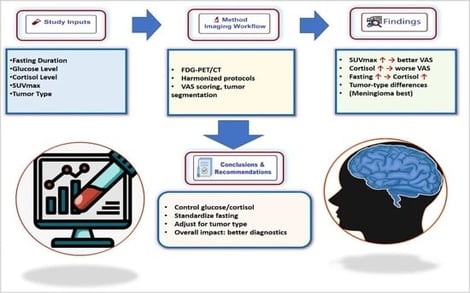
Objectives: This retrospective, multi-center study analyzed pre-existing anonymized clinical data from electronic health records and imaging archives. The analysis utilized real-world clinical data from 200 patients across four tertiary care centers, without additional patient recruitment or interventions. This study aims to investigate the impact of metabolic and physiological factors—specifically blood glucose levels, cortisol concentrations, fasting duration, and tumor histology—on the quality and diagnostic reliability of 18F-FDG PET/CT imaging in patients with primary brain tumors and inflammatory lesions. Methods: A total of 200 patients with primary brain tumors (including astrocytoma, glioblastoma, meningioma, and oligodendroglioma) were evaluated across four institutions using standardized protocols. The study examined the effects of prolonged fasting (>12 h), hyperglycemia (>150 mg/dL), and strict fasting (4–6 h) on tumor-to-background contrast and visual analog scale (DQS) scores. Results: Prolonged fasting was associated with elevated cortisol levels (correlation +0.54, p < 0.001), while hyperglycemia significantly reduced tumor SUVmax by up to 20% (r = −0.35, p = 0.012). Strict fasting and glucose control resulted in improved tumor-to-background contrast and DQS scores (r = +0.83, p < 0.001). Glioblastomas exhibited the highest SUVmax (9.1 ± 3.5), indicating aggressive metabolic activity, whereas meningiomas showed elevated cortisol levels (20.5 ± 6.8 µg/dL) linked to disruption of the hypothalamic–pituitary axis. Regression analysis confirmed that both cortisol and glucose levels independently degraded image quality (β = −0.25 and −0.18, respectively; p < 0.05). Conclusions: The findings highlight the necessity for harmonized patient preparation protocols. Recommendations are in alignment with the SNMMI Procedure Standard/EANM Practice Guideline for Brain [18F] FDG PET imaging.

5 February 2026
Participant flow diagram demonstrating the selection process for the final analytical cohort, following TREND guidelines, Item 19 requirements. Note: Colored boxes indicate different stages of the selection process: blue—initial medical records identified; white—eligibility screening; red—records excluded with reasons; green—final analysis cohort distributed across centers.

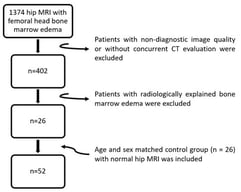
Background: This study aimed to investigate the association between femoroacetabular impingement (FAI) morphology and femoral head bone marrow edema of unknown etiology on hip magnetic resonance imaging (MRI), and to assess the added value of computed tomography-based three-dimensional maximum intensity projection (CT-MIP) measurements in identifying a predisposition to acetabular overcoverage. Methods: Hip MRI examinations performed between January 2007 and 2025 were retrospectively reviewed. Cases with bone marrow edema attributable to identifiable etiologies were excluded. Twenty-six patients with available hip or pelvis computed tomography (CT) examinations obtained within one year were included, along with an age- and sex-matched control group imaged for indications unrelated to hip pain. A total of 104 hip joints were evaluated. Alpha angles were measured on axial oblique CT reformations. Virtual pelvic radiographs generated from CT-based three-dimensional reconstructions were used for lateral center-edge angle (LCEA) measurements, and acetabular coverage was quantified using the acetabular coverage index derived from CT-MIP images. Appropriate statistical analyses were performed, with p < 0.05 considered statistically significant. Results: FAI was identified in 82.7% of cases with bone marrow edema of unknown etiology on MRI (p < 0.001), with pincer-type morphology being the most prevalent subtype (55.8%). Bone marrow edema was significantly more common in pincer-type FAI compared with other subtypes (p < 0.001) and predominantly involved the posterolateral femoral head. Mean alpha angle, LCEA, and acetabular coverage index values were significantly higher in the case group than in controls (p < 0.001). For the detection of pincer-type FAI, CT-MIP-based acetabular coverage index demonstrated superior diagnostic performance compared with LCEA (AUC, 0.917 vs. 0.855; p = 0.017), with an optimal cutoff value of 0.93 yielding high specificity and accuracy. All measurements showed excellent intraobserver and interobserver reliability. Conclusions: Femoral head bone marrow edema of unknown etiology may serve as a radiologic clue to underlying pincer-type FAI, while CT-MIP-based analyses may provide incremental value beyond conventional angular measurements in characterizing acetabular overcoverage.

4 February 2026

Flowchart of patient selection.

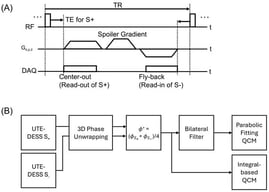
Background/Objectives: Tissue conductivity reflects ionic composition (e.g., sodium), providing critical insights into various diseases. Ultrashort echo time quantitative conductivity mapping (UTE-QCM) offers a method to obtain this information, which is particularly effective for musculoskeletal (MSK) tissues with short T2 relaxation times. The aim of this study is to develop a UTE-QCM framework using ultrashort echo time double echo steady-state (UTE-DESS) and validate its feasibility in the knee. Methods: An ultrashort echo time double echo steady-state (UTE-DESS) sequence was used to acquire S+ and S− images and estimate the transmit radiofrequency field (B1+) phase at 3T. The B1+ phase was derived by canceling the phase evolution in the free induction decay using these images. This phase data was then processed using two widely used QCM reconstruction methods for comparison: parabolic fitting and an integral-based method. The proposed UTE-QCM framework was validated using a phantom containing three different concentrations of sodium chloride (0%, 0.5%, and 1%). Additionally, three healthy volunteers were recruited to validate UTE-QCM in knee imaging. Results: In both phantom and in vivo experiments, the integral-based QCM demonstrated improved robustness to noise compared to parabolic fitting. In the sodium phantom, the estimated conductivity showed high linearity with sodium concentrations. In the in vivo knee, the generated conductivity maps successfully visualized both long and short T2 tissues. Conclusions: We demonstrated the feasibility of UTE-QCM as a novel quantitative imaging tool targeting short T2 tissues in the MSK system. This technique may facilitate the diagnosis and prognosis of joint disorders.

2 February 2026

UTE-QCM. (A) Pulse sequence diagram of 3D radial-based UTE-DESS and (B) the framework of UTE-QCM. The phase maps of the S+ and S− images from UTE-DESS were first phase-unwrapped and subsequently used for calculation of the B1+ phase. The resulting B1+ phase was then processed using two QCM methods: Parabolic fitting-based QCM and integral-based QCM. For the parabolic fitting-based QCM, a bilateral filter was applied to reduce noise in the B1+ phase maps (RF: radiofrequency, DAQ: data acquisition, Gx,y,z: x, y, and z gradients).

Background/Objectives: We compared the visibility of breast cancer using the newly developed standing automated breast ultrasound system (MammouS-N) and digital breast tomosynthesis (DBT), and identified factors influencing lesion visibility. Methods: We prospectively enrolled 100 women (mean age: 51.6 years; range: 26–76 years) who were diagnosed with breast cancer and were scheduled to undergo DBT between January and July 2024. They underwent DBT and an ultrasound on the same day. Two radiologists evaluated the visibility scores (0–5) of lesions corresponding to biopsy-confirmed breast cancers identified using magnetic resonance imaging. The Wilcoxon signed-rank test was used to compare the visibility scores of cancers identified on DBT and/or MammouS-N images. Results: Among the 100 women, invasive ductal carcinoma was the most common malignancy (73%). DBT findings included negative findings (7%), masses (46%), masses with calcification (29%), calcifications only (15%), and architectural distortions (3%). On MammouS-N ultrasound, most lesions were classified as masses (93%), whereas 7% were non-mass lesions. For Reviewer 1, MammouS-N demonstrated significantly higher visibility scores (higher scores: 26 on MammouS-N, seven on DBT; equal scores: 67, z = −3.234, p = 0.001). For Reviewer 2, the two modalities showed no significant difference in visibility (higher scores: 27 on MammouS-N, 28 on DBT, equal scores: 45, z = −0.040, p = 0.968). Noncalcified lesions that were obscured on DBT were better visualized on MammouS-N (p < 0.001) by both reviewers. Conclusions: MammouS-N holds promise as an imaging modality complementary to DBT in women with dense breast tissue, particularly for non-calcified lesion detection.

30 January 2026

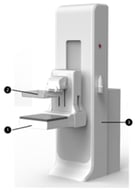
Overview of the MammouS-N system. 1. Breast Ultrasound Scanner: Captures ultrasound images of the breast. 2. Breast Compression Device: Applies compression to the breast during imaging for improved contact and stability. 3. Device Stabilization Structure: provides structural support and stability for the entire system.

News & Conferences

Issues

Open for Submission

Editor's Choice

Reprints of Collections

AI in Medical Imaging and Image Processing
Reprint

AI in Medical Imaging and Image Processing

Volume II
Editors: Karolina Nurzynska, Michał Strzelecki, Adam Piórkowski, Rafał Obuchowicz
AI in Medical Imaging and Image Processing
Reprint

AI in Medical Imaging and Image Processing

Volume I
Editors: Karolina Nurzynska, Michał Strzelecki, Adam Piórkowski, Rafał Obuchowicz

Get Alerted

Add your email address to receive forthcoming issues of this journal.

XFacebookLinkedIn
Tomography - ISSN 2379-139X