sustainability-logo

Journal Browser

Journal Browser

Foundational Industry 4.0/5.0 Technologies in the Digital Transformation of Supply Chains: A Global Perspective

A special issue of Sustainability (ISSN 2071-1050). This special issue belongs to the section "Economic and Business Aspects of Sustainability".

Deadline for manuscript submissions: 15 July 2026 | Viewed by 1679

Special Issue Editors


E-Mail Website
Guest Editor

E-Mail Website
Guest Editor
Department of Industrial Engineering, Pontifical Catholic University of Rio de Janeiro (PUC-Rio), Rio de Janeiro, Brazil
Interests: industry 4.0/5.0; maintenance; digital transformation; decision support; data science; sustainability

E-Mail Website
Guest Editor
Department of Civil and Environmental Engineering at the Pontifical Catholic University of Rio de Janeiro (PUC-Rio), Rio de Janeiro, Brazil
Interests: operations research; risk management; project management

Special Issue Information

Dear Colleagues,

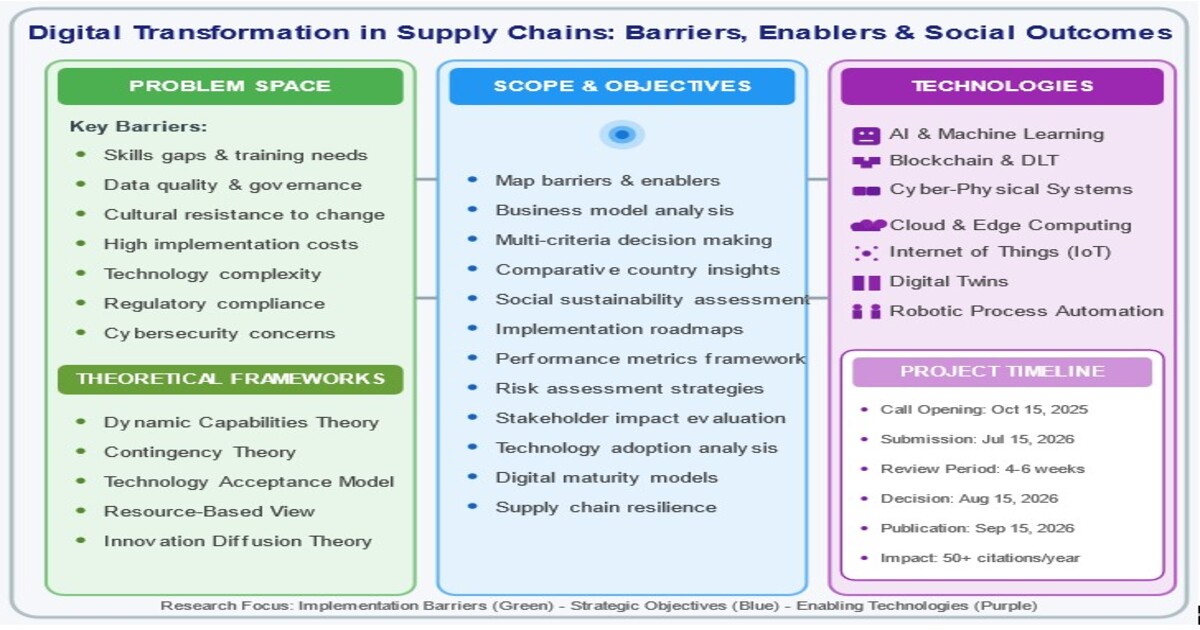
This Special Issue will examine the heterogeneous progression of the digital transformation of global supply chains through the lens of foundational Industry 4.0/5.0 technologies. Recognising that sectors are advancing unevenly in adopting IoT, AI, blockchain, and cyber–physical systems, this issue will investigate both barriers to (e.g., legacy systems, skill gaps, governance constraints, etc.) and enablers driving successful transformation. We encourage contributions that are rigorous, theoretically grounded, systematic literature reviews or use empirical, mixed-method, or quantitative modelling approaches to map relationships between digital enablers, business models, and organisational outcomes.

This issue will particularly emphasise cross-country comparative analyses, acknowledging divergent resource and institutional capacities between developed and developing economies. Its distinctive focus on social sustainability outcomes will position this collection at the intersection of technological advancement and human-centric operations. We especially welcome papers employing causal analysis or MCDM frameworks for investment prioritization; testing propositions through case studies, surveys, or panel data; or providing practice-oriented roadmaps.

By combining theoretical rigour with actionable insights, this Special Issue will advance evidence-based understanding of sustainable supply chain transformation, contributing to both academic discourse and the practical implementation of responsible digital transformation strategies in diverse global contexts.

Prof. Dr. Antonio Márcio Tavares Thomé
Dr. Renan Silva Santos
Dr. Mozart Caetano Heymann
Guest Editors

Manuscript Submission Information

Manuscripts should be submitted online at www.mdpi.com by registering and logging in to this website. Once you are registered, click here to go to the submission form. Manuscripts can be submitted until the deadline. All submissions that pass pre-check are peer-reviewed. Accepted papers will be published continuously in the journal (as soon as accepted) and will be listed together on the special issue website. Research articles, review articles as well as short communications are invited. For planned papers, a title and short abstract (about 250 words) can be sent to the Editorial Office for assessment.

Submitted manuscripts should not have been published previously, nor be under consideration for publication elsewhere (except conference proceedings papers). All manuscripts are thoroughly refereed through a single-blind peer-review process. A guide for authors and other relevant information for submission of manuscripts is available on the Instructions for Authors page. Sustainability is an international peer-reviewed open access semimonthly journal published by MDPI.

Please visit the Instructions for Authors page before submitting a manuscript. The Article Processing Charge (APC) for publication in this open access journal is 2400 CHF (Swiss Francs). Submitted papers should be well formatted and use good English. Authors may use MDPI's English editing service prior to publication or during author revisions.

Keywords

  • industry 4.0/5.0
  • supply chain digital transformation
  • sustainable supply chain management
  • multi-criteria decision-making (MCDM)
  • dynamic capabilities
  • social sustainability
  • digital technologies adoption
  • global comparative analysis
  • barriers and enablers
  • human-centric operations

Benefits of Publishing in a Special Issue

  • Ease of navigation: Grouping papers by topic helps scholars navigate broad scope journals more efficiently.
  • Greater discoverability: Special Issues support the reach and impact of scientific research. Articles in Special Issues are more discoverable and cited more frequently.
  • Expansion of research network: Special Issues facilitate connections among authors, fostering scientific collaborations.
  • External promotion: Articles in Special Issues are often promoted through the journal's social media, increasing their visibility.
  • Reprint: MDPI Books provides the opportunity to republish successful Special Issues in book format, both online and in print.

Further information on MDPI's Special Issue policies can be found here.

Published Papers (2 papers)

Order results
Result details
Select all
Export citation of selected articles as:

Research

Jump to: Other

35 pages, 2589 KB  
Article
From Barriers to Digital Transformation Pathways in Brazil and Germany
by Lia Denize Piovesan, Antônio Márcio Tavares Thomé, Rodrigo Goyannes Gusmão Caiado and Renan Silva Santos
Sustainability 2026, 18(1), 45; https://doi.org/10.3390/su18010045 - 19 Dec 2025
Viewed by 1002
Abstract
Digital transformation (DT) has become a strategic imperative for sustaining competitiveness in global supply chains. This study situates DT within the frameworks of Dynamic Capabilities Theory (DCT) and Structural Contingency Theory (SCT) to explain how leadership, culture, and institutional contexts shape adoption pathways [...] Read more.
Digital transformation (DT) has become a strategic imperative for sustaining competitiveness in global supply chains. This study situates DT within the frameworks of Dynamic Capabilities Theory (DCT) and Structural Contingency Theory (SCT) to explain how leadership, culture, and institutional contexts shape adoption pathways in Brazil and Germany. Using a sequential mixed-methods approach, it combines a tertiary literature review with expert elicitation and Interpretive Structural Modelling (ISM), supported by DEMATEL and MICMAC analyses, to uncover hierarchical relationships among barriers and foundational technologies—Big Data Analytics (BDA), the Internet of Things (IoT), and cloud computing. The results reveal distinct causal structures: in Germany, workforce deficits and economic-risk perceptions act as root barriers that constrain managerial and cultural adaptation; in Brazil, executive sponsorship drives workforce capability and analytics development, activating subsequent IoT and cloud adoption. Across both contexts, BDA consistently emerges as the foundational enabler, indicating a layered sequence of capability accumulation. The findings demonstrate that effective digital transformation depends on leadership-enabled alignment between organisational structure and environmental contingencies. This study contributes a comparative framework linking DCT’s dynamic routines with SCT’s structural fit, providing theoretical, methodological, and policy insights for context-sensitive digitalisation strategies. Full article
Show Figures

Figure 1

Other

Jump to: Research

50 pages, 1260 KB  
Systematic Review
Circular Economy Approaches for Sustainable Energy Supply Chains: A Systematic Review of Concepts, Models and Performance Assessment
by Lucian Dordai, Marius Roman and Anca Becze
Sustainability 2026, 18(7), 3371; https://doi.org/10.3390/su18073371 - 31 Mar 2026
Viewed by 360
Abstract
The transition from linear production and consumption models toward circular economy (CE) systems represents a key pathway for improving the sustainability and resilience of energy supply chains. This review provides a structured synthesis of circular economy approaches applied across the full lifecycle of [...] Read more.
The transition from linear production and consumption models toward circular economy (CE) systems represents a key pathway for improving the sustainability and resilience of energy supply chains. This review provides a structured synthesis of circular economy approaches applied across the full lifecycle of energy systems, encompassing resource sourcing, energy generation and conversion, processing, distribution, and end-of-life recovery. The analysis integrates conceptual frameworks with system-based and analytical modelling approaches, as well as environmental, economic, and operational performance assessment methods. The results reveal that current research remains largely fragmented across material, energy, and residual flow perspectives, with limited system-level integration and persistent inconsistencies in modelling and evaluation approaches. While circular strategies such as resource recovery, energy recirculation, and industrial symbiosis demonstrate significant potential for improving resource efficiency and reducing environmental impacts, their implementation continues to be constrained by data limitations, technological maturity, and coordination complexity across stakeholders. By consolidating the dispersed literature into a coherent analytical structure, this review clarifies the critical interdependencies between circularity strategies, modelling approaches, and performance metrics, and identifies the methodological gaps that currently limit progress toward integrated circular energy supply chains. The findings offer a structured foundation for researchers and practitioners working to develop more robust evaluation frameworks and governance mechanisms in this field, and point toward the convergence of digital technologies, multi-stakeholder governance, and lifecycle thinking as a productive direction for advancing the field. Full article
Show Figures

Figure 1

Back to TopTop