sustainability-logo

Journal Browser

Journal Browser

Higher Education for Sustainability

A special issue of Sustainability (ISSN 2071-1050). This special issue belongs to the section "Sustainable Education and Approaches".

Deadline for manuscript submissions: closed (25 March 2026) | Viewed by 5004

Special Issue Editors


E-Mail Website
Guest Editor
WELS, The Open University, Milton Keynes MY7 6AA, UK
Interests: sustainable pedagogies; mathematical resilience; mathematics learning and teaching

E-Mail Website
Guest Editor
WELS, The Open University, Milton Keynes MY7 6AA, UK
Interests: professional learning; ethical enquiry; environmental sustainability in research
Special Issues, Collections and Topics in MDPI journals

E-Mail Website
Guest Editor
WELS, The Open University, Milton Keynes MY7 6AA, UK
Interests: five ways of working for sustainability; sustainability in practice

E-Mail Website
Guest Editor
WELS, The Open University, Milton Keynes MY7 6AA, UK
Interests: sustainable development and global citizenship; mentoring; artnership working and the use of video technology in the classroom; embedding education for sustainable development in the curriculum

Special Issue Information

Dear Colleagues,

Higher Education Institutions (HEIs) have a particularly powerful role in galvanising sustainability action across the globe. As institutions, they must organise themselves to reduce the environmental impact of their operations while continuing to sustain their staff and student body. As educators, they must develop and enable their staff and students to apply sustainable practices and use sustainable pedagogies. A sustainable future will depend on their students working with sustainability in mind, whatever their sector, as the impacts of climate change become increasingly visible. A further complication is how HEIs provide higher education, which combines facilitating their students’ understanding of the specialist, detailed content of their chosen course, along with sustainable thinking. They must show their discipline’s relationship with the Sustainable Development Goals, whilst enabling their students to develop values-based, transferable skills to think creatively, reason critically and act sustainably—known collectively as the Inner Development Goals.

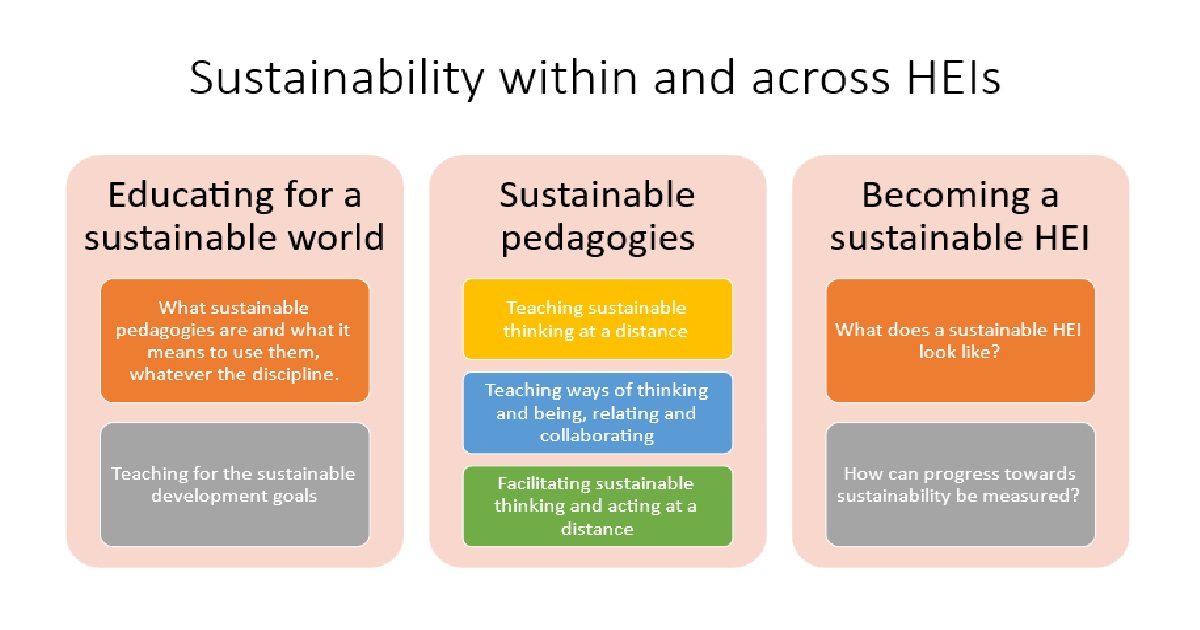
The focus of this Special Issue is education for sustainability within HEIs. We aim to include articles on the following topics:

  • Enabling all students to understand sustainability and learn to think and act sustainably.
  • What sustainable pedagogies are and what it means to use them, whatever the discipline, thus facilitating learning about acting sustainably within each and every discipline.
  • Enabling learning on how to use different ways of thinking and being, as well as relating and collaborating, that are required for students to act sustainably within a complex world.
  • The particular issues that come from offering learning about and for sustainability at a distance.
  • Becoming a sustainable HEI—what a sustainable HEI might look like and how to assess progress towards sustainability.

Dr. Clare Lee
Dr. Alison Fox
Dr. Victoria Hands
Dr. Alison Glover
Guest Editors

Manuscript Submission Information

Manuscripts should be submitted online at www.mdpi.com by registering and logging in to this website. Once you are registered, click here to go to the submission form. Manuscripts can be submitted until the deadline. All submissions that pass pre-check are peer-reviewed. Accepted papers will be published continuously in the journal (as soon as accepted) and will be listed together on the special issue website. Research articles, review articles as well as short communications are invited. For planned papers, a title and short abstract (about 250 words) can be sent to the Editorial Office for assessment.

Submitted manuscripts should not have been published previously, nor be under consideration for publication elsewhere (except conference proceedings papers). All manuscripts are thoroughly refereed through a single-blind peer-review process. A guide for authors and other relevant information for submission of manuscripts is available on the Instructions for Authors page. Sustainability is an international peer-reviewed open access semimonthly journal published by MDPI.

Please visit the Instructions for Authors page before submitting a manuscript. The Article Processing Charge (APC) for publication in this open access journal is 2400 CHF (Swiss Francs). Submitted papers should be well formatted and use good English. Authors may use MDPI's English editing service prior to publication or during author revisions.

Keywords

  • sustainable pedagogies
  • HEIs
  • distance learning
  • Inner Development Goals
  • sustainability competencies

Benefits of Publishing in a Special Issue

  • Ease of navigation: Grouping papers by topic helps scholars navigate broad scope journals more efficiently.
  • Greater discoverability: Special Issues support the reach and impact of scientific research. Articles in Special Issues are more discoverable and cited more frequently.
  • Expansion of research network: Special Issues facilitate connections among authors, fostering scientific collaborations.
  • External promotion: Articles in Special Issues are often promoted through the journal's social media, increasing their visibility.
  • Reprint: MDPI Books provides the opportunity to republish successful Special Issues in book format, both online and in print.

Further information on MDPI's Special Issue policies can be found here.

Published Papers (4 papers)

Order results
Result details
Select all
Export citation of selected articles as:

Research

0 pages, 295 KB  
Article
Teaching Sustainability Through Ancient Texts: Digital Pedagogy and Environmental Humanities in Higher Education
by Marianna Olivadese
Sustainability 2026, 18(9), 4354; https://doi.org/10.3390/su18094354 - 28 Apr 2026
Viewed by 603
Abstract
Higher Education Institutions (HEIs) are increasingly called upon to integrate sustainability across curricula and to prepare students to respond critically and responsibly to complex environmental challenges. While sustainability education is often associated with scientific, technological, or policy-oriented disciplines, the contribution of the humanities [...] Read more.
Higher Education Institutions (HEIs) are increasingly called upon to integrate sustainability across curricula and to prepare students to respond critically and responsibly to complex environmental challenges. While sustainability education is often associated with scientific, technological, or policy-oriented disciplines, the contribution of the humanities remains underexplored, particularly in digitally mediated university teaching. This paper argues that ancient texts, approached through the lens of the Environmental Humanities and supported by digital pedagogy, can offer a valuable framework for fostering sustainability literacy in higher education. Drawing on a humanities-based pedagogical model, this article explores how practices such as collaborative close reading, ecocritical discussion, narrative mapping, reflective writing, and digital storytelling can help students connect classical representations of nature, fragility, order, and human responsibility with contemporary ecological concerns. These activities encourage the development of sustainability-related competencies—including critical thinking, ethical reflection, interpretive complexity, and ecological awareness—while also supporting Inner Development Goals such as self-awareness, empathy, relational thinking, and responsible action. Based on a conceptual pedagogical model supported by exploratory qualitative evidence from a small-scale higher education course, this paper suggests that digital pedagogy can make sustainability learning in the humanities more dialogic and reflective. In doing so, this article proposes a practice-based pedagogical framework that may help Higher Education Institutions explore ways of embedding sustainability meaningfully beyond traditionally environmental fields. This article’s primary contribution is therefore pedagogical: it presents a humanities-based model for sustainability education while using exploratory qualitative evidence from one course context to illustrate how such a model may support interpretive, ethical, and sustainability-oriented learning. Full article
(This article belongs to the Special Issue Higher Education for Sustainability)
17 pages, 1163 KB  
Article
Environmental Attitudes as Sustainability Learning Outcomes in Higher Education: Gender, Age, and Disciplinary Differences in Andalusian Universities
by Macarena Esteban Ibáñez, Luis Vicente Amador Muñoz and Francisco Mateos Claros
Sustainability 2026, 18(9), 4328; https://doi.org/10.3390/su18094328 - 27 Apr 2026
Viewed by 676
Abstract
Higher education institutions (HEIs) play a central role in fostering sustainability competencies to address environmental challenges. Within Education for Sustainable Development (ESD) and Sustainable Development Goal (SDG) 4 frameworks, universities must cultivate not only knowledge but also attitudes and behaviours promoting environmental responsibility. [...] Read more.
Higher education institutions (HEIs) play a central role in fostering sustainability competencies to address environmental challenges. Within Education for Sustainable Development (ESD) and Sustainable Development Goal (SDG) 4 frameworks, universities must cultivate not only knowledge but also attitudes and behaviours promoting environmental responsibility. This study examines environmental attitudes as sustainability learning outcomes among undergraduate students, analysing differences by gender, age, and discipline in six Andalusian universities. Sustainable Education is defined as an approach integrating environmental, social, and economic sustainability dimensions into teaching to develop active competencies for sustainable development. A cross-sectional survey (n = 1471) used the validated CASEM questionnaire (see previous validation studies) to assess environmental knowledge, environmental education knowledge, and pro-environmental behaviour. The results show significant differences: women outperformed men across all dimensions, students aged over 25 exhibited stronger profiles, and Education Sciences students outperformed Engineering students. A persistent knowledge–behaviour gap emerged, especially in technical fields. These findings reveal curricular inequalities in sustainability integration. Mandatory, discipline-specific ESD—particularly in engineering—may help bridge these gaps and enhance uniform learning outcomes. By employing a multidimensional instrument and stratified sample, this study offers robust evidence of structural disparities, informing policy for equitable Higher Education for Sustainability. Full article
(This article belongs to the Special Issue Higher Education for Sustainability)
Show Figures

Figure 1

39 pages, 4701 KB  
Article
PAMD-Based Interdisciplinary Teaching Reform for Linear Algebra and Accounting: A Sustainable Education Perspective
by Saxi Du, Sihan Yan, Yuxuan Wang, Lihong Li and Hongling Ding
Sustainability 2026, 18(8), 3843; https://doi.org/10.3390/su18083843 - 13 Apr 2026
Viewed by 491
Abstract
Under the dual carbon strategy and the sweeping tide of digital transformation in education, higher education confronts an urgent imperative: cultivating talent equipped with interdisciplinary skills and sustainable decision-making capabilities. To meet this critical challenge, this study pioneers the PAMD (Patient Capital–Accounting–Matrix–Development) interdisciplinary [...] Read more.
Under the dual carbon strategy and the sweeping tide of digital transformation in education, higher education confronts an urgent imperative: cultivating talent equipped with interdisciplinary skills and sustainable decision-making capabilities. To meet this critical challenge, this study pioneers the PAMD (Patient Capital–Accounting–Matrix–Development) interdisciplinary teaching framework. Rooted firmly in Education for Sustainable Development (ESD) principles, PAMD uniquely weaves together patient capital, carbon asset accounting, and linear algebra matrix modeling. Utilizing a quasi-experimental design with undergraduate business students, we implemented “Carbon Asset Accounting and Low-Carbon Transition Investment Analysis” as a case study. We rigorously evaluated teaching effectiveness across academic performance, competency, and cognitive attitude dimensions using Welch’s t-test, Hedges’ g, and ANCOVA. After controlling for baseline scores, the experimental group significantly surpassed the control group in comprehensive decision-making (81.22 vs. 72.41, g = 0.71) and matrix modeling competency (3.74 vs. 3.22, g = 0.77). The experimental cohort also demonstrated consistent gains in carbon accounting reporting precision and data representation clarity. Cognitive assessments revealed moderate effect sizes for both low-carbon investment literacy and interdisciplinary learning interest. These compelling results demonstrate that embedding a long-term value orientation into accounting representation and matrix modeling powerfully cultivates students’ ability to transfer interdisciplinary knowledge and make sound sustainable decisions within complex contexts. This study offers a robust, evidence-based, and replicable pathway for driving sustainability-oriented interdisciplinary reform within business education. Full article
(This article belongs to the Special Issue Higher Education for Sustainability)
Show Figures

Figure 1

19 pages, 4676 KB  
Communication
“Which Voices Are Heard? Who Is Silenced?”: Learning from Young People About the Climate Emergency Using Artivism as a Sustainable Pedagogy
by Inma Alvarez, Deborah Ayodele-Olajire, Gemma Burnside, Carolyn Cooke, Margaret Ebubedike, Alison Fox, Alison Glover, Lloyd Muriuki Wamai and Catriona Willis
Sustainability 2025, 17(21), 9825; https://doi.org/10.3390/su17219825 - 4 Nov 2025
Viewed by 1020
Abstract
This article reports on an international project involving higher education institutions working in partnership with third sector organizations, to explore facilitating children and young people in expressing their concerns and ideas about climate change directly to decision-makers. Children and young people were invited [...] Read more.
This article reports on an international project involving higher education institutions working in partnership with third sector organizations, to explore facilitating children and young people in expressing their concerns and ideas about climate change directly to decision-makers. Children and young people were invited to engaged in ‘artivism’ (the use of art for activism) to create exhibitions for policymakers and business leaders in Scotland, Kenya and Nigeria. Through co-creation, underpinned by the principles of sustainable pedagogies, the project team created spaces and research methods exploring how artivism for climate action can be supported and enacted. The focus of this article is on the role of adults as local facilitators, educators, research team members, and exhibition attendees in facilitating, listening to, and engaging with children and young people as they express themselves and generate climate action through their artivism. It illustrates how adults enacting sustainable pedagogies, care and compassion are critical, and how arts-based education for sustainability involves pedagogies of collaboration and co-creation which entangle us with people, places, ideas, languages, materials and environments beyond our immediate educational settings. Full article
(This article belongs to the Special Issue Higher Education for Sustainability)
Show Figures

Graphical abstract

Back to TopTop