- 3.3Impact Factor
- 7.7CiteScore
- 20 daysTime to First Decision
Sustainability in Agricultural Systems and Ecosystem Services
This special issue belongs to the section “Sustainable Agriculture“.
Special Issue Information
Dear Colleagues,
Nowadays world requires that food systems adapt to meet the demands of a growing population, to deal with the urgency of climate change and the challenge of environmental conservation in the face of a range of planetary pressures. By 2050, the global population is expected to reach 9.8 billions, requiring a 70 percent increase in food production. At the same time agriculture needs to adopt sustainable solutions that lead to healthier agro-ecosystems, to carry on producing of food into the future.
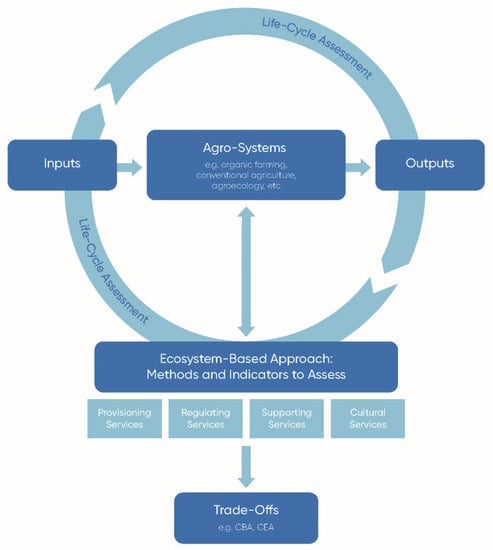
Ecosystem services underpin most part of the agricultural production systems. However, they are considered to be as free and expected component of the production system instead of an essential component that could cease if not properly managed. Ecosystem-based approaches offer an option to increase the sustainability and resilience of agricultural systems, strengthening key natural ecosystem services, protecting rural livelihoods and ensuring food security.
This Topical Collection will comprise a selection of papers presenting original and innovative contributions to the research field of sustainability of agricultural systems. In particular, contributions about the following themes will be considered: the promotion of agriculture based on diversifying farms and farming landscapes; the integration of biodiversity and ecosystem services into food production; the evaluation of positive and effective incentives systems for diversification, involving also trade and consumption; the assessment of sustainability and resilience in agricultural systems; the multifunctional agriculture and ecosystem services production and the advancement in decision support tools for improving sustainability of agricultural systems.
Papers selected for this Topical Collection will be subject to a rigorous peer-review process with the aim of rapid and wide dissemination of research results, developments, and applications.
Dr. Lucia RocchiDr. Luisa Paolotti
Collection Editors
Manuscript Submission Information
Manuscripts should be submitted online at www.mdpi.com by registering and logging in to this website. Once you are registered, click here to go to the submission form. Manuscripts can be submitted until the deadline. All submissions that pass pre-check are peer-reviewed. Accepted papers will be published continuously in the journal (as soon as accepted) and will be listed together on the special issue website. Research articles, review articles as well as short communications are invited. For planned papers, a title and short abstract (about 250 words) can be sent to the Editorial Office for assessment.
Submitted manuscripts should not have been published previously, nor be under consideration for publication elsewhere (except conference proceedings papers). All manuscripts are thoroughly refereed through a single-blind peer-review process. A guide for authors and other relevant information for submission of manuscripts is available on the Instructions for Authors page. Sustainability is an international peer-reviewed open access semimonthly journal published by MDPI.
Please visit the Instructions for Authors page before submitting a manuscript. The Article Processing Charge (APC) for publication in this open access journal is 2400 CHF (Swiss Francs). Submitted papers should be well formatted and use good English. Authors may use MDPI's English editing service prior to publication or during author revisions.
Keywords
- ecosystem-based agriculture
- biodiversity-based agriculture
- ecosystem services management
- ecosystem services production
- agro-ecosystem services assessment
- sustainable ecosystems services
- resilience in agricultural systems
Benefits of Publishing in a Special Issue
- Ease of navigation: Grouping papers by topic helps scholars navigate broad scope journals more efficiently.
- Greater discoverability: Special Issues support the reach and impact of scientific research. Articles in Special Issues are more discoverable and cited more frequently.
- Expansion of research network: Special Issues facilitate connections among authors, fostering scientific collaborations.
- External promotion: Articles in Special Issues are often promoted through the journal's social media, increasing their visibility.
- e-Book format: Special Issues with more than 10 articles can be published as dedicated e-books, ensuring wide and rapid dissemination.