
 Open Access
 - Review

11 Pages
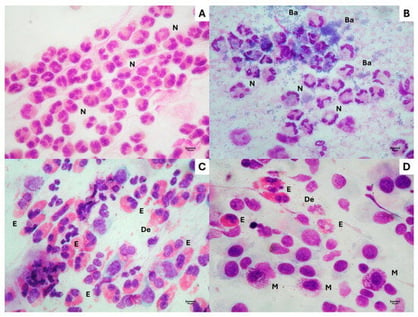
Chronic rhinosinusitis (CRS) is a heterogeneous inflammatory disorder traditionally classified according to the presence or absence of nasal polyps into chronic rhinosinusitis with nasal polyps (CRSwNP) and chronic rhinosinusitis without nasal polyps (CRSsNP). Although CRSwNP is frequently associated with Type 2 eosinophilic and mast-cell inflammation and CRSsNP has historically been linked to neutrophilic inflammation, this dichotomy does not fully reflect the biological complexity of CRS. Type 2 inflammation may also occur in CRSsNP, particularly in association with allergic disease, while neutrophilic and microbial components may coexist with Type 2 inflammation in CRSwNP. This review examines the cellular landscape of both phenotypes from a nasal cytology perspective, focusing on eosinophils, mast cells, neutrophils, epithelial alterations, microbial involvement, and biofilm formation. Particular attention is given to treatment-associated remodeling during biologic therapy. During dupilumab therapy, suppression of eosinophilic and mast-cell inflammation has been accompanied, in a subset of patients, by the emergence of a neutrophilic and microbial-associated cytological profile, although current evidence remains limited. Nasal cytology therefore provides a direct and repeatable window into the evolving sinonasal inflammatory environment, complementing conventional phenotyping and improving the interpretation of inflammatory overlap, microbial interactions, and treatment response.
Sinusitis
16 October 2026