



Biomass Energy Conversion for Efficient and Sustainable Utilization

A special issue of Processes (ISSN 2227-9717). This special issue belongs to the section "Energy Systems".

Deadline for manuscript submissions: 28 February 2026 | Viewed by 5962
Special Issue Editors


E-Mail Website
Guest Editor
Facultad de Agronomía (FA), Universidad Autónoma de Nuevo León (UANL), Francisco Villa S/N, Col. Ex-Hacienda “El Canadá”, Escobedo 66050, Nuevo Leon, Mexico
Interests: biomass transformation technologies; bioenergy; energy recovery of waste

E-Mail Website
Guest Editor
Instituto de Silvicultura e Industria de la Madera, Universidad Juárez del Estado de Durango, Durango 34120, México
Interests: biomass conversion technologies; charcoal production and optimization; pellet and briquet quality and standardization
Special Issues, Collections and Topics in MDPI journals

Special Issue Information

Dear Colleagues,

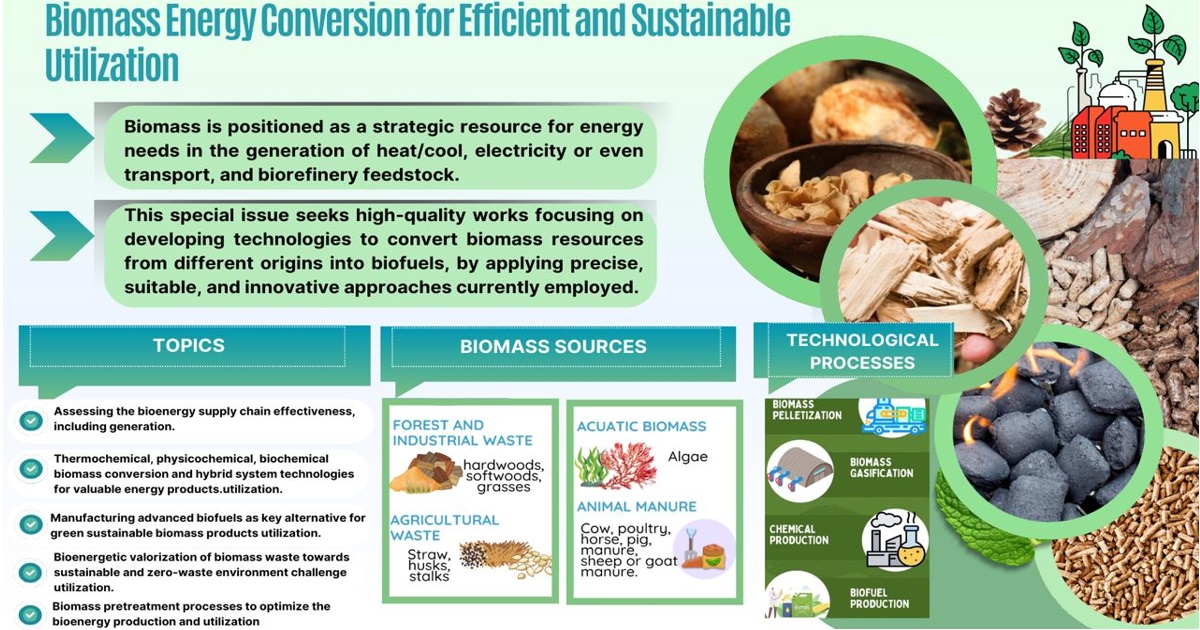
Increasingly, biomass is positioned as a strategic resource for energy needs in heating/cooling, electricity generation, transport, and biorefinery feedstock. Biomass resources include forest residues (hardwoods, softwoods, grasses), agricultural waste (straw, husks, stalks), aquatic biomass (algae), animal manure, and various types of organic waste, which are widely distributed throughout the world. As a form of renewable energy, they offer advantages such as easy storage and transportation, flexible load management, and versatile applications. They are mainly composed of lignocellulose, which contains substantial amounts of carbon, hydrogen, and oxygen, providing many chemical bonds and functional groups that facilitate various chemical reactions, which is vital in improving the current energy structure, alleviating the excessive reliance on fossil fuels, and reducing environmental contamination. Many processes exist for converting biomass into valuable forms of energy, depending on the number of properties, the type of biomass feedstock, its size and structure, the nature of the energy, etc. However, the main components of biomass (cellulose, hemicellulose, and lignin) form a complex structure that gives lignocellulosic fibers high biological and chemical stability, making their conversion and use difficult. Therefore, it is imperative to apply treatments to eliminate these biological barriers in order to facilitate the decomposition and separation of components and allow chemical reagents or hydrolytic enzymes to efficiently interact with the substrates for biochemical conversion, laying the foundation for the integral use of these main components. The predominant lignocellulose pretreatment technologies are classified into four categories: physical, chemical, physicochemical, and biological methods. However, there is also a tendency towards the implementation of hybrid systems for the optimization of biomass transformation and utilization processes.

This Special Issue on “Biomass Energy Conversion for Efficient and Sustainable Utilization” seeks high-quality works focusing on developing technologies (including pretreatment processes) to convert biomass resources from different origins into solid, liquid, and gaseous forms of biofuels by applying precise, suitable, and innovative approaches. Attention should be directed towards the potential environmental impacts, benefits/advantages, and challenges of these biomass conversion technologies, as well as their potential pretreatments and/or hybrid systems, in order to generate high-selectivity and high-performance biofuels and ensure efficient and sustainable utilization. Topics include, but are not limited to, the following:

-  Assessing bioenergy supply chain effectiveness, including generation and utilization;

-  Thermochemical, physicochemical, and biochemical biomass conversion and hybrid system technologies for valuable energy products;

-  Manufacturing advanced biofuels as key alternative for green sustainable biomass products;

-   Bioenergetic valorization of biomass waste towards sustainability and zero waste;

-   Biomass pretreatment processes to optimize bioenergy production and utilization.

Dr. Maginot Ngangyo-Heya
Dr. Artemio Carrillo-Parra
Guest Editors

Manuscript Submission Information

Manuscripts should be submitted online at www.mdpi.com by registering and logging in to this website. Once you are registered, click here to go to the submission form. Manuscripts can be submitted until the deadline. All submissions that pass pre-check are peer-reviewed. Accepted papers will be published continuously in the journal (as soon as accepted) and will be listed together on the special issue website. Research articles, review articles as well as short communications are invited. For planned papers, a title and short abstract (about 250 words) can be sent to the Editorial Office for assessment.

Submitted manuscripts should not have been published previously, nor be under consideration for publication elsewhere (except conference proceedings papers). All manuscripts are thoroughly refereed through a single-blind peer-review process. A guide for authors and other relevant information for submission of manuscripts is available on the Instructions for Authors page. Processes is an international peer-reviewed open access monthly journal published by MDPI.

Please visit the Instructions for Authors page before submitting a manuscript. The Article Processing Charge (APC) for publication in this open access journal is 2400 CHF (Swiss Francs). Submitted papers should be well formatted and use good English. Authors may use MDPI's English editing service prior to publication or during author revisions.

Keywords

  • bioenergy
  • biomass transformation technologies
  • biomass pretreatment
  • waste revaluation
  • advanced biofuels
  • hybrid biofuels.

Benefits of Publishing in a Special Issue

  • Ease of navigation: Grouping papers by topic helps scholars navigate broad scope journals more efficiently.
  • Greater discoverability: Special Issues support the reach and impact of scientific research. Articles in Special Issues are more discoverable and cited more frequently.
  • Expansion of research network: Special Issues facilitate connections among authors, fostering scientific collaborations.
  • External promotion: Articles in Special Issues are often promoted through the journal's social media, increasing their visibility.
  • Reprint: MDPI Books provides the opportunity to republish successful Special Issues in book format, both online and in print.

Further information on MDPI's Special Issue policies can be found here.

Published Papers (4 papers)

Order results
Result details
Select all
Export citation of selected articles as:

Research

15 pages, 1712 KB  
Article
Primary Constitution and Proximal Analysis of Three Fabaceae by the Thermogravimetric and Chemical Methods for Their Potential Use as Bioenergy
by Luis Fernando Pintor-Ibarra, José Juan Alvarado-Flores, José Guadalupe Rutiaga-Quiñones, Jorge Víctor Alcaraz-Vera, Rafael Herrera-Bucio, Víctor Manuel Ruiz-García and Oswaldo Moreno-Anguiano
Processes 2025, 13(12), 3907; https://doi.org/10.3390/pr13123907 - 3 Dec 2025
Viewed by 265
Abstract
The standard methods for determining the basic chemical composition of wood are well-established, but include processes that demand a great deal of time and diverse chemical reagents. TGA and DTG analyses, in contrast, offer precise results in less time. This study was designed [...] Read more.
The standard methods for determining the basic chemical composition of wood are well-established, but include processes that demand a great deal of time and diverse chemical reagents. TGA and DTG analyses, in contrast, offer precise results in less time. This study was designed to identify the primary components and results of the proximal analysis of wood from three species –Acacia farnesiana, A. pennatula and Albizia plurijuga—using TGA with deconvolution of the DTG curve and a chemical method. Higher heating value (HHV) was determined using a bomb calorimeter and mathematical models. Elemental organic and inorganic analyses were conducted. No statistically significant differences appeared in the results of the TGA-DTG and chemical methods for the wood in terms of cellulose, lignin, and volatile material content. Results were especially accurate in the samples of A. pennatula and A. plurijuga for hemicelluloses, extractives, and moisture. Regarding HHV, the wood of A. plurijuga showed no statistically significant differences between the bomb calorimeter test, calculations as a function of chemical composition, or the proximal analysis. Elemental organic results were C = 43.76–46.65%; H = 6.70–6.95%; O = 46.06–48.95%; N = 0.21–0.42%; and S = 0.06–0.11%. For the inorganic fraction we identified 18 elements in the ash. We conclude that the TGA-DTG method made it possible to obtain results in a short time with no need for the numerous reagents that chemical processes require. Findings suggest that in the absence of a bomb calorimeter, the best model for calculating HHV is proximal analysis. Full article
(This article belongs to the Special Issue Biomass Energy Conversion for Efficient and Sustainable Utilization)
Show Figures

Figure 1

16 pages, 1931 KB  
Article
Enhancing Thermophilic High-Solid Anaerobic Digestion of Swine Manure Using Ammonia-Stripped Biogas Slurry Reflux Amended with Waste Iron Powder and Biochar
by Jingjing Peng, Xin Zhang, Xinyu Wang, Zhe Liu and Ping Ai
Processes 2025, 13(12), 3787; https://doi.org/10.3390/pr13123787 - 24 Nov 2025
Viewed by 341
Abstract
Ammonia stripping has been widely used to recover ammonia nitrogen from biogas slurry; however, the inhibitory effects on biogas production cannot be fully eliminated if ammonia-stripped biogas slurry (ASBS) is recycled back to the high-solid anaerobic digestion (AD) of animal wastes. This study [...] Read more.
Ammonia stripping has been widely used to recover ammonia nitrogen from biogas slurry; however, the inhibitory effects on biogas production cannot be fully eliminated if ammonia-stripped biogas slurry (ASBS) is recycled back to the high-solid anaerobic digestion (AD) of animal wastes. This study investigated the performance of swine manure AD with recycling of ASBS and confirmed that there was no positive effect on increasing biogas production for ASBS recycling in the swine manure AD system under high solids (15%). The lowest accumulated methane yield was 133.9 mL/g-VS when swine waste was diluted with only raw biogas slurry (RBS), which was 9.2% lower than that of the water group (C0). Notably, the performance of AD was enhanced by adding rice husk biochar (RHB), waste iron powder (WIP), or their combination with ammonia-stripped biogas slurry (ASBS) reflux in the swine manure AD system. By adding 9.0 g/L of RHB, the biogas yield increased by 21.1%, and the total ammonia concentration (TAN) reduced by 15.1% compared to ASBS reflux alone (C1). The methane content reached a maximum of 75.2%, which was 12.8% higher than C1, while the methane yield was 1.5-times higher with the addition of 9.0 g/L of WIP. Correspondingly, the TAN was reduced, while the degradation of volatile fatty acids (VFAs) and total chemical oxygen demand (TCOD) increased. Both WIP and RHB can provide great potential to reuse biogas slurry in AD with a higher biogas yield and organic degradation rate. This approach facilitates source reduction in biogas slurry and nutrient recovery, while providing insights for reducing water consumption in manure treatment processes and enhancing biogas production efficiency. Full article
(This article belongs to the Special Issue Biomass Energy Conversion for Efficient and Sustainable Utilization)
Show Figures

Figure 1

19 pages, 1834 KB  
Article
Solar-Powered Biomass Revalorization for Pet Food and Compost: A Campus-Scale Eco-Circular System Based on Energy Performance Contracting
by Leyla Akbulut, Ahmet Coşgun, Mohammed Hasan Aldulaimi, Salwan Obaid Waheed Khafaji, Atılgan Atılgan and Mehmet Kılıç
Processes 2025, 13(9), 2719; https://doi.org/10.3390/pr13092719 - 26 Aug 2025
Viewed by 1957
Abstract
Integrating renewable energy with biomass valorization offers a scalable pathway toward circular and climate-resilient campus operations. This study presents a replicable model implemented at Alanya Alaaddin Keykubat University (ALKU, Türkiye), where post-consumer food waste from 30 cafeteria menus is converted into pet food [...] Read more.
Integrating renewable energy with biomass valorization offers a scalable pathway toward circular and climate-resilient campus operations. This study presents a replicable model implemented at Alanya Alaaddin Keykubat University (ALKU, Türkiye), where post-consumer food waste from 30 cafeteria menus is converted into pet food and compost using a 150 L ECOAIR-150 thermal drying and grinding unit powered entirely by a 1.7 MW rooftop photovoltaic (PV) system. The PV infrastructure, established under Türkiye’s first public-sector Energy Performance Contract (EPC), ensures zero-electricity-cost operation. On average, 260 kg of organic waste are processed monthly, yielding 180 kg of pet food and 50 kg of compost, with an energy demand of 1.6 kWh h−1 and a conversion efficiency of 68.4%, resulting in approximately 17.5 t CO2 emissions avoided annually. Economic analysis indicates a monthly revenue of USD 55–65 and a payback period of ~36 months. Sensitivity analysis highlights the influence of input quality, seasonal waste composition, PV output variability, and operational continuity during academic breaks. Compared with similar initiatives in the literature, this model uniquely integrates EPC financing, renewable energy generation, and waste-to-product transformation within an academic setting, contributing directly to SDGs 7, 12, and 13. Full article
(This article belongs to the Special Issue Biomass Energy Conversion for Efficient and Sustainable Utilization)
Show Figures

Figure 1

11 pages, 635 KB  
Article
Energy Production and Process Costing for Biomass Obtained from Underutilized Plant Species in México and Colombia
by Julio César Ríos-Saucedo, Rigoberto Rosales-Serna, Artemio Carrillo-Parra, Cynthia Adriana Nava-Berumen, Antonio Cano-Pineda, Martín Aquino-Ramírez and Jesús Manuel Martínez-Villela
Processes 2025, 13(6), 1878; https://doi.org/10.3390/pr13061878 - 13 Jun 2025
Viewed by 1017
Abstract
The objectives were to evaluate the energy potential of biomass and pellets produced from five underutilized herbaceous and woody plant species in México and Colombia; characterize pellet quality parameters; and calculate the preliminary production costs and energy requirement during the densification process. Harvest [...] Read more.
The objectives were to evaluate the energy potential of biomass and pellets produced from five underutilized herbaceous and woody plant species in México and Colombia; characterize pellet quality parameters; and calculate the preliminary production costs and energy requirement during the densification process. Harvest and sawmill residues were obtained for five non-timber and woody plant species. The volatile compounds, ash, and fixed carbon were evaluated, as well as the higher heating value (HHV) and pellet impact resistance (PIR); in addition, lignin, hemicellulose, and cellulose were quantified. The data were analyzed using descriptive statistics, including mean and standard deviation. The volatile compounds ranged from 65.9–77.5%, ash 2.5–17.2%, fixed carbon 5.4–19.9%, HHV 16.4–21.9 MJ kg1, and PIR (0.6–99.1%). Considerable intra- and inter-specific differences were observed for all the variables, which expanded the options for the selection of biomass sources used in bioenergy production. Biomass processing costs ranged from 675.9 to 679.3 EUR t1. Optimization of these processes is required to implement more efficient technologies that significantly reduce operating costs in biomass use in biofuel industry. The systematic study of different plant species, both introduced and native, will provide new sources of biomass to produce bioenergy, fertilizers, and other organic inputs. Full article
(This article belongs to the Special Issue Biomass Energy Conversion for Efficient and Sustainable Utilization)
Show Figures

Figure 1

Back to TopTop