
Article

Primary Constitution and Proximal Analysis of Three Fabaceae by the Thermogravimetric and Chemical Methods for Their Potential Use as Bioenergy


by
Luis Fernando Pintor-Ibarra
1,
José Juan Alvarado-Flores
1,*,
José Guadalupe Rutiaga-Quiñones
1,
Jorge Víctor Alcaraz-Vera
2,
Rafael Herrera-Bucio
3,
Víctor Manuel Ruiz-García
4 and
Oswaldo Moreno-Anguiano
1
1
Facultad de Ingeniería en Tecnología de la Madera, Universidad Michoacana de San Nicolás de Hidalgo, Edif. D. Cd. Universitaria, Santiago Tapia No. 403, Centro, Morelia C.P. 58000, Michoacán, Mexico
2
Instituto de Investigaciones Económicas y Empresariales, Universidad Michoacana de San Nicolás de Hidalgo, Cd. Universitaria, Santiago Tapia No. 403, Centro, Morelia C.P. 58000, Michoacán, Mexico
3
Instituto de Investigaciones Químico Biológicas, Universidad Michoacana de San Nicolás de Hidalgo, Cd. Universitaria, Santiago Tapia No. 403, Centro, Morelia C.P. 58000, Michoacán, Mexico
4
Instituto de Investigaciones en Ecosistemas y Sustentabilidad, Universidad Nacional Autónoma de México, Morelia 58190, Mexico
*
Author to whom correspondence should be addressed.
Processes 2025, 13(12), 3907; https://doi.org/10.3390/pr13123907
Submission received: 17 October 2025 / Revised: 24 November 2025 / Accepted: 26 November 2025 / Published: 3 December 2025
(This article belongs to the Special Issue Biomass Energy Conversion for Efficient and Sustainable Utilization)

Abstract

The standard methods for determining the basic chemical composition of wood are well-established, but include processes that demand a great deal of time and diverse chemical reagents. TGA and DTG analyses, in contrast, offer precise results in less time. This study was designed to identify the primary components and results of the proximal analysis of wood from three species –Acacia farnesiana, A. pennatula and Albizia plurijuga—using TGA with deconvolution of the DTG curve and a chemical method. Higher heating value (HHV) was determined using a bomb calorimeter and mathematical models. Elemental organic and inorganic analyses were conducted. No statistically significant differences appeared in the results of the TGA-DTG and chemical methods for the wood in terms of cellulose, lignin, and volatile material content. Results were especially accurate in the samples of A. pennatula and A. plurijuga for hemicelluloses, extractives, and moisture. Regarding HHV, the wood of A. plurijuga showed no statistically significant differences between the bomb calorimeter test, calculations as a function of chemical composition, or the proximal analysis. Elemental organic results were C = 43.76–46.65%; H = 6.70–6.95%; O = 46.06–48.95%; N = 0.21–0.42%; and S = 0.06–0.11%. For the inorganic fraction we identified 18 elements in the ash. We conclude that the TGA-DTG method made it possible to obtain results in a short time with no need for the numerous reagents that chemical processes require. Findings suggest that in the absence of a bomb calorimeter, the best model for calculating HHV is proximal analysis.

1. Introduction

Biomass is a renewable energy source that offers two significant advantages: first, it can be used as biofuel in solid, liquid, or gaseous forms; second, it is a net zero-carbon source since the amount of CO2 released during its use as energy is virtually equal to the amount captured by the plants through photosynthesis [1,2]. Biomass is also much more ecofriendly than the fossil fuels on which the global economy largely depends for producing electricity, heat, chemical products, other fuels, and energy because combustion contributes directly to atmospheric pollution [3,4].
The trees of the species A. farnesiana, A. pennatula and A. plurijuga belong to the Fabaceae family, classified as angiosperms, which are the most diverse worldwide and best represented in Mexico, where they constitute the second most diverse group of plants, estimated to be distributed across 50% of the national territory. They inhabit deciduous forests, grow in semiarid climates, and are of great ecological importance because they fix nitrogen in eroded soils and have important economic uses in the study area: the wood of A. farnesiana is used in rural construction, posts, fences, and tool handles, and its aromatic flowers are used in the perfume industry [5]. The leaves and fruits of A. pennatula are used as livestock feed, and its wood is used for fence posts, rural construction, tools, and fuel [6]. In the distribution area of A. plurijuga, its wood is used for construction purposes and in the study area it is used as firewood for cooking, posts to mark farmland, ornamental trees, and is currently being widely used in reforestation due to its rapid growth.
In relation to previous studies on the chemical composition of the wood of the three Fabaceae, the following works are noteworthy: for A. farnesiana, its wood has been proposed for the manufacture of cellulose for paper, where the fractions of lignin, holocellulose, hemicellulose, and ash have been characterized by chemical methods [7]. On the other hand, Ruiz-Aquino et al. report the proximal analysis and calorific value of the wood of this species [8]. Studies have been conducted on the energy characteristics of A. pennatula, such as proximal analysis and calorific value [9], and chemical and energy characteristics of the bark, sapwood, and heartwood of A. plurijuga have recently been reported [10].
Nowadays, the consumption of biomass has increased to represent 10% of all energy production worldwide [11] and it is estimated that in about 30 years, approximately 20% of energy generation could be achieved [12]. However, since this is a heterogeneous material, its chemical make-up and energy content must be determined to optimize utilization. To this end, diverse methodologies exist to identify the chemical composition and energy properties of biomass (e.g., proximal analysis and higher heating value [HHV]). Researchers choose a specific methodology to select one of the options available and apply it according to the precise type of biomass they study and the resources they have at hand [13]. Standard chemical methods are the characterization methodologies most often utilized to conduct proximal analyses (moisture, volatile matter, fixed carbon, and ash content) and compositional analysis (cellulose, hemicellulose, and lignin) which involves distinct chemical methods. Ascertaining the fractions of these substances involves mainly gravimetric calculations, but these approaches are routine, complex, time-consuming, costly, and the possibility of increasing the error and requiring multiple chemical reagents [14,15]. Consequently, the results may have a considerable margin of error because the separation of the components is not performed completely effectively [16]. In this sense, an optimal methodology that allows for the quantification of primary components is essential. The thermogravimetric (TGA) analysis is an alternative that can handle such expectations. The method TGA with deconvolution of the first derivative (DTG) permits determining the distinct stages of the thermal degradation of biomass based on numerical data. Recently, some researchers have reported this deconvolution for the calculation of lignocellulosic components [1,17]. It should be noted that the DTG curve deconvolution technique has some limitations, mainly the cost of TGA equipment, which is generally high. It should be noted that, in the thermal process of pyrolysis, in an atmosphere such as nitrogen, conditions and processes that are compatible at an industrial level are used. During pyrolysis—the thermal processing of biomass in an oxygen-free environment—two main stages are identified: first, moisture loss; second, the loss of the three structural components: cellulose, hemicellulose, and lignin [1]. TGA analysis, in particular DTG, allows the different stages of lignocellulosic material conversion calculation to be performed under pyrolysis conditions, allows precise quantifications, requires less time, is replicable, and minimizes the use of chemical reagents [18,19].
Against this background, the objectives of the present study were to (i) contribute to the development of new methodologies and (ii) augment our knowledge of the chemical and energy properties of wood, using as raw materials the three above-mentioned species of the Fabaceae family.

2. Materials and Methods

2.1. Sample Collection and Preparation

We collected three individuals of each species—A. farnesiana, A. pennatula, A. plurijuga—in the Cuitzeo Lake Basin in the state of Michoacán, Mexico, between the coordinates 19°57′49″ N 101°6′21″ O and 19°59′3″ N 101°8′45″ O, then selected one 10 cm thick cross-section (disk) taken at chest height (1.30 cm). The bark was separated and the wood splintered manually. Once prepared, the splinters were dehydrated under shade to a moisture percentage of 12%. The samples used to grind the samples were prepared in accordance with norm TAPPI 264 cm-97 [20]. The resulting sawdust was sieved in an RO-TAP machine (Model RX-29, W.S. Tyler, Mentor, OH, USA) using standard mesh ASTM E11-20 [21], numbers 20, 40, and 60. A −20 + 40 mesh meal wood (425 µm) was used to perform five analyses: chemical, TGA-DTG, proximal, elemental, and HHV.

2.2. Primary Constitution and Proximal Analysis by the TGA-DTG and Chemical Methods

2.2.1. Thermogravimetric Method (TGA-DTG)

Pyrolysis (TGA) of the wood was performed based on the parameters reported by Pintor-Ibarra et al. [9] in a Perkin Elmer Inc., Wellesley, MA, USA STA 6000 thermogravimetric analyzer (Pyris™ software). The ASTM D5142-90 standard [22] for the heating ramp under controlled conditions made it possible to obtain the proximal analysis. The curve of the first DTG derivative was then determined by deconvolution. The algorithm developed allowed us to calculate the fractions of the primary components—cellulose, hemicelluloses, lignin—as a function of the loss of mass from the sample [13,18]. Table 1 displays the specifications of the methods employed. In the thermogravimetric analysis, three samples were considered for each Fabaceae species, and the tests were performed in triplicate for each sample.

2.2.2. Chemical Method

Moisture was determined using a thermobalance (Benetech Inc., Model Gm640, Aurora, IL, USA), following norm ASTM D4442-20 [23]. Ash and volatile material content were calculated according to norms ASTM D1102-84 [24] and ASTM E872-82 [25], respectively. Fixed carbon was determined by difference. Table 1 shows the equation. Primary chemical constitution was performed in an Ankom Model A200 fiber analyzer (ANKOM Technology, Macedon, NY, USA) based on the methodology in Van Soest et al. [26]. The procedure is summarized in Table 1.
% extractives = 100 − % NDF
% hemicelluloses = %NDF − % ADF
% lignin = % IL − % ash
% fixed carbon = [100 − (% ash + % volatile material)]

2.3. Higher Heating Value

HHV was obtained in a bomb calorimeter (LECO AC 600, LECCO Corporation, St. Joseph, MO, USA) in strict accordance with the parameters stipulated in norm UNE-EN ISO 18125 [27]. The HHV was calculated using mathematical models that took into account lignin fractions and chemical composition extracts, according to White [28]. The proximal analysis also considered the amounts of fixed carbon and ash based on data from Cordero et al. [29] and employed the mathematical model that resulted from the elemental analysis [30].

2.4. Elemental and Inorganic Analyses

The elemental analysis of the wood was conducted in a model 2400 CHNS-O Perkin-Elmer analyzer [31]. Sulfur content was calculated by the turbidimetric method using gum arabic. Oxygen content was determined by difference based on the reports by Ghetti et al. [32]. The inorganic elements of the ash were identified in an inductively coupled plasma optical emission spectrometer (ICP-OES) (VARIAN 730-ES, Varian Inc. (Agilent), Mulgrave, Australia), following the recommendations in Arcibar-Orozco et al. [33].

2.5. Statistical Analysis

The primary constitution and proximal analysis were calculated using TGA-DTG and chemical methods. The statistical analysis of HHV was determined using analysis of variance and Tukey’s test (p ≤ 0.05) using the R Studio software, per Ref. [34], for each response variable, as follows: cellulose, hemicelluloses, lignin, extractives, ash, volatile material, fixed carbon, and moisture. For the elemental analysis we report the mean value ± standard deviation, only one determination was made for the specific case of the microanalysis of ash.

3. Results and Discussion

3.1. Primary Constitution: Proximal Analysis by the Thermogravimetric and Chemical Methods

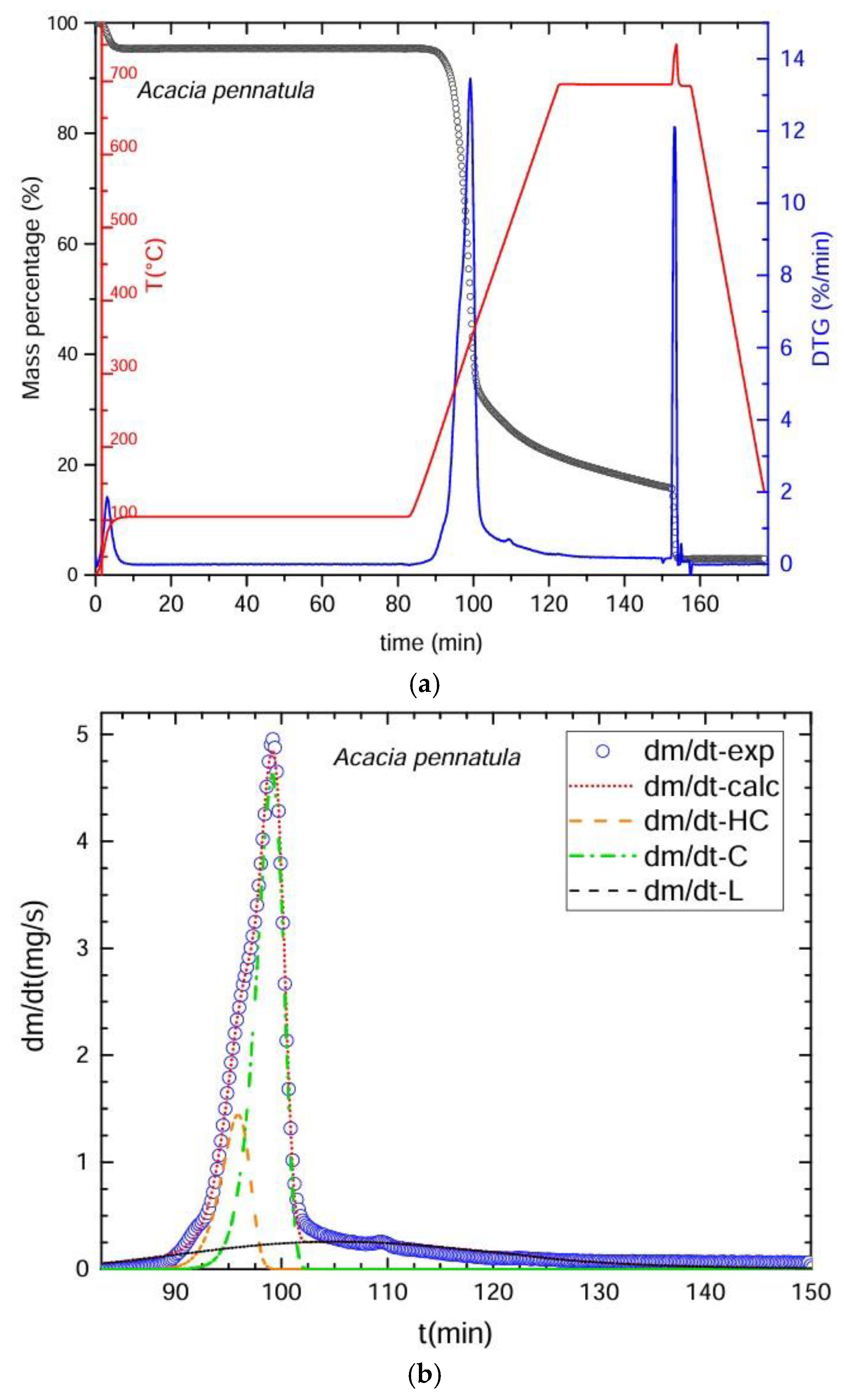
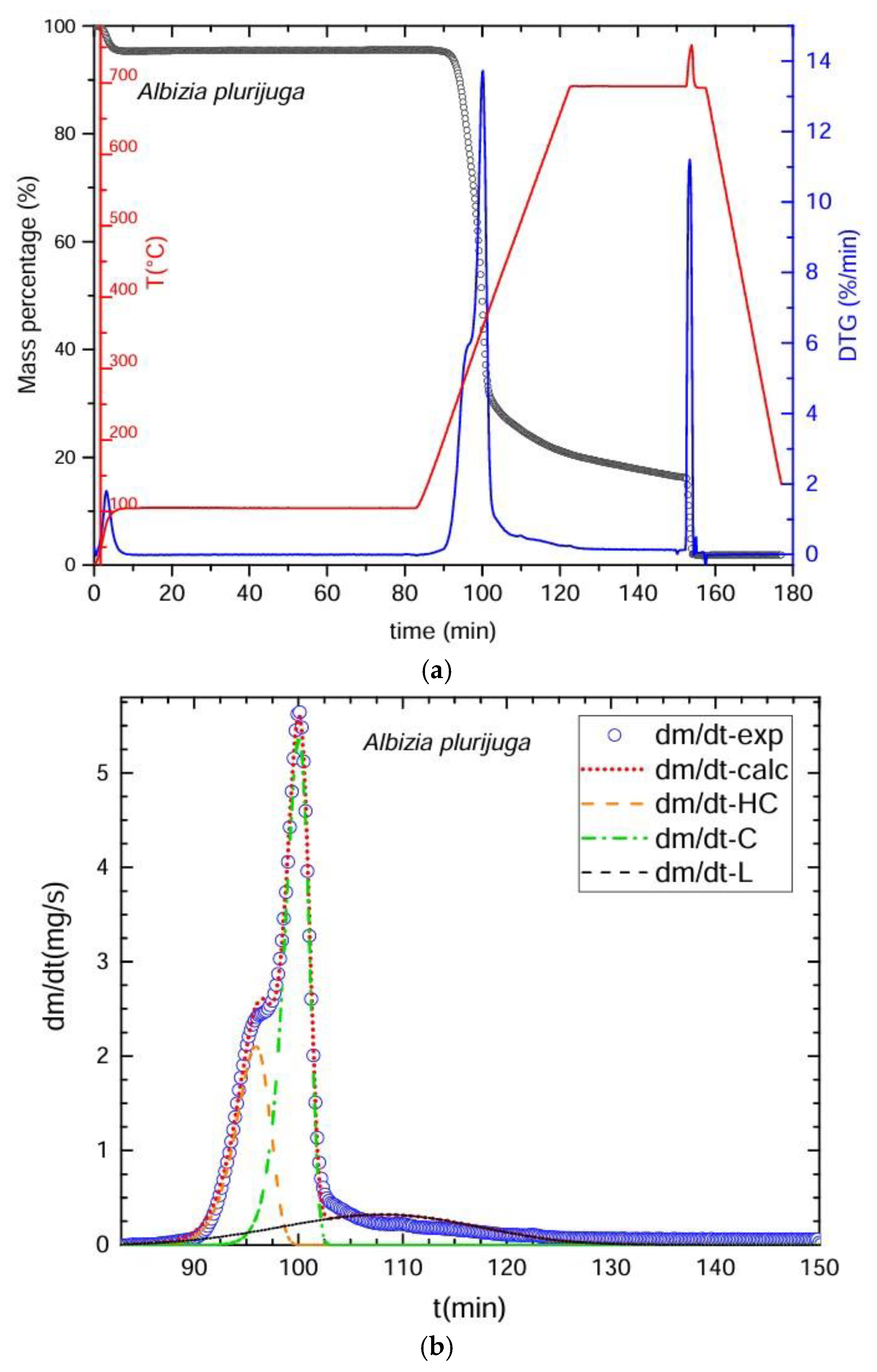
Chemical methods require diverse chemical substances. Careful handling of the residues produced during the procedure was obligatory because the filtrates from the washings, for example, can be harmful for the environment. In contrast, the TGA-DTG method provides results for both chemical components and proximate analysis with minimal amounts of chemicals and reduced fire risk [19]. One disadvantage of this approach compared to chemical methods is that it processes the material one sample at a time while the latter can analyze up to multiple samples at once, depending on equipment capacity. Regarding the primary constitution and proximal analysis of the wood of the three Fabaceae species, no statistically significant differences (p ≤ 0.05) were found between these two methods for the structural component—cellulose, lignin—or volatile material (Table 2). These components represented the largest proportion of the lignocellulosic material. The TGA-DTG approach allowed us to obtain results in less time (Table 2, Figure 1a,b, Figure 2a,b and Figure 3a,b). In addition, for the independent thermal degradation of the three main chemical components of wood (cellulose, hemicelluloses, lignin) by pyrolysis, this novel method can accurately predict the deconvolution parameters of DTG and optimize results using mathematical calculations such as multiple linear regression [10,35]. The samples of A. pennatula and A. plurijuga showed no statistical differences for hemicelluloses, extractives, or moisture (Table 2). Other reports based on these methods found no statistical differences for cellulose and extractives in the wood of Prosopis laevigata [13]. Overall, no statistically significant differences were observed (p ≤ 0.05) among the species and methods for the fractions of lignin (Table 2).
Statistically significant differences were found (p ≤ 0.05), however, for fixed carbon (Table 2). There, we explain that for the chemical methods the percentage of fixed carbon was obtained on the basis of the anhydrous weight of the ash and volatile matter compared to the thermal method, where the equation subtracted the fraction of moisture. This issue was discussed recently in other studies [13], clearly establishing that the moisture content of biomass is a key aspect that must be taken into account in all methodologies adopted due to its hygroscopic nature that—in the presence of atmospheric moisture—can vary on the same day and even at distinct hours [9]. Finally, both methodologies are limited in terms of their ability to obtain extractable substances to evaluate the bioactive compounds of plants because the thermal process degrades at low temperatures and the traditional method hydrolyzes when chemical reagents are used.
In other reports that determined the basic chemical composition of samples of A. farnesiana wood by chemical methods, we found that A. pennatula and A. plurijuga had the following proportions: cellulose = 45.58–58.83%; hemicelluloses = 12.83–20.85%; lignin = 10.60–14.30%; extractives = 13.44–17.29%; and ash = 1.07–2.89% [36]. In some cases—cellulose, extractives, and ash, for instance—results are similar to those of the present study, but for hemicelluloses and lignin distinct values were determined. For proximal analyses by the traditional method, other studies have reported the following intervals in wood from A. farnesiana, A. pennatula, and A. plurijuga: volatile material = 78.04–59% and fixed carbon = 12.32–17.44% [8,36,37]. These results are comparable to ours (Table 2).

3.2. Thermogravimetric Process

Figure 1a, Figure 2a and Figure 3a show, in black, the curves from the thermogravimetric analysis of the woods of A. farnesiana, A. pennatula and A. plurijuga where the loss of mass is represented as a function of temperature and time. By examining this process, we obtained the proximal analysis (moisture, volatile material, fixed carbon, ash). As a guide to explaining pyrolysis, we also show the heating ramp in those figures—in red—as a function of temperature and time. First, in the 0–80 min at 100 °C zone, the samples of wood lost water, a result consistent with another research [38]. Other publications report that a loss of a fraction of extractable substances (waxes, gums, terpenes, tannins, polyphenols, and carbohydrates, among others) occurs during this stage [39,40]. Returning to the description of the left side of these graphs, the blue color represents the peaks of the DTG that correspond to the moisture in the wood.
A second stage in the biomass disintegration process is presented as follows. Dehydration of the biomass was followed by the thermal decomposition of the organic components of the wood, that is, extractives, hemicelluloses, cellulose, and lignin. This process began as shown in Figure 1a, Figure 2a and Figure 3a in the time interval of 80–150 min at temperatures of 100–700 °C, the zone where fixed carbon was obtained. This second stage was marked by the greatest weight loss in the woods of A. farnesiana, A. pennatula, and A. plurijuga, a phenomenon consistent with reports which affirm that the maximum decomposition speed of wood in a nitrogen atmosphere occurs at 350–370 °C, with weight losses of up to 80%. This is related mainly to the degradation of carbohydrates: cellulose and the hemicelluloses [40,41]. Figure 1a, Figure 2a and Figure 3a also show the central signal. The largest proportion appears in blue. It is important to mention that this signal provides valuable information on the key changes that occur in biomass in relation to the reaction temperatures and decomposition speeds in a given time. On that basis, it is possible to derive the deconvolution process that we depict graphically in Figure 1b, Figure 2b and Figure 3b. Finally, on the right side of graphs Figure 1a, Figure 2a and Figure 3a, the signal of a lower proportion is visible. It expresses the combustion of the remaining organic material when oxygen was applied during pyrolysis after cooling the residue that corresponded to the ash.

3.3. Deconvolution of the DTG Curves

The deconvolution of the DTG analysis for each species is shown in Figure 1b, Figure 2b and Figure 3b. The expression dm/dt-exp relates to the thermogram obtained experimentally using the equipment; the expression dm/dt-calc relates to the thermogram calculated using the proposed logarithm. The behavior of the DTG curves (Figure 1b and Figure 2b) for the woods of these Acacias is similar in terms of deformation and height. In contrast to other studies that have utilized this method with aquatic, agricultural, and forest biomasses—including the bark and wood of conifers—our study generated peaks with distinct dimensions attributable to variations in their primary constituents [9,14]. Regarding the reaction patterns of the hemicelluloses and cellulose, Figure 1b and Figure 2b show similar peaks for the wood of these Acacias. Figure 3b, in contrast, which refers to the wood of A. plurijuga, shows a higher signal for both carbohydrates. This tendency was also found for lignin, as it presented a slightly higher signal at 110 min (Figure 3b). Reports document that because cellulose is a linear polymer with abundant glucose [42] units it requires greater activation energy and a higher reaction speed; hence, the curves it generates are more pronounced [43]. The hemicelluloses, meanwhile, require less activation energy at low temperatures, attributed principally to their amorphous structure. Because the structure of lignin contains distinct functional groups, it requires less activation energy than the carbohydrates, though its reaction speed is lower and persists across a broad temperature range. For this reason, it presents wider areas under the curves [14,44,45]. In the following paragraphs we outline the thermal properties of the primary constituents of the three woods.
Independent thermal degradation by thermogravimetry of the three primary components of wood (cellulose, hemicelluloses, lignin) can accurately predict the parameters of the deconvolution of the DTG. In addition, utilizing thermogravimetry with its derivative (DTG) based on weight loss as a function of time is highly reliable since this signal is much more sensitive to small changes [14,35]. Moreover, thermogravimetric analyses offer great precision and replicability [19].
It is important to emphasize, first, that the hemicelluloses, which are shorter molecules than cellulose and, in some cases present ramifications, are found in close association with cellulose [46]. Hemicelluloses contain five principal sugars: glucose, mannose, galactose, xylose, and arabinose [47]. Figure 1b, Figure 2b and Figure 3b show—in orange—the results for the 90–100 min time interval of the deconvolution of the derivative of the TGA of the three species of wood analyzed (A. farnesiana, A. pennatula, A. plurijuga). From earlier studies we know that hemicelluloses are non-crystalline polymers that are easily hydrolyzed. and that their thermal degradation occurs in the range of 200–300 °C [48,49,50].
Second, the most abundant structural polymers in wood correspond to cellulose, which represents approximately 50% in both broadleaf trees and conifers. Cellulose is a high molecular weight linear polymer made up exclusively of units of β-D-glucose [51]. The peaks for the woods of the three Fabaceae are shown in green in Figure 1b, Figure 2b and Figure 3b. Reports in the literature identify the following thermal properties of cellulose: crystalline regions that contribute to its rigidity and thermal stability; free hydroxyl groups present in its molecules that form intramolecular and intermolecular hydrogen bonds which foster the formation of various ordered molecular arrays; and thermal degradation that occurs between 240 and 400 °C [1,19,39,52].
Lignin is the third macromolecular component of wood. It consists of an aromatic system formed by units of phenylpropane and coumaric, coniferyl, and sinapyl alcohol [51,53]. Lignin decomposes in broader temperature ranges than the carbohydrate polymers. Figure 1b, Figure 2b and Figure 3b show this signal in black over an ample reaction time that runs from 80 to 150 min. We also found high thermal stability in the woods of these three Fabaceae, comparable to the tendency identified in the wood of Prosopis laevigata, which is also a member of this genus [13]. Other studies explain that this behavior is due to the high molecular weight and greater thermal stability that make decomposition very difficult. The thermal degradation of lignin occurs between 200 and 520 °C [19,49,50,54]. Figure 1b, Figure 2b and Figure 3b also show the experimental graph that displays—in blue—the variation in the mass of a sample as the temperature increases, and the variation —in pink—that represents the simulation of those changes. These graphs demonstrate the similarity between the experimental data and the data obtained by TGA with the deconvolution of the DTG derivatives for the woods of the three species of interest.

3.4. Higher Heating Value

Higher heating value is a key parameter of biomass that is to be used as biofuel. HHV utilizes the energy that is freed when water vapor condenses, while the lower heating value does not consider this [55]. Table 3 presents the results for HHV of the woods of these Fabaceae using a bomb calorimeter and mathematical models. As a function of these calculation methods, the chemical composition and proximal analysis of the woods of A. farnesiana and A. pennatula showed no statistically significant differences (p ≤ 0.05). The wood of A. plurijuga, specifically, did not present any statistically significant differences (p ≤ 0.05) when the bomb calorimeter was used, or as a function of the calculations of the chemical composition and the proximal analysis. These findings concur with earlier reports that utilized these methods with the wood of Prosopis laevigata [10]. It is important to mention that using the calculations as a function of the elemental analysis generated lower values for all three species, as statistically significant differences (p ≤ 0.05) emerged among the methods. This is also consistent with previous results reached when utilizing the same predictive models with distinct sources of biomass [56].
With respect to the interaction between the obtention methods and the species, we found no statistical differences (p ≤ 0.05) between A. farnesiana and A. plurijuga (Table 3). According to these results, in conditions where a bomb calorimeter is not available, the most recommendable model for calculating HHV is as a function of the proximal analysis since this provides immediate results and does not require much time or the use of chemical reagents. In this regard, the results for the HHV of the woods from these three Fabaceae using the bomb calorimeter and mathematical model based on the proximal analysis (Table 3) are within the interval of 19.17–20.3 MJ/kg cited in previous reports that used this equipment to analyze the woods of A. farnesiana, A. pennatula, and A. plurijuga [36,57].

3.5. Elemental and Inorganic Elemental Analyses

3.5.1. Elemental Analysis

Elemental analysis makes it possible to identify aspects of the quality of solid biofuels, such as the fractions of C, H, and O [58]. Some reports affirm that high concentrations of N contribute to the formation of nitrogen oxides (NOX) and that S promotes the formation of sulfur dioxide (SO2) [59]. It is also well known that these elements can damage the environment, are harmful for human health, and can deteriorate combustion equipment [60,61,62]. However, the low percentage of N in the wood of A. farnesiana, A. pennatula, and A. plurijuga documented in this study (Table 4) may have only low negative impacts when this biomass is utilized as solid biofuel, since they are below technical limits (N ≤ 0.5), according to the standard UNE-EN 14961-1 [63]. Present results are comparable to those of other works conducted with wood from species of Fabaceae: C (45.9–49.5%), H (6.7–7.3%), O (43.2–46.7%), N (0.11–0.41%), and S (0.04–0.14%) [13,36].

3.5.2. Microanalysis of Ash

Table 4 lists the 18 inorganic elements identified in the ash of the wood of A. farnesiana, A. pennatula, and A. plurijuga. The most abundant substances are K, Ca, P, Sr, Na, and Mg. The ash of woods from other Fabaceae species and other broadleaf species collected in the same zone is similarly rich in these elements [4,13,50]. International standards for solid biofuels [64] estimate the following limiting values for the woods of broadleaf species: K = 1500–500 ppm; Ca = 20,000–800; P = 200–50 ppm; and Mg = 400–100 ppm. Clearly, our results are higher than the standard values consulted. On this point, it is widely recognized that the constitution of the minerals in ash can vary due to such factors as the availability of minerals in the soil where the trees grow [65]. According to the literature consulted, the inorganic elements identified in ash can have positive or negative effects. While the elements Ca, Mg, and P may favor the use of this biomass as bioenergy by improving the fusion point of ash, retaining contaminants and reducing residues in combustion equipment [66,67], they may have negative effects on combustion processes since elements like Ca, Mg, P, K, Na, and S can cause particle emissions, slag, and corrosion. Similarly, Na, Fe, and Si can lead to incrustations and problems in the fusion of the ash [61,66,67]. For the wood characterized in this study, we found that the presence of Zn is slightly higher than the technical parameter of ≤10.0 ppm for solid biofuels (Table 4). In contrast, the proportions of Ni and Cr were both below the ≤10.0 ppm cited in the technical recommendation [63].

4. Conclusions

No statistically significant differences (p ≤ 0.05) were found between the thermogravimetric and chemical methods for the structural constituents—cellulose, lignin—or volatile material in the three species of Fabaceae. This was also true for the wood of A. pennatula and A. plurijuga for hemicelluloses, extractives, and moisture. In addition, TGA-DTG thermogravimetry made it possible to determine the chemical composition and proximal analysis in less time with minimal use of chemical reagents but with precise results. Regarding HHV, if researchers do not have access to calorimetric equipment, the model recommended for calculating this parameter is as a function of the proximal analysis since this generates immediate results, does not require much time or investment in expensive equipment, and does not occupy chemical reagents. The elemental analysis of the wood of A. farnesiana, A. pennatula, and A. plurijuga generated results below the technical limits (N ≤ 0.5) for commercialization as solid biofuels. Finally, 18 inorganic elements were found in the ash; most abundantly K, Ca, P, Sr, Na, and Mg.

Author Contributions

Conceptualization, L.F.P.-I., J.J.A.-F., J.G.R.-Q. and J.V.A.-V.; methodology, L.F.P.-I., J.J.A.-F., J.G.R.-Q. and J.V.A.-V.; software, J.J.A.-F.; validation, L.F.P.-I., J.J.A.-F., J.G.R.-Q., R.H.-B., J.V.A.-V., V.M.R.-G. and O.M.-A.; formal analysis, L.F.P.-I., J.J.A.-F., J.G.R.-Q., R.H.-B., J.V.A.-V., V.M.R.-G. and O.M.-A.; investigation, L.F.P.-I., J.J.A.-F., J.G.R.-Q., J.V.A.-V., V.M.R.-G. and O.M.-A.; writing—original draft preparation, L.F.P.-I., J.J.A.-F. and J.G.R.-Q.; writing—review and editing, L.F.P.-I. and J.J.A.-F.; visualization, R.H.-B., J.V.A.-V., V.M.R.-G. and O.M.-A.; supervision, J.J.A.-F. All authors have read and agreed to the published version of the manuscript.

Funding

This research received no external funding.

Data Availability Statement

The original contributions presented in this study are included in the article. Further inquiries can be directed to the corresponding authors.

Acknowledgments

The author Luis Fernando Pintor Ibarra thanks Secretaría de Ciencias, Humanidades, Tecnología e Innovación (SECIHTI) for the financial support provided during his studies in the Doctorado en Ciencias y Tecnología de la Madera program at the UMSNH. The authors thank the coordination of scientific research (CIC) program for supporting this research through the Universidad Michoacana de San Nicolás de Hidalgo. The authors thank the Vega-Izquierdo and Pintor-González families for donating the samples.

Conflicts of Interest

The authors declare no conflicts of interest.

References

  1. Rego, F.; Dias, A.P.S.; Casquilho, M.; Rosa, F.C.; Rodrigues, A. Fast determination of lignocellulosic composition of poplar biomass by thermogravimetry. Biomass Bioenergy 2019, 122, 375–380. [Google Scholar] [CrossRef]
  2. Aniza, R.; Chen, W.H.; Kwon, E.E.; Bach, Q.V.; Hoang, A.T. Lignocellulosic biofuel properties and reactivity analyzed by thermogravimetric analysis (TGA) toward zero carbon scheme: A critical review. Energy Convers. Manag. X 2024, 22, 100538. [Google Scholar] [CrossRef]
  3. Popp, J.; Kovács, S.; Oláh, J.; Divéki, Z.; Balázs, E. Bioeconomy: Biomass and biomass-based energy supply and demand. New Biotechnol. 2021, 60, 76–84. [Google Scholar] [CrossRef]
  4. Castillo-Tera, O.A.; López-Sosa, L.B.; Pintor-Ibarra, L.F.; Rutiaga-Quiñones, J.G.; Morales-Máximo, M. Evaluation of Bursera cuneata Schltdl. wood residues for use as densified biofuels. Results Eng. 2025, 26, 104916. [Google Scholar] [CrossRef]
  5. Rendón Correa, A.; Dorantes Hernández, F.; Mejía Valencia, S.; Alamilla Fonseca, L.N. Características Macroscópicas, Propiedades y Usos de la Madera de Especies Nativas y Exóticas de México; Comisión Nacional Para el Conocimiento y Uso de la Biodiversidad (CONABIO): Mexico City, Mexico, 2021. [Google Scholar]
  6. Rico-Arce, M.L.; Gale, S.L.; Maxted, N. A taxonomic study of Albizia (Leguminosae: Mimosoideae: Ingeae) in Mexico and Central America. An. Jard. Bot. Madr. 2008, 65, 255–305. [Google Scholar] [CrossRef]
  7. Ramírez-Casillas, R.; López-López, M.C.; Becerra-Aguilar, B.; Dávalos-Olivares, F.; Satyanarayana, K.G. Obtaining dissolving grade cellulose from the huizache (Acacia farnesiana L. Willd.) plant. BioResources 2019, 14, 3301–3318. [Google Scholar] [CrossRef]
  8. Apolinar-Hidalgo, F.; Honorato-Salazar, J.A.; Colotl-Hernández, G. Caracterización energética de la madera de Acacia pennatula Schltdl. & Cham. y Trema micrantha (L.) Blume. Rev. Mex. Cienc. For. 2017, 8, 71–82. [Google Scholar] [CrossRef]
  9. Pintor-Ibarra, L.F.; Méndez-Zetina, F.D.; Rutiaga-Quiñones, J.G.; Alvarado-Flores, J.J. Capítulo 5: Caracterización proximal de los biocombustibles sólidos. In Aplicaciones Energéticas de la Biomasa: Perspectivas para la Caracterización Local de Biocombustibles Sólidos; Universidad Intercultural Indígena de Michoacán: Pátzcuaro, Mexico, 2023; pp. 87–116. [Google Scholar]
  10. Alvarado Flores, J.J.; Alcaraz Vera, J.V.; Ávalos Rodríguez, M.L.; Rutiaga Quiñones, J.G.; Valencia Espino, J.; Guevara Martínez, S.J.; Ríos, E.T.; Zarraga Aguado, R. Kinetic, thermodynamic, FT-IR, and primary constitution analysis of Sargassum spp. from Mexico: Potential for hydrogen generation. Int. J. Hydrogen Energy 2022, 47, 30107–30127. [Google Scholar] [CrossRef]
  11. Agu, O.S.; Tabil, L.G.; Mupondwa, E.; Emadi, B.; Cree, D. Pelletization and quality evaluation of torrefied selected biomass with microwave absorber. Results Eng. 2025, 25, 104183. [Google Scholar] [CrossRef]
  12. Huang, J.; Chen, Y.; Chen, X.; Jia, D.; Evrendilek, F.; Liu, J. Pyrolytic Valorization of Polygonum multiflorum Residues: Kinetic, Thermodynamic, and Product Distribution Analyses. Processes 2025, 13, 2701. [Google Scholar] [CrossRef]
  13. Pintor-Ibarra, L.F.; Alvarado-Flores, J.J.; Rutiaga-Quiñones, J.G.; Alcaraz-Vera, J.V.; Ávalos-Rodríguez, M.L.; Moreno-Anguiano, O. Chemical and Energetic Characterization of the Wood of Prosopis laevigata: Chemical and Thermogravimetric Methods. Molecules 2024, 29, 2587. [Google Scholar] [CrossRef]
  14. Díez, D.; Urueña, A.; Piñero, R.; Barrio, A.; Tamminen, T. Determination of hemicellulose, cellulose, and lignin content in different types of biomasses by thermogravimetric analysis and pseudocomponent kinetic model (TGA-PKM method). Processes 2020, 8, 1048. [Google Scholar] [CrossRef]
  15. Espinosa-Negrín, A.M.; López-González, L.M.; Casdelo-Gutiérrez, N.L. Pretratamientos aplicados a biomasas lignocelulósicas: Una revisión de los principales métodos analíticos utilizados para su evaluación. Rev. Cuba. De Química 2022, 34, 87–110. [Google Scholar]
  16. Pettersen, R.C. The chemical composition of wood. Chem. Solid Wood 1984, 207, 57–126. [Google Scholar] [CrossRef]
  17. Moura, H.O.; Câmara, A.B.F.; Campos, L.M.A.; de Carvalho, L.S. Novel methodology for lignocellulose composition, polymorphism and crystallinity analysis via deconvolution of differential thermogravimetry data. J. Polym. Environ. 2023, 31, 1915–1924. [Google Scholar] [CrossRef]
  18. Saldarriaga, J.F.; Aguado, R.; Pablos, A.; Amutio, M.; Olazar, M.; Bilbao, J. Fast characterization of biomass fuels by thermogravimetric analysis (TGA). Fuel 2015, 140, 744–751. [Google Scholar] [CrossRef]
  19. Escalante, J.; Chen, W.H.; Tabatabaei, M.; Hoang, A.T.; Kwon, E.E.; Lin, K.Y.A.; Saravanakumar, A. Pyrolysis of lignocellulosic, algal, plastic, and other biomass wastes for biofuel production and circular bioeconomy: A review of thermogravimetric analysis (TGA) approach. Renew. Sustain. Energy Rev. 2022, 169, 112914. [Google Scholar] [CrossRef]
  20. TAPPI T264 cm-97; Preparation of Wood for Chemical Analysis. TAPPI Press: Atlanta, GA, USA, 2000.
  21. ASTM E11-20; Standard Specification for Woven Wire Test Sieve Cloth and Test Sieves. ASTM International: West Conshohocken, PA, USA, 2020.
  22. ASTM D5142-90; Standard Test Methods for Proximate Analysis of the Analysis Sample of Coal and Coke by Instrumental Procedures. West Conshohocken: PA, USA, 1998.
  23. ASTM D4442-20; Standard Test Methods for Direct Moisture Content Measurement of Wood and Wood-Based Materials. ASTM International: West Conshohocken, PA, USA, 2020.
  24. ASTM D1102-84; Standard Test Method for Ash in Wood. ASTM International: West Conshohocken, PA, USA, 2013.
  25. ASTM E872–82; Standard Test Method for Volatile Matter in the Analysis of Particulate Wood Fuels. ASTM International: West Conshohocken, PA, USA, 2013.
  26. Van Soest, P.V.; Robertson, J.B.; Lewis, B.A. Methods for dietary fiber, neutral detergent fiber, and nonstarch polysaccharides in relation to animal nutrition. J. Dairy Sci. 1991, 74, 3583–3597. [Google Scholar] [CrossRef] [PubMed]
  27. UNE-EN ISO 18125; Biocombustibles Sólidos. Determinación del Poder Calorífico. Asociación Española de Normalización y Certificación (AENOR): Madrid, Spain, 2018.
  28. White, R.H. Effect of lignin content and extractives on the higher heating value of Wood. Wood Fiber Sci. 1987, 19, 446–452. [Google Scholar]
  29. Cordero, T.; Márquez, F.; Rodríguez-Mirasol, J.; Rodríguez, J.J. Predicting heating values of lignocellulosics and carbonaceous materials from proximate analysis. Fuel 2001, 80, 1567–1571. [Google Scholar] [CrossRef]
  30. Demirbaş, A. Calculation of higher heating values of biomass fuels. Fuel 1997, 76, 431–434. [Google Scholar] [CrossRef]
  31. Rotz, L.; Giazzi, G. Characterization of Pharmaceutical Products by the Thermo Scientific FLASH 2000 Elemental Analyzer; Thermo Fischer Scientific: Milan, Italy, 2012. [Google Scholar]
  32. Ghetti, P.; Ricca, L.; Angelini, L. Thermal analysis of biomass and corresponding pyrolysis products. Fuel 1996, 75, 565–573. [Google Scholar] [CrossRef]
  33. Arcibar-Orozco, J.A.; Josue, D.B.; Ríos Hurtado, J.C.; Rangel Méndez, J.R. Influence of iron content, surface area and charge distribution in the arsenicremoval by activated carbons. Chem. Eng. J. 2014, 249, 201–209. [Google Scholar] [CrossRef]
  34. R Studio. A Language and Environment for Statistical Computing; R Foundation for Statistical Computing: Vienna, Austria, 2020. [Google Scholar]
  35. Kim, H.; Yu, S.; Kim, M.; Ryu, C. Progressive deconvolution of biomass thermogram to derive lignocellulosic composition and pyrolysis kinetics for parallel reaction model. Energy 2022, 254, 124446. [Google Scholar] [CrossRef]
  36. Salazar-Herrera, F.; Pintor-Ibarra, L.F.; Musule, R.; Nava-Berumen, C.A.; Alvarado-Flores, J.J.; González-Ortega, N.; Rutiaga-Quiñones, J.G. Chemical and energetic properties of seven species of the Fabaceae family. South-East Eur. For. 2023, 14, 215–224. [Google Scholar] [CrossRef]
  37. Ruiz-Aquino, F.; Jiménez-Mendoza, M.E.; Santiago-García, W.; Suárez-Mota, M.E.; Aquino-Vásquez, C.; Rutiaga-Quiñones, J.G. Energy properties of 22 timber species from Oaxaca, Mexico. South-East Eur. For. 2022, 13, 107–113. [Google Scholar] [CrossRef]
  38. Rani, M.S.A.; Mohammad, M.; Sua’it, M.S.; Ahmad, A.; Mohamed, N.S. Novel approach for the utilization of ionic liquid-based cellulose derivative biosourced polymer electrolytes in safe sodium-ion batteries. Polym. Bull. 2021, 78, 5355–5377. [Google Scholar] [CrossRef]
  39. Cichosz, S.; Masek, A. Thermal Behavior of Green Cellulose-Filled Thermoplastic Elastomer Polymer Blends. Molecules 2020, 25, 1279. [Google Scholar] [CrossRef]
  40. Alonso-Montemayor, F.J.; López-Badillo, C.M.; Aguilar-González, C.N.; Ávalos-Belmontes, F.; Castañeda-Facio, A.O.; Reyna-Martínez, R.; Neira-Velázquez, M.G.; Soria-Argüello, G.; Navarro-Rodríguez, D.; Delgado-Aguilar, M.; et al. Effect of cold air plasmas on the morphology and thermal stability of bleached hemp fibers. Rev. Mex. De Ing. Química 2020, 19 (Suppl. 1), 457–467. [Google Scholar] [CrossRef]
  41. Somorin, T.; Parker, A.; McAdam, E.; Williams, L.; Tyrrel, S.; Kolios, A.; Jiang, Y. Pyrolysis characteristics and kinetics of human faeces, simulant faeces and wood biomass by thermogravimetry–gas chromatography–mass spectrometry methods. Energy Rep. 2020, 6, 3230–3239. [Google Scholar] [CrossRef]
  42. French, A.D. Glucose, not cellobiose, is the repeating unit of cellulose and why that is important. Cellulose 2017, 24, 4605–4609. [Google Scholar] [CrossRef]
  43. Seshadri, V.; Westmoreland, P.R. Concerted reactions and mechanism of glucose pyrolysis and implications for cellulose kinetics. J. Phys. Chem. A 2012, 116, 11997–12013. [Google Scholar] [CrossRef]
  44. Skreiberg, A.; Skreiberg, Ø.; Sandquist, J.; Sørum, L. TGA and macro-TGA characterisation of biomass fuels and fuel mixtures. Fuel 2011, 90, 2182–2197. [Google Scholar] [CrossRef]
  45. Chen, W.H.; Wang, C.W.; Ong, H.C.; Show, P.L.; Hsieh, T.H. Torrefaction, pyrolysis and two-stage thermodegradation of hemicellulose, cellulose and lignin. Fuel 2019, 258, 116168. [Google Scholar] [CrossRef]
  46. Ebringerová, A.; Hromádková, Z.; Heinze, T. Hemicellulose. In Polysaccharides I: Structure, Characterization and Use; Springer: Berlin/Heidelberg, Germany, 2005; pp. 1–67. [Google Scholar] [CrossRef]
  47. Sjöström, E. Wood Chemistry: Fundamentals and Applications; Academic Press, Inc.: London, UK, 1981; pp. 49–66. [Google Scholar]
  48. Zhou, X.; Li, W.; Mabon, R.; Broadbelt, L.J. A critical review on hemicellulose pyrolysis. Energy Technol. 2017, 5, 52–79. [Google Scholar] [CrossRef]
  49. Nurazzi, N.; Asyraf, M.R.M.; Rayung, M.; Norrrahim, M.N.F.; Shazleen, S.S.; Rani, M.S.A.; Abdan, K. Thermogravimetric analysis properties of cellulosic natural fiber polymer composites: A review on influence of chemical treatments. Polymers 2021, 13, 2710. [Google Scholar] [CrossRef]
  50. Alvarado Flores, J.J.; Pintor Ibarra, L.F.; Mendez Zetina, F.D.; Rutiaga Quiñones, J.G.; Alcaraz Vera, J.V.; Ávalos Rodríguez, M.L. Pyrolysis and Physicochemical, Thermokinetic and Thermodynamic Analyses of Ceiba aesculifolia (Kunth) Britt and Baker Waste to Evaluate Its Bioenergy Potential. Molecules 2024, 29, 4388. [Google Scholar] [CrossRef] [PubMed]
  51. Fengel, D.; Wegener, G. Wood Chemistry, Ultrastructure, Reactions; Walter de Gruyter: Berlin, Germany, 2011; pp. 66–222. [Google Scholar]
  52. Poletto, M.; Ornaghi Junior, H.L.; Zattera, A.J. Native cellulose: Structure, characterization and thermal properties. Materials 2014, 7, 6105–6119. [Google Scholar] [CrossRef] [PubMed]
  53. Chávez-Sifontes, M.; Domine, M.E. Lignin, structure and applications: Depolymerization methods for obtaining aromatic derivatives of industrial interest. Av. En Cienc. E Ing. 2013, 4, 15–46. [Google Scholar]
  54. Brebu, M.; Vasile, C. Thermal degradation of lignin—A review. Cellul. Chem. Technol. 2010, 44, 353–363. [Google Scholar]
  55. Carrillo-Parra, A.; Bustamante-García, V.; Ngangyo-Heya, M.; Corral-Rivas, J.J. Capítulo 1. Contenido de humedad y calidad de biocombustibles sólidos. In Química de Los Materiales Lignocelulósicos y su Potencial Bioenergético; Universidad Michoacana de San Nicolas de Hidalgo: Morelia, México, 2016; pp. 12–28. [Google Scholar]
  56. Rutiaga-Quiñones, J.G.; Pintor-Ibarra, L.F.; Orihuela-Equihua, R.; González-Ortega, N.; Ramírez-Ramírez, M.A.; Carrillo-Avila, N.; Carrillo-Parra, A.; Navarrete-García, M.A.; Ruiz-Aquino, F.; Rangel-Méndez, J.R.; et al. Characterization of Mexican waste biomass relative to energy generation. BioResources 2020, 15, 8529–8553. [Google Scholar] [CrossRef]
  57. Jiménez-Mendoza, M.E.; Ruiz-Aquino, F.; Aquino-Vásquez, C.; Santiago-García, W.; Santiago-Juárez, W.; Rutiaga-Quiñones, J.G. Aprovechamiento de leña en una comunidad de la Sierra Sur de Oaxaca, México. Rev. Mex. Cienc. For. 2023, 14, 22–49. [Google Scholar] [CrossRef]
  58. Palamanit, A.; Khongphakdi, P.; Tirawanichakul, Y.; Phusunti, N. Investigation of yields and qualities of pyrolysis products obtained from oil palm biomass using an agitated bed pyrolysis reactor. Biofuel Res. J. 2019, 6, 1065–1079. [Google Scholar] [CrossRef]
  59. Ren, X.; Sun, R.; Meng, X.; Vorobiev, N.; Schiemann, M.; Levendis, Y.A. Carbon, sulfur and nitrogen oxide emissions from combustion of pulverized raw and torrefied biomass. Fuel 2017, 188, 310–323. [Google Scholar] [CrossRef]
  60. ISO 16948; Solid Biofuels—Determination of Total Content of Carbon, Hydrogen and Nitrogen. International Organization for Standardization: Geneve, Switzerland, 2015.
  61. ISO 16994; Solid Biofuels—Determination of Total Content of Sulfur and Chlorine. International Organization for Standardization: Geneve, Switzerland, 2016.
  62. Endriss, F.; Kuptz, D.; Hartmann, H.; Brauer, S.; Kirchhof, R.; Kappler, A.; Thorwarth, H. Analytical Methods for the Rapid Determination of Solid Biofuel Quality. Chem. Ing. Tech. 2023, 95, 1503–1525. [Google Scholar] [CrossRef]
  63. UNE-EN 14961-1; Especificaciones y Clases de Combustibles. Parte 1: Requisitos Generales. Asociación Española de Normalización y Certificación (AENOR): Madrid, Spain, 2011.
  64. UNE-EN ISO 17225-1; Biocombustibles Sólidos. Especificaciones y Clases de Combustibles. Parte 1: Requisitos Generales. Asociación Española de Normalización y Certificación (AENOR): Madrid, Spain, 2020.
  65. Pintor-Ibarra, L.F.; Carrillo-Parra, A.; Herrera-Bucio, R.; López-Albarrán, P.; Rutiaga-Quiñones, J.G. Physical and chemical properties of timber byproducts from Pinus leiophylla, P. montezumae and P. pseudostrobus for a bioenergetic use. Wood Res. 2017, 62, 849–861. [Google Scholar]
  66. Obernberger, I.; Thek, G. The Pellet Handbook: The Production and Thermal Utilisation of Pellets; Routledge: London, UK, 2010. [Google Scholar]
  67. ISO 16967; Biocombustibles Sólidos—Determinación de Elementos Mayoritarios—Al, Ca, Fe, Mg, P, K, Si, Na y Ti. Beuth Verlag: Berlin, Germany, 2015.
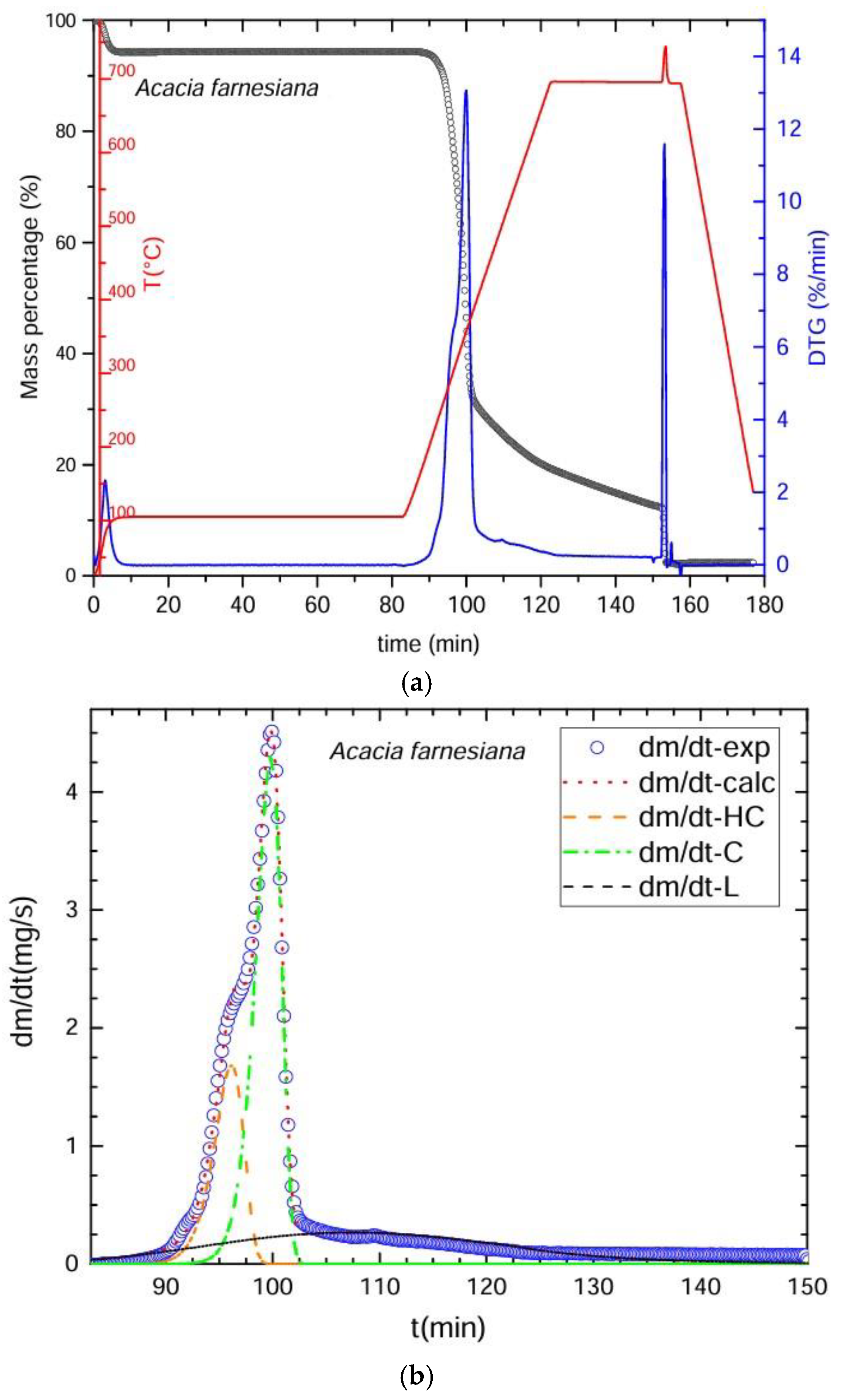
Figure 1. (a). TGA and DTG curves of A. farnesiana wood. (b). Deconvoluted DTG curve of A. farnesiana wood. Exp = experimental graphs, Calc = calculated graphs, HC = hemicellulose, C = cellulose, and L = lignin.
Processes 13 03907 g001
Figure 2. (a). TGA and DTG curves of A. pennatula wood. (b). Deconvoluted DTG curve of A. pennatula wood. Exp = experimental graphs, Calc = calculated graphs, HC = hemicellulose, C = cellulose, and L = lignin.
Processes 13 03907 g002
Figure 3. (a). TGA and DTG curves of A. plurijuga wood. (b). Deconvoluted DTG curve of A. plurijuga wood. Exp = experimental graphs, Calc = calculated graphs, HC = hemicellulose, C = cellulose, and L = lignin.
Processes 13 03907 g003
Table 1. Specifications of the TGA-DTG and chemical methods.
Thermogravimetry (TGA)Deconvolution (DTG)Chemical Method
Pyrolysis was conducted in an inert atmosphere with nitrogen gas (N2, 99.99% purity) at a flow rate of 20 mL/min. Heating and cooling speeds were 30 °C/min, divided into four stages to complete the proximal analysis.
Stage 1: began at 25–100 °C for 80 min to determine the % of moisture.
Stage 2: 100–700 °C for 30 min to obtain the amount of fixed carbon.
Stage 3: oxygen was applied for 5 min at 700 °C to eliminate organic material residues.
Stage 4: cooling from 700 to 25 °C in 20 min. The residue left represented the ash.
The % of volatile material was calculated as VM = [100 − (% moisture + % ash + % fixed carbon)].
Over 80,000 pieces of data were obtained from each sample.
Time required for the procedure: 160 min/sample.
DTG Deconvolution was used to determine the primary components: cellulose, hemicelluloses, and lignin.
The graphs of the obtained curves were plotted in the Scilab platform.
We utilized the ODE subroutine (ordinary differential equations) based on the Adams method for non-rigid ODE problems that integrates the differential equation multiple linear regressions.
To calculate the ODE function, a function containing the ordinary differential equations is constructed using arithmetic operators. This is achieved by identifying the number of variables that change over time and the corresponding rates of change that allow the calculation of the percentages of the main components of biomass, i.e., hemicellulose, cellulose, and lignin. This is usually the most complex part, because the optimization function must be constructed, i.e., ultimately ensuring that Scilab finds the best possible values for the mathematical model to predict the experimental results. To achieve this, the combination of adjustment parameters that minimizes the value of an error objective function is found, which in this case is the difference between the results calculated with the model and those measured experimentally. The evolution of the temperature over time, the conversion of each polymer, and the overall conversion will then be calculated, and from there, the change ratio predicted by the model with that combination of adjustment parameters can be calculated.
Optimization of the kinetic parameters to adjust the experimental results was carried out with the Fminsearch subroutine, based on Nelder and Mead’s algorithm.
To calculate the percentages of water, carbon, and ash, the initial mass value is considered, as well as the start and end times of the drying process. Subsequently, the start time of the pyrolysis process is considered, and commands are integrated into Scilab to calculate the percentages of water, carbon, and ash. In addition, conversion factors for mass (grams), time (seconds), and temperature (kelvin) are integrated.
The % of extractives was calculated by difference: % extractives = [100 − (% cellulose + % hemicelluloses + % lignin + % ash)].
The fiber and proximal analyses and the calculations of results were obtained based on anhydrous weight.
Neutral detergent fiber (NDF): digestion with 20 g of Na2SO3, 4 mL of α-amylase at 100 °C for 75 min, followed by washing in hot H2O and CH3CH3 with dehydration at 100 °C for 24 h.
Acid detergent fiber (ADF):
conducted with 20 g of C19H42BrN in 1 L of H2SO4 1 N for 60 min, followed by washing with hot H2O and CH3CH3 and dehydration at 100 °C for 24 h.
Insoluble lignin (IL):
digestion with H2SO4 at 72% for 90 min, then washing with hot H2O and dehydration at 100 °C for 24 h.
Equations (1)–(4) were used to calculate the percentages of extractables, hemicelluloses, lignin and fixed carbon.
Time required for the procedure = 76 h per lot of 16 samples.
Table 2. Chemical composition and proximate analysis by TGA-DTG and chemical methods of A. farnesiana, A. pennatula, and A. plurijuga woods.
MethodA. farnesianaA. pennatulaA. plurijuga
Cellulose (%)
TGA-DTG57.49 A,a (±0.51)54.19 A,b (±1.78)58.73 A,a (±0.74)
Chemical58.03 A,b (±0.68)54.96 A,c (±0.34)60.10 A,a (±0.45)
Hemicelluloses (%)
TGA-DTG11.03 B,a (±0.21)11.41 A,a (±0.54)11.15 A,a (±0.10)
Chemical11.75 A,a (±0.27)11.50 A,ab (±0.46)10.81 A,b (±0.33)
Lignin (%)
TGA-DTG18.98 A,a (±0.01)19.20 A,a (±1.49)18.06 A,a (±1.08)
Chemical19.21 A,a (±0.38)19.24 A,a (±0.65)18.16 A,a (±0.81)
Extractives (%)
TGA-DTG12.46 A,a (±0.71)15.16 A,a (±3.75)12.04 A,a (±1.39)
Chemical10.78 B,b (±0.17)13.96 A,a (±0.12)10.73 A,b (±0.29)
Ash (%)
TGA-DTG2.30 A,b (±0.01)2.90 A,a (±0.11)1.41 A,c (±0.21)
Chemical1.80 B,b (±0.01)2.57 B,a (±0.02)1.09 A,c (±0.05)
Moisture (%)
TGA-DTG5.84 A,a (±0.17)3.83 A,b (±0.91)4.11 A,b (±0.32)
Chemical5.35 B,a (±0.23)4.36 A,b (±0.17)4.50 Ab (±0.17)
Fixed carbon (%)
TGA-DTG13.43 B,ab (±0.52)12.83 B,b (±0.13)14.04 B,a (±0.13)
Chemical19.07 Aa (±0.08)18.26 A,a (±0.83)18.24 A,a (±0.25)
Volatile material (%)
TGA-DTG78.34 A,b (±0.69)80.40 A,a (±0.74)80.50 A,a (±0.79)
Chemical79.12 A,b (±0.07)79.15 A,b (±0.82)80.67 A,a (±0.25)
Identical capital letters in columns indicate no statistical difference between methods, and identical lowercase letters in rows indicate no statistical difference between species (Tukey, p = 0.05) for each response variable: cellulose, hemicellulose, lignin, extractives, ash, moisture, fixed carbon, and volatile material.
Table 3. Higher heating value of A. farnesiana, A. pennatula, and A. plurijuga wood.
Calorific Value (MJ/kg)A. farnesianaA. pennatulaA. plurijuga
Bomb calorimeter19.40 B,a (±0.42)18.49 B,b (±0.24)19.61 A,a (±0.27)
Chemical composition20.04 A,b (±0.04)20.25 A,a (±0.05)19.96 A,b (±0.05)
Proximal analysis20.26 A,a (±0.01)19.98 A,b (±0.15)20.24 A,a (±0.04)
Elementary analysis18.00 C,a (±0.08)16.87 C,a (±0.39)17.75 B,a (±0.82)
Identical capital letters in a column indicate that there is no statistical difference, and identical lowercase letters in a row indicate that there is no statistical difference. (Tukey, p = 0.05).
Table 4. Organic and inorganic elements of A. farnesiana, A. pennatula, and A. plurijuga wood.
ElementA. farnesianaA. pennatulaA. plurijuga
C46.65 (±0.21)43.76 (±0.18)45.78 (±1.0)
H6.70 (±0.14)6.89 (±0.29)6.95 (±0.34)
Elementary analysis (%)O46.06 (±0.24)48.95 (±0.32)46.97 (±1.20)
N0.42 (±0.14)0.31 (±0.14)0.21 (±0.09)
S0.11 (±0.02)0.07 (±0.006)0.06 (±0.007)
Ash microanalysis (ppm)K105,019.30150,391.90150,536.02
Ca102,885.9673,275.93101,960.59
P9238.776424.634400.24
Sr3069.602362.513245.48
Na2449.931390.548202.02
Mg1140.72578.961436.26
S2017.05836.61966.02
Ba280.89160.12105.75
Li122.1963.18155.30
Fe112.84103.61195.65
B86.4043.02240.56
Si52.4825.80158.15
Al41.4728.7972.82
Cu41.7126.5841.57
Mn24.8219.4120.91
Zn15.1313.3114.34
Ni1.055.47˂0.05
Cr˂0.050.54˂0.05
Disclaimer/Publisher’s Note: The statements, opinions and data contained in all publications are solely those of the individual author(s) and contributor(s) and not of MDPI and/or the editor(s). MDPI and/or the editor(s) disclaim responsibility for any injury to people or property resulting from any ideas, methods, instructions or products referred to in the content.