



Active/Bioactive Ingredient-Based Nanomedicines: From Design to In Vitro Evaluation in Advanced 2D/3D Disease Models
A special issue of Processes (ISSN 2227-9717). This special issue belongs to the section "Pharmaceutical Processes".
Deadline for manuscript submissions: 30 January 2027 | Viewed by 765
Special Issue Editors

Interests: nanomedicine; lipid nanocarriers; bioactive compounds; antioxidant; anti-inflammatory; drug delivery; physicochemical characterization; cellular model

Interests: Inflammatory bowel diseases; psoriasis; ether lipids; archaeal lipids; green extraction techniques
Special Issue Information
Dear Colleagues,
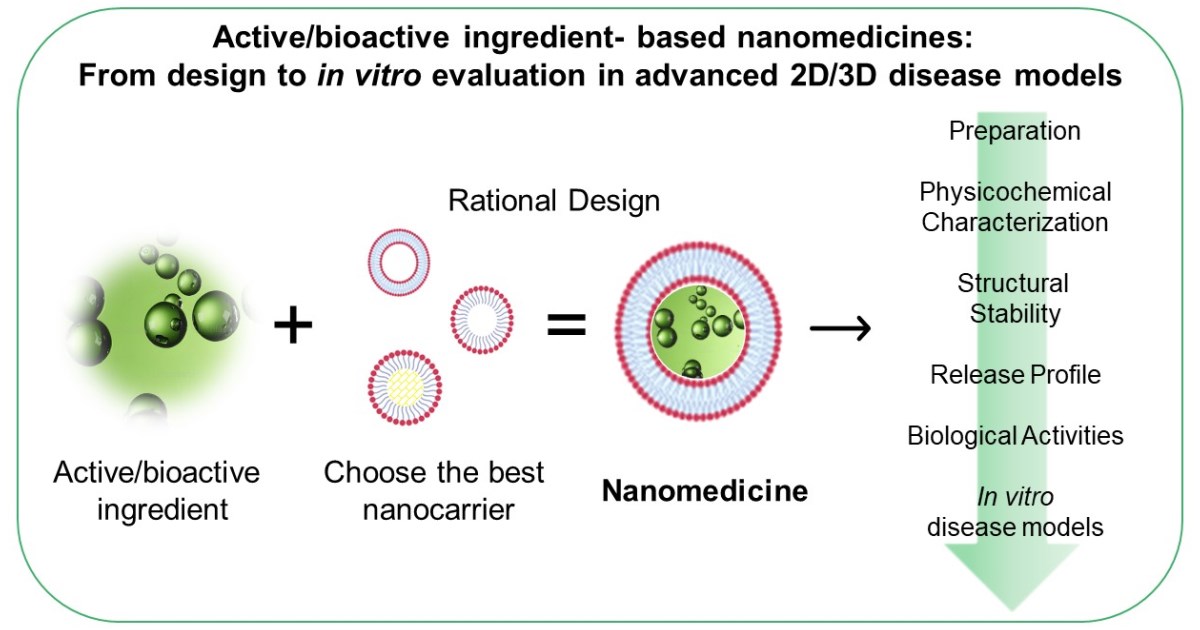
The rapid evolution of nanotechnology has opened new avenues for the precise delivery, protection, and controlled release of active and bioactive ingredients. Nanomedicine employs nanocarriers such as liposomes, polymer and lipid-based nanoparticles to deliver conventional drugs and natural bioactive compounds with diverse biological activities. Nanoencapsulation has improved pharmacokinetics, enhanced bioavailability, enabled targeted action, and reduced off-target toxicity. In addition, metallic and metal oxide nanoparticles may exhibit intrinsic biological activities, thereby contributing directly to therapeutic effects. Furthermore, green or sustainable synthesis approaches offer added value by providing safer and more environmentally responsible methods throughout the production process. At the same time, advances in the development of cellular models of disease, including spheroids, organoids, tissue-mimetic scaffolds, and microfluidic systems, have created new opportunities to better understand the interactions between nanocarriers and biological systems, thereby improving the predictive power of preclinical assessments.
This Special Issue highlights recent progress in the design, development, structural characterization and biological assessment of nanomedicines formulated with therapeutic active molecules, natural bioactives, peptides, proteins, or nucleic acids.
We welcome studies exploring innovative nanomedicine, improved formulations of active or bioactive compounds, metallic and metal oxide nanoparticles with intrinsic biological activities, green synthesis strategies, physicochemical characterization and release profiles; functionalization strategies for targeting or enhanced therapeutic action, in vitro assessment using 2D/3D cell culture systems and disease-mimicking platforms; mechanistic insights into nanocarrier–cell/microenvironment interactions; and applications in oncology, dermatology, infectious diseases, neurodegeneration, tissue regeneration, or other relevant fields.
By bringing together multidisciplinary contributions, this Special Issue seeks to provide a comprehensive overview of current trends and emerging strategies in nanomedicine research through research articles, reviews, and short communications.
Dr. Leticia Herminia Higa
Dr. María José Morilla
Guest Editors
Manuscript Submission Information
Manuscripts should be submitted online at www.mdpi.com by registering and logging in to this website. Once you are registered, click here to go to the submission form. Manuscripts can be submitted until the deadline. All submissions that pass pre-check are peer-reviewed. Accepted papers will be published continuously in the journal (as soon as accepted) and will be listed together on the special issue website. Research articles, review articles as well as short communications are invited. For planned papers, a title and short abstract (about 250 words) can be sent to the Editorial Office for assessment.
Submitted manuscripts should not have been published previously, nor be under consideration for publication elsewhere (except conference proceedings papers). All manuscripts are thoroughly refereed through a single-blind peer-review process. A guide for authors and other relevant information for submission of manuscripts is available on the Instructions for Authors page. Processes is an international peer-reviewed open access semimonthly journal published by MDPI.
Please visit the Instructions for Authors page before submitting a manuscript. The Article Processing Charge (APC) for publication in this open access journal is 2400 CHF (Swiss Francs). Submitted papers should be well formatted and use good English. Authors may use MDPI's English editing service prior to publication or during author revisions.
Keywords
- nanomedicine
- nanocarrier
- active ingredient
- bioactive ingredient
- metallic nanoparticle
- in vitro disease models
- spheroids
- organoids
- microfluidic systems
Benefits of Publishing in a Special Issue
- Ease of navigation: Grouping papers by topic helps scholars navigate broad scope journals more efficiently.
- Greater discoverability: Special Issues support the reach and impact of scientific research. Articles in Special Issues are more discoverable and cited more frequently.
- Expansion of research network: Special Issues facilitate connections among authors, fostering scientific collaborations.
- External promotion: Articles in Special Issues are often promoted through the journal's social media, increasing their visibility.
- Reprint: MDPI Books provides the opportunity to republish successful Special Issues in book format, both online and in print.
Further information on MDPI's Special Issue policies can be found here.
