




Aquatic Pathogens and Host Immune Responses

A special issue of Pathogens (ISSN 2076-0817). This special issue belongs to the section "Immunological Responses and Immune Defense Mechanisms".

Deadline for manuscript submissions: 30 September 2026 | Viewed by 3860
Editor


E-Mail Website
Guest Editor
Immunology and Genomics Group, Institute of Marine Research, Eduardo Cabello 6, 36208 Vigo, Spain
Interests: aquaculture; fish; immunology; diseases; disease resistance
Special Issues, Collections and Topics in MDPI journals

Special Issue Information

Dear Colleagues,

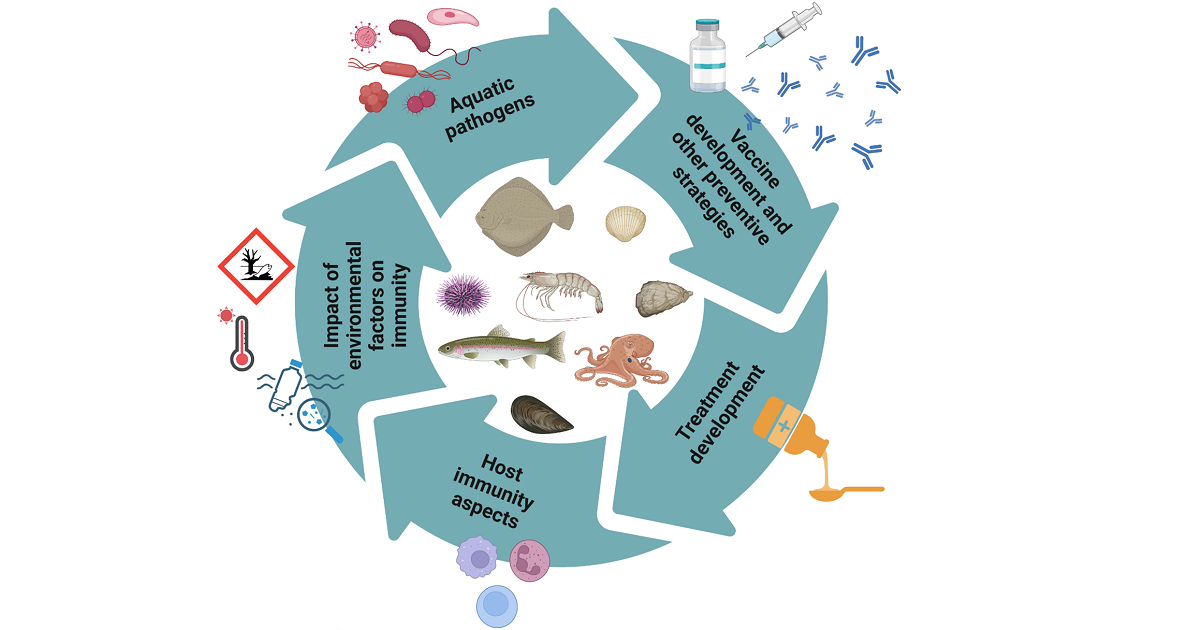
The aquaculture sector has seen a significant rise in importance in recent years, becoming a cornerstone for meeting the ever-growing global demand for fish and shellfish. Despite the successful establishment of certain farming practices, the industry still faces several formidable challenges, particularly in the area of disease prevention and control, where infectious diseases continue to cause substantial economic losses. The sector grapples with the emergence of novel diseases and variants, the lack of optimal vaccines for specific pathogens, the absence of approved antiviral treatments for use in aquaculture, the toxicity of certain antiparasitic agents, and the ongoing concerns related to antibiotic use. Furthermore, as new species are introduced into farming systems, there is an increasing necessity to develop innovative strategies for managing infectious diseases. These issues highlight the critical need for continued research in the fields of microbiology, pathology, and immunology as applied to aquatic organisms of both marine and freshwater environments. Additionally, the impact that certain environmental factors, such as microplastic pollution, water warming, or eutrophication, can have on the immune system of organisms is also of vital importance to the sector. In light of these challenges, we invite manuscripts that address any of these key aspects, applicable to both marine and freshwater organisms, for this Pathogens Special Issue. We welcome studies in the form of original research articles, reviews, or case reports.

Dr. Patricia Pereiro
Guest Editor

Manuscript Submission Information

Manuscripts should be submitted online at www.mdpi.com by registering and logging in to this website. Once you are registered, click here to go to the submission form. Manuscripts can be submitted until the deadline. All submissions that pass pre-check are peer-reviewed. Accepted papers will be published continuously in the journal (as soon as accepted) and will be listed together on the special issue website. Research articles, review articles as well as short communications are invited. For planned papers, a title and short abstract (about 250 words) can be sent to the Editorial Office for assessment.

Submitted manuscripts should not have been published previously, nor be under consideration for publication elsewhere (except conference proceedings papers). All manuscripts are thoroughly refereed through a single-anonymized peer-review process. A guide for authors and other relevant information for submission of manuscripts is available on the Instructions for Authors page. Pathogens is an international peer-reviewed open access monthly journal published by MDPI.

Please visit the Instructions for Authors page before submitting a manuscript. The Article Processing Charge (APC) for publication in this open access journal is 2400 CHF (Swiss Francs). Submitted papers should be well formatted and use good English. Authors may use MDPI's English editing service prior to publication or during author revisions.

Keywords

  • aquaculture
  • diseases
  • immunity
  • vaccines
  • treatments

Benefits of Publishing in a Special Issue

  • Ease of navigation: Grouping papers by topic helps scholars navigate broad scope journals more efficiently.
  • Greater discoverability: Special Issues support the reach and impact of scientific research. Articles in Special Issues are more discoverable and cited more frequently.
  • Expansion of research network: Special Issues facilitate connections among authors, fostering scientific collaborations.
  • External promotion: Articles in Special Issues are often promoted through the journal's social media, increasing their visibility.
  • Reprint: MDPI Books provides the opportunity to republish successful Special Issues in book format, both online and in print.

Further information on MDPI's Special Issue policies can be found here.

Published Papers (3 papers)

Order results
Result details
Select all
Export citation of selected articles as:

Research

Jump to: Review

16 pages, 2129 KB  
Article
Aeromonas piscicola in Chilean Salmon Farming: Genomic Insights, Phenotypic Traits, Virulence and Field Immune Response
by Marcos Mancilla, Adriana Ojeda, Yassef Yuivar, Maritza Grandón, Sebastián Valderrama, Marcela Oyarzún, Horst Grothusen, Pablo Ibarra and Patricio Bustos
Pathogens 2026, 15(4), 402; https://doi.org/10.3390/pathogens15040402 - 8 Apr 2026
Viewed by 960
Abstract
The incidence of furunculosis in juvenile Atlantic salmon, Salmo salar, has increased in recent years in Chile, with isolates of Aeromonas salmonicida being the primary cause. However, in some cases, molecular diagnostics failed to identify the etiological agent. We previously demonstrated that [...] Read more.
The incidence of furunculosis in juvenile Atlantic salmon, Salmo salar, has increased in recent years in Chile, with isolates of Aeromonas salmonicida being the primary cause. However, in some cases, molecular diagnostics failed to identify the etiological agent. We previously demonstrated that a proportion of undiagnosed cases was produced by a new A. salmonicida strain. In those cases where the pathogen remained unidentified, we isolated colonies with an A. salmonicida-like appearance. Subsequent phylogenetic analysis presented in this work grouped those A. salmonicida-like isolates within the Aeromonas piscicola clade. Whole genome sequencing confirmed the taxonomic affiliation, giving additional insights into virulence and antibiotic resistance markers. Indeed, one of the strains showed reduced susceptibility to oxytetracycline. Virulence potential was assessed by in vivo testing in S. salar, which resulted in disease with pathognomonic signs of furunculosis. Although the pathogen presents common antigens with A. salmonicida, the current vaccine triggered only a modest IgM response against A. piscicola in the field. Our results support the hypothesis that the increasing incidence of furunculosis in Chile cannot solely be ascribed to the emergence of the new less-virulent A. salmonicida strain, but may partially result from furunculosis-like infections caused by A. piscicola strains which exhibit a comparable virulence level. Full article
(This article belongs to the Special Issue Aquatic Pathogens and Host Immune Responses)
Show Figures

Figure 1

24 pages, 4265 KB  
Article
Prevalence and Intensity of Perkinsus sp. Infection in Mizuhopecten yessoensis and Its Impact on the Immune Status of Bivalves
by Elizaveta Tsoy, Ayna Tumas, Mariia Mokrina, Andrei Grinchenko, Vadim Kumeiko, Daria Lanskikh and Yulia Sokolnikova
Pathogens 2025, 14(12), 1303; https://doi.org/10.3390/pathogens14121303 - 18 Dec 2025
Cited by 1 | Viewed by 889
Abstract
Despite the economic importance of Mizuhopecten yessoensis, little is known about their parasites and immunity. This study, the first to examine the prevalence and intensity of Perkinsus across three age groups of scallops from four locations in the Sea of Japan, revealed [...] Read more.
Despite the economic importance of Mizuhopecten yessoensis, little is known about their parasites and immunity. This study, the first to examine the prevalence and intensity of Perkinsus across three age groups of scallops from four locations in the Sea of Japan, revealed that the gills, mantle, and digestive glands of one-year-old specimens from mariculture farms are heavily colonized. The cases of infection were notably higher in older specimens (mostly hemolymph and shell), suggesting that they act as carriers of Perkinsus. An immunological analysis indicated that when the pathogen is found only in the hemolymph and mantle, there is an increase in plasma protein concentrations, which likely plays a crucial role in resisting infection. However, when hypnospores were present in the mantle and gills, a decrease in reactive oxygen species and granulocytes occurred, accompanied by an increase in hemoblasts and agranulocytes. Phagocytic activity increased only when the pathogen appeared in the digestive gland. This evidence highlights the heightened vulnerability of young scallops, emphasizing the necessity for preventive measures against infection. The current troubling epidemiological situation regarding scallop diseases in the region suggests a rise in epizootics, raising doubts about the sustainability of the scallop farming industry unless timely interventions are implemented. Full article
(This article belongs to the Special Issue Aquatic Pathogens and Host Immune Responses)
Show Figures

Figure 1

Review

Jump to: Research

54 pages, 1502 KB  
Review
Rethinking Disease Control in Aquaculture Invertebrates: Harnessing Innate Immunity in Molluscs and Crustaceans
by Danielle Ackerly, Jacinta Agius, Darcy Beveridge, Karla Helbig and Travis Beddoe
Pathogens 2026, 15(2), 168; https://doi.org/10.3390/pathogens15020168 - 4 Feb 2026
Viewed by 1487
Abstract
Aquaculture of molluscs and crustaceans represents an important and expanding sector within global food production. The intensification of these systems has been accompanied by an increased prevalence and severity of infectious diseases, which continue to constrain productivity and sustainability. Current disease management approaches [...] Read more.
Aquaculture of molluscs and crustaceans represents an important and expanding sector within global food production. The intensification of these systems has been accompanied by an increased prevalence and severity of infectious diseases, which continue to constrain productivity and sustainability. Current disease management approaches include biosecurity measures, husbandry practices, therapeutics, and selective breeding, which have shown limited efficacy against many emerging pathogens affecting invertebrate species. Unlike finfish, aquatic invertebrates lack adaptive immunity and rely exclusively on innate immune mechanisms, limiting the effectiveness of traditional vaccine strategies. There is growing interest in immunostimulants that enhance innate defenses and support immune priming or trans-generational immune priming (TGIP). This review summarises the current understanding of immune defence mechanisms in molluscs and crustaceans and examines recent progress in the development of immunomodulators and prophylactic interventions aimed at improving health outcomes and disease resilience in invertebrate aquaculture. Full article
(This article belongs to the Special Issue Aquatic Pathogens and Host Immune Responses)
Show Figures

Figure 1

Back to TopTop